
Pantheon
At a glance
Rules, cards and Q&A (Chinese)
The rules, card data and player questions for this game are written in Chinese. Open the Chinese page to read them.
Where to find full rules
Full rules and card lookup are available in the cunlema app at cunlema.cn — pick this game and ask about any rule, card or turn you are unsure about.
Related games
Rulebook text (Markdown)
This game has 1 rulebook Markdown file(s) in our library; 1 rendered inline below — expand to read or download.
Pantheon_Rules_v2.05.md35.2 KB
PANTHEON
VÖLKER,
GÖTTER,
MONUMENTE!


Game Setup:
Component list:
1 board
48 columns in 4 player colors
48 feet in 4 player colors 4 point markers in 4 player colors
1 big foot
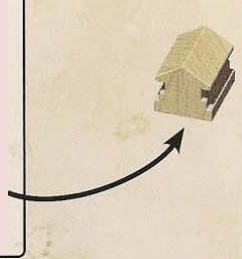
1 temple
8 round nation tiles
32 square sacrifice tiles
40 hex-shaped loot tiles
40 rectangular gods tiles
21 round half god tiles
4 square 50/100 points counter
6 square bonus tiles
75 action cards (16
movement, 44 sacrifice, 15 1-money)
7 special money cards (2x2- money, 2x3-money, 2x4- money, 1x5-money)

8 nation cards
Step 1: Lay out the board. The big foot and the 50/100 points counters are placed next to the board. The 48 columns and 48 feet in player colors form the general reserve and are placed next to the board. Shuffle the 6 bonus tiles and place them in a face down stack next to the board.
1 bag
4 reference cards
großer Fuß

allgemeiner Vorrat
Step 11: If one of the players is a half god, this player will be the starting player. In the unlikely case there are more than one or no half gods present, the youngest player will be the starting player. He takes the temple and starts the game.
Step 10: Each player gets in his player color: 1 point marker and put it on 0 field of the victory point track.
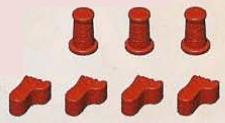
3 columns and 4 feet, forming his personal reserve
Additionally receive:
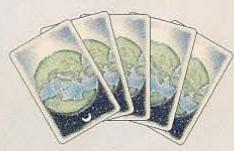
5 cards from the face down draw pile.
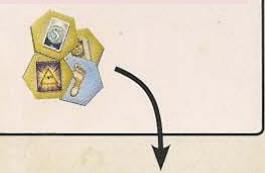
1 bonus tile from the face down stack
1 reference card

Step 2: Put the 40 hex-shaped loot tiles in the bag next to the board.

Bonusplättchen
今 A 会
Beispiel:
Opfer

Geld

Opfer
Step 3: Shuffle the 40 Gods tiles and place them in a face down stack next to the board.
Step 4: The 21 Half God tiles are sorted into 2 groups. First, shuffle the 4, 5, 6 tiles together and place in a face down stack next to the board. Then shuffle the 1, 2, 3 tiles together and place them in a face down stack on top of the first

4-6 unten

1-3 oben

Achtung! Wichtige Unterscheidung: Gottheiten Halbgötter
Epochenanzeiger

Gaben
Priester
Tänzer

Tempel
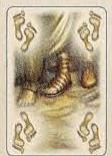
Bewegung
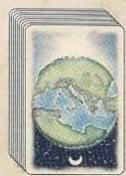
Step 9: Shuffle the 75 action cards
(movement, sacrifice, 1-money) and place them in a draw pile face down next to the board. Turn up 4 cards and place them face up next to the draw pile forming the card display. Leave room for a card discard pile.
2-4 Spieler ab 10 Jahren 60–90 Minuten
Step 5: Place the 8 round nation tiles face up next to the board.
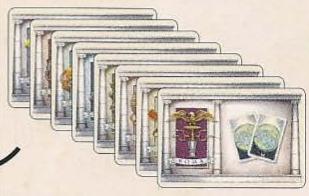
Step 6: Shuffle the 8 nation cards and place them face down next to nation tiles.
Step 7: Sort the 32 sacrifice tiles in to 1/2 and 3/4 groups of each kind (offerings, priests, dancers, temples) and place them next to the board.
Step 8: Sort the 7 money cards worth 2 – 5 in ascending order and place them next to the board. These form the specialty money card stack.

Goal of the Game:
The players score Victory Points by collecting the favors of gods and half gods of the Pantheon and building Columns (why build monuments when nothing more than columns will stand the test of time?). The player with the most Victory Points wins the game.
Flow of the Game:
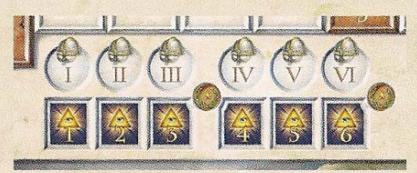
The game is played over 6 Epochs. In each Epoch, one nation will be played. Each Epoch consists of three phases:
-
Preparation Phase – Rise of the Nation
-
Turn Phase – Height of the Nation
-
End of Epoch Phase – Decline of the Nation
1. Preparation Phase – Rise of the Nation:
• The starting player turns the top face down nation card face up and activates the nation.
• He puts the corresponding nation tile on the leftmost free place on the Epoch meter.
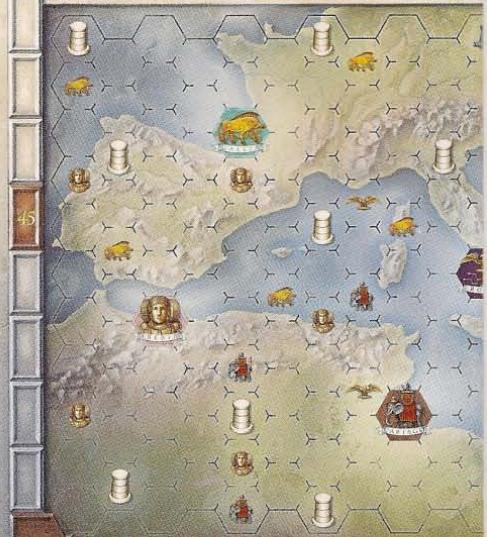
• From the face down Gods tile pile he draws and turns up Gods tiles equal to 1 more than the number of players, and places them on the board.
• Another player draws loot tiles from the bag equal to 1 more than the number of players. He places them randomly on the board on the hexes with the symbol of the active nation (each nation has 5 hexes).
o With 2 players, don’t use the hexes with numbers 3 and 4 on them.
o With 3 players, don’t use the hex with the number 4 on it.
• Each nation has one characteristic trait, execute it now.
• Put the temple on the starting hex of the active nation.
• If it is the first Epoch phase, players use their bonus tiles in player order.
• These preparations take place at the start of each Epoch.
(The nation characteristic traits and the loot and bonus tiles are explained in detail on pages 15 - 18. The benefits of the Gods tiles are explained on pages 18 - 23.)
Variant: Instead of giving out the bonus tiles at random, players can decide to choose between them. This is done at the end of the first Preparation Phase. The bonus tiles are placed face up instead of face down. In reverse player order, beginning with the player who goes last and then counter-clockwise, each player take one bonus tile.
Example: Preparation Phase in a 3-person-game:


1.The starting player turns the nation card “Gallia” face up.
2.He takes the nation tile “Gallia” and puts it on the Epoch 1 space.
3.He turns 4 Gods tiles (3 players + 1) face up and places them face up on the board.
4.Another player draws 4 loot tiles (3 players + 1) from the bag and places them on the hexes with the “Gallia” symbol. The hex with the number 4 is not used in a 3 player game.
5.Now the characteristic trait of the nation is executed.
6.As the last item, the starting player puts the temple on the starting hex of “Gallia”.
Clarification: The bonus tiles take effect at the end of the first Preparation Phase after setting up the first nation is finished.
See the diagram on the previous two pages for guidance on setting up the game.
2. Turn Phase – Height of the Nation:
Beginning with the starting player each player now takes a turn in clockwise order. On his turn, each player must take one of the following actions:
I. The player makes a movement – MOVEMENT ACTION or
II. The player buys something – BUYING ACTION or
III. The player gains 1 gods tile – GAINING GODS ACTION or
IV. The player draws 3 cards – DRAWING ACTION
When a player has completed one of these actions, his turn ends and the next player starts his turn by taking an action.
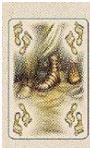
I. Movement Action: The player makes a movement
- The player who chooses this action takes the big foot. This gives him 1 step.
- The player plays movement cards. Each movement card gives him 2 steps.
- He may now take steps up to the total sum of the steps played.
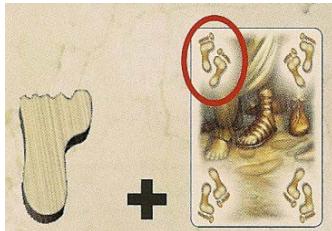
Example: It is Red’s turn. He takes the big foot. He plays 1 move card. He may execute a total of 3 steps.
Taking the movement action:
• For each step a player has, he may place a foot or a column on the board.
• Feet or columns must be taken from the player’s personal reserve.
• Feet may be placed on any hex (including water hexes), but not on column hexes.
• Columns may only be placed on column hexes.
• The player must place his first foot next to the temple or next to one of his own feet or columns pieces on the board.
• Columns must always be placed next to his own feet. All feet and columns a
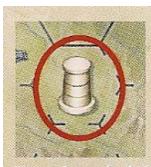
player places must be connected to the temple.
Example: It is Red’s turn. He has 3 steps to do. He places the first foot next to the temple and the second foot next to the first one. Then he places a column on the column hex next to the second foot. Now he has used all 3 of his steps.

• If a player places a foot on a hex with a loot tile, he takes the loot tile.
• If a player places a foot or a column on a hex already containing a foot or column of another player, it costs 1 additional step.
• Only 2 feet or columns may be placed on each hex and they must belong to different players.
• To finish his movement action, the player places the movement cards he played on the discard pile and gets any loot tile bonuses now. The player’s movement action ends, but not is turn!
• After the player has finished his movement action, all other players also get a movement action. They play movement cards but don’t get the bonus step from the big foot.

Example: Red has chosen the Movement Action. After he has ended his movement, Green plays one movement card and

places 2 feet. Now it’s Yellow’s turn. He plays 3 movement cards, meaning he can take up to 6 steps. He places 2 feet from the temple, then a column, costing 2 steps, because there is already another column in the same hex. Then he places 1 foot on the loot tile and takes it. He does not use his sixth step. Then he gets the bonus of the loot tile.
Sacrifice tiles:
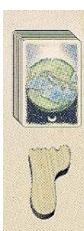
• If a player cannot or chooses not to do a movement action, he draws a card from the draw pile.
• When all players have finished their movement or drawn a card, the player places the big foot back on the board. Only now does his turn end and the next player in clockwise order takes his turn by choosing another action.
Other examples for movement are starting from the temple, branching off with his route or extending his route on different ends.
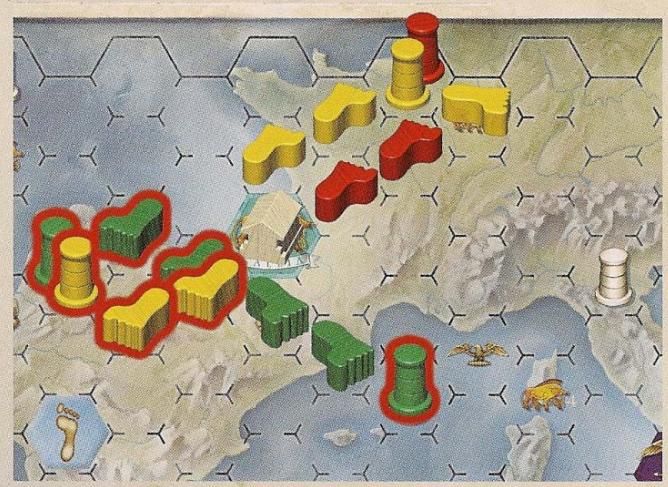
Example: Green chooses the movement action. He takes the big foot and plays two movement cards. He may take up to 5 steps. He places 1 column next to the foot, on the board from a former movement action. Then he places 2 feet and 1 column left from the temple. That costs him only 4 steps, because the yellow pieces shown are not on the board yet.
Now it’s Yellow turn. He plays 3 movement cards and can take up to 6 steps. He places 2 feet and 1 column from the temple, as shown on the left. This costs him 5 steps, because the green foot and the green column already there.
Red only has 1 movement card on hand. He can’t reach a column or loot hex. He decides to not take a movement and draws a card instead.
The columns stay on the board for the entire game (see End of Epoch, page 14). Players may add columns from earlier epochs to their routes. But to do this, the column must be connected with the new temple.
Example: Yellow chooses the movement action. He plays 2 movement cards plus the big foot giving him up to 5 steps.
He places 2 feet from the temple and connects the column from an earlier Epoch with the new temple. Now he can use this column in his route, placing 2 more feet and 1 column behind it (newly placed feet and columns are red bordered).

II. Buying Action: The player buys something
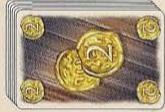
To buy something, the player plays money cards. With money cards he may make one or more purchases (more than one of the same item is possible):

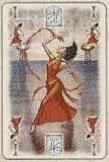
• The player buys a sacrifice tile. There are 4 different types of sacrifice tiles. The player may only have one tile of each type. Each sacrifice tile is available in levels 1 through 4. The price of the tile is shown on the bottom right corner of the tile.
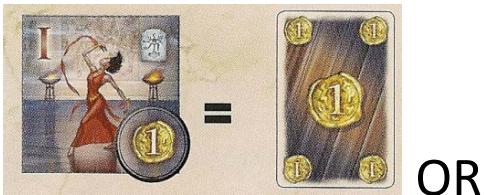
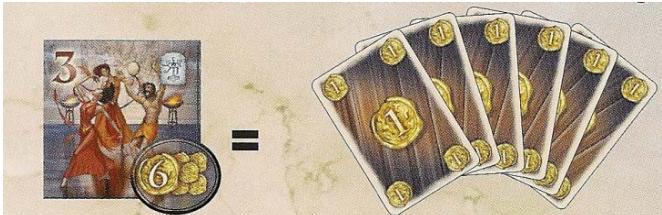
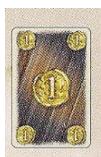
Example: The player buys the level 1 dancer tile costing him 1 money or he buys the level 3 dancer tile costing him 6 money.
• The player may upgrade one of his sacrifice tiles. If he upgrades a level 1 to a 2, or a 3 to 4, he just flips the tile. In all other cases, he puts the tile back into the box and takes the tile with the higher level. The cost of the upgrade is the difference between the prices on the tiles.
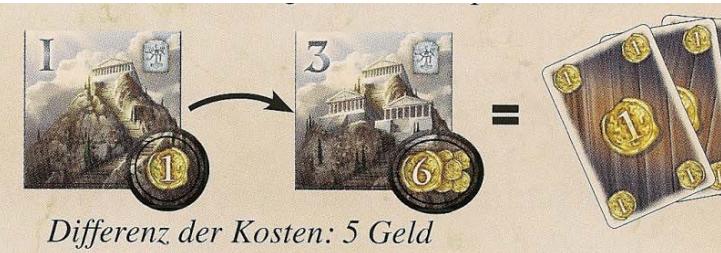
Example: The player already owns a level 1 temple tile and wants to upgrade it to a level 3 tile. He pays 5 money (6-1=5), puts the level 1 tile back in the box and takes the level 3 tile.
• The player may buy feet and columns in his color from the general reserve and place them in his personal reserve. Foot and column pieces cost 1 money each.
• The player may also place feet and columns from his personal reserve on the board, including just purchased feet and columns. Placing a foot or column costs 1 money, or 2 money if the hex is already occupied. The placement works just like movement, only that money cards are used and not movement cards. The differences from the movement action are:
o The big foot is not used.
o The other players are not allowed to get a free movement action or card draw.
• After buying, the player puts all his spent money cards on the discard pile.
• There is no change given for purchases.
Example of a purchase:
Green plays these money cards with a total value of 8 money to spend.
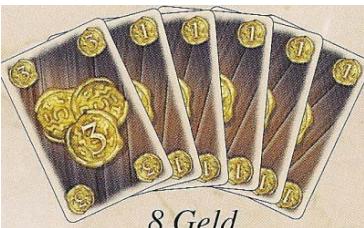
He buys a level 1 dancer and level 2 priest sacrifice tiles for 4 money.

He buys 1 foot and one column piece from the general reserve and places them in his personal reserve for 2 money.
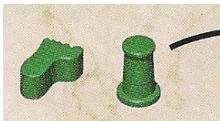
He places the column immediately on the column hex, already containing the yellow column for 2 money (all other feet and the column on the picture above where placed on the board earlier). Now he puts the played money cards on the discard pile.

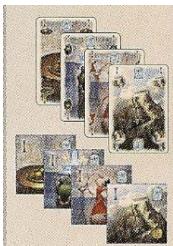
III. Gaining Gods Action: The player gains 1 Gods tile
The player may gain one Gods tile from the face up tiles on the board. To do so, he must make a sacrifice.
• Making a sacrifice means that the player has to use sacrifice cards and/or sacrifice tiles.
• There are sacrifice cards and sacrifice tiles of the same types:

How does this work in detail?
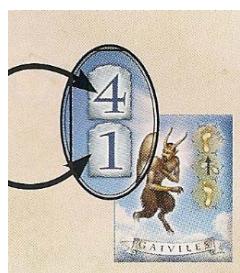
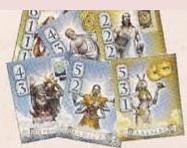
On each Gods tile, in the upper left corner, there are one or more numbers. The numbers tell how many sacrifice cards or sacrifice tiles a player needs and also show how many of each type are needed to gain the Gods tile.
Example - showing a sacrifice, done only with sacrifice cards:

Example: The
Red plays 4 dancer cards and one temple card. This gains him the Gods tile shown and he takes it.
Example - showing the same sacrifice, but only using sacrifice tiles:
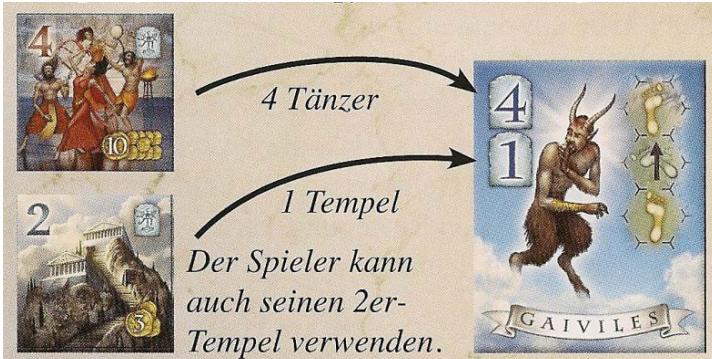
Yellow has a level 4 dancer tile and a level 2 temple tile. This is enough to fulfill the condition to gain the Gods tile shown. He takes it.
Example - combining sacrifice cards and tiles:
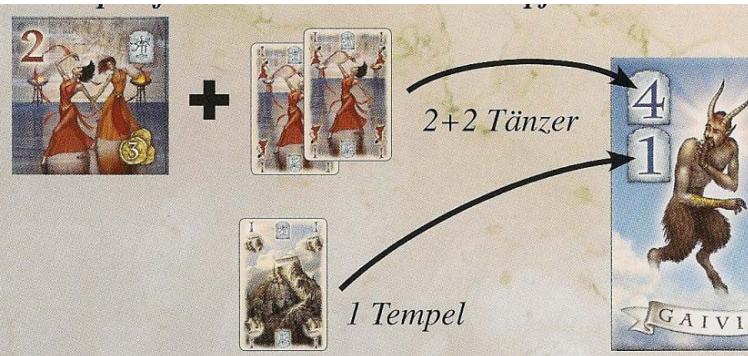
Green uses his level 2 dancer tile, plays 2 dancer cards and 1 temple card. Again, this is enough to gain the Gods tile shown and he takes it. Note that the player may use other kinds of sacrifice cards and tiles, not just the dancer and temples.
Example: Green would like this Gods tile. He needs 4 different sacrifice types in the numbers shown.

• Played sacrifice cards are put on the discard pile.
game is in the 2nd Epoch. Red gains a Gods tile and immediately gets 2 victory points. The victory points
• The sacrifice tiles are kept by the player. They may be used again in the next turn.
• Each Gods tile yields a benefit (see back of rules).
• The player immediately gets victory points for each Gods tile he gains. The number of points depend on the Epoch in which he gains the Gods tile.

earned are shown below current Epoch.
• In each Gaining Gods Action a player is only allowed to gain 1 gods tile.
IV. The player draws 3 cards:
The player takes 3 cards, one after another from the open card display and/or from the face down draw pile. If he takes an open card, the open spot will be immediately filled with the top card from draw pile, face up.
When the draw pile is emptied, the discard pile is shuffled, placed face down and is now the new draw pile. If a player is required to draw a card and a new draw pile can’t be formed, because the discard pile is empty, all players discard all cards, shuffle these and form the new draw pile. Then, the player draws the card(s) he is required to.
End of the Turn phase:
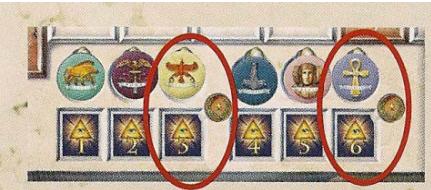
The players take turns in clockwise order, until the last loot tile or the last Gods tile was taken from the board. After that player’s action is completed, the turn phase ends (the active player ending his turn regularly). The active player gains 3 victory points and gives the temple to the player on his left, indicating the starting player for the next Epoch.
Note: If the last loot tile is taken in a movement action, all other players may take movement action or draw a cards a usual. Then the player with the big foot gets the 3 victory points.
3. End of Epoch – Decline of the Nation
• All players take their feet back from the board and put them back in their personal reserves.
• All columns stay on the board.
• Gods tiles, loot tiles and Half God tiles not taken in this Epoch are put back in the box.
• Then, a new Epoch starts with the Phases 1 – 3 (see scoring rounds after Epoch 3 and 6 below).
• Exception: After the third and sixth Epochs a scoring round occurs. The game ends after the second scoring round (following the sixth Epoch).
Scoring Round:
• Both scoring rounds are done exactly the same.
• All Half God tiles and Columns placed on the board are scored for victory points.
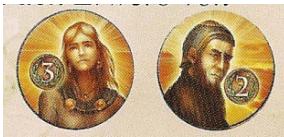
• Half Gods: Each player adds
up the points on the Half God tiles he had taken during the game. Each player keeps his Half God tiles after scoring.
• Columns: Each player gets victory points for his own columns he has placed on the board during the game. The victory points earned depend on the total number of columns he has on the board:
| Total number of columns on theboard | VictoryPoints |
| 1-3 | 1 per column |
| 4-7 | 2 per column |
| 8-11 | 3 per column |
| 12 | 4 per column |
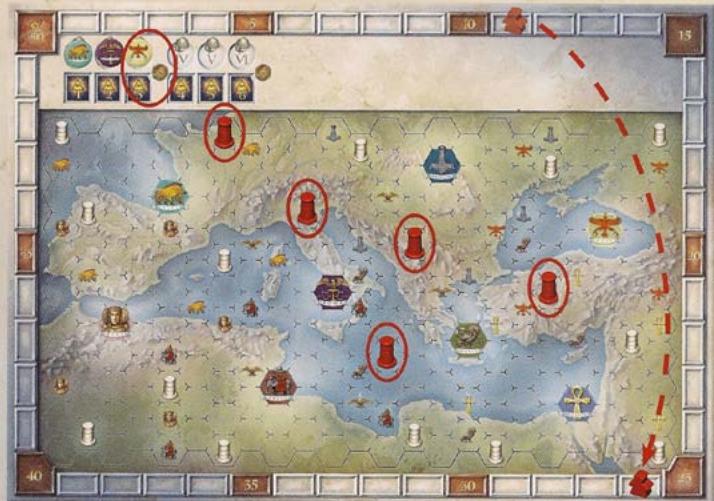
Example of scoring for Red (only the red columns and victory point marker are pictured): Red already has 11 points at the beginning of the scoring (because of ending the Epoch and gaining Gods tiles). He gets 10 points for his 5 columns no the board (each column is worth 2 points; 5 x 2 = 10).
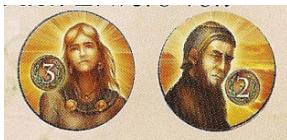
He has one Half God worth 3 and one worth 2 points. He gets 5 points for the Half God tiles (3 + 2 = 5). In total, he scores 15 points (10+5=15) in this scoring round.
Game end:
After the second scoring round, the game ends and the player with the most victory points is the winner. In case of a tie, the player with the most Half Gods tiles wins (count the number of Half God tiles, not the point values). If still tied, the victory is shared.
Bonus and Loot tiles:

Reserve: The player takes the number of columns and/or feet shown in his color from the general reserve and adds them to his personal reserve.
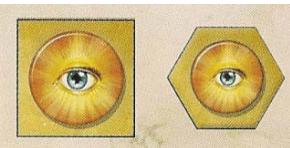
Half God tile: During the Preparation Phase, for each loot tile placed on the board showing a Half God, one Half Gold tile
from the face down pile is taken and placed face up on the board. When a player gets a loot tile, he immediately
takes the highest Half God tile and puts it face down in front of him. When a player takes this starting bonus, he takes one Half God tile from the face down draw stack and puts it face down in front of him. Players are allowed to look at their own Half Gods tiles at any time.
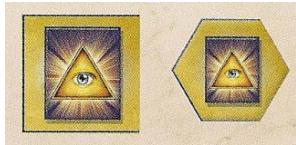
Gods tile: The player take the top Gods tile from the face down stack. He does not make a sacrifice. He puts it face up in
front of him and immediately gets the Gods tile benefit (see back of rules). He also gets victory points depending on the current Epoch number in the game.

Column: After the Preparation Phase of the first Epoch the player having this bonus tile places 1 of his own columns from the general reserve on the board in a column
hex of his choice. This column is just like it was placed during the game.
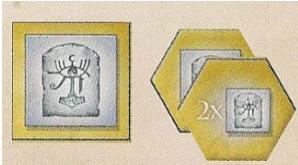
Sacrifice tile: The player upgrades one sacrifice tile one level, or takes a new level 1 sacrifice tile. If a player is
allowed to do this more than once, he may use it on the same sacrifice tile or different tiles.
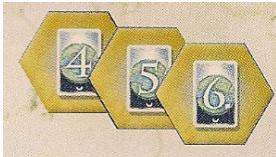
Draw cards: The player draws the number of cards shown from the face down draw pile.

Money card: The player immediately gets the top card of the specialty money card stack. When he plays this card later in the game, it will be placed in the discard pile
with all the other cards.
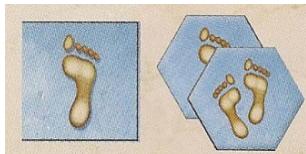
Steps: The player places these tiles in front of him. In each movement action, he may use the steps shown. The player
may move without using movement cards or by just using the steps provided by the tiles. The bonus and loot tiles are available throughout the whole game. The tiles are cumulative. They may not be used in the buying action.
The Nations:
Gallia: Each player, beginning with the starting player, has to choose either to draw two cards from the draw pile or turn a Gods tile from the Gods tile
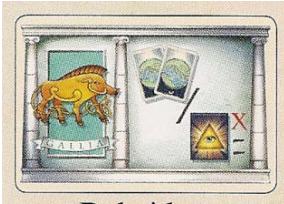
stack face up. To gain this tile, he only has to spend the sacrifice listed for the top number. He may use his sacrifice cards and tiles. If he cannot or does not want to take the Gods tile, it is put back in the box.
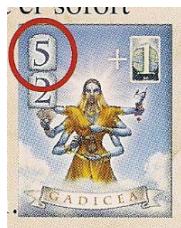
Example: If the Gadicea tile is turned up, the player would need 5 sacrifices of one type to gain the Gods tile.
Germania / Graecia: All players must adjust their hand size to 7 cards. Players
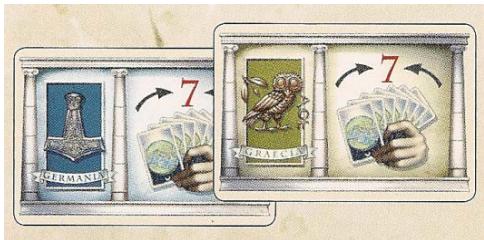
that have more than 7 cards on must discard, and players with less than 7 cards draw cards until they have 7. Players discard their choice of cards and draw cards only from the draw pile.
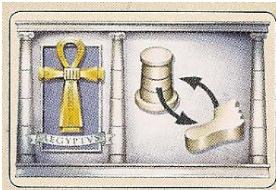
Aegytus: Players may, beginning with the starting player, trade feet for columns or vice versa. Players trade between their personal reserve and the general reserve.
Persia: The specialty money card stack is resorted in descending order. This new order remains until the end of the game.

Iberia: Each player, beginning with the starting player, takes a level one sacrifice tile or upgrades any one of his own sacrifice tiles by one level.

Cartago: Each player, beginning with the starting player, may immediately spend 2 money. This money may not be supplemented by money cards or Gods tiles. All

options under the Buying Action are available. Clarification: The preparation phase, including a nation’s special trait, is completed by placing the temple on the board. Therefore, a player is not allowed to place feet with the money provided by Cartago, because the temple is not on the board when the money must be spent (placing feet must start next to the temple).
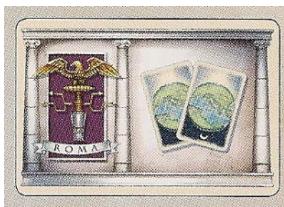
Roma: Each player, beginning with the starting player, draws two cards from the draw pile (not from the card display).
Gods of Pantheon:
The players may gain Gods tiles in 5 different ways:
• With a bonus tile at game start. The player takes the top gods tile from the face down stack.
• With a loot tile in the Movement or Buying Action. The player takes 1 Gods tile for each loot tile from the face down stack.
• With the Gaining Gods Tile Action. The player may take 1 face up Gods tile per action.
• With the nation “Gallia” (see above).
• With the god Surparit (see below).
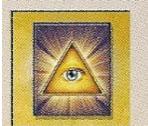
Each Gods tile yields a defined ability for the player gaining it.

A yellow Gods tile provides an immediate and one-time benefit. The player puts the Gods tile back in the box after use.

A blue Gods tile provides a permanent benefit. The player places it in front of him. Also each Gods tile provides victory points depending on the Epoch it is gained.
Surparit (immediate: Gods tile)
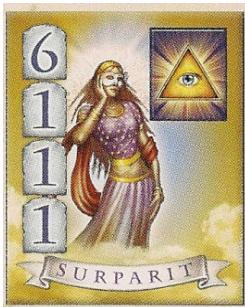
The player immediately takes another Gods tile from the face down stack. If he draws Surparit again, he is not allowed to take another Gods tile (no chain reaction). The player gets the Epoch
victory points for Surparit and for the drawn Gods tile.

Plaesiris (immediate: Half Gods)
If Plaesiris is drawn in the Preparation Phase, the top 2 Half Gods tiles from the face down Half God stack are placed face up on the board. When a player gains Plaesiris with the Gain Gods Tile
Action, he takes the 2 highest Half God tiles. When a player gains Plaesiris with bonus or loot tiles, or with the god Surparit, he takes the top 2 Half God tiles from the face down Half God stack.
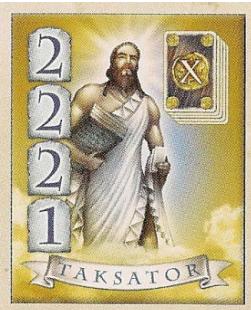
Taksator
(immediate: special money card)
The player immediately gets the
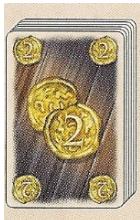
top card of the specialty money card stack. If he plays this card later, he discards it as usual. The
card stays in the game and may be drawn again.
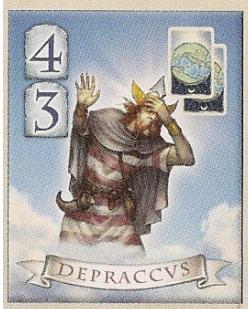
Depraccus (permanent: 2 cards)
At the end of Preparation Phase, after the temple has been placed, the player draws two cards from the draw pile. Clarification: If a player gets Depraccus from the bonus tile at the start of the game,
the Preparation Phase for the first Epoch is already finished and so he is not allowed to draw two cards.

Vinthra d (permanent : +1 step)
The player has in each movement action one more step to use, both starting the action or following.
Multiple copies of Vinthrad are cumulative. The player may move with the help of Vinthrad even without playing any movement cards. He may not use Vinthrad in the
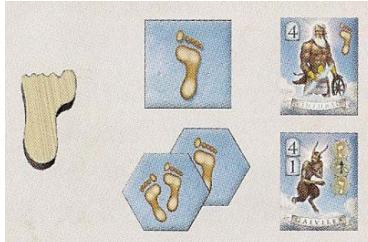
Buying Action, to place feet or columns on the board.
The tiles shown can be combined freely. Using them without playing
movement cards is possible. None of these tiles can be used with the Buying Action.
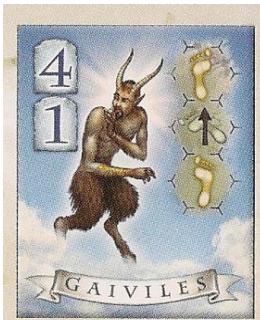
Gaiviles (permanent: jump)
another player.
The player may jump once during his movement action, either when starting the action or following. The jump ability allows the player to jump over a hex occupied by
The active player is allowed to:
• Jump away from the temple.
• Jump diagonally.
• Jump onto an occupied hex (this costs 2 steps as usual).
• Jump over a hex already containing 2 feet or 2 columns.
• Cannot jump over an empty hex
• Multiple copies of Gaiviles allow more jumps, but not
over more than 1 hex each.
Example: Yellow has one Gaiviles Gods tile in front of him.

He uses the ability and jumps in his movement action over the green feet. Then he places a column. He jumps diagonal and direct away from the temple.
Example: Green has 2 Gaiviles Gods tiles in front of him.
He may not jump over both yellow pieces (see left picture).
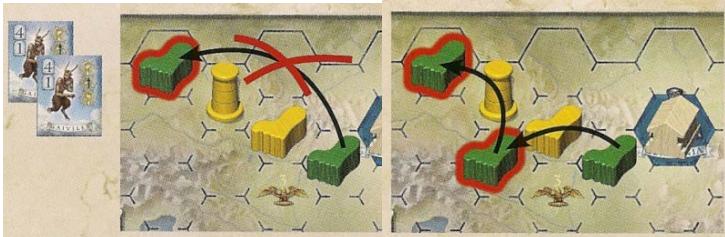
But he may jump two times over one piece (see right picture).

Gadicea (permanent: +1 card)
The player may draw 1 more card with each of his Draw Cards actions. Multiple copies of Gadicea are cumulative. Gadicea may only be used with the Draw Cards action and not on its own.
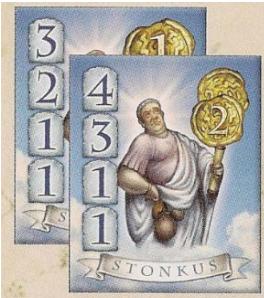
Stonkus (permanent: Money)
The player may use 1 or 2 additional money in each of his Buying actions. Multiple copies of Stonkus are cumulative. The player may take a Buying action using only Stonkus’ help and not
playing any money cards. He may not use Stonkus in the movement action to buy more steps.
Pietalte (permanent: scoring)
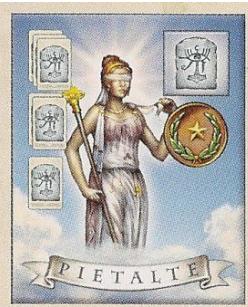
The Gods tile Pietalte may only be gained using sacrifice cards. Sacrifice tiles may not be used. The player must play 3 sacrifice cards of one type, 2 of another type and 1 one of a third type. Pietalte is used in scoring, aligned to one of a
player’s sacrifice tiles. The player gets points equal to the level of the sacrifice tile. Multiple copies of Pietalte may be aligned with the same or different sacrifice tiles.
Example 1: Red has 1 Pietalte and the 2 sacrifice tiles shown. During scoring, Red scores 4 points.
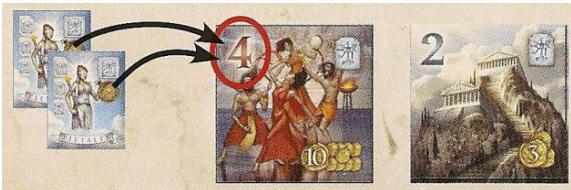
Example 2: Red has 2 Pietalte and the 2 sacrifice tiles shown. He can align both Pietaltes with the same sacrifice tile and scores 8 points.
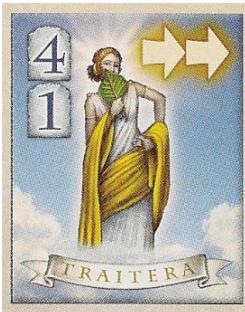
Traitera (one time: +1 action)
The player may use the Gods tile Traitera during his turn after he has finished his action to immediately execute a second action.
• He can choose the same or different action.
• If he chooses the same action, he is allowed to use all gods, sacrifice, bonus and loot tiles used in the first action, again.
Example: The player chose the Buying action and used Stonkus. He now uses Traitera and chooses the Buying action again. He may use Stonkus again.
• The player may use all gods- and loot tiles he received in the first action with the second action.
• The player may use Traitera only, if he possessed her at the beginning of his turn.
• The player may use multiple copies of Traitera in one turn (if he had possessed all of them at the beginning of his turn).
• After using Traitera, the player places the Traitera tile back in the box. Each Traitera may only be used once each game.
It’s theoretically possible, that the face down Gods tile stack is empty when a Gods tile must be drawn. In this case, any Gods tiles discarded previously in the box are shuffled and a new face down Gods tile stack is formed. If a player gains a Gods tile and cannot use it’s benefit (for example, he gets Taksator and the specialty money card stack is already used up), he only gets the Epoch victory points for the Gods tile and receives no other compensation.
Pantheon is © 2011 by Hans im Gluck Verlags-GmbH. English rules originally translated by BGG-User Cyberian (Christian Brunner) and proof read by Sorp222 (Paul Lister). English revision and art added by pmanoff (Philip Manoff).

Texts are community-compiled or publicly released by publishers; copyright remains with the original authors. For personal reference only.