
Pericles The Peloponnesian Wars
At a glance
Rules, cards and Q&A (Chinese)
The rules, card data and player questions for this game are written in Chinese. Open the Chinese page to read them.
Where to find full rules
Full rules and card lookup are available in the cunlema app at cunlema.cn — pick this game and ask about any rule, card or turn you are unsure about.
Related games
Rulebook text (Markdown)
This game has 2 rulebook Markdown file(s) in our library; 2 rendered inline below — expand to read or download.
rules_en_pericles-the-peloponnesian-wars_199904.md98.4 KB
来源类型:纯文本规则(非 PDF 源,早期抓取/转换产物)
说明:原文未改动,仅调整存放位置与文件名;非 PDF 扫描件,无对应原书 PDF
Pericles: The Peloponnesian Wars Rulebook | RulesPalRulesPalChatRulebookPericles: The Peloponnesian WarsPericles: The Peloponnesian Wars Rulebook Table of Contents Table of Contents 2.0 Components
3.0 General Course of Play 3.1 Description of Components 3.11 Game Pieces
3.12 Map
3.13 Examples of the Cards
3.14 Debate Issues
3.15 Theater Issues
3.2 Glossary
3.3 Setting up the game
4.0 Abbreviated Sequence of Play 4.1 Public and Secret Information
4.2 General Strategy Discussions
5.0 Aristophanes Phase 5.1 Aristophanes Card Segment
5.2 Political Cards Segment
5.3 Boule Segment
6.0 Assembly Phase 6.1 First Debate
6.2 Card Values and Attributes
6.3 Faction Leaders
7.0 Political Phase 7.1 Oration Honor
7.2 Controlling Faction Segment
7.3 Strategy Board Segment
7.4 Political Issues Segment
7.5 Theater Issue Award
8.0 Theater Phase 8.1 Honor Order
8.2 Base Limit per Theater
8.3 Theater Issue Placement Segment
8.4 Theater Issue Resolution Segment
8.5 Issue Resolution
8.6 Political Capital
9.0 Military Issue Resolution 9.1 Building City-State Military Units
9.2 Raid
9.3 Expedition Assembly
9.4 Battle
9.5 Battle Honor
9.6 Second Battle Option
9.7 Military Expedition Resolution
9.8 Treachery Markers
10.0 Honor, Hostages, & Treachery 10.1 Honor
11.0 End Phase 11.1 Victory Determination
11.2 Maintenance Segment
11.3 Redeployment Segment
11.4 Will of the Assembly
12.0 Special Units 12.1 Argos
12.2 Alcibiades
12.3 Athenian State Ship
12.4 Spartan 'Foot Cavalry'
13.0 Persia 13.1 Persian Bases
13.2 Persian War
2.0 Components
【勘误提示 · 官方】 本作有官方勘误 / FAQ:
-200904_199904_pericles-the-peloponnesian-wars/mineru/Rules Clarification_BoardgameGeek_v2.md与本文件冲突时,一律以勘误为准。 回答涉及数值、条件、例外与计分细节前,先检索并阅读上述勘误文件。
已内联 19 条官方勘误(正文段落 16 条 · 文末补充 3 条),统一编号〔勘误 …〕,与原句冲突时以括注为准。
1 Rulebook
1 Playbook
6 Player Aid cards: 2 Athenian Player Aid Cards (identical), 2 Spartan Player Aid Cards (identical), 1 Strategic Matrix Card, 1 Phormio Decision Card
1 Mounted map
1 Countersheet (130 counters)
4 Cardboard Player Shields (one for each Faction)
Wooden Pieces:
Athens (blue): 12 sticks, 8 Disks, 10 Cubes, 26 Octagons, 3 Embossed Resource Cylinders (used for Controlling Faction, Assembly Display, and Number of Bases on map)
Delian League (white): 8 sticks, 12 Disks, 12 Cubes
Sparta (red): 4 sticks, 4 Disks, 9 cubes, 1 Meeple, 26 Octagons, 3 Embossed Resource Cylinders (used for Controlling Faction, Assembly Display, and Number of Bases on map)
Peloponnesian League (yellow): 8 sticks, 20 Cubes, 10 Disks
Miscellaneous:
4 Tan Cubes (Argos)
3 Black Discs (Persian Bases)
1 Black Meeple (Alcibiades)
1 Black Athenian Ship of State Strategos Token (Embossed with a ship)
2 White pawns
2 Black pawns
1 Red Pawn (Spartan Will of Assembly)
1 Blue Pawn (Athenian Will of Assembly)
1 20-sided die
1 Six-sided die
Cards:
24 Aristophanes cards
32 Athens Political cards
32 Spartan Political cards
3.0 General Course of Play
Factions in the opposing City-States (Athens or Sparta) debate issues in their respective Assemblies, which are then implemented to prosecute their strategy to win the war by winning superior Honor. Strategos tokens are also awarded during these debates, representing military capital that fuels a Faction's efforts to create diplomatic and military advantage during periods of War and Peace. In most scenarios the goal is to have your City-State win a military victory while your Faction has the most Honor within that City-State.
3.1 Description of Components
Play Note: The component and counter mix are the limit of what can be built for a particular type of unit.
3.11 Game Pieces
Guide to Pieces
Cubes: Land Military unit
Sticks: Naval Military unit
Disks: Fortified Bases
Hexagonal Cylinders (red & blue): Strategos tokens
Hexagonal Cylinder (black with ship icon): The Athenians have a special black Strategos token that represents the State Ships of Athens which may be used in Battle once each turn. Turn the token embossed-side-down to indicate that it has been used that turn.
Round Cylinders: Used for Controlling Faction, Assembly Display, & Number of Bases on map
Alcibiades Meeple (black): Alcibiades
Guide to Pieces (continued)
Spartan Meeple (red): Spartan 300 military unit
Pawns (white & black): White pawn is used to designate issue in time of Peace; black pawn is used to designate issue in time of War.
Pawns (red & blue): Will of the Assembly pawns; placed due to an Aristophanes card event.
Color Guide:
Athens (blue)
Delian League (white)
Sparta (red)
Peloponnesian League (yellow)
Argos (tan)
Persian (black)
3.12 Map
The map consists of two sections. In the left section are two City-State displays (Athens and Sparta) with a Faction Track for each of the respective Factions, along which Issue markers move during the Assembly Phase. There is also a three box track titled Assembly that is used to determine which faction is favored by the Assembly at a given moment.
The remainder of the map consists of 20 Theater spaces, plus Persia. The Theaters are all numbered from 1-20 so that a twenty-sided die (1d20) can randomly select the Theater in which a Solitaire 'Bot action will occur. Theaters with a brown border are Land Theaters, and theaters with a blue border are Naval Theaters. Both land and naval units can occupy either type of Theater; its type indicates which type of Battle has priority in that Theater.
Theater Connections
Colored lines connect each Theater space to adjacent Theater spaces. Military units follow these connecting lines when they move during a Military Expedition. No Theater is adjacent to any other Theater except via a connecting line, regardless of relative position on the map. There are four types of Connections and several special Connection conditions, the effects of which are detailed in 9.32.
An Honor track runs along the edge of the map numbered 0 to 99. Each Faction uses their Honor counter to record their current Honor. If a Faction's Honor exceeds 99, flip the Honor marker to its +100 side. A Faction's Honor may never fall below 0.
3.13 Examples of the Cards
Aristophanes Card — Example: "Peace" (A). Elements shown: Title of Play; a version of three (B and C); Quote from play; Issue placement for each City State (e.g., League (Athens): Place on the Opposition faction's 1 space; Diplomatic (Sparta): Place on the Opposition faction's 1 space); Event (in this case a Will of the Assembly Event): "Will of the Assembly (Rebellion): Athens - Sicily Theater, Sparta - Hellespont Theater. Build or convert a base at marker location. Success: each faction gains 5 Honor. Failure: each faction loses 5 Honor plus 5 Strategos tokens are removed from next turns stock."
Political Card (Athenian) — Example: "Algeis II" (card value 5). Elements shown: Card Value (1 to 5); Card Title (Athenian Tribe; no effect on play); Athenian Aristocrat faction oriented — "+2 Military, 3 Strategos: THERAMENES: Athenian statesman prominent during the late war period" (Issue Alignment +2 Military alignment if Alcibiades is NOT in Athens, in Persia; 3 Strategos Tokens awarded if played on Military Issue); "+3 Military, 3 Strategos: ALCIBIADES: Scion of the Alcmaeonidae who became a renegade who literally fought on all sides of the conflicts" (Issue Alignment +3 Military if Alcibiades is in Athens; 3 Strategos Tokens Awarded; Meeple symbol for Alcibiades). Demagogue faction would turn the card 180 degrees to use, reading "Demagogue: THUCYDIDES: Ostracized political opponent of Pericles" (1 Strategos, League 1+: Issue Alignment +1 League alignment, 1 Strategos Token awarded if played on League issue).
3.14 Debate Issues
In each Assembly Phase players will debate a series of issues which will determine who will set the diplomatic and military agenda for the turn. A full set of Debate issues for each Side comprises: six Military, three League, three Diplomatic, one Ostracism, one Games, one War/Peace, one Oracle, and two Side-specific issues.
Faction Leader Card (example: Spartan Agiad)
Card value 5, "Agiad", "King".
"+1 Ostracism, 1 Strategos: Play during the Assembly Phase: +1 Ostracism Issue OR +2 ANY Issue (Except Ostracism)" — if played on the Ostracism Issue, Issue Alignment: +1 Ostracism and 1 Strategos token awarded. On all other issues except Ostracism, +2 bonus with a 1 Strategos token award.
"+2 Pre-Plague Strategos 2 / Post-Plague Strategos 4: Play during the Strategy Board segment" — if played during the Strategy Board segment; if Pre-Plague, 2 Strategos Tokens, if Post-Plague, 4 Strategos Token award.
Card Legend — The top left value is the nominal strength of the card when played on an issue. However the card may provide a strength boost or strategos benefit if the conditions on the card are met when played. The following symbols summarize these conditions or benefits:
"+2": Bonus value, if card meets requirements
"+2" (boxed): Bonus value, if card meets requirements and the player must be the Controlling Faction
Meeple icon: Alcibiades must be in Athens
Crossed swords icon: Athens must be at War
Star ("ANY"): Bonus applies to any issue
"NOT": Requires the issue to not be the one above the "NOT"
Skull with wreath: Requires the game to be in Pre-Plague status
Skull (dark): Requires the game to be in Post-Plague status
"1" (circled): Strategos tokens gained, if card meets requirements
Spear/shield icon: Requires the issue to be War/Peace
Runner icon: Requires the issue to be Games
Catapult/siege icon: Requires the issue to be Diplomatic
Statue with masks icon: Requires the issue to be Ostracism
Bull icon: Requires the issue to be Oracle
Helmeted head icon: Requires the issue to be Military
Ship icon: Requires the issue to be Military
Owl icon: Requires the issue to be League
3.15 Theater Issues
Theater Issue chits are placed on the map by the Faction which won them in the Assembly Phase's debates. One side of each chit is a generic icon for the City-State, concealing its identity, with the other side denoting both the issue and the owning Faction. A full set of Theater issues for each Faction comprises: six Military, three League, three Diplomatic, and one Oracle.
AF = Aristocrat Faction
DF = Demagogue Faction
EK = Eurypontid King
AK = Agiad King
Theater issue chits shown: an "Issue" chit with an owl (Athens generic side) paired with "DF — League"; another "Issue" chit with an owl (Athens generic side) paired with "AF — League"; an "Issue" chit with a lambda (Sparta generic side) paired with "EK — Oracle"; and an "Issue" chit with a lambda (Sparta generic side) paired with "AK — Rumors".
Geography Design Note: Each of the 20 Theaters is a large area that in most cases contained multiple city-states. I have named each theater for how it is most often discussed from a military strategy perspective in Thucydides, so in some cases I use the name of a location instead of the region. Here is a short summary of the key locations in each Theater.
Aegean Sea: This is an Aristophanes card reference to Theaters 15-19 (Lesbos, Chios, Samos, Cyclades, S. Sporades).
Sicily (Theater 1): Includes the Island of Sicily where Syracuse is located and also includes Messenia, Leontini, and southern Italy.
Corcyra (Theater 2): Besides the island of Corcyra, included are Zacynithus, Cephallenia, Leucas, and Ambracia.
Corcyra Design Note: The Corcyra Theater represents both Corcyra (modern Corfu) and other large islands in the area and portions of the Adriatic coast. What is really happening is units are sailing from this location to Italy, eventually coming to the Straits of Messina and crossing over to Sicily. These naval moves covered a distance that could be traversed in one daylight period. As long as you have a base in this Theater, like Ionia, your forces are picking their moment to cross when conditions are right and there are no hostile naval forces in the area.
Aetolia (Theater 3): Covers the entire region that surrounds the Athenian base at Naupactus.
Naupactus (Theater 4): Is a very specific location at the narrowest point in the Gulf of Corinth. It was a critical naval chokepoint that blockaded Corinth's west coast.
Play Note: If Athens does not have a base on the Isthmus they can get to Naupactus via the route Athens to Corcyra to Naupactus. If Athenian units move from Athens to the Isthmus they can fight a naval Battle in that location with no detriment without a base. The Spartan navy is usually assumed to be on the Saronic Gulf side of the Isthmus.
Isthmus of Corinth (Theater 5): This is one of the critical land chokepoints in Greece. The Isthmus is home to Corinth and Megara. This chokepoint controlled land access into and out of the Peloponnesus (Sparta).
Isthmus of Corinth Design Note: Triremes are apparently not so heavy that they cannot be muscled onto land and moved some distance. The Corinthians controlled a Trireme 'portage' causeway that they used to move small fleets from the Gulf of Corinth to the Saronic Gulf and back. I have simplified this ancient Panama canal whereby if you have a base you are assumed to have some way of dragging ships across the narrow isthmus.
Sparta (Theater 6): This Theater includes all of the Peloponnesus, home to many City-States including—but not limited to—Sparta, Tegea, Mantinea, Argos, Elis, Haleis, the territory of Messenia, and the island of Cythera.
Athens (Theater 7): The home theater for the other protagonist in this conflict. It includes Athens and its connected port of Piraeus, the surrounding territory of Attica, Aegina, Salamis, and the southern portion of the island of Euboea.
Design Note: Athens is a good case in point to discuss the routes that connect Theaters to each other. You will notice that Athens has 3 of the four types of connections. The Athens theater could have been called Attica (region around the City of Athens-Piraeus) and Southern Euboea. All of the Theaters in Pericles have a coastline to allow for the land-naval symbiosis that is characteristic of this period. The routes that show land units capable of going over water are actually the use of coastal routes and short hops with islands to move forces around the map. Be conscious of what kinds of forces are required in Athens to keep land forces from going over water routes.
Boeotia (Theater 8): Centered on the dominant city-state Thebes, it also includes Delphi, Heraclia, Phocis, Plataea, Tanagra, Delium, and the famous 'hot gates' of Thermopylae plus northern Euboea.
Thessalia (Theater 9): Includes the entire region of the same name with its most notable city, Larissa.
Macedonia (Theater 10): The future birthplace of Alexander the Great is the region by the same name. It contains the main city that eventually became Pella and included for a time the Athenian colony of Brea.
Chalcidice (Theater 11): A region with many small city-states such as Potidaea, Scione, and Torone.
Amphipolis (Theater 12): This region is actually Thrace, but I chose to name it for the critical land chokepoint of Amphipolis, which became the site of conflict and political acrimony when the Spartans could not fulfill their obligation under the Peace of Nicias to return it to Athens. This Theater also includes the large island of Thasos.
Hellespont (Theater 13): This Theater contains the narrows (Dardanelles and Sea of Marmora) that connects the Aegean Sea to the Black Sea. Athens drew most of its grain supplies from the Crimea and its loss to Lysander after the Battle of Aegospotami caused Athens to surrender after a lengthy siege.
Ionia (Theater 14): This Theater covers the western coastline of what is modern Turkey, but in this period was dominated by many Greek colonies in what was known as Ionia and Caria. The city of Ephesus became a major Spartan naval base that was funded with Persian gold.
Ionia Design Note: The islands of Lesbos, Chios, and Samos are a short distance from the Ionian shoreline. Land units regularly used local transport to cross this short distance. Enemy naval forces were unable on most occasions to stop this traffic if the land units could wait until the naval units were not in the immediate vicinity, but would have to have somewhere to wait for the right time. The Connection rule that you have to have a base present captures this dynamic.
Lesbos (Theater 15): Just off the coast of Ionia, this island was dominated by Mythennia.
Chios (Theater 16): Just off the coast of Ionia where the city of Chios was a major Athenian ally that contributed its military forces in lieu of tribute until its revolt.
Samos (Theater 17): A critical location that revolted against Athens during the Samian War then later became the center of Athenian power during the short reign of the 400 oligarchs. The citizens of Samos were afforded the rare honor of becoming Athenian citizens and stood by their side right through the end of the war.
Cyclades (Theater 18): Represents a string of small islands off the southern coast of Euboea. These include Tenos, Andros, Melos, Delos, and Naxos to name a few.
Southern Sporades (Theater 19): A string of islands also known as the Dodecanese. The island of Rhodes dominates this Theater.
Eastern Mediterranean (Theater 20): This Theater represents the Persian Empire's Levant coast and Egypt.
Persia: An abstract location used to show Persian support for Sparta in the war (see Persia 13.0).
3.2 Glossary
Aegean Sea: Theaters 15-19 (Lesbos, Chios, Samos, Cyclades, and S. Sporades).
Assembly: There is a three space Assembly display that uses a wooden marker embossed with the City State's logo that shows the Favor of the Assembly for either of the factions or neutral. The marker moves left to right and right to left based on how control of the government changes over the course of a scenario.
Athenian State Ship Strategos: This piece represents the Athenian sacred ships Paralus and Salaminia (see Aristophanes quote). For all game purposes it is a Strategos token and not a naval unit: no rules that apply to naval units apply to this piece.
Battle Deck: After all political cards are dealt out for the turn, the remaining Political cards are set aside and become the Battle deck, used to randomize various theater issue outcomes. Each turn the Battle deck is shuffled in with all of the discards to reconstitute a player's political deck.
Base: Each side has wooden disks that represent bases that are both land and naval units, infrastructure that builds and maintains military units, sometimes a movement requirement along certain routes, and a source of Honor in the longer scenarios.
Design Note: There are ~1500 city states on the area represented by the map. Bases are not city states, although a base would historically be associated with a city state in a Theater. A base is military infrastructure that is garrisoned with land and naval forces.
Build/Maintenance Cost: Bases can build and maintain four military points. A military point is different than military value. It costs four military points to build and two military points to maintain a naval unit. It cost two military points to build and one military point to maintain a land unit. League Bases require four Strategos tokens to build — and two to later convert to an Athenian or Spartan Base.
Card Value: A card's value is the number in the upper-left of the card (either orientation), not counting any issue alignment bonuses.
City-State: Sparta or Athens and their military units (red and blue, respectively) and not including League units.
City-State Theater: Athens and Sparta
Commanding General: The owner of a revealed military issue who makes all force movement decisions for its resolution.
Compatriot: The Aristocrat and Demagogue Factions in Athens are Compatriots of each other, and the Eurypontid and Agiad Factions in Sparta are Compatriots of each other.
Contested Theater: A Theater occupied by military units and/or bases from both Sides.
Controlled Theater: A Theater occupied by military units and/or bases from only one Side. A Theater is either Friendly- or Enemy-Controlled, depending on whether the units/bases are from the respective Faction's Side or not.
Controlling Faction: Faction currently in charge of its City-State government. Some political cards require that they be Issue Aligned and the faction is the Controlling Faction to gain the card bonus.
Enemy: Sparta and the Peloponnesian League are the Enemy of Athens and the Delian League, and vice versa.
Entourage: The three cards, from a player's initial hand of nine Political cards, set aside facedown to be used as a Brain Trust or saved for subsequent turns (6.31).
Faction Track: There are four Factions in the game, two per Side, representing political alliances within the respective City-State. For Athens they are the Aristocrats and Demagogues. For Sparta they are the royal houses Eurypontid or Agiad. Faction does not refer to the distinction between City-State and League units. Each City State has a central issues space (zero space) that connects two faction tracks numbered from 1 to 7+ on which issues move as they are placed and debated.
Friendly: Units belonging to the same Side.
Honor: Honor is the measure of a Faction's success or failure and is used to determine victory.
Issue Alignment: A Political card used in debate that matches the issue currently designated for debate in the Assembly Phase.
League: Military units representing the Delian League (white, controlled by Athens) or the Peloponnesian League (yellow, controlled by Sparta), as opposed to City-State units.
Military Value: Each unit has a military value that varies from one for most units and two for bases, Spartan land, and Athenian naval units. Remember military value is not military cost.
Neutral Theater: A Theater not occupied by military units and/or bases from either Side.
Opposition Faction: Faction currently not in charge of its City-State government.
Owning Faction: The Faction whose color and markings are on the issue, regardless of who flipped the issue. The Owning Faction makes all decisions for that issue and may use any units (City-State and League) on their Side when they resolve the issue.
Shield: Each faction has it own cardboard shield behind which it can conceal information that the player is allowed to keep hidden.
Side: There are two Sides in the game, Athens and Sparta, each with two Factions. There are four colors of units. Both Athenian Factions may use the Athenian and the Delian League units equally. Both Spartan Factions may use the Spartan and the Peloponnesian League units equally.
Strategos Stock: A pool where Strategos tokens are stored and drawn from when not owned by a Faction, on the Strategy Board, or temporarily removed from the game by an Aristophanes card.
Strategy Board: A location near the Faction track from which five Strategos tokens are distributed after the Debate Segment ends.
Treachery Marker: Placed in a Theater space by the Diplomatic issue. The 10 Treachery markers for each side are the limit that can be in play at any time and once placed cannot be voluntarily removed from the map, but requires an issue or a change in base affiliation to remove the marker(s).
Zero: The large issues space on each city state display with the city state emblem (Athens-Owl, Sparta-Lambda) is also the zero space.
3.3 Setting up the game
Select one of the 14.0 scenarios in the Play Book, set up the pieces as indicated, and shuffle the three decks: Aristophanes, Athens Political, and Sparta Political. Begin play by picking the top card of the Aristophanes deck and continue with the sequence of play.
Note to First Time Players: Even if you are an experienced gamer, it is strongly advised that you use the First Time players sequence (14.01) to ease into the design. While the mechanics of Pericles are not individually complicated, the combination of systems can be a bit overwhelming. It has been found from testing that taking an hour to play through all of the design's subsystems in stand-alone mode allows you to see how they work before you dive into one of the bigger scenarios.
Design Note: I believe that game length and topic are the most important variables that affect whether a game hits the table or not. I have gone to great lengths to create a large number of competitive, one-turn scenarios that can be played in less than an hour with several more that can be played in less than two hours (e.g., The Archidamian War). Of course, I have supplied the ability to fight either of the major wars (1st and 2nd Peloponnesian War) or the entire sixty year period chronicled by Thucydides that Will Durant called "The Suicide of Greece".
4.0 Abbreviated Sequence of Play
Play Note: The timing of cards depends strongly on adhering closely to the Sequence of Play below.
Aristophanes Phase (5.0)
Aristophanes Card Segment (5.1) Reveal and resolve the next card from the Aristophanes deck (and optionally read the play quote out loud in your best thespian voice)
Political Cards Segment (5.2) If player has his Entourage available, discard 0-3 Entourage Cards (5.21)
Refresh hand to 9 cards, or 6 cards if Entourage used for Brain Trust option (6.31)
If hand size of 9 create new Entourage of 3 cards (5.23), else use all 6 cards dealt (6.31)
Add Faction Leader card to 6 cards to create a 7 card hand
Boule Segment (5.3) If Hostages available, Controlling Faction has the option to place War/Peace issue on other City-State's Opposition Faction track two space (5.33)
Controlling Factions pick one issue (2 space, 5.32A), except Ostracism and War/Peace issue (5.32E), which is placed in the center (zero space).
Opposition Factions pick one issue (1 space, 5.32B), except Ostracism and War/Peace issue (5.32E), which is placed in the center (zero space).
Controlling Factions pick three issues (zero space, 5.32C)
Opposition Factions pick two issues (zero space, 5.32D)
Assembly Phase (6.0)
Starting with the Controlling Faction each City-State sequentially conducts six debates (6.11, 6.14)
Political Phase (7.0)
Oration Honor is determined (7.1, Honor 10.0) and Controlling Faction is determined (7.2)
Strategy Board Segment (7.3) Controlling Factions reveal 7th card and receive Strategy Board Strategos
Opposition Factions reveal 7th card and receive Strategy Board Strategos
Political Issues Segment (7.4) Resolve all non-military, league, diplomatic, and oracle issues in the following order: War/Peace (7.41, 7.42), Games (7.43), Citizenship (7.44A), Colony (7.44B), Krypteia (7.45A), Agoge (7.45B)
Determine if the status change from War to Peace ends the game (see Scenario instructions)
Theater Issue Award (7.5) All Factions substitute their military, diplomatic, league, and oracle won Assembly issues for their corresponding Faction colored marker plus their two rumor markers
Theater Phase (8.0)
Theater Issue Placement Segment (8.3) In Honor Order (8.1), each player sequentially places facedown one military, diplomatic, league, oracle or rumor marker on one of the twenty Theaters and potentially Persia
The placement of a second marker in a Theater or Persia creates a stack of markers hereafter referred to as a LIFO (last in, first out) queue (8.31)
Continue sequence until all issues are placed in Theaters or Persia
Theater Resolution Segment (8.5) Reveal and resolve issues (Diplomatic 8.51, League 8.52, Oracle 8.53, Military 9.0) one at a time to completion in Honor Order
A player must reveal one marker from his side that is at the top of any Theater queue
A player who has no markers from his side available to be revealed passes his turn to the next player
A player who passes still takes his next turn in the Honor sequence and a player can pass multiple times
In all cases the marker belongs to one of the players and in all cases the owning player resolves the issue revealed, regardless of who revealed it
All Theater queue markers must be resolved
After all Theater queue markers have been resolved, move to the end phase
End Phase (11.0)
Victory Determination Segment (11.1) Automatic Victory Determination (11.11, 11.12, 11.13)
If last turn of scenario, determine winner (11.14); otherwise continue
Maintenance Segment (11.2)
Redeployment Segment (11.3)
Resolve Will of the Assembly (11.4)
Start new turn
4.1 Public and Secret Information
Play Note: These are guidelines that can be followed, but your group should feel free to be as strict as they wish in following them, or to substitute in some variant if you find it makes the game session more enjoyable.
All information is public unless specifically mentioned in this rule.
A. A player may not reveal his hand of unplayed cards or the cards in his Entourage, until they are revealed during an issue debate or during a discard.
B. After a Faction has been awarded Strategos tokens from the stock, he places them behind his shield, and it becomes secret information. A Faction may show his Compatriot his current number of Strategos tokens, but the opponents may not examine how many Strategos tokens a Faction has in total or remaining behind their faction shields.
C. Issues that are being, or have been, debated and where they are on a City-State's display are public information. Once the Factions convert their won issues into Theater issue markers, the issues are removed from the display and this is no longer public information. A Faction may show his Compatriot the issue he is about to place on the map and what issues he still holds.
4.2 General Strategy Discussions
Players may discuss Theater strategy and make decisions, although nothing is binding. If an issue ends up in the wrong place, whether intentionally or by mistake, it is played and resolved per the rules with no modification.
Play Note on Negotiations and Information: I am not a fan of secret negotiations, so they are discouraged in Pericles. I have tried to articulate what is secret information, but any rule in this regard can only go so far. Try to stay within the spirit of the rules and avoid arguments. Remember, it's only a game, and there is no computer referee.
Team strategy discussions on the other hand are quite fun and part of the game, but try to keep it to whispering and knowing glances. But things can bog down if team discussions are overdone. You will find that the Theater issue queues bring their own kind of chaos that all the planning in the world cannot overcome. You will discover, like the historical figures you represent, that no plan survives contact with the enemy.
5.0 Aristophanes Phase
5.1 Aristophanes Card Segment
5.11 Draw the top card from the Aristophanes Deck and execute all of its instructions. An Aristophanes card will do the following:
A. Place named issues onto indicated City-State Faction track spaces.
Note: Ignore a War/Peace issue that was already placed due to a major defeat (9.54).
B. An event may add or remove Strategos tokens to the stock, give Strategos tokens to a Faction, add units, subtract units, indicate Will of the Assembly objectives, cause a Plague, and/or affect Alcibiades.
5.12 Will of the Assembly
If the Aristophanes card includes a Will of the Assembly event, place each Side's Will of the Assembly pawn in the indicated Theater locations as a mnemonic. The conditions for each Side's Will of the Assembly will be checked in the End Phase (11.4).
Play Note: Each Aristophanes card is unique. Some Will of the Assembly events say Control and some say Control or Contest a Theater. The cards should be read literally, they are different and it is not a typo when they are different.
Design Note: Several of Aristophanes' plays were performed multiple times in competition, and there were several outbreaks of Plague during this period. You may see the same play up to three times during the game, and if that play is the Acharnians, you will see three Plagues.
5.13 Plague
The three versions of the Acharnians (A, B, and C) play cause a Plague, the effects of which are below (5.14). After the first Plague occurrence, the game enters a Post-Plague condition, referred to by some cards, which remains in effect for the duration of the game. A second or third Plague does not alter this condition.
The Pre-Plague/Post-Plague marker is placed in the indicated space on the Athenian display.
Play Note: Most scenarios with game turn 1 through 6 begin in a Pre-Plague condition with later scenarios beginning in a Post-Plague status, see scenario rules in Playbook for details.
5.14 Effects of the Plague
Whenever a Plague occurs (whether the first or subsequent occurrence), both Sides immediately remove one third of their land units and one third of their naval units in the Athens Theater (only), fractions rounded up. Additionally, each Side removes one land unit and one naval unit in every Contested Theater. In all situations, do not remove the last land unit in Land Theaters or the last naval unit in Naval Theaters.
Play Note: If you are using the Campaign rule 14.43, note that Plague losses are permanent and the affected units are removed from play.
5.2 Political Cards Segment
Each Faction is dealt Political Cards from their Side's Political deck.
5.21 Before any cards are dealt, if a Faction did not use his Entourage as a Brain Trust last turn (6.31), he may first choose to either keep or discard all, some, or none of his three Entourage cards. All cards for the Side, except Leaders and those kept from Entourages, are then shuffled together to form the respective decks. This includes both cards which remained in the deck and any discards.
If a Faction did not use his Entourage as a Brain Trust last turn (or this is the first turn of a scenario), his hand is refilled to nine cards, including cards kept from his Entourage. He may then create a new Entourage (5.23).
5.22 If a Faction did use his Entourage as a Brain Trust last turn, he is dealt only six cards. He does not create a new Entourage; all six cards he is dealt will comprise his hand this turn.
All Factions also receive their Leader card into their hand each turn, resulting in a seven-card hand.
5.23 Entourage
If entitled to create an Entourage, a Faction secretly chooses three non-Leader cards, removes them from his hand and sets them aside, facedown, to form his Entourage. They are now longer a part of his hand, but may be used this turn as a Brain Trust (6.31). If they are not used this turn as a Brain Trust, he will have the option of including them in his hand in the next or subsequent turns.
Play Note: There are numerous strategies on which cards are kept in your Entourage. You can choose to keep the same 3 cards in your Entourage for the entire game, dump your worst cards each turn, or use the Entourage as a Brain Trust. Which cards to keep or discard are entirely up to you.
Design Note: It appears that in Athens this group of men around Pericles was known as the 'brain trust', at least that is how I have seen it translated from the Greek.
5.3 Boule Segment
During the Boule segment the Factions on each Side between them will place seven issues in both the Athens and Sparta faction track, four by the Controlling Faction and three by the Opposition Faction, which will be debated this turn. Any issues placed by the Aristophanes card, by a previous major defeat (9.54), and/or by the use of a Hostage marker (War/Peace, see 5.33) are in addition to these seven placed by the two Factions.
5.31 Replenish from Stock
Replenish from the stock both Strategy Boards back up to five Strategos tokens each.
5.32 Picking the Issues
The two Factions for each Side will select the issues, from their respective pool of available issue markers, to be debated this turn in their City-State's Assembly. The sequence for selecting issues is as follows, with each Side performing these steps simultaneously, placing them on their own Side's Faction track:
A. The Controlling Faction selects one issue and places it on the 2 space on his end of the Faction track.
B. The Opposition Faction selects one issue and places it on the 1 space on his end of the Faction track.
C. The Controlling Faction selects three issues and places them on their side's center (zero) space.
D. The Opposition Faction selects two issues and places them on their side's center (zero) space.
E. IMPORTANT: If the Ostracism and/or the War/Peace issue are selected they are always placed in the center space.
Play Note: Instead of the Side's making simultaneous selections, some groups may prefer an ordered process. If this is desired, in all cases of simultaneous acting, the Athenians go first. The same rule can apply in the Assembly Phase (6.0).
Example: The Athenians Aristocrats begin the 1st Peloponnesian War scenario as the Controlling Faction for Athens and the Agiad King begins as the Controlling Faction for Sparta. The Athenian Aristocrat Faction chooses a League issue, while the Spartan Agiad Faction chooses Games. Both issues are placed on their respective Faction "2" space. This is followed by the Opposition Factions for both Sides choosing an issue and placing it on their respective "1" space. Then the Controlling Factions each pick three issues and place them on the center space followed by the Opposition Factions placing two issues on the center space. These seven issues plus any placed due to an Aristophanes card or other mechanic constitutes the issues that will be debated in Assembly.
5.33 Hostages
At the beginning of the Boule Segment, before any issues have been chosen, if a Side has a Hostages marker, the Controlling Faction may choose to expend it and place the War/Peace issue on the 2 space of the Opposition Faction's Side on the other Side's Assembly track. If the Aristophanes card or a major defeat has already put the War/Peace issue onto the Assembly display, Hostages may not be used.
6.0 Assembly Phase
6.1 First Debate
Each Side simultaneously conducts its own Assembly Phase: a series of six debates, each targeting an issue on that Side's Assembly Track. After all six debates have been conducted, continue to the Political Phase.
Play Note: Groups may instead prefer to have both Sides conduct each round of debate in sync with each other, rather than each at its own pace. This is highly advised the first time you play the game. For that more ordered process, Athens selects its issue first, then Sparta second, with all four Factions selecting and revealing their cards simultaneously.
6.11 Begin with the Controlling Faction and alternate until each Faction has selected 3 issues out of the 6 debates. A Faction will select an issue on his side's faction track (the 'debate issue') and place a pawn on it. (Players should use white pawns if at Peace, black pawns if at War as a mnemonic.) Issues that have previously been captured (6.15) may not be selected for debate. An issue may be selected once, multiple times, or not at all.
6.12 Each Faction then secretly selects one card from his hand and places it facedown, revealing them simultaneously, calculating their values, and resolving any effects (6.2).
6.13 The Faction on each Side with the higher modified card value has won the debate and moves the selected issue marker on the Assembly Track a number of spaces toward his end of the track equal to the full difference between the two values. Each Faction's card is discarded to its Side's respective Political discard pile. If the values are identical the debate was a draw and the issue marker does not move.
6.14 All debated issues must be moved the full difference between the Factions' card values, with the exception of the War/Peace issue. The player that wins a debate involving the War/Peace issue, if moving the issue through the center space, may stop it in the center space, rather than moving it the full distance.
Play Note: A player may not want the War/Peace status to change and by stopping this issue in the Issues (zero) space can veto a change, at least for that card play.
6.15 Capturing an Issue
If an issue marker is moved into the seventh space, in either direction, the issue has been captured. The Faction on that end of the Assembly track automatically wins the issue (see 7.1). The issue can no longer be selected as the debate issue again this turn.
Play Note: Gamers who have played Churchill will note that unlike its predecessor, issues in Pericles will rarely be captured in this manner.
Design Note: The debates described in Thucydides appear to be very close affairs. Of course the database is quite limited, but I reflect this by showing that most issues are not won decisively illustrating the partisan nature of city state politics.
6.16 Winning an Issue
At the conclusion of the 6th debate all issues on a faction's side of the track (spaces 1 through 7+) are won by that faction. All issues on the zero space are not won by either faction and are removed.
6.2 Card Values and Attributes
Each political card and leader has a base card value from one to five. In addition, each card has a bonus that is added to the card value during a debate if the issue listed on the card matches the issue selected for debate, or some particular game condition is in effect:
A. Pre- or Post-Plague
B. If the Faction playing the card is the Controlling Faction and Issue Aligned
C. War/Peace status
D. Alcibiades's status
6.21 Strategos Token Award
If a card's issue attribute is aligned to the debate issue, that Faction is also awarded, from his Side's stock, the number of Strategos tokens indicated by the bonus. This is regardless of whether the Faction had the highest value card or not.
〔勘误 01:6.2/6.21:卡牌奖励须先满足 A–D 全部适用条件才加值;加值成立且议题属性与辩论议题一致,才按奖励数发放 Strategos,条件不足则两者皆无。〕
6.22 Strategos Scarcity
If the number of Strategos tokens to be distributed is insufficient to meet the combined demand, begin with the Controlling Faction and alternate taking one Strategos token at a time until the supply runs out.
6.3 Faction Leaders
A player can play his Faction Leader during any of the debates like any other card from his hand, including any applicable attributes (6.2).
6.31 Brain Trust
When a player plays his Faction Leader during a debate and his Compatriot did not also play his Faction Leader, he has a one-time option to immediately use his Brain Trust. To do so, he randomly reveals one of the cards in his Entourage, and adds its basic value to the Faction Leader's card value. Any attributes on the non-Leader card (value bonuses, Strategos rewards) are ignored, but attributes on the Leader card are still applied.
After resolving the issue debate the player turns their entire Entourage faceup, and next turn they will not receive an Entourage (5.22).
7.0 Political Phase
7.1 Oration Honor
For each City-State separately, adjust the Honor of the two Factions.
If a Faction has won the Ostracism issue, that Faction gains 3 Honor, and his Compatriot loses 3 Honor.
If neither Faction has won the Ostracism issue, the Factions add up the value of the boxes where all of their won issues reside to determine their Oration value. A captured issue has an oration value of seven. The difference between the Oration values is added to the Honor of the Faction with the higher value and subtracted from the Honor of the Faction with the lower value. The player with the higher value gains that amount of Honor to a maximum of +3 Honor (ignore overages). The player with the lower value is reduced by that amount of Honor to a maximum of –3 Honor (ignore overages). Any differential above 3 is ignored. (In the event that a Faction's Honor falls to zero because of Oration, his Compatriot only gains as much Honor as was actually lost.)
Example: Neither Athenian Faction won the Ostracism issue. The Aristocrats won three issues and they reside on a four, three, and a one box for a total of 8 Oration value. The Demagogues won 5 issues, one on the two box and the other four on the one box for a total of 6 Oration value. The Aristocrats will gain 2 Honor and the Demagogues will lose two Honor. Despite this oration victory, the Demagogues have won more issues and become the new Controlling faction.
Design Note: Oration Honor is a zero-sum outcome between the two Factions on a Side. Your Side's total Honor value will not change relative to the other Side.
7.2 Controlling Faction Segment
Each Side now determines its Controlling Faction. If a Faction won the Ostracism issue, it immediately becomes the Controlling Faction. If the Ostracism issue was not won, the controlling Faction is the one that won the greater number of issues during the Assembly segment.
In addition, the Favor of the Assembly marker is adjusted:
If a Faction won the Ostracism issue, place the Favor of the Assembly marker in his box, regardless of its current location.
If the Ostracism issue was not won, the Faction that won the most issues is the Controlling Faction and moves the Favor of the Assembly marker one space towards their end of the track. If it was already in his box, he gains one Honor, and his Compatriot loses one Honor.
If the Ostracism issue was not won and each side won an equal number of issues, the Favor of the Assembly marker remains where it was, then apply the Controlling Faction tiebreaker.
Controlling Faction Tiebreaker
If there is a tie as to which Faction won the most issues, the Faction who has the Favor of the Assembly wins the tie. If the Favor of the Assembly is neutral, then the Side that won the most Oration Honor wins the tie, and if there is still a tie the current Controlling Faction wins the tie and remains the Controlling Faction.
7.3 Strategy Board Segment
All Factions reveal the card remaining in their hand and receive a number of Strategos tokens from the Strategy Board, Controlling Faction first. If a Faction Leader is revealed, he receives the number of Strategos tokens indicated on the card, depending on whether it is Pre- or Post-Plague. If any other card is played, he receives 1 Strategos token maximum.
If there are too few tokens on the Strategy board for both Factions to receive their full entitlement, the Controlling Faction receives the full amount of Strategos tokens first and the Opposition Faction takes any remaining tokens; the remainder is lost. Any Strategos tokens that remain in the Strategy board spaces are placed in the stock; neither player receives them.
7.4 Political Issues Segment
Diplomatic, League, Military, and Oracle issues are resolved during the Theater Segment. All other issues are resolved immediately in the following order:
A. War/Peace (7.41, 7.42)
B. Games (7.43)
C. Citizenship (7.44A)
D. Colony (7.44B)
E. Krypteia (7.45A)
F. Agoge (7.45B)
Play Note: As with the Boule and Assembly Phases, if there is a question as to which Side should implement the effects of issues, Athens acts first.
7.41 War/Peace
Most scenarios begin at Peace. If a Faction wins the War/Peace issue, then the War/Peace status between Athens and Sparta can change.
A. If there is currently Peace (white pawns) and a Faction on either/both Sides wins the War/Peace issue, War is declared (change out the white pawns for the black pawns as a mnemonic). (Also see 14.43, Ravages of War Campaign rule).
B. If currently at War and the War/Peace issue was won by Factions on both Sides, Peace is declared (change out the black pawns for white pawns as a mnemonic). The two Factions that won the War/Peace issue also each gain 10 Honor.
C. Depending on the scenario rules, if Peace is declared, the game could end immediately with a final scoring and a winner declared. Check now before resolving any other effects of the War/Peace issue.
D. If Peace occurs, all City-State land and naval units, whether in a Controlled or Contested Theater, are immediately placed in their respective Home Theaters or a Theater with a Spartan or Athenian (not League) base. This has no effect on League units or bases.
7.42 War and Peace Effect
A. When resolving a Military issue during War, there are no restrictions on where military units can move.
B. When resolving a Military issue during Peace, Athenian military units may not enter, but may exit, a Theater that contains Spartan Military units or Bases, and vice versa. League units and bases from either Side have no effect on movement during Peace and may move without restriction.
C. Military units and Bases from Athens and Sparta can remain in the same Theater during Peace, and if a Military issue is resolved in that Theater, they can engage in Battle, but only League military units (Delian or Peloponnesian League) are allowed to Assemble in that theater.
D. If the transition from War to Peace or vice versa neuters the required War/Peace status for a unique issue, the issue is cancelled and removed from play without any effect.
Play Note: Be conscious on whether the status of War or Peace can potentially alter the value of winning an issue.
Design Note: The distinction between war and peace was very different during 5th Century Greece. During periods of peace, City-State conflicts continued but with less direct Athenian and Spartan confrontations. There were several periods of Peace during the period covered by the game, the most famous of which were the Thirty Years Peace that lasted ~14 years and the Peace of Nicias during which the largest land Battle of this period (Mantinea) was fought.
Play Note: Players will quickly discover that judicious placement of Spartan or Athenian military units can severely restrict the movement of the opponents' units during Peace, hence the motivation to go to war.
7.43 Games
The resolution of the Games issue has different effects depending on whether there is War or Peace.
A. If at Peace, the Faction that won the issue gains 3 Honor.
B. If at War, the Faction that won the issue receives 3 Strategos tokens from its Side's stock, if available, else lost.
7.44 Athenian Unique Issues
A. Citizenship: If Athens is at War or Peace the Faction that won the issue may convert any Delian League Base into an Athenian Base at no cost (gain 2 Honor). It also adds one naval unit, or two Athenian land units, in that converted base's Theater if available. The Citizenship issue is then removed from the game whether a base or units were placed or not.
Design Note: Altering the qualifications for who qualified as an Athenian citizen was sometimes used to stabilize support for the ruling Faction or as a reward for extraordinary service. During the late war period Samos was accorded this Honor and this small democracy stood by Athens right up till their surrender.
B. Colony: If Athens is at Peace, it may build a Delian League base, within the normal 3 base per theater limit, plus 4 points of Delian military units in any Controlled or Contested theater at no cost (gain 2 Honor). The Colony issue is then removed from the game, regardless of whether base/units were placed or not.
Design Note: This represents the founding of any number of colonies such as Thurii (Sicily Theater) or the military colony at Brea (Macedonia Theater). Winning this issue during a recently declared war simulates the formation of a Pan-Hellenic colony that fails such as Thurii.
7.45 Spartan Unique Issues
A. Krypteia: If Sparta is at War or Peace the Spartan player may remove up to six Athenian Treachery markers from anywhere on the map. The Krypteia issue is then removed from the game, regardless of whether any or all allowed Treachery markers were removed or not.
Design Note: The Krypteia was the Spartan secret 'police' who used brutal tactics to keep the Helot population under control.
B. Agoge: If Sparta is at War, it may build up to three Spartan Land military units in the Sparta Theater, if available. The Agoge issue is then removed from the game, regardless of whether units were placed or not.
Design Note: This represents the acceleration of young recruits and the mustering of older men to the hoplite ranks in times of emergency.
7.5 Theater Issue Award
Each Faction notes the remaining issues on their half of their respective Faction track, including those that were captured, and receives Diplomatic, League, Military, and Oracle Theater Issue markers for each respective issue won by his Faction. He also receives two Rumor markers each turn, regardless of how many issues he won.
7.51 Theater Issue Distribution
After receiving these markers, the player with the most issue markers in each City-State gives a number of markers to the Opposition Faction until each player has one half of the total available markers, with the odd marker retained by the player who has more markers. When doing so, the actual, physical marker is loaned. Regardless of who places or reveals a marker, the player who won the issue always resolves it.
Play Note: This procedure prevents edge cases where one player has far more markers than any other player and can unduly impact the Theater queues.
8.0 Theater Phase
During the Theater Phase, the players in Honor order place Military, League, Diplomatic, Oracle, and Rumor markers they possess into Theaters on the map. If multiple Theater Issues are placed in a single Theater, they create a last-in-first-out (LIFO) queue (8.31). After all of the Theater Issues are placed, again in Honor order, they are sequentially revealed and resolved until all markers have been resolved.
8.1 Honor Order
Honor Order is based on the total Honor each Faction has at the beginning of the Theater Phase, in descending order, with the Faction with the most Honor acting first. Though the Honor each Faction may change over the course of the Theater Phase, the Honor order does not change for the duration of the Phase. The supplied Honor Order markers can be used as a mnemonic. Ties between two or more players are resolved in the following order: Controlling Faction in Athens, Controlling Faction in Sparta, Opposition Faction in Athens, Opposition Faction in Sparta.
8.2 Base Limit per Theater
No more than three Bases, both Sides combined, are permitted in a Theater. A Faction may not voluntarily place a fourth base in a Theater, and any time an issue calls for the placement of a fourth base, there is no effect.
8.3 Theater Issue Placement Segment
All Theater Issue markers (including Rumors) are placed, one at a time in Honor Order, facedown in Theaters. After a player places a Theater Issue marker, the next player in Honor Order places one and so forth, until all markers have been placed.
8.31 If a player places a marker in a theater where one or more markers have already been placed, he stacks the marker on the top of existing markers (creating a last-in-first-out queue). There is no limit to the number of markers that can be placed in a Theater queue.
Example: The Naupactus Theater shows one Athenian base, land, and naval pieces plus one Peloponnesian land unit. In the Theater is how a Theater Issue queue might look. In this case the Spartans placed an issue first (bottom of the LIFO queue), followed by the Athenians placing two issues in the queue, with the Spartans playing the last issue into the queue. The queue resolution will begin when a Spartan faction picks the top issue for resolution.
8.32 If a player runs out of markers to place, he passes until all other players' markers are placed. A player may not otherwise voluntarily pass; he must place a marker if he is able.
8.4 Theater Issue Resolution Segment
Once all markers have been placed, they are then revealed and resolved, one at a time in Honor Order. After a Faction reveals and resolves a marker, the next Faction in Honor Order reveals and resolves one and so forth, until all markers have been resolved.
8.41 A player reveals any issue of his Side atop any queue anywhere on the map — regardless of which Faction placed or won the issue. The Faction to which the marker belongs then resolves that issue — regardless of who placed or revealed it. If a Rumor is revealed, it is resolved with no effect.
8.42 If there are no markers from a Faction's Side atop any stack in any Theater, that Faction must pass, and play continues to the next Faction. There is no penalty for passing, and he may reveal a marker normally when play comes back to him, if able.
8.5 Issue Resolution
When a marker is revealed, the Faction to which the marker belongs immediately resolves the issue indicated. With the exception of the Oracle issue (8.53), all issues target the Theater in which they are located. After the issue is resolved, return it from the map to the Faction's stock.
The owner of an issue can opt not to resolve a revealed issue for any reason and simply return it from the map to his stock. If the issue is Military, however, he must still expend one Strategos token, if able. But if the issue is resolved, all elements must be fully resolved.
Example: If a Military issue assembles units in a contested theater a Raid or Battle must also be resolved.
Whenever the resolution of an issue requires the commitment of Strategos tokens, these must come from the indicated Faction's pool. Players may never trade or shift Strategos tokens amongst themselves for any reason. If a player has insufficient Strategos tokens to implement an issue, the issue is automatically cancelled.
8.51 Diplomatic Issue
The resolution of the Diplomatic issue depends on the status of its Theater.
Contested or Enemy-Controlled Theater
The owning Faction commits up to three Strategos tokens from its pool. If the number of Strategos tokens, plus Treachery markers of his Side already present, is greater than the military value of Enemy military units, plus twice the number of Enemy Bases in the Theater, convert one Enemy League Base to a Friendly League base and remove all friendly Treachery markers in the Theater. Otherwise, place Treachery markers in the Theater equal to the number of committed Strategos tokens. If an Enemy base converts the issue owner gains 2 Honor and the other Side's Controlling Faction loses 2 Honor.
〔勘误 02:8.51:外交议题中基地的防御值为 2(基地数×2),不是 4;基地不是单位,不再另计其军事值 2。〕
Friendly-Controlled Theater
The owning Faction commits up to three Strategos tokens and removes that number of Enemy or Friendly Treachery markers.
Neutral Theater
The owning Faction secretly commits up to five Strategos tokens (including none), and the Controlling Faction of the other Side secretly commits up to four Strategos tokens (including none), with both Sides revealing simultaneously. Both Sides then draw and discard the top card from their Battle Deck and add the value of that card to the number of committed tokens. If the owning Side's total value is at least twice as many as the other Side's, the owning Side places a friendly League base in the Theater, otherwise no effect.
〔勘误 03:8.51:在中立剧场建基地不获得 2 Honor;只有争夺或敌方控制剧场转化敌方基地才得 2 Honor。〕
8.52 League Issue
The owning Faction can choose one of these four options to affect the friendly control
Content is long; only the first part is inlined. Download the file or open the rules page for the full text.
Download MarkdownRules Clarification_BoardgameGeek_v2.md25.3 KB
PERICLES
THE PELOPONNESI△N W△RS
RULES CLARIFICATIONS
Fan made document - with thanks to GMT Games LLC for the approved use of picturesfrom the official Pericles rulebook.
6.2. POLITICAL CARD BONUS
To get any bonus, INCLUDING STRATEGOS, ALL conditions MUST be met.
➔ Back up to clarification:
The relevant rule is:
6.2 Card Values and Attributes
Each political card and leader has a base card value from one
to five. In addition, each card has a bonus that is added to the
card value during a debate if the issue listed on the card matches
the issue selected for debate, or some particular game condition
is in effect: A. Pre- or Post-Plague B. If the Faction playing the card is the Controlling Faction and Issue Aligned C. War/Peace status D. Alcibiades's status
6.21 Strategos Token Award
If a card's issue attribute is aligned to the debate issue, that Faction is also awarded, from his Side's stock, the number of Strategos tokens indicated by the bonus. This is regardless of whether the Faction had the highest value card or not
It should be read sequentially, and all steps must apply:
-
Are all conditions A, B, C and/or D met? If yes, add the bonus value number. AND
-
If the above is met AND the issue attribute is aligned to the debate issue, then also gain the relevant numbers of strategos.
In other words, if point 1 above is not met, then point 2 cannot be fulfilled either and you do not get the strategos.
This interpretation is confirmed by Mark Herman, here:
https://boardgamegeek.com/thread/1762328/assembly-phase-strategies-token-awardquestion
8.51. DIPLOMATIC ISSUE
8.51. Defensive value of bases: In a Contested or Enemy-Controlled theatre, the value to be considered for a base to be converted is 2 (i.e. twice the number of base) and not 4 (i.e. considering the base as a unit, hence a military value of 2, plus twice the number of base, 2).
➔ Back up to clarification:
The number of BGG threads on this matter is significant and derives from what is considered a "unit" in the context of a Diplomatic issue.
If we go back to the description of components, it is clear that cubes and sticks are "units" while discs are not, and they are described as "Bases":
3.1 Description of Components
Play Note: The component and counter mix are the limit of what can be built for a particular type of unit.
3.11 Game Pieces
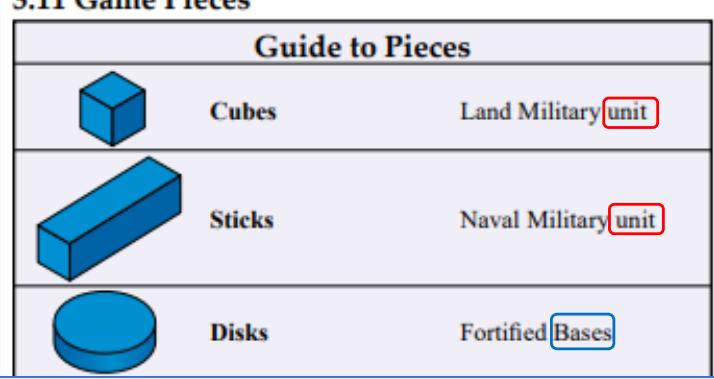
A base has a military value for the purpose of battle strength calculation, but it is NOT a unit.
So, the sentence in 8.51 implies that a base = 2 (i.e. twice the number) for the purpose of its defence value in a Diplomatic issue resolution context:
8.51 Diplomatic Issue

The resolution of the Diplomatic issue depends on the status of its Theater.
Contested or Enemy-Controlled Theater
The owning Faction commits up to three Strategos tokens from its pool. If the number of Strategos tokens, plus Treachery markers of his Side already present, is greater than the military value of Enemy military units, plus twice the number of Enemy Bases in the Theater, convert one Enemy League Base to a Friendly League base and remove all friendly Treachery markers in the Theater. Otherwise, place Treachery markers in the Theater equal to the number of committed Strategos tokens. If an Enemy base converts the issue owner gains 2 Honor and the other Side’s Controlling Faction loses 2 Honor.
The following thread will give supporting evidence to the answer:
https://boardgamegeek.com/thread/3114280/diplomacy-against-a-single-base
8.51. Building base in a neutral theatre does not award 2 honors.
The following thread will give supporting evidence to the answer (here Mark Herman corrected one of his previous posts; the one below is the final one):
https://boardgamegeek.com/thread/2002344/honour-clarification
9.0. MILITARY ISSUE RESOLUTION / BUILDING HOME UNITS
There has been a considerable number of threads on BGG asking to clarify the military issue resolution process, how and when home units are built and/or how many strategos must be spent at any given time and what happens when the active player no longer has any.
The easiest to answer all queries is to show the process as a diagram (process established from the perspective of the active player only):
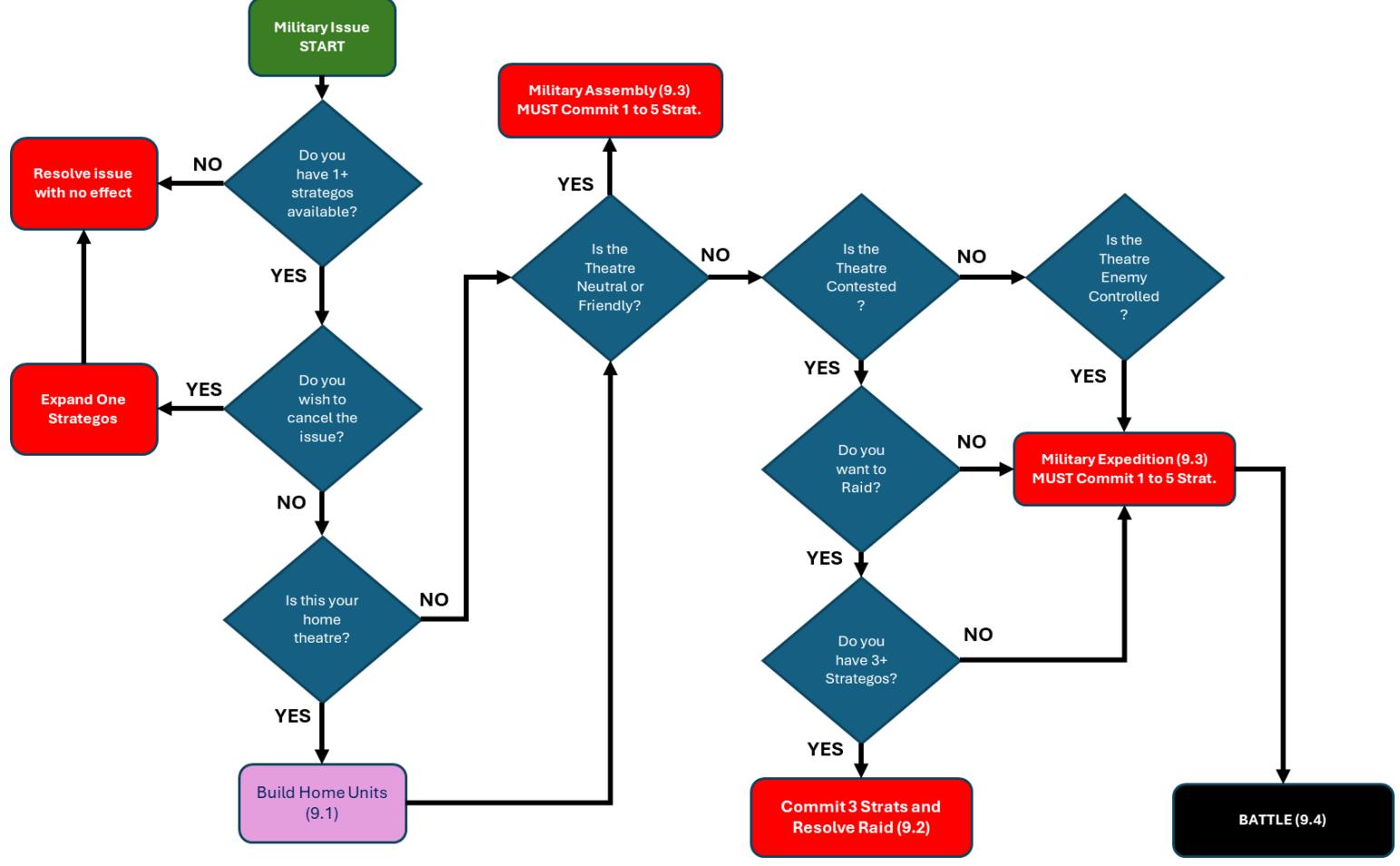
➔ Back up to clarification:
The main rule book makes perfect sense if the relevant section is read as a mandatory sequence, each step being executed before moving to the next (i.e. it is not a choice, just answer each point, execute and move on):
Abbreviated Military Issue Sequence
-
If issue is in owning Faction's City-State Theater, may build military units (9.1).
-
If Friendly-Controlled or Neutral Theater, Commanding General conducts a Military Assembly (9.3).
-
If Contested Theater, issue owner decides whether to conduct a Raid (9.2) or an Expedition Assembly (9.3) and Battle (9.4).
-
If Enemy-Controlled (or Contested; in lieu of a Raid) Theater issue owner conducts an Expedition Assembly (9.3) and Battle (9.4).
-
Expedition Assembly
a. All players secretly commit their Strategos tokens (9.31). b. Commanding General and his Compatriot reveal their Strategos tokens.
c. Commanding General executes unit movements (9.3).
d. The other Side now reveals their Strategos tokens. e. The Athenian Controlling Faction may choose to commit its State Ship Strategos token if it is available (12.3).
-
Resolve Battle (9.4).
-
Award Battle Honor (9.5).
-
Conduct Optional Second Battle (9.6).
ALL STEPS MUST BE FOLLOWED
By default, therefore, the active player will ALWAYS end up spending strategos as step 1 (build home units) must be followed by step 2 or 3 which MUST be met by relevant strategos commitments.
The only exception being if the active player wishes to cancel the issue altogether and therefore not start the resolution sequence. But even in that case, if able, he must pay at least one strategos (see rule 8.5)
There are several BGG threads that are relevant and support the above:
https://boardgamegeek.com/thread/1768607/understanding-begins-dawn
"… If the Commanding General has no Strategos tokens the Military issue is immediately resolved for no effect. AND the Commanding General must commit from 1 to 5 Strategos in 5a (9.31), this is where the rule is that you have to spend one, there is no option for the Commanding General to spend zero.
I would like to review this from the perspective of the abbreviated Military Sequence of Play; everything is covered in detail and in order.
- in the sequence is where you build Military units in the City State space. It is the first thing. If you are in any other Theatre, you would not do this, so you go to 2...
From 2 to the end the Military issue in all Theatres is identical, so the Raid decision (step 3 or 4) always comes after the city state build in step 1.
https://boardgamegeek.com/thread/1797825/military-issue-home-city-states-theater
"… the military issue costs 1 strategos even if cancelled. In this case the recruitment is done, but the onus to create a Military Assembly still exists, thus expending 1 strategos even if no military units are moved to the home theatre…"
9.32. MOVEMENT
9.32. Legal Path: a legal path only refers to connections over which a unit can travel (i.e. excluding brown and blue parallel lines, depending on the unit), within the restrictions imposed by "Peace", and it is "legal" to send a unit along a series of theatres linked by a legal path, even if the player knows that the unit will not be able to exit one of the theatres (e.g. for lack of required friendly base) before it gets to the theatre where the military issue is resolved.
➔ Back up to clarification:
Although there is no definition of what a "path" is in the game, we can infer that a path is made of one or more connections between two theatres:
See 9.32.F, making reference to "shortest path", implying theatres linked by connections:
F. A unit is not obligated to take a shortest path (or indeed,
even to move towards' the Expedition Theater), but it may
only stop moving when it cannot exit a Theater or reaches
the Expedition Theater. A unit may purposely take a path that
would cause it to enter a theater that it cannot exit.
Connections are defined as (3.12):
Theater Connections Theater Connections
Colored lines connect each Theater space to adjacent Theater spaces. Military units follow these connecting lines when they move during a Military Expedition. No Theater is adjacent to any other Theater except via a connecting line, regardless of relative position on the map. There are four types of Connections and several special Connection conditions, the effects of which are detailed in 9.32.
In this context, what is a path that would be "legal" for a unit to follow?
9.32 Military Unit Movement
Each Strategos token committed by the Commanding General and his Compatriot (if permitted) allows the movement of any one Friendly military unit, land or naval.
Units may move from multiple Theaters, may move through an unlimited number of Theaters, and can take any legal path desired until it must stop. A unit must stop when it either enters the Expedition Theater, or a Contested Theater which it is not permitted to exit via any Connection. Units may not stop in any other Theater.
Three factors will determine whether a unit may exit a Theater along a certain Connection; whether the moving unit is land or naval; the type of path (see map key); and the number of Enemy units and bases in the Theater it is exiting. In addition, certain Connections require a Friendly base in the Theater being exited. Refer to the table on the map for these interactions.
The only reference to forbidden movement, in relation to a connection, is shown on the movement table:



(see A)
No Exit Permitted
No Exit Permitted

So only brown (for naval units) and light blue (for land units) parallel lines are not legal connections and cannot therefore be part of a "legal path".
But there is also a reference to forbidden movement when Athens and Sparta are at war:
7.42 War and Peace Effect

A. When resolving a Military issue during War, there are no restrictions on where military units can move.
B. When resolving a Military issue during Peace, Athenian military units may not enter, but may exit, a Theater that contains Spartan Military units or Bases, and vice versa. League units and bases from either Side have no effect on movement during Peace and may move without restriction.
So, it is not legal, either, for blue pieces to enter a theatre containing red pieces, and vice versa, when at peace.
On the other hand, the rules do allow for a unit to move along a path which would lead it to a theatre from where it cannot exit:
Again see 9.32.F:
F. A unit is not obligated to take a shortest path (or indeed, even to move towards' the Expedition Theater), but it may only stop moving when it cannot exit a Theater or reaches the Expedition Theater. A unit maypurposelytake a path that would cause it to enter a theater that it cannot exit.
This includes theatres that cannot be exited for lack of a friendly base (e.g. Corcyra)
So a legal path only includes connections over which a unit can travel, within the restrictions imposed by "Peace", and it is "legal" to send a unit along a series of theatres linked by a legal path, even if the player knows that the unit will not be able to exit one of the theatres.
The following threads will give supporting evidence to the answer:
https://boardgamegeek.com/thread/3129108/details-on-freeform-movement
https://boardgamegeek.com/thread/3140866/infinite-movement-during-peace
9.32. Computing military value of friendly pieces to allow for theatre exit: the military value of the pieces staying behind to allow another friendly unit to exit a theatre includes the military value of bases (hence valid for land or naval calculations)
The following thread will give supporting evidence to the answer:
https://boardgamegeek.com/thread/1785316/movement-rules
‘Naupactus has a land strength of 3 (Delian League base + one land), so two Spartan units need to remain in Naupactus in order for the third one to exit.’
9.32. Exiting theatre restrictions: the requirements on land vs. naval units leaving a theatre follow the same logic despite the wording being slightly different for each type in the rules:
The following threads will give supporting evidence to the answer:
https://boardgamegeek.com/thread/2081491/932-land-unit-vs-naval-unit-movement
https://boardgamegeek.com/thread/3053359/on-last-attempt-to-clarify-the-landnavalmovement
9.4. BATTLE LOSSES
9.44. Loser losses:
The Rules state: "The losing side must take losses according to the units present on the winning Side (see table) but no more units may be eliminated than the loss differential."
In this context, should the loss differential be applied to the "Military Value" of the units or the number of "cubes or sticks" involved?
Mark Herman has clarified that the Military Value of the units should be used.
➔ Back up to clarification:
The main rule book has caused some confusion with many readers as there is no real definition on how the battle differential should be applied, either to the "number" of actual pieces (units) or their "military value".
9.44 Battle Loser Losses
The losing Side must take losses according to the units present on the winning Side (see table), but no more units may be eliminated than the loss differential. The Commanding General determines which units are eliminated, but he may not choose to eliminate units whose conditions are not fully met, and he may not combine losses from different rows of the table. Any fractional losses are disregarded. Eliminated units are returned to their Sides' stock and are immediately available. If one or more bases are eliminated the loser removes all friendly Treachery markers from the Theater.
For example, reading the above, assuming Athens (with 4 blue cubes) wins a battle against Sparta (with 2 red cubes) with loss differential of 2, would Athens eliminate 2 red cubes (number of pieces/units) or 1 red cube (of military value of 2)?
The battle losses table implies that the Military Value should be used by matching sets of units/pieces against others in a proportion expressed in relation to their relative value.
Although Mark Herman makes the battle loss differential apply to the loser, I found that the easiest way to get our head round it and explain the process, is to follow Mark Herman's recommendation and use the loss table by physically placing the cubes on it, but from the winner's perspective (i.e. place the winner's pieces on the table; this will achieve the same effect).
In the above example, Athens gained a loss differential of 4. For Athens, this is therefore equivalent to a military value of 4, equalling 4 blues cubes: now place the 4 blue cubes on the losses table:
| LAND <OMBAT LSSS: Battle Loser | |
| For each winning set of units | Remove losing set of units |
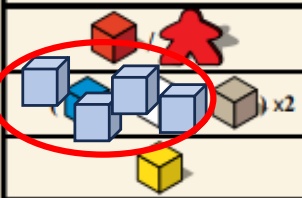 | |
Each set of 2 blue cubes will therefore kill 1 red cube. Here, 4 blue cubes kill 2 red cubes. And two red cubes = loss differential = red cubes military value = 4
Note that if the loss differential had been 3 only, then only 3 blue cubes would be placed on the table, and this would limit the red cubes losses to 1 only:
| LAND <OMBAT LSSS: Battle Loser | |
| For each winning set of units | Remove losing set of units |
| ) x2 | |
| x2 | |
It takes a full set of 2 blue cubes to kill 1 red cube, so the third blue cube has no effect and only 1 red cube is eliminated. And 1 red cube = cube military value = 2 = loss differential - 1 being "fractional loss[…] disregarded" per 9.44: the extra differential point is lost as it cannot be applied fully (for this to happen, for example, a yellow league cube would have had to be present,
in which case it could have been eliminated by a single blue cube.)
The same rule applies if Sparta wins. Assume 1 red cube spartan army wins against 3 blue cubes Athenian army, with a loss differential of 2. For Sparta, this loss differential is therefore equivalent to a military value of 2, equalling 1 red cube (red cubes have a military value of 2 each, see 9.42): now place the 1 red cube on the losses table:
| LAND <OMBAT LSSS: Battle Loser | |
| For each winning set of units | Remove losing set of units |
| 大 | x2 |
| x2 | ⭐ |
Each set of 1 red cube will therefore kill 2 blue cubes. Here, 1 red cube kills 2 blue cubes. And two blue cubes military value = loss differential = 2
In the above example, Athens started the battle with 3 blue cubes, lost 2 and is therefore left with one only.
There have been many threads on BGG that relate to this topic and Mark Herman has replied consistently by indicating that the military value should be used when calculating the number of eliminated units driven by the battle “loss differential” generated by the winner.
The following threads will give supporting evidence to the answer:
https://boardgamegeek.com/thread/1765425/battle-rule-help
“…Rule 9.42: When a Battle occurs, each Side totals the military values of the units, bases, and Treachery present in the Theatre as well as Friendly Strategos tokens committed earlier.
This rule sits directly above the Military Value Table where we see that each red cube equals 2 Military Value and all other cubes equal 1 Military Value. So, lose 9 Military Value for the Athenian means to lose 9 cubes (only Spartan cubes are worth 2 Military value)…”
https://boardgamegeek.com/thread/1870103/combat-loss-differential
“…Mike's first point is the right answer which I have quoted here.
Quote:
I would say, based on the link above, that each such kill equates to 2 of the loss differential, so that it takes all 4 of the differential to remove both spartan cubes, and that this satisfies the loss…”
And one final reference, clearly stating Mark Herman’s intention on the topic:
https://boardgamegeek.com/thread/1894340/loss-differential-1-944-question
Building on the previous thread, the following makes it clear that once all units (“cubes” and “sticks”) of a side have been eliminated, any remaining loss differential may be applied to any surviving base(s) of that side. For each two loss differential points remaining, one base can be eliminated (two being the military value of a base). In other words, one point only of loss differential remaining is not enough to eliminate a base:
https://boardgamegeek.com/thread/1894347/eliminating-enemy-base-944-question
9.45. Winner losses: The battle winner may lose units based on the loser’s number of units that have been eliminated after the battle in question. This is driven by the combat losses table.
➔ Back up to clarification:
Again, you may use the relevant loss table (Battle Winner) and place on it the units lost by the loser to determine the impact on the winner. If we take the very last example where a 1 red cube spartan army defeated a 3 blue cubes Athenian army with a loss differential of 2, Athens lost 2 blue cubes which we now place on the table:
LAND <◇MBAT LSSS: Battle Winner
| For each losing set of units | Remove winning set of units |
| ) x4 | |
| ) x2 |
It takes a set of 4 blue cubes to kill 1 red cube. 2 blue cubes, therefore, cannot kill the red cube and Sparta takes not loss.
The following threads will give supporting evidence to the answer:
https://boardgamegeek.com/thread/1765425/battle-rule-help
“…Rule 9.45: After the loser takes losses, the winner takes losses based on the losses sustained by the loser.
Please note that there is no mention of the differential or anything else to include any other units on the losing side since it's based on losses not losers present. So, once again we look at the graphic and it states:
One eliminated red cube you remove one Athenian cube (any colours) For each set of four Athenian cubes (any colours) you remove one red cube For each set of two yellow cubes you remove one Athenian cube (any colours) For each set of two Athenian cubes (any colours) you remove one yellow cube.
That's it... I purposely kept it down to two sentences and a picture, which has definitely confused some folks, my apologies.
The naval works exactly the same way. I think once you take it literally it works and once you get it you no longer need the table or the rule...”
11.0. END PHASE
11.11. Honor Automatic Victory: the Honor Automatic Victory only applies to scenarios 14.2, 14.3 and 14.4 (i.e. longer/"full" games) and requires the leading faction to computes its total honour vs. BOTH enemy factions put together:
https://boardgamegeek.com/thread/1778568/honor-automatic-victory-information
"… Lastly, in the third bullet of the rule the potentially winning player has to have 3x Honor of 'any' as in both of the enemy factions
11.13. Athens Granary Theatres: Sparta is a Granary Theatre so if Athens has a base there it qualifies to prevent an automatic Spartan Granary victory, as long as Athens holds the base in Sparta.
https://boardgamegeek.com/thread/1880389/athens-base-sparta-granary-surrender
11.3. REDEPLOYMENT
When redeploying, a side may leave either one land unit OR one naval unit IF there is NO friendly base (League or City-State). If there is a friendly base, only units of its colour may stay there (except for blue units which may stay with a white disc); all others must redeploy.
https://boardgamegeek.com/thread/2119551/redeployment-question
IN ADDITION TO THE ABOVE:
In a theatre with no base, each side can leave one unit. In other words, for example, one (only) Athenian/Delian unit (naval or land) and one (one) Spartan/Peloponnesian unit (naval or land) can coexist in the same theatre where there is zero base.
https://boardgamegeek.com/thread/2097444/strategos-tokens-and-easily-missed-rulesnew-playe
13.0. PERSIAN BASES
Spartan League issues may be placed in Persia if Alcibiades is in Persia OR Sparta has EITHER a Spartan (red) or Peloponnesian League (yellow) base in Ionia.
https://boardgamegeek.com/thread/1799751/persian-war
Persian bases count for maintenance (11.2) and economic bonus (11.14.B) in end game tally.
https://boardgamegeek.com/thread/1786496/persian-bases-maintenance
But the Persian theatre does NOT count as geography bonus (11.14.D)
https://boardgamegeek.com/thread/1793388/does-persia-theater-count-end-scoring
11.14. END OF GAME SCORING
Contrary to the published rules, Mark Herman issued an amendment to the end game scoring whereby, on the last turn, only theatres containing a base can either be counted as contested or controlled. Units only (i.e. no base) do not grant control or contested status to a theatre for the purpose of scoring geographical bonus.
https://boardgamegeek.com/thread/3259877/end-game-scoring-land-grab
To my knowledge, the only place Mark Herman clarified the end game scoring change officially was in an article published in Ci3 magazine; I do not have this formal reference and I would hope GMT could publish this on their website as many players do not have access to that magazine and are not aware of this new rule.
OTHER RULES (SCENARIOS)
RAVAGES OF WAR
The 300 Unit can be eliminated under this rule (14.43):
https://boardgamegeek.com/thread/1762468/three-hundred
PHORMIO RELATED RULES
PHORMIO’S THEATRE ISSUE PLACEMENT
The question about: Is there a friendly base in a granary theatre and/or no base with a league issue in the granary?
Once there is either a friendly base in at least one granary theatre, or no base but a League issue in the queue of the relevant theatre, then the answer to the diamond is yes:
https://boardgamegeek.com/thread/1788783/phormio-theatre-issue-placment-3rddiamond
PHORMIO STRATEGY MATRIX
For Athens: when asking if any Granary theatre lacks a friendly base, read:
ALL Granary Theatre lacks a friendly base.
So as long as there is one granary theatre with a base the condition is met, and you continue down the list.
https://boardgamegeek.com/thread/1781849/phormio-athens-granary-defense
Download MarkdownTexts are community-compiled or publicly released by publishers; copyright remains with the original authors. For personal reference only.