
Photosynthesis
At a glance
Rules, cards and Q&A (Chinese)
The rules, card data and player questions for this game are written in Chinese. Open the Chinese page to read them.
Where to find full rules
Full rules and card lookup are available in the cunlema app at cunlema.cn — pick this game and ask about any rule, card or turn you are unsure about.
Related games
Rulebook text (Markdown)
This game has 2 rulebook Markdown file(s) in our library; 2 rendered inline below — expand to read or download.
rules_zh_光合作用_788.md8.3 KB
中光合作用
翻譯:陳浩仁
監修:何仲焜
美術:Laangel
設計:Hjalmar Hach
插畫:Sabrina Miramon
玩家人數:2-4 年齡:8歲 或以上 遊戲時間:45-60分鐘
遊戲概覽
在這片細小但肥沃的森林裏·陽光照耀·數種樹木競相茁壯並開枝散葉。每棵樹把樹枝伸向天空、努力地攫取太陽的恩惠(陽光點數)的同時,也在身後留下越來越長的影子,遮蔽較矮小的樹木。當一棵樹的生長周期完結,玩家就能按照其所在土壤的肥沃程度獲得分數。
遊戲配件
規則說明書(中文/ENG)
1張遊戲版圖
1塊太陽板塊
4個公轉標記
4塊玩家版圖
1個起始玩家標記
24個分數指示物
4個陽光點數標記
24個 種子指示物(每種顏色6顆)
32棵小樹(每種顏色8棵)
16棵中樹(每種顏色4棵)
日棵大樹(每種顏色2棵)
遊戲目的
花費腸光點數,照料你的樹木,把它們從種子種植成擎天巨木·最後按照所在土壤的肥沃程度獲得分數。
遊戲設置
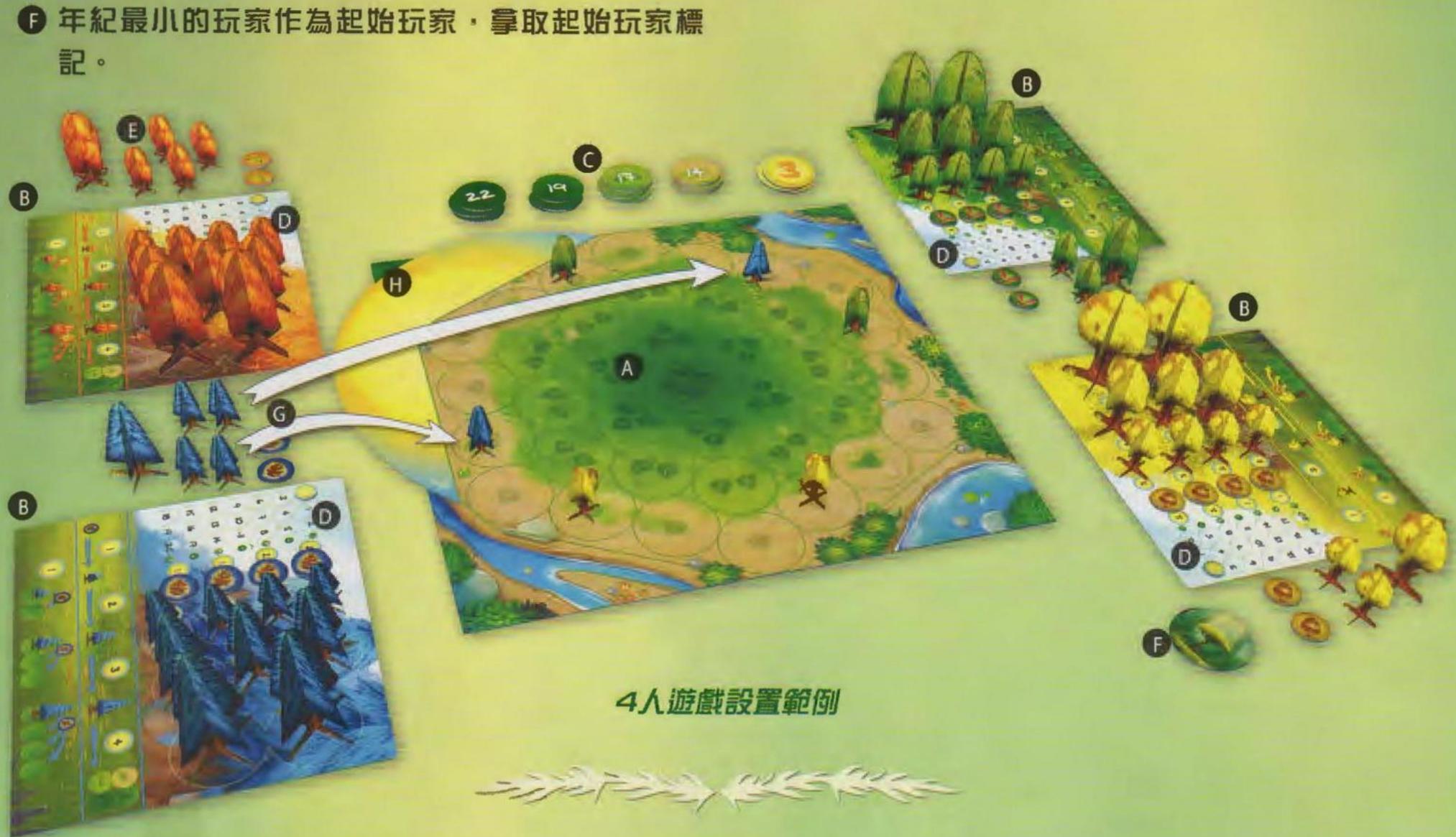
把遊戲版圖放到中間。
③每位玩家拿取1塊玩家版圖、1個陽光點數標記,並根據自己版圖的顏色,拿取相同顏色的6顆種子、日棵小樹、4棵中樹、和2棵大樹。
把分數指示物按顏色深淺和樹葉數量分成4叠,放到遊戲版圖旁邊·每疊按分數由高至低排列(高分在最頂)。
把4顆種子、4棵小樹、3棵中樹、和2棵大樹放到自己版圖上相應位置,並把陽光點數標記放到記錄表上「口」那一格。
把餘下的2顆種子、4棵小樹、和1棵中樹放到玩家版圖旁、稱為「備用區」的位置,表示每位玩家在遊戲開始時已經可用的種子和樹木。
由起始玩家開始,每位玩家按順時針方向,輪流把1棵自己備用區的小樹放到遊戲版圖最外面那圈的任何一格(一葉土壤),直到所有人都放了2棵小樹。
最後把太陽板塊放到遊戲版圖上太陽符號的位置,並預留足夠空間讓太陽板塊旋轉到6個指定位置。把1、2、3的公轉標記按大至小排序(3在最頂),疊好放到遊戲版圖旁,用來記錄公轉次數。第4個公轉標記只用於進階規則,若不用此規則則將之放回遊戲盒。
2人遊戲:把最深綠色的3個四葉分數標記放回遊戲盒·它們不會用於2人遊戲。玩家收割位於中央四葉土壤的大樹時,改為拿取三葉分數標記
遊戲回合
一局遊戲中,太陽板塊會旋轉三周·其間太陽會在不同角度灑下陽光·玩家需要獲得陽光點數·使樹木茁壯成長來獲得分數·每輪有下述2個階段:
1.光合作用階段(獲得陽光點數)
- 生長階段(花費陽光點数)
1. 光合作用階段:
擁有起始玩家標記的玩家·把太陽板塊按順時針方向移動1格,然後每位玩家根據太陽的新位置獲得陽光點數(註:遊戲的第一輪不用移動太陽板塊)。每棵沒有被其他樹的樹蔭遮住的樹木可以獲得陽光點數(見下一頁樹蔭圖例)。樹蔭會遮蔽高度相同或較矮的樹木,但無礙較高的樹木吸取陽光。玩家計算獲得的陽光點數總和·並按此調整陽光點數記錄表。
陽光點數會積累下去。每種樹獲得的點數如下:
小樹獲得1點
中樹獲得2點
大樹獲得3點
種子不會獲得點數。
樹蔭大小
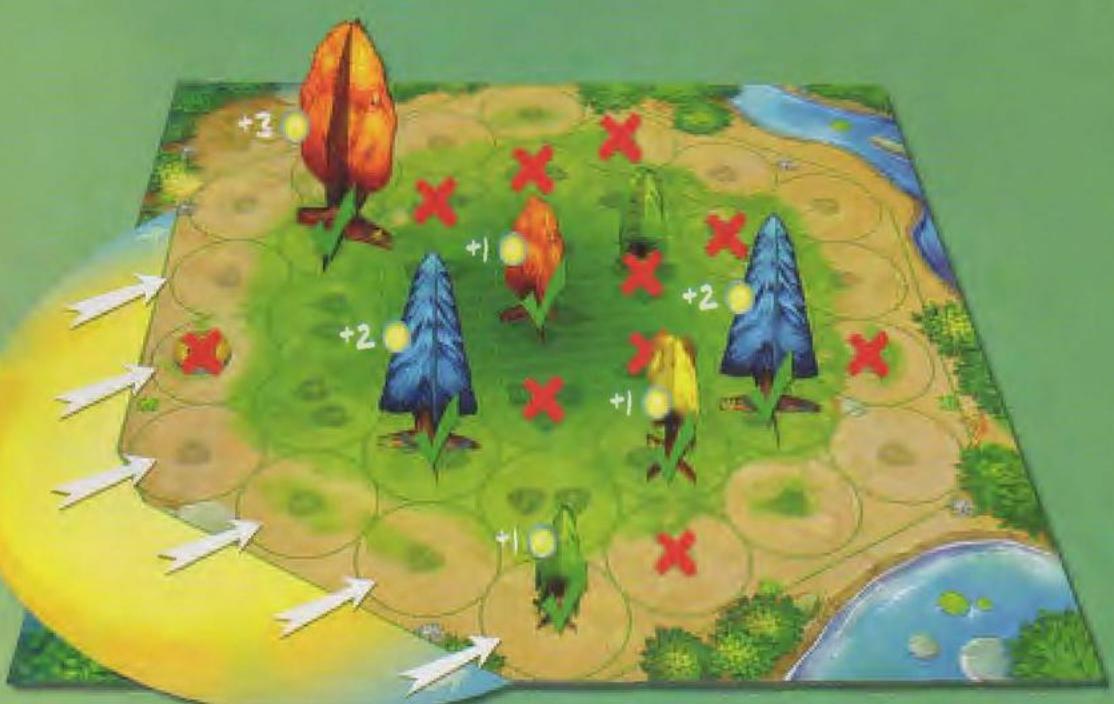
每棵樹會向太陽板塊的反方向留下樹蔭,大小如
小树1格樹蔭
中樹2格树蔭
大樹3格樹蔭
右圖中橙色和藍色各獲得4點、綠色和黃色各獲得1
11.生長阶段:
結算獲得的陽光點數後,由起始玩家開始,按順時針方向輪流進行玩家回合。在自己的回合中·玩家可花費陽光點數進行任意次數的行動。
但記得每回合每位玩家不能對遊戲版圖上的任何一格執行多於1次行動。
行動選項
購算玩家可用腸光點數購買自己版圖上的種子或任何大小的樹木。種子或樹木左邊的數字是購買的成本。每次購買,玩家必須從任何一行最下面購買起。
(即最便宜的那一個),在陽光點數記錄表減去所需點數後·便可將所買的種子或樹木放到自己版圖旁的備用

註:遊戲開始時,玩家版圖旁的2顆種子、2棵小樹、和1棵中樹已是在備用區,無需購買即可使用。
埋種子
玩家花費1點陽光點數,可在自己的樹木周圍埋下1顆自己備用區的種子。選擇1棵自己的樹木,根據它的高度,你可把種子埋在指定範圍內的其中1格空格,方向不限:
小樹1格範圍內
中樹2格範圍內
大樹3格範圍內

選擇1棵自己的樹木作為出發點:每輪每棵樹木只能作為出發點1次。換言之,每棵樹木在每輪只能散播1顆種子。
另外,玩家也不能在同一回合中先用某樹作為出發點埋種子、成長該種子、再以新樹為起點埋種子。
成長
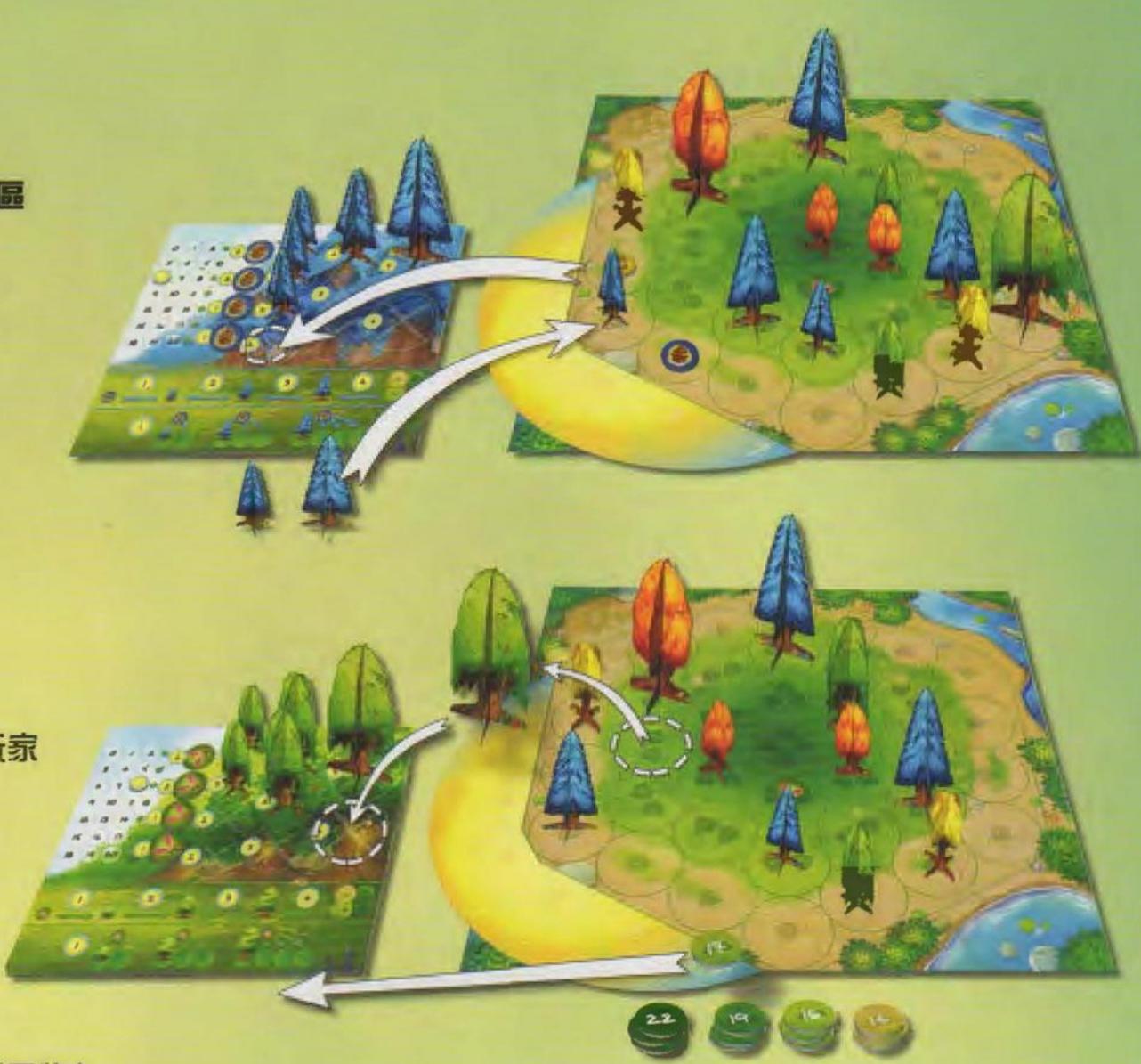
版圖上的種子或樹木只可長成下一級大小的樹木。
花費1點腸光點數把種子長成小樹
花費2點陽光點數把小樹長成中樹
花費3點腸光點數把中樹長成大樹玩家指定遊戲版圖上、自己的種子或樹木,把它放回自己玩家版圖上,然後從自己備用區拿取相應大小的樹木,放到剛拿走的位置。把回歸玩家版圖的種子或樹木,放到該種類中數字最大的空格·若已沒有空格則將之移出遊戲。


收割玩家花費4點陽光點數,
可收割1棵大樹以獲得分數。
從遊戲版圖拿取自己的大樹,回歸玩家版圖上數字最大的大樹空格。
該玩家根據樹木所在土壤有多少塊葉子,拿取相應圖示最頂(最高分)的分數指示物。
若該疊分數指示物被拿光,則拿取下一疊最頂的指示物(如:三葉分
數指示物被拿光,則拿取兩葉分數指示物)。
一輪結束
當每位玩家都進行了自己的回合,把起始玩家標記傳給左邊的玩家,然後執行新一輪的光合作用階段。
當太陽板塊旋轉了一周,把最大的公轉標記放回遊戲盒。
遊戲結束
當太陽旋轉了三周,並拿走了最後1個公轉標記,遊戲結束。玩家計算自己分數指示物的分數總和,另外每剩餘3點陽光點數可獲得1分(忽略餘數)。最高分的玩家勝出遊戲·若最高分遇平手,這些玩家當中,在遊戲版圖上擁有最多種子和樹木的玩家勝出;若再遇平手,則他們共享勝利。
進階規則
若玩家們都媚熟於基本規則,希望有更多桃戰,可以嘗試加入以下1-2項進階規則,為遊戲帶來更多變化:
加入第4個公轉標記,遊戲會在太陽板塊旋轉四周後才完結。
被樹蔭遮住的種子或樹木不能成長,種子亦不可埋在被樹蔭遮住的空格。
鳴謝
Giovanni Intini, Riccardo Sandroni, Karim Khadiri, Angela Lovat, Isabella Fattori, Lorenzo "Lollo" Cudicio, Chiara Pezzi,Gabriele Zuttion, Ivano Da Ronco, Pigiu, Roberto Pestrin, Federico Formentini, Davide Bardelli, Marco Piasentier, FilippoBertolini, Carlo Burelli, Emanuele Degano, Quarta Dimensione (Udine), IdeaG. 我更想感謝 Simon Le Minor 持續的付出·還有一直對道款遊戲的信心;感謝 Sabrina Miramon 令人屏息的美術:感謝 Giovanni Bernardis 測試這遊戲無數次。另外我特別希望感謝MaurizioVergendo慧眼找出這款遊戲,並由此樹立我們的友誼。
©2017 Blue Orange. Photosynthesis and Blue Orange are trademarks of Blue Orange. Game published and distributed under license by Blue Orange, 97 impasse Jean Lamour, 54700 Pont-à- Mousson, France. Made in China. Designed in France. www.blueorangegames.eu
Download MarkdownPhotosynthesis US Rules.md11.7 KB

Author: Hjalmar Hach Illustrator: Sabrina Miramon
2 to 4 Players – 8 and up – 45-60 Minutes
INTRODUCTION
Several varieties of trees compete to grow and spread their seeds in the sunlight of this small, but fertile, forest. As each tree grows its leaves are touched by the sun's rays, collecting Light Points and casting shadows on the surrounding smaller trees. When a tree reaches the end of its life cycle, players win points proportional to the richness of the soil the tree was rooted in.
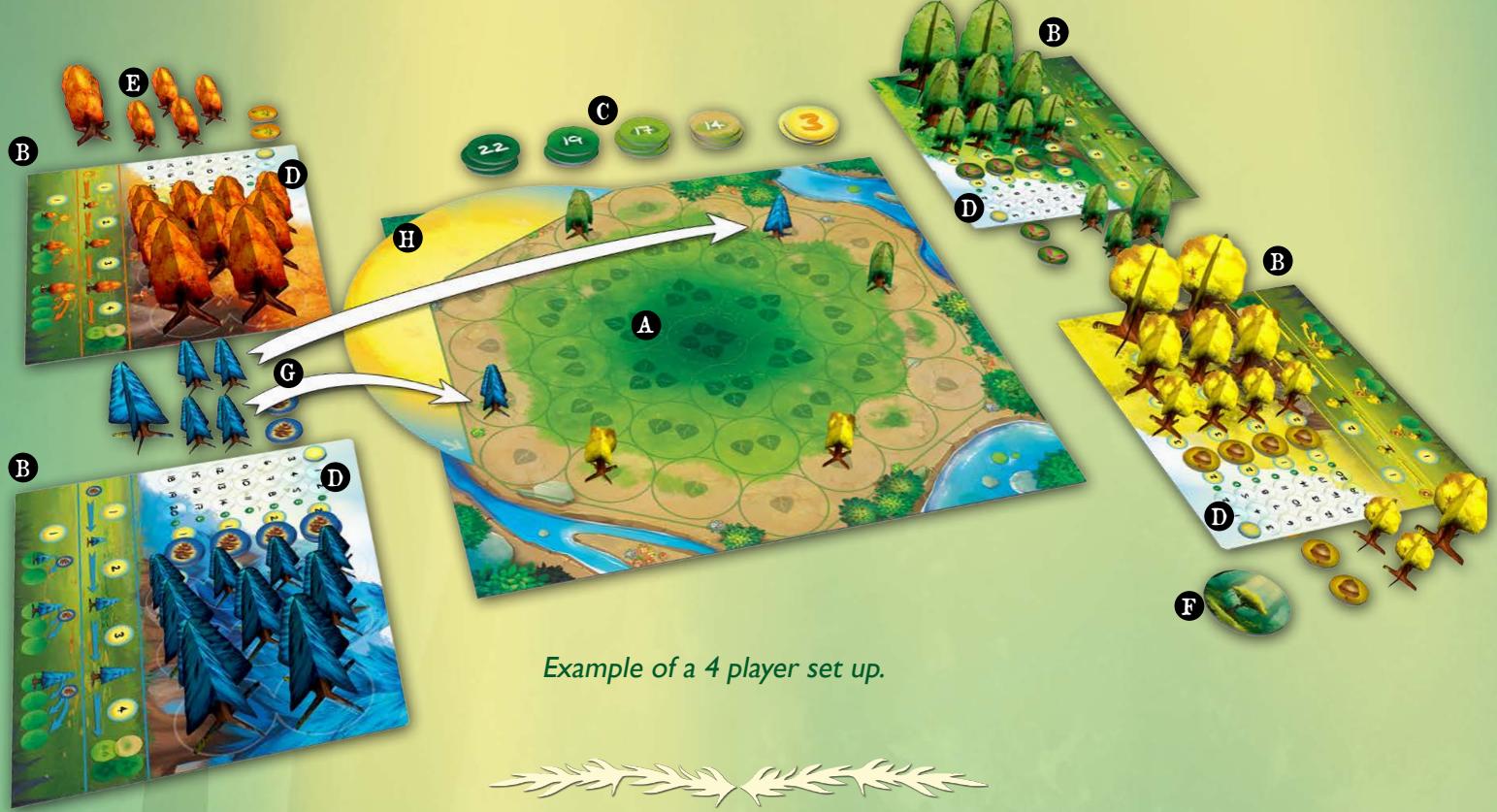
GAME COMPONENTS
Illustrated Rules
I Game Board
I Sun Segment
4 Sun Revolution Counters
4 Player Boards
I First Player Token
24 Scoring Tokens
4 Light Point Trackers
24 Seed Tokens (6 of each variety)
32 Small Trees (8 of each variety)
16 Medium Trees (4 of each variety)
8 Large Trees (2 of each variety)

OBJECT OF THE GAME
Using your light points, take your trees through their life cycles, from seedlings to fully grown.Then, collect Scoring Tokens with points proportional to the richness of the soil on which the trees grew.
SET-UP
Set the main board in the center of the table.
B Give each player I Player Board, I Light Point Tracker, 6 Seeds, and 14 Trees: 8 small, 4 medium and 2 tall (matching the tree variety on their Player Board).
Stack the Scoring Tokens in 4 piles (according to their shade of green and number of leaves) next to the board, in descending order so the highest scores are at the top of each pile.
①On each Player Board place 4 Seeds, 4 Small Trees, 3 Medium Trees, and 2 Large Trees on the corresponding open spaces. Then, set the Light Point Tracker on “0”.
Place the remaining 2 Seeds, 4 Small Trees, and I Medium Tree alongside each Player Board; these are the seeds and trees available to each player at the beginning of the game.
The youngest player starts the game, making sure to take the First Player Token.
© Taking turns, players place I of their available Small Trees on a space of the external edge of the main board (the I leaf zone).Taking turns again, they place a second Small Tree.This will allow players to collect Light points during the first Photosynthesis Phase.
Finally, place the Sun Segment on the sun symbol printed on the board (making sure there is enough space around the board to move the sun freely to each of the 6 positions).To keep track of the sun's revolutions, set the Ist, 2nd, and 3rd Revolution Counters on the edge of the board in numerical order. Unless playing the advanced version, leave the 4th counter in the box.
2 player game: Leave the 3 darkest green Scoring Tokens that have 4 leaves printed on them in the box, they will not be used.When players collect Scoring Tokens from the middle 4 leaf space, they instead take the tokens from the 3 leaf stack.
PLAYING A ROUND
In Photosynthesis, the goal is to maximize tree growth in the time it takes for the sun to circle the board three times. Each time the sun is in one position, a round is played. Each round has two phases:
- The Photosynthesis Phase (collecting light points)
- The Life Cycle Phase (taking actions using light points)
I-THE PHOTOSYNTHESIS PHASE:
The player with the First Player Token moves the Sun Segment clockwise, to the next angle on the hexagonal board (note: this step is skipped during the first round of the game). Light points are then counted based on the new position of the sun. Players get light points for each tree that is not in the shadow of another tree (see shadow sizes on the next page). Players add their light points to their Player Boards by moving the Light Point Tracker.
Light points accumulate from round to round, but a player may not have more than 20 light points at any given time.Any additional points earned are not scored, and cannot be used. Light points are scored as follows:
A Small Tree scores I point
A Medium Tree scores 2 points
A Large Tree scores 3 points
No points are scored for seedlings.
Shadow sizes:
All trees cast a shadow onto trees that are the same size or smaller, on the side opposite the sun. A tree that is taller than a shadow-casting tree is not shadowed, and receives full light points.Trees in the shadow retain the ability to cast their own shadow, and trees may cast shadows on their own variety.The shadows are casted as follows, in straight lines corresponding to the arrows illustrated on the Sun:
Small Trees cast a I space shadow
Medium Trees cast a 2 space shadow
Large Trees cast a 3 space shadow

In this example, the orange trees earn 4 light points, the blue trees earn 4 light points, the green trees earn I point, and the yellow tree earns I point.
2- THE LIFE CYCLE PHASE:
Once all light points have been counted and scored, the round continues clockwise with whoever is in possession of the first player token. Players are then free to spend their light points on any number of actions, and can choose to exhaust their light points, or only use a portion of them (keeping those leftover for future rounds). Each player carries out all the actions they wish to do during their turn before it is the next player's turn.
Important: During their turn, a player cannot carry out more than one action on the same space on the main board. Once a player has acted upon a space on the main board, that space is considered activated and cannot be used again by this player on that turn. A A
POSSIBLE ACTIONS
BUYING: Players can use their light points to purchase seeds or trees of any size from their Player Boards.The numbers next to them correspond to their value in light points.They must buy from the bottom of the board up, in any column (from the least to the most expensive). Once a player has bought the pieces
needed, and subtracted the value in light points using the tracker,
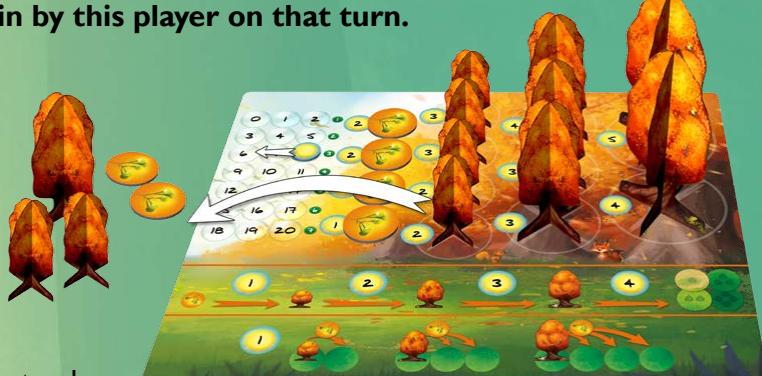
the pieces are moved to the available area next to the Player Board.
NoTE:The 2 Seeds, 2 Small Trees, and I Medium Tree left in the available area at the end of the set up are available to plant without buying, in future rounds.Any other seeds and trees a player wishes to use from their Player Board must be bought, and then placed in the available area.
PLANTING A SEED:
Players can plant a Seed around one or more of their trees, using one light point per Seed.A Seed from the available area can be planted at a distance that is determined by the size of the tree from which it originates.You can plant a seed in any direction, including nonlinear directions, as long as the spaces connect.
One space from a Small Tree
Up to 2 spaces from a Medium Tree
Up to 3 spaces from a Tall Tree

Planting a seed activates the tree of origin's space, as well as the space the seed is placed on. Therefore during their turn a player cannot plant more than one Seed originating from the same tree.Additionally, they cannot grow a tree from one size to the next, and then plant a Seed using that same tree as its origin.
GROWING A TREE:
A seed or tree can be replaced only by a tree that is the next size up.
Growing from a Seed to a Small Tree costs I light point
Growing from a Small Tree to a Medium Tree costs 2 light points
Growing from a Medium Tree to a Large Tree costs 3 light points
Players can only take new trees from their available area to grow seeds or trees on the main board.Trees and seeds that are removed and replaced from the main board are then placed on the Player Board, on the topmost available space. If no corresponding spaces are open, the trees or seeds are discarded into the box for the remainder of the game.
COLLECTING: Players can choose to collect Scoring Tokens by ending the life-cycle of their Large Trees.To do so costs 4 light points per Large Tree.
The Large Tree is removed from the main board and placed on the topmost available space of the player's Player Board. e
The player then collects the Scoring Token that is on top of the pile that matches the soil type of where the Large Tree was rooted.
If there are no tokens left in that pile, the player takes the top token of the next pile (Example: a player takes from the 2 leaf pile if the 3 leaf pile is g

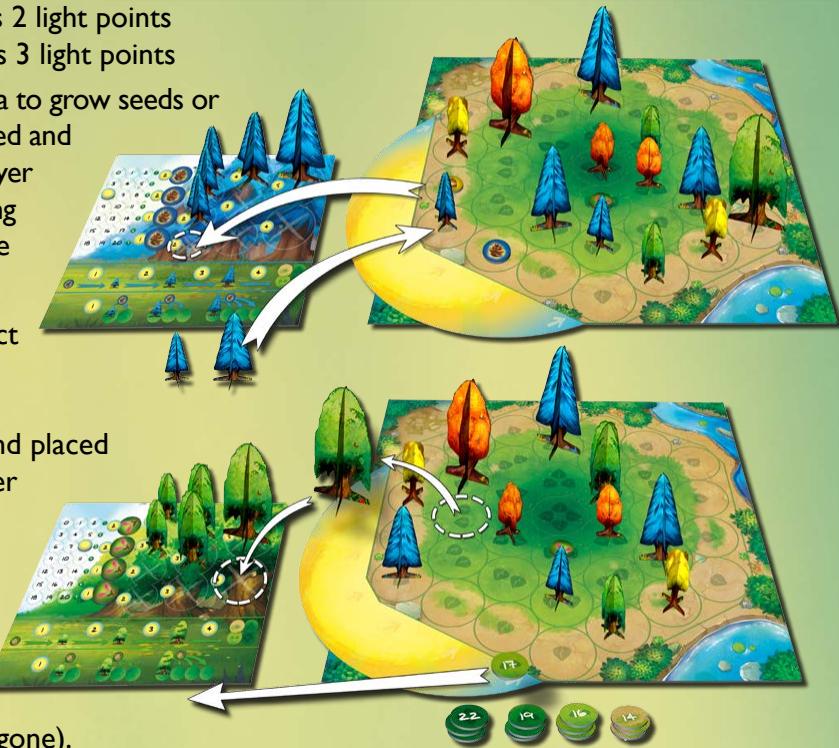
Once a tree has been collected, other players are free to plant in that space during that round.
Reminder: All of the above actions, except buying, activate a space on the main board (meaning you cannot act upon it again during your turn).This means that during your turn you cannot, for example, plant a seed and then grow it, grow a tree and then use it as a point of origin for a seed, use a tree as a point of origin for a seed and then grow it, or collect a tree and plant a seed in its space.
ADVANCED VARIATION
Once the basic rules have been mastered and players are comfortable with them,you can try a more intense variation by choosing to apply one, or both, of the following rules:
Include the 4th Sun Revolution Counter, giving the sun another revolution around the board.
Players cannot plant a seed or grow a tree when that seed or tree is shadowed by another tree.
ENDING A ROUND
After all players have taken a turn, the First Player Token is passed on to the next player, clockwise, and a new round starts with the Photosynthesis Phase.
When the sun has completed one revolution around the board, the top token of the Sun Revolution Counter pile is drawn and placed in the box.
END OF THE GAME
The game ends when the sun has completed three revolutions around the board, and the last Sun Revolution Counter has been drawn. A full game is 18 rounds, with the last round occurring at the 6th position of the sun (the one before the sun symbol printed on the main board). Players then count the points on their Scoring Tokens.They also add I point for every 3 unused light points (0-2 light points do not score any extra points). The player with the most points wins the game. In the event of a tie, the winner is the player with the most seeds and trees on the main board. If there is still a tie, both players win.
CREDITS:

Giovanni Intini, Riccardo Sandroni, Karim Khadiri, Angela Lovat, Isabella Fattori, Lorenzo
"Lollo" Cudicio, Chiara Pezzi, Gabriele Zuttion, Ivano Da Ronco, Pigiu, Roberto Pestrin,
Federico Formentini, Davide Bardelli, Marco Piasentier, Filippo Bertolini, Carlo Burelli,
Emanuele Degano, Quarta Dimensione (Udine), IdeaG. I would also like to thank Simon
Le Minor for his sustained efforts, and for believing in this game, Sabrina Miramon for her
breathtaking artwork, and Giovanni Bernardis for undertaking countless test. I would finally like to give special thanks to Maurizio Vergendo who discovered this game and whose friendship was born from this experience. Game created by Hjalmar Hach.© 2017 Blue Orange. All rights reserved for all countries.
Photosynthesis and Blue Orange are trademarks of Blue Orange. Made in China. Distributed under license by Blue Orange USA, San
Francisco, California, USA. Designed in France. www.blueorangegames.com

Texts are community-compiled or publicly released by publishers; copyright remains with the original authors. For personal reference only.