
Pret A Porter
At a glance
Rules, cards and Q&A (Chinese)
The rules, card data and player questions for this game are written in Chinese. Open the Chinese page to read them.
Where to find full rules
Full rules and card lookup are available in the cunlema app at cunlema.cn — pick this game and ask about any rule, card or turn you are unsure about.
Related games
Rulebook text (Markdown)
This game has 1 rulebook Markdown file(s) in our library; 1 rendered inline below — expand to read or download.
pap2_ENG_www.md60.2 KB
PRÊT-À-PORTER
Rulebook


Overview
Pret-a-Porter is an economic strategy game set in a world of fashion where Players run clothing companies and compete during fashion shows. Competition on the market is fierce – you win or you lose – so each Player has to choose his or hers market moves very carefully.
Course of the game is divided into twelve months, during which Players fight for market success and higher value of their companies by sewing clothing designs, showing their collections at fashion shows, hiring staff, buying buildings, signing contracts and investing their time and money in various other ways. Fashion shows are held four times a year in different cities around the world. Players' collections are evaluated on the basis of how well they fit the market trends, public relations that accompany the collection, quality and quantity of complete designs. These Features are evaluated in each city where the fashion shows take place, but may have a different degree of importance. Just like in a real market competition Players have little time to prepare, so they have to make wise choices answering their opponents' movements and adjusting their actions to market opportunities.

The Game's goal is to gain the greatest profit from clothing company in one year. Here, the profit is understood as the amount of money the company possesses in the end of a year when all costs are paid plus the value of company's brand (reputation, goodwill etc.)

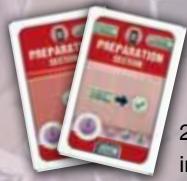

24 Building cards incl. 6 final Cards
24 Employee cards incl. 6 final Cards


50 Design cards
10 Credit cards
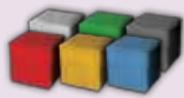
72 Material tokens (in 6 different colors)
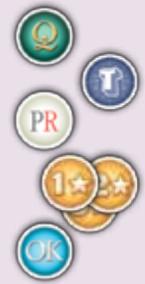
30 Quality tokens
19 Trend tokens
15 Public Relations tokens
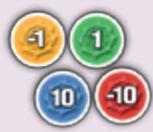
33 Star tokens
4 Collection Style adjustment tokens
13 bills of 100 thousand denomination (-10 on one side)
8 monthly maintenance costs/ incomes counters (in 4 different colors)
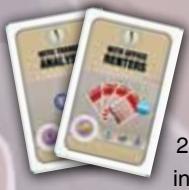
24 Contract cards incl. 6 final Cards
3 Loan cards
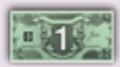
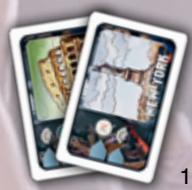
26 bills of 1 thousand denomination (golden on one side)
12 Action Pawns (in 4 different colors)
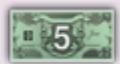
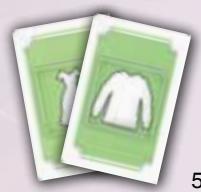
13 bills of 5 thousand denomination (golden on one side)

1 first Player token
10 Fashion Show cards
5 Design Type cards

33 bills of 10 thousand denomination (golden on one side)

19 bills of 50 thousand denomination (golden on one side)

1 calendar counter
4 Help cards
4 Players' Boards
1 Main Board
1 Rulebook
Boards' descriptions
In order to begin the game the basic knowledge about the Main Board and Players' Boards is required.
Main Board
The Main Board represents the market where transactions are made and where new Employees for hire, Buildings to buy and Contracts to sign appear. Players may also purchase diverse quality Materials to sew their clothing Designs, obtain new Designs and release some information about new Collection to the press, which will affect the evaluation of designs. There is also a possibility of getting money from a Bank in the form of Credit.
-
Places for Action Pawns
-
Bank field
-
Contracts field
-
Place for the Contracts deck
-
Buildings field
-
Place for Buildings deck
-
Employees field
-
Place for Employees deck
-
Designers field
-
Place for Designs deck
-
Calendar field
-
Local Manufacturer field
-
Warehouse field
-
Import field
-
Preparations field
-
Table of profits multiplier in the game of 2, 3 and 4 Players
Actions that Players may take on different fields are described further in the Playing the game part of this rulebook.
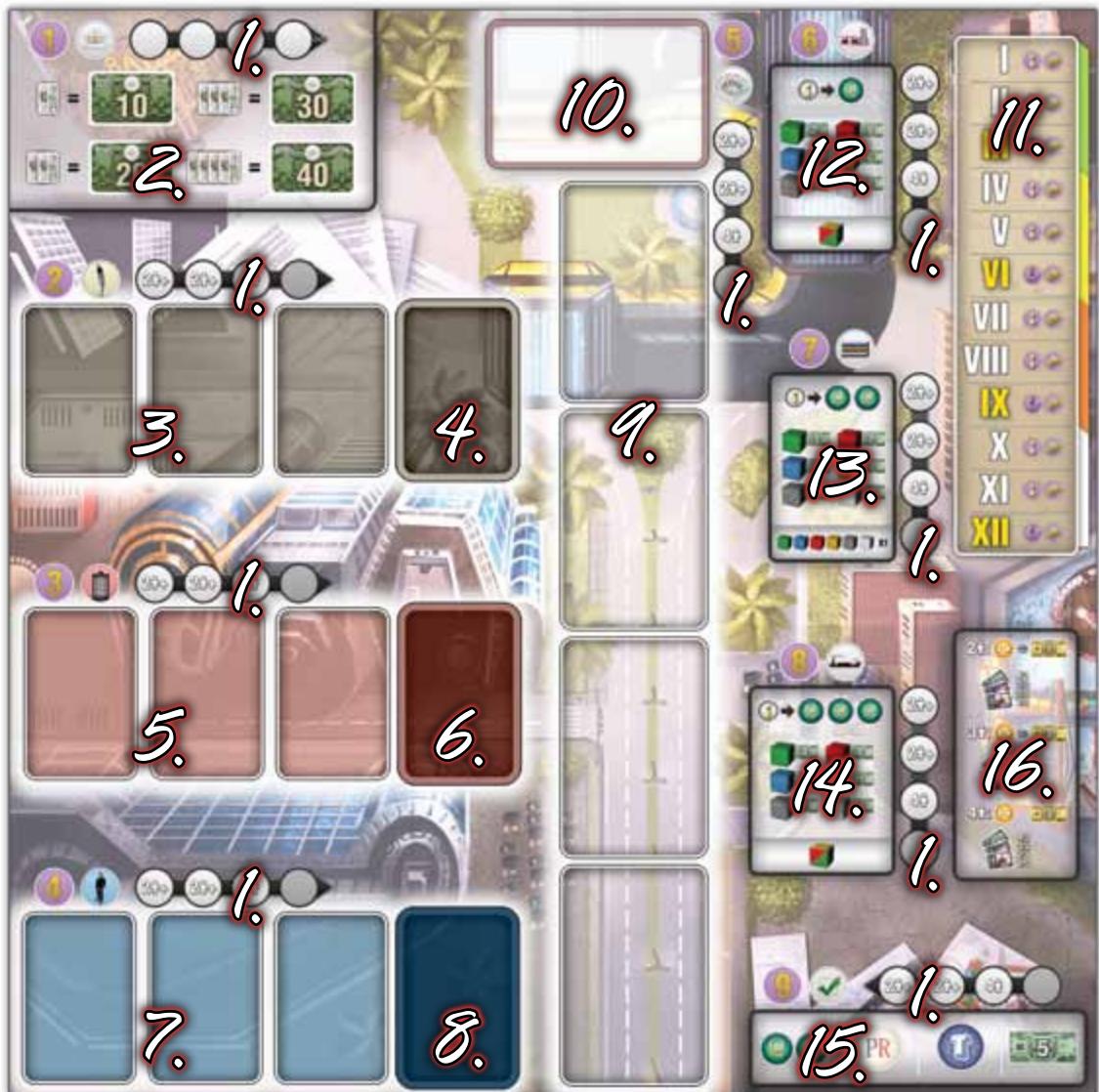
Player's Board – the company
Player's Board represents the clothing industry company which the Player manages. It shows important information about the company, such as monthly maintenance costs / incomes, employment, ownership of Buildings, signed Contracts and tokens increasing Collection's Features for the next show.

-
Place for Star tokens obtained during fashion shows (with short description of their further conversion to money)
-
Type of the Design in which the Player's company specializes in (each Design of this Type is automatically worth an extra Trend token for the Player)
-
Place for Trend, Public Relations (PR) and Quality tokens obtained during the two months of preparations before the next fashion show from other sources than Contract, Building and Employee cards
-
Current monthly maintenance costs/ incomes indicator
-
Place for Employees / employed unskilled workers
-
Cards of owned Buildings, additional Employees hired and Contracts signed are placed next to Player's Board
Company's Employees / Contracts / Buildings
Initially, the company employs three unskilled workers, who have a salary of1 thousand each. They are consequently replaced with newly hired specialists, a new Employee's card is put on top of the unskilled worker's space and changes the maintenance costs accordingly. The company that does not own Buildings can hire only up to 3 Employees. Each newly bought Building gives Player a place for one additional Employee (Employee's card is placed beneath the Building card). Buildings bought and Contracts signed are placed next to Players Board.
Setup
Without proper preparation it is quite impossible to play the game and so read this part carefully before playing. Follow the instructions and then enjoy the game.
-
Place the Main Board in such a way that each of the Players has easy access to it.
-
Prepare the pile of Materials, Quality, Trends and Stars arranged in a convenient place outside the Board.
-
Remove the cards with reverse showing the last quarter icon from Contracts, Buildings and Employees decks. Shuffle the remaining cards in decks and put top three cards from each deck brighter side up (not extended contracts, not yet trained Employees and Buildings that were not developed) on proper fields. Place the remaining cards in piles in designated places.
-
Cover the decks of Contracts, Buildings and Employees lying on the Board with final quarter cards (previously removed from those desks) face down so no one could see top cards of the stacks. Last quarter cards of each deck will come into play only for the last two months of preparations.
-
After shuffling the Design deck Players draw random Design cards so that each Player has a total of 2 Design cards without the profit icons (Trend,Quality or5Money) and not of the same style (Boho , Sport, etc.). Each Design card that does not match the criteria (i.e. marked with a profit icon or of the same style) should be discarded and when all the Players have 2 proper Design cards, the discard pile should be put back into Designs Deck and shuffled.
-
Reveal and place four top cards from Designs deck in appropriate places on the Board.
-
Place the rest of Designs deck face down on the board in the proper space.
-
From fashion shows deck remove the cards with reverse showing the last quarter. Other cards must be shuffled and randomly arranged face up next to the board in three rows of1, 2 and 3 cards each. First card represents the city of March fashion show, next two cards are cities for June, while the row of three cards stand for September shows. In the fourth row of December fashion shows the last quarter cards are placed face up.
-
Each Player receives bills with total value of 40 thousand.
-
The rest of the bills is placed next to the Board - they constitute a Bank during the game.
-
Players draw lots (determine randomly) in order to choose the First Player who receives the First Players token. If you don't want to draw lots, the youngest Player starts the game. Players take actions in clockwise order.
-
Players choose Player's Boards with various design Types starting with the last Player and going counterclockwise. Trend tokens should be placed on top of each Design matching the chosen Type.
-
Each Player takes a set of 3 Action Pawns and 2 monthly maintenance costs/ incomes counters in their colors (associated colors can be selected or chosen randomly).
-
Players place monthly maintenance costs/ incomes counters on Players' Boards in order to indicate maintenance costs. The -1 counter should be put on the field “3” and the -10 counter on the field “0"(cash), which represents the monthly cost of 3 thousand.
-
Calendar counter should be set to indicate the first round, January.
-
A space for discard pile should also be prepared.
Beginning of the game and the First Player token
The Player holding the First Player's token begins the game. Players take actions in clockwise order. During the game, after each month of preparations the first Player token is passed to the next Player in clockwise direction. During Fashion Show Months the token does not change hands

Cards with reverse showing the last quarter icon


Playing the game

Having the boards and cards placed in proper places you may start playing. This game depicts a year from company's operations on clothing market so the course of the game consists of 12 rounds, which represent months of the year.
Fashion Show month
Four of them are Fashion Show Months, while the eight remaining months Players spend on preparations for the shows. Each quarter consists of 2 Months of preparations, in which Players perform various actions and one month of fashion show, when Players' sewn clothing Collections are assessed and judged.
Preparations month

Course of the phases is different for Preparation Months and Fashion Show Month and thus in this rulebook there are separate descriptions for each of them.
Phases of Preparation Month
At the beginning of each month of preparations Players refill the Contracts, Buildings and Employees fields using 3 cards from the bottom of respective decks lying next to them. All those cards are placed brighter side up (if you are unsure which side is which – trained employees, developed buildings and the contracts that were NOT extended in most cases give the better profits to the owner). Also Design fields have to be refilled with 4 cards from the Design deck. If you run out of cards in the deck discarded Design cards have be shuffled and a new Design deck has to be created.
Each month of preparation is divided into four phases:
PHASE I – Actions planning
PHASE II – Actions execution
PHASE III – Training and development
PHASE IV – Maintenance: costs or profits

Actions Planning Phase
In Actions Planning Phase Players in turns place their Action Pawns on Main Board reserving the possibilities to sign Contracts, buy Buildings, hire Employees, acquire Designs, purchase Materials, take a Credit or work on Collection's preparations.
Each Player has three Action Pawns. Starting from the first Player and going in clockwise each Player puts one of his Action Pawns on one of available fields on the Board. When all Players have one action Pawn on the Board, the procedure is repeated twice, so that each Player has set all his or hers three Action Pawns on the Board. Each time an Action Pawn should be placed on first unoccupied field (counting from the left). Player may put more than one Action Pawn in the same field, if there is still available place there. The order of Action Pawns will be important in Actions Execution Phase.
Number of Players and available places for Action Pawns
Capacity for Action Pawns in each field on the Board is limited and dependent on the number of Play ers. In the game for 4 Players there are 3 places for Action Pawns available in each field on The board. In the game for 2 or 3 Players only 2 places on each field are available. Note that there is no limit to placing action Pawns on the Bank field – if a player wants a Credit, he or she will always have a chance to get it with an Action Pawn.
Actions Execution Phase
When all Players have placed their Action Pawns on the Board Actions Execution Phase begins. Players who have set their Action Pawns in places connected with specific fields on the Board may now perform actions related to these fields. Actions are taken in order of Action Pawns placement – owner of the first Action Pawn makes his action first. This rule is reversed in Preparations field, where owner of the first Action Token makes his action last and Player who has the last Action Pawn placed there acts first. This exception has been marked on the Board an arrow pointing in the opposite direction.
Actions (resulting from cards special capabilities) that do not require placing Action Pawns on specific fields are performed starting from the Player who has the First Player's token and going clockwise. If not stated otherwise, those actions are performed after the actions resulting from Action Pawns are finished.
Order of actions execution
1. Bank
a. Player may get a Credit here.
b. The exact rules for borrowing money from a Bank are discussed in Specific Rules Chapter: Credits and Loans.
2. Contracts field
a. Player chooses one Contract card from among Contract cards in this field and places it next to his or hers Player's Board.
b. From that moment this Contract is active until Maintenance Phase in upcoming Fashion Show Month.
3. Buildings field
a. Player chooses one Building card from among Building cards in this field and places it next to his or hers Player's Board.
b. Player has to pay the cost of Building's purchase (bills go to the Bank) and from that moment the Building is active.
c. Buildings have their costs of maintenance - after the purchase Player has to adjust the level of monthly maintenance costs and mark it with costs / profits tokens on Player's Board. Player must pay the maintenance costs of the Building until the end of the game (some Contracts may temporarily change the situation).
d. Each Building provides place to hire one additional Employee.
e. Active Building cards remain in play until the end of the game (the Building card cannot be discarded).
4. Employees field
a. Player chooses one Employee card from among Employee cards in this field and places it either replacing (covering) unskilled worker on Player's Board (up to 3 Employees) or on the lower part of Players unoccupied Building (if places on the Player's Board are already fully occupied). From this moment the Employee card is active.
b. Employees generate costs of maintenance (like their salaries) - after the purchase Player has to adjust the level of monthly maintenance costs and mark it with costs / profits tokens on Player's Board.
c. Each Employee remains active until the end of the game, unless the Player decides to dismiss him (Employee card is placed on discard pile). Employees may be released at any time by paying twice the cost of its maintenance to the Bank (this rule does not apply to unskilled workers, they are simply replaced).


5. Designers field
a. Player chooses one Design card from among Design cards in this field and places it next to his or hers Player's Board.
b. If any of the Players have Contracts / Buildings / Employees that allow them to take Designs at random, they do it before choosing the Design and take proper number of Designs from the top of Design deck starting from the first Player in this field. Other Players with no Action Pawns on this field, yet with the capabilities to take a Design at random - they do it after all Players' actions from Action Pawns were made. The order is consistent with the clockwise direction starting from the Player with the first Player token.
c. A Collection that may be presented during fashion shows is formed with finished Designs of the same style.
d. The Design is considered finished if two Materials that are listed on Design card are placed on top of this card.
6. Local Manufacturer field
a. For each Action Token Player may buy any number of Material pieces of1 selected type paying the appropriate amount of money to the Bank. Prices for one piece of various types of Materials are listed on the board in the Local Manufacturer field.
b. Player receives and places on his or hers Player's Board 1 Quality token for each purchase from Local Manufacturer (Action Pawn placed there) regardless of the number of Material pieces bought in this purchase (at least 1 Material piece bought for each purchase). This token is discarded after the end of closest month with fashion shows.
c. Player may buy as many Material pieces as he or she wants, regardless of the number of Designs or types of Materials needed to sew his or hers Designs (but still 1 type of Material for 1 Action Pawn placed in this field).
d. Number of Material pieces of each type is unlimited – it is not possible to buy the whole stock.
7. Warehouse field
a. For each Action Token Player may buy up to one piece of every Material type paying the appropriate amount of money to the Bank. Prices for one piece of various types of Materials are listed on the board in the Warehouse field.
b. Player receives and places on his or hers Player's Board 2 Quality tokens for each purchase from Warehouse (Action Pawn placed there) regardless of the number of Material pieces bought in this purchase (at least 1 Material piece bought for each purchase). These tokens are discarded after the end of closest month with fashion shows.
c. Player may buy as many Material pieces as he or she wants, regardless of the number of Designs or types of Materials needed to sew his or hers Designs (but still max 1 piece of each Material type for 1 Action Pawn placed in this field).
d. Number of Material pieces of each type is unlimited – it is not possible to buy the whole stock.
8. Import field
a. For each Action Token Player may buy any number of Material pieces of one selected type paying the appropriate amount of money to the Bank. Prices for one piece of various types of Materials are listed on the board in the Import field.
b. Player receives and places on his or hers Player's Board 3 Quality tokens for each purchase from Import (Action Pawn placed there) regardless of the number of Material pieces bought in this purchase (at least 1 Material piece bought for each purchase). These tokens are discarded after the end of closest month with fashion shows.
c. Player may buy as many Material pieces as he or she wants, regardless of the number of Designs or types of Materials needed to sew his or hers Designs (but still 1 type of Material for 1 Action Pawn placed in this field).
d. Number of Material pieces of each type is unlimited – it is not possible to buy the whole stock.
9. Preparations field
a. Note: reverse order of actions execution in this field.
b. Each Player may get one of the following profits: 2 Quality tokens, 1 PR token, 1 Trend token or 5 thousand bill. Tokens are placed on Player's Board.
c. Each Player always has a full choice of profits, there might be a situation where all Players take the same profit in this field in the same month
d. Tokens acquired in this field are discarded after the end of closest month with fashion shows.
Training and Development Phase
During this Phase, each Player may train one of his or hers Employees and develop one of his or hers Buildings. Players decide about their trainings and developments one after another starting with the Player with first Player token and going clockwise.
The cost of training/ development is given on each copy of Employee / Building card. Player pays the required amount to the Bank, and turns the card over to its darker side. Since then, the maintenance costs are higher, but also the abilities given by this card are better.
Players note the change in their monthly maintenance costs/ incomes with counters on the Player's Board.
Maintenance Phase
During months of preparations in Maintenance Phase Players pay all their costs, including costs of Ċredits / Loans taken (interests) and Buildings and Employees maintenance. Players note their monthly maintenance costs/ incomes coming from Employees hired, Buildings owned and Credits or Loans taken (interests to be paid monthly). There are two counters for each Player to be used: -1 and -10.
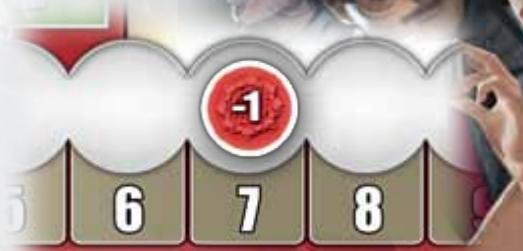
Example: T'he monthly cost of 7 thousand will be indicated by placing the -10 counter on the 0 field (cash) and the -1 counter on the 7 field. T'his represents the notation of $\dot { 0 } \ddot { } ( - 1 0 ) + 7 \ddot { } ( - 1 )$ = - 7. Similarly, the cost of 21 thousand will be written as $2 \ ^ { * } \ ( - l O ) + l \ ^ { * } \ ( - l ) .$ or the -10 on the field 2 and the -1 at the field 1.
These monthly costs may be reduced or changed by special capabilities brought to the company by cer tain Employees, Buildings and Contracts. There is a possibility that instead of incurring costs Player may end up having monthly income, which is marked with the +1 and +10 counters analogically.
If a Player does not have sufficient funds to pay the maintenance costs he or she is forced to take a 20 thousand Loan from Private Lender (Loan card). The exact rules for borrowing money from Private Lender are discussed in Specific Rules Chapter: Credits and Loans.
Cleaning the Main Board
At the end of each preparations month Players take all Buildings, Employees, Contracts and Design cards that were not taken by the Players off the Main Board to the discard pile (obviously this does not apply to card decks lying in proper places on Main Board).
In the end of this Phase the calendar counter should be moved by 1 month forward.
Phases of Fashion Show Months

Fashion Show Months (March, June, September and December) are significantly different from Preparation Months. During the month of exhibition Main Board is not refilled with cards, and First Player token is not passed on to the next Player.
Each Fashion Show Month is divided into five phases:
PHASE I - Stars Exchange
PHASE II - Collection Display
PHASE III - Collections' Features Comparison
PHASE IV - Collection selling
PHASE V – Maintenance: costs or profits
Stars Exchange Phase
At the beginning of this month Players exchange Stars received during previous fashion show for golden bills (reverse side of each denomination of bills). Each Star is worth 1, 2 or 3 thousand in terms of company's brand value, depending on the number of Players in the game:
In the game of 2 Players 1 Star is worth 1 thousand;
◆ In the game of 3 Players 1 Star is worth 2 thousand;
In the game of 4 Players 1 Star is worth 3 thousand;
Each Player takes the correct amount of money and places the bills with their golden side up beside his or hers Player's Board in a separate pile. This money stays there until the end of the game and cannot be used. These bills represent the value of company's brand name that is built during the game and they will be added to Player's financial result at the end of the game.
Collection Display Phase
Each Player chooses which Collection he or she will display at fashion show this month and he or she may choose only 1 Collection in a given Fashion Show Month. Collection consists of any number of finished Designs that share a common style (Sports, Boho, Vintage etc.). The Design is considered finished if two Materials that are listed on a Design card are placed on top of this card. It is the last moment for the Player to make changes in Materials' placement on Design cards. Unfinished Designs cannot be included into a Collection.
Collections' Features Comparison Phase
Collections at the shows are compared on the basis of the following Features: Quality Trends , Public Relations (PR) PR and Quantity
The Quality of the Collection is the sum of all Quality tokens available to the Player at the moment (Quality tokens gained from Materials purchases, preparations, from Employee, Building and Contract cards attached and in the form of profits from finished Design cards included in the Collection).
Collection Trends (that symbolize Collection's fit to current fashion trends) is the sum of all Trend tokens available to the Player at the moment (Trend tokens derived from the Design Type cards, preparations, from Employee, Building and Contract cards attached and in the form of profits from finished Design cards included in the Collection).
Public Relations of the Collection (that symbolize Collection's success in the media) is the sum of all PR tokens available to the Player at the moment (PR tokens derived from preparations and from Employee, Building and Contract cards attached).
Collection's Quantity is the number of Design cards that constitute this displayed Collection. Such Designs have to be finished and share a common style or be adjusted to fit the displayed style (some Employee, Building and Contract cards allow Player to change the style of Designs)
Quality or Trend tokens shown as profits on Design cards that are not displayed during fashion show, are not included in this count of Collections Features.
Cities
Depending on the game progress fashion shows are held in one city (in March), two cities (in June), three cities (in September) and four cities (in December) – Fashion Show cards order was determined during game setup.
In each city in a given Fashion Show Month Player displays one and the same Collection. Fashion Show cards (that is cities where fashion shows take place) differ when it comes to order of Features judged (i.e. in one city Quality is the most important, Trends in another one).
Number of judged Features
Moreover, the number of Features judged in fashion cities is being reduced as the calendar counter comes closer to year's end. And so:
◆ During the first Fashion Show (in March), all four Features listed on the Fashion Show card are judged;
◆ During the second Fashion Show (in June), only first three listed Features are judged and the fourth is ignored;
During the third Fashion Show (in September), only first two Features are judged, while last two are ignored;
During the fourth and final fashion show (in December), only the first Feature is judged in each city (final Fashion Show card include only one Feature, while the second one (in brackets) is taken into account only in case ofJournalist card).
Considering Fashion Show Cards
Fashion Show cards are considered one after another (1 card in March, 2 cards in June, 3 cards in September and 4 final cards in December). Players check the order of Features importance in every city For each Feature judged in each city Players determine who won the 1st and 2nd place. It is done by reading the judged Feature aloud and comparing Players' total scores in this Feature. Only 1st and 2nd place is awarded.
In a situation of two Players are in a tie for the 1st place in some Feature, they are treated as if each of them won the 2nd place in this Feature. If more than two Players are in a tie for 1st place, all of them get the3rd place which is not awarded. Analogically, a tie of two Players for 2nd place results in both of them having the 3rd place.
After determining the 1st and 2nd place in a Feature, Players are awarded with Stars.

The prize for 1st and 2nd place in a given Feature depends on Features order on Fashion Show card considered and the number of Players in game. It is shown in the table below:

| 2 Players | ||
| 1st Place | 2nd Place | |
| 1st Feature | 4 Stars | 1 Star |
| 2nd Feature | 3 Stars | |
| 3rd Feature | 2 Stars | |
| 4th Feature | 1 Star |
-8
| 3 Players | ||
| 1st Feature | 1st Place 4 Stars | 2nd Place 2 Stars |
| 2nd Feature 3rd Feature 4th Feature | 3 Stars 2 Stars 1 Star | 1 Star 1 Star |
| 4 Players | ||
| 1st Place | 2nd Place | |
| 1st Feature | 4 Stars | 2 Stars |
| 2nd Feature | 3 Stars | |
| 2 Stars | ||
| 3rd Feature 4th Feature | 2 Stars 1 Star | 1 Star |
After determining and awarding 1st and 2nd place in a given trait, Players check in the same way the following Features that are judged in this Fashion Show Month (as described earlier, all 4 Features in March, 3 in June, 2 in September and only 1 in December). If Player's displayed Collection doesn't have any points in a given Feature (like 0 PR tokens when PR Feature is being checked), he or she cannot score any place and be awarded in this Feature.
Collection Selling Phase
After the fashion shows are over Players automatically sell their displayed collections.
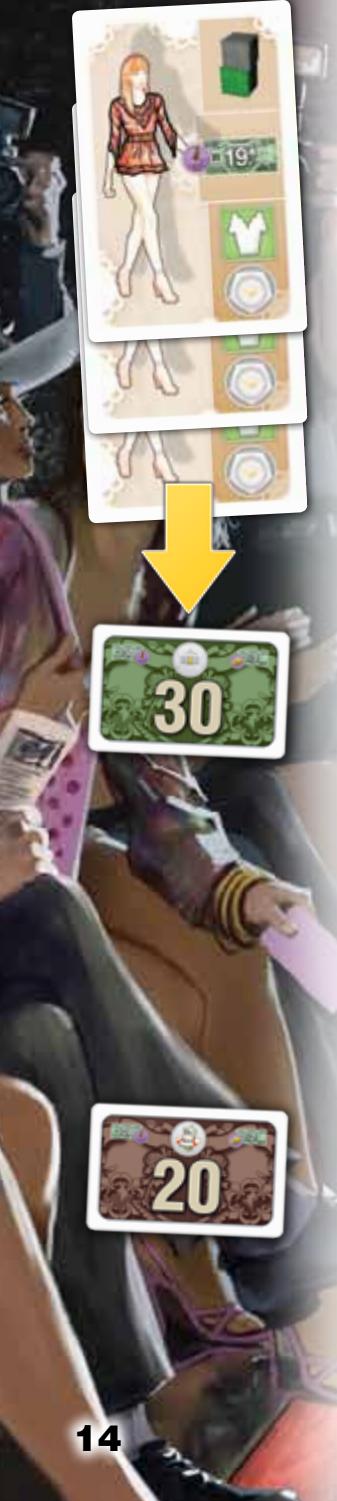
For each Design in Collection Player is paid the amount of money that is shown on Design card (Design value) increased by the number of Stars won during current fashion shows valued as 1 thousand each (if a Player won 7 Stars during the Fashion Shows he or she earns 7 thousand more for each Design).
Example: Player A displayed a Collection of 3 finished Designs in Boho style and won 6 Stars. After Fashion Shows he or she sells the Collection for: 14 + 17 + 21 (Design Values) + 3 * 6 (Stars) = 80 thousand.
Design value
Design cards and Trend, PR and Quality tokens that belonged to the sold Collection are discarded. Design cards that were not displayed nor sold are not discarded and tokens that are placed on those cards stay in the game. Also permanent Trend, PR and Quality tokens that result from special capabilities of Buildings, Employees or Contracts are not discarded if those cards stay in the game (in most cases Contract cards are discarded at the end of this month's Maintenance Phase).
Maintenance Phase
After getting money from the Collections sold, Players pay all their maintenance costs (or get their monthly incomes) as in Maintenance Phase in preparations month.
Additionally, in Maintenance Phase in Fashion Shows month Players have to pay all their Credits and Loans back to the Bank. Detailed rules are discussed in Specific Rules Chapter: Credits and Loans
At the end of Maintenance Phase in Fashion Shows month also all Contracts expire and Contract cards are discarded, unless they are extended by one quarter with usage of Negotiator card. The card of the extended Contract should be turned over to its darker side. In the end of this Phase the calendar counter should be moved by 1 month forward
Example of Fashion Show:
In the game of 3 Players - Adam (A), Barbara (B) and Cedric (C) display their Collections during the June Fashion Shows.
Adam's Collection includes thre Designs in Vintage style, Barbara displays two Boho Designs and Cedric has sewn Kids Collection with one Sports Design that is changed to Kids Style with the usage of Design bureau (Boho/Kids) card.
Adam opted for Quality - he's bought expensive Materials and therefore his Collection has 6 Quality tokens (including one obtained by displaying Vintage Pants Design from this Collection). Adam gave up the fight for PR and Trend - his Collection doesn’t have a single token of those Features. Barbarď's Collection consists of only 2 Designs with 3 Quality tokens, yet it is trendy and has a good PR - it has 2 tokens of each of these Features. Cedrić's Collection, just like Adam’s, consists of 3 Designs, but it was sewn at a lower cost which is reflected in its Quality (4 Quality tokens, including one obtained directly from the Kids Blouse Designfrom this Collection). It doesn’t have any Trend tokens, yet Cedric managed to get 1 PR token for this Collection from Preparations Action.
Paris and Berlin Fashion Show cards were drawn for the month of June during the game setup. Since June is the second Fashion Show Month, only the first three Features judged in those cities are taken into account.
Quality is the first Feature judged in Paris and Adam, who obtained the biggest number of Quality tokens wins 4 Stars for his 1st place. Cedric with his 4 Quality tokens gets the 2nd place and 2 Stars.
T'he Second Feature considered in Paris is Collections Trends. T'he leader here is Barbara with 2 Trend tokens and thus she wins 3 Stars. Neither Adam nor Cedric possesses any Trend tokens, so their Collections are not taken into account when judging this Feature.
PR is the last Feature taken into account in Paris during this Fashion Show. Barbara leads again with her 2 PR tokens and Cedric gets the 2nd place with 1 PR token. Since this is the third Feature judged in this city, their Collections earn 2 and 1 Star respectively.
PR is also the first and most important Feature evaluated in Berlin – Barbara wins 4 Stars for her 1st place and Cedric gets 2 stars for the 2nd place with 1 PR.
T'he second Feature judged in Berlin is the Quantity of Designs in the Collection. As two Players (Adam and Cedric) display 3 finished Designs in their Collections, their tie for the 1st place results in both of them winning the 2nd place in this Feature – each of them gets 1 Star. Barbara with 2 Designs in her Collection gets the 3rd place and thus receives no Stars.
T'he last Feature considered during this month is Quality – again Adam triumphs with his 6 Quality tokens that are worth 2 Stars now. Cedric receives 1 Star for his 2nd place.
In this moment the Features' comparison ends and Players count the number of Stars they’ve earned.
During the June Fashion Shows held in Paris and Berlin, Adam and Cedric won 7 Stars each, while Barbara managed to obtain 9 Stars. Players placed Star tokens on their Player's Boards.
Now Players sell their Collections.
Designs displayed by Adam are worth 22, 23 and 15 thousand respectively which gives the sum of 60 thousand. In addition, Adam gained 7 Stars during fashion shows, which multiplied by the number of displayed Designs (7 x 3) gives him 21 thousand and thus he gets the total income of 81 thousand (60+21).
Barbara has displayed 2 Designs worth 21 and 14 respectively, giving a total of 35 thousand. Additionally, 9 Stars obtained duringfashion shows multiplied by the number of displayed Designs (9 x 2) give her 18 thousand resulting in 53 thousand (35+18) of her total income from selling her Collection.
Cedric prepared Designs worth 27, 18 and 16 thousand respectively, that is 61 thousand in total. In addition, 7 Stars he managed to get multiplied by the number of Designs in his Collection (7 x 3) give him 21 thousand and thus he earns the total of 82 thousand (61+21).
Specific rules
Credit and Loan
In this game Players can borrow money from two different sources: a Bank (a Credit) or a Private Lender (a Loan). There is a significant difference between these two that is explained below in detail.
Credit
Action Pawn placed on the Bank field allows the Player to get a Credit. This field is always available for the Players during Actions Planning phase regardless of the number of Players in the game and the number of Action Pawns already placed on this field. Available amounts of Credit to be taken in the Game are 10, 20, 30, 40 thousand and more.
The Player takes the Credit cards of the appropriate denomination and receives money from the Bank (10, 20, 30, 40 thousand and more respectively). In the moment of taking the Credit Player should also increase monthly maintenance costs (or lower the incomes) by the amount of interests that have to be paid to the Bank on a monthly basis. Credit Interest rate is 10% of Credit value each month, that means 2 thousand interests cost à month for a Loan of 20 thousand.
Credit Value
The maximum Credit value a Player can receive in a given moment is determined by the potential size of his or hers Collection to be sewn - Player adds up the number of Design cards of the same style (such as Evening, Vintage etc.) and Design cards that will be changed to fit that Style during upcoming Fashion Shows through special capabilities given by Contracts, Buildings and Employees (it is important that Collection Style adjustment token was placed at this moment on the Design card that that will be changed, even though it gives an effect during the Shows):
Having 1 Design in the potential Collection Player can take a 10 thousand of Credit;
With 2 Designs in the potential Collection - Credit for the amount of 10-20 thousand;
With 3 Designs in the potential Collection - Credit for the amount of 10-30 thousand and so on where the number of Designs in the potential Collection multiplied by 10 thousand is the upper limit. ◆ For one potential Collection a player may only receive one Credit.
While repaying the Credit Player is obliged to pay interests (10% of Credit value) to the Bank every month. This rule applies also to the month the Credit was taken and the month of the Fashion Shows. Furthermore, the Credit should be paid back to the Bank immediately after Player gets money from his or her Collection sold during incoming Fashion Show Month (and only then).
Example: A player borrowed 30 thousand from a Bank in the first month of preparations, so this month and the next month he or she has to pay 3 thousand more as maintenance costs (interests). In the Fashion Show Month he or she pays back 3 thousand (interests) plus 30 thousand (Credit value) to the Bank
Loan
If Player is unable to pay the required maintenance costs amount in any Maintenance Phase, he or she automatically receives a compulsory Loan from a Private Lender in the amount of 20 thousand (a Loan card). This Loan's Repayment is identical as Credit's, except that in the Fashion Show Month for every 20 thousand of Loan Player has to pay the Loan amount plus 8 thousand (total 28 thousand each Loan), as Loans are more expensive than Credits. Also, Player should not forget about the payment ofinterests this month.
| Credit | Loan | |
| When taken? | Actions Execution Phase: Bank | Maintenance Phase |
| Borrowed amount | 10, 20, 30, 40 and more | 20 thousand |
| Amount to be paid back | Borrowed amount | Borrowed amount |
| +10% of borrowed Mount | +8 thousand | |
| (interests) monthly | +10% of borrowed Mount (interests) monthly |
Penalties
If Player is unable to repay his Credits / Loans in the Maintenance Phase of Fashion Show Month, he or she receives a penalty worth -10 thousand at the end of the game. As its symbol, Player places a Loan card beside Player's Board where the golden bills are places. The penalty doesn't remove Player's obligation to pay interests and to repay the amount of Credits / Loans in the next Fashion Shows month in the normal way. Penalties are given to each outstanding Credit/ Loan separately.
If Player fails to repay all his or hers Credits / Loans in the last month of the game after selling the Collection, he or she receives a final penalty in the form of a negative value of outstanding Credits / Loans.
Cards
At the top of the card there is a symbol indicating whether the card is a Contract, a Building or an Employee. Underneath the name of the cart is shown.
Special capabilities given by the card in the game are depicted in the middle of the card. Those symbols are described on the separate Help cards.
Below the information about the time when various cards are active is shown. If the icon depicts:
model – a card is active during fashion shows
cash register – a card is active during Maintenance Phase
pawn – a card may be activated during Actions Execution Phase. The number of the Action is shown on the right from the pawn symbol. Card with Pawn symbol is activated only if a Player puts his or hers Action Pawn in the proper field (same number) on Main Board. Each Pawn on this field activates the card.
crossed out pawn – a card is activated during Actions Execution Phase. The number of the Action is shown on the right from the pawn symbol. Card with crossed out pawn symbol is active regardless of Player's Action Pawn presence or absence on this specific field.
exclamation mark – a card is activated immediately after its purchase / expansion. Card operates only once with its capabilities in the moments of its activation.
XII month – a card is activated at the end of the game, after the last show, when the result is being indicated.
WITH TRENDS ANALYST


Cost
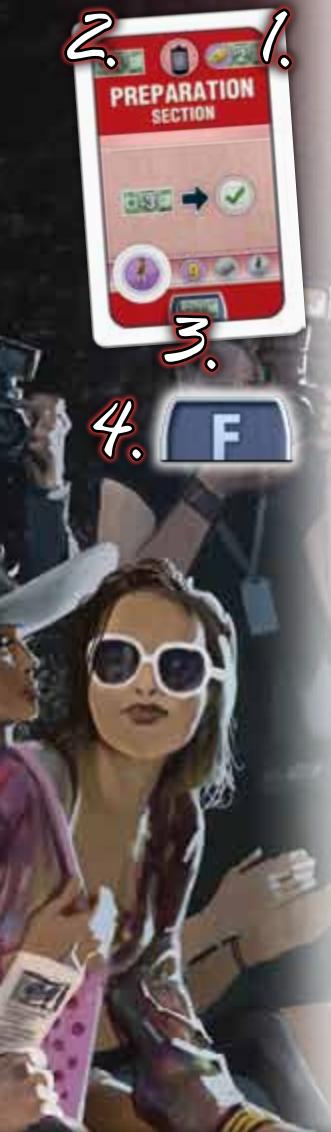
Cost of maintenance of Employee and Building cards is shown in the upper right corner (1) – this amount of money should be paid each month for card's possession. Building cards have additional cost of its purchase in the upper left corner of the card (2) – this amount of money should be paid to the Bank in the moment of Building's purchase.
Upgrading
Employee and Building Cards that can be trained / developed have the price of training/ development in the lower part of the card (3) – this amount of money should be paid to the Bank in the Training and Development Phase if a Player decides to train / develop this card. Final cards of Contracts, Buildings and Employees have a special final sign in this place (4).
Entering the Final Cards
Final Cards are put into play only during the months specified on the reverse side (the final card of Contracts, Buildings and Employees are put into play in October and November, and the final cards of fashion shows - in December). Final cards of Buildings cannot be developed, Employees cannot be trained and Contracts cannot be extended. These cards do not have the rules of developed Building, trained Employee / Contract extended on their reverse sides.
Dismissing an Employee
The Player may dismiss his or hers Employees (Employee cards are placed on discard pile) at any time in the game by paying twice the cost of their maintenance to the Bank (this rule does not apply to unskilled workers, they are simply replaced)
Other card rules
A Player may have any number of identical cards (i.e. Models) in his possession.
In case of a conflict, rules on the cards are always more important than general rules and precede them. Remember also that places the Players get on fashion shows are indicated first and then Stars are awarded (this is important in case of conflicts between cards capabilities).
Card rules description
Cards' symbols are explained on separate Help card in order to facilitate playing. Below there is a detailed explanation of Contract / Building/ Employee cards. If you have âny doubts how a card works - look here.
Contracts
With Employment Agency
Player may take Employee card without action from among Employee cards left on the Board after Players made their actions on Employees field or from discard pile.
Extended: Player's Action Pawn is required to acquire an Employee card from the sources mentioned above.
For Berets production
Player may sell up to 3 Material pieces for 7 thousand eāch
Extended: Player may sell up to 3 Material pieces for 5 thousand each.
With Modeling Agency
Player gets 2 PR tokens (put these tokens on the card)
Extended: Player gets 1 PR token.
With Construction Company
Without action Player may obtain one Building from among Building cards left on the Board after Players made their actions on Buildings field for free and develop one building for free during each Training and Development Phase.
Extended: Without action Player may obtain for free one Building from among Building cards left on the Board after Players made their actions on Buildings field
For Ready-to-Wear Collection preparation
Player may sell an additional Collection without added profits from Stars
Extended: Player may sell an additional Collection without added profits from Stars for the total price lowered by 3 thousand
For TV appearances
Player gains additional 4 Stars (put these tokens on the card) even if he or she does not display any finished Designs during the Fashion Shows
Extended: Player gains additional 2 Stars even if he or she does not display any finished Designs during the Fashion Shows.
With Real Estate Agent
Player may take Building card without action from among Building cards left on the Board after Players made their actions on Buildings field or from discard pile.
Extended: Player's Action Pawn is required to acquire a Building card from the sources mentioned above.
With Design Agency
Player may take Design card without action from among Design cards left on the Board after Players made their actions on Designers field or from discard pile.
Extended: Player's Action Pawn is required to acquire a Design card from the sources mentioned above.
With Trends Analyst
Player gets 2 Trend tokens (put these tokens on the card) Extended: Player gets 1 Trend token
With Designs Office
Player may sell one of his or hers unfinished Designs for 8 thousand in the first month of preparations in this quarter and for 15 thousand in the second month
Extended: Player may sell one of his or hers unfinished Designs for 10 thousand in each Maintenance Phase of preparations months.
With Design Company
Without action Player obtains two Designs at random after Players' actions on Designers field were made. Extended: Without action Player obtains one Design at random
With Office Renters
Maintenance costs of Player's Buildings are equal 0 (adjust the monthly maintenance costs / incomes).
Extended: as above
With Quality Consultant
Player gets 3 Quality tokens (put these tokens on the card) Extended: Player gets 2 Quality tokens
With Freelance Designer
Player may choose a type of Design (and take this Design Type card) and from that moment all Player's Designs of this type get additional Trend tokens (put these tokens on each Design card) as long as this Contract is active (when contract expires take the tokens off these Design cards)
Extended: Player may get max 1 Trend token from this card's capabilities.
With Sales Representative
Without action Player may buy Materials from Local Producer (any number of 1 color), Warehouse (1 Material of 1 color) or from Import (any number of 1 color) at a price lowered by 2 thousand each piece (yet the cost is always not lower than 1 thousand for 1 piece) not getting any Quality tokens for that purchase. This discount cannot be combined with other discounts.
Extended: price for Materials is not lowered any more
Final contracts:
With Audit Company
Player may sell one Employee card for 2 thousand and/or one Building card for 2 thousand
For Furniture Store Interior Design
Player gets 3 thousand in October and 9 thousand in November as additional income (change monthly maintenance costs/ incomes counters on Player's Board accordingly)
With PR agency
Player gets additional Star for each 2nd and 3rd place he or she gets during fashion shows
With Telecom Operator
Player may place his or hers Action Pawn even if there is no free place for Action Pawn.
With Ready-to-Wear Chain Stores
Player may sell up to 2 unfinished Designs for 5 thousand each in October and up to 4 unfinished Designs for 5 thousand each in November
With Cooperating Agency
Player may discard any number of his or hers Design cards and get the same number of Design cards at random after all other Players made all their actions on Designers field.
Buildings
Design bureau (style names)
Player takes one Design card at random before choosing a Design on Designers field.
Developed: Player may also adjust one Design to fit one of the stales named on the card (put Collection Style adjust-
ment token on this Design, Player has to make a final decision which Design to change in the beginning of Fashion Show Month).
Investment house
In each Maintenance Phase of Preparation Months and Fashion Show Months Player may choose one amount (5/10/15 thousand) and pay in order to get 8/17/25 thousand in the end of the game (put those bills golden side up beside Player's Board)
Developed: Player may also pay 2 thousand each time to get 1 additional Star during upcoming fashion shows (put these Star tokens on the card)
Credit house
Player gets 20 thousand immediately and puts 10 thousand of Penalty (Loan card) beside Player's Board on the golden bills pile.
Developed: repeat Action.
Machine facilities
Player gets 2 Quality tokens permanently (put these tokens on the card)
Developed: Player gets 3 Quality tokens permanently and in case of a tie in Quality Feature the Player wins.
Banquet hall
Player gets 1 PR token permanently (put this token on the card)
Developed: Player gets 2 PR tokens permanently and in case of a tie in PR Feature the Player wins.
Designers school
Player gets 1 Trend token permanently (put these tokens on the card)
Developed: Player gets 2 Trend tokens permanently and in case of a tie in Trend Feature the Player wins.
Preparation section
Pay 3 thousand to make an action in
Preparations field in the beginning of Fashion Show Month.
Developed: Player doesn't have to pay for this action.
Retail Outlet
Player gets equal amount of money (max 6 thousand in total) as the number of Stars in his or hers possession (1 VP = 1 thousand) as additional income (change monthly maintenance costs/ incomes counters on Player's Board accordingly)
Developed: Player gets 1 thousand plus as much money as the number of Stars in his or hers possession (max 10 thousand in total)
Transportation Base
After all Action Pawns are placed Player may switch up to 2 of his or hers Action Pawns with their neighbors. Switching is done in the order of placing the Action Pawns
Developed: Player may either switch his or hers Action Pawns or place his or hers Action Pawn even if there is no free place for Action Pawn.
Design Agency
Without action Player obtains one Design at random after Players’ actions on Designers field were made.
Developed: Player may also sell 1 unfinished Design during each Maintenance Phase
Final buildings
Real Estate Agency
At the end of the Game a Player gets 4 thousand for each Building in his or hers possession (including this one)
Fashion Show organizing agency
If a Player dominates in at least one Feature (it means that if fashion show was held in that moment the Player would have 1st place in at least one Feature) in the Maintenance Phase of last two Preparation Months, he or she gets Stars: 2 in October and 3 in December respectively (Stars should be put on this card). The domination in each feature is determined by comparing Features in that moments (the quantity is determined by the number of Designs that are sewn)
Warehouse
Player may buy without action Materials (max 1 of each type) in Warehouse for the price lowered by 2 thousand each (yet the cost is always not lower than 1 thousand for 1 piece) not getting any Quality tokens for that purchase.
Storehouses
Player may buy Materials (any number in 1 color) without action at Local Producer. Player gets 1 Quality token for that purchase.
Newspaper's Office
For each 1st place during fashion shows Player receives additional 3 Stars.
Sewing Factory
For each 1st place during fashion shows Player receives 18 thousand.
Employees
Credit Advisor
Without action Player can take Credit in the amount depending on which quarter it is at the moment in the game: 5 thousand in the first quarter, 10 in the second, 15 in the third and 20 in the fourth (regardless of the number of Designs in his or hers potential Collection). Player has no obligation to pay interests on this Credit (without increasing the maintenance costs)
Trained: Amounts of Credit available to the Player under the above conditions are respectively: 10 thousand in the first quarter, 20 in the second, 30 in the third and 40 in the fourth one.
Journalist
In a city of Player's choice an additional Feature (next one below) is also judged.
Trained: Player also gets 3 additional Stars for scoring 1st place at least once during fashion show.
Accountant
Player gets 5 thousand of additional income (change monthly maintenance costs/ incomes counters on Player's Board accordingly)
Trained: Player gets 7 thousand of additional income
Superstar (Model)
Player may adjust one Design to fit any other style (put Collection Style adjustment token on this Design, Player has to make a final decision which Design to change in the beginning of Fashion Show Month), yet layer decreases by 3 his or hers score in Quality during fashion shows.
Trained: layer may adjust one Design to fit any other style without any penalty
Face of the Company (Model)
Player gains additional 2 Stars (put these tokens on the card) Trained: Player gains additional 4 Stars
Model (Model)
Player gets 1 PR token permanently (put this token on the card as long as this Employee is employed) Trained: Player gets 2 PR tokens
Negotiator
Player may extend one Contract once for the period of three months (turn the contract card over at the end of Fashion Shows month)
Trained: Player may extend up to two Contracts
Freelance Designer
Player may adjust one Design to fit any other style (put Collection Style adjustment token on this Design, Player has to make a final decision which Design to change in the beginning of Fashion Show Month), yet layer decreases by 2 his or hers score in Trends during Fashion Shows.
Trained: layer may adjust one Design to fit any other style without any penalty
Creative Designer
Without action Player obtains one Design at random after Players’ actions on Designers field were made.
Trained: Without action Player gets two Design at random after Players’ actions on Designers field were made and discards one of them.
Sales Representative
Player may buy Materials from Local Producer (any number of 1 color), Warehouse (up to 1 Material of each color) or from Import (any number of 1 color) at listed price not getting any Quality tokens for that purchase.
Trained: Player may make these Materials purchase at a price lowered by 3 thousand each piece (yet the cost is always not lower than 1 thousand for 1 piece). This discount cannot be combined with other discounts.
Talented Designer
Player gets 1 Trend token permanently (put this token on the card as long as this Employee is employed) Trained: Player gets 2 Trend tokens
Spokesman
Player gets 2 additional Stars for each tie for 1st and/or 2nd place he or she is in during fashion shows
Trained: Also, in case of a one chosen tie in any Feature the Player wins.
Final employees
Sales Agent
Player may either switch his or hers Action Pawn with its neighbors after all Action Pawns are placed or place his or hers Action Pawn even if there is no free place for Action Pawn (in the moment of hiring this Employee Player's Action Pawn placed on Employee field may be placed somewhere else or other Action Pawn switched). Switching is done after all Players have placed their Action Pawns in the order of placing the Action Pawns.
Market Analyst
Player may see the top 6 cards from Design deck and arrange them in any desired order before Players execute their actions on Designers field.
Trader
Player may sell an additional Collection not displayed during the Fashion Shows without added profits from Stars
Young Designer
Player may adjust one Design to fit any other style (put Collection Style adjustment token on this Design, Player has to make a final decision which Design to change in the beginning of Fashion Show Month).
New Designer
Without action Player obtains two Designs at random after Players’ actions on Designers field (5th) were made.
Makeup Artist
Each employed Model gives a Player an additional Trend token (put the right number of Trend tokens on this card)

Where to get:
Quality
Purchasing Materials from Local Producer (1), Warehouse (2) and Imports (3)
Preparations Field (2)
Designs with Quality icon in the finished Collection (1 per each Design with such icon)
Èrom Cards' (Contracts, Buildings and Employees) capabilities in Player's possession
Trends
Preparations Field (1)
Designs with Trends icon in the finished Collection (1 per each Design with such icon)
For each Design in the finished Collection that is of the same Type as the Type on Player's Board (e.g. each Tro
Content is long; only the first part is inlined. Download the file or open the rules page for the full text.
Download MarkdownTexts are community-compiled or publicly released by publishers; copyright remains with the original authors. For personal reference only.