
Ra The Dice Game
At a glance
Rules, cards and Q&A (Chinese)
The rules, card data and player questions for this game are written in Chinese. Open the Chinese page to read them.
Where to find full rules
Full rules and card lookup are available in the cunlema app at cunlema.cn — pick this game and ask about any rule, card or turn you are unsure about.
Related games
Rulebook text (Markdown)
This game has 1 rulebook Markdown file(s) in our library; 1 rendered inline below — expand to read or download.
25C-RAdice-rulebook-140x190-20260113.md24.1 KB
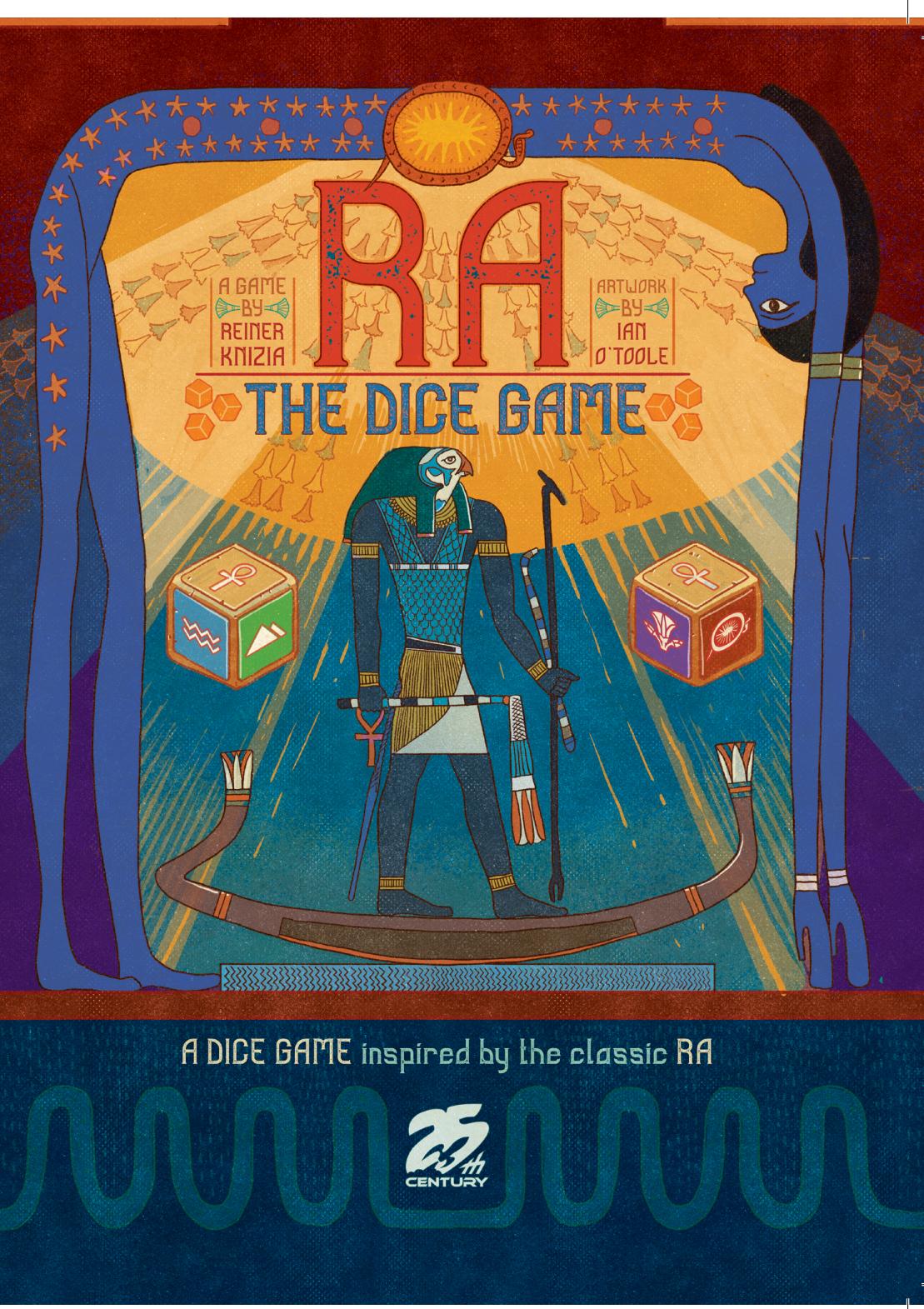
MEMMMMEEE
Dueruiew
Seek glory by pleasing Ra, the Sun God and creator of the pantheon of Egyptian deities. Roll and reroll dice to get valuable combinations, but be careful — you might hasten the day of Ra's judgment!
Credits
Game Design: Reiner Knizia
Graphic Design & Illustration: Ian O'Toole
Player Aid & Rulebook Editing: Joel Finch
Rulebook Editing: Jon Healey
Rulebook Layout: Kate Finch
Production & Development: Chad Elkins
The author and publisher thank all test players for their commitment and their numerous suggestions and comments. Special thanks to: Sebastian Bleasdale, Florian Ionescu, Sebastian Gieger, Vroni Sigl, and Philipp Winter.
© 2025 Dr. Reiner Knizia.
All rights reserved.

Components

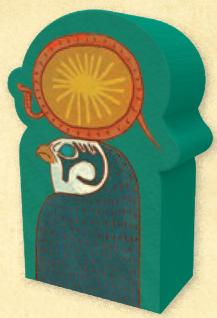
Ra figure
Game board


Dice×5
Rulebook
PLAYER COMPONENTS In four colors - blue, green, red, yellow
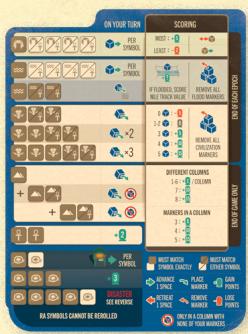
Reference card
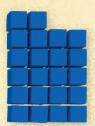
Player markers ×22
Scoring disc
MMM
Setup
① Place the board in the center of the play area.
② Place the five dice within easy reach of all players.
Place the Ra figure on the Ra track on the board, in the space matching the number of players in your game.
Give each player a set of 22 Player markers of the same color, along with the matching Scoring disc and Reference card.
Example: Setup for a four-player game
Each player puts one Player marker on the first space of the Pharaoh track and one Player marker on the first space of the Nile track.
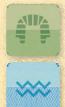
Choose a starting player at random. Each player puts their Scoring disc on the Points track around the edge of the board. The starting player begins with 10 points, the next player in clockwise turn order begins with 11 points, and so on.

How to play
Ra the Dice Game is played over three rounds, called epochs.
In each epoch, players take turns rolling five dice then applying the resulting symbols to advance their markers in one or more scoring areas.
Each epoch ends when the Ra figure reaches the end of the Ra track. Players score their progress in each scoring area, recording their points by advancing their Scoring disc on the Points track.
Rolling dice
On your turn, first roll all five dice.
You must immediately place any dice showing the Ra symbolson the Ra track of the game board. Place them to the right of the current position of the Ra figure, one die per space. If there are no spaces remaining, place the dice showing Ra symbols at the end of the Ra track, off the board if necessary.
After placing all dice showing a Ra symbol, you may reroll any or all of the remaining dice. If you choose to reroll, you must place all dice showing the Ra symbol in the same way as before.
Finally, you may reroll any or all of the remaining dice one more time, placing all dice showing the Ra symbol as usual.

Applying dice
After completing your dice rolls, apply each die to the scoring area on the board, matching its symbol to use the available scoring actions.
A die cannot be applied to an area if its symbol does not match that area, with the exception of an Ankh.

The Ankh symbol has no scoring area on the board but acts as a “wildcard", counted as an extra die of any other symbol you have rolled this turn, other than Ra (see page 8).
Each action requires a certain number of dice matching the symbol of that scoring area. The requirements are indicated as follows:

Required - exact match

A dark symbol with light markings is a required symbol. The symbol on your die must match the exact symbol shown.

Ankh permitted

A split symbol can be matched by either of the symbols shown the symbol of that scoring area or an Ankh symbol.

Permitted, not required

A light symbol with dark markings means the symbol is not required in order to use the action. The effect may increase if the extra die is applied.
If you rolled a die with a symbol that you cannot use this turn, it cannot be kept to use on later turns — that die goes unused.
Note: Each action “uses up” the dice applied to it — you cannot use the same die for more than one action.
MM
Pharaoh
ACTION: Advance on the Pharaoh track
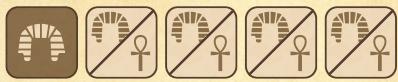
For each die applied to this action, advance your Pharaoh marker by one space on the Pharaoh track. It cannot advance beyond the end of the track.
Nile
ACTION: Advance on the Nile track
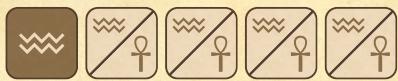
For each die applied to this action, advance your Nile marker by one space on the Nile track. It cannot advance beyond the end of the track.
ACTION: Flood the Nile

Place one of your markers to serve as a Flood marker in the separate Flood Catchment area to the left of the Nile track. You may repeat this action on later turns to “Flood the Nile" more than once.

You may take both Nile actions on your turn if you rolled enough of the required symbols (but remember that each die cannot be applied more than once).
Note: Your Flood marker(s) do not move when your Nile marker moves on the Nile track.
Example: Yaz (yellow) rolled one Pharaoh and one Ankh symbol. Yaz applies the Ankh as a Pharaoh and advances her marker by two spaces on the Pharaoh track.
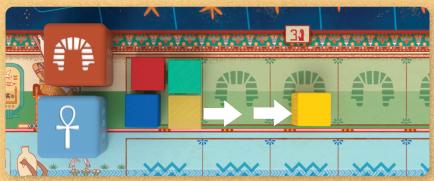
Example: Greg (green) rolled two Nile symbols. Greg advances his marker by two spaces on the Nile track.
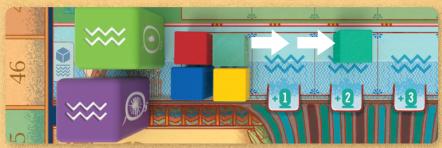
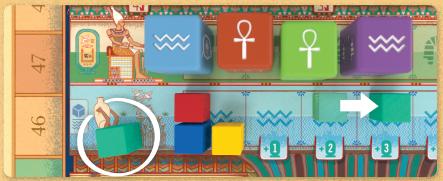
Example: Greg (green) rolled two Nile and two Ankh symbols on his next turn. Greg could advance his marker by four spaces on the Nile track, but he decides to “Flood the Nile” instead, and places one of his markers in the Flood Catchment area.
With the remaining Nile symbol, he advances his marker by one space on the Nile track.
MMM
Civilization
ACTION: Grow your Civilization by 1 level

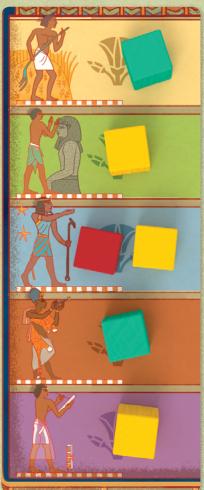
Place one of your markers in a space matching the color of a real Civilization symbol you rolled.
ACTION: Grow your Civilization by 2 levels

Place two of your markers, each in a different space matching the color of a real Civilization symbol you rolled.
ACTION: Grow your Civilization by 3 levels
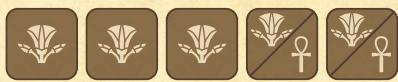
Place three of your markers, each in a different space matching the color of a real Civilization symbol you rolled.
The maximum number of markers allowed in each Civilization space for all players combined is the number of players minus 1, but each player cannot place more than one marker in each space.
Note: You can use Ankh symbols to reach the required number of dice, but you cannot use the color of an Ankh when placing a marker.
Example: Bilal (blue) rolled three Civilization and one Ankh symbol, so he takes the action "Grow your Civilization by 2 levels".
Bilal's Civilization dice are green, blue, and tan, which means that he can place his two markers in two of the green, blue, or tan spaces. The color of the Ankh symbol cannot be used.
Remembering that in a four-player game there can be no more than three markers in each Civilization space, Bilal checks the board.
Bilal sees that Rosa (red) has placed one of her markers in the tan space, but there is still room for Bilal to place a marker there if he wants to.
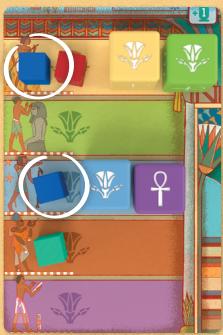
He decides to place his markers in the tan and blue spaces.
Monument
ACTION: Build a 1st Monument this turn

Place one of your markers in any empty Monument space matching the color of the Monument symbol you rolled.
You can place the marker in any column that has an empty space, regardless of any other markers you have placed previously.
You cannot use this action more than once per turn. Placing additional monuments in the same turns requires two extra symbols each time, as shown below.
ACTION: Build a 2nd Monument this turn ACTION: Build a 3rd Monument this turn

Place one of your markers in an empty Monument space matching the color of the Monument symbol you rolled.
Important: When placing your second or third Monument in the same turn, you must place the marker in a column that does not already have any of your markers.
Note: You can use Ankh symbols to reach the required number of dice, but you cannot use the color of an Ankh when placing a marker.
Example: Yaz (yellow) rolled two Monument and one Ankh symbol, enough to let her build two Monuments on her turn.
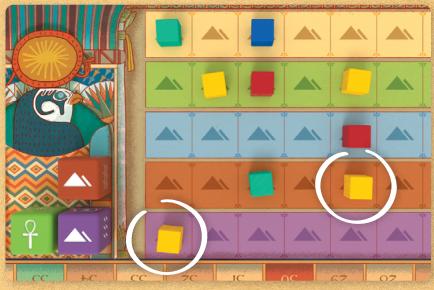
The dice with the real Monument symbols are red and purple, so Yaz can only build Monuments in those rows. The color of the Ankh symbol cannot be used.
First, Yaz builds a red Monument in the same column as she built a green Monument on a previous turn.
Second, Yaz applies the remaining Monument and Ankh symbols to build a purple Monument. Because it's her second Monument this turn, Yaz must build this Monument in a column that does not already have any of her markers.
Ankh
ACTION: Use as a wildcard

The Ankh symbol does not have its own scoring area. Instead, you can apply an Ankh in combination with a die showing a different symbol (except for Ra) to count it as an extra die of that symbol.
If you roll more than one Ankh, you can apply each one separately or together to any scoring area where you rolled at least one real symbol matching that scoring area.
You cannot use an Ankh as a symbol you did not roll this turn.
You cannot use each Ankh more than once in a turn.
ACTION: Score 2 points

Use two Ankhs together to score 2 points immediately instead of applying the Ankh symbols to a scoring area.
Example: Rosa (red) rolled one Nile, two Pharaoh, and two Ankh symbols.
She could apply both Ankhs as Pharaoh symbols, or both as Nile symbols, or one Ankh to each of Pharaoh and Nile, increasing the number of spaces her markers advance on those tracks accordingly.
Or she could combine two Ankhs with the Nile symbol to use the “Flood the Nile" action.
Or she could use the two Ankh symbols to score 2 points.
She cannot use an Ankh symbol to grow her Civilization or build a Monument this turn because she rolled no real Civilization or Monument symbols.
EMMMMMMMMMMMMMMMMMMMMMMMMMMMMMMMMMMMM
Ra
The effect of dice on the Ra track depends on the number of dice applied. You cannot apply Ankh symbols to the Ra track.
You must always use the Ra action matching the total number of Ra symbols you rolled.
ACTION: Advance on the Ra track

For each die applied, advance the Ra figure one space on the Ra track.
ACTION: Score 3 points

Don't advance the Ra figure.
Score 3 points immediately.
ACTION: Declare a Disaster

Don't advance the Ra figure. You may declare a disaster in the scoring area of your choice, affecting only your opponents. There is no difference in effect whether four or five dice are applied.
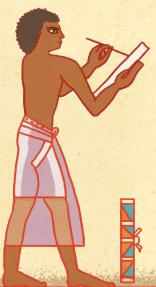
DISASTER EFFECTS
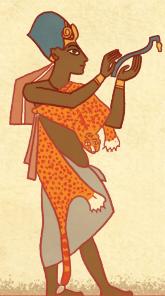

Pharaoh: Each opponent must retreat their Pharaoh marker by two spaces (but no further than the first space).


Nile: Each opponent who has no markers in the Flood Catchment area must retreat their Nile marker by two spaces (but no further than the first space).

Each opponent who has at least one marker in the Flood Catchment area must remove one of their Flood markers.


Civilization: Each opponent must remove two of their markers from the Civilization spaces of their choice (or one marker if they have only one)


Monument: Each opponent must remove two of their markers from the Monument spaces of their choice (or one marker if they have only one).

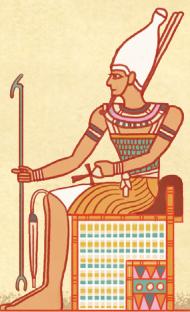
MMEEN
Scoring at the end of each epoch
If the Ra figure reaches or exceeds the end of the Ra track, the current epoch ends after you finish your turn. Then all players determine their scores.
Pharaoh
Perform Pharaoh track scoring in this order:
-
If all markers on the track are in the same space, all players receive no points or penalty.
-
If your marker is the most advanced (or equal most advanced) on this track, score 5 points +5.
-
If your marker is the least advanced (or equal least advanced) on this track, lose 2 points –2
-
If you scored 5 points, retreat your marker two spaces on this track.
-
If you lost 2 points, advance your marker one space on this track.
After scoring, leave your Pharaoh marker in its current position on the Pharaoh track.
Example:
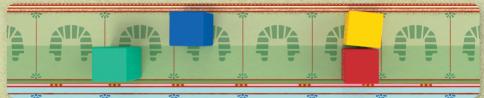
• Yaz (yellow) and Rosa (red) are equal most advanced, and both score 5 points +5.
• Greg (green) is least advanced and loses 2 points – 2.
• Bilal (blue) scores no points or penalty.
Because Yaz and Rosa scored 5 points, both of their markers must retreat two spaces on the Pharaoh track.
• Because Greg lost 2 points, his marker advances one space on the Pharaoh track.

Note: Scoring is done separately, before moving markers, to avoid causing confusion about whose marker was most or least advanced.
Nile
• If you have no markers in the Flood Catchment area to the left of the Nile track, score no points.

• If you have at least one marker in the Flood Catchment area to the left of the Nile track, score points equal to the value of the space your marker occupies on the Nile track +? and then remove all of your Flood markers from the Flood Catchment area.
After scoring, leave your Nile marker in its current position on the Nile track.
Example:

• Greg (green) has no markers in the Flood Catchment area, so he scores no points for the Nile track this epoch.
All other players have at least one marker in the Flood Catchment area, so each scores points equal to the value of their position on the Nile track: Yaz (yellow) and Bilal (blue) both score 4 points +4and Rosa (red) scores 6 points +6
MMM
Civilization
Score points according to the number of markers you have in Civilization spaces.
| Number of markers | Points | |
| 0 | -0 | |
| 1-2 3 | 0 points +0 | |
| 4 | +四 +5 |
After scoring, remove all of your markers from the Civilization area.

Example:
Do not score the Monument spaces at the end of each epoch. Monuments are only scored at the end of the game (see page 12).
• Bilal (blue) has no markers in any Civilization spaces: Bilal loses 5 points -
Leave your markers in the Monument area between epochs.

The new epoch
Rosa (red) has one marker and Greg (green) has two markers in Civilization spaces: they both score 0 points.
Monument
If the epoch just scored was the first or second epoch, start a new epoch.
• Yaz (yellow) has three markers in Civilization spaces: Yaz scores 5 points +5
Move the Ra figure back to its starting space. Play continues where it ended in the previous epoch, with the next player in turn order rolling the dice.
MEE
Game end
The game ends after the third epoch is scored.
In addition to normal scoring for the end of the epoch, also score your Monuments.
Monument
Only score the Monument area after the end of the third epoch.
- Score points according to the number of different Monument columns containing at least one of your markers.
| Different columns | Points |
| 1-6 7 | +0for each column +亚 |
- Score points according to the number of markers you have placed in each Monument column.
| Markers in a column | Points |
| 0-2 | 0 points |
| 3 | +0 |
| 4 | +四 |
| 5 | +5 |
After scoring the third epoch and the Monuments, the player with the most points is the winner!
Example:
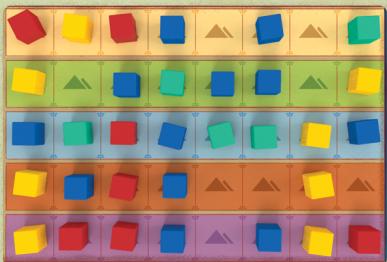
Scoring according to the number of different columns containing at least one player marker:
| Rosa (red) $\mathbf { 1 } + \mathbf { 1 } + \mathbf { 1 } + 0 + 0 + 0 + 0 + \mathbf { 1 } = + \mathbf { \boxed { 1 } }$ |
| Yaz (yellow) $\mathbf { 1 } + \mathbf { 1 } + 0 + 0 + 0 + 0 + \mathbf { 1 } + \mathbf { 1 } = + \boxed { 1 }$ |
| Bilal (blue) Markers in 7 columns = +10 |
| Greg (green) $0 + 1 + 0 + 1 + 1 + 1 + 0 + 1 = + 1 5$ |
Points for number of columns with at least one marker
Scoring according to the number of markers placed in each Monument column:
| Rosa (red) $0 + 0 + 1 0 + 0 + 0 + 0 + 0 + 0 = + \sqrt { 1 0 }$ |
| Yaz (yellow) $5 + 0 + 0 + 0 + 0 + 0 + 5 + 0 = + \textcircled { 1 1 }$ |
| Bilal (blue) $0 + 0 + 0 + 1 0 + 0 + 5 + 0 + 0 = + \textcircled { 1 6 }$ |
| Greg (green) 0+0+0+0+0+0+0+0=0 |
Points for number of markers in each column
MMM
Solo mode
You now have the opportunity to play the game as a single player against the most powerful Gods.
Setup
①Choose one of the Gods on the following pages.
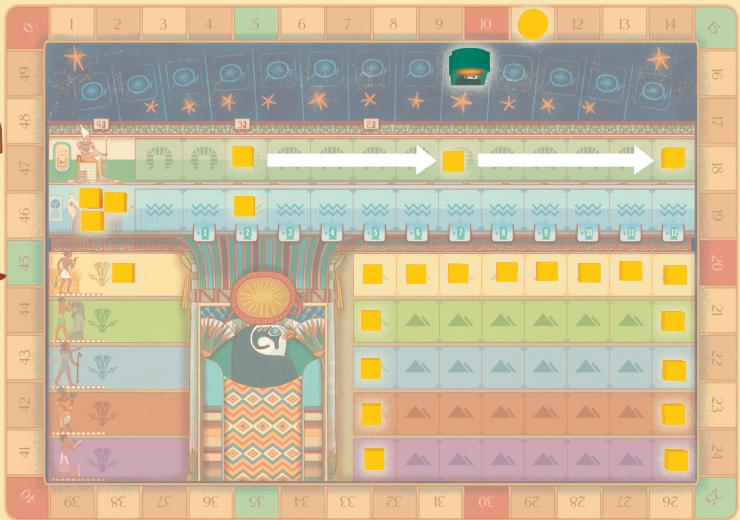
Place the Ra figure, the Player markers, and the Scoring disc of your chosen God's color, matching the board layout shown for that God.
Choose a player color different to the God and take the Player markers, Scoring disc, and Reference card of that color.
Place one of your markers at the start of the Pharaoh track, one at the start of the Nile track, and one on the 10 space of the Points track.
How to play
The God does not take turns during the game — your objective is to out-score their position.
Play the game as usual over three epochs, taking one turn after another, but note the following:
• The maximum number of markers allowed in each Civilization space is one.
You can now also apply Ankhs as Ra symbols, but you may only apply Ankhs to the Ra track at the same time you apply real Ra symbols there. This makes it easier to declare Disasters to weaken the God. For Civilization and Monuments, you decide which of the God's markers to remove.
Regardless of how many dice you apply to the Ra track (0, 1, 2, 3, 4, or 5), you always advance the Ra figure by one space. In each epoch, this gives you five turns when playing against Amun or Hapi, and four turns when playing against Thoth or Anubis.
Scoring
Score the epoch as usual for the God and for you, but note the following:
• On the Pharaoh track, the most advanced marker scores 5 points and the other scores nothing. Dont retreat the most advanced marker or advance the least advanced marker.
• On the Nile track, if only you or the God has a Flood marker in the Flood Catchment area, the Nile track score is doubled.
The new epoch
After you have scored an epoch, set up the board for the next epoch:
• Reset the Ra figure to its starting space on the Ra track, as usual.
Set the God's marker on the Pharaoh track to its next position, as shown by the arrows on the God's board layout. This will help you keep track of which epoch you are playing.
Remove any Flood markers from the Flood Catchment area, as usual. Then reset the God's markers to the positions shown by the God's board layout.
Remove all your markers from the Civilization area, as usual. Then reset the God's markers to the position shown by the God's board layout.
Game end
The game ends after scoring the third epoch, and scoring Monuments as usual.
If your score is higher than the God's, you win!
MEE
AmUN Patro of the Pharaohs
Difficulty: Standard


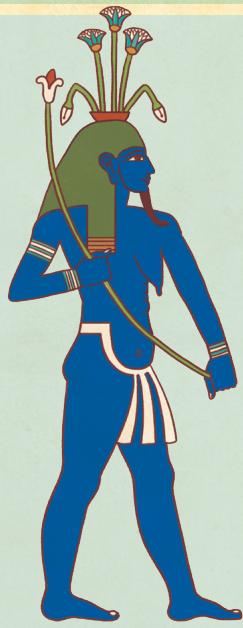
Hapí God of the Nile
Difficulty: Hard

Thath God f riting& Wisdom
Difficulty: Very Hard


AnubíS Protetorofthe Dead
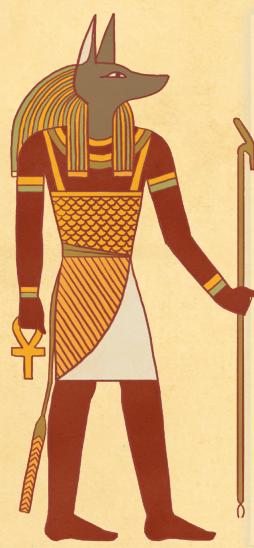
Difficulty: Very Hard

Texts are community-compiled or publicly released by publishers; copyright remains with the original authors. For personal reference only.