
Red Dragon Inn
At a glance
Rules, cards and Q&A (Chinese)
The rules, card data and player questions for this game are written in Chinese. Open the Chinese page to read them.
Where to find full rules
Full rules and card lookup are available in the cunlema app at cunlema.cn — pick this game and ask about any rule, card or turn you are unsure about.
Related games
Rulebook text (Markdown)
This game has 1 rulebook Markdown file(s) in our library; 1 rendered inline below — expand to read or download.
Red Dragon Inn combined rules as of RDI 10 (v 2.7).md228.6 KB
The Red Dragon Inn
Combined Rules as of The Red Dragon Inn 10 (version 2.7)
The Red Dragon Inn
Combined Rules as of The Red Dragon Inn 10 (version 2.7)
Table of Contents
Table of Contents..
Introduction .....
Object of the Game.
Getting Started...
On Your Turn ...
1. Discard and Draw
2. Action.
3. Order a Drink...
4. Drink .....
Ending Your Turn .
Sometimes and Anytime Cards......
Losing the Game.
Running Out ofGold.
Passing Out .
Gambling ....
Ending the Round.
Winning Hand!.
Leaving a Round ofGambling ...
Forcing a Player to Leave a Round ofGambling .
Running out ofGold During Gambling ..
Artifacts and Bombs.
More Drink Rules ..
Running Out ofDrinks .
Drink Events..
Chasers....
Discarding and Drawing.
Drinks That Aren’t Discarded
Ordering Additional Drinks.....
Other Rules ...
Minimum and Maximum Fortitude, Alcohol Content, Gold.
Cards That Affect Your Fortitude, Alcohol Content, Gold.
Negate and Ignore Effects
Redirecting Damage. ..10
Reduction Effects ... ..10
Timing... ..10
Cards that ”Change the Effects of a Drink” . ..12
“The Wench/Barkeep thinks you should stop playing with the drinks.” ...12
Splitting Drinks ..... ..12
Self-Splitting Drinks ...... ..13
Round on the House and A Toast to Villainy! .. ..13
Drinking Contest .... ..14
Variants ... 15
The Bar Deck Variant . ..15
The Prize Variant... ..15
The Pub Crawl Variant .16
The Dungeon Event Deck. ..19
The Sea Event Deck.. ..21
The GM Event Deck. .22
Dungeon Training.. .23
Team Variants ... .25
Two-Headed Dragon .33
Boss Battle...... ..33
Two-Headed Boss Battle ..35
Leaders and Lackeys...... ...36
Boss Versus Boss.. ..36
Otto, Our Mechanical Friend.. . 36
Setup..... ..37
General Rules ..37
Other Otto Rules.. ..40
Boss Otto. 41
Setup.... .41
General Rules . ..42
Boss Otto’s Turn.. .43
Targeting and the Priority Target.. ..43
Repairs...... ..44
Threat Level .44
Gambling ..... ..44
Provoking Boss Otto – the Sometimes Deck.......44
Potion Tokens.. .46
Boss Otto’s Choices .47
Boss Otto – Advanced... 48
Adjusting Difficulty... ..48
Components... .48
Boss Otto – Other Rules . .49
Character-Specific Rules for Boss Otto ...............51
Card-Specific Notes ... 53
Postscript.. 79
Introduction
Welcome to The Red Dragon Inn! If you have never played The Red Dragon Inn before, please read the first few pages of this document (up to “Other Rules”). The other sections include clarifications and variants that you probably won’t need during your first game.
Object of the Game
Keep your Gold and stay conscious. If you run out of Gold, or if your Alcohol Content is ever greater than or equal to your Fortitude, you are out of the game!
Getting Started
Shuffle the 30-card Drink Deck and place it where everyone can reach it, leaving space for a discard pile next to it. (To use more than 30 Drink Cards in the game, see the Bar Deck Variant on page 15.)
Each player chooses a character and takes the material for that character.
Make sure that you are using a regular Character Deck that contains no Boss cards! Boss cards have a dragon head in the upper corners, shown to the right. (For Boss Battle setup, see page 33.)
Shuffle your Character Deck and place it below the space labeled Deck on your player mat. When you must discard Character Deck Cards, place them below the space labeled Discard on your player mat.

Take 10 Gold and place it near your player mat in plain view. This is your “Stash”. (2 players take 8 Gold instead; 7 or more players take 12 Gold instead.) Put the extra Gold to the side. This is the “Inn”.
Place a red Fortitude marker on the 20 on your player mat to track your Fortitude. Place a clear Alcohol marker on the 0 on your player mat to track your Alcohol Content.
Take a card from the Drink Deck and place it face down next to the space labeled Drink Me! This is your Drink Me! Pile. Do not look at the cards in your Drink Me! Pile yet.
Draw the top seven cards from your Character Deck. This is your hand. You may look at these cards, but you must keep them hidden from the other players.
Some characters come with special tokens or a secondary deck. Shuffle the latter if so instructed. For example, Molly comes with a secondary deck of Stable Cards, while Amundyr comes with Scarab tokens.
Choose someone to go first.
On Your Turn
Your turn consists of four Phases, which must be played in order: Discard and Draw, Action, Order a Drink, Drink. Some characters have extra phases. The phases are indicated on your player mat.
1. Discard and Draw
You may discard any cards from your hand that you do not want and then draw from your Character Deck until you are holding seven cards. You may not play any cards or effects until you have finished drawing cards.
If you draw the last card from your Character Deck, shuffle your discarded Character Cards and put them back below the Deck space of your player mat.
If you are holding seven or more cards, you may opt to keep all of them and draw no new cards.
2. Action
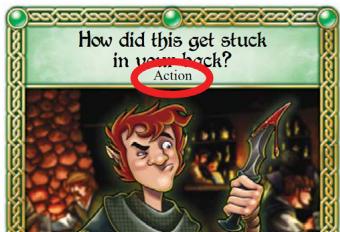
You may play one Action Card. To do so, read its title out loud and pick the affected player(s), if any. Also make any choices that the card calls for (e.g., some of Dominique’s cards may be accompanied by an Energy expenditure), and then give other players a chance to respond to the card. Unless it is Negated or Ignored (see page 9), follow the card’s instructions and discard it to your player mat’s Discard space.
If you play a “Gambling? I’m in!” card, you start a Round of Gambling (see “Gambling” on page 4 for more details).
If you cannot or do not want to play an Action Card, you don’t have to.
3. Order a Drink
Take the top card from the Drink Deck and place it face down, without looking at it, on top of any other player’s Drink Me! Pile.
If the Drink Deck runs out of cards, each player must pay the tavern 1 Gold to serve up a new round of Drinks. (See “More Drink Rules” on page 7 for details.)
4. Drink
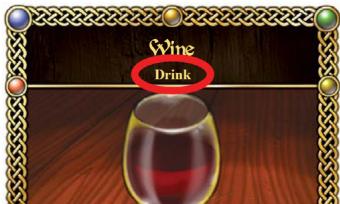
Reveal the top card of your Drink Me! Pile, follow the instructions on the card and place it in the Drink Deck discard pile. Some of the instructions on Drink Cards are represented by icons:

Gain [X] Alcohol Content

Gain [X] Fortitude

Add a Chaser—see “Chasers” on page 7

Lose [X] Fortitude
If you don’t have any cards in your Drink Me! Pile when you have to drink, you start to sober up: reduce your Alcohol Content by one.
Ending Your Turn
After your Drink Phase, the player to your left goes next.
Sometimes and Anytime Cards
Sometimes Cards can only be played under certain conditions. Each card tells you when it can be played in its text. Some allow you to Negate or Ignore another card; these are described under “Negate and Ignore Effects” on page 9.
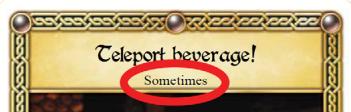
You may play multiple Sometimes Cards in response to the same game event, even if they are multiple copies of the same card. However, you must play the cards one at a time and give your opponents an opportunity to respond to each one.
Anytime Cards may be played at any time, even if they interrupt another action.
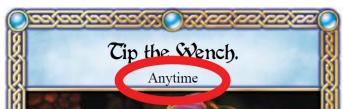
Relevant Sometimes and Anytime Cards may be played in any phase of a turn, either before or after the special action for that phase. For
example, you may play an Anytime Card during your Discard and Draw Phase before you discard and draw.
If two or more players would like to play Sometimes or Anytime Cards at the same time, see “Timing” on page 10.
Losing the Game
Running Out of Gold
If you run out of Gold, you lose your place at the table and must spend the rest of the night out in the stables. You are out of the game.
Passing Out
If your Alcohol Content is ever greater than or equal to your Fortitude, you fall unconscious and the party continues without you. Your Gold is divided between the Inn and any players still in the game. Split your Gold in half. One half, rounded up, goes to the Inn. What’s left gets split evenly among the remaining players, with any remainder going to the Inn. You are out of the game.
If you run out of Gold or pass out, you don’t lose immediately. First, finish resolving any cards that have been played but have not yet resolved. After these cards resolve, you have one last chance to play Sometimes or Anytime Cards to save yourself or attack others. If you can’t save yourself, then you’re out of the game.
If you have any cards in your Drink Me! Pile when you lose, put them in the appropriate discard pile(s).
It is possible for multiple players to lose at the same time. If this happens, first determine which players are passing out. Each of those players divides their Gold among the players who aren’t passing out, as described above. After this, if any players have no Gold, they lose the game as well. This means that if one player passes out and another runs out of Gold simultaneously, the player who is running out of Gold could be saved by getting a share of the Gold from the other player!
If all remaining players would lose the game simultaneously, the game is a tie between those players.
Gambling
When a player plays “Gambling? I’m in!” as their Action, this starts a Round of Gambling.
When a Round of Gambling begins, normal play is suspended and each player must ante 1 Gold, putting it in the middle of the table (making sure not to get it confused with the Inn’s Gold). This counts as “losing Gold” for the purpose of cards which affect that.
The player who started the Round of Gambling is currently winning (“in control” of the Round).
Play proceeds clockwise around the table from the player who started the Round. On your turn you may either play a Gambling or Cheating Card or pass.
Play a Gambling or Cheating Card:
Playing either of these two types of card gives you control of the Round of

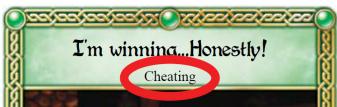
Gambling. The card you play may have other effects, as well.
Pass: You may choose to pass instead of playing a card. You may pass even if you have a Gambling or Cheating Card that you could play (and it is often correct to do so!). If you pass, you are still in the Round of Gambling and may play Gambling or Cheating Cards later in the Round, as long as the Round does not end first.
Ending the Round
If you play a Gambling or Cheating Card and everyone else passes, the Round of Gambling ends, and you win. Take all of the anted Gold and add it to your Stash.
As soon as the last player passes, the Round of Gambling ends immediately. You may not play cards that would affect the Round after this point unless the card explicitly states that you can. In particular, The Wench’s “Oh, I guess I thought that was my tip…” may not be played after the last player has passed.
If a card effect says that you win the Round, the Round ends immediately, and you take the anted Gold.
When the Round of Gambling is over, normal game play resumes. The player who started the Round moves on to their Order a Drink Phase.
Winning Hand!
“Winning Hand!” is a special Gambling Card, because only Cheating Cards (and a few specific other cards) can be used to take control after it has been played. If “Winning Hand!” is played and it is followed by a Cheating Card, then any Gambling or Cheating Card can be played next. Just remember:

- A Cheating Card can be played after anything.
- A Gambling Card can be played after anything except a “Winning Hand!”.
Leaving a Round of Gambling
Some cards allow you to leave a Round of Gambling. If you leave a Round of Gambling, you cannot play Gambling or Cheating Cards for the rest of that Round, but you may still play Sometimes or Anytime Cards. You are no longer affected by cards that require you to ante, such as “I raise!”. Any Gold that you previously anted stays in the pot.
If you play a card that requires players to ante, then immediately leave the Round (for example, with “Gambling? I’m in!” followed by “I’m a little busy right now!”), then the Round proceeds normally, but currently has no winner. If the Round ends before any player takes control, all anted Gold goes to the Inn unless there was only one player left (see below).
Forcing a Player to Leave a Round of Gambling
Some cards force a player to leave a Round of Gambling. When a player is forced out of the Round, each player, including the one being forced out, has a chance to respond—for example, with an anti-cheat card like Warthorn’s “The Red Dragon Inn doesn’t tolerate cheaters! (Usually.)”.
If there is ever only one player left in the Round of Gambling, it ends and the remaining player wins.
Gambling Example
On his turn, Warthorn plays “Gambling? I’m in!” to start a Round ofGambling.
The Wench plays “Wait a minute! Someone’s playing with the drinks!” to leave the Round of Gambling.
She does not have to ante, but she cannot play any Gambling or Cheating Cards for the rest of this Round.
Warthorn, Molly, and Jasper each ante one Gold. Since Warthorn started the Round, he’s winning (in control).
Molly goes next. She passes.
Jasper plays “I raise!”, a Gambling Card that forces all players in the Round to ante an additional Gold. Warthorn, Molly, and Jasper each ante one more Gold (bringing the pot to 6 Gold). The “I raise!” card also puts Jasper in control of the Round of Gambling, so he is now winning.
Warthorn plays “Winning Hand!”. This is a special Gambling Card that can only be beaten by Cheating Cards. Warthorn is now winning.
Molly plays “Oops… I dropped my cards”, a Cheating Card. Molly is now winning.
Jasper passes.
Warthorn plays “Gambling? I’m in!”. In addition to starting a Round ofGambling, “Gambling? I’m in!” can be used during a Round to take control. Warthorn is now winning.
Molly passes and so does Jasper.
Warthorn wins the 6 Gold in the pot.
Running out of Gold During Gambling
If you run out of Gold during a Round of Gambling, you will remain in the game at least until the Round ends, even if you leave the Round or are forced out. Ignore any effects that force you to pay or ante Gold. If you do not win the Round of Gambling, you are out of Gold and out of the game!
If you play a card that would require players to ante, but you cannot ante (because you are out of Gold and cannot use a card like “Illusionary Coin”), then no player is required to ante.
Artifacts and Bombs
If a player plays a card that allows them to steal a Gold from the pot during a Round of Gambling, they may steal a Gold piece, an Artifact, or a Bomb of their choice from the pot. If they steal a face-down card, they immediately reveal it. If it is a Bomb or a Triggered Artifact with an immediate effect, they resolve that effect. Note that, in most cases, stealing a Bomb from the pot would be a very bad idea!
More Drink Rules
Running Out of Drinks
When you reach the end of the Drink Deck, each player must pay one Gold to the Inn to get the tavern to bring more Drinks.
After each player pays one Gold, shuffle the discarded Drink Cards into a new Drink Deck. This happens instantly, so the Drink Deck is never out of cards. Drink Cards that have been put on Drink Me! Piles remain where they are.
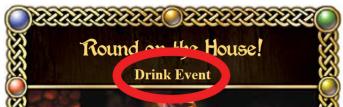
Drink Events
Some cards in the Drink Deck are Drink Event Cards. If you reveal a Drink Event Card, follow the instructions on the card. Cards that affect Drink Cards do not affect Drink Event Cards unless they specifically say that they do so.
Chasers
If you reveal a Drink Card that has the phrase “with a Chaser” in the title or the “+” mug icon, reveal the next card from the deck from which you revealed the original Drink. If it’s a Drink Card, add its effects to the original Drink. If it’s another Drink with a Chaser, add its effects to the original Drink and continue this process.

If no cards remain in your Drink Me! Pile when you would reveal a Chaser from it, or if you reveal a Drink Event Card as your Chaser, there

is no additional effect. Do not continue revealing cards, and if you revealed a Drink Event, discard it without taking its effects. You do not sober up if your Drink Me! Pile runs out while revealing Chasers.
The Drink Deck is never out of cards, so if you run out of cards while revealing Chasers from the Drink Deck, follow the Running Out of Drinks rule above and then continue revealing Chasers.
The original Drink and its Chasers all count as a single Drink. A card that allows you to Ignore a Drink will Ignore the original Drink and all of its Chasers.
No player may respond to a Drink until all of its Chasers have been revealed.
Example: Jasper drinks from his Drink Me! Pile and gets Halfling Stout with a Chaser. He reveals the next card on his Drink Me! Pile and gets Dragon Breath Ale. He adds the effects of both Drinks, for a total Alcohol Content of 6. Jasper plays “Not now. Gotta bounce!” to Ignore the Drink, so he gains no Alcohol Content.
Example: During a Drinking Contest, Warthorn reveals Light Ale with a Chaser from the top of the Drink Deck. He reveals the next cardfrom the Drink Deck and gets Round on the House! Since Round on the House is a Drink Event Card, it has no effect as a Chaser. Warthorn gains 1 Alcohol Content.
Discarding and Drawing
Some Drinks cause you to draw cards, discard cards, or reveal cards from your Character Deck. If a Drink includes multiple such effects due to Chasers or other effects added to the Drink, resolve them in the order of your choice. However, you must fully resolve one such ability before moving on to the next—you may not interrupt one ability to resolve another.
Drinks That Aren’t Discarded
Some cards, such as the Elixirs in the Wench’s Special Reserve Deck, instruct you to do something with a Drink Card other than putting it in a discard pile after it resolves. Multiple players can end up being affected, but only one of those players can move the card. If that happens, start with the player who controlled the Drink when it resolved, or the active player if the Drink had no single controller (like in the case of “Round on the House”). Then proceed in turn order among all players who were instructed to move the Drink, skipping any players who Ignored the Drink or passed it to another player. The first player in that order takes the indicated action with the physical card. If no player is eligible to take the action, the Drink goes to the Drink discard pile as usual.

Example: On his Drink Phase, Warthorn reveals Elixir of Alacrity. He plays “Here, finish my drink!” to split the Drink with Jasper. Warthorn and Jasper each gain 1 Alcohol Content. Since Warthorn is the first affected player in turn order, he puts the Elixir of Alacrity in front of him. Unfortunately for Jasper, he does not gain the benefit of the Elixir.
Ordering Additional Drinks
Some cards allow you to order additional Drinks during your Order a Drink Phase. When you do this, you may put the Drinks face down on any other players’ Drink Me! Piles. They can all go to the same player, or they can be distributed however you like among multiple players.
Other Rules
Minimum and Maximum Fortitude, Alcohol Content, Gold
Your Fortitude and Alcohol Content can never go below 0 or above 20. Your Gold can never go below 0, but it has no maximum. If the Inn runs out of Gold Pieces, use some other markers as a substitute.
If a card effect cannot fully take effect due to these limits, the card still takes effect as completely as it is able.
Example: Warthorn is at 0 Alcohol Content. Fleck plays “And now I’m going to play something really sad” to make each player lose 1 Alcohol Content and pay him 1 Gold. Warthorn cannot lose 1 Alcohol Content, since he is already at 0, but he still must pay Fleck 1 Gold.
Cards That Affect Your Fortitude, Alcohol Content, Gold
Some cards specify that they can be played in response to a card that affects your Fortitude, Alcohol Content, or Gold. A card affects one of these attributes only if it would directly change that attribute when it takes effect.
If a card would normally affect an attribute but can’t because that attribute is already at its minimum or maximum value, the card is still considered to affect that attribute.
You may not Ignore a Round of Gambling with a card that allows you to Ignore a card that affects your Gold.
Example: Molly plays “Tip the Wench” to make Jasper pay 1 Gold to the Inn. In response, Jasper plays “Zzzzzzzz…”, allowing him to Ignore the card, since it would directly change his Gold.
Example: Jasper reveals Wine on his Drink Phase. Dimli plays “Spike it with Firewater” to add 2 Alcohol Content to the Wine. Jasper may not play “Zzzzzzzz…” here, because Dimli’s card is not changing Jasper’s Alcohol Content directly—it is changing the effects of the Wine.
Example: Jasper reveals Dragon Breath Ale on his Drink Phase. He plays “Not now. Gotta bounce!” to Ignore the Drink. The Wench plays “I don’t think so!” to Negate “Not now. Gotta bounce!”. Jasper may not play “Zzzzzzzz…” here, because The Wench’s card is not changing Jasper’s Alcohol Content directly—it is Negating Jasper’s card that would allow him to Ignore the Drink.
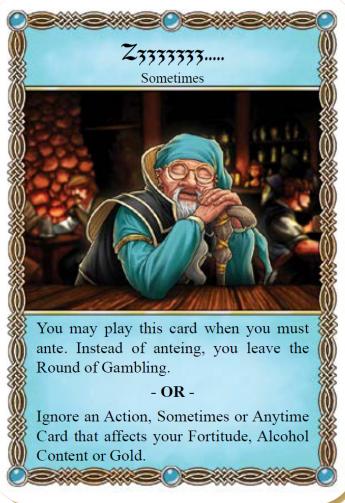
Example: Jasper wins a Round of Gambling. At the end of the Round, Gerki plays “Um…I know you think you won, but…” to take the pot. Jasper may not play “Zzzzzzzz…” here, because Gerki’s card is not directly changing Jasper’s Gold. It is affecting the outcome of the Round of Gambling.
Negate and Ignore Effects
Some Sometimes Cards allow you to Negate or Ignore another card.
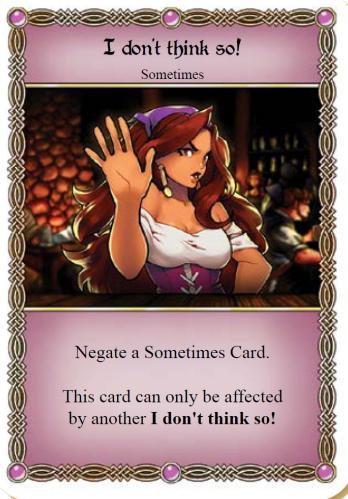
When you Negate a card, you completely prevent it from resolving. The Negated card goes to the appropriate discard pile. None of its effects happen.
When you Ignore a card, the card resolves normally, but it has no effect on you. It still affects other players as usual.
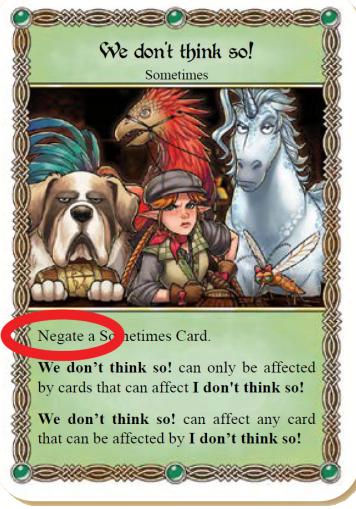
Cards do not Negate or Ignore other cards unless they specifically use the
words “Negate” or “Ignore”. So, for example, cards which reduce or redirect damage, reduce Alcohol Content, or pass Drinks to other players are not Negating or Ignoring anything.
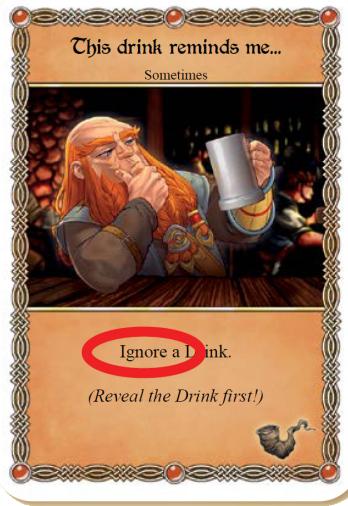
Many cards allow you to Ignore a Drink. You may only play a card of this type on a Drink that would affect you in some way. You may not Ignore someone else’s Drink unless that player first passes it to you or splits it with you, or if you would somehow take effects from it.
Some cards allow you to Ignore a card that affects your Gold. You may not use such a card to avoid a Gold payment on a card that you played yourself. You may still use cards that reduce payments or pay with Gold from the Inn, however.
Some cards allow you to Ignore an Event. This includes Drink Events, Tavern Events, Sea Events, Dungeon Events, or GM Events (other than Active Events). You may not Ignore an Event after it has started resolving in order to selectively Ignore the later parts of the Event. (This can be relevant for cards like “Drinking Contest”.)
Negate Example: Jasper plays “Hey! Don’t mess with the staff!” on Warthorn. Warthorn loses 2 Fortitude, then plays “Never mess with a dwarf!” to try to hit Jasper back. Jasper responds with “I don’t think so!”. Warthorn’s card is Negated, so it has no effect. Jasper loses no Fortitude.
Ignore Example: Molly plays “Stampede!” to make Warthorn, Jasper, and The Wench each lose 2 Fortitude. In response, Jasper plays“Zzzzzzzz…” to Ignore the card. Jasper does not lose Fortitude, but the other players do, since Molly’s card affects them normally when it resolves. (And Molly must still pay 3 Gold to the Inn.)
Redirecting Damage
Some cards, such as “It’s all fun and games until someone else gets hurt” allow damage to be redirected from one player to another. When this happens, the game treats the Fortitude loss as though it came from its original source.
Example: Captain Whitehawk plays “I won’t stand idly by while you insult the Drake!” to make Natyli lose 3 Fortitude. Natyli plays “It’s all fun and games until someone else gets hurt” to redirect the damage to Bryn. After the damage resolves, Bryn plays “You wanna play, huh?” to make the player who hit her lose 2 Fortitude. Bryn’s card causes the Captain to lose 2 Fortitude, not Natyli.
If a card says that it redirects Fortitude loss, it does not redirect any other effects on the redirected card.
Example: Remy plays “Take this as a warning! Next time it’ll be the brig” to make Natyli lose 2 Fortitude and become marked. Natyli plays “It’s all fun and games until someone else gets hurt” to redirect the damage to Gog. Gog loses 2 Fortitude, but Natyli still becomes marked.
If multiple redirection effects would apply to a damage effect, each redirection effect applies exactly once.
The effects are applied in the order they were played.
Example: Natyli plays “Uh oh, your doll has a loose stitch!” to make Bryn lose 1 Fortitude and gain a Power Jinx. Bryn plays “Stop hitting yourself!” to redirect the damage back to Natyli. Natyli plays “It’s all fun and games until someone else gets hurt” to redirect the damage to Fleck. Fleck loses 1 Fortitude and Bryn gains a Power Jinx.
Reduction Effects
Some cards allow you to reduce an effect from another card.
Reducing an effect from a positive number to a negative number or vice versa reduces it to 0 instead. If a card would affect all players, reducing the effect that one player takes does not change the effect for the other players unless that card says that it changes “numeric effects”.
Timing
Whenever any card is played or a Drink or Event is revealed, each player (in turn order, starting with the player who played or revealed the card) may play relevant Sometimes Cards in response.
If no player has any response to a card, that card resolves and its instructions are carried out.
If a player plays a response to a card and that response resolves, each player (in turn order, as above) has another opportunity to respond to the original card. If no player does, the original card resolves.
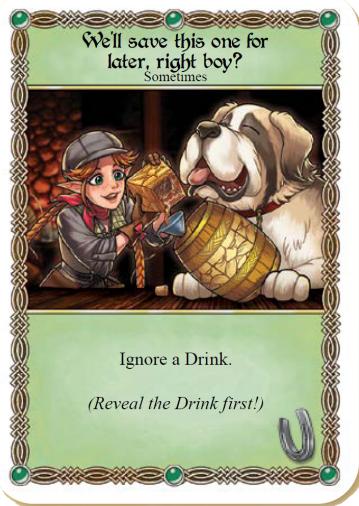
Example: Molly reveals Light Ale during her Drink Phase. She is holding “We’ll save this one for later, right boy?”, which would allow her to Ignore the Drink. She chooses not to play it, since the Drink only has an Alcohol Content of 1. Dimli plays “Spike it with Firewater” to add 2 Alcohol Content to the Light Ale. After Dimli’s card resolves, Molly will have another opportunity to play “We’ll save this one for later” to Ignore the spiked Light Ale, even though she previously chose not to respond.
If two or more players are instructed to reveal and drink Drinks at the same time (for example, with the Drink Event “Drinking Contest!”), they first reveal Drink Cards and Chasers, as appropriate. After that, in turn order (as above), players may play Sometimes Cards that modify Drinks. Anytime Cards may also be played here. When no player has any further responses, each player drinks their Drink simultaneously.
If two or more players wish to respond to the same game event with Sometimes or Anytime Cards, players should take back their plays, then play and resolve their Anytime Cards in turn order, beginning from the player whose turn it is. After that, they should play and resolve their Sometimes Cards in the same way.
If a situation arises in which two or more players are each waiting for the others to act before making a decision, the deadlock should be broken with a similar method. In turn order, beginning with the player whose turn it is, each player declares their choice, then the game continues normally.
Example: Jasper is at 12 Fortitude and 10 Alcohol Content. On his Drink Phase he reveals Elven Wine. In order to keep from passing out, he plays “Not now. Gotta bounce!” to Ignore the Drink. The Wench (sitting to Jasper’s left) and Warthorn (sitting to The Wench’s left) each hold an “I don’t think so!”, and each suspects that the other is holding one. Both The Wench and Warthorn are interested in Negating Jasper’s Ignore card, but neither wants to be the one to spend their critical “I don’t think so!”. To resolve the deadlock, first The Wench, then Warthorn must either play a response to Jasper’s card or choose not to. If neither The Wench nor Warthorn decides to play “I don’t think so!” on Jasper’s card, he Ignores his Drink and remains in the game.
If two or more players wish to respond to sequential game events that occur as the result of a card being played, then players should take back their plays, then play them sequentially.
Example: Molly plays “Stampede!” to make Warthorn, The Wench, and Jasper each lose 2 Fortitude. At this point, Jasper wants to play “Zzzzzzzz…” to Ignore the effect and Warthorn wants to play “Never mess with a dwarf!” to hit Molly back. Since the game event of responding to Molly’s card happens before the game event of players losing Fortitude, Jasper plays his card first. Once that card takes effect, Molly’s card resolves, causing Warthorn and The Wench to each lose 2 Fortitude, and causing Molly to pay 3 Gold to the Inn. At this point, Warthorn may play his card to hit Molly back.
Cards that ”Change the Effects of a Drink”

Several cards allow you to Negate a Sometimes Card that changes the effects of a Drink. Negating or Ignoring a Drink, passing a Drink to another player, splitting a Drink, and increasing or decreasing a Drink’s
Alcohol Content are all considered changing the Drink’s effects, so such cards can be played in all of these cases.
Cards that Order Drinks, force a player to drink, or directly increase a player’s Alcohol Content do not count as changing the effects of a Drink.
Altering or interacting with a Drink Event does not count as changing the effects of a Drink, since a Drink Event is not a Drink.
Negating a card that would change the effects of a Drink does not itself count as changing the effects of a Drink. (Quite the opposite, in fact!)
“The Wench/Barkeep thinks you should stop playing with the drinks.”
Negating or Ignoring a Drink, passing a Drink to another player, splitting a Drink, and increasing or decreasing a Drink’s Alcohol Content are all considered changing the Drink’s effects, so “The Wench/Barkeep thinks you should stop playing with the drinks” can be played in all of these cases.
“The Wench/Barkeep thinks…” cannot be used to Negate another copy of itself nor a card that orders you Drinks, gives you Special Reserve Drinks, forces you to drink, directly increases your Alcohol Content, or affects a Drink Event Card.
The Wench’s own “I think you should stop playing with the drinks” is functionally identical to other players’ “The Wench/Barkeep thinks you should stop playing with the drinks”.

Splitting Drinks
When a card is played that can split or duplicate a Drink, it creates separate, independent Drinks. A card that affects a Drink can only affect one of the split Drinks unless it specifically says otherwise. If a Drink is altered before it is split, then the altered Drink is split.
Example: Warthorn reveals an Elven Wine (3 Alcohol Content). He plays “Here, finish my drink!”, which splits the Drink into two Drinks with 2 Alcohol Content each (3 Alcohol Content split in half, then rounded up). Dimli then plays “Spike it with Firewater” to add 2 Alcohol Content one of the two Drinks. The result is one Drink with 2 Alcohol Content and another with 4 Alcohol Content.
Example: Dimli plays “Spike it with Firewater” as soon as the Elven Wine is revealed, making the Elven Wine a Drink with 5 Alcohol Content. Warthorn then plays “Here, finish my drink!”, creating two Drinks with 3 Alcohol Content each.
To split a Drink with one or more Chasers, first combine all like numeric effects (Alcohol Content, Fortitude, drawing cards, etc.), then split each combined effect in half, rounding up.
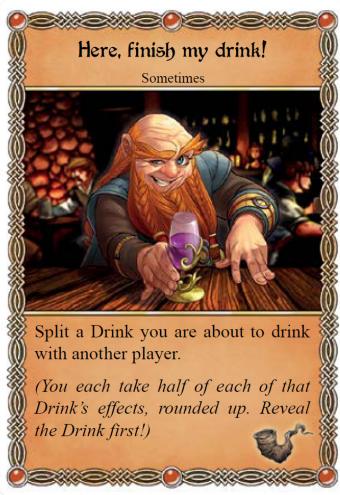
Example: On Warthorn’s Drink Phase, he reveals Elven Wine with a Chaser of Ale of Intrigue (Gain 2 Alcohol Content, draw 2 cards). He then plays “Here, finish my drink!” to split the Drink with Molly. Warthorn and Molly each gain 3 Alcohol Content and draw 1 card.
Self-Splitting Drinks
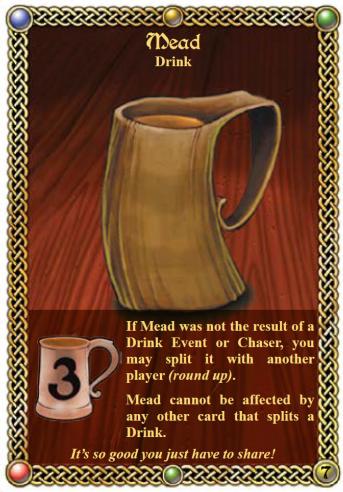
Some Drinks, such as Mead, have their own built-in split effects. When a player reveals one of these Drinks, players first get an opportunity to affect the Drink. When players are done affecting the Drink, the player who revealed it may choose a player with whom to split it. Players then have another opportunity to affect the split halves of the Drink. Because players have an opportunity to affect the Drink after it is split, the two players sharing the Drink could end up taking different effects from it!
Example: Warthorn reveals Mead during his Drink Phase. No player alters the Drink, so he decides to split it with The Wench. This creates two copies of Mead with 2 Alcohol Content each (half of 3 rounded up). After this, Dimli plays “Spike it with Firewater” on The Wench’s Mead,
giving it a total Alcohol Content of 4. Each player then drinks their half, so Warthorn gains 2 Alcohol Content and The Wench gains 4.
If a self-splitting Drink is the result of a Drink Event or is revealed as a Chaser to another Drink, it may not be split with another player. The player drinking the Drink takes its full effects.
Round on the House and A Toast to Villainy!
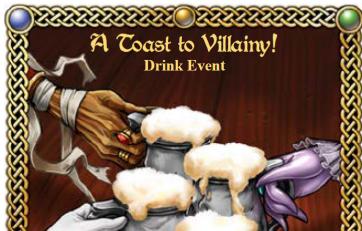
The cards Round on the House and A Toast to Villainy! are similar to a split effect, but are not considered split effects. When a Drink is revealed for either, each player immediately receives a separate, independent copy of that Drink. Players do not have an opportunity to affect the Drink before it is copied, but may affect the individual copies afterward.
Drinking Contest
When a player reveals a Drinking Contest card, each player, starting with the player whose turn it is, reveals the top card of the Drink Deck. If that card is a Drink Event, it has no effect and counts as having no Alcohol Content. If it is a Drink with a Chaser, the player continues revealing Drink Cards as appropriate. Once all players have revealed one or more cards from the Drink Deck, players may, in turn order, play Sometimes Cards that modify Drinks. Anytime Cards may also be played here. When all players are done playing cards, each player drinks and discards their Drink, then the player who revealed the Drink with the highest total Alcohol Content receives one Gold from each other player.
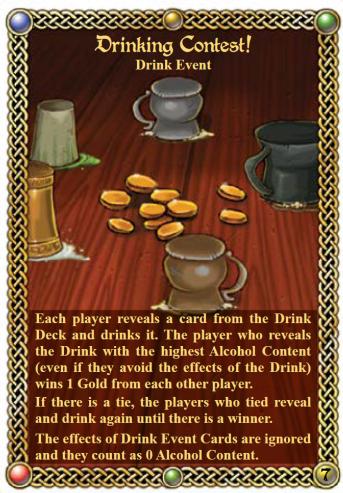
If two or more players tie for the Drink with the highest total Alcohol
Content, the tied players repeat the process of revealing, modifying, drinking, and discarding Drinks until there is a clear winner. If all tied players but one pass out during this process, the remaining player wins the Drinking Contest and does not continue drinking. If all tied players pass out during this process, the Drinking Contest has no winner.
If a player would win the Drinking Contest and pass out at the same time, that player collects Gold for winning the contest, then passes out.
If a player passes out during a Drinking Contest, that player loses the game, but does not split their Gold among the other players until after the Drinking Contest is completed. Players who lose the game in this way still must pay one Gold to the winner of the Drinking Contest before splitting their Gold.
Cards that increase or decrease the Alcohol Content of a Drink will affect the outcome of a Drinking Contest. If a Drink is split, Ignored, or given to another player, this does not affect the outcome of the contest. If a player somehow drinks extra Drinks during a Drinking Contest (with a card like The Wench’s “Drink up, before it goes flat!”), these extra Drinks do not affect the outcome of the Drinking Contest.
If a Drink’s total Alcohol Content is less than 0 (such as Coffee), it counts as a 0 Alcohol Content Drink in a Drinking Contest. The Drink will still affect your Alcohol Content as usual.
Example: In a Drinking Contest, Molly reveals Wine (2 Alcohol Content), and Jasper reveals Light Ale (1 Alcohol Content). The Wench plays “Playing with the drinks? That’s my job!” to increase the Alcohol Content of Jasper’s Drink to 2, causing his Drink to tie with Molly’s. Molly and Jasper each gain 2 Alcohol Content, then the Drinking Contest continues.
Example: In another Drinking Contest, Warthorn reveals Dragon Breath Ale (4 Alcohol Content), and Molly reveals Dark Ale (1 Alcohol Content). Warthorn plays “Here, finish my drink!” to split his Drink with Molly. Molly gains a total of 3 Alcohol Content and Warthorn gains 2 Alcohol Content, but Warthorn still wins the Drinking Contest.
If you run out of Gold during a Drinking Contest, you will remain in the game at least until the Drinking Contest is finished. Ignore any effects that force you to pay Gold. If you do not win the Drinking Contest, you are out of Gold and out of the game!
Example: Molly has 1 Gold and reveals a Drinking Contest on her Drink Phase. As Drinks are revealed by each player, the Drink Deck runs out, so everyone pays 1 Gold to the Inn to get a new round of Drinks. Molly pays her last Gold, so she will be out of the game if she does not win. She reveals a Dragon Breath Ale and wins the Drinking Contest, receiving a Goldfrom each other player and staying in the game.
Variants
The Bar Deck Variant
The Red Dragon Inn is designed to be played with a 30-card Drink Deck, so that the deck will run out during the game and force everyone to pay Gold to the Inn. However, there are now many more than 30 unique Drink Cards available across all expansions. If you’d like to play with a Drink Deck of more than 30 cards, use this variant.
Setup: Shuffle together all of the Drink Cards you wish to use for the game. This is the Bar Deck. Count out 30 cards from the Bar Deck face down and use those cards as your Drink Deck at the start of the game.
The Bar Deck must be made up of Red Dragon Inn Drink Cards, with the backs marked “Drink Deck”. Tavern Drink Cards for the Pub Crawl Variant may not be used in the Bar Deck. However, it is possible to play a game with both the Pub Crawl Variant and the Bar Deck Variant. Simply use the Bar Deck as the Red Dragon Inn Drink Deck and use the usual Tavern Decks for the other taverns.
When the Drink Deck runs out, each player pays 1 Gold to the Inn, as usual. Then, take the next 30 cards from the Bar Deck and use them as your replacement Drink Deck. If the Bar Deck runs out during this process, shuffle all of the discarded Drink Cards and use that as your new Bar Deck.
The Prize Variant
Some cards have the type “Prize”. The Prize Variant provides an optional way to spice up Rounds of Gambling. To play with this variant, add any number of unique Prize Cards to the Inn at the start of the game.
Whenever a player starts a Round of Gambling, that player must choose one of the Prize Cards in the Inn and add it to the pot before players ante. The player who wins the pot also takes the Prize and follows its instructions at the appropriate time.
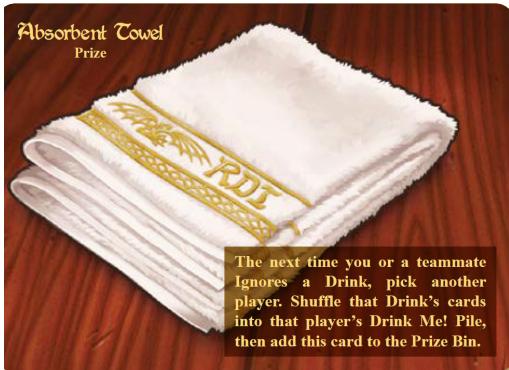
Using a Prize will cause it to move to the Prize Bin, a holding pile for used Prizes. The Prize Bin ensures that each Prize must be won once before any Prize can be won again. If a player starts a Round of Gambling and there are no Prizes in the Inn, move all Prizes from the Prize Bin to the Inn, then choose a Prize as usual. If a player starts a Round of Gambling and there are no Prizes in the Inn and no Prizes in the Prize Bin, that Round of Gambling simply doesn’t include a Prize.
If the pot goes to the Inn, the Prize in that pot goes to the Inn with it.
Stealing Gold from the Pot: A Prize is not Gold, so it cannot be stolen from the pot with cards like Eve’s “Sleight of Hand”. Stealing Gold from the pot does not cause you to win the Prize, even if you happen to steal the last Gold from the pot.
Taking the Pot Without Winning the Round: A few characters, including Gerki, Torglesnarf, and The Wench can take the pot without actually winning the Round of Gambling. If they do this, they get the Prize.
Events: If an Event Card starts a Round of Gambling, the active player chooses which Prize to add to the pot.
Team Variants: In a team game, a Prize is won by the individual player who takes the pot. That Prize may only be used by that player, not by that player’s teammates.
The Pub Crawl Variant
In the Pub Crawl Variant, you’re not at the Red Dragon Inn for the whole evening—you’re floating around to various taverns trying out new and interesting drinks! If it’s your first time playing The Red Dragon Inn, we recommend playing without this variant.
Setup
Set out the Red Dragon Inn Tavern Card and five other Tavern Cards in the center of the table with their Open sides face up. (The Open side of a Tavern Card is the side with the name of the tavern and its Tavern Event.) Shuffle the regular 30-card Drink Deck and put it next to the Red Dragon Inn Tavern Card. Shuffle the other 6-card Tavern Drink Decks separately and put each one next to its Tavern Card. Put the Party Pawn on the Red Dragon Inn Tavern Card. Each player starts with one Drink from the Red Dragon Inn Drink Deck on their Drink Me! Pile, as usual.
Pub Crawling
At several points during the game, the party will move to a different tavern. Whenever a player reveals a Drink that includes one or more Chasers, that player must Crawl. They move the Party Pawn to a different Open Tavern of their choice after the Drink and any other pending effects are finished resolving.
Revealing a Drink with a Chaser causes the party to Crawl whether that Drink resolves normally or was Negated, Ignored, passed to someone else, modified, left in front of a player after resolution, etc. The player who revealed the Drink is the one who Crawls, even if someone else ends up taking effects from the Drink.
Revealing a Drink with an “empty Chaser”, like Wine with a Chaser of Round on the House, or Light Ale with a Chaser of nothing because you have no cards left in your Drink Me! Pile, still causes the party to Crawl.
You may not Crawl to a Closed Tavern (one that is out of Drinks—see below). You may not return to the Red Dragon Inn until all other taverns are Closed. If these rules make it impossible to Crawl, the party stays where it is. Once you return to the Red Dragon Inn, there is no more Crawling—you simply stay there for the rest of the game, because you’ve literally closed down every other tavern in town.
Tavern Events
Each Tavern Card has a Tavern Event on it. Whenever the Party Pawn moves to a new tavern, resolve that tavern’s Event. A Tavern Event happens each time the party moves to that tavern. They may be Ignored or otherwise affected as Events. If a player is Ignoring all effects from a card like Nerodia’s “You need a moment in the statuary hall”, they Ignore Tavern Events (including the one on the Red Dragon Inn— paying to reshuffle the RDI Drink Deck is separate from this Event).
Ordering Drinks
Whenever a player must Order a Drink, they take it from the Drink Deck corresponding to the tavern where the Party Pawn currently is. After ordering the last Drink from a tavern, it Closes. Put the Tavern Card back in the box, then the player who ordered the last Drink from that tavern must Crawl.
If a tavern would Close while a player still has more Drinks to Order, the player Orders as many as they can from the current tavern, then Closes the current tavern, then Crawls (causing the new tavern’s Event to happen), then continues Ordering Drinks.
Drink Discard Piles
Each tavern has its own Drink discard pile. Keep each tavern separate. Taverns other than the Red Dragon Inn don’t reshuffle. When the RDI Drink Deck reshuffles, everyone pays 1 Gold to the Inn as usual, then shuffle just that Drink Deck, leaving the other taverns’ cards out.
“The Drink Deck”
When a card specifically refers to the Drink Deck, that always means the Red Dragon Inn Drink Deck, even if the Party Pawn is at some other tavern.
Example: The party is at Startusk’s. Samantha reveals a Drinking Contest as her Drink for the turn. Each player reveals a Drink from the RDI Drink Deck as usual.
Example: The party is at Lucky’s Rolling Barrel. Joran plays “I’m heading up to the bar. Let me get you something!” during his Order a Drink Phase. Since his card specifically refers to the Drink Deck, he looks at the top 3 cards of the RDI Drink Deck, not Lucky’s Drink Deck.
Be sure to pay close attention to whether a card tells you to Order a Drink or to do something else that looks like Ordering but actually refers to the Drink Deck!
Multiple Crawls at the Same Time
It is possible (via something like a Drinking Contest or a “toast” card) for multiple players to reveal Drinks with Chasers at the same time. When this happens, first completely resolve the Drinking Contest or toast and all of its Drinks normally. (In the case of a Drinking Contest, this could involve doing more drinking rounds to break ties.) Then, in turn order starting with the active player, any player who revealed one or more
Chasers during the process must Crawl. This will cause multiple Tavern Events to happen, and the Party Pawn will end up at the tavern that the last player Crawls to. Each Crawling player must move the Party Pawn—they may not leave it where it is, but they may move it to a tavern that was previously visited in the current chain of Crawling. You may wish to use the Crawl Tokens to help you keep track of which players must Crawl if multiple players must do so.
In the event that a single player reveals multiple separate Chaser Drinks during a multi-round Drinking Contest, that player Crawls once at the end of the Drinking Contest, not multiple times.
Multiple Players Affected by a Chaser Drink
If multiple players take effects from a single Drink with a Chaser, or if multiple players get a copy of a Drink with a Chaser (from Round on the House, for example), then only the player who revealed the Drink Crawls.
Revealing Multiple Drinks
Some cards, such as “The Wench dares you…” or Zariah’s “Amber has a knack for mixing drinks”, instruct a player to reveal multiple Drinks and take some action with them. If one or more of the revealed Drinks include Chasers, the revealing player will Crawl after the revealing card effect is finished resolving. That player only Crawls once, even if they happened to reveal multiple Drinks with Chasers.
Example: Zariah plays “Amber has a knack for mixing drinks” with its Chimera effect. She reveals Light Ale with a Chaser of Wine and Dragon Breath Ale. She gives the Dragon Breath Ale to Samantha, shuffles the Light Ale and the Wine back into the Drink Deck, then Crawls.
Example: Farai reveals The Challenge as his Drink for the turn. He decides to accept the challenge and reveals Light Ale with a Chaser of Wine and Elven Wine with a Chaser of Ogre Brew as his two Drinks. He drinks the two Drinks, gets a Gold from each other player, then Crawls (once).
This rule also applies to the case where multiple different effects are causing Drinks to “stack up”.
Example: Samantha reveals Light Ale with a Chaser of Wine as her Drink for the turn. Before it resolves, Fiona plays “We’re at an inn, and you’re not drinking. What’s wrong with you?” to make Samantha drink again from her Drink Me! Pile. She reveals Wine with a Chaser of Dwarven Firewater. She Ignores the very large Drink, then drinks her Light Ale with a Chaser of Wine, then Crawls (once).
Looking at Ordered Drinks
If a player (such as Tara) is Ordering multiple Drinks and looking at them in the process, and the card effect does not refer to the Drink Deck, then you first gather and look at the cards you are Ordering, possibly Closing taverns and Crawling in the process. When you have the correct number of Drinks, you may look at all of them and decide where to put them. (Note that Tara’s “Signs point to you getting drunker…soon!” is the only card affected by this rule.)
Shuffling Drinks Back into a Deck
If a Tavern Drink would be shuffled back into the Drink Deck, such as with Sera’s “I think these drinks might have been poisoned”, it is shuffled back into the appropriate Tavern Drink Deck instead. If that Tavern is closed, then that Tavern Drink Deck no longer exists, so the card is discarded instead of shuffled back in.
Gizmos, Minions, Shadowfiends
Remember, Wrench’s Gizmos, Torglesnarf’s Minions, and Baelfire’s Shadowfiends Ignore all Events. This includes Tavern Events!
Special Reserve Drinks
If The Wench gives players Special Reserve Drinks, those cards “float to the top” of those players’ Drink Me! Piles as usual, even if the affected Drink Me! Piles include Tavern Drinks. Tavern Drinks do not float to the top—they can be covered by other cards, including cards from the Red Dragon Inn Drink Deck.
Otto
If Otto, the automated third player, is in the game, it never Crawls, even if it gets a Drink with a Chaser. If a Tavern Event says that it can be affected as though it were an Action or a Drink, Otto reveals a Sometimes effect in response. Tavern Events always affect both of Otto’s tracks, regardless of which player Crawled.
Boss Otto
If Boss Otto must Crawl, it goes to a random legal tavern. Boss Otto does not respond to Tavern Events, even those that say that they can be responded to as though they were an effect of a different type that Boss Otto would normally respond to.
Teams
When playing a team game with the Pub Crawl Variant, any player revealing a Drink with a Chaser will Crawl, as usual. If multiple players happen to reveal Chasers at the same time, they are resolved in turn order, just like in individual games. Remember that teammates reveal and resolve their Drinks separately during their shared Drink Phase, though!
Since the effects resulting from Crawling are Events, each team will choose a Champion. The Crawling player does not necessarily need to be chosen as their team’s Champion. Once Champions are chosen, the Tavern Event is resolved, affecting only the Champions.
The Dungeon Event Deck
The Dungeon Event Deck offers an optional play variant for your game. When you play with the Dungeon Event Deck, you are drinking, gambling, and roughhousing in the villainous Black Dragon Depths tavern, deep in the catacombs beneath Greyport. During the game, random events happen that are just the kind of things you’d expect to see in a dungeon!

You may use the Dungeon Event Deck with any combination of Red Dragon Inn characters. If you decide to use it, shuffle the deck and place two Dungeon Event Progress Counters on top of it. Leave space next to the deck for its discard pile. If you run out of Dungeon Event cards, shuffle the discards and use that as the new Dungeon Event Deck.
At the end of each player’s turn, remove a Progress Counter from the Dungeon Event Deck. When you remove the last Progress Counter, reveal and discard the top card of the Dungeon Event Deck and follow the instructions on the card. After this, place a number of Progress Counters onto the Dungeon Event Deck equal to the Encounter Level of the revealed Dungeon Event Card.
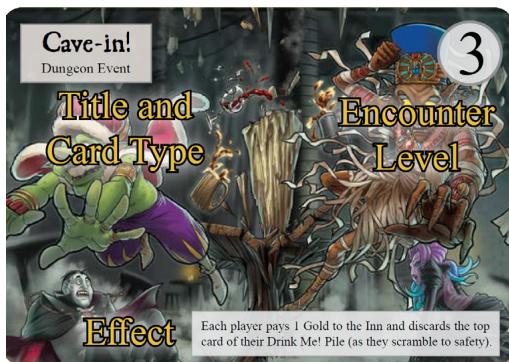
Example: At the end of Vlazlo’s turn, he removes the last Progress Counter from the Dungeon Event Deck. He reveals the top card, which is “Cave-in!”. Each player pays 1 Gold to the Inn and discards the top card of their Drink Me! Pile. “Cave-in!” has an Encounter Level of 3, so Vlazlo puts 3 Progress Counters onto the Dungeon Event Deck and the game continues.
Dungeon Events affect all players. If a Dungeon Event requires players to make a choice, those choices are made in turn order, starting with the player whose turn is ending, unless the card says otherwise.
If a Dungeon Event gives you the option of taking an action that you can’t take, you may not choose that option. So, for example, if you have fewer than 3 cards in your hand, you may not choose to discard to “Drink or Meet Your Doom!”.
Some Dungeon Events refer to “Heroes” and “Villains”. A Villain is any of the characters from Red Dragon Inn 6 and later characters whose decks include Boss cards. A Hero is any other character.
Removing a Progress Counter and revealing a Dungeon Event (if appropriate) is the last thing that a player does on their turn. So, for example, this happens after the active player loses a Fortitude due to having one of Amundyr’s Scarab Tokens.
If a player loses the game on their turn, or if a turn ends prematurely (for example, with Vlazlo’s card “Bat nap”), a Progress Counter is still removed from the Dungeon Event Deck as usual.
Interaction Between Dungeon Events and Other Cards
Once an Event Card starts resolving, it can no longer be Negated or Ignored (note that this rule applies to Drink Events, Tavern Events, Sea Events, Dungeon Events, and GM Events).
Discarding a card to a Dungeon Event effect does not count as “playing” that card. (This can be relevant for Erin when she is in Tree form.)
Cards that say that they affect Event cards can affect Drink Events, Tavern Events, Sea Events, Dungeon Events, or GM Events (other than Active Events). Cards that say that they affect only a particular type are limited to that type (such as Wizgille’s “I didn’t activate my temporal dilation field. It’s just déjà vu”, which refers only to Drink Events).
Some Dungeon Events say that their effects may be reduced or Ignored as though they were Action Cards. You may play cards to reduce or Ignore these effects only if the card you play specifically states that it may be played in response to an Action Card.
Playing with Dungeon Events and Sea Events
Thanks to a teleport spell gone awry (nice job, Joran), the party is randomly shifting back and forth between the Crimson Drake and the Black Dragon Depths!
In this variant, you play with both the Sea Event Deck and the Dungeon Event Deck. Shuffle each deck separately, then put 2 Sea Progress Counters onto the Sea Event Deck and 3 Dungeon Progress Counters onto the Dungeon Event Deck.
At the end of each player’s turn, remove a Progress Counter from the Sea Event Deck and reveal the event if appropriate. Then, do the same with the Dungeon Event Deck. Yes, this means that you could get a Sea Event followed by a Dungeon Event on the same turn!
The Sea Event Deck
The Sea Event Deck offers an optional play variant for games of The Red Dragon Inn. When you play with the Sea Event Deck, you are leaving the relative safety of the Red Dragon Inn and are instead drinking and carousing in the Captain’s cabin on board The Crimson Drake while it is at sea. Because you are out on adventure, you run the risk of being interrupted by random encounters. Some of the encounters are relatively safe, while others are very dangerous!

You may use the Sea Event Deck with any combination of Red Dragon Inn characters. If you decide to use it, shuffle the deck and place two Sea Event Progress Counters on top of it. Leave space next to the deck for its discard pile. If you run out of cards in the Sea Event Deck, shuffle the discards and use that as the new Sea Event Deck.
At the end of each player’s turn, remove a Progress Counter from the Sea Event Deck. When you remove the last Progress Counter, reveal and discard the top card of the Sea Event Deck and follow the instructions on the card. After this, place a number of Progress Counters onto the Sea Event Deck equal to the Encounter Level of the revealed Sea Event Card.
Sea Events affect all players. If a Sea Event requires players to make a choice, those choices are made in turn order, starting with the player whose turn is ending, unless the card says otherwise.

Example: At the end of Tara’s turn, she removes the last Progress Counter and reveals “Pirates!” from the Sea Event Deck. She chooses to discard a card, so she loses 1 Fortitude. Fiona, who is next in turn order, also chooses to discard, so she also loses 1 Fortitude. Remy, who is last, chooses not to discard, so he loses 3 Fortitude. No player gains Gold. Tara puts 4 Progress Counters onto the Sea Event Deck and the game continues.
If a Sea Event gives you the option of taking an action that you can’t take, you may not choose that option.
Example: “Rough Seas” allows you to discard 2 cards to lose 1 Alcohol Content. You may not choose to do this if you have fewer than 2 cards in your hand.
Removing a Progress Counter and revealing a Sea Event (if appropriate) is the last thing that a player does on their turn. So, for example, this happens after Wulfric changes moods.
If a player loses the game on their turn, or if a turn ends prematurely (for example, with Wizgille’s “Uh oh! I’d better fix that right now!” or Erin’s Tree form), a Progress Counter is still removed from the Sea Event Deck as usual.
Interaction Between Sea Events and Other Cards
Once an Event Card starts resolving, it can no longer be Negated or Ignored (note that this rule applies to Drink Events, Tavern Events, Sea Events, Dungeon Events, and GM Events).
Discarding a card to a Sea Event effect does not count as “playing” that card. This can be relevant for Erin when she is in Tree form.
Cards that say that they affect Event cards can affect Drink Events, Tavern Events, Sea Events, Dungeon Eve
Content is long; only the first part is inlined. Download the file or open the rules page for the full text.
Download MarkdownTexts are community-compiled or publicly released by publishers; copyright remains with the original authors. For personal reference only.