
Republic Of Rome
At a glance
Rules, cards and Q&A (Chinese)
The rules, card data and player questions for this game are written in Chinese. Open the Chinese page to read them.
Where to find full rules
Full rules and card lookup are available in the cunlema app at cunlema.cn — pick this game and ask about any rule, card or turn you are unsure about.
Related games
Rulebook text (Markdown)
This game has 7 rulebook Markdown file(s) in our library; 3 rendered inline below — expand to read or download.
LivingRules_V1.07B.md249.1 KB

REPUBLIC OF ROME Second Edition, Living Rules v1.07B
BASIC GAME
1.01 INTRODUCTION
1.02 GAME COMPONENTS
1.03 SEQUENCE OF PLAY
1.04 GAME TERMS & CONCEPTS
1.05 MORTALITY PHASE
1.06 REVENUE PHASE
1.07 FORUM PHASE
1.08 POPULATION PHASE
1.09 SENATE PHASE 10
1.10 COMBAT PHASE 16
1.11 REVOLUTION PHASE 18 19 19 20 20 20 21 23 23 23 24 24 24 25 5 25 25 29 30 30 31 3 5
1.12 VICTORY CONDITIONS
1.13 ADDITIONAL CARD NOTES
ADVANCED GAME
2.01 PONTIFEX MAXIMUS
2.02 PROVINCIAL WARS
2.03 REBEL GOVERNORS
2.04 LEGIONARY DISBANDMENT & RECALL
2.05 ADVOCATES
2.06 PASSING LAWS
III SCENARIOS
3.01 EARLY REPUBLIC SCENARIO
3.02 MIDDLE REPUBLIC SCENARIO
3.03 LATE REPUBLIC SCENARIO
3.04 EXTENDED SCENARIO
3.05 ALTERNATIVE HISTORY SCENARIO
IV. SOLITAIRE AND TWO-PLAYER RULES
V. 2nd EDITION CHANGES
VI. NOTES
PLAYER'S NOTES
HISTORICAL NOTES
DESIGNER NOTES
THE MAKING OF REPUBLIC OF ROME
VII. INDEX AND GLOSSARY 36
I. BASIC GAME
1.01 INTRODUCTION
REPUBLIC OF ROME is a game that captures 250 years of political history during the Roman Republic, from its appearance on the world stage around the time of the 1st Punic War (264 BC) through its eventual collapse into civil war with the assassination of Julius Caesar in 44 BC. Players control factions composed of the leading Senatorial families who compete for state offices, military commands, economic concessions and new adherents. Each player is attempting to become the dominant political force in Rome. However, the Senate must also attend to the affairs of state in a hostile world, necessitating a certain amount of cooperation in the prosecution of wars and the maintenance of public contentment. Failure to do so, especially at the outset when Rome is most vulnerable, may result in the collapse of the Republic. Therefore, the players must not only out maneuver one another, but also defeat the game itself, which constitutes an ever-present opponent scheming to divide and defeat them all. Players are advised to keep the threat of the downfall of the Republic foremost in mind and stand ready to cooperate for the good of the state. Otherwise, the most likely winner will be the game, and all players will be put to the sword!
WINNING: There are multiple ways to win REPUBLIC OF ROME. One common way is for the Senators in your Faction to accumulate the most combined Influence by the end of the game. However, if a single Senator can accumulate enough Influence to be elected or appointed Consul for Life, this will usually result in a victory for his Faction. The most difficult and most dramatic way to win is to gain the allegiance of the formidable Roman Legions, Revolt against the State and attempt to take the Senate by force! For more details on Winning Conditions see 1.12.2.
10 x 50T 8 x 100T

6 Faction
6 Faction Treasury boxes/Vote Counters 3 Dice
25 Fleet

1.02 GAME COMPONENTS
1 Game Board
THE REPUBLIC OF ROME

160 Scenario Cards

18 Event Cards
1 Summary Sheet
6 Solitaire/Two Player Reference Cards

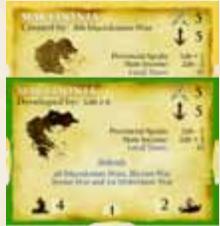
15 Provinces
Markers/Chits
25 Legion (Front)/Veteran (Back)

10 Major Office
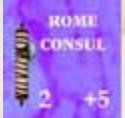


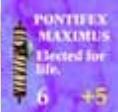
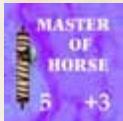
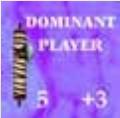



3 Naval Victory 2 Manpower Shortage 2 Drought 1 Consul for Life




8 Rebel
12 Priest
1 Primary Rebel



25 Allegiance


15 Prior Consul


36 Mortality


40 Knight
5 Faction Dominance

1 Unrest

Front / Back

3 Captive


Number
90 Positive

52 Negative
3 State Revenue


80 x 1T

44 x 5T

Talents 24 x 10T




1.03 SEQUENCE OF PLAY
Each turn is modeled on the political year of the Roman Republic wherein lackluster "years" are skipped to keep the action constant. Each turn is composed of seven Phases.
I.MORTALITY PHASE (1.05)
II. REVENUE PHASE (1.06)
III. FORUM PHASE (1.07)
IV. POPULATION PHASE (1.08)
V. SENATE PHASE (1.09)
VI. COMBAT PHASE (1.10)
VII. REVOLUTION PHASE (1.11)
1.04 GAME TERMS & CONCEPTS
Blue Text: Text in blue signifies that the listed rule applies only to an Advanced Rule. Advanced Rules are optional rules that can be incorporated into the Basic Game.
1.04.1 GAME TERMS: The following terms are used throughout the rules and players should be familiar with them. The index in the back (Section VII) contains additional game term definitions.
• Faction Card: Any card with red text.
• Forum Card: Any card with black text.
• Talent (T): A denomination of Roman currency.
HRAO: Highest Ranking Available Official (1.09.11). The Senator holding the highest ranking Major Office in Rome.
• Bank: All the chits and markers that are not in play.
• Faction: A group of Senators belonging to a player.
• Aligned: A Senator belonging to a Faction.
• drm (die roll modifier): Modifier applied to any die or dice roll.
• 1d6, 2d6, 3d6: A roll of 1, 2 or 3 six-sided dice.
• Personal Treasury: Talents on a Senator card.
• Faction Treasury: Talents in the Faction Treasury Box.
1.04.2 FACTIONS: Each player will control a Faction of Senators, which they will display before them. These Senators have different attributes that increase a Faction's voting power and Influence. The black-text Senators represent Families, while the red-text Senators represent specific Statesmen of the era. Statesmen are treated like Senators but usually have better attributes and a special power.
Statesmen are either played by themselves or on top of a matching black Family card. As the Game progresses Senators will gain various markers, Concessions, military commands, and political offices, all with the goal of increasing their Influence (which can almost be considered victory points). Each Faction will usually have a Faction Leader, indicated by the yellow Faction Leader maker.

1.04.3 PUBLIC AGREEMENTS: During the course of the Game players will conduct negotiations and make deals. Deals made publicly, for all players to hear, are considered binding and must be honored. If one party to the deal is unable to fulfill his or her side of the bargain when required, the wronged party can rescind those aspects of the deal that are still being held (and are therefore retrievable). However, a player may not back out of a Public Agreement simply because it is inconvenient. Virtually anything that does not circumvent the rules can be agreed to in such a deal. However deals involving the distribution of the Rome and Field Consul offices amongst the two candidates are never enforceable, nor is any deal involving an Assassination attempt, or agreements to Revolt or to remain loyal to Rome. If there is disagreement as to the terms of a Public Agreement, the other players must honestly and impartially arbitrate the disagreement, by majority vote if needed.
EXAMPLE: During the Senate Phase, Chris agrees in open discussion to give Eve 15 Talents in exchange for Eve's promise that her Rome Consul will propose Julius for Censor and vote for his election. Eve does as promised. However, the Rome Consul calls upon Chris to vote first for his own election, whereas Chris wants to vote last to assure passage. The measure is defeated when Paul spends money to buy votes to defeat it. Chris protests that the bargain was not kept, but the other players agree with Eve that nothing was said about a specific voting order and the trade stands. Eve is entitled to 15 Talents from Chris during the next Revenue Phase. Chris gets nothing except heartburn.
1.04.4 PRIVATE AGREEMENTS: Players who discuss their deals in private have no recourse when a deal partner fails to honor the terms of any agreement. Caveat emptor.
1.04.5 TRADING CARDS: During the course of the Game players will hold secret cards that will make up their hand. Players may trade and/or give away their held Faction cards only during the Revolution Phase (1.11.1). Players may show their cards and agree to the terms of trade (including binding Public Agreements), but they may not exchange cards until the next Revolution Phase.
1.04.6 TRANSFERRING TALENTS: Players may give Talents to each other only during the Redistribution step (1.06.3) of the Revenue Phase. Players may make deals for votes, buy Faction cards, and even agree to the terms of a binding Public Agreement (1.04.3), but they may not actually transfer any Talents until the next Revenue Phase.
1.04.7 VOTE TALLY: Each player should always readjust his Vote Tally dial as soon as he gains or loses votes for any reason.
1.04.8 RESOLVING TIES & TURN ORDER: Ties of any nature not resolved by stated secondary considerations are always broken in favor of the highest roller on 2d6. Disputes about what order players should resolve actions not resolved by stated secondary considerations are always broken by the HRAO going first and play proceeding clockwise around the board.
1.04.9 HIDDEN INFORMATION: Only Talents kept in the Faction Treasury and a player's hand of Faction cards are hidden. Unless otherwise specified everything else, including discard piles and Personal Treasuries, are always open for inspection. When a card is discarded, place it face up on the discard pile. Except during setup (3.01, 3.02, 3.03), cards in the discard pile never return to the game.
1.05 MORTALITY PHASE
1.05.1 IMMINENT WAR ACTIVATION: Wars located in the Imminent Wars box in the Forum move to the Active Wars box. See Imminent Wars section (1.07.3321) for more detail.
1.05.2 MORTALITY PHASE DRAW: One Mortality Chit is drawn at random from the cup every Mortality Phase.
1.05.21 MORTALITY RESOLUTION: Whenever a Mortality Chit is drawn, the chit indicates that the Senator whose numerical ID matches that of the chit has died. If the named Senator is not in play, there is no effect. In the event you need to draw more than one chit (whether through “Draw 2" chits, combat losses, or events), these chits are laid out and not returned to the cup until the appropriate number of chits have been drawn [EXCEPTION: If a Draw 2 marker is drawn, it is immediately returned to the cup and two more markers are drawn (i.e., it does not stay out)]. It is possible (although unlikely) that a "Draw 2" marker could be redrawn several times in the same turn resulting in three or more deaths in a single turn. Once all the needed Mortality Chits have been drawn, the chits are returned to the cup.

1.05.22 GRACCHI & LICINII BROTHERS: No Senators with the same ID# can be in play at the same time, except for the Gracchi brothers (Statesmen 25A and 25B) and the Licinii (Statesmen 29A and 29B) in the later scenarios. Should the 25 or 29 Mortality Chit be drawn when both its respective Statesmen are in play, the Senator affected is determined by a random 2d6.
1.05.3 DEATH CONSEQUENCES: Regardless of the cause of death, all markers except a Faction Leader marker are removed from the afflicted Senator's card. Any Concessions attached to the Senator are placed in the Forum and, if he was a Governor, his Provinces (along with any Garrison Legions they have) are placed in the Forum. If the Primary Rebel dies, the Revolt fails (1.11.372 and 1.12.3). Any Family card (black-text Senator) without a Faction Leader marker is placed under all other Family cards in the "Repopulating Rome" space in the Curia. Any Family card with a Faction Leader marker remains in the Faction, is not a rebel, and returns to Rome if the dead Senator was not in Rome (1.09.11). [EXCEPTION: Special Major Prosecution of Assassins (1.09.74) and Statesmen pairs (1.07.312)].
1.05.31 STATESMAN CARD DEATH: A Statesman card (red-text Senator, 1.07.312) is permanently removed from play when he dies, and any Family card beneath the Statesman card suffers the normal death consequences (1.05.3). Statesmen that are Faction Leaders without a Family card are still removed from play, and the player can appoint a new Faction Leader in the Forum Phase (1.07.7).
1.05.4 FACTION ELIMINATION: A Faction is eliminated only if it loses its last Senator as a result of trying an Assassination (1.09.74). Any cards held in the eliminated Faction's hand are discarded and the Faction Treasury is returned to the Bank. If a Faction is not eliminated, but has no Senators left, that player may either quit the Game or draw the top Senator card in the Curia that does not match a played Statesman to use as his new Faction Leader. If there is none, he must wait and take the first Senator that enters the Curia.
1.06 REVENUE PHASE
1.06.1 PERSONAL REVENUE: All Senators generate Personal Revenue unless they are in Revolt (1.11.33), Captive (1.10.71), or non-Aligned [EXCEPTION: Rebel Governors if using the Rebel Governor (2.03) Advanced Rules]. The revenue includes Base Income plus funds from Concessions, Governorships and Knights. These are given as a lump sum to the player for Redistribution (1.06.3).
1.06.11 BASE INCOME: Each Faction Leader collects 3 Talents and all other Senators collect 1 Talent apiece.
1.06.12 KNIGHTS/CONCESSIONS: Each Senator collects from the Bank 1 Talent for each Knight on his card, plus he must generate revenue on each Concession (1.07.32) he controls and reveal the Concession's corrupt bar. Grain Concession bonuses may be taken for Drought even if the Senator's Popularity (1.07.31) is -9.
1.06.13 PROVINCIAL SPOILS: Each turn, each non-rebel Governor has the option to roll a die or dice to generate Talents of Provincial Spoils from his Province. A Governor need not pay a negative Provincial Spoils result, but the State must pay for unpaid negative amounts resulting from both Personal and State Income rolls during the Debits step (1.06.53) of the Revenue Phase. A Governor need not collect Provincial Spoils produced by his Province, but must make that decision before rolling to determine the amount. A Governor who attempts to collect Provincial Spoils from his Province takes a Corrupt marker (unless he already has one) and is subject to a possible Minor Prosecution until the end of the first Prosecution Phase after his return to Rome (1.09.41). If using the Provincial Wars Advanced Rule (2.02.4), ALL Provinces listed under Attacks on each Active War provide no Provincial Spoils.
EXAMPLE: The Governor of Undeveloped Hispania Ulterior takes a Corrupt marker and rolls a 2 for Provincial Spoils, which results in net income of -1 (2 - 3 = -1), but he need not pay any negative totals out of his own funds. Total bill to the State Treasury is -1 Talent.
1.06.2 REBEL MAINTENANCE: Rebel Forces must be maintained at a cost of 2 Talents per Legion and Fleet before the Redistribution of wealth occurs (1.06.3). See (1.11.35) for more details.
1.06.3 REDISTRIBUTION: All Personal Revenue generated, in addition to any existing Talents, may at this point be moved freely between Personal Treasuries and Faction Treasuries. The exceptions to this rule are that Rebel Senators may not transfer money in their Personal Treasury to or from either non-rebel Senators or any Faction Treasury (but to or from other Rebel Senators is ok), and Captive Senators may not give or receive money at all. Money may be transferred to or from Senators who are not in Rome. Except as noted for Rebels and Captives, players may give Talents from their Faction Treasury and the Personal Treasuries of their own Senators to other players (1.04.6), who may then redistribute the Talents as needed.
1.06.31 FACTION TREASURY: Talents allocated to the Faction Treasury are placed in the Faction Treasury Box in front of each player. Faction Treasuries are secret and not available for inspection by other players (1.04.9). This is the only money that may be used to defend against another Faction's Persuasion Attempt (1.07.4). Talents from the Faction Treasury may also be used to maintain Legions and Fleets in the event of a Revolt by a Senator of that Faction (1.11.35) or to Ransom a Captive Senator (1.10.71). Only money in the Faction Treasury is safe from loss due to death. Money in the Faction Treasury may be spent only for the purposes listed in this paragraph.
1.06.4 PROVINCE DEVELOPMENT: After collecting or declining to collect his Provincial Spoils, the Governor of each Undeveloped (yellow-bordered) Province (unless in Revolt) must roll 1d6 to see if that Province has been improved by Roman control. Rebel Governors do not roll for Province development and provinces without a Governor are not eligible to be Developed. There is a +1 drm to the Improvement roll if the Governor does not hold a Corrupt marker. If the roll is ≥ 6, the Province card is flipped to its Developed (green) side. The new values listed thereon remain in effect for the rest of the Game. Provinces being attacked by a Barbarian Raids Event, allied with a War (Advanced Rule 2.02), or under attack by a War (Advanced Rule 2.02) cannot be Developed. The current Governor of a Province when it is Developed gains 3 Influence.
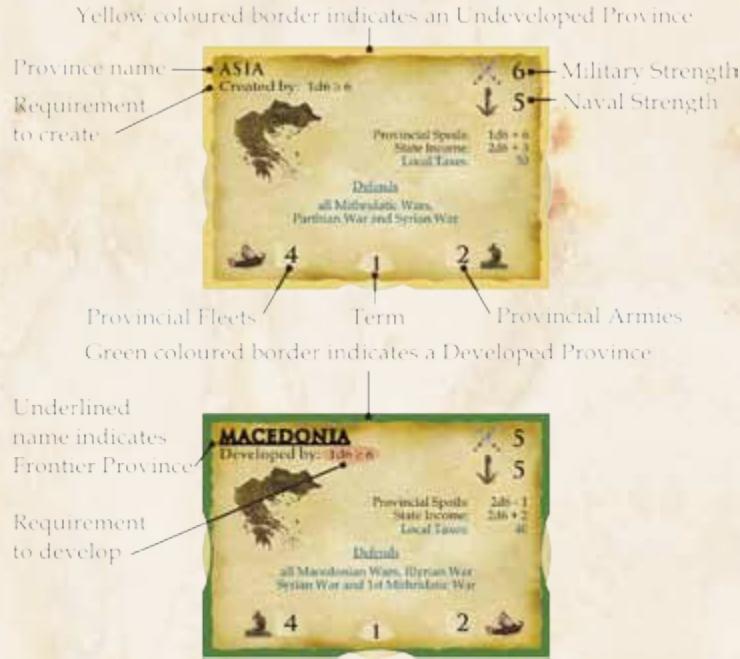
1.06.5 STATE REVENUES: The players adjust the Treasury markers on the State Treasury track. The State receives 100 Talents Annual Revenue at the start of each Revenue Phase.
1.06.51 TAXES: If there are any active Provinces, each non-rebel Governor rolls a die or dice as indicated on that Province card after “State Income" to determine the number of Talents paid to the State by his Province. In some cases, this can be a negative amount and results in the Treasury Track markers being reduced. The amount collected is recorded by adjusting the Treasury Track. A Province with a Rebel Governor, without a Governor (1.09.54), or engaged in a Provincial War (2.02) does not provide taxes to the State.
1.06.52 CONTRIBUTIONS: Any non-rebel Senator (even those not in Rome) may contribute money to the State Treasury regardless of the level of the Treasury. In doing so, a Senator may gain 1 Influence for 10 Talents, 3 Influence for 25 Talents, or 7 Influence for 50 or more Talents. A Senator may make one such contribution per Revenue Phase. Excess Contributions do not accumulate credit for Influence gains in later turns. Players may wish to determine the State Debits (1.06.53) before making Contributions in order to avoid Bankruptcy.
1.06.53 DEBITS: After adding the Annual Revenue, Provincial Taxes and any contributions to the State Treasury, subtract 20 Talents for each Active War (including Unprosecuted Wars and Civil Wars) and the costs for any Land Bills in effect. Finally, deduct 2 Talents for maintenance of each existing Legion or Fleet not in rebellion and not in the Garrison of a Rebel Governor (1.11.32). Players cannot eliminate Forces by voluntarily not paying maintenance. [EXCEPTION: The HRAO may decline to pay the maintenance for Forces released by a Rebel; any of these Forces not maintained must be eliminated (1.11.35, 2.03.6).] If unable to pay its obligations at any time in the game, the State is Bankrupt and only the declared Rebel (if there is one) has a chance to win the game (1.12.2); otherwise, all players lose (1.12.1). Forces that cannot be maintained are eliminated. All the players should be advised when the State Treasury drops below 70 Talents due to the danger of Bankruptcy (and immediate loss) due to subsequent Natural Disaster or Evil Omens Event draws.
1.06.6 RETURNING GOVERNORS: At the end of the Revenue Phase reduce the term dial of non-rebel Governors by 1. When a term dial moves off of “1" return the Governor to Rome and return the Province card to the Forum (along with any Garrison Legions on the Province). Returning Governors who have a Corrupt marker keep it.
1.07 FORUM PHASE
1.07.1 PASSAGE OF TIME: Remove any Event cards in the Forum, unless the card specifically states otherwise.
1.07.2 INITIATIVE SEQUENCE: The HRAO player (1.09.11) must roll 2d6 for Initiative. If he rolls a 7, he must roll 3d6 on the Random Events Table to determine which Event card he has drawn (1.07.21). Otherwise, he draws a card from the Forum deck. If the Forum deck is empty and will not be replaced with another deck (Extended Scenario 3.04), a player must still roll but does not get to draw a card. He may then take any of the following steps in the order listed below:
• Make one Persuasion Attempt (1.07.4).
Make one attempt to attract a Knight or pressure multiple Knights (1.07.5).
• Sponsor Games once (1.07.6); and/or
• Appoint a Senator as his Faction Leader (1.07.7)
A player need not have a Senator in Rome to take his regular Initiative.
1.07.21 EVENTS: If the player rolls a 7 as his Initiative roll, he does not draw a card but instead must roll 3d6 on the Random Events Table and place the corresponding light blue Event card from the table in play. If that Event card is already in play, it is flipped to its dark blue side. If the Event card is already flipped to its dark blue side, there are no additional effects unless specified on the Event card. This prevents the drawing of another Forum or Event card by that player. Evil Omens Events do not modify Natural Disaster Event rolls.
1.07.22 BIDDING ON INITIATIVES: Once the HRAO has completed his Initiative Sequence, the other players in clockwise order complete an Initiative Sequence until all players have completed one Initiative Sequence. Any additional Initiatives needed to bring the total number for that turn to six are publicly auctioned off to the highest bidder (once around clockwise, starting with the HRAO, minimum bid is 1 Talent). Each Initiative is immediately completed by the winner of the bid. This is repeated until there are no remaining Initiatives.
Only those Senators currently in Rome may bid for an extra Initiative with the winning bid coming from a single Personal Treasury. Winning the bid allows the entire Faction to take the Initiative Sequence, not just the winning Senator. The HRAO's Faction takes any Initiatives that are not bid on.
1.07.3 CARDS: There are two classes of cards. Cards with black text are called Forum cards and must be played face up in the Forum when they are drawn. Cards with red text are called Faction cards and belong to the player who draws them. A Faction card may be held secretly in a player's possession until he chooses to play it in accordance with any restrictions pertaining to that card.
1.07.31 SENATORS: There are two types of Senator cards: Family cards (1.07.311), which are Forum cards, and Statesmen (1.07.312), which are Faction cards. The number after the “MIL" on the right of the card is the Senator's Military rating, representing his ability as a Commander (general and admiral). The number after the “ORA" is the Oratory rating, representing his political skills and voting power. The number after the "LOY" is his Loyalty rating, measuring the degree of adherence the Senator feels towards the Faction controlling him (1.07.411). The number in the bottom center of the card is his Influence and serves as a fluctuating gauge of his prestige. This rating can be increased during the Game by his public service or reduced by his misdeeds. This number is always positive; a Senator can never have less than 0 Influence. The small number in the upper center of the card is the Senator ID Number, which corresponds to a likenumbered Mortality Chit. Senator cards also contain designated areas to record the Senator's Popularity and Knight markers. If a Senator's Popularity is negative, it is recorded with a black Number marker. Popularity may not go above 9 or below -9.
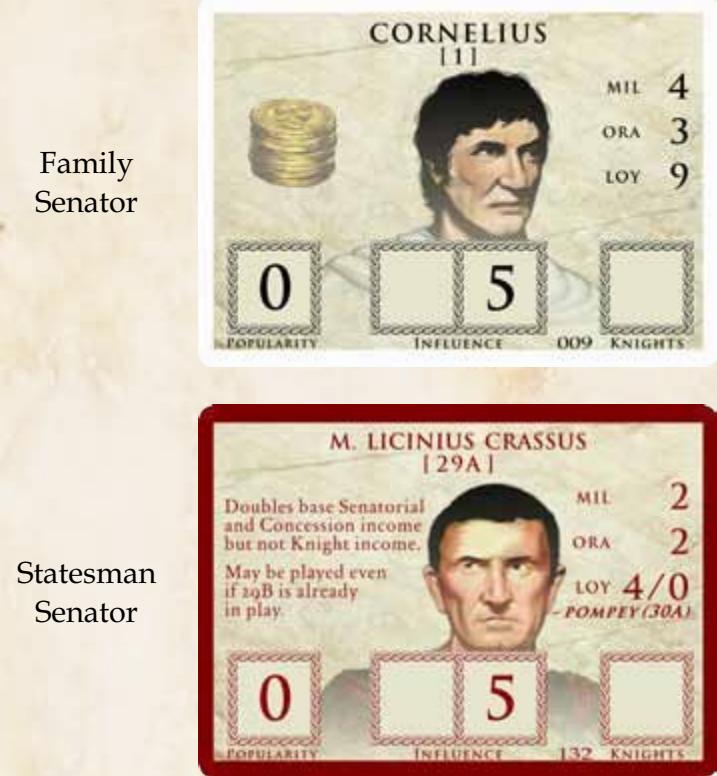
1.07.311 FAMILY SENATORS: Family cards are Senator cards with black text and a marble background that represent leading families in the Senate. New Family cards are added to a Faction only through Persuasion Attempts (1.07.4), when Repopulating Rome (1.09.81) and sometimes when playing a related Statesman card (1.07.312). Having a particular Family card means a player has in his Faction the leading member of that family. Should that Senator die, his place is taken by the next leading member of that family who, if not a Faction Leader, leaves the current Faction and goes to the bottom of the Curia. Family cards with an ID# in brackets “[ ]" include a related prominent Statesman that may appear during play.
1.07.312 STATESMEN SENATORS: Senator cards with an alphanumeric ID, red text and a marble background represent outstanding individual Statesmen with special capabilities. Statesmen can enter play only at Game start (3.01.9) or during the Revolution Phase (1.11.1). A player may not add a Statesman card to his Faction if either of the following conditions exist:
A related Statesman with the same ID# is already in play. [EXCEPTION: 25A/B or 29A/B per 1.05.22]
When a Statesman enters play, if the player already controls the related Family card, place the Statesman on top of it. If the related Family card is in the Forum, move the Family card to the player's Faction and place the Statesman on top of it. If the related Family card is in the Curia or deck, place the Statesman by itself in the player's Faction.
When a Statesman is already in play and its related Family card appears in the Forum (not the Curia), immediately place it beneath the Statesman.
If two Statesmen with the same number are in play legally [25A/B or 29A/B per (1.05.22)] and the Family card then appears in the Forum (not the Curia), place the Family card under the “A" Statesman of the pair. A player may not play one of these Statesmen if the Family card is in play with a different Faction, unless the other Statesman of the pair is already in play. If one of the pair dies, and the Family card is with the other, move the Family card to the surviving Statesman, even if the dead Statesman was the Faction Leader
When a Statesman is placed on his Family card, the Statesman takes over any Influence and Popularity ratings on the Family card that are greater than his own and all its Concessions, Governorships, Knights, and other markers. Note that the Statesman's Military, Oratory, and Loyalty ratings which are less than those on the Family card remain equal to the Statesman's printed rating.
Statesmen may use their special abilities even while they are away from Rome. Marius must still be in Rome to attract a Knight.
1.07.32 CONCESSIONS: Concessions are Faction cards with a picture frame background that represent economic considerations such as collecting taxes or distributing grain. The player who draws it from the deck owns a Concession. He may assign it to one of his Senators at Game start (3.01.9) or during a Revolution Phase (1.11.1) by placing it partially beneath that Senator's card. That Senator must then collect the number of Talents listed on that Concession during the Revenue Phase (1.06.12) or as otherwise indicated on the Concession card. Generating revenue on a Concession reveals the corrupt bar on that Concession's card. This indicates that the Senator is liable to a Minor Prosecution during the next Senate Phase. A Senator loses a Concession only due to his death (1.05.3), a successful Minor Prosecution, or due to certain Wars or Natural Disasters. Whenever a Senator dies or is convicted, his Concessions are returned to the Forum, where they can be awarded to another Senator by a proposal (1.09.61).
Concession assigned to a Senator.
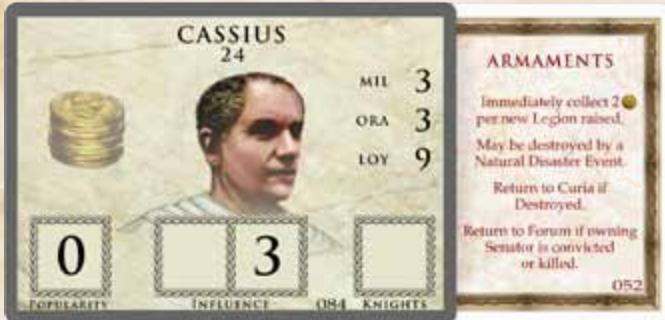
1.07.321 DESTROYED CONCESSIONS: If a Concession is destroyed (aka eliminated) (by a War, Leader or Natural Disaster), then it is placed in the Concession space of the Curia and has a chance to be revived at the end of the Forum Phase (1.07.8).
1.07.33 WARS: War cards are Forum cards with a parchment background representing external threats to Rome. The numbers next to the icons on the right of the card represent its value in combat. The number next to the Swords icon is the enemy's Land Strength, which represents the value of his army. The number next to the Anchor icon is the Fleet Support number, which indicates the number of Roman Fleets, if any, required to support the War. Some War cards have a number next to a Ship icon, which represents enemy Fleet Strength which must be defeated in a Naval Battle before conducting the Land Battle. The numbers highlighted black and gray next to the D and S on the right of the card determine Disasters and Standoffs and are explained in the Combat section (1.10.21, 1.10.31). The number inside the Coin on the bottom right indicates the Spoils of War that are generated upon defeat of the War and are detailed in the Combat section (1.10.4). Some Wars have a Dying Plant icon, which indicates the War causes a Drought Effect (1.08.12). Some cards have an Armaments icon beside the date, which indicates whether the War is Active or Inactive (1.07.331) UI
when it is drawn. When a War card with an Armaments icon is drawn, it goes into one of the
Armaments Icon
the “Active Wars" spaces in the Forum [EXCEPTION: Imminent Wars (1.07.3321)]. It usually remains active until the Senate defeats it.
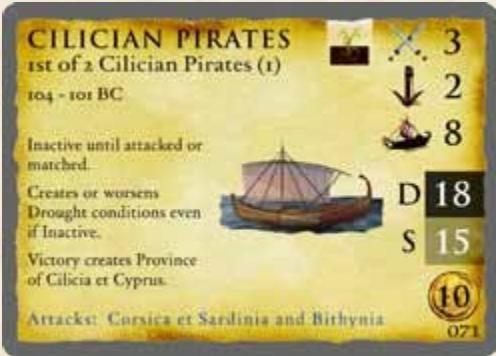
1.07.331 INACTIVE WARS: War cards without an Armaments icon are Inactive Wars. When drawn, place them in the "Inactive Wars" spaces of the Forum [EXCEPTION: Imminent Wars (1.07.3321)]. They remain inactive in the Forum until the Senate sends an Army or Fleet to attack them, or until activated by their Leader (1.07.341) or a Matching War (1.07.3321). Once activated, change the War's status by moving it to one of the “Active Wars" spaces of the Forum. Some War cards list how many Matching Wars activate them and where they reside within their sequence of Matching Wars.
1.07.332 MATCHING WARS: Whenever two Wars of the same type are active (e.g., two Punic Wars or two Cilician Pirates), the Land and Fleet Strength (but not Fleet Support) of each are doubled as long as the two remain active. If a third Matching War is active, the Strength numbers of all three are tripled. If all four Macedonian War cards are active at the same time, their Strength is quadrupled. However, each War is fought individually - not added to its related Wars. In these situations, the Strength numbers of the remaining related Wars are reduced again to tripled, doubled, or normal Strength as their Matching Wars are individually vanquished. When counting Active Wars, each Matching War card (not set) is considered to be a separate War. Rome may not attack the latter of any currently active Matching Wars unless she first (or simultaneously) prosecutes (or ends via New Alliance) all earlier (in Matching War Sequence) currently active and related Matching Wars.
EXAMPLE: Assume the 1st and 2nd Punic Wars are in the Forum. Rome need not defeat the 1st Punic War in order to attack the 2nd, but she must attack the 1st Punic War in the same turn she attacks the 2nd Punic War.
Each Matching War contains a line of text similar to "1st of 2 Cilician Pirates (1)". The number in () is the number of Wars of that type in the Era of the card (i.e., in the Early, Middle, or Late Republic deck).
1.07.3321 IMMINENT WARS: Whenever a War card is drawn from the deck that would match another War card that is already located anywhere in the Forum, the drawn card is placed in the “Imminent Wars" Forum space for the remainder of the current turn, and it does not multiply any Active Wars until it, itself, becomes Active. If multiple Matching Wars become Active at the same time (e.g., Spanish Revolts), the earliest one (e.g., 1st before 2nd) becomes Active; the rest become Imminent. If the already existing War in the Forum is currently located in an Inactive War space, it is immediately moved to the Active Wars space; otherwise, nothing else happens. At the beginning of each new turn, before any other action is taken, all cards in the Imminent War space are examined, and one card from each set of Matching Wars is moved to an Active War space on the Forum (1.05.1). Activate all Imminent Wars in Matching War order (e.g., 1st Macedonian before 2nd Macedonian), even if it means the most recently drawn War card must be activated. Imminent Wars can be attacked by the Senate (just as if they were Inactive); however, the moment the Senate sends a Force to attack the Imminent War, it is instantly moved to the Active War column and begins to multiply War Strengths. Once played in the Imminent Wars space the War will only be moved out of that box at the beginning of a turn or if attacked by the Senate; Leaders (1.07.34) do not activate Imminent Wars. For the brief period the Wars are located in the Imminent Wars space they are considered Inactive, regardless of their Armaments icon.
EXAMPLE: First Punic War begins the turn in an Inactive War slot. Third Punic War is drawn; it is placed in the Imminent War space, and the 1st Punic War is moved to an Active War space. The 2nd Punic War is drawn in the same turn; it is also placed in the Imminent War space. The Hannibal Leader card is then drawn; it is immediately placed with the active 1st Punic War. At the start of Turn 2, the 2nd Punic War is moved to an Active War space, but the 3rd Punic War remains Inactive until the start of Turn 3.
1.07.333 REVOLTS: A Revolt is a type of War card in which no Spoils of War are created by defeating the War. Many Revolts are conditional (i.e., they are treated as Revolts if a named Province currently exists at the time of being drawn, but are treated as Wars that are not Revolts if it does not). Whenever the last War in a numbered series of Matching Wars is defeated, any previous War in that series is thereafter treated as a Revolt.
1.07.334 WAR CONSEQUENCES: A War need not be fought immediately, but for each Active War during the Revenue Phase, the State loses 20 Talents (1.06.53). Some Wars create Drought Effects, threaten Concessions, or attack Provinces. Each War in one of the "Unprosecuted War" spaces (1.10.9) increases Unrest by 1 during every Population Phase (1.08.11). If, at the end of any Combat Phase, there are 4 Active Wars, the Republic collapses and all players lose the Game (1.12.1). Inactive or Imminent Wars do not count against the four-war limit, the State Treasury drain, or Unrest.
1.07.34 LEADERS: Leader cards are Forum cards with a parchment background representing the appearance of a particularly able enemy Commander. Their presence makes a War more difficult to prosecute.
1.07.341 LEADER ACTIVATION: If, while an Inactive or Active War is in play, a matching Leader card is drawn (e.g., Hannibal is drawn while any Punic Wars are Active or Inactive), the Leader is immediately placed with the War and the War is considered Active [EXCEPTION: Leaders cannot activate Imminent Wars (1.07.3321)]. If a Leader resides in the Curia and a War matching that Leader is drawn (or becomes Active), both the Leader and the War are immediately considered Active, even if the War would normally be considered Inactive.
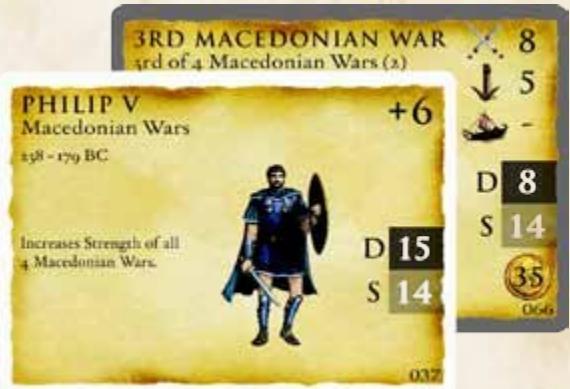
1.07.342 LEADER STRENGTH: While a Leader is active and matched with the War(s), the Land and Fleet Strength (not Fleet Support) number(s) of the War(s) are increased by his value, after any relevant doubling, tripling, or quadrupling for Matching Wars.
1.07.343 ADDITIONAL LEADER PENALTIES: The numbers on the right side of the Leader card determine automatic Roman Disasters and Standoffs (1.10.21, 1.10.31) directly attributable to the skill of the Leader and in addition to those in effect for the War itself. Statesmen with “Nullifies Disaster / Standoff" abilities only void the D/S associated with the Wars, not those of associated Leaders.
1.07.344 LEADER DEATH: If the last active Matching War associated with a Leader is defeated, or a Leader is drawn when none of his Matching Wars are currently in play, the Leader is moved to the Curia. If all of the Matching Wars associated with the Leader are removed from the deck and board the Leader is removed from play. At the end of each Forum Phase, an Aging roll on 1d6 must be made for each Leader in the Curia. If the result is a 5 or 6, that Leader dies and is removed from play. On the Refuge / Rise from Refuge Event “killed by a Victory" refers to a Leader who was aiding a War card and was either removed from play or moved to the Curia due to a Victory result (1.10.4), the Enemy Leader Dies / Enemy Leader Sues for Peace Event, or the New Alliance / Another New Alliance Event. A Leader in Refuge still aids his normal Matching Wars.
1.07.35 INTRIGUE: Intrigue cards are Faction cards with a picture frame background that have various uses and requirements on when and how they can be played.
1.07.36 LAWS: Law cards are Faction cards on a scroll background that represent changes in the rules governing the Republic and play of the Game. Display played Law cards in the Law space rather than
mixing them with the discards. Law cards may be playedanytime during the Senate Phase (1.09, 2.06)- even before the Consuls are elected. A player need not have a Senator present in Rome to play a Law card.

1.07.37 EVENTS: A few Event cards are Forum cards on a picture frame with parchment background. They are resolved immediately and in the same manner as the blue-bordered Event deck. They are discarded after being fully resolved.
1.07.4 PERSUASION ATTEMPTS: A Senator in Rome may attempt to persuade an Unaligned Senator in the Forum or an already Aligned non-Faction Leader Senator also in Rome to join his own Faction.
1.07.41 RESOLUTION: The Senator making the Persuasion Attempt adds his Oratory and Influence and subtracts from this sum the target
Senator's Loyalty rating to get a Base Number. This Base Number can be modified by Conditions (1.07.411), Bribes (1.07.412) and Counter-Bribes (1.07.413). After Bidding (1.07.414), compare the resulting Base Number to a 2d6 roll. If the roll is less than or equal to the Base Number, the Persuasion Attempt succeeds and the target Senator joins the Faction of the Senator making the Persuasion Attempt. If the original (unmodified) roll is greater than or equal to 10 (or 9 after the “Era Ends" card is revealed), or the modified roll is greater than the Base Number, the Persuasion Attempt fails and the target Senator remains either Unaligned in the Forum or Aligned to his current Faction.
1.07.411 CONDITIONS: If the target Senator is already Aligned (i.e., in a Faction), subtract 7 from the Base Number. The number of Talents in the Personal Treasury of the target Senator, whether Aligned or not, is also subtracted from the Base Number.
Some Statesmen oppose others and display a “-“ followed by another Statesman's name. If a Statesman belongs to the same Faction as any Statesmen shown with a "-" on his card, his printed base Loyalty rating is reduced to 0; however, he still subtracts 7 if he is Aligned. Some Statesmen oppose others who do not oppose them back. The exception is the Gracchi brothers (25A/B), who have a “+″ next to their names because both desire to belong to the same Faction. In this case the Loyalty of 0 occurs when the other brother is in the Faction of the Senator making the Persuasion Attempt. This effect only occurs when both 25A and 25B are in play (otherwise their Loyalty is 6).
1.07.412 BRIBES: The Senator making the Persuasion Attempt may spend money from his Personal Treasury to aid the Persuasion Attempt. Each Talent spent adds 1 to the Base Number. This money is paid into the Personal Treasury of the target Senator at the end of the Attempt, regardless of the outcome.
1.07.413 COUNTER-BRIBES: All players may interfere in a Persuasion Attempt made against a Senator by spending money from their Faction Treasuries to resist (not aid) the Persuasion Attempt. Each Talent thus spent subtracts 1 from the Base Number. This money is paid into the Personal Treasury of the target Senator at the end of the Attempt, regardless of the outcome. If an Unopposed Persuasion Attempt is made (which requires a Seduction or Blackmail card), this type of interference is not allowed and the target Senator must defend strictly with his Loyalty rating and Personal Treasury.
1.07.414 BIDDING: The Senator making the Persuasion Attempt announces his target and the initial Base Number, which may already reflect money irrevocably spent from his Personal Treasury. Play then moves clockwise around the table, and each player in turn announces the Talents, if any, he is irrevocably spending from his Faction Treasury to resist the Persuasion Attempt. The player making the Persuasion Attempt may then either roll 2d6 at the present Base Number or irrevocably spend more Talents, with bidding moving around the table again. This cycle of bidding continues until all players stop spending money or the Persuader accepts the current Base Number. Money thus spent should be initially placed on the table in front of a player's Faction (making change as necessary) and transferred to the target Senator's card only after the Persuasion Attempt is resolved.
EXAMPLE: Fabius wishes to make a Persuasion Attempt against Claudius, who is an Unaligned Senator in the Forum. Fabius adds his Oratory and Influence ratings and gets a sum of 7, from which he subtracts Claudius' Loyalty rating of 7 to produce a Base Number of 0. Fabius spends 9 Talents from his Personal Treasury to bring the Base Number up to 9. Play then moves around the table, and the other players spend a total of 8 Talents from their collective Faction Treasuries to lower the Base Number to 1. Fabius responds by spending the 7 Talents remaining in his Personal Treasury to raise the Base Number to 8. Play revolves around the table again, but this time the other players are unwilling or unable to spend any more money, so the final Base Number is 8. Fabius rolls a 9, which is not less than or equal to
8, so the Persuasion Attempt fails and Claudius remains uncommitted in the Forum. All the money spent on the Persuasion Attempt is placed in Claudius' Personal Treasury, making him both more attractive and harder to get, since the 24 Talents now in his Personal Treasury are automatically added to his Loyalty rating in any future Persuasion Attempts.
1.07.5 KNIGHTS: A player may attempt to attract one Knight per Initiative to one of his Aligned Senators in Rome by paying 0 or more Talents from that Senator's Personal Treasury and then rolling a die. If the sum of the

die roll and the number of Talents paid is greater than or equal to 6, a Knight is attracted and that Senator places a Knight marker on his card indicating the total number of Knights he controls. There is no limit to the number of Knights that may eventually be controlled by a Senator. For each Knight a Senator controls he gains an extra vote in the Senate and an extra Talent of income during the Revenue Phase unless the Senator is held Captive. A Senator in Revolt (1.11.33) or who dies loses control of all of his Knights.
1.07.51 PRESSURING KNIGHTS: Instead of rolling to attract a Knight, a player may opt to pressure any Knights he has in his Faction for contributions and, in so doing, loses their support. He announces how many of his Knights under each of his Senators he will pressure and rolls a die for each to determine the amount of Talents gained. This money must be added to each controlling Senator's respective Personal Treasury and the pressured Knights are returned to the Bank. Pressured Knights no longer provide extra income or extra votes.
1.07.6 SPONSORING GAMES: Sponsoring Games allows one Senator to increase his Popularity while lowering the Unrest Level of the populace. The Senator pays the cost of the games he wishes to Sponsor from his Personal Treasury (see the Games Table). Adjust his Popularity and reduce the Unrest Level as indicated. The Senator does not need to be in Rome to Sponsor Games.
1.07.7 APPOINT NEW FACTION LEADER: A player may change his Faction Leader by placing his Faction Leader marker on any Senator in his Faction. The new Faction Leader does not need to be in Rome.
1.07.8 PUTTING ROME IN ORDER: After all six Initiatives have been resolved, complete the following steps.
-
All Senators (in Rome or not) that currently hold a Major Office get a "major" marker, which indicates they are available for a Major Prosecution this turn.
-
The HRAO rolls to see which Tax Farmer Concessions are destroyed if the 2nd Punic War or Gladiator Slave Revolts are active (Evil Omens Events do not modify these rolls). Make rolls for Hannibal / Spartacus only if 2nd Punic War / any Gladiator Revolt is active. These may be immediately rolled for revival in the next step.
-
The HRAO then rolls a die for each Concession and Senator in the Curia (even if destroyed or killed that turn). If he rolls a 5 or 6 that card is revived and placed face up in the Forum. He also rolls for each Leader in the Curia and discards it on a die roll of 5 or 6.
1.08 POPULATION PHASE
1.08.1 UNREST: The Unrest Level represents the degree of dissatisfaction of the populace with the government. The Unrest Level starts at


- There is no limit to how high the Unrest Level can go, but it can never go lower than 0. To show an Unrest Level higher than 9, flip the Unrest Level marker over. At the beginning of the Population Phase, the Unrest Level is adjusted for the following conditions:
1.08.11 UNPROSECUTED WARS: Each Unprosecuted War (1.10.9) adds 1 to the Unrest Level.
1.08.12 DROUGHT EFFECTS: The Unrest Level is increased by 1 for
each separate Drought Effect in play. Drought Effects can be caused by both Events and Wars. Each Drought Effect is cumulative and adds 1 to the Unrest before the State of the Republic speech is made (1.08.2). Drought markers can be used to keep track of the number of Drought Effects in play.

EXAMPLE: A War with a Drought Effect is in play and Unprosecuted. The Drought Event is rolled twice in the Forum Phase. The total modifier to the Unrest would be +4 (+1 for the Unprosecuted War and 3 for 3 Drought Effects - the initial Drought Effect on the War plus the 2 additional Drought Events rolled).
1.08.2 STATE OF THE REPUBLIC: The HRAO gives a State of the Republic speech by rolling 3d6, subtracting the Unrest Level, and adding his Popularity. The result is found on the Population Table. The numbers on the Population Table indicate the amount the Unrest Level is to be immediately increased or decreased. A result of “NR" (No Recruitment) places the No Recruitment marker onto the Force Pool, prohibiting the raising of any Forces for the rest of the turn. [EXCEPTION: Neither No Recruitment nor Manpower Shortage applies to Legions/Fleets recruited via the Gabinian Law card.] "MS" places the Manpower Shortage Event card into the Forum, places the Manpower Shortage marker onto the Force Pool, and is cumulative with any existing Manpower Shortage (1.07.21). “Mob" results in an assault on the Senate by an outraged mob, which is resolved by drawing six Mortality Chits to check among those currently in Rome to determine the Senators killed (1.05.21). “People Revolt" results in an overthrow of the Senatorial government and immediate defeat for all players (1.12.1), unless a Rebel is currently in Revolt, in which case he wins [barring loss due to four Wars] (1.12.2).
1.09 SENATE PHASE
1.09.1 HOW THE SENATE PHASE WORKS: The Senate Phase is the heart of the Game. Players will put forward a variety of proposals which will then be voted on by Senators and enacted if passed. The Senate Phase begins as soon as the results of the State of the Republic speech are implemented.
REMEMBER: Each player should readjust his Vote Tally dial as soon as he gains or loses votes for any reason.
1.09.11 HIGHEST RANKING AVAILABLE OFFICIAL (HRAO): The HRAO is the highest ranking available official in Rome. The order of precedence is listed on their Major Office Marker:
-
Dictator,
-
Rome Consul,
-
Field Consul,
-
Censor,
-
Master of Horse,
-
Pontifex Maximus (2.01).
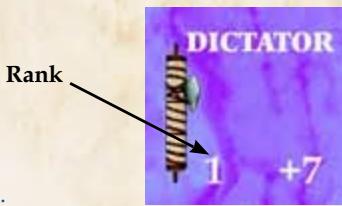
If none of these officials is alive and in Rome, then Aligned Senators in Rome are eligible to become the HRAO (and/or Presiding Magistrate, 1.09.12, 1.09.144) from most to least Influence (using Oratory and then lowest ID# to break ties). All Senators in Rome [i.e., everyone except Governors (1.09.5), Proconsuls (1.10.8), Captives (1.10.71) and Rebel Senators (1.11.3)] must attend the Senate meeting.
1.09.12 PRESIDING MAGISTRATE: The HRAO is typically the Presiding Magistrate. The HRAO will not be the Presiding Magistrate during Prosecutions (1.09.41) or after stepping down as a result of a unanimous proposal defeat (1.09.144). The Presiding Magistrate has complete control over the procedures of the Senate and conducts all business. He may recognize Senators in any order he wishes and may call for the votes of each Faction in any order. He alone makes
nominations and proposals without the use of a Tribune card (1.09.151), and he may break off discussion on any proposal by calling for an immediate vote. Any player who ignores his demand for an immediate vote is considered to have abstained and loses his right to vote on that proposal. After all elections (including Governors) and Prosecutions, he may close the meeting at any time there is no unresolved proposal on the floor by saying “the Senate is adjourned." If the Presiding Magistrate is killed, the next HRAO becomes Presiding Magistrate.
1.09.13 PROPOSALS: A proposal is anything put before the Senate for a vote (except a Prosecution, see 1.09.41), either by the Presiding Magistrate, a Tribune, or as otherwise allowed. A nomination is a type of proposal. Whenever a vote is not in progress, any player may offer advice, discuss options, and/or suggest courses of action, but only the Presiding Magistrate or a Tribune can formally define a proposal (i.e., place the proposal “on the floor"). Only the Presiding Magistrate may call for votes.
1.09.131 PROPOSAL ALTERATION: Defeated proposals may not be introduced again in the same Senate Phase without significant change.
EXAMPLES:
A proposal to assign Fabius 8 Legions fails. A subsequent proposal to assign Fabius 7 Legions or Claudius 8 Legions may be put forward.
A proposal to send Fabius to govern Hispania Citerior and Claudius to Sicilia might fail as a joint proposal but a subsequent separate proposal to send Fabius to Hispania Citerior is legal.
A proposal to nominate Fabius and Claudius as Consuls fails. A Subsequent proposal to nominate Claudius and Fabius as Consuls would be illegal (rewording the proposal is not enough).
In contrast, Concessions (1.09.61) and Consul for Life nominations (1.09.82) can be voted upon only once per turn.
1.09.14 VOTING: After announcing the proposal, the Presiding Magistrate calls on a Faction to vote first. That Faction must vote, abstain, or use a Tribune to veto the vote (1.09.151, 1.09.152) without delay (1.09.12). After that Faction votes or abstains, the Presiding Magistrate calls on another Faction to vote, and the process is repeated until all Factions have had an opportunity to vote, abstain, or the proposal is vetoed. The voting procedure of the Senate is the same for all business requiring a vote except that abstaining is not allowed during the passage or repeal of a Land Bill (1.09.62); any Faction refusing to vote on a Land Bill when prompted is considered to have voted against it (or for its repeal).
1.09.141 VOTES: Each Senator in Rome controls votes equal to his Oratory plus the number of Knights he controls. However, he may temporarily increase his votes for any particular proposal or Prosecution (1.09.41) by buying them. For each Talent he pays out of his Personal Treasury he receives 1 extra vote for that round of voting. These Talents are paid out when the Senator's votes are called upon.
1.09.142 BLOCK VOTES: All the Senators in a Faction need not vote alike, though they usually will. Once a Faction declares any vote, it may neither change it nor play a Tribune to veto (cancel) the vote.
1.09.143 PASSAGE: A simple majority (> 50%) of votes cast is required to pass any measure (i.e., a proposal, Prosecution (1.09.41), or anything else requiring a vote), except recalling a Pontifex Maximus.
1.09.144 LOSS OF INFLUENCE: Whenever the Presiding Magistrate makes a proposal which is defeated by unanimous vote of all Senators in Rome controlled by the other players, he may choose to lose 1 Influence (down to a minimum of 0) or he may step down as Presiding Magistrate and immediately hand over conduct of the
meeting to the next HRAO. If the Presiding Magistrate does not have any Influence to lose, he must step down as Presiding Magistrate. The Senator stepping down retains his office, but is not available to be the Presiding Magistrate at any further point in the turn. This does not affect the HRAO order, just who is the Presiding Magistrate. This can happen multiple times during a Senate Phase. These penalties do not apply when a Tribune is used to put forth a proposal (1.09.151).
1.09.15 TRIBUNES: Tribune cards may be played during the Senate Phase to veto or initiate proposals, including nominations. Once used, Tribunes are discarded. If two or more players play a Tribune at the same time, they dice off to determine who gets precedence with the loser(s) taking their Tribune(s) back to their hand(s). Factions may play Tribune cards even if they have no Senators in Rome.
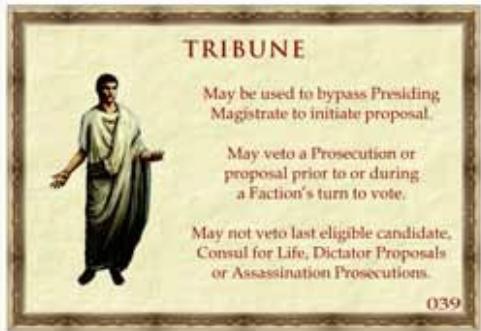
1.09.151 PROPOSAL USING A TRIBUNE: Players may force proposals to a vote by using a Tribune card and announcing "Tribune!". A proposal is considered on the floor the moment the player who played the Tribune defines the proposal. The Presiding Magistrate must call for the votes of each Faction and can do so in any order. The proposal must still be made at the correct time in the Senate Phase (e.g., a player may not propose to recruit Legions before the Censor has been elected). This may be done any time there is no proposal already on the floor. Alternatively, it can be played during a current proposal with or without specifying intent so as to establish that player's right to make the next proposal. Other facts about Tribunes:
• A Tribune may not be used to interrupt an already played Tribune (i.e., once a Tribune has been played to make a proposal, another Tribune may not interrupt it).
A Prosecution is not considered a proposal and is therefore not eligible to be proposed (though they may be vetoed).
• A Tribune can also be played immediately after the Pres
Content is long; only the first part is inlined. Download the file or open the rules page for the full text.
Download Markdown01.md109.1 KB
I. Basic Game
1.01 Introduction
REPUBLIC OF ROME is a game that captures 250 years of political history during the Roman Republic, from its appearance on the world stage around the time of the 1st Punic War (264 BC) through its eventual collapse into civil war with the assassination of Julius Caesar in 44 BC. Players control factions composed of the leading Senatorial families and compete for state offices, military commands, economic concessions and new adherents. Each player is attempting to become the dominant political force in Rome. However, the Senate must also attend to the affairs of state in a hostile world, necessitating a certain amount of cooperation in the prosecution of wars and the maintenance of public contentment. Failure to do so, especially at the outset when Rome is most vulnerable, may result in the collapse of the Republic. Therefore, the players must out maneuver one another, but defeat the game itself which constitutes an ever-present opponent scheming to divide and defeat them all. Players are advised to keep the threat of the downfall of the Republic foremost in mind and stand ready to cooperate for the good of the state. Otherwise, the most likely winner will be the game, and all players will be put to the sword!
WINNING: There are multiple ways to win REPUBLIC OF ROME. One common way is for the Senators in your Faction to accumulate the most combined Influence by the end of the game. However, if a single Senator can accumulate enough Influence to be elected or appointed Consul for Life, this will result in an immediate victory for his Faction. The most difficult and most dramatic way to win is to gain the allegiance of the formidable Roman Legions, Revolt against the State and attempt to take the Senate by force! For more details on Victory Conditions see (1.12.2).
LOSING: Be ever watchful as Rome can fall a myriad of ways! If the State goes Bankrupt due to poor fiscal policy, all players lose. If the citizens of Rome ever Revolt due to the poor stewardship of the Senate, all the players lose. Finally, if, at the end of any turn, Rome is beset by four Active Wars, the Republic will collapse under the strain and Rome will be no more! For more details on the Losing Conditions see (1.12.3).
1.02 Game Components & Game Terms
1.02.1 COMPONENTS:
1 Game Board
160 Scenario Cards
18 Event Cards
1 Summary Sheet
15 Provinces
6 Solitaire/Two Player Reference Cards
6 Faction Treasury boxes/Vote Counters
3 Dice
Markers/Chits: 25 Legion (Front)/Veteran (Back)
25 Fleet
11 Major Office
3 Naval Victory
2 Manpower Shortage
2 Drought
1 Primary Rebel
8 Rebel
12 Priest
25 Allegiance
17 Corrupt (Front)/Major (Back)
15 Prior Consul
36 Mortality
40 Knight Number (1 to 10)
5 Faction Dominance
1 Unrest (Front/Back)
3 Captive
90 Positive/52 Negative Number (0 to 9, −1 to −9)
3 State Revenue
6 Faction
6 Land Bill
Talents: 80 x 1T, 44 x 5T, 24 x 10T, 10 x 50T, 8 x 100T
1.03 Sequence of Play
Each Game Turn is modeled on the political year of the Roman Republic wherein lackluster "years" are skipped to keep the action constant. Each turn is composed of seven Phases.
I. MORTALITY PHASE (1.05)
II. REVENUE PHASE (1.06)
III. FORUM PHASE (1.07)
IV. POPULATION PHASE (1.08)
V. SENATE PHASE (1.09)
VI. COMBAT PHASE (1.10)
VII. REVOLUTION PHASE (1.11)
1.04 Game Terms & Concepts
Blue Text: Text in blue signifies that the listed rule applies only to an Advanced Rule. Advanced Rules are optional rules that can be incorporated into the Basic Game.
1.04.1 GAME TERMS: The following terms are used throughout the rules and players should be familiar with them. The index in the back (Section VII) contains additional game term definitions.
Faction Card: Any card with red text.
Forum Card: Any card with black text.
Talent (T): A denomination of Roman currency.
HRAO: Highest Ranking Available Officer (1.09.11). The Senator holding the highest ranking office in Rome.
Bank: All the chits and markers that are not in play.
Faction: A group of Senators belonging to a player.
Aligned: A Senator belonging to a Faction.
drm: Modifier applied to any die or dice roll.
1d6, 2d6, 3d6: A roll of 1, 2 or 3 six-sided dice.
Personal Treasury: Talents on a Senator Card.
Faction Treasury: Talents in the Faction Treasury Box.
1.04.2 FACTIONS: Each player will control a Faction of Senators, which they will display before them. These Senators have different attributes that increase a Faction's voting power and Influence. The black-text Senators represent Families, while the red-text Senators represent specific Statesmen of the era. Statesmen are treated like Senators but usually have better attributes and a special power. Statesmen are either played by themselves or on top of a matching black Family card. As the Game progresses Senators will gain various markers, Concessions, military commands, and political offices, all with the goal of increasing their Influence (which can almost be considered victory points). Each Faction will usually have a Faction Leader, indicated by the yellow Faction Leader marker.
Example diagram callouts: Personal Treasury, Unpopular, Major Office, Senator — Statesman C. Sempronius Gracchus (#25A) is placed above the Sempronius Family card. Corrupt Governor, Faction Leader, Garrison — Legions, Provincial Armies and Fleets are always 0 unless using Provincial Wars Advanced Rule.
EXAMPLE: Faction Vote Total = 4 (Manlius 2 ORA + 2 Knights) + 4 (Sempronius 4 ORA) + 2 (Sulpicius 2 ORA) = 10
1.04.3 PUBLIC AGREEMENTS: During the course of the Game players will conduct negotiations and make deals. Deals made publicly, for all players to hear, are considered binding and must be honored. If one party to the deal is unable to fulfill his or her side of the bargain when required, the wronged party can rescind those aspects of the deal that are still being held (and are therefore retrievable). However, a player may not back out of a Public Agreement simply because it is inconvenient. Virtually anything that does not circumvent the rules can be agreed to in such a deal. However deals involving the distribution of the Rome and Field Consul offices amongst the two candidates are never enforceable, nor is any deal involving an Assassination attempt, or agreements to Revolt or to remain loyal to Rome. If there is disagreement as to the terms of a Public Agreement, the other players must honestly and impartially arbitrate the disagreement, by majority vote if needed.
EXAMPLE: During the Senate Phase, Chris agrees in open discussion to give Eve 15 Talents in exchange for Eve's promise that her Rome Consul will propose Julius for Censor and vote for his election. Eve does as promised. However, the Rome Consul calls upon Chris to vote first for his own election, whereas Chris wants to vote last to assure passage. The measure is defeated when Paul spends money to buy votes to defeat it. Chris protests that the bargain was not kept, but the other players agree with Eve that nothing was said about a specific voting order and the trade stands. Eve is entitled to 15 Talents from Chris during the next Revenue Phase. Chris gets nothing except heartburn.
1.04.4 PRIVATE AGREEMENTS: Players who discuss their deals in private have no recourse when a deal partner fails to honor the terms of any agreement. Caveat emptor.
1.04.5 TRADING CARDS: During the course of the Game players will hold secret cards that will make up their hand. Players may trade and/or give away their held Faction Cards only during the Revolution Phase (1.11.2). Players may show their cards and agree to the terms of trade (including binding Public Agreements), but they may not exchange cards until the next Revolution Phase.
1.04.6 TRANSFERRING TALENTS: Players may give Talents to each other only during the Redistribution step (1.06.3) of the Revenue Phase. Players may make deals for votes, buy Faction cards, and even agree to the terms of a binding Public Agreement (1.04.3), but they may not actually transfer any Talents until the next Revenue Phase.
1.04.7 VOTE TALLY: Each player should always readjust his Vote Tally dial as soon as he gains or loses votes for any reason.
1.04.8 RESOLVING TIES & TURN ORDER: Ties of any nature not resolved by stated secondary considerations are always broken in favor of the highest roller on 2d6. Disputes about what order players should resolve actions not resolved by stated secondary considerations are always broken by the HRAO going first and play proceeding clockwise around the board.
1.04.9 HIDDEN INFORMATION: Only Talents kept in the Faction Treasury and a player's hand of Faction cards are hidden. Unless otherwise specified everything else, including discard piles and Personal Treasuries, are always open for inspection.
1.05 Mortality Phase
1.05.1 IMMINENT WAR ACTIVATION: Wars located in the Imminent Wars box in the Forum move to the Active Wars box. See Imminent Wars section (1.07.3321) for more detail.
1.05.2 MORTALITY PHASE DRAW: One Mortality Chit is drawn at random from the cup every Mortality Phase.
1.05.21 MORTALITY RESOLUTION: Whenever a Mortality Chit is drawn, the chit indicates that the Senator whose numerical ID matches that of the chit has died. If the named Senator is not in play, there is no effect. In the event you need to draw more than one chit (whether through "Draw 2" chits, combat losses, or events), these chits are laid out and not returned to the cup until the appropriate amount of chits have been drawn [EXCEPTION: If a Draw 2 marker is drawn, it is immediately returned to the cup and two more markers are drawn (i.e., it does not stay out)]. It is possible (although unlikely) that a "Draw 2" marker could be redrawn several times in the same turn resulting in three or more deaths in a single turn. Once all the needed Mortality Chits have been drawn, the chits are then returned to the cup.
1.05.22 GRACCHI & LICINII BROTHERS: No Senators with the same ID# can be in play at the same time, except for the Gracchi brothers (Statesmen 25A and 25B) and the Licinii (Statesmen 29A and 29B) in the later scenarios. Should the 25 or 29 Mortality Chit be drawn when both its respective Statesmen are in play, the Senator affected is determined by a random 2d6.
1.05.3 DEATH CONSEQUENCES: Regardless of the cause of death, all markers except a Faction Leader marker are removed from the afflicted Senator's card. Any Concessions attached to the Senator are placed in the Curia and, if they are Governors, their Provinces are placed in the Forum. Any Family card (black-text Senator) that does not have a Faction Leader marker is placed in the "Repopulating Rome" space in the Curia [EXCEPTION: Special Major Prosecution due to failed Assassination (1.09.74)].
1.05.31 STATESMAN CARD DEATH: A Statesman card (red-text Senator) is permanently removed from play when he dies and any Family card beneath the Statesman card suffers the normal death consequences (1.05.3). Statesmen that are Faction Leaders without a Family card are still removed from play and the player can appoint a new Faction Leader in the Forum Phase (1.07.7). Statesmen cards are discussed in detail later in the rules (1.07.312).
1.05.4 FACTION ELIMINATION: Factions are not eliminated unless they have lost their last Senator as a result of trying an Assassination (1.09.74). If a Faction has no Senators left, that player may either quit the Game or draw the top Senator card that does not match a played Statesman in the Curia to use as his new Faction Leader. If there is none, he must wait and take the first Senator that enters the Curia. Any cards held in the eliminated Faction's hand are discarded and the Faction Treasury is returned to the Bank.
1.06 Revenue Phase
1.06.1 PERSONAL REVENUE: All Senators generate Personal Revenue [EXCEPTION: Rebel (1.11.34), Captive (1.10.71) and non-Aligned Senators do not produce Personal Revenue]. The revenue generated includes Base Income plus funds collected from Concessions, Governorships and Knights. These are given as a lump sum to the player for Redistribution (1.06.3).
1.06.11 BASE INCOME: Each Faction Leader collects 3 Talents and all other Senators collect 1 Talent apiece.
1.06.12 KNIGHTS/CONCESSIONS: Each Senator collects from the Bank 1 Talent for each Knight on his card, plus he must generate revenue on each Concession (1.07.32) he controls and he reveals the Concession's corrupt bar.
1.06.13 PROVINCIAL SPOILS: Each Governor has the option to roll a die or dice to generate that number of Talents of Provincial Spoils from his Province that turn. A Governor need not pay a negative Provincial Spoils result, but the State must pay for unpaid negative amounts collected by both Personal and State Income rolls during the Debits step (1.06.53) of the Revenue Phase. A Governor need not collect Provincial Spoils produced by his Province, but must make that decision before rolling to determine the amount. A Governor who attempts to collect Provincial Spoils from his Province takes a Corrupt marker and is subject to a possible Minor Prosecution until the end of the first Prosecution Phase after his return to Rome (1.09.41). If using the Provincial Wars Advanced Rule (2.02.4), ALL Provinces listed under Defends provide no Provincial Spoils.
EXAMPLE: The Governor of Undeveloped Hispania Ulterior takes a Corrupt marker and rolls a 2 for Provincial Spoils which results in net income of -1 (2 - 3 = -1), but he need not pay any negative totals out of his own funds. Total bill to the State Treasury is -1 Talent.
1.06.2 REBEL MAINTENANCE: Rebel Forces must be maintained at a cost of 2 Talents per Legion before the Redistribution of wealth occurs (1.06.3). See (1.11.33) for more details.
1.06.3 REDISTRIBUTION: All Personal Revenue generated, in addition to any existing Talents, may at this point be moved freely between Personal Treasuries and the Faction Treasury. The exception to this rule is that Rebel Senators may not transfer money from their Personal Treasury to either non-Rebel Senators or their Faction Treasury. Money may be transferred to or from Senators who are not in Rome. Players may give Talents from their Faction Treasury and the Personal Treasuries of their own Senators to other players (1.04.6), who may then redistribute the Talents as needed.
1.06.31 FACTION TREASURY: Talents allocated to the Faction Treasury are placed in the Faction Treasury Box in front of each player. Faction Treasuries are secret and not available for inspection by other players (1.04.9). This is the only money that may be used to defend against another Faction's Persuasion Attempt (1.07.4). Talents from the Faction Treasury may also be used to maintain Legions in the event of a Revolt by a Senator of that Faction (1.11.33) or Ransom a Captive Senator (1.10.71). Only money in the Faction Treasury is safe from loss due to death. Money in the Faction Treasury may not be spent for any purpose other than these listed.
1.06.4 PROVINCE DEVELOPMENT: After collecting or declining to collect his Provincial Spoils, the Governor of each Undeveloped (yellow-bordered) Province must roll 1d6 to see if that Province has been improved by Roman control. Rebel Governors do not roll for Province development and vacant provinces are not eligible to be Developed. If the roll is ≥ 6, the Province card is flipped to its Developed (green) side. The new values listed thereon remain in effect for the rest of the Game. Provinces being attacked by a Barbarian Raids Event, allied with a War (Advanced Rule 2.02), under attack by a War (Advanced Rule 2.02) or controlled by a Rebel Governor (Advanced Rule 2.03) cannot be Developed. There is a +1 drm to the Improvement roll if the Governor does not hold a Corrupt marker. The current Governor of a Province when it is Developed earns 3 Influence.
1.06.5 STATE REVENUES: The players adjust the Treasury markers on the State Treasury track. The State receives 100 Talents Annual Revenue at the start of each Revenue Phase.
1.06.51 TAXES: If there are any active Provinces, each Governor rolls a die or dice as indicated on that Province card after "State Income" to determine the number of Talents in taxes paid to the State by his Province. In some cases, this can be a negative amount and results in the Treasury Track markers being reduced accordingly. The amount of taxes collected is recorded on the Treasury Track. A Province in Revolt (Rebel Governors 2.03) or engaged in a Provincial War (2.02) does not roll for State Income.
1.06.52 CONTRIBUTIONS: Any non-rebel Senator (even those not in Rome) may contribute money to the State Treasury regardless of the level of the Treasury. In doing so, a Senator may gain one Influence for 10 Talents, 3 Influence for 25 Talents, or 7 Influence for 50 or more Talents. Excess Contributions do not accumulate credit for Influence gains in later turns. Players may wish to determine the State Debits (1.06.53) before making Contributions in order to avoid Bankruptcy.
1.06.53 DEBITS: After adding the Annual Revenue, Provincial Taxes and any contributions to the State Treasury, subtract 20 Talents for each Active War (including Unprosecuted Wars) and the costs for any Land Bills in effect. Finally, deduct 2 Talents for maintenance of each existing Legion or Fleet not in rebellion. Players cannot disband Forces by voluntarily not paying maintenance. [EXCEPTION: The HRAO may decline to pay the maintenance for Forces released by a Rebel; any of these Forces not maintained must be disbanded (1.11.33, 2.03.6).] If unable to pay its obligations at any time in the game, the State is bankrupt and only the declared Rebel has a chance to win the game (1.12.4); otherwise, all players lose. Forces that cannot be maintained are disbanded. All the players should be advised when the State Treasury drops below 50 or 20 Talents due to the danger of Bankruptcy (and immediate loss) to subsequent Natural Disaster or Evil Omens Event draws.
1.06.6 RETURNING GOVERNORS: At the end of the Revenue Phase move the center term dial of non-Rebel Governors. When a term dial moves off of "1" return the Governor to Rome and return the Province card to the Forum. Returning Corrupt Governors keep their Corrupt marker.
1.07 Forum Phase
1.07.1 PASSAGE OF TIME: Remove any Event cards in the Forum, unless the card specifically states otherwise.
1.07.2 INITIATIVE SEQUENCE: The HRAO player (1.09.11) must roll 2d6 for Initiative. If he rolls a 7, he must roll 3d6 on the Random Events Table to determine which Event card he has drawn (1.07.21). Otherwise, he draws a card from the Forum deck. If the Forum deck is empty and will not be replaced with another deck (Extended Scenario 3.04), a player must still roll but does not get to draw a card. He may then take any of the following steps in the order listed below:
Make one Persuasion Attempt (1.07.05).
Make one attempt to attract a Knight or pressure multiple Knights (1.07.5).
Sponsor Games (1.07.06); and/or
Appoint a different Senator as his Faction Leader (1.07.07)
A player need not have a Senator in Rome to take his regular Initiative.
1.07.21 EVENTS: If the player rolls a 7 as his Initiative roll, he does not draw a card but instead must roll 3d6 on the Random Events Table and place the corresponding light blue Event card from the table in play. If that Event card is already in play, it is flipped to its dark blue side. If the Event card is already flipped to its dark blue side, there are no additional effects unless otherwise specified on the Event card. This nonetheless prevents the drawing of another Forum or Event card by that player.
1.07.22 BIDDING ON INITIATIVES: Once the HRAO has completed his Initiative Sequence, the other players in clockwise order complete an Initiative Sequence until all players have completed one Initiative Sequence. Any additional Initiatives needed to bring the total number for that turn to six are publicly auctioned off to the highest bidder (once around clockwise, starting with the HRAO). Each Initiative is immediately completed by the winner of the bid. This is repeated until there are no remaining Initiatives. Only those Senators currently in Rome may bid for an extra Initiative, with the winning bid coming from a single Personal Treasury. Winning the bid allows the entire Faction to take the Initiative Sequence, not just the winning Senator. If nobody bids for an Initiative, the HRAO's Faction takes any Initiatives that are not bid on.
1.07.3 CARDS: There are two classes of cards: Cards with black text are called Forum cards and must be played face up in the Forum when they are drawn. Cards with red text are called Faction cards and belong to the player who draws them. A Faction card may be held secretly in a player's possession until he chooses to play it in accordance with any restrictions pertaining to that card.
1.07.31 SENATORS: There are two types of Senator cards: Family cards (1.07.311), which are Forum cards, and Statesmen (1.07.312), which are Faction Cards. The number after the "MIL" on the right of the card is the Senator's Military rating, representing his ability as a Commander (general and admiral). The number after the "ORA" is the Oratory rating, representing his political skills and voting power. The number after the "LOY" is his Loyalty rating, measuring the degree of allegiance the Senator feels towards the player that controls him (1.07.411). The number in the bottom center of the card is his Influence and serves as a fluctuating gauge of his prestige. This rating can be increased during the Game by his public service or reduced by his misdeeds. This number is always positive; a Senator can never have less than 0 Influence. The small number in the upper center of the card is the Senator ID Number, which corresponds to a like-numbered Mortality Chit. Senator cards also contain designated areas to record the Senator's Popularity and Knight markers. If a Senator's Popularity is negative, it is recorded with a black Number marker. Popularity may not go above 9 or below -9.
1.07.311 FAMILY SENATORS: Family cards are Senators cards with black text and a marble background that represent leading families in the Senate. New Family cards are added to a Faction only through Persuasion Attempts (1.07.4), when Repopulating Rome (1.09.81) and sometimes when playing a related Statesman card (1.07.312). Having a particular Family card means a player has in his Faction the leading member of that family. Should that Senator die, his place is taken by the next leading member of that family who, if not a Faction Leader, leaves the current Faction and goes to the bottom of the Curia. Family cards with an ID# in brackets "[ ]" include a related prominent Statesman that may appear during play.
1.07.312 STATESMEN SENATORS: Senator cards with an alphanumeric ID, red text and a marble background represent outstanding individual Statesmen with special capabilities. Statesmen can enter play only at Game start (3.01.9) or during the Revolution Phase (1.11.1). A player may not add his Statesman card to his Faction if any of the following conditions exists:
An opponent controls the related Family card; or
A related Statesman with the same ID# is already in play. [EXCEPTION: 25A/B or 29A/B per (1.05.22)]
If the player already controls the related Family card, the Statesman is placed on top of it and takes over any current possessions: Prior Consul markers, Influence, and Popularity ratings greater than his own. Any other printed ratings of the Statesman that are less than that of the Family card remain equal to the Statesman's printed rating. If the related Family card is currently Unaligned in the Forum, the Statesman is placed over it and both cards are moved to that player's Faction. If the matching Family card subsequently appears, it is immediately placed beneath the Statesman.
If two Statesmen with the same number are in play legally [25A/B or 29A/B per (1.05.22)] and the Family card then appears, the Family card is placed under the "A" Statesmen of the pair. A player may not play one of these Statesmen if the Family card is in play with a different Faction, unless the other Statesman of the pair is already in play. If one of the pair dies, and the Family card is with the other, the Family card is moved to the surviving Statesman, even if the dead Statesman was the Faction Leader.
1.07.32 CONCESSIONS: Concessions are Faction cards with a picture frame background that represent economic considerations such as collecting taxes or distributing grain. The player who draws it from the deck owns a Concession. He may assign it to one of his Senators at Game start (3.01.9) or during a Revolution Phase (1.11.1) by placing it partially beneath that Senator's card. That Senator must then collect the number of Talents listed on that Concession during the Revenue Phase (1.06.12) or as otherwise indicated on the Concession card. Generating revenue on a Concession reveals that Concession's corrupt bar listed on the card. This indicates that the Senator is liable to a Minor Prosecution during the next Senate Phase. A Senator loses a Concession due to his death (1.05.3), a successful Minor Prosecution (1.09.441) or due to certain Wars or Natural Disasters. Whenever a Senator dies or is convicted, his Concessions are returned to the Forum, where they can be awarded to another Senator by a proposal (1.09.61).
1.07.321 DESTROYED CONCESSIONS: If a Concession is destroyed (by a War, Leader or Natural Disaster), then it is placed face down in the Concession space of the Curia and has a chance to be revived during the end of the Forum Phase (1.07.8).
1.07.33 WARS: War cards are Forum cards with a parchment background representing external threats to Rome. The numbers next to the icons on the right of the card represent its value in combat. The number next to the Legion icon is the enemy's Land Strength, which represents the value of his Army. The number next to the Anchor icon is the Fleet Support number, which indicates the number of Roman Fleets, if any, required to support the War. Some War cards have a number next to a ship icon, which represents enemy Fleet Strength which must be defeated in a Naval Battle before conducting the Land Battle. The numbers highlighted black and gray next to the D and S on the right of the card determine automatic Disasters and Standoffs and are explained in the Combat section (1.10.21, 1.10.31). The number inside the Coin on the bottom right indicates the Spoils of War that are generated upon defeat of the War and are detailed in the Combat section (1.10.4). Some Wars have a Dying Plant icon, which indicates the War causes a Drought Effect (1.08.12). Some cards have an Armaments icon beside the date, which indicates whether the War is Active or Inactive (1.07.331).
When a War card with an Armaments icon is drawn, that particular War has broken out. It usually remains in effect until the Senate defeats it. [EXCEPTION: Matching Wars (1.07.332)]
1.07.331 INACTIVE WARS: All War cards without an Armaments icon are Inactive Wars. Although they remain in the Forum when drawn, they do not attack Rome until the Senate sends an Army or Fleet to attack them, or they are activated by their Leader (1.07.34) or a Matching War (1.07.332) of the same type. Place them in the "Inactive Wars" spaces of the Forum until activated. Once activated, their status is changed by movement of the card to the "Active War" Forum spaces. Some War cards will also list how many Matching Wars will activate it and where it resides within the sequence of Matching Wars (1.07.332).
1.07.332 MATCHING WARS: Whenever two Wars of the same type are active (e.g., two Punic Wars or two Cilician Pirates), the Land and Fleet Strength (but not Fleet Support) of each are doubled as long as the two remain active. If a third Matching War is active, the Strength numbers of all three are tripled. If all four Macedonian War cards are active at the same time, their Strength is quadrupled. However, each War is fought individually - not added to its related Wars. In these situations, the Strength numbers of the remaining related Wars are reduced again to tripled, doubled, or normal Strength as their Matching Wars are individually vanquished. When counting Active Wars [4 and Rome is defeated (1.12.3)], each Matching War card is considered a single War. Rome may not attack the latter of any currently active Matching Wars unless she first (or simultaneously) prosecutes all earlier (in Matching War Sequence) currently active and related Matching Wars.
EXAMPLE: Assume the 1st and 2nd Punic Wars are in the Forum. Rome need not defeat the 1st Punic War in order to attack the 2nd, but she must attack the 1st Punic War in the same turn she attacks the 2nd Punic War.
1.07.3321 IMMINENT WARS: Whenever a War card is drawn from the deck that would match another War or Revolt card already located anywhere in the Forum, the drawn card is placed in the "Imminent Wars" Forum space for the remainder of the current turn, and it does not multiply any Active Wars until it, itself, becomes Active. If the already existing War in the Forum is currently located in an Inactive War space, it is immediately moved to the Active Wars space; otherwise, nothing else happens. At the beginning of each new turn, before any other action is taken, all cards in the Imminent War space are examined, and one card for each War is moved to an Active War space on the Forum (1.05.1). Activate all Imminent Wars in Matching War order (e.g., 1st Macedonian before 2nd Macedonian), even if it means the most recently drawn War card must be activated. Imminent Wars can be attacked by the Senate (just as if they were Inactive); however, the moment the Senate sends a Force to attack the Imminent War, it is instantly moved to the Active War column and begins to multiply War Strengths. Once played in the Imminent Wars space the War will only be moved out of that box at the beginning of a turn or if attacked by the Senate; Leaders (1.07.34) do not active Imminent Wars. For the brief period the Wars are located in the Imminent Wars space they are considered Inactive, regardless of their Armaments icon.
EXAMPLE: First Punic War begins the turn in an Inactive War slot. Third Punic War is drawn; it is placed in the Imminent War space, and the 1st Punic War is moved to an Active War space. The 2nd Punic War is drawn in the same turn; it is also placed in the Imminent War space. The Hannibal Leader card is then drawn; it is immediately placed with the active 1st Punic War. At the start of Turn 2, the 2nd Punic War is moved to an Active War space, but the 3rd Punic War remains Inactive until the start of Turn 3.
1.07.333 REVOLTS: A Revolt is a type of War in which no Spoils of War are created by a defeated Revolt. All Revolts are Wars, but some Wars are also classified as Revolts. Many Revolt cards are conditional (i.e., they are treated as Revolts if a named Province currently exists at the time of being drawn, but are treated as normal Wars if it does not). Whenever the last War in a numbered series of Matching Wars is defeated, any previous normal War in that series is thereafter treated as a Revolt.
EXAMPLE: If the 3rd Punic War is defeated, the 1st and 2nd Punic Wars are considered Revolts.
1.07.334 WAR CONSEQUENCES: A War need not be fought immediately, but for each Active War in the Forum during the Revenue Phase, the State loses 20 Talents (1.06.53). If, at the end of any Combat Phase, there are 4 Active Wars, the Republic collapses and all players lose (1.12.3). Inactive or Imminent Wars do not count against the four-war limit or the State Treasury drain until activated. Any Active War in the Forum in one of the "Unprosecuted War" spaces (1.10.9) also increases the Unrest by 1 each during every Population Phase (1.08.11), in addition to costing 20 Talents.
1.07.34 LEADERS: Leader cards are Forum Cards with a parchment background representing the appearance of a particularly able enemy Commander. Their presence makes a War more difficult to prosecute.
1.07.341 LEADER ACTIVATION: If, while an Inactive or Active War is in play, a matching Leader card is drawn (e.g., Hannibal is drawn while any Punic Wars are Active or Inactive), the Leader is immediately placed with the War and the War is considered Active [EXCEPTION: Leaders cannot activate Imminent Wars (1.07.3321)]. If a Leader resides in the Curia and a War matching that Leader is drawn, both the Leader and the War are immediately considered Active, even if the War would normally be considered Inactive.
1.07.342 LEADER STRENGTH: While a Leader is active and matched with the War(s), the Land and Fleet Strength (not Fleet Support) number(s) of the War(s) are increased by his value, after any relevant doubling, tripling, or quadrupling for Matching Wars.
1.07.343 ADDITIONAL LEADER PENALTIES: The numbers in the bottom corners of the Leader card determine automatic Roman Disasters and Standoffs (1.10.21, 1.10.31) directly attributable to the skill of the Leader and in addition to those in effect for the War itself. Statesmen with "Nullifies Disaster / Standoff" abilities only void the D/S associated with the Wars, not those of associated Leaders.
1.07.344 LEADER DEATH: If a Leader is drawn when none of his Matching Wars are currently in play or the Matching Wars associated with the Leader are defeated, the Leader is moved to the Curia. If all of the Matching Wars associated with the Leader are removed from the deck and board the Leader is removed from play. At the end of each Forum Phase, an Aging roll on 1d6 must be made for each Leader in the Curia. If the result is a 5 or 6, that Leader dies and is removed from play.
1.07.35 INTRIGUE: Intrigue cards are Faction cards with a picture frame background that have various uses and requirements on when and how they can be played.
1.07.36 LAWS: Law cards are Faction Cards on a scroll background that represent changes in the rules governing the Republic and play of the Game. Display played Law cards in the Law space rather than mixing them with the discards. Law cards may be played anytime during the Senate Phase (1.09, 2.06) - even before the Consuls are elected. A player need not have a Senator present in Rome to play a Law card.
1.07.37 EVENTS: A few Event cards are Forum cards on a picture frame with parchment background. They are resolved immediately and in the same manner as the blue-bordered Event deck. They are discarded after being fully resolved.
1.07.4 PERSUASION ATTEMPTS: A Senator in Rome may attempt to persuade an Unaligned Senator in the Forum or an already Aligned non-Faction Leader Senator also in Rome to join his own Faction.
1.07.41 RESOLUTION: The Senator making the Persuasion Attempt adds his Oratory and Influence and subtracts from this sum the target Senator's Loyalty rating to get a Base Number. This Base Number can be modified by Loyalty (1.07.411), Bribes (1.07.412) and Counter-Bribes (1.07.413). The resulting Base Number is then compared to a 2d6 roll. If the roll is less than or equal to the Base Number, the Persuasion Attempt succeeds and the target Senator joins the Faction of the Senator making the Persuasion Attempt. If the original (unmodified) roll is greater than or equal to 10 or if the modified roll is greater than the Base Number, the Persuasion Attempt fails and the target Senator remains either Unaligned or Aligned to his current Faction, as the case may be.
1.07.411 LOYALTY: If the target Senator is already Aligned, 7 is added to his Loyalty rating. The number of Talents in the Personal Treasury of the target Senator, whether Aligned or not, is also added to his Loyalty rating.
Some Statesmen oppose others and display a "-" followed by another Statesman's name. If two Statesmen who historically opposed each other belong to the same Faction, the printed base Loyalty rating of both is reduced to 0; however, they still add 7 for being Aligned. Some Statesmen oppose others who do not oppose them back.
The exception is the Gracchi bothers (25A/B), which have a "+" next to their names because both desire to belong to the same Faction. In this case the Loyalty of 0 occurs when one brother belongs to a Faction without his brother. This effect only occurs when both 25A and 25B are in play (otherwise their Loyalty is 6).
1.07.412 BRIBES: The Senator making the Persuasion Attempt may spend money from his Personal Treasury to aid the Persuasion Attempt. Each Talent spent adds 1 to the Base Number. This money is paid into the Personal Treasury of the target Senator at the end of the Attempt, regardless of the outcome.
1.07.413 COUNTER-BRIBES: All players may interfere in a Persuasion Attempt made against a Senator by spending money from their Faction Treasuries to resist (not aid) the Persuasion Attempt. Each Talent thus spent subtracts 1 from the Base Number. This money is paid into the Personal Treasury of the target Senator at the end of the Attempt, regardless of the outcome. If an Unopposed Persuasion Attempt is made, this type of interference is not allowed and the target Senator must defend strictly with his Loyalty rating and Personal Treasury.
1.07.414 BIDDING: The Senator making the Persuasion Attempt announces his target and the initial Base Number, which may already reflect money irrevocably spent from his Personal Treasury. Play then moves clockwise around the table, and each player in turn announces the Talents, if any, he is irrevocably spending from his Faction Treasury to resist the Persuasion Attempt. The player making the Persuasion Attempt may then either roll 2d6 at the present Base Number or irrevocably spend more Talents, with bidding moving around the table again. This cycle of bidding continues until all players stop spending money or the Persuader accepts the current Base Number. Money thus spent should be initially placed on the table in front of a player's Faction (making change as necessary) and transferred to the target Senator's card only after the Persuasion Attempt is resolved.
EXAMPLE: Fabius wishes to make a Persuasion Attempt against Claudius, who is an Unaligned Senator in the Forum. Fabius adds his Oratory and Influence ratings and gets a sum of 7, from which he subtracts Claudius' Loyalty rating of 7 to produce a Base Number of 0. Fabius spends 9 Talents from his Personal Treasury to bring the Base Number up to 9. Play then moves around the table, and the other players spend a total of 8 Talents from their collective Faction Treasuries to lower the Base Number to 1. Fabius responds by spending the 7 Talents remaining in his Personal Treasury to raise the Base Number to 8. Play revolves around the table again, but this time the other players are unwilling or unable to spend any more money, so the final Base Number is 8. Fabius rolls a 9, which is not less than or equal to 8, so the Persuasion Attempt fails and Claudius remains uncommitted. All the money spent on the Persuasion Attempt is placed in Claudius' Personal Treasury, making him both more attractive and harder to get, since the 24 Talents now in his Personal Treasury are automatically added to his Loyalty rating in any future Persuasion Attempts.
1.07.5 KNIGHTS: A player may attempt to attract one Knight per Initiative to one of his Aligned Senators in Rome by paying 0 to 5 Talents from that Senator's Personal Treasury and then rolling a die. If the sum of the die roll and the number of Talents paid is greater than or equal to 6, a Knight is attracted and that Senator places a Knight marker on his card indicating the total number of Knights he controls. There is no limit to the number of Knights that may eventually be controlled by a Senator. For each Knight a Senator attracts he gains an extra vote in the Senate and an extra Talent of income during the Revenue Phase [unless he is in Revolt (1.06.12)].
1.07.51 PRESSURING KNIGHTS: Instead of rolling to attract a Knight, a player may opt to pressure any Knights he has in his Faction for contributions and, in so doing, loses their support. He announces how many of his Knights under each of his Senators he will pressure and rolls a die for each to determine the amount of Talents gained. This money must be added to each controlling Senator's respective Personal Treasury and the pressured Knights are returned to the Bank. Pressured Knights no longer provide extra income or extra votes.
1.07.6 SPONSORING GAMES: Sponsoring Games allows a Senator to increase his Popularity while lowering the Unrest Level of the populace. The Senator pays the cost of the games he wishes to Sponsor from his Personal Treasury (see the Games Table). Adjust his Popularity and reduce the Unrest Level as indicated. The Senator need not be in Rome to Sponsor Games.
1.07.7 APPOINT NEW FACTION LEADER: A player may change a Faction Leader by placing his Faction Leader marker on any Senator in his Faction. The new Faction Leader does not need to be in Rome.
1.07.8 PUTTING ROME IN ORDER: After all six Initiatives have been resolved, the following steps are completed in order to prepare Rome for the upcoming Senate Phase (1.09).
All Senators (whether in Rome or not) that currently hold a Major Office get a "major" marker which indicates they are available for a Major Prosecution this turn.
The HRAO rolls to see which Tax Farmer Concessions are destroyed if the 2nd Punic War or Gladiator Slave Revolts are active. These may be immediately rolled for revival on the next step.
The HRAO then rolls a die for each Concession and Senator in the Curia (even if destroyed or killed that turn). If he rolls a 5 or 6 that card is revived and placed face up in the Forum. He also rolls for each Leader in the Curia (currently without a Matching War in the Forum) and discards it on a die roll of 5 or 6.
1.08 Population Phase
1.08.1 UNREST: The Unrest Level represents the degree of dissatisfaction of the populace with the government. The Unrest Level starts at 0. There is no limit to how high the Unrest Level can go, but it can never go lower than 0. To show an Unrest Level higher than 9, flip the Unrest Level marker over. At the beginning of the Population Phase, the Unrest Level is adjusted for the following conditions:
1.08.11 UNPROSECUTED WARS: Each Unprosecuted War adds 1 to the Unrest Level.
1.08.12 DROUGHT EFFECTS: The Unrest Level is increased by 1 for each separate Drought Effect in play. Drought Effects can be caused by both Events and Wars. Each Drought Effect is cumulative and adds 1 to the Unrest before the State of the Republic speech is made (1.08.2). Drought markers can be used to keep track of the number of Drought Effects in play.
EXAMPLE: A War with a Drought Effect is in play and Unprosecuted. The Drought Event is rolled twice in the Forum Phase. The total modifier to the Unrest would be +4 (+1 for the Unprosecuted War and 3 for 3 Drought Effects - the initial Drought Effect on the War plus the 2 additional Drought Events rolled).
1.08.2 STATE OF THE REPUBLIC: The HRAO gives a State of the Republic speech by rolling 3d6, subtracting the Unrest Level, and adding his Popularity. The result is found on the Population Table. The numbers on the Population Table indicate the amount the Unrest Level is to be immediately increased or decreased. A result of "NR" (No Recruitment) places the No Recruitment marker onto the Force Pool, prohibiting the raising of any Forces for the rest of the turn. "MS" places the Manpower Shortage Event card into the Forum, places the Manpower Shortage marker onto the Force Pool and is cumulative with any existing Manpower Shortage (1.07.21). "Mob" results in an assault on the Senate by an outraged mob, which is resolved by drawing six Mortality Chits to check among those currently in Rome to determine the Senators killed (1.05.21). "People Revolt" results in an overthrow of the Senatorial government and immediate defeat for all players, unless a Rebel is currently in Revolt, in which case he wins the Game [barring loss due to four Wars (1.12.4)].
1.09 Senate Phase
1.09.1 HOW THE SENATE PHASE WORKS: The Senate Phase is the heart of the Game. Players will put forward a variety of proposals which will then be voted on by Senators and enacted if passed. The Senate is convened the moment the State of the Republic dice are thrown in the Population Phase.
REMEMBER: Each player should readjust his Vote Tally dial as soon as he gains or loses votes for any reason.
1.09.11 HIGHEST RANKING AVAILABLE OFFICIAL (HRAO): The HRAO is the highest ranking available official in Rome. The order of precedence is listed on their Office Marker:
Dictator,
Rome Consul,
Field Consul,
Censor,
Master of Horse,
Pontifex Maximus (2.01).
If none of these officials are available due to death or absence from Rome, the Senator with the most Influence in Rome opens the meeting (using Oratory ratings and then lowest ID# to break ties). All Senators in Rome [i.e., everyone except Governors (1.09.5), Proconsuls (1.10.8), Captives (1.10.71) and Rebel Senators (1.11.3)] must attend the Senate meeting.
1.09.12 PRESIDING MAGISTRATE: The HRAO is typically the Presiding Magistrate. The HRAO will not be the Presiding Magistrate during Prosecutions (1.09.41) or after stepping down as a result of a unanimous proposal defeat (1.09.144). The Presiding Magistrate has complete control over the procedures of the Senate and conducts all business. He may recognize Senators in any order he wishes and may call for the votes of each Faction in any order. He alone makes nominations and proposals without the use of a Tribune card (1.09.151), and he may break off discussion on any proposal by calling for an immediate vote. Any player who ignores his demand for an immediate vote is considered to have abstained and loses his right to vote on that proposal. After all elections (including Governors) and Prosecutions, he may close the meeting at any time there is no unresolved proposal on the floor by stating "the Senate is adjourned." If the Presiding Magistrate dies as a result of an Assassination or Prosecution, the next HRAO becomes Presiding Magistrate.
1.09.13 PROPOSALS: A proposal is anything that is put before the Senate for a vote, either by the Presiding Magistrate, a Tribune, or as otherwise allowed. A nomination is a type of proposal.
1.09.131 PROPOSAL ALTERATION: Defeated proposals may not be introduced again in the same Senate Phase without significant change.
EXAMPLES:
A proposal to assign Fabius 8 Legions fails. A subsequent proposal to assign Fabius 7 Legions or Claudius 8 Legions may be put forward.
A proposal to send Fabius to govern Hispania Citerior and Claudius to Sicilia might fail as a joint proposal but a subsequent separate proposal to send Fabius to Hispania Citerior is legal.
A proposal to nominate Fabius and Claudius as Consuls fails. A subsequent proposal to nominate Claudius and Fabius as Consuls would be illegal (rewording the proposal is not enough).
In contrast, Concessions (1.09.61) and Consul for Life nominations (1.09.82) can only be voted upon once per turn.
1.09.14 VOTING: After announcing the proposal, the Presiding Magistrate chooses a Faction to vote first. That Faction must vote, abstain, or use a Tribune to veto the vote (1.09.151). After that Faction votes or abstains, the Presiding Magistrate selects another Faction to vote, and the process is repeated until all Factions have had an opportunity to vote, abstain, or the proposal is vetoed. The voting procedure of the Senate is the same for all business requiring a vote except that abstaining is not allowed during the passage or repeal of a Land Bill (1.09.62); any player refusing to vote on a Land Bill when prompted is considered to have voted against it (or for its repeal).
1.09.141 VOTES: Each Senator in Rome controls votes equal to his Oratory plus the number of Knights he controls. However, he may temporarily increase his votes for any particular proposal by buying them. For each Talent he pays out of his Personal Treasury he receives 1 extra vote for that round of voting. These Talents are paid out when the Senator's votes are called upon.
1.09.142 BLOCK VOTES: All the Senators in a Faction need not vote alike, though they usually will. Once a Senator (or entire Faction) declares his vote, he may not change it, nor play a Tribune to veto (cancel) the vote.
1.09.143 PASSAGE: A simple majority (> 50%) of votes cast is required to pass any measure.
1.09.144 LOSS OF INFLUENCE: Whenever the Presiding Magistrate makes a proposal which is defeated by unanimous vote of all Senators in Rome controlled by the other players, he may choose to lose 1 Influence (down to a minimum of 0) or he may step down as Presiding Magistrate and immediately hand over conduct of the meeting to the next HRAO. If the Presiding Magistrate does not have any Influence to lose he must step down as Presiding Magistrate. The Senator stepping down retains his office, but is not available to be the Presiding Magistrate at any further point in the turn. This does not affect the HRAO order, just who is the Presiding Magistrate. This can happen multiple times during a Senate Phase. These penalties do not apply when a Tribune is used to put forth a proposal (1.09.151).
1.09.15 TRIBUNES: Tribune cards may be played during the Senate Phase to veto or initiate proposals, including nominations. Once used, Tribunes are discarded. In the rare case that two or more players ever play a Tribune at the same time, those players dice off to determine who gets precedence with the loser(s) taking their Tribune(s) back to their hand(s).
1.09.151 PROPOSAL USING A TRIBUNE: Other Senators may force proposals to a vote only by using a Tribune card and announcing "Tribune!". The proposal must still be made at the correct time in the Senate Phase (e.g., a player may not propose to recruit Legions before the Censor has been elected). This may be done any time there is no proposal already on the floor. Alternatively, it can be played during a current proposal with or without specifying intent so as to establish that player's right to make the next proposal. A proposal is considered on the floor the moment the first vote is called for. Other facts about Tribunes:
A Tribune may not be used to interrupt an already played Tribune (i.e., once a Tribune has been played to make a proposal, another Tribune may not interrupt it).
A Prosecution is not considered a proposal and is therefore not eligible to be proposed (though they may be vetoed).
A Tribune can also be played immediately after the Presiding Magistrate adjourns the Senate to force its continuation to consider the Tribune's proposal.
A Tribune may not be used to make a proposal to adjourn the Senate; however, a proposal could be put forth to send the Presiding Magistrate to war, which, if it passes, would close the Senate upon the Presiding Magistrate's departure (1.09.642).
A Tribune can be used in the middle of a vote that would send the Presiding Magistrate off to war (thus closing the Senate Phase) before or during his turn to vote - not as a veto, but as a measure to suspend the vote until after his proposal has been acted upon. (1.09.642)
Some Statesmen have the capability of playing an inherent Tribune each turn without actually playing a card. Treat this ability exactly the same as if the Faction had played a Tribune card.
1.09.152 VETO USING A TRIBUNE: A Tribune may be used prior to or during the owning Faction's turn to vote to stop any vote from being taken, whether it is an election, Prosecution, or other proposal [EXCEPTIONS: Consul for Life, Special Prosecution of Assassins, any proposal by a Dictator, and the appointment of the last eligible candidate for any office]. The Senator playing the Tribune announces "Veto," and the vote is cancelled, even if it already had enough votes for passage. The slate of candidates in a vetoed election may not be nominated again in the same turn, nor may the Accused in a vetoed Prosecution be prosecuted again that turn for the same reason.
1.09.16 PROPOSAL IMPLEMENTATION TIMING: A proposal is implemented as soon as the last Faction votes on it and the proposal passes. No cards can be played or actions occur between the time the last Faction votes and the proposal is implemented.
EXAMPLE: A Senator could not be Assassinated after he is elected Governor since he is considered to be in his Province as soon as the last vote on the passing proposal is cast.
1.09.17 PROHIBITIONS: The Senate may not put forth a proposal or nomination not defined within the rules.
1.09.171 RESIGN: A Senator elected to an office may not resign his office.
1.09.172 DECLINE A NOMINATION: A Senator may not decline a nomination; however, he may vote against or veto the proposal.
1.09.18 OFFICE INFLUENCE: Influence gained from an office is not lost when the Senator ceases to hold the office, but is his to keep until lost by some form of misdeed or death. [EXCEPTION: Pontifex Maximus Advanced Rule (2.01)]
1.09.2 CONSULS: The first act of any Presiding Magistrate must be to conduct elections for new Consuls from among the ranks of Aligned Senators in Rome. He must nominate candidates in pairs. Any pair of candidates that is defeated may not be nominated again that turn as the same pair, but the individuals making up the defeated pair may be nominated again as part of a new pair. Candidates are elected or defeated as a pair; one cannot be elected while the other is defeated in the same vote. The current Consuls and Dictator (if any) may not be elected Consul this turn until the Tradition Erodes Law is passed. A Senator may not hold two offices simultaneously, but the current Censor or Master of Horse may be elected Consul with the understanding that he will not continue to serve in his existing office.
1.09.21 AUTOMATIC APPOINTMENT: Nominations continue until two Consuls are elected or until only one possible pair of candidates remains, in which case this final pair is automatically appointed Consuls.
1.09.22 ROME/FIELD CONSUL: The newly elected Consuls decide amongst themselves who will be Rome Consul. If they cannot agree, they dice off for the choice of office. Place the appropriate Consul markers on their respective cards and immediately increase their Influence by 5. The new Rome Consul becomes Presiding Magistrate and takes over conduct of the meeting. The outgoing Consuls receive Prior Consul markers (assuming they don't already have one). Upon the election of the Consuls if a Dictator and Master of the Horse exist, they lose their offices and the Dictator gains a Prior Consul marker.
1.09.3 DICTATOR: If, and only if, Rome is facing 3 or more Active Wars or one with a combined Land and Fleet Strength of at least 20, a Dictator may be elected or appointed immediately after the Consular elections. A Naval Victory marker reduces the Naval Strength of a War to 0 for this purpose. To be eligible for Dictator, a Senator must be Aligned, in Rome, and not holding any office except Censor.
1.09.31 AUTOMATIC APPOINTMENT: The Consuls, acting together, may appoint any eligible Senator on whom they can agree as Dictator. If there is only one Consul present because the other has been assassinated, he may act alone to appoint a Dictator. This appointment may not be vetoed with a Tribune.
1.09.32 DICTATOR ELECTION: If the Consuls cannot agree to appoint a Dictator, the Senate may immediately elect a Dictator if the Presiding Magistrate calls for such elections (which may be vetoed). A Dictator may also be proposed via the use of a Tribune at this time (after the Consuls decline to make a joint appointment). The Presiding Magistrate, or anyone with a Tribune, may continue to try to elect a Dictator even after multiple failures; however, once a Censor is elected (1.09.4) a Dictator nomination may no longer be put forth (even with a Tribune).
1.09.33 TERM: The new Dictator becomes Presiding Magistrate, takes the Dictator marker, increases his Influence by 7, and appoints as his Master of Horse any Aligned Senator in Rome not already holding an office (except Censor). That Senator takes the Master of Horse marker and increases his Influence by 3. The Dictator's proposals cannot be vetoed, though all proposals must still be voted upon normally. The term of the Dictator and his Master of Horse lasts until the Consular elections of the next Game Turn, at which time both the Dictator and his Master of Horse must immediately surrender their offices [unless already in revolt (1.11.3)] and the Dictator (not the Master of Horse) takes a Prior Consul marker. The Dictator (or another Senator) may be immediately appointed/elected Dictator again, assuming the War requirements are met (1.09.3).
1.09.34 MASTER OF HORSE: Whenever the Dictator commands a Force, he is accompanied by his Master of Horse. The Dictator's Military rating for any combat is the sum of his Military rating and that of his Master of Horse. The Master of Horse must accompany the Dictator to War and cannot act independently of the Dictator, unless the Dictator dies in combat or if the Dictator Revolts (1.11.3), he remains loyal to the Dictator. If victorious in a War, the Dictator receives the usual increase in his Influence and Popularity (1.10.4), while the Master of Horse gets nothing. If the Dictator is defeated, the Master of Horse is killed along with him. The Master of Horse can also be killed by a Mortality Chit draw during a battle result (1.10.7). The Master of Horse also adds to the Commander's Military rating in a Naval Battle (reflecting the greater efficiency of a unified command), but cannot be used to nullify a Disaster or Standoff result in any battle (1.10.21, 1.10.31).
1.09.4 CENSOR: Immediately after the election of the new Consuls and the option to appoint or elect a Dictator, the Presiding Magistrate conducts elections for Censor. Eligible candidates for Censor must have a Prior Consul marker, must be an Aligned Senator in Rome, and must not hold an existing Major Office except for Censor. If only one eligible candidate of Consular experience is available (as usually happens on the first turn), he is appointed automatically. If there are no Senators with Consular experience present in the Senate and free of other offices, the election for Censor is temporarily thrown open to all Aligned Senators in Rome.
Each time a Censor is elected, the Censor marker is placed on that Senator's card and his Influence increases by 5. The Presiding Magistrate now turns the conduct of the meeting over to the Censor temporarily to conduct any Prosecutions (1.09.41).
1.09.41 PROSECUTIONS: The Censor either declares no Prosecutions and returns conduct of the meeting to the Presiding Magistrate or announces a Prosecution. He may conduct up to two Minor or one Major Prosecution each turn in addition to any Special Major Prosecutions of Assassins. During Prosecutions the Censor is the Presiding Magistrate and conducts all voting. If he suffers a unanimous defeat, he may either lose the required Influence (1.09.144) or hand control of the meeting back to the previous Presiding Magistrate and end all Prosecutions. A Censor may not Prosecute himself. Only Senators in Rome may be Prosecuted. If the Censor dies as a resu
Content is long; only the first part is inlined. Download the file or open the rules page for the full text.
Download Markdown04.md43.9 KB
V. 2nd Edition Changes
REPUBLIC OF ROME was always known to have an infamous long list of errata, both official and unofficial. The changes listed below reflect actual changes between this latest edition compared to the original game combined with the official Avalon Hill errata. Differences between the original and the current rulebooks that are not reflected below are likely detailed in official errata compiled over the last twenty years by fans and are available (with some searching) on the internet. Keep in mind that terminology changes and cosmetic changes have not been listed here. Only mechanical changes to the game are listed.
The game now ends in the Forum Phase when the "Era Ends" Event is drawn instead of at the end of the turn after the last card is drawn from the deck. The change results in slightly different deck construction as well as changes any rule or card that mentioned reshuffling the deck. Reason for Change: To limit the artificial Assassination free-for-all that occurs at the end of the game.
Revenue transfers between players moved to the Personal Income step in the Revenue Phase. Reason for Change: To simplify the Revenue Phase and to ensure that players could not get out of Public Agreements by contributing to the State first.
Corrupt Governors can now be prosecuted even when recalled in the Senate Phase. Reason for Change: To remove the "loophole" where Corrupt Governors could avoid at least the threat of a prosecution.
Factions with two opposing Statesmen may now not voluntarily abandon one of them. Reason for Change: This is to remove numerous rules questions that arise from "abandoning" a Senator – something that is extremely rare.
Removed the chart and DR for determining how many Provincial Armies vs. Legions are taken for battle losses in a mixed force and replaced them with a pattern of 1 Legion for every 2 Provincial Armies. Reason for Change: To simplify the way losses are taken in Provincial Wars.
Removed the official "Banker" position. Reason for Change: Players may now hand out money from the Bank as they see fit. If they would like a "Banker" role they may appoint one amongst themselves.
The Exile rules have been removed. Reason for Change: Exiles were (for the most part) never used and didn't contribute anything to game play.
The loss of Legions in battle incurs a minor Popularity loss. Reason for Change: To simultaneously allow an alternative method besides minor Prosecutions to lower the Popularity on highly popular Senators and to more accurately simulate the consequences of military troop losses.
The Temporary Rome Consul is no longer assigned to the Senator with the lowest ID# but instead is randomly determined. Reason for Change: To limit the advantage of the player controlling ID#1 at the very beginning of the Early Republic Scenario.
Players now track who is available for minor/major prosecutions with markers and by adjusting concession cards. Reason for Change: This was included to remove the memory portion of the Censors job (i.e., "Who is eligible for prosecution again?") but it does add some additional fiddliness. Players as a group can decide to use these markers as they see fit.
Talents in the Faction Treasury cannot be used to aid the attacker of a Persuasion Attempt. Reason for Change: The original rulebook and player aids had contradictions on this subject. Subsequent AH errata confirmed that they could aid the attacker though much of the REPUBLIC OF ROME community assumed this was an incorrect answer and never played this way due to the perceived potential negative effects and loops holes that this created. We have decided that allowing additional Factions to aid the attacker of a persuasion attempt gives an excessive advantage to the attacker and significantly increases the chaos of persuasions attempts.
Matching Wars Time Delay Variant Rule is made Official Rule (Imminent Wars). Reason for Change: The AH General magazine released a variant that delayed a Matching War from becoming Active immediately if there already was a Matching War of the same type in play. This extremely popular variant rule was considered by most players to be necessary in order to have a fighting chance in many of the harder scenarios. It has since become standard in most games and has now been made official. These delayed wars are now referred to as Imminent Wars.
Changing Faction Leader and Sponsoring Games are no longer either/or options. Reason for Change: Our view of the rule in which you could not Change Faction leaders if you Sponsored games was that it was arbitrary, anti-intuitive and takes players out of the immersion. After extensive debate internally and with the designer it was decided that taking this unusual restrictions out of the rules would have little to no impact and streamline a small but rather glaring oddity.
Assignment/Reassignment/Removal of a Priest by the Pontifex is now optional. Reason for Change: The original wording indicated that the Pontifex must assign/reassign or remove 1 Priest every turn. Unfortunately, sometimes the Pontifex would simply forget, leaving the players to wonder if they should just ignore the mistake or correct it immediately. Making this action optional removes this problem and should have no real effect on the game.
VI. Notes
Player's Notes
NOVICE
Here you stand, wide-eye and innocent, about to leap into your first game of REPUBLIC OF ROME . . . the Early Republic scenario to boot. Good, it's the toughest! You barely grasp the rules, but it is clear to you that this is not your average wargame. If you are playing with experience players, well, Bunky, you're dead meat. Just try to pick an ally and stick with him for a while. As long as you're making yourself useful, he'll probably throw you an occasional bone. You probably won't win, but at least you'll have a say in who does. And who knows, maybe you'll get lucky. You can also improve your chances by keeping the following pointers in mind:
Stick together! Unlike your average user-friendly game, this one's a killer. It's designed to tempt you and drag you down to your demise. Novices who play too aggressively will soon find themselves facing the choice of a glorious death on the spears of a hostile phalanx or a somewhat more sordid one at the hands of an angry mob.
Knock off the Punic and Macedonian Wars as soon as possible with as much force as you can bring to bear. Don't get cute. If you fool around with stalemates until Matching Wars or Hannibal appear, all the co-operation in the world may not be enough. There is time enough to be devious once Carthage has been eliminated.
Build a big army early. Manpower shortages always seem to occur when the Active War count reaches critical mass.
Use your own funds to throw games—lots of them. This is better for the health of the State than land bills, and will make fewer enemies.
Don't let Concessions sit in the Forum or your hand unused. Pass them out freely in exchange for favors. Above all, don't play them on yourself until you've established your Popularity or guaranteed control of the Censor unless you want to get a first hand view of the receiving end of a Prosecution.
Try to win the game on points by exhausting the deck with a healthy Rome. Other methods are too volatile for a newcomer.
Don't allow the others to take extra Initiatives cheaply, but insist on them yourself only when you have something to gain such as another Persuasion Attempt versus an attractive and vulnerable Senator. Otherwise, bank the difference while your opponents spend their money.
Beware the Temporary Rome Consul. As the only Senator with prior Consular experience he automatically becomes Censor on turn 1. Allowing his faction to continue in power may give him too big a lead to overcome. He may offer great payments in exchange for the necessary votes to retain a consulship among his faction. Don't let him do it cheaply.
Stick together! I said it before but it bears repeating. Don't make early enemies. Like RISK, the game is rarely won in the early going. With reasonable precautions, it should take at least six turns before anyone is in position to win. Bide your time and wait for your opportunity.
INTERMEDIATE
Now that you've played a few games, you're probably ready to start cutting some throats, so let's get a bit more specific.
Use your power as Rome Consul like a surgeon uses a scalpel. Think ahead. You should always have a plan not only for what you want to accomplish in this Senate phase, but the next one as well. By increasing your Popularity now or sending an opponent off to a province, you may make one of your Senators a likelier candidate for Consul next turn. You have tremendous power in your ability to put bills on the floor and control the order of voting. Always make your opponents vote first and your friends vote last. As consul, you should always have money in your Personal Treasury with which to carry close votes.
When making proposals, combine Governorships or Concession measures into a single bill to gain widespread support for their passage. Don't be timid. Make offers. Politics is a game of greed at any level and every politician has his price. Don't be afraid to cut yourself out of the deal in exchange for promised votes on other measures. Spend your Intrigue cards as bribes in exchange for needed votes or support. There is always a way to get what you want by creating the right circumstances.
If you have the best General, use him to win an early victory and then withdraw him from politics. You can then be a bit of an Obstructionist, voting against raising armies and the like in the hope that an unstable State will be forced to seek your services. A Dictator can often write his own ticket while fending off disaster.
Avoid the appearance of being in the lead. Even the weakest player can be in the best position as a compromise candidate when others are chasing a dominant faction. If cut out of the action by a dominant coalition, kill them with kindness…pick one leader and shower him with support. Only by creating a clear leader can you weaken his coalition and unite all against him.
Don't look at a Governorship as an exile. It allows you to build a power base while relatively free of the dangers of being in Rome. Verres boasted that a third of his loot was reserved for his prosecutors, a third for the jurists, and a third for himself. A large Faction Treasury transferred to the returning Governor's Personal Treasury upon his return to Rome can buy a lot of friends if need be.
Spend early cash to attract Knights. Spend late cash on bribes.
ADVANCED
By now you have realized, as one tester told me, that this game makes most look like CHUTES & LADDERS. I designed it for those who think DIPLOMACY is too tame. There are many subtle ways to gain advantage over even experienced players. Here are but a few:
Only in the Late Republic Scenario should you plan on a victory by conquest. Only in this scenario is it easy to get the necessary Legion allegiance to a Commander vs. the State. However, because of this and the lessened strength of foreign Wars, the Senate should be reluctant to entrust any Commander with a dominant Army. To overcome this, you'll need to build a large Faction Treasury and pass the necessary Laws when you're ready to strike.
Use the power of the Censor. Always prosecute vulnerable Senators. Even the threat of prosecution is worth something…get value for your promise to withhold prosecution.
Always add to your Faction Treasury. It is the only thing that can't be taken from you in a changing environment and it is the only source of power that cannot be readily counted and used against you.
Think deviously. So you want to be Censor. You can afford to be generous. Nominate your rival as Censor, but vote last. If it looks as though he will be elected, veto the proposal. One less candidate to worry about and if yours is the last eligible candidate, well…
Once an opposing Senator reaches 21 Influence always be wary of a Consul for Life vote. Keep funds in your Personal Treasury to combat any such vote. If you have such a Senator, look for opportunities to swing such a vote by sending influential Senators out of Rome to fight wars or govern lucrative Provinces.
Go easy on the assassinations. They were not prevalent in Roman history and for that reason the penalties for invoking them have been made especially severe. In a well-played game, a player never plans to be an assassin…rather he plans how to force another player to be the assassin. For example, during a Consul for Life vote which appears as though it will be successful, the HRAO wields tremendous power by determining the order of vote. The last opposing player called upon to vote will have the choice of being an assassin or allowing the game to end. The faction with the most to lose should be forced to sit in that uncomfortable seat.
Use your imagination. There is no such thing as a bad Intrigue card, only bad players. For example, on the surface, the Julian Law card would seem to be detrimental to the faction which plays it. But when the Land Bills are exhausted, the Unrest Level is high, and a Manpower Shortage is in effect how much will your fellow players pay to see this card fall? Surely the next Consulship/Censorship can be yours.
Be flexible. There are many ways to win and the best ones are the least obvious. Just because one plan fails, all is not lost. An epidemic can turn a have-not into the new leader in a single turn. A player is never out of REPUBLIC OF ROME as long as he doesn't give up.
— Robert Haines
Historical Notes
The Roman Republic was born c. 509 B.C. when the young city-state threw out its last king, Tarquin the Proud. The new state than spent its first two centuries making the transition from aristocracy of birth to oligarchy of wealthy (the Struggle of the Orders) and developing the machinery of republican government. By 287 B.C. the finished republican constitution had emerged.
The Republic possessed a hierarchy of annually elected magistrates, the highest of which were the two consuls. They and the next rank of officials, the praetors, were normally the only individuals with the power to command military forces, but in times of crisis the consuls and Senate could together nominate a dictator, who would in turn choose an assistant, his master of horse. These temporary magistrates could hold office for at most six months, but during their tenure, their power was superior to that of the regular officials. The Senate might also choose to extend the power of a consul or praetor beyond the normal year in office by making him a proconsul or proprietor, both of whom could command troops.
Important in domestic affairs were the two censors and the pontifex maximus, the former elected for an eighteen-month term every five years, the latter for life. The censors controlled the census and the Senatorial roles, possessing the power to eject members from the Senate, while the pontifex maximus headed Rome's secular religious establishment. Finally, there were the ten annually elected tribunes, who possessed the important powers of initiating legislation and vetoing any act of the government.
Of the Republic's four citizen assemblies only two were of any importance: the Centuriate, which elected the consuls, praetors and censors, and the Tribal, which elected the tribunes and passed legislation. The Senate was made up of ex-consuls and ex-praetors, who held their seats for life, and until the last half century of the Republic it had a membership of about 300. The Senate was simply an advisory body and after 287 B.C had no actual constitutional power.
Rome of the Republic remained in theory a democracy, and the people were the sovereign authority, electing, legislating, and declaring war. But in actuality the Republic was controlled by an oligarchy of wealth, centered in the Senate. The magistracies were theoretically open to all citizens, but in practice were restricted to the wealthy, who thus composed the Senate. Though it lacked any legal powers, the Senatorial oligarchy was easily able to dominate the legislative processes of the Tribal assembly, and the magistrates, who were constitutionally independent, were in reality the executive arm of the Senate.
Being of the same class (and being Romans), the Senatorial nobility had a unity of purpose and action in its direction of Rome, but the families who made up this ruling class were constantly struggling for preeminence within the Senate. What motivated them was not so much wealth or power, as the competition for the prestige gained by serving Rome, and the goal of the Senatorial statesman was to excel his colleagues in prestige and become recognized as the unofficial "Dean of the Senate"—the princeps senatus.
Until the last century of the Republic the Roman people were quite content with the rule of the Senatorial oligarchy, which served the state extremely well. While the internal restructuring was going on in the fourth and fifth centuries, Rome managed to conquer and unite the Italian peninsula, creating the power base for her overseas adventures. She won mastery of the western Mediterranean by destroying the power of Carthage (First Punic War 264-241 B.C., Second Punic War 218-201 B.C.) and was then drawn into the Balkan Peninsula by Philip V of Macedon, who had joined Hannibal in the war on Rome (First Macedonian War 214-205 B.C.). Philip's defeat in the Second Macedonian War (200-196 B.C.) quickly led to a confrontation with the last great Mediterranean power, the Seleucid Empire in Asia, and Antiochus III fared no better than Philip (192-189 B.C.). There were many more wars to be fought, and the Romans had yet to occupy most of the real estate of Europe and the Mediterranean, but after 189 B.C. the Republic no longer had any serious rivals for control of the western world.
On the domestic front, however, the eastern wars, following hard on the heels of Hannibal's devastating sojourn in Italy, created serious social and economic problems, as what was essentially a city-state government with a citizen militia struggled to meet the demands of a growing empire. Major reform was needed, but the period had also seen dramatic growth in the power of the Senatorial oligarchy, which in the course of the second century looked more and more to its own interests rather than those of the Republic. Even moderate reform was resisted by a short-sighted and self-interested Senate, and in 133 B.C. T. Sempronius Gracchus, using unprecedented, but perfectly legal tactics, gained control of the Tribal assembly and began a revolutionary assault on the traditional authority of the Senate.
So began the Roman Revolution, a century long collapse of the Republic that would end only in 31 B.C. Resisting any change was the majority of the Senate, known as the Optimates; they had the advantage of unity of purpose, wealth and extensive control of the government machinery. Opposing them were the Populares, a mixed bag of anti-Senatorial forces, usually led by the dissenting minority in the Senate. The earliest leaders of the Populares, such as the Gracchi brothers, were true reformers, but very quickly the attack on the Optimates became simply an avenue for the politically ambitious, as the reform movement degenerated into civil strife and finally into civil war.
The Senate resisted the reform bill of T. Gracchus, but before his death in a riot Gracchus had demonstrated that it was possible to gain at least temporary control of the Tribal assembly and pass measures against the wishes of the Senate. The weakness of the Senate—that all its power was based on nothing more than custom—had been made clear, while the Senate had shown itself unwilling to countenance even the most moderate reform. G. Gracchus was perhaps more politically minded than his brother and attempted in 123-122 B.C. to build a more permanent anti-Senatorial base by attracting the support of the Knights, the wealthy class of businessmen, who had until now been essentially apolitical. In this he was essentially successful, but his work was quickly undone when he and the rest of the Populares leadership were killed in a Senate inspired riot.
The Senate had defended itself with violence, and it was not long before the use of force was formalized and escalated by the introduction of the military into politics. The last decades of the second century saw the rise of G. Marius, an eminently successful general who rode his popularity to leadership of the Populares and an unprecedented six consulships in eight years. Marius, whose military reforms furthered the professionalization of the legions, used his veterans in Rome only as political workers and toughs, never as military units, but his actions pointed the way to the emergence of the client army, whose primary loyalty was to the commander rather than the state. The first commander actually to bring legions into Rome itself was L. Cornelius Sulla, who led the Senatorial counterattack in the 90's and 80's. Sulla earned his military reputation and loyal veterans in the great allied revolt (Social War 91-87 B.C.), which brought Roman citizenship to the Italian allies, and in his victory over King Mithridates VI of Pontus in Asia Minor (88-85 B.C.). When he returned from Asia he defeated the Marian forces in Rome's first civil war, and by the time of his death in 78 B.C. the Senate seemed once again firmly in control.
But appearances, especially in politics, can be deceiving. Violence was now firmly embedded in the political system, and there were too many ambitious men ready to follow the examples of Marius and Sulla. The rest of the Revolution can still be seen in terms of Optimates and Populares, but the real contest was now among a group of tremendously powerful individuals and ultimately their armies. More and more, foreign policy became simply a reflection of domestic struggles, as the political contenders sought military commands as a way to gain money, reputations, and above all veteran armies for the contest in Rome.
The next generation of leaders came from the ranks of Sulla's own lieutenants. Cn. Pompeius (Pompey the Great) and M. Licinius Crassus both took advantage of military crises in Spain and Italy (Sertorian War 80-72 B.C., Revolt of Spartacus 72-71 B.C.) to gain armies with which they then intimidated the Senate. The Senate refused to face reality and ally with Pompey and instead did everything to drive him into the arms of Crassus, a rich Knight and natural leader of the Populares. The two men began falling out during the 60's, as Pompey gained a greater (and largely unwarranted) military reputation by clearing the Mediterranean of pirates and campaigning in the east (Third Mithridatic War 72-66 B.C.). However, civil war was averted by the young G. Julius Caesar, who in 60 B.C. brought the two leaders and himself into a private political alliance: the First Triumvirate. Caesar spent the 50's conquering Gaul, and in 53 B.C. Crassus got himself killed fighting the Parthians, thereby simplifying the political situation. The showdown came in 49 B.C., when Caesar invaded Italy, and was essentially over the following year, when a defeated Pompey was assassinated in Egypt on the orders of the last Ptolemy, Cleopatra VII.
The Republic was quite dead by 44 B.C., when Caesar was assassinated, but Rome had to face the agony of one more civil war. Caesar's lieutenants, M. Antonius (Marc Antony) and M. Aemilius Lepidus, and his grandnephew and personal heir, G. Octavious (Octavian), formed the Second Triumvirate in 43 B.C. In the course of the 30's Lepidus was set aside. Octavian gained control of Italy and the west and Antony established himself in the east in alliance with Cleopatra. The war came and the Revolution ended in 31 B.C. with the defeat and suicide of Antony and Cleopatra. In 27 B.C. Octavian began laying the foundation of the Principate, an autocracy clothed in republican garb. He took the name Augustus and the title Princeps and became Rome's first emperor.
— Richard M. Berthold
Designer Notes
REPUBLIC OF ROME concentrates on what might be called the classic period of Republican history, from about 265 B.C. to 44 B.C. Prior to this period the Roman constitution was still taking shape amidst the Struggle of the Orders, and after Julius Caesar traditional Senatorial politics, battered for several generations by the rise of the client armies, are dead. Even within this period there is a sharp change in the political scene with the advent of the Revolution in 133 B.C., when personal ambition began rapidly to overtake concern for the Republic as a primary motivation among Senators. REPUBLIC OF ROME, with its player goal of dominating the state, in fact has more in common with the century of the Revolution, but factional politics were a characteristic of the Senate throughout the history of the Republic.
The game was originally designed as a more or less purely political simulation, with random wars and a given number of governorships providing a typical environment for the mid-Republican government. It evolved, however, into a more historical game, in which the players actually build the empire from scratch and thus develop and change the political environment in which they are competing. The major wars, personalities, events and political developments of the period are reflected in the Forum cards, which are separated into three decks in order to provide a more historical framework. The first group (white) is roughly the period 265-189 B.C., the second (gray) 188-100 B.C., and the last (red) 99-44 B.C.
The War cards represent the major conflicts of the period and have been assigned their values on the basis of the actual wars, although these values are to a degree "false", since in the game they are not likely to occur in exact chronological order. Those that were more or less precipitated by the Romans, such as the Second Macedonian War, have been categorized as Inactive in order to give the players some choice in when to fight them. With a few exceptions the fleet requirements represent necessary transport, rather than naval combat potential. It may seem, incidentally, that the military threats in the game are excessive, what with the potential multiplicative effect of wars, but bear in mind that Rome grew up in a tough world. The hope is that the possibility of a devastating war situation will instill in players something of the national security paranoia that seemed to move the Senate.
The Province cards have likewise been based on their real world counterparts, and here also there is a degree of historical distortion. In the game all the provinces are created automatically by the appropriate wars, and this was far from being the case with the actual Roman provinces. The Senate was in fact loathe to take up the burdens associated with the direct territorial rule and, where it could, avoided taking on provinces, preferring to control areas through client states. We adopted the war-creates-province mechanism because it is simpler. The governorships are also simplified; by the late Republic the posts were automatically filled by the previous year's consuls and praetors, but we made them elective and lengthened the term of office in order to add more vote stability and political action to the game. "Improvement" of a province simply reflects the development of its economy and infrastructure.
The actual political structure of the Republic is simplified in the game. With the exception of the tribunes all the offices below the consulship are ignored for the sake of playability. The tribunes, with their powerful twin weapons of veto and legislative initiation, could not be ignored, but since ten of them were elected every year it seemed reasonable and far more playable to represent their adherence to a faction with random cards. Further, there were actually two censors, elected every five years for 18-month terms, and they did not bring prosecutions for corruption, as they do in the game. They did have the power to remove members of the Senate for grave misconduct, however, and that is what is reflected in their prosecutorial power. A player's option to appeal to the people during a prosecution represents the basic right of provocation, which allowed a citizen to appeal a magisterial decision to the people. The dictator (and his master of horse) was actually given a maximum of six months in power, and the pontifex maximus and priests on questions of military expeditions reflect their ability to sway superstitious opinion through control of the religious establishment.
Completely ignored in the game are the Roman citizen assemblies, but until the Revolution these were little more than rubber stamps for the Senate, and after 133 B.C. they were essentially the tools of ambitious Senators. The bottom line is that for most of Republican history the politics of the Senate were the politics of Rome, and not until the Revolution did the people, or at least those who lived in Rome, play a direct political role, and even then it was a limited one. The Roman people are, however, given some influence in the game through the mechanism of the Unrest Level, which was added primarily to provide another distraction for the Senate to worry about. Games and land bills, which provided for Roman colonies and thus opportunities for poor citizens, were in fact used to please the populace, but mostly during the Revolution and essentially to win their support for some individual politician, rather than to stave off a popular revolt. The Roman Republic actually never faced any real possibility of a revolt of the people, but we wanted to put yet more pressure on the Senate to deal with domestic concerns and thereby give the populus Romanus some role in the game.
The heart of the game is the Senate meeting. Throughout most of the Republican period the Senate numbered about 300 and until the Revolution presented a more or less united front in its direction of Roman policy. Behind that front, however, the Senate was a swirling pool of constantly changing alliances among the families that made up the Senatorial nobility. While the Senate as a whole was generally united in common action (until the Revolution) for the good of Rome, at the same time the individual Senators were continually jockeying to improve their position and influence in the body.
Each Senator card represents the current leading member of that particular family, the families included in the game being the most important for the period. The numbers on the cards are historically arbitrary and differ from family to family simply to add variety. One may understand the larger Oratory numbers (votes) of some Senators as representing their control of lesser lights in the Senate. The Statesmen cards do represent historical figures, and their numbers to some degree reflect the characteristics of that individual. But individuals are in many ways shaped by their circumstances, and in that respect these Statesmen are historically "inaccurate", since in the game they are unlikely to appear in their exact historical environment. This fact is most obvious in the special characteristics assigned to each: as examples, Fabius Maximus halves losses in combat because his "Fabian" tactics against Hannibal reduced casualties, and Sulla's Loyalty rating is 0 if in the same faction with Marius because historically the two men were enemies—and this game technique encourages their gravitating to different factions.
In a similar vein many of the Leaders, such as Spartacus, were given the ability to influence Wars/Revolts with which they were not historically associated. This provides for more frequent use of the Leaders, who might match several conflicts rather than just one, and increases the threat potential of most of the Wars/Revolts. One might consequently think of the Leaders in more general terms. Vercingetorix, for example, being a generic good Gallic commander. Further, since Leaders and Statesmen often remain in the game for a long period, they might also be viewed as father-son teams, in which the son carries on the father's policies.
We do not know all that much about procedural rules in the Senate, but certainly the Senate meeting of the game is more formal and limiting than what was historically the case. It was necessary to add many restrictions in order to make the game work and prevent players from exploiting many unhistorical and game-distorting possibilities inherent in a more wide open meeting. Incidentally, the selection of a Field Consul and a Rome Consul has no historical basis, but makes the game easier to play. Further, widespread bribery, represented in the game by the ability to buy votes, was historically limited to the period of the Revolution, but we needed a way for a player to translate economic power directly into political power and thus the exaggeration was allowed.
Many of the economic aspects of the game are also misleading. The Senatorial oligarchy, especially in the years before the Revolution, represented landed wealth, and commercial matters were for the most part left in the hands of the Knights, Senators in fact being legally barred from many business activities. In order to provide more income and more action in the Senate, however, we have allowed commercial opportunities that would have been handled by Knights to be assigned to Senators in the form of Concessions. The Knights themselves were essentially apolitical until the Revolution, but we include them in a manner that reflects the added economic and political influence that accrued to a faction that established alliances within the business community. A tax farmer, by the way, was some individual or group (inevitably Knights) that contracted with the state to collect the taxes of a province; this notorious and corruption prone system was changed after the collapse of the Republic.
Most of the Event and Intrigue cards are generic and serve the standard purpose of adding variety and sudden changes of fortune to the game, although it should be noted that much of the activity on the Intrigue cards is more characteristic of the Revolution. Some of the Events do represent actual occurrences in Republican history as indicated by their dates, and while most are self-explanatory, a few are not. The proscription was used by Sulla (and later Octavian and Anthony) to eliminate enemies and acquire their property and consisted of publishing lists of people who could be "legally" killed as enemies of the state; 2600 Knights died in Sulla's proscription. The trial of Verres, an obviously corrupt ex-governor, was historically insignificant, except in that it brought into political prominence Cicero, who prosecuted the case. The same can be said of the Catilinarian conspiracy of 63 B.C., which because it happened during the consulship of Cicero is well documented.
The rules of the political game in Rome changed dramatically during the Revolution, which comprised the last century of the Republic. These changes are represented by the Law cards, which in fact do alter the rules of the game in ways reflective of the changes that actually took place during those troubled years. Perhaps the most important of these is the Military Reforms card, the appearance of which means the game can no longer be won with Influence alone. Many factors led to the direct involvement of the military in the political arena, but the military reforms of the Marius were probably the most important in this rise of the client army, which was more loyal to its general than to the state. What this development meant was that political influence was no longer the end, but only the means to gain military support, which had become the ultimate and only secure form of political power.
Of the possible ways to win the game, gaining supremacy through influence is the only one historically correct for all but the last 50 years of the Republic, since being recognized princeps senatus, unofficial leader of the Senate, meant surpassing your colleagues in prestige and influence. In reality of course being princeps senatus never meant absolute domination of the state—there could in fact be several principes senatus—but it was as close as you could come. Gaining complete control of the state through a military coup is something that was possible only during the last decades of the Republic, as is the notion of Consul for Life, which in reality presumed you already had a military dictatorship (Caesar).
— Richard M. Berthold
The Making of Republic of Rome
REPUBLIC OF ROME was inspired directly by Livy's History of the Roman Republic. I had just finished reading the histories and stewing about them for several days. It was clear there was an interesting little game there, but there was a hitch. No political simulation could capture the flavor of Roman politics without some compelling reason for players to put personal interest aside. The trick turned out to be reducing the idea to a solitaire game. Once viewed in this fashion, it became obvious one need only split the single player side into factions and voila! The rest of the rules were pretty easy and only took an afternoon working in my garage to produce a prototype we played that evening.
This is not to suggest the game arrived in its present state that first evening. My only real contribution, I think, was to see the possibilities of using the game itself as one of the players. We played three games that first night. Each game took between an hour and ninety minutes to finish. We lost the first two to wars, but won the third when Marcus White returned from a Macedonian war with a big army and a belligerent attitude. He earned the honor of being the first person to win a game of REPUBLIC OF ROME.
The games went quickly because of a rule that permitted a Consul to make proposals without fear of being penalized for a unanimous vote against the proposal. In this way a Consul could drain his opponent's votes and money with unacceptable proposals before he cashed in with the big Consul for Life proposal. The only thing to fear was that once the groundwork was laid, another faction could jump in with a tribune card and force you to make a Consul for Life proposal with their boy as the beneficiary. We also had no allied armies, no provinces formed by victories, and no historical order for events. One could be sent from Rome as a Governor, but the post was an abstract one.
My focus at this time was the politics of the Senate (in fact we called the game Senate), not the wars or Rome's expansion. There were two rounds of card draws at the beginning of each turn, and state concessions were placed face up in the Forum and distributed politically during the Senate phase. We had fewer war cards in play, but with the large number of cards drawn, it was always possible for bad luck to smash the State quickly.
Students of history know that Livy is very unreliable. His works are not so much a true history, but rather a representation of the myths the Romans used to think of themselves. There was little chance of a popular revolt, and Livy's description of the populace withdrawing to the Sacred Mount is pure fiction. But my point was that this fiction still provided the framework for Senate politics. Sure the revolt was fiction, but who at the time could know it was not a possibility? I suspect the possibility weighed heavily on the early Romans. For the same reasons we did not number the Punic or Macedonian wars. There was not a priori way to know what war would pop up, and I was more interested in the atmosphere of uncertainty than historical truth.
Our gaming group played Senate on and off over about five years, usually as the last game of the evening to fill a short time slot. Players won about half the games, and we considered this about what we wanted.
Then one evening Richard Berthold, our own Professor of Ancient History at the University of New Mexico, suggested we should try to sell it, and volunteered to put the rules in a coherent order. I thought this would be good for a laugh and dumped my STACKS of papers and notebooks crammed with rules and notes on the poor fellow.
Imagine my surprise when a week later Rick said he was done. About this time my wife and I were in the process of moving to Berkeley, California, where my wife had been offered a job as a designer for the University of California Press. Rick thought we ought to start at the top, so he sent the rules off to Avalon Hill. Within a week we got a reply in the form of a letter telling us that Avalon Hill NEVER looks at unsolicited manuscripts and just tosses them in the trash, and, oh, did we think we could send him a prototype to playtest(!)
Apparently on the way to the trash the rules must have fallen out or something, and Mr. Greenwood couldn't help seeing that Senate was a card driven game for which he had a soft spot. Rick whipped up a quick prototype and sent it in for six to eight weeks of playtesting. One week later Don Greenwood sent us a contract.
Now things began to take off. Don's playtesters were getting crushed game after game. My opinion was that the testers weren't quite understanding how to work together, but it was decided that waiting for players to figure out how to play skillfully might mean many players would be quickly turned off by it. That really wasn't my concern, but I understand why a game company might consider this a deal breaker. So rules were added to scale back the lethality of the game. The number of card draws were cut back, and penalties for failed proposals were added.
Next I got a frantic letter saying the testing was on the verge of collapse because players were becoming angry when their opponents failed to complete their side of a public bargain. I was asked to come up with a solution to prevent "fistfights from breaking out". Look, I'll admit I wasn't the guy to ask about this. The mere idea that the testers could become so involved in the game as to make violence a possibility warmed my evil little heart. I suggested the solution might be to hire ADULTS to do the playtesting. As you might imagine, this was not the answer they were looking for, and from this point on, I was out of the development loop.
The rule requiring public agreements to be carried out (1.04.3) was added. As a player of Diplomacy and Junta, I hated it. Oh well, once you create something and turn it loose, it ceases to belong to you.
The next major phase began with a suggestion from Rick that we might want to tie the game more closely to historical events and AH liked the idea. Professor Berthold began to percolate with ideas and it is from this point that the rules which change the rules date. Now early on we had experimented with permitting players to change the rules of the game by votes in the Senate phase, but had discarded them as unworkable. But the experiment had left a residue of silly proposals we still used for color. A player could be required to wear a clown nose while tabulating votes, for instance. But Rick and Don made the idea work. REPUBLIC OF ROME was about to become an historical simulation as well as a political one.
Eventually one has to quit fiddling and publish, and so AH put it into print. REPUBLIC OF ROME won the award at Origin that year for best pre-twentieth century wargame. The following year Descartes Games licensed the rules and put out a beautiful version in French.
I have only played the final game three times. Professor Berthold has played it once. I have watched many games, however, and if you ever played the game online, I have probably seen your play.
Senate was my game when it left my garage, but today many people have had a hand in its development. I have had people ask why, if I was the designer, my name is not more prominently displayed. I must say that it is because I believe that others have contributed more to the game's development over the years than I. She was my baby, but I turned her loose and others have taken the ideas and run with them.
— Robert Haines
Download MarkdownTexts are community-compiled or publicly released by publishers; copyright remains with the original authors. For personal reference only.