
Rex Final Days Of An Empire
At a glance
Rules, cards and Q&A (Chinese)
The rules, card data and player questions for this game are written in Chinese. Open the Chinese page to read them.
Where to find full rules
Full rules and card lookup are available in the cunlema app at cunlema.cn — pick this game and ask about any rule, card or turn you are unsure about.
Related games
Rulebook text (Markdown)
This game has 8 rulebook Markdown file(s) in our library; 3 rendered inline below — expand to read or download.
DUNE Spiced Sands (Rules).md67.3 KB

DUNE. SPICED SANDS
Rules of Play
Dune by Frank Herbert is a landmark masterpiece of science fiction. This board game will not only allow you to take on the role of one of the factions in the conflict and change the course of events but also breathe new life into the harsh desert planet of Arrakis.
Dune... The very name evokes desolation. A planet of endless deserts, broken only by rare mountain ridges. Beneath the sands live giant worms hundreds of meters long, devouring anyone who steps onto their territory. People live in scattered refuges with access to precious water and hide from the devastating Coriolis storms.
Despite the harsh conditions, Dune plays a crucial role in the fate of a galactic empire. Only here is Spice harvested — a unique substance necessary for interstellar travel. The Guild Navigators consume Spice to calculate safe routes through hyperspace and to prolong their lives. Spice binds the galaxy together — nothing is more valuable or important.
Powerful forces fight for control of Dune: Imperial troops, the aristocratic Houses (Atreides and Harkonnen), representatives of the Guild, the mysterious Bene Gesserit order, and the defiant native Fremen.
All of them need resources, and the galactic company CHOAM is ready to meet any demand. The currency, of course, is Spice. Major settlements are transport hubs — those who control them can move quickly using ornithopters. The rest must slowly make their way across the sands.
But everyone anxiously awaits that turning point marked by the sudden appearance of the great sandworm, Shai-Hulud.
On Arrakis, hundreds die, but the water from their bodies is preserved as the most precious resource, and from their tissues the Tleilaxu engineers grow genetic copies, ready to fight again at your command.
Game overview
Dune is a strategic board game for 3-6 players. Each player takes on the role of one of six factions fighting for control of Arrakis. Each faction has unique advantages — economic, military, strategic, or treacherous — that allow it to influence certain aspects of the game or even win through a special victory condition.
In each round, players move their forces across the game board, collecting Spice (the main resource in Dune) and capturing locations on Arrakis. Although combat and conquest are elements of the game, its heart lies in diplomacy, treachery, and brittle alliances. Players must be careful whom they trust and always remain vigilant — victory may arrive suddenly and from the most unexpected direction.
Objective of the game
To win in Dune, a player must fulfill one of the following conditions:
Control of Strongholds – At the end of a round, control three strongholds on Arrakis (the cities of Arrakeen and Carthag, as well as the three Fremen sietches).
Special Victory – Fulfill the unique victory condition of your faction (described on your faction sheet).
Allied Victory – A group of allied players may win together by controlling a greater number of strongholds (see the Alliances section for details).
If no player (or alliance) has met the victory conditions by the end of Round 8, the game ends, and the winner is determined by alternate rules (see the "Winning the Game" section pg.16).
Components
Board
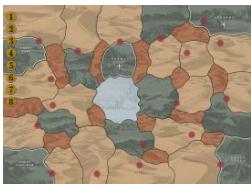
The board depicts the planet Arrakis and is divided into 28 spaces. Players fight for control of these spaces, especially the strongholds (see "Arrakis" on page 9).
6 faction sheets
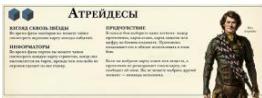
Each sheet represents one of the factions from the Dune universe. Each sheet indicates the faction's special advantages, the number of your cubes that can be revived for free (in the upper corner of the sheet — right or left), and the unique victory condition (if any).
2 battle sheets
These sheets are used to determine how many of your forces and Strategy cards players are willing to commit to battle (see the "Resolving Battles" section on page 20 for details).

140 cubes
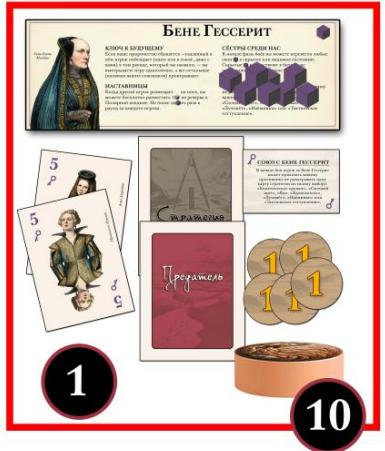
The cubes represent the military and other forces of the players, with which they control spaces on the game board and fight against enemies. Out of the Emperor's 20 cubes, 5 (marked with a crown icon) are special (elite Sardaukar). In addition to 20 standard cubes, the Bene Gesserit have 20 transparent cubes (hidden state — see "Sisters Among Us" on the Bene Gesserit faction sheet).

Atreides troops

Bene Gesserit sisters

Guild mercenaries

Imperial Guard and Sardaukar

Fremen tribes

Harkonnen legions
16 Event cards
There are three types of Event cards:
Spice Blow – determines where new spice tokens appear on the game board.
Shai-Hulud – a sandworm appears on the game board and attacks spaces.
Crisis – crises immediately interrupt the game and require a negotiation phase.
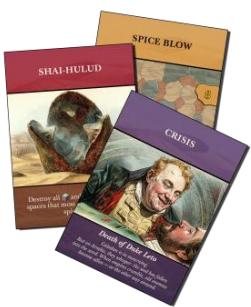
42 Strategy Cards
Strategy cards grant a variety of bonuses and are frequently used in battle. Each round, during the Bidding Phase, players may buy them using spice.
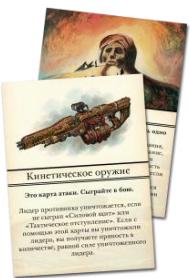
30 Leader cards
Leader cards add their strength during battle. Leaders can turn the tide of a battle but are vulnerable to Traitor cards and Strategy cards.
30 Traitor cards
At the beginning of the game, each player receives one Traitor card. It can be used to force an opponent's leader to betray their faction during battle.
6 Storm cards (small cards)
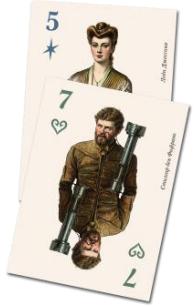
These cards determine how far the storm will move each round and, consequently, which spaces will be affected by it.
8 Betrayal cards (small cards)

These cards are used to steal victory from your ally. Betrayal cards are only used when the optional "Betrayal Cards" rule is in effect (see page 28).
12 Alliance cards (small cards)

These cards are used to track alliances between players and provide special abilities to the allied player.

Reference cards
The game includes 6 reference cards, as well as two large reference sheets for quick access to commonly requested information.
Spice tokens
Spice tokens represent units of spice — the currency and symbol of power not only on Arrakis but throughout the entire universe. Spice is used to purchase Strategy cards, revive your cubes and leaders, and deploy your cubes onto the game board.

Ornithopter tokens
These tokens are optional and serve as a convenient reminder of which player currently controls Arrakeen and/or Carthag — you simply place the token(s) on your faction sheet.

Storm markek
This marker is placed on the game board to indicate which spaces are currently affected by the storm¹.

Round marker
This marker is used to indicate the current round.
First player marker

This marker is used to indicate which player goes first in each phase of the round.

Drum sand overlay
This overlay is used when playing with four or fewer players to remove the Sietch Habbanya space from the game board.

Atomic blast token
This token is placed on the board by playing the "Family Atomics" Strategy card and indicates which rock space has been subjected to an atomic blast and is no longer protected from the sandstorm.

Setup
General Setup
-
Game board. Unfold the game board and place it in the center of the table.
-
Tokens. Place all spice tokens in an area next to the game board. This will be the spice bank. Place the ornithopter tokens in Carthag and Arrakeen.
-
Decks. Shuffle the Event cards, Strategy cards, and Storm cards separately, then place them facedown in decks next to the game board.
-
First player. Each player draws one card from the Storm deck. The player with the lowest number on their card becomes the first player and receives the first player marker. All drawn cards are returned to the deck, then the deck is shuffled and placed facedown next to the board to form the Storm deck.
-
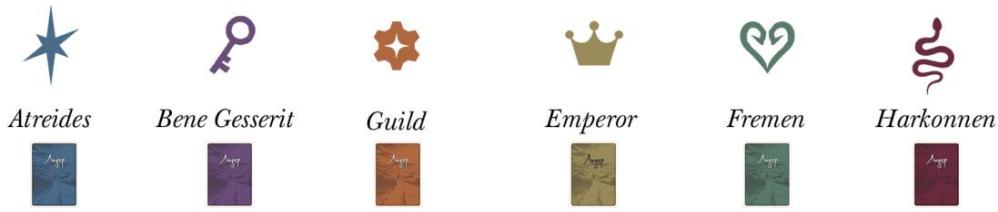
Factions. Starting with the first player and proceeding clockwise, each player chooses one of the six faction sheets. Then each player takes all of their faction's Leader cards, Alliance cards, and cubes. Cards and cubes from unchosen factions are returned to the box and are not used in the game. If playing with fewer than six players, see the list of recommended factions on page 27.
-
Traitors. Gather all Traitor cards from all factions participating in the game into a single deck and shuffle them thoroughly facedown. Then the first player deals four random cards from this deck to each player. Each player chooses one of the Traitor cards they were dealt and places it facedown next to their faction sheet. The chosen Traitor card is kept facedown so that other players cannot see it, but a player may look at their own card at any time. The Harkonnen player keeps all four Traitor cards they receive (this is their faction advantage). All unchosen Traitor cards are returned to the Traitor deck facedown without being revealed. Cards from the Traitor deck may be used later in the game (for example, by the "Double Agent" Strategy card). Each player should choose a Traitor card that matches an opponent's leader. If a player only receives Traitor cards matching leaders of their own faction, they choose one of them, places it facedown next to their sheet, and returns the rest to the deck as usual. The chosen card cannot be revealed as a traitor and has no effect on the game. However, this gives the player valuable information about which leaders are loyal to them (i.e., an opponent will not be able to use that Traitor card to corrupt the corresponding leader).
-
Sandstorm. The players to the left and right of the first player each take a battle sheet. Each of these players secretly selects a number from 0 to 20 using their battle sheet. Both sheets are revealed simultaneously, and the difference between the two numbers indicates where to place the storm marker. For example, if the players reveal "3" and "9", the storm marker is placed on storm space "6" (see "Phase 7: Storm" on page 14). If both players choose the same number, or if the number exceeds "18", place the storm marker on space "1".
-
Strategy cards. Each player draws one card from the Strategy deck and places it facedown next to their faction sheet. Strategy cards are kept facedown so that other players cannot see them, but a player may look at their own cards at any time.
-
Casualty pool. Next to the game board, designate an area as the Tleilaxu Tanks, where destroyed units and leaders will be placed.
Player Setup
-
Personal setup. All players flip over their faction sheets and perform their personal setup according to the instructions. If any player needs to make a choice during this step (for example, the Fremen player), these decisions are made in normal turn order.
-
Prophecy. At any time during game setup (before the start of round 1), the Bene Gesserit player must secretly write down a player's name and a round number (from 1 to 8). This is their Prophecy. If the Prophecy comes true, that player alone wins the game. See page 16 for details.
-
Round marker. Place the round marker on space "1" of the round track on the game board.
You are now ready to begin, starting with the Events Phase!

SETUP DIAGRAM
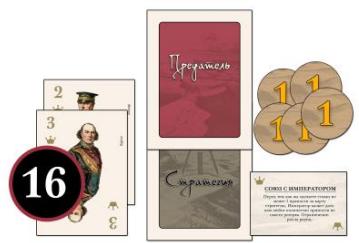

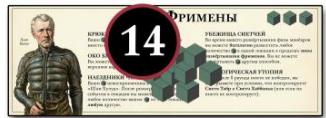
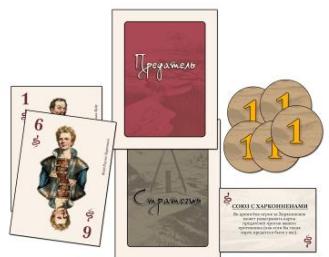


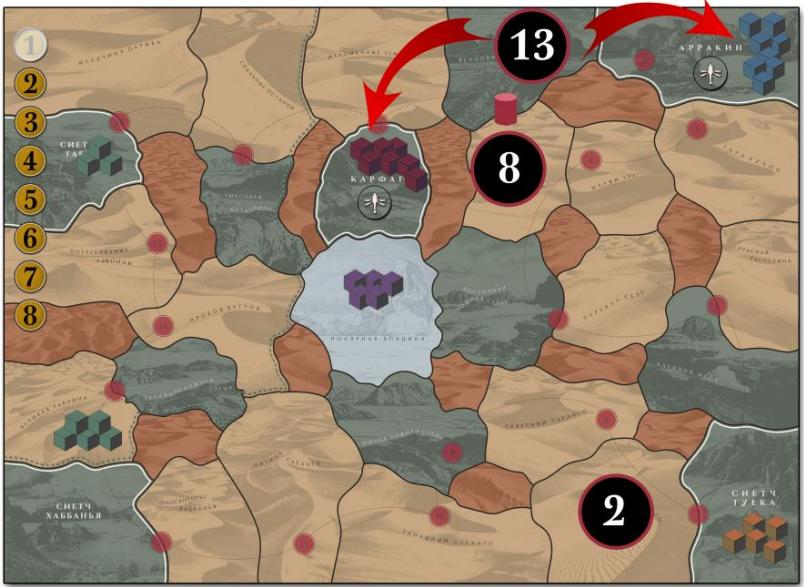


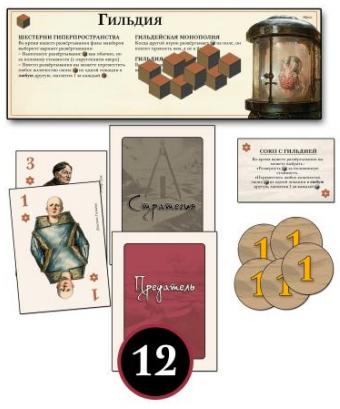

- A Player's Play Area
- Game Board
- Strategy Deck
- Event Deck
- Spice Bank
- Tleilaxu Tanks
- Battle Sheets
- Storm Marker
- Storm Deck
- First Player marker
- Traitor Deck
- Drawn Traitor Cards
- Starting Units
- Unit Reserves
- Ally Advantage Cards
- Leader Tokens
Key Terms and Concepts
First Player and Order of Play
Some rules and abilities refer to the first player and order of play . A player is considered to be the first player while he has the first player token. The order of play for each Phase always begins with the first player and proceeds to the next player clockwise around the table. If two or more players attempt to use an ability or effect at the same time, these effects are resolved in turn order starting from the first player. At the end of the Storm Phase, the first player marker is passed clockwise.
Alliances
Alliances are formed during the "Crisis" event. Players who possess each other's Alliance Advantage cards are considered allied. These players may win the game together and provide special benefits to one another.
Control
A player controls a space if he is the only player that has units in the space. Each space that a player controls is also referred to as a friendly space.
Destroy
When cubes or a leader are destroyed, they are placed in the Tleilaxu Tanks (the casualty area next to the game board).
Enemy
All game components belonging to another faction (excluding allies).
Friendly
All game components belonging to a player's own race are considered friendly components.
Spice Bank
The pile of spice tokens next to the game board that do not belong to any player.
Faction
Each player represents one of the six factions. In this rulebook, the terms "faction" and "player" are used interchangeably to refer to the player and all components belonging to them.
Reserve
The area next to the faction sheet where a player keeps all of their spice tokens, unused cubes, and leaders that have not been destroyed.
Space
An area on the game board that players fight to control. The game board is divided into 28 different spaces.
Spending/Paying Spice
When a player spends or pays spice, it must be taken from their reserve and placed into the spice bank. Note that there are special abilities that require spent spice to be placed elsewhere (the Emperor's and Guild's abilities).
Arrakis
The game board depicts this vast planet (also known as Dune), home to the native Fremen tribes and the sandworms.

Rocks
Spaces colored gray are rock spaces. Such spaces are protected from the storm — cubes in them are not destroyed when the storm passes through or stops in such a space. However, cubes in a rock space that is under the storm cannot enter or leave that space until the storm moves away.
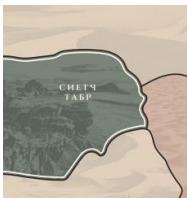
Strongholds
Rock spaces that have a white outline are strongholds. These are important spaces that are the key to controlling Arrakis. There are five such spaces in total: Arrakeen, Carthag, Sietch Tabr, Tuek's Sietch, and Sietch Habbanya. A player wins the game if, at the end of a round, they control the required number of strongholds.

Sands
In all sand spaces, a spice blow may occur during the game, and the corresponding spice tokens are placed there (according to the Event cards). The reference sheets provide a reminder of which spaces can produce how much spice. Players may collect spice tokens during the Collection Phase if they have their cubes in those spaces.
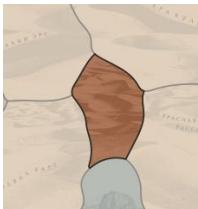
Drum Sands
In drum sands² spaces (colored red and unlabeled), no one may, under any circumstances, deploy or move cubes into or through them by any means.
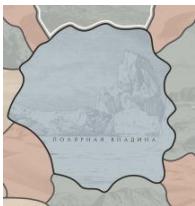
Polar Sink
The Polar Sink is unique in that it is the only space on the game board where cubes from different factions can peacefully coexist. No battles occur in the Polar Sink, and cubes may freely enter this space even if it is occupied by enemies or allies. The Polar Sink is never affected by the storm.
Fremen Deployment Zone
On the game board, a number of spaces are outlined with a dotted green line. The Fremen may only deploy their cubes within this zone.

Storm Spaces
All storm spaces are numbered. The storm marker moves clockwise (from the lower number to the higher number). From space 18, the storm marker moves back to space 1. Some spaces are located at the intersection of two locations — for example, spaces "1" and "5" — and when the marker is on such a space, the storm affects both locations.
General Rules and Concepts
Golden Rule
Many abilities and cards in the game allow players to break the rules in a variety of ways. In the event that a card or ability conflicts with this rulebook, the card or ability takes priority. If a Strategy card conflicts with a racial advantage, the card takes priority.
Secrecy
Players are never allowed to show their Traitor cards or Strategy cards to other players. However, players are free to tell other players this information or even lie about it. The number of cubes and leaders in players' reserves, the strength of leaders, the number of Strategy cards in hand (but not their types), and the amount of available spice — all of this is public information and may not be hidden from other players. Players may not discuss strategies secretly with one another, even if they are allied. All discussions must take place openly, in front of all players. Players may not write down information to remember it. For example, players must remember which Traitor cards they decided not to keep. Likewise, the Atreides player may not write down which Strategy cards are being bid on.
Making Deals
Players may make any verbal deals with one another. These deals are not binding. An exchange of spice cannot be undone (if it has already taken place during a Crisis). Spice may only be part of a bribe or deal when resolving a "Crisis" event card. A deal or bribe may not involve other game components, including the transfer of Strategy cards, Traitor cards, leaders, cubes, or faction advantages. Players may not make a deal or bribe that would contradict the rules of the game
Component Limitations
As soon as the last Strategy card is drawn from the deck, all of the discarded Strategy cards are immediately shuffled and placed facedown to form a new Strategy deck. Players are free to “make change" for influence in their reserves, on the game board, or amongst each other. This is done by exchanging the influence tokens with an equal value (but in different denominations) of influence tokens from the influence pool. All game components (including influence, units, etc) are limited by those provided in the game.
Hand Limit
A player may never have more than four Strategy cards in their hand at one time. If a player already has four Strategy cards in hand, they must pass during the Bidding Phase. The number of Strategy cards each player holds (but not their types) is always open information to the other players.
Rounding Up
Whenever a rule or effect refers to losing or paying half of a component, it is always rounded up. For example, the Guild may deploy units onto the game board at half the cost. If the Hacan deploys three units into an empty space (normally one influence per unit), he would instead pay two influence (half of three, rounded up).
Timing Conflicts
If two players want to use cards or advantages at the exact same time, they should resolve these abilities following the standard order of play. The only exception to this is a card that would cancel another card or advantage. In this circumstance, the cancel effect is resolved before any others.
Sequence of Play
Dune is played over the course of up to 8 rounds. Players continue playing rounds until one player wins or the 8th round ends. Each round consists of the following seven phases:
-
Move the Round Marker. The round marker is moved to the next space on the round track.
-
Events Phase. The top card of the Event deck is revealed and resolved. Typically, this results in spice being placed on spaces on the game board.
-
Bidding Phase. Players spend spice to acquire Strategy cards through an auction.
-
Revive Phase. Players pay spice to return their cubes and leaders from the Tleilaxu Tanks to their reserves.
-
Maneuvering Phase. Each player in turn may move their cubes from one space to another, and then deploy new cubes to one space.
-
Battle Phase. Players resolve battles in every space where cubes from two or more players are present.
-
Collection Phase. For each of their cubes in a space containing spice tokens, a player may collect up to two spice tokens. Then, each player receives 2 spice from the bank.
-
Storm Phase. The top card of the Storm deck is revealed and moves the storm marker across the game board. All cubes and spice are destroyed by the storm along its path and in the space where it stops. Then, the first player marker is passed to the next player, and a new round begins.
0. Move the Round Marker
Move the round marker to the next space on the round track. If no early victory has occurred, the game will end after the 8th round in any case.
1. Events
During this phase, the first player reveals the top card of the Event deck and resolves its effect. Most of these cards place spice tokens on the game board, which players will then try to collect using their cubes. But many events occur on Arrakis that are beyond the control of the great Houses. Among them are the appearance of the great worm Shai-Hulud, as well as Crises, which immediately interrupt the game and force a negotiation phase. Players may look through the Event card discard pile at any time, but may not change the order of the cards within it.
Full rules for resolving Event cards can be found on page 17.
2. Bidding
At the start of this phase, the first player draws a number of Strategy cards equal to the number of players (excluding those who have already reached their hand limit of four cards). These cards are placed facedown next to the game board. Then, bidding begins for the first card. It is important to note that the card remains facedown while players bid on it.
The first player starts the bidding for the first Strategy card by making a bid in spice or by passing. Bidding then proceeds in turn order. Each player in turn must either bid or pass:
Y Bid: If a player wishes to bid, they announce how much spice they are willing to pay for the card (minimum 1 spice). If another player has already bid on this card, the player must bid at least 1 spice more than the current highest bid. A player cannot bid more spice than they have in their reserve. A player cannot bid if their hand has reached its limit (normally 4 cards) or if they have 0 spice — in these cases, they must pass.
Pass: When a player passes, they may no longer bid on the current card. However, they may bid on other Strategy cards when those come up for bidding later in this phase. Players who have passed do not pay any spice, even if they previously bid on this card.
Bidding continues until a highest bid has been made and all other players have passed. The player who made the highest bid must pay the announced amount of spice to the bank, and then receives the Strategy card. Strategy cards are kept facedown so that other players cannot see them, but a player may look at their own cards at any time.
A new round of bidding then begins for the next Strategy card. Bidding is started by the player to the left of the previous opening bidder. In this way, each player gets a chance to start the bidding for a Strategy card. If a player has no spice or has reached their hand limit for Strategy cards, they cannot be the opening bidder. In that case, the player to their left opens the bidding instead.
The Bidding Phase continues until all available Strategy cards have been acquired, or until no player bids on the next card. If all players pass on the same card, all remaining Strategy cards are returned to the Strategy deck, and the Bidding Phase ends immediately.
Example: Players are bidding on the first Strategy card. The Atreides player uses their advantage to peek at the card, then returns it facedown. The first player (Guild) bids 1 spice. Each other player passes in turn, except the Atreides player, who bids 2 spice. The Guild player decides this is too expensive and passes. The Atreides player pays 2 spice and takes the card.
3. Revive
In turn order, players may return up to 5 of their cubes and one leader from the Tleilaxu Tanks. Reviving a cube costs 2 spice per cube. Some cubes may be revived for free — the number of free cubes is indicated in the upper corner of the faction sheet (free cubes count toward the limit of 5 revivable in this phase). All revived cubes are returned to their owner's reserve (next to the faction sheet).

Reviving a Leader
When a leader is destroyed, its card is placed face up in the Tleilaxu Tanks. During each Revive Phase, each player may revive one of their leaders by paying an amount of spice equal to that leader's strength. Revived leaders are placed in their owner's reserve. A revived leader may be used in battle as normal and can still be a traitor or be destroyed by Strategy cards.
Example: During the Revive Phase, the Emperor player receives one free revive as indicated on their faction sheet. They take 1 cube as a free revive from the Tleilaxu Tanks and place it in their reserve. Then they decide to revive four more cubes, costing 2 spice each. Thus, they have revived the maximum of five cubes allowed per round. Finally, they decide to revive their leader of strength 5. They pay 5 spice and return that leader to their reserve.
4. Maneuvering
During the Maneuvering Phase, players may move their cubes that are on the game board, and then deploy new cubes from their reserve. Starting with the first player and proceeding in turn order, each player performs one movement step followed by one deployment step. A player must complete both steps in sequence before the next player begins their Maneuvering Phase.
a. Movement. A player may move any number of their cubes (as a single group) from one space to another. Cubes may move up to two spaces, and the group must end its movement in a single space. Cubes cannot move through a space that is under the storm (even if it is a rock space). Also, cubes cannot end their movement in a space occupied by an ally's cubes (except
CONTROLLING A SPACE A player controls a space if they are the
only player with cubes
in that space. Control
ling spaces is important for collecting spice,
gaining the ornithopter
bonus, and controlling
strongholds to win the game.
in the Polar Sink). Otherwise, cubes may freely move into, out of, or through any space, regardless of how many cubes are in it (friendly, allied, or enemy).
b. Deployment. A player may perform one deployment, moving any number of their cubes from their reserve to any one space on the game board. A player must pay 1 spice for each cube deployed if deploying into an empty space. If an enemy is present in the space, the player must pay 2 spice per cube deployed. Exception: Deployment into the Polar Sink always costs 1 spice per cube.
A player cannot deploy into a space that is under the storm (even if it is a rock space), nor into a space occupied by an ally's cubes.
A player cannot move cubes from the game board back to their reserve.
After all players have completed their Maneuvering Phase, the Battle Phase begins. In each space where enemy cubes are present, a battle takes place.
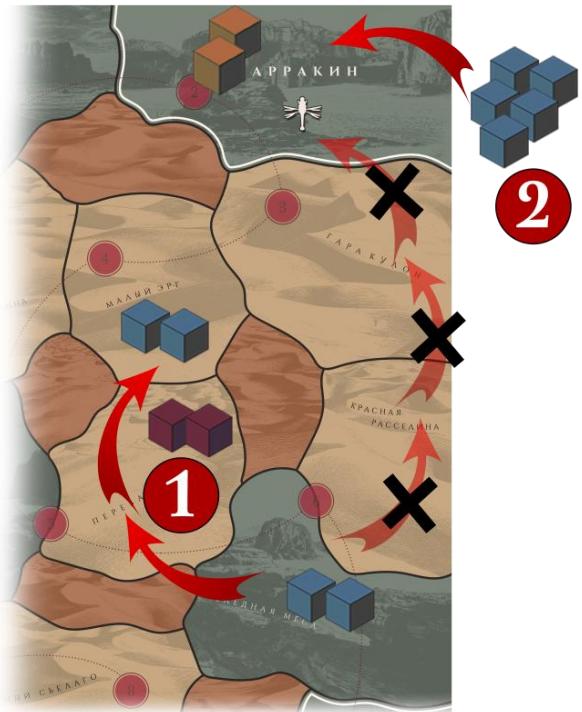
MOVEMENT AND DEPLOYMENT EXAMPLE
1) The Atreides player moves their cubes (blue) from Pasty Mesa to The Minor Erg, even though enemy cubes are along the path. Atreides cannot move their cubes into Arrakeen because it is too far away (three spaces away).
2) Then, the Atreides player deploys cubes directly into Arrakeen from their reserve. This costs them 10 spice (2 spice per cube, because enemy cubes are present in that space).
Ornithopter Movement Bonus³
A player who controls Arrakeen and/or Carthag at the start of the Maneuvering Phase may move their group of cubes up to four spaces during the Movement Step. The moving group itself does not need to be in Arrakeen or Carthag to receive this bonus. You may use ornithopter tokens by placing them on your faction sheet as a reminder of control and this bonus, but they are optional.
5. Battles
Battles occur in all spaces where cubes from two or more players are present, except in the Polar Sink, where battles can never take place.
Starting with the first player and proceeding in turn order, each player must resolve all of their battles (in any order of their choice). When there are no longer any enemies in the spaces where their cubes are located, the next player in turn order resolves their battles.
During a battle, both participating players use their battle sheets to choose the number of cubes they wish to commit (and sacrifice). Each player must also choose a leader (who adds their strength to the committed cubes) and up to two Strategy cards (which may alter the outcome of the battle). The player with the lowest total strength loses the battle and must destroy all of their cubes in that space.
For more details on resolving battles, see page 20.
When all battles have been resolved, the game proceeds to the Collection Phase.
6. Collection
During this phase, players first collect spice from spaces, and then receive support from CHOAM⁴.
a. Collecting Spice from Arrakis. For each of their cubes in a space, a player collects up to 2 spice from that space. Collected spice is placed in their reserve. Any spice tokens not collected from the spaces remain there and are available to collect in future rounds.
b. CHOAM Support. Each player receives 2 spice from the bank. This step is performed regardless of whether the player collected spice from Arrakis or not.
Example: The Bene Gesserit player controls a space containing 6 spice. Since they have 2 cubes in that space, they collect 4 spice and place it in their reserve. The remaining 2 spice remain in the space and may be collected in a future Collection Phase.
7. Sandstorm
The storm marker moves across the game board, destroying cubes and spice as described below:
a. Draw a Storm card. The first player reveals the top card of the Storm deck.
b. Move the storm marker. The storm marker moves a number of spaces equal to the value on the Storm card. The marker moves one space at a time, always proceeding to the next higher number (clockwise). When moving from space "18", the marker returns to space "1". Any cubes and spice tokens in spaces that the storm enters are destroyed, except for rock spaces (see Space Descriptions, page 9). When the storm marker is placed on a space that lies at the intersection of two locations, the storm affects both locations (for example, if the storm marker is on space "1", the storm occurs in both Rim Wall West and Imperial Basin). Spaces that the storm has passed through are no longer under the storm and do not affect movement.
DESTROYED CUBES AND SPICE
When cubes are destroyed, they are placed in the
Tleilaxu Tanks. Players may
return their cubes by paying spice during the Revive
Phase (although some cubes
may be revived for free — see
"Phase 3: Revive", page 12).
When spice is destroyed, the
tokens are simply returned to the spice bank.
Important: The space where the storm ends its movement remains under the storm until the marker moves again. Deployment into that space, as well as movement into or out of it, is prohibited.
c. Shuffle the Storm deck. The first player shuffles the drawn Storm card back into the Storm deck.
d. Pass the first player marker. The first player marker is passed to the next player clockwise. Then, a new game round begins.
SANDSTORM MOVEMENT EXAMPLE
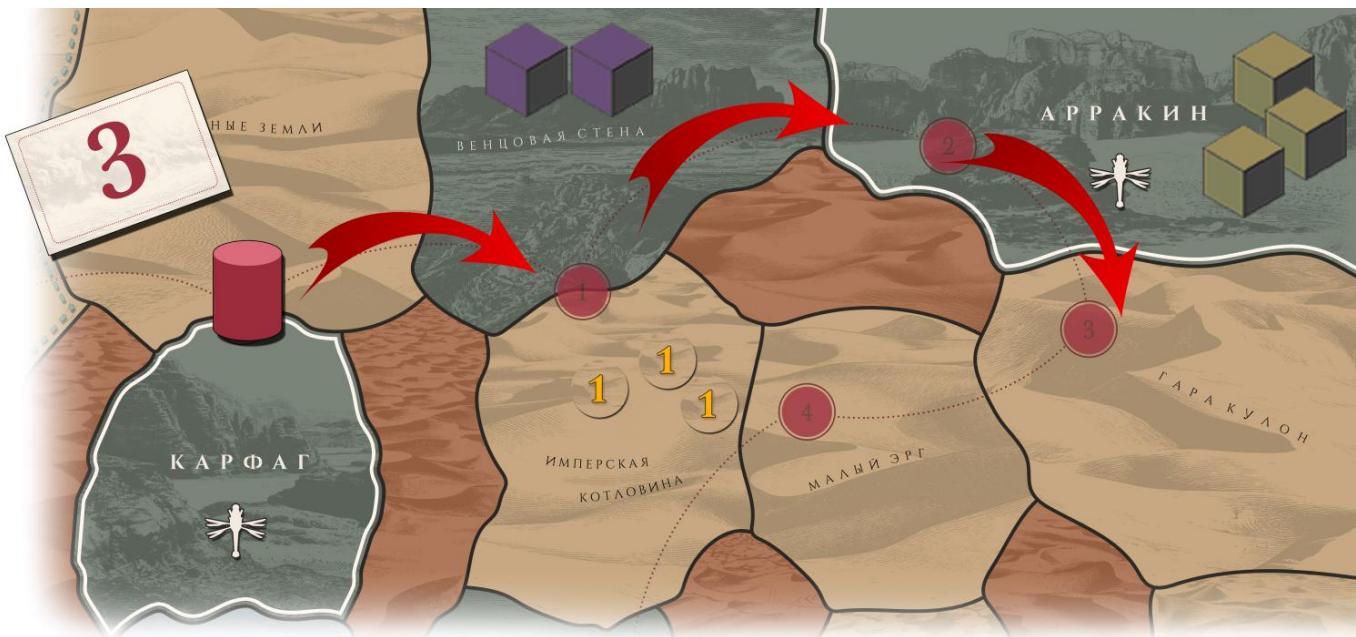
The storm marker is on space "18". The first player reveals a Storm card — "3". The marker will move 3 spaces, one at a time. On space "1", the storm affects both locations, but Crown Wall is a rock space, so the purple cubes are protected and are not destroyed. However, the 3 spice in Imperial Basin are destroyed and returned to the spice bank. Then, the storm marker moves to space "2". This is a rock space, so the two gold cubes are also protected. The storm marker ends its movement on space "3". While the storm is here, cubes cannot move into or through this location.
Winning the Game
At the end of each round (and especially at the end of the 8th round), it must be determined whether someone has won and who that is. Below are all possible victory conditions — from the most unexpected to the most obvious. The check is performed in the following order:
- Bene Gesserit Prophecy (overrides everything). If the Prophecy comes true and the predicted player wins by any means in steps 1-3 below (alone, in an alliance, or even in an alliance with the Bene Gesserit) in the predicted round — the Bene Gesserit wins alone, without sharing the victory with their ally(ies). The victory of the predicted player (or alliance) is canceled.
Example: At the end of the fifth round, an alliance of Fremen and Guild each controls two strongholds — this is enough to win. The Bene Gesserit reveals their Prophecy: they chose the Guild and round "5". Since the Guild won in round 5, the Bene Gesserit wins the game alone. The Fremen and Guild lose.
1. Control of Strongholds (at the end of any round)
1.1. Player not in an alliance. Controls 3 or more strongholds — wins alone.
1.2. Alliance of 2 players. Jointly controls 4 or more strongholds — both win.
1.3. Alliance of 3 players. Jointly controls all 5 strongholds — all three win.
2. Special Victory (only at the end of round 8 and if no one won in step 1)
2.1. Fremen. No one won by controlling strongholds, and the Fremen (or no one) control Sietch Tabr and Sietch Habbanya — the Fremen win (with allies, if any). If the Fremen control at least one of these spaces — the victory still counts. However, if anyone else (even an ally) controls at least one of these spaces — the Fremen cannot fulfill the special conditions of their Ecological Utopia.
2.2. Guild. If no one won by controlling strongholds, and the Fremen did not win by their special condition — the Guild wins (including in an alliance).
- Maximum Strongholds (alliances are ignored, if steps 1–2 did not trigger)
3.1. Maximum Strongholds. One player has more strongholds than every other player — that player wins.
3.2. Tie. Multiple players have the same highest number of strongholds — they share the victory.
Betrayal (Optional Rule)
Betrayal may trigger at the moment when an alliance declares its victory. If a player in the alliance meets the condition on their Betrayal card, they reveal it and steal the victory from their allies, winning alone. If multiple players reveal Betrayal cards — the player with the highest difficulty (the number in the corner of the card) wins alone.
Important: Betrayal cards cannot be revealed if the victory was achieved through the Bene Gesserit Prophecy (the Bene Gesserit wins alone, and no betrayals can be triggered or revealed in this case).
Victory Check Order (short version)
-
Bene Gesserit Prophecy → if fulfilled → Bene Gesserit wins. End of game.
-
If not — check control of strongholds (single player / alliance of 2 / alliance of 3).
-
If no one has won by the end of round 8 — Special Victory for the Fremen or the Guild.
-
If that also did not trigger — the player(s) with the most strongholds win (one or several).
Resolving Event Cards
The first player reveals and resolves an Event card. After "Shai-Hulud" and "Crisis" cards, a new Event card is always revealed and resolved.
Spice Blow
Take the indicated amount of spice from the bank and place it in the spaces shown on the card. If a space is currently under the storm, no spice is placed there. After the card is resolved, it is discarded face up next to the Event deck. For convenience, tokens of 4, 6, 8, and 10 are provided for placing during a spice blow (they match the amounts on the cards), while tokens of 1 and 5 are for regular change.
Shai-Hulud
A worm appears and attacks the spaces of the last spice blow card in the discard pile. All cubes and spice in both indicated spaces are destroyed (in the order shown on the card). Then, remove the "Shai-Hulud" card from the game, and reveal and resolve a new Event card. If another "Shai-Hulud" card is revealed, it is removed from the game without effect, and the next card is revealed instead.
Note: In the first round, all "Shai-Hulud" cards have no effect and are instead shuffled back into the deck at the end of the Events Phase. In such cases, reveal and resolve a new Event card instead of the "Shai-Hulud' card.
Crisis
In the world of Dune, events constantly disrupt the fragile balance of power on Arrakis. Crises are key moments when the fate of the planet and the entire Empire hangs in the balance. They demand an immediate reaction, a re-evaluation of alliances, and fateful decisions. When a Crisis is resolved, players gain the opportunity to form and break alliances. Additionally, during a Crisis, players may freely trade spice with one another as they see fit. Players may even give spice to those they are not allied with. Although players may make non-binding deals at any time, bribing or otherwise exchanging spice with one another is only permitted during a Crisis.
Once all players have finished forming and breaking alliances, remove the Crisis card from the game and reveal and resolve another Event card. If another "Crisis" card is revealed during this phase, it is removed from the game without effect, and another card is revealed instead.
Forming an Alliance. Players may discuss among themselves the advantages and disadvantages of an alliance and decide with whom to form one. Up to three players may form an alliance, but it is important to remember that the larger the alliance, the more strongholds they need to control to win (see page 16). When players form an alliance, each player gives one of their Alliance Advantage cards to each of their allies. Each player places their ally's card(s) face up in their play area to remind them that they are in an alliance and what special ability their ally provides. Several alliances may be formed during a "Crisis", but no player may belong to more than one alliance at a time. Once all players have had the opportunity to form an alliance, no further alliances may be formed until the next "Crisis" card is revealed.
Optional Rule: If players spend too much time deliberating over alliances, all players may agree on a time limit for negotiations (two minutes should suffice).
Example: During the Events Phase, a "Crisis" card is revealed. The Guild player decides they are unhappy with their current alliance with the Bene Gesserit player and breaks the alliance. The Fremen and Emperor players decide that an alliance would be beneficial to them and exchange Alliance Advantage cards. They then decide they would like the
Guild player to join their alliance and invite them. The Guild player accepts and exchanges Alliance Advantage cards with the Fremen and Emperor players.
Breaking an Alliance. A player may leave an alliance during a Crisis. To do so, they simply announce that they are breaking the alliance, return their allies' Alliance Advantage cards to them, and take back all of their own Alliance Advantage cards into their reserve. Players who break an alliance immediately gain the opportunity to form a new alliance.
Important: Alliances may only be broken during a Crisis.
Example: The Emperor and Bene Gesserit players form an alliance. Later, the Emperor player controls three strongholds, while their ally controls none. This alliance needs to control 4 strongholds to win. During the next Crisis, the Emperor player still controls three strongholds and decides to break the alliance. They will win the game if they still control all three strongholds at the end of that round.
Effects of an Alliance. Forming an alliance provides each member with several benefits:
If the members of an alliance control the required number of strongholds at the end of a round, all members of that alliance win together. An alliance of two players needs to control 4 strongholds to win (see also "Winning the Game", page 16); an alliance of three players needs to control all 5 strongholds.
Allies assist each other as indicated on their Alliance Advantage cards. Any of these abilities that use the word "may" are used only with the permission of the card's owner.
Players cannot deploy or move cubes into a space where their ally already has cubes, although they may move through such spaces (see "Phase 4: Maneuvering", page 13). Since allies may never occupy the same space, they may never battle each other.
Note: Players only gain the ally advantages listed on the Alliance Advantage card. Players also do not gain access to their allies' ornithopters.
-
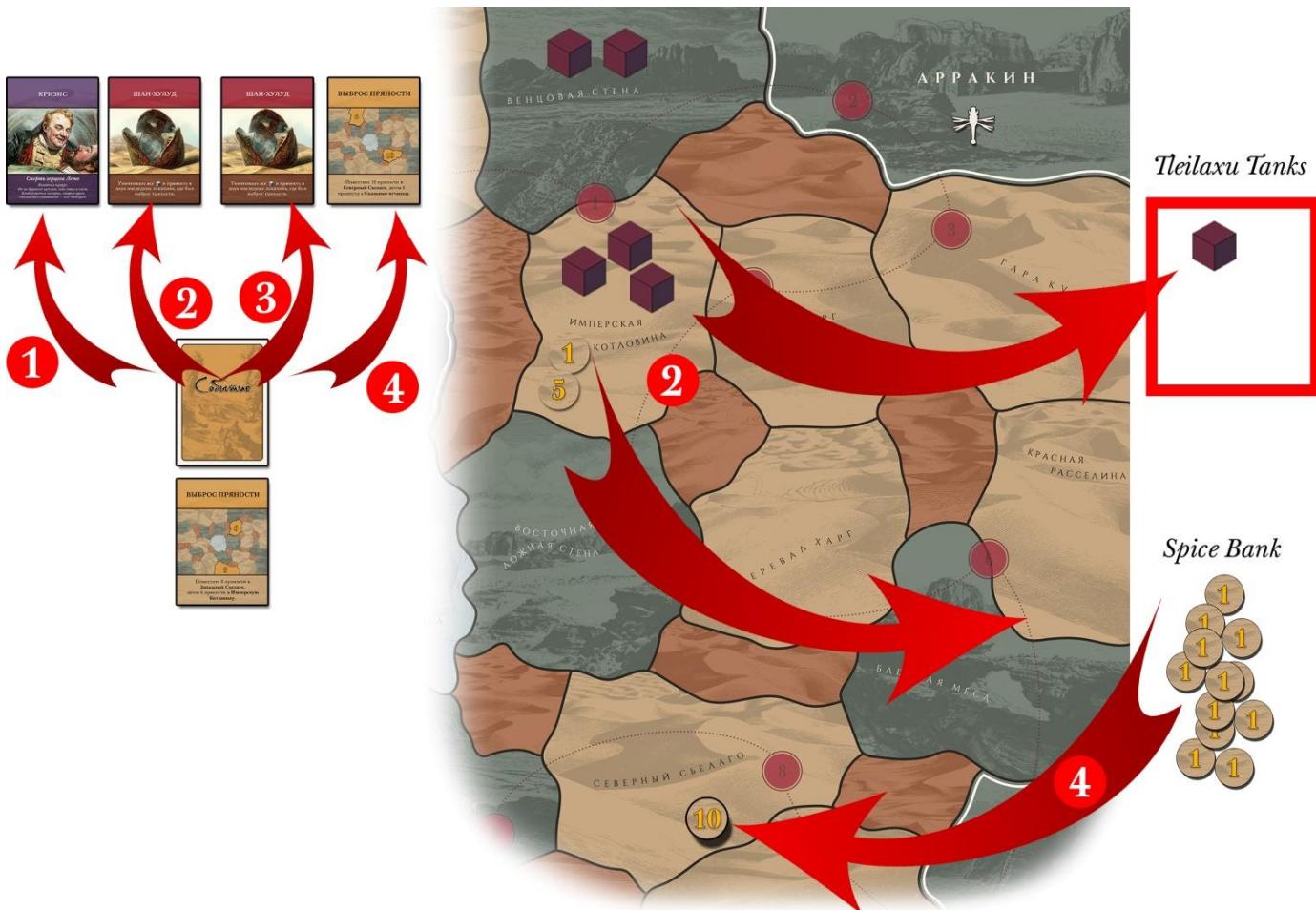
It is the fourth game round. During the Events Phase, a "Crisis" card is revealed, which interrupts the game and gives players the opportunity to form and break alliances. After this, the card is returned to the game box, and a new Event card is revealed.
-
The second card is "Shai-Hulud". All cubes and spice in the spaces indicated on the top spice blow card in the discard pile (in this case, the last card in the discard pile was a spice blow in the Imperial Basin and Cielago West spaces) are destroyed. The Harkonnen player moves all of their cubes from the Imperial Basin space to the Tleilaxu Tanks. Then, all spice tokens in those spaces are destroyed and returned to the bank. There were no cubes in the Cielago West space, so it was not affected by the worm. The "Shai-Hulud" card is then returned to the game box, and a new Event card is revealed.
-
The third card is another "Shai-Hulud". Since one such card has already been played this round, the effect of this card is ignored, and it is removed from the game.
-
Another card is revealed from the Event deck. This is a spice blow, and 10 spice must be placed in the Cielago North space and 8 spice in the Rock Outcroppings space. Then, this card is placed face up in the Event card discard pile. After a spice blow card, no additional cards are revealed. The Events Phase ends, and the game proceeds to the Bidding Phase.
Resolving Battles
During the Battle Phase, battles occur in spaces where two players have cubes. If cubes from more than two players are present in a single space, several two-player battles are fought — one at a time, in turn order (see "Phase 5: Battle Phase", page 14).
To resolve a battle, follow these steps in order:
-
Situation Report. Each participating player must declare aloud how many units he has in the area, how many Strategy cards he has in hand, and the strength of the leaders in his reserve. Each player then flips his leader tokens facedown so that his opponent cannot see which leader token he will choose.
-
Choose Strength and Card Type. Each player takes a battle sheet and secretly selects a value from zero up to the number of cubes they have in the space where the battle is taking place. This is the number of cubes they intend to commit to this battle. They also select a strategic mode — which types of Strategy cards they will commit to this battle: none, one Attack card, one Defense card, or one Attack and one Defense card. By choosing the card type on the sheet, the player is committing to playing that type of card(s) during Step 4. If a player chooses not to commit any Strategy cards, they point the arrow downward to the empty space. Important: A player may not play more than one Attack card and one Defense card in a single battle.
-
Choose Leader. Both players simultaneously choose one of their leaders and place it facedown in front of them. Each player must play a leader card in every battle (if they cannot — see "Leaders in Battle", page 21).
-
Reveal Leaders and Battle Sheets. Once both players have chosen their strength, strategic mode, and leader, they simultaneously reveal their battle sheets and leader cards.
-
Commit Strategy Cards. Both players then simultaneously select Strategy cards from their hand that match the strategic mode chosen on their sheets and place them facedown. The cards are revealed simultaneously. For example, if a player chose the "Attack" strategic mode during Step 2, they must play a Strategy card of that type during this step.
-
Reveal Traitor (optional). If a player has a Traitor card that matches the revealed leader card of their opponent, they may play it to immediately win the battle (regardless of attack strength — proceed directly to the "Determine Winner" step below). When a leader's Traitor card is revealed, the opponent's leader is destroyed, and both players' chosen Strategy cards are not played (the loser's cards are discarded). The Traitor card is then shuffled back into the unused Traitor card deck. If both players reveal a Traitor card, both automatically lose the battle (and must follow the losing rules in Step 8).
-
Resolve Strategy Cards. In turn order, each player resolves their chosen Strategy cards. Many Strategy cards destroy the opponent's leader unless they played a corresponding Defense card. Destroyed leaders are immediately placed in the Tleilaxu Tanks and do not contribute their strength when determining the winner of the battle (see "Leaders in Battle", page 23).
-
Determine Winner. Each player adds their leader's strength to the value chosen on their battle sheet to determine their total battle strength. The player with the highest total battle strength wins the battle. If both players have the same total battle strength, the player whose turn is earliest in order of play wins the battle.
• The loser must destroy all of their cubes in the space.
• The loser must discard all Strategy cards they committed to the battle.
• The loser's leader is not destroyed as a result of losing. Leaders are destroyed only by the effect of a Strategy card or if a Traitor card is revealed.
• The winner must destroy a number of their cubes in the space equal to the value chosen on their battle sheet.
Exception: If a player wins the battle by revealing a Traitor card, they do not destroy any of their cubes.
The winner may keep or discard any of the Strategy cards they committed to the battle. Strategy cards may only be discarded after being used in battle or as specified on the Strategy card itself. Players may not voluntarily discard Strategy cards at any other time.
Battle Sheet Structure
The battle sheet is divided into two zones: on the left — selection of the strategic mode, on the right — selection of strength.

Strategic Mode
On the left side of the sheet, there are four modes. The player rotates the arrow, steering the ship, to select one of them:
Attack.The player must play only an Attack card.
Defence. The player must play only a Defense card.
Attack and Defense. The player commits both cards.
Empty space (ship pointing down). The player does not commit any Strategy cards.
Strength
On the right side of the sheet, Arrakis is depicted, with numbers from 0 to 20 arranged in orbit around it. The player rotates the arrow and selects a number from 0 up to the number of their cubes in the space. This number determines:
How many cubes the player intends to commit to the battle.
How many cubes the player must destroy if they win.
Leaders in Battle
Leaders in a player's reserve are public information. At any time (except during Step 3 of battle), a player may be asked to reveal all of their leaders. However, the selection and play of a leader in battle is done facedown.
When a leader is destroyed, its card is placed face up in the Tleilaxu Tanks. A player may pay spice during the Revive Phase to return one of their leaders to their reserve (see "Phase 3: Revive", page 12).
Important: If a leader is committed to a battle, they cannot be committed to a battle in another space during the same round. However, a leader may be selected for battle in the same space again.
If a player cannot select a leader for battle (all of their leaders have been destroyed or have already fought in another space this round), they must declare that they are without a leader and cannot play any Strategy cards during this battle. Such a player's attack strength is determined solely by the number of cubes chosen on their battle sheet, and the strategic mode arrow must point downward.
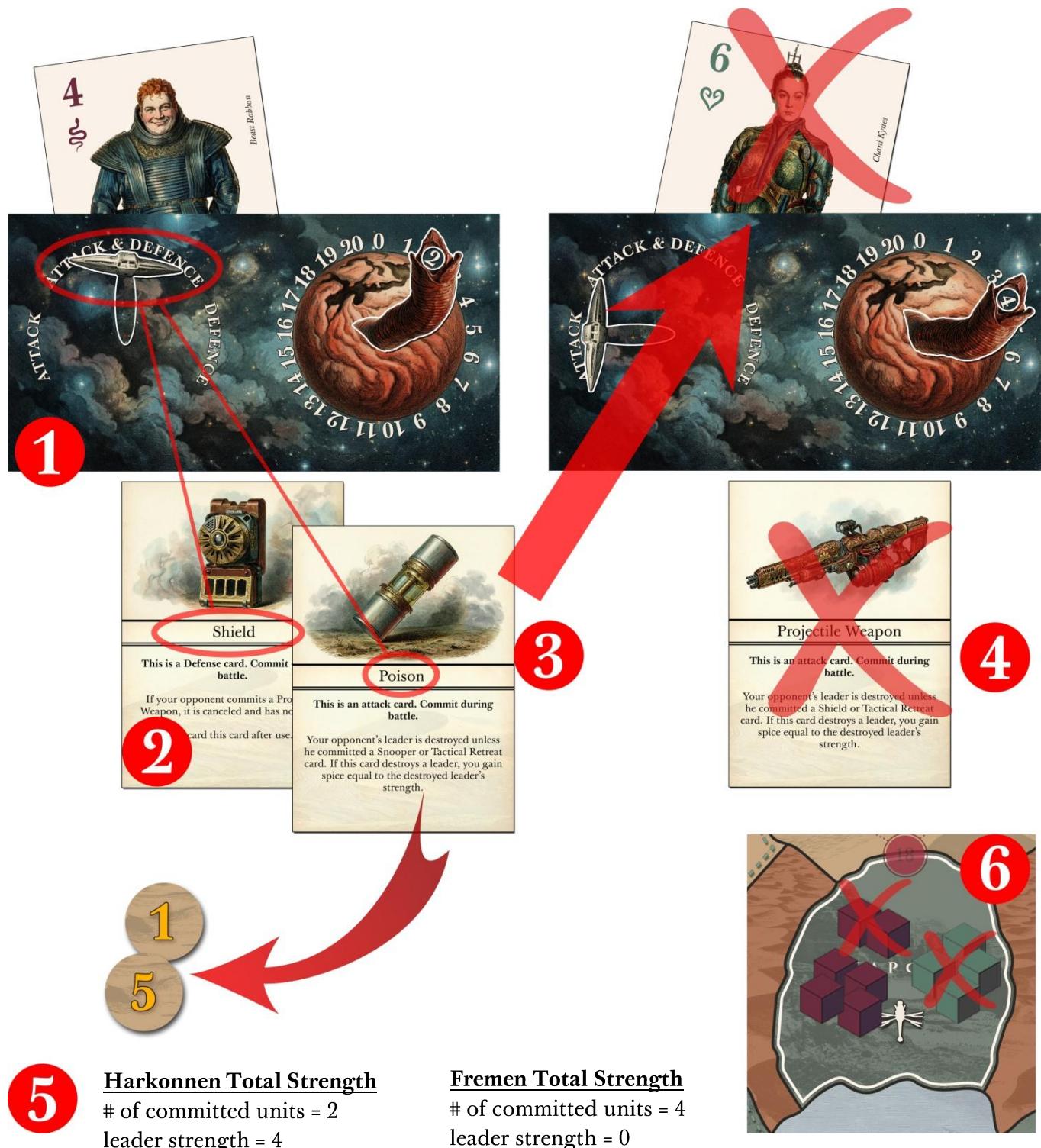
Harkonnen Total Strength # of committed units = 2 leader strength = 4 Total Combat Strength= 6
Fremen Total Strength # of committed units = 4 leader strength = 0 Total Combat Strength= 4
-
At the start of the Battle Phase, the Harkonnen player and the Fremen player have cubes in Carthag. The Harkonnen player has 6 cubes in the space, opposed by 4 cubes of the Fremen. Both players take battle sheets. Each secretly selects a value and a strategic mode on their sheet, and also selects and places a leader card facedown.
-
After the sheets are revealed, both players must select Strategy cards according to their chosen mode and play them facedown.
-
The chosen Strategy cards are revealed simultaneously. The first player (Harkonnen) resolves their card first. Their "Poison" card destroys the opponent's leader (Fremen) and allows the Harkonnen player to gain spice equal to the destroyed leader's strength.
-
Then the Fremen player resolves their Strategy card. They play "Projectile Weapon", but its effect is canceled by the Harkonnen player's "Shield".
-
Now both players calculate their battle strength. The Harkonnen player totals 6 (2 — the number of committed cubes on their sheet, 4 — from their leader). The Fremen player totals 4 (4 — the number of committed cubes on their sheet, 0 — from their leader, since they were destroyed).
-
zpok The Harkonnen player wins the battle. All of the Fremen player's cubes in the space are destroyed, and they discard the "Projectile Weapon" card they committed to the battle.
Then the Harkonnen player must destroy two of their cubes in that space (equal to the number chosen on their sheet). After that, they may discard one, both, or none of the chosen Strategy cards.
Strategy Card Clarifications
This section clarifies a few of the more complex Strategy cards, and includes some specific rules and situations that could not fit on the cards.
Double Agent. When gaining a Traitor card with "Double Agent," the player keeps any other Traitor cards that are in his hand. Traitor cards that have been used are shuffled back into the Traitor deck and may return to play through use of this card.
Tleilaxu Ghola. A player may use more than one "Tleilaxu Ghola" card during a single Revive Phase.
Cone of Silence. If this card is used to prevent a player from participating in the bidding for Strategy cards one fewer Strategy card than normal is laid out for that bidding round. If the card is used on the Atreides player, they may still look at the facedown Strategy cards, even though they cannot bid on them.
Family Atomics. A player may use this card in any rock space where they have at least one cube (even if enemy cubes are also present). If a bombardment is currently affecting that space, all cubes in it are immediately destroyed, including hidden Bene Gesserit cubes.
Karama – Deployment: This card allows the player to deploy into two spaces during the same turn. The spice paid for this extra deployment is not given to the Guild player. If the Fremen player uses this card, he may deploy units to any space of the game board for a cost of one spice per unit. This card may be used even if the player decides to not deploy any units in his normal deployment step.
Karama – Canceling. This ability may be used to cancel a faction advantage or an ally advantage (as stated on the card). Any ally advantage may be canceled by this card. Some faction abilities cannot be canceled, or have special cancellation rules:
Emperor. If the Emperor's advantage is canceled ("Crown of the Golden Lion"), it only applies for a single Strategy card purchase. Spice is placed in the bank as usual. The faction's second advantage ("Sardaukar") cannot be canceled.
Fremen. If the Fremen ability to look at the top card of the Storm deck is canceled, the player cannot look at it until the next Storm Phase. If their deployment advantage is canceled ("Sietch Sanctuaries"), the player may deploy cubes to any one space and must pay the deployment cost according to standard rules.
Harkonnen. The Harkonnen advantage of starting the game with four Traitor cards and two Strategy cards cannot be canceled. If their maximum hand size advantage is canceled ("The Baron's Hand"), they must discard down to four cards, but may later build back up to eight through normal means (e.g., during bidding).
• Atreides. If the Atreides advantage to look at a facedown Strategy card ("Star Informants") is canceled, it only applies to the current card being bid on (not to all cards).
Bene Gesserit. If the Bene Gesserit advantage to make their cubes hidden or visible is canceled ("Sisters Among Us"), the player cannot make their cubes hidden or visible during that round. Any cubes that are already hidden remain hidden, unless they share a space with visible Bene Gesserit cubes (in which case they automatically become visible according to the rules on page 26).
• Guild. If the Guild's "Guild Monopoly" advantage is canceled, it only applies for a single player's deployment. Spice is placed in the bank as usual. If their deployment discount is canceled, the player must pay deployment costs according to standard rules.
Rapid Mobilization. This card allows the player to take a second Movement step. This allows him to move units from one space to one other space following all normal movement rules (for example, only moving up to two spaces barring special abilities). This can even be used to move the same units more than once during the same game round.
Tactical Retreat. When this card is used, the owner's leader and all his units in the area are returned to his reserves. The opposing player is considered the winner of the battle for all intents and purposes. Both players take zero casualties in the battle regardless of the numbers selected on their dials, and all other committed Strategy cards have no effect. If both players commit this card to the same battle, both cards take effect, and neither player is considered the winner of the battle.
Thumper. When this card is played, a "Shai-Hulud" event is resolved in the spaces that last received a spice blow, following all the rules on page 17. If another "Shai-Hulud" card is revealed during this Events Phase, it is removed from the game without effect. The Fremen player and their allies are immune to the effects of this Shai-Hulud and may use it to move cubes from that space to any other space on the game board (as specified in their faction advantage and ally advantage).
Advantage Clarifications
Emperor
The Emperor may not select a value higher than 20 on the battle sheet (even if they have greater total strength due to Sardaukar).
When assigning casualties, the Emperor player chooses which of their cubes are destroyed, with each destroyed Sardaukar counting as two cubes. The Emperor player must take all casualties in the battle and cannot ignore a point of damage by using a Sardaukar.
Example: The Emperor player has three cubes in a battle, all of which are Sardaukar (total strength 6). They set their battle sheet to 3 and must destroy cubes with a total strength of at least 3. They must destroy two Sardaukar, because destroying only one would not cover the value of 3 selected on their sheet.
The Emperor may give any amount of spice to their ally during the Bidding Phase. This spice must be given before the player makes a legal bid on the current Strategy card. The ally is not required to spend all (or any) of the spice received, and keeps any unspent spice.
Example: The Emperor's ally (the Bene Gesserit) has 2 spice. During the Bidding Phase, they ask the Emperor for 4 spice to bid. The Emperor agree
Content is long; only the first part is inlined. Download the file or open the rules page for the full text.
Download Markdown06.md47.7 KB
Optional Rules
This section contains variations on the rules that modify the game to provide different play experiences. Before each game, players must decide as a group if they would like to use one of the following options, or a combination of both.
Playing with Fewer than Six Players
Rex is a game that relies heavily on diplomacy, deal making, and backstabbing. For this reason, the game is more enjoyable with more players.
If players wish to play with fewer than six players, they should make the following changes.
Three-Player Game
When playing a three-player game, no alliances may be formed. When a "Temporary Ceasefire" Influence card is drawn, players may trade influence as normal, but cannot form any alliances.
We also suggest that players only use the Sol, Lazax, and Jol-Nar races in a three-player game.
When resolving an Influence card that places influence tokens in two different locations, the second space is ignored. In a three-player game, players only place influence in the first space listed (left most image).
When a Sol Offensive card is resolved, both locations listed on the card are affected as if influence was placed in them.
Important: When playing a three-player game, place the Demolished Location token on top of the Mecatol Power South space. Units cannot enter this space for any reason.
Four-Player Game
When playing a four-player game, alliances may consist of a maximum of two players. We also suggest that players only use the Sol, Lazax, Jol-Nar, and Letnev races in a four-player game.
Important: When playing a four-player game, place the Demolished Location token on top of the Mecatol Power South space. Units cannot enter this space for any reason.
Five-Player Game
There are no changes. We suggest that players only use the Sol, Lazax, Jol-Nar, Letnev, and Hacan races in a five-player game.
Betrayal Card Option
This option is for players who want to add even more backstabbing and treachery into alliances. All players must agree to use this option before the start of the game.
When using this option, each player is dealt one random Betrayal card during setup. This card tells each player how he alone can steal the victory away from his allies.
Each player's Betrayal card is kept facedown, and may not be shown to other players during the game. A player may look at his own Betrayal card at any time, and only reveals it to other players if he chooses to betray his allies at the end of the game.
At the end of the game, if an alliance has won the game, each member of the alliance must perform one of the following two options:
Share the Victory: The player shakes hands with his allies. If all members of an alliance shake hands, they share the victory and have won the game together.
Betray: If the player is currently fulfilling the conditions on his Betrayal card, he may reveal it. If he does so, he alone wins the game (and all of his allies lose). If multiple players choose to reveal Betrayal cards, the player who revealed the card with the highest difficulty number (printed in the center of the card) wins alone.
Once all players have shaken hands, the game ends immediately. However, if one player reveals a Betrayal card, other players (even ones that have already shaken hands) can reveal Betrayal cards of higher difficulty to steal the win away from him.
This option is intended for experienced players only because it has such a profound impact on the game dynamic. When using this option, players must be much more careful when forming alliances, since they are more volatile.
Example: Joe, Bob, and Glenn have just won the game in a three man alliance. Joe is not fulfilling the condition on his Betrayal card. Bob and Glenn are both fulfilling the condition on their Betrayal cards, but only Bob chooses to betray his allies (he reveals his card). Glenn is upset by this betrayal and decides that he now wishes to reveal his card. Since his difficulty number is highest, he therefore wins the game alone. Joe, Bob, and all other players have lost the game.
Xxcha Special Victory and Betrayal Cards
If the Xxcha player wins the game through use of his special victory condition, Betrayal cards cannot be revealed. The Xxcha player wins alone if he chose the correct round and his chosen player was a member of the winning alliance (regardless of any betrayals).
Fiction Text
They were caught on the 82nd day of hell.
The shadowy skyline of the Tarmalin sector had been within sight, and their grueling journey almost at an end. They'd been readying themselves for the final trek to whatever safety friendly ground could provide, but a Sol patrol had caught them in the open, and that had been the end of it.
They hadn't hoped for much. Like water, hope was in short supply in the devastation that had been the greatest city in the galaxy.
The Lazax body––tall, humanoid, with its four long arms and two long legs––didn't require a particularly high level of daily sustenance. A few pieces of fruit or a bite of a high-protein wafer could nourish a Lazax for a day, and was easy to carry besides. Water was a different story. Traveling through the ruined city had been an exhausting and thirsty business, and the four friends were far from young.
Water is life was one of the fifteen miscu, truths, taught to them as children. Ironically, it was water that would be the death of them.
The water that flowed in the city distribution network had been unsafe to drink. Too many of its pipes had been compromised, touched by chemical leaks or raw sewage where the Sols' bombing, uncaring of city services, had destroyed civilian infrastructure. They'd learned this lesson the hard way on the 17th day when they'd all gotten violently sick from drinking city water. Gil, Deino, and Peor had recovered a few days later, but Eemin had died from dysentery on the 20th day, and then they were three.
After Eemin's death, they'd been forced to forage for safe liquid as they traveled—in derelict shops, in coolers of abandoned civhabs, in automatic dispensers overlooked by looters. They'd even tried to cool steam from boiling city water, but were unable to capture sufficient amounts of liquid. The best source of safe water was the wellheads, the civic facilities that pumped groundwater from the granite bowels of Rex to Mecatol's trillion citizens. So close to the source, the water was yet untouched by the corrupting influence of war.
In his old life, the life he'd lived before Sol dreadnoughts had unleashed hell on his world, Gil Sai Dinish had been a Lazax councilor at the Civita Planetar. After they'd buried Eemin under a cairn of ceramic rubble, Gil had located a working data console. Here he'd used the privileges of a past life to acquire the location of every wellhead in the zones surrounding the imperial palace. Such was it that their journey to the Tarmalin sector had taken them from wellhead to wellhead, an indirect path from one life-giving island to another in a sea of death.
At the time of Emperor Sallai Sai Corian, the great city of Mecatol had stretched almost 4,000 miles east to west, and only slightly less from north to south. It had been an endless jungle of mile-high structures, elevated walkways, platforms, and sparkling towers covering the surface in a near-unbroken carpet of permacore and plasticon. Yet, as impressive as Mecatol had seemed from the air, the subcity that lay beneath its surface had been almost as developed as the city above.
Where possible, the three friends had traveled through the subsurface sectors and thoroughfares. The journey had taken them through cavernous halls—some hot and sooty from topside fires—along wide tunnels lit only by fading emergency sconces, and through smoldering craters where the bombing had penetrated so deep as to expose the levels below. At times, the topside fires had burned so hot they'd been forced to descend into long abandoned sub-levels. For a stretch of days they'd even been forced as far down as the upper chambers of the Old Deep. In that pitch black darkness, they'd felt their way through ancient warrens of causeways and habitats bored below Mecatol millennia ago. It had been a dangerous course. In many regions of the Old Deep, the air was poisonous, and a wrong turn could find the unwary traveler lost in some subterranean wilderness like the Catacombs of the Primals, the Starless Desert, or worse.
Closer to topside, they'd frequently come across great atriums filled with refugees—mostly mistrustful and hungry people who had fled the topside for the dubious safety of the subcity. The refugees had pieced together ragged shelters from whatever materials they could scavenge, forming large, shadowy shantytowns. Once, the three travelers had come across a long chamber which housed a village of the dead. Gil guessed the topside ventilation ports had been blocked by rubble, and after a few days the refugees' cooking fires had poisoned the air, asphyxiating the hall's inhabitants. The smell had been ghastly.
Aboveground, even greater dangers lurked. In their region of the city, Sol patrols were to be most feared, but a thousand things could get one killed in the new Mecatol. Gangs of looters that would kill first and steal later. Packs of flying ruvar birds that, driven mad by the poisoned rains and desperate for food, had become feral and savage things. And there was the endless Sol bombings. While the explosions could kill one well enough, they left behind a broken landscape almost as deadly. In those death zones––at the slightest touch of wind––deadly debris would fall from the burnt husks of structures above. At times, entire elevated civblock platforms would disappear underfoot, collapsing into the urban depths below, weakened girders giving way with rusty pops. Even the weather had turned deadly, especially the devilish storms of glass-dust that followed the worst bombardments.
And there was the war. Many of the great races were now fighting each other in the city, like crows squabbling over the choice morsels of a carcass.
On the 82nd day, the three had filled their bottles at the last wellhead. It was the seventh wellhead of their journey and they'd thought themselves quite adept at the process by then. Perhaps they'd gone complacent, perhaps the wellhead had been used by the Sol troops at the Tarmalin sector, or maybe they'd just gotten unlucky. Whatever the cause, they'd filled their bottles and had been leaving the facility when a Sol patrol had spotted them. Two Sol craft, hovering above, had trained their lights on the three old Lazax, blinding them.
Deino had acted instinctively. Of navy make and fiber, he was the strongest, and certainly the bravest of the three. As soon as the lights had washed onto their position, he'd thrown down his load and leapt back into the darkness.
It hadn't done any good. With an angry roar, the dual slug-spitters of a Sol craft had torn apart the shadows, Deino with them, and then they were two.
Gil and Peor had raised their hands in submission and their precious bottles had dropped. Water had spilled onto the street, and what little hope they'd had left spilled with it.
The beginning of their journey had started many cycles before hell came to Rex. Before the water had turned sour and the sky had burned.
The four had been childhood friends, each of them a promising son of Lazax nobility. They'd been taught at the finest schools, eaten the finest foods, and grown to maturity in the finest quarters of Mecatol. Each of the four had come from families so ancient and wealthy that entire buildings on their estates had been dedicated to family histories and heirlooms. Undoubtedly, the four friends were among the most privileged in the galaxy. Their race was that of the emperors, the Lazax, the eternal rulers of the stars, and their future as bright as a sun.
As they came of age, the four friends had separated by careers. The duties of the empire were legion, and Lazax nobility of their stature expected to serve the glory of the emperor wherever needed. Peor San Welai became a powerful ambassador to one of the Lenoten collectives. Deino Aya Fillin advanced far in the imperial navy, and in time came to command his own wing of cruisers in the 502nd fleet. Eemin Gu Xaxos advanced to the role of section commander in the Mecatol Planetary Defense force before following his father's comfortable footsteps as a senior stakeholder in one of the eight Kenatar—the Lazax industrial conglomerates whose holdings and industry stretched across the stars. Of the four childhood friends, only Gil Sai Dinish stayed on Rex through his whole career, first serving as junior administrator in the Cor, and later as an emissary of the emperor to the Civita Planetar.
As all things in the universe, the four grew older. When they'd entered that uncomfortable age which lies past the peak of one's career yet before retirement, three of them had received calls to serve the emperor's administration on Rex. Deino was offered a role as tactical adviser to an Admiral serving on the emperor's council of war. Eemin was to become elderman in the emperor's industrial committee, and Peor took the position of senior attendant to one of the thirteen Mirritan, the emperor's personal ambassadors to the Galactic Council.
Gil had remained an emissary to the Civita Planetar. His lifelong career on Mecatol had made him a well-connected individual, with comrades in hundreds of bureaucracies, and favors owed in many more. The other three suspected, with good reason, that it was Gil's subtle machinations that had brought them back together on Rex in the twilight of their years.
As they'd taken their new positions on Rex, they'd enjoyed their reunited camaraderie, their lofty positions at the imperial palace, and their roles as the senior patriarch on their family estates.
Then had come Eemin's clandestine meeting in the clid gardens.
After Gil and Peor surrendered in the courtyard of that seventh wellhead station, they were cuffed and taken onboard one of the Sol flyers. As they'd flown, their dying city passing underneath them, their legs had ached in remembrance of painful leagues walked and now quickly erased in the jet-wash of the flyer.
Their destination was one of the elevated warehabs near the Sallab slums—a monstrous construct recently converted to a Sol penitentiary. Spindly guard towers had been raised along the outer edges of the complex, and a squadron of Sol airborne gunships patrolled its perimeter like angry insects. When their craft approached, a gunship escorted them to one of the many freight piers that extended from the construct. As they approached for landing, Gil glimpsed a Sol landing zone to the south. There, a massive freighter was preparing to dock while columns of Sol troops and military supplies were streaming from the gaping loadport of another. Gil swore the freighters displayed the Hacan, not Sol, insignia.
Upon landing, a terse Sol corporal took their names and positions on a filthy data-tablet. Then they were stripped, submerged in some foul-tasting chemical cleaning agent, dressed in grey prison robes, and each supplied with a fiberwool blanket of some unidentifiable dark color. Four guards then took them roughly in arm and brought them to their cell.
The cell was really more of a hall: a great metal-walled room filled to near capacity by hundreds of occupants, mostly Lazax civilians. As Gil and Peor were shoved into the cell, few inmates seemed to notice. Of those that did, none seemed to care.
Their new home had no beds, no bunks, no furniture at all to speak of. Other than the dull metal walls and the permacore floor, the only notable feature was the ceramic sheds that allowed inhabitants to relieve themselves in privacy. The shed's biowaste containers were emptied only every four rotations, and the stench slowly accumulated to one that made Gil gag. Then the containers were emptied and the cycle of accumulating stench repeated itself all over again.
Food was served twice a day, each food ration accompanied by a small container filled with tasteless water. While the bland food sufficed, the amount of liquid was nowhere near enough to properly sustain a Lazax body. After a few weeks of incarceration, inmates slowly became dehydrated, their eyes and cheeks sinking, their tongues swelling.
They'd meet during the hour of the second moonset, the humdrum of merrymaking a muffled drone in the background. On the eve of every tenth rotation, the emperor would host a festive gathering for the empires' persona vitalis. Senior staff, the greater nobility, and the highest ranking of the ambassadors to the Galactic Council would mingle casually across the entirety of the palace grounds. It was no coincidence that Eemin had planned their meeting for such a night. With the socializing, the secret dealings, and the copious layers of intrigue bred in the palace on such occasions, few would pause to wonder why four senior statesmen with far-flung responsibilities would congregate in one of the many palace gardens for idle conversation.
This particular night had been a cool one. Moisture had gathered on the colorful flowers and the sharp leaves of the clid trees from which the garden took its name. They'd found Eemin standing by the balustrade on the eastern side; he had been visibly uncomfortable.
Far below, down and beyond the palace walls, the river Dorus moved incessantly south—a liquid slab of black marble, its inky blackness intercut by frequent whitecaps and the gusts of spray against midstream outcroppings. From the clid gardens, if one looked up from the Dorus, the vastness and lights of Mecatol would stretch as far as one could see in every direction. Dominus Island, on which the imperial palace was built, had once been a remote river islet, but the city had reached and bridged the Dorus long ago, enveloping the palace.
So great was Mecatol, the imperial city, that its sky never darkened. Upon the setting of the Gul, the ambient glow of ten trillion lights would soak the sky in a lustrous amber haze that could be seen far into space. Above the tangle of buildings scurried unending city traffic—flying vehicles of every size, each on some business or pleasure in the greatest city the galaxy had ever known.
Gil had seen the view a thousand times before and hadn't given it a second thought that night; only the great plume of smoke that rose in the far northeast had given him pause. Even after several weeks, the great Hall of Cartography was still burning. Ibna Vel Syd had set it ablaze and hightailed it to the stars, stealing one of the finest of the emperor's cruisers in the process. Vel Syd had been called "the doomsayer" or "the fearmonger" by his peers. Now he was referred to simply as "the traitor," and the once-proud name of Vel Syd was spat upon and mentioned only with righteous scorn.
When they'd all arrived, Eemin had turned to greet them pleasantly. Then he had taken a deep breath and said in a firm whisper, "Vel Syd may have been right!"
Diplomats and councillors both, Gil and Peor had reacted to Eemin's words with expressionless caution. While they'd glanced at each other with calm they did not feel, Deino had responded more forcefully. "Are you mad?" he'd hissed between his teeth. Deino was a military man and he'd been outraged at the loss of a cruiser to Vel Syd's cowardly flight, not to mention the great loss of life at the Hall of Cartography.
Only the bonds of a lifelong friendship had kept Deino from storming off during those first minutes. Yet, by the time Eemin had made his case, even the old rear-admiral stood pale and taut in disbelief.
Eemin, with his connections to both imperial administration and private industry, had come across a disturbing sequence of information. Facts that, when followed, had led the old Lazax businessman to a dark conclusion.
He'd told them how Mecatol's Hylar freeunions perhaps were not as free from University influence as thought. When the Jol-Nar headmasters had abdicated from the empire some seventy years ago, the Lazax had begun to appreciate how addicted the empire was to Hylar expertise. The great majority of datanets, robotics, and even propulsion technologies, had emerged from the watery laboratories of the Hylar, and had been maintained under lucrative service arrangements with University unions.
After the Universities of Jol-Nar had resigned from the Galactic Council, many Hylar unions and expatriate enclaves had declared themselves loyal to the emperor in return for amnesty and rich contracts. While those "freeunions" were under careful observation during the first few decades of the conflict, in time they'd become an accepted and moderately trusted part of the empire.
"Why, in the last six cycles, have freeunion populations in Mecatol dwindled by almost half?" Eemin had asked, showing them immigration statistics illustrating how curious numbers of Hylar women and children had left Mecatol. Not in droves, but in a steady trickle; not in numbers that would raise suspicion, except viewed over time.
"Who maintains our defense systems?" Eemin had asked rhetorically, glancing at the still-angry Deino. It was common knowledge that maintenance of most military emplacements for centuries had been a joint effort between the Lazax military and freeunion contractors.
Gil had cleared his throat and spoken. That morning he'd returned from the Adminus Mecatol, where the three largest freeunions had declared a strike. During the past year, freeunion leaders had been seeking expansion of their charter, their demands aggressive, almost obstinate. "As if engineered to force a strike," he'd muttered.
Eemin had nodded knowingly and continued. He'd shown them how the administrations of both the Hacan and N'orr embassy quarters had been reduced to skeleton crews. "Why are they leaving Mecatol?" He'd asked as more of a statement than a question. "What do they know that we do not?"
Deino had become visibly nervous when Eemin suggested the decade-long state of hostility between the Sol and Jol-Nar rebels had been clever theater to create a pretense of conflict. "If they are near all-out war, why have Sol warships been docking at Jol-Nar shipyards?" Eemin had shown them supply manifests and classified subcontractor work orders from his industry connections.
Peor had interrupted gently, calmly concluding that a conspiracy of such scale would have been impossible to keep secret from the empire. "Why?" Eemin had countered. "Can our eyes see when we do not look? Can our ears hear when we do not listen?" Eemin had waved his arm in the direction of the distant smoke plume. "Only Vel Syd dared to question Lazax hegemony. He was met with mockery and dismissal. Was he the one-eyed man in the land of the blind?"
There were other facts and figures, subtle snippets of information one could easily dismiss as trivial, but when seen together formed a mosaic of troubling visage. Storm clouds were gathering at all sides of the empire, and few seemed to have noticed.
"My friends," Eemin had taken them by their shoulders and whispered emphatically, "I have come to fear that our empire is on the brink of collapse. That Rex itself may be in imminent danger."
They'd stood in silence after that. Sounds of careless laughter, superficial conversation, and the clinking of expensive glass had continued unabated from the corridors, halls, and garden terraces around them. After some time, Deino had said quietly, "I cannot believe it. It's inconceivable!"
Eemin had nodded sadly, then he'd turned to Deino and asked, "Where is the Mecatol fleet?"
Deino's eyes had dropped, a flicker of trepidation passing over his features as the last wall of his disbelief crumbled. Navy movements were confidential, and Deino couldn't betray his post by answering the question, but his reaction was all the answer they needed.
The Mecatol fleet was nowhere near Mecatol.
"Here's another one!"
Gil was jarred from the memories by one of the shock-prods the Sol guards used to control and corral the prisoners; 'cutors, they called them. One of the guards had a particular dislike for the elder statesman and seemed to take perverse pleasure in counting the blue-yellow welts he'd so amply provided on Gil's arms. Gil had come to think of the man as "Scar" for the deep fissure that crossed the man's left brow and had left him with a blind, milky eye. "Here's another one!" he'd growl in accented univoca, followed by a painful kiss of his 'cutor, a cruel grin splitting his ugly primate face, white eye shiny with glee.
Except for the daily inspection and Scar's pointless punishment, the stale days of imprisonment simply passed from one into the next. No news came from the outside world, and the mood of the inmates did nothing if not deteriorate. Some wept, many slept, a few talked in low voices, but most just passed the days in silence with blank, dehydrated stares. On rare occasions, nearby bombardments were felt rather than heard, the faint tremors their only reminder that the universe was alive and hurting around them.
After more than a fortnight, despite Gil's misgivings, Peor decided to raise a complaint about the water rationing and its deleterious effects. A few concerned prisoners reminded Peor that it was generally considered a poor idea to speak to guards or detention staff. Not only was dialogue rarely returned, but the presumptuous speaker would often receive a healthy 'cutor poke or two. Worse, anyone in near proximity would likely be 'cuted as object lessons.
Gil reminded Peor that on the day they'd arrived, a woman had asked the guards to be moved to the hall where her children were kept. "They're afraid of the dark," she had pleaded, "and they need their mother." The guards had answered with their simian laughter and then 'cuted her so badly she'd lost her mind. Afterward, the poor woman would just sit facing the wall, hugging her knees and whispering repeatedly, "They're afraid of the dark. They're afraid of the dark…"
Peor would hear none of it, and insisted on trying to improve their lot.
Two other elder Lazax, whom Gil didn't know, decided to join Peor in his request. The three stood together near the double entry door, waiting for the staff to enter for the scheduled emptying of biowaste containers. "We request to discuss the water situation with your officer," Peor said when the staff finally arrived, laden with suction equipment. The two other elders had nodded solemnly in solidarity. As expected, the accompanying guards 'cuted them until they were sobbing on their knees.
After the guards thought the three obstinate Lazax to be sufficiently cowed, they waved for the sanitation staff to proceed. But Peor slowly returned to his feet and said calmly, "I think you misunderstood me: We need to discuss the water situation with your officer."
Peor's defiance surprised the guards and prisoners both; it surprised even Gil. As the guards moved to 'cutor Peor again, many prisoners rose in disapproval, hands closing into fists.
Reading the sudden change in situation, the senior guard called for his comrades to hold back. Then he recalled the sanitation staff, and together they left the hall in quick step. The waste containers remained full and the stench was at an all-time high, but even so, Gil noticed a few rare smiles.
A few hours later, the sour-faced corporal who'd admitted them entered with a large contingent of guards. He glanced impatiently at the prisoners and then called loudly, "Who wants to discuss the water situation with me?" Still shaking from the earlier punishment, Peor and the two other elders rose slowly and approached the human. When they finally stood towering before him, he looked them up and down with contempt. Then, without warning, he drew his service pistol and shot each of the three in the head.
The hall erupted in a clamor, inmates cowering from the unexpected shots, screaming in fear, pleading for mercy. Peor, who in life had been so graceful, collapsed to the floor with a fleshy slap, and then they were one.
After the guards pulled the bodies out of the hall, the corporal, pistol still smoking in hand, gave the quailing prisoners a hateful look of warning. Then he spun on his heels and marched out without another word.
After their meeting in the clid gardens, his three friends had come to share Eemin's concerns. Regretfully they'd not known what to do with the knowledge. Ibna Vel Syd had been a lone voice in the wilderness. He'd warned the emperor, he'd warned the inner circle, and he'd warned the council of military commanders. He'd urged the need to change, and he'd advocated for both prudence and action. In turn a charismatic and forceful individual, Vel Syd had attempted to change the course of the empire and he'd failed. Then he'd burned every trace of his plans and destination, and abandoned his race to rot in their complacence.
Despite their high birth, the four friends could not hope to match the access or power that Vel Syd had enjoyed. He'd been their senior by far, a personal friend and councillor to the emperor, and still none had listened. In leaving as he did, Vel Syd had sown such enmity within the inner circle and the military command to his ideas, that presenting the information Eemin had gathered would surely fall on deaf ears.
The four had lamented for weeks on their course of action. They'd sent their closest family members off-planet "for relaxation," but were at a loss as to how to convince their superiors of a looming danger of a nature they couldn't directly identify. Deino had advocated they simply run the risk of being declared anathema and forcefully present their findings to anyone that would listen. The three others had found such strategy too risky for their careers. Instead, they'd fretted and weighed their options, waiting for some moment of opportunity, perhaps some outside event that would support their concerns and give them a window for action.
When that event did occur, it had been entirely too late.
About a month after Peor's death, the prisoners were woken in the night.
The heavy doors slammed open and a dozen guards burst into the hall, shouting loudly for the inmates to rise. Anyone too slow or too sleepy got a taste of the 'cutor. Then the prisoners were paraded out of the hall, through a maze of metal corridors, down staircases, and finally into a brightly lit atrium where other groups of Lazax inmates were being assembled. All were dressed in the same dirty grey robes, eyes glazed from sleep and fear. Though the bright atrium was many times larger than the incarceration hall from which they'd come, it was filling rapidly as prisoners by the hundreds kept arriving in a steady stream.
After what Gil assumed was the last prisoner group had joined them, they were herded into long lines and their feet shackled. When the jailers had completed the shackling, two great metal doors on the far side of the hall were opened. With 'cutor prodding and a salting of shouts, the guards soon had the lines moving through the doors and a long march began.
In the hours of walking that followed, they crossed hall after enormous hall, corridor after long corridor. After some time, Gil was sure they'd left the prison complex, but the guards gave no evidence of their destination. They passed through halls untouched by war, while others were nothing more than blackened shells. On occasion they crossed into the open where a taste of sulfur on the wind and smoke columns on the horizon reminded them war was still raging in the city. Then they'd invariably enter another civblock structure, which meant more halls and more dilapidated corridors. In the end, Gil lost count.
After nearly a day of marching, they arrived at a wide set of stairs. After a short rest, more for the benefit of the guards than the prisoners, they were coaxed up the steps. Upward they went, under the intermittent glow of faint light sconces. Upward, as a thousand footsteps echoed in the staircase shaft, thumping and scraping like the slow shuffle of some alien monster. Up, up, up toward some high destination.
Gil shuffled forward and upward, the magnetized shackles at his feet humming and his thighs burning with every step. The long miles of walking to the Tarmalin sector had given him a wiry strength he'd never possessed in his old life. Even so, the endless climb was hell on his legs.
Every few minutes Gil would hear the sudden slap of a pistol, sometimes ahead, sometimes behind. He'd invariably pass the results of those ahead––corpses that had crudely been kicked aside to give way to the climbing column of prisoners.
Up, up, and up. Gil's world narrowed until it consisted of three things only: the next step, the burning in his legs, and his memories.
One early evening, a Sol fleet had struck Rex from deep space without warning. Equipped with new mass-drives developed by the Jol-Nar, the Sol navy had taken the Lazax high command by complete surprise. As a result of freeunion strikes and other sabotage, great portions of Mecatol's planetary defense systems were off-line at the time of attack, including those of the imperial palace. Only a few sectors managed to form proper shielding and defense.
In the imperial palace, chaos had ensued. Palace staff, soldiers, and bureaucrats had run in every direction. Others had frozen where they stood, gaping at the impossible events unfolding around them. Servant automatons had scurried this way and that, sensors overloaded by the tumult and conflicting commands.
In case of some disaster, the four friends had planned to use Gil's shuttle to return to their home district. Unfortunately, their plans hadn't included a noble that, desperate to escape the palace, had crashed his craft into a docked luxury barge and converted the landing platform holding Gil's shuttle into a fiery wreck. Instead, they'd been forced to take a droma-lift down to the island surface and there managed to secure space on one of the few broadhull water ferries that supplied the imperial palace by way of the Dorus river.
As the ferry had pushed off against the pier, hundreds had already been swarming on the docks, all desperate for a place on one of the few departing ferries. Gil had seen several people fall into the rapid waters, shoved heedlessly off the pier by the throbbing crowds.
They'd been about a third of the way across the river when the first bomb had struck the island and the resulting shock wave had hit with unforgiving force. A group of passengers, three servants and a noblewoman, had been flung into the water as the swell from the explosion violently shifted the ferry's prow to the left, forcing the boat parallel to a rising wave. As the wall of water grew, the boat had begun to tilt dramatically sideways with the rising wave. Those passengers who managed to cling to something—a railing, a vent, or a solid piece of machinery—avoided certain death in the angry river. The rest plunged into the water like rotten fruit from a shaken tree. Peor had nearly fallen. Just as he had been about to slide screaming over the side, Deino had managed to grab him. For a minute, Peor had hung in midair, clinging to Deino's hands as the angle of the boat continued to tilt. For a few dreadful seconds, the boat had loomed near capsizing.
Then the boat had cleared the wave, and the deck had violently risen to rejoin them. As the boat slid down the back of the first wave, the captain had corrected the ferry's angle to meet the second wave head on. The resulting spray had taken another few passengers with it, but the boat had held.
A few wet and grueling minutes later, the ferry had managed to finally cross the Dorus. It inelegantly scraped against the permacore river barrier much further downstream than its accustomed landing. The remaining passengers, using an old line of steel rungs bolted to the barrier, had clambered off the ferry onto a mostly abandoned riverside roadway. The captain had climbed with them, abandoning the ferry to its own fate.
Upstream, the palace was burning. The great dome of the emperor had been cracked like an egg, and fire and smoke blazed from the large fissure. Smaller conflagrations raged across the entirety of the island, and walls were crumbling where mortar finally gave way. Gil had seen the clid gardens in flame before they disappeared in a cloud of debris as their entire wing of the palace crumbled into dust.
The sky had been thick with Sol military craft. Cruisers and frigates had moved slowly across the horizon while flights of fighters roared angrily across the sky. Far above in the evenfall light, great grey shapes of dreadnoughts and carriers could be gleaned, their huge engines emitting pallid blue glows in the darkening atmosphere. Panicked civilian traffic had skirted across the skies, abandoning normal traffic routes as Sol warships indiscriminately fired at all non-Sol vessels. The skies had been ablaze with burning transporters, freighters, personal flyers, and all manner of non-military vessels, all plummeting like orange rain toward the surface, tracing faint lines of smoke in their dying wake. The downpour of doomed vessels impacted buildings, antennas, landing platforms, or the planetary surface itself, where blooms of fire and dull booms had seemed to emanate from everywhere at once.
A few planetary defense systems had come on-line. Far to the north, in the direction of the Tarmalin sector, Gil had seen a huge Sol cruiser repeatedly hit by plasma tracers from PDS emplacements. Burning and breaking, the great cruiser began to tilt sideways and lose altitude. Like a falling citadel, they saw it plunge to its death, the distance and size of the craft making it look as if it were in slow motion. After the careening ship had descended below view, a blinding flash and then a torrent of black smoke had emerged from its faraway grave.
Around them, the population of Mecatol had been in disarray. Gil had seen families hauling possessions into private flyers, only to be shot down as they emerged into the traffic routes above. Many individuals had been running, others looting, some just stood and stared at the skies. Some were wounded, a few of those being attended, but many that couldn't walk had been left to bleed.
Then a swarm of Sol landing craft had emerged from one of the carriers idling far above. Like heavy beetles, the craft had descended on the emperor's smoking island and no defenses had stopped them. By that time, the disparate group of ferry survivors had begun to scatter. Short of options, and little wish to encounter the Sol forces that were landing on the Dominus, the four friends had begun to walk. Their destination at first had been the Ahain nobility sector, the home of their ancestral estates. While it had been considered suitably close to the imperial palace, the Ahain was still more than 200 miles from Dominus Island. By air, this would have been a short jaunt. By foot, through a war zone, they'd guessed it would take four old men nothing less than twelve rotations to cover.
They'd walked during lulls in the bombardments, or when the attention of the Sol forces had seemed at a sufficiently safe distance. Sometimes, on the horizon, they'd seen the encouraging glow of shields and the plasma tracers of PDS emplacements.
As the days passed, civilian airborne traffic had all but disappeared, and only the constant to and fro of Sol military vessels had been seen in the skies. The bombardments had continued unabated. Even for a fleet as vast as the one Sol had sent to Rex, the imperial city of Mecatol was much, much greater yet.
The four had slept where they could. During the first few days, the local citizenry had been surprisingly friendly, as if the attack had brought the city together. Private citizens and shop owners had freely opened doors and larders to the displaced citizens that walked the city.
But this camaraderie unfortunately did not last. As the Sol bombardment continued and little to nothing was seen of either imperial forces or planetary administrators, anarchy had begun to take firm root. What had been kindness and generosity was replaced by mistrust and hoarding. As the days wore on, a grey despair had begun to set in the dying city like gangrene in dying flesh.
On the ninth day of their walk, the four friends had found hospitality from a shop owner who'd kindly agreed to take them in for the night. She'd given them bowls of canned soup and a small bowl of pasteflakes. The four had eaten greedily, particularly appreciating the reinvigorating salty broth.
A few other dislocated souls had been resting at the back of the shop. Gil had struck up idle conversation with a dislocated family and learned with dismay that they'd come from the Ahain sector. They'd described how the ancient district had first been targeted by several Sol bombardments and later by hordes of looters. Those estates that weren't in ruins or burning had been looted or occupied by the many citizen posses that were forming across the city.
A wounded PD guardsman had been in the shop also. When he hadn't been coughing blood or drinking from a bottle of snada liquor, he'd told them of how Lazax forces had managed to organize themselves in a few sectors—that military frequencies were broadcasting summons to guardsmen, police, or any loyal imperial citizen willing to help repel the cowardly assault. The Cor and the Fastness were two of such locations, and so were the Tarmalin, Arbaxes, Bec, and Sai Sallai sectors. The guardsman had sworn that forward Lazax naval forces were trying to break the blockade, and that some Lazax reinforcements had even managed to land in the Bec sector. Of the fate of the emperor or the central administration, he could say nothing.
The four friends had hoped to join the guardsman in the morning, to go wherever he was going. But the soldier had died of his wounds during the night. Of those sectors the dead guardsman had mentioned, only the Tarmalin was within reasonable distance of their current location. On foot, it would be a journey that would take months, but it was what little hope they had.
And so, on the tenth day, the four had begun their long journey to the Tarmalin sector.
The endless climb upward continued for several hours, and Gil was nearing the end of his strength. His legs were shaking so violently that he needed to prop himself against the corridor walls. Even the guards seemed too tired to care. What waits at the top of the stairs? he wondered. Another prison? Gil didn't think so. He expected they were being moved to some high platform for transportation. The higher the platform, the larger the shuttle.
At last the climb was over. They came to a landing and stopped. The temptation to throw himself onto the floor in exhaustion was almost unbearable, but the guards would have none of it. Any prisoner that tried to sit or collapsed got treated with 'cutors until they stood again or died where they lay.
More prisoners kept arriving from behind—sobbing, shaking from exertion—and the wide landing soon became crammed and hot. After more waiting, the guards finally opened a set of heavy plasticon doors and took the first batch of prisoners through. As the doors closed again, Gil felt a taste of cool air; he imagined he heard the whine of engines as well. They'll move us off-world, he guessed. In his youth, he'd heard rumors of the infamous prisons on Jord's moon. A senior member of the administration won't be sent to a work-farm, he hoped. Surely Lazax forces across the galaxy would regroup to punish the humans for this brazen attack. When that happened, a hostage like Gil would be valuable as Sol negotiated terms of peace.
When the doors opened again, Gil was pushed forward with the next group. Pressed into a second corridor, the guards shoved them forward with renewed urgency. The air was cool and breezy. Curiously, Gil didn't hear the expected drone of engines from an awaiting craft, instead he could hear only the crackling of 'cutors and the howling of outside winds.
Then Gil passed Scar, and the guard stopped him with a shove. It was the first time that Gil hadn't seen Scar smiling. Instead there was a different, colder look on the guard's face; his white eye shone not with glee, but with some grim finality. Scar pressed something into Gil's hand, a wallet of some kind. Then someone from behind pushed Gil down the line and he never saw Scar again.
The sound of 'cutors discharging increased in intensity to a non-stop crackle, their ozone smell filling the air. Gil glanced at the small wallet the guard had given him. It wasn't a wallet, but some form of light pictoframe. Gil flipped the cover aside. Inside was a picture of a small human girl. Then he finally understood.
There was no shuttle waiting for him.
As the corridor turned, Gil entered a wind-blown room awash in broken furniture and rubble strewn across a mildewed industrial carpet. Abandoned ruvar nests clung to the molding where the walls met the ceiling. The most prominent feature of the room was an enormous hole that had been torn into the side of the building. The steel girders and permacore walls were twisted and bent like grass in the wake of a great beast. Gil guessed the building had been grazed by one of the many craft that had been shot out of the sky. Kernels of shattered plasticon glass covered the floor like sand, crunching beneath his feet as he was shoved toward the opening. Through it, Gil could see a grey sky and his city, skeletal and inanimate, stretching beyond sight. A frigid wind was blowing, howling through the scarred building like a broken-hearted animal.
The sound of the wind almost covered the screams of the falling.
Like the Sol cruiser he'd seen fall, Gil's last seconds seemed to happen in slow motion. A breathless clutch of fear gripped him, and the beating of his two hearts drummed on his throat like hammers. The pictoframe of the dead human girl dropped to the floor.
With 'cutors red-hot and smoking, with kicks of heavy boots, the guards pushed the line forward. Forward, through the hole and beyond their custody. Gil saw those before him forced to the edge, their grey robes catching the wind for a precious second before they were pushed from sight. Sound seemed to leave the world.
As the end came, Gil didn't feel the 'cutors as they kissed his back and thighs, prodding him forward, nor did he hear the yelling or the sound of the wind. Then he was at the edge, the wind catching his ragged robes for a fleeting moment. A mile below flowed the Dorus river. He saw the faint, falling bodies of those who had walked before him. A final shove, and then there was only air, and wind, and the blurry rush of the building moving past him.
The river will carry me downstream, Gil thought as he fell. The current would take him through his city on a last journey. Past the emperor's palace and the sunlit balcony where he had spent so many of his afternoons. Past the park shores where he'd played as a child with his three friends. Then at last, out of the city and out of history.
In the end, the waters of the Dorus rose to take him, and then they were none.
Download Markdown04.md16.4 KB
Core Concepts
Although most phases of the game are straightforward and easy to explain, the Influence and Battle Phases require additional description. This section lists the detailed steps for resolving Influence cards, forming alliances, and conducting battles.
Resolving an Influence Card
To resolve an Influence card, read the special ability on the card and perform its effect.
If the card places influence on the game board, take the listed amount of influence from the influence pool and place it on the spaces indicated on the card. If the space is currently under bombardment, no influence is placed.
After resolving the card's ability, it is discarded faceup adjacent to the Influence deck.
Two special cards do not place influence on the game board, "Sol Offensive" and "Temporary Ceasefire." Due to text space, the special ability on these cards is only a summary of the full effects. These two cards are described in detail in the following sections.
Resolving a Sol Offensive Card
These cards represent an assault of heavily armed transports with enough firepower to level a city block. When revealed, players look at the top influence-providing card in the Influence discard pile. All units and influence in both of the listed spaces are destroyed (resolve them from left to right as listed on the card).
After resolving the "Sol Offensive" card, it is returned to the game box and a new Influence card is drawn and resolved. If another "Sol Offensive" card is drawn during this phase, it is returned to the game box without effect and a replacement is drawn.
Note: During the first turn's Influence Phase only, all "Sol Offensive" cards revealed have no effect and are instead shuffled back into the Influence deck at the end of the Phase. In such instances, draw a new Influence card to replace the Sol Offensive card and resolve its effects instead.
Example: During the Influence Phase, a "Sol Offensive" card is drawn. Players look at the top card of the Influence discard pile, and note that influence was last placed in the Hall of Records and Hall of Cartography. All three Xxcha units and two influence in the Hall of Records are destroyed. There are no units or influence in the Hall of Cartography, so this location is unaffected.
Resolving a Temporary Ceasefire Card
These cards represent a moment of temporary political deliberation among the great races. When resolving a "Temporary Ceasefire" card, all players have a chance to form and break alliances (see below).
Also, when resolving this card, players are free to trade influence to each other as they see fit. Players may even give influence to players that they are not allied with. Although players may make non-binding deals with players at any time, they may only bribe or otherwise trade influence with one another during a Temporary Ceasefire.
Once all players have finished forming and breaking alliances (see below), the card is returned to the game box and a new Influence card is drawn and resolved. If another "Temporary Ceasefire" card is drawn during this phase, it is returned to the game box without effect and a replacement is drawn.
Forming an Alliance
Players may discuss among themselves the advantages and disadvantages of allying and with whom. Up to three players can form an alliance, but it is important to remember that a larger alliance requires the players to control more strongholds to win the game (see page 13).
When players form an alliance, each player gives one of his Ally Advantage cards to each of his allies. Each player places his ally's card(s) faceup in his play area to remind players that they are in an alliance and the special ability their ally provides.
Several alliances may be formed during a "Temporary Ceasefire" but no player may belong to more than one alliance at a time. Once all players have had a chance to form an alliance, no further alliances can be made until the next "Temporary Ceasefire" card is drawn.
Optional Rule: Should players spend too long deliberating about alliances, all players may agree upon a time limit for resolving Temporary Ceasefires (two minutes should suffice).
Example: During the influence phase, a "Temporary Ceasefire" card is drawn. The Hacan player decides that he is not happy with his current alliance with the Xxcha player, and breaks the alliance. The Sol and Lazax players decide that an alliance would be beneficial to them and exchange Ally Advantage cards. They then decide that they would both like the Hacan player in their alliance, and invite him to join. He accepts and exchanges Ally Advantage cards with the Sol and Lazax players.
Breaking An Alliance
A player may break off from his alliance during a Temporary Ceasefire. To do so, he simply announces that he is breaking from his alliance, returns his allies' Ally Advantage card(s) to their owners, and retrieves all of his own Ally Advantage cards to his play area. Players who break from an alliance have an opportunity to immediately form a new alliance.
Important: Alliances may only be broken during a Temporary Ceasefire.
Example: The Lazax and Xxcha players form a two person alliance during a Temporary Ceasefire. Later in the game, the Lazax player controls three strongholds and his ally controls zero. Since he is in an alliance, he does not control enough strongholds to win the game. During the next Temporary Ceasefire, the Lazax player still controls three strongholds and decides to break off from his alliance. He will win the game if he still controls all three strongholds at the end of this game round.
Effects of an Alliance
Forming an alliance allows each member of that alliance to take advantage of several benefits.
If members of an alliance control the required number of strongholds at the end of a game round, all members of that alliance win the game together (see "Winning the Game" on page 13).
Allies assist each other as indicated on their Ally Advantage card. Any of these abilities that use the word "may" are used only with the original owner's permission.
Players cannot deploy or move units in a space where one of their allies already has units, although they may move through them (see "Phase 4: Maneuvering" on page 11). Since allies can never coexist in the same space, allies may never battle each other.
Note: Players do not gain access to their allies' race advantages, except as listed on the Ally Advantage card. Players also do not gain access to their allies' spaceports.
Influence Phase Example
Example: It is the fourth game round. During the Influence Phase, a "Temporary Ceasefire" card is drawn, which immediately grants players the opportunity to form and break alliances. After resolving this card, it is returned to the game box and a new Influence card is drawn (as dictated on the card).
The second card drawn is a "Sol Offensive" card. All units and influence in the spaces shown on the top card on the discard pile (in this case, Tarraguth Slums and Imperial Intelligence HQ) are destroyed. The Letnev player moves all of his units from the Tarraguth Slums space to his casualty pool. Then all influence tokens in the area are returned to the influence pool. Note that there are no units in the Imperial Intelligence HQ, so it is unaffected by the Sol Offensive ship.
The "Sol Offensive" Influence card is then returned to the game box and a new Influence card is drawn (as dictated on the card).
The third card drawn is also a "Sol Offensive" card. Since one such card has already been resolved this turn, this card's effect is ignored and it is removed from the game.
Another card is drawn from the Influence deck. This card's special ability places 10 influence on the Holonet Central space and eight influence on the Sallab Slums space (not shown). The card is then placed faceup in the Influence card discard pile. Since this card does not instruct players to draw an additional card, the Influence Phase is now over and play proceeds to the Bidding Phase.
Resolving Battles
When two players have units in the same space during the Battle Phase, a battle must be resolved. In the case in which more than two players' units occupy the same space, multiple two player battles are resolved in the area, one at a time as determined by the order of play (see "Phase 5: Battle" on page 12).
To resolve a battle, perform the following steps in order:
Situation Report: Each participating player must declare aloud how many units he has in the area, how many Strategy cards he has in hand, and the strength of the leaders in his reserve. Each player then flips his leader tokens facedown so that his opponent cannot see which leader token he will choose.
Choose Strength: Each player in the battle takes a battle dial and secretly selects a number from zero up to the number of units he has in the space where the battle is being fought.
Commit Leader: Each player in the battle secretly chooses one of his leader tokens from his reserve. He also secretly chooses what types of Strategy cards he will commit to this battle. He can choose either no card, one attack card, one defense card, or one attack card and one defense card. The player attaches his chosen leader (faceup) into the slot that matches his Strategy card choice. By selecting this slot, the player is committing to playing this type of card(s) during step 4 of the battle. For example, if a player wishes to play one Attack and one Defense card, he places his leader token in the slot displaying one attack icon and one defense icon (ie: the bottom slot). If a player chooses not to commit any Strategy cards, he places his leader token in the "–" slot. Important: A player cannot play more than one attack and one defense card per battle. Each player is also required to commit a leader token to each battle (unless he is unable to – see "Leaders in Battle" on page 18).
Reveal Battle Dials: When both players have chosen strength and committed a leader, they simultaneously reveal their battle dials.
Commit Strategy Cards: Both players then secretly and simultaneously choose Strategy cards from their hands matching the icons on the slot they selected with their leader. Once both players have selected their card(s), they are simultaneously revealed. Important: If a player placed his leader in the attack icon slot during step 3, he is required to commit this type of Strategy card during this step.
Reveal Traitors (optional): If a player in the battle has a Traitor card that matches the leader token his opponent placed on his battle dial, he may reveal and discard the Traitor card to immediately win the battle (regardless of attack score – skip to "Determine Winner" below). When a leader's Traitor card is revealed, the leader is destroyed and both player's chosen Strategy cards are not resolved (the loser's cards are still discarded). The Traitor card is then shuffled into the deck of unused Traitor cards. If both players reveal a Traitor card, both players automatically lose the battle (and must follow the rules for losing the battle in step 8).
Resolve Committed Strategy Cards: In order of play, each player resolves his chosen Strategy cards. Many Strategy cards destroy the opponent's leader unless he committed the proper Strategy card. Destroyed leaders are immediately moved to the casualty pool and do not contribute their strength when determining the winner of the battle (see "Leaders in Battle" on page 18).
Determine Winner: Each player adds his leader's strength to the number selected on his battle dial to determine his combat strength. The winner of a battle is the player with the highest combat strength. If both players have the same combat strength, the player whose turn is earliest in order of play wins the battle. The loser must destroy all of his units in the space. The loser must also discard all Strategy cards he committed to the battle. The loser's leader is not destroyed as a result of losing the battle. Leaders are destroyed only as a result of a Strategy card or if the leader's Traitor card is revealed. The winner must destroy a number of his units in the space equal to the number selected on his battle dial. Exception: If a player wins a battle by revealing a Traitor card, he does not destroy any of his units. The winner may keep or discard any of the Strategy cards he committed to the battle.
Note: Strategy cards may only be discarded after use in battle (as described in step 8) or as specified on the Strategy card. Players cannot voluntarily discard Strategy cards at other times.
Battle Dial Breakdown
Strength: This dial is used to select how much strength the player's units add to the battle, as well as how many of his units will be destroyed should he win the battle.
Leader Slots: When a player selects a leader to commit to the battle, he places it in one of these four slots. By selecting a slot, he is choosing whether he will commit an attack card, defense card, none, or both in this battle.
Traitor Card Breakdown
Leader Title: Each leader has a unique title that aids players in determining whether their Traitor card matches their opponent's leader token used in the battle.
Race Icon: The race icon determines which player the Traitor card can be used against.
Strength: This number lists the strength of the matching leader token. The strength number on this card is used for reference purposes only and does not contribute strength to the battle.
Leaders in Battle
During battle, players should keep their leader tokens facedown so that their opponent does not know which leader token they are selecting. The strength of each player's leader tokens is public information, and may be asked at any time. If a player asks about leader strength during battle, his opponent should verbally tell him the information while keeping his leader tokens secret.
When a leader is destroyed, its token is placed faceup in the casualty pool on the game board. A player may pay influence during the Recruitment Phase to return one of his leaders from the casualty pool to his reserves (see "Phase 3: Recruitment" on page 10).
Important: If a leader is committed to a battle, he cannot be committed to a battle in another space during the same game round. The leader may be selected for battle in the same space, however.
If a player cannot select a leader for battle (all of his leaders are destroyed or already fought in another space that game round), he must declare that he is without a leader and he cannot play any Strategy cards during the battle. The player's attack score is simply the unit strength selected on his battle dial.
Example of a Battle
Example: At the beginning of the Battle Phase, both the Sol and Letnev players have units in the Imperial Navy Base. The Sol player has six units in the area, which are opposed by four Letnev units. Both players then receive a battle dial. They each secretly choose a number on the dial and insert one of their leaders into one of the slots.
After revealing their dials, both players secretly choose appropriate Strategy cards from their hands to play in the battle. These cards must match the icons next to their inserted leader.
Their chosen Strategy cards are simultaneously revealed, the first player (Letnev) resolves his card first. His Biological Weapon card destroys the opposing Sol leader and allows the Letnev player to receive six influence (equal to the leader's strength).
The Sol player then resolves his Strategy card. The Energy Rifle is canceled by the Letnev player's Energy Shield.
Both players now total their combat strength. The Letnev player totals six (2 from the number of committed units on his dial, 4 from his leader). The Sol player totals four (4 from the number of committed units on his dial, 0 from his leader because he was destroyed).
The Letnev player has won the battle. All of the Sol player's units in the area are destroyed, and he discards the Energy Rifle card that he committed to the battle.
The Letnev player must then destroy two of his units from the space (equal to the number he selected on his dial) and may then discard either, both, or none of his chosen Strategy cards.
Download MarkdownTexts are community-compiled or publicly released by publishers; copyright remains with the original authors. For personal reference only.