
Rise Of Tribes
At a glance
Rules, cards and Q&A (Chinese)
The rules, card data and player questions for this game are written in Chinese. Open the Chinese page to read them.
Where to find full rules
Full rules and card lookup are available in the cunlema app at cunlema.cn — pick this game and ask about any rule, card or turn you are unsure about.
Related games
Rulebook text (Markdown)
This game has 1 rulebook Markdown file(s) in our library; 1 rendered inline below — expand to read or download.
RiseofTribes_rulebook.md29.9 KB
Breaking Games
RiSEof TRIBES
RULES OF THE GAME

You are a nomadic, prehistoric people.
Throughout the game, you shall grow your tribe, move across the land, gather resources and lead your people to victory. As we all know, what tribes want most is... 15 points - to rise above the rest.
Setup... .2-3
Order of Play 4-7
Events and Game End. 8
Play Example. 9
Advanced Play 10-13
Card Clarifications .14-15
Credits. 15
SET UP

Take a number of Lake, Forest and Mountain hex-shaped Terrain Tiles equal to the number of players + 1 for each type of terrain. For example, if you have 2 players, take 3 of each type. Find the Volcano hex-shaped terrain tile and set it aside. All other tiles can be returned to the box.

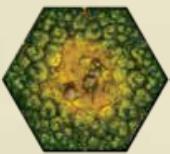

LAKE
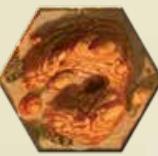
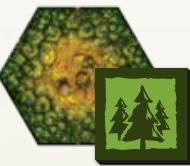
FOREST

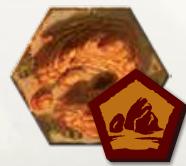
MOUNTAIN

VOLCANO

Lay the terrain tiles face up - randomly - in the configuration shown based on number of players.

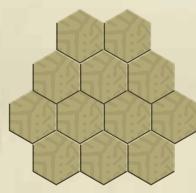
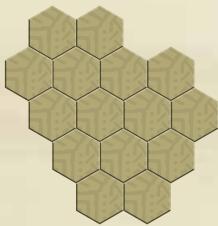
2 PLAYERS

3 PLAYERS
4 PLAYERS (

(pictured)
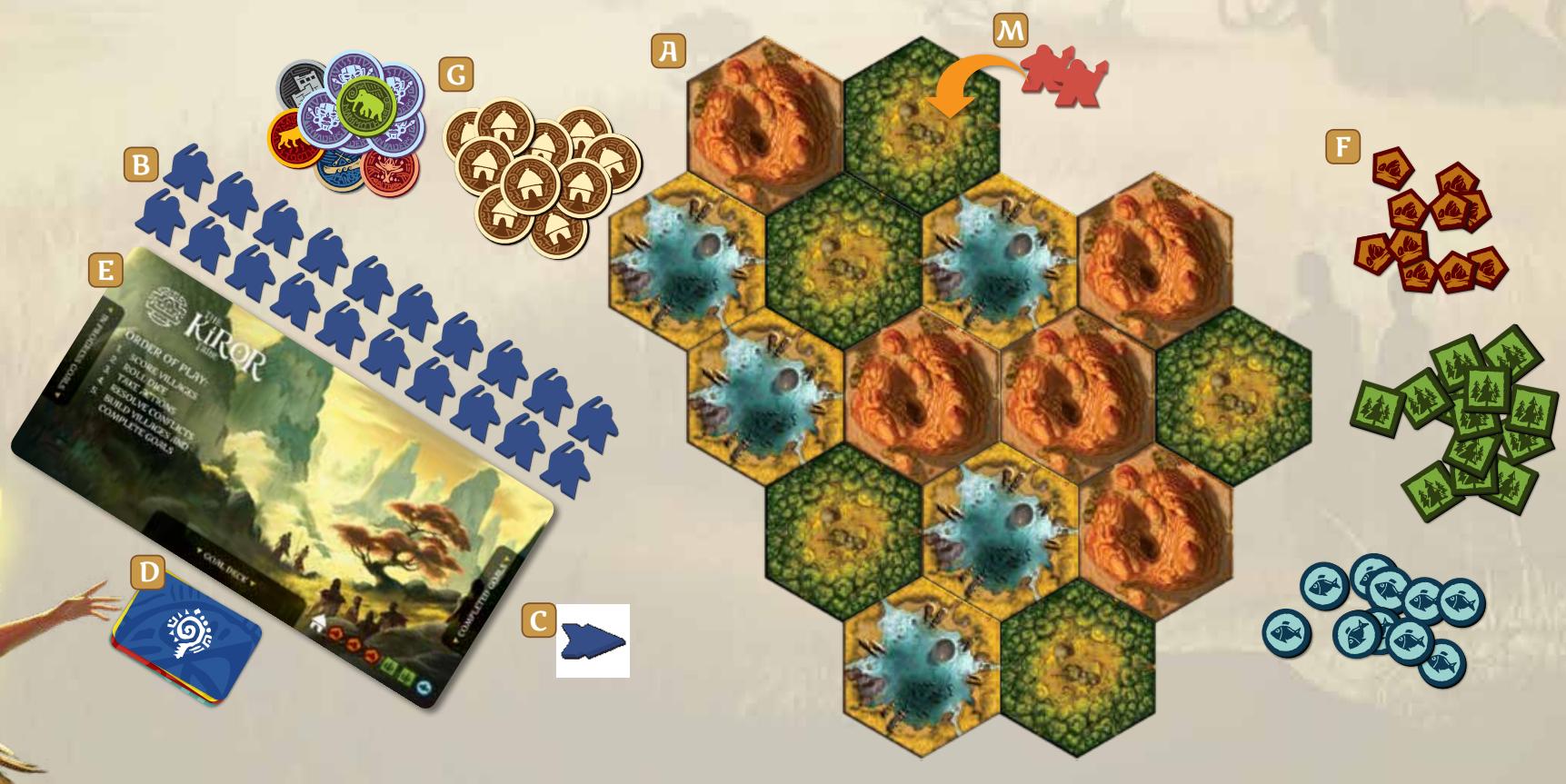
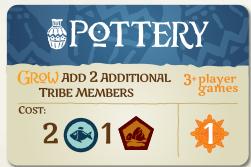
Players take 20 Tribe Members (B) and 1 Score Marker (C) in their color, as well as a deck of 15 shuffled Goal Cards D. Each of 4 complete decks has a different back design but are otherwise identical. ln a 2 player game, remove the Pottery cards.

Each player randomly chooses 1 of the 8 Player Boards E and places it in front of them. One side has an “Order of Play” reference, and the other features the tribal leader. For the basic game, each player may use either side.

Place the Resource Tokens F, and the Village and Event Tokens G nearby.



FOOD
WOOD
STONE

VILLAGE
Place the Action Board within sight of all players.
Set aside the Chieftain and Abandoned Village Event Tiles* 1 near the action board. Shuffle the remaining 14 event tiles J and place in a deck above the action board.
Place everyone's score markers on the ‘O' space on the action board.
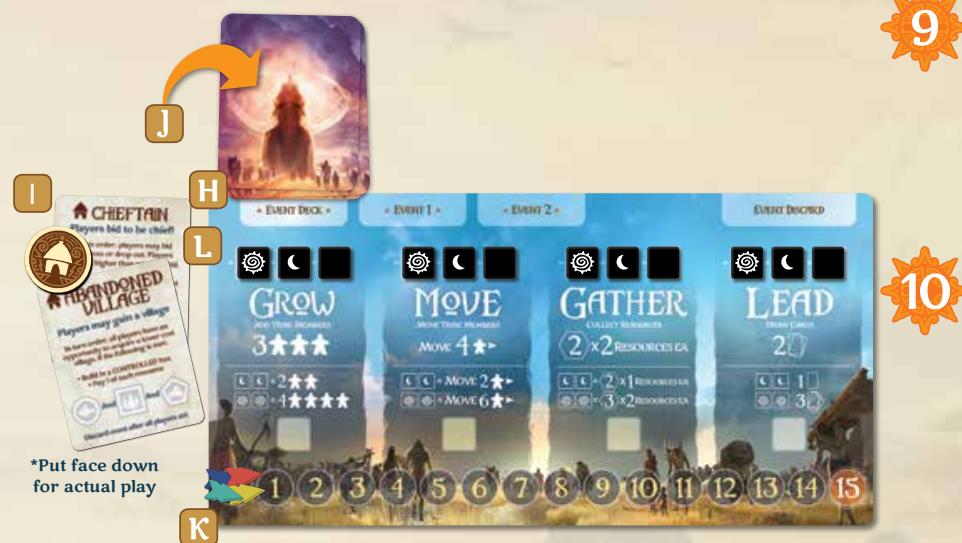
Place 3 dice as shown L on each of the 4 actions. The remaining 2 dice will be rolled on the first turn.

To determine Starting Player, players randomly select villages, each marked with a number. The lowest number goes first, and that village is placed on top of the 2 set-aside event tiles. 1 ) Return all other villages to their pile.
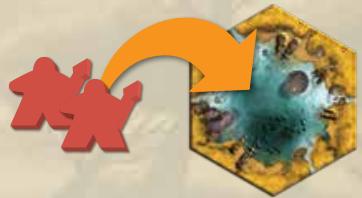

The starting player places two of their tribe members on a single hex M of their choice. The rest of the players, in clockwise order, have the following starting setup:
2nd Player: Three tribe members in 1 unoccupied hex.
3rd Player: Three tribe members in 1 unoccupied hex + collect 2 resources F of their choice.
4th Player: Three tribe members spread across 2 unoccupied adjacent hexes + collect 2 resources F of their choice.

Play begins with the starting player.

Elders, Leader Cards and special Terrain Tiles are used in Advanced Rules, detailed on pages 10-13.
ORDER OF PLAY
Each player takes their turn going through the following 5 Steps, trying to score 15 points before the other tribes. Once a player reaches 15, they win immediately!
Step 1: Score Villages
At the beginning of each turn, the player scores 1 point for every village they have. Initially, players do not have villages, but their tribe may build them through the course of the game. See Step 5: Build Villages and Complete Goals (page 7).
Step 2: Roll Dice
THE ACTIVE PLAYER ROLLS 2 DICE. lf doubles are rolled (2 suns, moons, or blanks), an event is triggered. See Events (pages 8, 14-15).
GROW
Add the number of tribe members indicated by the action board from your supply to one or more hexes that already contain your tribe members.

Example: If the action board indicates a growth of 3 tribe members, the red player here could add those 3 to any of the hexes they are in. They could split up the new incoming members between their hexes as shown.
Step 3: Take Actions
The action board depicts 4 actions that players can perform on their turn:
GROW, MOVE, GATHER and LEAD.
The player will take 2 actions on their turn, and each action must be different.
To select an action, the player places one of their rolled dice results onto the board at the top of an action's column. Each action is resolved entirely before the next die is placed.
MOVE
Move up to the number of tribe members indicated by the action board from one hex to any adjacent hex. Neither terrain nor opponent tribe members affect movement.

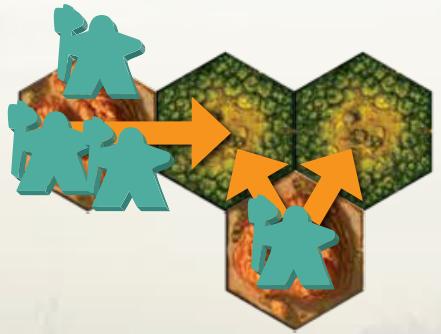
lmportant: A single tribe member can only be moved once in a turn, and has a base movement of 1 hex per move.
Add your die to the first die slot of an action, pushing all the other dice along to the right. The right-most die is then pushed down, and becomes one of the dice that will be rolled next turn. The dice result on the action now determines the power of the action chosen.

GATHER

Obtain resources from the hexes you occupy as specified on the action board. Forests produce wood, lakes produce food and mountains produce stone.

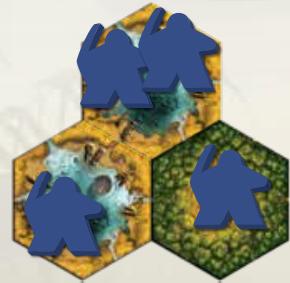
Example: If the action board indicates 2 hexes produce 2 resources each, the blue player could either choose both of the 2 lakes they occupy to produce 4 food total OR they could have a lake and the forest produce 2 food and 2 wood, respectively.
All actions have a default benefit listed directly below the action name. This is the power of the action unless a certain set of symbols are present.

2 MOONS
lf you see at least 2 moon symbols on the dice (any combination) then this is a low point for civilization! Not to worry, your tribe still claims a reward.

2 SUNS
If you see at least 2 sun symbols on the dice (any combination) then civilization is booming! You claim the highest reward for this action.
LEAD
Draw a number of goal cards as indicated on the action board from the top of your goal deck and put these “in progress” on the left side of your player board, FACE UP. Your goal deck contains Developments (blue) and Achievements (brown). More details on page 7.


Village power! You may discard as many unfulfilled goal cards as you have villages before drawing. Discarded cards are put at the bottom of your
oal deck and the same number of cards are drawn
om the top of your deck - in addition to the cards indicated by the LEAD action.
ORDER OF PLAY
Step 4: Resolve Conflicts
The population limit of each hex is 5 tribe members. Conflict occurs in every hex that has more than 5 tribe members (regardless of color) immediately after the current player has resolved both of their actions in Step 3. If there is no conflict, go to Step 5. Multiple hexes in conflict are resolved in the current player's preferred order.


Villages don't count towards the hex limit, only tribe members.
CONFLICT RESOLUTION (MULTIPLE TRIBES)
The current player is ‘offense', and the other players are ‘defense' for card purposes. Acting simultaneously, each player removes 1 of their tribe members from the hex. This repeats until no more than 1 player's tribe members remain in the hex. The result may be no tribe members, if players had matching numbers.
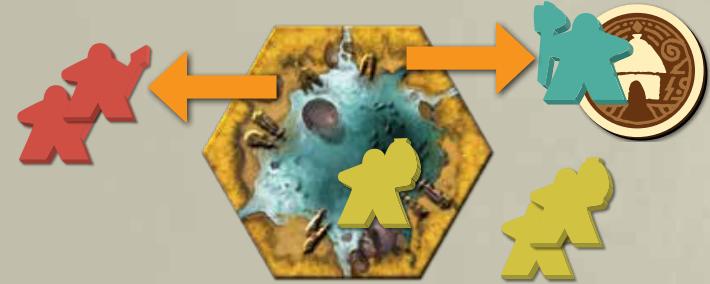
CONFLICT RESOLUTION (SINGLE TRIBE)
If conflict occurs in a hex with only 1 player's members, the conflict still occurs, and the player removes their tribe members until the population limit of 5 is reached.
DEVELOPMENTS AFFECTING CONFLICT
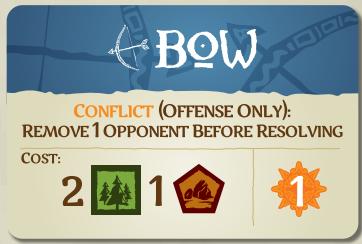
If the current player has completed the Bow development card, they remove one defending tribe member of their choice from this hex before continuing with conflict resolution.

If the defending player has acquired the Walls event tile and has a village in this hex, they remove one tribe member from the offense before continuing with conflict resolution.
If this takes the total number of tribe members down to 5 it does not stop conflict resolution. Bow development can't be used by defending players.

LOSING VILLAGES
After conflict has been resolved in a hex, if there remains a village with none of its tribe members present, the village is removed.

Step 5: Build Villages and Complete Goals
Goal cards are made up of Developments and Achievements. Players may complete any number of goals (and score for each one) during this step. Goals “in progress” are kept face up on the left side of the player's board (as shown), and then moved to the right side when completed. Once completed, points gained cannot be lost, and any abilities granted are for the rest of the game.
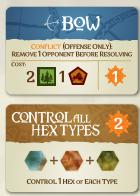


GOALS INPROGRESS
COMPLETEDGOALS
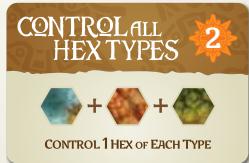
Developments cost resources and reward the player with action enhancements and a victory point.
Achievements are triggered by circumstances in the game (e.g. occupation of hexes) and reward 2-4 victory points as indicated on the card.

Players are not required to complete a goal card even if they have met the condition.

HEX CONTROL
The following goal card terms explain a player's positional status on any given hex:
Occupation: At least one of a player's tribe members is on the hex.
Majority: Player's tribe members outnumber the total tribe members from all opponents on the hex.
Control: Only the player's tribe members are present on the hex.
At the end of their turn, players may build any number of villages by spending the indicated resources on their tribe card and placing a village on a hex that contains their tribe members and no other village.

When the first village of the game is built, players take this village from the top of the set-aside events, and shuffle those 2 events into the event deck.
lf at any point a player has no tribe members in the same hex as one of their villages, the village is destroyed.
VILLAGE POWER: SCORING AND IMPROVED LEAD
Each village awards one victory point to the player at the start of their turns (Step 1: Score Villages).
In addition, when taking LEAD, a player may discard one “in progress” goal card for each village they have.
When discarding, the player returns goal cards to the bottom of their goal deck and draws that same number of cards from the top of the deck, in addition to the cards drawn due to the LEAD action.
All discarded cards must be returned to the bottom of the deck before any are drawn.
EVENTS AND GAME END
Events
lf a player rolls the same result (2 suns, 2 moons, 2 blanks) on both dice, they trigger an event.

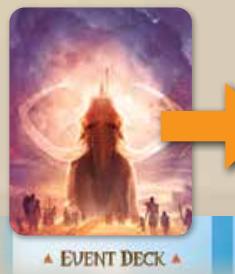
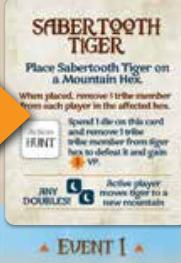
First, resolve any effects at the bottom of active event tiles that trigger off doubles. This may update or remove events from play. Some events use resources (added to or removed from the tile) to indicate when a condition is met. Then, if there is an open event spot, the player draws the top tile from the event deck and follows its instructions.
After triggering an event and following its directions, the player continues with their turn.
When completely resolved, event tiles are removed from their active slot into the event discard pile indicated.
Winning
As soon as a player has reached 15 victory points, they have immediately won the game! There are no additional turns, it's up to YOU to take your tribe to 15 points first!
Elimination
If a player is eliminated (i.e., all tribe members removed from terrain tiles), they start their next turn by placing two tribe members on a hex of their choice, unoccupied if possible.
PLAY EXAMPLE
Example of Play
Tristan and Aidan are playing a 2 player game. It's Tristan's turn and he starts by rolling a sun and a moon.
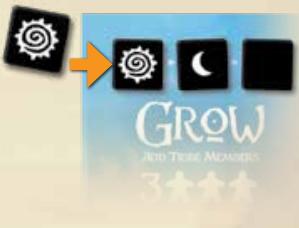
ACTION - GROW
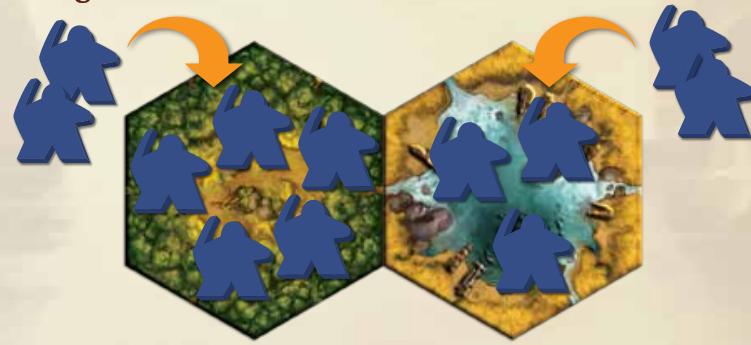
Tristan sees a chance to pull off a great action with his sun die. By adding it to GROW, he gets 2 suns for a maximum result, adding 4 tribe members to the board!
ACTION - MOVE
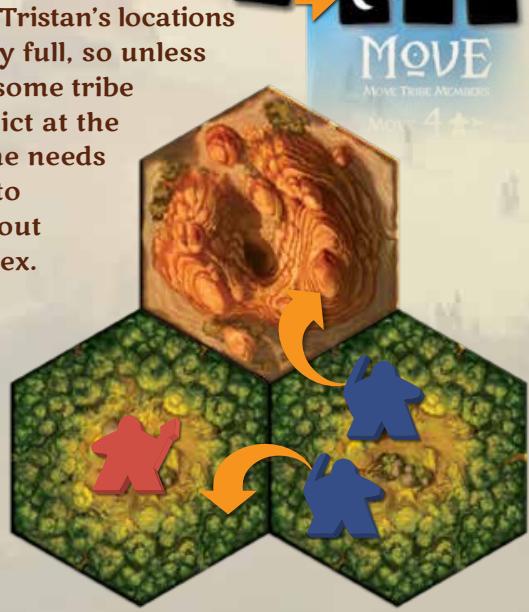
Unfortunately, all Tristan's location are already pretty full, so unless he wants to lose some tribe
members to conflict at the
end of his turn, he needs
to use his moon to
MOVE 2 of them out
of the crowded hex.
There's no conflict to resolve and Tristan doesn't complete any goals this turn.
Play passes to Aidan, who rolls a sun and a blank.
ACTION - LEAD
Aidan wants to give his tribe direction, so he slides a die onto LEAD and draws 2 cards.

ACTION - GATHER
Aidan can see that he needs more resources in order to achieve these goals, so he uses his sun to gather the 6 resources he needs.
Aidan now has enough resources to complete both of his goal cards and score 2 points!
Tristan starts his turn, determined
to catch up
and rolls
double blanks,
activating an
event! The
Sabertooth
Tiger event
comes out,
and Aidan
looks nervous for his mountain village.
lt's still anyone's game!

ADVANCED PLAY
Once you’ve played Rise of Tribes a few times, you can choose to expand the game with several advanced modes:
TRIBAL ELDERS: A special tribe member goes on the board giving you a new power.
SPECIAL TERRAIN: New types of tiles are added to the map. LEADER POWERS: Each tribe gains unique abilities that can add new elements to the game.
You can mix and match these modes as you choose: playing with one, two, or all three in a single game!
Tribal Elders
ACTIVATION:
Players may choose to bring out their Elder when they build a village. The elder is placed on the newly built village and that player can now use the elder's effect. The elder doesn't add to the hex's population count, or affect conflict.

EFFECT:
Once per turn, you have the ability to give a resource to a player and then use the ability of any single development which that player has completed.
RISK:
If the village holding the elder is destroyed by an opponent, the attacking player gains 1 point, the elder is removed, and you can no longer use its effect. However, the elder can be put back in play with the next village built.
Special Terrain
Special terrain tiles can be swapped with the basic terrain tiles during set up to add bonuses, difficult terrain and hazards to the game. Choose 1 or mix and match several special terrain tiles to change things up or create a scenario to play.
Special terrains still count as the basic land types they were swapped with for the purposes of goals, events, and types of resources produced.
GREAT LAKE, MOUNTAIN AND FOREST

SWAP WITH/COUNTS AS: lake, mountain and forest tiles, respectively.
SPEClAL: The great lands produce an extra resource of their type during GATHER.
WILD LAND
SWAP WITH: Any basic terrain tile.
COUNTS AS: All basic terrain tiles.

SPECIAL: When collecting resources from the wild land, players can choose any mix of resources. lt cannot be triggered multiple times during a single GATHER action.
JUNGLE AND DESERT OASIS
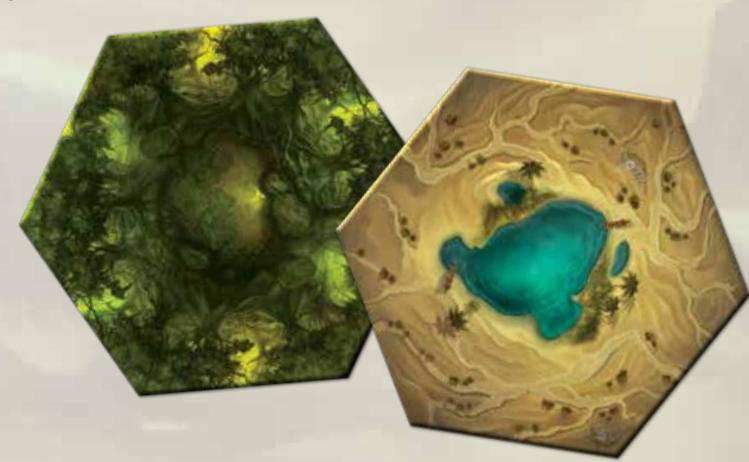
SWAP WITH/COUNTS AS: Any forest tile (Jungle), and any lake tile (Desert Oasis).
SPEClAL: On these terrains, the active player must have 3 tribe members there before they can GATHER from this tile. Once that requirement is met, the tiles produce the normal amount according to GATHER.
TAR PIT
SWAP WITH/COUNTS AS: Any lake tile.
SPECIAL: If any tribe has only 1 member on this hex after the conflict phase, that tribe member is removed (lost in the tar!). Each tribe is checked individually for this condition.
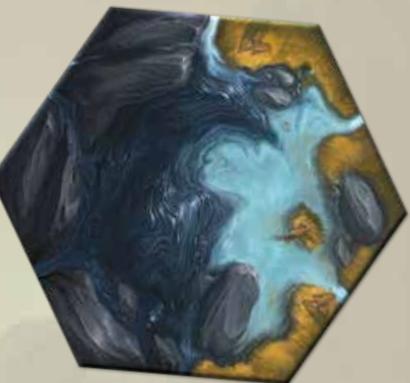
GLACIER
SET UP: The first player places the glacier tile OVER one of the mountain tiles. lt still counts as a mountain for events, gathering and goals.

SPECIAL: The glacier tile has a population limit of 3, can't contain a village, and produces a maximum of 1 stone during GATHER (even with developments).
Each time a player takes the maximum benefit from an action (SUN SUN), place a stone resource on the glacier. Immediately after the 5th resource is placed, the glacier melts and is removed. The 5 stone resources are available to the next player who GATHERs from the mountain below.
ADVANCED PLAY - LEADER POWERS
Leader Powers
After you have mastered the base game, you can try this Leader Powers variant. Flip over the player board to reveal your leader, and then choose one of the two powers on your tribe's unique Leader Card.
Slide the tribe logo portion of the leader card under the matching logo at the top of your player board.
CUNNiNG
Once per turn, you may pay 1 resource to trigger conflict in a hex you occupy during the Conflict Step when it wouldn't otherwise occur.

Choose and reveal your power when you place your starting tribe members.
DABA
The Daba are at the forefront of innovation, discovering more efficient ways to grow and use their resources.
TRADER Trading ‘at any time' includes during event resolution.
CRAFTY BUILDERS TIP: Look to see if you can build a village on turn 1!
INDARTSU
Finding strength in numbers the Indartsu focus on expanding their tribe and thriving in this new land.
FARMING Adding the additional tribe member is optional, if you wish to avoid creating conflict.
EXOGAMY
This only applies to normal tribe
members - not invaders, elders, mammoths, etc.
THE DANÃNU HE
A skilled and organized people, the Danãnu are adept at timing their efforts for maximum gain.
CUNNING This is once on your turn. Pay the resource to the main supply.
AGRICULTURE TIP: Your tribe needs 4 Food for a village, but that starts to become easier as you build more villages!
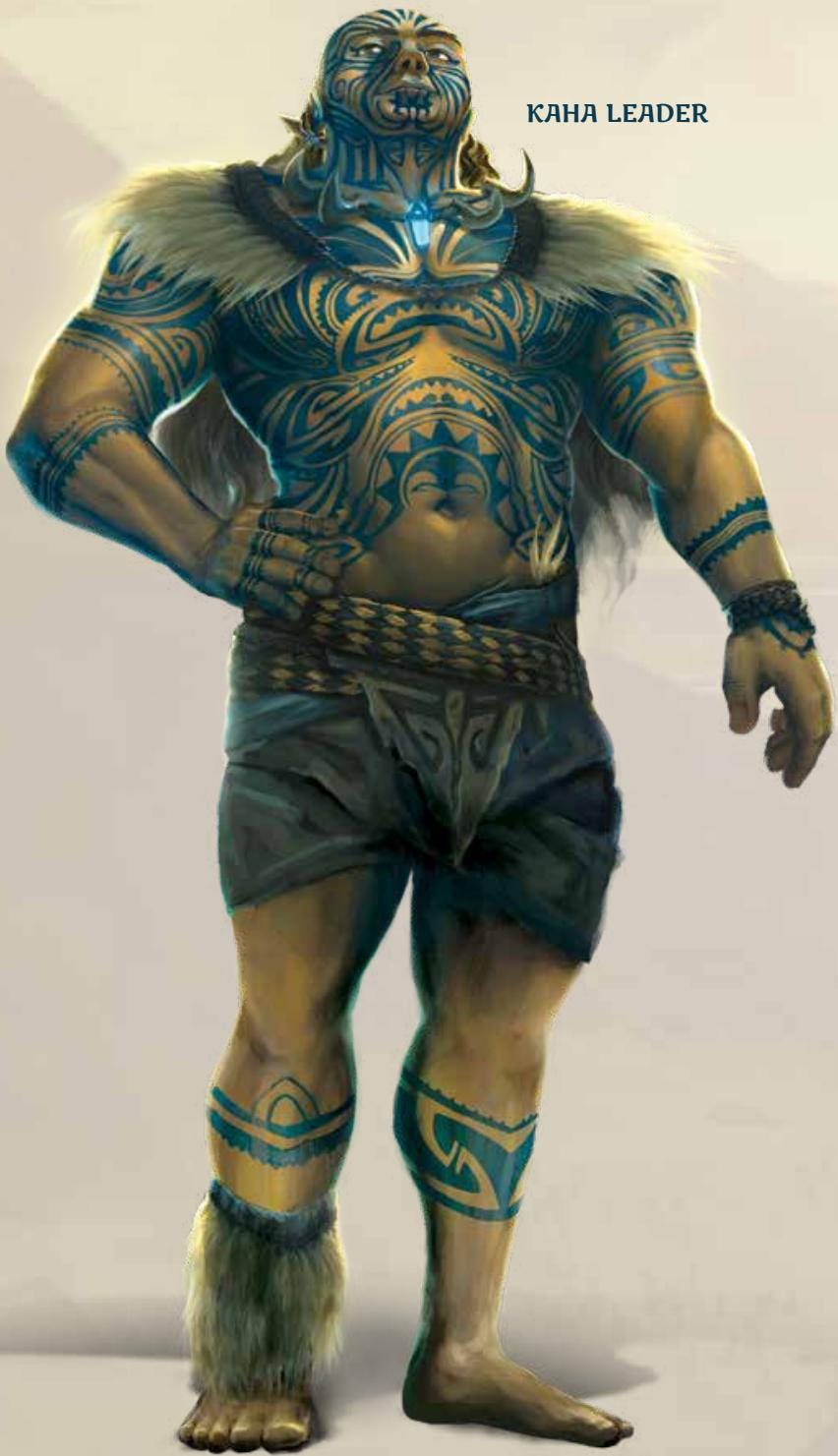
KAHA THE TRÍBE
Working together with ease, the Kaha can accomplish great feats as they travel far and wide.
WAYFARERS
TIP: Perform your normal move in full before or after this special action for ease of handling both movements.
FOCUSED EFFORT
This bonus resource is gained
from EVERY hex you select for
GATHER that contains 4 or more of your tribe members.
THE 三⑥三 KiA-KiA TRÍBE
The Kia-Kia are able to use their tactical knowledge of the land to surprise and overwhelm their foes.
AMBUSH
You may mix and match the tribe members added in a GROW between your player board and the terrain hexes. You cannot complete the Build Entire Tribe achievement with any members on your player board.
DREAMTIME TIP: Try to remember before you roll. Once you roll, you cannot use this ability.
MU'K'A'AN TRIBE
The Mu'k’a’an are a sociable tribe and they are at their best (and worst) when sharing land with other tribes.
SHARED BOUNTY
The resource you produce does
NOT have to be of the type that your
opponent gathered, just a type you can produce among your hexes.
INTIMIDATE Pay the resource to the main supply.
THE KiROR
The Kiror are experts at taking the lay of the land, and can move their tribe around with deftness and skill.
PATHFINDER
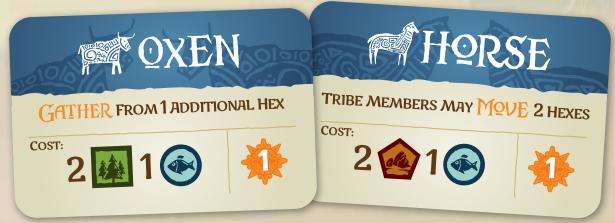
EXAMPLE: If you have tribe members on a mountain hex, and there is an adjacent mountain hex, moving to the lake on the other side of that second mountain is possible for you as a single move. A Horse development or Dugout Canoe event enhances your movement further.
EVASION
Conflict is first resolved as normal. Defeated tribe members are the ones in question that can move instead of being removed.
TUNGA THE
An independent and fearless people, the Tunga know how to make the best of any situation.
HIDDEN VILLAGE
Your elder token cannot be placed on your hidden village. lf you lose your 1st village before you build the hidden village, you need to build a village on the main board again before building your hidden village.
LIGHT IN THE DARK Changing the dice can create or eliminate event triggering “doubles”.
CARD CLARIFICATIONS
Events Explained
DISCOVERY
DROUGHT Population limit 4
The population limit of each Hex is now 4 Tribe Members.

The player can take any resource after entering a hex containing only opponents, not just the type corresponding to that hex.
iNVADERS Add Invaders to Board
This event doesn't trigger until the Conflict Step of the turn it was drawn. While the card is active, conflicts will trigger in hexes over 4 tribe members. Doubles rolled discards this event and triggers another event.
Put 3 Invader Tolkens on the least populated Hex (Active Player
MILD WINTER Stack Food on this card (Equal to the
Players can draw extra resources for EACH TILE of that type they GATHER from.
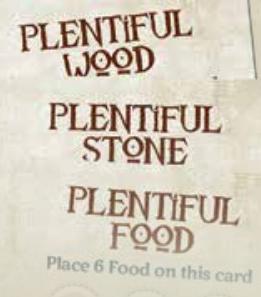
Example: If Plentiful Wood is active and a player gathers from 2 different forest hexes, they would take 4 wood from the card, in addition to the normal GATHER.
SHARED KNOWLEDGE Share a Hex with Opponent(s)
When placing Invaders, empty hexes may count as the least populated hex, with the active player breaking any ties.
A food marker is removed from the card whenever a player takes the GROW action, whether or not they grow the additional tribe members.
Players can only pay a resource to get a goal card once per turn. They may complete the goal card during the same turn it was drawn.

When placing the mammoth, empty hexes may count as the least populated hex, with the active player breaking any ties.
RULES FOR A TAMED MAMMOTH:
As a free action, The mammoth tamer player may move the mammoth to any other hex they occupy when they take the MOVE action.
If the mammoth is ever in a hex where there are no mammoth tamer tribe members (either through conflict or movement), the mammoth is discarded and the mammoth tamer loses 3 VP.

The active player who rolled the doubles chooses which hex the sabertooth tiger moves to. The tiger must move to a new hex and trigger its effect when doubles are rolled. The sabertooth only affects normal tribe members. lt may not target an elder or invaders.
VOLCANO Add Volcano outer Board touching 2 other Hex sides ar
The volcano hex is only placed once - on its first time drawn. lt also erupts this first placement according to the doubles rolled. After that, the event tile is shuffled in the event deck and further draws just cause an eruption based on the doubles rolled.
The initial volcano placement must be touching a hex containing the active player if possible.
If it helps to remember that the adjacent hexes to the volcano produce either their original resource OR stone during a GATHER, add a stone resource to the border of the volcano adjacent tiles.
WALLS ALTAR DUGOUT Pay 3 Wood to acquire
As long as one of these event tiles has not been purchased, a player rolling doubles places the appropriate resource marker on the tile and the cost is thus reduced by 1 resource. Once the cost reaches 0, discard the event tile.
These may be purchased and used at any time during the active player's turn. After purchase, the corresponding token is placed on the active player's board.
WALLS:

All villages controlled by the player with this token have this ability.

CANOE:
Using the canoe still requires a MOVE action to move into or through a lake.
ALTAR:
The cost is 1 tribe member AND resources - either 4 resources of 1 type, or 3 resources - 1 of each type.
The Abandoned Village and Chieftain events are only added to the event deck once the first village is built.

DESIGN: Brad Brooks
DEVELOPMENT: Peter Vaughan
PRODUCTION: Shari Spiro / AdMagic / Breaking Games ARTWORK & ILLUSTRATIONS: Sergio Chaves
GRAPHIC DESIGN, TYPOGRAPHY, LOGOS & ICONOGRAPHY Marshall Gill, Wes Straub, Peter Vaughan
3D MODELING: Chris Strain
PROTOTYPING: Print and Play
LEAD PLAY-TESTERS: Norv Brooks, Astrid Dalmady
ADDITIONAL PLAY-TESTING: First Play L.A.
SPECIAL THANKS: Squirmy Beast lnc., The League of Gamemakers, and all of our supportive and wonderful backers on Kickstarter who made this game possible.
RISE OF TRIBES ONLINE: www.riseoftribes.com TWITTER AND INSTAGRAM: @breaking_games RISE OF TRIBES FACEBOOK GROUP: www.facebook.com/groups/riseoftribes BREAKING GAMES: www.breakinggames.com
16 Event Tiles
60 Goal Cards (Deck of 15 per Player)
80 Tribe Member Meeples (4 Player Colors/Shapes)
4 Arrowhead Score Markers (4 Player Colors)
14 Custom Rise of Tribes Dice
8 Player Boards (2 Sided)
1 Action Board
96 Resource Tokens (Wood, Food, Stone)
12 Village Tokens
11 Event Tokens (5 Invaders, 6 Others)
1 Resource Multiplier Token
ADVANCED GAME
8 Scenario Terrain Tiles
4 Tribal Elder Meeples (4 Player Colors)
8 Leader Cards (2 Sided)
Breaking Games R
Deluxe Upgrade pieces available. For More lnformation about Rise of Tribes visit BreakingGames.com
© Breaking Games. All Rights Reserved. Made in China by AdMagic.
Breaking Games LLC - 125 Main Street, Netcong, NJ, USA 07857
Download MarkdownTexts are community-compiled or publicly released by publishers; copyright remains with the original authors. For personal reference only.