
Rococo
At a glance
Rules, cards and Q&A (Chinese)
The rules, card data and player questions for this game are written in Chinese. Open the Chinese page to read them.
Where to find full rules
Full rules and card lookup are available in the cunlema app at cunlema.cn — pick this game and ask about any rule, card or turn you are unsure about.
Related games
Rulebook text (Markdown)
This game has 2 rulebook Markdown file(s) in our library; 2 rendered inline below — expand to read or download.
rules_zh_洛可可_1050.md36.2 KB
Matthias Cramer,
Louis Malz,
Stefan Malz
Kococo
for 2 to 5 players, aged 12 and up
欢迎来到洛可可时代。路易十五统治着法国,举办奢华舞会成为了时下高雅与时髦的象征。各界名流锦衣华服,不落人后。最为盛大的宴会将在几周后举行,所有人都希望你可以满足他们的需求:制作一件优雅的大衣,设计一条华美的长裙,又或是为烟火表演募捐资金。很快你就意识到这不仅仅是关于你的裁制生意——而是关于筹划这个时代里最富盛名的一场舞会。现在,尽情享乐吧,it's time to roc(k)!
游戏目标
在洛可可中,你经营着服装裁制的生意并且渴望提高自己的声望。在每个回合中,你打出一张雇员卡并且让他执行一个工作任务:招募一个新的雇员,制作一件衣服,或是出资装饰舞会。尽管如此,并不是每一个雇员都能胜任所有工作,所以你需要明智的选择并且领导他们。值得一提的是,每个雇员都会授予你独特的奖励。有些雇员甚至会给你带来额外的声望点数(以获得声望标记的形式体现)。
游戏在进行7轮之后结束,舞会顺利举行并且计算玩家们的最终得分。你从如下几处得到声望点数:特定的雇员奖励,租借给宾客们的衣服以及你出资完成的舞会装饰。
最后,所有玩家计算他们得到的总声望点数,声望最高的玩家获得游戏的胜利。

游戏配件
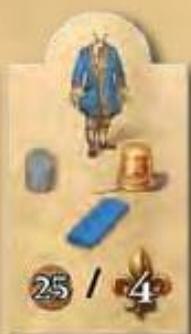
42个双面服装板块,一面代表图纸,另一面代表租借。
图纸面细节介绍:
- 服装的主色调
- 制作服装所需的材料
- 服装的价值(6-28里弗)
- 服装的声望点数 (2-4)

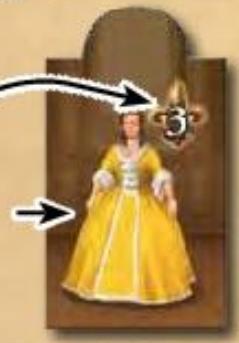
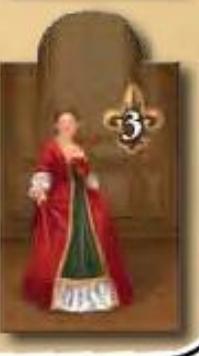
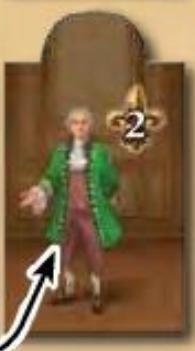
租借面细节介绍:


- 服装的声望点数 (2-4)
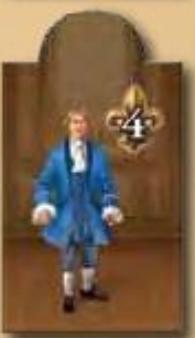
- 身着黄色或红色长裙的女士 又或是 身着绿色或蓝色大衣的男士
注释:
→ 当提到词语“服装”时,它是女士长裙和男士大衣的统称。
→ 尽管有些服装上有第二种颜色,每件服装只有1个主色调(罩裙的颜色或是短上衣的颜色)。
→ 服装颜色与玩家颜色无关。
→ 黄色长裙和绿色大衣较为常见(每种颜色13块),红色长裙(10块)和蓝色大衣(6块)则较为罕见。
雇员属性
等级(1到6)
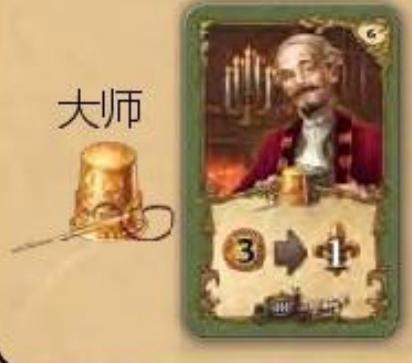
指派雇员可得到的金币
(大师,熟手,学徒)

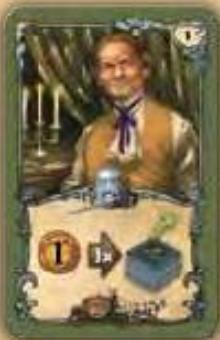
雇员奖励
28张雇员卡
1张双面游戏版图

(1面供2至3位玩家进行游戏,1面供4至5位玩家进行游戏)
1个起始玩家标记


16个木制蕾丝标记

16个木制丝线标记


1个布制口袋

48枚钱币

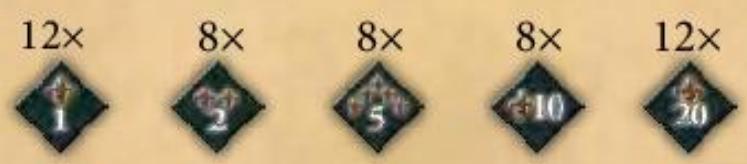
48个声望点数标记
12×
12×
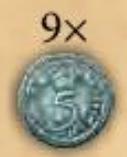
(里弗,古时的法国货币单位)
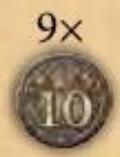
9×


(每种颜色5张,卡牌的右上角标注了对应颜色)
1张恩赐卡

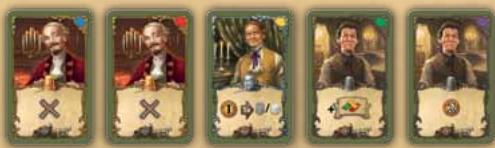
25张基础雇员卡
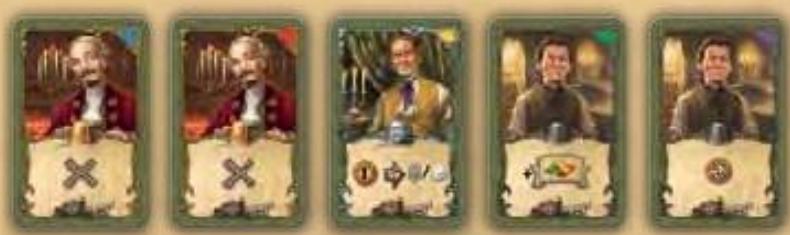
1张“最终计分”概览卡
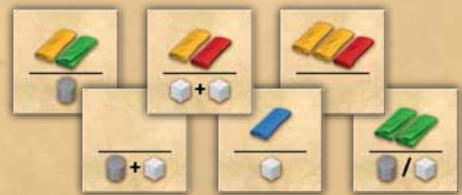
48个资源板块,每一块由如下元素组成:
- 绿色绸缎(常见)
- 黄色绸缎(常见)
- 红色绸缎(不常见)
·丝线
- 蓝色绸缎 (罕见)
·蕾丝

80个木制玩家标记(每种颜色16个)
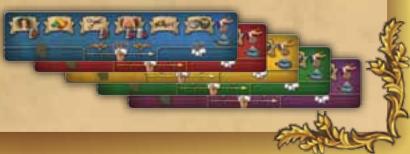
5张玩家游戏板(每种颜色1张)


游戏设置
在首次游戏之前,小心的将游戏配件从材料板上取下来。
- 将游戏版图置于桌面中央,对应玩家人数的那一面朝上。
版图的右下角标注了对应玩家人数:
2-3位玩家
- 将恩赐卡放置在版图上的对应区域旁
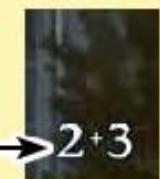

4-5位玩家
- 将28张雇员卡按照等级顺序分类(1到6)。
将六张“等级6”的卡牌洗混,正面朝下形成牌堆放置在版图的左侧
接下来,将四张“等级5”的卡牌洗混,正面朝下放在牌堆的上层。
2+3

以此类推,放置等级4,3,2的卡牌,最后将洗混的“等级1”卡牌放在牌堆的最上层。
这个牌堆被称为“公共雇员牌堆”
- 洗混所有的资源板块,将它们正面朝下分成若干公共堆,放置在版图上仓库区域的旁边。
4+5
“宾客如云”
奖励
- 最后,随机决定一个起始玩家,他获得起始玩家标记。

- 给予每个玩家起始资产,放置在玩家游戏板的旁边:
• 15 里弗


- 1个蕾丝标记

- 1个丝线标记
-
将丝线标记和蕾丝标记整理好放在版图旁边形成公共区
-
将钱币放置在版图旁边,形成银行。
将声望点数标记放在银行旁边。
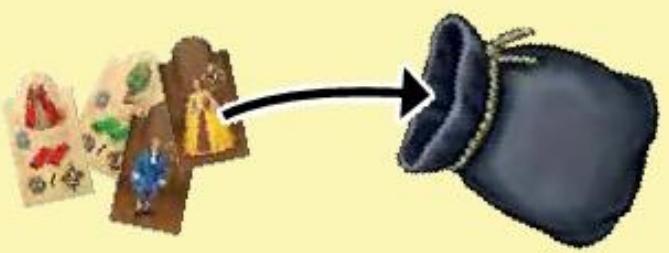
- 将所有服装板块放进布袋中并将它们洗混。接着将布袋放置在版图旁边。
注释:
- 每位玩家选择一种颜色并且获得对应的配件:
→ 玩家标记,丝线标记,蕾丝标记,钱币以及声望点数标记视作无限。如果其中任何一种标记在游戏过程中被耗尽,请用一些其他的物品替代表示。
在任何时候,当你获得声望点数时,从公共区拿取相应数目的标记,正面朝下放置在你面前。直到游戏结束时你的声望点数都是不公开的。
→ 你的钱币是公开的。
• 1张玩家游戏板
• 5张基础雇员卡,将它们正面朝下放置在玩家游戏板的左下方。
·16↑玩家标记


在游戏开始时,每位玩家的基础雇员卡正面朝下放置在他的“雇员补充区”(位于玩家游戏板的左下方)。在每一轮开始时,玩家从雇员补充区中抓取手牌。一旦玩家打出一张手牌,这张牌立即正面朝上进入“弃牌堆”(位于玩家游戏板的右下方)。玩家的雇员补充区,手牌和弃牌堆共同组成玩家的“雇员牌库”。
洛可可将会进行7轮。
游戏流程
每轮包含4个阶段。
7轮之后(即公共雇员牌堆耗尽时),游戏结束并且进行最终计分。
阶段1:准备新的一轮
阶段2:选取三张手牌
阶段3:执行主要行动
阶段4:获得相应收入
阶段1:准备新的一轮
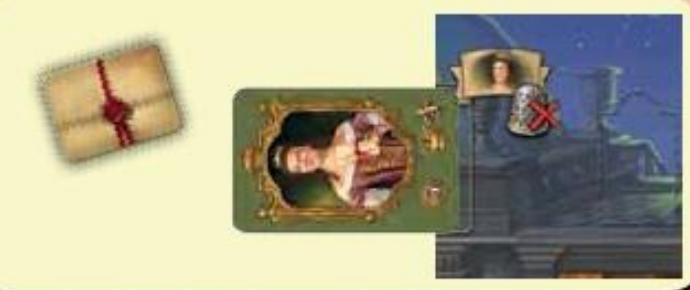
(A) 恩赐卡 > 起始玩家 (第一轮忽略此行动)
如果一个玩家在上一轮里获得了恩赐卡,他获得起始玩家标记并且将恩赐卡放回版图旁的相应位置。(如果在上一轮里没有玩家获得恩赐卡,那么起始玩家不变。)
(3) 4张新的雇员卡
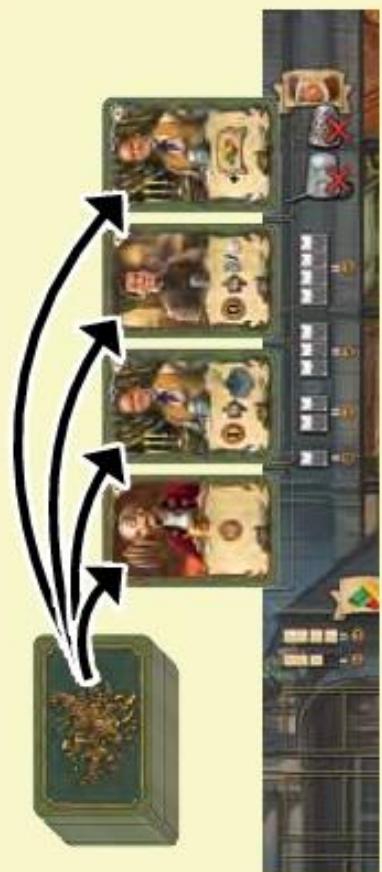
-
如果在游戏版图的招募区域旁边,有上一轮遗留下来的若干正面朝上的雇员卡,首先从游戏中移除这些卡牌。
-
接着从公共雇员牌堆里翻出4张新的雇员卡,正面朝上放置在游戏版图的招募区域旁。
注释:在第1-6轮中,翻出卡牌右上角显示的最高的等级数字代表了当前是第几轮。
在第7轮中,当翻出4张新的雇员卡后,公共雇员牌堆将被清空。
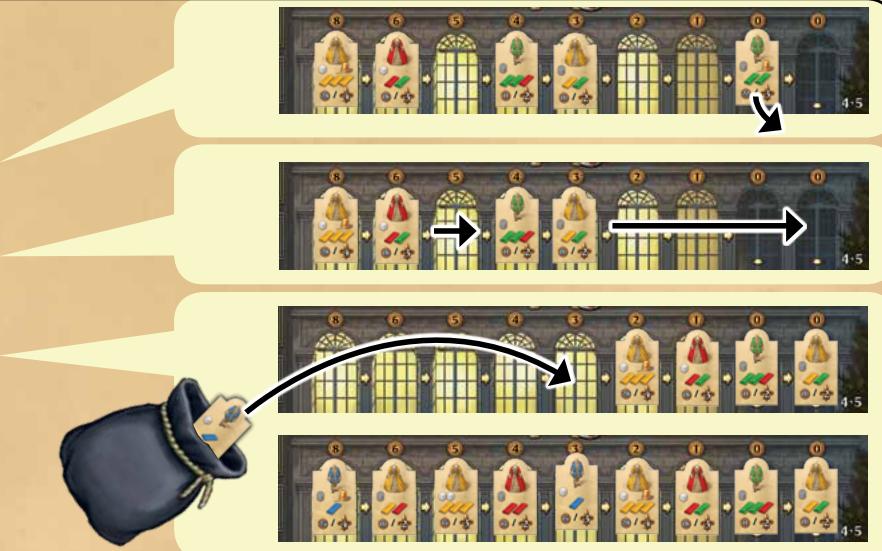
( D )新的服装板块
遵循如下规则,向版图上画有窗户的区域(即工坊区域)填补服装板块:
-
如果在最右边的两个窗户区域(颜色较深并且以①标注),有前一轮遗留下来的服装板块,先将它们弃至弃牌堆。
-
如果在其他的窗户区域,有遗留的任意数量的服装板块,将它们一齐向右边移动,直到最右边对应数量的窗户区域被填满。
-
最后,从布袋里随机拿取新的服装板块,填补剩下的空的窗户区域。确保所有弃掉的服装板块图纸面朝上。
如果布袋是空的,那么将所有弃掉的服装板块放进布袋里并且洗混。(如果此时布袋里的服装板块仍然无法填满所有的窗户区域,那么这些空缺的区域保持空缺状态。)
阶段2:选择三张手牌
每位玩家同时秘密的从自己的雇员补充区的所有卡牌里选择3张雇员牌(玩家游戏板左下方正面朝下的牌堆)。
将选取的3张卡牌作为手牌,接着将雇员补充区中剩下的牌正面朝下放回原位。
从第二轮开始,考虑如下情况:
如果你的雇员补充区中剩下不到3张牌,首先将剩下的所有卡牌作为手牌。接着,将你的整个弃牌堆(玩家游戏板右下方正面朝上的牌堆)移至左边,正面朝下放置形成新的雇员补充区。最后,从新的雇员补充区里挑选适量的卡牌,从而将你的手牌补充至3张。
如果你的雇员补充区里刚好剩下3张牌,直接将他们作为手牌。
重要:在这种情况下,不使用弃牌堆形成新的雇员补充区。在下一轮的阶段2里再执行此行动。
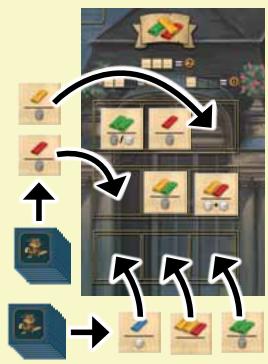
C) 新的资源板块
从任意资源板块公共堆里随机抽取板块,然后填补游戏版图上3层仓库的空缺位置,正面朝上放置。
如果仓库里有前一轮遗留下来的资源板块,它们继续留在原位。
如果所有的板块公共堆都耗尽了,那么将游戏中弃掉的资源板块洗混,正面朝下形成新的公共堆。(如果这些新的公共堆仍然无法填补仓库的空缺位置,那么这些位置保持空缺状态。)


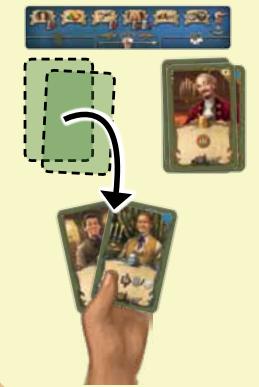
案例(第二轮开始):
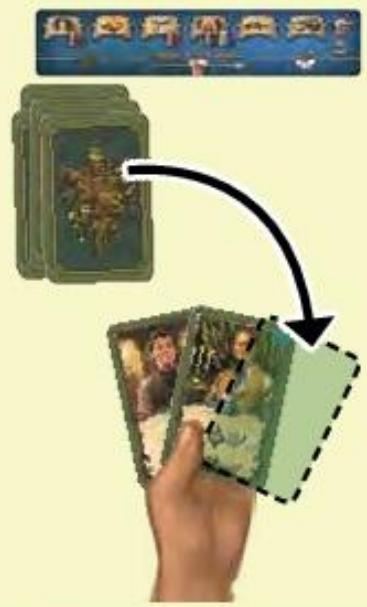
麦克必须从雇员补充区里选取3张手牌。
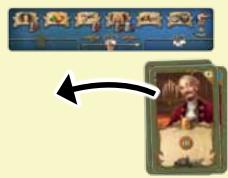
由于他的雇员补充区里只剩下2张牌,他必须选取他们作为手接下来他将自己的弃牌堆整个翻面,形成新的雇员补充区,放在玩家游戏板的左下方。
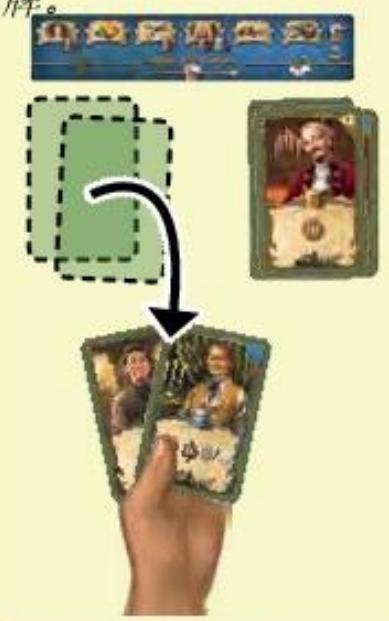

然后他可以从新的雇员补充区里挑选任意一张牌作为他的第三张手牌。
阶段3:执行主要行动
从起始玩家开始,按顺时针顺序,每位玩家在本回合中必须打出1张手牌(只要他有手牌就必须打出)。
根据打出的卡牌,玩家可以执行1个主要行动。此外,打出的卡牌可能会带来额外奖励。
当所有玩家都没有手牌时,此阶段结束。
玩家在本回合可以执行的主要行动(共6种),取决于玩家打出的卡牌上的雇员属性:
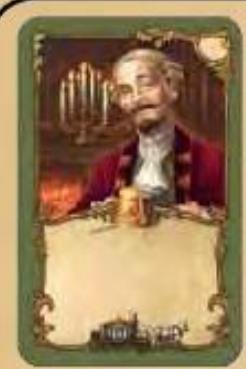
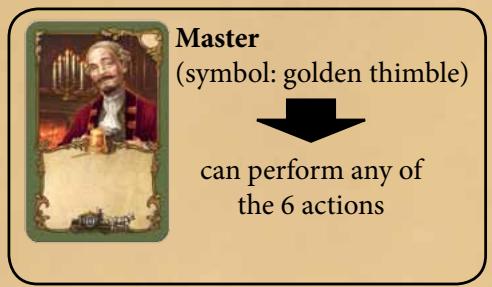
大师
(符号:金制顶针)

可以执行6个主要行动中的任意一个

熟手
(符号:银制顶针)

无法执行“招募雇员”行动
当(且仅当)你执行了你的主要行动以后,你可以按照打出的雇员卡下半部分的描述执行雇员奖励。当然,你可以选择不执行主要行动和/或奖励。
在你的当前回合结束的时候,将打出的雇员卡正面朝上置于弃牌堆(玩家游戏面板右下方)。
接着轮到下一个玩家行动。


学徒
(符号:黄铜顶针)

无法执行- “皇后恩赐” 行动
- “制作服装” 行动
- 招募雇员”行动
注释:
→基础雇员卡中的“大师”没有奖励。
→ “等级6”的“学徒”卡牌上有皇冠标记并且以红色为背景。
你无法在游戏过程中使用这些卡牌上显示的奖励。这些奖励只在最终计分时有效。
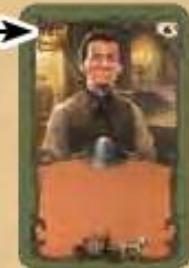
对于所有奖励的详细解释,请参考第8页。
6种主要行动分别是:

1. 皇后恩赐 (可通过大师或熟手执行)
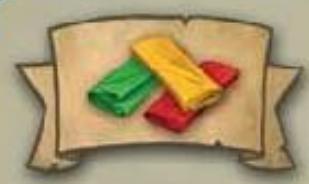
如果恩赐卡仍然在游戏版图上恩赐区域的旁边,拿取它并且放置在你面前。接着立刻从银行获得5里弗。
2. 获取资源
(可以通过大师,熟手或学徒执行)
你可以从3层仓库区域的任意一层获得1个资源板块。这样做的话,你需要根据当前楼层里的板块数量支付相应的钱币。
同时,你成为下一轮的起始玩家。(这个行动在每轮内只能被1位玩家执行,不管这位玩家是否是当前的起始玩家。)
- 如果在这一层里有3到4个板块,支付2里弗到银行。
- 如果在这一层里有2个板块,支付1里弗到银行。
- 如果这一层里只有1个板块,那么你免费得到它。
在你购买资源板块以后,你必须立即决定:
a) 将这个板块正面朝下放置在你面前(允许你使用板块上描绘的绸缎)
在游戏结束时,如果你拥有恩赐卡,你获得3点声望点数。
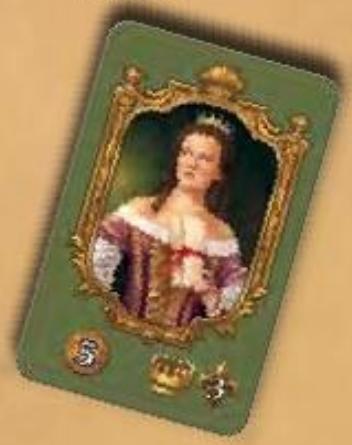
b) 将这个板块正面朝上弃置弃牌堆,从公共区获得对应数量的丝线标记或蕾丝标志。(标注在板块的分隔线下方)
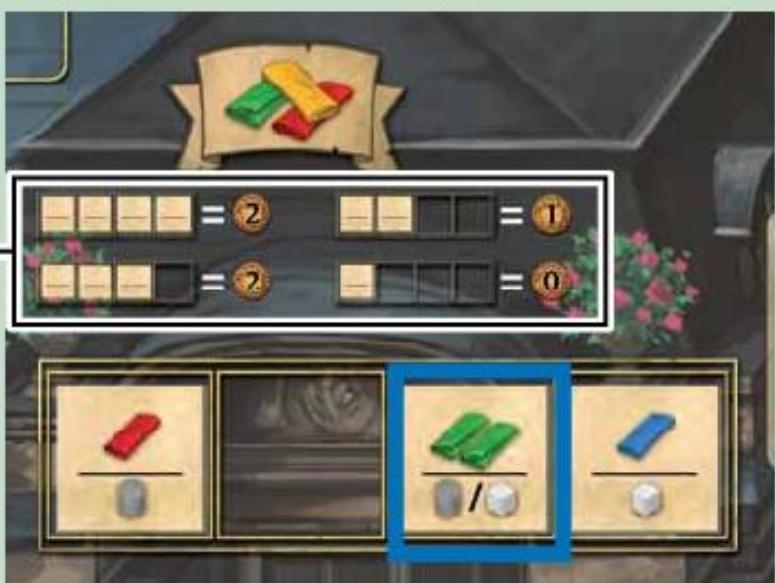

注释:板块上描绘的资源标记之间的“+”号代表你可以同时获得这些资源,“/”代表你可以选择其中的一个。
→ 资源板块正面朝下整理好放在你的面前。但是,当有玩家提出要求时,你必须声明你所拥有的板块数量。
→ 玩家的丝线标记和蕾丝标记必须保持公开。
→ 如果在仓库区域没有剩下任何资源板块,那么你无法执行“获取资源”行动。
案例:
麦克打出一张学徒卡牌并且想要获得仓库中绘有2匹绿色绸缎的资源板块。因为在这层仓库中仍然有3个板块,他支付2里弗到银行,接着他获得这个板块。
现在他必须决定:
a) 将这个板块正面朝下放在他面前(允许他使用板块上的2匹绿色绸缎)或者
b) 弃掉这个板块,从公共区获得1个丝线标记或是1个蕾丝标记。
他决定留着绸缎使用,于是将这个资源板块正面朝下放在了自己的面前。

3. 制作服装 (可以通过大师或熟手执行)
你可以制作展示在工坊区域中的一件服装。制作时,首先向银行支付服装板块上方显示的钱币(1到8里弗)。接着,支付服装板块上标注的相应数目的材料:
相应颜色的绸缎+丝线/蕾丝。
你可以消耗多个资源板块从而支付所需的材料。这些板块上的绸缎会被立刻消耗。即便其中有些绸缎并不是制作服装所需的,它们也会被消耗。
将消耗的资源板块正面向上弃至弃牌堆。
有一些服装板块上标注有金制顶针的图案。只有大师能制作这些服装。
重要:玩家面前正面朝下摆放的资源板块只能作为绸缎使用。支付制作需求的丝线或者蕾丝必须将相应的木制标记弃至公共区。
案例:
为了制作黄色长裙,麦克打出一张大师卡牌(因为金制顶针表明这件服装只能由大师制作)。
首先他支付4里弗到银行。
接着他消耗1个蕾丝标记和3匹绸缎(红色绸缎被浪费)。

在你支付了相应的钱币和资源之后,从工坊区域拿取这个服装板块,然后立即决定:
a) 将这件服装租借给舞会中的宾客
或是
b) 出售这件服装
a) 将这件服装租借给舞会中的宾客:
将这个服装板块翻到租借面,放置在游戏版图上5个大厅里任意1个大厅中的空缺宾客区域(不可以放在露台的虚线区域中)。
每个大厅中央有两个装饰精致的宾客区域,这些是“大师宾客区”。只有当你的服装是由大师制作的时候(服装板块的图纸面有相应的金制顶针),你才能把服装板块放在这些区域里。
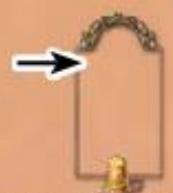
当你放置了服装板块以后,将你的1个玩家标记放置在这个服装板块的上方。在游戏结束时你可以获得该服装板块上所标注的声望点数。

如果宾客区域(你所放置板块的那个区域)上注有额外奖励,
你立即获得这些奖励:


从银行获得相应数量的里弗。
从公共区获得1个丝线标记。


从公共区获得1个蕾丝标记。
如果可能的话,从仓库的任意一层里免费获得1个资源板块。你必须立即决定保留这个板块用作绸缎,或是弃除从而获得相应的丝线或蕾丝。
b) 出售这件服装
根据服装板块左下角显示的数字,立即从银行立即获得对应数量的里弗。然后弃掉这个服装板块。

→ 如果工坊里已经没有剩余的服装板块,你无法执行“制作服装”行动。
→ 如果你制作了一件服装,但是在任何大厅里都没有合适的宾客区域可以放置这个板块,你必须出售它。
4. 招募雇员 (只能通过大师执行)
你可以招募1张放置在游戏版图招募区旁边的雇员卡。如果你要这样做,你必须根据当前招募区旁展示的卡牌数量支付相应的费用:
案例:
- 如果招募区旁有4张卡牌,支付5里弗到银行。
- 如果招募区旁有3张卡牌,支付3里弗到银行。
- 如果招募区旁有2张卡牌,支付1里弗到银行。
- 如果招募区旁只有1张卡牌,那么你免费获得它。

在支付完招募费用以后,你将招募的卡牌加入手牌中。这意味着在本轮之后的回合里你可以打出这张牌。(如此一来每位玩家在一轮当中可能会有不同的回合数。)
→ 如果招募区旁没有展示的雇员卡,你无法执行“招募雇员”行动。
麦克打出一张大师卡牌,并且想要招募版图旁边展示的熟手卡牌。因为招募区旁一共展示了3张雇员卡,他支付3里弗到银行。接着他将招募的熟手卡牌加入手牌。

5. 指派雇员
(可以通过大师,熟手或学徒执行)
你的雇员被你指派到王宫去工作。将这张雇员卡从游戏中完全移除。
如果你这样做,按照雇员卡下方马车上显示的数字,从银行获得相应的里弗:
- 指派大师获得10里弗
- 指派熟手获得7里弗
- 指派学徒获得4里弗

重要:在获得钱币之后,你还可以使用卡牌上显示的雇员奖励。之后从游戏中移除这张卡牌(放回游戏盒中)。
非常重要:你可以指派你的基础雇员或是招募的雇员。但是,如果你的雇员牌库(雇员补充区+手牌+弃牌堆)中只剩下4张雇员卡,那么你无法再指派雇员。这条限制不仅对于这个主要行动,对于雇员卡的奖励也同样有效(参照第8页)。
由于大师卡牌非常重要,我们强烈建议你至少留一张大师卡牌在你的雇员牌库中。

6. 出资装饰
(可以通过大师,熟手或学徒执行)
出资装饰舞会可以在游戏结束时给你带来声望点数,或是在“获得相应收入”阶段给你带来额外的收入。
你可以将1个玩家标记放置在游戏版图上空缺的装饰区域(烟火,乐师,雕塑,喷泉)来代表你出资装饰1处。如果你要这样做,按照你选择的区域上所标注的金额,支付给银行相应的里弗。
案例:
麦克向银行支付10里
在游戏结束的时候,相应玩家得到装饰区域旁所显示的声望点数作为奖励。
在游戏中,你可以投资占据的装饰区域没有限制。
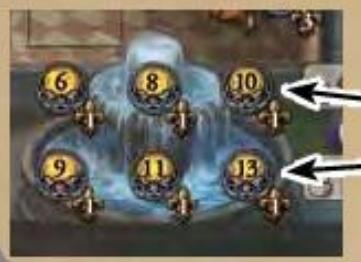
- 上层
- 下层弗,接着在这个装饰区放置一枚自己的玩家标记。
但是,在装饰喷泉时存在限制。喷泉由双层组成:
你在每层只能占据1个装饰区域。



乐师
装饰
区域


喷泉
装饰
区域

“宾客如云”奖励
当在1个大厅里,至少有1个你自己的玩家标记放置在服
装板块或是乐师装饰区域中时,你视为在这个大厅中出席。
当你在5个大厅里都出席的时候,你可以立即放置1个玩家标记到“宾客如云”奖励区域的空缺位置中。

(每位玩家最多只能在“宾客如云”奖励区域占据1个空缺。)
阶段4:获得相应收入
当所有玩家都用尽手牌时,“执行主要行动”阶段结束,所有玩家获得他们对应的收入。
每位玩家获得5里弗的基础收入。
在喷泉装饰区域有玩家标记的玩家获得额外收入:

- 在喷泉装饰区域的上层,每个玩家标记给对应玩家带来等同于此玩家在游戏版图上占据的装饰区域数量的里弗。(包括喷泉装饰区域,但不包括“宾客如云”奖励区域。)
- 在喷泉装饰区域的下层,每个玩家标记给对应玩家带来等同于此玩家在游戏版图上放置的服装板块的数量的里弗。(服装板块上不同颜色的玩家标记标注了其归属。)
接下来,新的一轮从阶段1:“准备新的一轮”开始。
案例:
乔治获得5里弗的基础收入。(他在喷泉装饰区域没有标记。)
伊娃获得8里弗的收入(5+3)。她在喷泉装饰区域下层的标记为她带来额外的3里弗(她在游戏版图上有3个服装板块)。
麦克获得9里弗的收入(5+3+1)。他在喷泉装饰区域上层的标记为他带来额外的3里弗(因为他在游戏版图上装饰了3处),他在下层的标记为他带来1里弗(他在游戏版图上有1个服装板块)。
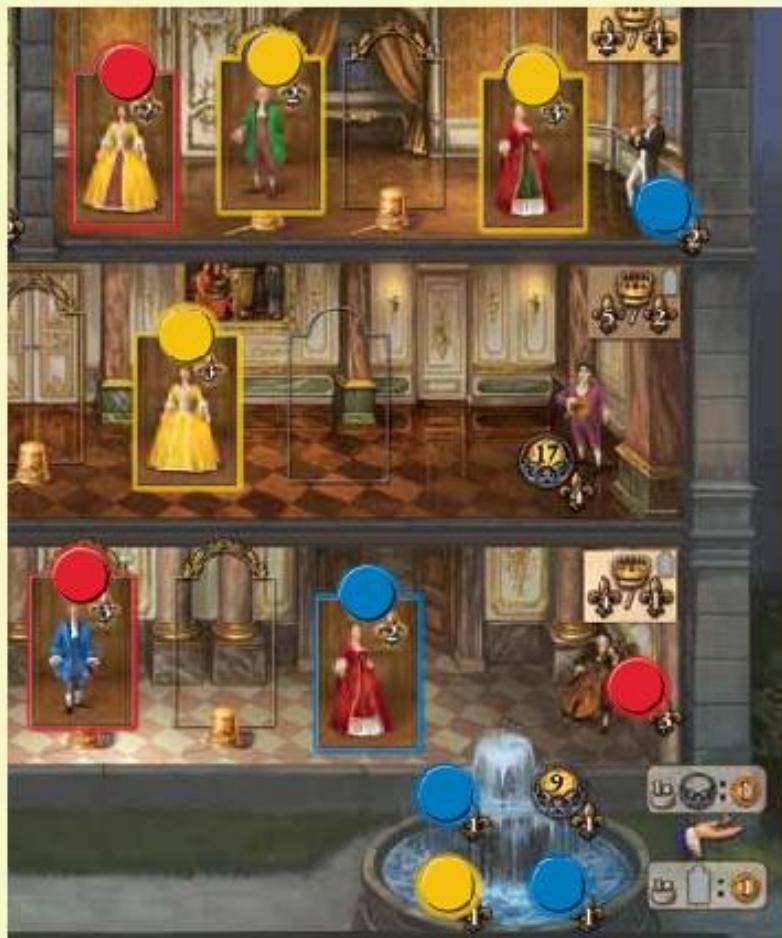
游戏结束
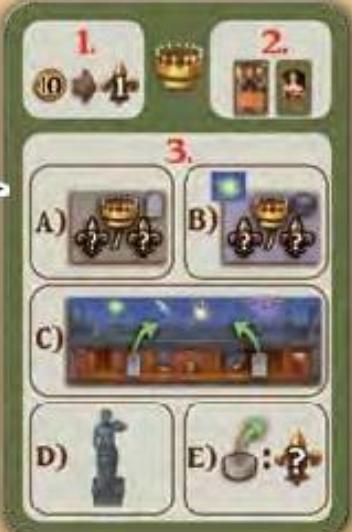
游戏在第7轮的“获得收入”阶段后结束(即公共雇员牌堆被耗尽的一轮)。之后,舞会之夜终于来临,进行最终计分。(皇冠符号代表最终计分的项目。)

为了确保你按照正确的顺序进行最终计分,你可以参考“最终计分”概览卡。
-
首先,计算你剩下的里弗。每10个里弗你获得1个声望点数。(尽量不要先放回银行,在平局情况下里弗数将作为重要参照。)
-
接着根据你雇员牌库中有皇冠符号和红色背景的雇员卡,获得对应的额外奖励(对于所有奖励的详细解释,请参考第8页)。
如果一位玩家在游戏结束时拥有恩赐卡,他获得3个声望点数。

[NO TEXT]
- 然后根据游戏版图的不同区域,按照如下顺序结算:
A) 5个大厅中的服装数量优势
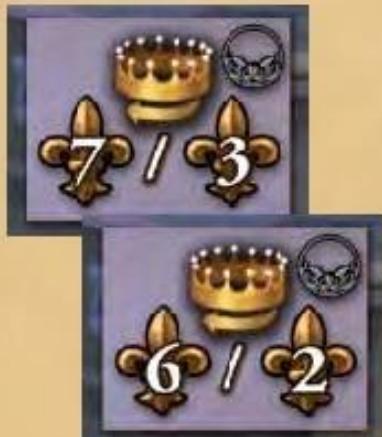
在5个大厅中,每一个大厅里,租借的服装数量最多和第二多的玩家获得声望点数。每个大厅右上角的彩色方框里显示了声望点数的数额:租借服装数量最多的玩家,获得等同于斜杠左边数目的声望点数;租借服装数量第二多的玩家,获得等同于斜杠右边数目的声望点数。

平局时,在当前大厅里占据最多“大师宾客区域”的玩家胜出(视为服装最多)。如果仍然是平局,在当前大厅里占据乐师装饰区域的玩家胜出(视为服装最多)。如果没有满足条件的玩家,那么两位平局的玩家都获得斜杠左边数目的声望点数。(后续玩家无法再从这个大厅里获得声望点数。)
2人游戏特殊规则:在5个大厅中,每一个大厅里,只有服装最多的玩家获得声望点数。服装第二多的玩家不获得任何奖励。
B) 烟火装饰区的数量优势
根据游戏玩家的数量,在烟火装饰区域有最多玩家标记的玩家,获得7或者6个声望点数;玩家标记第二多的玩家,获得3或者2个声望点数。平局时,占据的烟火装饰区域价值更高的玩家胜出(越靠右边价值越高)。
2人游戏特殊规则:只有在烟火装饰区域玩家标记最多的玩家可以获得声望点数。玩家标记第二多的玩家不获得任何奖励。
案例:
C) 在露台观赏烟火
伊娃获得3个声望点数。

乔治获得1个声望点数。
案例:
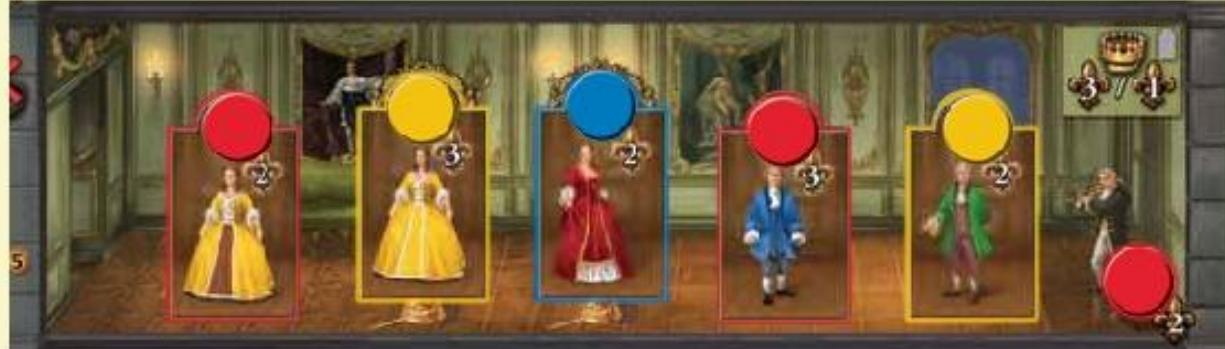
尽管伊娃和乔治在租借的服装数量上持平,但是伊娃占据的“大师宾客区域”(1个)比乔治(0个)更多,所以伊娃胜出。
麦克获得2个声望点数。(虽然他和伊娃都只占据了一个区域,但是麦克占据的区域价值更高。)
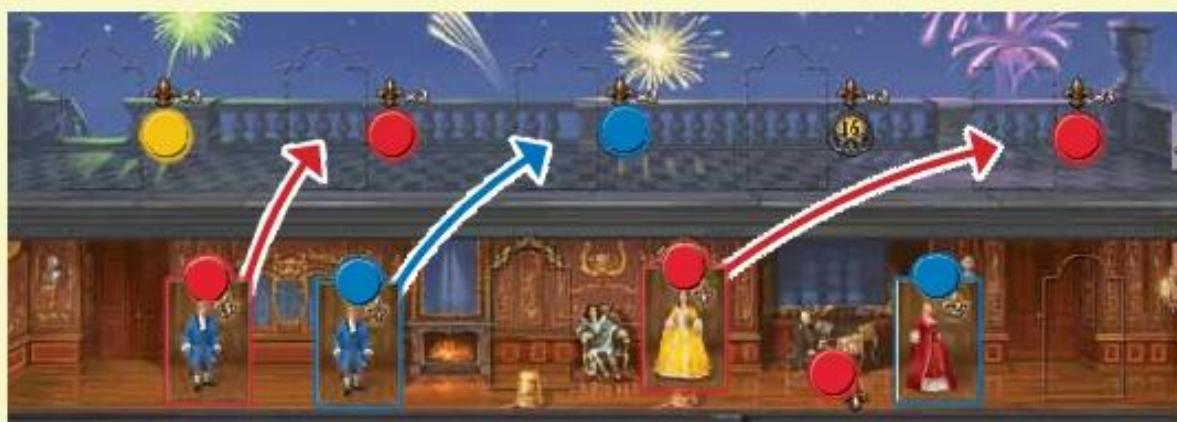
在烟花装饰区域,你每有1个玩家标记,就可以邀请1位在王储大厅(露台下方的大厅)里,身穿你制作的服装的宾客到露台上观赏烟花。直接将你的服装板块移动到露台上用虚线描绘的宾客区域里。
如果你在王储大厅中的服装数量少于你在露台上的玩家标记数量,则多余出来的宾客区域保持空缺;
每一种主色调给你带来2个声望点数(所以最多你可以获得8个声望点数)。
在雕塑装饰区域,你每有1个玩家标记,就可以根据你游戏版图上1组不同颜色的服装(黄色,绿色,红色,蓝色)获得声望点数。
如果你在王储大厅中的服装数量多于你在露台上的玩家标记数量,你必须选择放置哪个或哪些服装板块到露台。剩余的服装板块保留在王储大厅里。
D) 雕塑
重要:如果你在雕塑装饰区域有多于1个玩家标记,你必须为每个标记计算不同的服装组合(任何一件服装都无法被重复计算)。
案例:
麦克在雕塑装饰区域总共有2个玩家标记。在游戏版图上,他一共有7件服装。他有1组4个色调的服装组合,这为他带来8个声望点数。对于他在雕塑装饰区域里的第2个玩家标记,他无法再使用上述4个服装计分。由于他的另1组服装组合里只有2种色调的服装,他获得4个声望点数。
最后,计算服装,装饰区域,和“宾客如云”奖励得分。首先从起始玩家开始,逐一从游戏版图上移除他的玩家标记。大部分玩家标记的右下角方位会显示其获得的声望点数。在移除玩家标记的过程中将这些数值相加。当从露台区域移除玩家标记时,将对应服装的声望点数乘以玩家标记上方显示的数值(×2或者×3)。当一位玩家的所有标记都被移除时,他获得等同于这些数值总数的声望点数。按顺时针重复这个过程为每位玩家计分。
(€) 玩家标记计分

在最终计分后,获得声望点数最多的玩家获得游戏的胜利。平局时,剩余钱币最多的玩家获得游戏的胜利。
雇员额外奖励概览
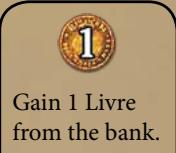
从银行获得1里弗
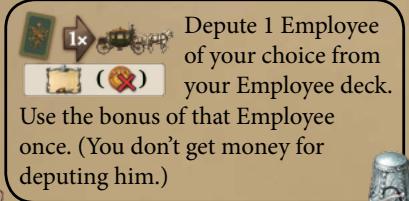
1x 指派你雇员牌库中的一位雇员使用一次该雇员的额外奖励(你不获得指派金钱)
获得1元;每有一件红色服装,你就从银行获得2元
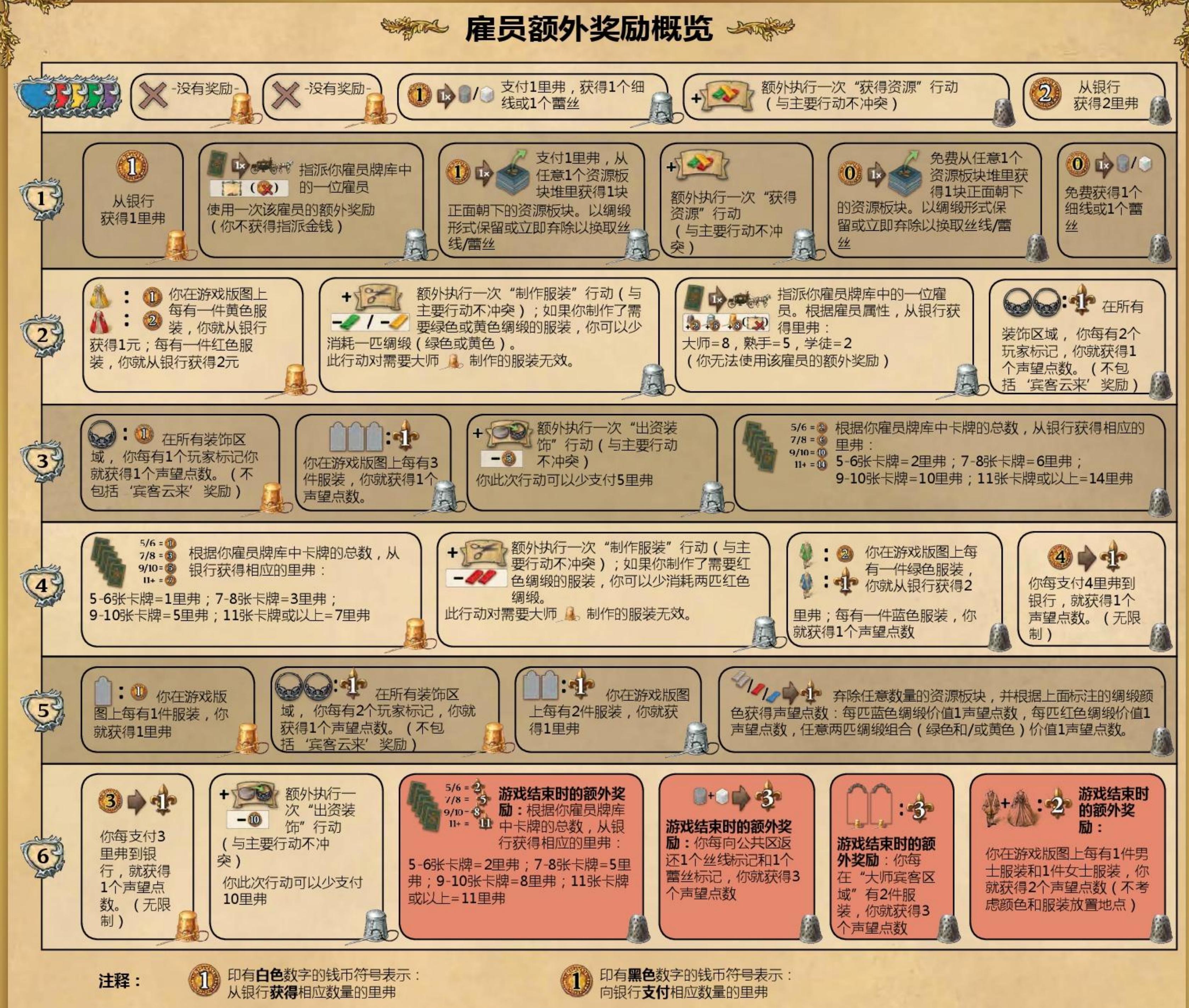
1 在所有装饰区域,你每有1个玩家标记你就获得1个声望点数。(不包括‘宾客云来’奖励)
正面朝下的资源板块。以绸缎形式保留或立即弃除以换取丝线/蕾丝
你在游戏版图上每有3件服装,你就获得1个声望点数。
额外执行一次“制作服装”行动(与主要行动不冲突);如果你制作了需要绿色或黄色绸缎的服装,你可以少(绿色或黄色)。
5/6 = 1 根据你雇员牌库中卡牌的总数,从
7/8 = 3
9/10 = 3 银行获得相应的里弗:
11+ = 7
5-6张卡牌=1里弗;7-8张卡牌=3里弗;9-10张卡牌=5里弗;11张卡牌或以上=7里弗
额外执行一次“获得资源”行动(与主要行动不冲)
额外执行一次“制作服装”行动(与主要行动不冲突);如果你制作了需要红色绸缎的服装,你可以少消耗两匹红色绸缎。
此行动对需要大师制作的服装无效。
1 在所有装饰区域,你每有2个玩家标记,你就获得1个声望点数。(不包括‘宾客云来’奖励)
额外执行一次“获得资源”行动(与主要行动不冲突)
免费从任意1个资源板块堆里获得1块正面朝下的资源板块。以绸缎形式保留或立即弃除以换取丝线/蕾丝
0 1x 1/
指派你雇员牌库中的一位雇员。根据雇员属性,从银行获得里弗:
大师=8,熟手=5,学徒=2
(你无法使用该雇员的额外奖励)
你在游戏版图上每有2件服装,你就获得1里弗
:1 在所有
装饰区域,你每有2个玩家标记,你就获得1个声望点数。(不包括‘宾客云来’奖励)
5/6 = ② 根据你雇员牌库中卡牌的总数,从银行获得相应的
7/8 = ⑥ 里弗:
9/10 = 10 5-6张卡牌=2里弗;7-8张卡牌=6里弗;
11+ = 14 9-10张卡牌=10里弗;11张卡牌或以上=14里弗
: ② 你在游戏版图上每有一件绿色服装,你就从银行获得2你每支付4里弗到银行,就获得1个声望点数。(无限制)
你在游戏版图上每有1件服装,你就获得1里弗
里弗;每有一件蓝色服装,你就获得1个声望点数
弃除任意数量的资源板块,并根据上面标注的绸缎颜色获得声望点数:每匹蓝色绸缎价值1声望点数,每匹红色绸缎价值1声望点数,任意两匹绸缎组合(绿色和/或黄色)价值1声望点数。
③ → ①
你每支付3里弗到银行,就获得1个声望点数。(无限制)
5/6 = 2
7/8 = 5
9/10 = 8
11+ = 11
游戏结束时的额外奖励:根据你雇员牌库中卡牌的总数,从银行获得相应的里弗:
5-6张卡牌=2里弗;7-8张卡牌=5里弗;9-10张卡牌=8里弗;11张卡牌或以上=11里弗
游戏结束时的额外奖励:你每向公共区返还1个丝线标记和1个蕾丝标记,你就获得3个声望点数
游戏结束时的额外奖励:
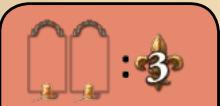
游戏结束时的额外奖励:你每在“大师宾客区域”有2件服装,你就获得3个声望点数
你在游戏版图上每有1件男士服装和1件女士服装,你就获得2个声望点数(不考虑颜色和服装放置地点)
注释:
印有白色数字的钱币符号表示:从银行获得相应数量的里弗
印有黑色数字的钱币符号表示:向银行支付相应数量的里弗

www.eggertspiele.de
Credits
Authors: Matthias Cramer, Louis Malz, Stefan Malz | Illustrations: Michael Menzel
Rule book and layout: Alfred Viktor Schulz | Rule book revision: Neil Crowley
Copyright: © 2013 eggertspiele GmbH & Co. KG, Friedhofstr. 17, 21073 Hamburg, Germany. All rights reserved.

www.eagle-gryphon.com
规则翻译:菠萝殿 感谢所有在翻译过程中给予我支持的朋友
本规则书仅供桌游爱好者研究使用或随英文游戏附赠,请勿用作其他商业行为,或直接盗取本人翻译和制作成果作为他用。
Download MarkdownRokoko_rules_GB_lr.md38.2 KB

Welcome to the Rococo era. Louis XV rules in France and it is bon ton to hold lavish balls. Important personalities wrap up in noble coats and dresses, anxious to outshine one another. As the biggest event is coming up in just a few weeks, everyone is turning to you with their requests: an elegant coat here, a stunning dress there, or a donation to fund the fireworks. Soon you realize that it's not just about your dressmaking business anymore – it's about managing the most prestigous ball of the era.. and now it's time to ro(c)k!
Object of the Game
In Rokoko, you own a dressmaking business and try to gain as much Prestige as possible. Each turn you play an Employee card and have that Employee perform a task, for example: hire a new Employee, make a Dress, or fund a Decoration. However, not every Employee is up to every task, so you must choose and lead your Employees wiseló. Especially since each grants a unique bonus. Some of these bonuses generate Prestige Points, which are awarded in the form of Prestige Point tokens.
After 7 rounds the game ends with the ball and a final scoring. Then you gain Prestige Points for certain Employee bonuses, for Dresses that you rented out to guests at the ball as well as for Decorations that you funded.
Afterwards, all players count their Prestige Points and whoever has collected the most wins the game.
Components
42 Dress tiles, each with a draft side and a rental side.
The draft side depicts:
• the main color of the Dress
• the required resources to manufacture the Dress
• the monetary value of the Dress (6 to 28 Livre)15

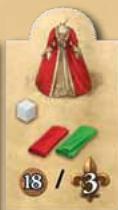
• the Prestige Point value of the Dress (2 to 4)
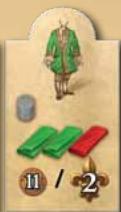

The rental side depicts:
• the Prestige Point value of the Dress (2 to 4)
• EITHER a woman in a yellow or red Ladies’ dress-OR a man in a green or blue Men's coat.

1 double-sided Game board
Note:
→ When the term “Dress" is used, it refers to both the Ladies’ dress and the Men's coat.

(1 side for 2 and 3 players, 1 side for 4 and 5 players)
1 Starting Player marker

16 wooden Lace markers

→ Even though some Dresses include a second color, each Dress has only 1 main color (the color of the overskirt or jacket).
16 wooden Yarn makers

1 Cloth bag
48 Coins
→ The colors of the Dresses do not correspond to the player colors.
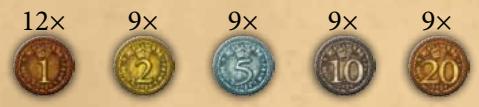
48 Prestige Point tokens

→ Yellow dresses and green coats are common (13 tiles each), while red dresses (10 tiles) and blue coats (6 tiles) are rather rare.

1 Favor card
1 Overview card "Final scoring"
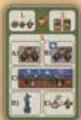
28 Employee cards
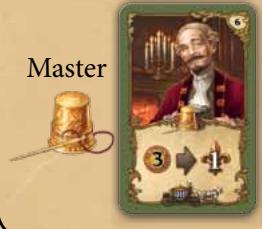

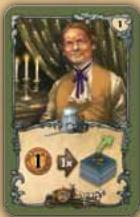
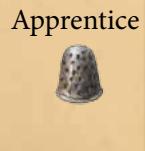
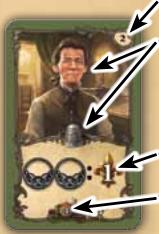
level number (1 to 6)
• type of Employee
(Master, Journeyman,
Apprentice)
• Employee bonus
• money gained by deputing the Employee
48 Resource tiles, each with a combination of:
• green silk (common)
• yellow silk (common)
• red silk (not so common)
• blue silk (rare)
• Yarn
• Lace
25 Base Employee cards (5 of each player color, indicated by the color in the upper right corner)
80 wooden Property markers (16 of each player color)

5 Player boards (1 of each player color)

r Setup 上
Before the first game, carefully detach the cardboard pieces from the punch boards.
-
Put the Game board in the middle of the table, with the side that corresponds to the number of players facing up. This is indicated by the numbers in the lower right corner:
-
Place the Favor card next to the Favor space on the Game board.
-
Sort the 28 Employee cards by level number (1 to 6).
Shuffle the six “level 6” cards face down and place them as a stack next to the Game board.

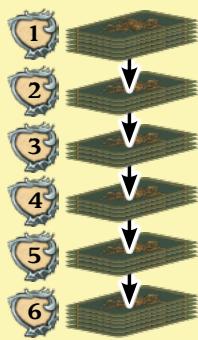
Then shuffle the four “level 5” cards and place them face down on top of this stack.
Continue in this manner with the cards of level 4, 3, 2, and finally place the shuffled “level 1” cards on top of this stack. This stack is called the
“general Employee stack”.
-
Shuffle all the Resource tiles and place them as multiple face-down stacks next to the Warehouse section of the Game board.
-
Finally, determine a Starting Player, who gets the Starting Player marker.

- Give each player his starting capital, which he places next to his Player board:
• 15 Livre
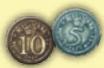
• 1 Lace marker

• 1 Yarn marker

-
Set up the general supply of Yarn and Lace markers next to the Game board.
-
Place the Coins (Livre) beside the Game board, forming the bank. Place the Prestige Point tokens next to the bank.
-
Put all the Dress tiles into the Cloth bag and mix them up. Then place the Cloth bag beside the Game board.
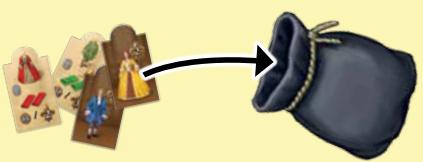
Note in general:
→ Property markers, Yarn markers, Lace markers, Coins, and Prestige Point tokens are considered unlimited. If any of these items should run out during the game, please use something else as a replacement.
→ Whenever you gain Prestige Points, take the appropriate amount from the Prestige Point tokens supply and place it face down in front of you. You may keep your score hidden until the end of the game.
→ You may not keep your money hidden.
- Each player chooses a color and receives the items of that color:
• 5 Base Employee cards, which each player places face down beneath the left space of his Player board
• 16 Property markers


At the beginning of the game, each player's cards are in his face-down Employee supply (the left space of his Player board).
At the beginning of each round, he picks his hand cards from this supply. Once he plays a hand card it goes into his face-up Discard pile (the right space of his player board). His Employee supply, his hand cards, and his Discard pile make up his Employee deck.
Playing the Game
Rokoko is played over 7 rounds.
Each round consists of 4 phases.
Phase 1: Prepare for new round
Phase 2: Select 3 hand cards
Phase 3: Take actions
Phase 4: Collect income
After the 7th round (in which the general Employee stack is used up), the game ends with a final scoring.
(A) Favor card > Starting Player (Ignore in first round.)
(B) 4 new Employee cards
If a player acquired the Favor card during the previous round, he receives the Starting Player marker and returns the Favor card to its place next to the Game board. (If no player acquired the Favor card during the previous round, the Starting Player remains the same.)
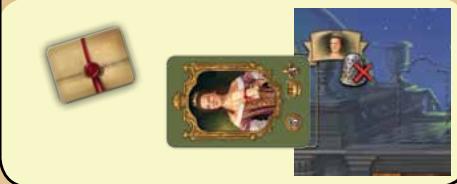
-
If, next to the Hire spaces of the Game board, there are any face-up Employee cards left from the previous round, remove these from the game first.
-
Then reveal exactly 4 new Employee cards from the Employee stack and place them face up next to the 4 Hire spaces of the Game board.
Note: In rounds 1 through 6, the highest revealed level number indicates the number of the current round. In round 7, the Employee stack will be empty after the final 4 cards have been revealed.

(C) New Resource tiles
Fill each empty space of the 3 Warehouse segments with a face-up Resource tile drawn randomly from any Resource stack.
If there are Resource tiles left from the previous round, they remain on their spaces.
If all Resource stacks run out, shuffle the discarded Resource tiles and place them face down as new stacks. (If these new stacks should still not suffice to fill all empty spaces, these spaces are left empty.)
'D) New Dress tiles
Fill the Window spaces of the Workshop with Dress tiles (draft side face up) as follows:
-
If there are any Dress tiles from the previous round remaining on the 2 rightmost Window spaces (dark and marked with a), discard these first onto a Dress tile discard pile.
-
If there are Dress tiles left on any other Window spaces, move those tiles together to the right until that many Windows on the right side of the Workshop are filled.
-
Finally, fill each empty Window space of the Workshop with a Dress tile drawn randomly from the Cloth bag until the Workshop is full. Make sure that all displayed Dress tiles have their draft side face up.
If the Cloth bag is empty, put the Dress tiles from the discard pile back into the bag and shuffle them. (If the Dresses in the Cloth bag should still not suffice to fill all Window spaces, the leftmost spaces of the Workshop are left empty.)
phase 2: Select 3 hand cards ××xxx×××x×xxx××××××xxx×××××xxx××××××xx××××××xxx×××××xxx×××××x
Each player simultaneously and secretly selects 3 Employee cards from among all cards in his Employee supply (the face-down pile beneath the left space of his Player board).
Take your 3 chosen Employee cards into your hand and return the remaining cards of your Employee supply face down to the left space of your Player board.
From the second round onwards, consider the following:
If you have fewer than 3 cards in your Employee supply, first take all of these cards into your hand. 'Then create a new Employee supply from your Discard pile (the face-up pile beneath the right space of your Player board) by moving the entire Discard pile over to the left space and turning it face down. Finally, select from among the cards of this new Employee supply as many cards as you need to bring your hand up to 3 cards.
If you have exactly 3 cards left in your Employee supply, you have no other choice than to take these into your hand.
Important: In this case, do not create a new Employee supply from your Discard pile afterwards. Instead, do this at the beginning of Phase 2 of the next round.
Example (second round onwards):
Mike must select 3 hand cards from his Employee supply.
Since he has only 2 cards left there, he must take these 2.
Next he takes his Discard pile, flips it and places it as his new Employee supply beneath the left space of his Player board.
Then he may select any card of that new Employee supply as his 3rd hand card.

Phase 3: Take actions xxx×XxxX×XXxXx×x×xxxXX×xxXXxxxxXXXxxXXXXxxXXX×xxXXX×xxXXXxxxXXXxx
Beginning with the Starting Player and then in a clockwise direction, each player in turn must play exactly 1 of his hand cards (as long as he still has any).
With the played card he may perform 1 main action. In addition, the played card may grant a bonus.
As soon as all players have no hand cards left, the phase ends.
Which of the 6 possible main actions you may perform on your turn depends on the Employee depicted on the card that you play:

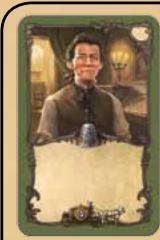
Journeyman
(symbol: silver thimble)
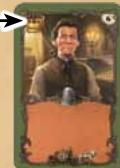
After (and only after) you have performed your main action, you may use the Employee bonus depicted in the lower half of the played card. However, you may always choose to forfeit the main action and/or the bonus.
can never perform the “Hire a new Employee” action

At the end of your turn, place the Employee card face up beneath the right space of your Player board on your Discard pile. Then it is the next player's turn.

Apprentice
(symbol: brass thimble)

can never perform: • the “Claim the Queen's favor” action • the “Make a Dress” action • the “Hire a new Employee” action
Note:
→ The Base Employee cards “Master" have no bonuses.
→ The “level 6” Employee cards “Apprentice" show a crown - and have a red bonus background. You cannot use the bonus of these cards during the game. They only take effect in the final scoring.
For a detailed description of all bonuses, see page 8.
The 6 main actions are:
1. Claim the Queen's favor (may be performed via a Master or a Journeyman)
If the Favor card is still lying next to the Favor space of the Game board, take it and place it in front of you. Then gain immediately 5 Livre from the bank.

Also, you are the Starting Player of the next round. (This action can only be performed by 1 player each round, irrespective of whether that player is the current Starting Player or not.)
At the end of the game, if you own the Favor card,

3 Prestige Points.
2. Acquire Resources
(may be performed via a Master, a Journeyman, or an Apprentice)
You may acquire 1 Resource tile from any of the 3 segments of the Warehouse. For the tile you must pay Livre according to the number of tiles currently displayed in its segment.
• If there are 3 or 4 tiles in the segment, return 2 Livre to the bank.
• If there are 2 tiles, return 1 Livre to the bank.
• If the tile is the last one in its segment, you get it free of charge.
After you have paid for the tile, you must decide immediately to either:
a) put the tile face down in front of you (allowing you to use the bale(s) of silk depicted on the tile later)
OR
b) discard the tile onto a face-up Resource tile discard pile to gain from the general supply the number of Yarn and/or Lace markers depicted in the lower half of the tile.
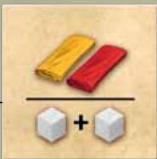
Note: A plus sign between the depicted markers always means gain both, a slash means gain either.
→ Resource tiles are stored face down in front of you. However, upon request, you must state the number of tiles you own.
→ Yarn and Lace markers must be stored publicly.
→ If there is no Resource tile left in any of the Warehouse segments, you cannot perform the “Acquire Resources” action.

Example:
Mike plays an Apprentice and wants to acquire the Resource tile depicting 2 green bales of silk from the Warehouse. Since there are still 3 Resource tiles in that Warehouse segment, he pays 2 Livre to the bank and then takes the tile.
Now he must decide to either:
a) put this tile face down in front of him (allowing him to use it later as 2 bales of green silk) OR
b) discard the tile and either gain 1 Yarn OR 1 Lace marker from the general supply.
He decides to keep the silk and puts the tile face down in front of him.
3. Make a Dress
(may be performed via a Master or a Journeyman)
You may manufacture 1 of the Dresses displayed in the Workshop. To do this, pay the costs stated above the Dress tile (0 to 8 Livre) to the bank. Then surrender the resources depicted on the tile:
bale(s) of silk + Yarn marker(s) / Lace marker(s).
You can surrender multiple Resource tiles to match the total number of bales needed. However, any bales on those tiles in excess of the bales required are lost. Discard the used Resource tiles onto a face-up Resource tile discard pile.
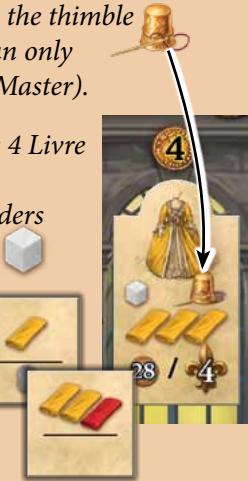
Some Dress tiles also show a golden thimble.
You can only manufacture such a Dress via a Master.
Important: The face-down Resource tiles in front of you can only be used as silk. Any Yarn or Lace required must be returned to the general supply in the form of the wooden markers.
Example:
To make the yellow Dress, Mike plays

a Master (since the thimble shows that it can only be made via a Master).
First he returns 4 Livre to the bank. Then he surrenders 1 Lace marker
and 3 bales of yellow silk (the red bale is lost).
After you have paid the required amount of money and resources, take the Dress tile from its Window space and immediately decide whether you:
a) rent the Dress out to a guest at the ball
OR
b) sell it for money.
a) Rent the Dress out:
Flip the Dress tile to its rental side and place it onto any free Guest space in 1 of the 5 halls on the Game board (never onto a dashed space on the Terrace).
The “fancy” Guest spaces in the middle of each hall are Master Guest spaces. You can only place a Dress tile onto a Master Guest space if you have made it via a Master (irrespective of whether the tile shows a thimble on its draft side). After you have assigned the tile to a Guest space, place 1 of your Property markers onto the top of the tile. The Prestige Points shown will be awarded at the end of the game.

If the Guest space (onto which you place your tile) shows a bonus reward, gain that reward immediately:


Gain from the bank the amount of Livre depicted.
Gain 1 Yarn marker from the supply.


Gain 1 Lace marker from the supply.
If available, gain 1 Resource tile from any segment of the Warehouse free of charge. You must decide immediately whether to keep the tile as silk or discard it to gain the depicted Yarn and/or Lace.
b) Sell the Dress
Gain immediately from the bank the amount of Livre shown on the left side of the tile. Then discard the Dress onto a Dress tile discard pile.

→ If there are no Dresses left in the Workshop, you cannot perform the “Make a Dress" action.
→ If you make a Dress and there is no appropriate Guest space left in any of the hals, you must sell it.

4. Hire a new Employee (may be performed via a Master only)
You may acquire 1 of the Employee cards displayed next to the Hire spaces of the Game board. For that card you must pay Livre according to the number of cards currently displayed:
• If there are 4 cards, return 5 Livre to the bank.
• If there are 3 cards, return 3 Livre to the bank.
• If there are 2 cards, return 1 Livre to the bank.
• If the card is the last one, you get it free of charge.
After you have paid for it, take the chosen Employee card from the display into your hand. 'This means you will get to play it in a later turn of the current round. (This way players can have a different number of turns in a round.)
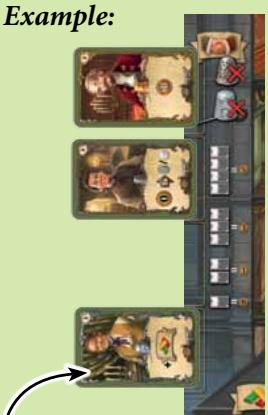
→ If there is no Employee card available in the display, you cannot perform the “Hire a new Employee” action.
Mike plays a Master and wants to hire the Journeyman displayed. Since there are still 3 Employee cards left in the display, he pays 3 Livre to the bank. Then he adds the hired Journeyman to his hand.

5. Depute your Employee (may be performed via a Master, a Journeyman, or an Apprentice)
Remove the Employee card entirely from the game. Your Employee is following a calling to work at the King's court, so to speak.
For this, gain from the bank the amount of Livre stated on the carriage at the bottom of the Employee card:
• 10 Livre for a Master
• 7 Livre for a Journeyman
• 4 Livre for an Apprentice
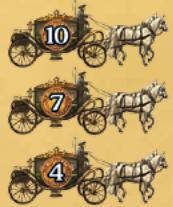
Important: After gaining the money, you may also use the Employee bonus of the card. Afterwards remove the card from the game (return it to the box).
VERY IMPORTANT: You can depute Employees of your own color as well as any hired ones. However, you are not allowed to depute an Employee if you have only 4 Employee cards left in your Employee deck. This limitation applies to this main action as well as to similar Employee card bonuses (see page 8). Since Masters are very important, we highly recommend never deputing the last Master from your Employee deck.


6. Fund a Decoration
(may be performed via a Master, a Journeyman, or an Apprentice)
Investing money in the ball's Decoration will give you Prestige Points at the end of the game or supplement your income in the “Collect income” phase.
You may fund 1 Decoration by placing 1 of your Property markers onto a free Decoration space on the Game board (Fireworks, Musician, Statue, Fountain). For this, pay to the bank the amount of Livre stated on the chosen space. Any Prestige Points shown next to the Decoration space will be awarded at the end of the game.
Example:
There is no limit to the number of Decoration spaces you may occupy during the game.
a Property marker onto this Decoration space.
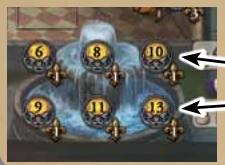
However, you are limited in the Fountain. The Fountain comprises: • an upper row and
• a lower row.
You may not occupy more than 1 Decoration space per row.
Each player receives a base income of 5 Livre.
When all players have no hand cards left to play, the “Take actions" phase ends and all players collect their income.
Players who have Property markers on Fountain Decoration spaces receive additional income:
Each Property marker in the upper row of the Fountain grants its owner an amount of Livre equal to the number of Decoration spaces on the Game board that are occupied by a Property marker of his color (including Decoration spaces in the Fountain and excluding spaces of the “All halls” bonus).
Each Property marker in the lower row of the Fountain grants its owner an amount of Livre equal to the number of Dresses he has placed on the Game board (i.e. that have a Property marker of his color on them).

Afterwards, the next round starts with phase 1: “Prepare for new round”.

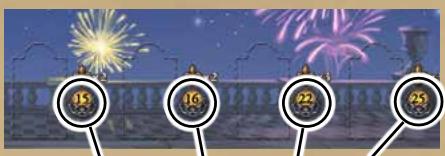
Fireworks Decoration spaces

Musician Decoration spaces


Fountain Decoration spaces
Statue Decoration spaces

Example:
George gets the base income of 5 Livre. (He has no marker in the Fountain.)
Eve gets an income of 8 Livre (5 + 3). Her marker in the lower row of the Fountain gives her 3 additional Livre (for 3 Dresses on the Game board).
Mike gets an income of 9 Livre (5 + 3 + 1). His marker in the upper row gives him 3 additional Livre (because he has funded 3 Decorations) and his marker in the lower row gives him 1 Livre (for 1 Dress on the Game board).
"All halls" bonus
As soon as you manage to be present in each of the 5 halls, immediately place 1 of your
Property markers
onto the most
valuable free
space of the
“All halls” bonus.
You are present
in a hall if you
have at least
1 of your
Property
markers on a
Dress or the
Musician Decoration space in that hall.
(No player can occupy than 1 space of the “A] bonus.)

End ofthe Game
The game ends after the “Collect income” phase of the 7th round (in which the general Employee stack has been used up). Afterwards, the night of the ball finally arrives and a final scoring takes place. (The overall symbol for the final scoring is a crown.)
To make sure that you score the elements of the inal scoring in the proper order, you can use the Overview card “Final scoring”.
-
Start by gaining 1 Prestige Point for every 10 Livre that you return to the bank. (Keep any remainder as a tie breaker.)
-
Then score the bonuses of any Employee cards in your own Employee deck that show a crown and a red bonus background (see page 8 for a detailed description of the bonuses).
If a player owns the Favor card, he receives 3 Prestige Points.

Example:
George gets 6 Prestige Points.
Mike gets 2 Prestige Points (since he occupies a Fireworks Decoration space with a higher monetary value than Eve).
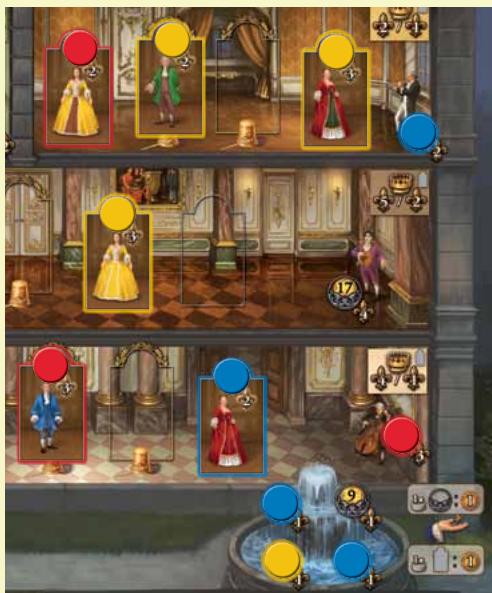
A) Majority in each of the 5 halls
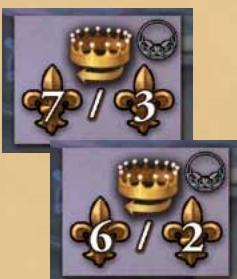
In each of the 5 halls, the players with the most and second most Dresses in that hall receive Prestige Points. The number of Prestige Points is shown in the colored box in the upper right corner of each hall: The player with the most Dresses gets the number of Prestige Points stated in front of the slash, the player with the second most Dresses the number of Prestige Points behind the slash.

A tie is resolved in favor of the player who has more Dresses on Master Guest spaces in that hall. If that doesn't break the tie, the tie is won by the tied player who also has a marker on the Musician Decoration space in that hall. If no such player exists, all tied players get the full number of Prestige Points to the left of the slash (then any runners up do not receive Prestige Points for that hall).
Special rule for 2-player games: In each of the 5 halls, only the player with the most Dresses receives Prestige Points. The Prestige Points for the second most Dresses are not awarded.
B) Majority in the Fireworks
Depending on the number of players, the player with the majority of Property markers on Fireworks Decoration spaces receives 7 or 6 Prestige Points, the player with the second most Property markers receives 3 or 2 Prestige Points. In the case of a tie, the tie is won by the tied player who occupies the Fireworks Decoration space with the higher monetary value (the space farther to the right).
Special rule for 2-player games: Only the player with the most markers on Fireworks Decoration spaces receives Prestige Points. The Prestige Points for the second most Property markers are not awarded.
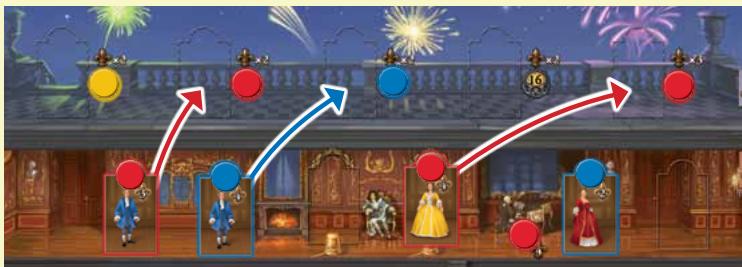
(C) Watch the Fireworks from the Terrace
To each Fireworks Decoration space that has your Property marker on it, you may now assign 1 of your Dresses from the King's hall (the hall beneath the Terrace). Simply move the Dress to the dashed Terrace Guest space to the left of the Fireworks Decoration space. If you have fewer Dresses in the King's hall than Property markers in the Fireworks, the extra Guest spaces on the Terrace remain empty. If you have more Dresses in the King's hall than Property markers in the Fireworks, you have to choose which ones to assign. The remaining Dresses stay in the King's hall.
(D) Statues

For each of your Property markers on a Statue Decoration space, you receive Prestige Points for 1 set of your Dresses of different main colors (yellow, green, red, blue) on the Game board. Each main color gives you 2 Prestige Points (so you can score a maximum of 8 Prestige Points). Important: If you occupy more than 1 Statue Decoration space, you must score a different set of Dresses for each of your Statue Decoration spaces (i.e. no Dress counts for more than 1 set).
€) Score Property markers
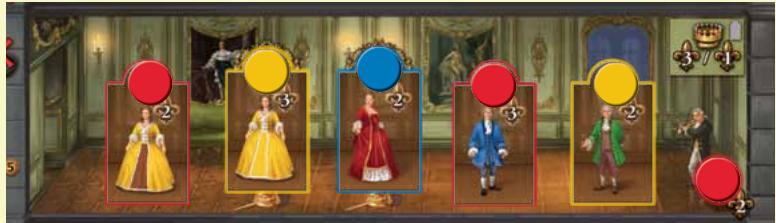
Example:
Finally, award the Prestige Points for Dresses, Decoration spaces, and the “All halls” bonus. To do this, start with the current Starting Player and remove his Property markers from the Game board one by one. Most of the Property markers show a Prestige Point value at their lower right side. Add these Prestige Points up while removing the markers. When removing a marker from a Dress on the Terrace, multiply the Prestige Point value of that Dress by the multiplier to its right (×2 or ×3). After all of his markers have been removed, the player receives the total sum of Prestige Points. Repeat this procedure in a clockwise direction for each player.
Eve gets 3 Prestige Points.
George gets 1 Prestige Point.
Even though Eve and George are tied for the majority, Eve wins the tie since she has more Dresses on Master Guest spaces (1)
than George (0).
Example:
Mike has a total of 2 markers on Statue Decoration spaces. On the Game board, he has a total of 7 Dresses. He has 1 set of all 4 Dress colors, which gives him 8 Prestige Points. For his second Statue Decoration space he may not score any of these 4 Dresses again. Since he only has another set of 2 Dress colors, he receives 4 Prestige Points for those.

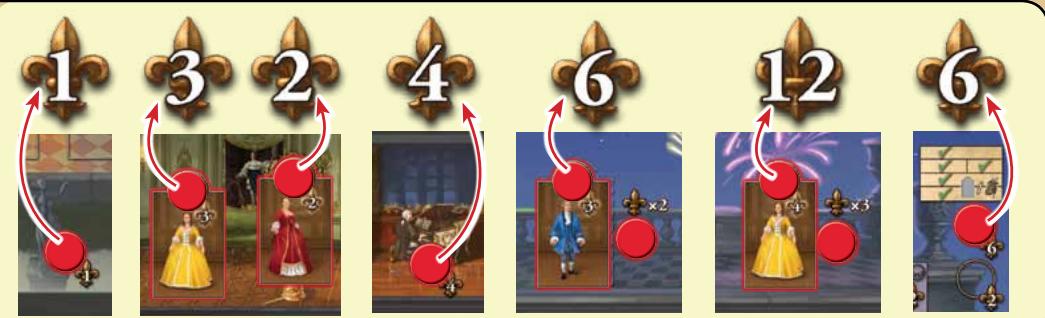
Note in general:
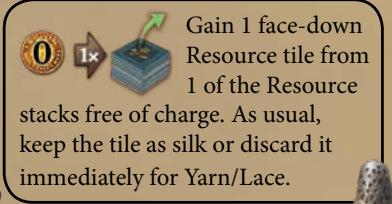
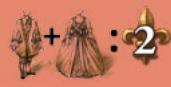


Overview of the Employee bonuses


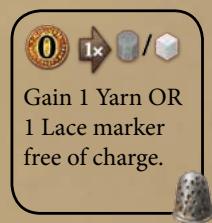
Gain 1 Yarn OR 1 Lace marker by paying 1 Livre.


stacks by paying 1 Livre. As usual keep the tile as silk or discard it immediately for Yarn/Lace.

Dresses on the Game board. Gain 2 Livre for each of your red Dresses on the Game board.
Perform 1 additional “Acquire Resources” action (irrespective of your main action).

Gain 1 Livre from the bank
Gain 1 Prestige Point for every 3 of your Dresses on the Game board.
for each of your Property markers on Decoration spaces (“All halls” bonus excluded).
m:1


5/6 =② Gain from the bank an amount of Livre that depends on
7/8 = 6 the total number of cards in your Employee deck:
9/10= 10
11+ = 14 5 or 6 cards = 2 Livre, 7 or 8 cards = 6 Livre,
9 or 10 cards = 10 Livre, 11 or more cards = 14 Livre.


5/6 = ① Gain from the bank an amount of Livre 7/8 =③ 9/10=⑤ that depends on the total number of 1l+ = 7 cards in your Employee deck:
5 or 6 cards = 1 Livre, 7 or 8 cards = 3 Livre,
9 or 10 cards = 5 Livre, 11 or more cards = 7 Livre.
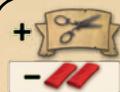
1 Prestige Point for each of your blue Dresses on the Game board.
Gain 1 Livre from the bank for each of your Dresses on the Game board.
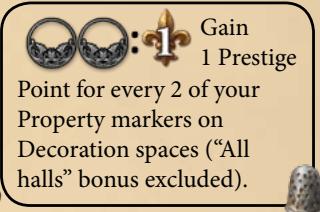
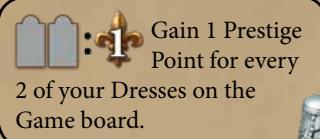
Gain 1 Prestige Point for every 2 of your
Property markers on Decoration
spaces (“All halls” bonus excluded).
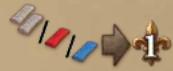
Discard any number of Resource tiles and gain Prestige Points for the bales of silk on them: Each blue bale gives you 1 Prestige Point, each red bale gives you 1 Prestige Point, any combination of 2 bales (green and/or yellow) gives you 1 Prestige Point.
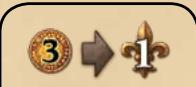
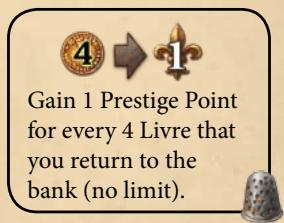
Gain 1 Prestige Point for every 3 Livre that you return to the bank (no limit).

Perform 1 additional “Fund a
Decoration” action (irrespective of your main action) and pay 10 Livre less than the respective Decoration space states.
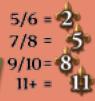
Bonus at the end of the game: Gain an amount of Prestige Points that
depends on the total number of cards in your Employee deck: 5 or 6 cards = 2 Prestige Points, 7 or 8 cards = 5 Prestige Points, 9 or 10 cards = 8 Prestige Points, 11 or more cards = 11 Prestige Points.

Bonus at the end of the game: Gain 3 Prestige Points for each pair of 1 Yarn marker and 1 Lace marker that you return to the general supply.
Bonus at the end of the game: Gain 3 Prestige Points for every 2 of your Dresses on Master Guest spaces.
Bonus at the end of the game:
Gain 2 Prestige Points for each pair of 1 Women's dress and 1 Men's coat that you have on the Game board (irrespective of their colors and where on the Game board they are placed).

A Coin with a white number means: Gain from the bank the amount of Livre shown.

A Coin with a black number means: Pay to the bank the amount of Livre shown.

Credits
Authors: Matthias Cramer, Louis Malz, Stefan Malz | Illustrations: Michael Menzel Rule book and layout: Alfred Viktor Schulz | Rule book revision: Neil Crowley
Copyright: © 2013 eggertspiele GmbH & Co. KG, Friedhofstr. 17, 21073 Hamburg, Germany All rights reserved. | www.eggertspiele.de
Distribution: Pegasus Spiele GmbH, Straßheimer Str. 2, 61169 Friedberg | www.pegasus.de

We wish to thank all testplayers, especially Anke Binnewies, Dennis Egbers, Oliver Westphal, Andy Butz, Regina and Andreas Molter, Hedwig and Wolfgang Heidenheim, Antje and Michael Lauxmann, Ralph Bruhn, Wolfgang Panning, and Ulrich Flaskampf's gaming group. Very special thanks go to Susanne Cramer and Anja Malz.
Download MarkdownTexts are community-compiled or publicly released by publishers; copyright remains with the original authors. For personal reference only.