
Set And Match
At a glance
Rules, cards and Q&A (Chinese)
The rules, card data and player questions for this game are written in Chinese. Open the Chinese page to read them.
Where to find full rules
Full rules and card lookup are available in the cunlema app at cunlema.cn — pick this game and ask about any rule, card or turn you are unsure about.
Related games
Rulebook text (Markdown)
This game has 1 rulebook Markdown file(s) in our library; 1 rendered inline below — expand to read or download.
S_M_V2_A4_LAYED_VC014_PAGES_WEB_ALLsmaller.md103.0 KB
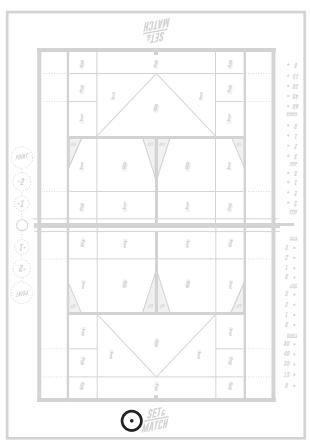
These rules use the figures shown on the VISUAL AID centre pages of this leafllet
SET&MATCH IS A FLICKING,DEXTERITY BOARDGAME THATRECREATES A TENNIS GAME OFFTHE COURT.THIS GAME HEAVILYRELIES ON TENNIS RULES, BUTTHE SPECIFICS EXPLAINED IN THISRULEBOOK WILL ALLOW YOU TOMAKE THE MOST OF YOUR GAME.
THE FLICK
Flicking is at the core of the SET&MATCH experience. Flicking is a quick motion of the finger in order to hit and propel the ball (the yellow pawn). Prolongated contact to push or guide is not considered flicking.
MERCI!
We would like to thank Fréderic Jouhert, Olivia Cohade, Nicolas Séverin, Isabelle Bellet, Laurent Sigonneau et Denis Fornet for their help while developing the game. Also a special thank to Nicolas Bigué at La Maison ludique for his invaluable spirit and his guidance. And thanks to all the ones we forgot that believed in us along the way.


Created by Philippe Latarse and Vincent Chatel, SET&MATCH is the property of Prétexte SAS. Registered since 2017 © 2020- Prétexte SAS All rights reserved. contact@pretexte.co
GAME PLAY
Flick after flick, making the ball slide across the net and within the court’s limits, players compete to win RALLIES, GAMES, and SETS, to ultimately win the MATCH. .
Each player takes position on the short side of the court across one another, and gets attributed the portion of the court directly in front of them, on their side of the NET. They can only flick the pawn beyond the NET on the opponents’ side, and within the court’s limits.
Each stroke will earn the player some stroke points The players calculate their differential advantage within the rally moving the pawn on the RALLY SCORER at their turn. This represents them building adbvantage within the rally.
Every completed rally gives a point to one of the players, which will be reported on the MATCH SCORER. Points are to be counted just like Tennis.
> SEE FIGURE J
SETUP
Install and unfold the board on a flat surface. Ensure that the junction in the middle of the board is perfectly adjusted, so that the ball can slide from one side to the other without any disruption. Place the pawns as shown on figure A.

BALL PAWN
A coloured wooden disc, with a central black dot on the top. Players will stick the felts discs provided under the ball (the non printed side). This will slow down the ball to be truer to sensations on clay surface. (No felt needed on MAXI versions).
RALLY SCORER PAWN
Shared by the two players, it is to be used on the RALLY SCORER, to track the point differential of the stroke points between the players. Each player pushes the pawn towards their opponents’ side by the number of stroke points their last stroke earned them.
SIMPLIFIED RULES I know nothing about Tenhis, I nowt know how scores are kont in a Tennis match.... kep all of this sounds a bit and alicated... no problem, comp can go straight to the simplified rules at the end of these rules.

MATCH SCORER PAWNS*
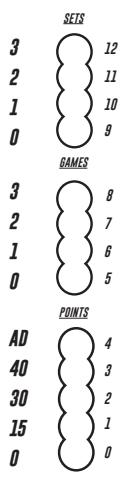
To be placed and used on the MATCH SCORER, they show constantly the live score of the Tennis match (POINTS/GAMES/ SETS) for each player. (These pawns are not in the MAXI version)

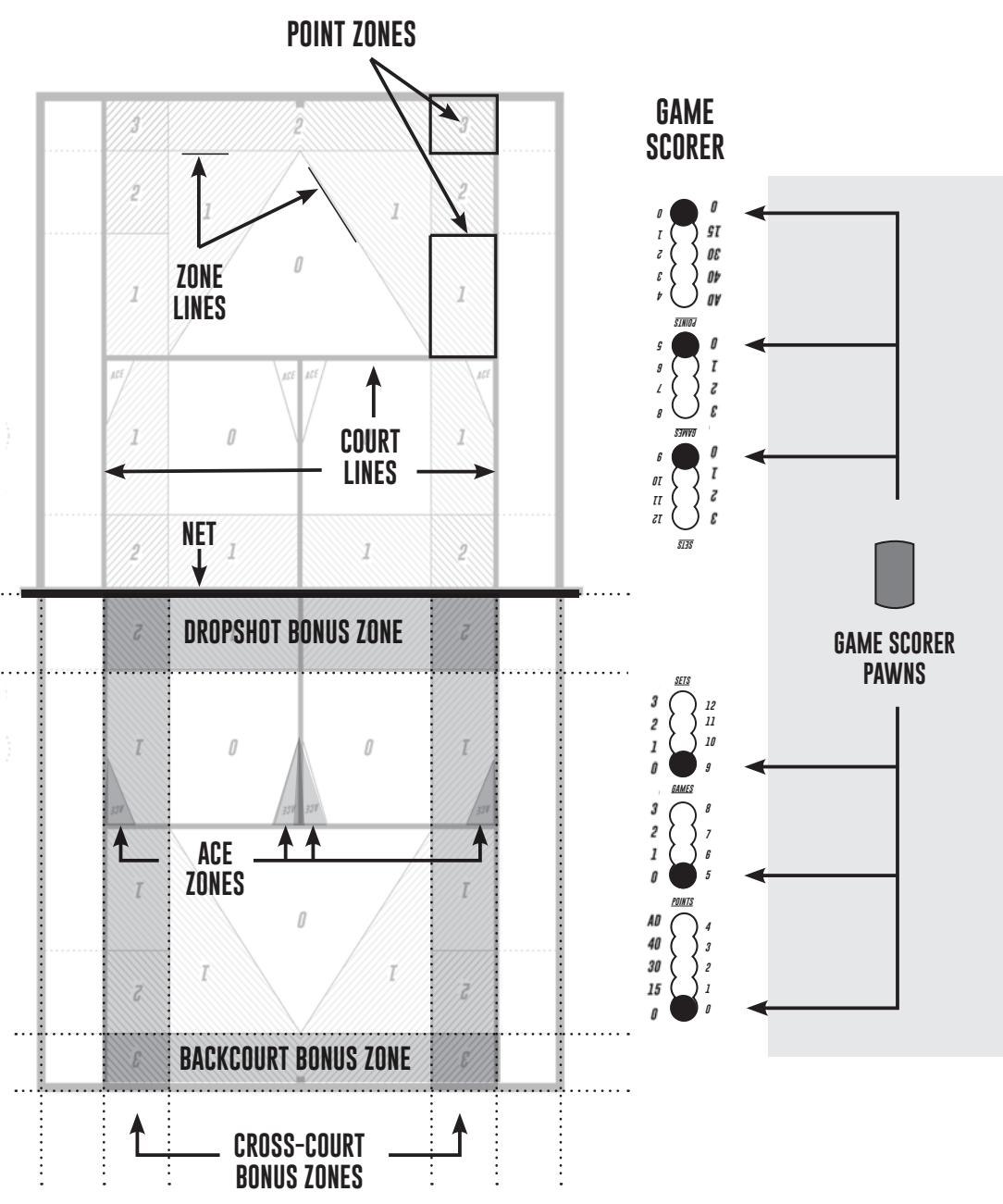
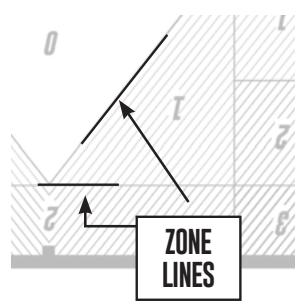
The board represents a tennis court. The net is materialised by the thicker line on the fold of the board. The tennis lines are thicker, while the zone lines are thinner.
Just like Tennis, the rally starts with a serve, and strokes (flicks) are exchanged, while the stroke points are duly reported on the RALLY SCORER.
The rally can end either with a winning shot, either with a fault. Once the rally ended, the winner of the rally adds a point onto his MATCH SCORER
THE SERVE
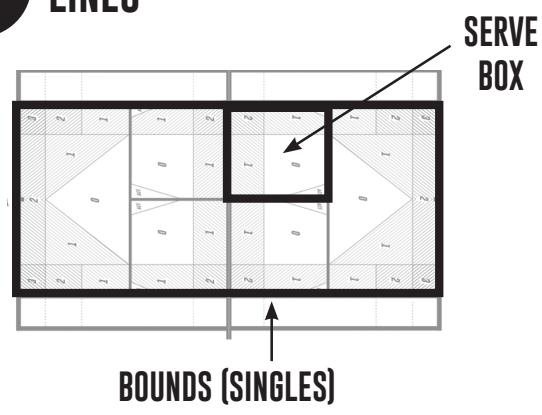
Any rally always starts with a stroke. Just like Tennis players serve during the entirety of a GAME (not the match) , and serve alternatively on the right, then the left of the backcourt middlemark (see figure C). A serve earns Stroke Points just like any other stroke.
BEGINNERS’ RULES
The player has two attempts. If after the second serve, the ball still hasn’t landed in the service box, we will place the ball on the “0” in the box we were aiming at : We start the rally from here without penalties.
NIVEAU CONFIRMÉ
The player has two attempts. If after the second serve, the ball still hasn’t landed in the service box: Double fault, the point is lost.
ADVANCED RULE
In real tennis, a first serve is always stronger, so we will add a 1 stroke point bonus on the RALLY SCORER to the number of PT attributed to the serve.
NB: if the ball lands on the “2” zone of the board, we will still add the 1stroke point bonus and place the pawn into the “POINT”position of the opponent side. The RALLY will start from this position with maximum pressure on the opponent.
ACE
> SEE FIGURE C
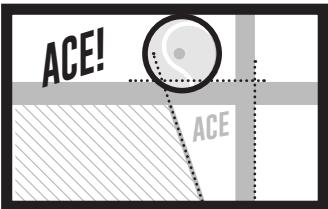
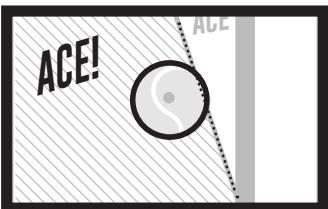
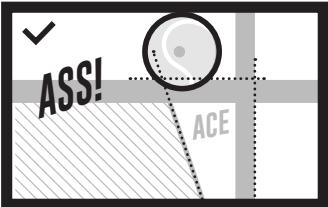
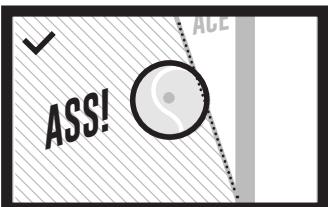
A serve is considered an ACE (a winning serve) when any part of the ball pawn is on one of the ace triangles in the service box the player was aiming at. We use the outer envelope of the ball to define this.
NB: the service box lines around the ACE are also part of the ACE zones. If ACES become to frequent due to players gaining in skills, they can agree to use the black dot on the ball as a reference for ACES, making it more difficult to achieve.
ADVANCED RULE
For similar reasons, scoring an ACE on the second serve won’t give you the POINT directly, but the serving player will place the pawn in the “POINT” position, and the RALLY will start from there, with a big advantage given to the player who just served.
THE RALLY SCORER

After each stroke, the players identify the value of the stroke (how many stroke points are earned) using the black dot at the centre of the pawn. The stroke points are then added to the RALLY SCORER by the player who last played, by pushing the pawn towards the opponent’s side of the scale.
When one of the player succeeds in pushing the pawn on the “POINT” end of the scale... it’s a winning shot (see opposite page)
THE MATCH SCORER
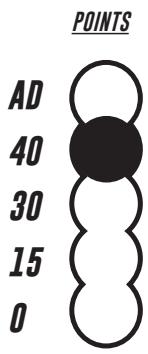
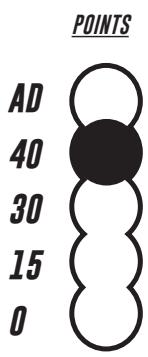
It is the part of the board that allows players to keep track of their points in the match. Each player has his own MATCH SCORER. After each rally a point is to be added to MATCH SCORER by one of the players. On the first rally of the game ,for example the player who won the rally will push his pawn up in the POINTS section from “0” to “15’ ( then “15” to “30” if he wind the next rally, etc.)
Like at tennis, the first player to go over “40” in the point section within the GAME wins the game (except if the players are tied at 40-40, see ADVANTAGE rule below). The first player to win 3 GAMES wins the SET.
> SEE FIGURE F
MATCH SCORER
ADVANTAGE (AD)
When a deuce (40 - 40) happens in a GAME, the next rally won by a player will confer them an ADVANTAGE .Two situations then:

He wins the next rally and wins the GAME
or

He loses the rally and comes back down down to 40 ( back to deuce: 40-40).
Each stroke considered valid (within the court bounds, and beyond the net) earns a player a number of stroke points that is determined by the landing position of the ball in the points zones. Just like Tennis, the place where the ball lands is crucial at SET&MATCH: here are the rules that allow you to judge each stroke...
IMPORTANT: WE MAKE
THE DISTINCTION BETWEEN
THE ENVELOPE OF THE PAWN
AND THE BLACK DOT BEARING
ON THE PRINTED SIDE
OF THE BALL PAWN
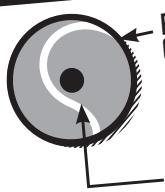
CENTRAL BLACK DOT/BEARING
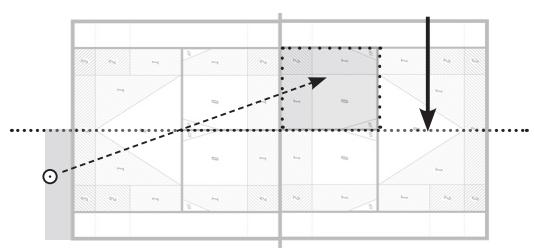
IS THE BALL IN OR OUT?
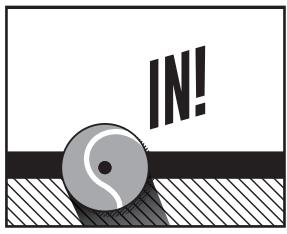
> SEE FIGURE D1
The ball is good if the central black dot has made it beyond the NET and the external shape of the pawn is in the court or touching one of the lines of the court. (see the “FAULTS” section below)
In the example described on figure D, the opponent’s stroke has passed the net and landed within the court... the ball is IN!
WITHIN RALLIESAFTER THE SERVE, THE BALLIS ALWAYS PLAYED FROM WHERETHE LAST STROKE HAS PLACED IT
END OF THE RALLY
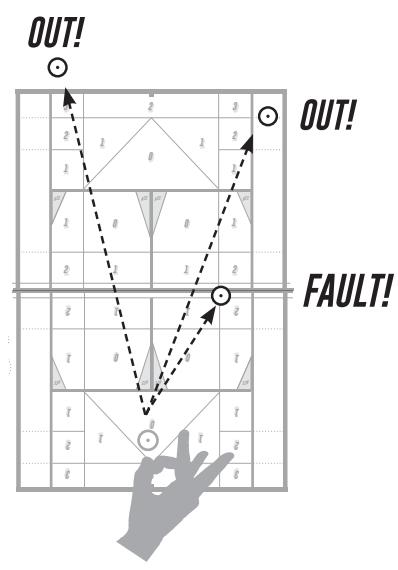
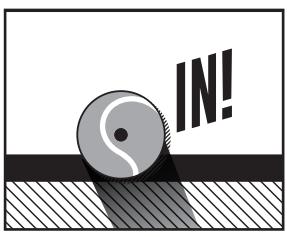
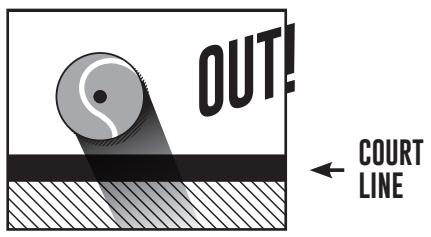
A rally typically ends in two ways: a winning shot, or a direct fault. Any ball that does not make it across the NET, or lands fully outside the courts limits, or is not flicked properly constitutes a direct fault and gives the point to the opponent. Just like tennis, a ball on the line (the shape of the pawn is in contact with the line ), even very lightly, will be considered “IN”.
DIRECT FAULT!
When a player commits a direct fault (OUT OF BOUNDS or NET), we will directly add a point on the opponent’s MATCH scorer

HOW MANY STROKE POINTS DO I GET?
> SEE FIGURE D2
The central black dot bearing helps defining with precision which point zone the ball has landed on. This simply defines how many stroke points. When in doubt, we will always round-up to the superior number of stroke points . If the central black dot bearing is outside the limits of the court, and if the ball is “IN”, we extend the nearest point zones lines to deduct the value.
In the example described on figure D : the stroke is worth 2 stroke points, as the eagle-eye view of the pawn demonstrates
WINNING SHOT...
One of the players accumulates enough stroke points differential that allows him to push his the pawn on the RALLY scorer to the “POINT!” Position.

REPORT THE STROKE POINTS ON THE RALLY SCORER
> SEE FIGURE D3
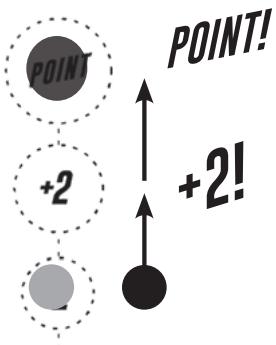
After each stroke, players record the result of their last stroke onto the RALLY SCORER. stroke points by pushing the pawn towards their opponent’s side by the equivalent number of steps on the scale. When one of the player succeeds in pushing the pawn on the “POINT” end of the scale... it’s a winning shot. After every stroke (including serves), players will update the RALLY SCORER from where the pawn was left by the opponent, and put it back to neutral at the end of each RALLY. In the example,the opponent pushes the pawn 2 steps towards me on the RALLY SCORER.
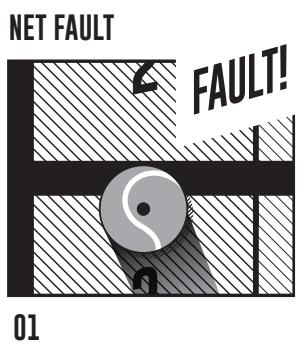
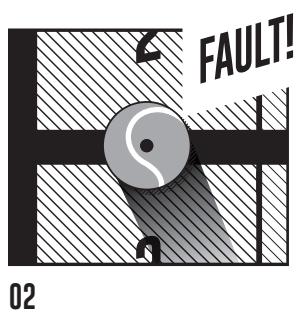
NET FAULTS (“LET”)
When the ball is in contact with the NET line, we follow the cases below:

CASE 1
Neither the ball or the black dot make it passed the NET line: FAULT!

CASE 2
Players who opted and agreed to play the Tie Break should play it according to tennis rules, but in 5 points instead of 7.
The ball hasn’t passed the NET line entirely, and the black dot is touching the line: FAUTE!

CASE 3
The ball hasn’t passed the NET entirely, but black dot has passed the line...LET!
SEE FIGURE H
SEE FIGURE H
TIE BREAK
Tie Breaks are optional in SET&MATCH, when players are tied at 2 GAMES each..
SEE FIGURE H
PLAYING DOUBLES
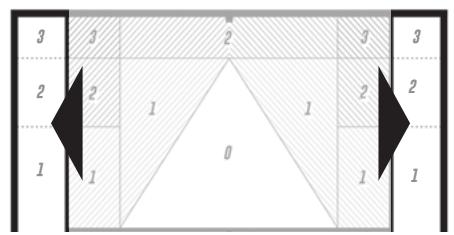
When playing doubles we use the full court as Figure I shows.
SEE FIGURE I
SHIFTING THE ZONES
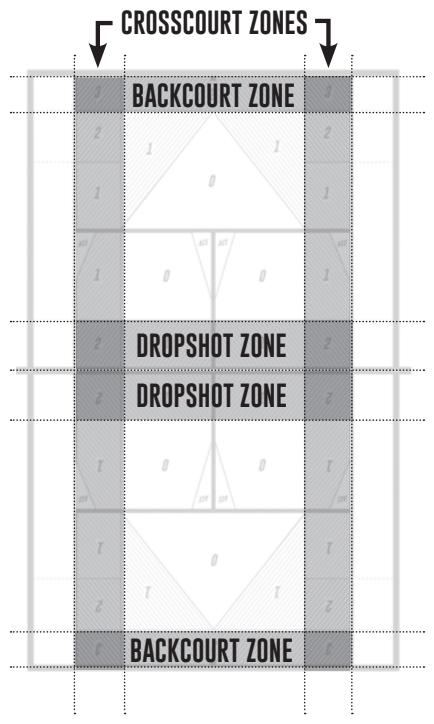
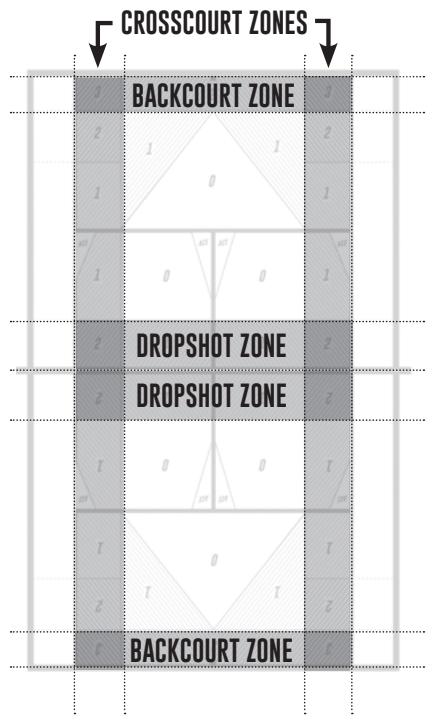
Just like in Tennis we will use the corridors either side of the singles area, which become the point zones, and the CROSSCOURT BONUS zones (seeFIgure I)
PLAYING IN TURNS
As the diagram on Figure I shows, when playing doubles people will play in turns. We can also add the constrain of players not leaving their seats when playing.
BONUSES
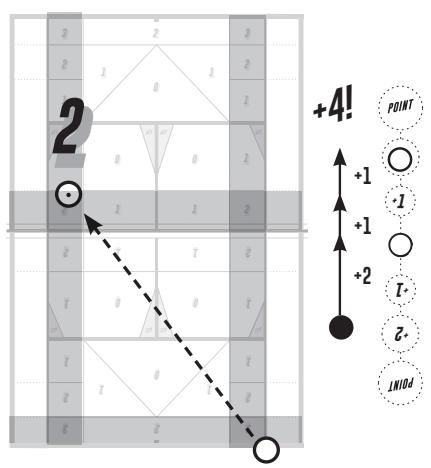
SET&MATCH offers 2 types of bonus shots: “CROSSCOURT BONUS” and the “DROPSHOT BONUS”. Bonuses can be cumulated on one single stroke as shown on the right, where the shot is worth 4 stroke points (2+1+1)
SIMPLIFIED RULES
CROSS-COURT BONUS
When a player completes a stroke from one CROSSCOURT zone on one side of the board to the other CROSSCOURT zone across, he will add a +1 stroke point bonus to the value determined by the black dot on the RALLY SCORER.
DROP-SHOT BONUS
When a player completes a stroke from his backcourt zone to the opponent’s DROPSHOT zone (behind the net ) , he will add a +1 stroke points bonus to the value determined by the black doton the RALLY SCORER. WARNING : a « NET » (see below) on a DROPSHOT gives an extra +1stroke point to the player
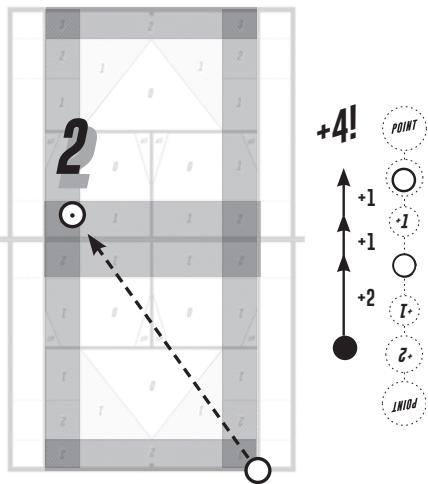
Bonuses can be cumulated on a single stroke. Here the stroke is worth 4 stroke points. It landed into a 2 pt zone, to which we add “+1” of CROSS COURT BONUS, and “+1” of DROPSHOT bonusI.
For the youngest ones, or to speed up the matches, here is a simplified way of playing SET&MATCH... They allow all players to the table,Tennis fans or not...
Simplified rules use the same material as the normal rules.
THIS DOES NOT CHANGE
- Similar set-up
- Same court limits (single and doubles)
- Can be played singles and doubles
- Stroke points are still counted in the RALLY SCORER
THIS DOES CHANGE
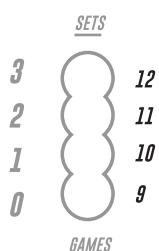
- Matches are played in 12 points
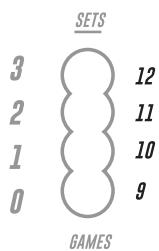
- We count points on the MATCH SCORER from 1 to 12 points (like Ping Pong) using the MATCH SCORER’s simplified scale
- Players serve alternatively every two points point (with two serves)

- Serving in the service boxes is optional
- Counting ACES is optional
- BONUSES are optional.
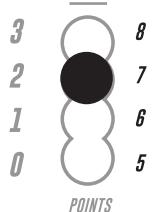
THE OBJECTIVE IS TO SCORE 12 POINTS, PLACING THE SCORER PAWN AT THE TOP OF THE GAME SCORER SIMPLIFIED SCALE (WITHOUT THE TENNIS WAY OF COUNTING THE POINTS (POINTS/GAMES/SETS).
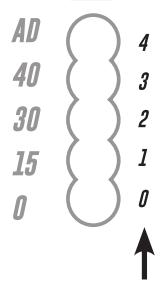
1 scorer pawn per player.
The example above shows the player has 7 points.
SET&MATCH EST UN JEU DE SOCIÉTÉ BASÉ SUR LE TENNIS QUI RECRÉE UN MATCH DE TENNIS HORS DU COURT, À COUP DE PICHENETTES. LE JEU S’APPUIE SUR LES RÈGLES DU TENNIS, MAIS UNE ADAPTATION DE CES RÈGLES VOUS PERMETTRA DE JOUER À SET&MATCH DE LA MEILLEURE DES FAÇONS.
LA PICHENETTE
La pichenette est un coup sec et instantané entre un doigt et le pion balle, dans le but de propulser le pion dans une direction et à une distance voulue. On peut utiliser n’importe quel doigt, mais un seul doigt uniquement. Tout contact prolongé avec la BALLE ne peut être considéré comme une pichenette.
MERCI!
Nous tenons à remercier - entre autres- Fréderic Jouhert, Olivia Cohade, Nicolas Séverin, Isabelle Bellet, Laurent Sigonneau et Denis Fornet pour leur aide dans le développement de ce jeu, ainsi que Nicolas Bigué pour sa collaboration et son spirit. Sans oublier tous ceux que l’on a oubliés.

Créé par Philippe Latarse et Vincent Chatel, SET&MATCH est la propriété de Prétexte SAS. Déposée depuis 2017 ©2020- Prétexte SAS Tous droits reservés. Contact@pretexte.co
Ces règles référencent les planches de schémas (en anglais) au centre de ce livret, intitulées “VISUAL AID”.
BUT DU JEU
À coup de pichenettes, faisant glisser la balle sur le terrain, les joueurs s’affrontent pour remporter les échanges, puis les jeux, puis les sets, afin de remporter le match.
Chaque joueur se place à l’extrémité (courte) du terrain, et se voit attribué une moitié de terrain de son côté du filet (son camp). Il ne peut pitcher que de son camp vers le camp de l’adversaire, envoyant la balle au-delà du filet, dans les limites du terrain. Les joueurs se disputent l’échange coup après coup, en accumulant des points de coup dans le scoreur dans l’échange qui représente l’avantage dans l’échange. Le joueur qui accumule suffisamment de differentiel de point de coups pour atteindre la case POINT! remporte l’echange
Toute faute directe (voir page suivante) met fin à l’échange et donne le l’echange à l’adversaire. Chaque échange remporté sera ajouté sur le tableau de score de match. On comptera les points comme au Tennis dans le tableau scoreur de match.
VOIR FIGURE J
INSTALLATION
Installez le plateau sur une surface plane et lisse: la jonction du milieu (sur le filet) doit être alignée pour que la balle glisse d’un côté à l’autre. Placez les pions sur la planche comme indiqué sur la figure A

PIONS BALLE
Un disque coloré, avec un point de repère central. On collera le disque de feutrine adhésive fourni sur la face non imprimée de la balle pour ralentir légèrement la BALLE. (Pas de feutrine sur la version MAXI)
PION MARQUEUR DANS L’ÉCHANGE
Commun aux deux joueurs, à utiliser sur le scoreur dans l’échange, pour suivre le différentiel de points de coup dans l’échange. Chaque joueur le pousse vers le camp adverse après chaque coup, en fonction des points de coup attribues à chaque pichenette..
RÈGLESSIMPLIFIÉES
lo ne connais pas le Tennis,
Je nis pas compter les points comme au Tennis.... Ettout ca me semble un noE ctomplexe... Rendez-vous peu conde ces règles pour les rèales simplifiées!
PIONS DE SCOREUR DE MATCH À utiliser sur le tableau de score de match, ils indiquent en permanence le nombre de POINTS/JEUX/SETS gagnés par chaque joueur. (Ces pions ne sont pas dans la version MAXI)

Le plateau représente un terrain de Tennis. Le filet matérialisé par la ligne de filet. Les lignes plus larges sont les lignes du terrain de Tennis, les lignes plus fines sont les lignes de zones, propres à SET&MATCH.
VOIR FIGURE B

Comme au Tennis, on sert pour débuter l’échange, et on joue à coup de pichenettes dans l’échange en reportant les points de coups (notés “PC” dans ces regles) dans le scoreur dans l’échange. L’échange se termine soit pas un coup gagnant, soit par une faute. Une fois l’échange terminé, le gagnant inscrit le point dans le tableau de score de match.
LE SERVICE
> VOIR FIGURE C
L’échange commence par un service, et se termine par un coup gagnant, ou une faute. Comme au Tennis les joueurs servent tout un JEU, et servent une fois dans le carrè de service de droite, puis celui de gauche. Comme pour tout coup, des points de coup sont attribues au service, en fonction de la zone ou le coup a atterri, dans le carré.
NIVEAU DÉCOUVERTE
Le joueur dispose de deux services. Si au deuxième service, la balle n’arrive toujours pas dans le carré de service, on place la balle sur le chiffre “0” dans le carré de service concerné: l’échange peut démarrer.
NIVEAU CONFIRMÉ
Le joueur dispose de deux services. Si au bout du deuxième service, la balle n’arrive toujours pas dans le carré de service: double faute, l’échange est perdu.
REGLE AVANCÉE
Au vrai Tennis, le premier service est toujours plus appuyé. On donnera donc au serveur un bons de +1PT sur le nombre de point(s) gagnés par le COUP sur le premier service. NB: Si la balle atterrit dans la zone a 2PTS sur le premier service, le joueur avance directement le pion dans la case “POINT!” du MARQUEUR dans l’échange, mais l’échange continue, avec une pression accrue du joueur adverse sur le retour (si retour en zone “0” : échange gagné par le serveur.)
ACE
> VOIR FIGURE C
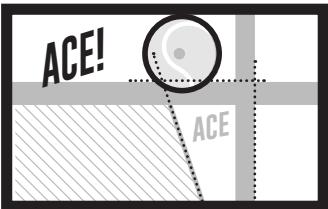
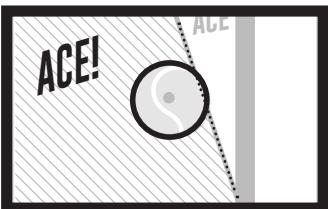
Le service compte comme un ACE (service gagnant) si la BALLE touche n’importe quelle partie de la ZONE D’ACE (voir figure B). Le point est immédiat: on note le score sur le tableau de score de match, puis on engage l’échange suivant.
À noter que l’on utilise le contour externe du pion balle pour déterminer si le service est un ace, et non le point central (voir shéma ci-dessous)
REGLE AVANCÉE
Scorer un ACE lors d’un second service ne donne pas le point directement, puisque les seconds services au Tennis sont moins appuyés. Le joueur place le pion dans la case “POINT!” du marqueur dans l’échange, mais l’échange continue, avec une pression accrue du joueur adverse sur le retour (si retour en zone “0” : échange gagné par le serveur.)
LE SCOREUR DANS L’ÉCHANGE

Après chaque pichenette,
les joueurs identifient la valeur du coup grâce au repère (point noir) au centre de la balle. Les points de coup sont reportés sur le scoreur dans l’échange par le joueur qui vient de jouer. Il pousse alors le pion du scoreur vers l’adversaire du nombre de points collectés par de son coup.
Lorsqu’un des joueurs parvient a placer le pion dur la case “POINT” c’est un coup gagnant (voir ci-contre)
LE TABLEAU DE SCORE DU MATCH
C’est le diagramme qui propose les “POINTS”, “JEUX”, et “SETS”. Chaque joueur a son propre tableau de score. Lorsque qu’un échange est conclu, le joueur qui a remporté l’échange ajoute une unité dans le scoreur de match en déplaçant le pion de “0” vers “15” ( ou de “15”’vers “30”, etc.).
Comme au Tennis, le premier des joueurs à dépasser “40” remporte le jeu (sauf en cas d’égalité a 40-40, voir la regle “AVANTAGE”). Le premier des deux joueurs a remporter 3 jeux remporte un SET.
> VOIR FIGURE F
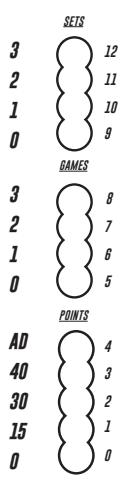
TABLEAU DE SCORE DE MATCH
AVANTAGE (AD)
Lorsque que les joueurs se retrouvent à 40 - 40 dans le scoring d’un JEU, alors le prochain échange gagné donnera l’AVANTAGE au joueur. Deux situations ensuite :
il remporte encore l’échange et il gagne le JEU
ou

il perd l’échange et il redescend à 40 - 40 (égalité).

Chaque coup considéré comme bon (dans les limites du terrain, et au-delà du filet) rapporte un nombre de points de coup déterminé par la position d’arrivée de la balle dans les zones de points. Comme au Tennis, l’endroit où la balle “atterrit” est crucial à SET&MATCH, voici les règles qui permettent d’arbitrer chaque coup.
LA BALLE EST-ELLE BONNE OU FAUTE?
> VOIR FIGURE D1
Elle est bonne si le repère du pion balle (le point noir central a passé le filet). L’enveloppe externe du pion balle est dans le court ou en contact avec une des lignes qui limitent le terrain. (voir la section FAUTE ci-dessous)
Dans l’exemple: Le coup de mon adversaire a passé le filet, et a atterri dans les limites du terrain: la balle est bonne.
DANS L'ÉCHANGE, APRES LE SERVICE LA BALLE ÉST JOUEE DU POINT EXACT OU LE DERNIER CUUP DE L'ADVERSAIRE L'A LAISSEE.
FIN DE L’ÉCHANGE
Un échange peut se terminer de deux façons: par un coup gagnant ou une faute directe. Toute balle qui ne passe pas la ligne de filet, atterrit complètement en dehors des limites, ou est mal pitchée constitue une faute directe et donne le point à l’adversaire. Comme au Tennis, toute balle (l’enveloppe externe de la balle) qui touche la ligne, même très légèrement, est bonne.
FAUTE DIRECTE!
Un des joueurs commet une faute directe (HORS LIMITES ou FILET). On inscrit les points sur le tableau de score de match.
VOIR FIGURE H
TIE BREAK
Le Tie Break est optionnel a SET&MATCH en cas d’égalité à deux jeux partout.
Les joueurs ayant décidé de jouer le Tie Break à 2 jeux partout joueront ce Tie Break selon les règles du Tennis, mais en 5 POINTS au lieu de 7.
COMBIEN DE POINTS DE COUP?
> VOIR FIGURE D2

Le repère central sur la balle indique dans quelle zone de points la balle a atterri, et combien de points on reporte sur le scoreur dans l’échange. En-cas de doute, on donnera toujours le nombre de points de coup supérieur. À chaque coup (meme au service), on devra donc mettre à jour le scoreur dans l’échange, et le remettre en position neutre à la fin de chaque échange. Si le repère central est en dehors du court, mais que la balle est ‘bonne’, on etendra les lignes de zones les plus proches pour determiner le nombre de points.
Dans l’exemple: le coup vaut 2 points, comme le montre la vue de haut du plateau, ou le repere central est clairement dans une zone ”2”.

COUP GAGNANT...
Au cours de l’échange, sur un retour de balle, si un des joueurs remporte suffisamment de points de coup pour atteindre la zone “POINT” sur le marqueur, alors il conclue l’échange par un COUP GAGNANT.
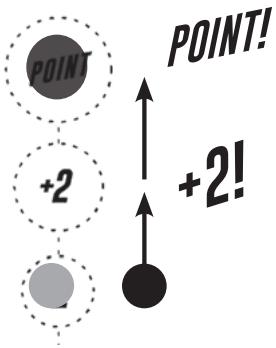
VOIR FIGURE E
COMPTER LES POINTS DE COUP DANS L’ECHANGE
> VOIR FIGURE D3
Après chaque pichenette, les joueurs identifient le nombre de
grâce au repère (point noir) au centre de la balle. Les points de coup sont reportés sur le scoreur dans l’échange par le joueur qui vient de jouer: Il pousse le pion du scoreur vers l’adversaire du nombre de points collectés.
Si un joueur parvient à pousser le pion sur la case « POINT!» dans le camp de l’adversaire : c’est un coup gagnant qui met fin à cette échange et lui donne le point.
Dans l’exemple: mon adversaire pousse le pion de deux points vers moi sur l’echelle du scoreur dans l’echange.
FAUTES DE FILET (“LET”)
Lorsque toute partie de la balle est en contact avec le filet, on applique la logique ci-dessous:

CAS 1
La balle, et son point central ne franchit pas la ligne de filet: FAUTE!

CAS 2
La balle ne franchit pas la ligne de filet, le point central est sur la ligne... FAUTE!

CAS 3
La balle ne franchit pas la ligne de filet entièrement, mais le point central a dépassé la ligne...LET!
VOIR FIGURE H
JOUER EN DOUBLE
En double, on joue dans les limites du terrain ci-dessous, en étendant les zones de points aux couloirs de double.
PROLONGEMENT DES ZONES DE POINTS
Pour jouer en double, comme au Tennis on utilisera les couloirs de double, et on étendra les zones de points aux couloirs de double.
VOIR FIGURE I
ORDRE DE TOURS
On jouera en alterné comme le montre la figure I. En jouant assis autour d’une table, on peut ajouter la contrainte de ne pas quitter son siège.
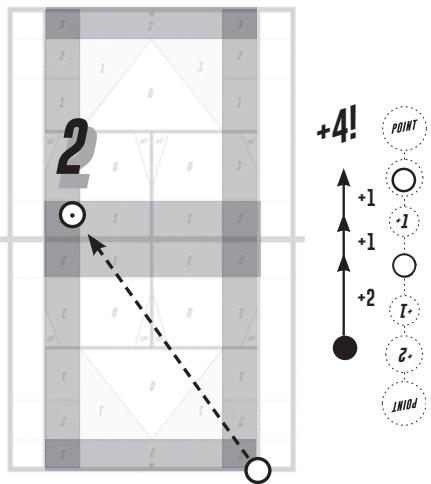
LES BONUS
SET&MATCH offre deux types de coups bonifiés à ajouter à n’importe quel coup: le bonus “COUP-CROISE” et le “BONUS D’AMORTI”. Les bonus sont cumulables comme dans l'exemple de coup a 4PTS sur la droite.

BONUS DE COUP CROISÉ
Lorsqu’une balle part de la zone de COUP CROISÉ à la zone de COUP CROISÉ opposée, ce coup rapporte un point de coup supplémentaire sur le marqueur dans l’échange.
BONUS D’AMORTI
De la même facon, un coup qui part de la ZONE DE FOND DE COURT, et atterrit dans la ZONE D'AMORTI rapporte à son auteur un point de coup supplémentaire: c'est un AMORTI.
ATTENTION : un « NET » sur ce coup AMORTI apporte un +1pt supplémentaire à son auteur. S’excuser reste fair play...
Les bonus sont cumulables: Ici le coup rapporte 4PTS a son auteur. Le coup se pose dans une zone a 2PTS, a laquelle il faut ajouter “+1PT” de bonus de COUP CROISE, et “+1PT” de bonus d’AMORTI.
RÈGLES SIMPLIFIÉES
Pour les plus jeunes, ou pour rendre les parties plus rapides, voici une version simplifiée de SET&MATCH...
Elle utilise le même matériel, et permet a tous et toutes de profiter du jeu, familiers avec le Tennis, ou pas.
CE QUI NE CHANGE PAS
- On installe de la même facon
- On joue dans les limites du terrain
On joue en simple ou en double
- On comptabilise les points dans l’échange
CE QUI CHANGE
- L’objectif est d’arriver tout ten haut de l’échelle de score: 12pts
- On comptabilise les points de 1 a 12pts (façon Ping Pong) en utilisant le scoreur de match avec son échelle simplifiée
- Les joueurs servent deux échanges de suite (avec deux services), avant de changer de serveur. On change a chaque resultat pair dans le scoreur (ex: 2-0, 1-1, 5-3 etc.)

- Servir dans les carrés de service est optionnel - Comptabiliser les ACE est optionnel
- Les bonus sont optionnels.
L’OBJECTIF EST D’ARRIVER TOUT EN HAUT DE L’ÉCHELLE DE SCORE. CELA CORRESPOND À UNE PARTIE EN 12PTS GAGNANT (SANS PASSER PAR LA COMPTABILITÉ COMPLEXE PTS/JX/SET DU TENNIS)
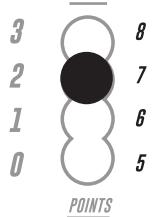
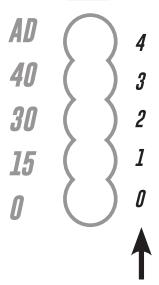
SCOREUR SIMPLIFIÉ
1 pion de score par joueur. Dans l’example ci-dessous, le joueur a 7pts.

Die folgenden Regeln beziehen sich auf die Abbildungen der (englischsprachigen) ‘VISUAL AID’-Seiten, die du in der Mitte dieser Anleitung finden kannst. Um die Nutzung dieser Seiten für dich einfacher zu gestalten haben wir bei manchen Schlagworten deren englischen Titel in Klammern direkt dahinter vermerkt.
BEI SET&MATCH HANDELT ES SICH UM EIN SCHNIPP-GESCHICKLICHKEITS-SPIEL, WELCHES DAS GEFÜHL EINES TENNISSPIELS AUF DEN SPIELTISCH PROJIZIERT. ES BASIERT STARK AUF DEN ORIGINALEN TENNISREGELN, ABER MIT HILFE DIESER ANLEITUNG WIRST DU AUCH OHNE VORKENNTNISSE LERNEN, DAS SPIEL ZU MEISTERN!
DAS SCHNIPPEN
Das Schnippen ist das Kernelement einer SET&MATCH-Partie. Als “Schnippen” bezeichnen wir die schnelle Bewegung eines Fingers gegen den Ball (den gelben Spielstein), mit dem Ziel, diesen zu treffen und durch die Wucht des Aufpralls voranzutreiben. Ein längerer Kontakt zum Ball, das Schieben oder gar das Führen des Balls mit dem Finger über das Spielfeld gilt nicht als Schnippen.
DANKE!
Unser Dank geht an Fréderic Jouhert, Olivia Cohade, Nicolas Séverin, Isabelle Bellet, Laurent Sigonneau und Denis Fornet, die uns sehr bei der Entwicklung des Spieles geholfen haben. Ganz besonders möchten wir uns an dieser Stelle auch noch bei Nicolas Bigué von ‘La Maison ludique’ für seinen unschätzbaren Geist und seine Führung bedanken. Danke auch an all jene, die immer an uns geglaubt - und die wir hier schlicht vergessen - haben.

Gegründet von Philippe Latarse und Vincent Chatel, SET&MATCH ist Eigentum der Prétexte SAS. Eingetragenes Markenzeichen seit 2017 © 2020- Prétexte SAS Alle Rechte vorbehalten. contact@pretexte.co
SPIELÜBERSICHT
Schnipp um Schnipp versuchen die Spieler den Ball über das Netz auf die gegnerische Seite zu befördern um so BALLWECHSEL (RALLIES), SPIELE (GAMES), SÄTZE (SETS) - und zu guter Letzt - das MATCH zu gewinnen.
Die Spieler setzen sich dazu an den kurzen Spielfeldseiten gegenüber und bekommen den Bereich des Spielbretts zwischen ihnen und dem NETZ (NET) als ihre Seite des Platzes zugewiesen. Sie müssen den Ball um zu punkten über das NETZ aus ihrem Bereich heraus auf die gegnerische Seite schnippen - und dabei natürlich auch die Grenzen des Platzes beachten.
Jedes erfolgreiche Schnippen verschafft einem Spieler sog. Schlagpunkte, welche es ihm ermöglichen, den Wertungsstein im BALLWECHSEL-WERTUNGSBEREICH zu seinen Gunsten zu bewegen und so einen Vorteil innerhalb des Ballwechsels aufzubauen. Schafft es ein Spieler, einen Ballwechsel für sich zu entscheiden, so bekommt er einen Punkt, den er in seinem MATCH-WERTUNGSBEREICH festhält. Die Zählweise dieser Punkte entspricht der Zählweise beim echten Tennis (0-15-30-40).
SIEHE ABBILDUNG J
SPIELAUFBAU (SET-UP)
Klappe das Spielbrett auf und lege es auf eine flache Oberfläche. Gehe dabei sicher, dass die Spielbrettmitte völlig plan ist, so das der Ball ohne daran anzuecken von der einer zur anderen Seite geschnippt werden kann. Lege dann die Spielsteine wie in Abbildung A gezeigt darauf.

BALL-SPIELSTEIN
VERFINFACHTE REGELN
Joh habe keine Ahnung von Tech na bch weiß nicht, wie das Tennis. ir Wertung funktioniert a mit d überhaupt klingt das alles sehr kompliziert!
K.in Problem. Springe direkt zu Kein Prebinfachten Regeln ans Ende dieser Anleitung.
Eine farbige Holzscheibe mit einem mittig aufgedruckten, schwarzen Punkt. Unter den Ball müssen einmalig die mitgelieferten Filzaufkleber geklebt werden (auf dessen unbedruckte Seite; in der MAXI-Version nicht notwendig). Dies sorgt für eine Verlangsamung des Balls und gibt den Spielern so das Gefühl, auf einem echten Sandplatz zu spielen. Es liegt ein Ersatzball bei.
MATCH-WERTUNGSSTEINE
Diese werden im MATCH-WERTUNGSBEREICH platziert und zeigen dort konstant die aktuellen Matchwertungen (POINTS/ GAMES/SETS) beider Spieler an (in der MAXI-Version werden keine Match-Wertungssteine benötigt).
BALLWECHSEL-WERTUNGSSTEIN
Beide Spieler teilen sich diesen Spielstein. Er wird im BALLWECHSEL-WERTUNGSBEREICH dazu eingesetzt, die Punktedifferenz der Schlagpunkte beider Spieler festzuhalten. Ein Spieler bewegt den Stein für jeden der von ihm erreichten Schlagpunkte ein Feld in Richtung seines Gegners.

Der Tennisplatz. Die breite Linie auf der Mittelfalz ist das NETZ (NET), die anderen breiten Linien (LINES) stellen die Tennislinien (=Platzgrenzen; die inneren Seitenlinien für das Einzel, und die Äußeren für das Doppel) dar. Die dünnen Linien markieren die einzelnen Zonen.
SIEHE ABBILDUNG B
Wie auch im richtigen Tennis beginnt der Ballwechsel im Spiel mit einem Aufschlag. Danach wechseln die Spieler sich mit ihren Schlägen (Schnippaktionen) ab, wobei ihre erzielten Schlagpunkte permanent im BALL-WECHSEL-WERTUNGSBEREICH mitgezählt werden.
Der Ballwechsel (RALLY) kann auf zwei Arten enden: Durch einen Punktgewinn oder einen Fehler.
In beiden Fällen bewegt der Gewinner am Ende des Ballwechsels seinen Wertungsstein im MATCH-WERTUNGSBEREICH um ein Feld weiter.
DER AUFSCHLAG (SERVE)
> SIEHE ABBILDUNG C
Zu Beginn eines jeden Ballwechsels steht der Aufschlag. Der Spieler, der den Aufschlag ausführt, wechselt - wie man es vom Tennis kennt - nach jedem Spiel (GAME; nicht zu verwechseln mit MATCH). Der Aufschlag findet hinter der eigenen Grundlinie (BACKCOURT) statt und wird abwechselnd von rechts und links (beginnend rechts) in die schräg gegenüberliegende SERVICE BOX des Gegners ausgeführt (siehe Abbildung C). Ein Aufschlag kann - wie auch alle anderen Schläge - dem Spieler Schlagpunkte sichern.
REGEL FÜR ANFÄNGER
Der Spieler hat zwei Versuche. Schafft er es auch nach dem zweiten Versuch nicht, den Ball in die schräg gegenüberliegende SERVICE BOX des Gegners zu schnippen, so legt er ihn stattdessen direkt auf die “0” dieser SERVICE BOX. Dann ist sein Gegner an der Reihe. Der aufschlaggebende Spieler erfährt hierdurch keinerlei Nachteile.
REGULÄRES SPIEL
Der Spieler hat zwei Versuche. Schafft er es auch nach dem zweiten Versuch nicht, den Ball in die schräg gegenüberliegende SERVICE BOX des Gegners zu schnippen: Doppelfehler (siehe nächste Seite). Der Punkt geht an den Gegner.
REGEL FÜR FORTGESCHRITTENE
Im echten Tennis ist der erste Aufschlag immer stärker als der zweite Aufschlag, deshalb bekommt der Spieler 1 Bonus-Schlagpunkt, wenn er es schafft, bereits den ersten Aufschlag regelkonform in die Service Box des Gegners zu schnippen.
Landet der Ball durch den Aufschlag in der “2”-Zone, so platzieren wir den Wertungsstein im BALLWECHSEL-WERTUNGSBEREICH auf “+2”. Durch den Bonus-Schlagpunkt rutscht er um eine Position weiter hoch auf das ‘POINT’-Feld. Dies beendet den Ballwechsel aber nicht und der Spieler erhält somit auch keinen Punkt (POINT) im Match-Wertungsbereich - ein einzelner Schlagpunkt würde aber nun zum Punktgewinn führen, was den Gegner bereits zu Beginn maximal unter Druck setzt!
ASS (ACE)
> SIEHE ABBILDUNG C
Ein Aufschlag wird auch Ass (oder Aufschlagpunkt) genannt, wenn der Spieler es schafft, dabei den Ball in eine der mit ACE beschrifteten Dreiecke in der SERVICE BOX des Gegners zu schnippen. Um ein Ass zu erzielen reicht es aus, dass der Ball mit mindestens seinem äußeren Rand eine solche ACE-Zone berührt. Der Spieler bekommt dafür sofort einen Punkt (POINT; nicht: Schlagpunkt) und ein neuer Ballwechsel beginnt.
Achtung: Die Linien der Service Box rund um die ACE-Zone gelten ebenfalls als Teil dieser Zone. Sobald die Spieler erfahrener sind und Asse gefühlt zu häufig vorkommen können sie sich darauf einigen, dass zum Ermitteln eines Asses die Position des schwarzen Punktes auf dem Ball (statt dessen Außenrand) herangezogen wird.
REGEL FÜR FORTGESCHRITTENE
Wie bereits erwähnt ist im Tennis immer der erste Aufschlag stärker. Aus diesem Grund bekommt der aufschlaggebende Spieler für ein Ass beim zweiten Aufschlag den Punkt (POINT) nicht direkt gutgeschrieben. Er platziert zwar den Wertungsstein im Ballwechsel-Wertungsbereich auf dem Feld POINT, beendet den Ballwechsel aber nicht und erhält somit auch keinen Punkt (POINT) im Match-Wertungsbereich - ein einzelner Schlagpunkt würde aber nun zum Punktgewinn führen, was dem Spieler für diesen Ballwechsel einen großen Startvorteil beschert.
BALLWECHSEL-WERTUNGSBEREICH
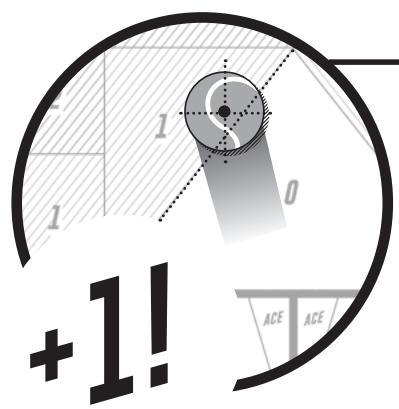
Nach jeder ausgeführten Schnippaktion +1: (also jedem ‘Schlag’) prüft der Spieler deren Wert und ermittelt so, wie viele Schlagpunkte er sich dadurch verdient hat. Dazu schaut er, in welcher Zone sich der schwarze Punkt (Ball-Oberseite) befindet. Die in dieser Zone aufgedruckten Schlagpunkte nutzt der Spieler dann, um den Wertungsstein im Ballwechsel-Wertungsbereich (IN-RALLY SCORER) eine entsprechende Anzahl von Feldern in Richtung seines Gegners zu verschieben.
Sobald ein Spieler es schafft, den Wertungsstein auf das “POINT”-Feld seines Gegners zu schieben, ist dies für ihn ein Punktgewinn (siehe nächste Seite; Ausnahmen: siehe ‘Regel für Fortgeschrittene’ für Aufschlag und Ass).

MATCH-WERTUNGSBEREICH
Jeder Spieler hat auf dem Spielbrett seinen eigenen MATCH-WERTUNGSBEREICH, den sog. GAME SCORER. Diesen nutzt er, um seine erreichten Punkte innerhalb eines Matches festzuhalten. Nach jedem Ballwechsel bekommt der Spieler, der diesen für sich entscheiden konnte,einen Punkt (POINT), den er im MATCH-WERTUNGSBEREICH durch das Verschieben des Wertungssteines in der Kategorie POINTS markiert. Nach dem ersten Ballwechsel des Spieles würde der siegreiche Spieler so seinen Wertungsstein im Punktebereich (POINTS) von “0” auf “15” setzen (bzw. von “15” auf “30”, wenn er den nächsten Ballwechsel gewinnt).
Wie beim Tennis gewinnt der Spieler, der über 40 Punkte (POINTS) kommt, das Spiel (GAME; Ausnahme: Vorteil (Advantage; AD) - siehe unten) - er verschiebt den Wertungsstein in der Kategorie GAMES um eins nach oben. Der Spieler, der zuerst 3 Spiele (GAMES) gewinnt, gewinnt den Satz (SETS). Das Spiel gewinnt, wer 3 Sätze (SETS) gewonnen hat.

> SIEHE ABBILDUNG F
MATCH-WERTUNGSBEREICH
VORTEIL (ADVANTAGE; AD)
Kommt es im Spiel zu einem sog. Einstand (40:40), so wird der darauf folgende Punkt (POINT) eines Spielers als Vorteil (Advantage; AD) bezeichnet und der Wertungsstein auf das Feld AD gesetzt. Es gibt dann für diesen Spieler zwei Möglichkeiten:
Er gewinnt den nächsten Ballwechsel und gewinnt somit das Spiel (GAME)
oder
er verliert den nächsten Ballwechsel und wird zurück auf die “40” verschoben. Es kommt wieder zu einem Einstand (40:40).

(IN THE RALLY) Jeder regelkonforme Schlag (= jede Schnippaktion, die auf dem Spielbrett innerhalb der Platzgrenzen aka Tennislinien endet UND über das Netz hinüber ging) bringt seinem Spieler eine gewisse Anzahl an Schlagpunkten. Diese Anzahl wird von der Zone festgelegt, in welcher der Ball nach dem Schnippen gelandet ist, deshalb ist es - wie beim echten Tennis - auch bei SET&MATCH sehr wichtig, wo der Ball aufkommt. Die folgenden Regeln helfen dir dabei, den Ball abhängig seiner Position zu werten:
WICHTIG: WIR UNTERSCHEIDEN ZWISCHEN DEM AUSSENRAND DES RALL-SPIELSTEINS UND DEM SCHWARZEN PUNKT, DER MITTIG AUF DIE OBERSEITE DIESES SPIFLSTEINS GEDRUCKT IST.

SCHWARZER PUNKT AUE DER BALLMITTE
IST DER BALL IM FELD ODER IM AUS?
> SIEHE ABBILDUNG D1
Der Ball gilt als “im Feld” (IN!), wenn der schwarze Punkt sich nach dem Schnippen auf der gegnerischen Spielfeldseite (also hinter dem Netz) und der Außenrand des Balls sich innerhalb der Platzgrenzen (Tennislinien) befindet oder diese berührt (ansonsten ist er im Aus (OUT!): siehe ‘FEHLER!’).
Im Beispiel (Abbildung D) ging der Schlag über das Netz und landete innerhalb der Platzgrenzen...der Ball zählt als “im Feld”!
WÄHREND EINES BALLWECHSELS - NACH DEM AUFSCHLAG - WIRD DER RALL IMMER VON DER POSITION AUS GESPIELT, ZU DER ER ZUL ETZT GESCHNIPPT WURDE.
ENDE DES BALLWECHSELS
Ein Ballwechsel endet typischerweise auf eine von zwei Arten:
1) Punktgewinn, oder 2) Fehler.
Jeder Ball, der es nicht über das Netz (NET) schafft und vollständig außerhalb der Platzgrenzen (Tennislinien) landet (oder nicht korrekt geschnippst wurde) führt zu einem Fehler, was dem Gegner einen direkten Punkt (POINT) beschert. Wie im Tennis gilt ein Ball “auf der Linie” (der Spielstein berührt - wenn auch nur ganz leicht - die Platzgrenze) als “im Feld”.
FEHLER! / DOPPELFEHLER (FAULTS)
Begeht ein Spieler einen Fehler (Ball im Aus [OUT] bzw. Netz [NET]) oder Doppelfehler (beide Aufschlagversuche schlagen fehl) so bekommt sein Gegner sofort einen direkten Punkt (POINT) auf seinem MATCH-WERTUNGSBEREICH.
SIEHE ABBILDUNG H
WIE VIELE SCHLAGPUNKTE BEKOMME ICH?
> SIEHE ABBILDUNG D2
Der schwarze Punkt auf dem Ball-Spielstein zeigt präzise an, auf welcher Punktezone sich der geschnippte Ball befindet und wie viele Schlagpunkte der Spieler, der die Schnippaktion ausgeführt hat, bekommt. Im Zweifelsfall (wenn der Punkt z.B. genau zwischen zwei Zonen auf die Linie zeigt) wird immer auf die jeweils höhere Schlagpunktezahl aufgerundet. Befindet sich der schwarze Punkt außerhalb der Platzgrenzen (= Tennislinien) obwohl der Ball noch “im Feld” ist (da sich sein Außenrand auf oder innerhalb der Platzgrenze befindet), so nutzen wir die dem Ball nahegelegenste Zone zur Ermittlung der Schlagpunktezahl!
Betrachten wir uns das Beispiel in Abbildung D einmal aus der Vogelperspektive (D2), so sehen wir, dass die Schnippaktion des Spielers 2 Schlagpunkte wert ist.
PUNKTGEWINN (WINNING SHOT)
Einer der Spieler hat genug Schlagpunkte gesammelt, so dass er über diese im BALLWECHSEL-WERTUNGSBEREICH den Wertungsstein auf die gegnerische “POINT!”-Position verschieben konnte. Der Ballwechsel endet sofort und dieser Spieler bekommt einen Punkt (POINT) im MATCH-WERTUNGSBEREICH gutgeschrieben.
VERMERKE DEINE > SIEHE ABBILDUNG D3 SCHLAGPUNKTE IM BALLWECHSEL-WERTUNGSBEREICH
Nach jeder Schnippaktion vermerkt der aktive Spieler das Ergebnis seines letzten “Schlags” im BALLWECHSEL-WERTUNGSBEREICH. Dazu verschiebt er den Wertungsstein dort von dessen aktueller Position für jeden einzelnen ergatterten Schlagpunkt ein Feld in Richtung seines Gegners. Der Wertungsstein wandert im Laufe eines Ballwechsels also zwischen den Spielern hin und her. Sobald ein Spieler es schafft, den Wertungsstein auf das “POINT”-Feld seines Gegners zu schieben, ist dies für ihn ein Punktgewinn (Ausnahmen: siehe ‘Regel für Fortgeschrittene’ für Aufschlag und Ass). Am Ende des Ballwechsels wird der Wertungsstein zurück auf die neutrale Mittelposition gesetzt.
Das Beispiel in Abbildung D3 zeigt, wie der Wertungsstein im BALLWECHSEL-WERTUNGS-BEREICH 2 Felder in Richtung des unteren Spielers verschoben wird.
NETZ (NET)
SIEHE ABBILDUNG H
Berührt der Ball nach der Schnippaktion die Netzlinie, so handeln wir wie folgt:

FALL 1
Weder der Ball noch der schwarze Punkt darauf haben die Netzlinie überquert. Der schwarze Punkt berührt die Netzlinie nicht: FEHLER!

FALL 2
Der Ball hat die Netzlinie nicht komplett überquert. Der schwarze Punkt berührt das Netz: FEHLER!

FALL 3
Hat der Ball hat die Netzlinie nicht komplett überquert, der schwarze Punkt hingegen schon, so kommt es zu einem LET! Handelte es sich um einen Aufschlag, so wird dieser einfach ohne Nachteile für den Spieler wiederholt. Bei einem normalen Schlag bekommt der Spieler zusätzlich zu den Schlagpunkten durch die Ballposition +1 Schlagpunkt, dann fährt sein Gegner mit dem Ballwechsel fort.
TIE-BREAK
EIN DOPPEL SPIELEN (DOUBLES)
Ein Tie-Break ist bei SET&MATCH optional. Um noch näher an den echten Tennisregeln dran zu sein kann ein Tie-Break gespielt werden, wenn beide Spieler je 2 Sätze (SETS) gewonnen haben.
Einigen sich die Spieler darauf mit Tie-Break zu spielen, so entfällt ab sofort die Zählweise mit 15, 30, 40 Punkten. Jeder Punktgewinn und Fehler führt zu 1 Punkt. Ein Tie-Break ist dann gewonnen, wenn ein Spieler mindestens fünf solcher Punkte gewinnt und dabei mindestens zwei Punkte Vorsprung zu seinem Gegner hat. Das Aufschlagrecht wechselt jeweils, wenn die Summe der gespielten Punkte ungerade ist.
Wird ein Doppel gespielt, so benutzen wir dafür den gesamten Platz, wie in Abbildung I gezeigt.
DIE ZONEN ERWEITERN
Wie beim echten Tennis nutzen wir bei einem Doppel die äußeren statt der inneren Platzgrenzen (auf den beiden langen Spielbrettseiten). Diese werden sowohl zu Punktezonen (die jeweiligen Punktezonen werden bis zu den äußeren Seitenlinien verlängert), wie auch zu den CROSS-BONUSZONEN (siehe nächste Seite).
SIEHE ABBILDUNG I
ABWECHSELND SPIELEN
Wie in Abbildung I (SERVER ORDER) zu sehen, spielen die Spieler bei einem Doppel abwechselnd. Optional - um den Schwierigkeitsgrad etwas zu erhöhen - kann es den Spielern zusätzlich verboten werden, während des Spiels von ihrem Platz aufzustehen.
BONI (BONUSES)
In SET&MATCH gibt es 2 Arten von “Bonusschlägen”: Den “CROSS-BONUS” und den “STOPPBALL-BONUS”. Beide Boni können mit einer einzigen Schnippaktion erreicht werden, wie du dem Beispiel rechts entnehmen kannst.
CROSS-BONUS (CROSSCOURT)
Schnippt ein Spieler den Ball von der eigenen CROSSCOURT-Zone in die schräg gegenüber liegende CROSSCOURT-Zone des Gegners, so bekommt er +1 Schlagpunkt als Bonus (zusätzlich zu den Schlagpunkten, die von der Position des schwarzen Punktes vorgegeben werden)gutgeschrieben.
STOPPBALL-BONUS (DROPSHOT)
Schnippt ein Spieler den Ball von seiner BACKCOURT-ZONE in die DROPSHOT-Zone seines Gegners (dies ist der Bereich direkt hinter dem Netz) , so bekommt er +1 Schlagpunkt als Bonus (zusätzlich zu den Schlagpunkten, die von der Position des schwarzen Punktes vorgegeben werden) Beachte: Ein «LET» (siehe vorherige Seite: NETZ) im Rahmen eines STOPPBALLS gibt dem Spieler selbstverständlich noch einen weiteren Schlagpunkt (für das LET) extra!

Boni sind kumulativ, d.h. sie addieren sich. Der Schlag im Beispiel ist 4 Schlagpunkte wert. Der Ball landete in einer 2-Punkte-Zone. Darauf addieren wir “+1” CROSS-BONUS und noch einmal “+1” als STOPPBALL-Bonus, was insgesamt zu den 4 Schlagpunkten (2+1+1) führt.
VEREINFACHTE REGELN
Für die Jüngsten unter uns - oder um das Spiel zu beschleunigen - kommt hier eine vereinfachte Version von SET&MATCH, die keinerlei Tennis-Vorwissen voraussetzt und somit Neulinge wie auch Kenner an einen Tisch bringt.
Für das Spiel nach diesen Regeln wird das gleiche Spielmaterial wie auch für das normale Spiel benötigt.
DIES ÄNDERT SICH NICHT:
- Der Spielaufbau bleibt gleich.
- Es können Einzel oder Doppel gespielt werden
- Die Platzgrenzen bleiben gleich (Einzel & Doppel)
- Die Punkte werden wie gehabt im BALLWECHSEL-WERTUNGSBEREICH gezählt
DAS HIER ÄNDERT SICH:
- Ein Match wird über 12 Punkte gespielt
- Wir zählen die Punkte im MATCH-WERTUNGS-BEREICH von 1 bis 12 (wie beim Tischtennis). Dazu benutzen wir die vereinfachte Match-Wertungsskala.
- Die Spieler wechseln sich alle 2 Punkte mit dem Aufschlag ab (je 2 Aufschläge)
- Der Ball muss beim Aufschlag nicht in der Service Box landen
- Asse (ACES) sind optional
- BONI sind optional
DAS SPIELZIEL IST ES, 12 PUNKTE ZU ERLANGEN. DER WERTUNGSSTEIN MUSS DAS OBERSTE FELD DER MATCH-WERTUNGSSKALA ERREICHEN.WIR VERZICHTEN AUF DAS ZÄHLEN NACH DEN TENNIS-REGELN (POINTS/GAMES/SETS).

VEREINFACHTE MATCH-WERTUNGSSKALA
1 Wertungsstein pro Spieler. Der Spieler in dem obigen Beispiel hat 7 Punkte.
SET&MATCH VISUAL AID

SET-UP


B LINES
PRÉTEXTE
Created by Philippe Latarse and Vincent Chatel, SET&MATCH is the property of Prétexte SAS. Registered since 2017 © 2020- Prétexte SAS All rights reserved. Contact@pretexte.co
SERVE
CENTRAL LINE

IN THE RALLYD
In the example on the right, a typical stroke is played. the three steps described below help you judge how many points to attribute to a particular stroke within the rally.

IS THE BALL GOOD OR FAULT?
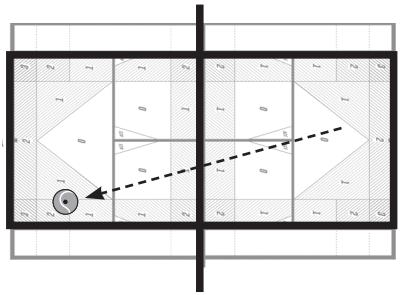
The opponent stroke has landed the ball beyond the net, and within the limits of the court: It is good. We use the shape of the ball pawn to judge.
HOW MANY POINTS FOR THIS STROKE?
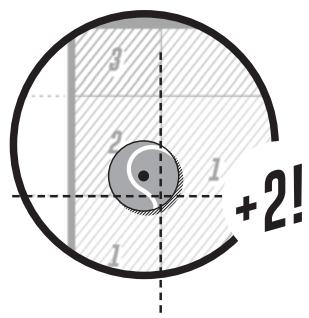

This stroke is worth 2 stroke points, an eagle-eye view of the board clearly shows it, using the black dot to judge.

PUT THE POINTS IN THE RALLY SCORER
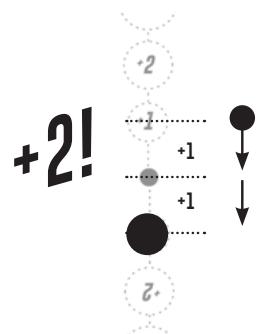
The 2 stroke points are added on the rally scorer, always pushed towards the opponent’s side, towards the “POINT!” position.
IMPORTANT:
WE MAKE A BIG DIFFERENCE BETWEEN THE SHAPE OF THE BALL PAWN (1) AND THE CENTRAL BLACK DOT ON THE BALL PWAN (2)

1 EXTERNAL ENVELOPE/SHAPE OF THE BALL PAWN.
2 POINT / CENTRAL BEARING ON THE BALL
INTERESTING CASES

If the ball is good, but lands in a place where the black dot it outside the court, we count the stroke points from the nearest point zone.

When aiming for the serve box, the serve can be good, even if the black dot is outside of the serve box. We count the stroke points from the nearest point zone.

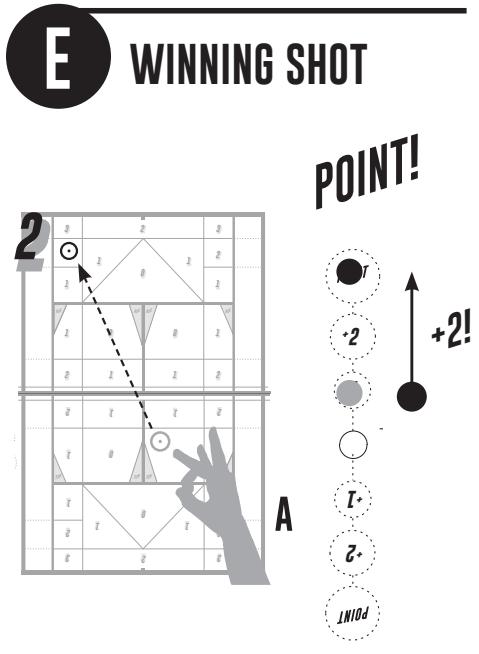
In this example, player A gets 2 stroke points, thanks to their stroke, increasing his advantage in the rally from +1 to “POINT!” (+3) in the rally scorer. It’s a winning shot.
GAME SCORER3322

PLAYER A
PLAYER B
Player A leads 2 sets to 0, and in0 the third set. player B leads11 2 games to 1, and the score is 30 to 15 for player A.
BONUSES
Bonuses can be cumulated on a single stroke. Here the stroke is worth 4 stroke points. It landed into a 2PTS zone, to which we add “+1PT” of CROSSCOURT BONUS, and “+1PT” of DROPSHOT bonusI.

FAULTS
DIRECT FAULT


DOUBLES

DOUBLES COURT’S BOUNDS
EXTENDING THE POINT ZONES
SERVE ORDERS

1/
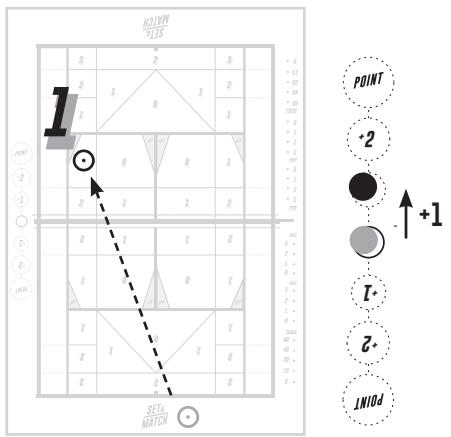
2/
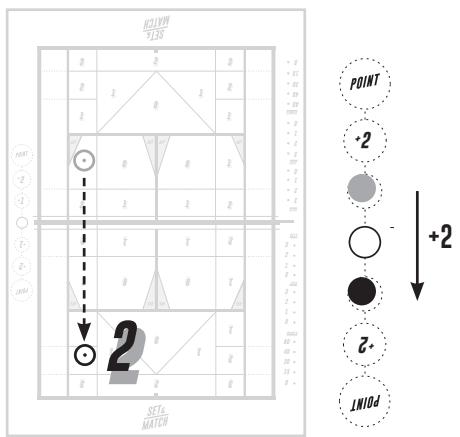
Player B answers with a stroke in11 a 2pt zone (adding 2 stroke points00 22 on the RALLY SCORER)11
Player A serves in a 1pt zone in the service box. (adding 1 stroke point on the RALLY SCORER)
3/

Player A strikes back hitting a 1pt zone, with an extra 1 stroke points CROSSCOURT bonus
4/
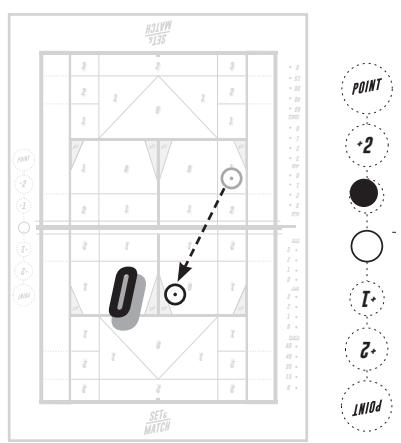
Player B strikes back hitting a 0 pt zone.11 no stroke points added00
5/
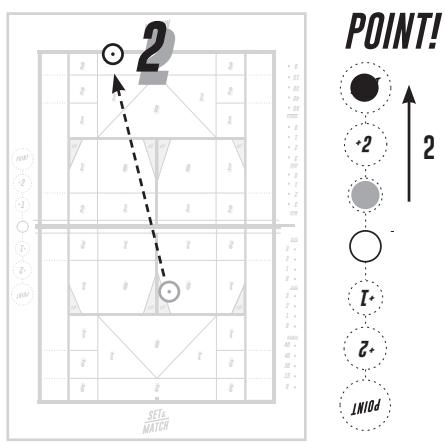
Player A makes the winning shot, striking back in a 2pt zone, he adds 2 stroke points to the rally scorer, and onto the “POINT” circle. He wins the rally, and he can add a point to the game scorer.
6/
The rally-scorer pawn is placed back in1 the neutral position, a new rally is about0 AD to start, Player A is about to serve.22
SET&MATCH È UN GIOCO DI TOCCO E DESTREZZA CHE RICREA UNA PARTITA DI TENNIS SUL VOSTRO TAVOLO. SI BASA PRINCIPALMENTE SULLE REGOLE DEL TENNIS, MA ADATTATE PER RENDERLO UN’ESPERIENZA UNICA
LA “SCHICCHERA”
Imparare a colpire la palla con un tocco delle dita è alla base di SET&MATCH. La “schicchera” è un movimento veloce del dito fatto in modo da colpire la palla (la pedina gialla). Toccare la palla in maniera prolungata o accompagnandola non è consentito.
GRAZIE!
Ringraziamenti particolari vanno a Fréderic Jouhert, Olivia Cohade, Nicolas Séverin, Isabelle Bellet, Laurent Sigonneau e Denis Fornet per il loro aiuto nello sviluppo del gioco. Inoltre un ringraziamento speciale va a Nicolas Bigué (La Maison ludique) per la sua guida e la sua incredibile energia. E grazie a tutti coloro che hanno creduto in noi fin dall’inizio.
Un ringraziamento particolare va a Nicolò Giovenzana e Spartaco Albertarelli per la traduzione in italiano.

Creato da Philippe Latarse e Vincent Chatel, SET&MATCH è di Prétexte SAS. Registrato dal 2017 © 2020 - Prétexte SAS. Tutti i diritti riservati. contact@pretexte.co
Questo regolamento internazionale,
usa le immagini mostrate nella sezione centrale VISUAL AID, che è scritta in inglese. Per avere esempi in italiano,
utilizzate le indicazioni presenti sul sito www.kaleidosgames.com
SVOLGIMENTO
Tocco dopo tocco, mandando la palla oltre la rete, ma dentro i limiti del campo, i giocatori si sfidano per vincere SCAMBI, GAME, SET e alla fine il MATCH.
I giocatori prendono posizione ‘in campo’ mettendosi sul lato corto del tabellone, uno di fronte all’altro. La propria metà campo è quella di fronte al giocatore ed è delimitata dalla RETE. E’ possibile toccare la palla solo per mandarla oltre la RETE e nella metà campo avversaria.
Ogni colpo potrebbe far guadagnare al giocare dei punti pressione. Durante lo scambio i giocatori tengono traccia del vantaggio accumulato muovendo a
Content is long; only the first part is inlined. Download the file or open the rules page for the full text.
Download MarkdownTexts are community-compiled or publicly released by publishers; copyright remains with the original authors. For personal reference only.