
Spots
At a glance
Rules, cards and Q&A (Chinese)
The rules, card data and player questions for this game are written in Chinese. Open the Chinese page to read them.
Where to find full rules
Full rules and card lookup are available in the cunlema app at cunlema.cn — pick this game and ask about any rule, card or turn you are unsure about.
Related games
Rulebook text (Markdown)
This game has 1 rulebook Markdown file(s) in our library; 1 rendered inline below — expand to read or download.
Spots rulebook 2nd edition.md15.4 KB
SPOTS
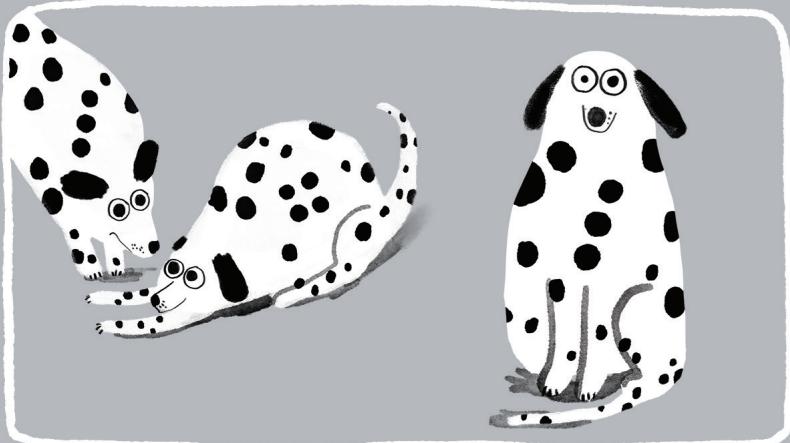
Dogs have spots.
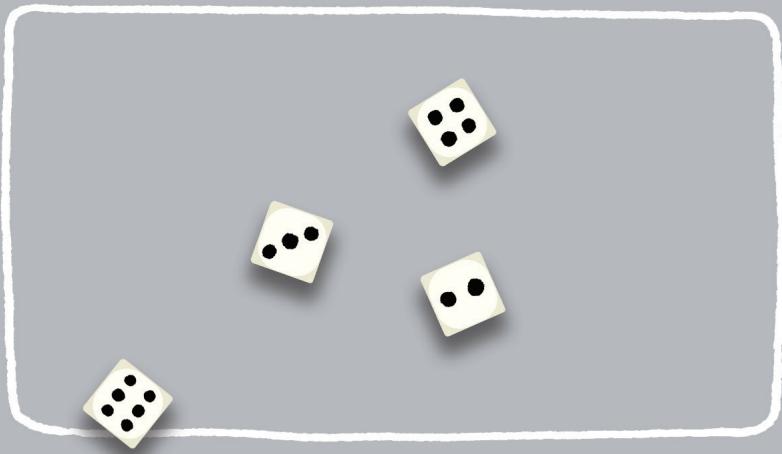
Dice have spots.
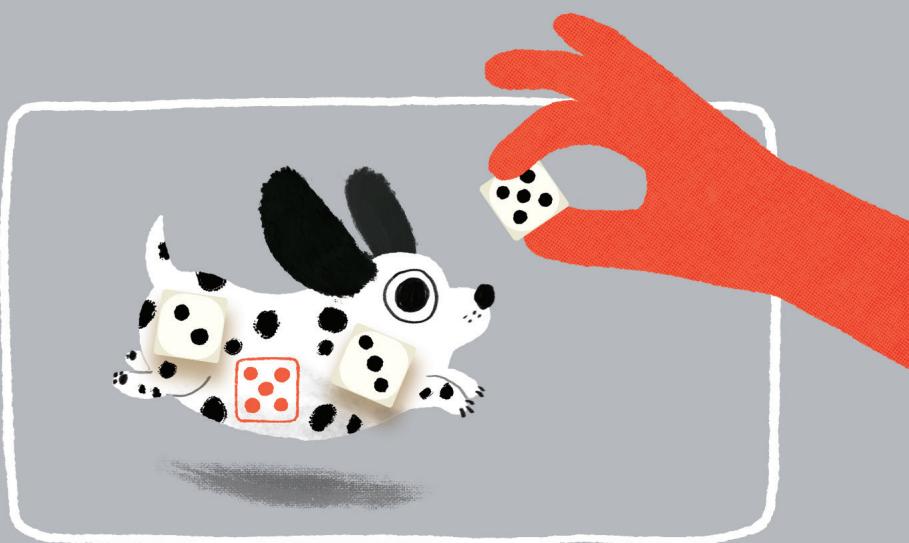
Place your dice on the right spots.
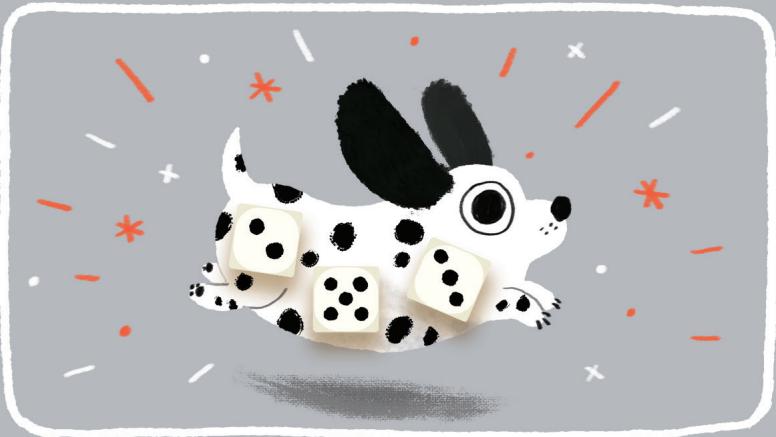
Complete your dogs to score them!

Dice you can’t place get buried in your yard.
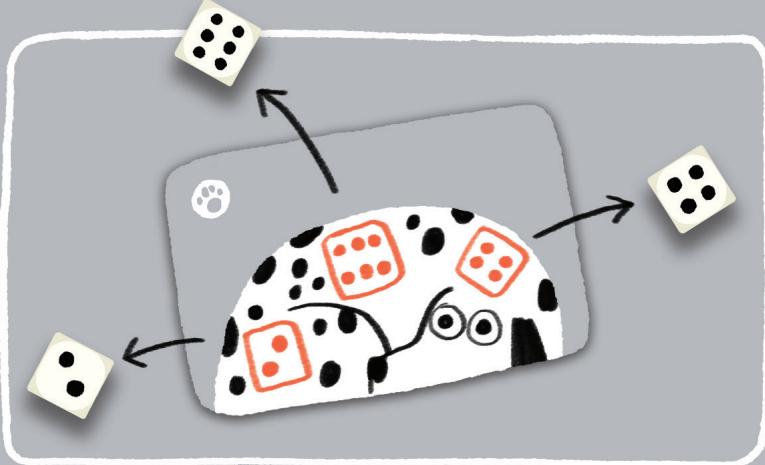
Bury too many spots and you bust.
Score 6 dogs and you win!
Setup
- Take these 6 trick tiles out of the box:

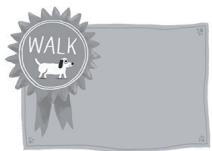
HOWL


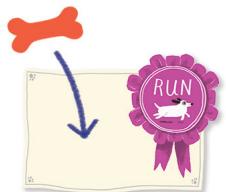
RUN

ROLL OVER

FETCH

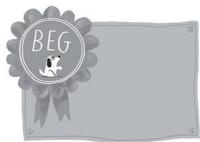
BEG
Put them faceup in the middle of the table, like above. Don’t worry about the other tiles yet—they’re for adding variety in future games.
-
Take out the deck of dog cards, shufle it, and deal 2 dog cards to every player, gray side up. This is your dog pack! Put all the remaining dog cards in the middle of the table, gray side up.
-
Put all the dice and treats in piles where everyone can reach them. It can be messy. You’re dogs.
-
Each player takes 1 yard, 1 treat, and 1 die. Everyone rolls their die and buries it in their yard. Here’s what each player will have in front of them:
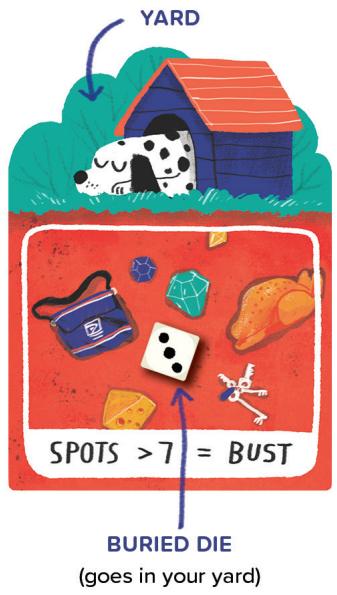
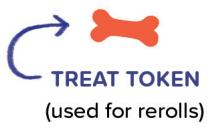
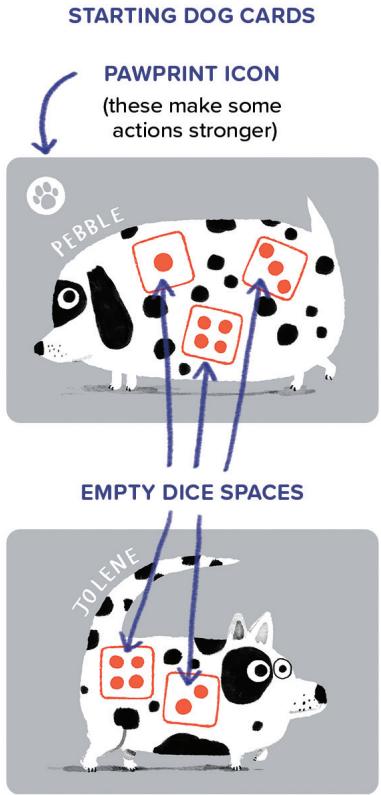
- Whoever has the highest buried die goes first. If there’s a tie for highest, those players reroll. Now you’re ready to play!

How to Play Spots
In Spots, players take turns in clockwise order. On your turn, you can choose to either (1) do a trick or (2) score your dogs.
On most turns, you’ll be doing a trick:
Do a Trick
Choose any of the faceup trick tiles (at the beginning of the game, they all start faceup).





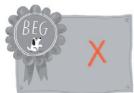
Example: In this situation below, you have two faceup actions to choose from, WALK or RUN.
After you choose a faceup tile, flip it facedown and follow all steps on it in the order they are listed.
STEP 1
STEP 2
Roll 3 dice THEN
You may roll 1 die. You may repeat this second step as many times as you want.

rolling and placing dice
Most tricks involve rolling dice and then placing them on your dogs. Whenever you need to roll dice, take them from the common pile, unless the trick tile says otherwise.
After you roll, you may place those dice on matching spaces on any of your dogs, i.e. a die showing 4 spots can go on any space that also shows 4 spots. Any rolled dice that you can’t (or don’t want to) place, must be buried in your yard instead.

Example: You choose the Run trick tile (shown at the left), and begin by performing the first step, which tells you to roll 3 dice. You take 3 dice from the common pile, roll them, and get a 3, 4, and 6. You can place the 3 and 4 dice on your dogs, but have to bury the 6 in your yard, since there aren’t any 6 spaces on your dog.
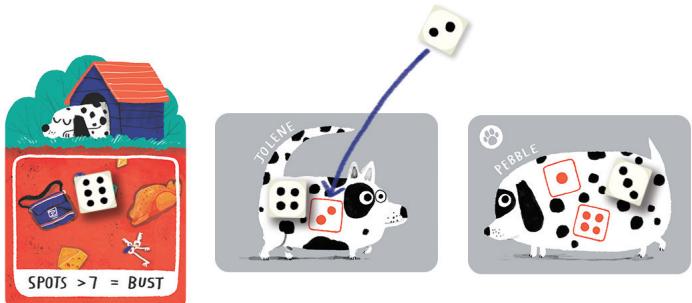
Example, cont: You move on to the second step of the Run trick tile, which is optional because it says you may do it. You decide to roll a die. You get a 2 and place it on a dog. Since the second step is repeatable, you have the option to do it again and roll another die, but you decide to stop instead.
spending treats
Treats are great, because they let you reroll your dice!
Immediately after rolling—but before placing or burying them—you can always choose to reroll all of the dice you just rolled by spending 1 treat. Here’s how it works:
• You must reroll ALL the dice in the roll, not just the dice you don’t like.
• There’s no limit to the number of treats you can spend in a turn. As long as you have enough treats to spend, you can keep rerolling until you get a result you like.
• You can only spend treats to reroll your most recent roll.
Example: Consider the situation on page 9, where you rolled a 3, 4, and 6. You can place the 3 and 4, but you have nowhere to place the 6, so you would have to bury it instead. You decide to spend a treat and redo the roll. As a result you reroll ALL of the dice, including the 3 and 4 you could have otherwise placed.
busting
If you can’t (or don’t want to) place a die on a dog, you must bury it in your yard instead. And if the total number of spots on your buried dice is more than 7, you bust!
When you bust, this happens:
• Your turn ends immediately, even if you haven’t finished performing all the steps on the trick tile.
• Discard all dice placed on your dogs.
• Discard all of your buried dice.
Of course, you can use treats to try to prevent this—rerolling happens before burying dice—but if you can’t or don’t want to spend treats to prevent a bust, then you’re out of luck.

• Steps are mandatory unless they say you “may” do it.
• If you can’t perform a step for some reason, e.g. you choose Roll Over but have no buried dice, then simply skip it.
• If you can’t perform the first step, that does not prevent you from still performing the second step.
• Some steps on tiles say you can repeat them (such as Run, pictured earlier). That means you can do that step of the trick as many times as you want (or until you bust)!
• Some trick tiles become stronger based on how many are on your dog cards.
• If a step tells you to place or bury multiple dice, you can do a mix of both, placing some and burying others.
• After you roll dice, place or bury all of those dice before moving on to any other roll. See examples below for two in-game situations that this applies to.
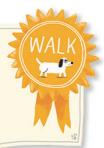
EXAMPLE 1: You choose Walk and roll 2 dice. After spending any treats, you must place or bury those initial 2 dice before moving on to the second step and deciding if you want to roll 1 more die.
EXAMPLE 2: You choose Bolt, and set aside 3 dice. Since the tile instructs you to roll the dice 1 at a time, you must place or bury each die before moving on to the next one.
resetting the trick tiles
Eventually, only one trick tile will be faceup. If you start your turn and only have 1 trick to choose from:
-
Place 1 treat from the supply on the only faceup trick tile (the treat will go to the next player who chooses this trick).
-
Flip all of the trick tiles faceup. You can now choose from any of them!







Scoring your dogs is how you win the game! And since scored dogs are never at risk when you bust, it helps you steadily make progress.
There are two ways to score your dogs:
slow and steady
On your turn—instead of doing a trick—you can score your dogs! When you do:
-
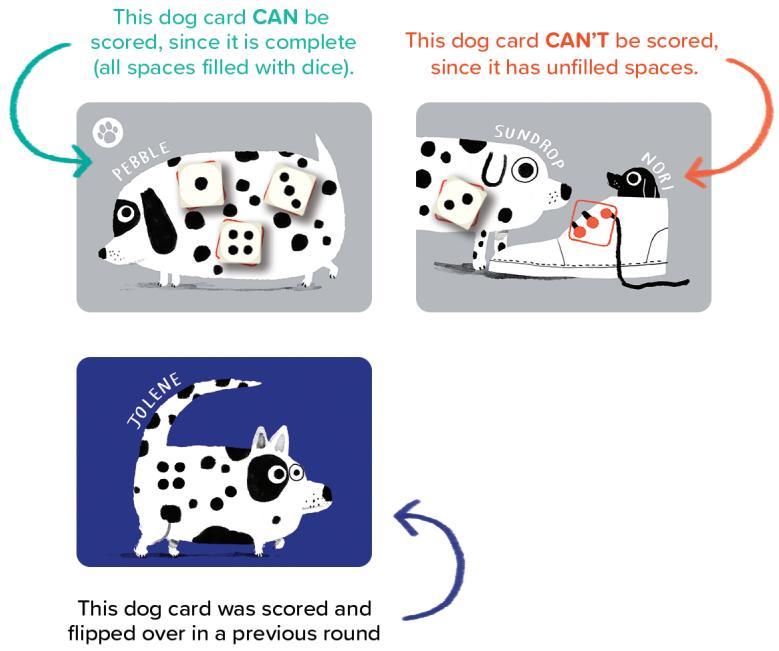
Discard ALL dice on your completed dog cards (cards that have all their spaces filled with dice) and flip them over to show that they’ve been scored.
-
For each dog card you scored this turn, draw the top card of the dog deck and add it your pack, gray side up.
A couple important details about scoring...
• You must have at least one completed dog card to score. You can’t just score to avoid doing a trick.
• When you score, you must score ALL completed dogs cards, not just certain ones.
fast and risky
If you ever complete ALL of your faceup dog cards while doing a trick, score them instantly!
This is a reward for being brave…or just lucky.
When you score this way, do it the exact same as “slow and steady” above (discard the dice, flip the dogs, draw new dogs). The only diference is, unlike slow scoring, you don’t have to spend a whole turn doing it!
• To do Fast and Risky scoring, you must first place or bury all the dice from your most recent roll. If that roll causes you to bust, you will not get to score!
• After Fast and Risky scoring, be sure to finish your current trick. If you still have a second step of a trick tile to perform, or are in the middle of a repeatable step (like the second step of Run), draw your new dogs and keep going!
six dog card limit
You can never have more than 6 dog cards, counting both scored and unscored cards. If you ever should draw above that amount, stop drawing once you’ve reached that limit of 6.
Example: if you have 5 dog cards and score 2 of them, you will only draw 1 new dog card, since drawing the second one would put you above 6.
Winning the Game
The first player to have 6 scored dog cards wins immediately!
Other Things to Know
running out of dice or treats
If you need to take dice or treats but not enough are available, simply take what you can, even if that number is less than what the trick requires.
In the extremely rare case that zero dice are available at the start of your turn, all players immediately bust and lose all of their dice! Afterwards, continue your turn as normal.
adding variety to future plays
After you’ve played with the first set of trick tiles, go ahead and mix things up by using some of the other tiles provided.
• Always include Howl and Roll Over.
• Include 1 additional tile from each of the 4 color categories (each color also has a diferent rosette style). They can be selected randomly, or you can use one of these recommended sets:
• Adoption Event: Walk, Run, Fetch, Beg
• Dog Park: Dig, Chase, Guard, Chew
• Agility Course: Trot, Bolt, Fetch, Gobble
• Hunting Grounds: Retrieve, Sprint, Hunt, Stay
• Kennel Club: Track, Dogpile, Search, Beg
• Puppy Pen: Retrieve, Bolt, Scavenge, Play Dead
off leash hours variant
This is a variant for people who don’t mind a slightly more chaotic game. Use ALL the trick tiles! Trick tiles of the same color should be stacked on top of each other in a random order. When you use a tile, flip the top trick tile of the stack. When it comes time to reset the tiles, any facedown tiles are not only flipped faceup but also moved to the bottom of the stack. Note that this does not apply to Howl and Roll Over, which are always in play.
solo mode
You will play against an AI opponent named d0g. d0g starts with 1 treat, no yard, and no dogs. You go first. On d0g’s turn, roll a die. Imagine the trick tiles are labeled 1-6:
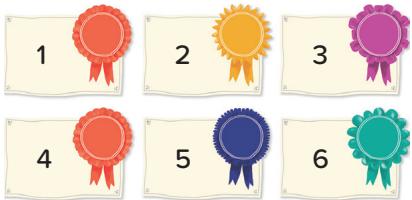
The die result indicates a specific tile. If the tile is faceup, d0g flips it facedown, taking any treats on it. If the tile is facedown, d0g scores the top card of the dog deck instead.
If d0g starts its turn with only 1 faceup tile, first reset the tiles like you would for your own turn. If d0g ever has at least 2 treats, it returns 2 and scores the top card of the dog deck.
You win if you score 6 dogs. You lose if d0g scores 6. Adjust dificulty by starting d0g with more or less treats.
Credits
lead game design Jon Perry
development and design Alex Hague & Justin Vickers
art John Bond
game design consultant Montana Graboyes
art and design consultant Kristen Leach
namer of dogs Sophie Abromowitz
thank you
Cardstock ‘21, Alisa Daar, Jonathan Daar, Josh Freeman, Alex Hart, Brian Henk, Game Makers Guild, Eric Garneau, Sara Glenn, Chris Grote, Hasting Johnson, Mary Johnson, Wesley Johnson, Doug Maccaferri, Mark McGee, Steven Ness, Luca Pimentel, Fiona Pongratz, Daniel Pool, Regina Salazar, Spencer Saunders, Unpub, Joey Vigour, James Woodbury.
Need help with anything else? Visit www.spotsthegame.com for clarifications or email us at hello@cmyk.games.

Quick Reference
On your turn, choose one of these two actions:
do a trick
• Select a faceup trick tile, flip it, and perform all steps on it in order.
• If a step says “may” you don’t have to do it.
• Some steps say you may repeat it until you decide to stop (or bust).
score your dogs
• Discard all dice on completed dogs and turn those dogs facedown.
or
• Draw 1 new dog for each dog scored, but stop once you have 6 total scored and unscored dog cards.
when rolling dice
• Take them from the common pile, unless the tile says otherwise.
• If you spend a treat, you have to reroll ALL the dice you just rolled. You can’t just choose the ones you don’t want.
• After you finish rolling (and spending treats), place or bury all dice before continuing to any other rolls.
other really important rules
• When there’s only 1 faceup trick tile left, put 1 treat on the last faceup tile and then flip all trick tiles faceup.
• If all the spaces on all of your dogs are filled, score them all immediately without spending a turn!
• You bust if your buried dice add up to more than 7. When this happens, end your turn and discard all buried dice and dice on your dogs.
Download MarkdownTexts are community-compiled or publicly released by publishers; copyright remains with the original authors. For personal reference only.