
Sunflower Valley
At a glance
Rules, cards and Q&A (Chinese)
The rules, card data and player questions for this game are written in Chinese. Open the Chinese page to read them.
Where to find full rules
Full rules and card lookup are available in the cunlema app at cunlema.cn — pick this game and ask about any rule, card or turn you are unsure about.
Related games
Rulebook text (Markdown)
This game has 2 rulebook Markdown file(s) in our library; 2 rendered inline below — expand to read or download.
rules_zh_向日葵物语_6060.md14.0 KB

游戏概况
游戏规则
你的目标是用特制的骰子在山谷定居。把房子放置在山谷里并用铁路连接它们以获得胜利分数。你也可以通过在山脚下种植向日葵来鼓舞村民以得到额外分数。切记,村民生活也需要羊群。别的玩家可不会无所事事,他们也在试图获取最好的骰子。拿起马克笔,在这个具有创造性的桌游里绘制你自己山谷吧!

游戏配件
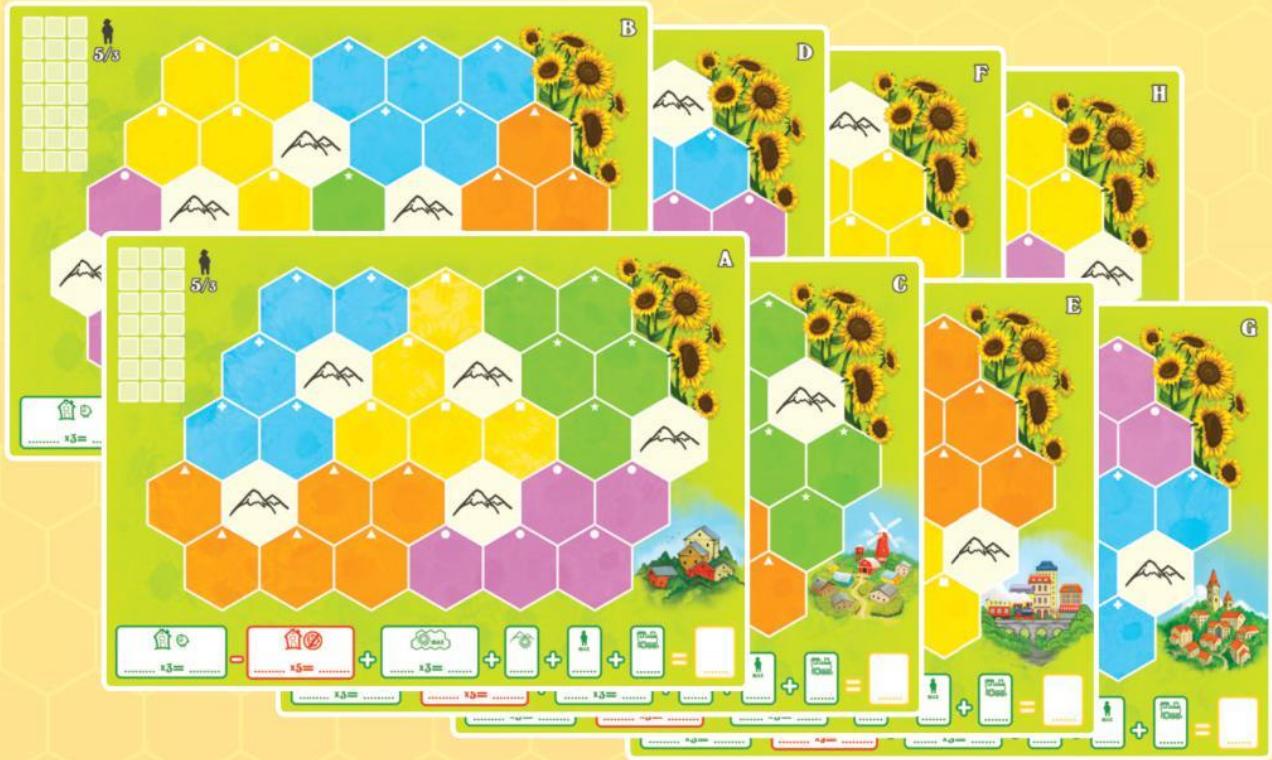
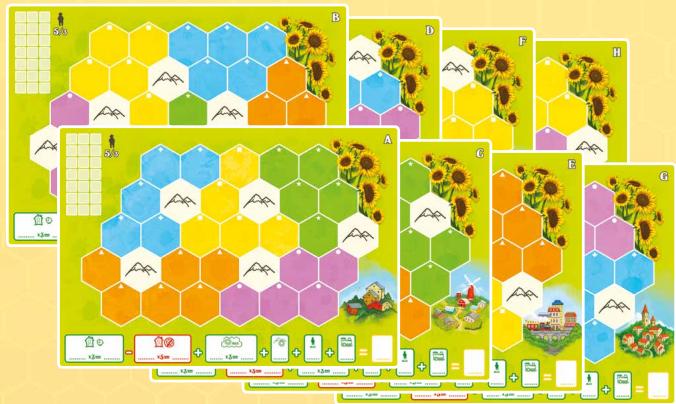
20张双面玩家面板

5支马克笔

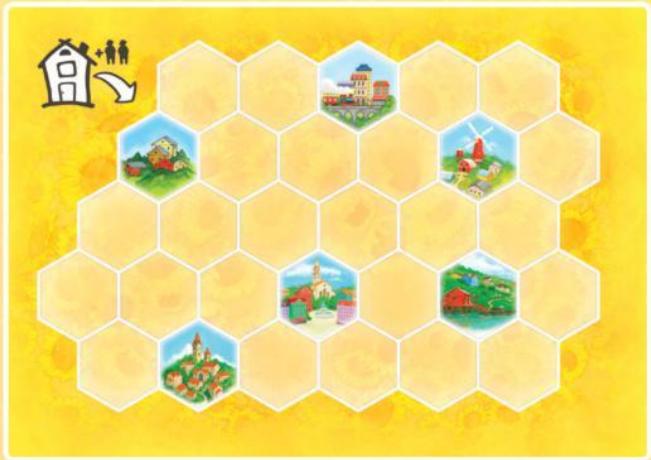
一张带有游戏面板和参照图的双面游戏板

6个骰子

一个先手玩家指示物

游戏规则
游戏设定
- 每位玩家拿取一支马克笔和一张带有字母标记(A, B, C, D, E, F, G 或 H)的玩家面板。所有玩家必须使用带有相同字母的玩家面板。
提示: 为了加快游戏进程, 我们建议在最初几次进行游戏时参与的玩家人数最多为四人。当你积累足够的游玩经验后, 可选择加上第五名玩家。
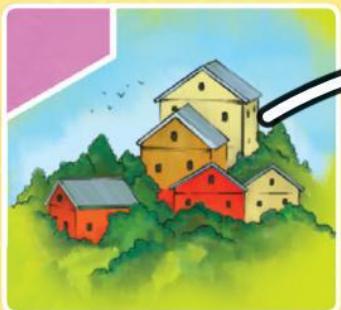
- 把6个骰子、游戏板放在桌面上(参照图那一面朝上)。每名玩家随机挑一张未被占用的玩家面板并查看位于其右边的城镇图片。然后玩家需要在参照图上找到自己的城镇并在玩家面板上同位置的六角格画出第一所属于自己的房子。把那些没用过的马克笔和玩家面板放回盒子里。
图片
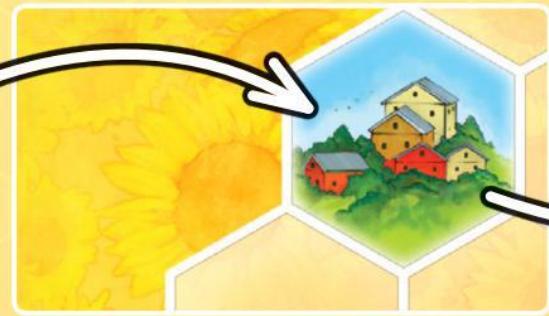
参照图
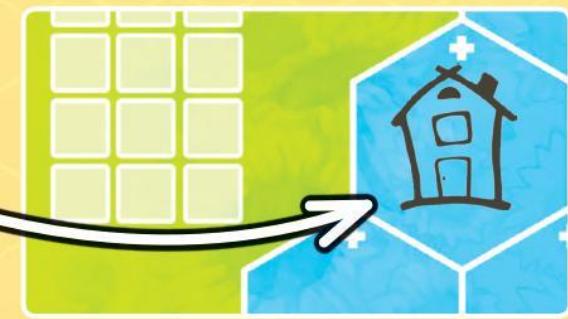
房子
- 每位玩家在自己玩家面板上的村民区域添加两名村民。

- 给年龄最小的玩家先手玩家指示物。

- 把参照图翻过来, 让游戏面板那一面朝上。
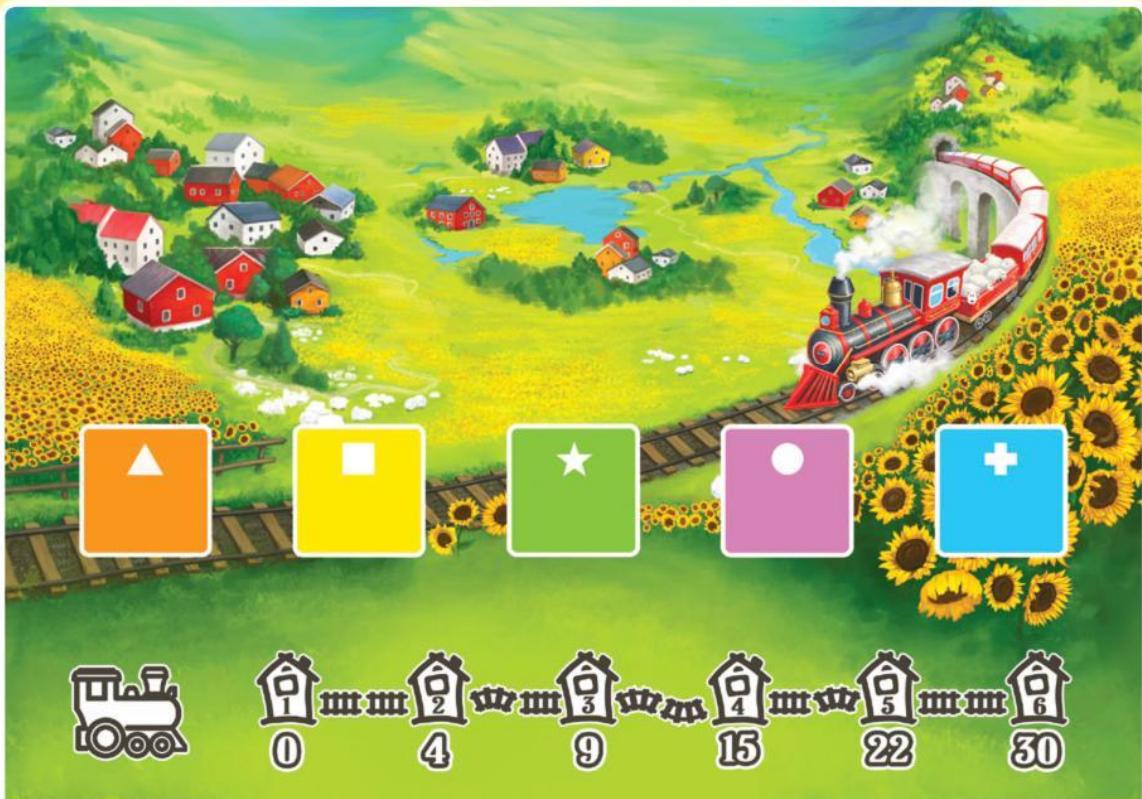
- 把所有电子设备关掉。准备享受这个游戏吧!
提示: 把游戏盒的上盖当作骰盘。

警告: 在玩之前保护好游戏区域。马克笔会弄脏衣物或其它东西的表面。不要让马克笔离眼睛或皮肤太近。确保玩家面板上的笔迹清理干净后再将其放回盒子。

游戏流程
一场游戏包含若干回合。每一回合从先手玩家开始,按顺时针方向,玩家们轮流执行他们的行动。
在每回合中,需按顺序完成以下阶段:
A. 掷6个骰子
B. 玩家拿取一个骰子并画出相应标志
C. 回合结束
阶段A. 掷6个骰子
在每回合的开始, 先手玩家掷出全部6个骰子, 形成骰子的储备区。
阶段B.玩家拿取一个骰子并画出相应标志
从先手玩家开始, 每名玩家轮流执行一次行动。
在轮到其执行行动时, 玩家需要从骰子储备区选出1个骰子并放在游戏面板的一个空闲的彩色区格之上。然后玩家应从自己的玩家面板上选出一个空着的同颜色六角格并把骰子上的标志画在上面。
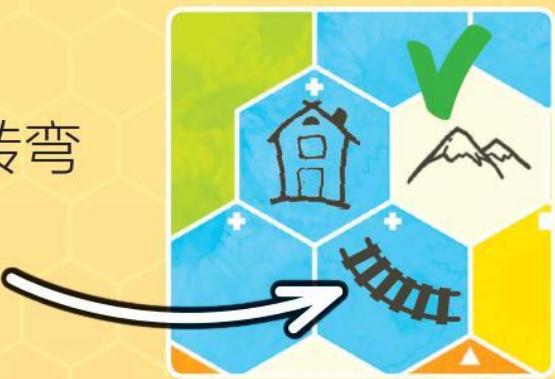
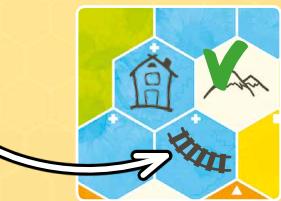
实例: George是先手玩家。他拿到的骰子是 📄 并选了游戏面板上的蓝色区格…他在自己玩家面板蓝色区域的空着的六角格上画出一条转弯的铁路标志。

注意: 你不能把转弯的铁路( )画成急转弯形式的或者笔直的铁路( )。

你只能这样画一条转弯的铁路!
当你建造房子( 🏠️ )或种植超级向日葵( 🎟 🏠️ )的时候,你可以得到一定数量的村民。当你获得一名村民时,在玩家面板的村民区域打一个勾。游戏结束时拥有最多村民的玩家可以获得额外的胜利分数。
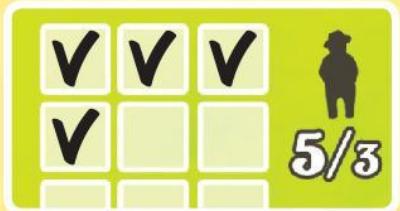
玩家面板上的村民区域
一所房子( 📄)可让你获得2名新的村民。
一株超级向日葵(💡)可让你获得1名新村民。
注意: 你可以通过绘制区别于普通向日葵的超级向日葵来增加你的村民数量。
实例: 轮到Paul了, 他选取了 🏠 并在游戏面板上选了橙色,所以他可以在自己的玩家面板上的橙色区画一所房子。同时,他因为刚刚建造的房子获得两名村民。

Paul的玩家面板
即使剩下的骰子你都不想要, 你仍须选一个并画出相应的标志。
即使你的玩家面板上可供绘制的区域的颜色无法与游戏面板可供选择的彩色区格相对应, 你仍须选择一个骰子并放到一个彩色区格之上。在这种情况下, 你只能在自己玩家面板上任一空闲六角格里画一株向日葵而不是骰子显示的标志。如果你选取了 📄 你才能得到一名新的村民。
阶段C. 回合结束
当游戏面板上所有的彩色区格都被选中并且玩家们都画完其对应的标志时(如果可以的话), 本回合结束。
把所有6个骰子以及先手玩家指示物以顺时针的顺序传到下一名玩家。新的一回合再从阶段A开始。
注意: 在一个回合里, 不是所有玩家都能执行相同数量的行动, 但是整场游戏玩家们执行行动的次数是一样的。
提示: 不要让骰子上的标志限制你的创意。如果你能画出具有自己特色的标志岂不更好?利用等待的时间来创造既独特又具有细节的图画吧!


游戏结束
当每名玩家都将标志填满自己的玩家面板上的六角格的时候, 游戏结束。所有玩家统计各自玩家面板上所有标志带来的分数。分数最高者赢得本场游戏。

计分
在游戏结束后, 玩家需在自己的玩家面板下方的对应区域记下各项目的分数。

项目A. 拥有羊的房子
每对房子和羊的组合获得3分。每只羊只能和一所房子配对。

通过这样来把羊和房子配对:
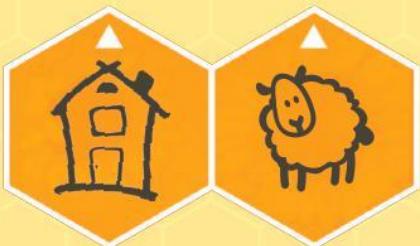
相邻: 一只羊可以与相邻六角格的房子配对。
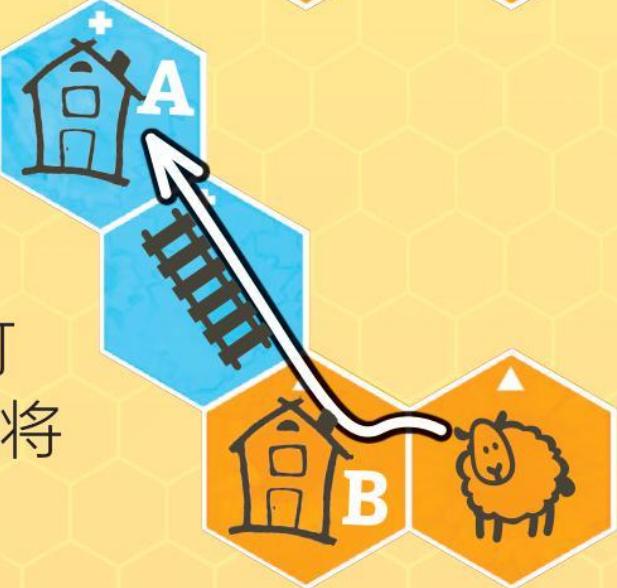
连接: 如果羊与房子B相邻, 那么这只羊也可以和房子A配对。房子B必须相邻房子A或两者至少通过一条铁路相连结。可以把这想成从一个村子通过铁路将羊运输到另一个村子。
羊群: 如果两只或多只羊位于相邻的六角格, 它们视为一个羊群。如果羊群中至少一只羊可以通过 “相邻” 或 “连接” 与一所房子配对, 那羊群中其余的羊也可与那所房子配对。

提示: 策略性地放置羊群以便为你的房子、铁路和向日葵留出好的位置, 而这还可以给你的房屋提供羊。
聚居地: 如果两所或以上房子位于相邻的六角格, 它们视为一个聚居地。如果一只羊可以跟聚居地中的一所房子配对, 那么它可以跟这个聚居地中任意一

所房子配对。切记, 每个聚居地中的房子仅能配对一只羊。
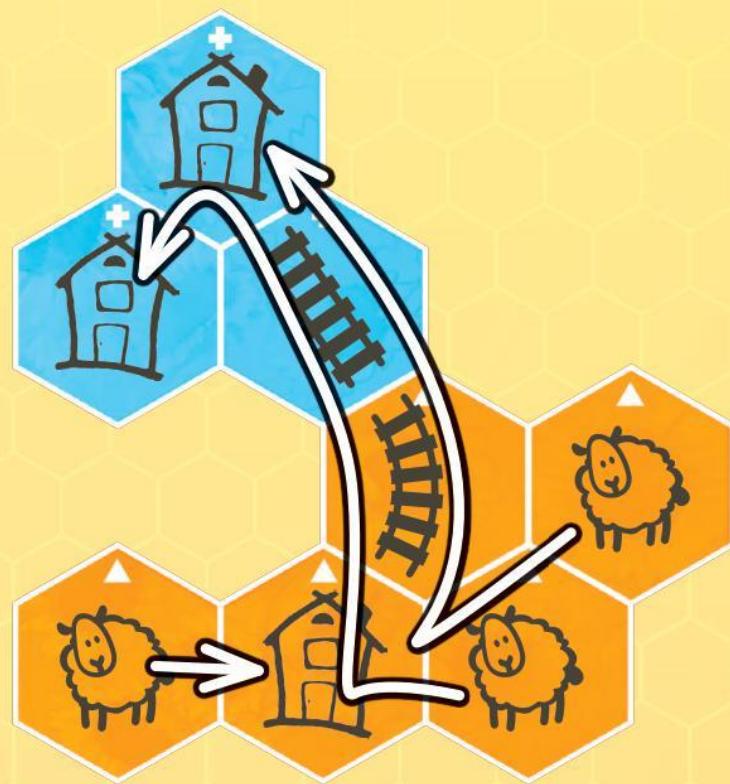
实例: 任意一只羊都可以跟任意一所房子进行配对, 或是因为其通过铁路“连接”到了那所房子, 或是因为通过铁路“连接”到了其所在的聚居地。
如何跟小孩子一起玩
当你跟小孩子一起玩的时候, 房子和羊配对这步对他们来说有些难。你可以简化步骤为: 羊只能与相邻六角格里的房子配对。
项目B. 没有羊的房子
每所没有与羊进行配对的房子扣除5分。
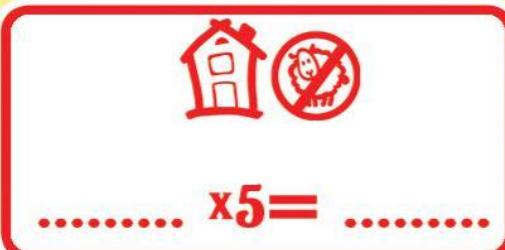
提示: 确保你的房子可以通过多种方式与羊配对, 例如通过聚居地和铁路来增大配对完所有羊的可能性。
项目C. 最多的向日葵
清点玩家面板上每种颜色的区域,如果在该区域你的向日葵数量最多,即可获得3分。如果一个区域出现平局情况那没人得分。

Mary的紫色区域
Paul的紫色区域
实例: Paul和Mary查看紫色区域中谁的向日葵数量最多。Mary拥有一株向日葵, Paul一株都没有。因为Mary在紫色区域拥有最多的向日葵, 她可以得到3分。

注意: 一株超级向日葵在这种情况被视为普通向日葵。
项目D. 山脉
与每座山相邻的向日葵的数量就是你可以获得的分数。
实例: 通过左边的山玩家可以得到2分, 通过右边的山玩家可以得到3分。


项目E. 村民
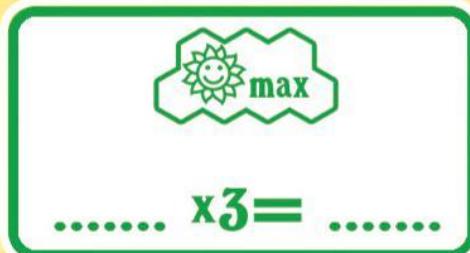
如果你的村民数量最多, 你可以获得5分。如果你的村民数量第二多, 你可以获得3分。
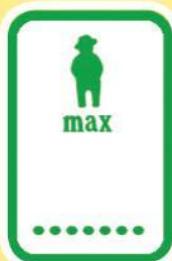
如出现平局, 则房子数量最多的玩家得到相应分数。如果再平局, 那拥有最多向日葵的玩家得到相应分数。如果依旧平局, 那就都不得分。
项目F. 山谷特快
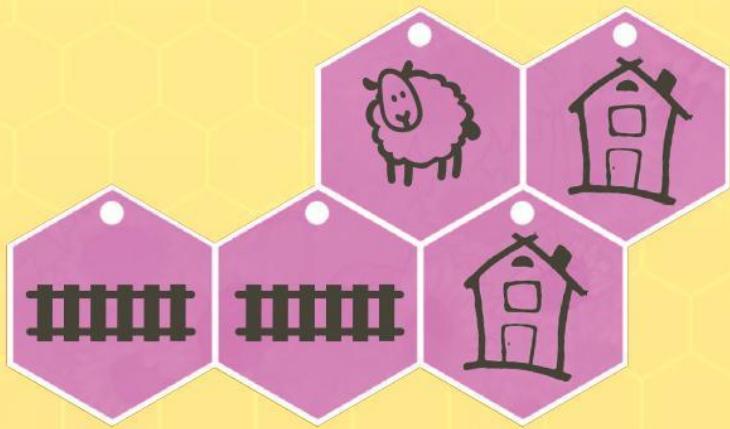
使用至少两条铁路将房子彼此之间连接起来可以使你获得山谷特快的奖励。

所得的总分数取决于多少所房子被这样连接起来。具体查看游戏面板下方的图示。
房子数量分数

重要事项: 当结算山谷特快奖励时, 多个相邻的房子算作一所房子。
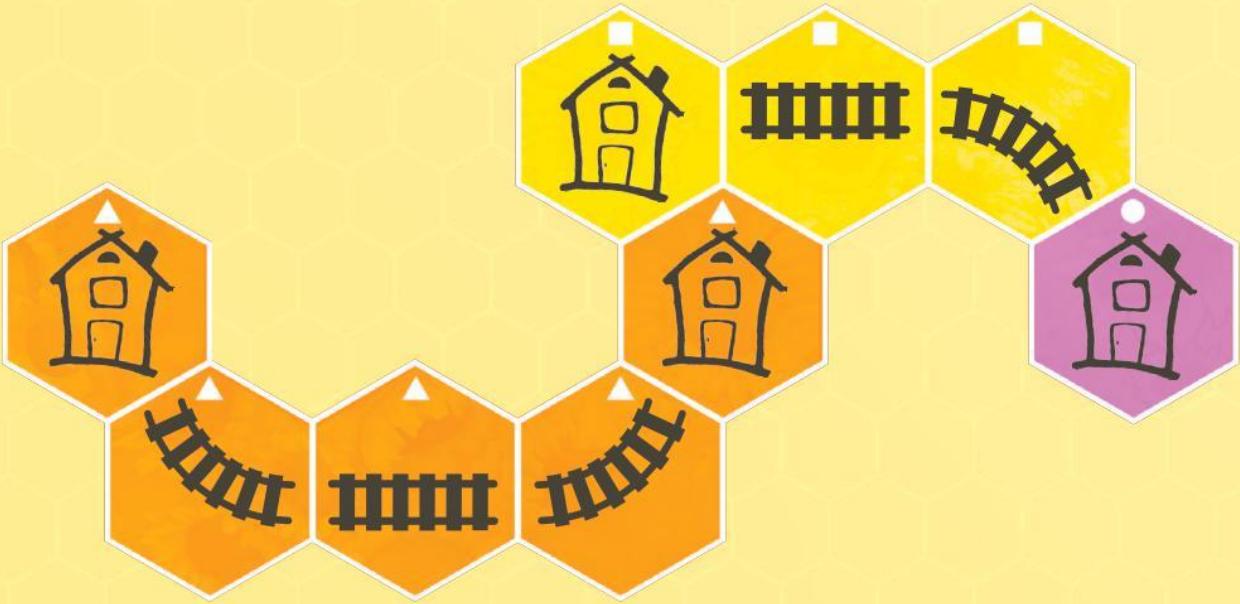
实例: 三处房子(或聚居地)彼此之间通过两条以上的铁路连接起来。该玩家可获得9分。
项目G. 相加
把所有你得到的分数加起来。拥有最多分数的玩家获胜!

如果平局, 拥有最多房子数的玩家获胜。

如果再平局, 拥有最多向日葵数的玩家获胜。

如果依旧平局, 拥有最多村民数的玩家获胜。

✓ ✓ ✓
✓ ✓ ✓
✓ ✓ ✓
✓ ✓ ✓
✓ ✓ ✓
✓ ✓ ✓
✓ ✓
③=9
计分实例
②=4

$6^{x3}=18=1^{x5}=5+2^{x3}=6+8+5+13=45$ $1+2+3+0+2$ $9+4$
在社交媒体上分享出你自己玩《向日葵物语》的照片。我们会在社交网站频道上放出最好的一些照片。
工作人员名单
游戏设计: Wouter van Strien
游戏开发: Petr Tyulenev
制作人: Nikolay Pegasov

发行商: Hobby World
美工: Alexander Shaldin
排版: Kristina Soozar
总监: Mikhail Akulov
产品总监: Ivan Popov
总编辑: Alexander Kiselev
编辑: Valentin Matyusha
预编辑: Ivan Sukhovey
商业管理: Sergey Tyagunov
中文版发行商: Planplay
翻译: 李昂
校正: 韩蓓蓓、范笑宇
编辑: Daniele P. Correale

中文版版权和发行: 济南蒲蓝蒲蕾智力玩具有限公司
Jinan Planplay Co.,Ltd
中国山东省济南市历下区甸柳小区2区11号楼2单元401室 www.bgplanplay.com - info@bgplanplay.com

台湾代理商: 尖端桌遊
Sharp Point Board Game
臺北市民生東路二段141號10樓
www.spp.com.tw/url/?sbg
calvin_chen@mail2.spp.com.tw
没有版权拥有者的允许, 本游戏的规则、内容和插图的再印刷和出版都是严格禁止的。
© 2018 Hobby World. All rights reserved.
info@hobbyworld.ru
international.hobbyworld.ru
Download MarkdownSunflower Valley_rules_eng_.md13.4 KB

GAME RULES
SUMMARY
Your goal is to settle a mountain valley using special dice. Place houses in the valley and connect them with railroads to gain victory points. You will gain additional points for cheering up villagers by planting sunflowers at the base of the mountains. Remember that the villagers also need sheep. Other players are not going to stand idly by — they also want to get the best dice. Take a marker and draw your own valley in this creative board game!
COMPONENTS
20 double-sided player sheets


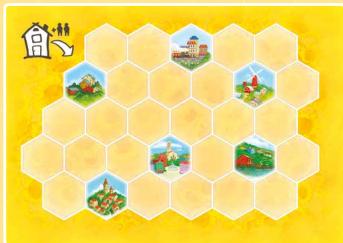
1 double-sided sheet with playing board and reference

6 dice
1 first player token

GAME RULES
Setup
- Each player gets a marker and a sheet marked with any letter (A, B, C, D, E, F, G or H). All the players must have sheets with the same letters.

Tip: We recommend playing your first games with up to four players to speed up the process. When you have enough game experience, feel free to add the fifth player.
- Place the 6 dice and the playing board (reference side up) on the table. Each player randomly takes an unused player sheet and looks at the picture of the town on the right. Then the player finds that picture on the reference and draws their first house on the same hex of their sheet. Return the unused markers and player sheets (including those used to determine the position of the first house) to the box.
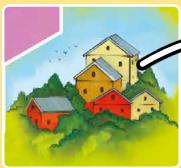
Picture
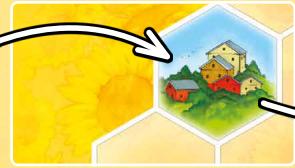
Reference

House
- Each player adds their first 2 villagers to the Villagers section of their sheet.

- Give the first player token to the youngest player.

- Turn the reference sheet over, so the playing board is face-up.

- Turn off all distracting digital devices. You are now ready to enjoy this fully analog game!
Tip: Use the top of the box as a dice tray.

Warning: Protect your play area before play. The markers may stain fabrics and some surfaces. Keep away from eyes and skin. Make sure all player sheets are clean before returning them to the box.
GAME PLAY
The game consists of several rounds. Each round the players take their turns one by one, starting with the first player and continuing clockwise.
During a round the following phases happen in this order:
A. Throw 6 dice
B. Players take the dice and draw symbols C. End of the round
A. Throw 6 dice
In the beginning of a round the first player throws all 6 dice to create a dice reserve.
B. Players take the dice and draw symbols
Starting with the first player each player takes a turn.
During their turn a player chooses 1 die from the reserve and claims a color by placing the die on a free colored space of the playing board. Then they find a free hex of the same color on their sheet and draw the same symbol that was on the die they chose.
Example: George is the first player. He takes (m and claims blue on the playing board. He draws a curved railroad on a free hex in the blue area of his sheet.

Note: You cannot draw a curved railroad (m) as a sharp bend or straight railroad (#).
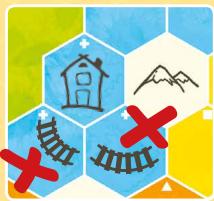
This is the only way you may draw a curved railroad!
When you build a house () or plant a super sunflower (with ), you gain a certain number of villagers. You get à villager by drawing a check mark in the Villagers section of your sheet. You may get additional victory points at the end of the game by having the largest number of villagers.

The Villagers section on your sheet
A house () gets you 2 new villagers. A super sunflower () gets you 1 new villager. Note: You can track the number of your villagers by drawing super sunflowers a little different from your regular sunflowers.
Example: Paul has the next turn. He chooses ( and claims orange on the playing board so that he can draw a house in the orange area of his sheet. He also adds 2 villagers for the house he just built.

If the only dice left are those you don't need, you must still choose one of them and draw the corresponding symbol.
If none of the colors available on the playing board are available on your sheet, you must still choose a die and claim a color with it. Instead of drawing the corresponding symbol, you must draw a sunflower on any free hex of your sheet. You get a new villager only if you choose a.
C. End of the round
The round ends when all the colors on the playing board have been claimed and the players have drawn the corresponding symbols (if possible).
Take all 6 dice and pass the first player token to the next player clockwise. The new round begins with phase A.
Note: Not all the players can take an equal number of turns during a round, but all the players will take an equal number of turns during the game.
Tip: Don't let the symbols on the dice limit your creativity. Set your imagination free and draw the symbols any way you want. Use the waiting time between your turns to make your pictures unique and detailed!


END OF THE GAME
The game ends when all the players have drawn symbols on all the hexes of their sheets. After that the players count the points they gain for all the symbols on their sheets. The player with the most points wins!

SCORING
At the end of the game players mark their scored points in the corresponding fields at the bottom of their sheet.

A. Houses with sheep
Gain 3 victory points for each pair of a house and a sheep. Each sheep can only be paired with one house.

This is how you pair them:
Adjacency: A sheep can be paired with a house in an adjacent hex.
Connection: A sheep can be paired with house A if it's adjacent to house B. House B must be adjacent to house A or connected to it with at least one railroad. Think of it as a sheep being transported from one house to another by train.
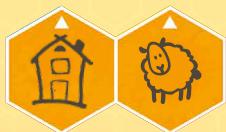

A flock of sheep: If 2 sheep or more are on adjacent hexes, they are considered a flock of sheep. If at least one sheep in the flock can be paired
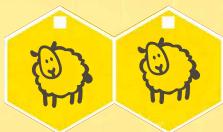
with a house by adjacency or connection, then any other sheep in the flock could be paired with that house instead.
Tip: Strategically place flocks of sheep to leave the best spots for your houses, railroads and sunflowers, while still providing your houses with sheep!
Settlement: if 2 houses or more are on adjacent hexes, they are considered a settlement. If a sheep can be paired with a house in a settlement, it could
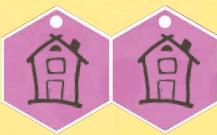
be paired with any other house in that settlement instead. Remember that each house in the settlement needs its own sheep.
Example: Any of these sheep can be paired with any of these houses or transported to any other connected house or settlement over the railroad.

How to play with children
When you play with children, pairing sheep and houses might seem difficult for them. You may simplify the rules so that the sheep can be paired only with houses in adjacent hexes.
B. Houses without sheep
Withdraw 5 points for each house without a sheep.
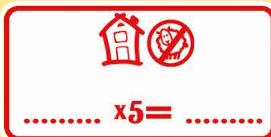
Tip: Make sure that your houses
can be paired with sheep in multiple ways, such as through settlements and railroads, to increase your chances of pairing them all!
C. The most sunflowers
Gain 3 victory points for each
colored area of your sheet
where you have the most
sunflowers. In case of a tie nobody gains victory points for that colored area.
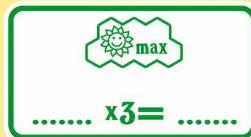
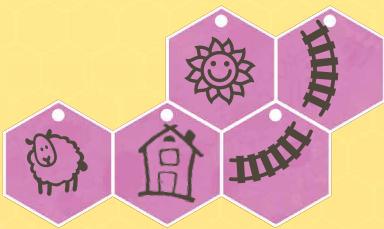
Mary's purple area
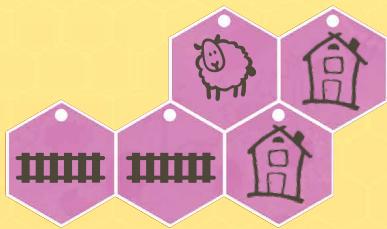
Paul's purple area
Example: Paul and Mary check who has the most sunflowers in the purple area. Mary has 1 sunflower, Paul has none. Since Mary has the most sunflowers in the purple area, she gains 3 victory points.

Note: A super sunflower is considered a regular sunflower in this case.

D. Mountains
You gain as many victory points for each mountain hex as there are sunflowers on adjacent hexes.
Example: for the left mountain the player gains 2 points, for the right mountain the player gains 3 points.


E. Villagers
You gain 5 victory points if you have the most villagers. You gain 3 victory points if you are the player with the second largest number of villagers.
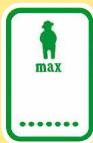
In case of a tie, the player with the most houses gains the victory points. If there's still a tie, the player with the most sunflowers gains the victory points. If there's still a tie, nobody gains victory points.
F. Valley Express
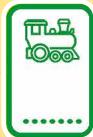
You gain the Valley Express bonus for houses connected to each other with at least 2 railroads.
The number of victory points depends on how many houses are connected. See the table at the bottom of the playing board:
Important: A settlement of multiple adjacent houses counts as a single house when scoring the Valley Express bonus.

Example: 3 houses/settlements are connected with (at least) a two-hex railroad. The player gains 9 victory points.
G. Winning the Game
Sum all the victory points you've gained. The player with the most victory points wins!

In case of a tie, the player with the most houses wins.
If there's still a tie, the player with the most sunflowers wins.
If there's still a tie, the player with the most villagers wins.


Feel free to share your Sunflower Valley on your social media channels with #sunflowervalley. We'll repost the best pictures on our sites.

Game Designer: Wouter van Strien Game Development: Petr Tyulenev Producer: Nikolay Pegasov
PUBLISHER: HOBBY WORLD
Artwork: Alexander Shaldin Layout: Kristina Soozar
General Manager: Mikhail Akulov Production Manager: Ivan Popov Editor-in-Chief: Alexander Kiselev
Editor: Valentin Matyusha
Prepress: Ivan Sukhovey
English Translation: Evgeniya Nekrasova Business Development: Sergey Tyagunov
The author of this game would like to thank his little brother Willem van Strien for the help and support throughout the development of Sunflower Valley.
Special thanks to Ilya Karpinsky.
Reprinting and publication of the game's rules, contents, and illustrations without the copyright holder's permission is strictly prohibited.

© 2018 Hobby World. All rights reserved. info@hobbyworld.ru international.hobbyworld.ru
Download MarkdownTexts are community-compiled or publicly released by publishers; copyright remains with the original authors. For personal reference only.