
System Gateway
At a glance
Rules, cards and Q&A (Chinese)
The rules, card data and player questions for this game are written in Chinese. Open the Chinese page to read them.
Where to find full rules
Full rules and card lookup are available in the cunlema app at cunlema.cn — pick this game and ask about any rule, card or turn you are unsure about.
Related games
Rulebook text (Markdown)
This game has 11 rulebook Markdown file(s) in our library; 3 rendered inline below — expand to read or download.
rules_zh_Gateway_Uprising_10147.md29.0 KB
“我们城市的历史是与魔法和掌握魔法的人紧密相关的。而这正是使得我们现在发现自身正身处于一个领导者取缔这座城市的根基的时代更为讽刺的原因。魔法曾让盖特威成为已知世界艳美的中心;现在魔法必须帮助重建这个被打败为因城的昔日王城。”
一个盖特威的忧虑市民
- 胜利条件....3
- 板件目录....4
- 游戏准备阶段....5
- 开始游戏
I. 游戏人数....7
II. 回合概述....7
III. 部署阶段....9
IV. 招募阶段....9
V. 符文石....10
VI. 攻击阶段....10
VII. 结算阶段....12
VIII. 回合结束....12 - 进阶规则
I. 区域奖励....13
II. 区域毁坏....13 - 游戏结束和胜利....15
- 可替代的隐藏符文石规则....15
- 官推基础卡组....16
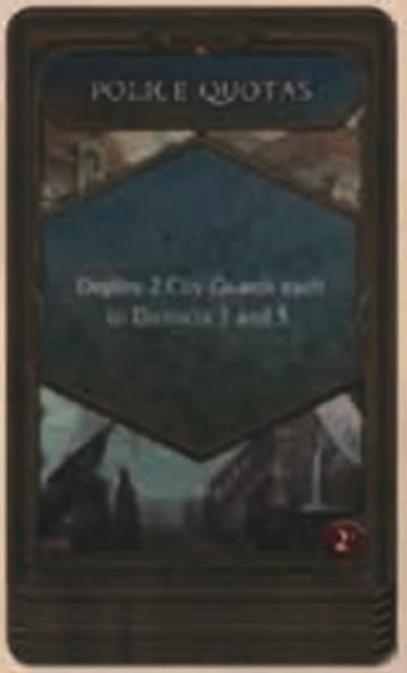
· 10 区域板块
· 8 板块标记
· 24 玩家指示物
· 24 塑料底座
· 134 名望指示物
· 1 规则书
· 4 玩家帮助面板
· 376 卡牌:
· 22 城市守卫
· 16 怪物部落
· 26 事件卡
· 130 叛军卡
· 84 支援卡
· 48 贸易卡
· 42 符文石卡
· 8 独特的阵营领袖
目录
板件目录
目标
在游戏中,你化身为反叛军首领试图从基登总理手里解放整座城市。但突如其来的怪物——妄图摧毁城市的德鲁格尔族,使你的战斗变得复杂起来。
你的起始牌组由一位反叛军领袖、一些反叛军和一些贸易卡组成,你必须壮大你的势力,招募士兵和商人,并使用魔法来创造一支足以使你控制整个版图的军队。
玩家通过控制城市区域或收集名望点数来获得胜利。大多数时候,玩家需要击败德鲁格尔族或城市守卫来达到目的。
板件目录
叛军卡
支援卡

城市守卫卡
贸易卡
德鲁格尔族卡

阵营领导者
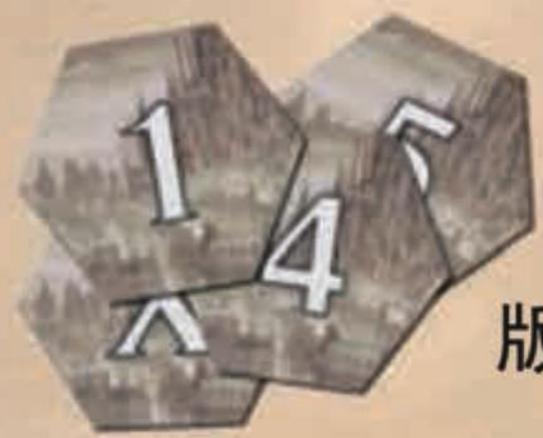
版块标记
玩家帮助面板
名望指示物
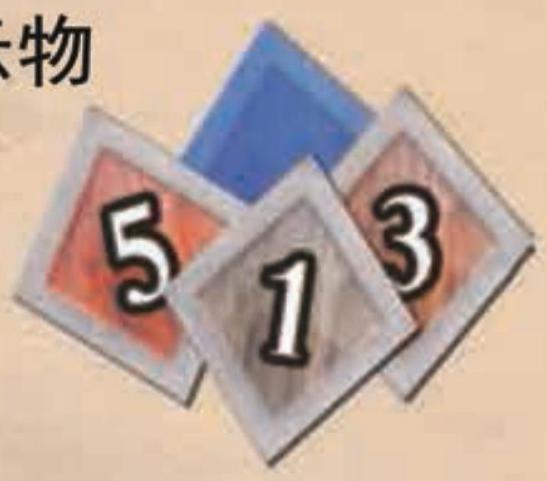
符文石
卡牌术语解释
招募:从公共区购买一张卡。它直接进入你的弃牌堆并从现在起属于你的牌组。
抽牌:从你的牌组中抽一张卡放入你的手中。
事件卡
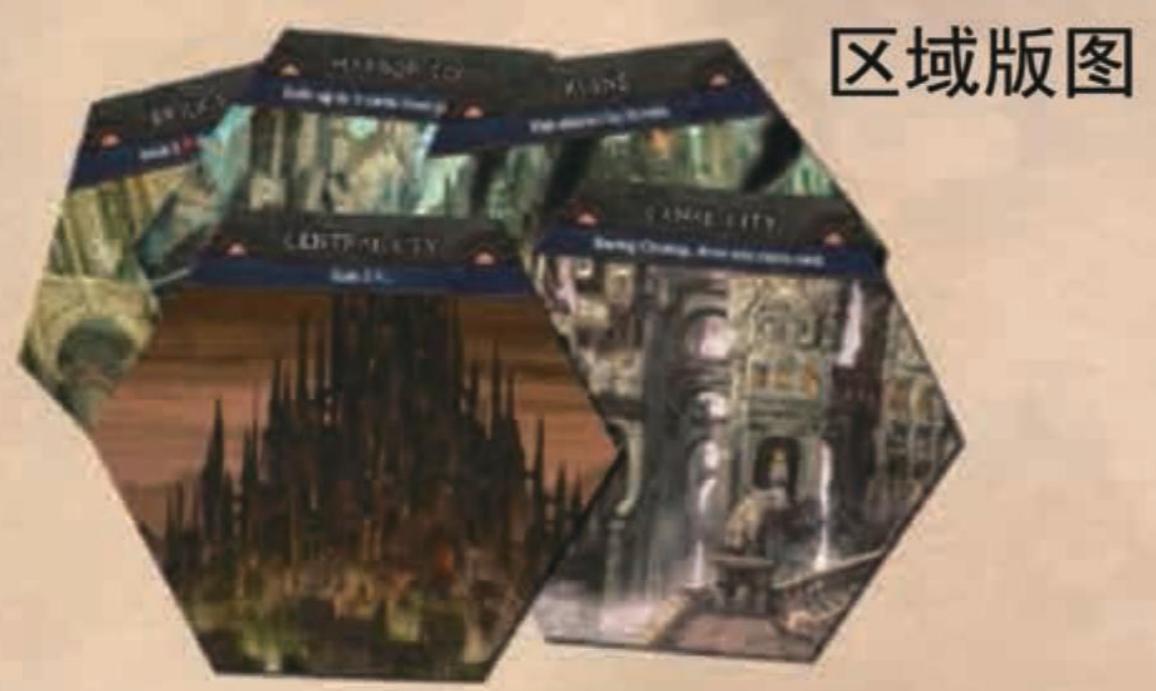
区域版图

玩家指示物
放逐: 将该卡从游戏中移除并将其返还到盒中。它不再属于你的牌组。
城市起始准备
将中心城市版块放置在桌的中央。将所有其他版块洗混并随机拿取其中6个围绕中心城市摆放(参见右图)。把写着未毁坏的一面朝上放置。
对于2人局,将中心城市顶部和底部相接的两块版块翻为已毁坏的一面——它们从一开局就被毁坏了。对于3-4人局,没有版块被毁坏。
接下来,将8个版块标记洗混并从中心城市右边相邻的未毁坏的版块开始顺时针依次摆放标记。(一次一个)
对2人局,每个版块将会有两个标记;
对3-4人局,一些版块会有一个标记而另一些会有两个。
一旦所有的版块标记被放置,标有“X”的版块标记将会被移出游戏。一些版块可能最终没有被放置任何标记。
将名望标记放置在所有玩家都可拿取的公共区域。
每个玩家选择一套(每套6个)玩家指示物来代替自己(将这些指示物安插在对应颜色的底座上)并给每个玩家发放一张玩家帮助面板。
将顶部和底部
两版块翻面
2人局布局:2版块被毁
从这一版块开始顺时针放置版块标记。不要在毁坏的版块上放置。

一旦所有标记放置完毕这这些“x”标记将被移除。
中心城市版块始终放在中心并不会被放置任何版块标记。
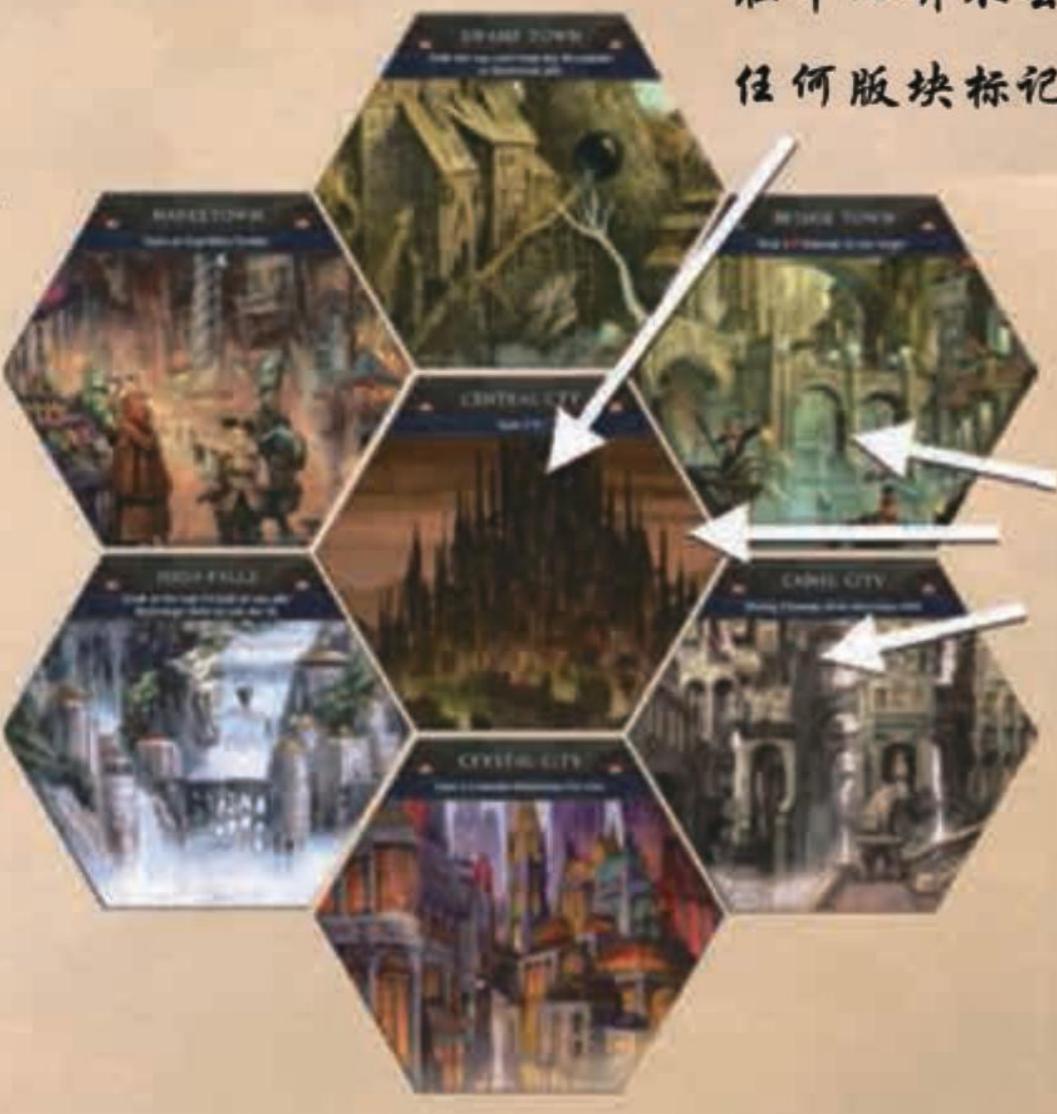
3-4人局布局:0版块被毁坏
凡是有相接的一边的版块皆视作相邻。当确定相邻后,跳过被毁坏的版块并继续放置下一块版块。
公共区域起始准备
将德鲁格尔族卡和城市守卫卡洗混并在每块版块旁边创建一副背面朝上的卡组。抽取并放置一张城市守卫在每个外圈版块上(如有必要,卡牌特殊效果优先)在中心城市上放置三张城市守卫。
根据玩家人数来创建一副事件卡组:
对2人局,仅拿2+事件卡并洗混它们;
对3人局,拿取2+和3+事件卡并洗混它们;
对4人局,拿取所有事件卡并洗混它们。
无论有多少个玩家,抽取12张卡并创建一副背面朝上的事件卡组。任何剩余的事件卡将被返还到盒中并在本局游戏中将不会被用到。至此为止,不可观看事件卡。
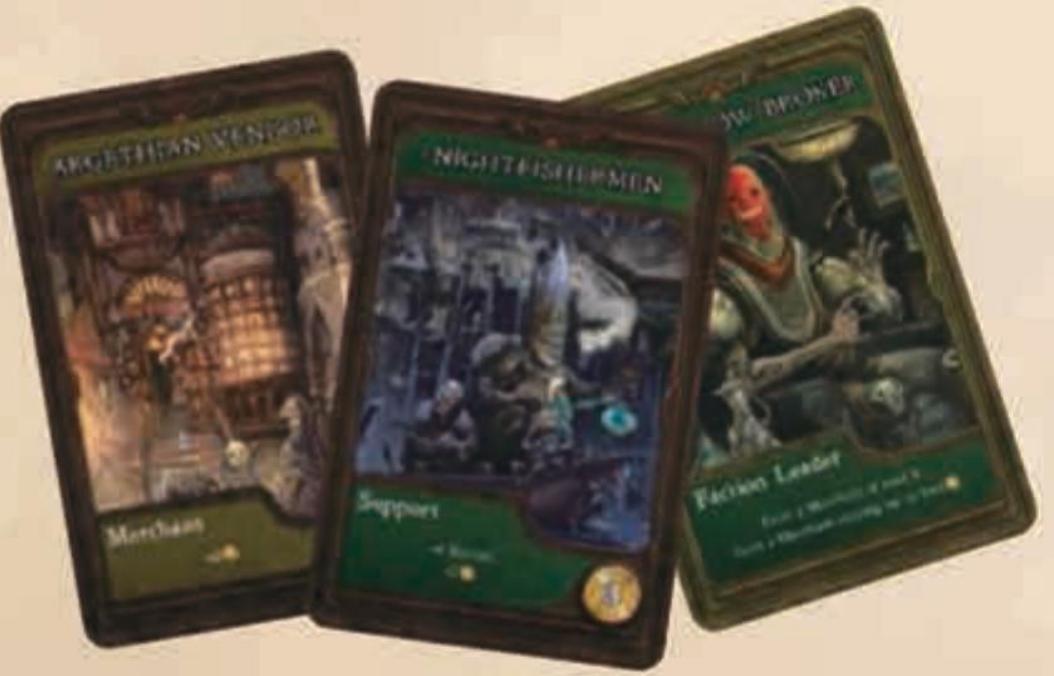
每局游戏都使用一组核心卡作为起始卡组。将所有Sledge, Rebel, Saloran Cart, Argethian Vendor, 和 Shadow Market卡分别组成面朝上的卡组并放在桌上。
将符文石卡按照类别(普通,异常,稀有)分开并洗混。每个玩家抽取一张随机普通符文石并背面朝上放置在他们面前。玩家可以查看该卡。然后把这三组符文石卡组面朝上放置在核心卡组旁边。
接下来每个玩家拿取7 Saloran Carts, 1 Argethian Vedor, 3 叛军, 和1 阵营领袖来创建他们的初始卡组。阵营领袖可以随机抽取或由每个玩家单独选取。这些是独一无二且每张都能提供不同类型的奖励和玩法。每位玩家洗混并将卡组面朝下放置在玩家区域。
每位玩家从牌堆顶抽取6张卡牌作为起始手牌。
核心叛军卡组
符文石卡组
核心贸易卡组
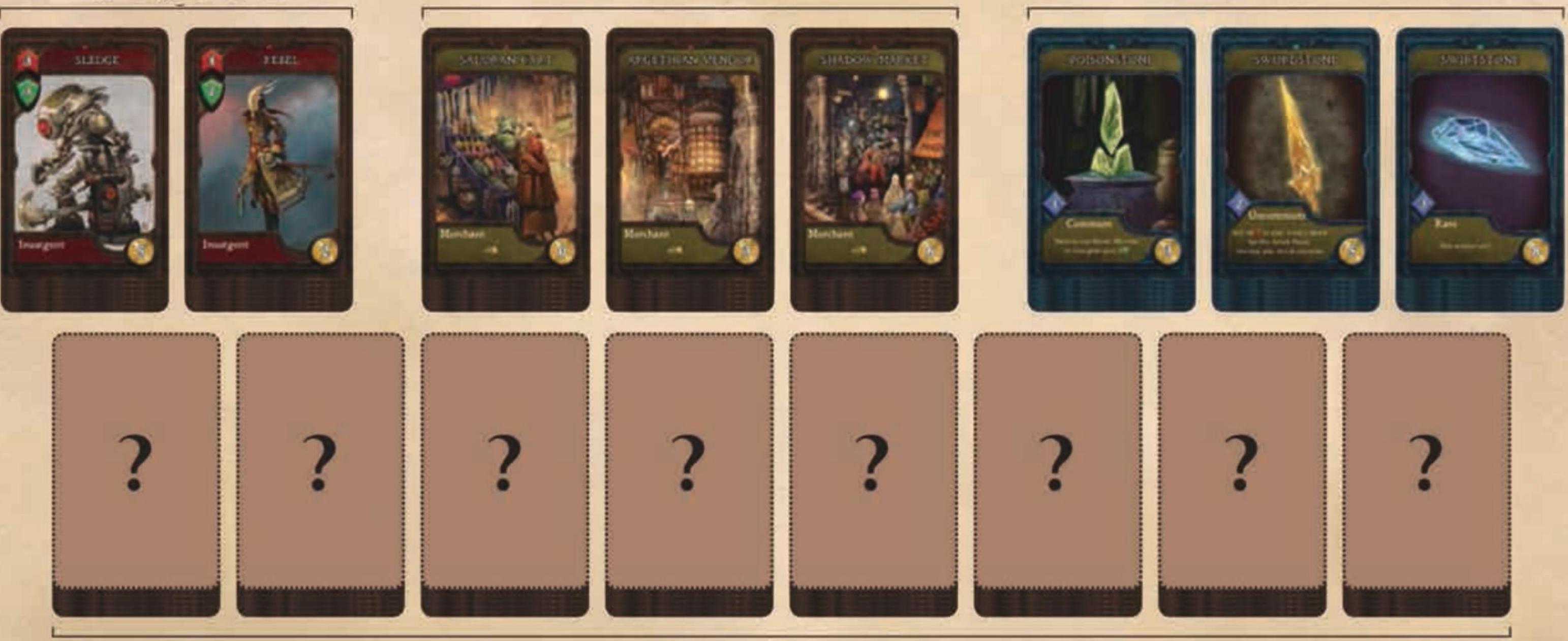
革命卡组
选择叛军卡组
除了核心卡和符文石之外,玩家必须放8个革命卡组进游戏。革命卡由所有非核心叛军卡和支援卡组成。要选择8个革命卡组,使用以下的方法之一:
将每张叛军卡的复制洗混并翻开每组第一张;
创建一副由每张叛军卡的复制组成的卡组。第一位玩家观看所有卡牌并挑选1张在游戏中使用,然后将剩余卡牌传给他左边的下一位玩家。其余玩家重复该过程直到每个人选完8张卡。
选择一副官方预组的卡组(参见第16页)。对于通过上述方法之一构建的8张叛军卡,创建一个5张卡的牌堆。将所有卡组放在公共区域。
注意:任何没被使用的叛军卡会被留在游戏的剩余部分。把它们返还到盒子中。
叛军卡

开始游戏
起始玩家
革命不会等待!为了决定起始玩家,拿一张Shadow Market卡和足够多的Solaran Cart卡使总数等同于玩家数量。洗混这些卡并给每个玩家发一张。得到Shadow Market卡的玩家成为起始玩家。将所有贸易卡返还到各自的牌组。
回合概述
游戏会进行诸多回合,每个回合又由所有玩家单独的行动轮按顺时针方向进行后完整形成。
每位玩家的行动轮由4个阶段构成。这4个阶段必须按顺序执行:
雇佣阶段-玩家可以使用行动点来打出手牌。
招募阶段-玩家可以从公共区域购买一张新卡(叛军、支援、或贸易)。新招募的卡将进入弃牌堆并稍后会加入进牌组。
攻击阶段-玩家可以攻击任何他们当下没有控制的区域板块。
清算阶段-玩家从手中丢弃所有未打出的卡牌,将任何已打出或使用的支援卡和贸易卡从玩家区域移入弃牌堆,并抽取6张新的卡牌加入手牌。
玩家在游戏过程中能够与参考帮助面板获得这些信息。
玩家区域示例
军队区-打出的叛军保留在该区域


本回合打出的
支援卡和贸易
卡(在清算阶段会被置入弃牌堆)
弃牌堆
拥有的符文石

牌组
雇佣阶段
在每位玩家的雇佣阶段开始,他们有两点行动点来将卡牌从手中打出。为了防止有剩余的行动点未使用,玩家可以继续打出任意多张卡。贸易卡的行动力花费为0 - 这些卡在雇佣阶段是免费使用的。
玩家宣读他所打出的卡牌并将卡牌面朝上置于前面。
任何被打出的叛军卡应被放置进玩家特定的军队区域并且将不会在清算阶段被置于弃牌堆。
注意:部分卡牌可能会提供额外的行动力。
招募阶段
在玩家的招募阶段,他们可以花费对应的金币从公共区域购买一张新卡。这张被招募的新卡,如果是一张核心卡或者叛军卡,则直接进入弃牌堆并会在之后加入玩家牌组。而任何被招募的符文石则立刻进入玩家的军队区域。
为了计算玩家在该回合中的金币池(玩家在新卡上花费的金币数),玩家在他们的游戏区域(游戏中的贸易和支援/叛军)中添加由牌提供的金币。
例如:一张被打出的Shadow Market 为玩家的金币池提供3点可用金币。接下来他可用这些金币从公共区域中招募任意一张新卡。
卡牌的花费在每张卡的右下角。玩家不必全部花费完他的金币,同样他也可以不招募任何卡牌如果他们并不想要它们。未使用的金币会在清算阶段被移除。
一般而言每位玩家每回合只能招募一张新卡,但一些卡牌提供的能力可以使他们招募额外的卡牌。
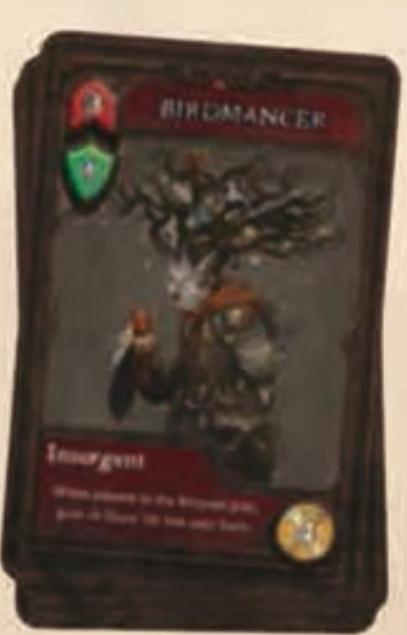
如果一个玩家可以在他的回合招募超过一张卡,他需支付所有他想招募的卡牌的费用的总和。例如:如果一个玩家拥有6个黄金在他的处置阶段,他可以用2金币来购买一张新的Multi-Wizard并用剩下的4金币来买一张Birdmancer。或者他们可以选择仅用5金币来购买一张Blunderbuss Mage并留下1剩余金币。
公共区域牌组会用完- 在盖特威中支援是有限的 - 所以玩家应该确保优先抓取他们想要的卡。
*为了使游戏中革命卡的招募更有帮助,请合理安排黄金的使用。
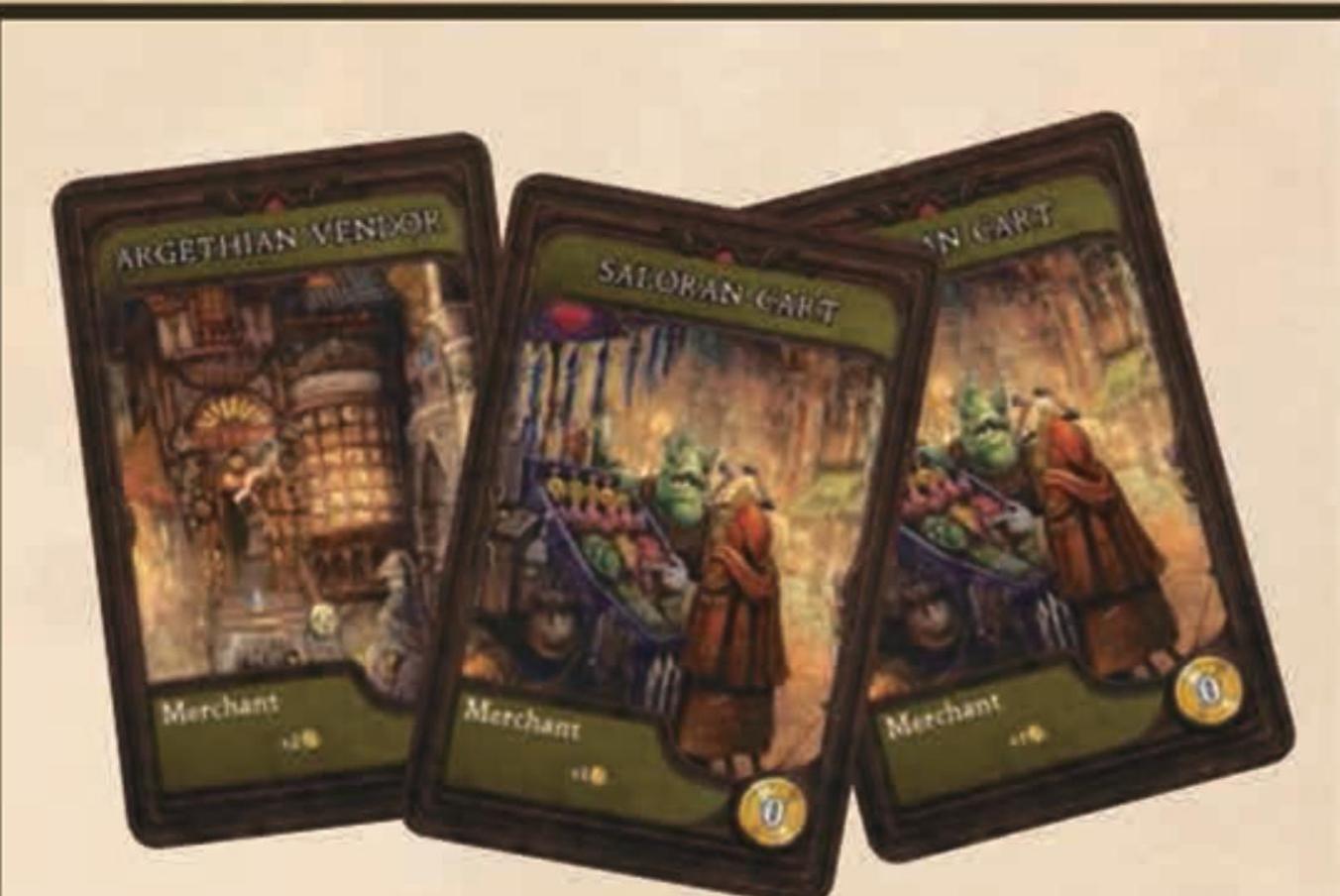
苏珊在她的回合打出2张Saloran Carts(每张+1金币)和1张Argethian Vendor(+2金币)。在她的招募阶段,苏珊有4金币(1+1+2)任她使用来招募一张新卡。
符文石卡
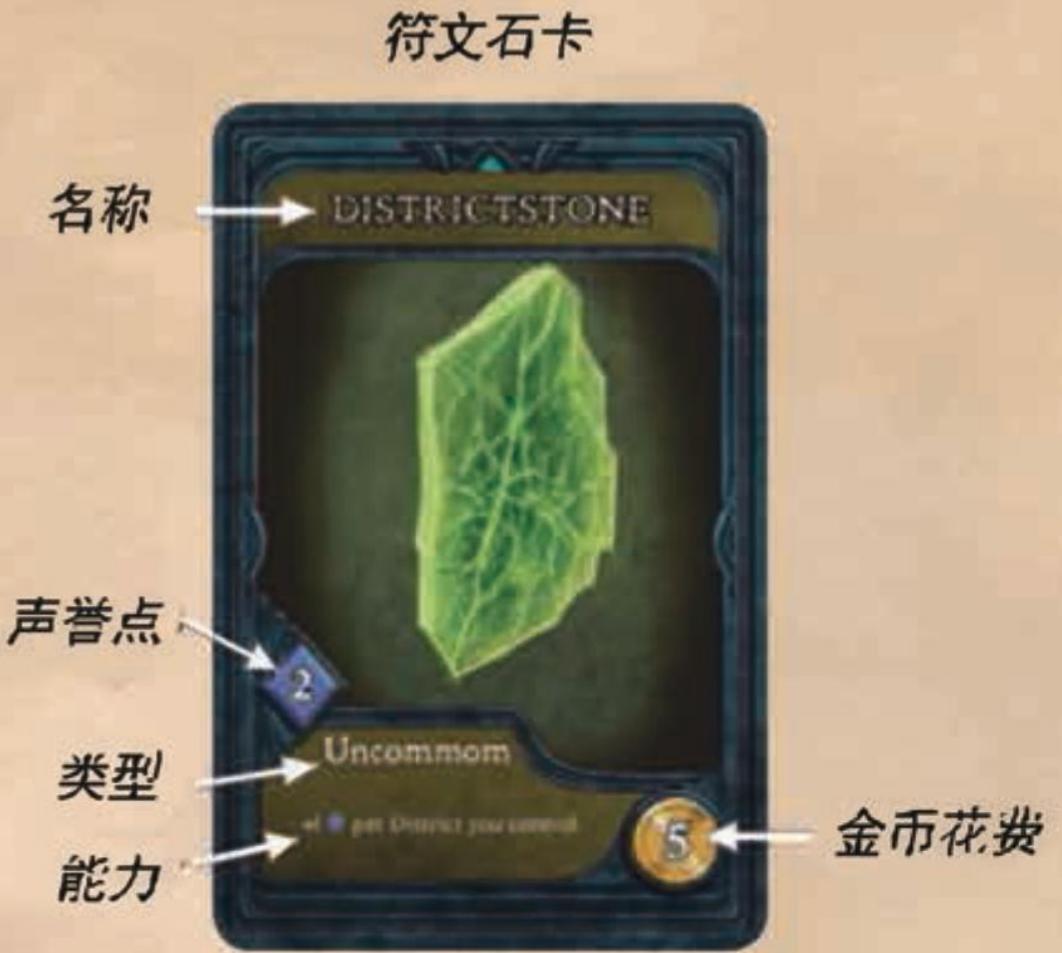
尽管自然魔法在盖特威中是不被允许的,符文石(可被随意使用的物理现象)仍然可以被强悍的反叛军发现,
在玩家的招募阶段,如果玩家希望购买符文石,他们会抽取3堆牌中的任何一个的最顶上的牌(支付符文石卡右下方列出的金币花费)。一旦购买,符文石面朝下放入玩家的军队区域,并可随时使用。
要使用符文卡,玩家必须声明卡片,显示其能力,然后放逐它(将其从游戏中移除)。

因此,每个符文石只能使用一次。
除非卡上另有说明,否则符文石的能力持续在玩家回合的持续时间内。
任何未花费的符文石在游戏结束时提供指定的荣誉点。玩家可以激活的符文石数量没有限制。
攻击阶段
在攻击阶段,玩家可以使用他们的军队攻击他们目前未控制的1个区域。区域可能由玩家,怪物部落或城市卫队控制。
如果玩家希望攻击另一个玩家,他们只能通过攻击该玩家控制的区域来实现。如果玩家不控制城市的任何区域,他们可能不会受到攻击
如果玩家的军队中没有牌,他们必须直接进入清理阶段。(你需要至少1名叛军才能占领新区,即使它是空的。)
玩家的军队由玩家在其游戏区域中使用的任何叛军和符文石牌组成。叛军和符文石卡可以在他们玩的回合中立即用于战斗。每张叛军牌都有一个攻击值(红色箭头),表示它可以造成多少伤害,还有一个防御值(绿色盾牌),表示在死亡前它可以承受多少伤害。军队作为一整个部队进行攻击并作为一整个部队进行防御 - 玩家不得仅仅部分部队进攻或进攻。
宣布进攻
在攻击阶段开始时,玩家声明他们正在攻击哪个区域。如果该区域不受控制(没有其他玩家,怪物或城市守卫控制它),那么他们可以立即将1个玩家指示物放在区域上,以表明他们现在控制它。
如果该区由任何其他派系控制,则该玩家和该派系进行一场战斗。如果对立阵营是德鲁格尔族或城市守卫,则当前玩家左侧的玩家控制战斗中的对立阵营。
某些技能或牌可能允许玩家拥有超过1个攻击阶段。如果是这种情况,只需在第一阶段完全结算后再进行另一阶段。
伤害计算
首先,攻击者声明他们是否正在使用任何可能对他们的军队有增益的符文石。然后,他们将卡片上的所有攻击值加在一起,以计算其伤害量。
接下来,防御者将他们所有的军队攻击值加起来以计算出他们的伤害量,同时宣布他们可能想要激活的任何符文石。
德鲁格尔族和城市守卫卡

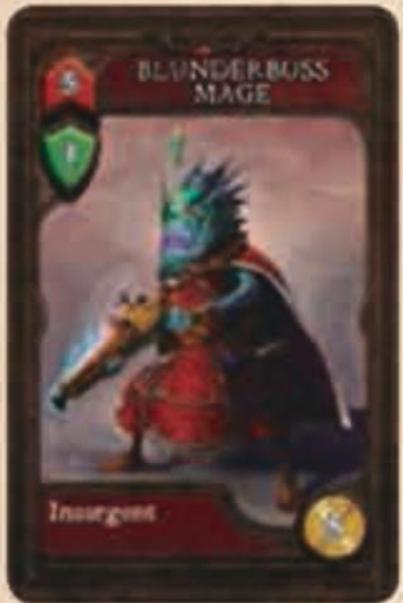
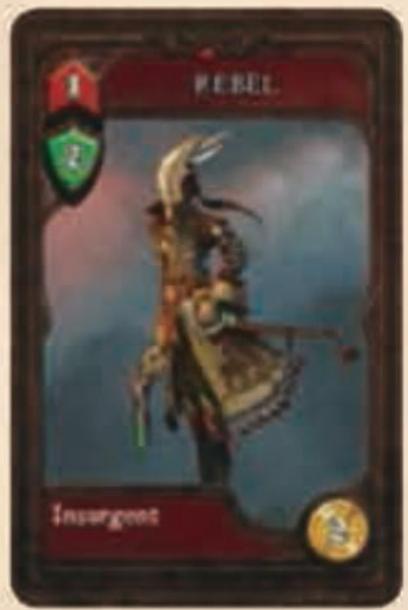
乔安娜决定进攻,所以她必须使用目前在她的军队中的所有牌:一个Blunderbuss Mage和两个叛军。所有3张牌的攻击值之和使她的基础伤害量为7(5 + 1 + 1)。
伤害分配
攻击者决定如何在防御单位中分配他们的伤害量。他们可以按照他们希望的数量将伤害分配到防御者军队中任意数量的牌。防御者对攻击者的军队做同样的事情。
然后从其防御值中减去分配给卡的伤害。任何防御达到的牌0被认为已经死亡,并被立即置入其所有者的弃牌堆。没有受到致命伤害的牌在回合结束时将其防御值设置回满。
如果攻击者击败防御者的所有牌,他们就会控制该区(即使他们在攻击中失去了整个军队)。
如果攻击者面对的是一名玩家,他们会从该区域移除防御玩家指示物。如果他们面对的是德鲁格尔族或城市守卫,他们只需删除所有防御牌,然后将他们自己的玩家指示物中的一个放在版块上,以表明他们现在控制它。
如果攻击玩家在攻击中杀死任何怪物或城市守卫,那么他们也会获得适当数量的声誉点。
例如,如果玩家杀死了一名Elite Guard,则会获得2声誉点。

在这种情况下,3名叛军正在攻击1名独立的Drueggar Soldier。攻击者可以对Drueggar Soldier造成9点伤害 $(3 + 3 + 3)$ 。

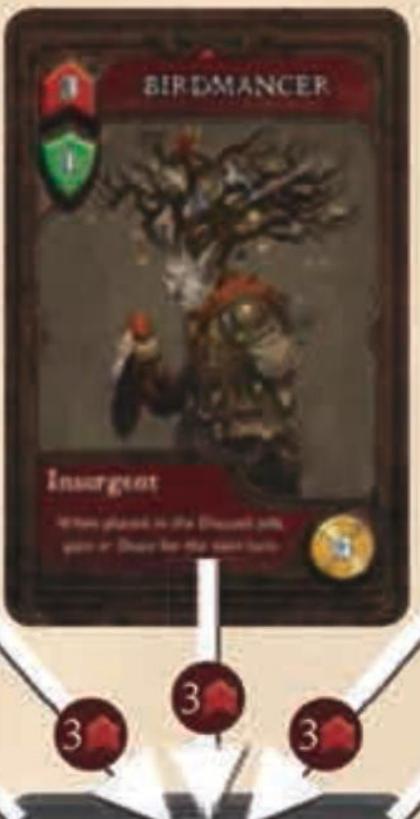

dier可以造成6点伤害,在3名攻击者之间分配,只要防御者认为合适。Drucg-gar Soldier设法摧毁了2个Sledges(每个受到的3点伤害将其防御值降低到0或者以下),但是还没有足够的伤害来移除Birdmancer。
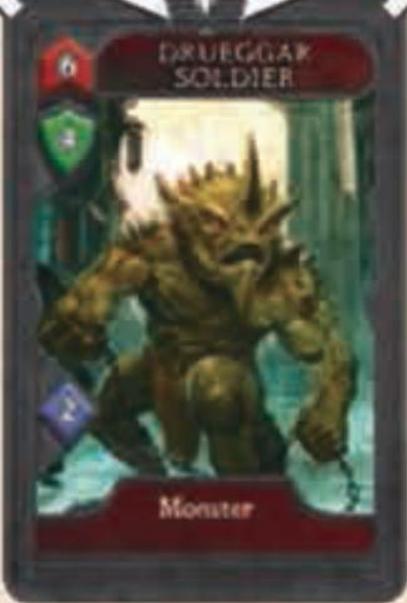
Insurgents对摧毁Druegar Soldier造成了足够的伤害(4-9-5)。攻击者丢弃他们的2个被摧毁的Sledges,从该区移除Drueggar Soldier,并获得2声誉点。Birdmancer留在军队区域中以备日后战斗。
清算阶段
任何未使用的行动点和/或金币将在玩家回合结束时被丢弃,以后将无法使用。
玩家在本回合所使用的任何支援和/或贸易卡,将置入弃牌堆中。叛军和符文石卡直到在被击败或使用前保持存在。玩家手中剩余的任何未使用的牌也会被置入弃牌堆中。
然后玩家将抽取6张新的卡牌作为手牌。在任何时候,如果玩家的牌组是空的并且他们不能抽牌,他们将他们的弃牌堆洗混并将其面朝下放置为他们的新牌组。玩家继续根据需要抽卡。

回合结束
在每轮结束时(在每个玩家进行过回合之后),首发玩家补充中心城区,增加更多城市守卫,以保证总有3个城市守卫在场。
例如:如果中心城区的2名城市卫队队员在这一轮中被击败,则会有2张城市卫队牌被用来补充中心城区的城市守卫且城市守卫至多3名。
必要时遵守任何城市卫队卡的能力效果。
然后,首发玩家将抽出一张事件卡,并按照卡上的说明进行操作。
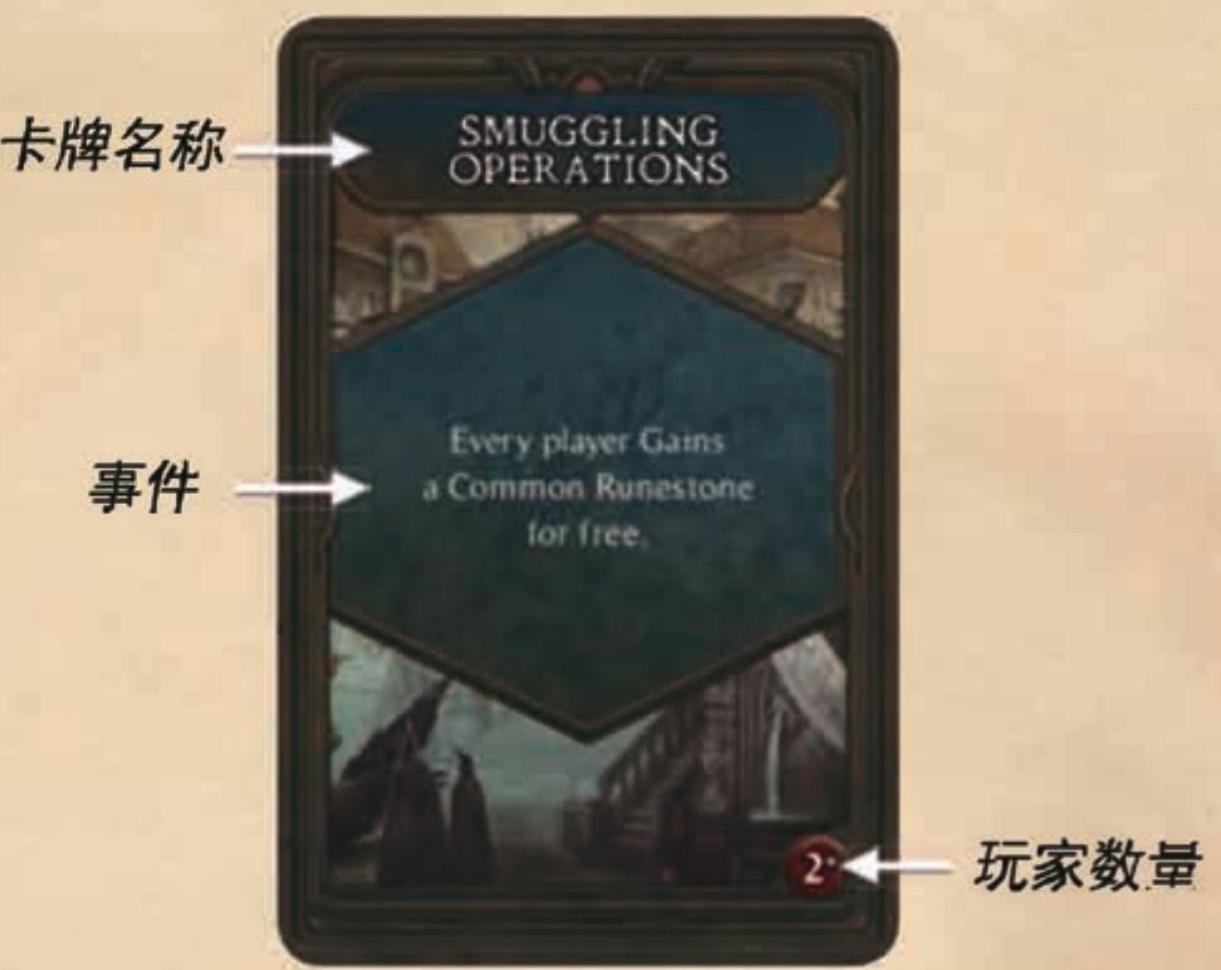
如果事件卡指示你在区域中部署卡牌,则玩家只需抽取相应的卡并将其放置在标记的区域中。如果区内已经存在相同类型的卡(德鲁格尔族加入部落,城市守卫加入守卫),那么新卡就会被添加到区内,这使得解放的难度更加令人生畏。
如果放置新卡的区域由不同于新卡的派系控制,则立即发生战斗。如果一名玩家控制了区域,他们必须立即使用他们的军队对抗守卫或德鲁格尔族。
使用标准攻击阶段规则来确定伤害 - 防御者左侧的玩家将确定德鲁格尔族/守卫伤害分布。
区域控制解决如下:
如果德鲁格尔族或守卫击败了玩家(例如击败他们所有的军队),但玩家也能够击败所有敌人的牌,玩家将保留对该区的控制权。
每当玩家击败任何守卫或德鲁格尔族牌时,他们会得到卡上标出的相应数量的声誉点。
如果玩家同时在多个区域受到攻击,则攻击同时发生,并且他们可以选择他们认为合适时防御/击败的卡片。但是,如果他们无法击败攻击他们的所有部队,他们将失去对所有地区的控制权。所有效果,包括符文石,只对攻击和防御(作为一个单位)施加一次,就像在1对1战斗中一样。
如果防御部队无法击败入侵的入侵,但同时有足够的防御力来抵御攻击,则在分配伤害后剩余的任何守卫或部落牌将被移除并丢弃。玩家不会因为退出版图而失去声誉点。
如果部署到同一区域,德鲁格尔族和城市守卫会相互攻击。使用标准的攻击阶段规则来确定战斗结果,起始玩家控制城市卫队以及他们选择的另一个玩家控制怪物部落。被击败的卡片被丢弃,没有人因这些卡的丢弃而得到声誉点。
果怪物部落或城市卫队的牌堆空了,重新洗牌丢弃的卡片以创建新的牌堆。
区域规则
区域奖励
每当玩家从其他人控制的区域(德鲁格尔族,城市守卫或其他玩家)解放该区域时,他们立即获得区域描述的奖励。
区域毁灭
任何时候有3个或更多德鲁格尔族卡占用一个区域,则该区立即被毁坏。从该区域移除所有卡牌或指示物并将其翻转以显示废墟一侧。没有派系(包括玩家)可以在游戏剩余时间内攻击或声称该区域。
丢弃与该区域相关联的任何区域标记,并在将来的事件卡上忽略与其相关的任何部署。

完整示例情景
在他的最后一轮,Marc控制了Bridge City区,在他的清理阶段结束后,他手里拿着以下6张牌:1The Highway Robber(领袖),2Saloran Carts(贸易),1 Runesmith(支援),1 Fearless Four(支援)和1 Rebel(叛军)。现在Marc从他的雇佣阶段开始。
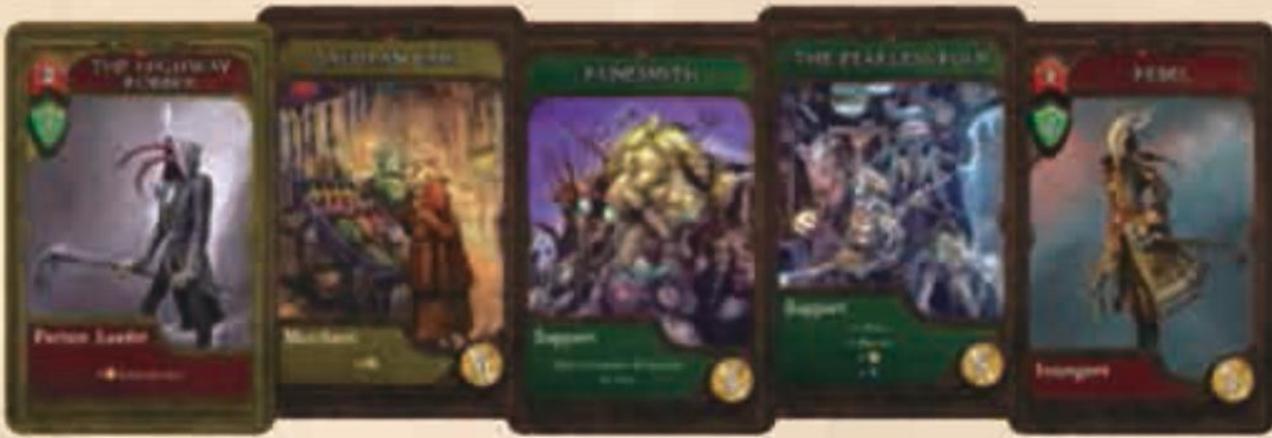
[2行动点,1招募和0可用金币]:马克花费1个动作点并放置Fearless Four,获得+1抽卡,+1招募,+1金币和+1声誉点。他从公共区域中拿取了他的声誉积分并从他的套牌中抽出最顶上的牌:1 Argethian Vendor(贸易)。

[1行动点,2招募和1可用金币]:马克只有1个动作点和3张牌需要该点数打出:The Highway Robber, Runesmith和Rebel。他还有3张不需要行动点的贸易卡,因此他将它们打出:2个Saloran Carts和1个Argethian Vendor。凭借从Fearless Four获得的金币,他总共有5金币用于招募新牌。
马克想要在本轮征服一个区域,并且他想要一个可以给予他额外攻击力的符文石,比如Swordstone(费用5金币,在攻击阶段给你的军队+6攻击值)。
在评估手小的牌时,他决定使用他的行动点来让Rebel发挥作用 - Runesmith会给他一个普通的符文石(这不是他想要的)并且The Highway Robber会增加他的黄金,这是他购买Swordstone所不需要的东西。

[0行动点,2招募和5可用金币]:Marc继续进行招募阶段。他直接进入罕见品质的符文石堆并拿起Swordstone,从他的金币中扣除其花费。
[0行动点,1招募,0金币可用]:没有金币,他就会失去额外招募的机会。
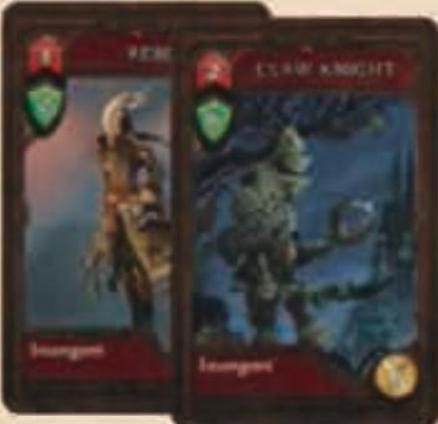
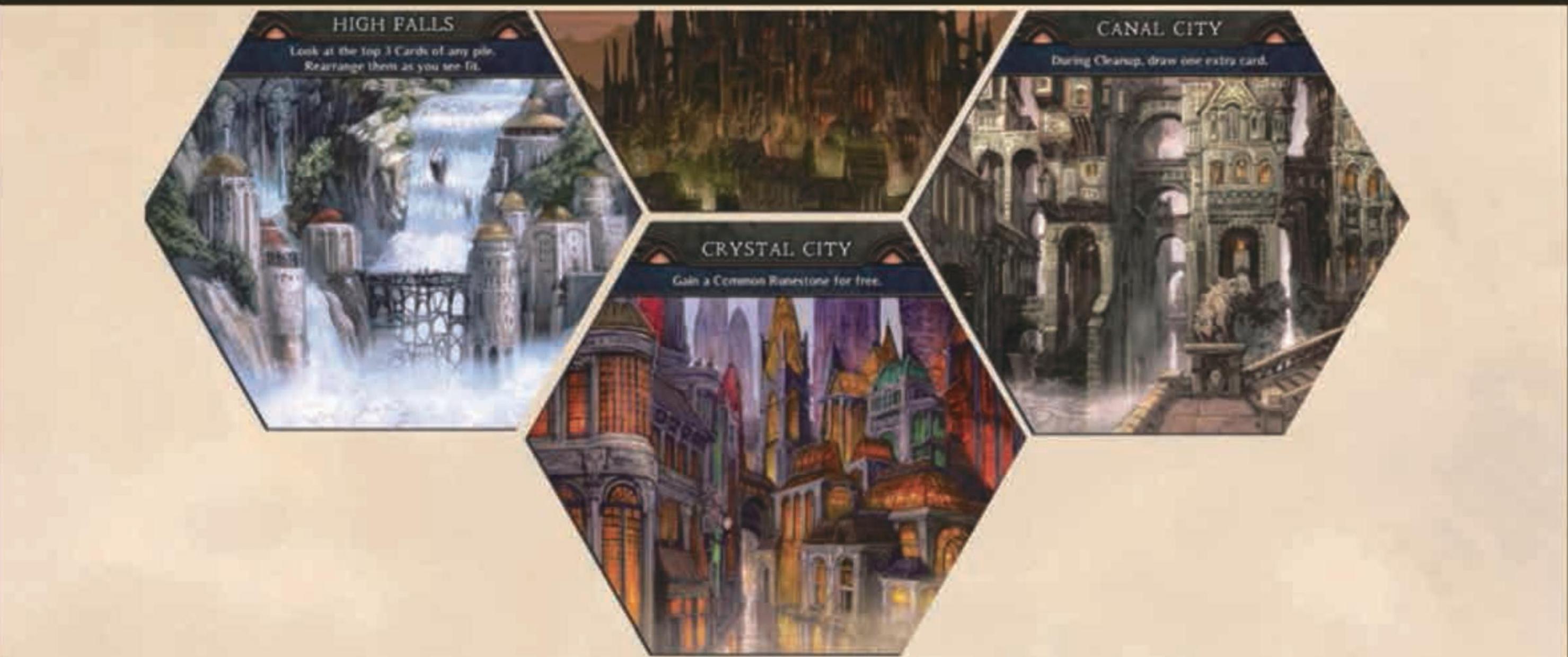
现在马克进入了攻击阶段。随着Rebel卡的打出,他的军队现在包括:2 Rebels和1 Claw Knight。他的总攻击值是4,防御值是10。根据他的战略,攻击Canal City是最容易实现的选择,但是它由一个
Drueggar Soldier (A攻击 6 防御 4) 守卫着
。马克展示了他新近获得的Swordstone符文石!他的攻击力现在是10,他能够杀死Drueggar Soldier(10对4),但他会失去一些单位。玛丽坐在马克的左边,将决定如何分配Drueggar Soldier的攻击点。她选择击败马克的2 Robels,花费4点攻击值(6可用),但不能用剩余的2点伤害击败爪骑士。
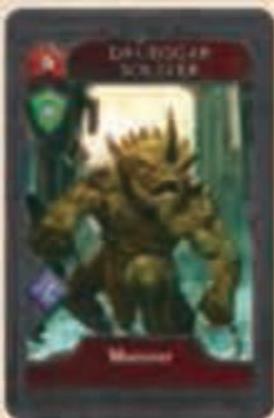
攻击阶段已经结束,因此马克得到2声誉点(用于击败Druegger Soldier)并将他的玩家指示物放在 Canal City!
清算阶段:马克放逐已经使用的符文石卡,并丢弃手中剩余的卡牌(Runesmith和The Highway Robber)。他抽取6张新的牌(作为常规回合)+区奖励中的1张牌(由于本回合解放Canal City)。他的军队区域现在只包含1个Claw Knight。马克的回合结束了。
游戏结束与胜利
在回合结束时,没有事件卡可以被抽取时游戏结束。每位玩家计算他们获得的声誉指示物以及未使用的符文石提供的声誉点数,玩家同样将在游戏结束时他们控制的区块所提供的声誉点数计入:外圈区域每个1声誉点,中心城市2点声誉点。
拥有最多声誉点的玩家成为盖特威最强大的叛军势力并且赢得游戏胜利。
然而盖特威城市一直受到攻击并且可能不会持续那么长时间(直到所有事件卡被翻开)。在某些情况下,游戏会以不同的情况提前结束:
如果德鲁格尔族毁坏了所有外圈城市,则中心城市沦陷并且所有玩家都失败;
如果德鲁格尔族占领包括中心城市在内的所有区域(即至少一张德鲁格尔族卡在区域版块上), 则城市沦陷所有玩家失败;
如果一个玩家控制版图上除了中心城市以外的所有区域,则该玩家立刻获得胜利。

可替代的隐藏符文石规则
如果你发现你想保持你所购买和发现的符文石不为人知来更好地释放这个强大的组合给你的对手一次突然袭击,你可以将3张符文石卡组成的牌组洗混并面朝下在桌子上,而不是面朝上。虽然你不会确切知道你从黑市经销商那里买了什么符文石,但你的对手同样不知道。
即使是在最好的情况下,符文石在盖特威也是极其难找到的,有时一个节俭的叛军必须尽可能利用好他的符文石带给他的惊喜和所有。
制作人员:
插图和世界设计:SEAN ANDREW
MURRAY
游戏设计与开发: JOHN HAWKINS.
MICHELLE MENARD
美工: MICHELLE MENARD, JÚLIA FERRARI, AND
FABIO DE CASTRO
生产: THIAGO ARANHA, GUILHERME GOULART, CAROLINA NEGRÃO, AND RENATO SASDELLI.
出版商:DAVID PRETI
测试者:ROBERT BRADSHAW, CIARAN CAIN, SHAY NILES KRASINSKI, DAVID KAUFMAN, LAUREN LAWLER, AURORA LAZARO, TIM MAHER, ANDRE MALKINE, NICHOLAS NOSENCHUCK, NEIL POSNER, ERIC SCHUMM, KATE STERF, DANIEL STONE, REBECCA VEST, KT WALLIN
©2017 FISHWIZARD GAMES, ALL RIGHTS RESERVED. NO PART OF THIS PRODUCT MAY BE REPRODUCED WITHOUT SPECIFIC PERMISSION. GATEWAY AND FISH-WIZARD GAMES LOGO ARE TRADEMARKS OF FISHWIZARD GAMES. COOLMINIOR-NOT, AND THE COOLMINIORNOT LOGO ARE TRADEMARKS OF CMON PRODUCTIONS LIMITED.
官方预组卡组
相比随机选择革命卡,玩家同样可以选择列举在下文的任意卡组来进行游戏。对每一套卡组的搭配版块也同样列在下方。
初入盖特威(推荐给首次玩耍的小伙伴)
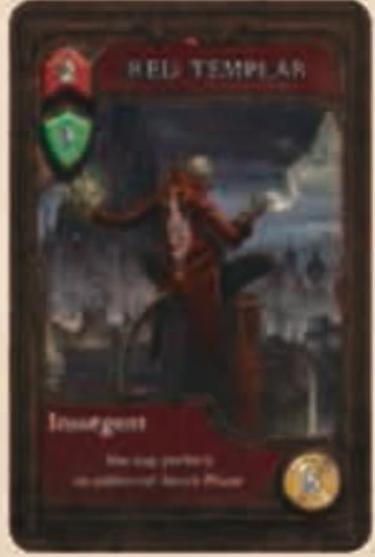
叛军卡: Pythian Wizard, The Elusive Birdfish, Red Templar, Birdmancer, Runesmith, Witchmasker, Multi-Wizard, Summoner.
推荐版块:Swamptown, Bridgetown, High Falls, The University, Marketown, Crystal City.
Fishmasters崛起
叛军卡: Fishwife, Fishmancer, Blunderbuss Mage, The Elusive Birdfish, Trumpeter, Nightfishermen, Grand Levitator, Gravemaster.
推荐版块:Swamptown, Canal City, Harbortown, High Falls, Marketown, Bridgetown.
荒蛮之力
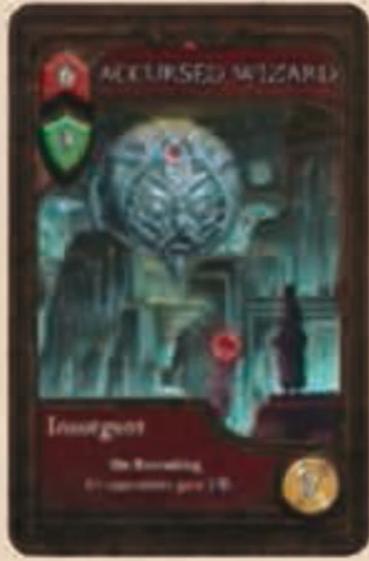
叛军卡: The Defiant Five, Witchmasker, Geomancer, Wandering Pete, Red Templar, Mobile Wizard Tower, Claw Knight, Accursed Wizard.
推荐版块: Bridgetown, Swamptown, High Falls, The Univeristy, Harbortown, Marketown.
风险交易
叛军卡: Summoner, Multi-Wizard, Pythian Wizard, Jar Wizard, Wandering Pete, Spellbones, War Hero, Travelling Wizards.
推荐版块: High Falls, Swamptown, Harbortown, Crystal City, The University, Canal City.
商贸诸侯
叛军卡: Magic Orb, Runegheist, Fearless Four, Nightfishermen, Runedealer, Mobile Wizard Tower, Kleptomancer, Grand Levitator.
推荐版块:Marketown, Canal City, High Falls, Crystal City, Harbortown, The University.
符文石经销商
叛军卡: Runesmith, Runedealer, Magic Orb, Fishwife, Nightfishermen, Blunderbuss Mage, Accursed Wizard, Geomancer.
推荐版块: Crystal City, Marketown, High Falls, Bridgetown, Harbortown, The University.
尽在掌握
叛军卡:Trumpeter, Summoner, Gravemaster, War Hero, Witchmasker, Runegheist, Birdmancer, Runedealer, Fearless Four.
推荐版块:Canal City, High Falls, Swamptown, Bridgetown, Harbortown, Crystal City.
06.md16.0 KB
Playing a Turn
The world melts away into a smear of color. A rising tone fills my ears. Suddenly, everything cuts to black.
I'm falling.
The walls come back slowly, fading into streaks of blue. A familiar voice whips past my ears, as if from far away.
"Hey buddy, still with me?"
"Yeah?" The words are ripped from my lips and tossed into the void.
"Whoa, whoa there. I can hear you just fine. You've still got control of your motor functions, yeah? The first dive can be a bit rough. Just follow my voice and you'll be fine."
A pixelated spot of blue materializes to my left, and slowly sharpens into a snake. It looks towards me, then swims over.
Jericho's voice. "There we go. Buckle up, we're landing soon."
I look down on a small pane of rapidly approaching white. There are things down there, wriggling like ants, but I'm falling too fast to focus. I plummet through, into a world of shapes and spires, and hit the ground, kicking up a puff of light.
The snake lands on my shoulder, grinning. "Welcome to the real NET, kiddo."
There are two kinds of resources in Netrunner: the CLICK (click) and the CREDIT (credit). Clicks measure time, while credits measure money. You spend clicks to take ACTIONS during your turn, and doing most anything will also cost some number of credits.
On each of your turns you have FOUR clicks to spend; essentially, you get to do four things on your turn. There are a few BASIC ACTIONS that are always available to you, as shown on the red side of the action reference card. You don't have to worry about the last action on the reference card for your first game.
click: Gain 1 credit.
click: Draw 1 card.
click: Play 1 event from your grip.
click: Install 1 hardware, program, or resource from your grip.
click: Run any server.
In addition to these basic actions, some cards will give you access to other special actions. An action on a card is always written with a click symbol at the start followed by a colon, like so: "click: Place 3 credit on this resource."
When it is your turn, you must take four actions one at a time in any combination. You can take them in any order, and you can repeat actions if you like, but you cannot end your turn with click to spare. Use the track on the action reference card to keep track of your available click as you take actions.
After you take actions, your turn ends, and it becomes the Corp's turn. Before you can pass your turn over, check to see if you have more than five cards in your grip. If you do, you have to choose and discard cards from your grip until you have only five.
To show that you're done with your turn, flip the action reference card over to the blue Corp side.
Steps of a Turn
Action phase
Gain click click click click for taking actions.
Resolve any "when your turn begins" abilities.
Take actions until you run out of click.
Discard phase
If you have more than five cards in your grip, discard until you have only five cards.
Your turn ends and it becomes the Corp's turn.
Playing and Using Cards
One of the actions you can take on your turn is to play an event card from your grip. Events are your one-shot effects: put the event you wish to play faceup into the play area so the Corp can see it, pay credits equal to its PLAY COST, and follow the instructions in the text box. Afterward, trash the event to your heap (discard pile).
Example: You want to play the event VRcation from your grip. To do so, you must reveal it and pay its play cost of 1 credit. Then you draw 4 new cards from your stack and lose click (unless you just spent your last click to play VRcation!). Finally, trash VRcation to your heap.
The rest of your cards (hardware, programs, and resources) stay on the table once they enter play instead of getting trashed immediately. Before you can benefit from one of these cards, you must first INSTALL it into the play area by paying its INSTALL COST. Once a card is installed, you get access to the abilities listed in its text box.
Programs are special because they have a memory cost in addition to their install cost. The memory cost is not something you have to pay in order to install a program. Instead, the number of programs you can have installed at any given time is limited by the number of available MEMORY UNITS (MU, also marked with mu) you have. The total memory cost among all your installed programs can never go above the number of memory units you have. You start the game with 4 memory units granted by your identity card, but cards can give you more.
You can still install a new program if you are already at capacity from your available memory units, but in order to do so you first have to trash programs to make enough room.
Example: You want to install the program Unity from your grip. To do so, you must put it into the play area and pay its install cost of 3 credit. However, you already have 4 mu (MU) of programs installed: 2 mu from Mayfly and 1 mu each from Cleaver and Carmen. In order to install Unity, you will also have to trash one of your already installed programs to free up some MU.
What to Expect from the Corp
The Corp player will spend their clicks to add cards to their board facedown, invest in those cards, and keep their economy going, all in service of scoring out agendas before you can get your greedy paws on them. The Corp installs all of their cards face-down. Instead of paying the cost for a card up-front, the Corp will pay when they activate that card by turning it face-up. This is called REZZING.
The Corp's play area is divided into areas called SERVERS. Each server has two sections of installed cards: the ROOT and the ICE. The Corp installs ice in front of servers to defend them, and they install their other cards in the roots of servers in order to use those cards.
The Corp starts the game with three CENTRAL SERVERS. In addition to ice and a root, each central server is associated with one of the Corp's out-of-play areas: HQ is the central server containing the Corp's hand (represented by the Corp's identity card), R&D is the central server containing the Corp's deck, and ARCHIVES is the central server containing the Corp's discard pile.
The Corp can create any number of new servers in addition to their central servers as well. Servers created during the game are called REMOTE SERVERS. Remote servers are not associated with any out-of-play areas.
Even though you won't know what cards the Corp installs until they rez them, the location of an installed card can tell you what to expect. The Corp isn't allowed to move their cards around once they are installed, except to trash old cards when they install new ones.
An UPGRADE is an installable that boosts a specific server. They are installed oriented vertically inside the root of a server (for central servers, upgrades are typically placed between the corresponding out-of-play area and the ice). The Corp can install any number of upgrades in the root of each server.
AGENDAS and ASSETS can only go in the roots of remote servers. Unlike upgrades, each remote server is limited to either a single agenda or a single asset. Watch out though: you won't be able to tell if a card in the root of a remote server is an agenda, asset, or upgrade until you run on it or the Corp reveals their plans.
The Corp's other type of installable card is ICE, which are installed oriented horizontally in front of the server the ice is set to PROTECT. The Corp can install any number of ice protecting a given server, placing them in discrete POSITIONS outward from the server toward your side of the table. In order to breach a server, you'll have to get through the ice one at a time, starting with the outermost piece nearest to you and moving inward toward the server. A bigger server is a more expensive server for you to breach, but it's also more expensive for the Corp to set up, as each ice costs 1 credit to install for each ice already protecting the server.
The Corp gets to take THREE click worth of actions on their turn, but they also draw 1 card at the start of each of their turns without spending any clicks. Like you, the Corp has access to basic actions to draw cards, gain credits, install cards, and play operations (one-shot cards like your events).
They also have a basic action to ADVANCE an installed card, where they pay click and 1 credit to place an ADVANCEMENT COUNTER on the chosen card. The Corp can't score an agenda until they've installed it and advanced it enough times. Typically, agendas worth 1 point require 3 advancement counters, agendas worth 2 points require 4 advancement counters, and agendas worth 3 points require 5 advancement counters. While the Corp has to advance agendas to score them, the Corp's starter deck has one special asset that can also be advanced.
One of the tools the Corp can use to directly hit you back is DAMAGE. In your first game or two, the only kind of damage is NET DAMAGE. Whenever you take any amount of damage, you must trash that many cards from your grip at random. If you don't have enough cards in your grip to trash, you are FLATLINED and lose the game. Most of the time you'll face net damage from ice during a run, but as you can see, the advanceable asset Urtica Cipher can surprise you with some net damage while masquerading as an agenda the Corp is advancing. Be careful you don't run with too few cards in your grip.
While the Corp's role might seem defensive at first, a smart Corp player will apply pressure and try to set the pace of the game by scoring out agendas rapidly or forcing you to push through remote servers that tax your resources. Your job as the Runner is to shut down those threats and hit the Corp where they are weakest.
Runs
Runs are how Runners gain points to win, and therefore what Corporations must defend against. Let's walk through some of the basics of running.
Why should I run?
You run to ACCESS the Corp's cards. This allows you to STEAL their agenda points, TRASH their assets and upgrades, and anticipate their plans.
How do I start a run?
The entire process of attacking a server is called RUNNING. You have a basic action to spend a click to run during your turn, at which point you'll pick a particular server to attack. Some of your cards also trigger runs. If the Corp hasn't protected the attacked server well enough, then you'll make a SUCCESSFUL RUN and BREACH the server.
What happens when I get through?
Breaching a server gives you ACCESS to some cards from that server, one at a time.
All Servers: You get to access every card installed in the root of that server.
HQ: You get to access 1 card from the Corp's hand at random.
R&D: You get to access 1 card from the top of the Corp's deck.
Archives: You get to access all of the cards in the Corp's discard pile.
Whenever you breach a server, you are required to access every card that you are allowed to.
What happens when I access a card?
Agenda: You STEAL it! This puts it into your score area and is how you acquire points to win the game. This is why running ADVANCED cards (which the Corp has to do to score) is potentially extra valuable!
Asset or Upgrade: You can choose to spend credits equal to the TRASH COST of the accessed card (shown in the bottom right corner of the card) in order to send it straight to Archives faceup. (This option isn't available if the card is already in Archives.)
Operation or Ice: Nothing happens, but now you know what the Corp might be able to do in the future.
If you don't trash or steal the card you access, the Corp will simply return it to where it was before you access the next card, if applicable.
Some of your cards allow you to access an additional card when you breach HQ or R&D. This is a very powerful ability that lets you make fewer runs for better results. It's important to know that you won't ever access the same card during a run, so if you get to access 2 cards from the Corp's hand, you'll see two different cards, which is even better than two successful runs on HQ! Similarly, if you get to access 2 cards from R&D, you'll get to look at the top two cards of the Corp's deck instead of one.
Can the Corp stop me from getting in?
Ice form the bulk of the Corp's defenses, creating blocks against your intrusion. There are three (important) subtypes of ice: BARRIER, SENTRY, and CODE GATE. Very generally, barriers END THE RUN—that is, stop your progress into the Corp's system entirely. Sentries hurt you in some way, and code gates tax your resources.
The most important cards you can install are your ICEBREAKER PROGRAMS. These are the cards that will allow you to deal with the Corp's ice. Matching up against the subtypes of their ice are your subtypes of icebreaker: FRACTERS, KILLERS, and DECODERS.
You also have Mayfly, a special icebreaker that can help you against ice of any subtype for a limited time.
In order for the Corp's ice to do anything, they'll need to be rezzed, just like their assets. The Corp can only rez ice during a run, though, so they'll have the chance to rez ice before you get to their servers. This means that the first time you ENCOUNTER a piece of ice, you won't know anything about it until it's actively trying to affect you.
You'll have to deal with every piece of rezzed ice on the server you're attacking before you can breach the server, starting with the one closest to you and moving one at a time toward the server. Ice have SUBROUTINES, instructions that you must BREAK or they will RESOLVE. Subroutines resolving is bad for you and good for the Corp. In order to avert the effects of the subroutines, you'll need the right icebreaker (matched with the subtype of ice) and enough credits to use it. Your icebreakers have abilities for both increasing their strength and breaking subroutines. Pay whatever you need to get the icebreaker to the same strength (or higher) as the ice you're breaking, then pay whatever you need to break the subroutines.
You don't necessarily always have to break every subroutine. After you choose which subroutines you can and want to break, all the ones you haven't broken resolve. If the run hasn't been ended, next you'll PASS that ice and continue the run. (The Corp's ice will stay where it is and stay rezzed, and you'll again have to deal with it the next time you run this server.)
When you pay to increase the strength of an icebreaker, the increased strength will only last for the duration of the encounter with the current piece of ice. Once you pass the ice, the icebreaker(s) whose strength you increased will return to their base strength. So, for instance, if you pay 2 credit for an ability on an icebreaker that reads "+3 strength", that +3 strength goes away after you're done encountering the current piece of ice. If you want to use it again on another piece of ice during the run, you'll have to pay 2 credit again.
In between each piece of ice and right before you reach the server, you have the opportunity to JACK OUT. Jacking out is when you choose to end the run rather than continue. If you do that, the run is UNSUCCESSFUL just as if a piece of ice ended the run, but sometimes doing so is the safest choice depending on the ice you encounter. If you make it past all of the Corp's ice without the run ending, the run is considered SUCCESSFUL. Then, you breach the attacked server as described above.
Corporate defenses are often weaker than they look. While it can feel scary to run without knowing what you're up against, don't hesitate to run even if you don't have a full suite of icebreakers yet. Unprotected servers are nearly always a safe bet, and even if your run against a protected server fails, you can always try again next click!
Download Markdown04.md14.9 KB
Fighting Back Against the Runner
Your ice have a wide variety of subroutines to help you defend your servers. Some subroutines help you out by letting you install cards without spending click, fetching cards out of your Archives, or even gaining you some credits. Other subroutines attack the Runner's resources, such as by making them lose credits. Perhaps the most iconic subroutine is the instruction "End the run.", which stops the Runner in their tracks.
Another powerful tool at your disposal is DAMAGE. In your first game or two, the only kind of damage is NET DAMAGE. Whenever the Runner takes any amount of damage, they must trash that many cards from their grip at random. If the Runner doesn't have enough cards in their grip to trash, they are FLATLINED and lose the game. Several of your ice, such as Karunā, can inflict net damage on the Runner during a run.
One of your cards, Urtica Cipher, has an ability that happens when the Runner accesses it, even while it is unrezzed. This is another source of net damage in your deck. The more you advance Urtica Cipher ahead of time, the more net damage the Runner will suffer when they access it.
While you can sometimes surprise the Runner with damage this way, or even flatline them outright, the true power of Urtica Cipher lies in being hidden. Is the card you've been advancing an agenda or a deadly trap? Until you score it or the Runner accesses it, the Runner has no way of knowing. Use this game of information to your advantage.
Getting Started
By now, you should know all you need to get started. Using the Corp deck provided, set up the game to match the diagram on the back of your identity card, The Syndicate.
Your identity card represents HQ, so you will place ice in front of it to protect the cards in your hand. R&D and Archives are represented by the cards in those servers, which are a full and empty pile respectively at the start of the game.
Shuffle R&D, then draw 5 cards to form your starting hand in HQ. Start a CREDIT POOL of 5 credit, placing them nearby without covering any cards. Your credit pool is where you keep track of how much money you have throughout the game.
If you don't like your starting hand, you have one opportunity to shuffle it back into R&D and draw 5 new cards. This is called a mulligan. It's probably a good idea to take a mulligan if your first starting hand has more agendas than ice. Once you've chosen whether to keep or mulligan your starting hand, the Runner may also mulligan. Then the game can begin.
You always take the first turn of the game. At the beginning of your turn, don't forget that you're required to draw a card. Then you have three click to spend. The classic (though by no means only) strategic opening turn for a Corp is:
Get some money, either by spending click to gain 1 credit or by playing a card that gives you money, such as Hedge Fund.
Install a piece of ice protecting HQ.
Install a piece of ice protecting R&D.
Once you've taken all three clicks and discarded down to your maximum hand size, play passes to the Runner. Keep going back and forth until one of you has won, and check back on these rules as you need to. For this game, you win if you are the first player to acquire 6 agenda points or if the Runner flatlines to damage.
Armed with this knowledge and following along with the quick reference flowchart, you should be able to handle most runs in your first few games. There are some subtleties to runs that might raise questions as you explore the game more. When you are ready to learn more, or if you run into a situation where you're not sure who should do what when, check out the in-depth Run Timing Guide below.
Frequently Asked Questions
Below are some common beginner questions that might come up while you learn the ropes. After you've played a full game or two, the next section covers where to go from there.
What happens if I can't draw a card when I'm required to?
If you, as the Corp, ever attempt to draw a card from an empty R&D, you lose the game. This is commonly referred to as "decking." This does not apply to the Runner.
Do I have to tell the Runner what type of card I've just installed?
No. The Runner should be unable to tell the difference between an agenda, an asset, or an upgrade in a remote server until you rez the card.
When the Runner accesses the top card of R&D, do I get to see it?
No.
Can I get cards back from Archives?
Not unless you have a card that says so.
What does "hosted" mean?
Whenever a credit or counter is placed onto a card, it is said to be "hosted" on that card. If the text of a card uses the word "hosted", it refers only to something on that card and not on another card.
What do "load", "empty", and "take" mean?
To "load" some credits or counters onto a card is to place them on that card from the bank. They are now "hosted" on that card. A card is "empty" once it runs out of whatever was loaded onto it. "Taking" credits from a card mean you get to remove them from the card and add them to your credit pool.
Card Clarifications (Corp)
Brân 1.0
When the first subroutine on Brân 1.0 resolves, choose a piece of ice in HQ or Archives. Immediately install that ice directly inward from the ice with this subroutine (so that the Runner will encounter it right after this ice). Usually installing ice has a cost (based on how many ice are already installed on that server), but installing ice with this subroutine does not incur that cost.
Seamless Launch
Choose a card you did not install this turn. Take 2 advancement counters from the bank and host them on the chosen card. Canny Corps might use this to advance cards faster and more cheaply than they could by using the "click, 1 credit: Advance 1 installed card" basic action.
Manegarm Skunkworks
After the Runner has passed all of your ice protecting the server of this upgrade, the Runner must do one of the following things: pay 2 click, pay 5 credit, or let the run end. You must rez this upgrade before the run is declared successful.
Urtica Cipher
Whether this card is rezzed or not, you can always use the "click, 1 credit: Advance 1 installed card" basic action to place advancement counters on this card.
Additionally, this card has an effect when the Runner accesses it while it is installed, again whether it is rezzed or not. When the Runner accesses this card, count how many advancement counters are hosted on it. Add 2 to that number. Then, the Runner trashes that many cards at random from their grip (hand). (If they cannot, they lose the game.)
Diviner
When Diviner's subroutine fires, the Runner trashes one card at random from their grip (hand). (If they cannot, they lose the game.) Look at the trashed card. If it has a play or install cost that is an odd number (1, 3, 5, etc.), end the run.
Karunā
When the first subroutine on Karunā resolves, the Runner trashes two cards at random from their grip (hand). (If they cannot, they lose the game.) After the Runner takes the net damage, they can choose to jack out. If they do, the second subroutine does not resolve, even if the Runner did not break it.
Send a Message
Unlike the other agendas in System Gateway, Send a Message has an ability that resolves either if you score it or if the Runner steals it. Regardless of whose score area Send a Message gets added to, it lets you choose a piece of ice that you have installed and rez it for free.
Superconducting Hub
When you add Superconducting Hub to your score area, you may optionally immediately draw 2 cards. Afterward, for the rest of the game, your maximum hand size is increased by 2. (So, if you have one of these scored, your hand size is 7. Scoring a second one raises your hand size to 9.)
Tithe
Remember: Subroutines are addressed to you, the Corp, so if Tithe's second subroutine resolves, you take 1 credit from the bank and add it to your credit pool.
Whitespace
When the first subroutine of Whitespace resolves, the Runner must remove 3 credit from their credit pool and return them to the bank. If have less than 3 credit, they lose as much as they have.
When the second subroutine resolves, count the number of credits in the Runner's credit pool. If they have 6 or fewer credits, the run ends immediately.
Regolith Mining License
Regolith Mining License is a card with a load/empty ability. When you install it, take 15 credit from the bank and put them on Regolith Mining License. During your turn you can, as an action, take 3 credit off of Regolith Mining License and add them to your credit pool. Once you have taken all the credits off of Regolith Mining License, you trash it because it is empty.
Opening the Booster Pack (Corp)
When a notification comes in bearing the name of the Chief Security Officer, Rasul quickly stuffs the rest of his celebratory snack in his face. It's not bad for vending machine fare, but he wonders if it bears any resemblance to what real chocolate would have tasted like. He hits "accept," and a severe-looking executive in a sleek bio-luminescent suit stares out at him from the main holo.
"What can I do for you?" Rasul smiles. It's almost sincere, too, he's expecting congratulations. The exec doesn't bother with pleasantries.
"Headquarters has been compromised. We have intruders in meatspace and netspace."
The exec pulls up two more virts with a sweep of their hand, like a weathercaster with anger issues. The first is a server map, the intruder already past a dormant piece of ice. The second, surveillance footage. A gray-clad figure knocking a prisec agent unconscious, rifling through pockets and swiping a datacard.
Rasul can fill in most of the blanks, but one question sticks out. "Why didn't you rez that ice, boss?"
Wrong question. "Of course," they seethe, "why didn't I think of that?" The already stern-looking executive glows red with rage, a vein pulsates in their forehead like it's about to burst. "Do you realize how much computing power you tied up swatting whatever fly it was that buzzed your way? By the time we can rez, they'll be long gone. Hasn't anyone ever told you 'don't spend it all in one place'? Consider this your first and last lesson. I don't know what human scrap heap Thorn pulled you out of, but I can …"
The exec is still talking, but their words become noise, their image blurs out of focus. Rasul can't keep his eyes off the live feed, the intruder. It's a joy to watch a master at work.
Once you've played at least one game with the Starter decks and feel ready to learn more, return to the STOP card and the cards behind it. There are 20 cards in the booster pack: 10 for the Runner and 10 for you. Shuffle your 10 bonus cards into your deck to make The Syndicate's full deck!
The cards in the booster pack introduce a few more mechanics that will make your games more dynamic and exciting.
Viruses
Two of the Runner's booster cards are special programs with the subtype VIRUS. These cards accumulate VIRUS COUNTERS based on certain conditions, which can then be spent or counted for useful effects.
Fear not! You can slow the tide of virus counters with the basic action that removes all virus counters from all virus cards in play:
click click click: PURGE virus counters.
Purging virus counters takes your whole turn, so you'll need to balance the time it takes against how big you're willing to let the Runner's viruses get.
Leech is a program that the Runner can use during encounters with ice to bring the strength of a piece of ice down instead of boosting the strength of an icebreaker up. Conduit is a powerful piece of access acceleration, similar to Jailbreak and Docklands Pass. If that virus gets big enough, the Runner can dig down deep into R&D for agendas, so watch out. Remember the rules for accessing additional cards, which are further explained in the Run Timing Guide.
Tags
Many of your cards in the booster pack give you the ability to track the Runner when they're not being careful. This is called TAGGING the Runner. The back of the STOP card is a tag tracker. Whether you give the Runner a tag or the Runner takes one voluntarily, the effect is the same: place a counter on the tag tracker card. If the Runner has at least one tag on the tag tracker, they are said to be TAGGED.
If the Runner is tagged, you have access to this basic action:
click, 2 credit: Trash 1 installed resource.
While the Runner is tagged, they also have access to a new basic action:
click, 2 credit: Remove 1 tag.
Additionally, there are some especially nasty cards in this booster pack that you can only use if the Runner is tagged. For example, normally you only have the ability to trash resources while the Runner is tagged, but the card Retribution lets you trash a program or a piece of hardware. The more tags you can land on the Runner, the longer you'll have to mess with their stuff before they can shake all the tags.
Meat Damage
One of your booster cards introduces a second type of damage: MEAT DAMAGE. Regardless of the type of damage the Runner takes, the effect is the same: for each point of damage the Runner must trash 1 card from their grip at random. Remember, if you can deal more damage than the Runner has cards in their grip, they flatline and lose the game.
Orbital Superiority is a powerful agenda that lets you leverage tags into meat damage. When you score it, you'll either give the Runner a tag or, if they are already tagged, 4 meat damage all at once.
Funhouse
One of your booster cards is the ice Funhouse, which has an ability that triggers when the Runner encounters it. Before the Runner has the chance to use icebreakers, they have to decide whether Funhouse ends the run or gives them a tag.
Predictive Planogram
One of your booster cards has a variable modal choice—a choice with multiple options, marked with bullet points. When making choices for card abilities like this, you do not have to choose ahead of time, and you can choose from among the options in any order.
If the Runner is not tagged, you can choose to either gain 3 credit or draw 3 cards.
If the Runner is tagged, you can choose to gain 3 credit before drawing 3 cards, draw 3 cards before gaining 3 credit, or do only one of the options. You can even draw 3 cards and look at the new cards before deciding whether or not to gain 3 credit.
AMAZE Amusements
One of your booster cards has a "Persistent" ability on it. The ability on AMAZE Amusements always applies until the end of a run. The Runner has to take 2 tags when the run ends if they steal any agendas, even if they access and trash AMAZE Amusements before accessing any agendas.
Download MarkdownTexts are community-compiled or publicly released by publishers; copyright remains with the original authors. For personal reference only.