
The Dwarf King
At a glance
Rules, cards and Q&A (Chinese)
The rules, card data and player questions for this game are written in Chinese. Open the Chinese page to read them.
Where to find full rules
Full rules and card lookup are available in the cunlema app at cunlema.cn — pick this game and ask about any rule, card or turn you are unsure about.
Related games
Rulebook text (Markdown)
This game has 1 rulebook Markdown file(s) in our library; 1 rendered inline below — expand to read or download.
EXE-DW-Rules-US.md8.8 KB


As everybody knows, dwarves have beards and their king has the longest! So the King of Dwarves is a bearded guy who is even more bearded than the others …
Contents
• Contents
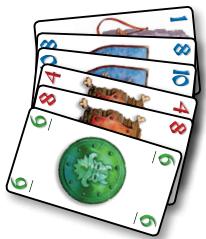
• 39 basic cards (3 suits with 13 cards each, from 2 to A)
• 14 special cards (three cards with a value of 1, six cards with a value of 11 in one of the three suits, and 5 suit-less magic cards)
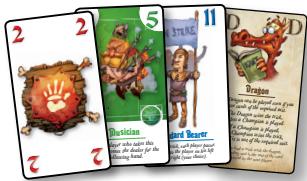
The basic cards and the special cards come in three suits:
• Knight (Blue)
• Dwarf (Green)
• Goblin (Red)
• 20 Quest tiles (they determine how to win or lose points during the ongoing hand)

Shuffle the tiles, the 39 basic cards and the 14 special cards separately.
Goal of the game
The player with the highest total score after seven hands wins the game. A different scoring rule is chosen for each hand.
Hand of player 1
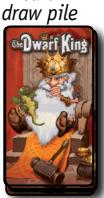
Tricks in play

Active quest
Tricks taken by player 3


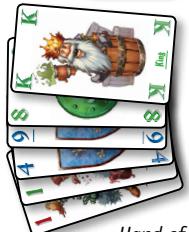
Tricks taken by player 1
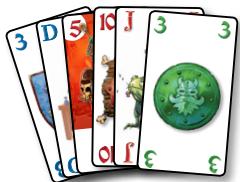
Hand of player 3
Hand of player 2
Tricks taken by player 2
The quest determines how many points are scored during the present hand.
Briefly put, the goal is to take tricks (each card or trick taken wins you points) OR to avoid taking tricks (each card or trick taken would then make you lose points).
Note: a trick designates the cards that have been played during a turn and that have been collected (taken) by the player that played the highest card. A hand designates both the cards in a players hand and the succession of tricks played with the players' hands.
Setup
A game of King of Dwarves is played in seven hands.
• 3-player game: the 2 of Dwarves is permanently removed from the game. Each hand is played with the remaining 38 cards and a special card. • 4-or-5-player game: each hand is played with 40 cards : the 39 basic cards and a random special card. The Quest tiles and the special cards are shuffled and set in two separate draw piles. After each hand, the used Quest tile and special card are removed from the game (and will therefore not be used in any later hand).
Dealing the cards
The first dealer is the owner of the game. Afterwards, the dealer is always the player who took the 5 of Dwarves in the previous hand. The dealer draws the first of the special cards, reveals it and explains its effect to all the other players. The dealer then shuffles this card with the 39 basic cards (38 for 3 players) and
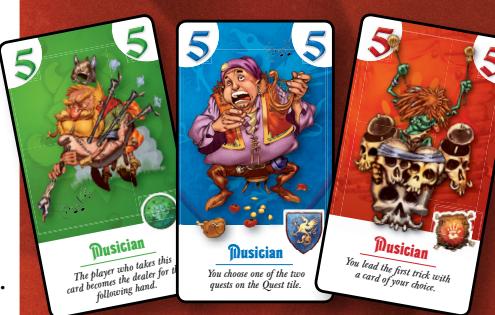
Summary of the three 5s: • 5 of Dwarves: the player who took it in the previous hand is the dealer for the next hand, and draws the special card.
• 5 of Knights: the player who has it in hand draws the Quest tile and chooses the scoring rule for the ongoing hand.
• 5 of Goblins: the player who has it in hand leads the first trick.
Note: to lead is to play the first card in a trick.
deals the cards, the same number to each player (8 cards per player for a 5-player game, 10 cards per player for a 4-player game, 13 cards per player for a 3-player game).
The player who has the 5 of Knights must show it. He draws the top Quest tile from the pile, reads the two scoring rules written on it, and chooses one, explaining it to the other players.
The text of the scoring rules always refer to the cards or tricks taken by the players, not to the cards they have in hand at the start of the hand.
Playing a hand
At the start of a hand, the player who has the 5 of Goblins must show it. He has to lead the first trick by playing the card of his/her choice (not necessarily the 5 of Goblins). Afterwards, each trick is led by the player who took the previous
one. A suit called must be played if possible, with no requirement to raise. A player who does not have a card of the suit called can play any card. There is no trump. The highest card of the suit called takes the trick.
Example of the beginning of a hand with 3 players:
Peter took the 5 of Dwarves in the previous hand. He becomes the dealer for this hand. He draws a special card (the Dragon), shuffles it in with the rest of the cards and deals 13 cards to each player (remember, this is a 3-player game).
Bruno gets the 5 of Knights. So he draws the top Quest tile and the scoring rule he chooses
for this hand is: "Knights victory over Dwarves: +1 Point per Knight, -1 point per Dwarf". It means that each Knight card taken will earn 1 Point whereas each Dwarf card taken will make players lose 1 Point.

Catie has the 5 of Goblins so she plays first. She plays a 3 of Dwarves. All the players must play Dwarf if they have some. Peter plays a 4 of Dwarves. As Bruno has no Dwarf in hand,
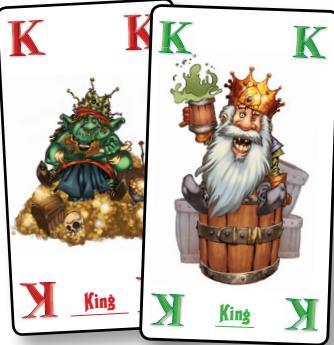
he can play whatever he wants instead and chooses to get rid of the King of Goblins.
Peter takes the trick (he had to play Dwarf and his 4 of Dwarves beats Catie’s 3 of Dwarves ; Bruno’s card, the King of Goblins, could not take the trick, since it was not of the called suit) and so leads the next trick.
Scoring points
Points are scored and added up after each hand.
Once the last trick is played (the players have no more cards in hand) they count how many points
they scored during the hand.
Depending on the scoring
rule that was chosen,
cards taken in the tricks
will make them win or
lose points.
Finally, the Quest tile and the special card used when the cards were dealt are removed from the game. The next hand will use a new special card and a new Quest tile.
Important: magic special cards have neither suit nor value when score is determined. Therefore, they do not provide any points.
Example:
The victory condition chosen for this hand is: "Knights victory over Dwarves: +1 Point per Knight, -1 point per Dwarf". At the end of this hand, each player looks at the cards collected in taken tricks and determines the corresponding score: Catie has 6 Dwarf cards and no Knight card. So she loses 6 points (-1 point per Dwarf, as announced by the quest).
no has 5 Knight cards and 1 Dwarf card. He scores 4 points (+5 for the Knights, -1 for the Dwarf). Pierre has 8 Knight cards and 6 Dwarf cards. So he scores 2 points (+ 8 for the Knights, -6 for the Dwarves).
Scores are: Bruno, 4 points ;
Pierre, 2 points ; Catie, -6 points.
Value of the cards
The ranking of the cards is as follows (from highest, the Champion, to lowest, the 1):
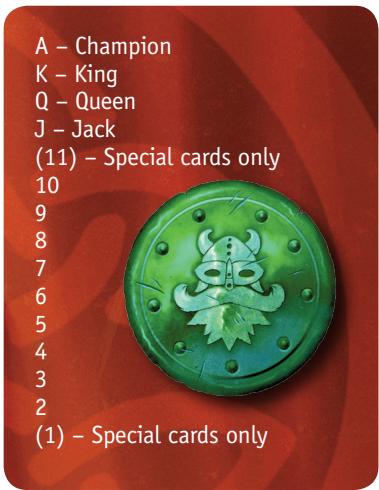
Magic special cards have neither suit nor value. Their suit and rank depend on the circumstances in which they are played (and then forgotten).
Reminder: when scores are determined from the tricks taken by the players, these cards return to having neither suit nor value.
Victory
The player who scored the most points after seven hands is the winner. It is quite possible for a player with the least negative points to win (if the players frequently chose goals that earned negative points on the Quest cards). In case of a draw, additional hands are played until there is only one winner.
Author: Bruno Faidutti Illustrations: Christophe Swal Development, design and packaging: Origames

© 2011 Iello. All rights reserved.
IELLO
309 BD DES TECHNOLOGIES
54710 LUDRES - FRANCE
www.iello.info

Texts are community-compiled or publicly released by publishers; copyright remains with the original authors. For personal reference only.