
The Great Dalmuti
At a glance
Rules, cards and Q&A (Chinese)
The rules, card data and player questions for this game are written in Chinese. Open the Chinese page to read them.
Where to find full rules
Full rules and card lookup are available in the cunlema app at cunlema.cn — pick this game and ask about any rule, card or turn you are unsure about.
Related games
Rulebook text (Markdown)
This game has 2 rulebook Markdown file(s) in our library; 2 rendered inline below — expand to read or download.
rules_en_the-great-dalmuti_929.md9.3 KB
来源类型:纯文本规则(非 PDF 源,早期抓取/转换产物)
说明:原文未改动,仅调整存放位置与文件名;非 PDF 扫描件,无对应原书 PDF
The Great Dalmuti Rulebook | RulesPalRulesPalChatRulebookThe Great DalmutiThe Great Dalmuti Rulebook Table of Contents Table of Contents Game Components
The Deck Card Ranks
Object of the Game
Setup
The Deal
Taxation
Revolution
The Play
Going Out
Winners and Losers
Joining a Game in Progress
The Strategy of Saving Cards
Optional Rules First Deal Revolution
Stripped Decks for Four or Five Players
Scoring
Philanthropic Scoring
More Appropriate Seating
Other Status Symbols and Perks
Merchant Exchange
Misdeals
Credits
Game Components
One deck of 80 cards
One rulebook
The Deck
The number on a card is called its rank. The lower the rank, the better the card (see chart). For example, the Baroness (4) is better than the Abbess (5). A card’s rank also tells you how many cards of its type are in the deck. The only exceptions are the two Jesters, which are a type of wild card. A Jester played alone counts as a card with rank 13—worse than even the Peasants (12)—but when played along with one or more other cards, Jesters take on the rank of the other cards.
Card Ranks
Object of the Game
In each hand of The Great Dalmuti card game, the object is to get rid of your cards as soon as you can. The faster you get rid of your cards, the higher your social class will be in the following hand.
Setup
Shuffle and fan the deck, and let each player draw and reveal a card. Players arrange their seating to reflect their cards’ ranks: The person with the best card is called the Greater Dalmuti and takes the seat of his or her choice. The person who drew the second-best card, who is called the Lesser Dalmuti, sits to that person’s left, and so forth around the playing area. The player with the worst card is the Greater Peon. The person to his or her right is the Lesser Peon. All other players are varying classes of Merchants. Remember, the lower the rank, the better the card; treat the Jesters as the worst cards possible. Break ties by drawing additional cards.
The Deal
The Greater Peon is responsible for collecting, shuffling, and dealing the cards. He or she deals out the entire deck each hand, starting with the Greater Dalmuti and giving one card to each player in clockwise order until the deck runs out. Some players may get more cards than others—after all, life isn’t fair! Players may look at their hands while the cards are still being dealt.
Taxation
Before play begins, the Peons must pay taxes. The Greater Peon chooses his or her two best cards to give to the Greater Dalmuti, and in exchange the Greater Dalmuti chooses any two of his or her own cards to give to the Greater Peon. (Again, the lower the rank, the better the card, with the Jesters considered the worst cards.) The Lesser Peon and Lesser Dalmuti do the same but with one card rather than two. All exchanges happen at the same time.
Revolution
If any player is dealt both Jesters, he or she may call a revolution. A revolution means there is no taxation, to the disappointment of the Dalmutis and the delight of the Peons. If the Greater Peon declares a revolution, it’s called a greater revolution. In a greater revolution all players exchange seats with their opposites. That is, the Greater Peon becomes the Greater Dalmuti, the Lesser Peon becomes the Lesser Dalmuti, and so forth.
The Play
Each hand starts when the player who has the lead plays a set of cards of the same rank face up. A set is simply one or more cards. The Greater Dalmuti has the lead in the first hand, and then play proceeds clockwise. On his or her turn, each player can either play a set of the same number of cards of better rank or pass. (Remember, the lower the rank, the better the card.) A player who chooses to pass may still play later in the hand, when it’s his or her turn again. Play continues clockwise until everyone passes in a row. This ends the hand, and the Greater Peon collects the played cards and puts them aside. The player who made the last play then gets the lead for the next hand.
Going Out
A player who has played his or her last card is said to have gone out. The first player who goes out wins the hand and becomes the Greater Dalmuti for the next hand. The second person to go out becomes the Lesser Dalmuti and sits to the left of the Greater Dalmuti, and so on around the playing area.
After a player goes out, play continues clockwise as usual. If no one plays a better set, then the lead passes clockwise to the next player who still has cards.
Winners and Losers
Each hand of The Great Dalmuti card game is played for its own sake: Becoming the Greater Dalmuti is winning and becoming the Greater Peon is losing, and all the other positions are somewhere in between. Like life, the game isn’t fair, and it’s often difficult to hold your position, let alone move up in rank.
For even more flavor, get into the roles. Merchants might schmooze with the upper classes while snubbing the lower. Dalmutis might be either kind or spoiled. Peons might show deference or defiance. Just make sure you have fun!
Joining a Game in Progress
New players can join a game at the beginning of any hand. Because the Peons shouldn’t be deprived of the joy of working themselves out of the lower classes, the new player enters as a Merchant, halfway between the Greater Dalmuti and the Greater Peon. If there’s a choice of positions, the Greater Dalmuti decides the order.
The Strategy of Saving Cards
Most of the time you should play your worst cards when you can, but don’t be afraid to pass sometimes even when you can play. A savvy player in a lower position often won’t play a good set until several people are out, saving it until he or she can use it to try to take the lead. Saving cards until they’re the best that are left is a good idea if you’re only trying to move up one rank or you just want to hold onto your position.
Optional Rules
Once you’ve got the basic game down, you might want to try one or more of the following variations.
First Deal Revolution
The first deal automatically has a revolution, so no taxes are collected. If the Greater Peon is dealt both Jesters, he or she may still call a greater revolution as usual.
Stripped Decks for Four or Five Players
When playing with fewer players you may want to use a smaller deck so you have fewer cards to hold. When playing with five players, strip out the Peasants so you’re playing with a deck of sixty-eight cards. For four players, strip out the Peasants and the Stonecutters to bring your deck down to fifty-seven cards.
Scoring
As each player goes out, he or she gets 1 point for every player still in that hand. Set a number of hands to play, and the person with the highest score at the end wins. Twenty hands is a fine number to start with.
Philanthropic Scoring
Use the scoring rules above. In addition, the Greater Dalmuti gets 1 point at the end of the hand if the Greater Peon goes up in status, and the Lesser Dalmuti gets 1 point if the Lesser Peon goes up in status.
More Appropriate Seating
Arrange the playing area with ranked seating. This means the Greater Dalmuti gets the best or most comfortable seat; the Lesser Dalmuti gets a very nice seat; the Merchants get ordinary seats; and the Peons are stuck with the worst seats. The Greater Peon might even have to sit on a suitcase, a box, or the floor—if he or she gets to sit at all!
Other Status Symbols and Perks
Players wear hats that indicate their ranks: A crown for the Greater Dalmuti and a straw hat for the Greater Peon, for example. Allow the Greater Dalmuti first choice of the snacks, with the Lesser Dalmuti getting second choice, and so forth, so that the Greater Peon only gets the bubble-gum-flavored jelly beans. Use your imagination and invent your own status symbols.
Merchant Exchange
During taxation, the highest-class Merchant may choose a card at random and exchange it with another Merchant of his or her choice.
Misdeals
If the Greater Peon accidentally exposes a card while dealing, the Greater Dalmuti decides whether it goes to the intended person or to the Greater Peon. If the card goes to the Greater Peon, he or she must replace it with one randomly drawn from his or her hand.
Credits
Game Design: Richard Garfield
Design Contribution: Dave Howell, T. Brian Wagner, Vic Wertz, Lily Garfield, Beverly Marshall Saling, Kristin Looney, and Andy Looney
Editing: Jenny Scott and Darla Kennerud
Art Direction: Daniel Gelon
Illustration Line Art: Margaret Organ-Kean
Graphic Design: Daniel Gelon, Anson Maddocks, Sandra Everingham, and Kim Casebeer
Typesetting: Monica Glasenapp-Horn and Nick Isaac
Production Management: Jane Flohrschutz
Brand Management: Linda Cox
Thanks to all our project team members and the many others too numerous to mention who have contributed to this product. Special thanks to Elizabeth Garfield for suggesting the project, and to all the playtesters through the years.
© 1995 Wizards of the Coast, Inc. The Great Dalmuti, Wizards of the Coast, and their logos are trademarks of Wizards of the Coast, Inc. in the U.S.A. and other countries. Card illustrations by Margaret Organ-Kean.
Download MarkdownTheGreatDalmuti_Greed_D&D_v20260429.md1.2 KB
additional rules for THE GREAT DALMUTI card game
GREED permits active players to steal Status tokens from other players, exchanging positions at the table.
SETUP
All players are given numbered Status tokens representing their table position. Players should conceal these tokens. The Prey token is given to the Greater Dalmuti. This token marks the current contested table position.
Prey token
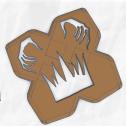
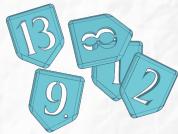
Status tokens
DUNGEONS
DRAGONS
Licensed under
CC BY-SA
2021-26
THE PLAY
When a player "goes out", the Prey gives their Status token to the "out" player and gives the Prey token to the player on the Prey's left.
If a Status token is unprotected, other players may steal it at any time during THE PLAY. Once in the hands of a thief, THE PLAY stops, the thief and the victim exchange Status tokens and table positions; cards stay with the players. THE PLAY continues normally at the table position before THE PLAY stopped.
COVET THY STATUS WITH TRINKET AND GUARD, LEST YOUR STATION BE CHALLENGED.
AND SO THEY SEIZED, BY EACH FOUL LIMB,
TRUSTING HEARTS THROUGH MIDNIGHT DIM.
Download MarkdownTexts are community-compiled or publicly released by publishers; copyright remains with the original authors. For personal reference only.