
Thunderstone Quest
At a glance
Rules, cards and Q&A (Chinese)
The rules, card data and player questions for this game are written in Chinese. Open the Chinese page to read them.
Where to find full rules
Full rules and card lookup are available in the cunlema app at cunlema.cn — pick this game and ask about any rule, card or turn you are unsure about.
Related games
Rulebook text (Markdown)
This game has 1 rulebook Markdown file(s) in our library; 1 rendered inline below — expand to read or download.
Starter Set_Rulebook_WEB 01-compressed.md81.4 KB
Mike Elliott
THUNDERSTONE
RULEBOOK
TABLE OF CONTENTS
Objective
Unpacking the Box
Setting Up Your Player Area
Setting Up the Village and Dungeon .
Heroes
Items, Spells, and Weapons
Starting the Game
The Bazaar
Turn Sequence
Prep Phase
Village Phase
Dungeon Phase.
End of Turn Phase
Monsters. 11
Dungeon Rooms 12
Treasure 13
Game End and Winning 14
Guardians 14
Side Quests 15
Guild Sponsorship 15
Legendary Cards 15
More Ways to Play 16
Random Setup 16
Epic Thunderstone Quest 17
Campaign Mode 18
What's Different 18
Lexicon 19
Keywords 20
FAQ 21
Iconography Back Cover
A game by Mike Elliott. For 2-4 players, ages 14 and up.
Visit our website at www.alderac.com/thunderstone Questions? Email CustomerService@alderac.com
CREDITS
THUNDERSTONE DESIGN: Mike Elliott, Joe Babbit, Will Baker, Bryan Reese, Mark Wootton
PROJECT LEAD: Mark Wootton
DEVELOPMENT LEAD: Bryan Reese
DEVELOPMENT TEAM: Will Baker, Bryan Reese, Mark Wootton
ADDITIONAL DEVELOPMENT: Nicolas Bongiu, Ryan Scott Dancey, John Goodenough, Mark Harbison, Dave Lepore, Andrew Narzynski, Kaz Nyborg-Andersen, Todd Rowland, Erik-Jason Yaple, John Zinser
ART DIRECTION: Thomas Kohler, Todd Rowland, Erik-Jason Yaple, Hal Mangold
ARTISTS: Christopher Appel, Steve Argyle, Helge Balzer, BROLO,JB Casacop, Dusty Crosley, Jeremy Dale, Biagio D'Allesandro, Chris Dien, Steve Donegani, Jason Engle, Claudio Fontanesi, Anthony Francisco, Carl Frank, Michele Frigo, Michele Giorgi, Gong Studios, Gunship Revolution, Hinkle/Silva Art, Ambrose H. Hoilman, Igor Ivanovic, Michael Komarck, Heather Kreiter, Brett Martin, Emmanuel Julian Madail Monzon, Monztre, Liam Peters, Ramon Puasa Jr, André Rodgers, Aaron Romo, Riccardo Rullo, Richard Sardinha, Erich Schreiner, Pedro Sena, Ilya Shipkin, Andrew Sonea, David Su, Kristy Ann Sunshine, Kamila Szutenberg, Mark Tarrisse, Ren Tu, Shane Tyree, Inna Vjuzhanina
MINIATURES ART: Gunship Revolution
MINIATURES DIRECTOR: Erik-Jason Yaple
GRAPHIC DESIGN: Matt Paquette
LAYOUT: Matt Paquette, Bryan Reese
LOGO: Kalissa Fitzgerald
STORY AND WORLD DEVELOPMENT: Brett Satkowiak
RULES WRITING: Will Baker, Bryan Reese, Mark Wootton
EDITING: Will Baker, Nicolas Bongiu, Rich Edwards, Bryan Reese, Nicholas Singer, Mark Wootton
PROOFING: Nicolas Bongiu
PRODUCTION: Dave Lepore
LOGISTICS: Taylor Butts
GIANT RAT COURTESY OF: Ryan Scott Dancey
YELLOW MEEPLE: Itself
PLAYTEST: Anastasios Grigoriadis, Andrew Narzynski, Andrew Tate, Avgoustos Arsenis, Brinjolfur Owens, Bryan Reese, Chris Paliogiorgos, Curt Crane, Daniel Jacobson, Davey Chacon, David Camillieri, David Lepore, Dimitrios Giannakis, Erik-Jason Yaple, Ernie Enriquez, Giovanna Donnithorne-Tait, Gordon Allen, Hansel Miyama, Jake Hatten, "James" Donnithorne-Tait, James RJeffery III,James Stewart,Jean Le Bail,Jeff “Piddler" Yost,Jeff Williamson, John “Ouch My Toe" Walker, John Espinoza, John Frizzell, John Zinser, Jon Palmer, Kaitlin MacLean, Katie Fountaine, Kaz Nyborg-Andersen, Kyle Huibers, Leah Wood, Manolis Trahiotis, Mark Harbison, Maryne Blanchetière, Mike Colson, Mike McDonald, Nicolas Bongiu, Petros Meletakos, Ricardo Rhodes, Ross Warrington, Rozen Wood, Ryan Letzer, Ryan O'Neill, Soren Haurberg, Steve Tynes, Tan, Touradj Mansouri, Troy Perez, Vincent Carassus, Will Baker, Will Gordon
A big Thank You to the 5,129 backers on Kickstarter and the additional backers from the Pledge Manager. It was with your help that AEG was able to make this all-new version of Thunderstone!
OBJECTIVE
In Thunderstone Quest™, you take on the role of a Champion, recruiting mighty Heroes, casting magic Spells, and wielding powerful Weapons. Then delve into the Dungeon, battle Monsters, gain Experience Points (XP), and find Treasures. As you defeat Monsters, you will sometimes find Guardian Keys. After 4 Keys are found, the Thunderstone Guardian is summoned and players will each have one final turn.
When the game ends, players score Victory Points (VP) from cards in their deck and XP tokens gained during play. Highest total wins!
UNPACKING THE BOX
This box should include the following Basic Components. If it does not, please contact CustomerService@alderac.com for assistance. Most of these components will be needed in each game. However, you do not play with every card you own every game. For now, open only the Basic Components card bundle in the box.
• 24 Adventurers
• 8 Thunderstone Shards
• 8 Lanterns
• 8 Daggers
• 21 Treasures
• 16 Side Quests
• 16 Guild Sponsorships
• 25 Legendary Cards
• 24 Festering Wounds
• 6 Guardian Keys
• 1 The Wilderness Dungeon Room
• 60 Experience Point tokens (45 1-point tokens, 15 10-point tokens)
• 32 Wound tokens
• 48 Gear tokens (16 Iron Rations, 16 Lanterns, 16 Potions)
• 6 Player Champions (Figurines)
• 1 Village Board
• 4 Player Boards
• 16 Dividers
• 1 Questbook
• 5 Six-Sided Dice
Throughout this Rulebook, we are going to follow a few turns of the first game for our three example players: Ashley, Drew, and Adam. In this first game, they are going to play with fewer cards and game elements while they familiarize themselves with Thunderstone Quest™.
We encourage you to shuffle your decks and play through your first game using the same setup as our example players. We are going to introduce the various cards, tokens, and rules as the example players encounter them.
These examples, which contain useful play tips for new players, are written in these special, brown boxes. If you already know how to play, you may skip these.
This box should also include a number of Quest Expansions: bundles of cards that come packaged together with suggested setups, allowing players to experience the story of Thunderstone Quest with their cards. For the component checklists and stories of each Quest, refer to the Questbook located in this box. We recommend opening the Questbook only after you have
played your first game of Thunderstone Quest.
DIVIDERS
Dividers help keep your Thunderstone Quest cards separated. Dividers are taller than standard cards and contain only the card’s title. Beyond the Dividers found in the Basic Components, each Quest contains 1 Divider for each Hero, Item, Spell, Weapon, and Monster group in that Quest. Monster group Dividers have a checklist of that group on the back.
SETTING UP YOUR PLAYER AREA
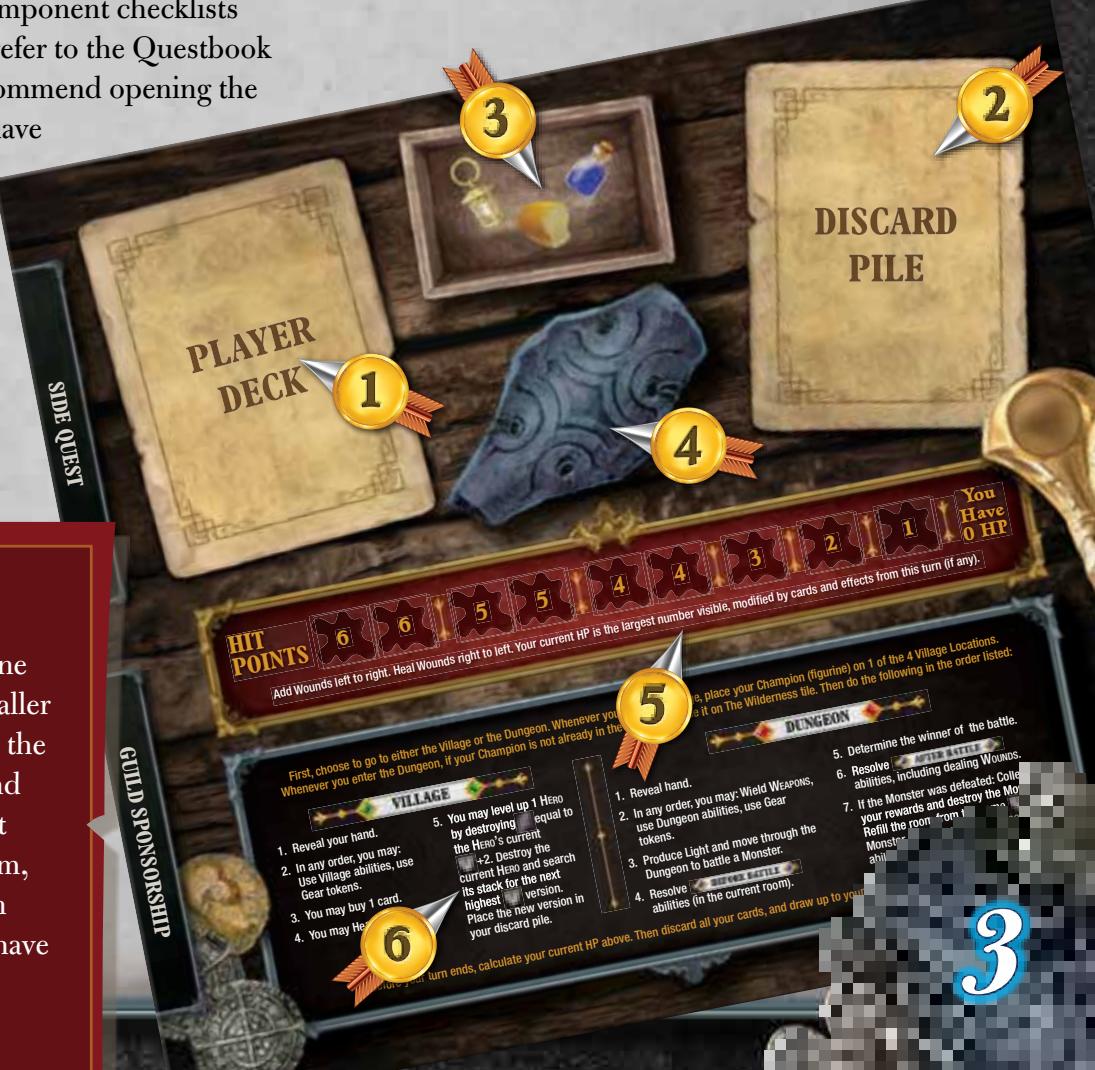
Player Boards help players keep their cards, tokens, and Hit Points straight as shown below. Give each player a Player Board.
-
Your deck is placed here.
-
When cards are discarded, place them here.
-
Your Gear tokens are placed here.
-
Your XP tokens () are placed here.
All players have 6 HP, but as the players battle Monsters and take Wounds (), this number drops, as indicated. At the end of their turn, players draw cards equal to their current Hit Points. Some cards give you HP temporarily for that turn. Extra HP increase the number of cards you draw at the end of that turn.
- Quick guide to how each turn proceeds.
SETTING UP THE VHLAGE AND DUNGEON
Place the Village Board in the middle of the table so the side with labels in The Marketplace and The Guilds' Quarter are face up. After your first game, players may wish to try the unlabeled side. For now, we will now set up as show to the right.
Choose the cards with which you will play. If this is your first game of Thunderstone Quest, open the A Mirror in the Dark Quest bundle, separate the cards listed in the brown Sidebox on page 6, and use them for setup. Set out 4 Hero stacks face up in their respective Class spots in The Guilds Quarter: 1 Cleric, 1 Fighter, 1 Rogue, 1 Wizard. If a Hero has more than one Class, you choose which spot to put it in. Arrange the Heroes so the Level 1 () versions are on top, then the Level 2 () versions, with the Level 3 () versions at the bottom.
- In their respective spots in The Marketplace, set out two stacks of each: Items, Spells, and Weapons. Add an additional stack from two of these three categories to the Any spots.
DUNGEON ROOMS AND MONSTERS
- Each game uses 7 Dungeon Rooms; 2 rooms, 2 rooms, 2rooms, and The Wilderness (). Set these out as shown.
Choose three groups of Monsters (a aW, and aW). Each group has 10 total Monsters in it. Take two random Monsters from each group and place them face up into their appropriately matchingDungeon Rooms so that each room has 1 Monster.
Take the 6 Guardian Keys and shuffle 1
Key into theMonster group, shuffle 2 Keys into theTMonster group, and shuffle 3 Keys into theMonster group. These form your three Monster decks. Place them into their
respective spots on the Village Board. We will come back to the Guardian Keys later
-
Now choose a Thunderstone Guardian. Guardians are special high-level “boss" Monsters that you fight at the end of the game. Guardians have three versions (W, &), each more powerful than the last. Players should familiarize themselves with the Guardian they will be facing (this information is open throughout the game if players want to check it).
-
Place the Guardian into The Wilderness, face down, so the Monster is showing.
STARTER CARDS
- Give each player a starting deck of 6 Adventurers, 2 Lanterns, 2 Thunderstone Shards, and 2 Daggers. They shuffle their decks and place them on their Player Board.
TOKENS
- Sort the various tokens by type; Iron Rations, Lantern, Potion, Thunderstone (XP), and Wound. Place the Gear tokens (Iron Rations, Lantern, Potion) in The Bazaar. Place the Wound tokens in The Wilderness. Place the XP tokens nearby so everyone can access them.
CHAMPIONS
- Each player selects one figurine as their Champion. They will move their Champion through the Village and Dungeon to activate
new abilities and battle Monsters.
TREASURE
- Shuffle all the Treasure cards together to form the Treasure deck. Set it face down in the Shop
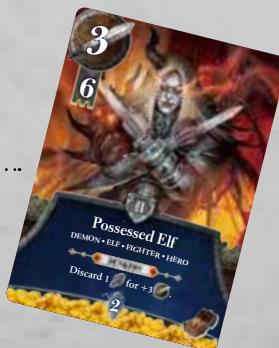
of Arcane Wonders. Treasures can be identified by the pile of gold at the bottom of the card, as well as the Treasure Chest in the bottom right of the card.
SIDE QUESTS, GUILD SPONSORSHIPS & LEGENDARY CARDS
In a full game of Thunderstone Quest, there are three additional card types: Side Quests, Guild Sponsorships, and Legendary cards.
Our example game will not be using them, and if this is your first game of Thunderstone Quest™, or even if you have not played in a little while, we recommend you wait on using these cards for now.
If you are going to play with them, follow these steps in the order listed:
-
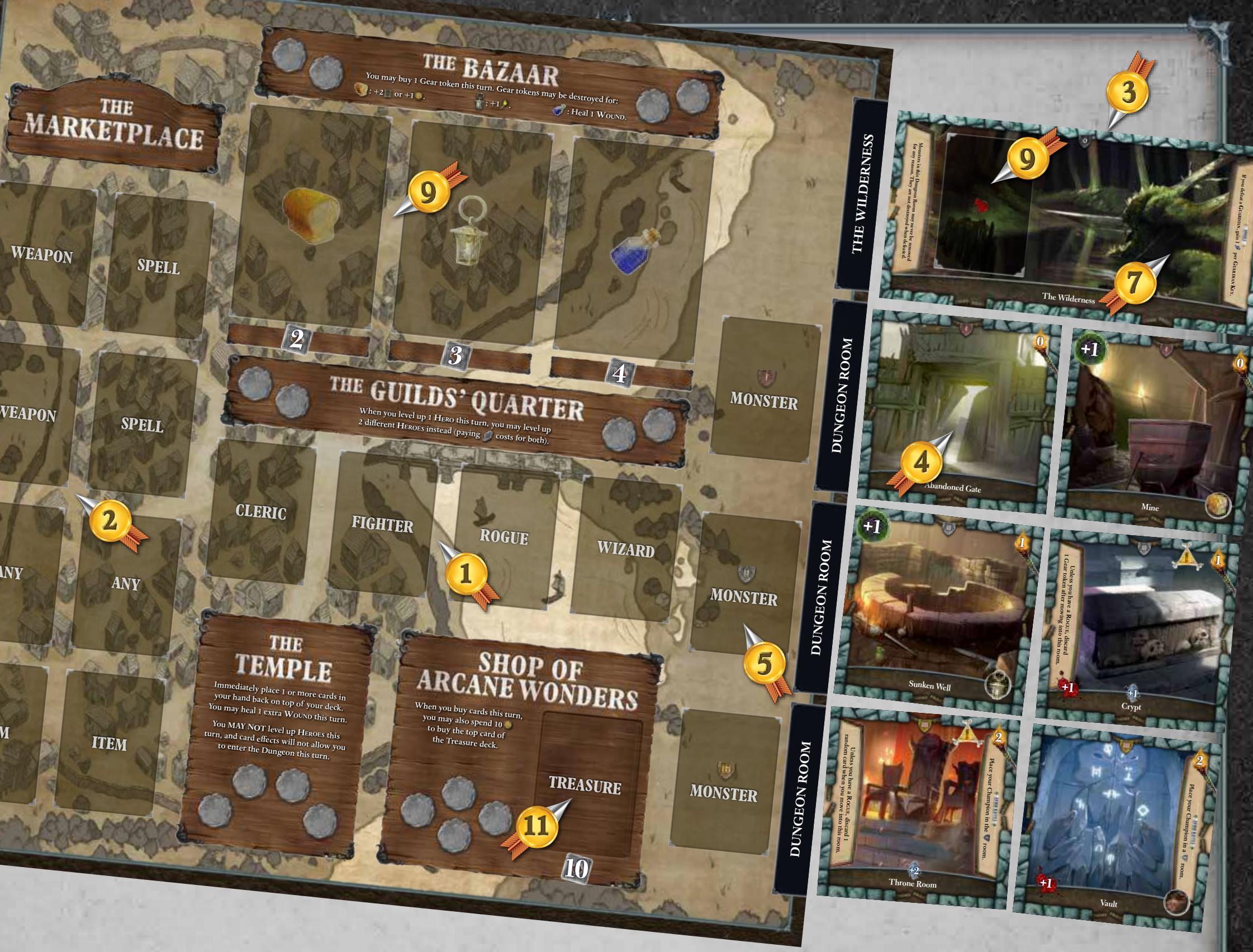
Deal 3 random Side Quests to each player. Each player chooses 1 to keep and returns the rest. Some Side Quests reward the player who completes them with powerful Legendary cards (this is the only way to acquire Legendary cards). Legendary cards (such as Vampire Acolyte below) have a pile of platinum coins at the bottom of the card, as well as the Legendary keyword. Players should review any Legendary cards rewarded by their Side Quest, as they may greatly alter your game strategy. Keep your Side Quest secret so other players do not know your strategy until you need to reveal it to collect its reward.
-
Next, each player chooses 1 Guild Sponsorship; these are cards which give you bonuses for focusing on particular Class-strategies in the game. Place these next to your Player Board as indicated.
-
Put all unchosen Side Quests, Legendary cards, and Guild Sponsorships back in the box. They will not be needed again. Make sure that no Legendary cards get into the Treasure deck.
To read more about these card types, see page 15.

IT's YOUR GAME
We have found that there are a lot of different types of Thunderstone players out there, each with their own preferences. Later in this book, we provide alternate styles of play and setups that some Thunderstone Quest™ players may enjoy even more (see Random Setups, Epic Thunderstone, and Campaign Mode, page 18). Find the style of play that you and your group enjoy most.
Some players may also wish to adjust the length of their game based on time allowed or number of players. An easy way to do this is to adjust the number of Guardian Keys that are needed to be found before the Guardian is revealed. For example, in a four-player game, the number of Guardian Keys needed to be found can be increased, allowing each player more turns to develop and play their deck. Feel free to increase or decrease this number to adjust the game length.
The cards used in this first example game will all be found in the A Mirror In the Dark Quest; open that now if you have not done so yet. You may leave the other Quests packaged until after you play through your first game.
Our players use the following cards:
-
HEROES Silverhelm, Hawkswood, Pylorian, Stormhand.
-
MARKETPLACE Short Bow (Weapon), Short Sword (Weapon), Magic Missile (Spell), Tome of Knowledge (Item). For the first game, there are only 4 Marketplace cards used, not 8.
-
MONSTERS Goblin Grunts, Hobgoblin Brutes, and Goblin King's Guard.
-
GUARDIAN Smorga the Queen iy.
Before the game begins, Adam, Ashley, and Drew look through the Village and read the cards. Many cards will combine with each other to make them even more powerful, and the players want to find a strategy for the game. Ashley is looking for a lot of card draw, Adam wants to use Wizards and Spells, and Drew wants to test a Rogue strategy with lots of Light. Drew knows Light is a very important element of the game in order to quickly and frequently access higher rewarding and Monsters.
Let's go through the card types on the Village Board now.
3 MARQUEE RULES
There are 3 marquee rules that always apply to games of Thunderstone Quest:
Thunderstone Quest has dozens of different cards, and many of them disagree with the Rulebook. When a card’s text contradicts a rule, the card’s text takes priority.
THE GUILDS’ QUARTER
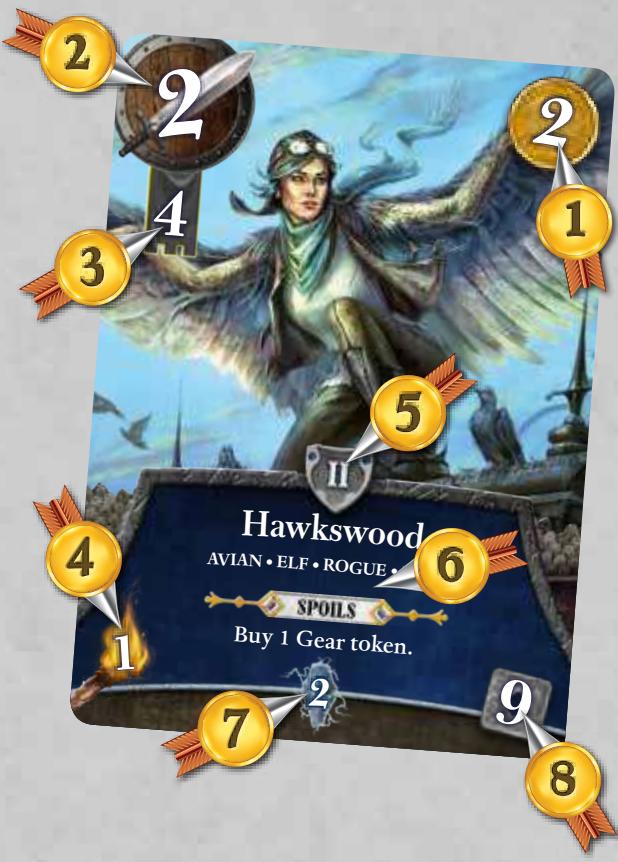
Over the course of the game, you will need to recruit and level up your Heroes from The Guilds' Quarter, making your deck stronger in order to battle more dangerous and rewarding Monsters. Hero cards have blue frames.
- Whenever something references“your cards” or “cards you have” during play, it is always referencing the cards that you revealed from your hand that turn and are currently in front of you; never cards in your deck, discard pile or Guild Sponsor/ Side Quest cards, unless it explicitly says
1. GOLD PRODUCTION VALUE
The amount of gold () the card produces.
Gold is used to buy cards in the Village.
2. ATTACKVALUE
The amount of Attack the card produces. Attack is used for battling Monsters. There are two types of Attack: Physical Attack ( and Magic Attack (). Monsters may be resistant to one type or the other.
3. SKILL VALUE
The Hero's Skill value (M). This determines how proficient a Hero is at wielding Weapons. A Hero may wield any number of Weapons that have a combined Skill Requirement of less than or equal to the Hero's Skill.
4. LIGHTVALUE
The amount of Light () the card produces. Light is used to move deeper into the Dungeon.
5. LEVEL
All Heroes (and Monsters) have a Level Heroes in your starting deck begin as Level 0 Adventurers. As they gain power they may be upgraded into Level 1, 2, and even 3!
6. TEXTBOX
It contains the card's Title, Keywords, and game text.
7. VPVALUE
The amount of VP the card is worth at the end of the game.
8. GOLD COSTVALUE
The amount of gold the card costs.
otherwise. This holds true for all game components (e.g. tokens).
- The effects of a card last as long as that card remains in play. If a card ever leaves play for any reason, its effects end immediately.
EMPTY DECK
If a player ever needs a card from their deck for any reason, but their deck is empty, they first shuffle their discard pile to form a new deck, and then continue. This process does not happen when a deck becomes empty, only when a card is needed from an empty deck.
BOosTS
Some cards (such as Heroes and Spells) add their Attack value directly to your total, while other cards (such as Weapons and some Items) do not and instead boost one of your Hero’s values. Boosts will always be listed with a + symbol preceding the value (e.g., +3). If you do not have a Hero, then you do not receive the effects of the boost, though you may still gain the effects of other parts of the card, such as the card’s ability.
Weapons are special. A Weapon must be wielded by a Hero before a player can use any of its abilities.
THE MARKETPLACE
Heroes are most effective when properly supplied with Items, Spells, and Weapons.
These cards may be bought in The Marketplace.

1. GOLD PRODUCTIONVALUE
The amount of gold the card produces.
Gold is used to buy cards in the Village.
2. ATTACK VALUE
The amount of Attack the card produces. Attack is used for battling Monsters. There are two types of Attack: Physical Attack ( and Magic Attack (). Monsters may be resistant to one type or the other.
3. ATTACK BOOSTVALUE
The amount of Attack a Hero is boosted. Boosts increase a Hero's value; they do not provide their own value. Boosts always have a + symbol preceding the value.
4. SKILL BOOSTVALUE
The amount of Skill a Hero is boosted. As with all boosts, they boost a Hero's value, they do not provide their own value.
5. SKILL REQUIREMENTVALUE
The amount of Skill this Weapon requires to be wielded. A Hero must have Skill equal to or greater than the combined Skill Requirement value () of all Weapons he or she wields.
6. LIGHTVALUE
The amount of Light the card produces. Light is used to move deeper into the Dungeon.
7. TEXTBOX
It contains the card's Title, Keywords, and game text.
8. VPVALUE
The amount of VP the card is worth at the end of the game.
- GOLD COSTVALUE The amount of gold the card costs.
ITEMS
You may use the ability on Items even if you do not have any Heroes. Some Items will boost a Hero's Attack or Skill. When getting boosts, you need to have a Hero to benefit from those boosts. Item cards have green frames.
SPELLS
Spells may be used even if you do not have any Heroes, though many of them get stronger the more Wizards and/or Clerics you have, especially as they reach higher levels. Spell cards have purple frames.
DISCARD VS. DESTROY
Many effects discard cards, while others destroy them. Discarded cards are always put into your discard pile and may be drawn again later. Destroyed cards are removed from the game; they may not be used again this game. Destroyed tokens return to the pile they came from to be acquired again later. If a destroyed card came from a stack of cards in play, we recommend you return it to the bottom of the stack, but face down to signify it is not a usable card. This helps clean up at the end of the game.
WEAPONS
Unlike Items or Spells, Weapons must be wielded by your Heroes to use them. To wield a Weapon, place the Weapon underneath the Hero, but leave the left side of the Weapon card showing.

The Hero is now wielding the Weapon.
A Hero may wield any number of Weapons as long as the total Skill Requirement () of the Weapons are equal to or less than the Hero's Skill. For example, to wield a Weapon with a 3 Skill Requirement, and another Weapon with a 2 Skill Requirement, a Hero would need at least 5 Skill.
If a Hero ever has too little Skill, immediately
remove Weapons from the Hero until this is no
longer true. Weapons which are not wielded sit in
front of you, providing no effects but their Gold Production value. Weapon cards have brown frames.
STARTING THE GAME
The first thing players do is draw a starting hand of 6 cards. Then randomly determine who goes first, with turns proceeding clockwise around the table. Players (other than the starting player) will receive extra Iron Ration Gear tokens to begin the game; 1 token for playing second, 2 tokens for playing third, and 3 tokens for playing fourth.
THE BAZAAR
Iron Rations are one of three types of Gear tokens that may be bought in The Bazaar. Unlike cards, tokens are not discarded each turn. Gear tokens are held until used for a special effect. When used, destroy the Gear token and return it to The Bazaar.
IRON RATIONS
An Iron Ration () costs 2 gold and may be destroyed as a Village, Dungeon, or Spoils ability to produce 1 gold this turn or to give a Hero +2 Skill this turn. This choice is made when the token is destroyed.
LANTERN
A Lantern () costs 3 gold and may be destroyed as a Dungeon ability for 1 extra Light this turn.
POTION
A Potion () costs 4 gold and may be destroyed as a Village or Dungeon ability to heal 1 Wound.

Adam wins the die roll to start the game. Play proceeds clockwise around the table, Drew will go second and Ashley will go third. For going second, Drew gets 1 Iron Rations Gear token to begin the game. For going third, Ashley receives 2 such tokens. If there had been a fourth player, they would have received 3 such tokens.
TURN SEQUENCE
PREP PHASE
The first choice a player makes on their turn is to decide whether they will be going to the Village (taking a Village Phase) or exploring the Dungeon (taking a Dungeon Phase).
If you choose to enter the Dungeon, you will move your Champion (figurine) through the Dungeon this turn to battle Monsters. Whenever you enter the Dungeon, you must place your Champion there. If it is currently in the Dungeon, leave it where it is. Otherwise, place it in The Wilderness. This is not considered movement.
If you instead go to the Village, place your Champion (figurine) on one of the indicated spots () on one of theVillage Locations.This is not considered movement. The four Village Location abilities are:
· THE TEMPLE
Before proceeding with your turn, place 1 or more cards in your hand back on top of your deck.
You then take a normal Village turn except: you may heal 1 extra Wound this turn, you MAY NOT level up Heroes this turn, and card effects will not allow you to enter the Dungeon this turn (e.g. the Lantern in your stating deck).
·THE BAZAAR
After you take your Village abilities this turn, you may also buy 1 Gear token, placing it on your Player Board. If you buy a Potion token from The Bazaar, you may use it immediately.
· SHOP OF ARCANE WONDERS
After you take your Village abilities this turn, you may also spend 10 gold to buy the top card of the Treasure deck, placing it directly into your discard pile.
· THE GUILDS'QUARTER
When you level up 1 Hero this turn, you may level up 2 different Heroes instead (paying XP costs for both).
ÁBILITIES AND TRAITS
Abilities are text on cards that are preceded byVILAGE(for use in the Village phase), DUNGEON(for use in the Dungeon phase), orSPoIs(for use after you defeat a Monster). Abilities may only be used once per turn. These abilities are optional to use. Sometimes there is an opportunity to use an ability in more than one circumstance, such as VILLAGE OR DUNGEON. Players may use these abilities in either phase, but they may still only be used once per turn.
Now you are ready to start the game. All players shuffle their deck and draw cards equal to their current HP as indicated on their Player Board. With no Wounds, players have 6 HP. Each player draws 6 cards now, and then Adam takes his first turn. The first choice a player makes on their turn is to decide if they are going to spend their turn
VILLAGE PHASE
If you choose the Village, do all the following steps in the order listed below:
-
Reveal all cards in your hand, placing them in front of you (required). Any future cards drawn during the turn are also immediately revealed and placed in front of you.
-
You may use Village and Gear token abilities in any order you wish (optional).
Total the gold you produced (required). You may now buy 1 card from either The Marketplace or The Guilds' Quarter (optional). If your Champion is in The Bazaar or Shop of Arcane Wonders, it triggers now (optional). Place purchased cards in your discard pile.
You may heal 1 Wound (optional). If your Champion is in The Temple, heal 1 extra Wound (optional). When a Wound is healed, you may return the rightmost Wound token on your Player Board to The Wilderness or you may destroy 1 of your cards with the Wound keyword (e.g.
There are also two more types of abilities, usually found on Monsters: abilities andm abilities (see page 10). Before Battle abilities and After Battle abilities are not optional.
Many cards in your deck and in the Dungeon also have traits on them. Traits are any text that is not preceded by an ability designator (e.g., Village, Dungeon, Before Battle). Trait text automatically resolves and is not optional.
in the Village (buying cards and improving their deck) or in the Dungeon (defeating Monsters and reaping the rewards). Adam, like most players, decides to go to the Village for his first couple of turns to improve his deck. Adam places his Champion (figurine) on The Bazaar Village Location, which will allow him to buy a Gear token this turn.
Festering Wound). Return destroyed Wound cards to the stack they came from.
- You may spend (destroy) XP tokens to level up 1 Hero (optional). If your Champion is in The Guilds' Quarter, it triggers now (optional). The XP cost ofleveling up a Hero is equal to their printed Level +2 (e.g., leveling up from Level 0 to Level 1 costs 2 XP, from Level 1 to Level 2 costs 3 XP, from Level 2 to Level 3 costs 4XP). Destroy the current Hero, search the appropriate Hero stack for a version with the next highest Level ( to , to , to ), and place it in your discard pile. If there are no more copies of the next highest level version, then that Hero may not be leveled (e.g., If you have a Level 1 Hero and there are no more Level 2 versions of that Hero). Adventurers are special Level 0 Heroes; they may level up into any Level 1 Hero.
After you have finished your Village Phase, you enter the End of Turn Phase (see page 11).
Adam reveals a hand of 2x Lanterns, 2x Daggers, and 2x Thunderstone Shards, giving him 10 gold! This is all of the gold in the starting deck, which means next turn when he draws the other half of his starting deck he will be as broke as a Kobold. He may now use the abilities on his cards.
There are abilities on his Thunderstone Shards, but at this point in the game their abilities are not relevant, just their Gold Production. The Dagger abilities are only usable in the Dungeon, so Adam is ready to move onto purchasing.
Adam knows that he has a lot of gold this turn so he will want to buy something expensive while he can.
Because of his chosen Village Location, Adam may also buy 1 Gear token. With his remaining 3 gold, he spends 2 of it to buy an Iron Rations Gear token. Spell users may not get much use from the Skill boost of Iron Rations, but the 1 Gold Production on a future turn will come in handy.
He decides to buy a Magic Missile for 7 gold. He notices his Dagger, in addition to its Dungeon ability, has a trait. It may be destroyed when he buys a card. A destroyed card is removed from the game. Since the Starter cards in your deck are almost always less powerful than the cards you buy from the Village, we recommend destroying your Starter cards as you gain better cards. Like most deckbuilding games, keeping a thin deck is powerful. Adam has two Daggers here, but the Daggers state that he may only destroy one of them, so he does so at this time, returning it to the box. Anytime one of your cards is discarded or destroyed, it immediately ceases to have any further effect on the game. He then places the newly purchased Magic Missile in his discard pile.
DUNGEON PHASE
Adam may now heal 1 Wound and/or destroy XP tokens to level up a Hero, but he hasn't fought any Monsters yet to get wounded or gain XP, so he skips these steps and ends his turn. The 1 gold he never spent this turn is lost. When his turn ends, he discards all of his cards and draws a new hand of 6 (his current HP).
Instead of going to the Village, players may go to the Dungeon on their turn. The Dungeon is home to many Monsters, which, if defeated, earn the players XP tokens and other rewards.
Play proceeds to the next player, Drew who has been preparing for his next turn. Unlike Adam, he decides to enter the Dungeon this turn.
After placing your Champion in the Dungeon, do the following steps in the order listed below:
BUYING STUFF
- Reveal all cards in your hand, placing them in front of you (required). Any future cards drawn during the turn are also immediately revealed and placed in front of you.
When you buy a card or token, subtract its Gold Cost from the amount of gold you have available to spend this turn. If you do not have enough gold to pay the Gold Cost of a card or token, then you may not buy it.
To buy a card or Gear token, first total the Gold Production value of your cards and any Iron Ration Gear tokens you used. This gives you the total gold amount you can spend this turn. Gold Production on your cards in front of you is always available, even if it is from a Weapon which is not being wielded.
- You may now do any of the following:
a. Use Dungeon abilities (optional).
b. Give Weapons to Heroes (optional).
c. Use Gear tokens (optional).
You may take these in any order you wish. For example, you may use a Dungeon ability, give a Hero a Weapon to wield, use a Gear token, use another Dungeon ability, then use the wielded Weapon's ability.
- You now produce your Light and may move through the Dungeon (optional). You must have enough Light for each room into which you wish to move. For example, if you move
You may only buy the top card of each respective stack when buying a card (e.g., you cannot buy a level 2 Hero unless it is the top card ofits stack). Each stack has a limited supply; when the last of a card of a stack is bought, you can no longer buy cards from that stack.
Place cards you buy on top of your discard pile. Place tokens onto your Player Board in the appropriate spots.
Gold Production value that is not used is lost, and does not carry over from turn to turn.
through a room with 1 Light requirement and into a room with a 2 Light requirement this would require 3 Light total.
Only the Monster in the final Dungeon Room you move into (and the room itself) resolve their text, so you mostly will only need to pay attention to the Monster and the Dungeon Room in which you finish your move. However, the Alert! Icon ( signifies a Monster or Dungeon Room that could affect you even if you don't end your movement there.
- Battle the Monster in the Dungeon Room:
a. Resolve its “Before Battle" abilities. (required).
b. If the Monster has Armor () or Magic Resistance (), reduce your Physical or Magic Attack, respectively, by the stated value.
c. If your total Attack (+) is now equal to or greater than the Monster's Health (), it is defeated.
d. Whether you defeated the Monster or not, receive Wounds (if any, as indicated on the Monster) and resolve “After Battle" effects (both required). Wound tokens () are placed on your Player Board, from left to right, reducing your HP. Some Monsters give Wound cards, instead of tokens, such as Festering Wounds (). Wound cards received are placed in your discard pile.
- If you did not defeat the Monster, nothing else happens; skip this step. If you defeated the Monster, do the following in order (required):
a. Gain XP tokens () and rewards.
b. Destroy the Monster and replace it with the top card of the Monster deck appropriate to the level of the now empty Dungeon Room. If you reval a Guardian Key, set it aside and continue refilling until the Dungeon Room has a Monster. If the Monster deck is empty, refill from the next highest level Monster deck that is available.
c. Spoils abilities may now be used (optional).
. Only one Guardian Key may be found per turn. If you reveal more than one, set them aside until after all rooms have Monsters. Then, shuffle the second and later Guardian Keys revealed this turn back into their appropriate decks. If four Guardian Keys have now been found, the Thunderstone Guardian is summoned and the end of the game is close (see page page 14).
After you have finished your Dungeon Phase, you enter the End of Turn Phase.
END OF TURN PHASE
After completing your Village Phase or your Dungeon Phase, you proceed to the end of your turn. Check your Player Board, as well as the cards you played this turn, to determine your current HP. Discard all your cards (but not your tokens) and draw cards equal to your current HP. If a player ever needs a card from their deck for any reason, but their deck is empty, they first shuffle their discard pile to form a new deck, and then continue.
All effects end at this time and any gold not spent is lost. Play passes to the left.
MONSTERS
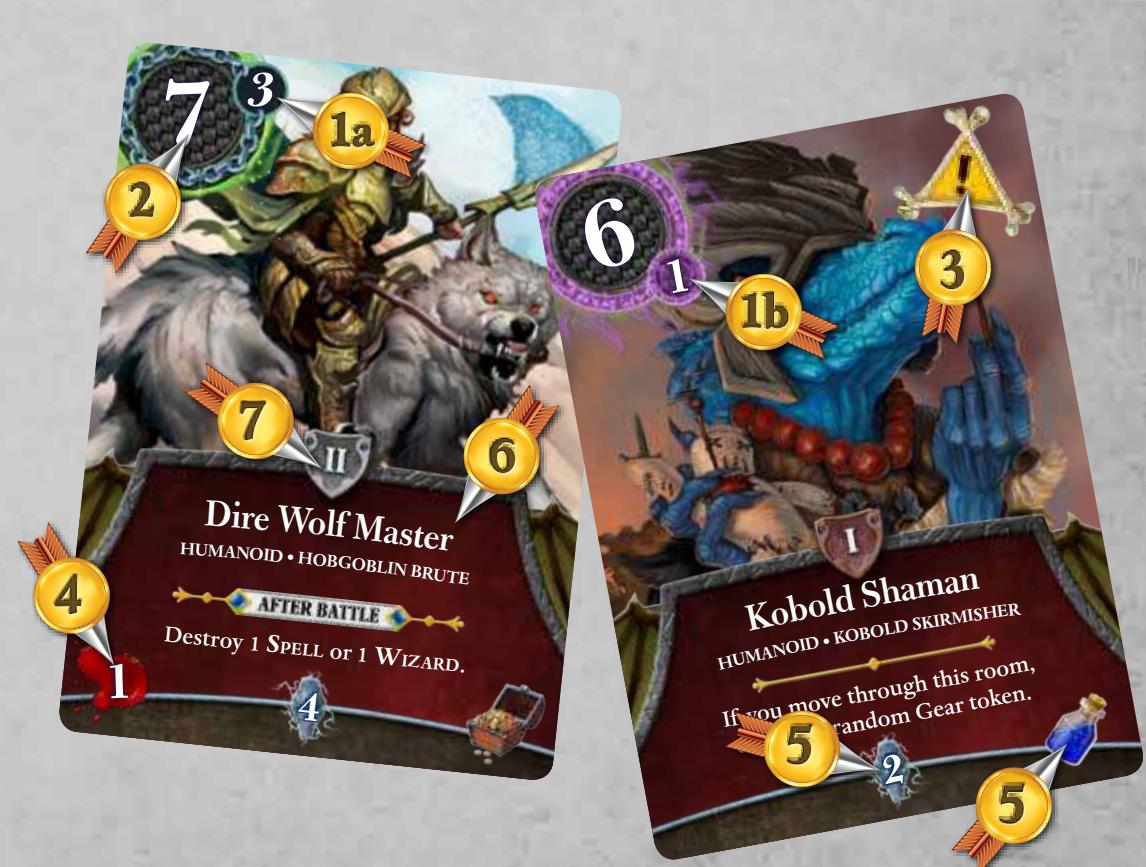
The Dungeon is populated with tough Monsters that will battle you, wound you, and if you are strong enough to defeat them, shower you in rewards. You can only see a few Monsters at a time, but more lurk in the Monster decks. Players may ignore all Monsters except the one they are battling that turn (and Monsters with). Monster cards have red frames.
ARMOR VALUE AND MAGIC RESISTANCE VALUE Sometimes a Monster will have
(1a) Armoror
(1b) Magic Resistance
Armor reduces the player's Physical Attack by the stated value. Magic Resistance does likewise to Magic Attack.
- HEALTH VALUE A player's total Attack (+) must meet or exceed the Monster's Health to defeat it.
3. ALERT! ICON
If the Monster should not be ignored (as mentioned above), it will have this icon. For example, the Kobold Shaman destroys 1 of your Gear tokens when you move through its room.
4. WOUND VALUE
Most Monsters deal Wounds after the battle, regardless of whether you defeat them.
XPVALUE AND REWARDS
Monsters give you rewards when you defeat them. Most Monsters give you XP tokens (the amount is shown on the Monster),
though many also give Treasure cards or Gear tokens.
-
TEXTBOX It contains the card's Title, Keywords, and game text.
-
LEVEL All Monsters have a level. Monsters usually reside in Dungeon Rooms which have the same level.
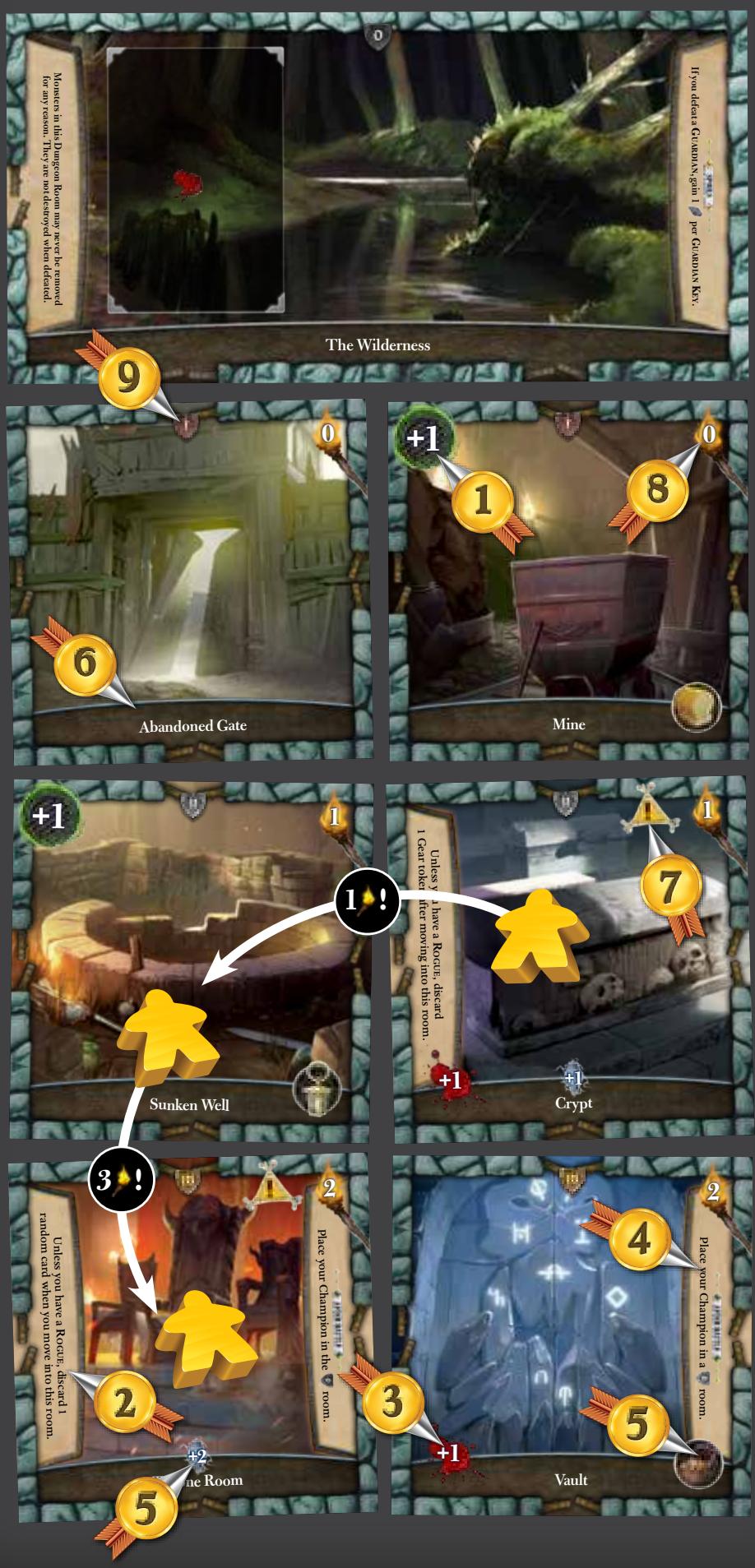
DUNGEON ROOMS
Dungeon Rooms are tiles that, when combined together, form the Dungeon where the Monsters live. Players move their Champion through the Dungeon Rooms to find the Monster they wish to battle. However, the deeper you go, the more Light you need. Players must meet the Light Requirement of each room they enter. Using the example diagram to the right, if a player wished to move into the Sunken Well room, it would require 1 Light. If they wished to then move into the Throne Room, it would require 2 additional Light. It would require 3 Light total to do this movement in a single turn. Players may not move diagonally through the Dungeon. Players may ignore all Dungeon Rooms except the one they are battling in that turn and Dungeon Rooms with the Alert! icon ().
1. DEFENSE BOOSTVALUE
Some rooms give the Monster in them a boost to its Health and/or a boost to its Armor or Magic Resistance. This will give Armor and Magic Resistance to a Monster without it.
2. ROOM PENALTY
It generally indicates any negative effects associated with the room.
3. WOUND BOOST VALUE
Some rooms give the Monster in them a boost to the Wounds it deals.
4. ROOM BENEFIT
It generally indicates any positive effects associated with the room.
5. ROOM REWARDS
Some rooms boost the Monster's XP value, give you Treasure cards, and/or give you Gear tokens when the Monster is defeated.
THE DUNGEON
6. ROOM TITLE
7. ALERT! ICON
If the Dungeon Room should not be ignored, it will have this icon. For example, the Crypt may destroy 1 Gear token when you move into its room, even if you are not stopping in that room to battle.
8. LIGHT REQUIREMENTVALUE
This indicates how much Light is required to move into or through the room. The deeper into the Dungeon you need to go, the darker it gets. Players must meet the Light Requirement of EACH room they enter during a turn.
9. LEVEL
All Dungeon Rooms have a level. Monsters usually reside in Dungeon Rooms which have the same level.
Having entered the Dungeon, Drew places his Champion in The Wilderness and reveals his hand. He reveals a hand with 5 Attack. He has 1 Light which would allow him to move through the level 1 Dungeon Rooms and into a level 2 room, but the Monsters in level 2 are too tough for him for now, so he is going to fight some weaker Goblins instead. He moves his Champion out of The Wilderness into the level 1 room Mine to fight the Goblin Berserker in it.

TREASURE

The Goblin Berserker has 4 Health, +1 from the Mine for a total of 5. With his 5 Attack Drew defeats it, but in return the Goblin Berserker deals him 2 Wounds. OUCH! He takes 2 Wound tokens from The Wilderness and places them on his Player Board. The Monster also has rewards: 2 XP tokens and a Treasure. He draws the top card of the Treasure deck and places it in his discard pile. The Mine also rewards Drew with an Iron Rations Gear token.
Drew places the destroyed Goblin Berserker face up under the level 1 Monster deck (easing clean up later), replacing it with the top card of the level 1 Monster deck. Drew reveals the first Guardian Key! He sets it aside and refills the Dungeon Room with the next level 1 Monster in the deck and ends his turn.
He discards all of his cards and draws a new hand. Because he has two Wounds, he is down to 5 HP (as shown on his Player Board). He only draws 5 cards this turn. He may want to go to the Village and recover next turn. Play now proceeds clockwise to Ashley's turn.
When you defeat a Monster, the Monster or Dungeon Room might drop Treasure ). Treasure may also be bought in the Shop of Arcane Wonders. Treasure comes in many forms: Treasure Caches, Weapons, Items, Spells, or even Heroes who were taken hostage.
Treasure cards look just like other cards (Heroes have blue frames, Weapons have brown, etc.). When a Treasure card is acquired, take the top card of the Treasure deck and put it directly into your discard pile. It is now part of your deck. Generally, once Treasure cards are in your deck, they are used just as you would use other cards. Treasure Cache cards work slightly differently. They have a one-time effect and are then destroyed; they are not added to your deck.
Ashley goes to the Village, placing her Champion in The Bazaar, and then reveals her hand. She purchases a Short Sword and a Gear token, placing the Gear token on her Player Board and the Short Sword in her discard pile. She knows that when buying a card in The Marketplace she could destroy the Dagger she has in front of her, but she has another plan so she chooses not to. She also revealed a Lantern this turn. It has a trait that allows her to venture into The Wilderness after completing her Village Phase, so she does so now.
She now gets a Dungeon Phase in which she may only go to The Wilderness
(the Lantern's trait stops her from moving any deeper into the Dungeon), so she places her Champion there. She has 4 Attack (thanks to the Dagger she kept), so she battles and defeats the first of many Giants Rats.

Giant Rats do not wound, nor do they give any rewards, but they have a very handy Spoils ability.
This allows Ashley to level up 1 Adventurer (without destroying XP), quickly improving the quality of her deck while retaining her XP. Normally, Heroes may only level up to more advanced versions of their same Hero, but Adventurers are special. They are level 0 and don't have a specific path yet, so they can level up into the level 1 version of any Hero in The Guilds' Quarter.
Ashley decides to level up one of her Adventurers into Stormhand; he combos well with that Short Sword she just bought. She takes the Adventurer and destroys it, removing it from the game. She takes a copy of a level 1 Stormhand and puts it in her discard pile. She decides she shall call him Frank, the mighty dwarven Fighter.
GAME END AND WINNING
The final stage of the game triggers at the end of the turn in which the fourth Guardian Key was found. Flip the Monster in The Wilderness over to reveal the Thunderstone Guardian. As indicated on the Guardian Keys, all players now draw 6 cards, and then discard 4. Each player will have one more turn, including the player who found the last Guardian Key. During this turn, the players may battle the Guardian in The Wilderness, or they may take a normal turn. If a player battles and defeats the Guardian, the player gains the rewards for defeating it but the Guardian will still remain in The Wilderness, awaiting the next challenger. Monsters cannot be removed from The Wilderness for any reason. All players will get one opportunity to battle the Guardian, though they may take a standard turn and ignore the Guardian if they prefer.
When the game ends, players total their VP from:
• Cards in their deck.
· Completed Side Quests (see page 15).
• XP tokens(XP is worth equivalent VP).
The player with the most total Victory Points wins the game. If there is a tie, the tied player with the most Wounds (tokens and cards) wins. If there is still a tie, the tied player with the most combined Treasure and Legendary cards in their deck wins. If it is still a tie, the tied players all win.
If you have not done so yet, please check out the Questbook also included in this box for background on the Thunderstone world and suggested setups to play through the story.
There are also several additional ways to play Thunderstone Quest, including Epic Mode and Campaign Mode (see pages 16-17).
GUARDIANS
The Thunderstone Guardian is a special, fearsome, and powerful Monster only available to battle on the last turn of the game. Guardians work the same as all other Monsters with two exceptions:

1. XPVALUE
All Guardians give XP when defeated equal to half your total Attack (+), rounded up. For example, 7 Physical Attack + 16 Magic Attack would give 12 XP (7+16= 23/2= 11.5, rounded up to 12 ).
- LEVEL Guardians are stronger than regular Monsters, and thus have a level of 4-6.
We pick up our example game several turns later. The players have been buying cards and leveling their Heroes into epic, level 3 versions. Ashley has just ended her turn in which she found the fourth Guardian Key. She flips the Monster in The Wilderness over (the Giant Rat) to reveal the Guardian, Smorga the Queen. Play continues around the table as normal until each player has taken one more turn, including Ashley. During this final turn, players take their turns as normal, but they also have the option to fight the Guardian in The Wilderness.
It is now time for Adam to take his final turn. After revealing his hand and using his Dungeon abilities, he has a total of 23 Attack. Smorga has a Health of 8, which is far less than Adam's 23 Attack, so she is defeated. But Before the Battle, Smorga's ability destroys 2 XP from Adam, because Adam currently has 2 Wounds. That hurts, but he is about to get a bunch more XP back.
When Guardians are defeated, in addition to any reward listed on the Guardian or The Wilderness, they also give the player XP equal to the half the total Attack, rounded up. Note that Smorga's 8 Health does not reduce the amount of XP the Guardian gives; Smorga's 8 Health is the merely the prerequisite to defeat her. So Adam gets 12 XP for defeating Smorga, plus a Treasure as listed on Smorga. He adds this Treasure to his deck now, before end game scoring.
After Drew and Ashley each take their final turn, our example game ends. Everybody now counts their XP tokens in front of them, plus the VP of cards in their decks. If the players were using Side Quests in their game, they may possibly gain bonus VP from them at this point as well.
Ashley played a strategy that focused on cycling through the deck quickly using Stormhand and Short Sword, which led to many turns of her playing 10 or more cards.
She didn't have great access to Light from the cards in her deck, so she bought Lantern tokens whenever possible, allowing her to access the high-rewarding level 3 Monsters several times. Her final score was 57.
While Adam had a great final turn against the Guardian, he bought too many cards along the way and did not get enough of his Starter cards out of his deck. This created too many turns where his draws were not smooth and his deck didn't reach full potential. Next game he is going to make sure to get rid of those Starter cards fast and get more Light. His final score was a respectable 43.
Drew used a Rogue strategy of having lots of Light in his deck, so he had access to fight whichever Monster was best for him each turn. This let him maximize the rewards he received every turn and worked really well for him. Adam had some powerful Spell combinations for lots of Magic Attack that was often higher than Drew's, but Adam lacked the Light to consistently reach to the level 3 Monsters. Drew's final score was 54.
Following the rules listed above, you are now ready to play THUNDERSTONE QUEST!
EXPERIENCE POINTS (XP)
You may invest XP in your Heroes over the course of the game, making them stronger. XP spent this way will not count towards precious Victory Points, so spend them wisely.
It is recommended to spend your XP leveling up your Heroes until 2-3 Guardian Keys have been found. Having more
SIDE QUESTS AND LEGENDARY CARDS
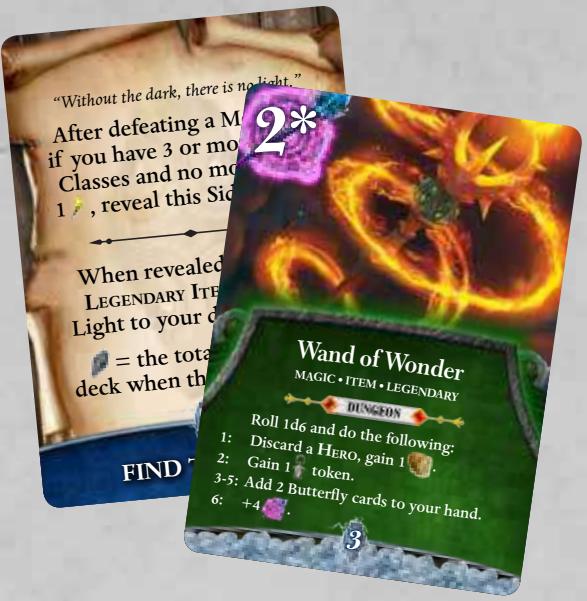
Side Quests are secondary objectives that provide specific goals for you to accomplish, rewarding you with VP or possibly Legendary cards. Side Quests are not mandatory to complete, though every VP counts. Keep your Side Quest face down and secret, revealing it only when it is time to collect its rewards. Side Quests often significantly impact your game strategy, so make sure to remain familiar with your Side Quest throughout the game.
Some Side Quests reward their players with cards that have the Legendary keyword. Legendary cards have a pile of platinum coins at the bottom of the card, as well as the Legendary keyword. Players should review any of these Legendary cards that are relevant to their Side Quest and keep them nearby. Any unchosen Side Quests and Legendary cards are put back in the box.
powerful Heroes will allow you to defeat more rewarding Monsters. Make sure there is enough time left in the game to get good use of your powerful Heroes.
At the end of the game, combine the XP on your Player Board with the VP in your deck and on completed Side Quests to see who wins.
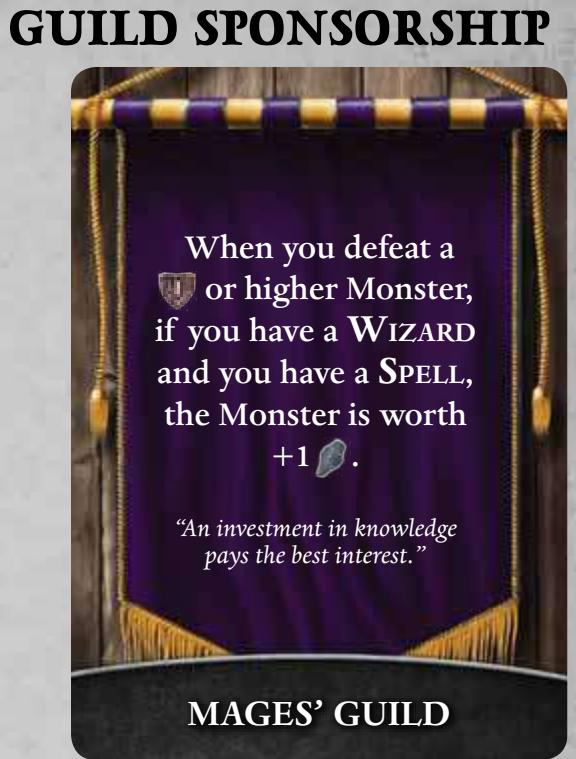
After players choose their Side Quests, they choose which Guild will sponsor their efforts. Guild Sponsorships favor one of the four Classes; try to pick one that synergizes with your Side Quest. Guild Sponsorships sit next to your Player Board and provide you a constant bonus throughout the game, as detailed on the card.
There are enough Guild Sponsorships so that each player may choose the Guild they wish. Any unchosen Guild Sponsorships are put back in the box.
MORE WAYS TO PLAY
RANDOM SETUP
Thunderstone Quest™ is designed to be played beyond the scenarios in the Questbook. If you wish to create your own setup, Randomizers have been included in this product to help you with setup.
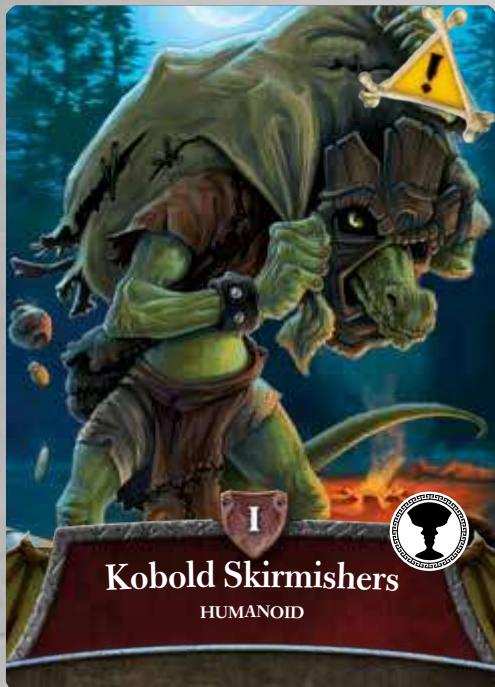
Randomizers are special cards that look like Heroes, Items, Spells, Weapons, Monsters, etc. with special card backs. Heroes sometimes work best with specific cards or Keywords, so some Hero Randomizers will have a small amount of special text.
To create a random setup, follow all normal steps listed in Setup (see page 4) with the following changes:
BUILD AND POPULATE THE DUNGEON
- Either randomly select or choose six Dungeon Room tiles; two of each level. Do likewise to select which Guardian you will be battling this game. You always use The Wilderness in every game.
Use the Monster Randomizers to select random level 1, 2 and level 3 Monster groups. The Monster Randomizers will list the keywords of most/all of the Monsters in that group, whether the Monsters tend to have the Alert! icon, and some may also speak briefly on the mechanics of the group. For example, if the Monster group discards and destroys your Weapons, it may say “They attack your Weapons." Use this knowledge when selecting cards for the Village. If, for example, a Monster group is particularly lethal, Damilu Huskie may be a good card to have in that game. We understand this means the setup is not completely random, but synergetic cards lead to better game experiences.
- Populate the Dungeon Rooms with Monsters and then add Guardian Keys to the Monster decks as normal, placing the Monster decks in their respective spots on the Village Board.
POPULATE THE VILLAGE
Shuffle the Hero Randomizers. Reveal the first Randomizer, placing the corresponding Hero stack into The Guilds' Quarter on the Village Board, in a spot which matches the Hero's Class keyword (Cleric, Fighter, Rogue, or Wizard). If the Hero has more than one Class, you decide which spot to use. Hero Randomizers display the icons they have, such asand.Some Heroes also have a brief amount of text that is relevant to set up or strategies for that Hero.
Repeat step 1, skipping revealed Heroes if the corresponding Class spot is already occupied. When you are done, The Guilds Quarter will contain four Hero stacks, including at least one Cleric, one Fighter, one Rogue, and one Wizard (but with multi-Classing, there could be more than one of a particular Class). Each stack should be arranged so that the level 1 Heroes are on top, level 2 next, and level 3 last.
Shuffle the Item, Spell, and Weapon Randomizers and reveal them until you have revealed one for each corresponding spot in The Marketplace, with a total of 8 spots. We recommend not playing with more than 3 of any particular card type. Some Hero randomizers will have a requirement for The Marketplace. Make sure those requirements are met now. If they aren't, the players should find a Randomizer that does meet them and put it into The Marketplace instead of one of the previously selected Randomizers.
As Item, Spell, and Weapon cards are mechanically consistent throughout the stack, the Randomizers are duplicate versions of the standard cards. Randomizers have a different back so they don't get confused.
Find the corresponding stacks of cards that match the Randomizers and place these stacks into The Marketplace. Put all of the Randomizers back in the box, and continue Setup as normal (see page 3 4).
EPIC THUNDERSTONE QUEST
This radical variant is a favorite of experienced players of classic Thunderstone and Thunderstone Advance. Rather than playing with only 12 different cards in the Village each game, you can play with every card you own! Epic Thunderstone Quest has a slightly different setup from a standard game.
SETUP
Get 1 copy of every Item, Spell, Weapon, and Monster (by card Title) you own. Separate the cards by type: Items, Spells, Weapons, and Monsters. We will deal with Heroes below.
Take 10 random Monsters of each level and populate the Dungeon Rooms as normal (see page 4). These are the Monsters you will play with this game. Put the remaining Monsters back in the box. Add Guardian Keys to the Monster decks as normal and place the Monster decks in their respective spots on the Village Board. Select a Guardian as normal, placing it face down in The Wilderness.
Shuffle and place the Item deck in The Marketplace near the Item section. Do likewise for the Spells, and then the Weapons.
-
Place the top two cards of each deck into their respective spots of The Marketplace. Leave “Any" spots empty to start the game.
-
Throughout the game, whenever a card in the Marketplace is purchased, replace its spot with a card from the corresponding deck. If it is empty, then there are no more cards available of that type. “Any" spots do not refill in this manner.
To fill an “Any" spot, players must place their Champion in The Marketplace at the beginning of their Village Phase (this is an extra Village Location only available in the Epic Mode style of game). For doing so, they take the top card of any deck in The Marketplace and put it in an empty “Any" spot. If there are no empty “Any" spots, then they first destroy 1 card in an “Any" spot, and then fill the newly emptied spot.
- There are two different ways to play with the Heroes. Try both below and decide which style you prefer:
The first style takes 1 copy of every level 1 Hero card you own and separates them into four different stacks, sorted by their Class keyword (Cleric, Fighter, Rogue, Wizard). Heroes with more than 1 Class may go into any corresponding stack. Shuffle these stacks separately, and then place them face up in their respective spots in The Guilds' Quarter. Only the top Hero on each stack is available at a time for purchase or to level an Adventurer into. When you need to level up a Hero into their level 2 or 3 version, use the same process as normal, but retrieve the new Hero from the box. This version of playing with the Heroes is the classic Epic Thunderstone experience. It allows you to play with the most Heroes in any given game.
b. The second style uses the normal Hero setup (see page 4). During playtest, we came to really enjoy this hybrid version and think you will as well. It allows for a very fluid Marketplace, giving you greater access to a wider variety of cards than the normal Marketplace. However, it still allows you to focus your deck construction and strategy around the mechanics of the core of your deck (the Heroes).
Dungeon Setup and play continues as normal from here (see page 4).
EPIC THANKS
Thanks to Richard Launius and Tom Vasel for the original Epic Thunderstone idea.

CAMPAIGN MODE
If you would like to play a series of Thunderstone Quest games back-to-back to tell a story, you can do so by playing a Campaign. Campaigns may last as many or as few games as the players wish. In Campaign Mode, your starting decks get better the more games you play. You may wish to increase the difficulty, as your Campaign progresses, to compensate for this. Increasing the number of Guardian Keys that need to be found or rearranging in which Monster decks the Guardian Keys are placed are two options.
GUILD RECOGNITION PHASE
After each game of a Campaign is finished players enter the Guild Recognition Phase before moving on to the next game. During this phase, players will have the opportunity to enhance their starting deck for all future games of this Campaign.
Starting with the player who won, and proceeding in final placement order, each player may select 1 Marketplace card from their deck. They may only select 1 Item, Spell, or Weapon (no Hero, Treasure, or Legendary cards). They may not choose a card which has already been chosen by another player this Guild Recognition
Phase. If they have no legal card to choose, they forfeit their Guild Recognition choice in this game of the Campaign.
Players add 1 copy of their selected cards to all of their future starting decks this Campaign. This means that players should start the second game of their Campaign with their standard starting decks plus 1 additional card. Game 3 should start with 2 additional cards, game 4 should start with 3 additional cards, and so on.
After each game, keep track of each player's score. The winner at the end of the Campaign is the player with the most combined VP.
WHAT'S DIFFERENT
If you're familiar with Thunderstone Advance, here is a list of changes/features unique to Thunderstone Quest.
• You can buy Gear tokens in the Village for onetime effects.
You have a Champion (a figurine) which moves through the Dungeon to battle Monsters and visits different Village Locations, opening up access to additional abilities.
• The Prepare ability is gone, though a very similar ability is available in the Village.
Rather than being added to your deck, Monsters deal Wounds to players when fought and reward players when defeated. Monsters are destroyed when defeated.
· Wound tokens reduce your HP, which lowers the number of cards you draw each turn. You may heal Wounds in the Village and with special effects.
• Light is now used to move through the Dungeon Rooms. Players no longer use Light to avoid Attack penalties.
• Each Dungeon Room is distinct, providing unique challenges and benefits.
• If a player fails to defeat a Monster, neither the player nor the Monster leaves the Dungeon.
• Each Dungeon level is populated with Monsters of the corresponding level (e.g., level 1 Monsters populate the level 1 Dungeon Rooms).
• Heroes may wield multiple Weapons, up to their Skill. In previous versions of Thunderstone, Skill was called Strength.
• You may level up only 1 Hero in the Village each turn.
• Most cards in the Village provide Victory Points.
• Side Quests, Legendary cards, Guild Sponsorships, and Treasures are all new card types.
• At the end of the game, players' XP are worth 1 VP each.
• Players can no longer Rest (destroy a card from their deck).
Monster abilities now exist in two mandatory timing windows; Before Battle and After Battle. These replace the previous Battle, Aftermath, Global, Trophy, Raid, Stalk, Breach, and React abilities.
There is no longer a restriction about using an ability to destroy another card whose ability has already been used this turn. Now, card effects last as long as they are in front of you The moment they leave play, their effects end immediately.
LEXICON
ABILITIES
Abilities are usable once per turn. There are five types of abilities:VILLAGE DUNGEON SPOILS EFOE , AFTER RATTLE Village, Dungeon, and Spoils abilities are optional, Before Battle and After Battle abilities are required.
Sometimes there is an opportunity to use an ability in more than one circumstance, such as VILLAGE OR DUNGEON. Players may use these abilities in either phase, but they may still only be used once per turn.
ADJACENT
Adjacent means orthogonally adjacent.
Diagonal is never adjacent.
ARMOR
Armor reduces the amount of Physical Attack you have by the stated amount. If a player has 7 Physical Attack and a Monster has 3 Armor, the player has 4 Physical Attack remaining.
BOOSTS
Boosts are bonuses to one or more valu
Content is long; only the first part is inlined. Download the file or open the rules page for the full text.
Download MarkdownTexts are community-compiled or publicly released by publishers; copyright remains with the original authors. For personal reference only.