
Tir Na Nog
At a glance
Rules, cards and Q&A (Chinese)
The rules, card data and player questions for this game are written in Chinese. Open the Chinese page to read them.
Where to find full rules
Full rules and card lookup are available in the cunlema app at cunlema.cn — pick this game and ask about any rule, card or turn you are unsure about.
Related games
Rulebook text (Markdown)
This game has 1 rulebook Markdown file(s) in our library; 1 rendered inline below — expand to read or download.
Tir Na Nog Preview Rulebook.md24.5 KB
ISAAC SHALEV & JASON SLINGERLAND
TIRNG NOG

PREVIEW RULEBOOK (NOT FINAL VERSION)
The golden path to Tír na nÓg is open once more, and the greatest Celtic Storytellers have gathered for a once-in-alifetime journey into the Otherworld. When they return, they’ll bring with them tales of the creatures they met and the adventures they lived. Over time those stories will become a saga — and the most epic saga will live on forever.
OVERVIEW
Journey to the Otherworld by placing Storytellers next to the Encounter cards in the Otherworld, then select from the cards next to your Storytellers and add them to your Saga, which is the grid of cards in front of you. At the end of 5 rounds, score each row according to the rules on its corresponding Geas card, and earn points for having the most connected Encounter cards of each color. The highest score wins.



COMPONENTS
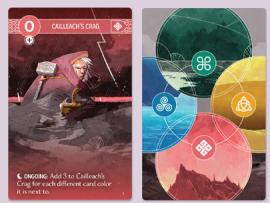
96 Encounter cards

1 Solo Card

30 Double-sided Geas cards 6 each in 5 colors




15 Storytellers 3 each in 5 player colors

24 Color Change Tokens
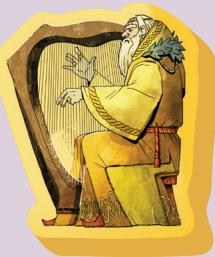
‘Regions of Tír na nÓg’ Geas card
1st Player Token



25 Value tokens
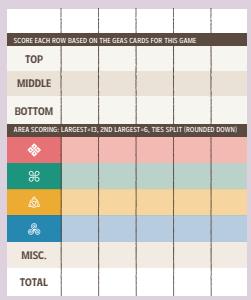
1 Score Pad
SETUP

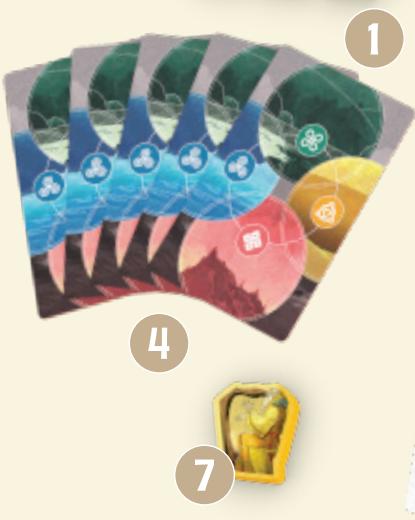
Give each player 3 storytellers in their chosen player color.

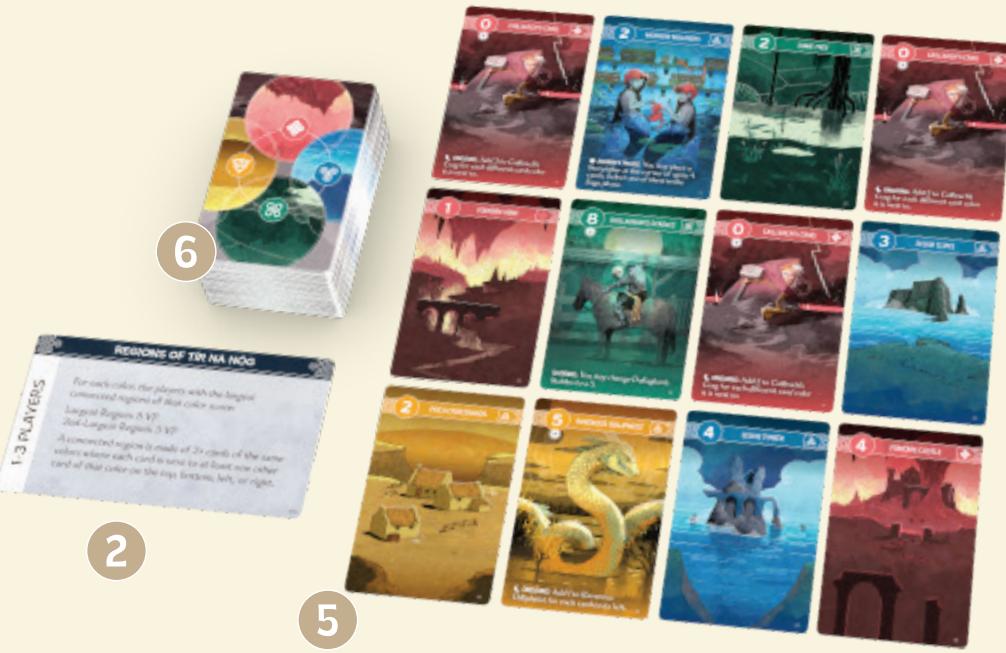
Flip the “Regions of Tir Na Nog” card to the appropriate player count and place the card where players can see it.
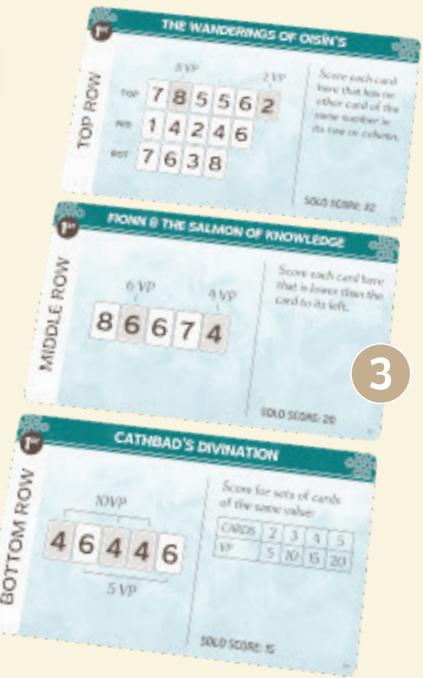
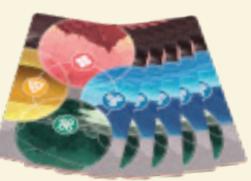
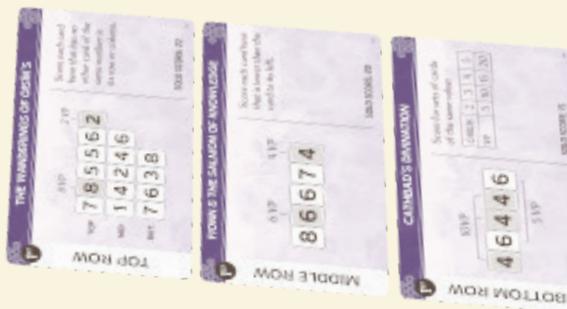
3 Select one Top, Middle, and Bottom Geas card to use for the game. Give each player a copy of each selected Geas card in their color. Place your Geas cards to the left of your personal play area, leaving space for rows of Encounter cards to be placed to their right. If this is your first game, use the cards marked with “1st Game”.
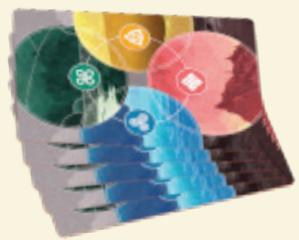
4 Shufle the Encounter card deck and deal 5 cards to each player.
5 In the center of all players, create the Otherworld by placing a face-up grid of Encounter cards according to the chart below.
PLAYERS SETUP
| 2 | 3x3 grid, but do not place thecentral card. |
| 3 | 3x4 grid |
| 4 | 3x5 grid |
| 5 | 3x6 grid |
Place the remaining Encounter cards in a face-down stack near the play area while allowing enough room for a discard pile beside it.
The player who most recently told a story takes the 1st player token. Alternatively, randomly choose a starting player.
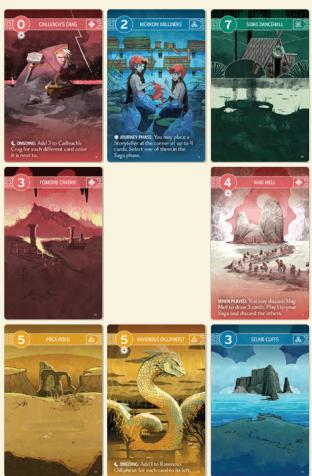
2 PLAYER SETUP
338


HOW TO PLAY
YOUR SAGA: GEAS AND ENCOUNTER CARDS
Geas is an Old Gaelic word for a vow or a curse, common in Irish mythology, that either requires you to do something, or to avoid doing something. Violating your Geas leads to punishment, but fulfilling it leads to great rewards! Over 5 rounds, you will place Encounter cards in 3 rows in front of you to create your Saga of 15 cards. Each row has a Geas card, with rules for placing and scoring Encounter cards in that row. Encounter cards come in four colors, and you will also score points for creating large connected regions of the same color, across all the rows of your Saga.
GAME ROUND
The game plays over 5 rounds. Each round has 3 phases:
-
JOURNEY PHASE: Place Storytellers
-
SAGA PHASE: Select & place Encounter cards
-
CLEANUP: Prepare for the next round
1. JOURNEY PHASE
In the Journey Phase, your Storytellers depart on a great voyage to reach the realm of Tír na nÓg, adventuring through fog and mist to a land of youth and promise.
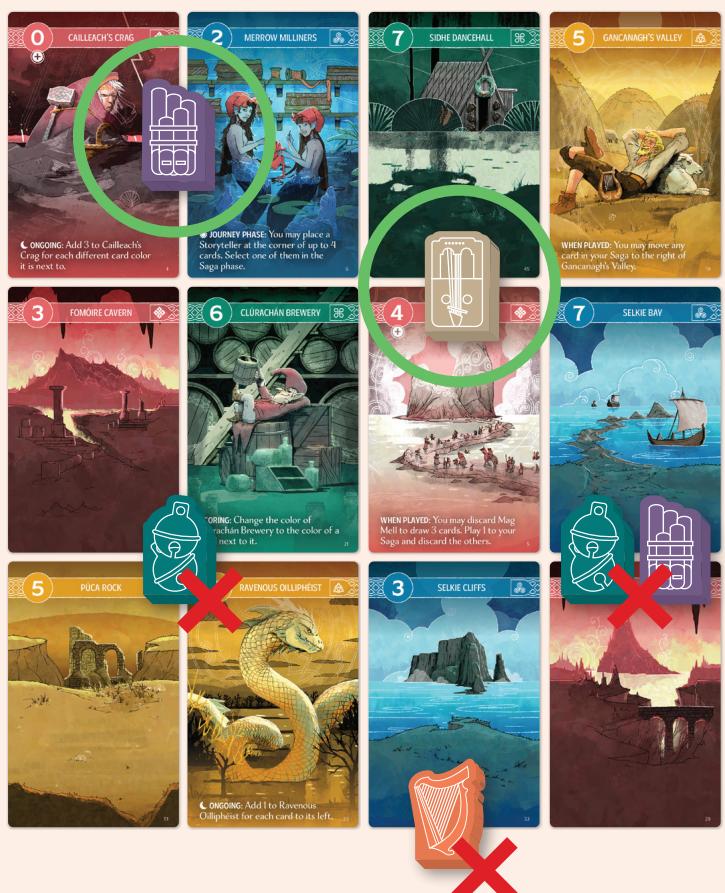
Starting with the player with the 1st Player Token, place a Storyteller in a space between any two Encounter cards in the Otherworld.
You may not place a Storyteller:
• On a space already occupied by a Storyteller
• At the corner of cards
• Along the outside of the Otherworld card grid
• In a 2-player game, along the inside edges of the card grid
Play passes to the left until all players have placed all of their Storytellers.
2. SAGA PHASE
Having tasted the Land of Eternal Youth, your Storytellers return home to sing songs and spin tales of their adventures, recording them in a great Saga.
The Saga phase has two steps:
1. SELECT AN ENCOUNTER CARD
2. PLAY AN ENCOUNTER CARD TO YOUR SAGA
SELECT AN ENCOUNTER CARD
Starting with the player to the right of the 1st Player token and proceeding counterclockwise, select an Encounter card and place an Encounter card into your Saga. After you have completed both steps, the player to your right takes their turn.

If none of your Storytellers are next to any cards, play passes to the next player. These Lost Storytellers will take their turns later, as described below in Lost Storytellers and the Echtra Quest.
PLAY AN ENCOUNTER CARD TO
YOUR SAGA
Choose any card from your hand - even the one you just took - and add it to a row in your Saga.
Place your card in the first open slot in a row, from left to right. Usually, this will be to the right of the last card in the row. However, a gap can sometimes appear in the middle of a row, and the next card played into the row will fill that gap.
Restrictions on Playing Encounter Cards
You may not play an Encounter card into a row that already has 5 cards, though some game efects may cause a row to have more than 5 cards. You must observe any placement rules and requirements on the Geas card for that row, if there are any. Very rarely, you may not have any legal plays available. In that case, discard one card to the discard pile instead, ignoring any efect printed on the card. This may result in your Saga having fewer than 15 cards at the end of the game.
After you have taken a card and played a card, the player to your right takes their turn.
Lost Storytellers and the Echtra Quest
Echtra means adventure or journey in Old Irish, and is related to the modern English word ‘extra.’
final scoring. Otherwise, prepare for a new round.
If all the Encounter cards next to your Storyteller are taken, your Storyteller has become Lost in the Otherworld. Don’t panic! After all the other Storytellers return home, your Storyteller will embark on an Echtra Quest.
When the only Storytellers left in the Otherworld are Lost, each player with a Lost Storyteller, in counterclockwise turn order, selects any card from the remaining cards in the Otherworld, and proceeds as normal, adding it to their hand, and playing a card to their Saga. Continue until all Storytellers have returned home with an Encounter card, and all players have played three cards.
When all players have returned all their Storytellers and played three Encounter cards, the Saga phase is over.
3. CLEANUP
All players discard a card from their hands. The number of cards left in your hand is equal to the number of rounds that remain in the game, so if you have no cards to discard, you have played all 5 rounds and it is time to proceed to
Discard the current Otherworld cards then create a new Otherworld grid from the draw deck just as you did at the start of the game. If the draw deck runs out of cards, shufle the discard pile to form a new draw deck. Pass the 1st Player token to the left and start a new round.
ENCOUNTER CARDS, CARD EFFECTS, AND TIMING
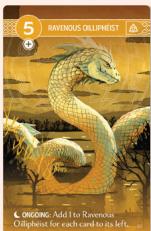
Every Encounter card has a color and a value. The value is the number printed on the top-left corner. Special Encounter cards have efects printed on them. Card efects only apply once the Encounter card is played into your Saga, not while the card is in your hand. Some cards, typically those that can change their own value, are marked with an Ailm
next to their printed value. This icon is referenced by some card efects.
The Encounter cards describe when and how their efects operate. Always follow the rules on the card even when they contradict the rules in this rulebook. Efects are mandatory unless the card says otherwise, or the efect is impossible to perform. Efects can increase or decrease a card’s value, change its color, move its position, and more. Initial card values range from 0-8. Efects can increase values past 8, but cannot decrease values below 0. Cards efects trigger at these times:
• When Played: Once, when the card is added to your Saga.
• Ongoing ( ): When the card is added to your Saga, and after any other change is made to your Saga
• Journey Phase ( ) / Saga Phase ( ): On your turn in that phase, unless otherwise noted on the card. These cards often have optional efects, or allow you to perform an additional action, or to take an improved version of a standard action.
• Scoring: At the end of the game as part of scoring
Moving or swapping a card that is already in your Saga is not the same as playing a card. Efects that move cards, like Manannan’s Dock, do not have to follow the placement restrictions on Geas cards, or the restriction of playing no more than 5 cards in each row.
Use Value tokens and Color Change tokens to indicate any changes made to the cards. Place Value tokens on top of the printed value, to replace it entirely. The tokens have diferent numbers on each side, so you should usually be able to find exactly the number that you need. In the rare case that you need a diferent number, use two or more tokens that sum up to the number you need.
Place Color Change tokens on the top right of the card, over the old color symbol.
Cards that are moved keep any tokens they have on them, but remember to re-check all ‘Ongoing’ cards, as their values may be afected by their own move, or the movement of other cards.
Cards usually trigger either when they are played, or during a particular phase. When your card triggers during a particular phase, but has no other timing instructions, you may choose when in the phase to trigger it. For example, you may trigger the ability of the Leipreachán Cobblers at any time during the Saga Phase, either prior
ENCOUNTER CARD

to adding a card to your Saga, or afterwards. If any timing issues arise with regards to the efects of your cards, you may choose how to resolve them as you wish, so long as you do not create infinite loops or other impossible situations.
GAME END
The game ends after 5 rounds. In most cases, you will have a complete Saga of 15 Encounter cards in 3 rows, with 5
Encounter cards per row. It is possible that you will have fewer cards, or have more than 5 cards in one row and fewer than 5 cards in another row, or that you will have a blank space in the middle of one of your rows. For the purposes of scoring, blank spaces simply do not count. A blank space in the middle of a row disrupts connections and runs for all Geas cards, including the Regions of Tír na nÓg Geas card.
SCORING
Check your Saga for cards with efects that trigger in the scoring phase, and resolve all of those efects. Usually, player order will not matter and players can all do this step at the same time. In the rare case where order matters, pass the 1st Player Marker at the start of scoring, as though you were starting a new round, then go clockwise from the 1st Player Marker.
I. GEAS CARDS
Geas cards will show scoring conditions on the right and an example of the scoring conditions on the left. Check the Geas cards in your Saga and score each row according to its Geas card. Geas cards score even if the cards in the row look
like they violate the placement rules on the Geas cards. This can happen when players use ‘move’ and ‘swap’ powers, because those powers do not count as playing a card.
Unless they explicitly state otherwise, Geas cards apply to the Encounter cards in their corresponding rows, and use the word “here” to mean “in this row.” When a Geas card says “score a card” it means score points equal to the value of the card. “Score the total” means sum up the values of each card the Geas card refers to, and score that many points. Record the totals for each on the score pad.
II. REGIONS OF TÍR NA NÓG
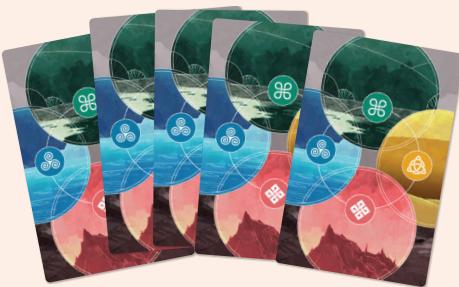
Score the Regions of Tír na nÓg Geas card. For each of the 4 Encounter card colors, Yellow, Blue, Green and Red, the player with the largest connected region of the same color scores the highest point value on the Regions of Tír na nÓg card. The player with the 2nd-largest region scores the second highest point value, and so on. Players must have a region of at least 2 cards to score points. Cards are connected when they are next to each other horizontally or vertically. Record the totals for each on the score pad.
In case of a tie for region size, give each player half the points (rounded down) for the position they have tied for, and half the points for the next position, if applicable. Do not award points to any other players for that next position.
Add up all the scores. The player with the highest score wins. In case of a tie, the player with the largest single region is the winner.
SCORING EXAMPLE
REGIONS OF TÍR NA NÓG
For each color, the players with the largest connected regions of that color score:
Largest Region: 8 VP 2nd-Largest Region: 3 VP
A connected region is made of 2+ cards of the same colors where each card is next to at least one other card of that color on the top, bottom, left, or right.
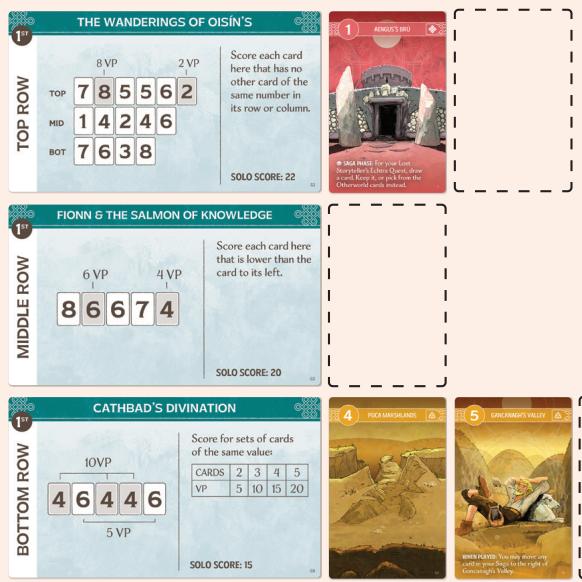
GEAS CARDS = 46 VP REGIONS = 11 VP TOTAL SCORE = 57 VP

The Wanderings of Oisins: 7+5+6+8=26 VP
Fionn and the Salmon of Knowledge: 4+4+2 = 10 VP
Cathbad’s Divination: 3 value 3 cards = 10 VP
Regions of Tir Na Nog: 7 red, 3 green, 2 yellow: 8+3 = 11 VP For example’s sake: this player’s 7 reds were the largest compared to the other players’ reds, the 3 green was the 2nd-largest compared to other player’s green regions, and the 2 yellow were not the largest in comparison to any other players.

SOLO RULES - BALOR’S GAZE
Balor, the evil-eyed chieftain of the Fomóire, has his own vision of his legacy. He has recruited his own Storytellers to retell the stories — with himself as the hero! Build your Saga as best you can and preserve the truth of the Otherworld, or at least something like it, for all time.
Set up for a 2-player game but with the following changes: Place the Balor reference card on the “Highest” side and do not deal Balor any Encounter cards. Balor does not have a Saga. Instead, he places all of his selected cards into a single scoring pile.
Balor always goes first during the Journey Phase AND the Saga Phase. Place the first player marker in between any two cards in the Otherworld grid. It will remain there the entire game.
JOURNEY PHASE: On Balor’s turn, discard the top card of the location deck. If that card has an Ailm flip Balor’s reference card.
Check Balor’s reference card. If it indicates “Highest,” place one of Balor’s Storytellers between the two cards that have the highest sum. If that spot is already occupied by a Storyteller, go to the spot with the next-highest sum, until you find an open spot. Ignore any efects on cards that would increase or decrease their value when summing the cards for this purpose.
If Balor’s reference card indicates “Lowest,” then place one of Balor’s Storytellers between the two cards that have the lowest sum, following the same rule as above if that spot is occupied, but looking for the lowest sum.
If two spots are tied, start at the first player marker and travel clockwise around the grid in a spiral until you reach one of the tied locations and place the Storyteller there.
SAGA PHASE: On Balor’s turn, discard the top card of the location deck. If that card has an Ailm flip Balor’s reference card.
Check Balor’s reference card. Balor takes the highest or lowest card he is eligible to take (next to a Storyteller) based on the reference card. Ignore any efects that would increase or decrease the value of the card. If one or more cards are tied, Balor will take the card closest to the 1st-Player Token, going clockwise.
If Balor’s two Storytellers are both next to the card Balor intends to take, Balor will use the Storyteller closest to the 1st-Player Token, going clockwise, to take the card.
When Balor chooses a card for a lost Storyteller, he will still take the highest or lowest card from those remaining, following the same rule for ties as above.
Place the card Balor took face up into his scoring pile.

JOURNEY PHASE: Place Storyteller between two cards with highest sum.
SAGA PHASE: Select highest value card eligible to be taken.
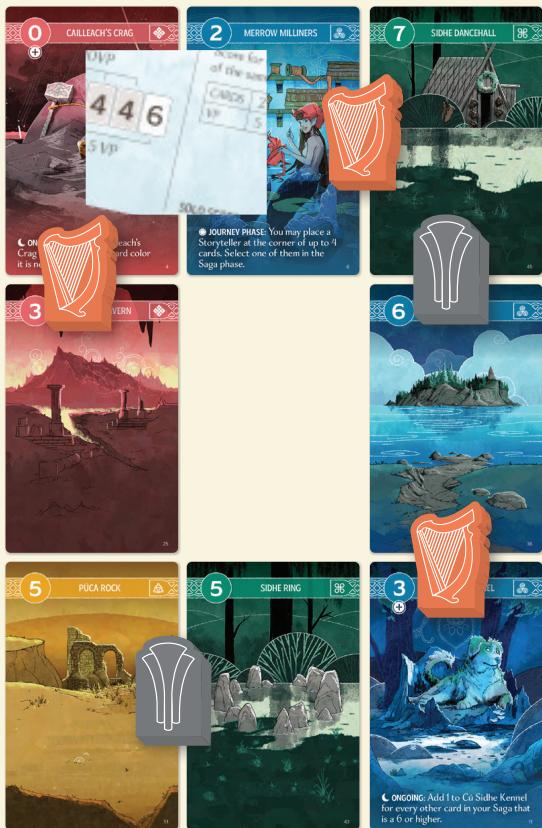
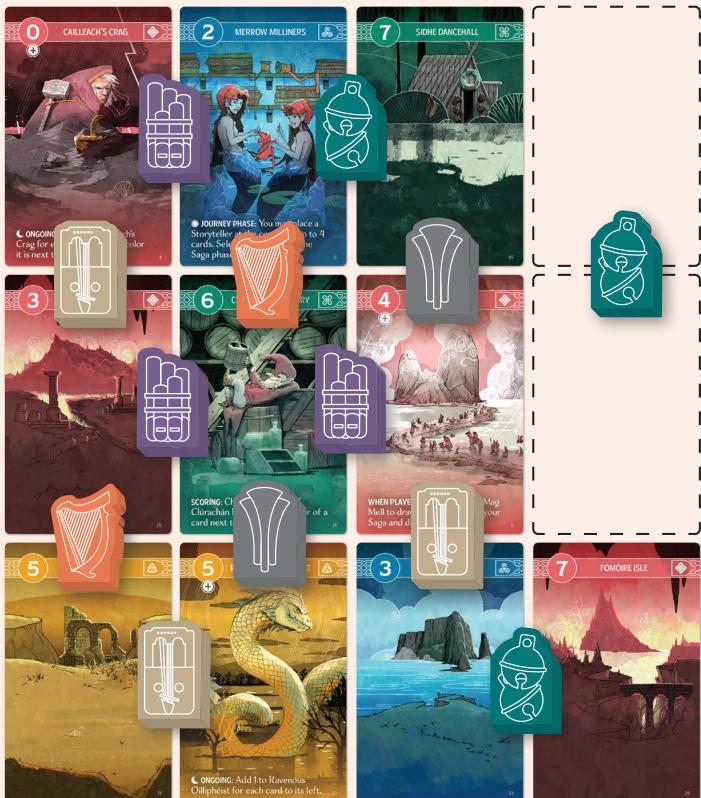
In this example, Balor’s Storyteller went between 7 and 6 because it was the highest sum. You placed between 6 and 3, and Balor went between 5 and 5 on his second turn.
In the Saga Phase, Balor will take the green 7 because it is the highest. Since the other pair are the same value, Balor will take the green 5 since it is the closest clockwise from the first player token.
CLEANUP PHASE: When you deal out the new Otherworld grid, flip Balor’s reference card.
SCORING: Calculate your score for Geas cards normally. Balor scores the points located in the lower right of each of the three Geas cards.
Discard a number of random cards from Balor’s scoring pile based on the dificulty setting you want to play from the table below. When comparing color regions, Balor’s connected region size is the number of all cards of that color remaining in his scoring pile after discarding. Points are awarded like normal for a two-player game: 8 points to the player with the largest region of that color, 3 points to the player with the second largest region, and 0 points to players with regions of 0 or 1 cards. Ties split the first and second total 11 points evenly rounded down, so 5 points each. Good luck beating Balor!
| Difficulty | Easy | Normal | Hard | Impossible |
| Discard | 6 cards | 4 cards | 2 cards | 0 cards |
CARD GLOSSARY
Note: There are many dialects of Old Irish, so there are many valid ways to pronounce these words.
ENCOUNTER CARDS
Aengus’s Brú (AYN-guhs’s BROO) You may choose to keep the card you drew, or resolve your Lost Storyteller normally, by discarding that card and picking a card from the Otherworld.
Brú na Bóinne (BROO nah BOY-neh) You may only place your Storytellers in a standard occupied space. You cannot, for example, place a Storyteller in an occupied corner, even if you also have the Merrow Milliners card in your Saga.
Cailleach’s Crag (KAH-lach’s)
Cailleach’s Crag gets a +3 per color that it is next to, for each of the four colors, Red, Yellow, Green and Blue. If it is next to all four colors, it gets +12. It does not count as next to itself for the +3 from Red.
Clúrachán Brewery (KLOO-ri-kahn) If there are no cards next to Clúrachán Brewery when it is played, it stays green. If there is a green card next to Clúrachán Brewery, you may choose for Clúrachán Brewery to remain green.
Cú Sidhe (KOO shee)
Cú Sidhe Kennel doesn’t count itself, but does count a second copy of Cú Sidhe Kennel
Dobhar-chú Loch
The Storyteller must be moved to another valid space where two cards are still present. If no such place is available, ignore the efect.
Far Darrig
If there is no card to the left of Far Darrig, it retains its printed value of 2.
Gancanagh’s Valley (GAN KAH-nah’s) If the space to the right of Gancanagh’s Valley is filled when Gancanagh’s Valley, ignore the efect of this card. This may occur when Gancanagh’s Valley is played into a gap in a row.
Keening Banshee
This card triggers as soon as one of your Storytellers has no cards next to them, and interrupts the regular turn order. It may trigger multiple times per round. You may place your Storyteller in a space next to one or two cards. You must still observe all the other placement rules, e.g. no placing on the outside of the Otherworld grid, etc.
Leipreachán Cobblers (LEP-ri-kahn) Moving does not count as playing, so you may move Leipreachán Cobblers to a row that already has 5 or more cards.
Mag Mell (mah mal)
Discard Mag Mell from your hand to trigger its ability. If you play Mag Mell into your Saga instead, its ability is lost forever.
Manannán’s Dock
Swapping is not ‘Playing’ and does not retrigger ‘When Played’ abilities
Merrow Milliners
Only one of your Storytellers may be placed at a corner in each Journey Phase. In the 2-player game, you may place the Storyteller along the inside edge of the Otherworld grid. In the Sage phase, activate that Storyteller on your turn as usual, take any of the up to 4 cards that the Storyteller is next to, and bring the Storyteller home.
Water Kelpie
If Water Kelpie ever stops being next to a Green card, add 6 back to its value.
GEAS CARDS
Legend of Knockgrafton (Middle)
Cards tied for highest in their column do not count as 2nd-highest, and do not score. E.g. a column of 8-8-1 will not score at all. The 8 in the middle row is tied for highest, and does not also count as 2ndhighest. The ‘1’ is second-highest, but it is in the wrong row. It would need to be in the middle row to score, since Legend of Knockgrafton scores the middle row.
CREDITS:
GAME DESIGN: Isaac Shalev and Jason Slingerland
SOLO MODE: John Brieger and Joe Hopkins
ILLUSTRATION: Marlies Barends
ART DIRECTION AND GRAPHIC DESIGN: Brigette Indelicato
PRODUCER: Marc Specter
DEVELOPMENT: Joe Hopkins and John Brieger
CULTURAL CONSULTANT: Nick Ferris
SPECIAL THANKS: TBD
PLAYTESTERS: TBD
Copyright © Grand Gamers Guild 2023
Download MarkdownTexts are community-compiled or publicly released by publishers; copyright remains with the original authors. For personal reference only.