
Trash Pandas
At a glance
Rules, cards and Q&A (Chinese)
The rules, card data and player questions for this game are written in Chinese. Open the Chinese page to read them.
Where to find full rules
Full rules and card lookup are available in the cunlema app at cunlema.cn — pick this game and ask about any rule, card or turn you are unsure about.
Related games
Rulebook text (Markdown)
This game has 1 rulebook Markdown file(s) in our library; 1 rendered inline below — expand to read or download.
TP_Rules.md11.3 KB
TRASHPANDAS
Play time: 15-20 minutes
Player count: 2-4 players
Components: 54 cards 1 custom die 6 tokens
Goal:
Players are raucous raccoons, tipping over trash cans for food (and shiny objects). Players push their luck to acquire more cards but must stash them in order for them to count as points at the end of the game. When the deck runs out, the game ends and players reveal their stashed cards. Players score points based on who has the majority for each card type. The player with the most points wins.
Setup:
The player who most recently took out the trash is the starting player (or choose randomly). Give that player the die and set the tokens in the middle of the playing area. Shuffle the cards to create a draw deck and deal cards to each player based on their turn order: Player 1 = 2 cards, Player 2 = 3 cards, Player 3 = 4 cards, and Player 4 = 5 cards.
Turn Sequence:
A. Rolling the die
Roll the die and take the token that matches the die result. Then decide to either STOP or CONTINUE. If you decide to stop, move to the Resolving Tokens step.
If you continue, roll the die again and take the token that matches that roll result. You may continue rolling and taking tokens as long as you do not “bust”: If you end your turn where the die result matches a token you have already taken, you BUST and do not resolve ANY tokens. You may save yourself from busting by using a Blammo! card to re-roll the last rolled die and possibly change the result or by using a Nanners card to ignore the last 2 roll (if you have one).
Consolation prize: If you bust, do not resolve any tokens. Instead, draw one card into your hand as a consolation prize.
B. Resolving Tokens
Once you stop rolling, you may then resolve each of the tokens you have collected in any order. Resolving each token is optional.
If you manage to collect all six tokens, resolve them, then continue by taking a BONUS turn. With this bonus turn, however, you are limited to collecting a maximum of three tokens. For the sake of the game end, this is still considered to be the same turn. Even with no cards available, you will be able to roll the die to try for stash or steal functions.
Important: Tokens are not resolved until you decide to stop (without busting). Before resolving tokens, you may set aside any cards from your hand that you plan to use during the token resolution step. Note: Once you start resolving tokens, you may not use any cards gained during that turn. For example, if you resolve a Trash Can token to draw a Doggo card, you may not use that Doggo card
during this turn and must wait to use it on a later turn. However, you may stash cards that have been gained during the same turn.
Notes: When drawing cards, it is important to remember that cards are not stashed (saved) unless a Tree action is used. Any cards that have not yet been stashed must remain in your hand. Stashed cards are set aside until the end of the game. Stashed cards are stored face down unless the Bandit Mask action is being used. If you ever go to draw a card and there are none left, the discard pile is not used to create a new deck – the end of the game is triggered.
Once you have resolved your tokens (or have drawn a card for busting) your turn ends. Place all the tokens back in the middle of the table and pass the die to the next player.
Die faces/tokens:
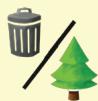
1) Trashcan/Tree: Draw one card into your hand OR stash one card from your hand.

2) Two Trashcans: Draw two cards into your hand.

3) Paw: Steal one random card from the hand (not stashed cards) of another player. That player may immediately play a Doggo or Kitteh card to block this (if they have one).

4) Bandit mask: Draw and REVEAL the top card from the deck. Add that card to your hand. Each other player now has the opportunity to stash one card from their hand that matches the card drawn. These cards must be stashed FACE UP. For each card stashed by other players, draw one card and add it to your hand.

5) Two Trees: Stash two cards from your hand.

6) Recycle: Exchange the Recycle token with a token that was not previously taken. Recycle is somewhat of a “wild” ability, but is limited to any remaining tokens. Because you turn in the Recycle token, the total number of tokens remains the same (for the sake of Doggo's Knock Over ability). Note: If you manage to collect all six tokens, the Recycle token has no effect since there are no remaining tokens.
Cards:
Stashed cards provide points at the end of the game (except for the Doggo and Kitteh cards). Each card also has an action that you may use during your turn (except for Yum Yum, or Doggo/Kitteh which may be used during the turn of another player). To activate the action, discard the card face up (the discard pile is open information), and then perform the action listed on the card. You may play any number of actions on your turn. The “protect” and “steal” actions on the Doggo and Kitteh cards are used on another player's turn, and only if you are the target of a Steal action. There is no limit to the number of cards you may have in your hand or your stash. The number in parenthesis () on each card indicates how many times that card shows up in the deck.
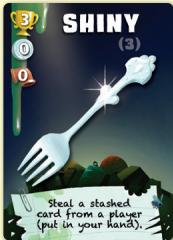
Shiny: Trash Pandas LOVE shiny objects. Use a Shiny card to distract another player while you steal one of their stashed cards. Add that card to your hand. You may steal a face up or face down card. If you steal a face down card, you do not look at it until you have taken it. The target player may use a Doggo or Kitteh from their hand to block this action. If they do, discard the Shiny card.
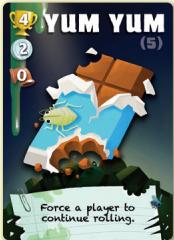
Yum Yum: Also known as chocolate. Yum Yum is not played on your own turn, but is instead played on another player's turn to force them to take an additional roll once they have decided to stop. That player must roll the die again. This basically cancels the players previous “stop” decision. If the player busts, they may use Blammo! or
Nanners cards as normal. If the player does not bust, they may decide to continue their turn instead of stopping as they had originally planned.
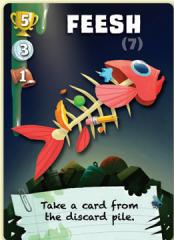
Feesh: Stinky, but tasty. Use a Feesh card to look through the discard pile and fish (take) any one card. If possible, you may use that new card on this same turn. i.e. - you may take a Blammo! or Nanners to prevent a bust.
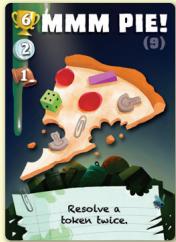
MMM Pie!: Everyone loves pizza. Use MMM Pie! to resolve a token a second time. For example, if you use it to resolve a Two Trashcan token, you would draw four cards instead of two. If used on Recycle, take two remaining tokens. Note: You may NOT use multiple MMM Pie! cards on a single token.
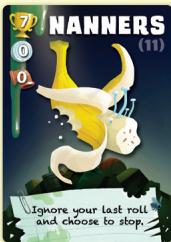
Nanners: Trash Pandas go bananas for Nanners. Nanners are used when you are about to bust. Discard the Nanners card to cancel your last die roll. It is treated as if it was not rolled and you had decided to stop. Once a Nanners is played, you may not continue rolling unless another player uses a Yum Yum card on you.
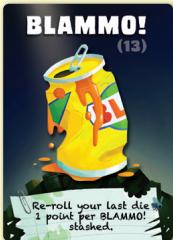
Blammo!: Also known as carbonated energy. Use a Blammo! to re-roll, ignoring the previous result. This is often done to prevent a bust, but you may decide to re-roll a die before busting if you want to try for a different result. When stashed, Blammo! cards are treated differently from other point cards as they are each worth one point and the majority does not matter.
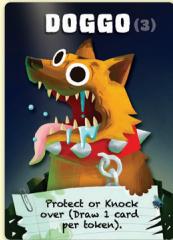
Doggo: This hulking dog is not happy about all this garbage shenanigans. When another player tries to steal from you, using Doggo will prevent them from doing so (discard the Doggo card and that player may not resolve their steal action). Doggo is also a bit clumsy and has a habit of knocking over trash cans. During your Token Resolution step, playing Doggo
allows you to draw one card for each token taken (assuming you haven't busted). Example: If you end your turn with three tokens, you may discard a Doggo card to draw three cards.
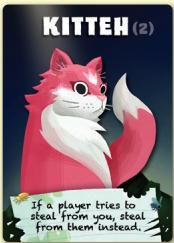
Kitteh: This cat is neither soft, nor warm – it is a cold and evil ball of fur. If another player targets you with a Steal action on their turn, you may use a Kitteh card to turn the tables on them. Instead of them taking a random card from your hand, you take a random card from their hand. That player may use a Doggo card or another Kitteh card to defend against this. If a player uses a Kitteh to defend against a Shiny steal attempt, the player using the Kitteh would then steal from the other player's stashed cards as if they were using a Shiny card.
Game End & Scoring:
Once the last card is drawn, the current player finishes their turn and the game ends. All players then set aside any cards remaining in their hand as these cards do not score points. Next, all players reveal their stashed cards. Any stashed Doggo or Kitteh cards do not score any points. Players then add up the total
number of cards they have of each type. Players will score points for each type of card depending on how many they have collected in relation to the other players. The scoring icons in the upper left corner of the card show how many points are scored for 1st place, 2nd place, and 3rd place, based on who has the majority of that type of card. Players must have at least one card of a type in order to score any points for it.
If there is a tie for a card type, the players


involved in the tie receive one fewer point. For example, if two players each have two Feesh cards and tie for the majority, both will score four points instead of five. The player with the third most Feesh cards would move to second place and score three points because of the tie for first place.
Players count up any points they have scored and the player with the most points wins the game. Ties are broken by the player who is later in turn order.
Thanks to playtesters: Beverly, Rick, Gideon, and Rachel Eskue, Ben, Emma, Noah, and Grace Vaterlaus, Greg Silva, Patrick (GIANT) Quinn, Andrew Darmitzel, Ed Hamby, Jeff Robinson, Jeffrey McKee, Kai Henderson, Patrick McIntyre, Josh Hrabowy, Spencer Munoz, Mark Means, Carol Yager, Hank and Kai Panethiere. Also, thanks to our fellow Hasbro finalists for making it an awesome experience: Jason Wiser, Steve Ehrensperger (Steve #3), Eugene Bryant, and Kelly North Adams.
Download MarkdownTexts are community-compiled or publicly released by publishers; copyright remains with the original authors. For personal reference only.