
Tribes Of The Wind
At a glance
Rules, cards and Q&A (Chinese)
The rules, card data and player questions for this game are written in Chinese. Open the Chinese page to read them.
Where to find full rules
Full rules and card lookup are available in the cunlema app at cunlema.cn — pick this game and ask about any rule, card or turn you are unsure about.
Related games
Rulebook text (Markdown)
This game has 1 rulebook Markdown file(s) in our library; 1 rendered inline below — expand to read or download.
TRI-EN-STD-rules-light-part2.md16.6 KB
Place a Temple

Discard 3 Element cards from your hand (you don't have to meet their requirements, and you do not trigger their effects) to place a temple.
Hint: This action may be useful (even upon the beginning of the game) if all of your cards' requirements are difficult or impossible to meet, or if you want to replace your cards faster (see Refill your hand p.9).
Choose a temple from the Temple area of your board (you can build them in any order).
Place the temple on a tile of your Terrain area without any temple (you cannot have more than one temple per tile). A village, however, does not prevent you from placing a temple (see Build a Village).
The spot where you choose to place the temple may be important to achieve some Village cards' objectives.
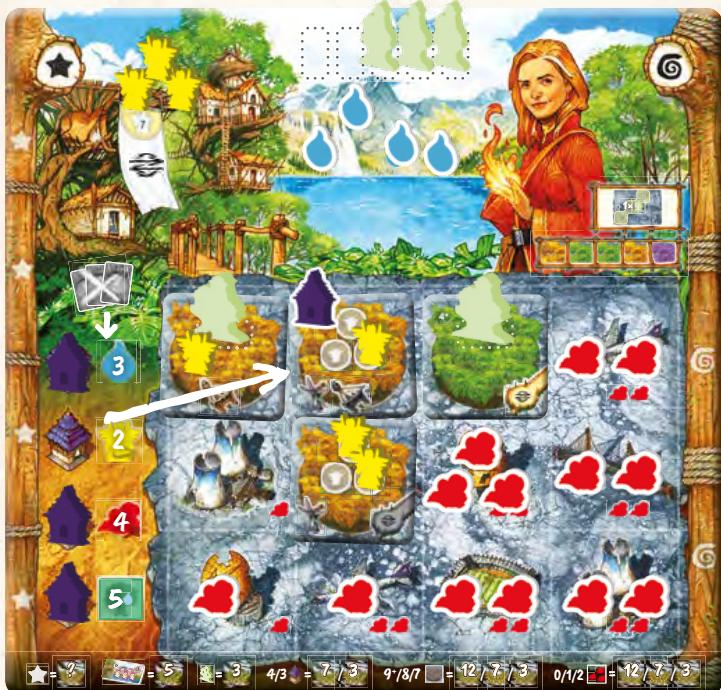
Depending on the temple that you built, you immediately trigger an effect whose strength depends on your Player board.
You cannot reuse an effect granted by a previous temple.
Example: Ben discards 3 cards from his hand and places a temple on a tile from his Terrain area. This temple allows him to immediately perform 2 Wind Rider moves.
Build a Village
Reminder: Villages do not build themselves automatically. You need to use your whole turn to take this action!

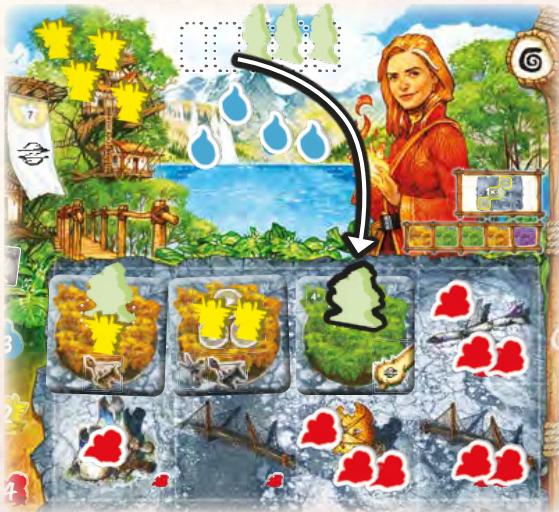
This symbol is a Wind Rider space. Each Forest tile features between 2 and 4 of those. When all spaces are occupied with Wind Riders (one per space), you may flip the tile on its Village side. You can only build one village per turn. Remove the Wind Riders from the spaces and place them back in your Capital. Any extra Wind Rider on the tile and any Temple remain there (place them back on the Village side of the tile once it has been flipped).
Place a Pollution token on each Terrain space that is orthogonally adjacent to the new Village tile and that does not contain a tile already (theicon acts as a reminder).
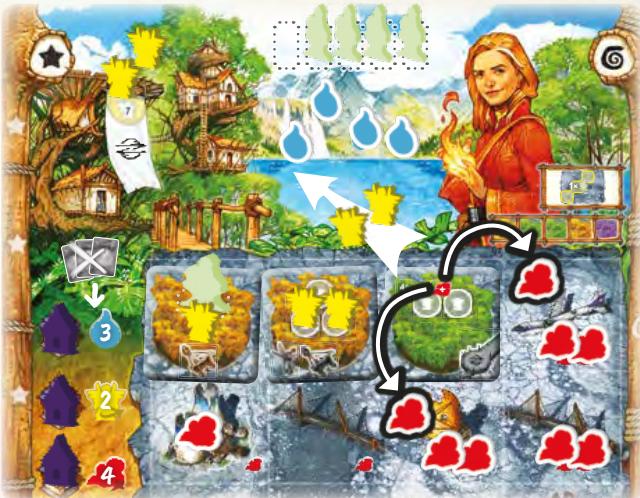
Then, take one of your Village Markers from the upper part of your board and place it on the tile that you flipped.
Building bonuses
Each tile features one or several building bonus(es) that activate once when the tile gets flipped on its Village side. As long as the tile is on its Forest side, the bonus is grayed out to indicate that it is not active:

If the tile features a Wind Turbine, do not place any Pollution token when building this village. (Also note that the tile has no icon).

If the tile features a Catapult, when you build the village, you can move any Wind Rider from your board (including one from the Capital) to any other tile (including those that are not adjacent to the catapult). You can use this bonus to move one of the Wind Riders that you used to build the village.

Some tiles feature a Wind Portal. This has no effect when building the village; however, a village with a Wind Portal is considered as adjacent to the Capital and to other Wind Portals. For a Wind Rider, moving from the Capital to a Wind Portal, or between two Wind Portals, only takes one move.
Example: Jennifer played a card that allows her to perform 2 moves. She moves as follows:
Village card
Each time that you build a village, take one Village card of your choice from the display. You can either immediately use its right side, or keep the card to try and complete the objective given on its left side by the end of the game.
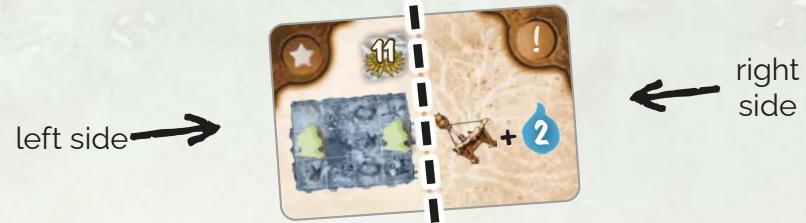
If you choose the right side, immediately resolve the indicated effects, then discard the card.
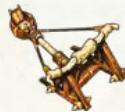
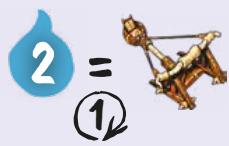
A Catapult allows you to move one of your Wind Riders to any tile.

A Temple allows you to immediately take the action Place a Temple without discarding Element cards - you still trigger the temple's effect.
If you choose the left side, slide the card below the left side of your board, keeping only the left part visible. You
cannot change your mind later to use the right side. You
cannot have more than 4 Village cards on the left of your
board (including the one that you placed during Setup). If you
gain a 5th Village card and wish to use its left side, you must
discard another Village card from your board. You will score
extra points at the end of the game if you manage to
complete the objectives given on the cards that you keep.

Here are the different existing objectives (types, spaces, quantities, regions and bonus may vary, and the color requirement may be “of the same color" or “of different colors"). Note that all objectives apply to your Terrain area:

Both of these Terrain spaces must be covered with a tile.
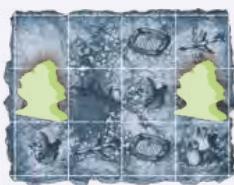
Each indicated space must be covered with a Village marker.

Each indicated space must be covered with a Temple marker.

You must place at least X tiles in the highlighted region (here, 3 tiles in the bottom row).

You must have a row of 3 adjacent tiles of the same color.

You must have a column of 3 adjacent tiles of the same color.

You must have a diagonal (it can be reversed) of 3 adjacent tiles of the same color.

You must have a L-shaped pattern (oriented as you wish) of 3 adjacent tiles of the same color.

You must have at least that many tiles with a village featuring the same building bonus (here, 3 tiles with a Village marker and a Wind Portal).
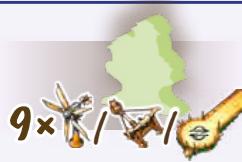
You must have 9 Building bonuses on your tiles with a Village marker.
2. REFILl YOUR HAND
At the end of your turn, after completing your action, take as many cards as necessary, until you have 5 cards in hand. Take them from the Elemental display and/or from the top of the Elemental draw pile.
If you have to draw 3 cards because of a Place a Temple action, do not check your cards one by one as you draw them: draw your 3 cards at once.
Once you've refilled your hand, refill the display (if needed) to 4 cards.


GUIDE'S POWERS
Each Player board features two specific requirements known as the “Guide Requirements".
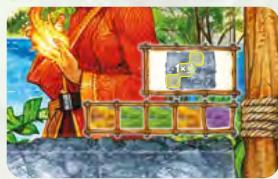
If you meet a Guide Requirement, you may choose one of your Guide cards at the very end of your turn. This gives you access to a new power. Each requirement can only be met once. If you meet both of your Guide Requirements, you'll have access to two powers!
GUIDE REQUIREMENTS
One of the requirements is to place your tiles according to a given layout. Each guide has their own layout of colors.
To meet this requirement, the tiles must be orthogonally adjacent and in the correct order. Each tile can only be used once. Besides that, you are free to create your “path" as you wish: your Starting tile is not necessarily the starting tile of your path, and you can even build a path without the Starting tile.
Example: The following layout is legal.

The other Guide Requirement is specific to each Guide:
 | Have 8 Terrain spaces withouta Pollution token (regardless ofthe number of Pollution tokenson the other spaces). Spaceswith a tile (including the Startingtile) also count. |
| 2! | Use the right side of two Villagecards. |
 | Slide 3 Village cards under yourboard (including the one placedduring Setup). |
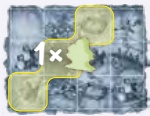 | Build a village on one of thehighlighted Terrain spaces ofthis region. |
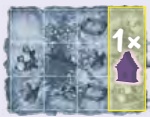 | Place a temple on one of thehighlighted Terrain spaces ofthis region. |
At the very end of your turn, when you meet one of your Guide Requirements, choose one of your Guide cards and slide it under the right part of your Player board. You can use the card's effect upon your next turn. It is possible to meet both Guide Requirements during the same turn, in which case you can choose 2 Guide cards at the end of your turn.
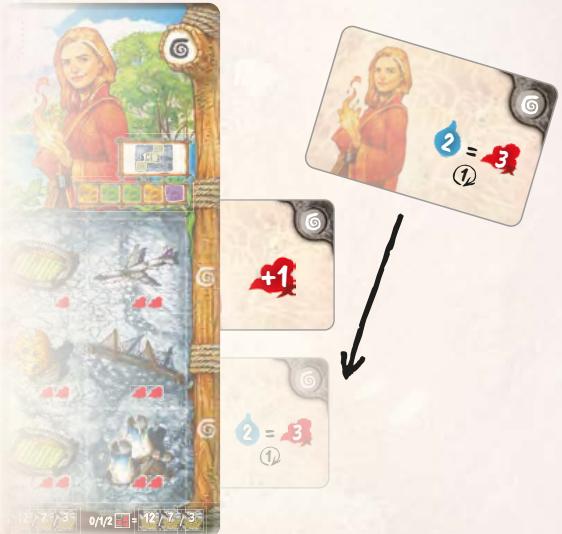
Here are the powers that can be unlocked (the examples are illustrated with specific elements and colors, but symbols may be declined for every existing element and color):

Each time that you play a given card (here, red), gain the indicated benefit (here, 3 moves). This power does not trigger if the card is discarded with the Place a Temple action. It only works with the Play an Element Cardaction.



On each of your turns, you can discard a given amount of Water tokens to gain the indicated benefit (here, discard 2 Water to remove 3 Pollution). You can only do this once per turn.
Each time that you add a Forest tile to your Terrain area, gain the indicated benefit (here, take 4 Water tokens).
Each time that you resolve the indicated effect because of an Element card, a temple or a Village card, the effect is amended as indicated (here, when you remove Pollution tokens, remove 1 extra token).

On each of your turns, you can discard 2 Water tokens to move any Wind Rider to any destination. You can only do this once per turn.

Each time that you add a Forest tile to your Terrain area, you can move one of your Wind Riders to any destination.

Each time that you add a Forest Tile to your Terrain area, you can remove all Pollution tokens from one of your Terrain spaces.

Spend one less Water token to place your Forest tiles. Also, remove one Pollution token when you place a Forest tile. You must still spend at least 1 Water token.

For each Pollution token that you remove, gain 2 Water tokens.
Once per turn, you may spend 6 Water tokens to place a Forest tile (in addition to your action).

Spend 2 less Water tokens to place your Forest tiles. You must still spend at least 1 Water token.
END OF THE GAME
The end of the game is triggered when someone builds their 5th village. This player takes the Game End token and places it next to them. Complete the current round (all remaining players play their turn, the player with the highest numbered Starting tile playing last) so that everyone has played the same number of turns. Then, play a final round (everyone plays a last turn).
FINAL SCORING

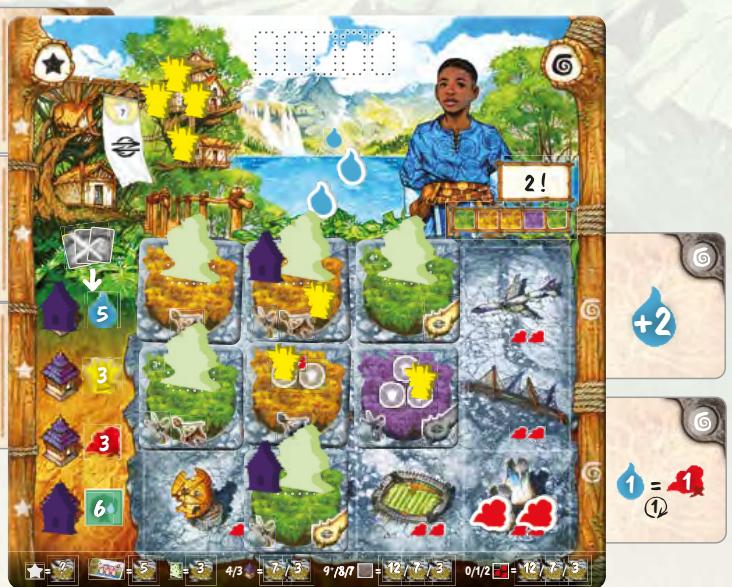
Victory Points (VP) are identified with this symbol. Check the bottom part of your board for a quick reminder about how you can score points.
If you have the Game End token (because you were the first one to build your 5th village) then you score 5 VP.
Each Village marker placed in your Terrain area is worth 3 VP.
If you have placed your 4 temples in your Terrain area, score 7 VP. If you have placed only 3 temples, score 3 VP.
# Depending on the number of Terrain spaces that still contain Pollution tokens (no matter how many), score VP as follows:
| Number of polluted Terrainspaces | O | 1 | 2 | 3 ormore |
| Victory Points | 12 | 7 | 3 | 0 |
# Depending on the number of tiles (with or without a Village marker, and including your Starting tile) in your Terrain area, score VP as follows:
| Number of tiles | 9 ormore | 8 | 7 | 6 orless |
| Victory Points | 12 | 7 | 3 | 0 |
# Also score VP for the completed objectives of your Village cards, if any.
Add up all your VP. The player with the most VP wins. In the case of a tie, the player with the most Water tokens wins. If the tie persists, the tied players share victory.
Example
Here is Joachim's board at the end of the game.
He does not have the Game End token (o VP).
He has placed 5 Village markers (5 × 3 = 15 VP).
He has only placed 2 Temples (o VP).
His board contains 7 tiles (3 VP).
He only has one Terrain space with Pollution tokens (7 VP).
He completed the objective listed on his first Village card (8 VP) and the one listed on his second Village card (1o VP). However, he did not complete his third objective (o VP).
His final score is 43 VP.
TWO-PLAYER GAME
All rules remain the same, except for Element card requirements. Treat the Elemental display + the back of the Elemental draw pile (a total of 5 card backs) as your second neighbor.

DON'T FORGET!
Do not get the icons on the back of the cards and the icons that refer to the game pieces mixed up. Card requirements always refer to card backs, while card effects always refer to game pieces, tokens or tiles.
Only take your own cards and the cards of your (left and right) neighbors into consideration. If there are more than 3 players, do not take into consideration the cards of the players that do not sit next to you.
The card that you play always counts for its own requirement. Check your whole hand BEFORE playing the card to see if you meet the requirement.
Temples allow you to avoid being blocked. If the requirements of your cards do not go well together, a temple will allow you to reset part of your hand and to make a fresh start.
The game is a race: the first player to build their 5th village gains a bonus and ends the game! Watch your opponents, keep an eye on their villages, and make sure to build your own villages! The game might end sooner than you think.
Download MarkdownTexts are community-compiled or publicly released by publishers; copyright remains with the original authors. For personal reference only.