
Up Or Down
At a glance
Rules, cards and Q&A (Chinese)
The rules, card data and player questions for this game are written in Chinese. Open the Chinese page to read them.
Where to find full rules
Full rules and card lookup are available in the cunlema app at cunlema.cn — pick this game and ask about any rule, card or turn you are unsure about.
Related games
Rulebook text (Markdown)
This game has 1 rulebook Markdown file(s) in our library; 1 rendered inline below — expand to read or download.
UoD_Rules_02_web.md7.2 KB
2-6 players, 8 years and up
In “Up or Down?" players build ascending and descending card columns that score points at the end of the game. Card columns with lots of cards of the same color score many points. The person with the most points at the end of the game wins.
GAME MATERIALS
126 cards in six colors with numbers 1 - 126

SETUP OF THE GAME

Depending on the number of players, only a certain number of cards are needed to play. We recommend starting with a shorter game of Up or Down. Use the number cards required for your player count and desired game length; return the rest to the box.


SHORT GAME
2 PLAYERS: 1–42
3 PLAYERS: 1–60
4 PLAYERS: 1–78
5-6 PLAYERS: 1–96
FULLGAME

2 PLAYERS: 1–54
4 PLAYERS: 1–102
5-6 PLAYERS: 1–126

Next, shuffle all the cards for your player count.

Deal a hand of 3 cards face down to each player. Look at the cards in your hand.

Next, place a circle of 6 face up cards in the middle of the play area. Sort them by ascending value, in clockwise order. These 6 cards make up the display
Divide the remaining cards into two piles roughly the same size.
In the middle of the display, place one pile face down, and the other face up. Both of these are draw piles.
Pick a start player.


DISPLAY
YOUR PLAY AREA
PLAYING THE GAME
Take turns in clockwise order. Your turn consists of the following:
IPlay a Card into the Display
2 Take a Card Next to your Played Card
3 Play the Taken Card into Your Play Area
4Draw a Card
0 Play a Card into the Display
Place a card from your hand face up into the display. Place it where it belongs in numerical order, which will always be clockwise.
Erin places the 14 from their hand between the 7 and 33.
If you play a card lower than the lowest card or higher than the highest card, place it between the highest card and lowest card.
Eli placed the 5 from their hand between the 106 and 7 because it was less than the 7.


② Take a Card Next to Your Played Card
Take a single card from the display. The chosen card will be one of the two cards next to the card you placed in Step 1.
After playing the 5, Eli decides whether to take the 7 or the 106. After choosing the 7, they will place the 7 in their Play Area in Step 3.
Play the Taken Card into Your Play Area
A Your First Card: Place the taken card in your Play Area. Your Play Area consists of zero to three columns and potentially a discard pile. The first card you take from the display will start the first column of your Play Area.
After playing the 5, Eli took the 7 and started the first column in their Play Area.

B Extending Your Play Area:
On future turns, when you add another card to your Play Area, make the choice to either add it to an existing column or start a new one. You may only have 3 columns of cards. Each column may contain any number of cards. However, either all cards in the column must be placed in ascending order, or all cards in the column must be placed in descending order. Once a second card is placed in a column, this determines whether it is ascending or descending.
C Create Ascending or Descending Columns:
As previously mentioned, the second card in a column determines whether the column is ascending or descending. You cannot change this card order later in the game. Once you play a card into your Play Area, you are not allowed to rearrange it.
Cards must be laid out differently depending on whether the column is ascending or descending. For columns in ascending order, place the 2nd and subsequent cards slightly offset so that the top number is covered on the previous card in the column. You will see all bottom numbers in an ascending column

For columns in descending order, place the 2nd and subsequent cards similarly so that the bottom number of the previous card is covered. You will see all top numbers in a descending column.
The new card must always be fully visible after you place it (not tucked behind or in between cards in the column).
D Giving up a Column to the Discard Pile:
If you cannot or do not want to place a card in any of your current columns, choose an entire column to turn face down and place in your discard pile. These discarded cards will score one point each at the end of the game. Then start a new column in your Play Area with the taken card.

Draw a Card and End your Turn
Once you place a card in a column of your Play Area, draw the topmost card from either the face down or the face up pile in the middle of the display, and add it to your hand. If one of the piles has been depleted, you must take your card from the remaining draw pile. Your turn is complete. The player to your left now takes their turn.
What about wrong number sequences?
If you or someone else notices a card that was just misplayed, fix it immediately. If the mistake is discovered later in the game, put the entire column with the misplayed card into that player's discard pile.
END OF THE GAME
When both draw piles have been depleted, continue to play until all cards in players' hands have been played. There will be 6 cards remaining in the public display. At this point, scoring takes place.
SCORING
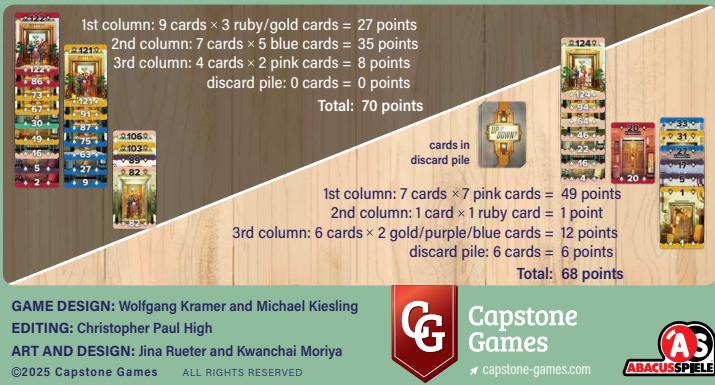
Each player will score all of their columns, as well as their discard pile cards. For each column, count the number of cards in the color that appears most frequently in that column. Multiply this number by the total number of cards in the column.
If Erin had 5 pink cards in column one, and the total number of cards (including pink) in column one was 9, then Erin would have 45 points from column one.
Do this calculation for each column. Add the three columns' points together. Then, add a single point for each card in your discard pile. The sum of all three columns and the discard pile is your total score. The player with the highest score wins. In case of a tie, the tied players share the victory.
SCORING EXAMPLES
Texts are community-compiled or publicly released by publishers; copyright remains with the original authors. For personal reference only.