
Vagrantsong
At a glance
Rules, cards and Q&A (Chinese)
The rules, card data and player questions for this game are written in Chinese. Open the Chinese page to read them.
Where to find full rules
Full rules and card lookup are available in the cunlema app at cunlema.cn — pick this game and ask about any rule, card or turn you are unsure about.
Related games
Rulebook text (Markdown)
This game has 1 rulebook Markdown file(s) in our library; 1 rendered inline below — expand to read or download.
Vagrantsong_RuleBook_v1.1_12192023.md200.7 KB
VAGRANTSONG
Rule Book
VERSION 1.1
Creative Direction Nathan Caroland
Lead Design & Writer Kyle Rowan
Game Design Matt Carter, Justin Gibbs
Additional Design & Writing Matthew Majarucon
Editing Jessie Clark, Kimberly Cooper, Shannon Riddle
Production Kelly Brumley
Art Nguyen Mai Diem
Graphic Design John Cason
Playtesters
Tom Benner, Doug Bowman, Wesley Boyer, David Brown, Chris Colasurdo, Sarah Cole, Kimberly Cooper, Jeff Dickson, Sean Fisher, Jason Gaughan, Cody Greene, Philip Higgs, Kai Hull, Hailey Kenyon, Taylor Lindberg, Tim Lyons, Laura Rowan, Nathan Sells, Diki Thomas, Dustin Vogel

© 2005-2024 Wyrd Miniatures, LLC
Table of Contents
About the Game…
Components.....
The Train Board
Starting Of (Choosing Vagrants)……
The Vagrant Card ...
Anatomy of a Scenario …
Setup....
Definitions.....
Playing Vagrantsong (The Scenario Phase) .
A Vagrant's Turn.
Westbound .....
General Actions.. 16
The Haint's Turn.. .20
Winning and Losing Scenarios.. 25
Example Round... .26
The Camp Phase 28
Timing Charts .... 32
Frequently Asked and Advanced Questions.... 33
Moments ... 37
Mile Post… 48
Index .... 49
THE HOBO CODE
In Vagrantsong, the ultimate goal is collaborative fun. Remember these when playing:
-
Rules on Events, cards, and Scenarios supersede rules in this Rule Book. If these rules contradict one another, follow the rules on the Event first, then the card (such as an In-Between or Skill card), then the Scenario, and finally this Rule Book.
-
Whenever players find themselves in a situation where they must make a choice and the game assumes there is only a single option, but there are actually multiple valid options, the players must choose the outcome that is the worst for the Vagrants. For examples on these types of situations (and situations where players have a choice), see question 13 at the top of page 34 in this Rule Book's Frequently Asked and Advanced Questions section.
-
If players cannot decide how to break a tie, who goes first, or have a disagreement, they are encouraged to roll Bones (pg. 12) to determine the outcome. Let the dice decide!
-
Sometimes components used for one thing, such as Tokens, are used for something else in a Scenario. Make sure to always read the Scenario Rules!
-
It's encouraged to keep a pen and scrap paper handy to jot down notes and various bits of information.
About the Game
Vagrantsong is a story-driven game where players take on the role of Vagrants who find themselves trapped on a ghostly train called the Silver Ferryman. Players will have to work together to face their fears and reveal the mystery behind their new surroundings.
But they will soon realize that they are not alone on this locomotive. Haints, the lost spirits hanging onto both life and death, are just as trapped on this train. They'll stop at nothing to ensure that the Vagrants accompany them... forever. No traveler will be the same at the end of Vagrantsong as they were the moment they began. Now grab your stuff - it's time to hop aboard!
Vagrantsong is played in two phases: the Scenario Phase and the Camp Phase. During the Scenario Phase, players will attempt to survive the train ride by performing various Actions while also trying to free the Haint by giving it back its lost Humanity. After the Scenario Phase is complete, players move onto the Camp Phase, where players will pool together their resources to heal, gain new Skills, and plan for the next adventure.
Player Count
Vagrantsong is a fully cooperative game for 2-4 players, where each player controls their own Vagrant.
Throughout the campaign, players may be added (or removed) during the Camp Phase, which takes place between each Scenario.
Victory Conditions
Each Scenario will have its own Victory Condition(s). Normally, these Victory Conditions are based on returning a Haint's Humanity so that it can be saved or completing Rituals in order to progress to the next Scenario. Win or lose, players will have opportunities to continue their journey. Make sure to always read the Victory Condition when starting a Scenario.
DEFEAT
Some Scenarios will also have a Defeat Condition. Normally, when all Vagrants become Westbound (pg. 15), they are defeated, but Scenarios may include different or additional ways for Vagrants to be defeated. Victorious or not, Vagrants will move on to the next Scenario, albeit a little worse for wear.
Components
Rule Book

20 Haint Standees

7 Vagrant Standees
Scenario Book

20 Haint Bases

7 Vagrant Bases

6 Bones (d6)

Bindle

Upbeat Tempo: If you only have 1 Coin on a Skill, reduce the success value of that Skill by 1.
The brighe lights of the big city have tugged on the Songsmith's strings since chilldhood. He's dreaming of performing on those grand stages, pouring out the music in his heart for all to hear.
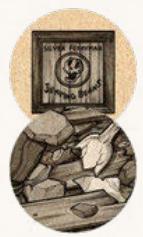
Box/Debris (6)

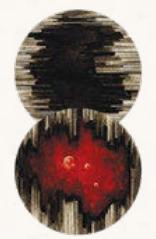
Coffin/Snow (6)
18 Terrain Tokens
Hole/Blood Pool (6)
6 Vagrant Cards

Can-Do Attitude For each success, target gains 1 Humanity.
Then, if you're the first Vagrant to take a turn this round, the target gains an additionalHumanity.


66 Ritual Cards

Cursebearer (3)
32 Junk Cards


Revivalist (3)
Empress (3)
1 Séance Card
Songsmith (3)

Break


Runaway (3)
19 Cadence Cards
18 Coins
S. Nearby Vagrant 6. Westbound Vagrant 2. Recent Vagrant


Humanity Threshold
If Vagrants are tied, go to the next available option, choosing only from those Vagrants.
Round
Wayfarer (3)
3 Track Markers

1. Special Priority 2. Action Specific 3.

1 Target Priority Token
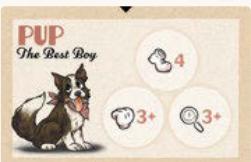
1 Pup Card
1 Haint Mood Token
Permanently add the Malady Token
Gained after 6 Mile Posts
When the Malady Tokenis drawn, place it on the next round. At the start of that round, the Haint takes the first turn.

Haint

Songsmith

20 In-Between Cards

Runaway

Empress
Revivalist
6 Westbound Cards

Move: For each Coln here, move your Vagrant your Vagrant's Move value.
Wayfarer
7 Humanity Tokens
Investigate: May only be taken whilein a han your Investigate val are treated asa success.

Rummage: For each Coin here, draw a ge Token from the Bindle, and ant may a number of Rummage Tokens equal to their Rummage value.
Patch Up: For each Coin here, roll1 Bone. For each Bone with a value equal to or igher than your Patch Up value, gain 1
Bust: Target an adjacent Haint. For each Coin here, roll 1 Bone. For each Bone with a value equal to or higher than your Bust value, that Haint gains I Humanity.


There's not much time to think between cars. A little misstep here could mean a missing leg there. But thanks to those faceless things, there's more to think about than losing a limb right now.
Outside, pointed pines sway against the howling wind. At the head of the train, a faint melody reaches out. A fiddle player, faster than lightning...
Iron Nails (8)

1 Malady Token

Candle (7)


Salt (5)
Rabbit's Foot (4)

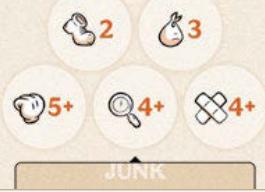
27 Rummage Tokens

Apple (3)
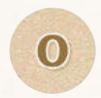
0-9
10 Event Tokens

In-Between(4)


Black(4)
White(4)
12 Haint Effect Tokens
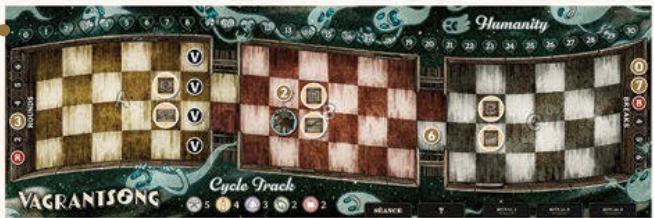
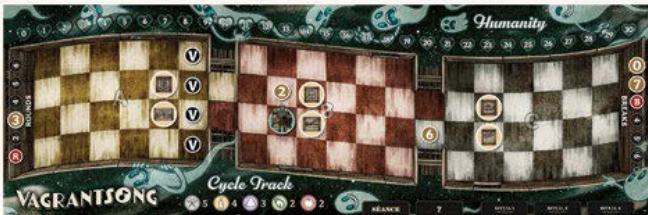
The Train Board
All Scenarios are played on the train board. Each Scenario will adjust certain aspects of the train board, such as adding Terrain and Event Tokens in specific locations, but there are constants that won't change between Scenarios. The following rules are always in effect to help players situate and orient themselves during gameplay.
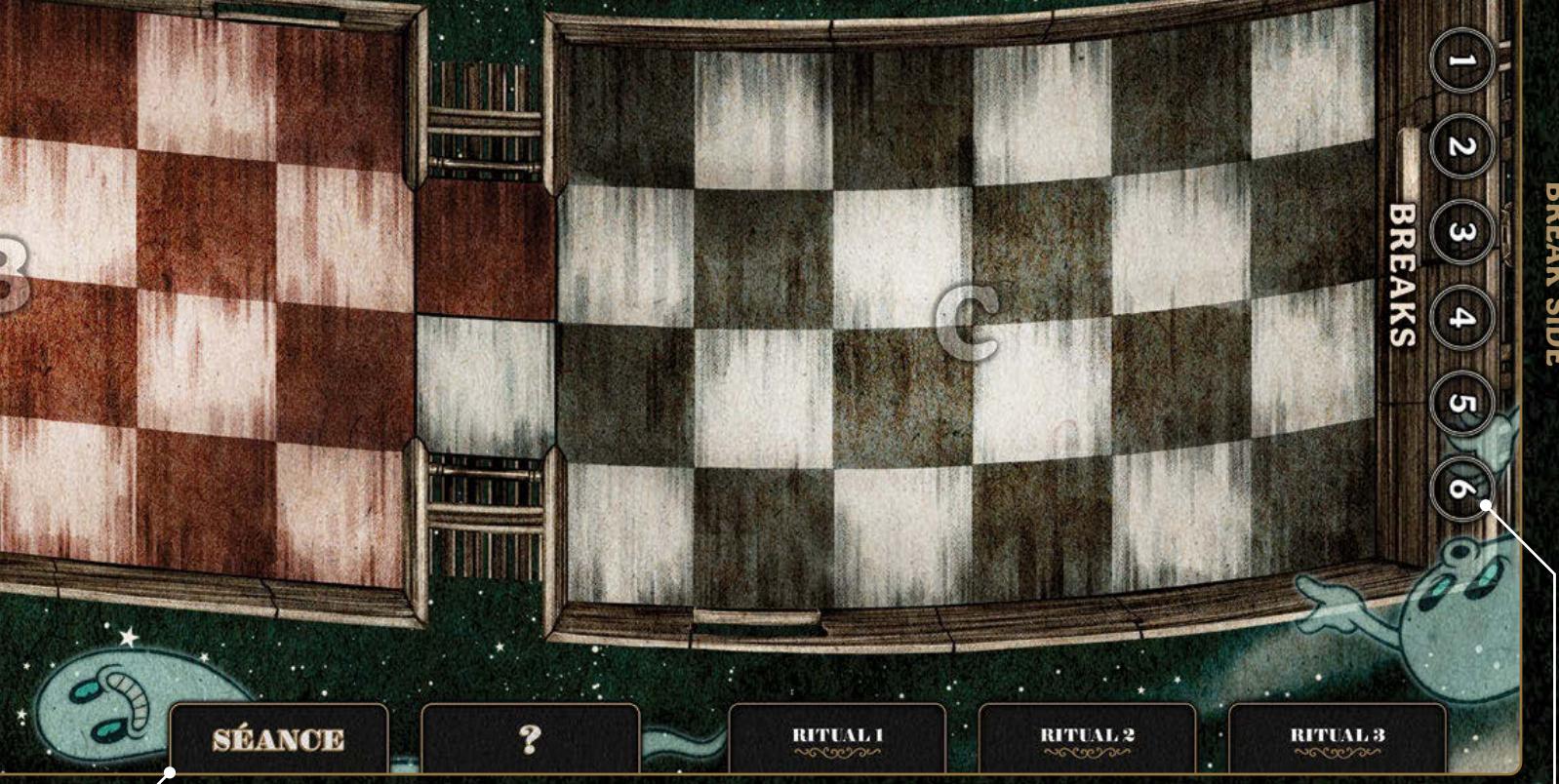
Three Train Cars: A, B, and C The train board is separated into three separate train cars. There are spaces between that connect train cars.
HUMANITY SIDE
CONNECTING SPACES
The connecting spaces are the spaces between two train cars. The connecting space closest to the Humanity Track is part of the train car to the left of that space, and the connecting space closest to the Cycle Track is part of the train car to the right. Connecting spaces do not have the wooden border around them, are not edge spaces themselves, and are not considered adjacent to any edge. Use this to your advantage in some Scenarios!
ROUD IDE
VAGRANTSONG
Cycle Track
5.4322
CYCLE SIDE
ROUND TRACK
Denotes the current round. The Round Marker moves up by 1 when all Vagrants have taken their turn and the Haint has taken their last turn in that round. When Round 6 is complete, move the Marker back around to Round 1 and keep going!
CYCLE TRACK
During their turn, Haints draw Rummage Tokens to determine which Actions they take. This section of the train board is used to keep these Tokens until they are Cycled back into the Bindle. Each Rummage Token has its own Cycle value listed to the right of that Token's symbol, representing how many Rummage Tokens of a specific type the Cycle Track can hold before all Tokens are Cycled back into the Bindle. More on Cycling can be found on page 24.
Sides and Edges
Sides and edges are referenced throughout the game by various effects, such as “Move toward Round side".
EDGES
Along the outside of train cars are wooden borders called edges. Some effects will refer to these edges. Usually, these effects will ask Vagrants to Move toward or away from the edges, or the effect may do something to the Vagrant if they are in a space adjacent to an edge.
Tracks
The train board is surrounded with various tracks to help mark game progress. Each track serves a different purpose.
HUMANITYTRACK
Denotes the Haint's current Humanity. This track has two markers: a Humanity Marker representing the Haint's current Humanity, and a Humanity Threshold that indicates the maximum amount of Humanity a Haint can get before that Haint Breaks.
HUMANITY SIDE
18 19 20 2i 22 23 24 25 26 27 28
BREAK SIDE
CARD SLOTS
This area of the board holds various cards that impact the Scenario, such as the 3 Ritual cards that Vagrants may perform, the Séance card (if the Séance was performed in the previous Camp Phase), and a mysterious card slot that players will learn about during the campaign.
CYCLE SIDE
BREAK TRACK
Denotes how much fight the Haint still has left. Whenever a Haint Breaks, the Break marker moves toward 1. When the Haint would Break and its Break Track is already at 1, the Vagrants have successfully saved them!
Starting Off (Choosing Vagrants)
Vagrants are travelers, hobos, and inquisitive explorers who have found themselves down on their luck. The first thing players will need to decide before diving into the first Scenario is which Vagrant they would like to play. Each player chooses a Vagrant, then gets out their 3 Coins, their standee(s), their Vagrant card, and their 2 Starting Skills.
Once each player has chosen a Vagrant, each player then takes a Humanity Token and places it on top of their maximum Humanity (indicated by a solid-colored heart), then places their Starting Skills (and/or Junk) into their appropriate slots on their Vagrant card.
CURSEBEARER
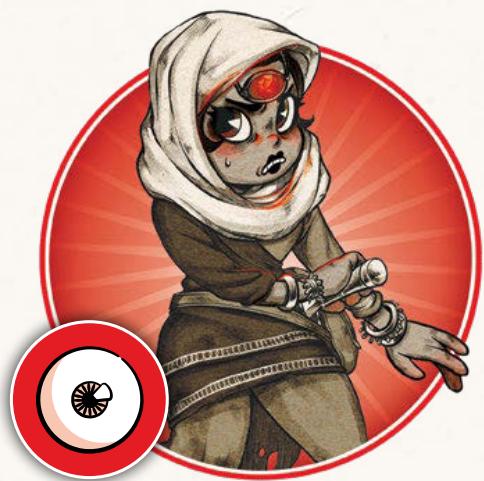
The Cursebearer has been running for a very long time. Armed with her guile and trusty knife, she hopes to defeat the creature of darkness that pursues her... she just needs to figure out how.
Passive - Devil On Your Heels
Once per turn, after you are Haunted, that Haint gains 1 Humanity. A Haint will regret Haunting you with this potent defensive effect!
Starting Skills
Old Knife, Strange Blade (#67) and Distant Memory (#68)
Playstyle
An aggressive, Haint-focused Vagrant who is always on the move.
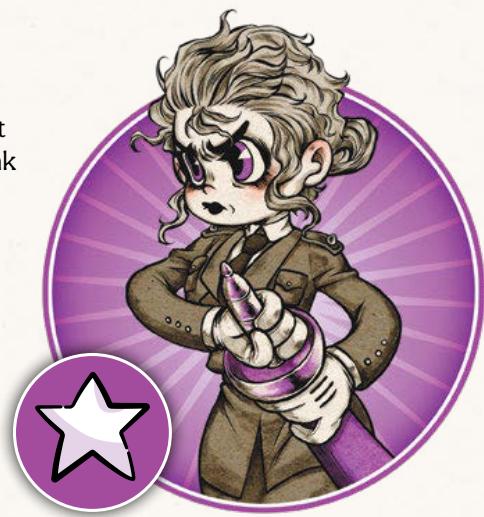
EMPRESS
Despite few people acknowledging her as the Empress of America, she hasn't stopped spreading her message or trying to amass an army. If any ghosts think they can stop her, they're sorely mistaken.
Passive - Boxcar Queen
The first time you roll a Booming Boxcar per turn, roll an extra Bone. With a little bit of luck, you can get the upper hand and teach a Haint a thing or two!
Starting Skills
General's Orders (#51) and Strangely Resonant Speech (#52)
Playstyle
A hard hitter and born leader who likes to embrace the unpredictable.
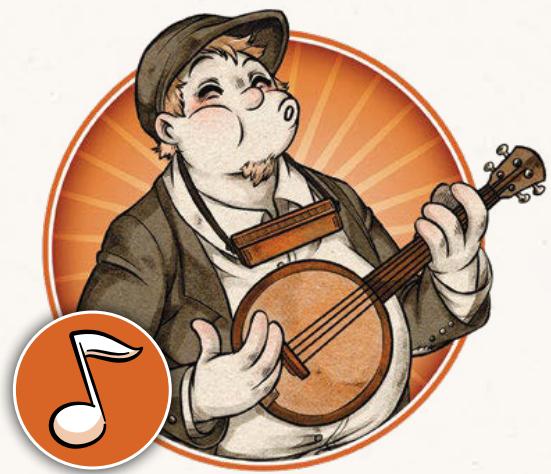
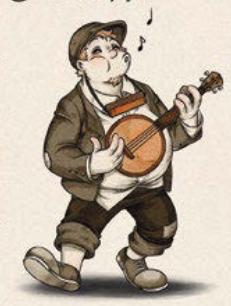
SONGSMITH
The bright lights of the big city have tugged on the Songsmith's strings since childhood. He's dreaming of performing on those grand stages, pouring out the music in his heart for all to hear.
Passive - Upbeat Tempo
If you only have 1 Coin on a Skill, reduce the success value of that Skill by 1. Spreading out the Skills and Actions that you perform per turn will make them a little easier!
Starting Skills
A Little Rhythm (#35) and An Old Medley (#36)
Playstyle
A versatile generalist who dabbles in a little bit of everything - from a distance.
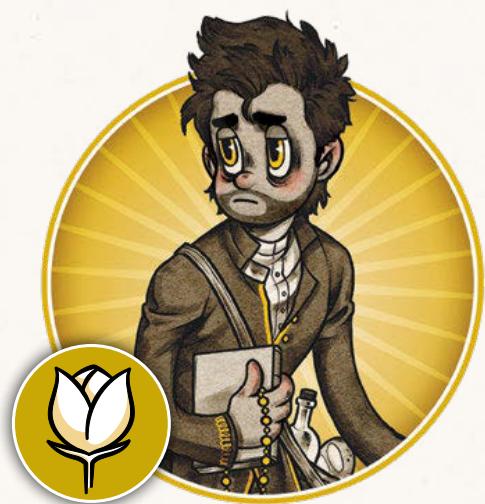
REVIVALIST
After failing to bring solace to the bereaved by attempting to speak to the dead, the Revivalist left his hometown to wander, hoping to find his purpose.
Passive - Selfless
When you would gain Humanity, you may have another Vagrant in Range 2 gain that Humanity instead.
This Passive helps the Revivalist extend his healing reach a little bit further. Sometimes that's all you need to keep a friend in fighting spirits!
Starting Skills
Soothing Hymn (#59) and Copal Incense (#60)
Playstyle
He's always got eyes on his friends and their well-being.
RUNAWAY
Accompanied by her loyal pup, the Runaway has fled home in search of a new adventure. She's eager to see the world, but it's definitely a little intimidating... or it would be, without her shaggy best friend!
Passive - Girl's Best Friend
You have the Pup.
The Runaway has two standees: the Runaway and the Pup. When placing Vagrants during Scenario Setup, place the Pup in an open space adjacent to the Runaway. The Pup is only ever removed from the train board if the Runaway is removed.
The Pup and Runaway are considered the same Vagrant. If both the Pup and Runaway are affected by a single effect, only the Runaway is affected. They share Humanity, Coins, Junk effects, the Rummage value, and Haint Effects. Coins may be placed on the Pup card to have the Pup perform Move, Investigate, or Bust during the Runaway's turn.

The Pup is considered a Vagrant for targeting purposes, but is not affected by being
Haunted by Haints (but if the Haint ends their Move in the same space, then the Pup would still Move 1).
The Pup cannot use Rummage Tokens or perform the Rummage Action. If the Pup finds a Rummage Token via an Event, it is placed on the Pup's card. The Pup may hold onto it so long as it does not exceed the Runaway's Rummage value. It must be traded or given to another Vagrant in order to be used. If the Pup trades/gives a Rummage Token to the Runaway, the Runaway cannot use a Rummage Token that round.
Starting Skills
Who's a Good Boy?! (#43) and Gumption (#44) - and don't forget about the Pup card!
Playstyle
With two characters to control, she can spread out and get plenty done in a turn.
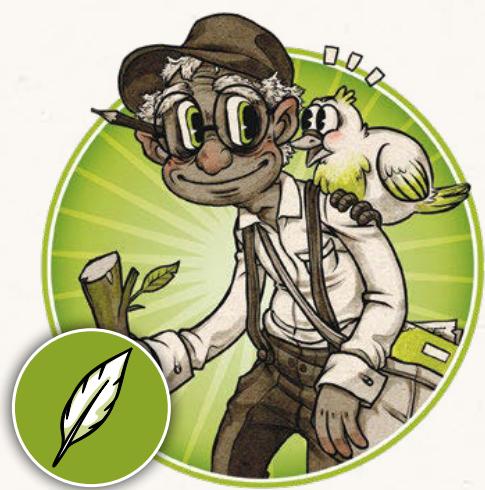
WAYFARER
Stories come and go, just like people do. For the Wayfarer, this journey is just another tale to tell. What better way to spin a yarn than with some new friends?
Passive - Thrifty
You may hold one additional Junk.
Junk provides more Humanity and additional passive effects, and having one more puts the odds in your favor. Place the second Junk beside the first on your Vagrant card.
Starting Skills and Junk
In a Pinch (#75), Feathery Friend (#76), and Writer's Satchel (Junk #31)
Playstyle
He's always got the right tools to use at the right times.

The Vagrant Card
Below is an annotated example of a Vagrant Card detailing the elements of each card and how other cards work in conjunction with it.
VAGRANT NAME & SYMBOL
Here is the name of each Vagrant and their symbol, which is also featured on their Coins and Exclusive Skills.
PASSIVES
Passives provide Vagrants with special bonuses and effects in the Scenario Phase.
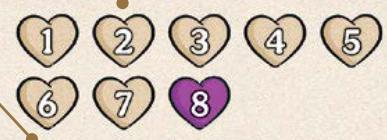
HUMANITY
Each Vagrant has a Humanity value indicated by the solidcolored heart, which dictates the maximum number of Humanity they have at a time.
Skill Card
Skill cards provide special Actions that Vagrants can perform when placed in the appropriate Skill slot and side.

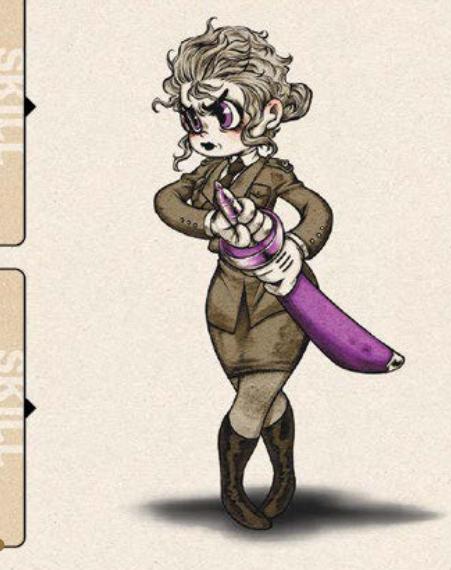
SKILL SLOTS (4)
Skill cards are placed face up on the Vagrant card in any of one of the four Skill slots. Some Skills are associated with a particular side of a Vagrant card: left or right.
JUNK SLOT (1)
Junk cards are placed face up at the bottom of a Vagrant's card. The Junk slot can only hold one Junk card at a time. The Wayfarer is the only Vagrant that has two Junk Slots.
Boxcar Queen: The first time you roll a Booming Boxcar per turn, roll an extra Bone.
Despite few people acknowledging her as the Empress of America, she hasn't stopped spreading her message or trying to amass an army. If any ghosts think they can stop her, they're sorely mistaken.

Fishin'Line
When a Vagrant suffers a Wound, flip over one of their Skill cards. That Vagrant can no longer perform the Action on that Skill card.

Any

Can-Do Attitude

For each success, target gains 1Humanity.

GENERAL ACTIONS
Then, if you're the first Vagrant to take a turn this round, the target gains an additional Humanity.
When placing a Skill, place it face up (with the Skill text) beside your Vagrant card in an available Skill slot. Some Skills are associated with a particular side of a Vagrant card: left or right. A small black triangle on the edge of the card will determine where the Skill fits on the Vagrant card. If a Skill can't connect in this way, it can't be placed. It's a good idea to be mindful about collecting a good balance of Skills for both sides of your Vagrant card! More information on Skills can be found on page 13.

Move (pg. 16)

Junk cards provide passive effects (and occasionally Actions or other bonuses) for that Vagrant. When Junk becomes Broken, flip over that Junk card. Its effect is no longer active.
Rummage (pg. 17)

Bust (pg. 19)
Placing Skills and Junk


Investigate (pg. 18)
Patch Up (pg. 19)
Junk Card
Junk must always be placed at the bottom of a Vagrant's card. The Junk slot can only hold one Junk card at a time. More information on Junk can be found on page 14.
If a Vagrant would gain a Skill or Junk during a Scenario, they may immediately add it to their Vagrant card, replacing any Skill that is not Wounded (or a Junk card that is not Broken). The replaced Skill (or Junk) is then placed in the Belongings (pg. 30).
Anatomy of a Scenario
Each Scenario in Vagrantsong poses its own unique puzzles and challenges. Be sure to read the rules of each Scenario carefully, as they are all a bit different! Below you will find a break down of the sections found in a Scenario.
TRAIN BOARD
This diagram shows the setup of Vagrants, Haints, Terrain, and Tokens.
SCENARIO NAME
HAINT HUMANITY THRESHOLD
This number indicates the maximum amount of Humanity a Haint can gain before that Haint Breaks, depending on the number of players.
Shelter from the Storm
Humanity Threshold TwoPlayers:8· ThrePlaers:10· Four Players:12
Hurtin'Since Hazlehurst
You're just one from a handful of train soppers trying to find shelter from the storm, You don't recognie ary familiar faces, and come to think of it, you don't even remeroer seeing them hop on the train withyou. But every one of them swears up and down that they just got here And based on your own experience, you can't help but believe them. The strange thing is that everyone seems to be from a different part of town - or towns places you've never even heard of. After a few h ndshakes and how-do-you-dos, you all try to settle in the best yoa can. But without a haybale or old cushion calling your name, neitner the train nor the situation bring you much comfort. The only thing you all have in common, it seems, is the welcoming hand chat helped each of you aboard. White glove, loose skin. dd't forget it yourd. Youanellifit's odord thing hat Mr. Welcoming Hand appears to be missing.
Setup
-
Place the Tokens, Terrain, and Markers (Break and Rounds) as bove
-
Players place their Vagrants on anyshown above.
-
Place the Threshold Token on the appropriate space on the Humanity Track based on player count.
4, Place the Tumed Faces on their designated space and the 3 Shelter from the Storm Ritual Cards on ther designated spaces. 5. Once players are ready to begin, read Event
Special Rules
There are no Special Rules for tis Scenario. Remember: "Losing Humanity" Is iferent for both Haints and Vagrants (pg. 14).
Terrain Effects
There are no special Terrain Effects for this Scenario. Remember that Haints may Move onto Terrain, but Vagrants may not (pg. 14).
Haint Effects

The Shakes (): Lower your Move value by I. To remove The Shakes, discard an Iron Nail.

Spooked O: If you end your turn in Range 2 of the Turned Faces, lose 2 Humanity. To remove Spooked, discard Salt.
Remember: Haint Effects are added to Vagrants periodically throughout the Scenario (pg. 24).
Breaks
When the Turned Faces Break, each Vagrant may Rummage 1. Remember: Whenever a Haint Breaks, the next turn a Haint would take is skipped and all Vagrants gain 1 Humanity. The effect above is unique to the Turned Faces.
Victory
lost Humanity until they have no more Breaks.
HAINT MOODS
Haints have different Moods that they switch out of and into, based on various effects. Haints always begin a Scenario in the topmost Mood (unless otherwise specified), and will use the Actions, Haunted Effects, and other Special Rules listed there.

SCENARIO INSTRUCTIONS
These are instructions for the Scenario setup and any additional Special Rules, Terrain Effects, Haint Effects, Breaks, and the Scenario Victory conditions.
SPECIAL RULES
Some Scenarios have rules that are unique to the Scenario.
TERRAIN EFFECTS
Many Scenarios have special rules for terrain. For example, in some Scenarios, Blood Pools may represent hot coals! Be sure to read this section carefully.
HAINT EFFECTS
Haint Effects are (usually) injuries or curses that a Haint may place on Vagrants during a Scenario, hindering a Vagrant in some way until the Haint Effect is removed. Haint Effects are represented by either a black or white token. Note: Haint Effects are not Haunted Effects, but some Haunted Effects may give out Haint Effects.
SPECIAL HAINT MOOD RULES
Most Scenarios have rules for each Haint Mood. These rules are only considered active when the Haint is in the associated Mood.
HAUNTED EFFECT
If a Haint Moves into a space occupied by a Vagrant (or vice versa), that Vagrant is afflicted with the Haunted Effect written on the Haint's Mood in the Scenario book.
HAINT ACTIONS

These are Actions that Haints can take.

Move: The number of spaces that a Haint can Move.
Range: The distance a Haint may target a character.
CYCLE EFFECT
Many Haints will have a Cycle Effect that is performed after any current Actions being performed (such as a Haint or Vagrant turn). The Cycle Effect may change depending on a Haint's current Mood.
The Cycle Effect is triggered when the number of any Rummage Token on the Cycle Track is equal to (or exceeds) its Cycle value. After the Cycle Effect is resolved, all Rummage Tokens on the Cycle Track are added back to the Bindle. Then give the Bindle a good shake.
Pack The Bindle
When setting the game up for the first time, place the 27 Rummage Tokens that come in the Vagrantsong Box into the Bindle. This is the default setup, and unless instructed otherwise you will return it to this state after every game.
Many effects throughout a campaign modify this default setup. The most common reason to make temporary changes is when starting a new Scenario; sometimes a Scenario's setup instructions ask players to add Event Tokens to the Bindle. Follow these instructions then give the Bindle a good shake before the first turn.
After your game, return the Bindle to its starting state. Keep in mind any permanent changes the game has asked you to make!

Create The Junk Deck
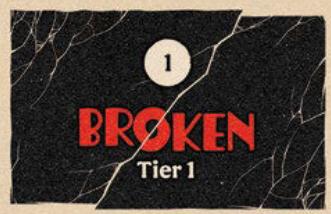
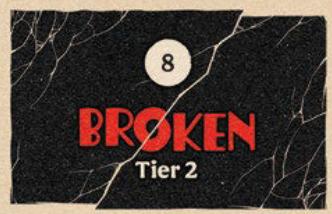
Find the Junk cards labeled Tier 1 on the back and shuffle them. This is your starting Junk deck. Set it aside for use between Scenarios, during the Camp Phase. You may be asked to add or remove cards from the deck, but it does not change unless otherwise stated. Special Junk are only acquired through playing Scenarios, and are never shuffled into the Junk deck.
The four different types of Junk cards: Tier 1, Tier 2, Tier 3, and Special


Humanity Threshold TwoPlayers:8·Three Players:10·FourPlayers:12
Setup According to the Scenario
Each Scenario has its own setup and rules in the Scenario Book. These will usually include placing Terrain, Markers, Event Tokens in the Bindle and on the board, placing Vagrants in specific spaces, and placing the Threshold Marker according to the player count. For every Scenario, players will also need to find the associated Ritual cards (pg. 25) and place them with the Ritual's name face up near the train board.
For a description of all of the effects, objects, and other curiosities required to set up a Scenario in Vagrantsong, see the Anatomy of a Scenario section on the previous page.
For the first Scenario (called Shelter from the Storm), turn to page 1 in the Scenario Book and follow the setup instructions there.
When the setup instructions state to place a Haint (such as the Turned Faces during the first Scenario), that Haint's art can often be found on the bottom-left of that Scenario's first page.
In the first Scenario, the last step in the setup is to read an Event. Flip the page of the Scenario Book to see that Scenario's Event page, then read out loud and resolve the associated text. Then, once the Scenario is set up, it's time to play.
Scenario Book Page 1
Shelter from the Storm
Hurtin'Since Hazlehurst
You're just one from a handful of trainhoppers trying to find shelter from the storm. You don't recognize any familiar faces, and come to think of it, you don't even remember seeing them hop on the train with you.
But every one of ther swears up and down that they just got here And based on your owm experience, you can't help but believe them The strange thing is that everyone seems to be from a different par of town - or towns - places you've never even heard of.
After a few handshakes and how-do-you-dos, you all try to settle in the best you can. But without a haybale or old cushion calling your name, neither the train nor the situation bring you much comfort.
The only thing you all have in common, it seems, is the welcoming hand that helped each of you aboard. White glove, loose skin... couldn't forget it if you tried. You can't tell if it's a good or bad thing that Mr, Welcoming Hand appears to be missing.

Setup
t. Place the Tokens, Terrain, and Markers (Break and Rounds) as
-
Players place their Vagrants on amy shown above.
-
Place the Threshold Token on the approprlate space on the Humanity Track based on player count.
-
Place the Turned Faces on their designated space and the 3 Shelter from the Storm Ritual Cards on their designated spaces. S. Once players are ready to begin, read Event
Special Rules
There are no Special Rules for this Scenario.
Remember: "Losing Humanity" is different for both Haints and Vagrants (pg. 14).
Terrain EHfects
There are no special Terrain Effects for this Scenario. Remember that Haints may Move onto Terrain, but Vagrants may not (pg. 14).
Haint EHfects

The Shakes (O): Lower your Move value by 1. To remove The Shakes, discard an lron Nail.

Spooked (Oß: If you end your tum in Range 2 of the Turned Faces, lose 2 Humanity. To remove Spooked, discard Salt.
Remember: Haint Effects are added to Vagrants periodically throughout the Scenario (pg. 24).
Breaks
When the Turned Faces Break, each Vagrant may Rummage 1. Remember: Whenever a Haint Breaks, the next turn a Haint would take is skipped and all Vagrants gain 1 Humanity. The effect above is unique to the Turned Faces.
Victory
Save the Turned Faces.
Remember: To Save the Tumed Faces, give them back all of their lost Humanity until they have no more Breaks.
Definitions
Below are some definitions that will be helpful to you as you set up the game and play.
Terrain
These pieces are added to the train board and may have a number of different appearances. Coffins, Boxes, Blood Pools, Holes, Rubble, Snow, and Swarms and Leaf Piles (if playing Vagrantsong: Encore) are all considered Terrain.
By default, a Vagrant can never enter a space with a piece of Terrain in it (but Haints can!). However, many Scenarios may have special rules that give Terrain new and exciting properties, so make sure you always check to make sure you're playing the Terrain how it's meant to be played! More information about Terrain can be found in the Targeting and Range section on page 14.
Box/Debris (6)

Coffin/Snow (6)
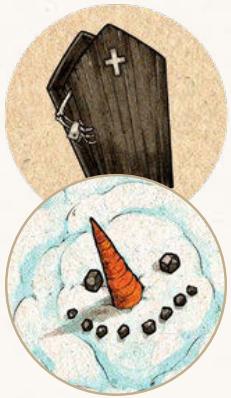
Hole/Blood Pool (6)

Haints
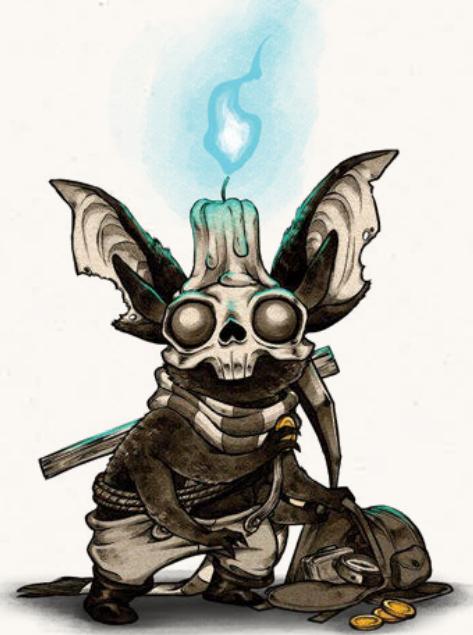
These are the ghostly characters you are facing on the Silver Ferryman. Each one matches the artwork on the Scenario page and should be placed on a Haint-blue base so it stands out during gameplay. They have a variety of special Actions, determined by drawing Rummage Tokens, and usually pose a threat to Vagrants (even Haunting (pg. 24) a Vagrant if they are ever in the same space!). Effects that specify a “Haint” refer to these characters.
Event Tokens
Numbered O-9, these Tokens are often placed on the train board, on its many Tracks, or even on Vagrant cards. They typically trigger when Investigated, or when another tracker (like the Break Track's Marker) is placed onto the spot the Event Token is

currently occupying. Once an Event Token is triggered, read the appropriate Event to figure out how to proceed! After an Event is resolved, it is discarded and removed from the game, unless the Event's text states to place or keep it somewhere, like the train board.
Lost Souls
Lost Souls are the nameless Haints that were passengers when the various disasters hit. Represent them on the board with one of these two standees. Lost Souls will not appear in every Scenario, and their rules will vary each time. Be sure to read their rules in each specific Scenario carefully!

Rituals
Ritual cards represent objectives the Vagrants may attempt in order to help save the Haint or unlock a Scenario's mysteries. Once a Ritual is complete, flip it over and gain its Reward, but don't peek at the back of the card before then!
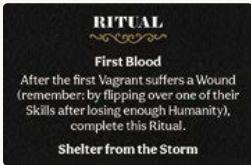
It is not always obvious how to complete a Ritual at first, but as you play, it will become more obvious. In this way, Scenarios can present puzzles and mysteries to solve!
Playing Vagrantsong (The Scenario Phase)
A Scenario is played over a series of consecutive rounds, each consisting of multiple alternating Vagrant and Haint turns. Characters (both Vagrants and Haints) perform Actions during their turn, and when all characters have taken their turn(s), the round is over.
Rounds
A round is the complete rotation of Vagrant and Haint turns. After the Haint takes its last turn and there are no more Vagrants remaining to take a turn, the round is over. Move the Round Marker to the next highest number on the Round Track. If the Round Marker is on the 6th space at the start of a round, it instead moves back to the lst space on the Round Track.
Turns
At the start of each round, players will discuss which Vagrant will take their turn first. After that Vagrant has completed their turn by performing various Actions, it then becomes the Haint's turn. After the Haint's turn is over, then a Vagrant who has not yet taken a turn does so. This process continues until all Vagrants have taken their turns, followed by the last Haint turn of that round. Vagrants may alter the order of their turns from round to round.
Here is an example of a round for a 3-player game:

AVagrant's Turn
During a Vagrant's turn, that Vagrant performs Actions by placing their Coins on Skill cards or General Actions.
At the start of that Vagrant's turn, they return any Coins that were placed on Skills, General Actions, or onto the train board so that they may be placed again during their turn.
PASSIVES
Passives provide special effects during the Scenario Phase for the Vagrant to which they belong. Some Passives provide a benefit that is always in effect for that Vagrant while others require a condition to be met (such as rolling a Booming Boxcar). When the Passive's condition is met, its effect automatically occurs.
Coins cannot be placed on most Passives (the Runaway's Pup is the exception).
COINS
In general, a Vagrant will have 3 Coins available to them on their turn. Coins are placed to decide the potency (or increase the success rate) of an Action taken by a Vagrant.
Coins may be placed freely on General Actions this way, but may only be placed on Skills (and Junk cards that require Coins) if that card had 0 Coins placed on it during the previous round.
At the beginning of a Vagrant's turn, if there are any number of their Coins on the train board, they are returned to that Vagrant.
CHOOSING ACTIONS
When choosing Actions to perform, that Vagrant places their Coins on Skills and/or General Actions they wish to perform during their turn. The more Coins that a Vagrant places on an Action, the stronger or more potent it can become. Vagrants may perform multiple Actions during their turn by placing individual Coins on each of those Actions, or focus on a single Action to increase that Action's success rate, power, or potential by placing multiple Coins on it. After all Coins are placed, the Vagrant performs their Actions in any order they wish.
An Action may only be taken if the Target and Range values can be met (more on that in a bit).
BONES
Success when performing Actions in Vagrantsong is not guaranteed. When attempting an Action that lists a number of Bones or has a Success value that must be met in order to succeed, a Vagrant will roll that many Bones to if (and possibly by how much) their Action succeeds.
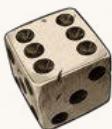
Each Bone roll that meets or exceeds the Action's Success value is considered a success.
Booming Boxcars
If a Vagrant rolls a 6 on a Bone when performing an Action, they may immediately roll an additional Bone for that Action. If a Vagrant rolls a 6 again, they gain another Bone to roll for that Action (continuing to gain Bones on rolls of 6, if able). These Bones are considered part of the initial roll and not as a separate Action.
In order for Booming Boxcars to apply, the roll must be part of the Vagrant's Action, and the 6 must be rolled naturally (meaning that a roll of a 5 that has received a +1 bonus from another effect does not trigger Booming Boxcars).
Actions
Vagrants have multiple Actions they can perform during their turn, but there are some limitations as to how and when they can perform them. Vagrants perform Actions by placing Coins on top of their Skill cards or General Actions on their Vagrant card. A Vagrant may perform as many Actions as they would like so long as they have a Coin available for that Action. Vagrants start their turns with 3 Coins available to them. Many Actions require Bones to be rolled and for successes to be met for their effect to be resolved.
Example
The Empress has placed 2 Coins on a Skill and 1 Coin on her Move General Action.
After placing her Coins, she may perform those 2 Actions in the order of her choosing.
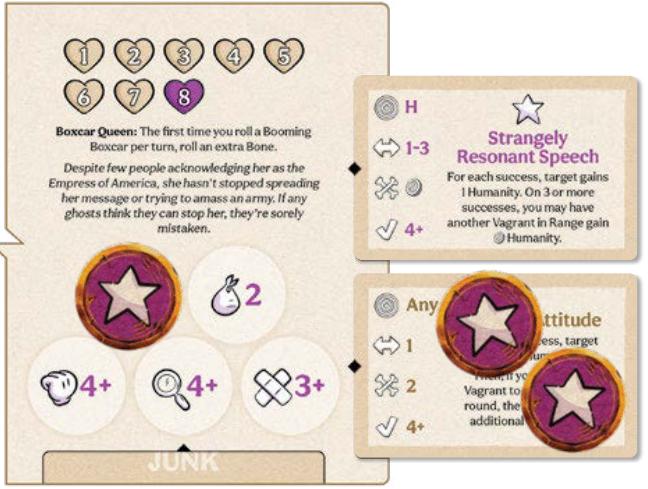

Target
The type of character that the Skill can target.

Range
The number of spaces that the target can be away from the target in order to attempt to perform the Skill. A Range of 0 means that the Vagrant can target themselves.

Skill Name The name of the Skill!
Bones
The number of Bones rolled when the Skill is performed.
Can-Do Attitude
For each success, target gains 1 Humanity.
Then, if you're the first Vagrant to take a turn this round, the target gains an additional Humanity.
Skill Effect What happens if the Skill's Action is a success.
Side
This indicates where the Skill can be slotted into a Vagrant card.

Success Value
The number that must be met in order for the Skill's Action to succeed.
Skills
Skills provide special Actions that Vagrants can perform during their turn when placed in the appropriate Skill slot and side. To attempt an Action on a Skill card, a Vagrant must first place at least 1 Coin on top of that Skill card. Additional Coins placed on top of that Skill card can increase the number of Bones rolled, the potency of the Skill's effect, and so on. Look for the on the Skill to see how the Coin increases the effectiveness of a Skill. Vagrants may have up to 4 Skills.
Types of Skills
Vagrants have access to two types of Skills: Common Skills and Exclusive Skills.
Common: These Skills are available to every Vagrant. The majority of these Skills are obtained by spending Coins on them during the Camp Phase. Common Skills can be exchanged between Vagrants during the Camp Phase as well, or held alongside Junk in the Belongings.
Exclusive: Only the Vagrant that matches the symbol and color of that Skill can use an Exclusive Skill. These Skills do not cost Coins and are instead obtained throughout the story of the game. Exclusive Skills cannot be traded, but Vagrants may hold onto them as Personal Belongings, and may swap them out during the Camp Phase.
Example
This example uses the Skill card to the left, Can-Do Attitude, and the number of Coins placed on it in the example to the top left of this page, 2.
With a Target of “Any”, the Empress may choose to target either a Haint or Vagrant. The Range is 1, so the target must be adjacent to the Empress when performing this Action. The number of Bones rolled is always 2, and the number the Empress is trying to roll is 4 or above, based on Can-Do-Attitude's Success value.
For each success, the target gains 1 Humanity. This Skill also has a bonus effect: “If you're the first Vagrant to take a turn this round, the target gains an additional Humanity."
The Empress takes the first turn this round and rolls 2 Bones for Can-Do Attitude. She rolled a 2 and a 6. A Booming Boxcar, nice! Because of her Passive, Boxcar Queen, she gains an additional Bone to roll for the Booming Boxcar. She then rolls a 3 and a 4, for a total of two successes for the Action! The Haint gains 2 Humanity because of the number of successes, and then an additional 2 Humanity because the Action was a success and she placed 2 Coins on the Action.
Skills that Summon
Some Skills may place previously saved Souls on the train board to assist Vagrants called Summons. They may not be placed on Terrain. Vagrants may Move through the Summons (but not end in that space), and Haints may Haunt it (to remove it from the train board). It cannot be targeted by Skills other than the Skill that placed the character.
If a Summon is on the train board while that Skill becomes Wounded, the Summon stays on the train board and its effects remain active until it becomes Haunted.
For more information about Summons, see question 23 in the FAQ on page 35.
Targeting and Range
Most Actions require a target, and oftentimes the target is a specific type of character, such as a Vagrant or Haint. For targeting, “V” is for “Vagrant”, “H” is for “Haint”, and “Any” is for any character.
Sometimes there is additional targeting information in an Action's text, such as “You may target an additional character for each success after the first," so make sure to keep an eye on the Action text as much as the Target icon:
Many Actions have a Range value that limits the distance one character may target another character. If a Vagrant's Action has a Range value, count the number of spaces between the character attempting the Action and the target, starting with a space adjacent to the character attempting the Action and ending on the space of the target. A “O” in the Range means that the Vagrant can target themselves.
Characters (both Haints and Vagrants) can draw Range through other characters. Vagrants may target characters in the same space as Terrain, but cannot draw range past that Terrain. Haints may draw Range through Terrain.
Example
The Songsmith is performing an Action that targets a Haint with a Range of at least 3. A Vagrant may not draw Range through Terrain.

Terrain
Vagrants and Haints treat spaces occupied by Terrain differently. Vagrants can never draw Range through Terrain, nor can they Move into or through it. Haints can draw Range through Terrain, and can Move into or through Terrain. They may also end their turn on Terrain.
Some Scenarios have special Terrain Effects, which may add to or replace the rules above during that Scenario. If Terrain is placed in a Scenario and it does not have any special Terrain Effects written in the Scenario, treat the rules listed above as the default.
Junk
Each Vagrant may only hold one Junk card at a time, placed in the Junk slot at the bottom of a Vagrant card. Junk cards provide passive effects (and occasionally Actions or other bonuses) for that Vagrant. As long as a Junk card is not Broken, its passive effects are always active; they do not require a Coin to use. However, some Junk might offer additional benefits if the player places a Coin on the Junk card. Just like Skills, Coins can only be placed on Junk if there were no Coins on that card during the previous round.
Like Common Skills, Junk cards can also be traded during the Camp Phase. As such, multiple Vagrants can use the same piece of Junk throughout the campaign.
When Junk would become Wounded (flipped over), it instead becomes Broken. Broken Junk can only be fixed (flipped back over so that it is usable again) during the Camp Phase.
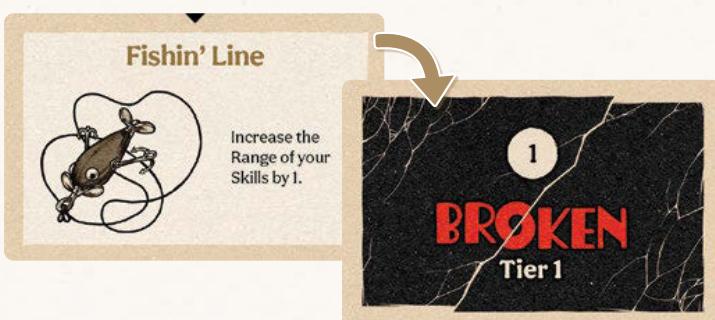
Example
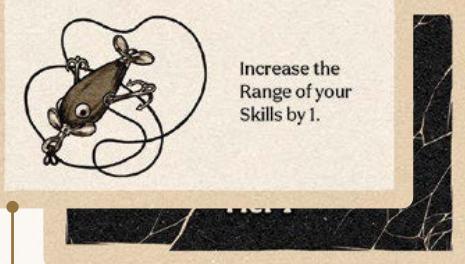
Fishin' Line is an early Junk that Vagrants have an opportunity to buy during the Camp Phase from DC, a mysterious cat. This Skill increases the Range of all Skills that Vagrant currently has slotted on their Vagrant card.
It's important to notice that this Junk does not increase the Range of other effects, such as General Actions or Rummage Tokens!

Defining a “Character"
Various effects in Vagrantsong may target Haints, Vagrants, or have the option to target both (or either). The term “character” refers to both Haints and Vagrants. If an Action or effect requires a specific type of target, it will state either Vagrant or Haint.
Humanity
Each Vagrant has a Humanity value on their Vagrant card indicated by the solid-colored heart, which dictates the maximum number of Humanity they may have at a time. Conversely, a Haint has no Humanity by default, and Vagrants attempt to save a Haint by giving them back their lost Humanity. Overall, it is easiest to imagine that gaining Humanity is a good thing, and losing Humanity is a bad thing. More on Haint Humanity can be found on page 20.
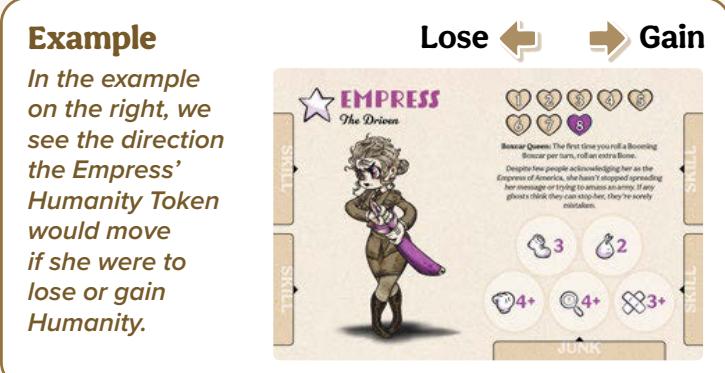
Vagrant Humanity
The horrors of the train will slowly take a toll on Vagrants, draining away their Humanity. Appropriately, Humanity is tracked by the Humanity Track on a Vagrant's card.
If a Vagrant gains Humanity, they move their Humanity Token up a number based on the Humanity that would be gained, up to their maximum Humanity value. Any additional Humanity that would be gained beyond a Vagrant's Humanity value is ignored.
If a Vagrant loses Humanity, they move their Humanity Token down a number based on the Humanity that would be lost from their total Humanity. When a Vagrant loses all their Humanity (meaning if their Humanity Token would move from 1 to O), they suffer a Wound, then place their Humanity Token on the space equal to their maximum Humanity value. Any additional Humanity that would be lost from a single effect after suffering a Wound is ignored.
Wounds & Broken Junk
When a Vagrant suffers a Wound, flip over one of their Skill cards. That Vagrant can no longer perform the Action on that Skill card. Vagrants may also choose to flip over a Junk card; in which case, it is referred to as being Broken.
Can-Do Attitude
For each success, target gains 1 Humanity.
Then, if you're the first Vagrant to take a turn this round, the target gains an additionalHumanity.

Westbound
If all of a Vagrant's Skills (and Junk) are flipped over to Wounds (or Broken), that Vagrant becomes Westbound. When a Vagrant becomes Westbound, discard any Haint Effect Tokens, flip over their Vagrant card to the Westbound side, and place their Humanity Token on 1. Keep any Rummage Tokens. Then find your Vagrant's Westbound Action card and place it on top of one of your Skill cards. If the Skill the Westbound Action is placed over had Coins on it, return those Coins to the Vagrant. That Westbound Action may be freely used on their next turn. A Westbound Vagrant cannot lose Humanity if their Humanity Token is on 1.
Westbound Vagrants cannot perform Skills (even if those Skills are healed during a Scenario), but can perform General Actions, use Rummage Tokens, and use their Westbound Action. Additionally, each Westbound Vagrant has different Passives!
If a Vagrant is ever immediately told to flip their card to the Westbound side due to a game effect, flip all their Skills to Wounded and their Junk to Broken.
Unless otherwise stated by the Scenario, if all Vagrants are Westbound at the end of a Scenario, read Moment 13.
A DIFFICULT CHOICE
If a Vagrant is still Westbound at the end of a Scenario, at the start of the Camp Phase, they must permanently discard the Skill they placed their Westbound Action card on top of, placing that Skill
card back in the box. If they became Westbound several times during a Scenario, they would only have to discard 1 Skill. That discarded Skill may be Wounded or normal.
WESTBOUND ACTION
While Westbound Vagrants may not perform Actions on Skill cards, they gain a unique Westbound Action that they may perform, which works exactly like performing a General Action. The Westbound Action is not a Skill, and may be used multiple turns in a row like General Actions.
GHOST SICKNESS
If a Westbound Vagrant loses Humanity (and their Humanity is greater than 1), the closest other Vagrant (who is not Westbound) may choose to lose that Humanity instead.
BACK TO LIFE
When a Westbound Vagrant gains their maximum Humanity (either during a Scenario or at the start of the Camp Phase), flip over any one of their Wounded Skills, then flip their Vagrant card back to its normal side. That Vagrant places their Humanity Token on their maximum Humanity. Then put aside the Westbound Action card.
Healing Wounds
During a Scenario, a Vagrant may use an Apple to flip a Wounded Skill card face up so that the Skill can be used again, so long as that Vagrant is not Westbound.

Vagrants may also spend 1 Coin to heal 1 Wounded Skill during the Camp Phase (pg. 28).
General Actions
Any Vagrant may attempt these Actions during their turn. Unlike Skills, General Actions may have Coins placed on them in subsequent rounds, allowing Vagrants to take those Actions whenever the need arises. There are 5 General Actions: Move, Rummage, Investigate, Patch Up, and Bust.
1. MOVE
For each Coin placed on this Action, that Vagrant may Move orthogonally (left, right, up, and down, but not diagonally) a number of spaces up to or equal to their Move value. Vagrants may split their Move however they would like during their turn.

For example, if a Vagrant placed 2 Coins on their Move Action and they have a Move value of 3, they may Move 2 spaces, perform the Action from their other Coin, then Move 4 more spaces.
Vagrants may only Move through open spaces or spaces occupied by a Haint, Vagrant, or Token, but may not end their Move on a space occupied by a Haint or another Vagrant. They may end their Move on a space occupied by a Token (such as an Event or Rummage Token). Vagrants may not Move into spaces occupied by Terrain.
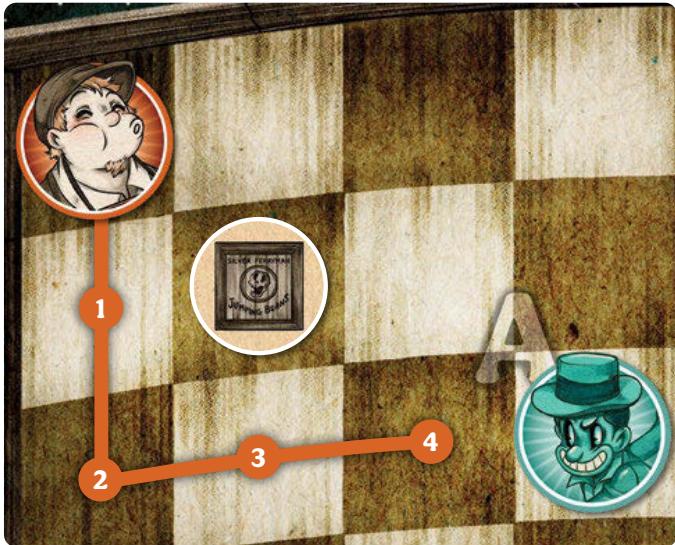
Example
The Songsmith has a Move value of 2. In this example, the player controlling the Songsmith placed 2 Coins on Move, allowing him to Move up to 4 spaces during his turn. Here we see that he can Move down 2 spaces and then right 2 spaces so that he is adjacent to the Haint.
Remember, Vagrants cannot Move into spaces occupied by Terrain!
Open and Occupied Spaces
The train board is marked with spaces laid out in a grid pattern. Whenever anything is placed onto the train board (a Vagrant, Haint, Token, or Terrain), it must be placed fully within one of those spaces. Any space without something placed inside it is considered open. If a space has something inside of it, it is considered occupied.
These terms are referenced throughout this Rule Book, and are particularly important for Movement and interactions between Vagrants and Haints.
Adjacent Spaces
Various effects, particularly effects involving Movement, resolve to or from adjacent spaces. An adjacent space is a space either to the left, right, above, or below the point of reference. Spaces diagonal from the point of reference are not considered adjacent spaces. If two objects, such as a character and an Event Token, are in the same space, they are considered adjacent to each other.
Example
The space the Songsmith is in is considered occupied, while the spaces to his right and below him are both adjacent and open, since they are within 1 space of him orthogonally and nothing else is in that space. The space with
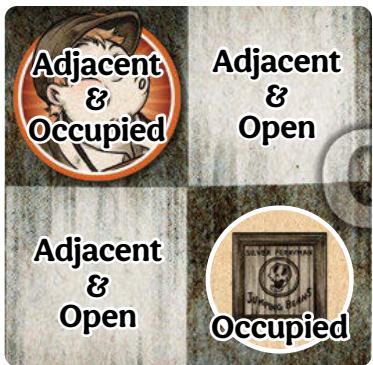
the Box Terrain is considered Occupied, but not adjacent.
Toward and Away
Sometimes an effect will Move a character in a certain direction. These effects will have a point of reference (such as the Haint performing the Action, a Vagrant, or another component of the Train) that the character will Move toward or away from.
When subject to such an effect, Vagrants will always Move the maximum distance, moving around Terrain and edges of the train so long as the effect doesn't say that the Movement is ended by Terrain, edges, etc..
Toward: When an effect states to Move toward something, the targeted character Moves in the direction of the point of reference (such as a Haint, Terrain, or edge), so long as they are not breaking any other Movement rules and never Move further from the poi
Content is long; only the first part is inlined. Download the file or open the rules page for the full text.
Download MarkdownTexts are community-compiled or publicly released by publishers; copyright remains with the original authors. For personal reference only.