
Valeria Card Kingdoms
At a glance
Rules, cards and Q&A (Chinese)
The rules, card data and player questions for this game are written in Chinese. Open the Chinese page to read them.
Where to find full rules
Full rules and card lookup are available in the cunlema app at cunlema.cn — pick this game and ask about any rule, card or turn you are unsure about.
Related games
Rulebook text (Markdown)
This game has 1 rulebook Markdown file(s) in our library; 1 rendered inline below — expand to read or download.
VCK101_RULES_ENGLISH_20210601.md52.7 KB
VALERIA CARD KINGDOMS
The Story of Valeria
After a few years of relative peace, the Kingdom of Valeria is once again under attack from legions of undead, goblins, and many more nightmarish creatures. The King of Valeria has valiantly stood against evil in the past, but in his old age he lacks the strength to protect our great kingdom. Valeria needs a new ruler to guide it out of the darkness and into the light.
As one of the reigning Dukes, you are in a modest position of power, respect, and wealth. Assuming the throne as Valeria’s new ruler is your destiny. Winning the support of the common folk and nobles is an easy task; however, reigning over a land full of monsters isn’t the future you had in mind. You must first expand your domain and hire citizens that will help you fight off the tides of monsters that plague Valeria’s borders. Outwit your fellow Dukes and earn your seat on the throne!
Game Material
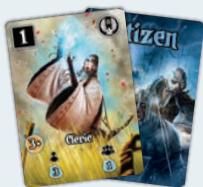
226 Cards:
108 Citizens in 18 decks

48 Monsters in 8 decks
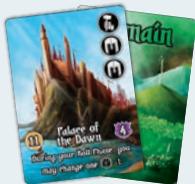
24 Domains
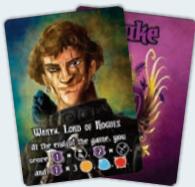
10 Dukes
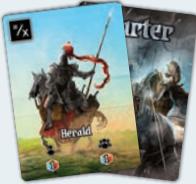

15 Starters
5 Reference
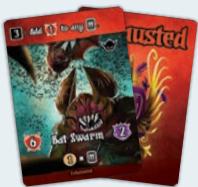
10 Exhausted
6 Monster Events
35 Dividers:
2 Double-sided Game Tokens:
2 Six-Sided Dice:


Starting / Resting


20 Wood Tokens:


5 Strength
5 Gold

32 Cardboard Tokens:
5 Magic

5 Victory

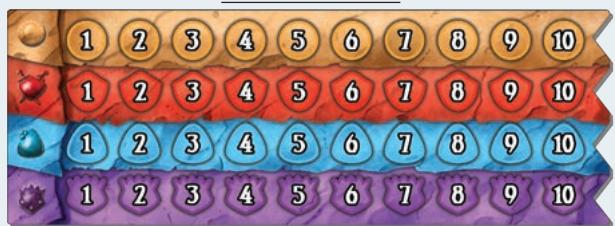
5 Player Boards:
Missing components? Email: contact@dailymagicgames.com. Note: Before your first game, unpack and sort cards according to their type. Arrange them inside the box with the dividers provided. Sort and arrange the cards when putting the game away to speed up the setup for future games.
Game Setup
Note: The following rules are for 2- to 4-player games and for sorting the cards into their initial stacks. See page 12 for other player counts.
Create the Center Stacks
Monsters, Citizens, and Domains are arranged in a grid of four rows by five columns to form the Center Stacks. Other stacks, tokens, and markers are placed around the Center Stacks after they have been set up.
Monster Cards
The top row is five stacks of Monster cards . For your first game, play with the following Monster stacks (removing cards with the icon):
•Hills (3 Goblin, 1 Goblin Mage, 1 Goblin King)
•Ruins (3 Skeleton, 1 Flaming Skeleton, 1 Skeleton King)
•Forest (2 Treant, 2 Bane Spider, 1 Spider Queen)
•Valley (3 Owlbear, 1 Giant, 1 Troll)

•Mountains (2 Dire Bear, 2 Orc Warrior, 1 Orc Chieftain)
In future games you may mix and match five Monster stacks as you wish. Monster stacks are grouped by the Area icon found in the top right corner of the cards. The Monsters in each stack are arranged so that the one with the lowest Strength is on the top and the one with the highest Strength (the Boss ) is on the bottom. Position each Monster stack in the top row so that the leftmost stack has the lowest Strength number and the rightmost stack has the highest Strength number. The anatomy of Monster cards is detailed on page 9.
Citizen Cards
The second row is five stacks of Citizen cards with activation numbers 1, 2, 3, 4, and 5. The third row is five stacks of Citizen cards with activation numbers 6, 7, 8, 9/10, and 11/12. Each stack has five copies of the same Citizen. Return unused cards to the box.
For your first game, we recommend that you play with the following Citizen stacks (removing one card from each stack so each stack has five cards):
• Cleric, Merchant, Mercenary, Archer, Peasant • Knight, Rogue, Champion, Paladin, Butcher
The anatomy of Citizen cards is detailed on page 8.
Domain Cards
The bottom row is five stacks of Domain cards , with three cards in each stack. To form the stacks, shuffle all of the Domains together, deal two cards face-down to start each stack, then deal one card face-up to complete each stack. Return unused Domains to the box.
The anatomy of Domain cards is detailed on page 11.
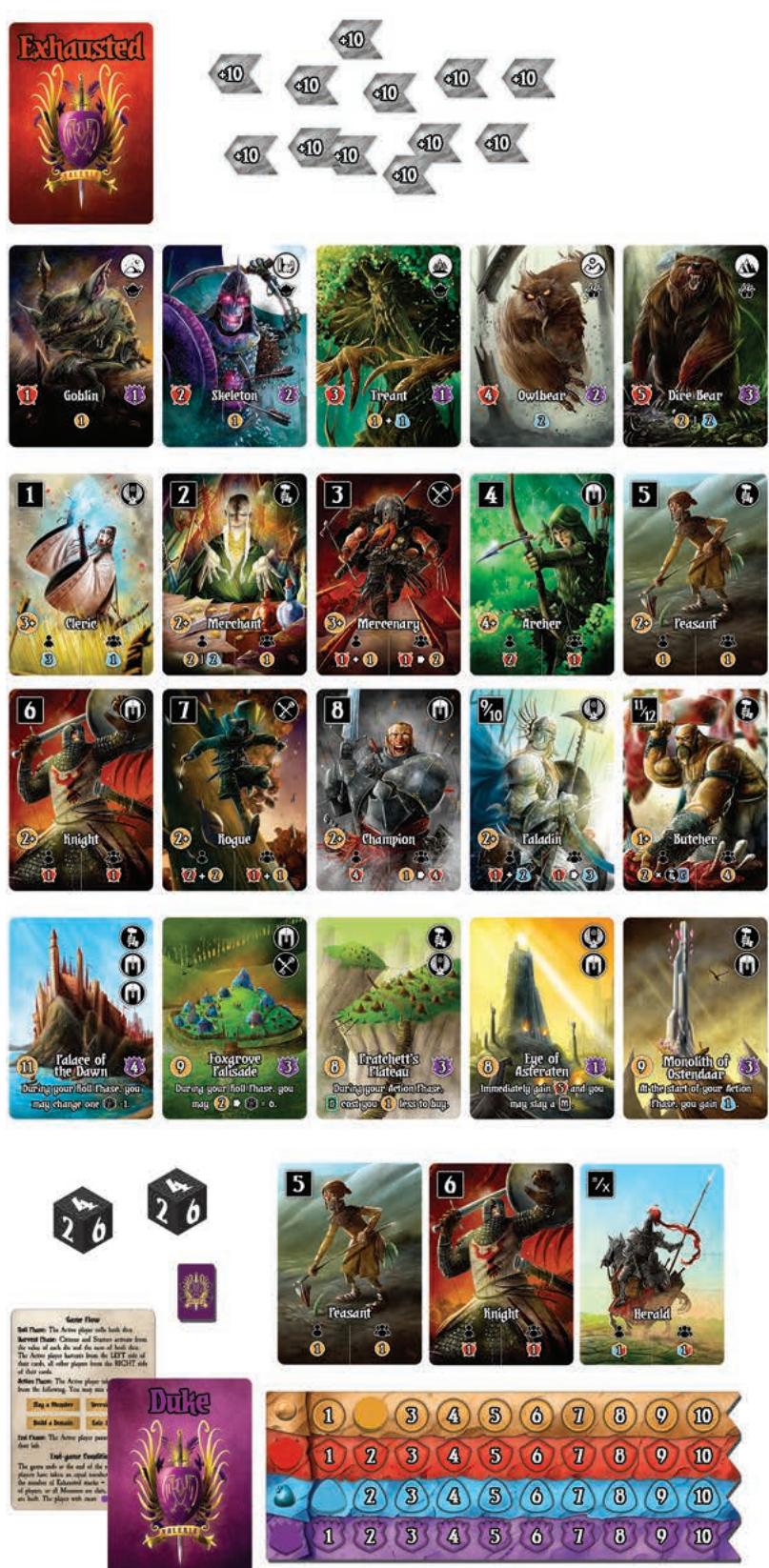
Prepare the Exhausted Cards
Take 2 Exhausted cards per player and place them in a stack above the Monster row. Return the rest to the box. (Note: For your first game, do not use the Monster Event cards or the Cardboard tokens. Return them to the box. See page 14 to incorporate them into the game.)
Player Setup
Player Board and Tokens
Give each player a player board and a set of the 4 wooden tokens: Strength , Gold , Magic , and Victory Point . Each player places their Strength and Victory Point token in the space with their respective icon (to indicate they have 0 of those items), their Magic token in the “1” space of the Magic track (to indicate they have 1 Magic available), and the Gold token in the “2” space of the Gold track (to indicate they have 2 Gold available). Place the +10 Markers next to the Center Stacks within easy reach of all players.
Starter and Reference Cards
Give each player 3 Starter cards to be placed next to their player board: 1 Starter Peasant, 1 Starter Knight, and 1 Starter Herald. These cards will form a player’s initial duchy, or tableau. Return any unused Starter cards to the box. Give each player 1 Reference card to assist them with useful information during the game. Return any unused Reference cards to the box.
Duke Cards
Shuffle all of the Duke cards together, then deal 2 cards to each player. Each player selects 1 Duke for this game and places it face down to the left of their player board. Each player keeps their Duke secret from the other players until the end of the game. You may look at your Duke at any time during the game. Return unselected and unused Duke cards to the box. The anatomy of Duke cards is detailed on page 11.
Active Player
Randomly select the first player. The selected player will be the first Active player in the game. Give them a Game token with the Starting player side up (Valeria seal). Return the other Game token to the box. Give them the 2 sixsided dice. You are now ready to play the game.
Game Overview
Objective
In Valeria: Card Kingdoms you play the role of a Duke or Duchess looking to defend the kingdom. During the game, you will be slaying Monsters, recruiting Citizens, and expanding your Domain. All of these actions build your infrastructure and add to your influence in the form of victory points. Keep an eye on your fellow Dukes and Duchesses as they will be doing the same.
The player with the most victory points at the end wins the game and is crowned the new ruler of Valeria!
Game Flow
The game is played in a series of turns, each divided into four phases:
-
Roll Phase - The Active player rolls the dice.
-
Harvest Phase - All players receive Resources produced by their Citizens (or take the consolation bonus).
-
Action Phase - The Active player takes 2 Actions.
-
End Phase - The Active player passes the dice to their left.
During each turn, the phases are executed in the same order.
NOTE: Certain Domain cards are only active during certain phases.
Roll Phase
In this phase, the Active player rolls the 2 dice to determine the numbers that will activate Citizens in the Harvest Phase.
Each die value and the sum of both dice will activate the Citizens with matching Activation Numbers (the number in the top-left corner of the card) in each player’s tableau during the Harvest Phase.
Example: If you roll a 3 and 5, you will activate Citizen cards in your tableau that have 3, 5, or 8 as their activation number.
DOMAIN CARDS DURING THE ROLL PHASE Some Domain cards allow the Active player to change the die values during this phase. Before players Activate their Citizens, the Active player must decide to use the power of any number of Roll-Phase Domain cards they own. Each Domain card that changes a die may only be used one time per Roll Phase.
To end the Roll Phase, the Active player announces the results of the dice roll and play proceeds to the Harvest Phase.
Harvest Phase
In this phase, players will acquire or exchange Resources according to the Citizens they own that are activated by the result of the dice roll from the Roll Phase. All players participate in the Harvest Phase. Each Citizen card has 2 powers shown at the bottom of the card. When a Citizen is activated, the power triggered for a player depends on whether that player is the Active player or a non-Active player:
•The left-side (on-turn) power under the icon only applies to the Active player.
•The right-side (off-turn) power under the icon only applies to the non-Active player(s).
If you have more than 1 copy of an activated Citizen card, each of those Citizens are activated individually.
Example: If you have two Archers (activation number 4) in your tableau, a result of 4 will activate both of the Archers.
Rolling doubles (both dice are the same value) will activate each matching card twice.
Example: If you have three Archers and the result is double 4s, then each Archer will activate for one 4 result and then each Archer will activate again for the other 4 result, for a total of six activations.
When you gain a Resource, move the respective token on your player board to the right for each Resource you gain. When you must pay a Resource, move the respective token on your player board to the left for each Resource you spend.
TRACKING VALUES PAST 10
If one of your tracks would increase past 10, add a +10 Marker from the supply to the end of the corresponding track, then continue tracking the value from 1.

Some Citizen cards allow you to take Resources from another player. When these are triggered you choose the player to target. When a Citizen card allows you to take something from another player (like the Thief) it is activated first, at the beginning of the Harvest Phase, before other Citizens activate.
Example: You roll a 2 and 5 (which is also a 7) and own a Thief. You must activate your Thief to take someone’s Gold or Magic before other players activate their cards.
Game Overview
During the Harvest Phase, a player may use the power of the Citizens that are activated in any order they wish.
Example: You roll a 1 and 4 (which is also a 5). You are not the Active Player and you own a Monk ( ) and a Peasant ( ). You use the Peasant’s power to gain 1 Gold, then you immediately use the Monk’s power to return that 1 Gold to the Bank to gain 2 Magic.
HERALD STARTER CARD
If the dice roll did not activate any of your Citizens with dice values, then your Herald Starter card activates whether you are
Example: The Active player rolled a 1 and a 2 (which is also a 3), but you do not own any Citizens with a 1, 2, or 3. You activate your Herald and decide to gain 1 Magic.
If the dice roll activates your Citizens with dice values but you are unable or choose not to perform the actions, you do not activate the Herald.
Example: The Active player rolled a 1 and a 1. You own two Monk’s, but do not have any Gold to perform the Monk’s power. You do not activate the Herald.
If the dice roll is doubles, then your Herald Starter card
activates whether you are the Active Player or not. You gain any
1 Resource. Important: It is possible the dice results are doubles
and do not activate any of your citizens with the dice values. In
this case, the Herald Starter card activates two times. You gain any 1 Resource two times.
After completing the Harvest Phase, play proceeds to the Action Phase.
Action Phase
In this phase, the Active player takes 2 Actions from the following:
•Slay a Monster
•Gain a Resource
•Recruit a Citizen
•Build a Domain
All Actions are described in more detail starting on page 6.
The same action may be taken twice.
A player must take 2 Actions and may not move on to the End Phase until both Actions are completed. The first action must be completed before the second action is started. After the Active player has taken their 2 Actions, play proceeds to the End phase.
PLACING EXHAUSTED CARDS
If a stack in the Center Stacks (the four by five grid of Monster, Citizen, and Domain stacks) is ever exhausted as a
result of an Action taken by a player, the player first finishes the Action then adds an Exhausted card from the Exhausted stack
to the emptied stack position. If the number of Exhausted cards
in the Center Stacks is equal to twice the number of players the final round of the game is triggered.
End Phase
In this phase, players check to see if the end-game conditions have been met. If not, the Active player passes the dice to the player to their left and a new turn begins.
The end-game conditions are met at the end of a turn if:
•All of the Monsters have been slain, or
•All of the Domains have been built, or
•The number of Exhausted stacks is equal to twice the number of players.
If one of these conditions is met, play continues until all players have taken an equal number of turns, then the game ends and players count up their Victory Points. Note: In a 2-player game it may not be possible to slay all of the Monsters or build all Domains.
Scoring
When the game is over, your score is the sum of the:
•Total Victory Points on all of your slain Monsters.
•Total Victory Points on all of your built Domains.
•Total Victory Points on your player board.
•Total Victory Points scored from your Duke.
Note: If your Duke scores on Citizen Role icons, be sure to include the Citizen Role icons found on your Citizens and your Domains.
The player with most Victory Points wins the game.
In the event of a tie, the tied player who has the fewest cards in their tableau wins the game. If still a tie, the tied players share the victory.

Slay a Monster
This action allows a player to take a Monster from the top of a stack and add it to their Victory stack. To Slay a Monster:
- Select a Monster that is on top of a stack.
2.Pay the Resources equal to the Strength and Magic cost on the Monster card. (See Monster card anatomy on page 9.)Magic can be used to augment Strength, but you must spend at least one Strength. Some Monster cards cost both Strength and Magic to slay. If so, the Magic cost is in addition to any Magic you might be using to augment your Strength.
3.Take the Monster and place it face-up in your Victory stack, next to your Duke card. This is public information for the rest of the game.
4.Take the Rewards at the bottom of the Monster card by moving the respective tokens on your player board. If the Reward is a card, that card is taken from the Center Stacks unless otherwise specified.
Some Monster card clarifications can be found on pages 15 and 16.
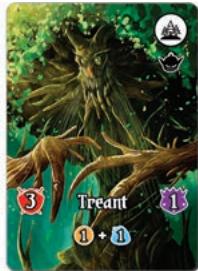

Example: The Treant is at the top of the Forest Monster stack. It has a Strength of 3. You spend 1 Strength and 2 Magic to slay the Treant and add the card to your Victory stack. You then take 1 Gold and 1 Magic as a reward from the Bank.
Reminder: Whenever you Slay, Recruit, or Build the last card in a stack, place an Exhausted card in the empty stack at the end of the action. See “Placing Exhausted Cards” on page 5.
Recruit a Citizen
This action allows a player to take a Citizen from the top of a stack and add it to their tableau. In order to Recruit a Citizen:
- Select a Citizen that is on top of a stack.
2.Pay the Resources equal to the Gold cost (base cost) on the Citizen card plus an additional 1 Gold for each copy of the same Citizen you already have in your tableau. (See Citizen card anatomy on page 8.) Magic can be used to augment Gold, but you must spend at least one Gold.
3.Take the Citizen and place it face-up in your tableau. This is public information for the rest of the game. A Citizen card does not activate on the turn it is recruited. Note: We recommend you stack Citizens on top of each other exposing Citizen Role icons to make them easier to count for building Domains (see page 7).
Some Citizen card clarifications can be found on pages 15 and 16.
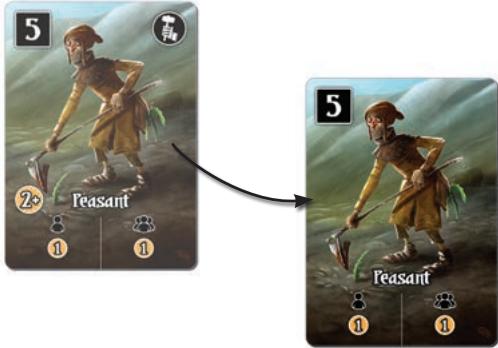

Example: The cost to recruit a Peasant is 2+ Gold. Since you already have your Starter Peasant, the cost for a second Peasant would be 3 Gold (2 for the base cost of the Peasant plus 1 because you already own a Peasant). You spend 3 Gold to recruit your second Peasant and add it to your tableau.
Gain a Resource
This action allows a player to gain one Strength , Gold , or Magic Resource.
Example: The cost to recruit an Archer is 4 Gold, but you only have 3 Gold. You spend your first action to gain 1 Gold, then spend 4 Gold to recruit the Archer as your second action.
Actions
Build a Domain
This action allows a player to take a Domain from the top of a stack and add it to their tableau. In order to Build a Domain:
- Select a Domain that is on top of a stack. In order to build a Domain, the Citizens in your tableau must have Citizen Role icons that match those on the Domain card. (See Domain card anatomy on page 11.) If the Domain card shows multiples of a Citizen Role icon, then you must have an equal number of matching Citizens in your tableau.
2.Pay the Resources equal to the Gold cost on the Domain. Magic can be used to augment Gold, but you must spend at least one Gold.
3.Take the Domain and place it face-up next to your player board. This is public information for the rest of the game.
4.Take the Rewards at the bottom of the Domain card, if applicable. Some Domains give you an immediate one-time reward and others have an effect that is active only during certain phases of your turn.
- Reveal the next Domain by flipping it over if there is still a Domain card in the stack.
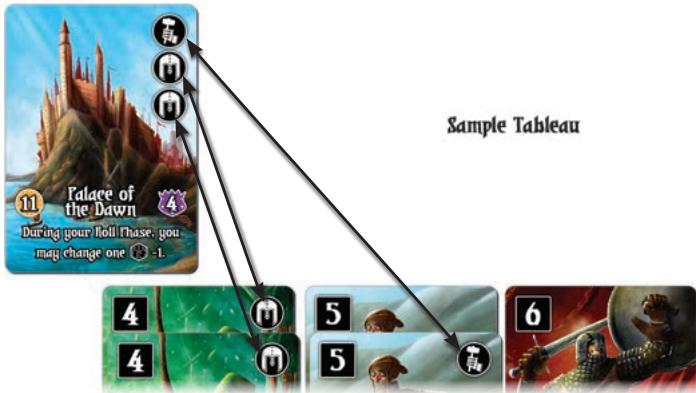
Example: The Palace of the Dawn Domain shows 1 Worker and 2 Soldier Citizen Role icons. You have a Peasant (which has a Worker Role icon) and 2 Archers (which each have a Soldier Role icon), so you meet the Citizen Role requirement. You pay 11 Gold and take the Domain and place it face-up in your tableau. For the rest of the game, you may use its ongoing benefit. If there is a conflict between the rulebook and the Domain card, follow the text on the card. Domain card clarifications can be found on pages 15 and 16.
Icons
There are four primary Card Types in the game and each has an icon that refers to the Card Type as a whole.


Starter

Duke

Citizen

Monster
Domain
There are no limits to how many of each card you may have, with two exceptions:
• Starter Cards. You may never have more or less than 1 Starter Knight, 1 Starter Peasant, and 1 Starter Herald.
•Duke Cards. You may never have more or less than 1 Duke card.
Gold, Strength, and Magic are Resources in the game and are represented by specific icons across all card types. When there is a number on top of the icon, it means that it represents that many of that type. If the icon is by itself as a reward or power, it means you gain that many and move the respective token on your player board.

Gold represents the currency of the kingdom and is used to purchase cards.

Strength represents the strength of the kingdom and the strength of Monsters.

Magic represents the magical abilities of the kingdom and magical defense of Monsters.
A SPECIAL USE FOR MAGIC
Players can use Magic to augment their Strength and Gold Resources during their actions as long as at least one non-Magic is being used.

Victory Points represent the prestige you have gained in the kingdom. Victory Points affect your score at the end of the game and are represented by this icon across all card types. Victory Points are not a Resource. A number on top of the icon represents the amount. If the icon is by itself as a reward or power, it means you gain that many and move the Victory Point token on your player board. If the icon is on a middle-right side of a Monster or Domain card, you do not gain those Victory Points on your player board, but tally them directly from your collected Monster and Domain cards at the end of the game. At the end of the game, the player with the most Victory Points wins the game.
Icons
Certain “operator icons” are used across all of the card types.

Both items on either side of the icon are included. You can read this as “plus”.
Only one of the listed items may be chosen from either side of the icon. You can read this as “or”.

x The item on the left is multiplied by the item on the right.You can read this as “per”.

Take the item on the left with the limit set by the right of the icon. You can read this as “less than or equal to”.
TAKING A CITIZEN AS A REWARD
Note: When you take Citizen cards with this operator icon, ignore the “+” symbol on the Gold cost for the Citizen and go by the base cost.
Example: You slay an Orc Warrior which rewards you with a Citizen card with a cost less than or equal to 3 Gold. You already have 3 Knights, but since you don’t consider the ‘+’ symbol when gaining a Knight as a reward, you take it and add it to your tableau.

The item on the left is paid to the bank in order to gain the item on the right of the icon. You can read this as “paid to gain”.

The item on the left is taken from the item on the right of the icon. You can read this as “taken from”.

The Active player chooses an opponent for the effect to target. You can read this as “an opponent of your choice”.

The Active player chooses a die for the effect to target.
You can read this as “any die”.
The following icon indicates whether or not you should use the card in the game.

If you are playing a 5-player game, include these Monsters in the stacks while setting up the game.
Card Anatomy
Citizen Cards
Citizen cards represent the people in Valeria that you can hire to help you prosper. Recruiting Citizens will help you gain and exchange Resources throughout the game. Additionally, they will help you meet the requirements needed to build Domains and may even give you Victory Points at the end of the game, depending on the Duke you select.
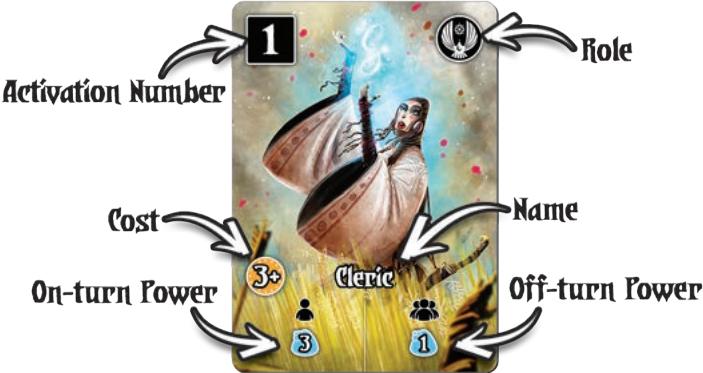
Citizen Names
Each Citizen has a name that can be found in the center of the card. These names are also considered the Citizen type when referring to the “+” symbol during the Recruit a Citizen Action. Additionally, these names are referenced on some card powers in the game. All Citizens within a stack must have the same name. Citizen Role Icons
Each Citizen card has a Role icon shown in the upper right corner.


Worker

Soldier

Shadow
Holy
The Role icon provides a reference for several game functions:
•Domain Role Requirements. Counts as one of the Role icons required to build a particular Domain.
•Powers and Rewards. Certain Citizen powers, Monster rewards, and Domain rewards reference specific Role icons.
•Victory Points for Dukes. Some Duke cards will score Victory Points at the end of the game based on the Role icons.
ROLE ICONS AND CITIZEN CARD ICONS
If the Role icon overlaps a Citizen card icon, then the power or reward only applies to Citizen cards with that icon.
Activation Numbers
Your Citizens activate based on the Activation Number in the top left corner of each card. If there are two numbers, it means that the Citizen activates with either of the numbers shown.
Citizen Cost
To recruit a Citizen card from the Center Stacks, you pay an amount of Gold equal to the cost shown on the center-left of the card (base cost) plus 1 Gold for each Citizen with the same name you already have in your tableau. The “+” symbol on each Citizen Gold cost is there to remind players that Citizen prices increase as you get more of each Citizen with the same name. See the Recruit a Citizen example on page 6.
Citizen Powers
There are two Harvest Phase powers on the bottom of each Citizen card. The left side with the icon is only used by the Active player and is also referred to as the on-turn power. The right side with the icon is only used by non-Active players and is also referred to as the off-turn power.
If a power references any Card Types, card names, or Citizen Roles, then it is referencing any cards in your tableau or Victory stack at that time.
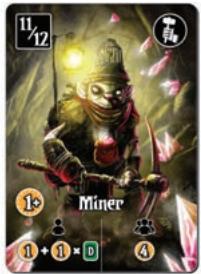
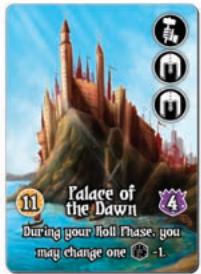


Example: You are the Active player and the sum of your dice roll is 12. The left-side harvest payout for the Miner in your tableau indicates that you gain 1 Gold + 1 Gold per Domain card in your tableau. You have previously purchased Palace of the Dawn and Eye of Asteraten so you gain 3 Gold.
POWERS THAT USE NAMES
Some powers may reference Citizen names, and you count any Citizen or Starter cards with the same name in your tableau.
Monster Cards
Monster cards represent the vile monsters that threaten the kingdom of Valeria. Slaying Monsters will gain you immediate rewards and give you Victory Points at the end of the game.
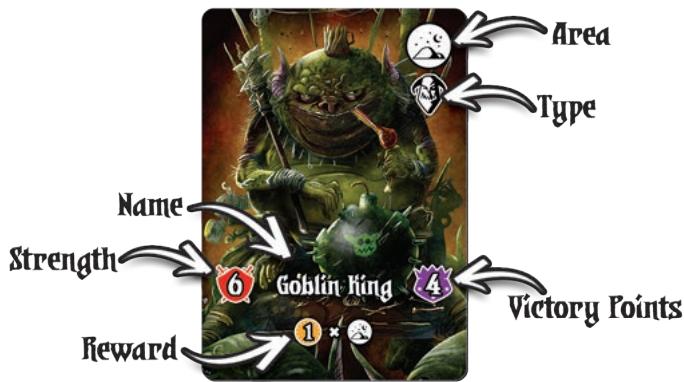
Monster Names
Each Monster has a name that the villagers cry out when they are being attacked.
Monster Areas
Monsters are separated into eight Monster Areas represented by the Area icon in the upper right corner of each Monster card.


Hills
Ruins

Forest

Swamp



Barrens

Valley
Every card in a Monster stack must contain the same Area icon. Boss Monsters in the game give rewards based on how many Monsters a player has slain from the same Area. (See the example on page 10.)
Monster Types
There are four Monster Types in the base game. Each Monster has a Monster Type icon below the Area icon.

Boss

Minion

Beast

Titan
These icons will become more important in future expansions, but for now, only the Boss and Titan icons are referenced in the base game. These references are found on Duke cards.
Card Anatomy
Monster Strength and Magic
All Monsters have a Strength value in the middle of the left side of the card. Some Monsters have a Magic value above their Strength value. Each Monster Area has Monsters with 3 different Strength values. When preparing each monster stack, sort the cards so that their Strengths progress from highest (on the bottom) to lowest (on the top). The Magic value is ignored in this sorting process.
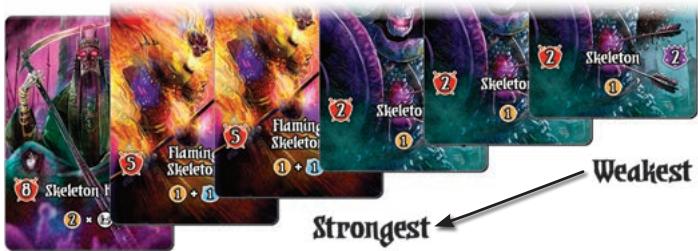
Example: When sorting the Ruins for a 5-player game, from bottom to top, place the Skeleton King, 2 Flaming Skeletons, and then 3 Skeletons.
To slay a Monster card at the top of any stack, you must spend Strength equal to the Strength value shown in the icon on the left side of the Monster card.
Magic may be used to augment your Strength, but at least one Strength must be spent.
Some Monster cards cost both Strength and Magic to slay. If so, the noted Magic cost is in addition to any Magic you might be using to augment your Strength.
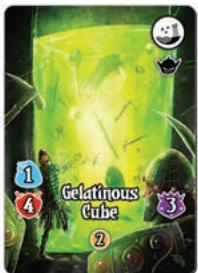

Example: The Gelatinous Cube is at the top of the Swamp stack and it has a 1 Magic and 4 Strength as its attributes. You spend 3 Strength and 2 Magic to slay the Gelatinous Cube. Place all slain Monster cards face-up in a Victory stack near your Duke card. They are public knowledge.
Monster Rewards
At the bottom of each Monster card is a reward that you receive immediately when you slay the Monster. Some Monsters require the player to choose a reward from available options shown on the card. Some Monsters reward a player with a free Citizen card of up to a certain value. When you take a Citizen card in this way, ignore the ‘+’ symbol on the Gold cost for the Citizen and go by just the base cost.
Some Monsters reward Victory Points, which should be taken immediately after slaying the Monster. If you are receiving Victory Points based on Monster Area icons, slain Monsters with the same Monster Area icon are counted.
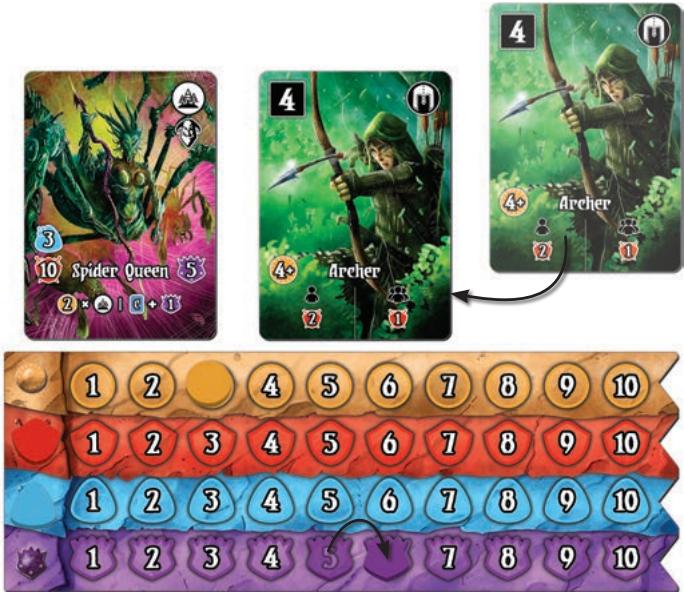
Example: You slay the Spider Queen which gives you an option to either take 2 Gold for every Forest Monster you’ve slain or to take any Citizen from the Center Stacks and 1 Victory Point. You have only slain one Monster from the Forest area (the Spider Queen, herself) which would only give you 2 Gold, so you decide to take the latter reward and take an Archer from the Center Stacks and gain 1 Victory Point.
Victory Points
All Monsters reward the player with Victory Points at the end of the game. This end-game Victory Point value is found in the middle of the right side of each Monster card. (Note: Don’t move your Victory Point token on your player board for these Victory Points.) Keep the Monster cards you’ve slain in a Victory stack near your Duke card.
Card Anatomy
Domain Cards
Domain cards represent the territory or buildings in Valeria that you need to acquire in order to expand your influence. Building Domains will help you attain powerful ongoing or one-time powers and give you Victory Points at the end of the game.
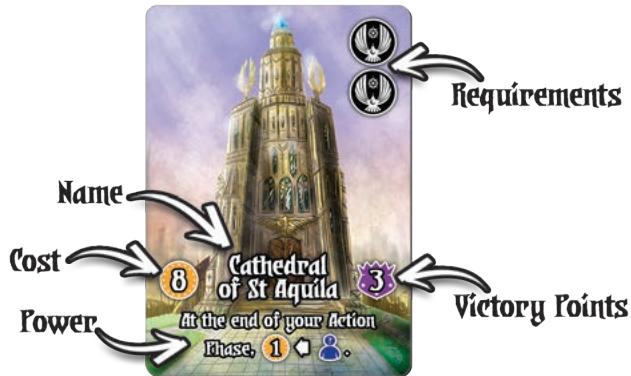
Domain Requirements
To Build a Domain, you must first have Citizens in your tableau that match the Role icons shown in the upper right corner of the Domain card. If a particular Role icon is shown more than once, you need to have that number of matching Citizen cards. See the Build a Domain example on page 7.
Note: Your Starter Peasant and Starter Knight do not have Role icons so they do not count toward fulfilling a Domain card’s Role Requirements.
Domain Cost
After meeting the Role requirement of a Domain card, you must then pay the Gold cost in order to build that Domain.
Magic may be used to augment your Gold, but at least one Gold must be spent.
Domain Powers
A special reward or power is described at the bottom of each Domain card. This benefit is granted to you for building that Domain. If a Domain card’s text breaks the rules written here, the Domain card supersedes these rules.
Some Domains grant an immediate reward that is received as soon as you build the Domain. Occasionally, these rewards will grant you an additional action as a reward. Fulfilling the additional action is still a part of the Buy a Domain action and is not considered one of the two actions you must take in a turn.
Some Domains provide an ongoing power and describe the effect as well as when the effect activates. It is possible that two different powers can take effect at the same time. If this happens, you choose in which order you would like to trigger the powers.
Victory Points
All Domain cards provide Victory Points that are scored at the end of the game. The Victory Point value is found on the middle-right side of the Domain card.
Duke Cards
At the beginning of the game, each player secretly chooses a Duke card (a secret role to take on during the game) and keeps the card face down near their player board.
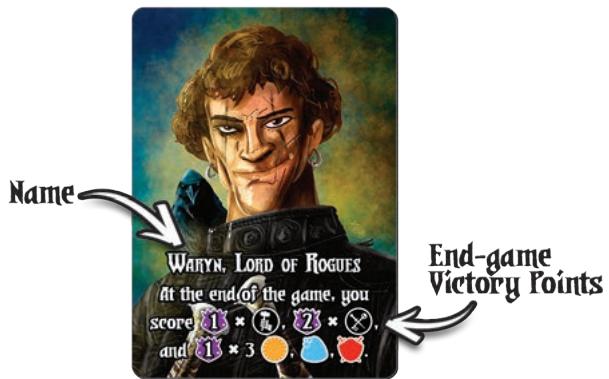
Your Duke is kept secret from other players but you may look at your Duke card at any time during the game. The description at the bottom of each Duke card shows how you can earn extra Victory Points when you add up your score at the end of the game. If you find yourself in a situation with several possible paths, take time to review your Duke card to see if one path leads to higher Victory Points than another.
SCORING ROLE ICONS
If your Duke scores on Citizen Role icons, be sure to include the Citizen Role icons found on both your Citizens and your Domains.
SCORING RESOURCES
Duke cards give you Victory Points for all of the remaining Resources on your player board. The Duke is not scoring for individual Resources. Simply add up all remaining Resources and divide that total by the number listed on your card.
Monster Event Variant
The following rules explain how to integrate the Monster Event cards. These instructions replace the Exhausted Cards paragraph in the Game Setup section and append to other Phases in the base game rules. All other standard rules apply.
Monster Event Card Anatomy
Monster Event cards have an Activation Number in the upper-left corner followed by Instructions. The Monster Event cards do not have a Monster Area. All other card anatomy is the same as a standard Monster card.

Activation Number: The Monster Event card is activated if the value is rolled on the dice, including the sum of both dice. The card does not activate twice in the case of doubles.
Instructions: The Active Player carries out the instructions at the end of their Roll Phase.
If the instructions include the text “All ” then all players must follow the instructions, if able.
Game Setup
Take 2 Exhausted cards per player and create the Exhausted stack above the Monster row. Then, take 1 face-down Monster Event card per player and shuffle them together. Place the shuffled cards on top of the Exhausted stack above the Monster row. The Monster Event cards are now considered to be part of the Exhausted stack. Return other Exhausted and Monster Event cards to the box.
Note: If there is a specific Monster Event card that you would like to play with, you may preselect it as one of the Monster Event cards to shuffle and place onto the Exhausted card stack.
Take the Cardboard Resource tokens and place them next to the Center Stacks within easy reach of all players. When a Monster Event requires you to place a Resource, use these tokens.
Roll Phase
At the end of your Roll Phase (after announcing the results of the dice roll), if you rolled the Activation Number on a Monster Event card, you carry out the instruction written on the top of the Monster Event card. (Important: This takes place before the Harvest Phase.)
Example: Kira rolled a “2” and a “3”. The Bat Swarm is in play.
She places 1 cardboard Strength token on a Monster of her choice.
Action Phase
As per normal, if a stack in the Center Stacks is ever Exhausted as a result of an Action taken by a player, the player first finishes the Action and then adds an Exhausted card from the Exhausted stack above the Monsters to the empty position. After revealing a Monster Event card, place it face-up in the stack you exhausted. This Monster may now be targeted with the Slay a Monster action and is considered a Monster when a icon is referenced on other cards.
Some Monster Event cards will add Strength or Magic cardboard tokens on to other Monster or Monster Event cards. During the Action Phase, the total amount of Strength or Magic needed to Slay this Monster is equal to its printed value plus any additional Strength or Magic tokens on the card.
Some Monster Event cards will add Gold cardboard tokens on to other cards. During the Action Phase, when a player takes the Monster card from a Slay a Monster action, the player gains that much Gold (adjusting their player board accordingly) and returns the cardboard Resource tokens to the supply.
Once a Monster Event card is taken by the Slay a Monster action, replace the empty stack with 1 of the Exhausted cards from the bottom, not the top, of the Exhausted stack. New Monster Event cards cannot replace taken Monster Event cards.
End Phase
Important: If there is a Monster Event card in one of the Center Stacks, the stack is still considered to be Exhausted for purposes of checking if end-game conditions have been met.
End of Game
At the end of the game, Monster Event cards are counted as if they were standard Monster cards. You gain the Victory Points printed on the card and you may count any icons present on the card for bonus points given to you by Duke and Noble cards.
5-Player Variant
The instructions below cover the rule changes for 5-player Valeria: Card Kingdoms. All other standard rules apply.
Game Setup
Monster Cards
Each stack of Monster cards will contain 6 cards. Include the cards with a 5-player icon .
Citizen Cards
Each stack of Citizen cards will contain 6 cards.
Domain Cards
Each stack of Domain cards will contain 4 cards, with 3 face-down cards and 1 face-up card on top of the stack.
Resting Player
After selecting the first player and giving that player a Game token and the dice, give the other Game token to the person to the first player’s right with the Resting side up (night scene). That person is the Resting player for the first round. Important: A Resting player may not be targeted by negative Citizen, Domain, or Monster Event card effects. The Resting player is not considered to be in play while they have the Resting Game token.
Harvest Phase
The Resting player does not harvest Resources during the Active Player’s turn.
RUNNING OUT OF +10 MARKERS
Resources and Victory Points are not meant to be limited by the +10 Markers in the game. In the unlikely event that the +10 Markers ever run out, we recommend using some other method to track your Resources and Victory Points.
End Phase
Each time the dice pass left to the next Active player, the Resting Game token passes left to the next Resting player. They will be the Resting player for the next round of play. In this way, the Resting player changes at the end of each players turn and is always the player to the right of the Active player.

Mixed Citizens Variant
The instructions below cover the rule changes for the Mixed Citizens Variant of Valeria: Card Kingdoms. All other standard rules apply.
Game Setup
Citizen Cards
When setting up each Citizen stack, take all of the Citizen Types of the same Activation number and shuffle them together, then deal 4 Citizens face-down and 1 face-up (5 face-down and 1 face-up for a 5-player game) to form the stack. Place the rest of the cards back in the box. Continue to do this for each Activation number.
Example: You take all of the Monk cards and all of the Cleric cards and shuffle them together. You are playing a 4-player game of
Valeria: Card Kingdoms, so you deal out 4 face down and then
1 face up to form the Activation number “1” stack.
During the game, Citizens that are face down are not public knowledge and may not be revealed until the Citizen directly above it has been taken by a player.
No Duke Variant
The instructions below cover the rule changes for the No Duke Variant of Valeria: Card Kingdoms. All other standard rules apply.
Game Setup
Duke Cards
Do not give players a Duke card at the beginning of the game.
Scoring
At the end of the game, score all Monsters, Domains, and Victory Points (on your player board) as normal. Then, all players score:
• 1 per , 1 per , 2 per , and 2 per icons on Citizen and Domain cards in their tableau.
•1 per 3 Resources remaining on their player board.
Additionally, the player with the most:
• Citizens in their tableau gains 7 .
•Monsters in their Victory pool gains 7 .
•Domains built in their tableau gains 7 .
In the event of a tie when calculating the most Citizens, Monsters, and Domains, the tied players instead gain 3 Victory Points.
Solo Variant
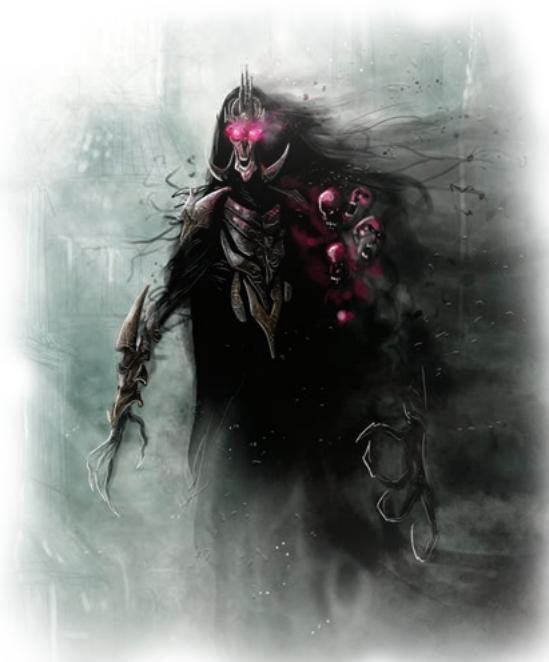
In the solo game, you play against a virtual player called the Dark Lord.
When a Duke of the Realm turns to evil and claims the title of Dark Lord, all of Valeria is threatened. You must step up to
defend the Kingdom, drive back the forces of evil, and defeat the Dark Lord... alone! The instructions below cover the rule changes for the solo game.
All other standard rules apply.
Game Setup
After you select your Duke card, randomly place one Duke face down above the Monster stacks. This traitorous Duke is the Dark Lord and will earn points at the end of the game based on the surviving Monsters as well as the Citizens and Domains that the Dark Lord has captured.
Game Flow
Roll Phase
Because you are the only player, you will roll the dice at the start of each new round.
Harvest Phase
You are the Active Player and Harvest resources from the LEFT side of all of your activated Citizens. If a card instructs you to take from a another player, you just gain the Resource instead.
Action Phase
If a card instructs you to take from a single player, you just gain the Resource instead. If a card instructs you to take a Citizen card from another player you gain the card from the Center Stacks instead. If the card instructs you to take a Monster, then you take the top card on the left-most non-exhausted Monster stack.
Monsters Phase
There are 5 stacks of Monsters in each game. The value on each die that you rolled during the Roll Phase activates a Monster stack in that respective position. So, rolling a 1 activates the first (leftmost) Monster stack, rolling a 2 activates the second Monster stack, etc. The sum of both dice does not activate that Monster stack.
In the case of doubles, that Monster stack is activated twice.
In the case of 6, a Monster stack of your choice is activated. You may not choose an exhausted Monster stack.
If a rolled stack is exhausted, a Monster stack is not activated for that die.
When a Monster stack is activated, you remove a card from one of the two Citizen stacks in that Monster stack’s column. Place the removed Citizen next to the Dark Lord above the Monster stacks. If both Citizen stacks are empty, you must remove a Domain card from that column and place it next to the Dark Lord.
If you cannot remove a card from that column because all of the stacks in the column are exhausted, check the Ending the Game section below to find out your fate.
INCREASING THE DIFFICULTY
To increase the difficulty, activate Monster stacks for the sum of both dice if the sum is equal to 2 - 6 using the rules above. Additionally, to increase the difficulty even more, if a rolled Monster stack is exhausted, the Dark Lord himself attacks that column and it is activated using the rules above.
Second Harvest Phase
This new phase functions like the “other players” Harvesting in the standard rules. Harvest all Resources from the RIGHT side of all of your activated Citizens, including Citizens you just recruited during this turn’s Action Phase.
End Phase
Check the end-game conditions. If they have not been met, pick up the dice to start the next round.
Solo Variant
Ending the Game
The game ends immediately if you have slain all of the Monsters…
The Dark Lord rages against the injustice of defeat but the screams of despair fade and go unheard by the joyous Citizens singing your praises throughout the land. Your duchy will surely prosper
in the age of light born from your victory. You have won the game. The game ends immediately if a Monster attacks and there are no Citizen or Domain cards in that column...
You have failed to defend the Kingdom of Valeria. The Monsters ransack the countryside and the Dark Lord adds your duchy to the shadow kingdom. Children will grow up cursing your name and the Dark Lord will rule over the blighted land for a hundred years. You have lost the game.
The game ends immediately if any five card stacks are exhausted. Total your score as follows:
•Total Victory Points on all of your slain Monsters.
•Total Victory Points on all of your built Domains.
•Total Victory Points based on the instructions at the bottom of your Duke card.
After counting your points, reveal the face of the Dark Lord and total the Dark Lord’s points as follows:
•Total Victory Points on all surviving Monsters still in the Center Stacks.
•Total Victory Points on all Domains captured.
•Total Victory Points based on the instructions at the bottom of the Dark Lord’s Duke card as applied to the surviving Monsters, the captured Citizens and the captured Domains.
If the Dark Lord’s score is higher or equal to your score...
The Dark Lord has solidified the evil in your lost duchy and secured a voice of influence within Valeria’s royal court. You have escaped to the protection of a neighboring Duke to heal your wounds and recruit allies to win back your duchy and oust the Dark Lord from the land. You have lost the game... but not the war.
If your score is higher than the Dark Lord’s score...
The infected duchy has been lost to evil but at least the darkness has been contained and your duchy is safe. You will have to guard the borders against the Monsters that lurk in the shadows and you will have many sleepless nights as you await the inevitable resurgence that could doom all of Valeria. You have won the game... for now.
Card Clarifications
Bane Spider gives a reward of 3 Gold or you may immediately take a Knight from the Center Stacks. If there is no Knight available, then you must take the 3 Gold.
Foxgrove Palisade allows you to change the value of one die to a 6 if you pay 2 Gold.
Gargan’s Embrace gives you a Victory Point whenever any player rolls doubles or when the dice are changed to be doubles. If the dice are doubles and a player changes the dice values so they are not, you still get a Victory Point. It is possible to trigger this ability more than once if a player rolls doubles then, using Domain powers, changes the dice to another pair of doubles.
Nest of the Weaver Woman allows you to return a Citizen card from your tableau to its original area in the Center Stacks. If the stack has an Exhausted card, return the Exhausted card to the bottom of the Exhuasted deck, then place the Citizen card. If the stack has a Monster Event card, return the Monster Event card to the top of the Exhuasted deck, then place the Citizen card. Yes, you can extend the game in this way since the end-game conditions are no longer being met. The Citizen card is now considered to be back in the Center Stacks and may be taken or purchased by players in a future action.
Orc Warrior gives a reward of a Citizen from the Center Stacks equal to or less than 3 Gold. Ignore the “+” on the Citizen card when taking the Citizen card.
Palace of the Dawn allows you to reduce the value of a die by one. You may not roll down the die to zero. You may roll down a die that you previously changed with another Domain power.
Purloiner’s Perch allows you to take a random Monster from any one player. We recommend having the target player shuffle their Monster stack face-down before you take the Monster card. You
Card Clarifications
Thief has an on-turn power of taking up to 3 Gold or 3 Magic from any one player of your choice. You may not mix Resources; it is either all Gold or all Magic. You may take less than 3 from a player if you wish or if they do not have 3 of the Resource you choose. The player who activates the Thief takes Resources from a player at the start of the Harvest Phase before other players take their Resources.
Watcher on the Water allows you to return a Monster card from your Victory stack to its original area in the Center Stacks. If the stack was Exhausted, remove the Exhausted card and then place the Monster. Yes, you can extend the game in this way since the endgame conditions are no longer being met.
Wraith gives a reward of a Citizen from the Center Stacks equal to or less than 2 Gold. Ignore the “+” on the Citizen card when taking the Citizen card.
Credits
Important Concepts
• Magic can be spent as if it were Gold or Strength as long as at least one of the actual required Resource is spent.
• If a Domain card text breaks the rules written here, the Domain card supersedes these rules.
• During the Harvest Phase, you may activate your Citizens in any order you wish (except for the Thief which must be the first Citizen activated) and may immediately spend any Resources gained during that Harvest Phase to activate and use the power of another activated Citizen.
• Regardless of whether you are the Active player or not, if the dice roll (the result of each die and the sum of both dice) does not activate any of your Citizens during a Harvest Phase or there are doubles, you activate the Herald.
• There is no limit to how many cards you may have in your tableau. You should always have 1 Starter Peasant, 1 Starter Knight, 1 Starter Herald, and 1 Duke.

Texts are community-compiled or publicly released by publishers; copyright remains with the original authors. For personal reference only.