Vantage
At a glance
Rules overview
English version of our rules overview, translated from the Chinese original (cunlema). The Chinese page is the source of record.
Game Overview
Vantage is a cooperative, open-world adventure game for 1–6 players in which each player crashes onto a different location of an uncharted planet and explores it from a first-person perspective. With nearly 800 interconnected locations and over 900 other discoverable cards, players take turns performing actions, rolling challenge dice, and placing those dice on cards to avoid losing time, morale, and health. Success is defined by completing a mission, a destiny, or both (an epic victory), or by whatever you pursue and achieve.
Core Mechanisms: Action selection with storybook-referenced costs, skill-token cost reduction, challenge dice rolling and placement on a 3x3 card grid, boost management, and cooperative information sharing.
1. Game Components
| Component | Quantity/Description |
|---|---|
| Large cards (double-sided, 80x120mm) | 415 |
| Standard cards (57x87mm) | 916 |
| Spoiler pack of cards | 1 pack |
| Storybooks | 8 |
| Book of Vantages | 1 |
| Game board | 1 |
| Boost tokens (cubes) | 60 |
| Challenge dice | 20 |
| Time trackers | 6 (1 per player) |
| Skill tokens | 60 |
| Morale trackers | 6 (1 per player) |
| Coins | 45 |
| Health trackers | 6 (1 per player) |
| Skill dice | 12 |
| Location card holders | 6 (1 per player) |
| Placeholder cards | Cards 1709–1714 |
2. Game Setup
- Place the game box next to one player in charge of finding and returning cards (they receive placeholder cards 1709–1714). Tilt the three big stacks of large cards out of their flat-packed position.
- Place the board (the "center") in the middle of the table with time, morale, and health trackers nearby. Both sides of the board are functionally the same.
- Place all skill tokens, coins, boost tokens, skill dice, and storybooks in a general supply near the center. The backs of most storybooks have reference guides.
- Seed the challenge dice pool with 8 challenge dice plus 2 per player (e.g., for three players there are 14 dice), then return the remaining challenge dice to the box.
- Each player gains a location card holder. Randomly select the first player.
- Place the Book of Vantages on the table with the back cover facing up to display location 000. Follow the instructions on location 000 to complete setup, using skill dice for randomization. Each player independently gains their character and starting stats here.
- For your first game, we recommend the "daring" starting level for time, morale, and health, and avoiding difficult crash locations.
3. Game Flow
Players take turns clockwise around the table. On your turn, you perform 1 action (unless an effect says otherwise) by following these steps in order:
1. Choose one action from three types: location action, card action, or depart action.
2. Read the cost and action (not the result), usually from a storybook entry.
3. Reduce the cost by 1 per matching skill token optionally paid by any player.
4. Roll challenge dice from the pool equal to the remaining cost.
5. Place rolled challenge dice one at a time on open slots on your grid cards (and impact slots on other players' grid cards).
6. Suffer penalties from rolled-but-unplaced challenge dice, then discard them to the penalty section of the center.
7. Read the action result.
8. End your turn (unless instructed to "continue"). Play proceeds clockwise.
You always succeed when performing an action; the challenge is to avoid losing time, morale, or health.
4. Player Actions
Location Actions
- Each location lists (usually 6) location actions in categories: move, look, engage, help, take, and overpower.
- Reference the storybook entry for this location and category.
- You may only perform 1 location action per location per game, unless the action is marked "always available" or an action result instructs otherwise.
- If another player previously visited the same location, you may not perform a thematically contradictory location action.
- Cost: Varies by action (read from storybook). Effect: Read the result after completing steps 4–6.
Card Actions
- Many non-location cards (in your grid, supply, or the center) include action options.
- Reference the storybook entry using the card's number.
- Unless stated otherwise, you may perform a card action even if you have already performed an action on that card.
- You may not look at the card you are gaining until you have completed the action.
- Cost: Varies; some grid card actions also require paying boost from that card. Effect: Read the result.
Depart Actions
- Move away from your location in 1 of 4 cardinal directions (north is always forward).
- Adjacent listed locations (numbers on the compass): a 1-cost move action (WALK or SWIM) that does not use a storybook.
- Unlisted adjacent locations (marked with a star): after declaring a direction, look up the cost, action, and result in the Depart storybook for this location number.
- Blocked directions (no number or star): you cannot depart in that direction.
- Cost: 1 for listed adjacent locations; variable for starred directions. Effect: You arrive at the new location.
Skill Payment (Step 3)
- Any player may discard matching skill tokens to reduce the action cost by 1 each.
- Players may pay skills to benefit each other at any time, not just to reduce action costs.
Boost Powers
- At any time on any turn (even mid-action or during another player's action), you may use boost powers on cards in your grid.
- Boost gained/paid on locations goes to/from your character; boost on other cards stays on/from that card.
- Effects of boost powers last until the end of the current turn.
- Each card has limited boost capacity that cannot be exceeded.
5. Scoring and Game End
The game ends when:
- You complete the mission (you then choose between ending the game and continuing to pursue a destiny).
- You complete a destiny and choose to read its storybook entry, which ends the game. You may collect multiple destiny cards.
- Any player's time, morale, or health is reduced to 0 (read the mission's entry in the take storybook).
- The time you allotted to play has expired.
Victory types: mission victory, destiny victory, or epic victory (completing both the mission and a destiny). When the game ends, return all cards and components to the box; everything resets for a new adventure.
Key Rules and Common Questions
Easy-to-miss Rules:
- You may never look at your previous locations or other players' locations; only your current location card may be viewed by you.
- You may not change your mind about your chosen action after reading the cost and description.
- You cannot read the cost or results of an action before performing it.
- If the challenge dice pool has fewer available dice than the remaining cost, first refresh ALL challenge dice from grids and the penalty section back to the pool, then roll.
- The total challenge dice in play is always 8 plus 2 per player; excess dice stay in the box.
- If a stat you would gain is already at the max of 6, instead gain 1 random skill (roll a skill die).
- If an action result causes you to lose something you don't have, ignore it—but this only applies to results, not costs.
- If you gain a card you already have in your grid, instead gain 1 boost on that card (if possible).
- The first time a player completes their 3x3 grid, place destiny 1705 in the center.
- Adjacency always means orthogonal adjacency (touching at edges left-to-right or top-to-bottom).
- When you gain a vertical card and your grid is full, you may reserve the new card or reserve a grid card (other than your character) to make space; if this exceeds reserve capacity, lose an excess reserve card.
- Reserved cards retain boost tokens but their challenge dice are refreshed, and you may not use their slots, abilities, or powers.
- You may not place challenge dice on horizontal cards in your supply.
- Unless a slot specifies otherwise, you can place blank and setback results on open slots.
- If you can't pay a listed cost, you may not gain the benefit.
- When a location's arrival effect or other penalty instructs you to suffer 1 heat, cold, or hypoxia damage, lose your choice of either 1 time or both 1 morale and 1 health.
- If another player is at your location during step 7, you may depart/move them with you (they don't pay the cost) and give them coins, items, flora, and vehicles (ignore "when placed" effects; exchanged cards retain challenge dice but lose all boost).
- When you replace or lose a grid card, refresh its dice, return its boost to supply, and insert the new card in the same position.
- You must always have your character card in your grid.
- If a challenge dice ability says "place them in the center," it means the penalty section (not refresh).
FAQ:
Q: Can I look at other players' location cards?
A: No. Only you may look at your current location card. You may describe its artwork, read the description aloud, and share the location action options.
Q: What happens if I reduce an action's cost to 0?
A: Do not roll any challenge dice.
Q: Can I perform two location actions at the same location?
A: No, unless an action result instructs you to "continue" (ignoring the restriction) or the location specifies an action as "always available."
Q: What does "continue" mean at the end of an action result?
A: If it says "continue," you must perform another action. If it says "You may continue," it's your choice. This only applies to your current turn.
Q: How many challenge dice are used in a solo game?
A: 10 total dice (8 plus 2 per player). There is no Automa; you control only 1 character.
Q: What happens if I can't place a rolled challenge die?
A: Suffer its penalty (time, morale, or health loss), then discard it to the penalty section of the center. Setback results return to the challenge dice pool instead; blanks go to the penalty section.
Q: Is Vantage a campaign?
A: No. Each game is standalone; you only bring to future sessions what you've learned about the world.
Rules Q&A
Questions below are real questions players asked cunlema about this game; answers are ours, translated into English.
Can I walk back to a previous location after I have walked to a new location?
Nothing in the rules prohibits you from walking back to a place you have already been. Walking back is simply another ordinary Depart action; movement itself is not subject to the "may only be performed once" restriction (that restriction applies only to Location Actions).
How to do it
- You do not walk the route in your memory; instead, look at the compass in the top-right corner of your current Location card: in the direction you want to head back, if a number is shown (an adjacent listed Location), it is a Move action costing 1. You do not need to consult the Storybook; follow all steps of a 1-cost Move action, and this move is your only action for this turn.
- If that direction shows an asterisk (★), you must look up your current Location's number + that direction in the Depart Storybook to learn the cost and result.
- If that direction shows neither a number nor an asterisk, you cannot depart in that direction — in this case you cannot walk back.
Restrictions after returning to a previously visited Location (this is where it's easy to make a mistake)
- If you yourself previously performed a Location Action at that Location, then after returning you may not perform any Location Actions (except those marked "Always Available"); you may only choose a Depart action or a Card action.
- If another player has been to that Location during this game, you may not perform Location Actions there that are thematically contradictory.
- You still may not view Location cards of places you have previously been, nor may view Location cards where other players are; after returning you receive the current card for that Location, handled according to the normal "Information Sharing" rules.
- Additionally, if the result this turn is "may continue/continue" and you continue acting, this continuation is limited to the current turn only; you cannot use it to continue acting in later turns.
The rulebook has no dedicated entry discussing "returning to visited Locations"; the above conclusions derive from the general rules on Depart actions and Location Action restrictions; no other relevant clauses were found.
… (condensed here; full text on the cunleme Chinese page)
Different investments rolled will yield different results; where will they be invested?
In Vantage, there is no "investment" mechanic. What you are referring to must be the placement of rolled Challenge Dice.
According to the rulebook, rolled Challenge Dice are placed in one of the following two locations:
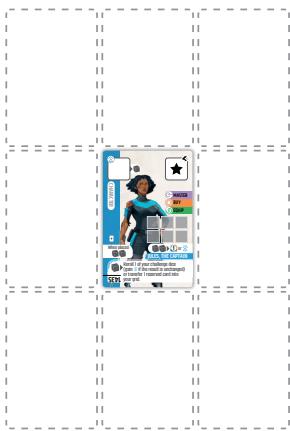
- Card Slots in the Card Grid
This is the primary placement area, used to avoid penalties and gain rewards.
* Specific location: The 3x3 card grid on the player's personal board (containing the character card and any acquired location/event cards).
* Placement rules:
* Dice may be placed on open dice slots on your own cards.
* Dice may also be placed on the "Impact Slots" of other players' cards (with that player's permission). If the other player is present and at the same location, with permission, dice may even be placed on non-Impact slots.
* Each slot typically holds only 1 die, and may have specific restrictions (such as action type, terrain match, result value match, etc.).
* Effect: Once successfully placed, the die remains on the card until all dice refresh; typically you also immediately gain a Boost or other immediate reward.
- Penalty Section of the Center
If a die cannot be placed in a card slot in the Card Grid, it is discarded here.
* Consequence: The player must suffer the penalty shown on that die (losing the corresponding Time, Morale, or Health).
* Exception: If the die bears a "Setback" symbol, it does not enter the Penalty Section; instead, it returns directly to the Challenge Dice pool (this delays the overall refresh of the dice).
Summary:
* Want to avoid penalties/gain rewards → place in the corresponding slot in the Card Grid.
* Cannot place/choose not to place → place in the Penalty Section of the Center and suffer the attribute loss (except for Setback symbols, which return directly to the dice pool).
x is how you choose a number?
In Vantage, there is no mechanic or die called "x".
The "x" you mentioned is most likely the action icon on a card, the cost symbol, or the marker on a location card indicating an adjacent direction (such as a number, asterisk, etc.). According to the rulebook:
-
Regarding "leaving a location with a number":
* If the location card directly prints a number (representing an adjacent location), the cost to travel to that location is 1.
* This means you need to roll 1 Challenge Die (unless a skill reduces the cost to 0).
* Rulebook reference: "Move to a listed adjacent location costs 1." -
Regarding the "asterisk (*)":
* If the location card shows an asterisk (), this usually represents an unlisted direction or a special location.
* The cost to travel to such a location is not a fixed 1; instead, you must consult the Depart storybook to determine the specific cost and outcome.
* Rulebook reference: "For other directions, consult the Depart* storybook." -
Regarding "die type":
* There is only one type of die in the game: the Challenge Die, which is printed with penalty symbols such as time, morale, and health.
* There is no special die called "x".
Conclusion:
* If you mean traveling to an adjacent location marked with a number on the card, the cost is 1, i.e., roll 1 Challenge Die.
* If you mean traveling to a location marked with an asterisk (*), the cost must be looked up in the storybook and is not necessarily 1.
* There is no die or standalone mechanic called "x" in the rulebook.
This content is for reference only; in case of any conflict, the rulebook and experienced players take precedence.
Actions with a cost of x?
In the rulebook for Vantage, there is no cost mechanism called "x". Action costs are specific numbers, not variables.
According to the rules text, costs are determined as follows:
-
Traveling to a listed adjacent location (a number is printed on the card)
* The cost is fixed at 1.
* No need to consult the storybook; simply treat it as a 1-cost action. -
Traveling to an unlisted adjacent location (the card is marked with an asterisk
*)
* The cost must be looked up in the Depart storybook.
* You need to find the corresponding entry in the storybook based on the direction of movement (e.g., "south"), where the specific cost value (e.g., 2, 3, etc.) will be explicitly stated. -
Other actions (location actions, card actions)
* The cost is specified by the storybook or the card itself.
* Most actions require consulting the corresponding storybook entry (in categories such as Move, Engage, Look, etc.) to obtain the specific cost; some card actions have the cost and description printed directly on the card.
Summary:
There is no vague "cost is x" setting in the game. If you are traveling to a neighbor directly marked on the map, the cost is 1; if you are traveling in another direction, check the storybook for the specific number.
Is the one-point cost paid to leave a numbered location a die?
Yes, leaving a location with a number (i.e., a listed adjacent location) costs 1, which is equivalent to rolling 1 challenge die.
Specific Rules:
* Action Type: Moving to an adjacent location with a number printed directly on the location card is a "Move Action".
* Cost Value: The cost of this action is fixed at 1.
* Number of Dice: According to the rules, the action cost equals the number of challenge dice to be rolled. Therefore, a cost of 1 means you need to roll 1 die from the challenge dice pool.
Exceptions:
* If the destination is a direction without a listed number (usually marked with an asterisk *), this rule does not apply; consult the Depart storybook to determine the specific cost.
* Other players can use skill tokens to reduce the cost. If the cost is reduced to 0, no dice need to be rolled.
This content is for reference only. In case of conflict, the rulebook and experienced players take precedence.
Rules, cards and Q&A (Chinese)
The rules, card data and player questions for this game are written in Chinese. Open the Chinese page to read them.
Where to find full rules
Full rules and card lookup are available in the cunlema app at cunlema.cn — pick this game and ask about any rule, card or turn you are unsure about.