
万境奇旅Vantage
一句话概览
万境奇旅 是一款已收录于村了吗规则库的桌游,支持 1–6 人,原名 Vantage。
本页内容:一句话概览 · 游戏概述 · 1. 游戏组件 · 2. 游戏设置 · 3. 游戏流程 · 4. 地点卡牌 · 5. 技能系统 · 6. 加速系统 · 7. 卡牌网格 · 8. 储备区与通用供应 · 9. 信息共享 · 10. 游戏结束 · 关键规则与常见问题 · 常见问题
万境奇旅 规则速览
以下规则速览由本站整理,与官方规则书表述不同,仅供快速上手参考。
游戏概述
在这款合作冒险游戏中,1-6名玩家各自驾驶逃生舱坠落在一颗未被探索的星球上,散布在不同地点。每位玩家拥有独立的第一人称视角,可以自由探索、发现和互动。玩家需要合作完成共享任务(使命),同时避免任何一人的时间、士气或生命值降至零。本作非战役游戏,每局独立,跨局保留的只有你对这个世界的认知。
核心机制: 技能减少行动费用 → 掷挑战骰 → 将骰子放入网格卡槽减免惩罚 → 通过探索获取卡片扩充网格
1. 游戏组件
| 组件 | 数量 |
|---|---|
| 大卡牌(双面,80×120mm) | 415张 |
| 标准卡牌(57×87mm) | 916张 |
| 剧透卡包 | 1包 |
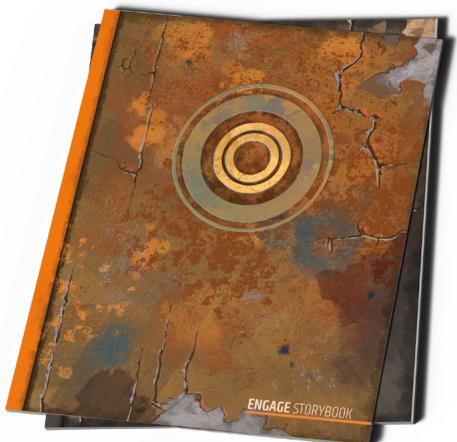
| 故事书 | 8本 |
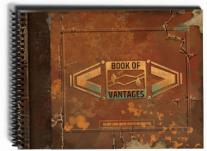
| 命运之书(Book of Vantages) | 1本 |
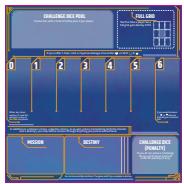
| 游戏板 | 1块 |
| 加速标记(方块) | 60个 |
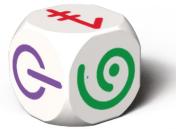
| 挑战骰 | 20颗 |
| 时间追踪器 | 6个(每人1个) |
| 技能标记 | 60个 |
| 士气追踪器 | 6个(每人1个) |
| 金币 | 45枚 |
| 生命值追踪器 | 6个(每人1个) |
| 技能骰 | 12颗 |
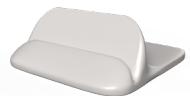
| 地点卡支架 | 6个(每人1个) |
2. 游戏设置
2.1 初始准备
- 游戏盒放在桌边,由一名玩家负责管理卡牌(领取位置标记卡1709-1714)
- 将三叠大卡牌从平放状态立起
- 游戏板放在桌子中央(两侧功能相同),附近放置时间、士气、生命值追踪器
- 所有技能标记、金币、加速标记、技能骰、故事书放在游戏板旁作为通用供应
- 故事书背面大多附有参考指南
2.2 骰子池配置
- 基础8颗挑战骰 + 每位玩家2颗(例如3人游戏=14颗,单人=10颗)
- 剩余挑战骰放回盒中
2.3 玩家个人设置
- 每位玩家领取1个地点卡支架
- 随机选出起始玩家
- 将命运之书封面朝上放在桌上(显示地点000),按地点000的说明完成设置(使用技能骰随机化),每位玩家在此独立获得角色和起始属性
2.4 难度等级
| 等级名称 | 时间/士气/生命值起始值 |
|---|---|
| 勇猛(brazen) | 3 |
| 大胆(daring) | 4(推荐首次游玩) |
| 务实(practical) | 5 |
| 谨慎(cautious) | 6 |
3. 游戏流程
3.1 回合结构
- 玩家按顺时针顺序轮流行动
- 每回合执行1个行动(除非另有说明)
- 行动必然成功,挑战在于避免损失时间、士气和生命值
3.2 行动步骤(共8步)
第1步:选择行动
从三种行动类型中选择一种(地点行动、卡牌行动、离开行动)。选择时不预知费用和结果,但选择后不可更改。大多数地点列出6种地点行动,每种地点在一个地点只能执行一次(除非标注"始终可用")。
第2步:读取费用和行动内容(不读结果)
费用和行动通常记载于故事书中,少数卡牌上直接印有。使用对应类别(如移动)的故事书,查找对应条目(如地点272)。部分网格卡牌行动还需支付加速标记。
第3步:使用技能标记降低费用
任何玩家可弃置与行动类型匹配的技能标记,每枚降低1点费用。弃置的标记归还通用供应。
第4步:从挑战骰池掷等同于剩余费用数量的骰子
- 若费用降至0则不掷骰
- 若骰池中骰子不足,先将网格和惩罚区的所有挑战骰回收至骰池(即全部刷新),再掷骰
第5步:将掷出的骰子逐一放置到网格卡牌的卡槽中
- 每个卡槽最多放1颗骰子
- 卡槽限制包括:技能类型(仅限对应行动时放置)、骰面要求、特定能力、特定交互对象、地形要求
- 部分卡槽放置时获得即时奖励(加速、技能等)
- 影响力卡槽可被任何玩家使用(需许可)
- 若另一玩家与你在同一地点,可使用其非影响力卡槽(需许可)
第6步:处理未放置的骰子并承受惩罚
- 时间/士气/生命值骰:放至中央惩罚区,扣减对应属性
- 挫折骰:放回骰池(延迟刷新时机)
- 空白骰:放至中央惩罚区(无惩罚)
第7步:读取行动结果
- 若结果包含"继续"(continue),必须再执行一个行动
- 若结果包含"可以继续"(You may continue),可选择是否继续
- 若地点改变,管理卡牌的玩家用位置标记卡替换当前地点卡
第8步:结束回合
传递给左手玩家。
3.3 三种行动类型
地点行动:
- 六种类别:移动、观察、交互、帮助、获取、压制
- 每个地点每个地点只能执行一次(除非标注"始终可用")
- 若其他玩家此前在同一地点执行过主题矛盾的行动,你不能执行该行动
卡牌行动:
- 执行网格、通用供应或中央区域中卡牌上的行动
- 引用该卡牌编号对应的故事书条目
- 除非另有说明,即使已对该卡执行过行动也可再次执行
离开行动:
- 向四个基本方向之一移动到相邻地点
- 已列出编号的相邻地点:费用1的移动行动,无需查阅故事书
- 标注星号(★)的相邻地点:需查阅离开故事书获取费用和结果
- 方向无编号也无星号:不可从该方向离开
4. 地点卡牌
- 画面: 你的视野,只能由你观看,可向其他玩家口头描述
- 地点编号(左上): 供其他玩家在故事书中查找对应条目
- 罗盘(右上): 显示四个方向的可移动选项
- 描述文字: 可向其他玩家朗读
- 特殊图标: 旅行者对话、强制指令(到达时必须执行)、元素交互图标
5. 技能系统
- 技能标记代表经验和建议
- 任何玩家可在任何时候弃置技能标记以帮助其他玩家(不限于降低费用)
- 弃置的标记归还通用供应,数量有限
6. 加速系统
- 加速代表你在探索中学到的知识
- 可在任何时候(甚至在行动中间或其他玩家回合中)使用网格卡牌上的加速能力
- 地点行动获得的加速放在角色卡上;其他卡牌上的加速放在该卡牌上
- 每张卡牌有加速容量上限,不可超出
- 加速能力效果持续至当前回合结束
- 若需获得加速但60个标记已全部在卡牌上,可用任意方块替代
- 若属性已达上限6时仍需获得该属性,改为获得1个随机技能(掷技能骰)
7. 卡牌网格
- 3×3网格,角色卡固定在中央,最多9张卡牌
- 不可重新排列网格中的卡牌
- 首次有玩家完成网格时,将命运卡1705放在中央
- 邻接仅指正交方向(上下左右边缘相触)
- 替换或失去网格中的卡牌时:刷新其上的骰子,加速归还通用供应,失去的卡牌归还盒中
- 网格卡牌提供的收益(除影响力外)仅作用于本网格
8. 储备区与通用供应
储备区:
- 容量等于网格和通用供应中所有"+"图标的总和
- 储备中的卡牌不可使用其卡槽、能力或效果,但保留加速标记
- 角色卡有加速能力可将储备卡转入网格
通用供应:
- 水平卡牌(使命、命运、个人卡)放在此处
- 数量无上限
- 不可在通用供应中的水平卡牌上放置挑战骰
9. 信息共享
- 你当前的地点卡只能由你观看
- 不可查看自己之前的地点或其他玩家的地点
- 可描述卡牌画面、朗读描述文字、分享行动选项
- 标记、骰子、网格/储备/供应中的卡牌、桌上指示卡为公开信息
10. 游戏结束
游戏在以下情况结束:
| 结束条件 | 说明 |
|---|---|
| 完成使命 | 可选择结束或继续追求命运 |
| 完成命运 | 读取命运的故事书条目后结束游戏 |
| 属性归零 | 任一玩家的时间、士气或生命值降至0时,读取使命在获取故事书中的条目 |
胜利类型: 使命胜利、命运胜利、史诗胜利(同时完成使命和命运)。你也可以用自己的方式定义成功。
游戏结束后,所有卡牌和组件归还盒中(剧透卡包的卡牌归还卡包),完全重置以便下次游玩。
关键规则与常见问题
易错规则
- 地点行动每地点仅一次: 在某地点执行过任意地点行动后,不可再次执行("始终可用"的行动除外)
- 行动选择不可撤回: 读取费用和描述后不可更换行动
- 费用可被技能降至0: 此时不掷骰,无惩罚风险
- 骰池不足时先刷新所有骰子: 将网格和惩罚区的骰子全部回收后再掷
- 影响力卡槽可跨玩家使用: 任何玩家(含不在同一地点者)可使用你的影响力卡槽
- 同一地点的玩家可互相使用卡槽: 需对方许可,不限于影响力卡槽
- 属性上限为6: 已满时再获得该属性,改为随机技能
- 没有的东西不用失去: 若行动结果要求失去你没有的东西,忽略该指令;但费用无法支付则不能获得收益
- 获得已有卡牌: 若获得网格中已有的卡,改为在该卡上加1加速(如可能);若获得其他玩家已有的卡,由双方决定归属
- "继续"与"可以继续"不同: 前者强制再执行一个行动,后者可选择
常见问题
- Q:移动到已列出编号的相邻地点费用是多少? A:费用1,为移动行动,无需查阅故事书
- Q:骰子上的空白和挫折结果是什么? A:空白骰无惩罚(放至惩罚区);挫折骰放回骰池,延迟刷新时机
- Q:可以查看其他地点卡吗? A:不可以,只能查看当前所在地点,且不可查看之前去过的地点
- Q:故事书何时由谁读? A:建议其他玩家在你回合朗读,让你专注于行动机制;第2步读费用和行动,第7步读结果
- Q:加速用完怎么办? A:60个标记用尽后可用任意方块替代
- Q:单人游戏规则有何不同? A:规则完全相同,无自动化系统,骰池为10颗(8+2×1)
常见问题(FAQ)
以下 5 条问答来自站内玩家的真实提问,答复由本站依据规则资料作答;答复内容保持原样,仅对提问做了去口语化的轻微整理。
我走去到一个新地点,之后可以走回来吗?
规则里没有任何条款禁止你走回之前去过的地方。走回去只是又一次普通的“离开(depart)”行动;移动本身不受“只能执行一次”的限制(那条限制只针对地点行动)。
具体做法
- 走的不是你记忆中的路,而是看你现在所在地点卡右上角的罗盘:朝回头的那个方向,如果标着编号(相邻已列出地点),就是一次费用1的移动行动,不用查故事书,按 1 费移动行动走完全部步骤,这次移动就是你本回合的唯一行动。
- 如果该方向标的是星号(★),就要在 Depart 故事书里查你当前地点的编号+该方向,才知道费用和结果。
- 如果该方向既没编号也没星号,则不能从这个方向离开——这种情况下就走不回去。
回到旧地点后的限制(这才是容易踩坑的地方)
- 如果你自己之前在那个地点执行过地点行动,那么这次回去后不能再执行任何地点行动(标注“始终可用”的行动除外),只能选择离开行动或卡牌行动。
- 如果别的玩家本局曾到过该地点,你不能在那里执行主题矛盾的地点行动。
- 你仍然不能查看自己之前去过的地方卡,也不能查看别人所在地点卡;回去后拿到的是该地点的当前卡,按正常“信息共享”规则处理。
- 另外,本回合若结果是“可以继续/继续”而你又继续行动,这种继续只限当前回合,不能在以后的回合里靠它继续行动。
规则书里没有专门讨论“返回已访问地点”的独立条目,以上结论来自离开行动与地点行动限制的一般规则;除此之外没有找到其他相关条款。
本内容仅供参考,如有冲突以说明书和身边大佬为准
不同的投资投出来不同结果,会放在哪里投资?
在《万境奇旅》(Vantage)中,并没有“投资”这一机制。你所指的应该是挑战骰(Challenge Dice)投掷后的放置位置。
根据规则书原文,投出的挑战骰会被放置在以下两个位置之一:
- 卡牌网格(Card Grid)中的卡槽
这是主要的放置区域,用于避免惩罚并获得奖励。
* 具体位置:玩家个人版图上的3x3卡牌网格(包含角色卡和获得的地点/事件卡)。
* 放置规则:
* 骰子可以放在自己的卡牌上开放的骰子槽位中。
* 骰子也可以放在其他玩家的卡牌上的“影响力槽位(Impact Slots)”中(需获得该玩家许可)。如果其他玩家在场且在同一地点,经许可甚至可以放在非影响力槽位。
* 每个槽位通常只能容纳1个骰子,且可能有特定限制(如行动类型、地形匹配、结果点数匹配等)。
* 效果:成功放置后,该骰子保留在卡牌上,直到所有骰子刷新;同时通常会立即获得加速(Boost)或其他即时奖励。
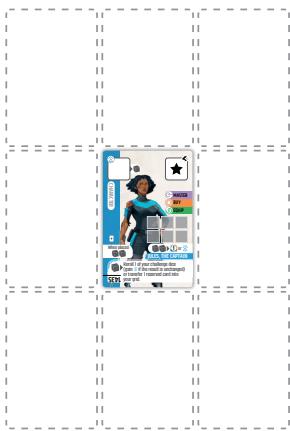
- 中心惩罚区(Penalty Section of the Center)
如果骰子未能被放置在卡牌网格的卡槽中,它们将被丢弃至此。
* 后果:玩家需要承受该骰子所示的惩罚(失去相应的时间、士气或生命值)。
* 例外情况:如果骰子上印有“挫折(Setback)”符号,它不会进入惩罚区,而是直接返回挑战骰池(这会延迟骰子的整体刷新)。
总结:
* 想避免惩罚/获取奖励 → 放在卡牌网格的对应槽位。
* 无法放置/放弃放置 → 放入中心惩罚区并承受属性损失(挫折符号除外,直接回骰子池)。
x是怎么选择数字?
在《万境奇旅》(Vantage)中,没有名为“x”的机制或骰子。
你提到的“x”很可能是指卡牌上的行动图标、费用符号,或者是地点卡牌上表示相邻方向的标记(如数字、星号等)。根据规则书原文:
-
关于“离开有数字的地点”:
* 如果地点卡牌上直接印有数字(代表相邻地点),前往该地点的费用是 1。
* 这意味着你需要投掷 1 个挑战骰子(除非通过技能将费用减至 0)。
* 原文依据:“Move to a listed adjacent location costs 1.”(前往列出的相邻地点费用为 1。) -
关于“星号 (*)”:
* 如果地点卡牌上显示的是星号(),这通常代表一个未列出的方向或特殊位置。
* 前往此类地点的费用不是固定的 1*,而是需要查阅《Depart》(离开)故事书来确定具体费用和结果。
* 原文依据:“For other directions, consult the Depart storybook.”(对于其他方向,请查阅离开故事书。) -
关于“骰子类型”:
* 游戏中只有一种挑战骰子(Challenge Dice),上面印有时间、士气、健康等惩罚符号。
* 不存在名为“x”的特殊骰子。
结论:
* 如果你是指前往卡牌上标有数字的相邻地点,费用是 1,即投掷 1 个挑战骰子。
* 如果你是指前往标有星号 (*) 的地点,费用需查阅故事书,不一定是 1。
* 规则书中没有名为“x”的骰子或独立机制。
本内容仅供参考,如有冲突以说明书和身边大佬为准。
费用为x的行动?
在《万境奇旅》(Vantage)的规则书中,不存在名为“x”的费用机制。行动费用是具体的数值,而非变量。
根据规则原文,费用的确定方式如下:
-
前往列出的相邻地点(卡牌上印有数字)
* 费用固定为 1。
* 无需查阅故事书,直接视为 1 费行动。 -
前往未列出的相邻地点(卡牌上标有星号
*)
* 费用需查阅《Depart》(离开)故事书。
* 你需要根据移动的方向(如“向南”),在故事书中查找对应条目,那里会明确写出具体的费用数值(例如 2、3 等)。 -
其他行动(地点行动、卡牌行动)
* 费用由故事书或卡牌本身指定。
* 大多数行动需要查阅对应的故事书条目(如 Move, Engage, Look 等类别)来获取具体费用;部分卡牌行动则直接在卡面上印刷了费用和描述。
总结:
游戏中没有“费用为 x”这种模糊设定。如果是去地图上直接标好的邻居,费用就是 1;如果是去其他方向,请查故事书看具体数字。
离开一个有数字的地点需要支付的一点费用是一个骰子吗?
是的,离开一个有数字的地点(即列出的相邻地点)需要支付 1 点费用,这等同于投掷 1 个挑战骰子。
具体规则如下:
* 行动类型:前往地点卡牌上直接印有编号的相邻位置,属于“移动行动”(Move Action)。
* 费用数值:该行动的费用固定为 1。
* 骰子数量:根据规则,行动费用等于需要投掷的挑战骰数量。因此,费用为 1 意味着你需要从挑战骰池中投掷 1 个骰子。
例外情况:
* 如果目的地是未列出编号的方向(通常标有星号 *),则不属于此规则,需查阅《Depart》故事书确定具体费用。
* 其他玩家可以使用技能令牌减少费用。如果费用被减至 0,则无需投掷任何骰子。
本内容仅供参考,如有冲突以说明书和身边大佬为准。
去哪查完整规则
想核对具体规则细节、卡牌效果或某个回合的结算方式,可以在村了吗里选中这款游戏后直接提问。
同类桌游
规则原文(Markdown)
本站收录这款游戏的规则原文 1 个文件,此处内联渲染 1 个,可直接展开阅读或下载。
Vantage_Rulebook_r26_web.md42.1 KB

AN OPEN-WORLD ADVENTURE
designed by Jamey Stegmaier art by Valentina Filić, Sören Meding, and Emilien Rotival
1–6 players·120-180 minutes· ages 14+· cooperative
Vantage is an open-world, cooperative adventure game featuring an entire planet to explore in standalone sessions that begin with players scattered randomly across the world. With nearly 800 interconnected locations on cards and over 900 other discoverable cards, the world is your sandbox.
TABLE OF CONTENTS
Components.. .2
Setup... ..3
Gameplay Overview... ..4
Location Cards.. ..5
Sample Turn... ..6
How to Take a Turn... ..7
Boost.. ..11
Card Grid.. ..12
Card Anatomy.. ..12
End of Game.. ..13
Before Your First Game. ..133
Friendly Reminders.. ..16
OVERVIEW AND GOAL
You begin each game of Vantage on an intergalactic vessel heading towards the same uncharted planet with 1 of 21 missions as your primary goal. Each player selects 1 of 6 unique characters, enters a single-person escape pod, and crashes onto 1 of 126 different locations.
You view your location from a first-person perspective—you can communicate with and support other players, but you are separated by vast distances, so only you can see your current location. You have complete freedom in how you explore, discover, and interact with the planet.
In addition to a mission victory, a destiny victory, or an epic victory (completing both the mission and a destiny), you may define success in Vantage through anything you pursue and achieve.
Vantage is not a campaign game. Each game is a standalone experience; you bring to future sessions only what you've learned about the world.

IMPORTANT:
Until instructed to gain a card or to read from a storybook, do not look at the content of any card or book (other than this rulebook), and do not open the spoiler pack.
Initial Setup
Before your first game, punch out all skill tokens and coins, and unwrap all cards other than the spoiler pack. Keep the cards in numerical order with the card numbers facing upwards so you can quickly locate any card. See page 3 for a visual of where cards go; large cards are stored in 3 flat stacks.
Find cards 1709-1714. The person managing cards will insert these placeholders whenever they take location cards from the box, making them easier to return to their original order.
COMPONENTS
415 large cards (double-sided; 80x120mm)

916 standard cards (57x87mm)

1 spoiler pack of cards
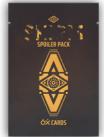
8 storybooks


1 Book of Vantages

1 game board
60 boost tokens (cubes)

20 challenge dice
6 time trackers (1 per player)
60 skill tokens


6 morale trackers (1 per player)



45 coins
6 health trackers (1 per player)
12 skill dice



6 location card holders (1 per player)
The cards in Vantage are never shuffled, so no sleeves are necessary. Replacement parts can be requested via the form at stonemaiergames.com/replacement-parts.

SETUP
① Place the game box on the table next to a player in charge of finding and returning cards (they gain placeholder cards 1709-1714); this is more efficient than passing the box around the table. Tilt the three big stacks of large cards out of their flat-packed position.
Place the board (the "center") in the middle of the table with time, morale, and health trackers nearby. Both sides of the board are functionally the same.
Place all skill tokens, coins, boost tokens (cubes), skill dice, and the storybooks in a general supply near the game board (the "center"). The backs of most storybooks have reference guides.
Seed the challenge dice pool with 8 challenge dice plus 2 per player (e.g., for three players there are 14 dice), then return the remaining challenge dice to the box.
Each player gains a location card holder. Randomly select someone to be the first player.
Place the Book of Vantages on the table with the back cover facing up to display location 000. Follow the instructions on location 000 to complete setup, using skill dice for randomization. It is here that each player will independently gain their character and starting stats.
For your first game we recommend the "daring“ starting level for time, morale, and health and avoid difficult crash locations. Other recommendations for your first game are found on page 13.
You can watch a rules video at stonemaiergames.com/games/vantage/rules-faq.
GAMEPLAY OVERVIEW
The game consists of players taking turns clockwise around the table. Each player performs 1 action per turn (unless indicated otherwise), using skills contributed by any player to decrease the action cost; rolling challenge dice based on that cost to determine any complications encountered; and placing dice on cards in grids to mitigate those complications. You always succeed when performing an action; the challenge is to avoid losing time, morale, and health.
You will typically begin the game by exploring the area where you arrive—which will be different than the other players—and interacting with various locations in the hopes of adding cards to your 3x3 grid; these cards offer additional challenge dice placement slots and other powers. One or more players may pursue the shared mission (why you traveled to this planet), and along the way you may discover various destinies (options for resolving your fate on or beyond this world). You must discover destiny cards—there is no destiny revealed during setup. Work together to share knowledge, skills, and impact dice slots as you seek to avoid any player's time, morale, or health being reduced to 0.
Universal Rule of Thematic Fun
If you are ever in doubt about a Vantage rule, card, ability, or anything else, choose the most fun answer that makes sense thematically.
We are always happy to help in real time or after your game if you post your question (aided by details about the situation, including exact text, when available) in the Vantage Facebook group, on BoardGameGeek, on the Vantage FAQ page on our website, or on the Stonemaier Games Discord server. Rulepop (vantage.rulepop.com) is also available for rules, errata, and digital storybooks.
Sharing Information
Since your location represents your vantage (what you can see), only you may look at your current location card.
▶You may not look at any of your previous locations or the locations seen by other players. You may describe the card's artwork to other players, read the description aloud to them, and share the location action options.
▶If you are directed to look at a page in the Book of Vantages, you may look at only that page, and you may not show it to other players.
▶Tokens, dice, cards in each player's grid, reserve, and supply, and cards you are instructed to place on the table are public information.
Storybooks
On most turns in the game, short passages of text in a storybook are referenced: Early in your turn you will read the cost and the action (in bold), then later in your turn you will read the result (unbold text). We recommend that players share the responsibility of reading aloud, with another player reading on your turn so you can focus on the mechanisms of performing an action.
Solo Play
Solo play in Vantage is the same as any other player count (the number of challenge dice scales as normal, with 10 total dice in a solo game). There is no Automa to represent the other characters—you are in full control. No matter the player count, you only ever control 1 character (we highly discourage you from breaking the immersion by playing multiple characters).
LOCATION CARDS
Your location card represents your current position on the planet, and it includes what you can see and many of your action options. Keep it in your location card holder.
Specific numbers in the descriptions below are examples referring to the sample location below.
① Art (background): This is your vantage. You may describe this view to the other players but not show it to them, as they are elsewhere on the planet and can't see through your eyes.
Location number (upper left): Provide this number to the other players when you interact with this location so they can find the corresponding entry (272) in a storybook
Compass (upper right): This symbol shows the 4 different cardinal directions to which you can depart from this location (forward is always north). The compass may include:
• Adjacent listed locations (e.g., 500, 273, and 271): Departing to any of these locations is a 1-cost move action without a storybook entry.
• Unlisted adjacent locations: After choosing to depart in the direction of a location, the cost is revealed in the Depart storybook for this location number (e.g., 272 move south)
• Blocked locations: If there is no number or *, you cannot depart from this location in that direction.
Description: Brief text about the location. You may read this to other players.
• Some locations show the icon in the bottom left, followed by text in quotation marks. This means that the mysterious Traveler is talking to you at this location.
• Aicon indicates a mandatory instruction that must be followed immediately upon arrival (typically a climate-related penalty; see page 10).
• Elemental icons (e.g.,) indicate an interaction with something of that composition.
These are the different ways you can interact with the location within the categories of move , look G, engage , help ©, take , and overpower (e.g., look-stuDY). Unless an action result indicates otherwise (see "End your turn" on page 11), you may only perform 1 location action per location.

SAMPLE TURN
This page provides a brief overview of a sample turn, and each of the steps described here will be explained in detail on pages 7-11 and the action flowcharts found on the back cover of most storybooks. 272
-
Choose one action from the three types of actions: I'm at location 272, and decide to perform a location action (see page 7 for information on the three action types). I read my location's description aloud and describe what I see. The area does not look dangerous, so I commit to performing the move-WANDER action (I cannot change my mind after proceeding to the next step).
-
Read the cost and action (not the result): Another player finds entry 272 in the move storybook and reads the cost (3) and the action ("WANDER around the mysterious area"). They do not read the action result.
-
Reduce the cost by 1 per matching skill optionally paid by any player: I do not have a move skill token, but another player does. They discard 1 move skill token to reduce the cost by 1.
-
Roll dice from the challenge dice pool equal to the remaining cost: I roll 2 challenge dice, resulting in 1 time and 1 health I have to deal with (thematically, the action took more time than expected and I hurt myself doing it).
-
Place rolled challenge dice one at a time on grid cards (any slots on your cards and impact slots on other players' cards): My character, the captain, has both challenge dice slots open. I am performing a move action, so I can place any die on the move slot—I choose the time die for this—and gain 1 boost () as the immediate output, placing a cube on my character. I only have my character card in my grid and no other player has an open impact () slot for health results, so I cannot place the health result.


-
Suffer penalties from rolled-but-unplaced challenge dice: The unplaced die showing health goes to the penalty section of the center and I lose 1 health (adjusting my tracker). The time die remains on the character card.
-
Read the action result: Another player reads the result for entry 272 in the move storybook.
-
End your turn: The action result did not say "continue," so my turn ends here. If the action had said to "continue," I'd be required to perform another action; if it had said, "You may continue," it's my choice to perform another action or not. This only applies to my current turn; I may not continue at this location on a future turn unless another action allows me to do so. The player to my left takes the next turn.
HOW TO TAKE A TURN (PAGES 7-11)
On your turn, perform one action by following a few steps in order (these steps are also shown in a flowchart on the backs of storybooks). You will always succeed when performing an action; the challenge is to avoid losing time, morale, or health. After your turn, play proceeds clockwise to the next player.
- Choose one action from the three types of actions (location, card, and depart). You will choose the action for your turn without knowing the cost or results, but you will always succeed.
▶Location Actions: Each location lists (usually 6) location actions in the categories of move , look G, engage , help ©, take , and overpower t.
• Reference the storybook entry for this location (e.g., for the look-STuDY action on location 272, reference entry 272 in the look storybook)
• If you previously performed a location action here (even in a turn some time before the last), you cannot perform another. Choose a depart action or card action instead.

"Always available": Some location action lists may have a note indicating that a specific action is always available. This action is available even if you previously performed it or another location action here.
STEER is always available.

• If another player previously visited the same location this game, you may not perform a thematically contradictory location action (e.g., if a player previously burned a bridge at your location, you may not cross the bridge). Because Vantage is a highly visual single-session game, players should be able to remember where they've been or what they've done (taking notes is permitted if necessary, though).
▶Card Actions: Many non-location cards include action options. These include actions on cards in your grid, your supply, and the center.
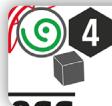
CRAFT a more advanced item (reserve this): Gain a harpoon bow (960).
• Reference the storybook entry for that specific card (e.g., for a help-EquIP action on card 1435, reference entry 1435 in the help storybook).
• You may not look at the card you are gaining (if any) until you have completed the action.

• Unless stated otherwise, you may perform a card action even if you have already performed an action on that card.
▶Depart Actions: Move away from your location in 1 of 4 cardinal directions to another location (north always points forward). This is a move action.
• Each number (500, 273, and 271 for this location) is an adjacent listed location. You may go to any of these locations using a 1-cost move action (wALK or SwIM) that does not use a storybook.

• Each star (*) requires you to reference the Depart storybook. For this location, you would look at the "move south" entry for location 272 in the Depart storybook for the cost, action, and result of moving south from this location.
• In the rare case that a direction shows neither a location number nor , you cannot depart from this location in that direction.
You have nearly complete freedom as to the action you choose, as there is no resource prerequisite/ expense when making this choice. You may not change your mind about the action after reading the cost and description. A big part of the game is intuiting, discussing, and learning by trying.
- Read the cost and action (not the result). As illustrated in step 1, the cost and/or action are printed on some cards, though most require players to reference a storybook. In most cases you will use a storybook entry to see the cost and full action. Use the storybook matching the category (e.g., engage) and the entry matching the card on which the action appears (e.g., location 272).
Some cards include the full cost, action, and result—do not reference the storybook for these actions. In addition to the type of action and the standard cost (the quantity of challenge dice to roll in step 4), some actions on grid cards also have a boost cost (; a cube paid from that card). In the example to the right, this is a 4-cost help action that requires you to also pay 1 boost.

▶If the depart action you chose is to an adjacent listed location, the move cost is 1. Other adjacent locations are marked with ; you must look up their move cost in the Depart storybook after declaring a direction. If you move in a specific orthogonal direction (e.g., move east) and there is a related diagonal direction entry in the Depart storybook (e.g., move southeast), you may choose to move in that related direction instead of your original choice.
Regions: Some location actions refer to the region (a broader area encompassing multiple locations), which is a letter noted in parentheses in the look storybook entry for your location.
▶For actions with cost, choose a number 1-6 as the cost. This indicates how much effort you will put into the action, and the result of the action will depend on the cost number you choose.
RESULT
272 () 3 STUD↓ the blobs:
- Reduce the cost by 1 per matching skill optionally paid by any player. Using skill tokens to reduce the cost will decrease the potential to lose time, morale, and health due to unplaced challenge dice.
▶Skills (tokens) represent insights and advice.
▶Players may pay skills to benefit each other at any time, not just to reduce action costs.
▶Discard paid skill tokens to the general supply. You are limited to the tokens provided.

- Roll dice from the challenge dice pool equal to the remaining cost. The cost of an action represents its difficulty; roll challenge dice from the pool equal to the numerical cost (e.g., for a cost of 2, roll 2 challenge dice).
▶For example, if the cost is and a player paid 1 look skill token, roll 2 challenge dice instead of 3. If the cost was decreased to 0 in the previous step, do not roll any challenge dice.

▶If (and only if) there are fewer available dice in the challenge dice pool than the remaining cost, first refresh ALL challenge dice from cards in grids and the penalty section of the center by returning them to the challenge dice pool. This is a good thing! Now all dice slots are open again. For example, if the remaining cost is 2 but there is only 1 die in the challenge dice pool, first refresh all challenge dice, then roll 2 of them from the full pool.
▶The total quantity of challenge dice in the game is always 8 dice plus 2 per player (any excess dice are not used—keep them in the box).
5. Place rolled challenge dice one at a time on your grid cards (and impact () slots on any players' grid cards). By placing a die on an open slot, you avoid suffering its penalty.
▶Each slot can hold at most 1 die. Most slots have restrictions on which types of challenge dice can be placed. For example:

Skill type (e.g., you may only place a challenge die here during a move () action).

Many slots have a , or, indicating that only a die showing that specific result may be placed there. For any slot without a specific die face, any result may be placed (even).
Ability (e.g., you may only place a challenge die here during a help-CREATE action). Important: If you have dice slots or powers related to abilities, pay close attention when moving to a new location, especially if someone else is reading the storybook to you.

Interaction (e.g., you may only place a challenge die on this slot during an action involving a sinew ( creature. This includes location actions and card actions showing this icon, plus interactive depart actions (e.g., "Sneak past the creature“).

Some slots provide immediate bonuses when you place a challenge die on them (arrow pointing away from the slot; place the gained boost on the same card). While the bonus is typically a boost, other bonuses are also possible (a skill, /, a specific card, etc).

To place a challenge die on a terrain-specific dice slot (e.g., underwater, identified visually from the art), your current location must match that terrain.
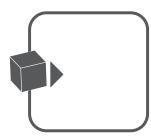
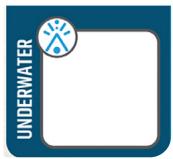
Some slots have costs to place a challenge die (arrow pointing towards the slot; you must pay the boost (1 or 2, as indicated) from the same card).
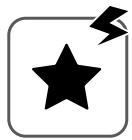
Impact () dice slots may be used by any player (with your permission), even if they are at a different location. They represent expertise and personality (e.g., a character with a morale impact slot is someone with a positive attitude and leadership qualities). If another player places a challenge die on your impact dice slot and there is a bonus (e.g., a boost), you gain it.
▶If another player is at your location, you may place challenge dice on open slots on their cards (even non-impact slots) with their permission.
▶ If another player has a location-specific card in their supply and you are on that card's location, you may perform actions on that card.
▶Whenever a challenge die is placed on a slot, it remains there until all challenge dice are refreshed (see step 4 on page 8).

6. Suffer penalties from rolled-but-unplaced challenge dice, then discard them to the penalty section of the center.
These symbols represent the loss of time, morale,
and health respectively. If you can't place these dice on cards, discard them to the penalty section of the center, and lose the time, morale, and/or health shown on those dice by adjusting the appropriate tracker. These losses are applied simultaneously. If any of these stats is ever reduced to 0, read the mission's entry in the take storybook.
V This symbol represents a setback. If you don't place dice with this symbol, return them to the challenge dice pool (this delays the potential for a full refresh, when all dice are returned to the pool from cards in grids and the penalty section).
V This symbol represents a blank result (this is good). Discard this die to the penalty section of the center.
7. Read the action result. Most actions result in an immediate benefit described in the storybook (or on the card for some card actions).
▶In multi-option lists, make a choice before learning or viewing the outcome (e.g., if you choose to move to location 259, you only look at that card after making the decision).
244 (A) ②INSPECT the orb: The orb is made of a shimmering, glass-like substance, and there are markings on the outside with which you might be able to interact. You don't see how to access the interior, but there must be a way inside. Gain 1 boost and either 1 engage or 1 take; you may continue.
▶If your location changes as a result, the player in charge of managing the cards will use your placeholder card to return your current location card to the box, find and give you the new card, and mark the new card's position. In the rare case that you move onto a location on either side of someone else's location card, simply pass it back and forth.
▶If a location's(upon arrival) effect—or any other penalty—instructs you to suffer 1 heat, cold, or hypoxia damage, lose your choice of either 1or both 1and 1
▶If you would ever gain//when that stat is already at the max of 6, instead gain 1 random skill (roll a skill die and gain a skill token matching the result).
Skills
• If the results include a skill payment (e.g., pay 1 move or 1 overpower), any player may discard a skill token so that you can gain the benefit. If no one pays, you do not gain the benefit.
• If the results include a skill benefit (e.g., gain 1 move or 1 engage), gain a skill token of that kind.
• If the results instruct you to gain a random skill, roll a skill die to determine the token to gain. Sometimes the benefit is a specific skill (e.g., "Roll 2 skill dice and gain all move results").
▶If another player is on your location, during this step you may:
• depart/move them with you (simultaneously, with permission; they don't pay the cost), and
• give them coins, items, flora, and vehicles (ignore "when placed" effects on exchanged cards; the exchanged cards retain all challenge dice but lose all boost).
▶If an action result or any consequence causes you to lose something that you don't have (e.g., lose ① when you have no money, lose a card in reserve when you have no cards in reserve, etc.), ignore those instructions. This rule only applies to results, not costs—if you can't pay a listed cost, you may not gain the benefit.
If you would ever gain a card you already have in your grid, instead gain 1 boost on the card (if possible).
If you would ever gain a card another player already has, the two players decide who keeps/gains it. If the card goes to you, any challenge dice on the card are refreshed and any boost are lost, and you gain "when placed" benefits on the card, if any. If the card remains with the other player, you instead ,gain 1 boost on your character (if possible).
- End your turn. If a location action's result includes instructions to "continue", you must perform an additional action, ignoring the restriction in step 1 (e.g., if you already performed the engage location action, you may choose another location action, but not the same engage action).
▶Some results include instructions to continue with a specific action. If it is an action noted on the location, start with step 2. Otherwise, start with step 1.
▶Some non-location actions include instructions to "continue," but these do not ignore the restriction in step 1.
▶The instructions sometimes read, "You may continue"; in that case, continuing to perform another action is a choice, not mandatory. This only applies to your current turn; you may not continue at this location on a future turn unless another action allows you to do so.

BOOST
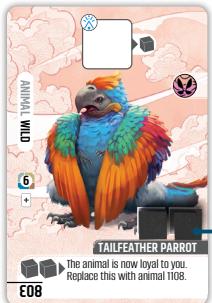
At any time on any turn (even in the middle of an action or while another player is performing an action), you may use boost () powers on cards in your grid to benefit yourself. Boost represents knowledge learned while you explore the planet and use the things you discover.

BOOST GAINED/PAID ON LOCATIONS (AND THIS CHARACTER CARD)
BOOST GAINED/PAID ON THIS CARD
▶Boost gained/paid on locations goes to/from your character (e.g., if the storybook text of a location action says to "Gain 1 boost," place it on your character)
▶Boost gained/paid on all other cards goes on/from that card.
▶Each card has limited capacity for boost that cannot be exceeded.
▶The effects of boost powers last until the end of the current turn.
▶When an icon () is used instead of the word "boost," the number of icons represent the amount of boost.is 1 boost,is 2 boost
▶There is no hard limit on total boost tokens in Vantage. In the rare case that all 60 boost tokens are on cards and you need more, any cube is a suitable addition.
▶If a challenge dice ability says "place them in the center," it's referring to the penalty section of the center (otherwise it would say to "refresh" the dice, which returns them to the challenge dice pool).
▶Some cards request that players place ubiquitous "tokens" to track progress; boost tokens are used for this purpose.
▶Your boost powers benefit you. If a boost power has an impact () icon, it can benefit any player.
CARD GRID
Whenever you gain a vertical card (same size as your character card), place it in any open space in your 3x3 grid: a tableau of up to 9 cards with your character in the middle. You may not reposition cards in your grid. The first time a player completes their grid, place destiny 1705 in the center.
▶Other than impact () slots/powers, any benefits provided by cards in your grid only apply to cards in your grid (not cards controlled by other players or in your reserve).
▶Whenever you replace or lose a card in your grid, refresh any dice on it and return any boost on it to the general supply. Return lost cards to the box. You must always have your character card in your grid. Insert the new card in the same position as the replaced card.

▶Adjacency in Vantage always refers to orthogonal adjacency (cards that touch at edges left-to-right or top-to-bottom).
Reserve
You also have a limited capacity to reserve vertical cards outside of your grid (capacity is the total of all + icons on cards in your grid and supply). Whenever you gain a card but your grid is already full, you may either reserve the new card or reserve a card in your grid (other than your character card) to make space. Then, if this exceeds your reserve capacity, lose an excess card from your reserve.
▶You may not use slots, abilities, or powers on reserved cards, but they retain boost tokens. When reserved, a card's challenge dice are refreshed.
▶Each character has a boost power to transfer a reserved card into their grid (to an open space or swapping with a card); do not gain "when placed" benefits of cards transferred from reserve.
Supply
Some cards you gain are horizontal, not vertical. These cards are either shared with all players (missions and destinies) or are kept in your supply. There is no limit to how many horizontal cards you can have in your supply. You may not place challenge dice on horizontal cards in your supply.
CARD ANATOMY

END OF GAME
A game can end in several different ways, and the storybooks will give you the option (or the requirement) to end the game when:
▶You complete the mission (completing a mission will give you a choice between ending the game and continuing to pursue a destiny).
▶You complete a destiny (and then choose to read its storybook entry, which will end the game). You may collect multiple destiny cards.
▶Any player's time, morale, or health is reduced to O. If this happens, read the mission's entry in the take storybook.
You may even end the game when the time you allotted to play Vantage has expired. There is a lot of variation in the duration of Vantage depending both on random factors and player choices (e.g., performing the actions printed on the mission can significantly decrease the duration). Some games may end far quicker than 2 hours, while others might push beyond the 3-hour mark.
In addition to a mission victory, a destiny victory, or an epic victory (both the mission and a destiny are complete), you may define success through anything you pursue and achieve.
When the game ends, return all cards and components to the box (any cards gained from the spoiler pack return to that pack). In other words, everything completely resets so you can have a new adventure the

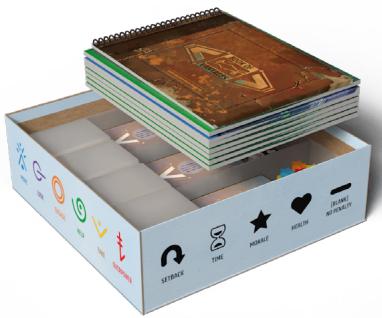
next time you play Vantage. For storage purposes, lay the 3 stacks of location cards flat inside their compartments with various tokens/dice in the gaps that remain, then place all storybooks on top of them.
BEFORE YOUR FIRST GAME
▶For your first game we recommend using the “daring" starting level for time, morale, and health and avoiding difficult crash locations. These settings are found on location 000 and on the escape pod locations. Make bold choices while playing, as the first time a player's time, morale, or health is reduced to 0 doesn't necessarily end the game—you will have an option to continue playing as presented by the mission's entry in the take storybook.
3 Each player sets the //trackers matching their character color to: 3 (brazen) 4 (daring) 5(practical) 6 (cautious)
▶Your first game is largely about experimentation as you learn about different actions, consequences, and risk tolerances in Vantage. This is more important than the mission; instead, just try to fill your grid by gaining 8 cards from different locations (and from actions on cards in your grid). It's perfectly normal if you don't achieve this goal. If you'd like some direction or want to speed up the game, you can perform the actions printed on the mission card.
▶Discovery and perception are significant elements of Vantage. You will wonder how to do and find things—that is a normal part of the discovery curve of this game, and the game will not hold your hand. Just try things that intrigue you. Use your eyes and intuition: If an action looks difficult, it probably has a high cost. Some actions will turn out differently or be more difficult than what you expect; this will help the next time a player sees that type of action. When in doubt about a rule, apply the Universal Rule of Thematic Fun in the moment (then ask about it later).
▶Communication between players is critically important, and not just for sharing skills and impact dice slots (which represent sharing your advice and expertise). Each player's choices are their own, but any information you have from what you have seen and experienced is yours to share freely. To succeed, you will often need to describe what you see and discuss your options, both for shortterm and long-term goals.
Glossary
The glossary, which is found on page 10 of the Book of Secrets, lists many of the types of cards and terms you may discover while playing Vantage. We highly recommend only reading a glossary entry if you have questions, and only after encountering a specific type of card or a specific term. For example, the first time you see a Lesson card, you may look up the word "Lesson" in the glossary.
Special Thanks
Vantage has been a passion project for me (Jamey) for over 8 years, but I was not alone in this endeavor. In addition to the monumental effort of creating an entire planet through nearly 1700 illustrations by Valentina Filić, Sören Meding, and Emilien Rotival, I am forever grateful to Juliana Moreno and Ariel Rubin (The Wild Optimists) for creating some of the in-game puzzles, Ira Fay for creating the playtest app from scratch, Shannon Lentz at Panda Game Manufacturing for years of discussions about components, Jose Manuel López-Cepero for creating the web app, Karel Titeca and Christine Santana for typesetting and graphic design, Morten Monrad Pedersen and the Automa Factory team for their help with the solo rules for the spoiler pack, developers Garrett Feiner and Travis Willse for their detailed feedback and editing, and Ryan Davis and Travis Willse for adding extra flair to many of the Move and Depart storybook results.
Playtesters: Mike Bartoo-Abud, Mitch Caudill, Blake Chursinoff, Caleb Chursinoff, Dusty Craine, Ryan S. Davis, Susannah Eisenbraun, Mark Espiridion, Ira Fay, Allie Feiner, Garrett Feiner, William Augustus Griffin Sr., Lindsay Grossmann, Ossian Hawkes, Wanja Heeren, Preston Holmes, Chris Ingold, Josh Jahner, Ben Jepsen, Abigail Jones, Emily Jones, Derik Kellner, Robert Konigsberg, Max Lüdov, Tyler McKinnon, Thom Mollinga, Chris Munford, Jay Nabedian, Crystal Nevin, Jason Nevin, Nicolas Pupat, Gregory Rempe, Caroline Rempe, Clara Rempe, Dominick Salazar, Ana Salazar, Erica Sanders, Artur Carvalho Santos, Nathan Smith, Franziska Steiner, David Studley, Lieve Teugels, Karel Titeca, Kobe Titeca, Michael Vannoy, Josh Ward, Travis Willse, Shawn Wilson, Darren Wolford, Frank Wolf, Kentoku Yamamoto
Proofreaders: Brian Chandler, Garrett Feiner, Jan Horák, Jared Kepron, Mike Lee, Crystal Nevin, Justin Radziewicz, Asa Swain, Karel Titeca, lan Tyrrell, Jay Voss, Josh Ward, Travis Willse, Dana Woller, Dave Zokvic
I’m also incredibly grateful for the many amazing games that inspired Vantage in some way, including The Legend of Zelda: Breath of the Wild (and Tears of the Kingdom), The Witcher 3, Baldur's Gate 3, Eastshade, Stardew Valley, Subnautica, Red Dead Redemption, Ghost of Tsushima, Elden Ring, Tunic, TIME Stories, The 7th Continent (and Citadel), Sleeping Gods, Tainted Grail, Earthborne Rangers, Near and Far, Crusoe Crew, Lands of Galzyr, Micro Macro, One Deck Dungeon, and Roll Player Adventures, among others.

WANT TO WATCH A HOW-TO-PLAY VIDEO OR READ THE FAQ?
Go to stonemaiergames.com/games/vantage/rules-faq This is where we will post clarifications or revisions. Rulepop (vantage.rulepop.com) is also available for rules, errata, and digital storybooks.

vantage.rulepop.com
HAVE A QUESTION WHILE PLAYING, A STORY TO SHARE,AN INTEREST IN SPECIAL CHALLENGES, OR A FINAL GRID TO BOAST ABOUT?
Post it on the Vantage Facebook group, on BoardGameGeek, or in the Vantage channel of the Stonemaier Games Discord server: stonemaiergames.com/discord (you can play remotely with others who own Vantage using the Discord server)
NEED A REPLACEMENT PART?
Request it at stonemaiergames.com/replacement-parts
WANT TO STAY IN TOUCH?
Subscribe to monthly updates at stonemaiergames.com/e-newsletter
FRIENDLY REMINDERS
▶You may always talk openly with other players and share the text of any card, but you may never show your location to anyone else (unless a card specifically says to do so), nor may you look at any location you are not currently on.
▶When you depart to an adjacent listed location, it is a move action with a cost of 1. Proceed with all steps to complete a 1-cost move action; just like any action, this movement is your entire turn.
▶When placing challenge dice, unless specified by a challenge dice slot, you can even place blank () and setback () results. For example, if you roll 1 challenge die to move to an adjacent listed location and the result is blank, you could place it on a general move slot on a card in your grid (to gain a boost bonus), even though there is no penalty for not placing it.

▶Instead of choosing a location action on your turn, you may perform an action on a card in your grid, your supply, or the center. If you do, view the entry for that action using the number at the bottom of the card.
▶To use a card's boost power, spend boost () from that specific card. If you gain a boost from a location action, place it on your character.
▶You can only perform 1 location action per location per game unless an action instructs you otherwise, or if the card specifies that the second action you take is always available (e.g., you cannot perform the take action on a location and then later perform the overpower action there). Other than this restriction, you have complete freedom to choose your actions.
▶You cannot read the cost or results of an action before performing it. Likewise, some action results include more choices; you can read the choices while selecting, but not the results.
▶The only "persistent" element in Vantage from game to game is information. Everything you learn about the world can benefit you in future games, and we encourage players to use that knowledge to their advantage. Please respect other players' desire to avoid or learn what you already know.
▶For a comprehensive list of ways to make Vantage easier or harder, see "Difficulty" on page 11 of the Book of Secrets.

原文为社区整理/出版社公开资料,版权归原作者,仅供个人学习查阅。