
Viticulture
At a glance
Rules, cards and Q&A (Chinese)
The rules, card data and player questions for this game are written in Chinese. Open the Chinese page to read them.
Where to find full rules
Full rules and card lookup are available in the cunlema app at cunlema.cn — pick this game and ask about any rule, card or turn you are unsure about.
Related games
Rulebook text (Markdown)
This game has 3 rulebook Markdown file(s) in our library; 3 rendered inline below — expand to read or download.
rules_zh_葡萄酒庄园_800.md25.6 KB
VITICULTURE
翻译:小柴 Translate by Lo Koshiba
一款關於釀酒的策略遊戲
by Jamey Stegmaier\~& Alan Stone'
*
舊世界托斯卡尼正等著你的釀酒技術和熟練的策略。
你將種植葡萄樹、採收葡萄、熟成美酒,並且完成商人的訂單,成為義大利最棒的酒廠!
2-6人遊戲,年齡13歲以上·遊戲時間45-90分鐘
葡萄園是一款工人擺放機制的策略遊戲,只要一張桌子和另一個玩家就可以讓玩家創建他們自己的托斯卡尼葡萄園。
遊戲概述
玩家在遊戲一開始會有一個舊的葡萄壓榨桶、三塊空的田地、一個小的酒窖,以及三個工人。玩家在遊戲中整年需要分配他們的工人做事,而且偶爾會有訪客可以讓玩家完成許多任務。春天時,玩家決定他們工人的行程表。工人很早起的話,你將有機會第一個行動;然而,工人晚起的話將會獲得越來越好的獎勵。夏天時,玩家把工人放到行動區域,可以讓工人種植葡萄以及建造可以讓玩家的葡萄園升級的設施。秋天時,玩家邀請訪客來幫助他們的工人。冬天時,玩家把工人放到行動區域來採收葡萄、釀酒,以及完成訂單。
目標
身為葡萄園莊主,分數代表你的名聲,遊戲目標是達到20分。當有玩家到達20分的位置,當年度整個進行完之後,最高分的玩家獲勝。玩家或許會超過20分的目標,但是最多不會超過25分。如果平手的話,依以下條件決定勝負(按順序):
1·最多里拉(義大利貨幣單位)
2 · 酒窖裡,酒的總價值
3·葡萄壓榨桶中的葡萄總價值
遊戲配件
卡片(總共118張)
* 42 張葡萄樹卡(綠牌)
* 36 張葡萄酒訂單卡(紫牌)
* 20 張夏天訪客卡(黃牌)
* 20 張冬天訪客卡(藍牌)
圖板(雙面)
* 1 張遊戲圖板
* 6 張葡萄園圖板
其餘配件
*36個工人米寶,有6種顏色,以及1個灰色暫時性工人
*60個葡萄和葡萄酒指示物
* 6個起床指示物(公雞)
* 6個分數標記(軟木塞)
* 6個剩餘款項記錄標記(酒瓶)
* 48個木製設施指示物(每個顏色有8個獨特的指示物)
*108個紙板里拉(78個銅色1元、18個銀色2元、12個金色5元)
* 1個起始玩家標記(葡萄)
規則書
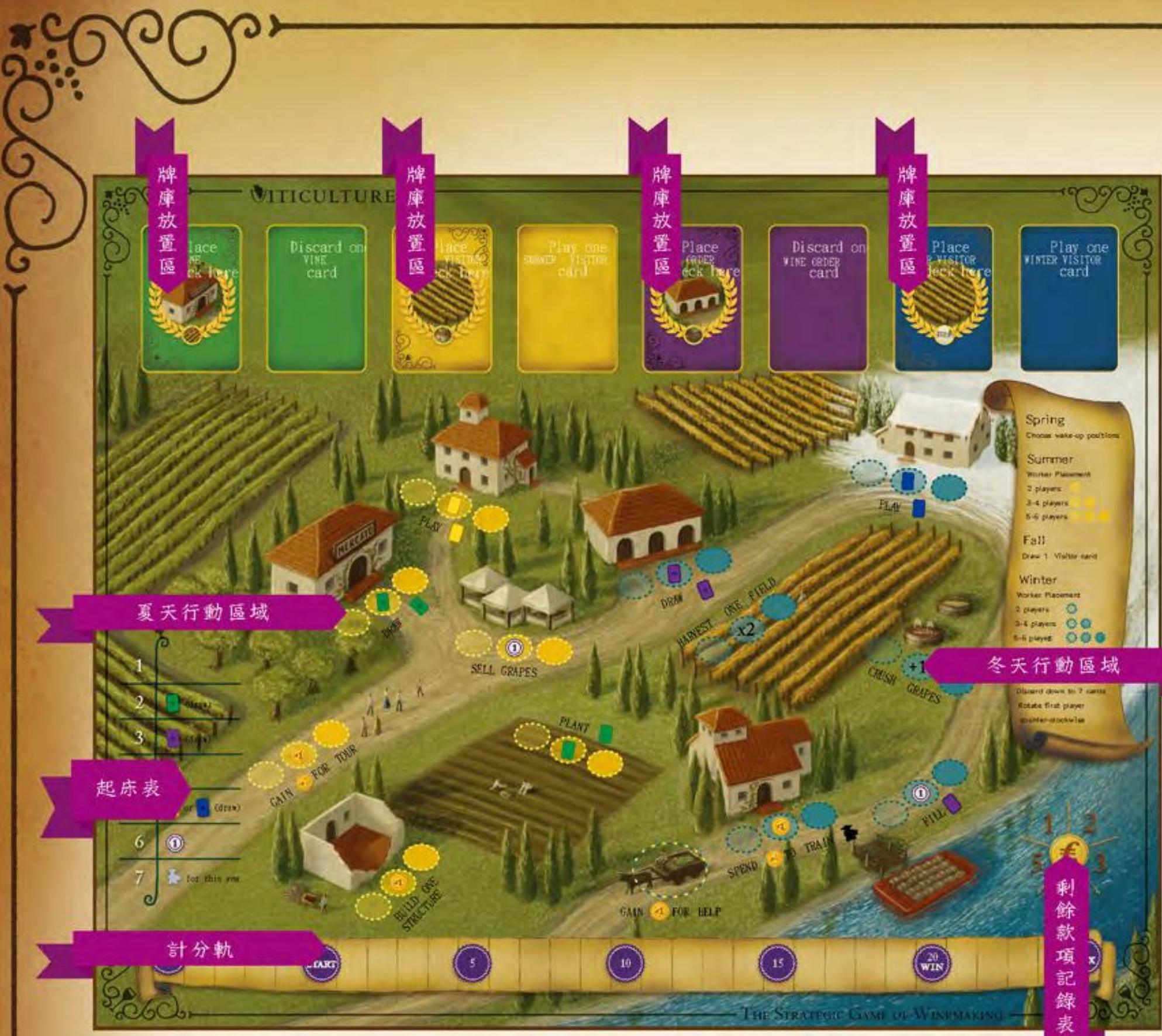

遊戲設置
把每個玩家的公雞放到起床表旁,軟木塞放到計分軌上的 位置。每個玩家也把酒瓶放到剩餘款項記錄表上
注意1:計分軌上有負分,在一些夏天及冬天訪客卡會用到。玩家在計分軌上不會扣到比-5還低的分數。如果玩家已經-5分,他不能使用一張訪客卡來失去更多分數。
注意2:遊戲圖板和玩家圖板是雙面的。其中一面有文字是給初次遊戲的玩家使用,另一面沒有文字是給有玩過的玩家使用。除了文字以外,這兩面沒有什麼不同。
遊戲流程
洗混四疊牌庫後,每個玩家開始遊戲時有以下配件:
*一個葡萄壓榨桶、一個小酒窖,以及三塊田地(通通都在葡萄圓圖板上)
* 塊錢
*1 張皮諾葡萄樹卡
* 1 張隨機黃色夏天訪客卡
* 3個工人
第一輪
*第一場遊戲晚上,年紀最大的玩家拿取起始玩家標記。
*其他場遊戲的起始玩家由上
一場遊戲最低分的玩家擔任
牌庫重整:如果四疊牌庫任何一疊在遊玩過程中用完了,馬上洗混棄牌堆形成新的抽牌堆。如果牌庫用完了,但是棄牌堆裡沒有卡片的話,該牌庫沒有牌可以抽,直到有更多卡片被棄掉時才會有新的抽牌堆。
春天
由起始玩家開始,並依順時針進行遊戲,玩家藉由放置公雞到起床表上來選擇這一年要多早起床。每個玩家馬上得到表上對應的獎勵。等所有玩家都放完公雞後,表上的順序即為玩家這一年接下來的行動順序。
夏天
夏天時,根據起床表的位置,每個玩家放置一個工人到圖板上一個黃色夏天行動區域,並且馬上執行該行動。下一個玩家做同樣的動作,直到所有的行動區域都被執行過、所有的玩家都跳過,或者所有玩家都無法執行行動。如果玩家已經喊跳過,在下一個行動季節開始前,他不能再放其他的工人。(所有夏天的行動區域在第6及第7頁有說明。)
秋天
秋天時,根據起床表的位置,每個玩家抽一張夏天或冬天訪客卡,並把這些牌加到手牌中。任何有在他們的葡萄園圖板建造小屋的玩家可以多從夏天或冬天訪客卡牌庫抽一張訪客卡。
冬天
冬天時,玩家和夏天的遊玩方式一樣,使用藍色冬天行動區域。如同夏天,擺放工人的順序根據起床表的位置,表上位置最高的玩家為第一個行動的玩家。(無論上一季最後一個行動的玩家是誰。)
一年結束
每一年結束時,玩家將會熟成葡萄及葡萄酒指示物、把工人拿回個人遊戲區域、獲得剩餘款項,並且把起始玩家標記逆時針傳給下個玩家。
術語解釋:
在這本規則書中,你會注意到價值和價格這兩個術語。
價值指的是一個葡萄變成葡萄酒以及葡萄酒在完成一個訂單時的價值。
價格指的是一個葡萄在賣出時會得到的金錢數量。在葡萄園中,葡萄可以在賣出後馬上獲得金錢,當葡萄酒透過葡萄酒訂單「售出」時,則會得到分數和剩餘款項。
春天行動
起床表:由持有起始玩家標記的玩家開始,然後依順時針進行,每個玩家放置他/她的公雞到尚未被佔據的起床格中。數字代表玩家想要讓他/她的工人在這一年多早起床。1 是最早的時間,7 是最晚的時間。對工人來說,越晚起越好;對葡萄園莊主來說,可能不是。

貼心提示:當玩家夏天跳過時,他可以把他的公雞從起床表上由左往右移動,這樣還可以動作的玩家就比較容易分辨了。接著當玩家冬天跳過時,他們可以把他們的公雞移回左邊,這會幫助玩家分辨現在是誰的回合。
範例:玩家1,該玩家有起始玩家標記,他選擇起床表6的格子,可以獲得1分。玩家2選擇第4格,並且獲得 $^{①}$ 。因此,即使玩家1有起始玩家標記,但在這一年接下來的時間裡,根據每個玩家放置公雞到起床表的位置,玩家2將會第一個行動,玩家1則第二個行動。
注意:夏天、秋天,及冬天第一個行動的玩家會還原為該年春天於起床表所選的表格順序。因此,在這個上面這個範例中,即使玩家2(在起床表的第4格)是夏天最後一個行動的玩家,他仍舊是秋天第一個行動的玩家,然後冬天也一樣。
工人放置
*玩家每年只能使用每個工人一次。
*這一年中,玩家輪流放置一個工人到當季每個尚未被占據的行動格。
*玩家只能選擇一個他可以完成的行動:也就是說,玩家不能選擇一個行動只是為了要卡其他玩家。
*如果玩家跳過,他該季就不能再放工人了。

在夏天行動區域的工人
葡萄樹卡的種類和價值
每張葡萄樹卡上有一個的顏色圈圈代表該種葡萄樹的葡萄種類,數字則是代表這個葡萄將會生產的價值。有些卡片在左上角有設施符號(灌溉系統、棚架,或者兩者都有)。種這些葡萄樹前,卡片上對應的設施要先建好。
| 種類 | 顏色 | 價值 | 卡片數量 | 先決條件 |
| 山吉歐維榭 | 紅 | 1 | 4 | 沒有 |
| 馬勒瓦西亞 | 白 | 1 | 4 | 沒有 |
| 皮諾 | 紅及白 | 每個1 | 6 | 棚架 |
| 西拉 | 紅 | 2 | 5 | 棚架 |
| 崔比亞諾 | 白 | 2 | 5 | 棚架 |
| 梅洛 | 紅 | 3 | 5 | 灌溉系統 |
| 白蘇維儂 | 白 | 3 | 5 | 灌溉系統 |
| 卡本內蘇維儂 | 紅 | 4 | 4 | 棚架及灌溉系統 |
| 夏多內 | 白 | 4 | 4 | 棚架及灌溉系統 |
棚架灌溉系统
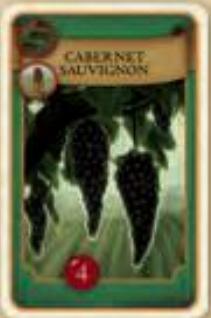
生產一個價值 4 的紅色葡萄
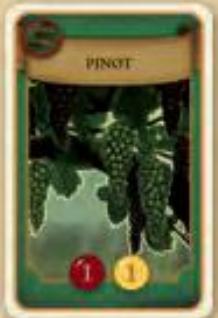
生產一個價值1的紅色及白色葡萄

生產一個價值3的白色葡萄
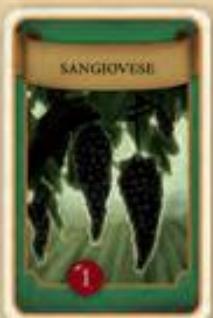
生產一個價值1的紅色葡萄
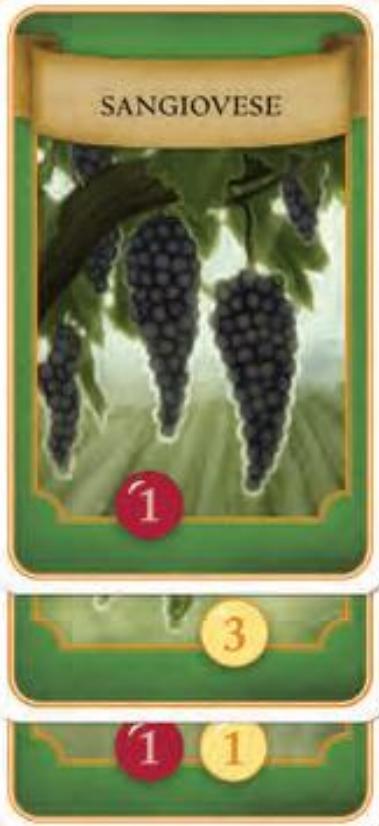
注意1:當一起把田地上卡片的價值加總時,一塊田地不能超過價值6。例如:這個葡萄樹生產一個價值2的紅色葡萄,及一個價值4的白色葡萄,採收時的最大值為6。
注意 2:雖然抽取葡萄樹卡時有一點運氣成分,聰明的玩家會把他抽的葡萄樹卡做最大化的利用並和葡萄酒訂單相輔相成的搭配
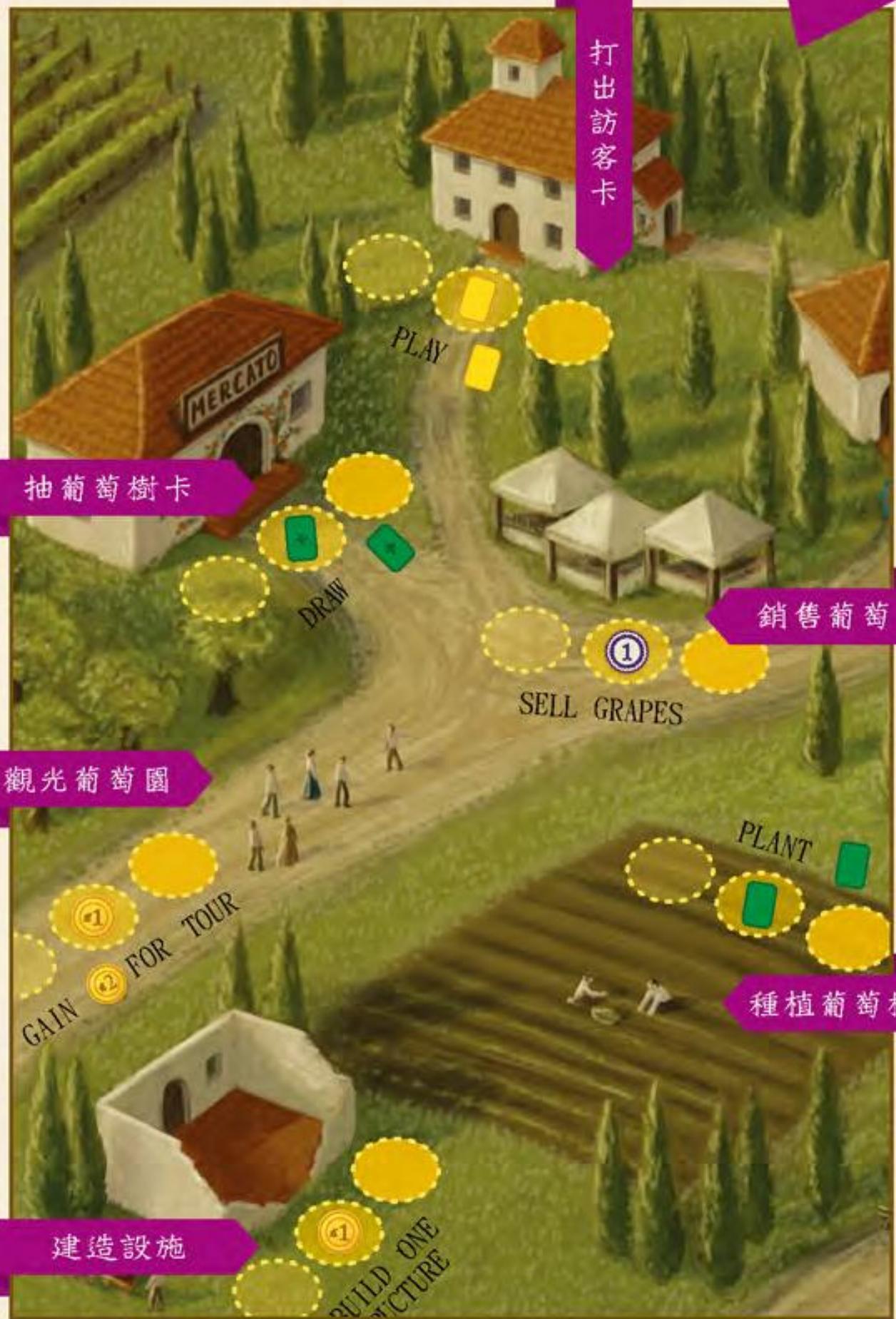
夏天行動
夏季是遊戲中可以擴展你葡萄園的時刻,前往市場、種植葡萄樹、讓你的夏天訪客去工作、炫耀你的葡萄園,並且銷售葡萄。
關於夏天及冬天訪客卡需要注意的地方
注意1:當玩家打出一張夏天或冬天卡時,立刻執行卡片上的行動,之後馬上棄掉這張卡,結束任何這張卡所給予的任何獎勵。
範例:如果玩家打出「買家」夏天訪客卡,上面指示「賣葡萄時價值變為兩倍,並且獲得1分。」,意指玩家馬上賣掉他們所選的葡萄,得到該種葡萄的兩倍價格,獲得1分,並棄掉這張卡,結束特殊獎勵。下一次該玩家賣葡萄時,回復正常價格。
注意2:藉由把一個工人放置到打出夏天/冬天訪客卡的行動區域來打出訪客卡。執行卡片上的行動不需要額外的工人。
外租工人赚取 ①
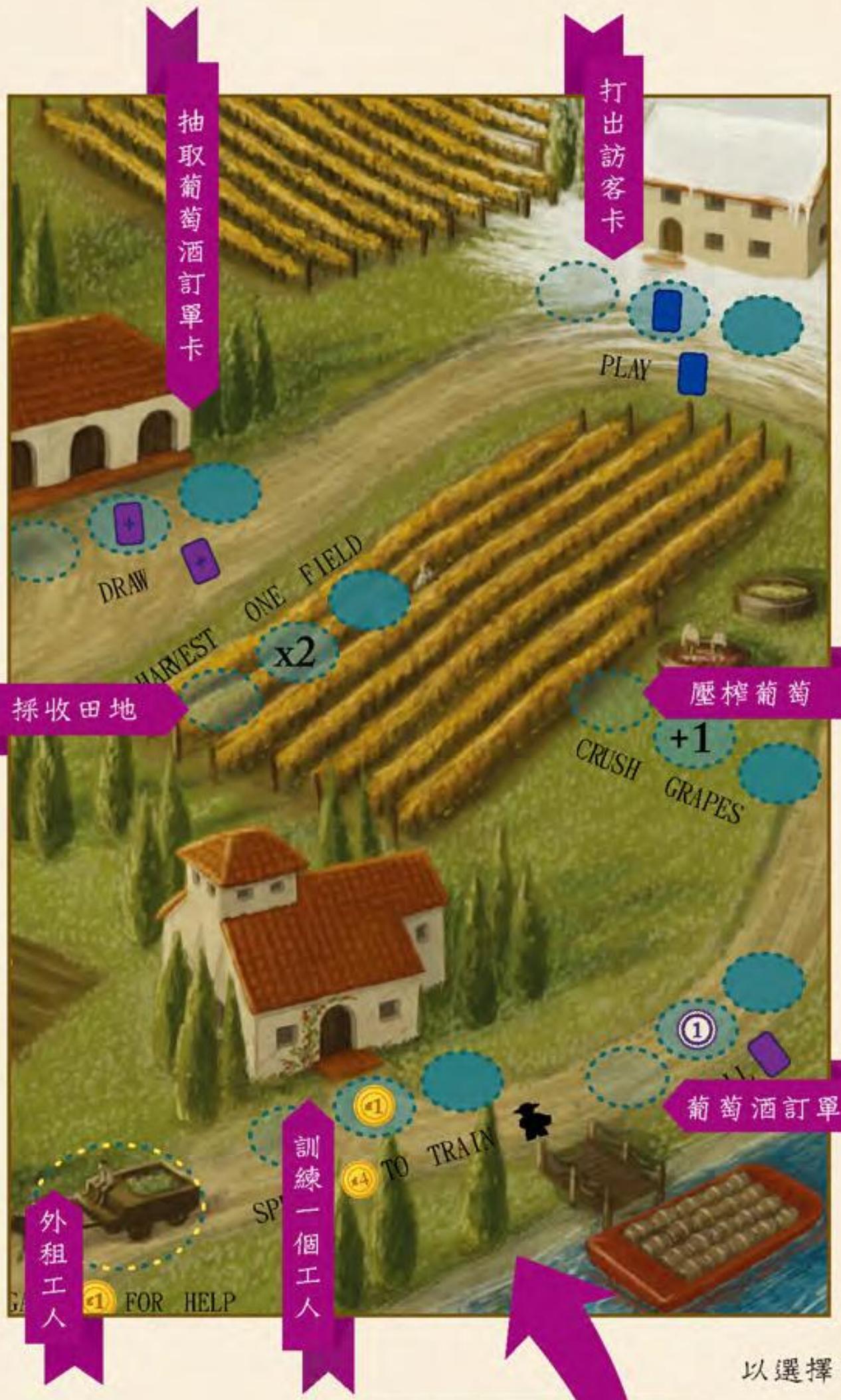
每個工人:在夏天或冬天時,玩家可以把一個工人放到圖板下方的運貨車上賺取①。放置1個工人在這裡視為一個玩家的回合。一年中可以有任意數量的工人放在這個行動區域。
牛犁:如果玩家建好牛犁的話,它會提供一個特殊的夏天或冬天行動。夏天時,玩家可以使用牛犁行動來拔除1個葡萄樹。玩家從他的田地中拿取1張葡萄樹,並且放回他的手中。使用牛犁行動和執行圖板行動相同,一個工人必須放到該行動區域,接著換下個玩家行動。
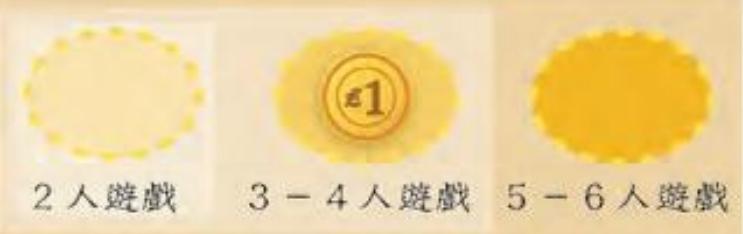
根據玩家人數使用不同的行動區域
2人遊戲時,只有左邊的行動區域開放;3-4人遊戲時,只有左邊和中間的行動區域開放;以及5-6人遊戲時,三個行動區域全開放。這些行動區域可以以任何順序開放。每個行動區域只能被一個工人佔據。




3-6人遊戲的獎勵區域
3-6人遊戲時,中間的行動區域提供獎勵給把工人放到這裡的玩家。如果玩家無法執行這個獎勵區域,它必須把工人移走讓其他可以執行的玩家選擇,並重新選擇一個沒有獎勵的區域。例如,如果玩家只有一個葡萄樹可以種植,他不能使用種植一個葡萄樹兩次的獎勵行動區域。唯一的例外是其他兩個區域已經被佔據,只剩有獎勵的區域沒有人佔據。那麼玩家可以放置一個工人到中間的區域執行行動,但不獲得這個獎勵。
打出一張夏天訪客卡:玩家必須面朝上棄掉一張夏天訪客卡,並且馬上執行卡片上的行動,接著將棄掉的卡片放到夏天訪客牌庫旁。
抽一張葡萄樹卡:
玩家必須抽一張葡萄樹卡。
3-6人遊戲時:玩家可以選擇中間的行動區域來多抽一張葡萄樹卡。
3-6人遊戲時:玩家可以選擇中間的行動區域來獲得額外的①。
建造一個設施:玩家必須花費指定的金額建造一個他的葡萄園中的設施,並把設施的指示物放到葡萄園中(見第8頁的說明來了解每個設施。)
3-6人遊戲時:玩家可以選擇中間的行動區域,從手中多打一張夏天訪客卡。
建造設施
3-6人遊戲時:玩家可以選擇中間的行動區域來建造一個設施,並且獲得折扣。
注意1:玩家遊戲一開始就有3塊田地、葡萄壓榨桶,以及小酒窖。
注意 2:玩家每個設施只能建造一次。
銷售葡萄:玩家必須從他的葡萄壓榨桶中賣出任意數量的葡萄指示物,並獲得葡萄壓榨桶之間的金錢。例如,一個價值4的葡萄指示物可以賣得。
3 - 6 人遊戲時:玩家可以選擇中間的行動區域來獲得 1 分。

每個葡萄指示物的價格
種植一個葡萄樹:玩家可以種植一個葡萄樹到他葡萄園中的田地。玩家可以把一張葡萄樹卡放到一個空的田地中來種植葡萄樹,或者把一
張葡萄樹卡堆疊到其他已經種植的葡萄樹卡上。
3-6人遊戲時:玩家可以選擇中間的行動區域來從他手上多種一張葡萄樹卡到田地中。
設施
建造設施可以讓玩家有特殊的獎勵,如下所述。
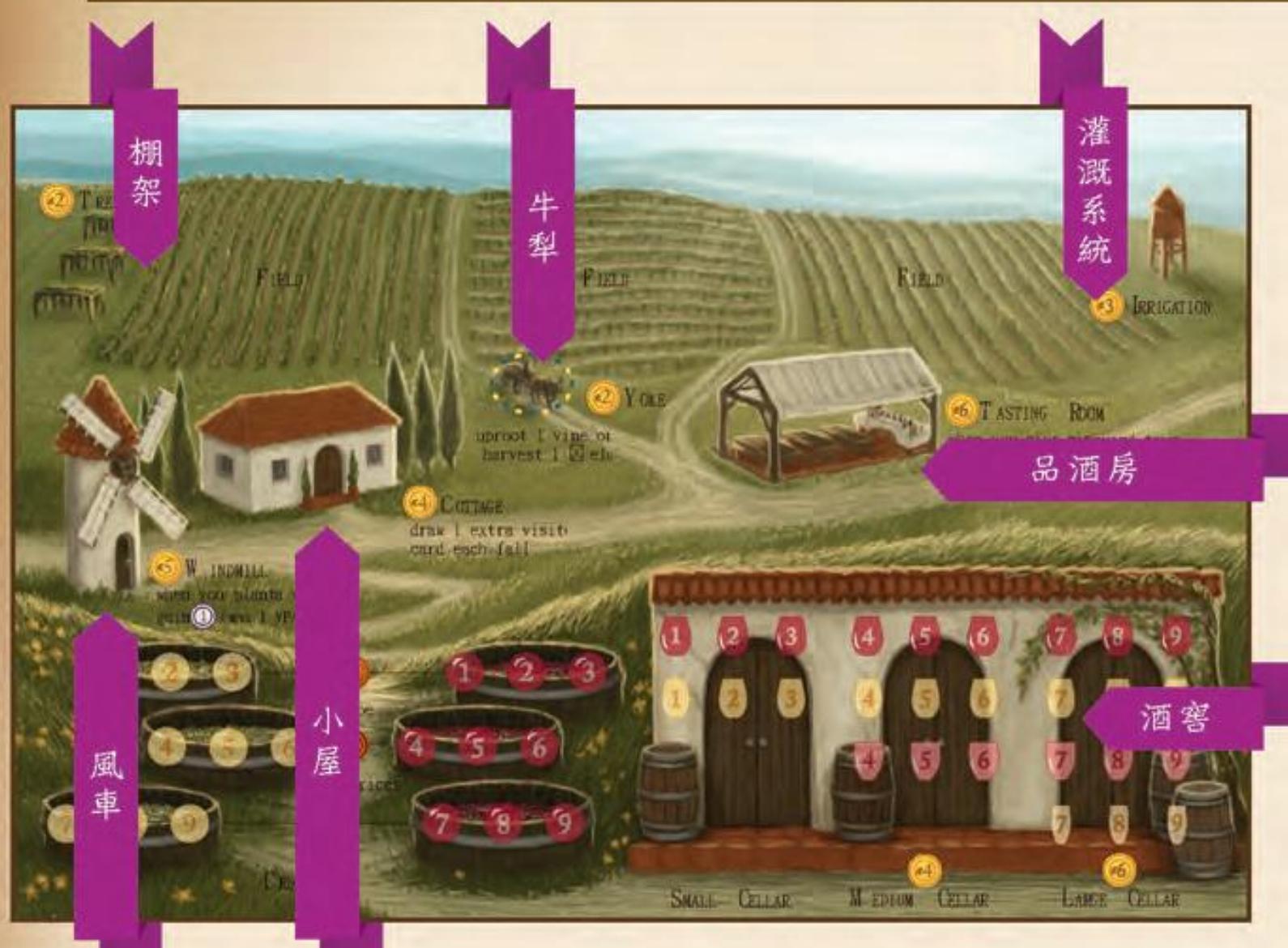
每個設施都有一個花費,玩家圖板上會用一個錢幣符號來指示。

棚架(②):棚架在種植特定種類的葡萄樹時會用到。
風車(⑤):在玩家建造風車之後,每當他種植葡萄樹時都可以獲得1分(最多每年①)。


牛犁(②):擁有牛犁
可以讓玩家在夏天或冬天時執行他的葡萄園圖板兩個行動之一,而不是遊戲圖板上的行動。夏天行動是拔除,拔除可以讓玩家從田地裡移除一張葡萄樹卡,並且把移除的葡萄樹卡放回手上。冬天行動是採收1塊田地(見冬天章節的採收)。如果玩家這一年使用牛犁行動區域,這會需要一個工人來執行,並且視為玩家的一個回合動作。
秋天行動
秋天是個邀請對你有幫助的訪客到葡萄園的時刻。這些旅客會在夏天或冬天到來,並在你的葡萄園中幫忙。
依照起床順序,每個玩家藉由抽取一張他所選的訪客卡來邀請一灌溉系統(③):灌溉系統在種植特定種類的葡萄樹時會用到。

品酒房(⑥):在玩家建造品酒房之後,每次他的葡萄園透過行動區域或是訪客卡開放觀光時,他可以獲得1分(最多每年①)。


酒窖(44及6):玩家把酒儲藏在他們酒窖中,但是小酒窖只能存放價值較低的酒類。建造中型和大型酒窖可以讓玩家儲藏價值較高的酒,中型酒窖還可以生產及儲藏玫瑰酒,而大型酒窖則可以生產及儲藏氣泡酒。
注意:一定要先蓋中型酒窖才能蓋大型酒窖。
小屋(④):如果玩家有建造小屋的話,秋天時可以額一張夏天或冬天訪客卡。
注意:當玩家在秋天抽取多張訪客卡時,他必須一次同時把要抽的卡片抽足。
個夏天或冬天訪客到他的葡萄園。玩家執行這個行不需使用工人。在玩家建造小屋後,玩家每年可以選擇多抽一張訪客卡,但是必須一次同時抽兩張卡。
冬天行動
冬天是採收的時刻,把葡萄變成葡萄酒、找出哪種酒是需要的、訓練新的工人、讓冬天訪客去工作,以及完成葡萄酒訂單。
抽一張葡萄酒訂單卡:玩家必須抽一張葡萄酒訂單卡。
3-6人遊戲時:玩家可以選擇中間的行動區域來多抽一張葡萄酒訂單卡。
採收一塊田地:玩家必須採收一塊田地上的所有葡萄,並把葡萄指示物放到葡萄壓榨桶對應的價值區域。(見第10頁採收細節。)
3-6人遊戲時:玩家可以選擇中間的行動區域來多採收一塊田地。
外租工人賺取
每個工人:見第6頁的細節。
花費④來訓練一個新的工人:玩家必須付④來訓練一個新的工人。額外的工人放到「訓練師」旁,在下一年到來之前還不能使用。
抽取葡萄酒訂單卡訓練一個工人
注意1:玩家不能擁有超過6個工人。這個限制不包含暫時性工人。
打出一張冬天訪客卡:玩家必須面朝上棄掉一張冬天訪客卡到冬天訪客牌庫,並馬上執行該張卡片的行動。
3-6人遊戲時:玩家可以選擇中間的行動區域來折扣①。
3-6人遊戲時:玩家可以選擇中間的行動區域從手中多打一張冬天訪客卡。
壓榨葡萄
壓榨葡萄:(見第10頁葡萄壓榨桶的圖示,和第11頁更多的細節。)
完成一張葡萄酒訂單:玩家查看手中的葡萄酒訂單卡的細節,並且滿足他手中葡萄酒訂單卡的要求,然後把這張卡棄掉。(見第11頁的細節。)
3 - 6人遊戲時:玩家可以選擇中間的行動區域獲得1分。
注意:玩家可以使用價值較高的葡萄酒來完成一張訂單,但是這些差額就損失了。
牛犁:牛犁的冬天行動—如果牛犁這個設施已經建造的話,這個行動區域就開啟—可以收穫1塊田地。
採收田地及壓榨葡萄
探收
注意1:採收一塊田地中多張紅色葡萄樹或者多張白色葡萄樹,一起加總它們各自的價值,並把一個紅色或白色的葡萄指示物拿來標示其價值,而一張紅色和白色葡萄樹在同一塊田地中被採收時會各拿取一個紅色及一個白色葡萄指示物,並放到各自的價值中。葡萄樹依舊留在田地中。
注意 2:每塊田地一年只能被採收一次。
注意3:採收多塊田地可能會產生兩個相同顏色及價值的葡萄。如果發生的話,其中一個葡萄必須貶值。如果壓榨桶中沒有空間可以貶值,則損失這個葡萄。
範例:玩家有三個葡萄樹種在一塊田地中。當採收這塊田地時,她把葡萄樹卡上紅葡萄的符號加總(1+1),在她的壓榨桶上形成1個價值2的紅葡萄,接著她加總白葡萄的符號(1+3),來形成1個價值4的白葡萄。
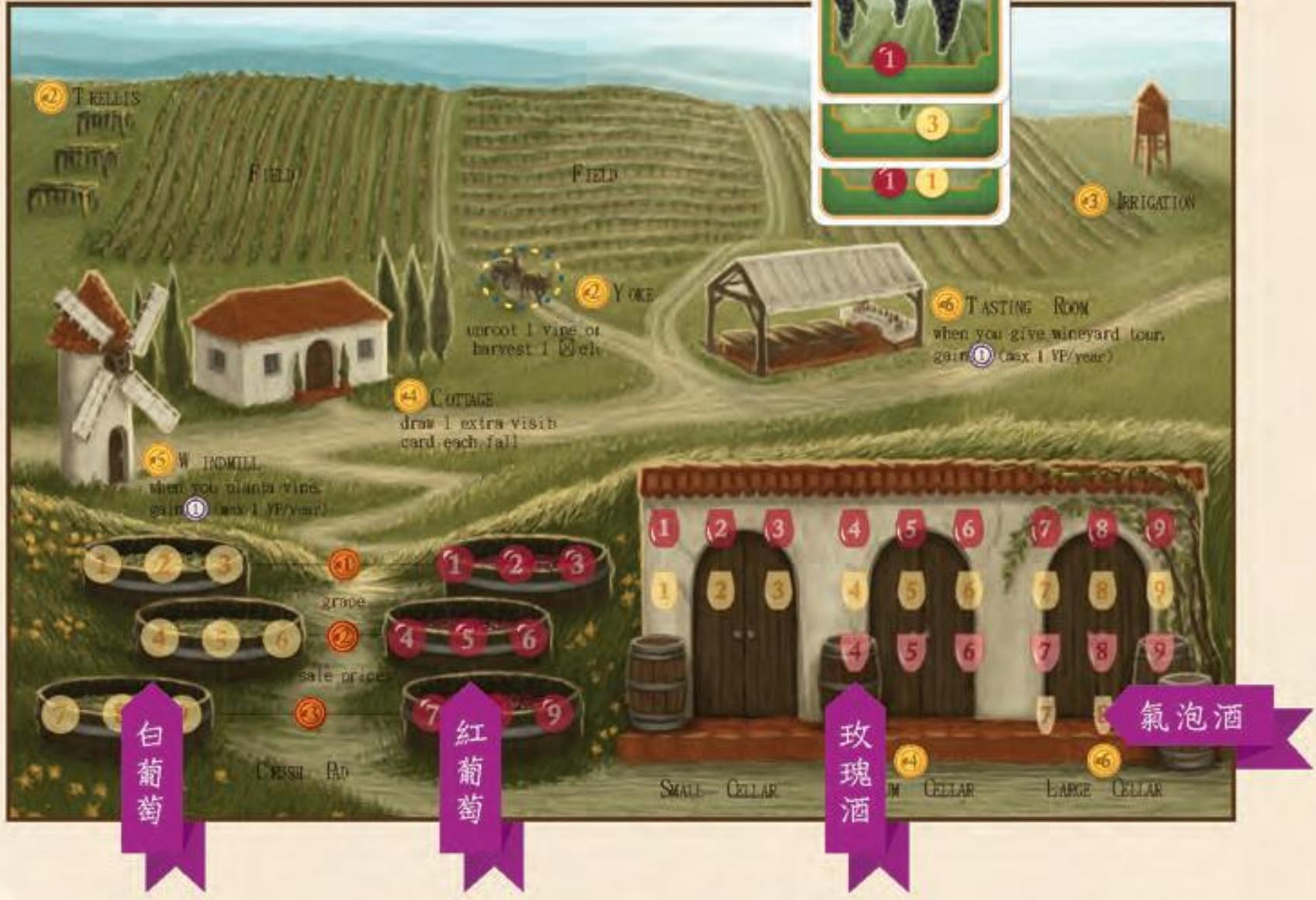
壓榨
壓榨葡萄:當玩家壓榨葡萄時,他使用一些或者全部在葡萄壓榨桶中的葡萄,來生產不同種類的葡萄酒。壓榨葡萄時,玩家可以生產多個任意一種種類的葡萄酒指示物(紅酒/白酒/玫瑰酒/氣泡酒)。
紅酒/白酒:把所有所選顏色的葡萄轉換成紅酒或者白酒,並放到對應價值的酒窖區域。所以一個價值3的紅葡萄會變成一個價值3的紅酒。多個同種顏色的葡萄不會加總生產出價值較高的葡萄酒。因此,他們生產多個葡萄酒的價值等同於壓榨桶中的葡萄價值。
玫瑰酒:需要累加總價值為4或更多的紅色和白色葡萄指示物,才能生產一個玫瑰酒指示物。
氣泡酒:玩家必須要累加總價值為7或更多的兩個紅葡萄及一個白葡萄,才能生產一個氣泡酒指示物。
3-6人遊戲時:玩家可以選擇中間的行動區域來使所有從「壓榨葡萄」行動中所生產的葡萄酒價值+1。因為多個相同種類的葡萄酒指示物可以從一個「壓榨葡萄」的行動中生產,每個指示物都會得到價值+1的獎勵。
注意:用2個紅葡萄和1個白葡萄來生產淡色的氣泡酒看起來好像很奇怪,但是現實生活中就是這麼做的!
注意1:生產玫瑰酒或氣泡酒時棄掉多出來的指示物。
注意2:玩家必須建造適當的酒窖空間來儲藏任何價值3或6以上的葡萄酒、玫瑰酒或者氣泡酒。
注意 3:任何沒有用來壓榨的葡萄留在葡萄壓榨桶中。
注意4:和葡萄壓榨桶的規則相似,一個酒窖區域只能被一個葡萄酒指示物佔據,因此葡萄酒必須被貶值直到有空間可以佔據或者直接損失。
注意 5:葡萄酒指示物一但放到酒窖中,就永遠不會再加總在一塊。
注意6:一個聰明的玩家會謹慎地、有策略性地根據他擁有的酒窖和手中的葡萄酒訂單來壓榨葡萄。畢竟,葡萄在葡萄園中熟成就和葡萄酒要在酒窖中使味道變醇一樣,急不來!

範例:玩家決定壓榨葡萄來生產紅酒,但是他沒還沒有中型酒窖。價值1的紅葡萄變成價值1的紅酒,而價值4的紅葡萄貶值為價值3的紅酒。
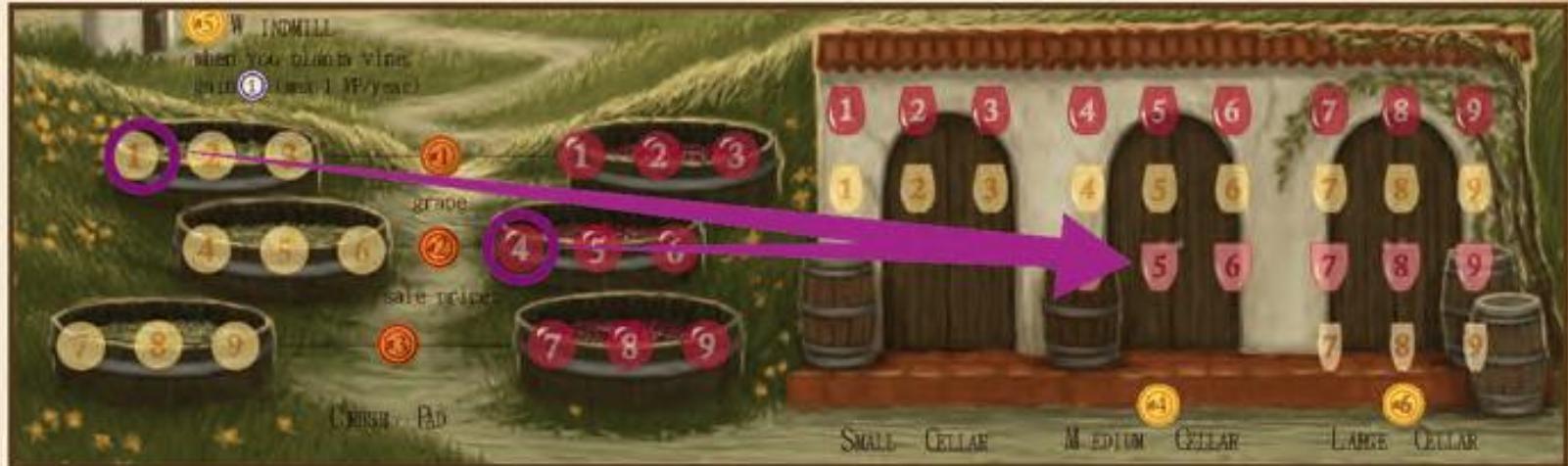
範例:玩家決定生產一個玫瑰酒指示物,所以他加總一個紅色和白色葡萄來形成一個等同於它們加總價值的玫瑰酒指示物。他可以這麼做,因為他有一個中型酒窖。
範例:完成一張葡萄酒訂單
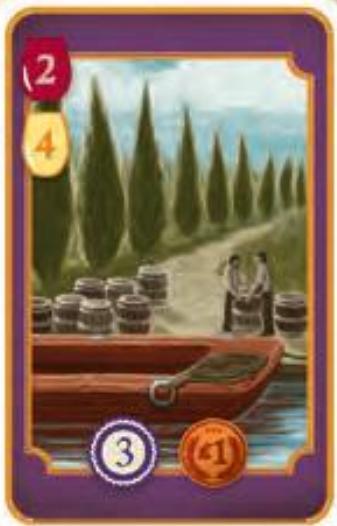
這張葡萄酒訂單卡需要一個價值至少為2的紅酒指示物,和一個價值至少為4的白酒指示物。要完成這個訂單,玩家展示這張葡萄酒訂單卡,從他的酒窖中移除對應的葡萄酒指示物,獲得3分,並把剩餘款項紀錄表中的標記移動到①。玩家接著棄掉這張葡萄酒訂單卡。
訂單需求為價值2的紅酒及價值4的白酒
獲得分數
剩餘款項
玩家持續紀錄從葡萄酒訂單所獲得的剩餘款項。所有玩家遊戲開始時把他們的酒瓶指示物放到剩餘款項紀錄表中央里拉符號的位置。當玩家完成一張葡萄酒訂單,玩家根據葡萄酒訂單上的里拉金額移動他的剩餘款項標記。在完成另外一張葡萄酒訂單前,該玩家的標記停在原地不動。這個表格顯示出玩家可以獲得的剩餘款項金額上限(⑤)。(玩家在每一年結束時得到這些款項。)

剩餘款項紀錄表
一年結束
每年結束時,玩家熟成葡萄和葡萄酒指示物、從圖板上移除所有工人、獲得任何因為完成訂單而得到的剩餘款項,然後把起始玩家標記逆時針傳給下個玩家。
每年結束時:
熟成葡萄和葡萄酒指示物:
所有葡萄壓榨桶中的葡萄和酒窖中的葡萄酒指示物增加1點價值。(例如,一個葡萄或者葡萄酒指示物在價值2就升到3,在3就會升到4)。葡萄和葡萄酒指示物不會超過價值9。
注意1:如果中型酒窖還沒建好的話,葡萄酒指示物只能被熟成到價值3。如果已經有中型酒窖但大型酒窖還沒建好的話,則只能被熟成到價值6。
注意 2:如果玩家沒辦法熟成葡萄或葡萄酒指示物,玩家不會失去這些指示物。例如,如果玩家擁有一個中型和大型酒窖,而且有價值 8 和 9 的紅酒,當到了要熟成這些指示物的時候,它們停在原地。
拿回工人:每個玩家各自拿回自己的工人。
玩家得到因為完成訂單的剩餘款項:玩家根據他們的剩餘款項標記的所在位置獲得對應數量的里拉(每年最多)。

STONEMAIER
GAMES
www.stonemaiergames.com
手牌上限7張:每年結束時,玩家必須把手牌棄到剩7張。
注意:「起始玩家」只是讓玩家春天時可以先擺放他的工人到起床表上。
傳遞起始玩家標記:依逆時針方向把起始玩家標記傳給下個玩家,並且移除所有起床表上的公雞標記。
特別感謝為這款遊戲付出的美術設計師—
Beth Sobel, David Montgomery, Gia Nguyen Hoang, 以及Jacqui Davis—
和 Christine Bielke 及 Maria Burke,圖像設計師。
特別感謝 Morten Monrad Pedersen, Sharon Rozines, 及 David Winchester 校對規則。
Download MarkdownSinglePageRulebook_2ndEd_r12-Panda.md28.8 KB
VITICULTURE
THE STRATEGIC GAME OF WINEMAKING
by Jamey Stegmaier& Alan Stone'
Old-world Tuscany awaits your winemaking skill and strategic cunning. You'll plant vines, harvest grapes, age wines, and ll merchant orders to create the greatest winery in Ttly! 2 – 6 PLAYERS AGES 13 & UP • 45 – 90 MINUTES
VITICULTURE IS A WORKER-PLACEMENT STRATEGY GAME THATALLOWS PLAYERS TO CREATE THEIR OWN TUSCAN VINEYARDANYWHERE A TABLE AND A FRIEND CAN BE FOUND.
OBJECT OF THE GAME
Players begin the game with an old crush pad, three empty fields, a small cellar, two workers, and one grande worker. Players allocate workers and the occasional visitor to complete various tasks throughout the year. In the spring, players decide the schedule their workers will follow. An early rise gives the player the chance to act first; however, offering workers a later wake-up time gives you escalating bonuses. In the summer, players place workers on action spaces to plant vines and build structures that help advance that player's vineyard. In the fall, players invite visitors to help their workers. In the winter, players place workers on action spaces to harvest grapes, create wine, and fill orders.
GOAL
The goal is to reach 2o victory points, with victory points representing your reputation as a vineyard owner. When a player reaches 2o points, the current year will be played through the year end, and the player with the most points wins. Players may go beyond the 2o-point goal, but they may not exceed 25 points. In the case of a tie, tiebreakers are (in order):
M&sb sitraira
ToTaltaaladuef ofiwirie ithehelteHar
Toftaltaaladuef gfrgpæpesnotm ehershshadad
COMPONENTS
CARDS (118 TOTAL)
* 42 vine cards (green deck)
* 36 wine order cards (purple deck)
* 20 summer visitor cards (yellow deck)
* 20 winter visitor cards (blue deck)
BOARDS (DOUBLE SIDED)
* 1 game board
* 6 vineyard mats
PIECES
* 30 worker meeples in 6 different colors and 1 gray temporary worker *6 grande worker meeples
* 50 grape and wine tokens (glass)
*6 wake-up tokens (roosters)
*6 victory point tokens (corks)
* 6 residual payment tracker tokens (wine bottles)
*48 wooden structure tokens (8 unique tokens for each color)
*72 punch board lira (52 bronze £1 coins, 12 silver £2 coins, 8 gold £5 coins)
*1 first-player token (grapes)
RULE BOOK & QUICK-REFERENCE GUIDE
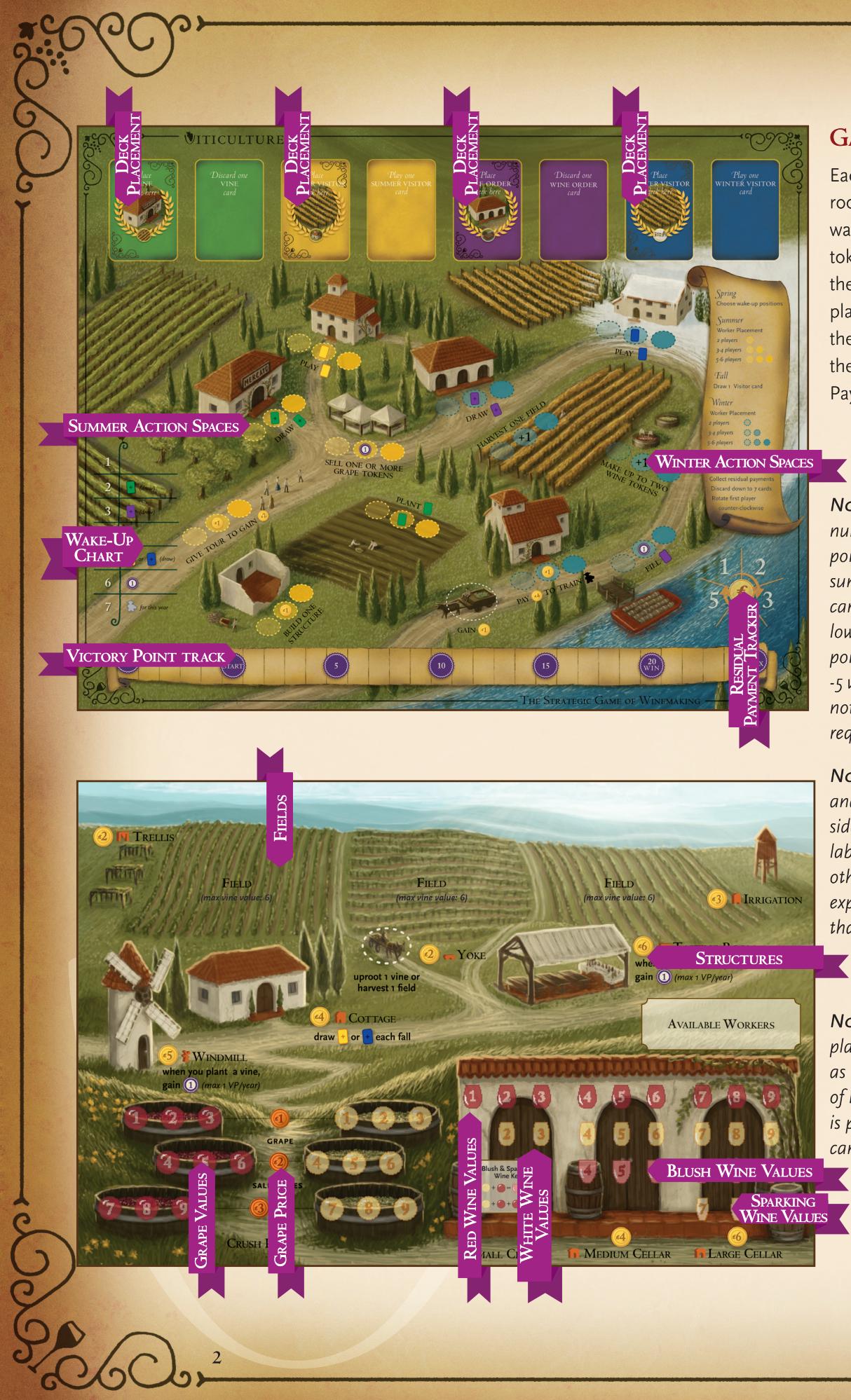
GAME BOARD SETUP
Each player places their rooster token above the wake-up chart and their cork token on the TART space on the victory point track. Each player should also place their wine bottle token on the middle of the Residual Payment Tracker.
NotE 1: There are negative numbers on the victory point track for a few of the summer and winter visitor cards. A player may not go lower than -5 on the victory point track. If a player has -5 victory points, he may not use a visitor card that requires losing more points.
NotE 2: The game board
and player mats are double
sided. One side is fully
labeled for beginners and the
other side is unlabeled for
experienced players. Other
than the labels, there is no difference between the two sides.
NoTE 3: All information on a player's vineyard mat as well as available workers, amount of lira, and number of cards is public information and cannot be concealed.
GAME PLAY OVERVIEW
SETUP
Remove pinot vine cards from the green deck equal to the number of players and give one to each player, then shuffle each deck of cards and place them on the board.
STARTING RESOURCES PER PLAYER
*A crush pad, a small cellar, and three fields (all on the vineyard mat)
* ® in coins
*1 pinot vine card () in hand
*1 random summer visitor card ( in hand
* 2 workers ()
* 1 grande worker

FIrSt RoUND
Take all of the rooster tokens that have been claimed by players, shake them up in your hand, and randomly pick one. The player with that color is the first player and gets the first player token () DECK MAINTENANCE: If any of the four decks are exhausted during play, immediately shuffle the discard pile and replace the deck. If the deck has been exhausted but no cards have been discarded, that deck is unavailable until more cards are discarded.
SPRING
Starting with the first player and moving clockwise around the table, players select the order in which they will “wake up” (turn order) by placing their rooster tokens on an unoccupied row on the wake-up track on the far left of the board. Each player immediately collects the corresponding reward. After all players have placed their roosters, the track displays the order in which players will take actions for the rest of the year.
SUMMER
In the summer, according to the positions on the wake-up chart, each player places one worker on a yellow summer action space on the game board and immediately takes that action (i.e., in a 2-player game, Player 1 places one worker, Player 2 places one worker, then Player 1 places another worker, and so on). The next player does the same until either all action spaces are taken, all players have passed, or all players are incapable of taking actions. If a player has passed, he may not place another worker until the beginning of the winter season. (All summer action spaces are described on pages 6 and 7.)
FALL
In the fall, according to the position on the wake-up chart, each player draws either a summer or winter visitor card and adds it to his hand. Any players who have built a cottage on their vineyard mats may draw one extra visitor card from either the summer or winter visitor deck.
WINTER
In the winter, players play in the same manner as in the summer, placing any remaining workers on the blue winter action spaces (each worker may only be used once per year). Just as in the summer, worker placement order in the winter is determined by the positions on the wake-up chart (the player at the top of the wake-up chart is still the first person to act in the winter, regardless of the last player to act in previous seasons).
YEAR END
At the end of the year, players age grape and wine tokens, return workers to their vineyard mats, collect residuals, remove rooster tokens from the wake-up track, and rotate the first-player token counterclockwise. The game then ends if any player reached or exceeded 2o victory points.
TERMINOLOGY:
Throughout this manual, you will notice the terms value and price.
VALue refers to a grape's worth when being turned into wine and the worth of a wine when filling an order.
Price refers to the amount of money a grape will bring when sold. In Viticulture, grapes can be sold for immediate payments, while wine is “sold” via wine orders in exchange for victory points and residual payments.
SPRING ACTIONS
WAkE-up cHART: Starting with the player holding the first-player token and moving clockwise, each player places his/her rooster on an unoccupied wake-up level. The number represents how early that player wants his/her workers to wake up in the coming year. 1 is the earliest time and 7 is the latest. For workers, the later the better; for the vineyard owner, perhaps not.
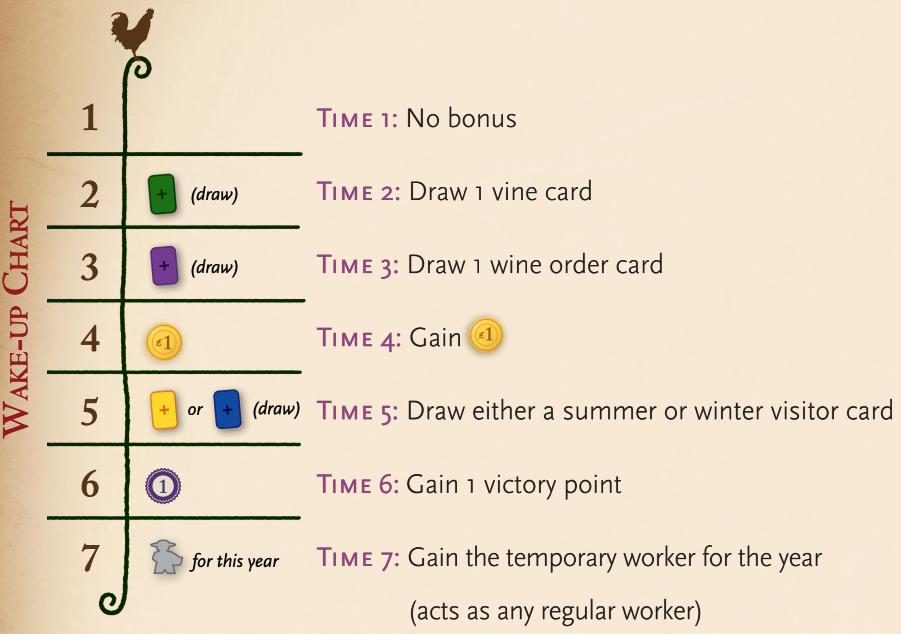
HELPFuL Tip: When a player passes during the summer, he will slide his rooster from the left to the right on the wake-up chart for a clear visual of the players that remain active. Then as players pass during the winter, they will slide their roosters back to the left. This will help players see who has yet to pass in the summer and winter.
WORKER PLACEMENT
*A player may use each worker only once a year. Thus a worker placed in the summer cannot be used in the winter.
* A player may place multiple workers on the same action in subsequent turns if there are open action spaces.
* Workers may only be placed on the current season's action spaces.
* If a player passes, he may place no more workers that season.
* A player must take the action when placing a worker. For example, if a player chooses the "Sell Grapes" action, that player must sell at least 1 grape.
ExAmPLE: Player 1, the player with the first-player token, chooses the 6 slot and gains a point on the victory point track. Player 2 chooses the 4 slot and gains ①. So, even though Player 1 has the first-player token, for the rest of the year Player 2 will go first and Player 1 will go second based on where each player placed their rooster on the wake-up chart.
Noτe: The first player to act in the summer, fall, and winter reverts back to the wake-up chart order from the spring of that year. Thus, in the example, above, even if Player 2 (level 4 on the wake-up chart) is the last player to act in the summer, he will be the first player to act in the fall, and then again in the winter.
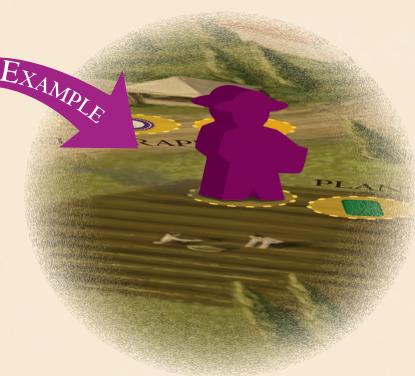
Worker on a Summer Action Space
VINE DECK VARIETIES AND VALUES
Each vine card has a circle with a number representing the value of grape the vine will yield. Some cards have structures in the upper-left corner (irrigation, trellis, or both). The depicted structures must be built before the vine can be planted.
| VARIETY COLOR | VALUE | TOTAL CARDS | PREREQUISITE |
| Sangiovese Red | 1 | 4 | None |
| Malvasia White | 1 | 4 | None |
| Pinot Red & White | 1 each | 6 | Trellis |
| Syrah Red | 2 | 5 | Trellis |
| Trebbiano White | 2 | 5 | Trellis |
| Merlot Red | 3 | 5 | Irrigation |
| Sauvignon Blanc White | 3 | 5 | Irrigation |
| Cabernet Sauvignon Red | 4 | 4 | Trellis & Irrigation |
| Chardonnay White | 4 | 4 | Trellis & Irrigation |
Trellis Irrigation

Produces a 4-value red grape
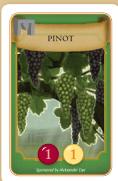
Produces a 1-value red & a 1-value white grape
Irrigation
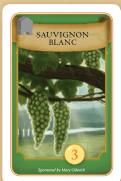
Produces a 3-value white grape
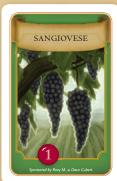
Produces a 1-value red grape
GRANDE WORKER PLACEMENT
The grande worker follows the rules to the left for workers but also has a special ability. The grande worker may be placed on an already full action to perform that action. Multiple players may place their grande workers in this way. If you place your grande worker on a full action space, you do not gain the bonus on that action (see page 6).
ExAmPLE: You are playing a 2-player game and the other player chooses to give a tour with regular worker to gain 2 lira. If you really need to give a tour, you may then place your grande worker on that action (on the art for that action, not an action space) to gain 2 lira as well.

NotE 1: A field cannot exceed a total value of 6 when adding the value of the cards on the field together. For example: This vine produces a 2-value red grape, and a 4-value white grape when harvested for the maximum allowed value of 6.
Note 2: Although there is some luck involved in which vine cards are drawn, a savvy player will maximize the vine cards he draws by pairing them with complementary wine orders.
SUMMER ACTIONS
SUMMERTIME IN THE GAME IS THE TIME TO EXPAND YOUR VINEYARD, GO TO MARKET, PLANT VINES, PUT YOUR SUMMER VISITOR TO WORK, SHOW OFF YOUR VINEYARD, AND SELL GRAPES.
IMPORTANT NOTES ABOUT SUMMER AND WINTER VISITOR CARDS
Noτe 1: When a player plays a summer or winter visitor card, the action described on the card is taken immediately and the card is discarded, ending any bonuses granted by that card.
ExAmpLE: If a player plays the “Buyer” summer visitor card, which says, “sell grapes at twice their value to gain 1 victory point," that means that the player immediately sells their chosen grape(s), gains double the price of the grape(s), gains 1 victory point, and discards the card, ending the special bonus. The next time this player sells grapes, it will be at their normal price.
Noτe 2: Visitor cards are played by placing a worker on the Play Summer/Winter Visitor Card action spaces. No additional worker is required to take the action described on the card.
See page 12 for additional details on specific visitor cards.
SCALING THE GAME BASED ON NUMBER OF PLAYERS
Yoκe: The Yoke offers a special summer or winter action, provided a player has built this structure. In either season, a player may use the Yoke action to Uproot 1 Vine. The player takes 1 vine card from his field and returns it to his hand. This action is rarely used; its primary use is when a player needs to change the purpose of a field late in the game. Using the Yoke action space is the same as taking a board action. A worker must
GAIN ①: In the summer or winter, a player may place a worker on the cart at the bottom of the board to gain 1 . Placing 1 worker here counts as a player's turn. Any number of workers may be placed on this action over the course of the year by any number of players.
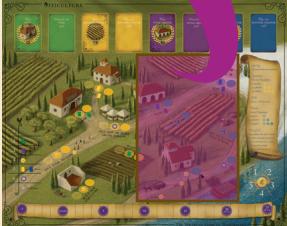
In the 2-player game, only the left action space is available; for the 3 – 4 player game the left and middle action spaces are available; and for the 5 – 6 player game allthree action spaces are available. These action spaces may be claimed in any order. Each action space can be occupied by only one worker.

be placed there, and play then moves to the next player.
Bonuses: Most actions have one action space with a special
optional bonus. A player may take the bonus when placing a worker on an action space with the bonus icon in the middle. When placed on a full action space, a player may take the action and the bonus in any order, but they may only gain the bonus if they complete the action. For example, a player cannot place a worker on the “Fill 1 wine order” bonus space to gain ① without also flling a wine order.
PLAY ONE SUMMER VISITOR CARD: Play a summer visitor card from your hand to resolve its effect. Place resolved cards on the summer visitor
Bonus: Draw an additional vine card.
GIVE A VINEYARD Tour: Collect
DRAW ONE VINE CARD: Draw one vine card.
Bonus: Collect an additional
Bonus: Play an additional summer visitor card.
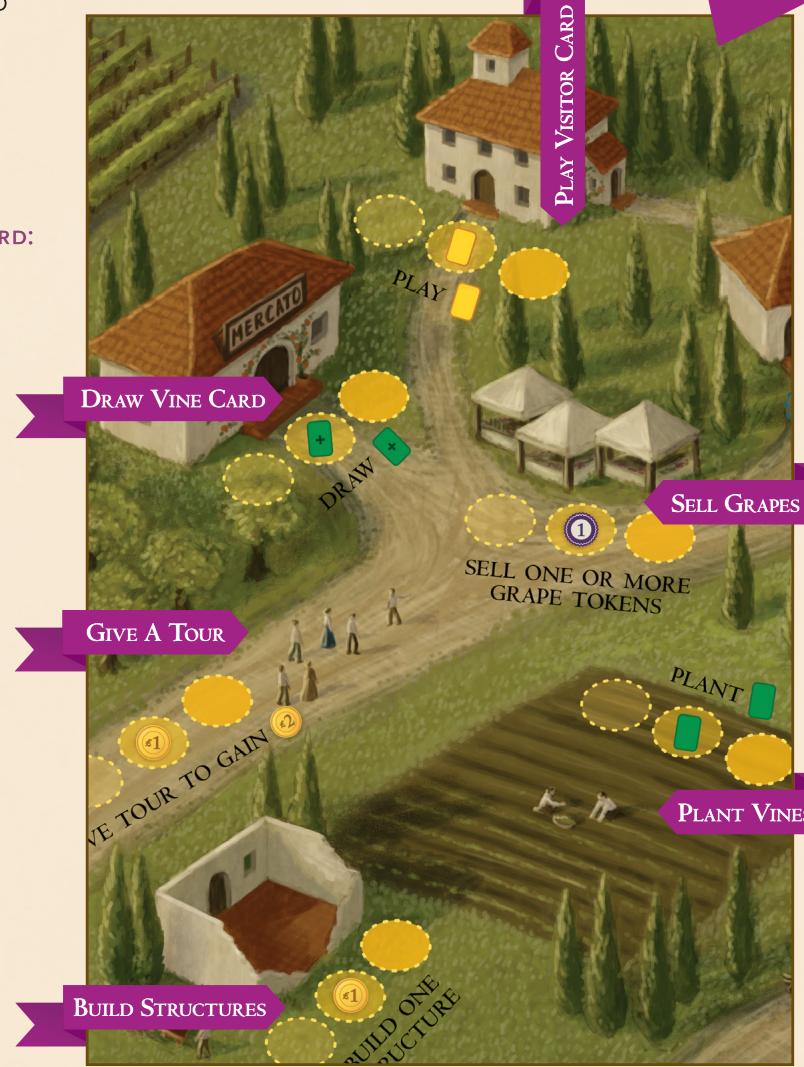
BUILD ONE STRUCTURE: Build one unbuilt structure on your vineyard mat by paying the cost and placing the corresponding structure token on your vineyard mat. (See page 8 for an explanation of each structure.)
Bonus: A discount.
NoTE 1: Players start the game with 3 fields, crush pad, and small cellar.
NoTe 2: Players may only have one of each structure on their vineyard mat.
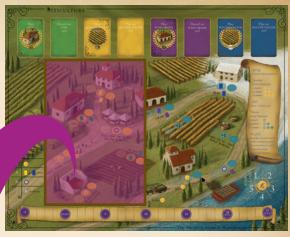
SeLL GrApEs: Sell any number of grape tokens (at least 1) from your crush pad for the price indicated by the coin between the crush pads. For example, a 4-value grape token is priced at when sold. Discard the tokens you sell.
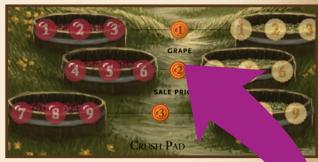
Prices for each tier of grape tokens
PLANT ONE VINE: Plant a vine on one of the fields in your vineyard. Vines are planted by placing a vine card on an empty field, or stacking a vine card on top of another vine that has already been planted
(max. value of 6 per field). Once a vine is planted, it stays on the field for the rest of the game, including when the field is harvested. The only way to remove a vine card is to use the Yoke or a visitor card to uproot it
Bonus: Plant an additional vine card from your hand.

STRUCTURES
STRUCTURES ALLOW YOU TO PLANT HIGHER QUALITY VINES, MAKE BETTER WINE, AND GAIN SPECIAL BONUSES IN THE SUMMER AND FALL. EACH STRUCTURE HAS A COST INDICATED BY A COIN ON THE PLAYER MAT.
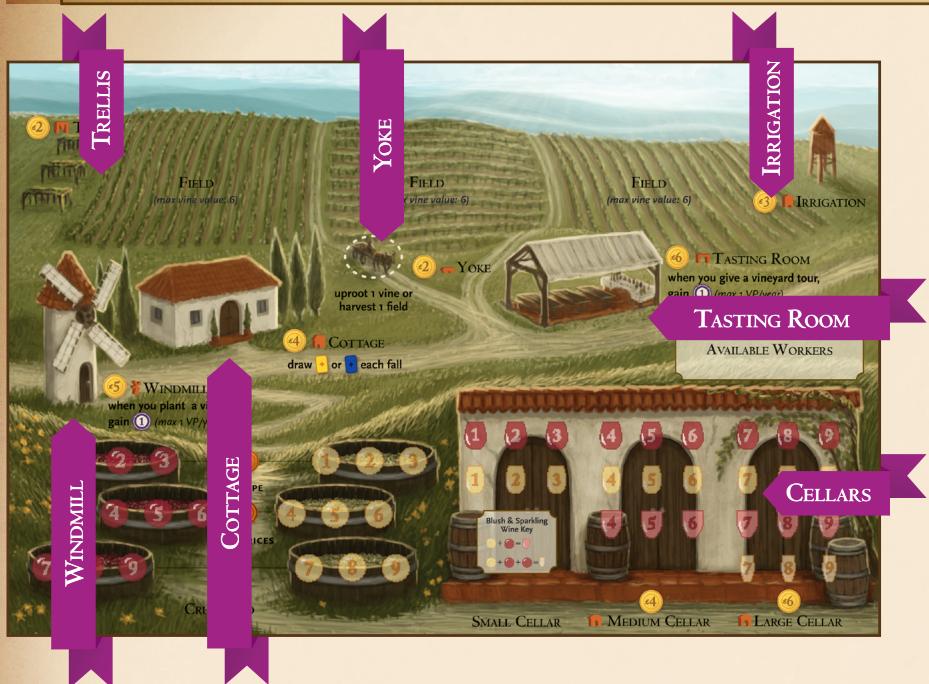

TRELLIs (): A trellis is required to plant certain types of vines.

WINDMILL (⑤): After a player builds a windmill, he collects 1 victory point whenever he plants a vine (max ① per year).

IRRIGATION (3): Irrigation is required to plant certain types of vines.

gives a player an action space only he may use once per year in any season (summer or winter). Placing a worker on the Yoke can either let a player Uproot 1 Vine Card (remove a vine from your field return it to your hand) or Harvest 1 Field (see Harvest in the winter section). If a player uses the Yoke action space, a worker must be placed there as that player's turn.
FALL ACTIONS
Fall is a time to invite helpful visitors to your vineyard. These visitors will arrive in the summer or the winter to provide a helpful hand on your vineyard.
In wake-up order, each player invites either a summer or winter visitor to his

player builds a tasting room, he collects 1 victory point for every tour of his vineyard via action spaces or visitor cards (max ① per year).


CELLARS (4 AND 6): Players store wine in their cellar, but a small cellar affords only enough room for lesser value
varieties. Building medium (4 – 6
value wine) and large(7 – 9 value
wine) allows players to store higher
value wines, as well as create and
store blushes in the medium cellar
and sparkling wines in the large cellar.
Note: The medium cellar must be built before a player builds the large cellar.

COTTAGE (): A player who builds a cottage may draw a visitor card in the fall in addition to the visitor card drawn by default in the fall. The two cards drawn may be of the same type or different types of visitor cards.
Noτe: When a player draws multiple visitor cards in the fall, he must draw all of the cards at the same time.
vineyard by drawing a visitor card of his choice. Players take this action without using workers. After a player builds a cottage, the player may choose to draw an extra visitor card every year, but must draw both of the cards at the same time.
WINTER ACTIONS
WINTER IS THE TIME TO REAP WHAT YOU HAVE SOWN, TURN GRAPES INTO WINE, FIND OUT WHICH WINES ARE IN DEMAND, TRAIN NEW WORKERS, PUT WINTER VISITORS TO WORK, AND FILL WINE ORDERS.
DRAW ONE WINE ORDER CARD: Draw one wine order card.
Bonus: Draw an additional wine order card.
HARVEST ONE FIELD: Choose one field and add grape tokens to the crush pad based on that field's yield (see page 10 for details). Vine cards remain on the field when harvesting—viticulturists do not remove vines from the ground when, they pick grapes.
Bonus: Harvest an additional field.
GAIn : Gain ①. This action space is not limited to 1 worker.
SPEND TO TRAIN A NEW WORKER: Pay to train a new worker. The additional worker is placed beside the “trainer" and is not active until the following year.
BoNus: A ① discount.
NoτE 1: A player may have no more than 5 workers and 1 grande worker. This limit does not include the temporary worker.
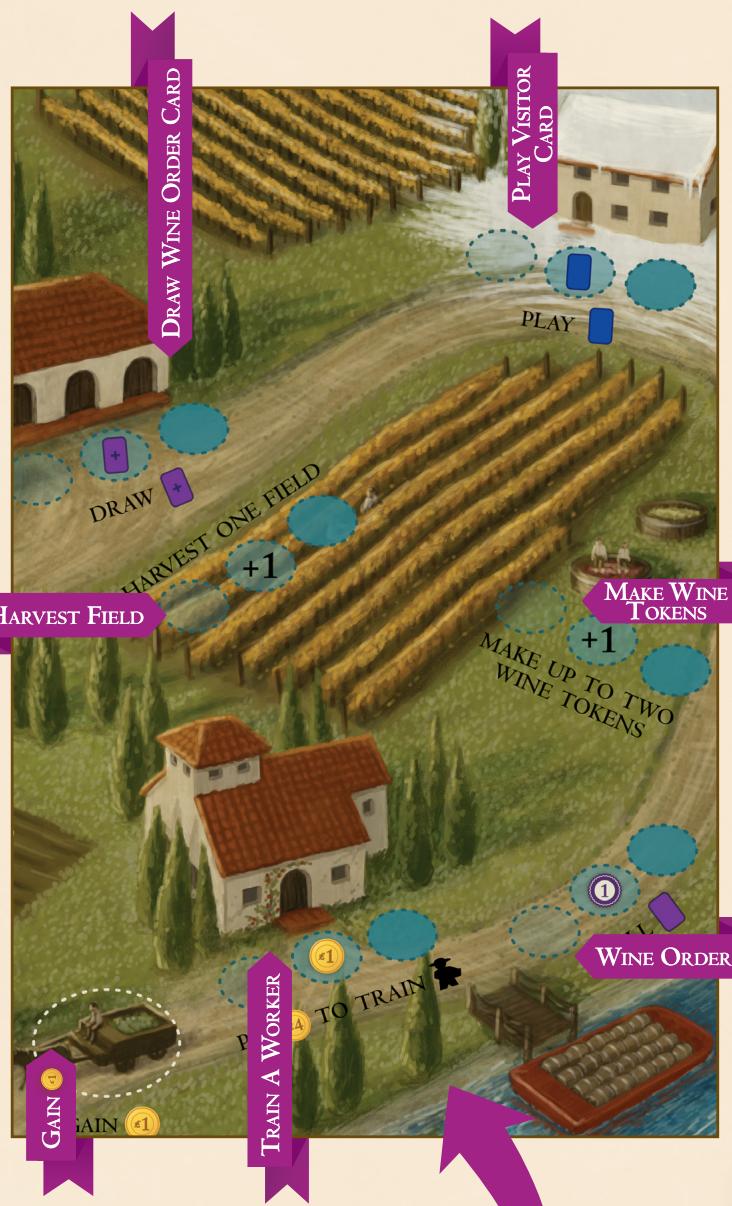
PLAY ONE WINTER VISITOR CARD: Play a winter visitor card from your hand to resolve its effect. Place resolved cards on the winter visitor discard pile at the top of the board.
Bonus: Play an additional winter visitor card.
MAKE UP TO TWO WINE
Tokens: ◆ Turn grapes on the crush pad into wine (see page 10 and 11 for more details)
Bonus: Make 1 extra wine token.
FILL ONE WINE ORDER: Fulfll the criteria on a wine order card and then discard it. See details on page 11.
BoNus: Gain
NoTe: A player may use higher value wine to fill an order, but the difference is lost.
Yoke: The winter action on the yoke—if the structure has been built and the action space is open—is to Harvest 1 Field.
HARVESTING FIELDS & MAKING WINE
HARVEST
When a player harvests a field, he picks grapes off the vines on that field.
To harvest a field, add the total value of all red grape icons on the vine to create 1 red grape token and then add the total value of all white grape icons on the vine to create 1 white grape token on your crush pad. The vine cards remain on the field.
Noτe 1: Each field can only be harvested once per year.
Note 2: Each grape icon on the crush pad can fit exactly 1 grape token. If the grape icon already has a token on it when you harvest a grape at that value, you must devalue the grape token to the next lowest icon. Thus if the 4-value white grape icon on your crush pad already has a token on it when you harvest a field yielding a 4-value white grape, the new token would instead go on the 3-value white icon on the crush pad (if it's empty). If there are no empty grape icons available for that grape's value, you may not gain that grape token.
MAKE WINE
MAKE UP TO2 WINE TOKENS: PlayerS make wine by converting grapes on theircrush pads into wine tokens. Low-value red and white wine tokens can be created when a player owns only asmall cellar, but the cellar must be upgraded to create blush wine, sparkling wine, and higher-value red and white wine.
ExAmPLE: A player has three vines planted on one field. When she harvests this field she adds the value of the two red-grape symbols (1 + 1) on the vines to form a single grape on her crush pad worth 2, and then the same for the two white-grape symbols (1 + 3) to form a white grape worth 4.

When a player makes more than 1 wine token, the wine he makes may be the same type of wine or different types.
RED WiNE: Move 1 red grape token to the corresponding space on the cellar. For example, a 3-value red grape becomes a 3-value red wine.
WHITE WINE: Move 1 white grape token to the corresponding space on the cellar.
BLusH: Combine 1 red grape token and 1 white grape token to make 1 blush wine token equal to the combined values of the grapes. For example, a 1-value white grape plus a 4-value red grape creates a 5-value blush wine.
SPARKLING: Combine 2 red grape tokens and 1 white grape token to make 1 sparkling wine token equal to the combined values of the grapes.
NoTE 1: Discard excess tokens when creating blush or sparkling wine.
NoτE 2: Players must build the appropriate cellar to house any wines, blushes, or sparkling wines above a value of 3 and 6.
Noτe 3: Each wine icon on the cellar can fit exactly 1 wine token. This follows the same rules as explained in Note 2 in the Harvest section of page 10.
NoTE 4: Once in the cellar, wine tokens may never be combined.
NoτE 5: AA savvy player will make wine strategically based on the cellars he owns and the wine orders in his hand. After all, grapes in Viticulture age just like wine!
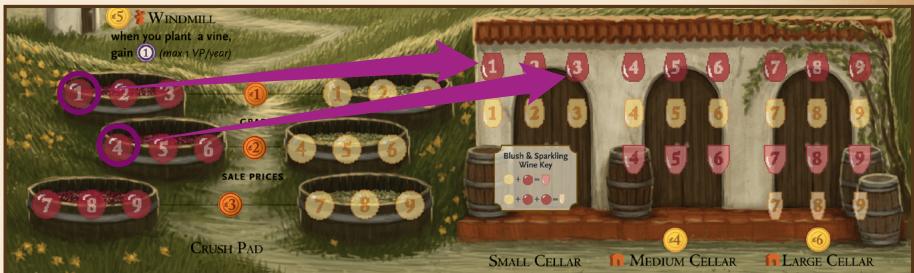
ExAmpLE 1: A player decides to make 2 red wine tokens, but he doesn't have the medium cellar yet. The 1-value red grape becomes a 1-value red wine, and the 4-value red grape is devalued to become a 3-value red wine.
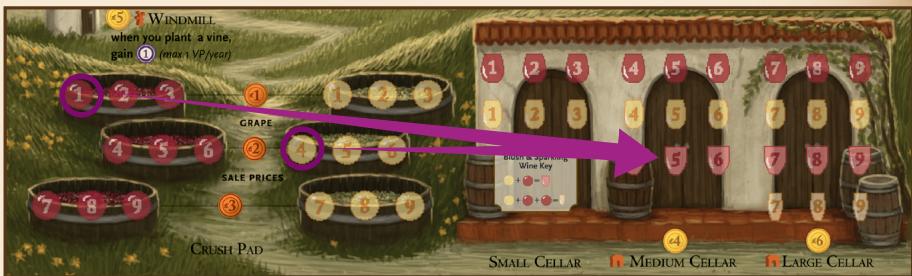
ExAmpLE 2: The player decides to make a blush wine token, so he combines a red and a white grape to form a single blush wine token equal to their cumulative value. He can only do this because he owns a medium cellar.
EXAMPLE: FILLING A WINE ORDER
This wine order card requires a red wine token worth at least 2 and a white wine worth at least 4. To fill this order, the player reveals the wine order card, removes exactly one red wine token worth at least 2 and exactly one white wine token worth at least 4 from his cellar, gains 3 points on the Victory Point Track, and moves up 1 on the residual payment tracker. The player then discards the wine order card.
Wine order for a 2-value red wine and a 4-value white wine.
Victory Points Earned ① Residual Payment
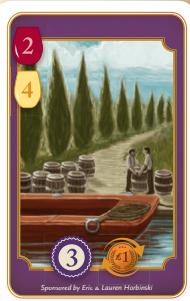
RESIDUAL PAYMENTS
Players keep track of residual payments from wine orders on the Residual Payment Tracker. All players begin the game with their wine bottle tokens on the lira symbol in the middle of the Residual Payment Tracker. When a player fills a wine order, that player moves his residual token up on the track based on the lira amount on the wine order card. It remains in that position—do not reset it. At the end of each year, each player gains lira equal to their position on the Residual Payment Tracker (1 = ). The highest residual payment a player can receive is , even if they fill additional wine orders. (Players receive those payments at the end of each year.)

YEAR END
AT THE END OF EACH YEAR, PLAYERS AGE GRAPE AND WINE TOKENS, REMOVE ALL WORKERS FROM THE BOARD,COLLECT ANY RESIDUAL PAYMENTS EARNED FROM FILLING ORDERS, AND ROTATE THE FIRST-PLAYER TOKENCOUNTER-CLOCKWISE TO THE NEXT PLAYER.
AT THE END OF EACH YEAR:
AGE GRAPE AND WINE TOKENS: Increase the value of all grape and wine tokens on your crush pad and in your cellar by 1 (i.e., a grape or wine token valued at 2 would move to 3 and a 3 would move to a 4). Wine and grape tokens may not have a value higher than 9.
Noτe 1: Wine tokens can only be aged past the value of 3 if the medium cellar has been built and past 6 if the large cellar has been built.
NotE 2: Players do not lose wine or grape tokens if they cannot age them. For example, if a player owns a medium and a large cellar and has red wine tokens valued at 8 and 9, when it comes time to age those tokens, they remain in the same position.
RETURN WoRKERS: Return all workers to their respective players, and return the temporary worker to the Wake-Up Chart.
ALL ORDERs FILLED: Players collect lira based on their position on the Residual Payment Tracker (max per year).
DISCARD DOWN TO 7 CARDS: At the end of each year, players must discard their hands down to 7 cards of their choice.
ROTATE FIRST-PLAYER TOKEN: Rotate the first player counter-clockwise and remove all rooster tokens from the wake-up chart.
Note: The new “first player” is merely the first player to select his worker placement order on the wake-up chart in the spring.
VISITOr CArDS
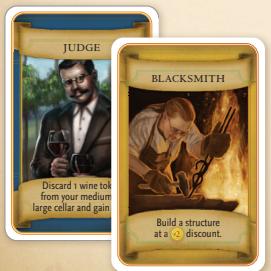
You may only play a visitor card if you are able to fully resolve the effect on the card. For example, if a card says that you must give all opponents each to gain a benefit, you can only play that card if you have enough lira to pay to all other players. Multiple actions on visitor cards may be taken in any order.
UNCERTIFIED VISITORS: All unCertified visitors let you spend victory points instead of money. As you can see on the game board, it is possible to have as low as -5 victory points. Thus you can spend victory points even if you are at or below o as long as they don't take you below -5.
UPGRADING THE CELLAR: SeVeral cards let you “upgrade your cellar to the next level." That means you may build either a medium or large cellar, depending on what you already have (you may not build a large cellar if you don't have a medium cellar).
ONE WAY CONVERSIONS (=): Some cards allow you to trade lira for victory points (or vice versa) at a specific ratio. For example, 3 = ① means that you can gain victory points at a rate of ① for every you spend.
STONEMAIERGAMES
END GAME GOAL ANDTIEBREAKERS
When a player reaches 2o points, the current year will be played through the year end, and the player with the most points wins (max. of 25 points). See page 1 of the rulebook for tiebreakers.
FRIENDLY VARIANT
A player may only choose a bonus action space if he completes that bonus (i.e., play a second summer visitor card) or if there is no other available space on that action. Thus players may not place workers on bonus action spaces to block other players as they can do in the standard rules.
WWW.STONEMAIERGAMES.COM
Download Markdown简繁检索对照.md1.6 KB
129621_128621_viticulture — 简体/繁体检索对照
本游戏的规则书是繁体中文原文。用户用简体提问时,把关键词按下面这张表转成繁体再去 grep 原文,命中率最高。
回答时用简体或繁体都可以,但引用的原文保持繁体。
简体 → 繁体 对照(按该游戏原文出现频率排序,共 60 字)
| 简体 | 繁体 | 原文出现次数 |
|---|---|---|
| 个 | 個 | 153 |
| 动 | 動 | 78 |
| 时 | 時 | 75 |
| 价 | 價 | 60 |
| 张 | 張 | 55 |
| 游 | 遊 | 50 |
| 戏 | 戲 | 48 |
| 这 | 這 | 47 |
| 区 | 區 | 43 |
| 来 | 來 | 42 |
| 树 | 樹 | 37 |
| 会 | 會 | 34 |
| 红 | 紅 | 32 |
| 访 | 訪 | 31 |
| 种 | 種 | 30 |
| 单 | 單 | 29 |
| 订 | 訂 | 28 |
| 并 | 並 | 27 |
| 压 | 壓 | 27 |
| 选 | 選 | 24 |
| 间 | 間 | 23 |
| 获 | 獲 | 22 |
| 为 | 為 | 21 |
| 标 | 標 | 21 |
| 产 | 產 | 21 |
| 择 | 擇 | 20 |
| 园 | 園 | 19 |
| 设 | 設 | 19 |
| 块 | 塊 | 18 |
| 记 | 記 | 18 |
| 图 | 圖 | 17 |
| 须 | 須 | 17 |
| 采 | 採 | 16 |
| 余 | 餘 | 16 |
| 们 | 們 | 15 |
| 当 | 當 | 15 |
| 后 | 後 | 15 |
| 过 | 過 | 15 |
| 项 | 項 | 15 |
| 没 | 沒 | 15 |
| 据 | 據 | 15 |
| 开 | 開 | 14 |
| 数 | 數 | 14 |
| 执 | 執 | 14 |
| 让 | 讓 | 13 |
| 奖 | 獎 | 13 |
| 励 | 勵 | 13 |
| 总 | 總 | 13 |
| 从 | 從 | 13 |
| 弃 | 棄 | 12 |
| 两 | 兩 | 11 |
| 该 | 該 | 11 |
| 结 | 結 | 11 |
| 话 | 話 | 10 |
| 则 | 則 | 10 |
| 对 | 對 | 10 |
| 类 | 類 | 10 |
| 顺 | 順 | 9 |
| 鸡 | 雞 | 9 |
| 库 | 庫 | 9 |
Texts are community-compiled or publicly released by publishers; copyright remains with the original authors. For personal reference only.