
Vivajava The Coffee Game
At a glance
Rules overview
English version of our rules overview, translated from the Chinese original (cunlema). The Chinese page is the source of record.
Game Overview
Vivajava The Coffee Game is a semi-cooperative negotiation game. A group of knowledgeable and resourceful coffee specialists develops blended beans for the island of Java, aiming to make their own blend the best-selling coffee—ultimately earning promotion, a substantial pension, and a lifetime supply of coffee. During the game, players form research teams to create blends together, but individual points are what ultimately determine victory. Each round consists of three phases: on-site harvesting, blending/research, and public tasting, repeated until one of three end conditions is met. Only by crafting the optimal blend and scoring higher in the public tasting phase can a team claim supremacy.
Core Mechanisms: Area selection and natural team formation, secret voting, blind drawing from roasting bags and negotiation (including lying), innovation and ability upgrades, as well as dynamic ranking and demotion on the bestseller list.
1. Game Components
| Component | Quantity/Description |
|---|---|
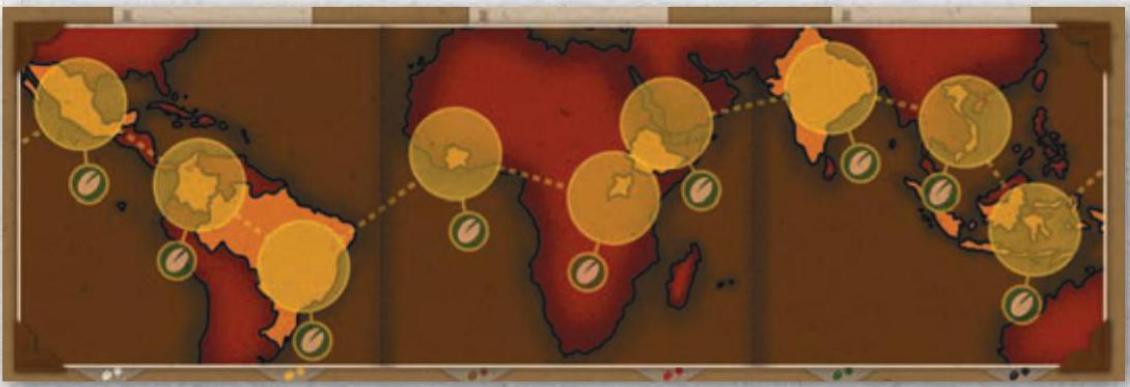
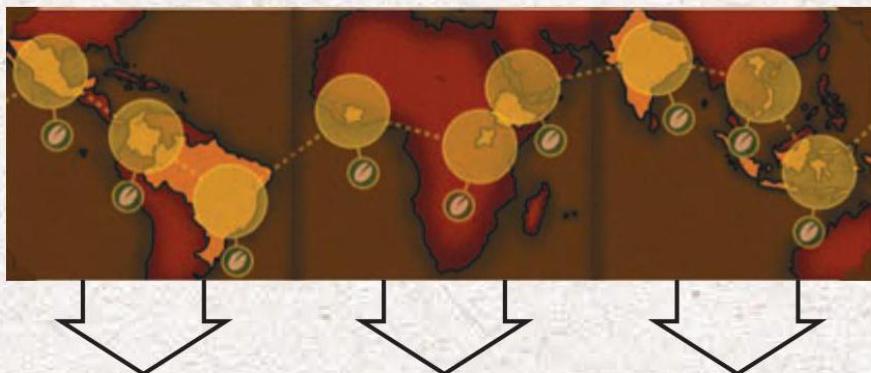
| World Map Tile | 1 tile, divided into three production regions: Americas, Africa, and Asia |
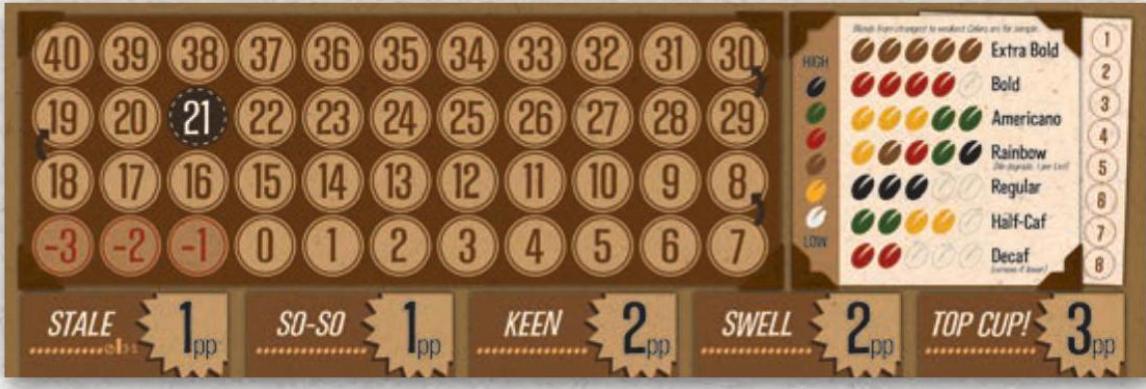
| Score Tracker/Best-Selling Coffee Bean List Tile | 1 tile |
| Blend Tiles | 15 tiles (5 sets of 3, shuffled face-down, then 3 are drawn and placed on top of the world map) |
| Double-Sided Research Tiles | 8 tiles (with another side for simplified rules) |
| Research Markers | 40 markers |
| Effect Markers | 9 markers, randomly placed on corresponding positions on the world map |
| Flavor Cards | 16 cards |
| Player Blend Markers | 24 markers (3 per set, totaling 8 sets) |
| Blend/Research Tokens | 8 tokens (used for secret voting) |
| Round Order Markers | 8 markers |
| Special Blend Cards | 8 cards (used in variant rules) |
| Roasting Bags | 8 cotton bags |
| Wooden Coffee Beans | 90 beans, in 6 colors |
| Starting Tiles | 2 tiles |
| Moldy Bean Tile | 1 tile (used in 3–5 player games) |
| Intern Cards | 24 cards (used in 3–4 player games) |
| Player Accessories | 8 player boards, 8 wooden player markers, 8 wooden scoring markers, 8 screening tokens, and a gameplay reference card |
| Investment Tokens | 18 tokens |
2. Setup
2.1 Public Setup
- Place the world map tiles and the prestige points tracker on the table; sort the 90 coffee beans by color and arrange them beneath the corresponding colored sections at the bottom of the world map, representing different coffee bean origins.
- Shuffle the blend tiles and place them face-down to the left of the world map; then draw 3 face-up tiles and position them at the top of the world map.
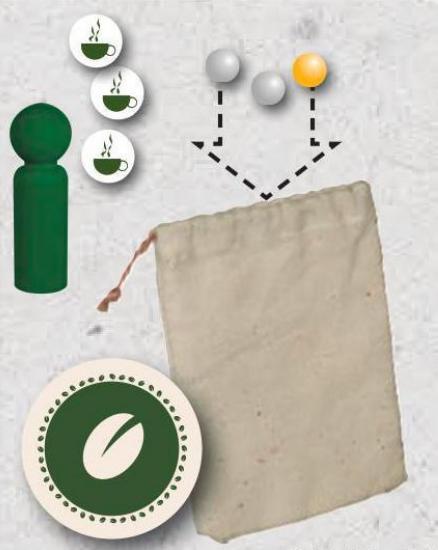
- Put the score markers into the baking bag and randomly determine the starting point for scoring; take out one marker per player and stack them on the prestige points tracker.
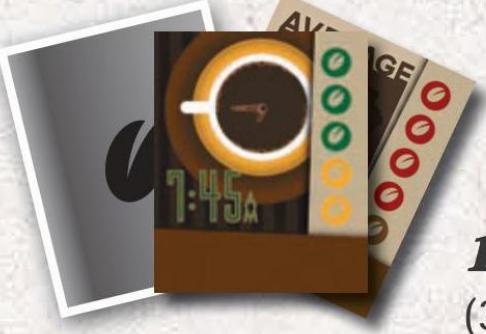
- The starting tile appears on the Best-Selling Coffee Beans list, with the Average Joe tile occupying the champion position.
- Shuffle the 9 effect tokens and randomly place them on the world map in their respective locations.
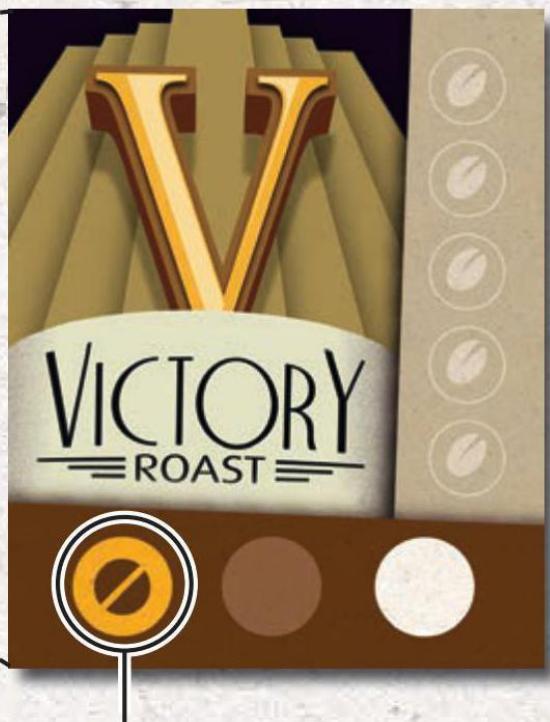
- Each starting tile is composed of a specific blend of 5 types of coffee beans; select the designated beans and place them in the corresponding positions on the starting tile.
- Based on the coffee bean types indicated on the blend tiles, position the beans beneath the tiles, connecting them to the corresponding countries.
- Designate one player as the "Blend Master," responsible for placing the player order markers, moving the score markers, and ensuring each round runs smoothly; typically, this role falls to the game owner or the player who has played most often.
2.2 Player Setup
- Choose one color and collect the corresponding player token, baking bag, research tile, and research marker.
- Place the research marker at the very beginning of the research track.
- Take 2 white coffee beans and 1 yellow coffee bean and put them into your own baking bag.
2.3 Adjustments Related to Number of Players
- For 3–6 players: After placing the blend tiles above the world map, remove the need to place coffee beans in countries marked with a prohibition symbol on the blend tiles, and flip the corresponding effect tokens over so that the prohibition symbol (☒) faces up.
- For 3–5 players: Due to fewer field investigators and insufficient coffee production, the market will introduce some common, standard blend beans. Add the Moldy Bean tile to the far left of the Best-Selling Coffee Beans list; it remains throughout the entire game and is not removed after each round.
3. Gameplay / Round Structure
The game proceeds over multiple rounds, each consisting of three phases that repeat until the end-of-game conditions are met:
- Field Harvest: Players sequentially place their player markers on world map tiles and collect coffee beans.
- Blending/Research: Players form different teams to either blend (earning points) or conduct research (gaining abilities).
- Public Tasting: New blending tiles are added to the best-selling coffee bean list, points are tallied, and then the flavor of blended beans is lost, causing rankings to drop.
The following details apply to games with 5–8 players; games with 3–4 players have separate intern rules.
3.1 Field Harvest
Negotiation & Information
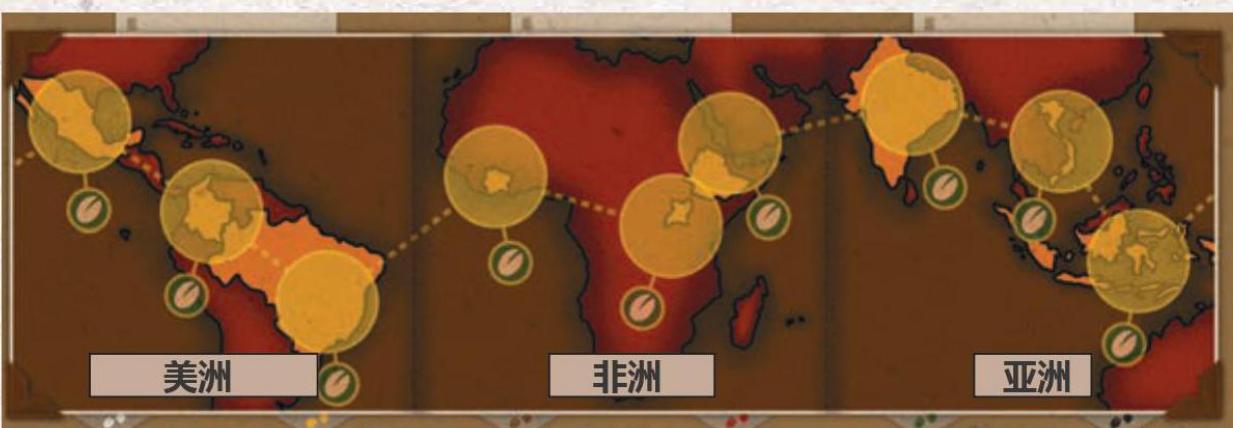
The world map is divided into three coffee-producing regions: the Americas, Africa, and Asia. Each region contains countries corresponding to specific actions. The game is fundamentally a social experience, encouraging players to reveal—or withhold—their strategies before placing player markers, which is crucial since players from the same region will form teams. Players may make any promises but cannot exchange tangible items; they must not disclose information about their roasting bags unless required by cards, actions, or rules.
Determining Turn Order
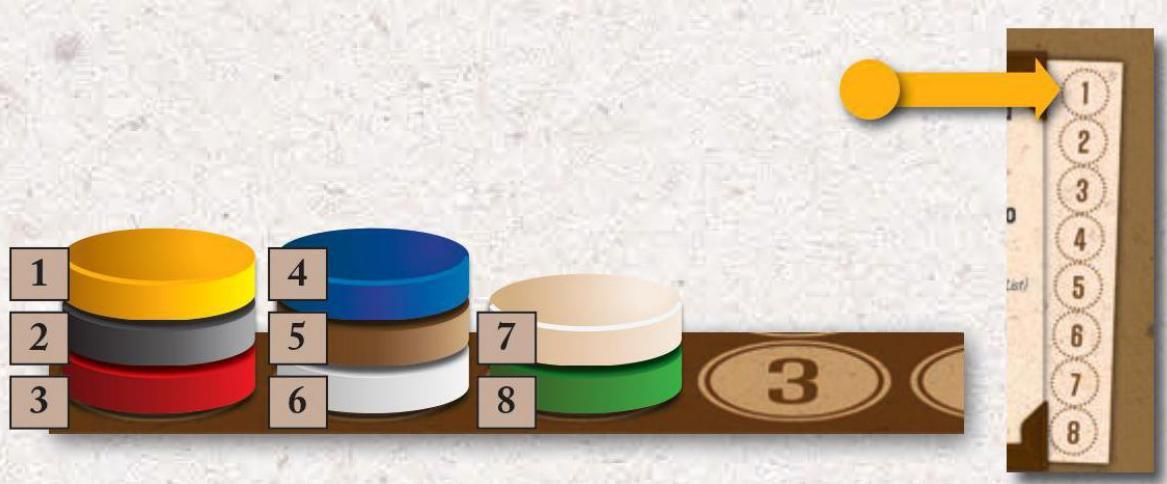
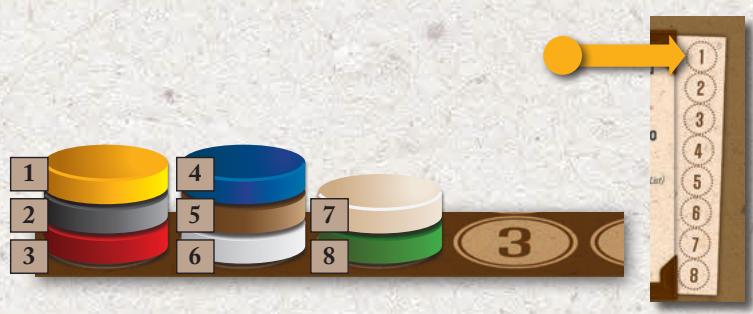
The player with the lowest score receives first turn; in case of a tie, the player at the top of the board takes first turn. The Blending Master arranges everyone's scores in the correct order along the turn order track.
Placing Player Markers
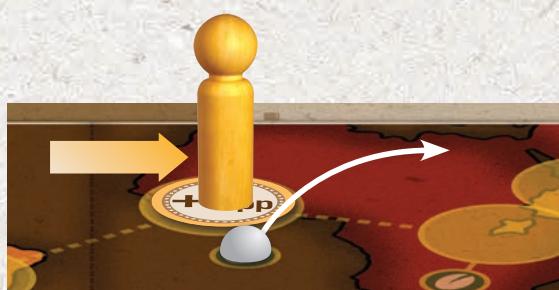
- In turn order, players take turns placing their player markers on a country tile on the world map. Upon placement, they immediately activate the marker's effect and collect any coffee beans below it (if available), adding them to their roasting bag.
- Each symbol listed on the marker indicates either a positive effect (dark brown) or a negative effect (red): positive effects are optional, while negative effects must be executed.
- Players continue placing markers until all have done so. Once a country is chosen, no other player may select the same country.
- In 3–6-player games, unless otherwise specified, players may not choose countries marked with ☒.
- During the first round, if a player places a marker on a country with a negative effect, they may ignore its impact; in subsequent rounds, the negative effect must be carried out.
3.2 Blending / Research
Voting to Decide Actions
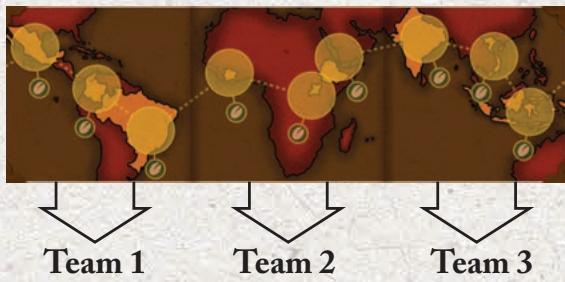
- Players divide into three teams—Americas, Africa, or Asia—and vote to decide whether to perform blending or research actions.
- When voting, players take blending/research tokens, secretly choosing one side up to hold in their hand; prior to voting, players are encouraged to negotiate agreements.
- Once all have made their choices, the Blending Master issues a command, and all players simultaneously reveal their votes: a blending side up signifies support for the team to carry out blending, while a research side up means support for research.
- The team with the most votes becomes the chosen action; in case of a tie, research is selected.
- The Blending Master must ensure that no team has already begun blending or researching before voting—this is especially important to prevent voting chaos.
- Investment Tokens: If any player holds an investment token, after voting the Blending Master pauses the game to offer investment opportunities, allowing players to place one investment token on a blending tile.
- Joint Actions: All blending teams and research teams should execute their respective actions simultaneously; blending teams should not wait for research teams to finish, nor vice versa.
3.3 Blending (2a)
Blending Action
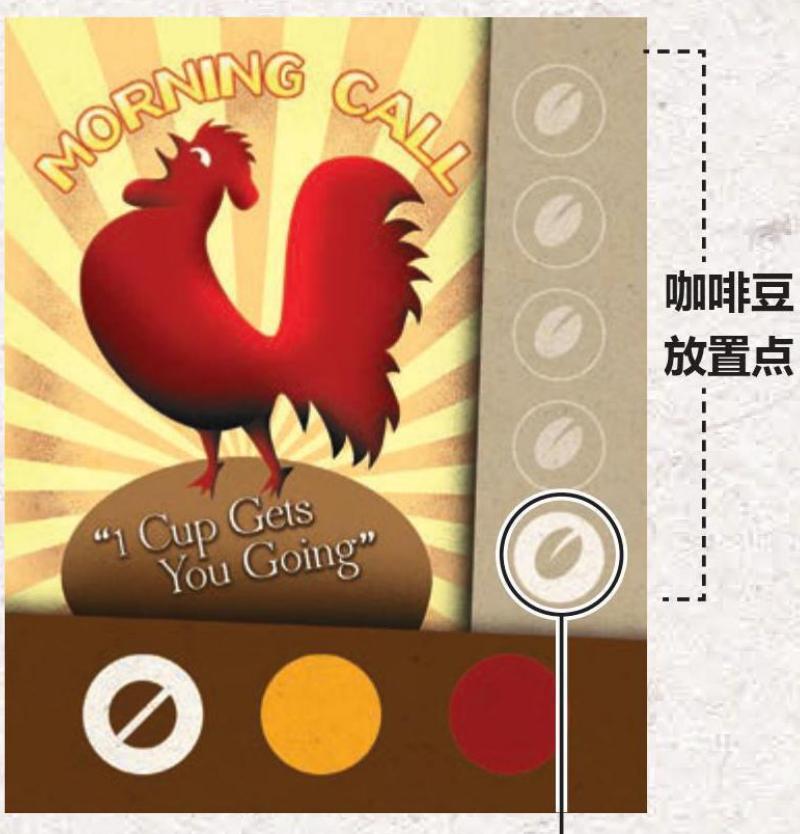
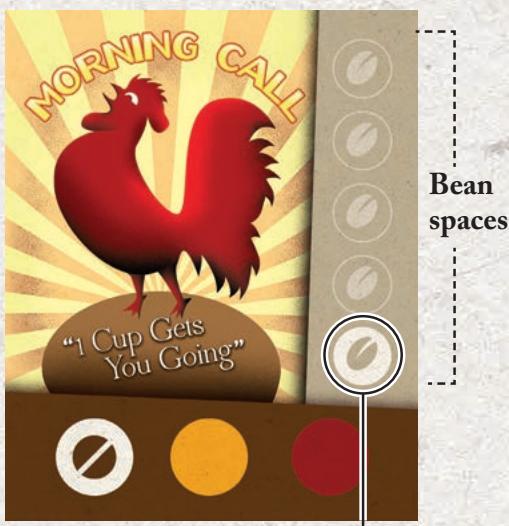
- Each team possesses a blending tile located above the world map. Each blending tile features five coffee bean placement spots, which players fill by randomly drawing beans from their own roasting bags.
- Teams collectively determine the order of member draws: one player shakes their roasting bag, randomly selects one bean, and places it in one of the five spots, then decides who goes next; this continues until all five spots are filled or the team unanimously agrees to stop drawing.
- A blending tile does not necessarily need to be fully filled, but every team member must place at least one bean.
- If consensus cannot be reached, members draw one bean at random from their roasting bags and place it on the blending tile; once all members have placed one bean, they may choose to continue placing or pass, until all members pass or all five spots are filled.
- Blending Rules: Unless required by cards, actions, or rules, players may not inspect the contents of their roasting bags; during negotiations, you may describe what's inside your bag as much as possible—even if it's deceptive.
Special Placement Spots
Some blending tiles feature designated spots for specific coffee types. When a team has filled four spots (each member having placed one bean), they may draw beans of the corresponding color from the supply area and place them in this special spot. If the team's region lacks such beans, they cannot place any beans there.
Blending Levels
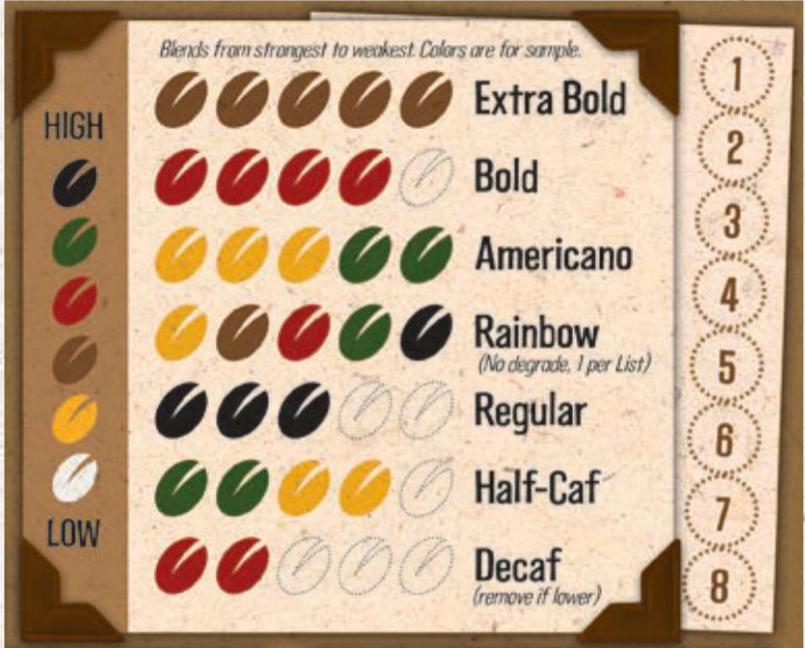
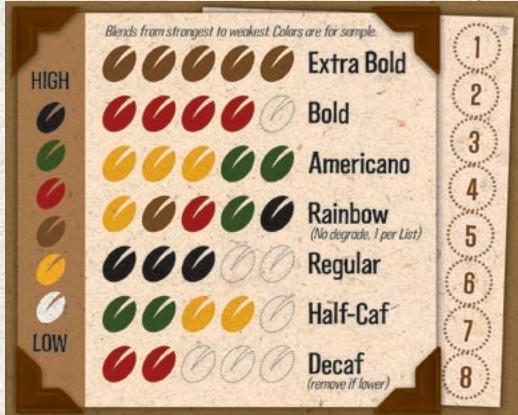
The blending level chart lists possible combinations resulting from blending five types of coffee beans. Based on these combinations and the colors of the beans, blending tiles are ranked and placed on the best-selling coffee bean list—for example, among Bold combinations, black beans rank higher than white beans, while white beans in Bold combinations rank higher than black beans in Regular combinations. Tie-breaking issues are resolved using the blending level chart—for instance, black beans in Bold combinations outrank red beans in Bold combinations; if both combination and color match, the team whose member holds the earlier turn order wins, securing a higher position on the best-selling list.
Joining the Best-Selling List
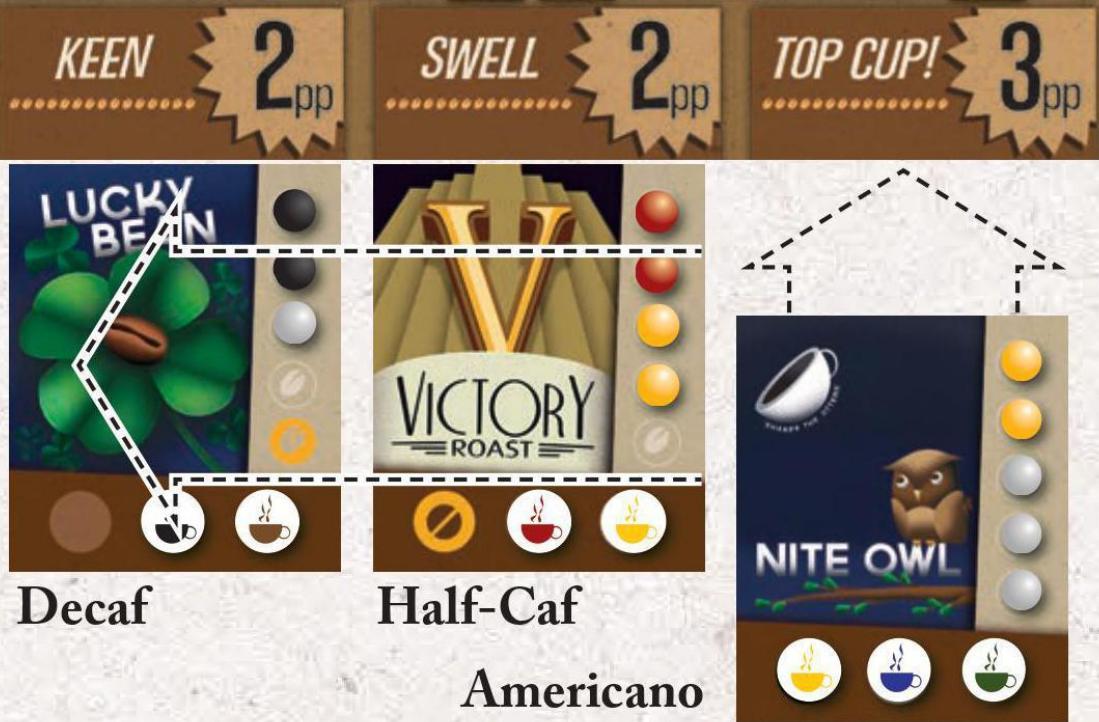
- After the blending action concludes, players place their blending tokens on their blending tiles; once all team members have placed theirs, all blending tiles are arranged according to the blending level chart on the best-selling list—lower-ranked tiles move left, higher-ranked ones move right.
- If, for some reason, a blending combination fails to materialize, the tile is removed, the beans returned to the supply pile, all tokens given back to players, and any investment tokens on the blending tile sent back to the general supply pile.
- Following the blending action, each player earns one research point, which they allocate to their research tile.
- Each player starts with three blending tokens; if a fourth needs to be placed, they either remove one from their original blending tile or choose not to place it. No two identical blending tokens appear on a single blending tile; if a new combination matches an existing one, the older combination is considered lower-ranked, with its flavor gradually fading away.
Rainbow Blending
Rainbow blending is a special type requiring five distinct kinds of coffee beans. It ranks higher than Regular combinations and never drops in the best-selling list. Only one Rainbow blending tile can exist on the list at a time; when a new Rainbow blending joins, the old one is removed. If multiple Rainbow blends enter simultaneously, the team whose member holds the earlier turn order wins, and the others are eliminated.
3.4 Research (2b)
Using Research Points
- When a team chooses the Research action, each player receives 3 research points to allocate across the research track. Players independently decide how to distribute these points among different abilities: by moving the corresponding research marker from left to right onto a new research point, with each step consuming 1 research point. Each column on the research track represents a player's level of mastery.
- When the first symbol in a column is covered, it indicates that the player has unlocked a new ability; once the research marker reaches the end of that ability using enough research points, the player gains access to it and can use it in subsequent rounds (except for flavor cards).
- The research marker can only move forward, not backward. At the end of the game, players earn points based on the level achieved in each row of the research track, plus additional points for advancing to the next level (e.g., a player who upgrades to Level 2 earns 2 points at the end of the game). Once an ability reaches its maximum level, players also gain extra perks that help them score even more—details of which are clearly listed on the research track.
… (condensed here; full text on the cunleme Chinese page)
(8 later sections are omitted here; see the Chinese page for the rest.)
Rules Q&A
Questions below are real questions players asked cunlema about this game; answers are ours, translated into English.
How many players does Vivajava The Coffee Game support?
3–8 players.
Rules, cards and Q&A (Chinese)
The rules, card data and player questions for this game are written in Chinese. Open the Chinese page to read them.
Where to find full rules
Full rules and card lookup are available in the cunlema app at cunlema.cn — pick this game and ask about any rule, card or turn you are unsure about.
Related games
Rulebook text (Markdown)
This game has 3 rulebook Markdown file(s) in our library; 3 rendered inline below — expand to read or download.
rules_zh_vivajava-the-coffee-game_1896.md57.3 KB
咖啡万岁 规则(集石文档 1896)
逐页 VLM 转写(qwen3-vl-plus),源:集石文档 1896,未翻译。
[图: 黑色皮革纹理封面,中央缝有棕色皮标,标上压印咖啡豆图案与文字“The Bean Is Life.™”,下方有灰色文字“翻译|茉雨”,底部有浅灰色文字“VivaJava CoffeeCo.”]
《拼配咖啡》 • 实地调查手册
游戏目标
《拼配咖啡》游戏是一款半合作的谈判游戏,一群见多识广、足智多谋的咖啡专员,为爪哇岛研发拼配豆,使其成为最畅销的咖啡豆。最终的赢家将获得晋升机会和巨额养老金,外加终生的咖啡供应。
游戏过程中,玩家成为团队的一员研发拼配豆,每次游戏的研发团队可能都不同。每轮游戏有3个阶段组成,重复进行,直到满足3个结束条件之一。
拼配出最佳组合,在大众品鉴阶段获得更高分数,成为最优秀的团队。
翻译|茉雨
制作团队&感谢名单
- 游戏设计: T.C. Petty III
- 美术设计: Chris Kirkman, T.C. Petty III
- 艺术插画: Chris Kirkman, Darrell Louder
- 制作发行: T.C. Petty III, Chris Kirkman, Cherilyn Joy Lee
- 出版商: Dice Hate Me Games
白金测试员: Mario Arnold, Keith Carter, Steven Doughty, Tom Gurganus, Timothy Hing, Brian Linnen, Sarah Linnen, Darrell Louder, John Moller, Jim Neuschwander, Chris Norwood, Jacquelyne Purtell, Shawn Purtell, Benjamin Rosset, Elizabeth ‘EB’ Singer, Robert Singer, Luke Winters
20019年7月首测名单: Mario Arnold, Michael Arnold, Alexis Arnold, Nikki Gortian, Timothy Hing, Jim McSherry
特别感谢: T.C. would like to thank people who play games, Battles (the band), variable turn order mechanics, John Moller again for his undying support, Dr. Moore/Kellar, everyone who supported the game on Kickstarter, Seattle, my iPhone, BGG, little wooden bits, those brave aviators fighting on the wings of aeroplanes, and Mommy and Daddy and Sissy for letting me figure it all out myself.
Chris would like to thank all the Kickstarter supporters for their wonderful enthusiasm and generosity, Don Lloyd, Lesley Louder, W. Eric Martin and Chris Norwood for their continued support and rules lawyering, and David MacKenzie for getting us into this whole mess.
Much thanks to the Lost Type Co-Op (losttype.com) for Airplane, Airship, Alexis, Carton, Cubano, Franchise, Governor, Habana, Haymaker, Liberator, Ministry, Oil Can, Onramp, Quaver, and Ranger, and to TypeArt Foundry for the awesome Fling-A-Ling.
[图: UNPUB 标志(圆形徽章,含“PLAYTESTED • ENJOYED”字样及网址 www.unpub.net)]
[图: Dice Hate Me Games 标志(两个骰子图案,左侧骰子带愤怒表情,右侧骰子为蓝色几何风格;下方文字“DICE HATE ME GAMES™”及“greater/than/games”)]
下载游戏规则,观看教学视频,请访问:
dicehatemegames.com/vivajava.
“Dice Hate Me,” “The Bean is Life,” the VivaJava logo and all art contained within are ©2017 Greater Than Games, LLC.
游戏目录
- 游戏预览&制作团队 ………………………………………… 2
- 游戏件配 ……………………………………………………… 3
- 游戏设置 ……………………………………………………… 4
- 游戏流程 ……………………………………………………… 6
-
- 实地调查 ………………………………………………… 6
-
- 拼配/研究
- a. 拼配 …………………………………………………… 7
- b. 研究 …………………………………………………… 9
-
- 大众品鉴 ………………………………………………… 10
- 游戏结束 ……………………………………………………… 12
- 简化规则 ……………………………………………………… 12
- 实习生(3-4人游戏) …………………………………………… 13
- 变体规则 ……………………………………………………… 15
- 附录A:效果标记/实习生能力 ………………………………… 16
- 附录B:风味卡详解 …………………………………………… 17
- 附录C:研究专题 ……………………………………………… 18
- 简明游戏流程 ………………………………………………… 20
VivaJava • 2
游戏配件
世界地图板块
[图: 一张横版世界地图,标有多个黄色圆形区域及连接线]
分数记录/畅销咖啡豆清单板块
[图: 一个带数字格子的记分板,含“STALE”、“SO-SO”、“KEEN”、“SWELL”、“TOP CUP!”等区域,右侧为咖啡豆类型图例]
8个双面研究板块
[图: 多张双面卡牌,正面标有“GROW”、“SELECT”、“INVEST”、“BREW”等字样及图标;背面为“FLAVOR”等]
15个拼配板块
[图: 多张卡牌堆叠,其中一张正面为公鸡图案与“ROASTING CO.”字样]
2个起始板块
[图: 两张卡牌,一张显示“1:45A”与咖啡杯图标,另一张为咖啡豆袋图案]
1张霉豆板块(3-5人游戏使用)
[图: 一张卡牌,显示咖啡豆袋与“MOLD”字样]
16张风味卡
[图: 多张卡牌,部分显示“+3rp +1rp”、“+2rp”、“Decaf”等文字与图标]
8张玩家流程参考卡
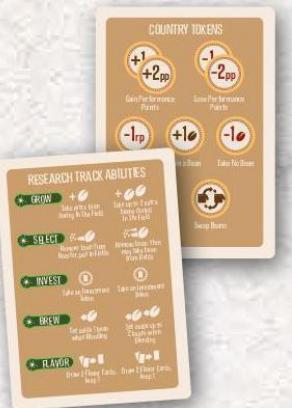
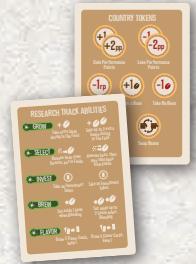
[图: 多张小卡,含“COUNTRY TIER”、“RESEARCH TRACK ABILITIES”等标题及流程图示]
40个研究标记(5个1组,共8组。)
[图: 五种颜色圆形标记:黄、绿、白、黑、红,每色8枚]
24个玩家拼配标记(3个1组,共8组。)
[图: 三枚圆形标记:红杯、蓝杯、白杯,各8组]
24张实习生卡(详见P13:实习生)
[图: 多张卡牌,含“AIDEN”、“ZOE”等角色名及“-1pp”、“+2rp”等效果]
8个回合顺位标记
[图: 八枚彩色圆形标记:黄、绿、白、黑、红、蓝、棕、灰]
8张特殊拼配卡(详见P15:变体规则)
[图: 多张卡牌,含“+2rp”、“Decaf”等文字与咖啡杯图标]
8枚拼配/研究标记
[图: 两枚圆形标记:一枚蓝色底白豆图案标“BLEND”,一枚蓝底白星图案标“RESEARCH”]
9个效果标记
[图: 三枚圆形标记:“+1pp”、“+2pp”、“+2pp”,均为米色底金色边]
8枚筛选标记(详见P15:变体规则)
[图: 两枚圆形标记:一枚蓝色底漏斗图标,一枚棕色底咖啡豆筛图标]
18个投资标记
[图: 六枚红色环形标记,内含白色竖条纹;十二枚红色环形标记,内含白色横条纹]
8个棉纺烘焙袋
[图: 一个米色布袋,系绳口]
90颗木质咖啡豆(6种颜色)
[图: 六色木质圆豆,按数量标注:20、18、16、14、12、10]
8个木质玩家标记
[图: 八枚木质棋子:四红四黄,圆柱形带圆头]
8个木质计分标记
[图: 八枚木质圆片:四红四棕]
游戏设置
如下图所示,将世界地图板块以及分数记录板块,放在桌面上。将90颗咖啡豆以颜色区分,摆放在世界地图底部对应颜色的下面,代表不同咖啡豆的产地。洗混拼配板块,面朝下放置在世界地图的左侧。
注意
拼配大师
指定一名玩家成为“拼配大师”,负责放置玩家顺位标记、移动分数标记,来确保每轮游戏正常进行。通常,这名玩家应该是游戏的拥有者,或者是玩得最多的人。
[图: 一个带编号1–40的圆形分数记录表,下方有STALE、SO-SO、KEEN、SWELL、TOP CUP!五个区域及对应pp值;右侧为咖啡豆颜色与名称对照表(Extra Bold, Bold, Americano, Rainbow, Regular, Half-Caf, Decaf),并标注HIGH/LOW]
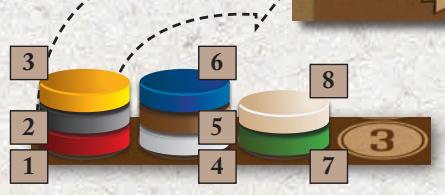
将分数标记放入烘焙袋中,以随机抽取的方式决定分数的起始位置。根据玩家人数,依次取出堆放在分数记录表上。(如下图)
[图: 三叠咖啡豆堆(黄/灰/红;蓝/白/绿;米/棕/黑),分别标号1–3、4–6、7–8,其中第3堆顶部标数字3]
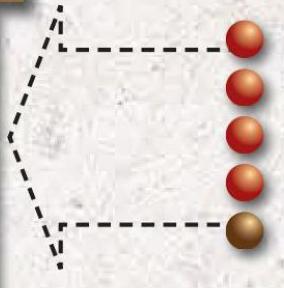
每个起始板块都有5种特定的咖啡豆拼配而成。取出特定的咖啡豆,放置在起始板块对应的位置上。
[图: 起始板块示意图:NITE OWL、CARAVAN、VICTORY ROAST三个板块,各含3个圆点(颜色组合不同);右侧示意5颗同色咖啡豆竖排]
起始板块出现在畅销咖啡豆清单上,特别是Average Joe板块,应该出现在冠军的位置。
[图: Average Joe板块特写,含咖啡杯图案与“7:45”字样;旁有“JOE”标志]
洗混拼配板块,摸取3个,面朝上放置在世界地图顶部位置。
[图: 世界地图板块,其上分布多个圆形标记(+2pp, +1pp, -1rp, -2pp, -1○, +1pp等),并有箭头指向三个起始板块(NITE OWL, CARAVAN, VICTORY ROAST)]
根据拼配板块所示的咖啡豆的种类,将咖啡豆放置在板块下方与国家相连的位置上。
[图: 两个矩形板块(左棕右白),下方各连一颗咖啡豆(棕→棕豆,白→白豆)]
咖啡都豆供应区
[图: 一个标“+2pp”的圆形标记,连接至一袋咖啡豆图标]
洗混9个效果标记,并随机放置在世界地图对应的位置上。
[图: 9个效果标记散落于世界地图下方,含黄、灰、棕、红、绿、黑等颜色咖啡豆]
研究板块
选择1个颜色,拿取对应颜色的玩家标记,烘焙袋,研究板块以及研究标记。
研究标记放置在研究板块最开始的外置。拿取2颗白色咖啡豆和1颗黄色咖啡豆,放入烘焙袋中。
[图: 研究板块网格,分GROW、SELECT、INVEST、BREW、FLAVOR五类,每类含多张卡牌;右侧为绿色玩家标记、烘焙袋、咖啡豆图标]
烘焙袋
VivaJava · 4
3-6人游戏设置
3-6人游戏时,在设置阶段做一些调整。将拼配版块放置在世界地图上方之后,在放置咖啡豆时,注意拼配版块上有禁止符号的国家不需要放置咖啡豆,并将对应的效果标记翻面,让禁止符号朝上。
[图: 世界地图上标有禁止符号(红色圆圈加斜杠)的国家位置,对应拼配版块如“NITE OWL”、“CARAVAN”、“VICTORY ROAST”,其中“VICTORY ROAST”特写显示其效果标记翻面后为禁止符号朝上;下方三组咖啡豆与效果标记对应标注“不放置咖啡豆,并将效果标记翻面”]
这个符号表示在对应的国家上禁止放置咖啡豆,并将效果标记翻面至 ⛔ 符号朝上.
[图: +2pp 标记与禁止符号标记并列,箭头指示从 +2pp 翻转至禁止符号]
3-5人游戏设置
由于实地调查人员减少,导致咖啡产量不足。此时市场会推出一些常见的普通的拼配豆,这些豆子冲煮出来的风味还算可以,豆子也很健康,但注意不要触及底线——使用霉豆。在3-5人游戏时,在畅销清单的最左侧加入霉豆板块,霉豆板块在整场游戏中都会存在,不会随着轮次结束而移除。
[图: 咖啡袋包装标有“Coffee*”,指向畅销清单最左侧新增的“霉豆”板块;畅销清单为40×8网格数字表,底部有“STALE”、“SO-SO”、“KEEN”、“SWELL”、“TOP CUP!”等区域及对应pp值;右侧附有咖啡风味强度与类型对照图;另有一小图显示霉豆板块(咖啡袋图标)及文字说明“霉豆板块不会被移除,直到游戏结束。”]
游戏流程
《拼配咖啡》将会进行多轮游戏,每一轮游戏包含3个阶段。
-
实地采摘
按顺序,将玩家标记放置在世界地图板块上并收集咖啡豆。 -
拼配/研究
玩家组成不同的团队,进行拼配(获得分数)或者研究(获得能力)。 -
大众品鉴
在畅销咖啡豆清单上新增拼配版块并计算分数,最终拼配豆风味丢失,降低排名。
下面每个阶段的详细介绍适合5-8名玩家游戏。3-4名玩家游戏规则详见P13。
1. 实地采摘
世界地图被划分为3个产咖啡豆的产区(美洲、非洲和亚洲)。每个地区都有国家且有对应的行动,玩家通过放置玩家标记来探索这些地区。
[图: 三张世界地图板块分别标注“美洲”、“非洲”、“亚洲”,各板块上有多个圆形区域及连接线]
《拼配咖啡》本质上是一款社交游戏,我们鼓励玩家在放置玩家标记之前,说出(或不说)他们的策略。这非常关键,因为在同一产区的玩家将组成团队。玩家可以做出任何承诺,但不会交换任何实质的东西。但这是有限制的,玩家不能公开烘焙袋里面的信息,除非卡牌、行动或者规则要求。
决定回合顺位
分数最低的玩家获得第一顺位。如果出现平局(如右图所示),位于顶部的玩家获得第一顺位.
拼配大师根据大家的得分,将它们按正确的顺序放置在回合顺位轨道上。
[图: 回合顺位轨道上有编号1至8的格子;左侧堆叠着标有1–3的黄色、红色、深灰色圆片,以及标有4–8的蓝色、棕色、白色、绿色、黑色圆片;右侧为竖排数字1–8的顺位指示条,箭头指向数字1]
放置玩家标记
按照回合顺位,玩家依次将玩家标记放置到世界地图板块的一个国家上。放置后,玩家需要立即执行标记上的效果,并拿取下方对应的咖啡豆(如果有),放入烘焙袋中。标记上列出的每个符号表示一个正面效果(深棕色)或一个负面效果(红色)。正面效果是可选的,而负面效果则必须被执行。
[图: 一个黄色棋子立于世界地图板块上的圆形区域,该区域有“+”和“p”符号;箭头指示棋子移动路径及与下方灰色小球的互动]
玩家继续放置玩家标记,直到所有玩家都已放置。国家一旦被选择,其他玩家就不能选择同一个国家.
在3-6名玩家游戏中,除非有特殊说明,否则不能选择有🚫符号的国家。
(有关效果标记的功能与效果,详见P16:附录A。)
在第一轮游戏中,如果有玩家将玩家标记放置在有负面效果的国家上时,可以忽略其效果。在随后的游戏中,必须执行负面效果。
VivaJava · 6
2. 拼配/研究
玩家分成三个团队(美洲,非洲,或亚洲),通过投票来决定执行拼配行动或者研究行动。投票时,拿取拼配/研究标记,秘密的选择一面朝上握在手中。投票前鼓励玩家通过谈判来达成协议。
[图: 世界地图分三区(美洲、非洲、亚洲),每区上方有若干圆形标记,下方分别指向“团队1”“团队2”“团队3”]
所有人选择好之后,拼配大师发布号令,所有玩家同时展示手中的投票结果。拼配面朝上,意味着你支持团队进行拼配行动,而研究面朝上,意味着你支持团队进行研究行动。
统计每个团队的票数,票数最多的行动将成为该团队的方案。
如果平局则执行研究行动。
注意
投票
拼配大师应确保在投票前,没有团队在进行拼配/研究行动。这对防止投票混乱显得尤为重要。投资标记
如果任意一名玩家拥有投资标记,在投票结束后,拼配大师让游戏暂停,提供投资机会,玩家可以将1个投资标记放置在拼配板块上。(详见P18:附录C)
2a. 拼配
考验团队合作的时候到了,同过拼配行动来创造畅销咖啡豆。在接下来的数个回合中,在拼配板块上放置咖啡豆来完成拼配,之后将拼配板块放置在畅销咖啡豆清单上,来获得预期的分数。
拼配行动
每个团队都会拥有一个拼配板块(世界地图上方)。每个拼配板块上都有5个咖啡豆放置点,这些放置点都由每位玩家从烘焙袋中随机抽取咖啡豆来填充。
共同决团队成员的抽取顺序。一名玩家首先摇动烘焙袋,并随机抽出一颗豆咖啡,放到拼配板块五个放置点之一的上面,然后决定下一位玩家。直到5个放置点都被填满或者团队一致决定停止抽取。拼配板块不一定要被填满,但必须保证团队的每一个成员都放置过1颗咖啡豆。
如果团队意见无法保持一致,那就按顺序每位成员从烘焙袋中随机抽取1颗咖啡豆放置在拼配板块上。所有成员都放置过1颗之后,可以继续选择放置或者Pass。直到所有成员都Pass或者5个放置点都被填满。
[图: “MORNING CALL”标题下一只红色公鸡站在写有“‘1 Cup Gets You Going’”的咖啡杯上;右侧为竖排5个椭圆空位,标注“咖啡豆放置点”;下方有三个圆形按钮:白色带斜杠、黄色、红色]
拼配法则
除非卡牌、行动或则规则需要,否则玩家不能查看烘焙袋的内容。在谈判时,你可以极尽可能的描述你的烘焙袋里有什么,即使是欺骗。
特殊放置点
某些拼配板块上会有一个指定咖啡种类的放置点。当一个团队已经填满4个放置点(每个成员都已经放置1次)时,可以从咖啡豆供应区拿取对应颜色的咖啡豆,放在拼配板块上。如果团队所在产区没有这种咖啡豆,则不能放置咖啡豆.
7 • VivaJava
2a. 拼配 (续上)
拼配等级
拼配等级表列出了5种咖啡豆拼配后的可能组合。根据这个组合以及咖啡豆的颜色,对拼配板块进行排名,并将其放到畅销咖啡豆清单上。例如,都是Bold组合时,黑豆就比白豆等级高;另外此外,Bold组合的白豆又比Regular组合的黑豆等级高。
借用拼配登记表可以解决平局问题。例如,Bold组合的黑豆比Bold组合的红豆等级高。然而,依然会出现拼配组合且颜色也一致的平局状况,此时位于回合顺位靠前的团队成员胜出,获得在畅销咖啡豆清单靠前的位置。
[图: 拼配等级表:左侧标有HIGH至LOW,右侧为8行咖啡豆组合图案与名称,从上至下依次为Extra Bold、Bold、Americano、Rainbow (No degrade, 1 per List)、Regular、Half-Caf、Decaf (remove if lower),每行含5–6颗不同颜色/填充状态的豆子图案]
加入畅销咖啡豆行列
拼配行动结束后,玩家将自己的拼配标记放置在拼配板块上。所有团队成员放置完毕后,所有的拼配板块会根据拼配等级表,放到畅销咖啡豆清单上。
根据拼配等级表调整拼配板块的位置,等级低的往左边移动,等级高的往右边移动。由于某些原因导致拼配组合没有得到要求,则移除该板块,咖啡豆放回供应堆,所有标记归还给玩家。拼配板块上的投资标记返回一般供应堆。(详见P18:附录C)
拼配行动结束后,每位玩家获得1个研究点数,把它分配在你的研究室板块上。
每位玩家有3个拼配标记,如果在放置拼配标记时,需要放置第4个,则从原来的拼配板块上拿取放置或者不放置。一个拼配板块上不会出现相同的拼配标记,如果新的拼配组合与原有组合相同,则原有组合被认为是等级低的,且风味不断丢失。
拼配示例
Chris, Cherilyn 和 T.C. 在同一个产区,属于同一个团队,他们投票决定执行拼配行动。Chris 说他有很大几率会给团队贡献3颗黄色咖啡豆。最终 Cherilyn 和 T.C.选择相信他,让他第一个进行拼配行动。
Chris把手伸进烘焙袋,摸出1颗黄色咖啡豆,放在拼配板块上。到目前为止,一切顺利。
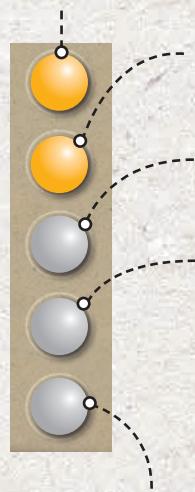
[图: 拼配示例流程图:竖排5个圆圈(自上而下:黄、黄、白、白、白),旁注文字说明事件顺序:团队决定让Chris再抽一次,又是1颗黄色咖啡豆!→ Chris再抽取了1次,居然是白色咖啡豆!OMG!→ 由于每个团队成员都必须至少放置1颗咖啡豆,因此Chris不能再放置了。接着Cherilyn摸出了1颗白色咖啡豆,情况突然好转了!→ Cherilyn有很多白色豆子,但T.C.必须放置咖啡豆。他闭上眼睛,把手伸进烘焙袋……然后摸出了1颗白豆!团队完美的拼配出Americano组合,不错!]
畅销咖啡豆清单
[图: 畅销咖啡豆清单顶部横条:STALE 1pp、SO-SO 1pp、KEEN 2pp、SWELL 2pp、TOP CUP! 3pp]
[图: 三个产品包装图示及对应拼配组合:左侧“LUCKY BEAN”下方标注Decaf;中间“VICTORY ROAST”下方标注Half-Caf;右侧“NITE OWL”下方标注Americano;各包装上方有对应颜色豆子排列,箭头指向其所属等级位置]
Cherilyn, Chris和T.C.的团队拼配出了Americano组合,准备投放市场。现在的销量冠军是红/黄Half-caf组合,紧跟其后的是黑/白Decaf组合。由于Americano组合的拼配等级更高,导致Half-caf和Decaf在畅销咖啡豆清单上的排名下降,Americano组合荣登榜首!这个团队立即获得3分奖励.
VivaJava · 8
2a. 拼配 (续上)
彩虹拼配
彩虹拼配是一种特殊拼配类型,团队可以进行拼配,需要五种不同的咖啡豆。彩虹拼配的级别比Regular组合要高,并且在畅销清单中不会降级。
在畅销清单中只能存在一个彩虹拼配。新的彩虹拼配加入后,原有的将会被移出。如果同时有多个彩虹拼配加入,则拥有在回合顺位靠前玩家的团队获胜,移除其他彩虹拼配。
[图: Rainbow(No degrade, 1 per List)图标,含五颗不同颜色咖啡豆:黄、棕、红、绿、黑]
咖啡豆应用策略
《拼配咖啡》是一款经营咖啡豆的游戏,收集咖啡豆只是其中一种策略。新手常犯的错误是尽可能的去收集咖啡豆。玩家应该带着特定的目标巧妙地选择加入烘焙袋中的咖啡豆,无论是拼配一种特定颜色的组合还是一种特殊的彩虹组合。
[图: 一颗星形装饰图案]
共同行动
咖啡世界千变万化。所有的拼配团队和研究团队应该同时执行对应的行动。拼配团队不应该坐等研究团队完成,反之亦然。
2b. 研究
有时候,为了保证团队成员的研发水平,加入一些训练是非常有必要的。在研究行动中,团队成员回到各自的实验室,培养一些特殊能力,来拼配出更强大的组合。
使用研究点数
选择研究行动的团队,每位玩家可以获得3个研究点数,来分配到研究板块中。玩家独自决定这些研究点数分配在哪些能力上,将对应的研究标记从左往右移动到一个新的研究点上。每移动1步,就消耗1个研究点数。研究板块的每一列代表玩家的拼配水平。
研究板块每一列中的第一个*符号被覆盖时,说明玩家启用了一个新能力。当玩家使用足够多的研究点数,使得研究标记到达这个能力的尾部,玩家获得这个能力,并可以在下一轮游戏中使用这个能力(风味卡除外,详见P17:附录B)。
研究标记只能往前移动,不能后退。同时,在游戏结束时,玩家将根据研究板块每一行所达到的级别获得分数。前一级别的分数也需加上。例如,升级到第二级别的玩家在游戏结束时获得2分。
一旦某个能力升级到满级,将会额外获得一些能力。这些能力能帮助玩家获得更多分数,在研究板块上都有具体说明。
(详见P18:附录C)
[图: 研究板块示意图,含GROW、SELECT、INVEST、BREW、FLAVOR五列,每列含若干带星号与图标的小格子,右侧有英文说明文字]
研究板块
从左往右移动研究标记。在下面的例子中,Shawn使用他的3个研究点,在GROW能力中向右移动了2步,在SELECT能力中向右移动了1步。现在他可以在下一轮使用GROW的特殊能力,并在游戏结束时获得1分。
[图: 研究板块局部放大图,显示GROW与SELECT两行;GROW行中红色箭头指示标记从起始位置右移2格至满格(带星标),SELECT行中标记右移1格;标注“游戏结束时获得的分数”、“新能力起始点”、“能力”]
9 • VivaJava
2b. 研究(续上)
注意
支付分数获取研究点
拼配/研究行动结束后,拼配大师声明游戏暂停,让玩家依次选择是否支付分数获取研究点。当所有玩家选择完毕,游戏继续,进入大众点评阶段。
使用分数获得研究点
执行研究行动的团队有一个好处,就是可以用所得分数去换取研究点数。
拼配/研究行动结束后,执行研究行动的团队成员(不包括拼配团队),依次选择愿意用多少分数去交换研究点数,然后,玩家在分数记录表上向左移动对应步数。每失去1分,玩家获得1个研究点数,并立即移动研究标记或用于某种能力。
(例如风味能力,详见P18:附录C。)
合理使用分数这一资源是非常有利的,对能力的早期投资,会让你的拼配结果能在畅销清单的排位上,产生很大的影响。
请注意,玩家的分数不能降到-3或者更低,任何时候计分标记都不能移动到-3这一格上。
[图: Shawn通过最初的3个研究点,升级了部分能力。现在,他想提升SELECT的能力,于是他用2分换得了2个研究点数。计分标记向左移2格,SELECT能力的研究标记往前移动2格,该能力升级到下一个。图中显示计分标记从7→5,SELECT能力条从初始状态(带星号)经红色箭头指示移动后变为带更多星号的状态;GROW能力条也显示类似结构。]
3. 大众品鉴
各个团队的工作必须得到肯定。每一轮游戏的最后阶段就是获得分数和为下一轮游戏(或游戏结束)做准备!
获得分数
拼配/研究行动结束后,结算每个在畅销清单上的拼配板块,根据拼配板块上的玩家拼配标(按顺序)获得分数。畅销清单有5个畅销排名,上面标注了每个排名的分数。
在拼配板块上,每有1个玩家拼配标记,获得畅销清单上标注的分数。
玩家拼配标记在结算分数之后不会移除,直到拼配板块被移除为止.
[图: 左侧示例:SWELL位置标2pp,TOP CUP!位置标3pp;下方两个拼配板块“VICTORY ROAST”与“NITE OWL”,各带3个拼配标记(以不同颜色咖啡杯图标表示),分别连接至上方对应位置的pp值;右侧文字说明T.C.(黄色)在TOP CUP!得3分、在SWELL得2分,合计5分,移动计分标记5格(3+2=5分),烘焙大师将世界地图上的玩家标记归还给T.C.。底部另有一图:计分轨道上标有5、6、7、8、10等数字格,三个叠放圆片(蓝、黄、绿)位于5格处,虚线箭头指向8格处,示意移动5格。]
3. 大众品鉴 (续上)
风味丢失
拼配的豆子在市场上售卖一段时间后,由于风味丢失,导致咖啡出品质量下降,变成陈年豆。之前在畅销清单上的豆子,在公众眼中就不再那么受欢迎。从拼配板块上移除1颗咖啡豆,放回供应区。移除的豆子必须是拼配板块上最不重要的。
例如,如果拼配的是 ● ○ ○ ○ ○,这是一个带有1颗多余黑豆(●)的Bold组合。多余的黑豆会被移除,因为移除其他的豆子会使组合变成 ● ○ ○ ○,导致风味丢失。而且Regular组合比Bold的组合等级低。
咖啡豆被移除后,会根据拼配等级表重新排序拼配板块。如果拼配结果比Decaf组合还低,拼配板块会被移除。
风味丢失示例
在下面的例子中,黑/白的Decaf组合移除1颗白豆,红/黄的Half-caf组合移除1颗黄豆(变成Decaf组合),Americano组合失去了1颗黄豆(变成Regular组合)。
[图: 三组垂直排列的豆子柱状图,每组含4颗豆子;第一组为黑、黑、白、灰,箭头指向移除白豆后变为黑、黑、灰;第二组为红、黄、黄、灰,箭头指向移除黄豆后变为红、黄、灰;第三组为黄、灰、灰、灰,箭头指向移除黄豆后变为灰、灰、灰]
风味丢失会降低拼配等级,在畅销清单上会重新排序。现在畅销清单上有两个Decaf组合,但由于黑豆等级比红豆等级高,所以黑色的Decaf组合排名上升了。万一两个组合都是红色,那么黄豆的存在会打破这一平局。
[图: 畅销清单三张卡牌:KEEN(2pp,VICTORY ROAST,含黑、红、黄、灰豆),SWELL(2pp,LUCKY BEAN,含红、黄、黑、灰豆),TOP CUP!(3pp,NITE OWL,含黄、灰、灰、灰豆);箭头显示KEEN与SWELL因黑豆优势位置互换]
移除拼配板块
畅销清单只有前五排名。如果因为某种原因,导致拼配结果等级太低,无法进入榜单,那么拼配板块将会被移除。
移除拼配板块,将剩余的咖啡豆返回供应堆,玩家拼配标记返回玩家手中。
畅销清单上只能有1个Rainbow组合。当有新的Rainbow组合出现时,移除之前的。
注意
检查游戏结束
游戏以三种方式结束,详情见下一页。在准备下一轮游戏之前,拼配大师应当检查是否满足游戏结束条件。
准备下一轮游戏
将世界地图上方未完成的拼配板块向右移动,翻开新的拼配板块放置在世界地图上方空白位置。
世界地图上的咖啡豆放回供应区,根据新的拼配板块重新放置对应的咖啡豆。如果咖啡豆供应不足,放置点空置即可。
[图: 左侧两张咖啡豆卡牌,虚线箭头指向右侧空白拼配板块区域,再指向下方世界地图区域及一张新翻开的拼配板块卡(含公鸡图案)]
超负荷研究
如果所有团队在一轮中都选择执行研究行动,那么将亚洲产区上方的拼配板块移除,其他按原有方式设置.
11 • VivaJava
游戏结束 & 计分
《拼配咖啡》游戏将以下面三种方式结束:
-
拼配板块不足
如果没有足够多的拼配板块,放置在世界地图上方,游戏立即结束。 -
4个能力满级
如果一位玩家的4个研究标记移动到该能力的末端,游戏在本回合的大众品鉴阶段后结束。 -
获得21分
如果一位玩家在大众品鉴阶段后,获得了21分。游戏在本回合后结束。
当满足三个游戏结束条件之一时,玩家(按顺序)从研究板块上获得分数以及任何所有在游戏结束时提供分数的卡牌。
研究奖励
研究板块上的各种能力在不同等级提供奖励分数,游戏结束时,加总到玩家分数中,并且这些分数时累计相加的。奖励分数标注在能力等级的左上角。
加总所有获得的分数,拼配大师负责将玩家的计分标记,往前移动对应的格数。
Shawn的INVEST能力已经达到满级,BREW能力已经达到第2级. 奖励分数时累积的。所以INVEST能力让Shawn获得5分(1+1+3), BREW能力提供2分(1+1)奖励。总共获得7分奖励。
[图: 研究板块示意图,含INVEST、BREW等能力轨道,标有星形、咖啡豆、齿轮等符号及分数标记;右侧有英文说明框:“When forming a team of two, your Research/Blend vote is the tiebreaker.”、“After Blending, may trade PPs for RPs as if you had Researched.”]
得分提示
玩家不要忘记,在游戏结束时,计算由升级能力带来的分数奖励!
[图: 一张卡牌样式的提示图,含“1pp”字样与箭头、星形图案]
分数最高的玩家成为最终的胜利者,获得公司提供的晋升机会、丰富的投资建议和巨额养老金.
如果平局,位于计分标记堆最下面的玩家获胜!
简化规则
进行《拼配咖啡》几轮游戏后,虽然感觉对游戏得心应手,但还是有很多难于理解的地方。但不要气馁,因为在你摸出第一颗咖啡豆,拼配出第一个天才组合的时候,你已经在成为烘焙大师的路途中。
然而,有些玩家还是觉得玩法有些复杂,那么这个变体规则,让游戏简化,让玩家专注于拼配和减少风味丢失带来的影响。使用这个简化规则,需要把研究板块翻到另一面,风味卡放回盒子,游戏中不需要用到。
注意,研究板块上的能力满级时不提供特殊能力,但会让你在游戏结束时,获得更多分数。祝你拼配愉快!
[图: 研究板块正面,标有GROW、SELECT、INVEST、BREW、FLAVOR等能力轨道,含多种符号与数字]
[图: 简化研究板块背面,标有GROW、SELECT、INVEST、BREW等能力轨道,下方有小字说明栏:“VivaJava TURN SUMMARY”、“IN THE FIELD”、“BLEND”、“RESEARCH”、“POPULAR OPINION”]
VivaJava · 12
实习生 (3-4人游戏)
3-4人游戏时加入实习生,会让游戏更加精彩。实习生是很不错的团队成员,游戏中玩家指导实习生进行拼配/研究行动。然而,由于实习生通常都很年轻,经验不足,因此在游戏过程中会带来短期和长期的负面影响。被选中的实习生只能使用一个回合,回合结束后,面朝下放置在研究板块旁。
游戏设置
游戏设置前,随机移除3个拼配板块。然后根据6人或更少玩家的规则(详见P5)设置游戏,并额外增加一些设置:
1) 准备1个烘焙袋。从咖啡豆供应区取出的3颗黑豆、4颗绿豆、5颗红豆、6颗棕豆、7颗黄豆和8颗白豆,放入烘焙袋中,作为实习生存储袋。
2) 洗混实习生卡,面朝上翻开3张放在世界地图旁。
3) 每张实习生卡都有咖啡豆放置点,放置点上的咖啡豆将会放入烘焙袋中。实习生一旦被翻开,则需立即放置咖啡豆。供应区的咖啡豆分配到国家之前,优先填满实习生的放置点。如果卡上有(?)符号,则从实习生存储袋中抽取并放置。如果供应区的咖啡豆不足,空置国家咖啡豆放置点,优先保证填满实习生放置点。
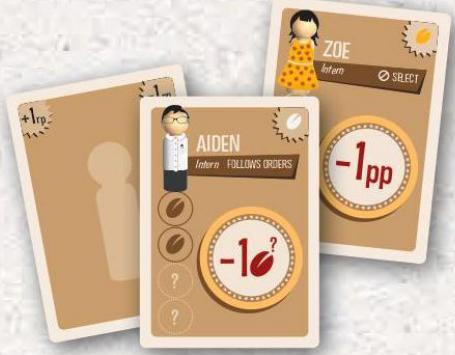
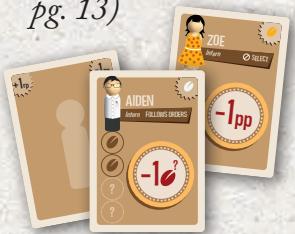
[图: 一张实习生卡示意图,标注有“实习生肖像”(AIDEN Intern FOLLOWS ORDERS)、“起始咖啡豆”(详见P14)、“实习生缺点”、“实习生能力”、“待加入烘焙豆”及一个标有“-1?”的圆形区域]
1. 实地采摘
按顺序,玩家从以下两个行动中选择一个。
1) 将玩家标记放置到世界地图上。
2) 拿取一张实习生卡(面朝上)。
[图: 一个黄色棋子指向“将玩家标记放置到世界地图上”,另一条虚线箭头指向一张实习生卡(标有AIDEN和-1?),表示两个可选行动]
如果玩家拿取了实习生卡,卡上的红色负面效果会立即生效。然后将实习生卡上的所有咖啡豆挪到研究板块上。玩家将指导这名实习生,并在这一轮中将他们作为特殊的团队成员使用。玩家选择两个行动之一后,轮到下一位玩家选择,以此类推。
当所有玩家已经选择了一个行动后,起始玩家执行未选择的行动。如果玩家第一次没有选择放置玩家标记的行动,此时他必须执行这个行动。但是,如果玩家之前已经选择过放置玩家标记的行动,此时他可以选择Pass,不拿取实习生卡。所有玩家执行两次行动或Pass后,游戏将进入第二阶段。
2. 拼配/研究
实习生由于缺乏经验,加上自我限制,合作能力差,导致意志很容易被玩家左右。在团队选择拼配/研究时,实习生将会同指导他的玩家投一样的票。实习生总是跟知道玩家的票。如果同一团队中,有2名玩家控制一位实习生,导致平局,则执行研究行动。
13 • VivaJava
# a. 拼配 *(实习生有时候言听计从)*

执行拼配行动时,实习生作为一名团队成员,所有的规则都适用于他们,只不过实习生被玩家控制。为了模拟这种关系,玩家左手边的玩家扮演实习生,拿取1个空的烘焙袋,将实习生卡上的咖啡豆放入袋中,玩家一声令下,实习生从烘焙袋中随机抽取豆子,并放置在拼配板块上。

实习生可以利用玩家的能力,来提升自己的拼配能力,前提是玩家必须已经拥有这个能力。例如,玩家的 SELECT 能力已经升级到 1 级,那么实习生就可以使用这个 1 级的能力。注意,如果实习生使用了这个能力,在玩家执行拼配行动时,就不能使用 SELECT 能力。

拼配/研究行动结束后,使用过的实习生卡面朝下放置在研究板块旁,实习生烘焙袋中的咖啡豆返回供应区。

一些实习生的缺点会影响玩家的能力
[图: 三个棕色标签,分别标有 “Intern ⊘ BREW”、“Intern ⊘ SELECT”、“Intern OUT OF CONTROL”,对应文字为:拼配时,实习生不能使用 BREW 能力。拼配时,实习生不能使用 SELECT 能力。拼配时,实习生什么能力都不能使用。]

---

# b. 研究 *(大部分实习生积极向上)*

玩家与实习生一起工作,玩家在这些工作后的实习生身上获得宝贵经验。玩家按照规则获得 3 个研究点数外,每位参与工作的实习生(面朝下),都会给玩家带来 1 个研究点数。

[图: 一张面朝下的实习生卡,左上角标有 “+1rp”,右侧等号后写 “= 1 RP”;右侧文字:“例如:玩家研究板块旁边有 3 位面朝下的实习生卡,那么玩家将额外获得 3 个研究点数。”]

---

# 3. 大众品鉴

本回合未被使用的实习生卡放入弃牌堆,并将卡上面的咖啡豆返回供应堆。若实习卡用尽,重新洗匀弃牌堆的实习生卡,形成新的牌堆。然后再次面朝上翻开 3 张实习生卡,用咖啡豆填满实习生卡上的放置点。

---

# 游戏结束 & 计分

游戏结束时,按照正常规则计分后,每位玩家计算各自拥有的面朝下的实习生数量。每拥有 1 张实习生卡,将会使玩家失去 1 分,计分标记移动对应的格数.

分数最高的玩家获得胜利。

[图: 三张面朝下的实习生卡(标有 +1、+1、-1pp),一个红色棋子位于标有数字 2 的格子上,虚线箭头指向右方格子 4、5 及一个粉色圆形终点区域。]

*VivaJava · 14*
变体规则
起始咖啡豆
游戏设置阶段,“从供应区拿取2颗白豆和1颗黄豆”的规则替换为“每位玩家获得3张实习生卡”。然后,从供应区拿取实习生卡右上角标注的咖啡豆,放入烘焙袋中,弃掉实习生卡。在3-4人游戏中,洗匀实习卡,形成牌堆。
[图: AIDEN Intern FOLLOWS ORDERS 卡片,右侧标注“起始咖啡豆”]
品质优化(清理坏豆)
游戏开始时,玩家获得1个筛选标记。在大众品鉴阶段结束且计分完毕后,玩家可以弃掉帅选标记,从烘焙袋中选出3颗咖啡豆,并返回供应区。这个规则可以让玩家在经过几轮游戏后,从烘焙袋中选出那些不是很受欢迎的豆子。通过清理坏豆,在拼配行动时,让玩家成为一名优秀的团队成员,因为可以提供优质的咖啡豆。
[图: 两个圆形筛选标记:棕色带咖啡豆与漏斗图标、蓝色带咖啡豆与漏斗图标;右侧标注“筛选标记”]
特殊拼配卡
游戏开始时,洗混8张特殊拼配卡,形成牌堆放在分数记录表旁.
翻开最上面的一张牌,在大众品鉴阶段,如果有团队拼配出跟特殊拼配卡一致的组合,则获得相应的奖励。然后,移除这张卡,重新翻开一张。只要拼配组合一致,不一定要使用跟拼配卡相同的咖啡豆。
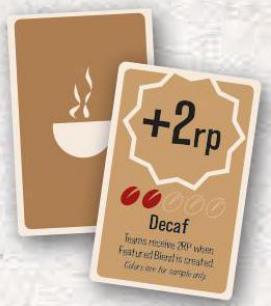
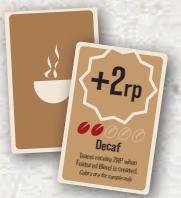
[图: 三张特殊拼配卡:左为咖啡杯图案卡;中为+2rp Decaf卡(红豆2颗),文字“Teams receive 2RP when Featured Blend is created. Colors are for sample only.”;右为+1pp Half-Caf卡(绿豆2颗+白豆1颗),文字“Teams receive 1PP when Featured Blend is created. Colors are for sample only.”;下方标注“特殊拼配卡”]
风味卡
游戏开始时,每位玩家获得2张风味卡,选择1张并弃掉另一张。所有玩家选择完毕,被丢弃的风味卡和其他风味卡一起洗匀,形成牌堆。写着“立即打出”的卡,在第一轮游戏的大众品鉴阶段可以打出。
公平
尽管《拼配咖啡》游戏规则涵盖了可能发生的情况,但偶尔也会出现未声明的实例。在这种情况下,为了让游戏继续下去,最好在玩家之间进行投票。
变动效果标记
每一轮大众品鉴阶段结束,世界地图板块上的玩家标记归还玩家后,拼配大师洗匀所有效果标记,按照游戏设置,随机放置在世界地图板块对应的位置上。
平局决胜
在非常罕见的情况下,同时行动会影响另一位玩家的行动,此时按照回合顺位解决,否则,拼配/研究行动总是同时进行。如果担心你的行动,你可以将研究板块盖起来,对其他玩家不可见。
15 • VivaJava
附录A:效果标记&实习生能力
-
+1pp
+2pp
获得分数
获得1分或2分,移动计分标记对应的格数。 -
-1pp
-2pp
失去分数
失去1分或2分,移动计分标记对应格数。 -
+1ø
获得1颗咖啡豆
立即从供应区拿取1颗与效果标记对应放置点相同种类(颜色)的咖啡豆。没有足够豆子,忽略此效果。 -
-1ø
失去1颗咖啡豆
不能拿取效果标记对应放置点的咖啡豆。不影响研究板块能力的使用,仍然可以获得1-2颗与放置点相同的咖啡豆。 -
[图: 两个方块图标循环交换]
交换豆子
当前玩家选择一位玩家为,查看他的烘焙袋并选择1颗豆子放入自己的烘焙袋中。接着选择1颗豆子放入对方烘焙袋中。 -
[图: 两个圆圈图标循环交换,下方标有“ø 3-4”]
交换效果标记
在拿取咖啡豆之前,将所在效果标记连同玩家标记(如果有),与另外一个放置点的效果标记交换。然后拿取新放置点的咖啡豆(如果有)。
这个效果不能在3-4人游戏中使用。 -
-1rp
失去研究点
将一个研究标记往后移动1格。研究标记不能回到起始点,也不能降级。如果研究标记无法合理移动,则忽略此效果。 -
[图: GROW 和 SELECT 按钮旁的轨道上,有带叉号和对勾的咖啡豆标记及箭头指示]
-
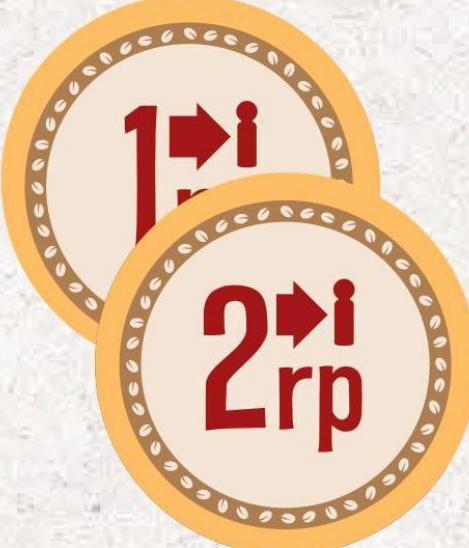
1→i
2→rp
研究贡献
除你之外,其他玩家获得1-2个研究点数。如果此效果让研究板块能力升级,玩家在这一轮中获得该能力。 -
[图: 一个红色拼配板块图标带箭头指向外]
移除拼配标记
立即将自己的1个拼配标记从拼配板块上移除,返回玩家手中。也可以移除投资标记上的拼配标记。如果玩家在拼配板块上没有拼配标记,则忽略此效果。 -
-1ø?
移除1颗豆子
立即从烘焙袋中随机抽取1颗咖啡豆返回供应区。 -
+1i
多带一个实习生
立即从牌堆抽取1张实习生卡,面朝下放置研究板块旁。这张实习生卡将计入玩家的实习生数量,用于获得研究点数以及游戏结束时计分。 -
[图: 红色星芒爆炸状图标]
减少研究
仍然可以执行研究行动,但不会获得厨初始研究点数,实习生也不会给你带来研究点数。在大众品鉴阶段,你可以用分数去换研究点。
VivaJava · 16
附录B:风味卡详解
《拼配咖啡》游戏有16种风味。下面是关于每一种风味的注释。
投资迁移
移动的投资标记必须是已经在拼配板块上的,而且也有玩家的拼配标记。注意,这个效果在大众品鉴阶段之前,拼配板块加入畅销清单之后使用。
[图: FICKLE INVESTOR — 在大众品鉴之前打出:将任意1个有拼配标记的投资标记移动到另一个拼配板块。]
流氓行为
玩家使用这张卡时,玩家标记没放置在国家上。意味着在实地采摘阶段,玩家不会获得任何咖啡豆,而且无法使用DROW能力。
[图: GOING ROGUE — 在实地采摘阶段前打出:选择一个控制的国家,抽取1个拼配板块,放置玩家标记,单独执行拼配行动]
热或冷
这张卡必须在计分之后立即打出。如果不执行,什么效果也没有。如果执行,所有的拼配结果都会受影响,每个团队都要移除2颗豆子。
[图: HOT OR COLD — 在大众品鉴阶段打出:风味丢失效果执行2次,或者不执行。由你决定。]
限量供应
拼配板块按正常规则移出游戏,不再使用。玩家标记回到玩家手中,投资标记返回一般供应堆。
[图: LIMITED OFFER — 在大众品鉴阶段打出:计分结束后,从畅销清单上移除1个拼配板块。板块上有拼配标记的玩家获得2分。]
快速切换
咖啡豆必须放置在可以放置的点上。拼配板块上不能超过5颗豆子。这张卡在大众品鉴阶段结束后,开始新一轮游戏前打出。
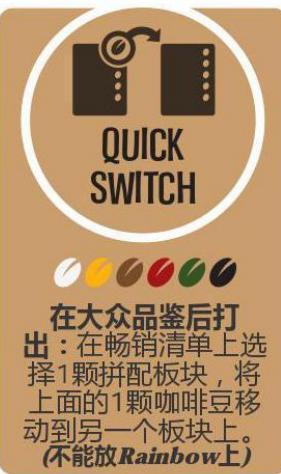
[图: QUICK SWITCH — 在大众品鉴后打出:在畅销清单上选择1颗拼配板块,将上面的1颗咖啡豆移动到另一个板块上。(不能放Rainbow上)]
重新开始
如果被选中的团队在拼配时使用了能力或风味卡,允许重新使用这些效果。
[图: RE-DO — 在一次拼配行动后打出:选择一个已拼配过的团队,归还所有的豆子,重新开始执行拼配行动。]
获得2分
这个分数的增加不会影响回合顺位,如果玩家通过这个效果获得21分,游戏立即结束。
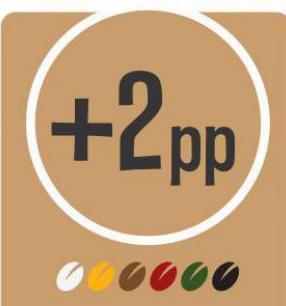
[图: +2pp — 立即打出:获得2分]
追加得分*2
因为风味丢失效果或其他原因,导致需要移动拼配板块时,该卡随板块一起移动。
[图: +1pp — 打出时,将这张牌放在畅销清单的一个拼配板块上。计分时,额外获1分,板块被移除时弃掉。]
获得研究点
如果这个团队正在执行拼配行动,在这个团队行动结束后依然可以获得该卡提供的研究点数。
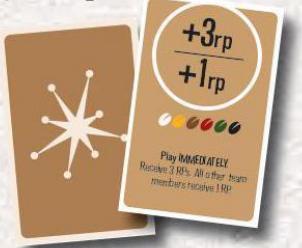
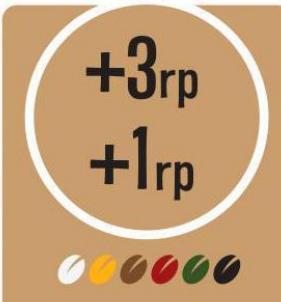
[图: +3rp +1rp — 立即打出:获得3个研究点数,其他团队获得1个研究点数。]
本地供应*2
从供应区拿取的咖啡豆,不一定要同一类型。
[图: INDIGENOUS FIND — 立即打出:从供应区选择2颗咖啡豆,放入自己的烘焙袋中。]
贪婪
虽然这张牌需要立即打出,但也应该等执行拼配行动的团队结束后,再打出。
[图: GREED — 立即打出:发起一次投票。玩家秘密地选择拼配/研究标记的一面。如果有玩家选择了研究,玩家们(包括你)获得1个研究点。]
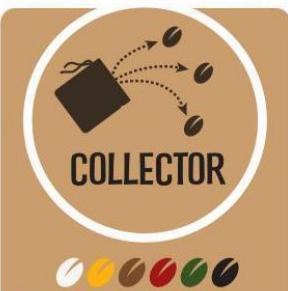
归还
取出的豆子放回供应堆。使用此卡换取的分数不能超过5分。
[图: COLLECTOR — 在大众品鉴阶段打出:打开烘焙袋,选择一种咖啡豆,放回供应区。每返回一个豆子,获得1分。(最多5分)]
私有储备
如果玩家选择的咖啡豆在供应堆没有,则玩家不会获得任何豆子。
[图: PRIVATE RESERVE — 拼配行动结束后打出:选择一种你在拼配行动中贡献的咖啡豆,从供应区拿回对应数量的咖啡豆。]
主管
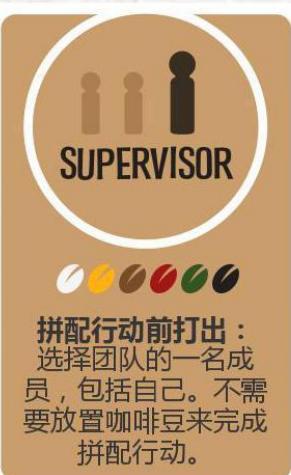
只有当团队有能力完成拼配行动,填满5个咖啡豆放置点时,才可以使用此卡。这个效果依然让获得奖励。
[图: SUPERVISOR — 拼配行动前打出:选择团队的一名成员,包括自己。不需要放置咖啡豆来完成拼配行动。]
17 • VivaJava
附录 C:研究专题
这个附录列出了所有的研究项目以及能力。研究项目的能力不叠加,升级到高一级后,只能使用其所在等级的能力。
GROW
- 如果使用得当,GROW 能力可以让玩家快速地在自己的烘焙袋里装满豆子。适合喜欢囤豆的玩家。
- GROW 能力可以用来从供应区获得咖啡豆。即使效果标记不允许。
- [图: 四个横向进度条图示,分别标有“1pp + ☕”、“1pp + ☕☕”、“2pp + 研究”等,显示不同等级的 GROW 效果]
- 可以让玩家在实地采摘阶段获取放置点咖啡豆多1颗。直接从供应区拿取。
- 可以让玩家在实地采摘阶段获取放置点咖啡豆多2颗。直接从供应区拿取。
- 这个能力取代了原有的初始配置“获得3个研究点”。无论得分多少,玩家的研究点数不会低于3个。
- [图: 一个带“-1”标记的圆形图标,旁边有红色叉号和黄色豆子箭头指向供应区,表示“失去1颗豆子”效果标记的国家上必须将放置点的咖啡豆返回供应区]
- 当玩家将玩家标记放置在有“失去1颗豆子”效果标记的国家上时,必须将这放置点的咖啡豆返回供应区。
- [图: 两个黄色豆子箭头从玩家标记指向供应区,标注“当GROW能力升级到1级或2级时,玩家可以从供应区拿取与国家对应咖啡豆同款的豆子。”]
SELECT
- SELECT 能力允许玩家筛选那些拼配错误的豆子,提高拼配等级。这对那些不喜欢运气的玩家,非常有利。
- [图: 四个横向进度条图示,分别标有“1pp”、“1pp”、“1pp”、“游戏结束时…”等,显示不同等级的 SELECT 效果]
- 在开始拼配行动之前,玩家可以查看自己的烘焙袋,移除1颗咖啡豆,放回咖啡豆供应区。
- 在开始拼配行动之前,玩家可以查看自己的烘焙袋,移除1颗咖啡豆,放回咖啡豆供应区。然后再从供应区选择1颗放回烘焙袋。
- 因为只有6种咖啡豆,因此这个能力最多给玩家带来6分。
- 游戏结束时,烘焙袋中每有1种咖啡豆,获得1分。
INVEST
- INVEST 能力能让玩家从其他团队的成果中获利(分数)。但是,玩家最多只能拥有2个投资标记,因为需要合理的使用它们。对于那些喜欢从赌博中获利的玩家来说,这是一个非常不错的能力。
- [图: 四个横向进度条图示,分别标有“1pp”、“1pp”、“1pp”、“3pp”等,显示不同等级的 INVEST 效果]
- 拿取1个投资标记,在拼配行动开始前,玩家可以在其他团队的拼配板块上放置1个投资标记,并在其上面放置自己的拼配标记。当这个拼配板块加入畅销清单时,可以获得对应分数。
- 拿取1个投资标记,在拼配行动开始前,玩家可以在其他团队的拼配板块上放置1个投资标记,并在其上面放置自己的拼配标记。当这个拼配板块加入畅销清单时,可以获得对应分数。
- 投票阶段,玩家投票结果,决定团队执行什么行动。如果你投票拼配行动,成员投票研究行动,则团队执行拼配行动。反之亦然。
- 当两人组成团队时,你的拼配/研究行动决定团队结果。
- [图: 左侧为“拼配标记”图标(蓝色咖啡杯)与“投资标记”图标(红色圆圈内含“I”)并列;右侧为两个“MORNING CALL”卡牌对比:左卡牌下方有3个咖啡杯图标,右卡牌下方有3个咖啡杯图标+4个绿色球形标记;虚线箭头连接左右卡牌,表示标记变化]
- 当拼配板块从畅销清单上移除时,投资标记返回一般供应堆,拼配标记回到玩家手中。一场游戏中,玩家不能拥有超过2个以上的投资标记。玩家不能投资自己的团队.
VivaJava · 18
附录 C:研究专题
BREW
- 当团队在拼配行动想获得最佳的拼配组合时,BREW能力可以提供比较保险的建议。对于那些珍惜资源,不想浪费资源来获得最佳策略的玩家来说,这无疑是极好的。
- 拼配时,玩家抽取的1颗豆子,暂时先放一边,不放置在拼配板块上,再抽1颗放置后,原先那颗放回烘焙袋中。
- 拼配时,玩家抽取的1颗豆子,暂时先放一边,不放置在拼配板块上,再依次抽2颗放置后,最先2颗放回烘焙袋中。
- 拼配行动结束后,可用分数换研究点,犹如进行研究行动。
[图: 四个横向流程图,展示BREW能力在不同阶段的操作:初始状态、抽取1颗豆子暂放、再抽1颗放置后放回原豆、最后用分数换研究点]
FLAVOR
- 风味卡的使用,大大增加了游戏的策略。使用过风味卡面朝上放在牌堆旁,形成弃牌堆。牌堆抽完时,重洗弃牌堆,形成新的牌堆。
- 升级这一级时,抽取2张风味卡,选择一张并弃掉另一张。
- 升级这一级时,抽取2张风味卡,选择一张并弃掉另一张。
- 升级这一级时,抽取2张风味卡,选择一张并弃掉另一张。并且在接下来的任何时候,支付3个研究点数来抽取2张风味卡,选择一张并弃掉另一张。
- 多抽取1次,需支付3个研究点。游戏结束时未使用的卡,每张获得1分。
[图: 四个横向流程图,展示FLAVOR能力在不同阶段的操作:初始状态、抽取2张风味卡选1弃1、重复选1弃1、支付3研究点额外抽取2张风味卡并选1弃1]
能力发动 & 打出风味卡时间表
每种能力和风味卡的使用在每一轮游戏中都有其特定时间,在指定时间内,玩家可以选择是否使用。
下面是具体时间的参考。能力用 红色斜体 表示,风味卡用 蓝色字体 表示。
| 放置 | 结算 | 拼配组合 | 加入 | 分数换 | 拼配得分 | 风味丢失 | |||
|---|---|---|---|---|---|---|---|---|---|
| 玩家标记 | 效果标记 | 采豆 | 组队 | 投票 | 分配研究点 | 畅销清单 | 研究点 | ||
| 实地采摘 | (注意) | 拼配/研究 | (注意) | 大众品鉴 |
- GOING ROGUE
- GROW INVEST
SUPERVISOR - SELECT
BREW - RE-DO
PRIVATE RESERVE - FICKLE INVESTER
COLLECTOR - HOT OR COLD
LIMITED OFFER - QUICK SWITCH
[图: 一条水平时间轴,标注各阶段名称及对应能力/风味卡名称,部分阶段有“注意”图标]
翻译|茉雨
19 • VivaJava
《拼配咖啡》 • 简明游戏流程
翻译|茉雨
游戏流程
1. 实习采摘
- 调整回合顺位
- 按顺序,在世界地图上放置玩家标记。
- 立即结算效果标记的正面效果和负面效果
- 从世界地图上拿取咖啡豆放入烘焙袋
2. 拼配/研究
- 同一产区的玩家秘密选择拼配或研究,并同时展开,票数多的剩出。
- 如果平局,执行研究行动。
a. 拼配
- 团队决定谁先抽取豆子
- 团队每个成员至少贡献1个豆子
- 一旦拼配行动结束,团队不能再放置豆子。
- 根据拼配登记表,加入畅销清单。
- 团队每个成员获得1个研究点,用于升级能力。
- 团队成员不能用分数换取研究点数
b. 研究
- 团队每个成员获得3个研究点,用于升级能力。
- 研究行动结束后,每位成员可以用分数换取研究点数。
3. 大众品鉴
- 团队根据畅销清单的排名来获得分数
- 风味丢失,导致畅销清单上的排名发生变化。
- 新的拼配板块添加到世界地图板块的上方,对应放置点上填满咖啡豆等。
研究项目能力
GROW
+从供应区额外多拿1颗咖啡豆+从供应区额外多拿2颗咖啡豆
SELECT
- [图: 咖啡豆图标向左箭头] 从烘焙袋移除1颗咖啡豆到供应区
- [图: 咖啡豆图标向左箭头再向右箭头] 从烘焙袋移除1颗,再从供应区拿回1颗。
INVEST
- [图: 圆形投资标记图标] 获得1个投资标记
- [图: 圆形投资标记图标] 获得1颗投资标记
BREW
- [图: 咖啡豆图标向右箭头] 拼配时多抽1颗备用
- [图: 两个咖啡豆图标向右箭头] 拼配时多抽2颗备用
FLAVOR
- [图: 两张风味卡图标,其中一张被划掉] 抽2张风味卡,保留1张。
- [图: 两张风味卡图标,其中一张被划掉] 抽2张风味卡,保留1张。
效果标记 & 实习生能力
- [图: +1pp 圆形标记] 获得分数
- [图: +2pp 圆形标记] 获得分数
- [图: -1pp 圆形标记] 失去分数
- [图: -2pp 圆形标记] 失去分数
- [图: +1咖啡豆 圆形标记] 获得1颗豆子
- [图: -1咖啡豆 圆形标记] 失去1颗豆子
- [图: 交换效果标记图标] 交换效果标记
- [图: 交换豆子图标] 交换豆子
- [图: -1rp 圆形标记] 失去1个研究点
- [图: 1→1 圆形标记] 支援研究
- [图: 2→1 圆形标记] 支援研究
- [图: 移除拼配标记图标] 移除拼配标记
- [图: -1? 圆形标记] 弃掉1颗豆子
- [图: +0 圆形标记] 抽取1张实习生卡
- [图: 减少研究图标] 减少研究
rules_zh_咖啡万岁_5299.md52.6 KB
The Bean Is Life. $^{TM}$
翻译 | 某雨
VivaJava CoffeeCo
《拼配咖啡》 。 实地调查手册
游戏目标
《拼配咖啡》游戏是一款半合作的谈判游戏,一群见多识广、足智多谋的咖啡专员,为爪哇岛研发拼配豆,使其成为最畅销的咖啡豆。最终的赢家将获得晋升机会和巨额养老金,外加终生的咖啡供应。
游戏过程中,玩家成为团队的一员研发拼配豆,每次游戏的研发团队可能都不同。每轮游戏有3个阶段组成,重复进行,直到满足3个结束条件之一。
拼配出最佳组合,在大众品鉴阶段获得更高分数,成为最优秀的团队。

翻译 | 某雨
游戏目录
游戏预览&制作团队 2
游戏件配 3
游戏设置 4
游戏流程 6
1.实地调查 6
2.拼配/研究
a.拼配 7
b.研究 9
3.大众品鉴 10
游戏结束 12
简化规则 12
实习生(3-4人游戏) 13
变体规则 15
附录A:效果标记/实习生能力 16
附录B:风味卡详解 17
附录C:研究专题 18
简明游戏流程 20
制作团队 & 感谢名单
游戏设计: T.C. Petty III
美术设计: Chris Kirkman, T.C. Petty III
艺术插画: Chris Kirkman, Darrell Louder
制作发行: T.C. Petty III, Chris Kirkman, Cherilyn Joy Lee
出版商: Dice Hate Me Games
白金测试员: Mario Arnold, Keith Carter, Steven Doughty, Tom Gurganus, Timothy Hing, Brian Linnen, Sarah Linnen, Darrell Louder, John Moller, Jim Neuschwander, Chris Norwood, Jacquelyne Purtell, Shawn Purtell, Benjamin Rosset, Elizabeth 'EB' Singer, Robert Singer, Luke Winters
20019年7月首测名单: Mario Arnold, Michael Arnold, Alexis Arnold, Nikki Gortian, Timothy Hing, Jim McSherry
特别感谢: T.C. would like to thank people who play games, Battles (the band), variable turn order mechanics, John Moller again for his undying support, Dr. Moore/Kellar, everyone who supported the game on Kickstarter, Seattle, my iPhone, BGG, little wooden bits, those brave aviators fighting on the wings of aeroplanes, and Mommy and Daddy and Sissy for letting me figure it all out myself.
Chris would like to thank all the Kickstarter supporters for their wonderful enthusiasm and generosity, Don Lloyd, Lesley Louder, W. Eric Martin and Chris Norwood for their continued support and rules lawyering, and David MacKenzie for getting us into this whole mess.
Much thanks to the Lost Type Co-Op (losttype.com) for Airplane, Airship, Alexis, Carton, Cubano, Franchise, Governor, Habana, Haymaker, Liberator, Ministry, Oil Can, Onramp, Quaver, and Ranger, and to TypeArt Foundry for the awesome Fling-A-Ling.

greater/than/games
下载游戏规则,观看教学视频,请访问:dicehatemegames.com/vivajava.
"Dice Hate Me," "The Bean is Life," the VivaJava logo and all art contained within are ©2017 Greater Than Games, LLC.
9个效果标记
游戏配件
世界地图板块
8个双面研究板块

15个拼配板块

(5个1组,共8组。


40个研究标记
16张风味卡
24个玩家拼配标记 (3个1组,共8组。)
分数记录/畅销咖啡豆清单板块
8个回合顺位标记

8张特殊拼配卡
(详见P15:变体规则)
8枚拼配/研究标记

8个棉纺烘焙袋

90颗木质咖啡豆
(6种颜色)

20 18 16 14 12 10
2个起始板块
1张霉豆板块
(3-5人游戏使用)
(详见P15变体规则)

24张实习生卡
(详见P13:实习生)
流程参考卡
8张玩家
8枚筛选标记

18个投资标记
8个木质玩家标记

8个木质计分标记
游戏设置
注意
如下图所示,将世界地图板块以及分数记录板块,放在桌面上。将90颗咖啡豆以颜色区分,摆放在世界地图底部对应颜色的下面,代表不同咖啡豆的产地。洗混拼配板块,面朝下放置在世界地图的左侧。
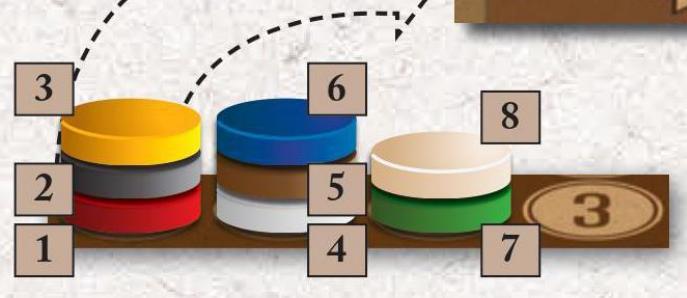
将分数标记放入烘焙袋中,以随机抽取的方式决定分数的起始位置。根据玩家人数,依次取出堆放在分数记录表上。(如下图)
洗混拼配板块,摸取3个,面朝上放置在世界地图顶部位置。
起始板块出现在畅销咖啡豆清单上,特别是Average Joe板块,应该出现在冠军的位置。
咖啡都豆供应区
洗混9个效果标记,并随机放置在世界地图对应的位置上。
选择1个颜色,拿取对应颜色的玩家标记,烘焙袋,研究板块以及研究标记。
研究标记放置在研究板块最开始的外置。拿取2颗白色咖啡豆和1颗黄色咖啡豆,放入烘焙袋中。
拼配大师
指定一名玩家成为“拼配大师”,负责放置玩家顺位标记、移动分数标记,来确保每轮游戏正常进行。通常,这名玩家应该是游戏的拥有者,或者是玩得最多的人。
研究板块


每个起始板块都有5种特定的咖啡豆拼配而成。取出特定的咖啡豆放置在起始板块对应的位置上。
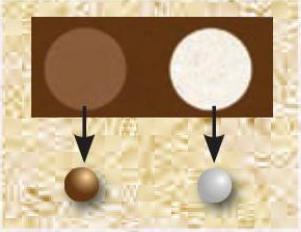
根据拼配板块所示的咖啡豆的种类,将咖啡豆放置在板块下方与国家相连的位置上。
烘焙袋
3-6人游戏设置
3-6人游戏时,在设置阶段做一些调整。将拼配版块放置在世界地图上方之后,在放置咖啡豆时,注意拼配版块上有禁止符号的国家不需要放置咖啡豆,并将对应的效果标记翻面,让禁止符号朝上。

不放置咖啡豆,
并将效果标记翻面。
不放置咖啡豆,
并将效果标记翻面。
不放置咖啡豆,
并将效果标记翻面。
这个符号表示在对应的国家上禁止放置咖啡豆,并将效果标记翻面至 ☒ 符号朝上。

3-5人游戏设置
由于实地调查人员减少,导致咖啡产量不足。此时市场会推出一些常见的普通的拼配豆,这些豆子冲煮出来的风味还算可以,豆子也很健康,但注意不要触及底线——使用霉豆。在3-5人游戏时,在畅销清单的最左侧加入霉豆板块,霉豆板块在整场游戏中都会存在,不会随着轮次结束而移除。

3- 5人游戏设置时,将霉豆板块放置在畅销咖啡豆清单最左侧。

霉豆板块不会被移除,直到游戏结束。
游戏流程
《拼配咖啡》将会进行多轮游戏,每一轮游戏包含3个阶段。
1. 实地采摘
按顺序,将玩家标记放置在世界地图板块上并收集咖啡豆。
2. 拼配/研究
玩家组成不同的团队,进行拼配(获得分数)或者研究(获得能力)。
3. 大众品鉴
在畅销咖啡豆清单上新增拼配版块并计算分数,最终拼配豆风味丢失,降低排名。
下面每个阶段的详细介绍适合5-8名玩家游戏。3-4名玩家游戏规则详见P13。
1. 实地采摘
世界地图被划分为3个成产咖啡豆的产区(美洲、非洲和亚洲)。每个地区都有国家且有对应的行动,玩家通过放置玩家标记来探索这些地区。
《拼配咖啡》本质上是一款社交游戏,我们鼓励玩家在放置玩家标记之前,说出(或不说)他们的策略。这非常关键,因为在同一产区的玩家将组成团队。玩家可以做出任何承诺,但不会交换任何实质的东西。但这是有限制的,玩家不能公开烘焙袋里面的信息,除非卡牌、行动或者规则要求。
决定回合顺位
分数最低的玩家获得第一顺位。如果出现平局(如右图所示),位于顶部的玩家获得第一顺位。拼配大师根据大家的得分,将它们按正确的顺序放置在回合顺位轨道上。
放置玩家标记
按照回合顺位,玩家依次将玩家标记放置到世界地图板块的一个国家上。放置后,玩家需要立即执行标记上的效果,并拿取下方对应的咖啡豆(如果有),放入烘焙袋中。标记上列出的每个符号表示一个正面效果(深棕色)或一个负面效果(红色)。正面效果是可选的,而负面效果则必须被执行。

玩家继续放置玩家标记,直到所有玩家都已放置。国家一旦被选择,其他玩家就不能选择同一个国家。在3-6名玩家游戏中,除非有特殊说明,否则不能选择有☑符号的国家。
(有关效果标记的功能与效果,详见P16:附录A。)
在第一轮游戏中,如果有玩家将玩家标记放置在有负面效果的国家上时,可以忽略其效果。在随后的游戏中,必须执行负面效果。
2. 拼配/研究
玩家分成三个团队(美洲,非洲,或亚洲),通过投票来决定执行拼配行动或者研究行动。投票时,拿取拼配/研究标记,秘密的选择一面朝上握在手中。投票前鼓励玩家通过谈判来达成协议。
团队1
团队2
团队3
所有人选择好之后,拼配大师发布号令,所有玩家同时展示手中的投票结果。拼配面朝上,意味着你支持团队进行拼配行动,而研究面朝上,意味着你支持团队进行研究行动。

统计每个团队的票数,票数最多的行动将成为该团队的方案。
如果平局则执行研究行动。
注意
投票
拼配大师应确保在投票前,没有团队在进行拼配/研究行动。这对防止投票混乱显得尤为重要。
投资标记
如果任意一名玩家拥有投资标记,在投票结束后,拼配大师让游戏暂停,提供投资机会,玩家可以将1个投资标记放置在拼配板块上。(详见P18:附录C)
2a. 拼配
考验团队合作的时候到了,同过拼配行动来创造畅销咖啡豆。在接下来的数个回合中,在拼配板块上放置咖啡豆来完成拼配,之后将拼配板块放置在畅销咖啡豆清单上,来获得预期的分数。
拼配行动
每个团队都会拥有一个拼配板块(世界地图上方)。每个拼配板块上都有5个咖啡豆放置点,这些放置点都由每位玩家从烘焙袋中随机抽取咖啡豆来填充。
共同决团队成员的抽取顺序。一名玩家首先摇动烘焙袋,并随机抽出一颗豆咖啡,放到拼配板块五个放置点之一的上面,然后决定下一位玩家。直到5个放置点都被填满或者团队一致决定停止抽取。拼配板块不一定要被填满,但必须保证团队的每一个成员都放置过1颗咖啡豆。
如果团队意见无法保持一致,那就按顺序每位成员从烘焙袋中随机抽取1颗咖啡豆放置在拼配板块上。所有成员都放置过1颗之后,可

拼配法则
除非卡牌、行动或则规则需要,否则玩家不能查看烘焙袋的内容。在谈判时,你可以极尽可能的描述你的烘焙袋里有什么,即使是欺骗。
以继续选择放置或者Pass。直到所有成员都Pass或者5个放置点都被填满。
特殊放置点
某些拼配板块上会有一个指定咖啡种类的放置点。当一个团队已经填满4个放置点(每个成员都已经放置1次)时,可以从咖啡豆供应区拿取对应颜色的咖啡豆,放在拼配板块上。如果团队所在产区没有这种咖啡豆,则不能放置咖啡豆。
2a. 拼配(续上)
拼配等级
拼配等级表列出了5种咖啡豆拼配后的可能组合。根据这个组合以及咖啡豆的颜色,对拼配板块进行排名,并将其放到畅销咖啡豆清单上。例如,都是Bold组合时,黑豆就比白豆等级高;另外此外,Bold组合的白豆又比Regular组合的黑豆等级高。
借用拼配登记表可以解决平局问题。例如,Bold组合的黑豆比Bold组合的红豆等级高。然而,依然会出现拼配组合且颜色也一致的平局状况,此时位于回合顺位靠前的团队成员胜出,获得在畅销咖啡豆清单靠前的位置。
加入畅销咖啡豆行列
拼配行动结束后,玩家将自己的拼配标记放置在拼配板块上。所有团队成员放置完毕后,所有的拼配板块会根据拼配等级表,放到畅销咖啡豆清单上。
根据拼配等级表调整拼配板块的位置,等级低的往左边移动,等级高的往右边移动。由于某些原因导致拼配组合没有得到要求,则移除该板块,咖啡豆放回供应堆,所有标记归还给玩家。拼配板块上的投资标记返回一般供应堆。(详见P18:附录C)
拼配行动结束后,每位玩家获得1个研究点数,把它分配在你的研究室板块上。
每位玩家有3个拼配标记,如果在放置拼配标记时,需要放置第4个,则从原来的拼配板块上拿取放置或者不放置。一个拼配板块上不会出现相同的拼配标记,如果新的拼配组合与原有组合相同,则原有组合被认为是等级低的,且风味不断丢失。
畅销 咖啡豆清单
Cherilyn, Chris和T.C.的团队拼配出了Americano组合,准备投放市场。现在的销量冠军是红/黄Half-caf组合,紧跟其后的是黑/白Decaf组合。由于Americano组合的拼配等级更高,导致Half-caf和Decaf在畅销咖啡豆清单上的排名下降,Americano组合荣登榜首!这个团队立即获得3分奖励。
拼配等级表
拼配示例
Chris, Cherilyn 和 T.C. 在同一个产区,属于同一个团队,他们投票决定执行拼配行动。Chris 说他有很大几率会给团队贡献3颗黄色咖啡豆。最终 Cherilyn 和 T.C. 选择相信他,让他第一个进行拼配行动。
Chris把手伸进烘焙袋,摸出1颗黄色咖啡豆,放在拼配板块上。到目前为止,一切顺利。

团队决定让Chris再抽一次,又是1颗黄色咖啡豆!
Chris再抽取了1次,居然是白色咖啡豆!OMG!
由于每个团队成员都必须至少放置1颗咖啡豆,因此 Chris不能再放置了。接着Cherilyn摸出了1颗白色咖啡豆,情况突然好转了!
Cherilyn有很多白色豆子,但T.C.必须放置咖啡豆。他闭上眼睛,把手伸进烘焙袋……然后摸出了1颗白豆!团队完美的拼配出Americano组合,不错!
2a. 拼配(续上)
彩虹拼配
彩虹拼配是一种特殊拼配类型,团队可以进行拼配,需要五种不同的咖啡豆。彩虹拼配的级别比Regular组合要高,并且在畅销清单中不会降级。
在畅销清单中只能存在一个彩虹拼配。新的彩虹拼配加入后,原有的将会被移出。如果同时有多个彩虹拼配加入,则拥有在回合顺位靠前玩家的团队获胜,移除其他彩虹拼配。
Rainbow (No degrade, 1 per List)
咖啡豆应用策略
《拼配咖啡》是一款经营咖啡豆的游戏,收集咖啡豆只是其中一种策略。新手常犯的错误是尽可能的去收集咖啡豆。玩家应该带着特定的目标巧妙地选择加入烘焙袋中的咖啡豆,无论是拼配一种特定颜色的组合还是一种特殊的彩虹组合。
共同行动

咖啡世界千变万化。所有的拼配团队和研究团队应该同时执行对应的行动。拼配团队不应该坐等研究团队完成,反之亦然。
2b.研究
有时候,为了保证团队成员的研发水平,加入一些训练是非常有必要的。在研究行动中,团队成员回到各自的实验室,培养一些特殊能力,来拼配出更强大的组合。
使用研究点数
选择研究行动的团队,每位玩家可以获得3个研究点数,来分配到研究板块中。玩家独自决定这些研究点数分配在哪些能力上,将对应的研究标记从左往右移动到一个新的研究点上。每移动1步,就消耗1个研究点数。研究板块的每一列代表玩家的拼配水平。
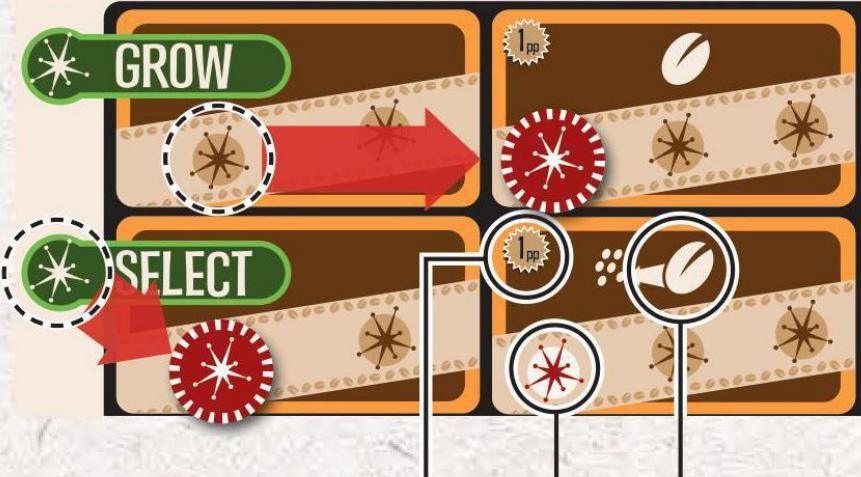
研究板块每一列中的第一个。符号被覆盖时,说明玩家启用了一个新能力。当玩家使用足够多的研究点数,使得研究标记到达这个能力的尾部,玩家获得这个能力,并可以在下一轮游戏中使用这个能力(风味卡除外,详见P17:附录B)。
研究标记只能往前移动,不能后退。同时,在游戏结束时,玩家将根据研究板块每一行所达到的级别获得分数。前一级别的分数也需加上。例如,升级到第二级别的玩家在游戏结束时获得2分。
一旦某个能力升级到满级,将会额外获得一些能力。这些能力能帮助玩家获得更多分数,在研究板块上都有具体说明。(详见P18:附录C)
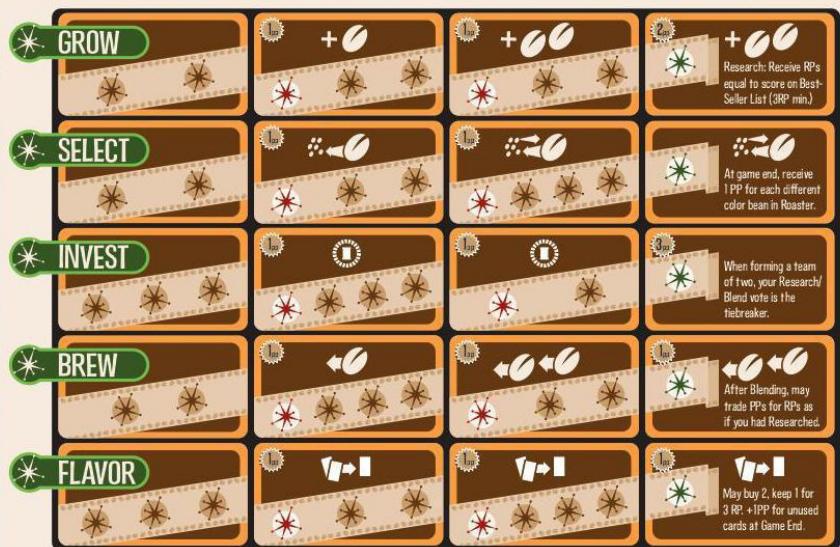
研究板块
从左往右移动研究标记。在下面的例子中,Shawn使用他的3个研究点,在GROW能力中向右移动了2步,在SELECT能力中向右移动了1步。现在他可以在下一轮使用GROW的特殊能力,并在游戏结束时获得1分。
游戏结束时获得的分数 | 新能力起始点
2b. 研究(续上)

支付分数获取研究点
拼配/研究行动结束后,拼配大师声明游戏暂停,让玩家依次选择是否支付分数获取研究点。当所有玩家选择完毕,游戏继续,进入大众点评阶段。
使用分数获得研究点
执行研究行动的团队有一个好处,就是可以用所得分数去换取研究点数。
拼配/研究行动结束后,执行研究行动的团队成员(不包括拼配团队),依次选择愿意用多少分数去交换研究点数,然后,玩家在分数记录表上向左移动对应步数。每失去1分,玩家获得1个研究点数,并立即移动研究标记或用于某种能力。
(例如风味能力,详见P18:附录C。)
合理使用分数这一资源是非常有利的,对能力的早期投资,会让你的拼配结果能在畅销清单的排位上,产生很大的影响。
请注意,玩家的分数不能降到-3或者更低,任何时候计分标记都不能移动到-3这一格上。
Shawn通过最初的3个研究点,升级了部分能力。现在,他想提升SELECT的能力,于是他用2分换得了2个研究点数。计分标记向左移2格,SELECT能力的研究标记往前移动2格,该能力升级到下一个。

3. 大众品鉴
各个团队的工作必须得到肯定。每一轮游戏的最后阶段就是获得分数和为下一轮游戏(或游戏结束)做准备!
获得分数
拼配/研究行动结束后,结算每个在畅销清单上的拼配板块,根据拼配板块上的玩家拼配标(按顺序)获得分数。畅销清单有5个畅销排名,上面标注了每个排名的分数。
在拼配板块上,每有1 个玩家拼配标记,获得畅销清单上标注的分数。
玩家拼配标记在结算分数之后不会移除,直到拼配板块被移除为止。
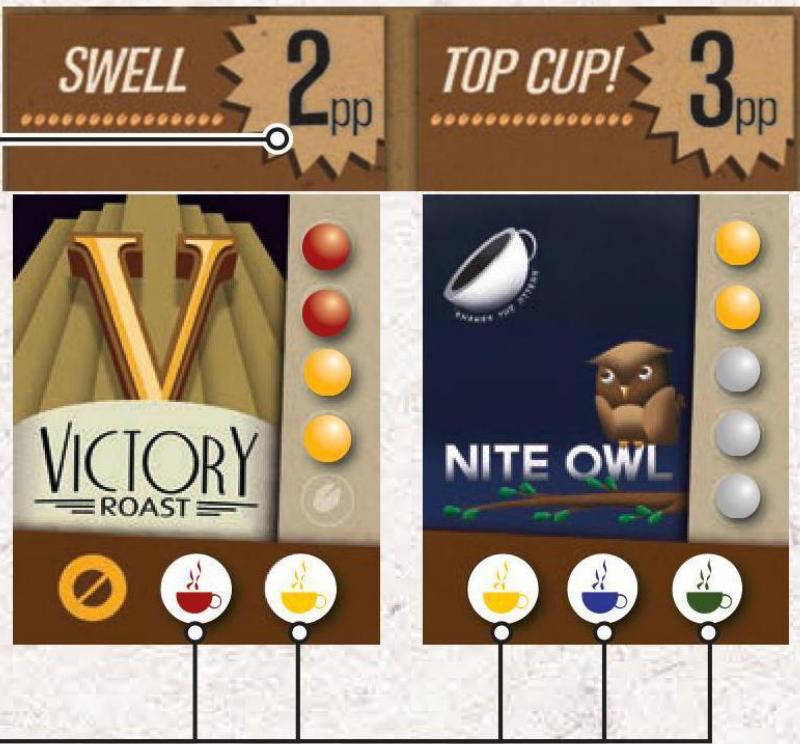
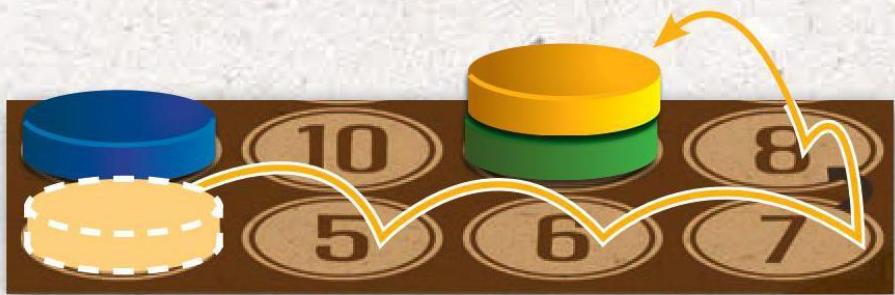
在左边的例子中,T.C.(黄色)在畅销清单的2个排名上都有拼配标记。T.C.在TPOP CUP!位置获得3分,在SWELL位置获得2分。移动计分标记5格(3+2=5分)。烘焙大师将世界地图上的玩家标记归还给T.C.。
3. 大众品鉴 (续上)
风味丢失
拼配的豆子在市场上售卖一段时间后,由于风味丢失,导致咖啡出品质量下降,变成陈年豆。之前在畅销清单上的豆子,在公众眼中就不再那么受欢迎。从拼配板块上移除1颗咖啡豆,放回供应区。移除的豆子必须是拼配板块上最不重要的。
例如,如果拼配的是 🍎 🍎 🍎,这是一个带有1颗多余黑豆( 🍎 )的Bold组合。多余的黑豆会被移除,因为移除其他的豆子会使组合变成 🍎 🍎 🍎,导致风味丢失。而且Regular组合比Bold的组合等级低。
咖啡豆被移除后,会根据拼配等级表重新排序拼配板块。如果拼配结果比Decaf组合还低,拼配板块会被移除。
移除拼配板块
畅销清单只有前五排名。如果因为某种原因,导致拼配结果等级太低,无法进入榜单,那么拼配板块将会被移除。
移除拼配板块,将剩余的咖啡豆返回供应堆,玩家拼配标记返回玩家手中。
畅销清单上只能有1个Rainbow组合。当有新的Rainbow组合出现时,移除之前的。
风味丢失示例
在下面的例子中,黑/白的Decaf组合移除1颗白豆,红/黄的Half-caf组合移除1颗黄豆(变成Decaf组合),Americano组合失去了1颗黄豆(变成Regular组合)。
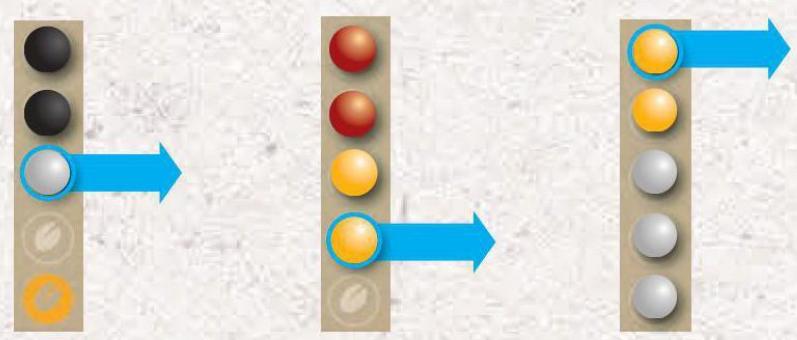
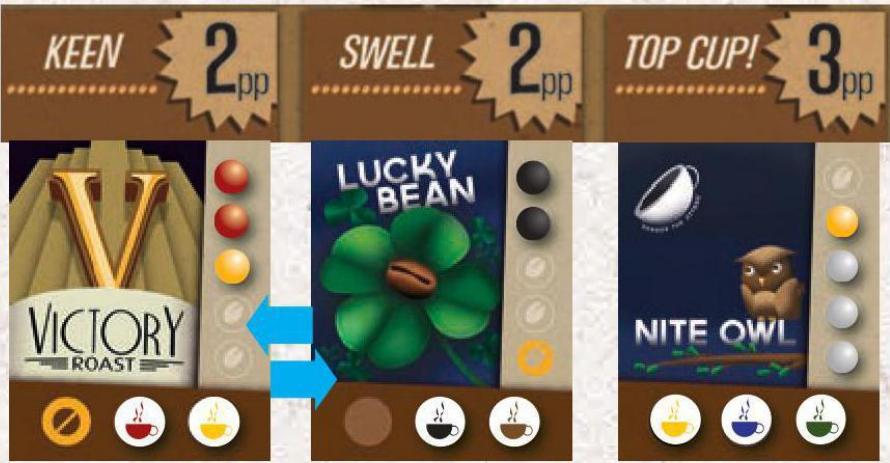
风味丢失会降低拼配等级,在畅销清单上会重新排序。现在畅销清单上有两个Decaf组合,但由于黑豆等级比红豆等级高,所以黑色的Decaf组合排名上升了。万一两个组合都是红色,那么黄豆的存在会打破这一平局。

检查游戏结束
游戏以三种方式结束,详情见下一页。在准备下一轮游戏之前,拼配大师应当检查是否满足游戏结束条件。
准备下一轮游戏
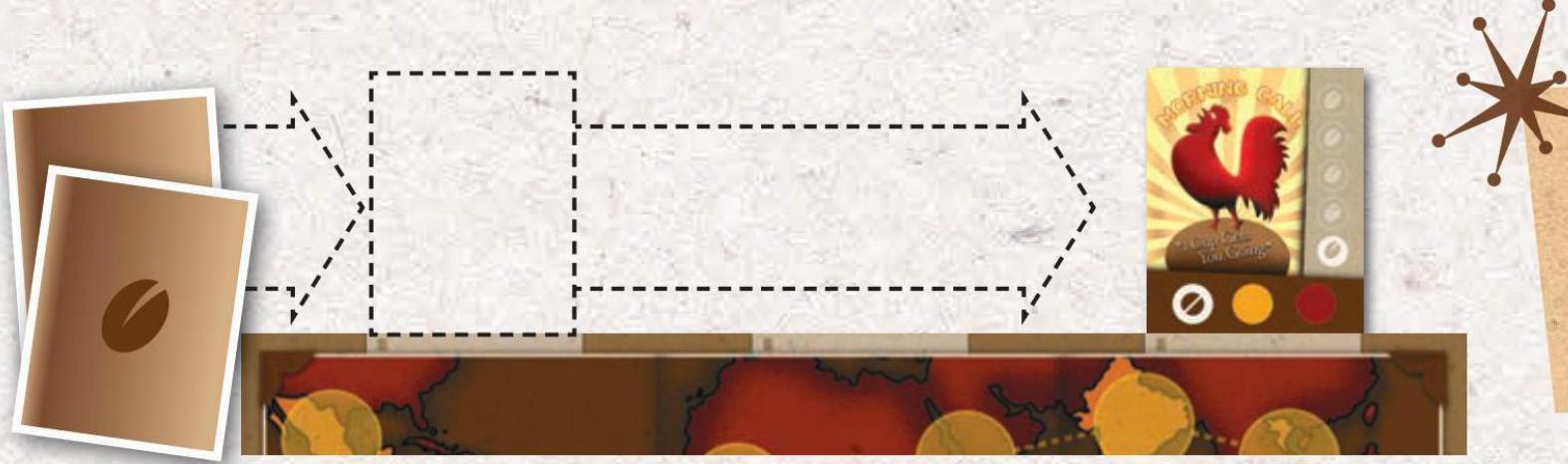
将世界地图上方未完成的拼配板块向右移动,翻开新的拼配板块放置在世界地图上方空白位置。
世界地图上的咖啡豆放回供应区,根据新的拼配板块重新放置对应的咖啡豆。如果咖啡豆供应不足,放置点空置即可。
超负荷研究
如果所有团队在一轮中都选择执行研究行动,那么将亚洲产区上方的拼配板块移除,其他按原有方式设置。

游戏结束 & 计分
《拼配咖啡》游戏将以下面三种方式结束:
拼配板块不足
如果没有足够多的拼配板块,放置在世界地图上方,游戏立即结束。
4个能力满级
如果一位玩家的4个研究标记移动到该能力的末端,游戏在本回合的大众品鉴阶段后结束。
获得21分
如果一位玩家在大众品鉴阶段后,获得了21分。游戏在本回合后结束。
当满足三个游戏结束条件之一时,玩家(按顺序)从研究板块上获得分数以及任何所有在游戏结束时提供分数的卡牌。
研究奖励
研究板块上的各种能力在不同等级提供奖励分数,游戏结束时,加总到玩家分数中,并且这些分数时累计相加的。奖励分数标注在能力等级的左上角。
加总所有获得的分数,拼配大师负责将玩家的计分标记,往前移动对应的格数。
Shawn的INVEST能力已经达到满级,BREW能力已经达到第2级。奖励分数时累积的。所以INVEST能力让Shawn获得5分(1+1+3), BREW能力提供2分(1+1)奖励。总共获得7分奖励。

得分提示
玩家不要忘记,在游戏结束时,计算由升级能力带来的分数奖励!


分数最高的玩家成为最终的胜利者,获得公司提供的晋升机会、丰富的投资建议和巨额养老金。如果平局,位于计分标记堆最下面的玩家获胜!
简化规则
进行《拼配咖啡》几轮游戏后,虽然感觉对游戏得心应手,但还是有很多难于理解的地方。但不要气馁,因为在你摸出第一颗咖啡豆,拼配出第一个天才组合的时候,你已经在成为烘焙大师的路途中。
然而,有些玩家还是觉得玩法有些复杂,那么这个变体规则,让游戏简化,让玩家专注于拼配和减少风味丢失带来的影响。使用这个简化规则,需要把研究板块翻到另一面,风味卡放回盒子,游戏中不需要用到。
注意,研究板块上的能力满级时不提供特殊能力,但会让你在游戏结束时,获得更多分数。祝你拼配愉快!
研究板块

简化研究板块
实习生缺点
实习生 (3-4人游戏)
3- 4人游戏时加入实习生,会让游戏更加精彩。实习生是很不错的团队成员,游戏中玩家指导实习生进行拼配/研究行动。然而,由于实习生通常都很年轻,经验不足,因此在游戏过程中会带来短期和长期的负面影响。被选中的实习生只能使用一个回合,回合结束后,面朝下放置在研究板块旁。
游戏设置
游戏设置前,随机移除3个拼配板块。然后根据6人或更少玩家的规则(详见P5)设置游戏,并额外增加一些设置:
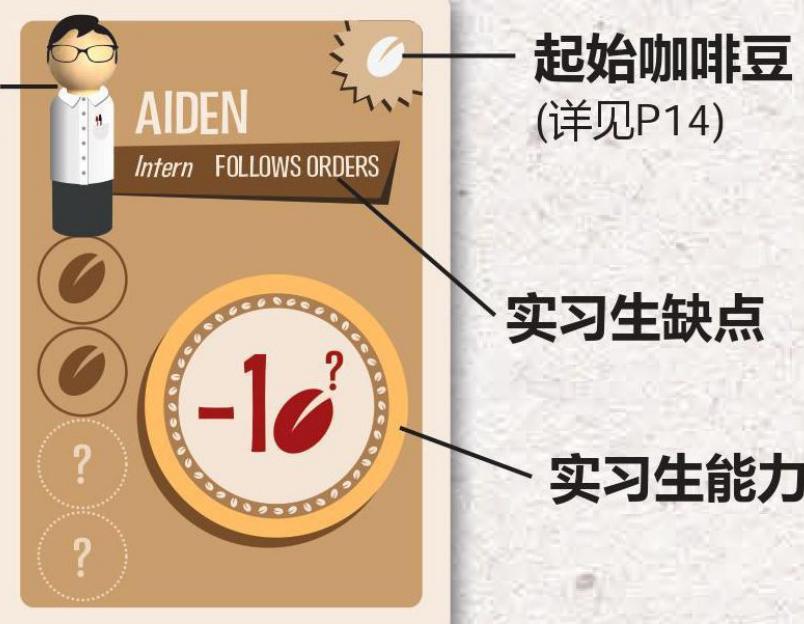
1) 准备1个烘焙袋。从咖啡豆供应区取出的3颗黑豆、4颗绿豆、5颗红豆、6颗棕豆、7颗黄豆和8颗白豆,放入烘焙袋中,作为实习生存储袋。
2)洗混实习生卡,面朝上翻开3张放在世界地图旁。
3) 每张实习生卡都有咖啡豆放置点,放置点上的咖啡豆将会放入烘焙袋中。实习生一旦被翻开,则需立即放置咖啡豆。供应区的咖啡豆分配到国家之前,优先填满实习生的放置点。如果卡上有(?)符号,则从实习生存储袋中抽取并放置。如果供应区的咖啡豆不足,空置国家咖啡豆放置点,优先保证填满实习生放置点。
实习生肖像
待加入烘焙豆
起始咖啡豆 (详见P14)
1. 实地采摘
按顺序,玩家从以下两个行动中选择一个。
1) 将玩家标记放置到世界地图上。

2)拿取一张实习生卡(面朝上)。
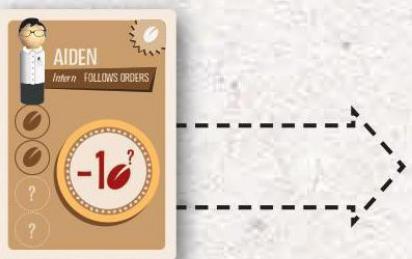
如果玩家拿取了实习生卡,卡上的红色负面效果会立即生效。然后将实习生卡上的所有咖啡豆挪到研究板块上。玩家将指导这名实习生,并在这一轮中将他们作为特殊的团队成员使用。玩家选择两个行动之一后,轮到下一位玩家选择,以此类推。
当所有玩家已经选择了一个行动后,起始玩家执行未选择的行动。如果玩家第一次没有选择放置玩家标记的行动,此时他必须执行这个行动。但是,如果玩家之前已经选择过放置玩家标记的行动,此时他可以选择Pass,不拿取实习生卡。所有玩家执行两次行动或Pass后,游戏将进入第二阶段。
2. 拼配/研究
实习生由于缺乏经验,加上自我限制,合作能力差,导致意志很容易被玩家左右。在团队选择拼配/研究时,实习生将会同指导他的玩家投一样的票。实习生总是跟知道玩家的票。如果同一团队中,有2名玩家控制一位实习生,导致平局,则执行研究行动。
a. 拼配 (实习生有时候言听计从)
执行拼配行动时,实习生作为一名团队成员,所有的规则都适用于他们,只不过实习生被玩家控制。为了模拟这种关系,玩家左手边的玩家扮演实习生,拿取1个空的烘焙袋,将实习生卡上的咖啡豆放入袋中,玩家一声令下,实习生从烘焙袋中随机抽取豆子,并放置在拼配板块上。
实习生可以利用玩家的能力,来提升自己的拼配能力,前提是玩家必须已经拥有这个能力。例如,玩家的SELECT能力已经升级到1级,那么实习生就可以使用这个1级的能力。注意,如果实习生使用了这个能力,在玩家执行拼配行动时,就不能使用SELECT能力。
拼配/研究行动结束后,使用过的实习生卡面朝下放置在研究板块旁,实习生烘焙袋中的咖啡豆返回供应区。
一些实习生的缺点会影响玩家的能力
Intern ∅ BREW
拼配时,实习生不能使用BREW能力。
Intern ⏻ SELECT
拼配时,实习生不能使用SELECT能力。
Intern OUT OF CONTROL
拼配时,实习生什么能力都不能使用。
b. 研究 (大部分实习生积极向上)
玩家与实习生一起工作,玩家在这些工作后的实习生身上获得宝贵经验。玩家按照规则获得3个研究点数外,每位参与工作的实习生(面朝下),都会给玩家带来1个研究点数。
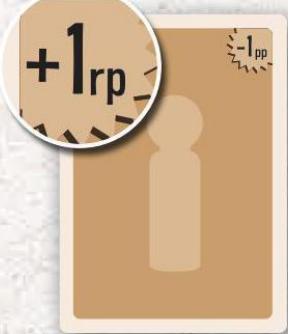
= 1 RP 例如:玩家研究板块旁边有3位面朝下的实习生卡, 那么玩家将额外获得3个研究点数。
3. 大众品鉴
本回合未被使用的实习生卡放入弃牌堆,并将卡上面的咖啡豆返回供应堆。若实习卡用尽,重新洗匀弃牌堆的实习生卡,形成新的牌堆。然后再次面朝上翻开3张实习生卡,用咖啡豆填满实习生卡上的放置点。
游戏结束 & 计分
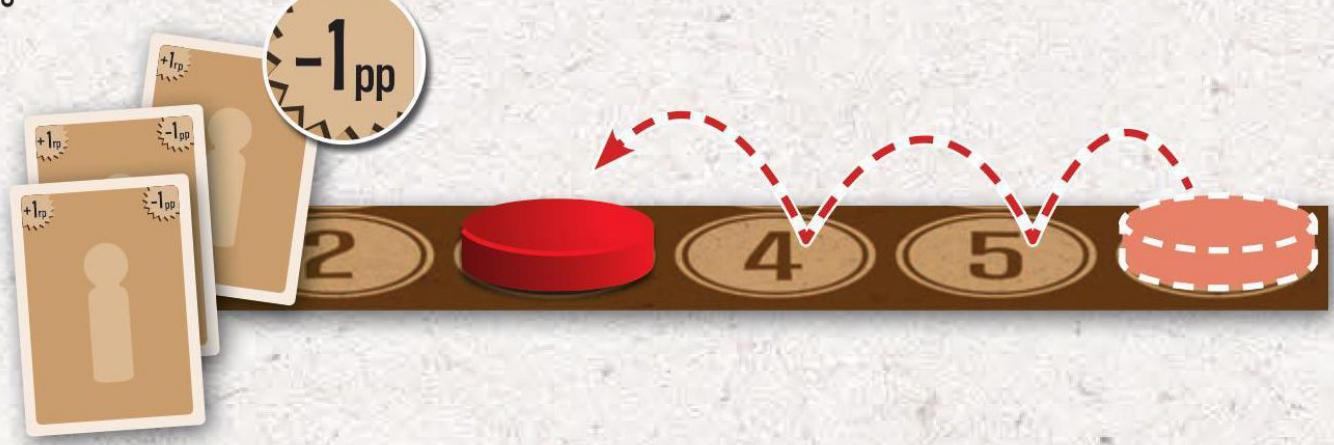
游戏结束时,按照正常规则计分后,每位玩家计算各自拥有的面朝下的实习生数量。每拥有1张实习生卡,将会使玩家失去1分,计分标记移动对应的格数。
分数最高的玩家获得胜利。
变体规则
起始咖啡豆
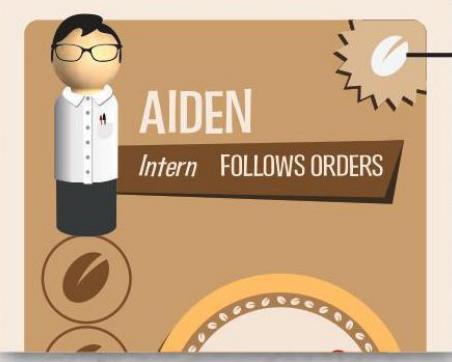
游戏设置阶段,“从供应区拿取2颗白豆和1颗黄豆”的规则替换为“每位玩家获得3张实习生卡”。然后,从供应区拿取实习生卡右上角标注的咖啡豆,放入烘焙袋中,弃掉实习生卡。在3-4人游戏中,洗匀实习卡,形成牌堆。
品质优化(清理坏豆)
游戏开始时,玩家获得1个筛选标记。在大众品鉴阶段结束且计分完毕后,玩家可以弃掉帅选标记,从烘焙袋中选出3颗咖啡豆,并返回供应区。这个规则可以让玩家在经过几轮游戏后,从烘焙袋中选出那些不是很受欢迎的豆子。通过清理坏豆,在拼配行动时,让玩家成为一名优秀的团队成员,因为可以提供优质的咖啡豆。
特殊拼配卡
游戏开始时,洗混8张特殊拼配卡,形成牌堆放在分数记录表旁。翻开最上面的一张牌,在大众品鉴阶段,如果有团队拼配出跟特殊拼配卡一致的组合,则获得相应的奖励。然后,移除这张卡,重新翻开一张。只要拼配组合一致,不一定要使用跟拼配卡相同的咖啡豆。
起始咖啡豆


特殊拼配卡
风味卡
游戏开始时,每位玩家获得2张风味卡,选择1张并弃掉另一张。所有玩家选择完毕,被丢弃的风味卡和其他风味卡一起洗匀,形成牌堆。写着“立即打出”的卡,在第一轮游戏的大众品鉴阶段可以打出。
公平
尽管《拼配咖啡》游戏规则涵盖了可能发生的情况,但偶尔也会出现未声明的实例。在这种情况下,为了让游戏继续下去,最好在玩家之间进行投票。
变动效果标记
每一轮大众品鉴阶段结束,世界地图板块上的玩家标记归还玩家后,拼配大师洗匀所有效果标记,按照游戏设置,随机放置在世界地图板块对应的位置上。
平局决胜
在非常罕见的情况下,同时行动会影响另一位玩家的行动,此时按照回合顺位解决,否则,拼配/研究行动总是同时进行。如果担心你的行动,你可以将研究板块盖起来,对其他玩家不可见。

附录A:效果标记&实习生能力

获得分数获得1分或2分,移动计分标记对应的格数。
失去分数
失去1分或2分,移动计分标记对应格数。

获得1颗咖啡豆
立即从供应区拿取1颗与效果标记对应放置点相同种类(颜色)的咖啡豆。没有足够豆子,忽略此效果。
失去1颗咖啡豆
不能拿取效果标记对应放置点的咖啡豆。不影响研究板块能力的使用,仍然可以获得1-2颗与放置点相同的咖啡豆。

交换豆子
当前玩家选择一位玩家为,查看他的烘焙袋并选择1颗豆子放入自己的烘焙袋中。接着选择1颗豆子放入对方烘焙袋中。

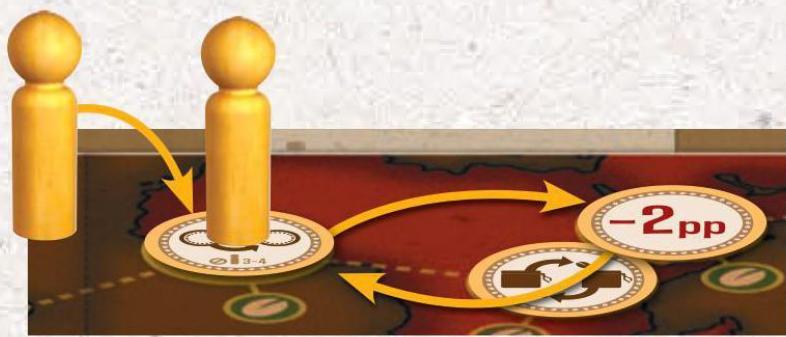
交换效果标记
在拿取咖啡豆之前,将所在效果标记连同玩家标记(如果有),与另外一个放置点的效果标记交换。然后拿取新放置点的咖啡豆(如果有)。
这个效果不能在3-4人游戏中使用。
失去研究点
将一个研究标记往后移动1格。研究标记不能回到起始点,也不能降级。如果研究
标记无法合理移动,则忽略此效果。

研究贡献
除你之外,其他玩家获得1-2个研究点数。如果此效果让研究板块能力升级,玩家在这一轮中获得该能力。

移除拼配标记
立即将自己的1个拼配标记从拼配板块上移除,返回玩家手中。也可以移除投资标记上的拼配标记。如果玩家在拼配板块上没有拼配标记,则忽略此效果。

移除1颗豆子立即从烘焙袋中随机抽取1颗咖啡豆返回供应区。

多带一个实习生
立即从牌堆抽取1张实习生卡,面朝下放置研究板块旁。这张实习生卡将计入玩家的实习生数量,用于获得研究点数以及游戏结束时计分。

减少研究
仍然可以执行研究行动,但不会获得厨初始研究点数,实习生也不会给你带来研究点数。在大众品鉴阶段,你可以用分数去换研究点。
在大众品鉴后打出:在畅销清单上选择1颗拼配板块,将上面的1颗咖啡豆移动到另一个板块上。(不能放Rainbow上)
附录B:风味卡详解
《拼配咖啡》游戏有16种风味。下面是关于每一种风味的注释。
投资迁移
移动的投资标记必须是已经在拼配板块上的,而且也有玩家的拼配标记。注意,这个效果在大众

在大众品鉴之前打出:将任意1个有拼配标记的投资标记移动到另一个拼配板块。
品鉴阶段之前,拼配板块加入畅销清单之后使用。
流氓行为
玩家使用这张卡时,玩家标记没放置在国家上。意味着在实地采摘阶段,玩家不会获得任何咖啡
豆,而且无法使用DROW能力。
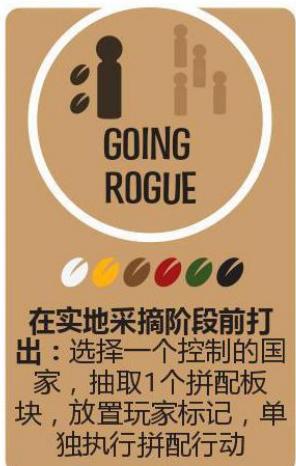
在实地采摘阶段前打出:选择一个控制的国家,抽取1个拼配板块,放置玩家标记,单独执行拼配行动
热或冷
这张卡必须在计分之后立即打出。如果不执行,什么效果也没有。如果执行,所有的拼配结果都会

在大众品鉴阶段
打出:风味丢失效果执行2次,或者不执行。由你决定。
受影响,每个团队都要移除2颗豆子。
限量供应
拼配板块按正常规则移出游戏,不再使用。玩家标记回到玩家手中,投资标记返回一般供应堆。

在大众品鉴阶段打出:计分结束后,从畅销清单上移除1个拼配板块。板块上有拼配标记的玩家获得2分。
快速切换
咖啡豆必须放置在可以放置的点上。拼配板块上不能超过5颗豆子。这张卡在大众品鉴阶段结束后,
开始新一轮游戏前打出。
重新开始
如果被选中的团队在拼配时使用了能力或风味卡,允许重新使用这些效果。
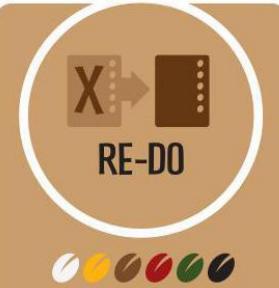
在一次拼配行动后打出:选择一个已拼配过的团队,归还所有的豆子,重新开始执行拼配行动。
获得2分
这个分数的增加不会影响回合顺位,如果玩家通过这个效果获得21分,游戏立即结束。
立即打出:获得2分
追加得分 *2
因为风味丢失效果或其他原因,导致需要移动拼配板块时该卡随板块一起移动。

获得研究点如果这个团队正在执行拼配行动,在这个团队行动结束后依然可以获
立即打出:获得3个研究点数,其他团队获得1个研究点数。
得该卡提供的研究点数。
本地供应*2从供应区拿取的咖啡豆,不一定要同一类型。

立即打出:从供应区选择2颗咖啡豆,放入自己的烘焙袋中。
贪婪
虽然这张牌需要立即打出,但也应该等执行拼配行动的

团队结束后,再打出。
立即打出:发起一次投票。玩家秘密地选择拼配/研究标记的一面。如果有玩家选择了研究,玩家们(包括你)获得1个研究点。
归还
取出的豆子放回供应堆。使用此卡换取的分数不能超过5分。
在大众品鉴阶段打出:打开烘焙袋,选择一种咖啡豆,放回供应区。每返回一个豆子,获得1分。(最多5分)
私有储备
如果玩家选择的咖啡豆在供应堆没有则玩家不会获得任何豆子。

拼配行动结束后打出:选择一种你在拼配行动中贡献的咖啡豆,从供应区拿回对应数量的咖啡豆。
主管
只有当团队有能力完成拼配行动,填满5个咖啡豆放置点
拼配行动前打出:选择团队的一名成员,包括自己。不需要放置咖啡豆来完成拼配行动。
时,才可以使用此卡。这个效果依然让获得奖励。

附录C:研究专题
这个附录列出了所有的研究项目以及能力。研究项目的能力不叠加,升级到高一级后,只能使用其所在等级的能力。

如果使用得当,GROW能力可以让玩家快速地在自己的烘焙袋里装满豆子。适合喜欢囤豆的玩家。
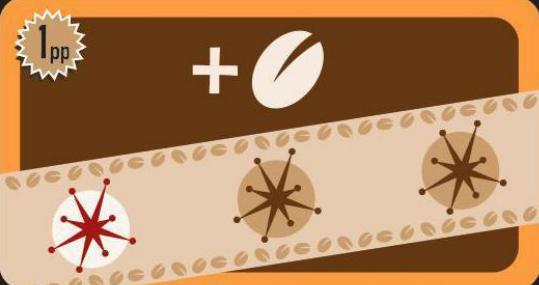
可以让玩家在实地采摘阶段获取放置点咖啡豆多1颗。直接从供应区拿取。

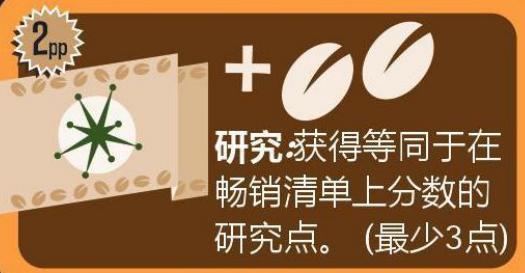
研究:获得等同于在畅销清单上分数的研究点。(最少3点)
可以让玩家在实地采摘阶段获取放置点咖啡豆多2颗。直接从供应区拿取。
GROW能力可以用来从供应区获得咖啡豆。即使效果标记不允许。
这个能力取代了原有的初始配置“获得3个研究点”。无论得分多少,玩家的研究点数不会低于3个。
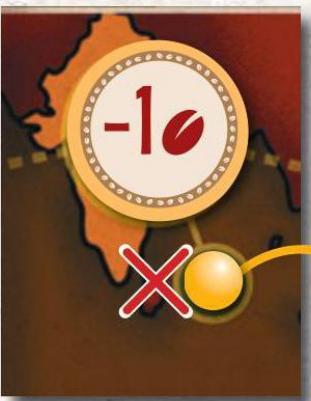
当玩家将玩家标记放置在有“失去1颗豆子”效果标记的国家上时,必须将这放置点的咖啡返回供应区。
当GROW能力升级到1级或2级时,玩家可以从供应区拿取与国家对应咖啡豆同款的豆子。
SELECT

SELECT能力允许玩家筛选那些拼配错误的豆子,提高拼配等级。这对那些不喜欢运气的玩家,非常有利。
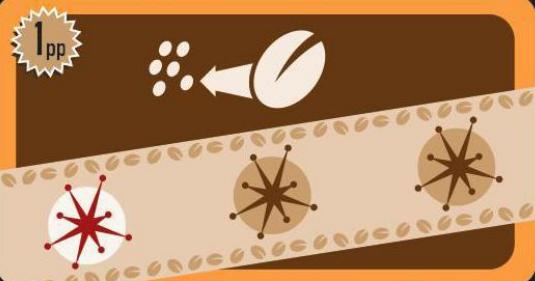
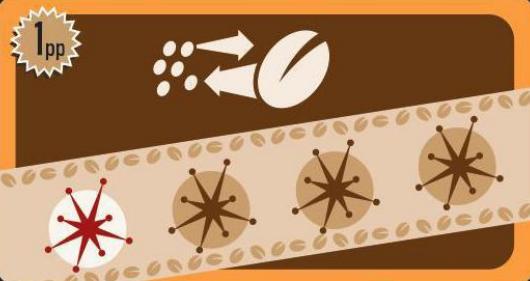
在开始拼配行动之前,玩家可以查看自己的烘焙袋,移除1颗咖啡豆,放回咖啡豆供应区。
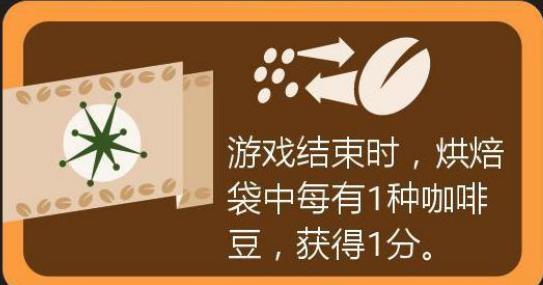
游戏结束时,烘焙袋中每有1种咖啡豆,获得1分。
在开始拼配行动之前,玩家可以查看自己的烘焙袋,移除1颗咖啡豆,放回咖啡豆供应区。然后再从供应区选择1颗放回烘焙袋。
因为只有6种咖啡豆,因此这个能力最多给玩家带来6分。
INVEST


INVEST能力能让玩家从其他团队的成果中获利(分数)。但是,玩家最多只能拥有2个投资标记,因为需要合理的使用它们。对于那些喜欢从赌博中获利的玩家来说,这是一个非常不错的能力。
拿取1个投资标记,在拼配行动开始前,玩家可以在其他团队的拼配板块上放置1个投资标记,并在其上面放置自己的拼配标记。当这个拼配板块加入畅销清单时,可以获得对应分数。
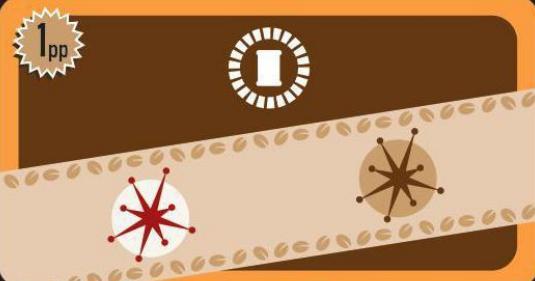
当两人组成团队时,你的拼配/研究行动决定团队结果。
投票阶段,玩家投票结果,决定团队执行什么行动。如果你投票拼配行动,成员投票研究行动,则团队执行拼配行动。反之亦然。
拿取1个投资标记,在拼配行动开始前,玩家可以在其他团队的拼配板块上放置1个投资标记,并在其上面放置自己的拼配标记。当这个拼配板块加入畅销清单时可以获得对应分数。


当拼配板块从畅销清单上移除时,投资标记返回一般供应堆,拼配标记回到玩家手中。一场游戏中,玩家不能拥有超过2个以上的投资标记。玩家不能投资自己的团队。
附录C:研究专题
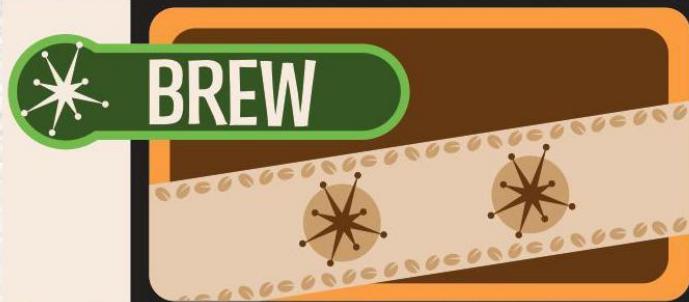
当团队在拼配行动想获得最佳的拼配组合时,BREW能力可以提供比较保险的建议。对于那些珍惜资源,不想浪费资源来获得最佳策略的玩家来说,这无疑是极好的。

风味卡的使用,大大增加了游戏的策略。使用过风味卡面朝上放在牌堆旁,形成弃牌堆。牌堆抽完时,重洗弃牌堆,形成新的牌堆。
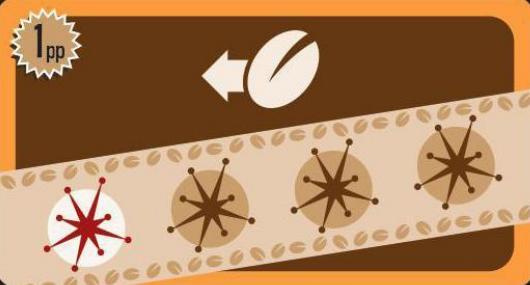
拼配时,玩家抽取的1颗豆子,暂时先放一边,不放置在拼配板块上,再抽1颗放置后,原先那颗放回烘焙袋中。

升级这一级时,抽取2张风味卡,选择一张并弃掉另一张。

拼配时,玩家抽取的1颗豆子,暂时先放一边,不放置在拼配板块上,再依次抽2颗放置后,最先2颗放回烘焙袋中。
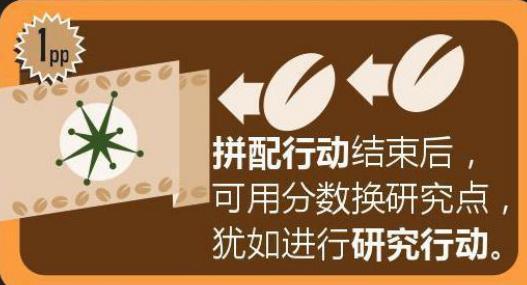
这个能力不会限制执行研究行动的玩家,用分数换取研究点数。

升级这一级时,抽取2张风味卡,选择一张并弃掉另一张。
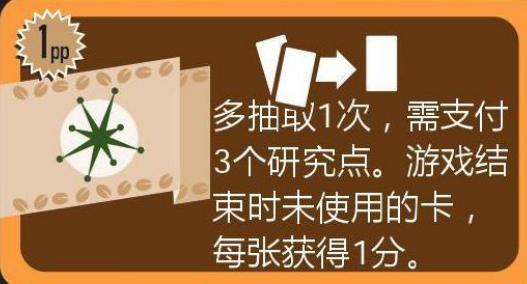
升级这一级时,抽取2张风味卡,选择一张并弃掉另一张。并且在接下来的任何时候,支付3个研究点数来抽取2张风味卡,选择一张并弃掉另一张。
能力发动 & 打出风味卡时间表
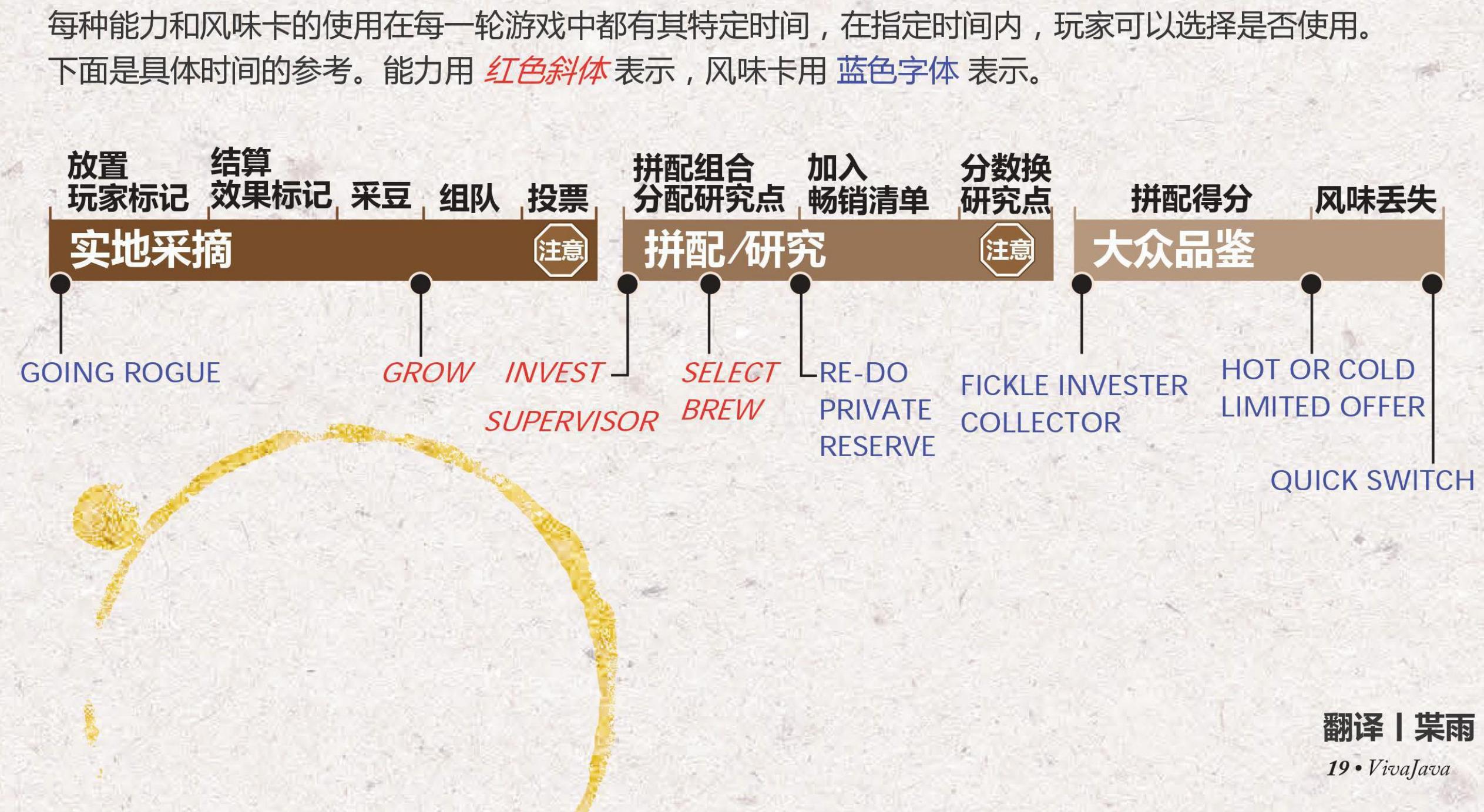
每种能力和风味卡的使用在每一轮游戏中都有其特定时间,在指定时间内,玩家可以选择是否使用。下面是具体时间的参考。能力用红色斜体表示,风味卡用蓝色字体表示。
《拼配咖啡》。简明游戏流程
游戏流程
1. 实习采摘
调整回合顺位按顺序,在世界地图上放置玩家标记。
- 立即结算效果标记的正面效果和负面效果
从世界地图上拿取咖啡豆放入烘焙袋
2. 拼配/研究
同一产区的玩家秘密选择拼配或研究,并同时展开,票数多的剩出。如果平局,执行研究行动。
a. 拼配
团队决定谁先抽取豆子
团队每个成员至少贡献1个豆子一旦拼配行动结束,团队不能再放置豆子。
根据拼配登记表,加入畅销清单。
团队每个成员获得1个研究点,用于升级能力。
团队成员不能用分数换取研究点数
b. 研究
团队每个成员获得3个研究点,用于升级能力。
研究行动结束后,每位成员可以用分数换取研究点数。
3. 大众品鉴
团队根据畅销清单的排名来获得分数
风味丢失,导致畅销清单上的排名发生变化。
新的拼配板块添加到世界地图板块的上方,对应放置点上填满咖啡豆等。
研究项目能力
翻译 | 茱雨

GROW

SELECT


从供应区额外多拿1颗咖啡豆


从烘焙袋移除1颗咖啡豆到供应区

获得1个投资标记

BREW 从供应区额外多拿2颗咖啡豆

拼配时多抽1颗备用


从烘焙袋移除1颗,再从供应区拿回1颗。

获得1颗投资标记

拼配时多抽2颗备用

FLAVOR

抽2张风味卡,保留1张。

抽2张风味卡,
保留1张。
效果标记&实习生能力
获得分数
失去分数


获得1颗豆子
失去1颗豆子
交换效果标记

交换豆子
失去1个研究点
支援研究

移除
拼配标记
弃掉 1颗豆子

抽取1张实习生卡

减少研究
Viva_Java_Second_Edition_Rules.md60.3 KB
The Bean Is Life.
Vivajava CoffeeCo.
VivaJava: The Coffee Game The Field Manual
Mission Statement
VivaJava: The Coffee Game is a semi-cooperative negotiation game in which a group of Field Researchers travel the world to create best-selling coffee blends for VivaJava brand coffee. The most traveled and resourceful employee will gain a gratuitous promotion and the chance to retire in style - plus a lifetime supply of coffee.
During the course of the game, players will be developing and researching new coffee blends on teams that may change each round. Each round has three distinct phases that are repeated until one of three game-ending conditions is met. The player with the most Performance Points from a combination of Blending and Researching will prove superior.

Table of Contents
Game Overview, Credis....
Field Components..
Game Set-up..
Sequence of Play..
1. In The Field.
2. Blend/Research.
a. Blend..
b. Research.
3. Popular Opinion. .10
Game End.. 12
Decaffeinated VivaJava. .12
Intern Inspansion (3-4 players). .13
Variants.. .15
Appendix A: Country/Intern Tokens ... 16
Appendix B: Flavor Card Notes........17
Appendix C: Research Track..... ...18
Game Reference .20
Credits & Acknowledgements
Game Design: T.C. Petty III
Graphic Design: Chris Kirkman, T.C. Petty III
Art: Chris Kirkman, Darrell Louder
Development: T.C. Petty III, Chris Kirkman, Cherilyn Joy Lee
Publisher: Dice Hate Me Games
Platinum Playtesters: Mario Arnold, Keith Carter, Steven Doughty, Tom Gurganus, Timothy Hing, Brian Linnen, Sarah Linnen, Darrell Louder, John Moller, Jim Neuschwander, Chris Norwood, Jacquelyne Purtell, Shawn Purtell, Benjamin Rosset, Elizabeth EB' Singer, Robert Singer, Luke Winters
First Playtest circa. July 2009: Mario Arnold, Michael Arnold, Alexis Arnold, Nikki Gortian, Timothy Hing, Jim McSherry
Special Thanks: T.C. would like to thank people who play games, Battles (the band), variable turn order mechanics, John Moller again for his undying support, Dr. Moore/ Kellar, everyone who supported the game on Kickstarter, Seattle, my iPhone, BGG, little wooden bits, those brave aviators fighting on the wings of aeroplanes, and Mommy and Daddy and Sissy for letting me figure it all out myself.
Chris would like to thank all the Kickstarter supporters for their wonderful enthusiasm and generosity, Don Lloyd, Lesley Louder, W. Eric Martin and Chris Norwood for their continued support and rules lawyering, and David MacKenzie for getting us into this whole mess.
Much thanks to the Lost Type Co-Op (losttype.com) for Airplane, Airship, Alexis, Carton, Cubano, Franchise, Governor, Habana, Haymaker, Liberator, Ministry, Oil Can, Onramp, Quaver, and Ranger, and to TypeArt Foundry for the awesome Fling-A-Ling.

For downloadable rules and a video tutorial, visit dicehatemegames.com/ vivajava.
"Dice Hate Me,""The Bean is Life," the VivaJava logo and all art contained within are ©2017 Greater Than Games, LLC.

Field Components
World Map

8 double-sided Research Labs
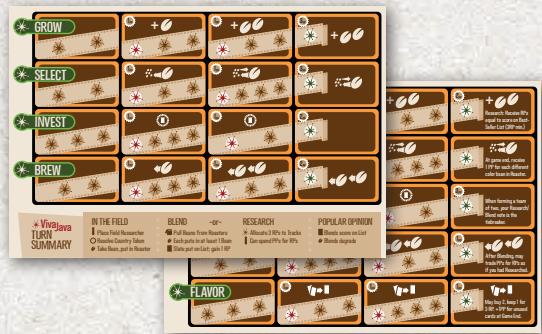
15 Blend Slates

16 Flavor Cards
40 Research Markers (8 sets of 5)

24 player Blend Markers (8 sets of 3)

8 Turn Order Tokens

8 Featured Blend Cards
(see Variants, pg. 15)
8 Blend/ Research Coins

8fabric Roaster bags
90 wooden beans in six colors

20 18 16 14 12 10
Performance Track/Best-Seller List

2 Starter Slates

1 Stale Marker (used in games with 3-5 players)

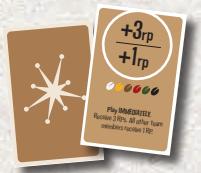
24 Intern Cards (see Intern Inspansion, pg. 13)
8 Player Reference Cards
8 Roaster Purge Coins

15 Investment Tokens

8 wooden Researcher pawns

8 wooden Scoring Tokens

3• VivaJava

Game Set-up
Unfold the World Map and Performance Track and place them on the table as shown below. Separate the 90 coffee beans by color and place them in piles as noted on the bottom of the World Map, arranged by Color Rank. These beans represent The Fields. Shuffle the Blend Slates and place them near the Western side of the World Map.
Put Score Tokens in a Roaster. Pull them out one at a time and stack on the Performance Track according to number of players._-----
Shuffle the
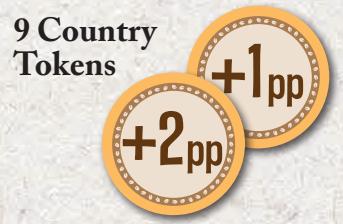
9 Country Tokens with special actions and randomly place them on the World Map in the round Country spaces.
STOP
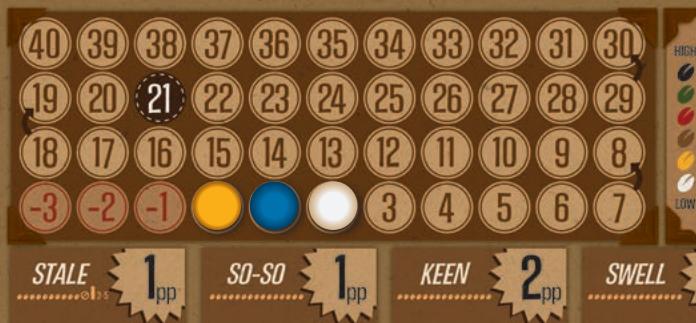
Place Starter Slates on the Best-Seller List. AverageJoe should be in the Top Cup! position.
THE BREWMASTER
Players should designate one player as the "Brewmaster," who will control the assignment of Turn Order Tokens, movement of the Scoring Tokens on the Performance Track, and make sure each round is running cmoothly. Typically, this should be either the owner of the game, or the person who has played the most.
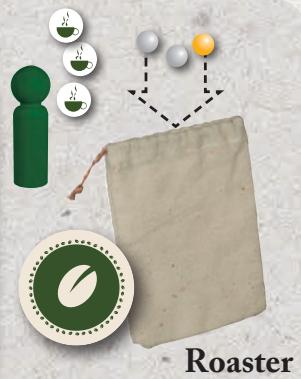
Give each player a set of pieces in the player's color, a Roaster bag, and a Research Lab. Research Markers should be placed at the start of each Research Track. Players take 2 white beans and 1 yellow bean from The Fields and place them into their Roasters.
Research Lab


Each Starter Slate has a column of 5 beans of specific colors. Take beans of the appropriate color from The Fields and add them to the Slates.
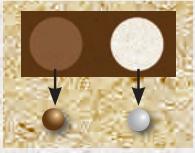
Place Beans from The Fields onto the Country Crop spaces connected to the Countries below them, based on the color represented in the circles on the Blend Slates.
ADDITIONS FOR GAMES WITH 3-6 PLAYERS
VivaJava scales easily for 3 to 6 players with only a few modifications to set-up and game play. In set-up and during the game when Blend Slates are placed above the regions on the World Map, a special symbol on each Blend Slate indicates an action that must be performed for a specific Country in that region.
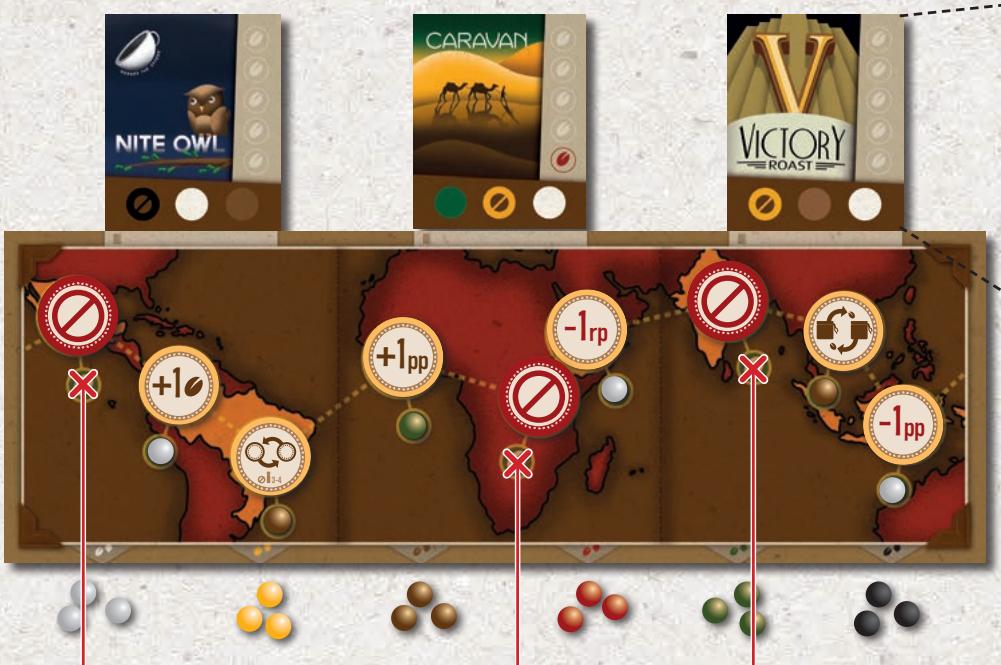
Bean is not placed and Country Token is turned over.
Bean is not placed and Country Token is turned over.
Bean is not placed and Country Token is turned over.

This symbol shows that the players should not place a bean in the Country Crop space, and the Country Token in that location should be flipped to the ∅ side.

ADDITIONS FOR GAMES WITH 3-5 PLAYERS
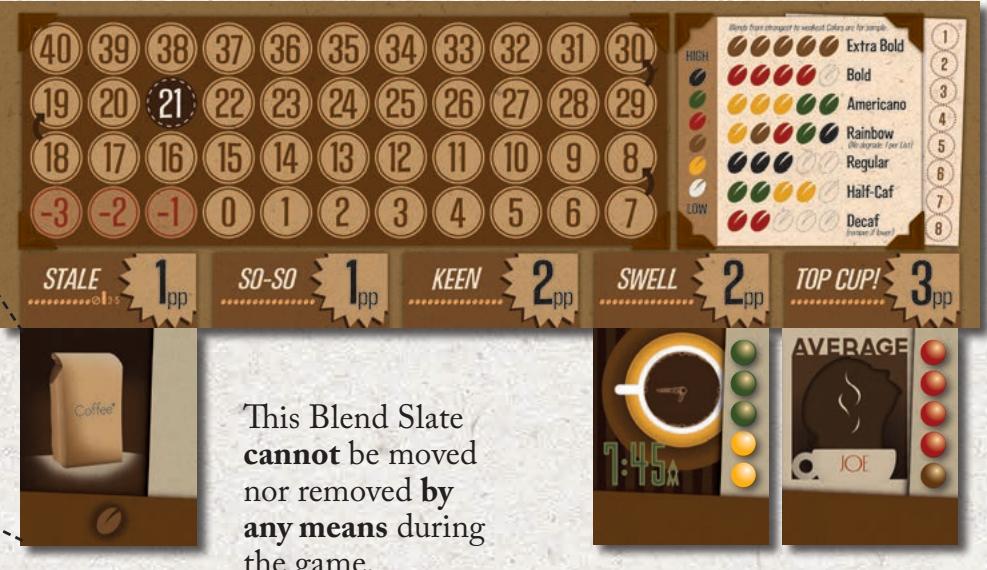
When fewer Field Researchers scour The Fields for valuable beans, the VivaJava CoffeeCo. will often release a generic Blend into the market to maintain a healthy - if not terribly flavorful - bottom line. In games with 3 to 5 players, the Stale portion of the Best-Seller List is dominated by the Coffee* Blend. This Blend is immune to degrading and remains in the Stale position for the entire game.

During set-up in a game with 3 to 5 players, place the Coffee* Slate in the Stale position on the Best-Seller List.
5•VivaJava
Sequence of Play
VivaJava: The Coffee Game is played over several rounds with each round broken down into three distinct phases:
1. IN THE FIELD
In Turn Order, players place their Field Researcher pawns on the World Map and collect beans.
2. BLEND/RESEARCH
Players break into teams and either Blend (combine beans to score) or Research (gain abilities).
3. POPULAR OPINION
Players add new Blends to the Best-Seller List and calculate scores. Blends then "degrade" and weaken.
The following details how to play VivaJava with 5-8 players. For additions to game play for 3-4 players, please see page 13.
1. IN THE FIELD
The World Map is split into three coffee-rich regions (Americas, Africa, and Asia) each with its own Country Crop space and action that players will explore by placing their Field Researcher pawns.
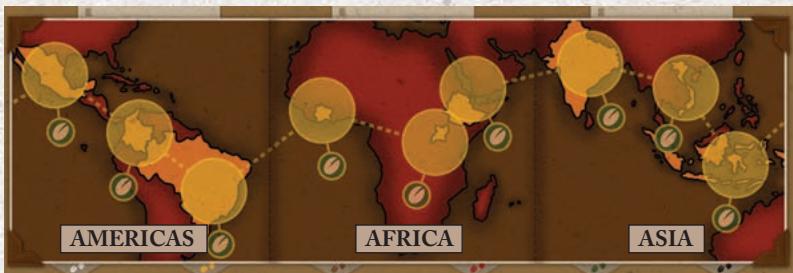
VivaJava is, at it's heart, a social game. Players may and are encouraged to tell (or not tell) their intentions and strategize before placing a Field Researcher. This is key, because players will split into teams each round based on the region in which they place their Field Researcher. Players may make promises, but nothing may be exchanged, no deals are binding, and a player can never show the contents of their Roaster unless a card, action or rule requires it.
Determine Turn Order
The player with the lowest score on the Performance Track will go first. If there is tie, as shown in the example to the right, the player on the top of the stack is first in turn order. The Brewmaster gathers all players'Turn Order Tokens and places them on the Turn Order Track in proper order for the Round.
Place Field Researchers
Each player, in turn order, places their Field Researchers onto a Country on the World Map. When a player chooses a Country, they must immediately resolve the action represented on the Country Token and then take the bean from the corresponding Country Crop space below (if available) and place it into their Roaster. Each symbol listed on the Tokens represents a positive action (marked in dark brown)
or a negative action (marked in red). Positive actions are optional, whereas negative actions must be performed.
Players continue placing Field Researchers in turn order until all players have chosen. Once a countryis chosen no other player can choose that same Country. In games of 3 to 6 players, countries that are flipped to the side cannot be chosen, unless a special action would allow it. For more information about specific Country Token abilities and effects, see Appendix A on page 16.
On the first round of the game, players ignore penalties if they place their Field Researcher on a country that contains a red negative action. In all subsequent turns, red negative actions must be taken. VivaJava·6
2. BLEND/RESEARCH
Players split into three teams (Americas, Africa, or Asia region) and decide together whether they will Blend or Research.
A team's action is determined by a majority vote. To vote, each player takes the Blend/Research Token in their hand and secretly chooses a
side to place face-up on the table. Loud debating, advertising, and negotiation are encouraged.

When everyone is ready, The Brewmaster will signal all players to reveal their Tokens simultaneously; Any Token that is revealed with Blend face-up is a vote for the team to Blend, and any Token with Research is a vote for the team to Research.
Count the votes on each team, and determine which action each team has collectively chosen through majority vote. All ties result in a Research action.

THE VOTE
The Brewmaster should make sure that no team proceeds with Blend or Research actions until the vote is complete. This is important to keep the simultaneous actions from becoming chaotic.
INVESTMENTTOKENS
If any player(s) has an Investment Token, the Brewmaster should stop play immediately after the Vote is complete and offer a brief opportunity to place an Investment Token onto a Blend at this time. (see pg. 18 Invest)
2a. BLEND
It's time for the team to work together to create a Blend to top the Best-Seller List. Created Blends are ranked by a simple poker scale and placed onto the Best-Seller List to score points, hopefully over the course of several rounds.
Make a Blend
Each team takes the Blend Slate above their region on the World Map. There are five spaces for beans on each Blend Slate and these will be filled by randomly pulling beans from each player's Roaster.
The team unanimously decides in which order players will pull beans from Roasters. One player starts by shaking his roaster, randomly pulling a bean and placing it on the Blend Slate in one of the five bean spaces. Then, the team decides which player pulls the next bean until all five spaces have been filled or the team unanimously decides to stop. The only restriction is that all players must contribute at least one bean. They are not required to contribute more. The Blend Slate does not need to be filled.
If there is ever no unanimous decision, players on a team must pull

COFFEE PROTOCOL
A player cannot show what's in a Roaster unless a card, action or rule requires it. Talk about it, lie about it, be detailed in your descriptions, but do not show what's in it.
one single bean at a time in turn order. After all players have contributed one bean, they may pull a bean or pass until all players have passed or the Blend Slate is full
Free Bean Space
Some Blend Slates have one bean space filled in with a specific color. When the other 4 bean spaces on the Blend are filled by a team (and all players have contributed at least one bean to the Blend), a bean of the specified color may be added to the Blend Slate from the Fields. If there are no beans of that type in the Fields, players cannot use this ability. 7• VivaJava
2a. Blend (continued)
Rank a Blend
The Blend Rank scale lists the possible ranking of a five-bean Blend. Blends are ranked and placed onto the Best-Seller List based first on the ranking of the combination, then on the color of the blend. For example, a Bold Blend of black beans would be ranked higher than a Bold Blend of white beans. Also, a Bold Blend of white beans would be higher-ranked than a Regular Blend of black beans.
Any extra "kicker" beans are used to break ties. A Bold Blend with a Black Bean kicker would be higher ranked than a Red Bean Kicker. However, if two or more exact Blends are created simultaneously, the Blend with the team member who has the highest turn order is placed higher on the List.
Place on the Best-Seller List
Once the Blend is complete, each player places a Blend Marker of his color onto the Slate. Once all Blending teams are done, all new Blends are simultaneously placed into position on the Best-Seller List according to the Roast Ranking that is shown on the board
All inferior Blends are moved to the left on the List and the new Blend is inserted to the right of any Blend it outranks. If for any reason, a new or existing Blend does not rank high enough to place onto the list, it is removed from play. All beans on the Slate are returned to The Fields, and all markers are returned to players. Investment Tokens on the Slate are returned to the general supply (see page 18).
After Blending, each player receives 1 RP to distribute on their own Research Lab Ability Tracks!
Each player has 3 Blend Markers. If a player needs to place a fourth Marker, that player removes a Marker from another blend or doesn't add a Marker to a Blend created this round. A player may never have more than one Marker on a single Blend. If a new Blend is exactly the same as a Blend already on the List, the old Blend is considered inferior.
The Best-Seller List
Cherilyn, Chris and T.C. now have a new Blend and are ready to place it on the market. The current Top Cup! Blend is a red/yellow Half-Caf Blend and the Swell Blend is a black/white Decaf Blend. As the team's new Americano Blend is stronger, the Half-Caf and Decaf Blends are moved down on the Best-Seller List and the Americano Blend takes the Top Cup! spot, which will net the team 3 Performance Points during Popular Opinion VivaJava·8
Blend Rank Scale
Example of Blending
Chris, Cherilyn and T.C. are all in the same region and have decided to Blend. Chris says he has the best chance to give the team three-of-a-kind in yellow beans. Trusting him, Cherilyn and T.C. let Chris Blend first.
Chris reaches into his Roaster and pulls out a yellow bean, placing it onto the Blend Slate. So far, so good.
The team lets Chris to pull again - another yellow bean!
Chris pulls one more a time – it's a white bean. Drat!
Since every team member must contribute at least one bean, Chris can no longer Blend. Cherilyn goes next and pulls a white bean - things are suddenly looking better!
Cherilyn has more white beans, but T.C. must contribute. He closes his eyes, reaches into his Roaster... and pulls out a white bean! The team now has an Americano Blend. Not bad.

2a. Blend (continued)
Rainbow Blends
A Rainbow Blend is a special type of Blend that teams may also create that requires five different colored beans. A Rainbow is ranked higher than a Regular Blend and does not degrade during Popular Opinion.
There can be only one Rainbow on the Best-Seller List at a time. When a Rainbow is created, any Rainbow Blend on the Best-Seller List is removed from the game and replaced by the new Rainbow Blend. If more than one Rainbow is created simultaneously, the Blend from the team with the member who holds highest turn order is placed on the Best-Seller List and the other is removed.
00000 Rainbow it)
BEAN MANAGEMENT
VivaJava is a bean management game, not a bean collection game.The most common mistake made by a new player is taking as many beans as possible. Players should skillfully select which beans they place in their Roasters with a particular goal in mind, whether that is to create a Blend with one particular color or to create a unique Rainbow Blend.
Simultaneous Actions

The world of Big Coffee is constantly on the move. All Blending and Researching teams should complete their actions simultaneously. Blending teams should not sit and wait for Researching teams to finish or vice versa.
2b. RESEARCH
Sometimes a little training is required in order for Field Researchers to stay at the top of their game. During the Research Phase, a team will split up and return to their own respective Research Labs to brew up some special abilities so they can create even more robust blends.
Spending Research Points
Each player on a team that chooses Research receives 3 Research Points (RPs) to distribute amongst his Ability Tracks. Players make this choice alone and can distribute them in any way they choose by moving their Research Markers from left to right and covering up a new spot on the track. Each spot represents 1 point used and the columns represent when a player has reached a new Research level.
The first spot in a column is marked .to indicate that a player has reached a new level. When players have used enough Research Points to move a marker to this position, they have "leveled up" that ability and can take advantage of the special action indicated for that part of the track in the next round of play (with the exception of Flavor Cards, see page 17). Once a player has crossed this level line, no actions or abilities can cause them to move backwards beyond this point. Also, at Game End, players will receive Performance Points (PP) for each level they have achieved on each Research Track. Scoring is cumulative; for example, achieving the second level of Grow would net a player a total of 2 PP at Game End.
Once an Ability Track has been completed, a player may now use an End-track Ability. Specific abilities for each track are detailed on each Research Lab, and enhance a player's ability to acquire Performance Points. Research attributes are explained in detail on page 18.

Research Lab
Research Markers are moved from left to right on the Ability Tracks. In the example below, Shawn has used his 3 RPs to move up 2 spots in GROW, and 1 spot in SELECT. He will now be able to use the GROW special ability during the next round, and will receive 1 PP at Game End.

2b. Research (continued)

SPEND PERFORMANCE POINTS FOR RP
Once all teams have completed Blending and Researching, the Brewmaster should pause to allow any Researching players to trade PP for RP in turn order. When all eligible players have chosen, continue to Popular Opinion.
Using Performance Points for Research Points
One of the most important benefits of Researching is that players may also trade Performance Points for Research Points.
After all teams have finished Researching and Blending, any players who Researched (not players who Blended) during the Round choose, in turn order, how many Performance Points they would like to trade for Research Points. The player's Scoring Token is then moved backwards on the Performance Track to indicate this. For each one PP spent, the player receives one (1) RP to use immediately to move his Research Markers along the Ability Tracks, or to use for certain End-track Abilities (such as for the Flavor Track - see Appendix C on page 18 for more details).
It is very advantageous to use this extra capital as early investments in abilities can make a large difference in the quality of a player's Blends on the Best-Seller List. Note that players may not move their Scoring Token to the -3 Performance Points mark on the Performance Track, but never below at any time.
Shawn gained the GROW Ability through the allocation of his initial 3 RPs. However, he now has his sights set on gaining SELECT. He indicates that he would like to trade 2PP for 2 RP. His Score Token is moved backwards two spaces and he adjusts his Research Marker on the Track, reaching the first level of SELECT.

3. POPULAR OPINION
Field Researchers must be given credit for their work. The final phase of each round of play is entirely based around dishing out Performance Points and preparing for the next round of play - or the end of the game!
Scoring
After all players have finished Blending and Researching, Performance Points are awarded to players (in turn order) for any Blend with their Blend Marker on the Best-Seller List. There are five possible positions on the List, with payout amounts listed above each position.
For each Blend Marker a player has on a Blend, that player receives Performance Points equal to the number above the Blend Slate.
Blend Markers are not removed after scoring and remain until the Blend is removed from the List.
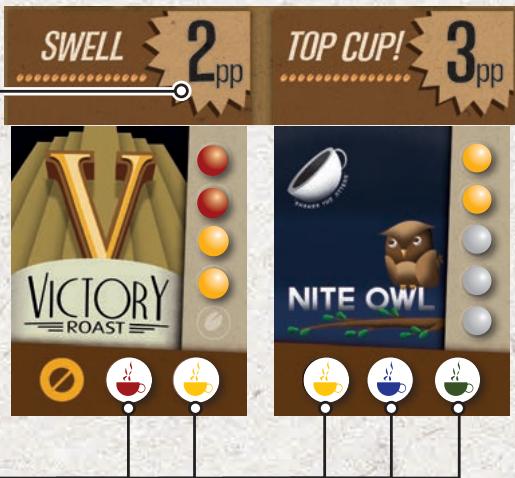
In the example at left, T.C. (playing yellow) has a Blend Marker on the two best blends on the List. T.C. receives 3 points for the Top Cup! Blend and 2 points for the Swell Blend and his Scoring Token is moved up on the Performance Track. The Brewmaster removes T.C.'s Field Researcher pawn from the World Map and returns it to T.C.

3. Popular Opinion (continued)
Degrading Blends
Once all players have been awarded points, the Bestselling Blends become less desirable in the public's eye and degrade. Remove one bean from each Blend and return each bean to The Fields. The bean removed must be the least important part of the Blend.
For example, if a blend is then it is a Bold Blend with one extra bean (). The extra bean would be removed, because removing any other bean would degrade the blend to a Regular Blend - a weaker Blend than the Bold Blend. Once a bean has been removed from all Blends, the Blends are re-ordered on the List as needed, according to Blend and Bean Rank. If a Blend is ever ranked lower than Decaf, it is removed from the Best-Seller List.
Removing a Blend
There are only five positions on the Best-Seller List. If for any reason, a Blend does not rank high enough to place onto the list, it is removed from the Best-Seller List.
If any Blend is removed from the Best-Seller List, return all remaining beans on the Slate to the Fields, return any Blend Markers to players and remove the Slate from the game.
There can be only one Rainbow on the Best-Seller List at a time. When a new Rainbow is created, the previous Rainbow Blend is removed from the Best-Seller List.
Example of Degrading
In the example below, the black/white Decaf Blend loses a white bean, the red/yellow Half-Caf loses one yellow bean (becoming a Decaf), and the Americano loses a yellow bean (becoming a Regular Blend).

The Degrading has changed the Roast Rank of the Blends, so they are reordered. There are two Decafs on the List now, but because black beans are Ranked higher than red, the black Decaf moves up. In the case of the red Decaf, the extra yellow bean would only be used to resolve ties.
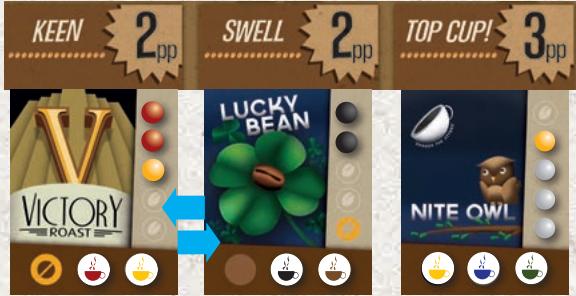

CHECK FOR GAME END
The game can end in one of three ways which are detailed on the next page. Before setting up for the next round, The Brewmaster should double-check to make sure none of the game end conditions have been met.
Setting Up for Next Round
Finally, the Brewmaster shifts any remaining Blend Slates above the World map from West to East,flling in any gaps, then draws new Blend Slates as needed from the deck to fill all empty regions.
Return any beans on Country Crop spaces to The Fields, then restock countries from West to East with a bean as indicated on the Blend Slates. If not enough beans are left then leave those remaining Country Crop spaces empty. If all teams choose Research in a round, removed the Blend Slate above Asia from the game, then continue setting up as described above.
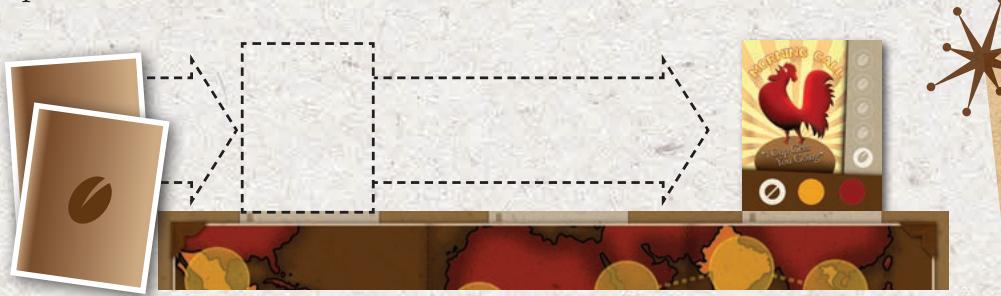
TOO MUCH RESEARCH
If all teams choose Research in a round, removed the Blend Slate above Asia from the game, then continue setting up as described above.
GAME END AND SCORING
VivaJava: The Coffee Game can end in three ways:
NOT ENOUGH BLEND SLATES
If there are not enough Blend Slates to fill all three spaces above the World Map at the end of Popular Opinion, the game ends immediately.
4 END-TRACK ABILITIES
If at any time during a round a player has reached the end of 4 Ability Tracks, the game ends at the end of the round.
21 PERFORMANCE POINTS
If a player reaches 21 Performance Points on the Performance Track after all players have scored during Popular Opinion, the game ends at the end of the round.
When one of the three game end conditions is met, players (in turn order) add up all PPs gained from Researching Levels and any bonuses from End-Track Abilities.
Research Bonus
Performance Points gained from reaching new levels of Research are only added to a player's score at the end of the game and are cumulative. They are noted by a PP symbol in the upper left.
Count up all PP symbols that have been reached or exceeded. The Brewmaster then moves the player's Token forward that many spaces on the Performance Track.

SCORE REMINDER
Don't forget - all players receive Performance Points at the end of the game for achieving levels on the Ability Tracks in their Research Labs!

Shawn has reached the end of the Invest track, and level 2 of the Brew track. Research track bonuses are cumulative, so Shawn will receive 5 PP for the Invest track, and 2 PP for the Brew track, for a total of 8 PP.
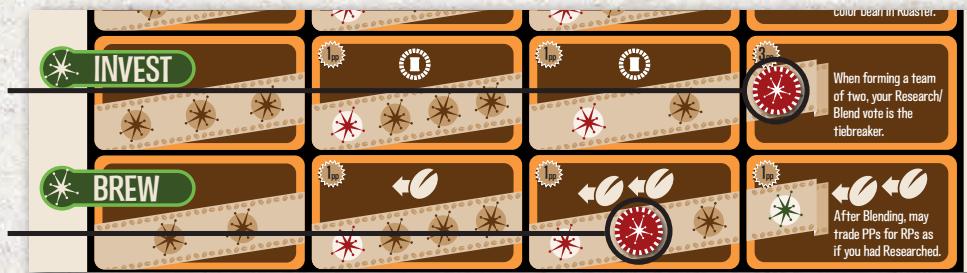
The player whose Scoring Token is furthest along the Performance Track is the winner and receives a wonderful promotion, complete with excellent investment options and a large pension. In the case of a tie, the Scoring Token that is lower in the stack is victorious!

Decaffeinated VivaJava
Although most players who play VivaJava for the first time feel comfortable with game play within a couple of rounds, there's a lot to absorb. Don't be intimidated - once you pull your first beans and create your first killer Blend, you'll feel like a Brewmaster.
However, some players may prefer to play VivaJava with this learning variant that streamlines the Research Lab with more standardized End-Track scoring to allow players to focus on Blending and the ebb and flow of Degrading. This is a useful variant in introducing the game to inexperienced players. To play, flip the Research Labs to the Decaffeinated side and put the Flavor Cards in the box, as they will not be used. Note that there are no End-Track abilities, and many Game End scores are increased. Happy Blending!
VivaJava· 12
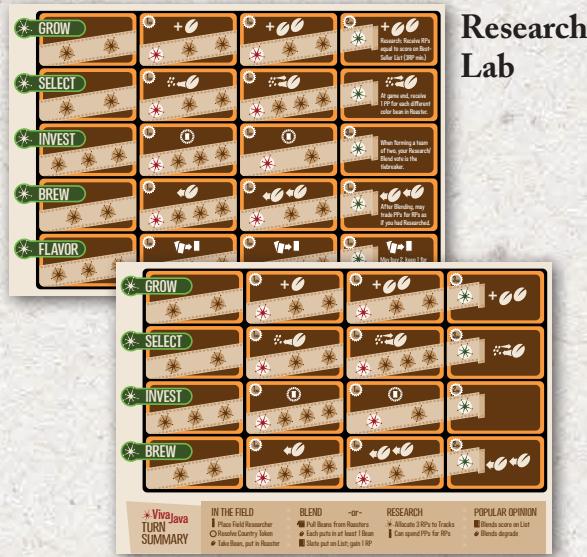
Decaffeinated Research Lab
The Intern Inspansion (VivaJava for 3-4 players)
The Intern Inspansion allows VivaJava to be played with 3 & 4 players. Interns are viable teammates that can be mentored by players to aid them in Blending or Researching. However, because Interns are often young and sometimes inept, mentoring an Intern incurs negative consequences, both immediate and long-term. When chosen, Interns are used for one turn only and then are placed face-down in a pile near the player's Research Lab.
SET-UP
Before set-up, 3 Blend Slates are randomly removed from the game. The game is then set up as per instructions for 6 or fewer players (as detailed on page 5), with some additions:
1) Reserve one extra unused Roaster; this will be the Intern Bean Reserve. From The Fields, remove 3 Black, 4 Green, 5 Red, 6 Brown, 7 Yellow, and 8 White beans and place them in this Roaster.
2) Shuffle the Intern Deck and place 3 cards, face up, near the World Map.
3) Each Intern Card shows beans that Interns will have in their Roasters. These beans are placed onto the Intern Card when drawn. Bean spaces on an Intern Card that include a bean of a solid color are filled with beans from The Fields before assigning beans to Countries. If there is a (?) symbol, the beans are drawn at random from the Intern Bean Reserve. Beans from The Fields are always used on Intern Cards before filling Countries if there is a shortage.

1. IN THE FIELD
In turn order, players choose one of two options:
1) Place a Field Researcher onto a Country as normal.
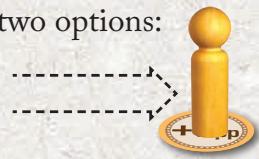
2) Take an available, face-up Intern Card.

If a player takes an Intern Card, the red negative action listed on the card must be performed immediately. The player then moves the Intern and all beans on the Intern Card nearby to his Research Lab. By taking an Intern Card, a player has chosen to mentor this Intern and utilizes them as a special teammate this round. Once a player has chosen one of these two actions, the next player in turn order takes one of the two actions and so on.
When all players have chosen an action, the starting player may take another action. If the player has not chosen a Country, he must do so now. But, if the player has already chosen a Country, he may pass and choose not to mentor an Intern this round. Once all players have chosen an action or passed, play proceeds to Phase 2.
2. BLEND/RESEARCH
Interns are easily moldable to a player's will, but are also inexperienced, self-limiting, and sub-par teammates. When choosing Blend or Research, Interns act as an extra vote for the player mentoring that Intern this turn; Interns always vote what their mentor votes. If two players on the same team control an Intern, any ties result in Research.
a. Blend (Interns can follow orders - sometimes)
When Blending, Interns act as a normal teammate would, and all rules still apply to them. However, Interns' mentors are in control of what they do. To simulate this, the player to the left of the mentor takes an extra empty Roaster from the supply and acts as a stand-in bean-puller. The Intern's Roaster is filled with the beans located on the Intern Card. At the mentor's command, the stand-in player will randomly pull beans from the bag and place them onto the team's Blend Slate.
Interns can also use their mentor's Research Abilities to enhance their bean-pulling power, but they must share them. For example, if a mentoring player has reached the first level of SELECT, the Intern under his control may use this Ability. However, once the Intern has used this Ability, the mentor is no longer be able to use this Ability again when pulling from his own Roaster this round.
Once Blending or Researching is completed, players take any Interns and flip them face-down into a pile beside their Research Shacks. Any unused beans in the Intern Roaster are returned to The Fields.
Some Interns have a listed ineptitude that affects the use of their mentor's Research Abilities.
Intern BREW
Cannot use BREW Abilities on this Intern's Roaster.
Intern SELECT
Cannot use SELECT Abilities on this Intern's Roaster.
Intern OUT OF CONTROL
No Abilities may be used on this Intern's Roaster.
b. Research (Interns can learn - mostly)
When Researching with an Intern, they learn from mistakes of past Interns, drawing from a pool of mentored knowledge. For every intern already in a player's pile (not including the face-up Intern), that player receives one (1) Research Point in addition to the 3 RPs as per the standard rules.
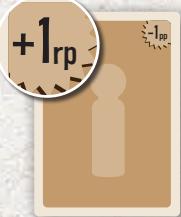
= 1 RP
Example: If a player chooses an Intern and has collected 3 other face-down interns, that player receives 3 extra RPs to allocate that round.
3. POPULAR OPINION
Place any unused Interns into a discard pile and return all beans on those cards to The Fields. If the Intern Deck is exhausted, shuffle the discarded cards and form another draw pile. Three new Intern cards are then drawn from the Intern Deck and placed face-up near the World Map and their Bean Spaces are filled with beans from The Fields.
GAME END AND SCORING
At the end of the game, after all other scoring has taken place, each player counts the number of face-down Intern cards in their possession.
In reverse turn order,each player's Score Marker is moved backwards on the Performance Track one space per Intern in his possession.
The player with the highest position on the Performance Track is the victor.
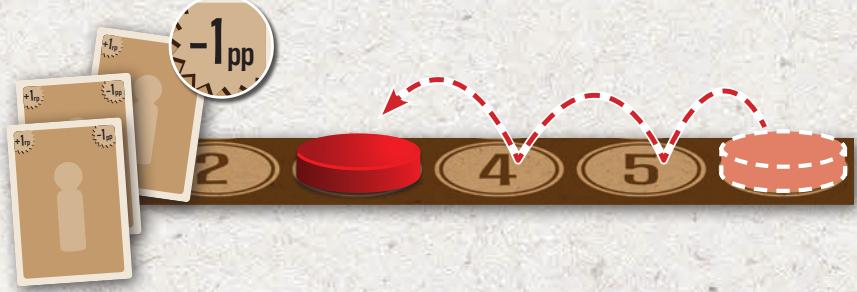
Variants
Variable Starter Beans
Instead of players taking 2 white beans and 1 yellow bean from The Fields to put in their Roasters, at the start of the game each player is dealt 3 Intern Cards. Players then take the three Starter Beans indicated from The Fields and place them in their Roasters. All Intern Cards are then returned and, in games of 3 to 4 players, shuffled to form the Intern Deck.
Roaster Purge Coins (Learning Variant)
At the start of the game, players are given a Roaster Purge Coin in their player color. At the end of any Popular Opinion phase, after Scoring, a player may discard his Roaster Purge Coin and remove up to 3 beans of his choice from his Personal Roaster, placing the beans back into The Fields. This variant helps beginning players may find an undesirable bean mix in their Roasters after a few rounds of play and the cleaning of a"dirty"Roaster can help them remain a viable teammate when Blending.
Featured Blend Cards
At the start of the game, shuffle the 8 Featured Blend Cards and place them next to the Performance Track. Take the top card and place it face up next to the deck. During the Popular Opinion phase, all players on a team that created the Blend type shown on the Featured Blend Card gain the bonus shown. Then, remove the card from the game, and the next card in the deck is placed face up next to the draw deck. Colors on the cards are for sample only; blends may contain beans of any color in legal combinations.
Flavor Card Draft
At the start of the game, each player is given 2 Flavor Cards from the Flavor Card deck. Players may choose 1 and discard the other. After all players have chosen, all discarded Flavor Cards are shuffled to form the Flavor Card Deck. Any cards that say "Play Immediately" may held and played at the start of Popular Opinion during Round 1.
Variable Country Tokens
At the end of Popular Opinion each round, after Field Researchers have been returned to all players, the Brewmaster collects all Country


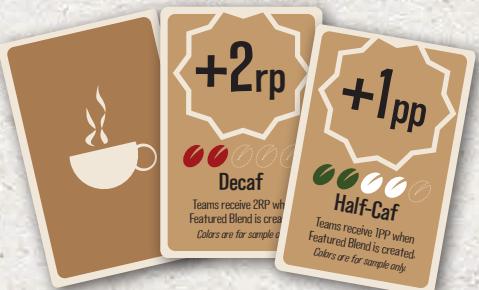
Featured Blend Cards
BE CIVIL
Although the rules for VivaJava cover most situations that may occur during a game, occasionally an instance may come up that is not explicitly stated. In these cases, it is often better to hold a vote amongst the players in order to keep the game moving.
Tokens, shuffles them facedown, and then redistributes them to Countries as in initial set-up.
TIE-BREAKERS
In the rare situation that a simultaneous action would directly affect another player's ability to take action, resolve the action in Turn Order. Otherwise, Blend/ Research actions are always simultaneous. Cover your Research Lab if you're really anxious about it.

Appendix A: Country/Intern Tokens
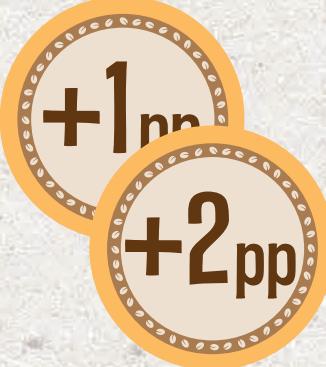
Gain Performance Points. Player immediately moves his Scoring Token ahead one or two spaces on the Performance Track.
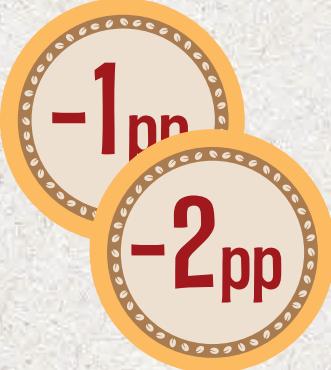
Lose Performance Points. Player immediately moves his Scoring Token back one or two spaces on the Performance Track.

Gain a Bean. Player may immediately take one (1) Bean from The Fields corresponding to the same type (color) as offered in that Country this round. If there are no more Beans of that type, this action has no effect.
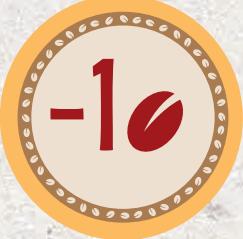

Take No Bean. Player cannot take the Bean offered in the Country Crop space this round If the player has achieved the first or second level of the GROW Ability, he may still use that Ability to take one or more beans of the same type.
Swap Beans. Active player chooses a player, looks in that player's Roaster and removes one Bean. Active player then places that Bean in his Roaster. The Active player removes one Bean of any type from his Roaster and gives that Bean to the other player.

Swap Country Tokens.
Before a Bean is taken,
player may move
Researcher and this
Country Token to another
location. The Country
Token at that location (and
a Field Researcher on that
Token, if occupied) is placed in the vacant Token spot. Player then takes the Bean in the resulting Country Crop space, if available. This action

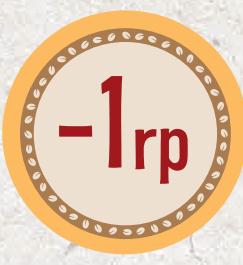
Lose Research Point. Player must move one Research Marker back one space in his Research Lab. A player cannot move a marker past the beginning of a column or the start of
the Research Track. If the player cannot legally move any marker back, this action has no effect.
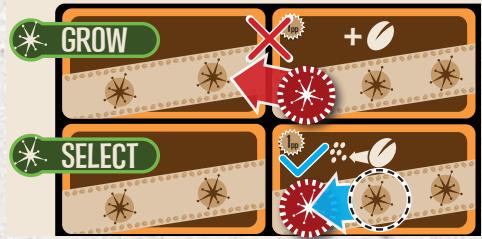
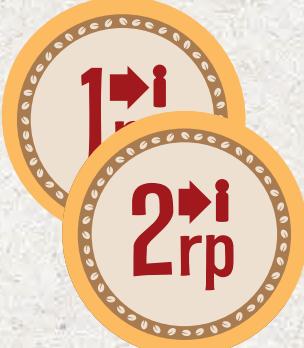
Give Research Points. All other players immediately receive 1 or 2 Research Points to apply to their Ability Tracks. If this would cause a player to gain an Ability, the Ability can be used that round. VivaJava·16

Remove a Blend Marker. Player must immediately remove 1 of his Blend Markers from a Blend Slate and return it to his personal supply. This marker may
be removed from an
Investment Token. If
the player has no Blend
Markers in play, then this
action has no effect.
Take an extra Intern. Player must
immediately draw one (1) Intern and place
it face-down near his Research Lab. This Intern card counts toward a player's
total Intern count for
Research Bonus and Game End scoring purposes. Reduced Research. Player may still
Research but he receives
no Research Points to
assign to his Research
Tracks and receives no
Intern Research Bonus. Player may still trade
PPs for RPs at the start
of Popular Opinion, if desired.

Discard a Bean. Active player must immediately remove one (1) Bean at random from his Roaster and place the Bean into The Fields.


Appendix B: Flavor Card Notes
There are 16 Flavor Cards in VivaJava. Below are notes on each.
Fickle Investor.
An occupied Investment Token is one that is currently on a Blend Slate and has a player's Blend Marker placed on it. Note that this action takes place after new Blends have been

Play before POPULAR OPINION. Move any occupied Investment Token from one Blend Slate to another Blend Slate.
added to the List, but before Scoring.
Going Rogue.
Player does not
place their Field
Researcher on a
Country when
playing this card.
This means that the
player will not receive
a Bean this round
from being In The
Field, even with the GRC
Play before choosing a country during IN THE FIELD. Draw a new Blend Slate from the Stack and Blend solo this turn.
Hot or Cold.
This card should be played immediately after Scoring, but before Degrading during Popular Opinion. All Blends are affected - so if the player chooses to Degrade twice, two

Play during POPULAR OPINION. Blends deqrade twice during the Popular Opinion in which this card is played, or not at all. You may choose.
Beans are removed from each Blend Slate.
Limited Offer.
The Blend Slate that
is removed from
the List is removed
from the game, just
as if it had fallen off
the List from going
Stale. All Blend
Markers are returned
to respective players
and Investment Tokens returned to the and Investment Tokens general supply. general supply.

Play during POPULAR OPINION. After Scoring, remove a Blend from the List. All Players with a Blend Marker on the Blend receive 2PPs.
Quick Switch.
The Bean must be placed in an open, legal Bean Space on the Blend Slate. There can never be more than five (5) Beans on a Blend Slate at any one time. This card is played after Scoring and Degrading, but before the beginning of the next round.

Play after POPULAR OPINION. Remove a bean from one Blend on the Best-Seller List and place it onto another Blend. (Cannot be used on a Rainbow Blend)
Re-Do.
If the team that is targeted by this card used Track Abilities and/or Flavor Cards while Blending, they are allowed to use those Abilities/Cards during the Re-Blend.

Play after BLENDING. Choose a team that just
Blended. All beans are réturned
to their respective players and the team must Blend again.
Gain 2PP. This
increase in score does not affect turn order for the round. This scoring adjustment
Play IMMEDIATELY. Receive 2PP.
could trigger the game end if a player reaches 21 points on the Performance Track.
Add PP to
a Blend.
When
adjusting
Blends
on the
Best-Seller
List after
Degrading,
this card
should be moy should be moved with the Blend. Blend.
Slide this card beneath a Blend Slate on the Best-seller
List. This Blend earns 1 extra PP when scoring. Discard when Blend is removed. 00 Gain team Research
Points.
If this card is received and played after
receiving
the 1
RP for

Play IMMEDIATELY. Receive 3 RPs. All other team members receive 1 RP.
Blending, team members still receive the additional RPs from this card.
Indigenous Find.
Beans taken from the
Fields need not be of
the same
type.
Play IMMEDIATELY.
Take 2 beans of your choice
from The Fields and add them
to your Roaster. Greed.
Although
this card
must be
played
immediately,
the player
who chooses
this card
should wait
for all teams t for all teams to complete Blending before calling for Blending befo the vote.

Play IMMEDIATELY. Call a vote! Each player secretly uses their Blend Token to choose a side and reveal simultaneously. If a player chooses Research, they recieve 1 RP and so do you.
the vote.
Collector.
Beans used for scoring should be returned to The Fields. No player may gain more than 5 PP per use of this card.
Play during POPULAR OPINION. Reveal the contents of your Roaster. Choose and return beans of one type. For every bean returned, gain 1PP (5PP max.).
Private Reserve. Reserve.
If there are
no beans
of the
required
type
remaining
in The
Fields, a
player does n beans to plac Roaster. Roaster.

Play after BLENDING. For each bean you contributed to the Blend, return a bean of the same type to your Roaster. (Take beans from The Fields)
player does not receive those beans to place in his personal
Supervisor. This card may only be used if the remaining team member(s) are able to create a Blend with

Play before BLENDING. Choose any member(s) of your team, including yourself. These players do not have to add a bean to complete the Blend.
5 beans, as per the normal rules for Blending. All team members still receive credit for the Blend.
Appendix C: Research Tracks
This section is a listing of all Research Tracks and their abilities. Research track abilities are not cumulative. Reaching a new column on the track activates the ability pictured at the top of each individual level.

When used wisely, the GROW Ability allows players to quickly fill their Roasters with beans of the same type from The Fields. Great for players who like to hoard.
GROW Abilities can be used to take beans from The Fields even when a Country Token action may not allow a player to take a bean from a Country Crop space.

The SELECT Ability allows players to skillfully cull their Roasters for errant beans, improving their chances of producing a more fruitful Blend. Great for those who don't like playing the odds.

The INVEST Track can provide powerful Investment Tokens, which allow players to take credit for (and Score from) other players' hard work. However, players can only ever gain two during each game, so they must be used wisely. Great for those players who like big payoffs from smart gambling.

Blend Marker
Investment Token

Player may take 1 extra bean of the same type as the Country chosen while In The Field each round. Extra beans are taken from The Fields.
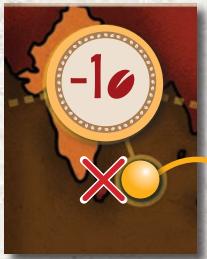
Before player Blends, player may remove 1 bean of any type from own Roaster and return the bean to The Fields.

Take an Investment Token. Before any team Blends, player may place Token and Blend Marker on another team's Blend Slate. Each time Blend Scores on Best-Seller List, player receives PPs as if player was part of the team.
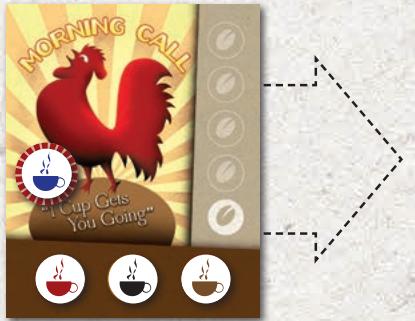

Player may take up to 2 extra beans of the same type as the Country chosen while In The Field each round. Extra beans are taken from The Fields.
When a player places a Field Researcher pawn on the "Take No Bean" Country Token, they must put the bean from the Country Crop space back into The Fields.

Before player Blends, player may remove 1 bean from Roaster, return it to The Fields, then take an available bean of any type from The Fields and place in Roaster.


Take an Investment Token. Before any team Blends, player may place Token and Blend Marker on another team's Blend Slate. Each time Blend Scores on Best-Seller List, player receives PPs as if player was part of the team.

This ability replaces the standard 3 RPs a player receives when Researching. A player never receives less than 3 RPs regardless of Score.
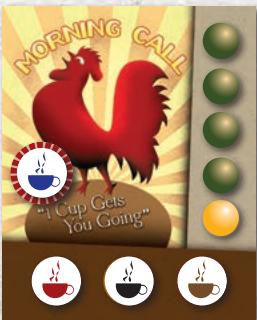
A player with the first or second level GROW Ability may take 1 or 2 available beans from The Fields of the same type as the bean removed from the Country Crop space.
As there are only 6 types of beans in the game, the maximum Game End Score from this Ability is 6PP.

When forming a team of two, your Research/ Blend vote is the tiebreaker.
If player votes for Blend and teammate votes for Research, the team will Blend. If player votes for Research and teammate votes for Blend, the team will Research.
When a Blend is removed from the Best-Seller List any Investment Tokens are removed from the Blend and returned to the general supply. No player may ever receive more than two Investment Tokens during a game. You may NOT Invest in your own team's Blend.
Appendix C: Research Tracks

The BREW Ability can provide players a safety net when Blending if they are trying to produce a specific Blend. Great for players who like to increase their odds without sacrificing resources they may need later in the game.

Delicious uncertainty; bold strategies. Discarded Flavor Cards are placed face-up next to the draw deck. When deck runs out, shuffle discards to form another deck.

When Blending, player may choose not to place 1 drawn bean onto Blend Slate. Bean is set aside and another is drawn. After Blending, bean is returned to Roaster.

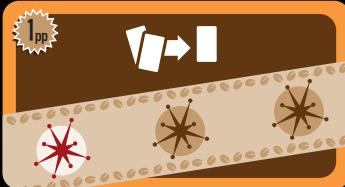
When this level is reached, draw 2 Flavor Cards, choose 1 and discard the other.
When Blending, player may choose not to place up to 2 drawn beans onto Blend Slate. Beans are set aside and more are drawn. After Blending, beans are returned to Roaster.
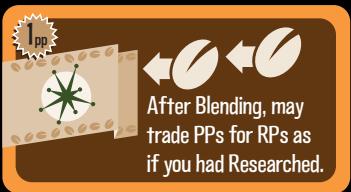
This Ability does not prevent a player from trading PPs for RPs after Researching.
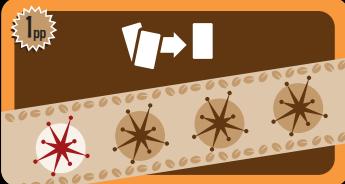
When this level is reached, draw 2 Flavor Cards, choose 1 and discard the other.
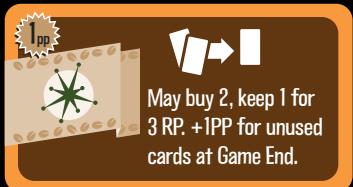
When this level is reached, draw 2 Flavor Cards, choose 1 and discard the other. Player may use 3 RP on any subsequent turn to draw 2 Flavor Cards, choose 1 and discard the other.
Research Track Abilities and Flavor Card Actions Timeline
Each Research Track Ability and Flavor Card Action has a certain time during each round when they can be activated and used by players. Below is a reference for specific timing. Research Track Abilities are in italic.
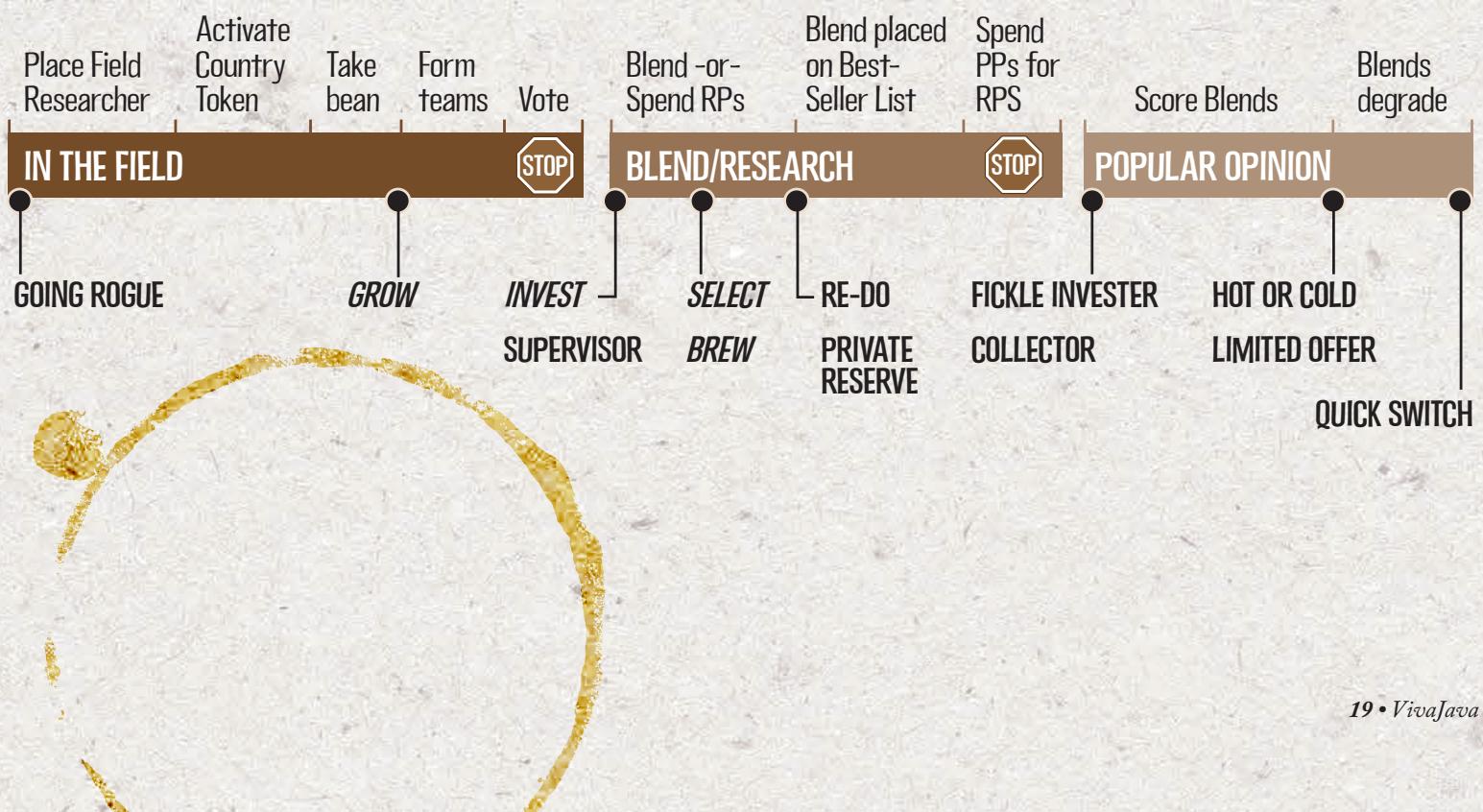

VivaJava: The Coffee Garhe Reference Guide

Sequence of Play
1. IN THE FIELD
Re-order the Turn Order Track Players take turns placing Field Researchers on World Map in turn order
Player takes bean from Country and places it in personal Roaster
2. BLEND/RESEARCH
Players in same region secretly choose "Blend" or "Research" and reveal simultaneously; majority votes win, ties result in Research
a. Blend
Team decides who pulls from Roaster first
Each team member must contribute at least one bean to the Blend
Once a team member stops Blending, they can no longer contribute more beans to the Blend
Blend Slate is placed on Bestseller List according to Ranking
Each team member receives 1 RP to allocate to a Research Track Team members may not exchange PPs
b. Research
Each team member may spend 3 RPs to increase Research Track(s)
After all members have allocated RPs and all teams have completed Blending, members may exchange PPs for RPs in turn order
3. POPULAR OPINION
Players score points from Blends on Bestseller List according to turn order
Blends are degraded and Best-Seller List
Blend Slates still on World Map are shifted East; new Blend Slates are pulled and placed accordingly, beans added, etc.
Research Track Abilities


Take extra bean during In The Field



Take 2 extra beans during In The Field
Remove bean from Roaster, put in Fields


Remove bean, then may take bean from Fields.
Take an Investment Token

Take an Investment Token


Set aside 1 bean when Blending
![](images/da0a40fcd3673b52898131
Content is long; only the first part is inlined. Download the file or open the rules page for the full text.
Download MarkdownTexts are community-compiled or publicly released by publishers; copyright remains with the original authors. For personal reference only.