
Whirling Witchcraft
At a glance
Rules, cards and Q&A (Chinese)
The rules, card data and player questions for this game are written in Chinese. Open the Chinese page to read them.
Where to find full rules
Full rules and card lookup are available in the cunlema app at cunlema.cn — pick this game and ask about any rule, card or turn you are unsure about.
Related games
Rulebook text (Markdown)
This game has 1 rulebook Markdown file(s) in our library; 1 rendered inline below — expand to read or download.
WhirlingWitchcraft_BaseGame_1P_Rulebook_WEB2(1).md22.5 KB
WHIRLING WITCHCRAFT

Welcome witch, your workbench is waiting...
Being a witch is all about wielding powerful magical ingredients. The more powerful, the more brilliant magic they can
produce. But be careful, one witch can only wield so much power before everything blows up in their face. This is a fact
you're willing to use to your advantage when you’re trying to destroy your nemesis. However, while you’re brewing the ingredients to get the job done, someone else is trying to do the same to you! Well, at least you’ve got some more ingredients to work with now, you just have to make sure you’re not the one who blows up.

Objectiue
Players use their recipe cards to produce as many ingredients as possible. They place these ingredients in their cauldron to send to their nemesis: the player on their right. However, each player's workbench can only hold a certain amount of ingredients; when a player sends more ingredients than their nemesis can hold, the ingredients are instead placed in the player's Witch's Circle.
The first player to have 5 or more ingredients in their Witch's Circle wins the game!
Contents
Your game of Whirling Witchcraft™ should include the following components. If it does not, please visit https://alderac.com/customer-service for assistance.
1 Rulebook
60 Recipe cards
5 Player boards
17 Personality cards
5 Cauldrons
170 Ingredient cubes
5 Reference cards
15 Arcana tracker tokens
Assembling the cauldrons
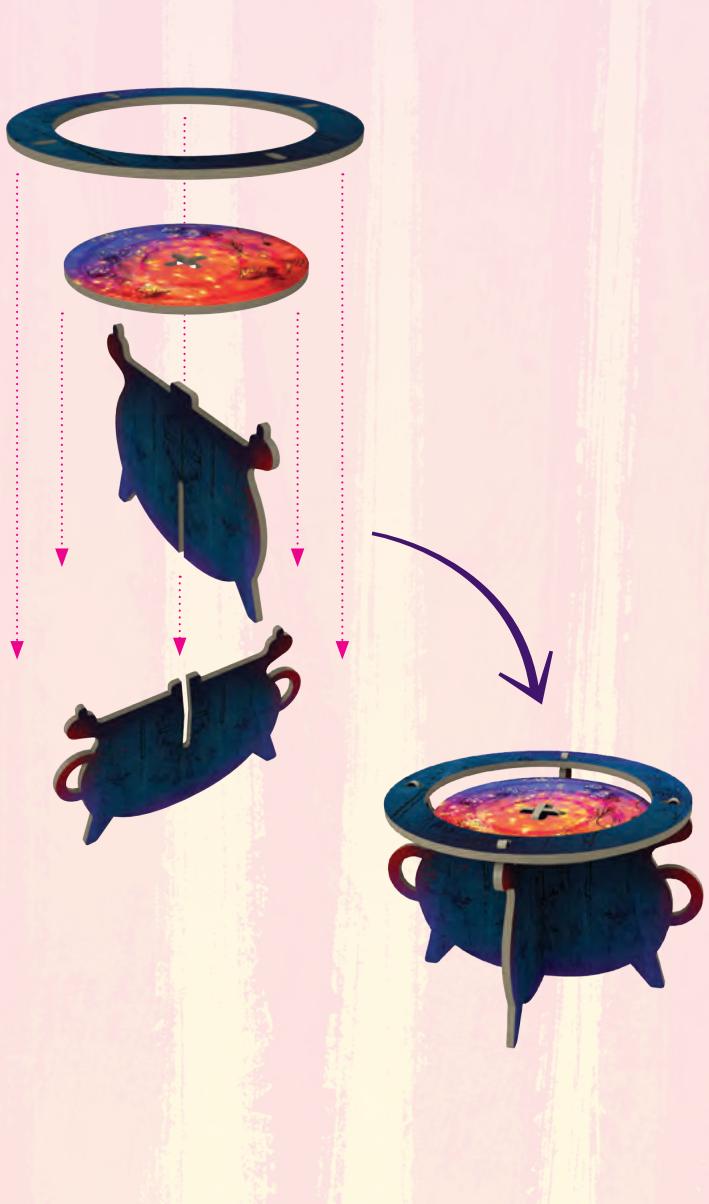
Component anatomy
Player boards
The player board is where players store their ingredients.
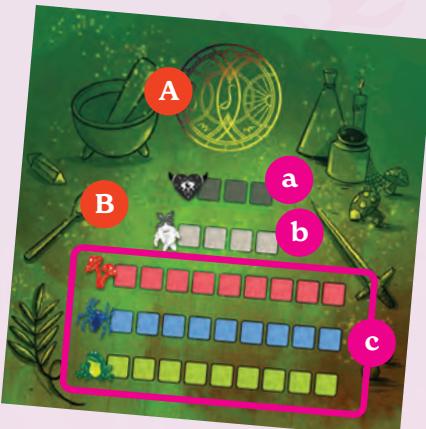
A. Witch's Circle B. Workbench
a. 3 spaces for Hearts of Shadow
b. 4 spaces for Mandrakes
c. 9 spaces for Toads , Spiders & Mushrooms . These are the basic ingredients.
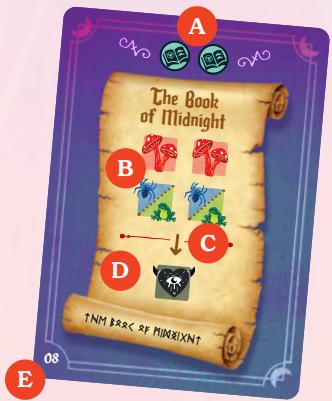
Recipe cards
The recipe cards are used to transform ingredients.
A. Arcana
B. Ingredient input spaces C. Recipe direction symbol D. Ingredient output spaces E. Initiative
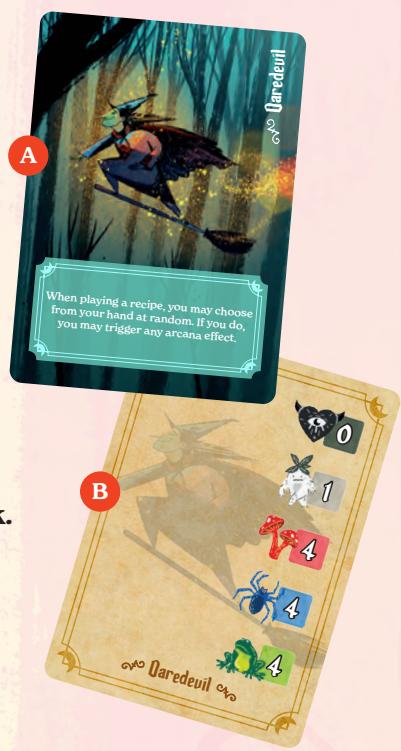
Personality cards
A. Ability side Contains either a unique power or a unique recipe.
B. Ingredient side Specifies starting ingredients.
Rules on personality cards may override the rules in the rulebook.
Setup
-
Give each player a player board, a cauldron, and a reference card.
-
If players are new to the game: Give each player an Initiate personality card (marked with a ).

If players are familiar with the game: Deal each player 2 random personality cards (not Initiate). Each player chooses 1 to keep and returns the other to the game box.
They place their personality card, with the ingredient side up, below their player board.
-
Shuffle the recipe cards and deal each player 4 cards face-down. These form the player's hand which they can look at, but should be kept secret from other players.
-
Place the recipe deck within reach of all players.
-
Place all ingredient cubes in a general supply within reach of all players.
-
The 5 ingredients are:
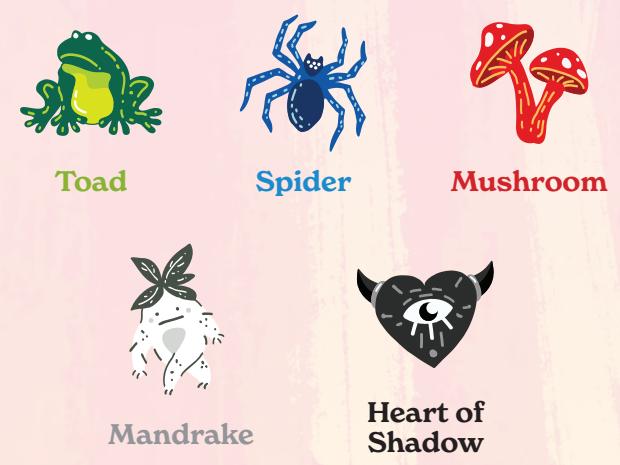
- Give each player ingredients according to their personality cards, placing them on the corresponding spaces on their workbench. Each player flips their personality card to its ability side. If it has any arcana icons, they adjust the arcana tracker on their reference card accordingly. (see page 4)
The round
Each round is played in 2 phases:
Study phase - In which players add new recipe cards to their tableau.
Brewing phase - In which players produce ingredients that are sent to their nemesis in an attempt to overwhelm them.
Study phase
The study phase is played in 3 steps:
-
Play recipes - Each player plays 1 recipe card from their hand.
-
Reveal recipes - Each player reveals their played recipe card.
-
Resolve arcana - Resolve arcana on revealed recipe cards.
Each step is resolved simultaneously for all players before moving on to the next step.
Play recipes
Each player simultaneously chooses 1 of the recipe cards in their hand and places it face-down below their player board, next to any recipe and personality cards already placed there. Everyone must play a recipe card, even if they will not be able to use it this round.
Recipe cards with 2 as their recipe direction symbol may be rotated, switching the input and output sides, when they are played. The player who plays the recipe card must choose which way to play it before revealing it. Once the recipe card has been revealed, it may not be rotated again.

Normal
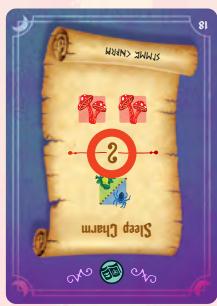
Rotated
Reveal recipes
All players reveal the face-down recipe cards they played in the previous step.
Resolve arcana

Some recipe cards have 1 or more arcana icons / at the top of the card.

Each player increases the count on the arcana tracker on their reference card for any arcana icons on the newly revealed recipe card. When a tracker reaches or passes an even number, marked , the player may trigger that arcana effect that turn.
Arcana effects trigger on each even number.
It's possible to play without using the arcana tracker, by simply counting the arcana icons each time a recipe card is played, and triggering the corresponding effect when a played recipe card means the amount reaches or passes an even number of arcana icons of a type.
If a player chooses not to trigger an arcana effect, they cannot save its use for a later turn. They must gather more arcana to reach or pass an even number to trigger the same arcana effect again.
Arcana effects:

The player may add 1 ingredient of any type from the general supply directly to their cauldron as though they had just output that ingredient from a recipe.

The player may remove up to 2 ingredients from their workbench. The ingredients may be different or the same type.

Choose a type of ingredient (for example Spiders). For this round, the player may take ingredients of that type from the supply as if they were on their workbench when filling recipe inputs.
Some cards may have multiple arcana icons, which can allow aplayer to trigger multiple arcana effects at once.
Example of resolving arcana
-
Kiki has 1 Potion and 1 Raven arcana.
-
She plays a recipe card with 1 Potion, 1 Raven and 1 Book arcana and adjusts her arcana tracker accordingly.
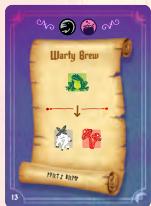
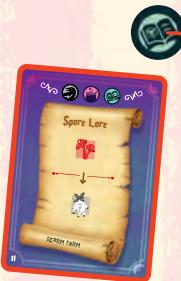
Already in play
Just played
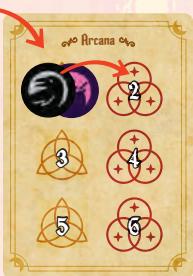
-
Both the Potion and Raven arcana reach even numbers, meaning both their effects may be triggered.
-
The Book arcana reaches 1, meaning its effect can not be triggered this round.
-
Next round, Kiki plays a recipe with 2 Book arcana icons and adjusts her arcana tracker accordingly.
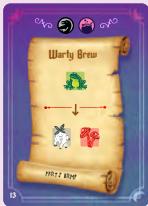
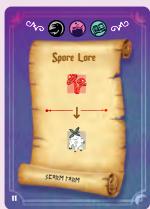
Already in play
Played last round

Just played
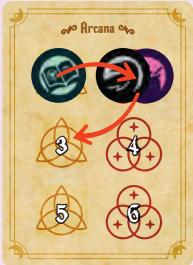
- The Book arcana passes an even number, meaning its effect may be triggered.
Brewing phase
The brewing phase is played in 4 steps:
-
Produce ingredients - All players produce ingredients using their recipe cards.
-
Pass cauldrons - Each player passes their cauldron to the right.
-
Check for winners - If a player has 5 or more ingredients in their Witch's Circle, they win.
-
Pass recipe cards - Each player passes their hand of recipe cards to the left then draws up to their hand limit of 4 cards.
Each step is resolved simultaneously for all players before moving on to the next step.
Produce ingredients
All players produce ingredients using the recipe cards below their player board. The recipe cards can be used in any order.
To use a recipe card, a player must:
- Place matching ingredients on all input spaces of the recipe card.
The ingredients used can come from the player's workbench or from the output spaces of previously used recipe cards.
A recipe card's input spaces must always be fully filled. It is not possible to partially fill a recipe card.
- Place matching ingredients from the general supply on all output spaces of the recipe card.
Players don't have to use all their recipe cards, even if they have the ingredients to do so. This also applies to a recipe card with no pictured input ingredients.
Each recipe card may only be used once per round.
Some recipe cards have hybrid input or output spaces where the player can choose which of the pictured ingredients to place. Each time the player uses the recipe card, they may choose either of the pictured ingredients..
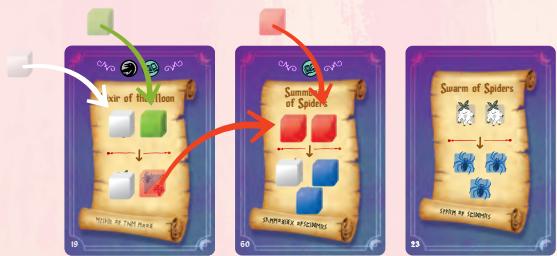
Example of producing ingredients
-
Matilda uses the first recipe card by placing 1 Mandrake and 1 Toad from her workbench on its input spaces.
-
From the general supply she places 1 Mandrake on the first output space. She can choose to place either 1 Mushroom or 1 Spider on the second one. She chooses to place 1 Mushroom.
-
Matilda uses the second recipe card by placing 2 Mushrooms on its input spaces, 1 from her workbench and 1 from the output of the previously used recipe card.
-
She places 1 Mandrake and 2 Spiders from the general supply on the output spaces.
-
Matilda chooses not to use the third recipe card, even though she has the necessary ingredients.
When a player has used all the recipe cards they want, they move all remaining ingredients on the output spaces of their recipe cards to their cauldron. Then they move the ingredients from the input spaces back to the general supply.
There is no limit to the general supply. In the unlikely event that players run out of ingredient cubes in the general supply, they should let players return ingredients from the input spaces of their used recipes before they are finished. If this is not enough, use temporary substitutes.
On rare occasions, timing of who decides to produce which ingredients will matter. If there is ever a situation where the order of players matters, the player with the lowest initiative on their most recently played recipe card goes first. The player with the second-lowest initiative goes next, and so on. To keep the game flowing it's strongly advised that players only use this turn order when absolutely necessary.
Example of using initiative
-
Piper played the recipe card with initiative 17 (rotated).
-
Rebecka played the recipe card with initiative 18. Before Piper chooses what ingredient to produce with her recipe card, she wants to know which ingredient Rebecka chooses to use as input for her recipe card. Likewise, Rebecka wants to know what ingredient Piper will produce before choosing what ingredient to use as input for her recipe card. They decide to play in initiative order to resolve this.
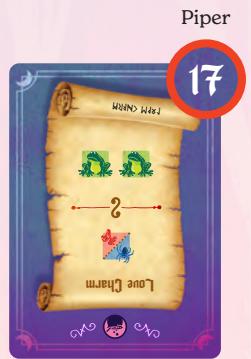
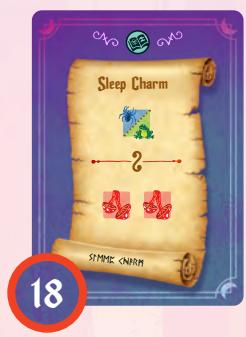
- Since Piper played the recipe card with the lowest initiative this round, she is forced to make her decision first.
Pass cauldrons
Each player passes their cauldron, and all ingredients on it, to the player on their right. The receiving player adds the ingredients from the cauldron they just received to the corresponding spaces on their workbench. After filling thespaces, any ingredients that do not fit on a player's workbench are placed in the Witch's Circle of the player to their left (the player who passed them the cauldron).
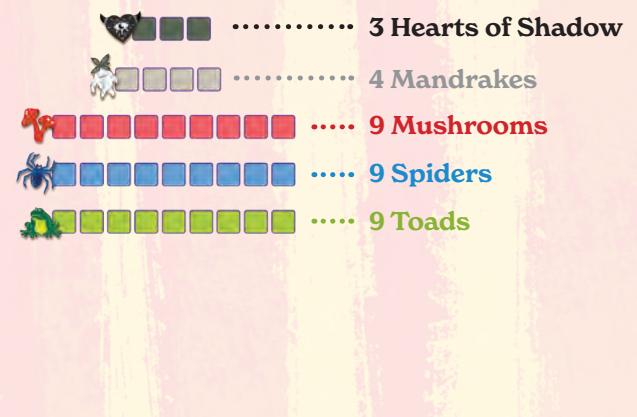
The number of ingredients that can fit on the workbench (as shown by the pictured spaces):
Example of passing cauldrons
-
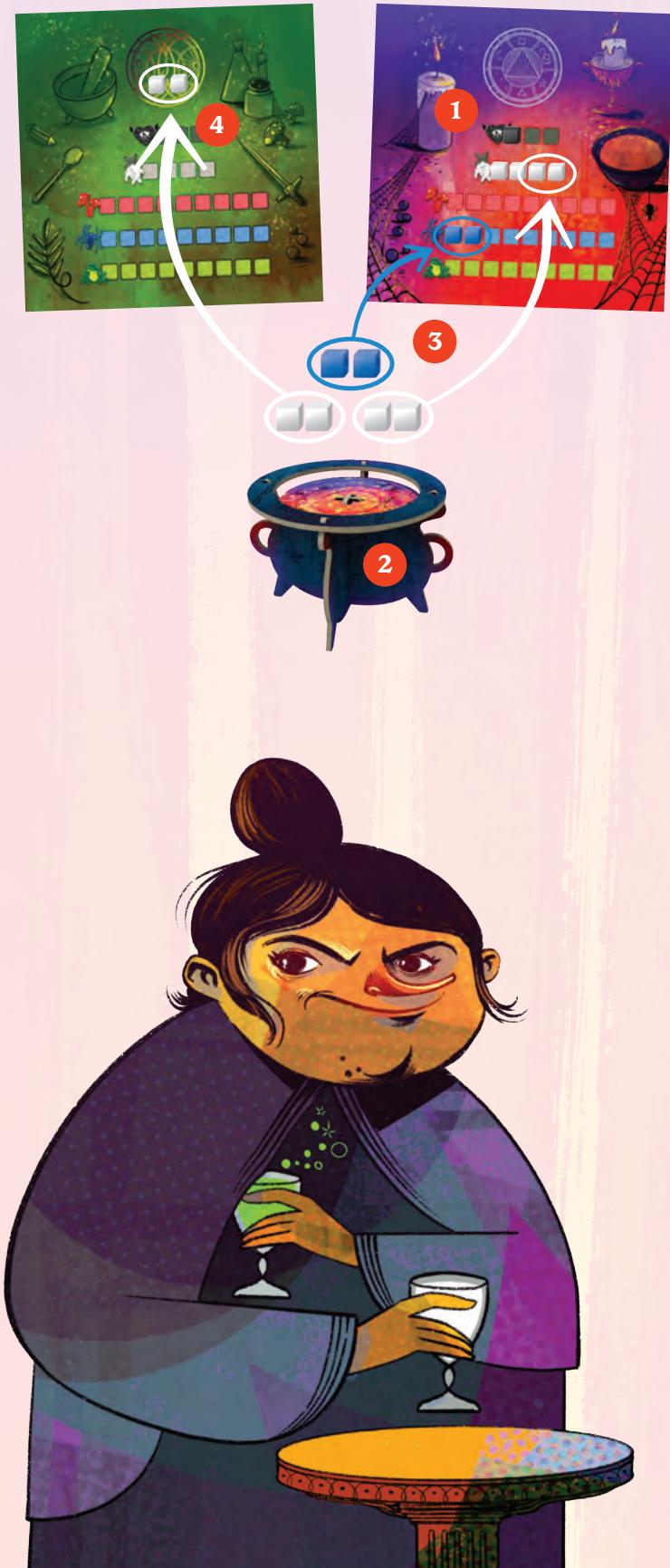
Trixie has 1 Heart of Shadow and 2 Mandrakes on her workbench after producing ingredients.
-
Yennefer passes her cauldron, with 2 Spiders and 4 Mandrakes, to Trixie.
-
Trixie places the 2 Spiders and 2 of the Mandrakes on her workbench.
-
Since she can’t fit the last 2 Mandrakes on her workbench, they are placed in Yennefer's Witch's Circle.
Yennefer's workbench
Trixie's workbench
Check for winners
If any player has 5 or more ingredients in their Witch's Circle, they win the game. If no player has won the game, continue to the next step of “Pass recipe cards”.
In the case of simultaneous winners, the player with the most ingredients in their Witch's Circle is the winner. If there is still a tie, the tied player with the most different types of ingredients in their Witch's Circle is the winner. If there is still a tie, the tied player with the least number of ingredients total on their workbench is the winner. If there is still a tie, the tied players share the victory.
Example of checking for winners
-
Sabrina has 5 Hearts of Shadow in her Witch's Circle after passing cauldrons.
-
Willow has 4 Mandrakes and 2 Spiders in hers.
-
Since they both have 5 or more ingredients in their Witch's Circle, the game ends and they are tied for winning. Since Willow has more ingredients in her Witch's Circle (6 vs Sabrina's 5), she wins the game.
Sabrina's workbench

Winner! Willow's workbench

Pass recipe cards
Each player passes all remaining recipe cards in their hand to the player on their left, then draws up to their hand limit of 4 cards.
Start a new round and keep playing until a winner is found.
Personality card clarifications
Some personality cards are discarded when using their unique power. Discarded personality cards are placed back in the box and are not used more this game.

Clairvoyant
Typically, when drawing cards before starting a new round, the Clairvoyant player draws 2 cards (to their hand limit of 5) and the player to their left draws no cards (to their hand limit of 4).
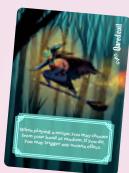
Daredevil
The arcana effect triggered by this ability is in addition to any arcana effects the player would normally trigger that round.
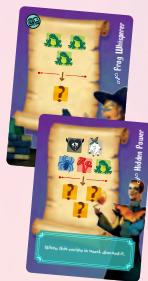
Frog Whisperer & Hidden Power
For these recipes, the player chooses any output ingredient of their choice. For Hidden Power the ingredients may be different or the same type.
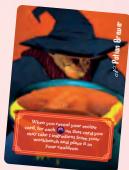
Potion Brewer
When adding an ingredient to their cauldron from their workbench, the player may choose any type of ingredient.
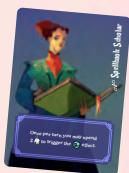
Spellbook Scholar
The player may spend the Mandrake for this effect from their workbench or output from recipes. The player may use this ability in addition to a Book arcana effect triggered normally.

Trickster
During setup, the recipe is placed with the Mushrooms as input. This personality card breaks the rule of recipe cards not being able to rotate once revealed.
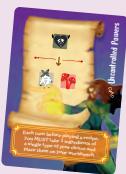
Uncontrolled Powers
If the player adds more ingredients to their workbench than spaces to hold those ingredients (e.g. more than 4 Mandrakes) they place the extra ingredients in the Witch's Circle of the player to their left.
Whirlwind
The player may choose to rotate any recipe card as it is played, even if it normally could not be rotated. The recipe cards still cannot be rotated after they are revealed.
Witch of All Trades
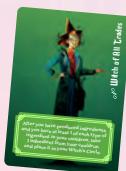
If the player has at least 1 each of Hearts of Shadow, Mandrakes, Mushrooms, Spiders and Toads in their cauldron after producing ingredients but before passing their cauldron, they may move 1 ingredient of any type from their cauldron to their Witch's Circle.
Credits
Design: Erik Andersson Sundén
Development Lead: Neil Kimball
Playtesters:
Illustration: Weberson Santiago
Graphic Design:
Luis Francisco
Director of Projects: Nicolas Bongiu
Writing: Hanna Björkman (We are Knytt)
David Lepore
Special thanks:
This game wouldn't exist if it wasn't for my loving and supportive family, My Sundén, Gustav Sundén, Elias Sundén, and Therese Jansson . Thank you for your enthusiastic playtesting of the game. Two other persons have supported me more than anyone could expect from friends during the creation of this game: Benny Wallin and Erik Lindblom. The game might not be a haiku anymore, but I cannot imagine what this game would've been without you.
Niklas Høøk, the way you lifted Whirling Witchcraft for me before Fastaval 2019 was amazing. I will forever be grateful!
The passing of resources around the table was inspired by a realtime 3D brick building game that I sincerely hope will be published, so I can play it with my family. I would like to thank the creators and designers, Magnus Karlsson and Henrik Gidmark for the beautiful idea! And thank you for all the help with the playtesting!
Martin Bonnevier, Vegard Farstad, Tim Green, Magnus Karlsson, and Bez Shahriari - thank you for your careful readthrough of the rules. And of course, thank you Hanna Knytt Björkman for the final editing of the rulebook - invaluable!
Neil, your continuous support and never ending will to improve this game this past year has been absolutely invaluable and I sincerely hope that this is not our last collaboration. Thank you! John Zinser, I am amazed at your belief in me as an unpublished designer. It is an honour to publish a game under the wings of AEG. Thank you for the encouragement and support!
And finally, thank you all people that have playtested this game, not the least at Fastaval 2019. It has been a pleasure to hear your thoughts and feedback of the game.
Shuan Algaff, Filipe Amaro, Morten Andersen, Peter Andersson, Martin Annander, Pablo André Jomer, Sophie Asplund, Hanna Knytt Björkman, CanIBeBlue, Cynthia Bathgate, Federico Binda, Søren Brandborg, Kamilla Kate and Peter Brichs, Saga Bokne, Nicolas Bongiu, Martin Bonnevier Kronlind, Sara Bonnevier Kronlind, Edvin Bonnevier, Mira Bonnevier, Marlie Rubow Kronlid, and Tage Bonnevier, Erik Branger, Malin Bredenberg, Henrik Brunnström, Gustav Bylund, Martin Bødker Enghoff, Li Paula Caldeira Balkeståhl, Steph Charij, Tina Christensen, Amanda Christiansen, Sofie Danbrant, Ryan Dancey, Simon Davies, Joseph Dominguez-Marrero, Steve #3 Ehrensperger, Samuel Einheri, Zsolt Elter, Göran Ericsson, Benjamin Eriksson, Mats Eriksson, Sven Eriksson, Jesper Errebo Nielsen, Felix Falk, Mads Fløe, Marcus Ford, Alex Frost, Henrik Gidmark, Mitchell Golden, John Goodenough, Cecilia Gustavsson, Nils Hansson Bjerke, Thor-Bjørn Henckel, Anders Hjalmarsson, Rob, Kelley and Xander Huddleston, Ludwig Hultgren, Rustan Håkansson, Niklas Høøk, Cecilia Jansson, Therese Jansson, Henrik Johansson, Jacob Jonsson, Anders Karlsson, Magnus Karlsson, Mikael Karlsson, Alexander Kezo Kazen, Allan Kirkeby, Henriette M. Kjær, Nicolai M., and Jesper Kjær, Vivienne Koh, Henrik Krøjmand, Dan Kärrholm, Peter Langkjær Møller, Lisbeth and Kim Larsen, Chris Lawrence, David Lepore, Jason Levine, Nickole Li, Kristofer Lilja, Erik Lindblom, Martin Lindström, Sofie Liv Støvelbæk, Morten Lund, Alexander Lundberg, Michelle Maghes, Chris Marchegiani, Benjaminas Marcinkevicius, Filip Marko, Wendy, Mitch, Makayla, Nicholas and Landen McEvoy, Pete McPherson, Jon Moffat, Chris Morris, Max Møller, Erik Navander, Jeppe Norsker, Kyle Nunn, Kaz Nyborg-Andersen, Tobias Olsson, Vlad Orellana, Otto Plantener Jensen, Stephan Pomp, Dina Ramse, Thor Rasmussen, Mauricio Redondo, Ian Rickett, Sean Robbins, Todd Rowland, Samuel Sapire, Björn Scheidmann, Björn Schröder, Peter Schrøder, Lila Scott, Tom and Lizzie Sheen, Taylor Shuss, Henrik Sjöstrand, Maja Škripelj, Johan Sundén, My, Gustav and Elias Sundén, Andreas Skov Esbech,Andrea Sperduti, Torbjörn Ståhle, Gustaf Sundström, Oskar Säll, Oscar C. E., Alexander O. E. and Peter Thomsen, Joakim Pim Thunborg, Alexander Thörnland, Stefan Tizar Hansson Kåre Torndahl Kjær, Mike Trias, Juan Pablo Vargas Seguel, David Vindtorp, Lars Wagner Hansen, Benny Wallin, Rasmus Nicolaj West, Lene West Frederiksen, Freja West Frederiksen, Jacob Westerlund, Ulrica Westermark, Josh Wood, Mark Wootton, Cristina Zavala, John Zinser, Jeppe Ørsøe Johansen, Victor Östersjö, and all the others who played this game.
I am sincerelygrateful!
Erik Anderso Sundén
Whirling Witchcraft won the Best game 2019 award at Fastaval 2019. Thank you for all the encouragement!
FASTAVAL WINNER 2019 BEST B OGAME
©2021 Alderac Entertainment Group
Whirling Witchcraft and all related marks are ™, ©, and ®Alderac Entertainment Group, Inc.

2505 Anthem Village Dr. Suite E-521 Henderson, NV. 89052
All rights reserved. Printed in China.
Download MarkdownTexts are community-compiled or publicly released by publishers; copyright remains with the original authors. For personal reference only.