
Wizards Of The Grimoire
At a glance
Rules, cards and Q&A (Chinese)
The rules, card data and player questions for this game are written in Chinese. Open the Chinese page to read them.
Where to find full rules
Full rules and card lookup are available in the cunlema app at cunlema.cn — pick this game and ask about any rule, card or turn you are unsure about.
Related games
Rulebook text (Markdown)
This game has 1 rulebook Markdown file(s) in our library; 1 rendered inline below — expand to read or download.
WOTG_RuleBook.md18.2 KB
WIZARDS OF THE GRIMOIRE
一+·+一
RULE BOOK

The Wizards of the Grimoire are a special sect of wizards sworn to protect the eternal Book of Spells.
Our story begins with the sudden death of the Archmage Andor, head of the sect and Keeper of the Grimoire, who is entrusted with safeguarding this all-powerful book.
As is tradition, his two protégés must now duel to the death to determine who will take up his seat.
GAME OBJECTIVE
Each turn you will be drawing mana and then using it to cast your available spells. Your primary goal is to deal damage to your opponent and to stop them from damaging you. If a player's health reaches zero, the opposing player wins the game, and becomes the new Keeper of the Grimoire.
SETUP
-
To track your health, use the Health Tracker Cards or download theWotG Health Counter' app.
-
Set both player's health to 60.
-
Shuffle both the Mana Deck and the Spell Deck and then place them face-down on the table between the two players.
-
Deal the top 10 spells from the Spell Deck face-up and visible in between the two players. These 10 spells make up the Spell Pool.
-
Flip a coin to determine who will be player one. Player one (the winner) chooses a spell first.
BEGINNER RULES
For your first couple of games (until you feel comfortable), we strongly recommend using only the beginner spells, identified by a single +.
This change will help to ease the learning curve and will remove particularly punishing spells from the game.
THE LOST PAGES Expansion spells can be identified by a , and should only be added to the game once you have had a few playthroughs.

Player Two
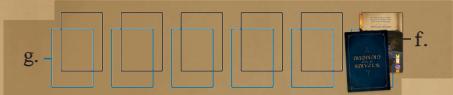
a.


e.


C.
b.


d.
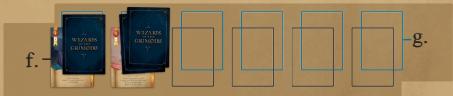
Player One
LEGEND:
a. Mana Deck
b. Mana Discard
c. Spell Deck
d. Spell Discard
e. Spell Pool
f. Spell Repertoire
g. Mana Cool Down
Overlap the Health Tracking cards to show your current health.
In this example, the player has 34 health.
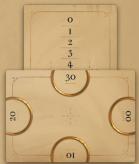
Or download the WotG Health Counter' app.

OPENING PHASE
Players choose spell cards from the Spell Pool and place each chosen spell face up in front of them. These spells will make up their Spell Repertoire.
Each time a spell is chosen, replace it with a spell from the Spell Deck, so that there are always 10 spells available in the Spell Pool.
Taking turns:
Player One:
Chooses a spell.
Player Two:
Chooses a spell.
Player One: Chooses a second spell.
Player Two:
Follows the "Turn Order" actions.
TURN ORDER
Following the opening phase, each player will take turns completing the 5 actions below in order. Once a player has completed these actions, the other player begins their turn.
-
Choose a New Spell.
-
Spell Cool Down.
-
Gain 3 Mana.
-
Cast Spells.
-
Basic Attack.
① Choose a New Spell
The current player chooses one spell from the 10 spell cards displayed in the Spell Pool. The current player's new spell is placed face up on the table in their Spell Repertoire, along with their other spells. Each time a spell is chosen, it should be replaced so that the Spell Pool always has 10 spells available.
If a player has 6 spells in their Spell Repertoire, they cannot add an additional spell. If 1 of their 6 spells has 0 mana on it, they may choose to replace that spell with 1 from the Spell Pool, discarding the old spell into the Spell Discard. If all 6 of their spells have mana on them, they must skip the Choose a New Spell game phase.
2 Spell Col Down
The current player discards the top mana off each of their spells that have mana on them and those mana are placed into the Mana Discard. During the game this phase will allow players to free up spells that have been used on previous turns, in order to cast them again.
On a player's first turn there will not be mana on any of their spells.
The current player draws 3 mana from the Mana Deck, adding these mana to their hand. A player's hand should remain hidden from their opponent. Each mana that is drawn will have a power level that ranges from 1 - 4. When players are no longer able to draw from the Mana Deck, the Mana Discard pile is shuffled to create a new Mana Deck.
4④ Cast Spells
Using mana in their hand, players may cast any of their spells that have no mana placed on them, one at a time.
Each spell's cost is indicated in the top left of the spell card. To cast a spell, a player must place a number of individual mana cards equal to the spell cost face down on the spell.
5 Basic Attack
As a final action before a turn ends, a player is able to discard a single mana from their hand and deal damage equal to the power of that mana (the number from 1 to 4 written on it). That mana then immediately goes to the Mana Discard pile.
HOW TO CAST SPELLS
The only conditions for casting a spell are:
-
You are in the Cast Spell phase
-
The spell has no mana on it, and
-
You have enough mana in your hand to cast it.
The least a spell can cost is 0 mana.
A 0 cost spell can be cast without playing mana on it.
Once this is done (or the player has opted out of doing a basic attack) that player's turn immediately ends, and the other player may begin their turn.
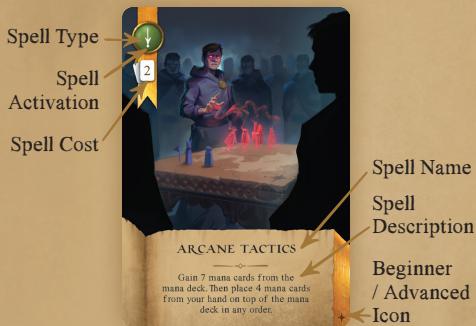
SPELL ACTIVATION
Not all spell effects happen at the moment a spell is cast. The symbol in the top left of each spell indicates its method of activation as either instant, delayed or ongoing.

INSTANT: This is the most common spell type. These spells are activated immediately after casting them. They are not activated if a mana is placed on them by another spell.

DELAYED: These spells are activated each time a mana is discarded off of them. This may happen during the spell cool down phase, or as a result of another spell's effect. Using another spell to discard off a delayed spell will activate the delayed spell. However, using another spell to pick up off of a delayed spell will NOT activate it.

ONGOING: This spell is always active so long as there is a mana on the spell. If the mana is removed, the spell stops being active.
SPELL TYPE
There are three types of spells in the game.

ATTACK SPELLS: These spells have red circles in the upper area of the card. The primary function of these cards is to damage your opponent.

REGENERATION SPELLS: These spells have green circles in the upper area of the card. The primary function of these cards is to gain additional mana.

UTILITY SPELLS: These spells have purple circles in the upper area of the card. The primary function of these cards is to manipulate mana or manipulate the rules of the game.
SPELL COST
A spell’s cost is the number of mana cards required to cast it. The “power” of each mana card (from 1-4) does not matter, only the quantity of mana cards.
of it. Shadow Attack has an instant activation, which means its spell effect happens immediately after placing those mana cards.
The mana used to cast a spell create that spell's cool down. At the start of your upcoming turns, during the cool down phase, you would discard 1 mana card of each off your spells. That means for a spell like Shadow Attack, it will take four turns before all the mana have been discarded and it becomes available for use again!
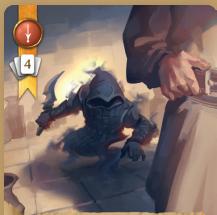
SHADOW ATTACK
Discard a mana card off Deal damage and gain mana equal to that mana's power.
EXAMPLE TURN
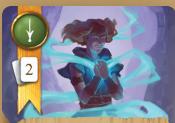
LIVING WIND
Gain 6 mana cards, gain 1 fewer mana for each of your other spells that have a mana on them.
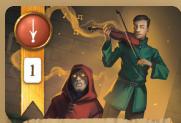
TRANCE STATE
Deal 3 damage, minus 1 damage for each mana card in your hand.

TIME DISTORTION
Pick up a mana card off 2 of your other spells.
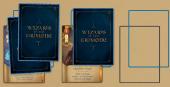
The current player has two spells in their Spell Repertoire.
They cast both of them last turn, so they are both currently in use.
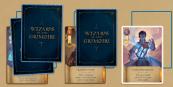
① Choose a New Spell
The first action for each player's turn is choosing a new spell. The current player adds Time Distortion to their Spell Repertoire.

2 Spell Cool Down
Now that the current player has chosen a new spell, they complete the second action: spell cool down. This means the current player discards one mana off each of their spells. The discarded mana goes directly to the Mana Discard pile.
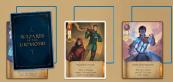
After discarding one mana off of each spell, Trance State is now available for use! Living Wind remains in cool down, which means the spell has mana on it and is not currently available to be cast.
③ Gain 3 Mana

Next, the current player gains 3 mana. The current player may now use that mana to cast their spells that are not in use. The cost of a spell is the number in the top left of the card. Spells are cast by placing the quantity of mana equal to that cost on top of them.
4 Cast Spells

With 3 mana currently in their hand, the player places 1 mana card on Trance State to cast it. Trance State deals 1 damage.

Next, they place 2 mana cards on Time Distortion. This allows them to pick up a mana off both Trance State and off Living Wind. This makes those spells available for use again and puts 2 mana cards back in their hand!

Having picked up mana from their spells, the current player has 2 mana in their hand. They use that mana to cast Trance State a second time, this time dealing 2 damage.

Basic Attack
At this point the player has only 1 mana left in their hand, which means they cannot afford to cast Living Wind.
Instead, they will use their remaining mana card for their basic attack. Your basic attack deals damage equal to the power of a single mana that you discard from your hand.
The current player discards a 4 power mana and deals 4 damage to the opposing player. Having finished their basic attack, the current player has completed their turn.


YOU ARE READY TO PLAY!
The rest of the rulebook discusses edge case scenarios so that you can refer to it in case they come up.
HAVE FUN!
KEY MECHANICS
CONFIRMING INFORMATION:
Some spells have effects that can't be confirmed with public information, as the mana is hidden from view in the opposing player's hand or at the top of the mana deck.
If a spell requires confirmation, players must reveal the necessary view to the opposing player, allowing them to confirm that a spell's requirement has been fulfilled.
HAND LIMIT:
If a player ever begins their turn with greater than 10 mana in their hand, they must discard down to 10 mana before beginning their turn.
PUBLIC Vs. PRIVATE KNOWLEDGE:
Your opponent can ask you to confirm the number of mana cards in your hand, but the exact power of that mana is private and does not need to be shared.
Similarly, your opponent may ask you to confirm the number of mana cards on your spells. The power of mana on your spells is private information and can be reviewed by you at any time, however, once the mana is placed on a spell the order of that mana cannot be changed.
SPELL INTERACTIONS:
In some circumstances, the casting or effect of a spell might trigger another spell's effect. If this happens, the spell that is currently being used must complete its full effect first. Once completed, the current player may choose the next spell effect that takes place. Continue this process until all spell effects have resolved.
If multiple spells are activated or deactivated simultaneously (eg. during cool down), they should be resolved in the following order: delayed spells are activated first in the order the current player chooses. Following this, if any ongoing spells are deactivated, they are deactivated in the order the current player chooses.
TERMINOLOGY
COOL DOWN:
At the beginning of each turn, you discard one mana off each of your spells, this is called the “Cool Down” phase. If any delayed spells activate during the cool down phase, discard all mana first, then activate the spell effects in the order of the current player's choosing.
MANA DECK:
The Mana Deck includes mana that has varying power levels (ranging from 1-4). The Mana Deck contains 32 one power mana, 16 two power mana, 8 three power mana and 4 four power mana.
MANA DISCARD:
Mana that is discarded immediately goes to the Mana Discard pile face-up. When a player tries to draw from the Mana Deck but fails because it is empty, shuffle the Mana Discard to create a new Mana Deck.
When discarding a mana from a spell, the top mana should always be the one that is discarded. Mana in the discard is public knowledge, both players are able to look through it at any time.
PICK UP A MANA:
Some spell effects may allow you to pick up a mana off a spell. This means that you take the top mana off of a spell that has mana on it, and add it to your hand. Picking up a mana from a delayed spell does not activate it, as delayed spells are only activated by a discard.
REPLACE / DISCARD A SPELL:
If a spell is removed from your spell repertoire it always goes to the spell discard. If the spell is being removed during the “Choose a new spell” phase it must have no mana on it. If, however, one of your spells is being replaced as the result of another spell's power, it can be discarded immediately and any mana on it is moved onto the spell that replaces it (unless the spell states otherwise).
REVEAL:
When a spell requires players to reveal mana, the indicated player looks at the number of mana mentioned and MUST show this mana to their opponent. Unless otherwise noted, the mana should be returned to where it was revealed from.
SPELL COST:
Listed in the top left corner of each spell, this number denotes the number of individual mana cards the spell requires to be cast. A spell's cost has nothing to do with the power of each mana used to cast it.
SPELL DISCARD:
During the “Choose a New Spell” phase, if a player is looking to switch a spell it must be one that is not in use. The player must also already be at 6 spells in their Spell Repertoire. The old spell that has been replaced is placed into the Spell Discard pile.
SPELL REPERTOIRE:
As players choose new spells for themselves, they are placed face up beside each other on the table. Players can have a maximum of 6 spells in their Spell Repertoire at any one time. Once a player has reached 6 spells, they may only take a new spell if they start their turn with no mana on the spell card they would like to get rid of.
SPELLS THAT ARE “NOT IN USE”:
These spells have no mana placed on them and are available to be cast. Each turn, a player may cast multiple spells as long as they are not in use. During the “Choose a New Spell” phase, if a player is looking to switch a spell, it must be one that is not in use.
WIZARDS F THE GRIMOIRE
GAME DESIGN: Cole Banning & Joe Banning
PRODUCER: Kenzie Nelligan
LOGO & DESIGN: Tarik El-Khateeb |teafortarik.com
ILLUSTRATIONS:
Luciano Carreira (Cyan Gorilla)
Raqsonu Duhu
Pedro Krüger Garcia
Gabriel Lopes
Trung Nguyen (Windboi)
Anderton Oliveira
Matheus Schwartz
Sergey Tsvelykh
Joao Vagner
Development by: GRIMOIRE GAMES
©2023 Grimoire Games
No part of this product may be reproduced without specific permission.
info@wizardsofthegrimoire.com www.wizardsofthegrimoire.com

©2023 GRIMOIRE GAMES
www.wizardsofthegrimoire.com
Download MarkdownTexts are community-compiled or publicly released by publishers; copyright remains with the original authors. For personal reference only.