
1862: Railway Mania in the Eastern Counties
At a glance
Rules, cards and Q&A (Chinese)
The rules, card data and player questions for this game are written in Chinese. Open the Chinese page to read them.
Where to find full rules
Full rules and card lookup are available in the cunlema app at cunlema.cn — pick this game and ask about any rule, card or turn you are unsure about.
Related games
Rulebook text (Markdown)
This game has 1 rulebook Markdown file(s) in our library; 1 rendered inline below — expand to read or download.
1862_TRAIN_RULES-Final.md117.9 KB
RULES OF PLAY
1862
( a k a 1 8 E A ) Railway Mania in the Eastern Counties
by Mike Hutton

GMT Games, LLC P.O. Box 1308, Hanford, CA 93232-1308
1.0 INTRODUCTION
2.0 COMPONENTS
2.1 Companies
2.2 Trains
2.3 Track Tiles
2.4 Game Setup .
2.4.1 2-6 players .
2.4.2 7-8 players
2.4.3 Trains and Game Length
2.4.4 Player Order and Starting the Game.
2.5 Simpler Game Variants
3.0 GAME OVERVIEW
3.1 Chartered and Non-Chartered Companies
3.2 Available Companies.
4.0 PARLIAMENT ROUNDS. .
4.1 Proposals
4.2 Obtaining a Parliamentary Charter.
4.3 Obligations
5.0 MERGING SHARES. . . .
5.1 Merging Opportunities
5.1.1 Mergers.
5.1.2 Acquisitions
5.1.3 Company Refinancing..
5.2 Merging Procedure. .
5.2.1 Choose Companies Involved (M/A Only)
5.2.2 Move Certificates from IPO to Bank Pool
5.2.3 Determine New Share Price (M/A Only)
5.2.4 Return, Redeem or Relinquish Half Shares 8
5.2.5 Determine Company Director
5.2.6 Example 1
5.2.7 Example 2.
6.0 STOCK ROUNDS
6.1 Priority Deal. . .
6.2 Player Actions
6.3 Directorships and Share Purchases/Sales
6.4 Selling Shares
6.4.1 Company Prices
6.4.2 Stock Market Movement
6.5 Buying a Share. . .
6.5.1 Available Shares. .
6.5.2 Certificate Limit. .
6.5.3 Starting a New Non-Chartered Company
6.5.4 Flotation
6.6 End of the Stock Round
7.0 OPERATING ROUNDS. . .
7.1 Operating Order
7.2 A Company’s First Operating Turn.
7.3 Companies without a Director. .
7.4 Routes
7.5 Mergers and Acquisitions – Mergers
7.5.1 Consent
7.5.2 Connection. . . .
7.5.3 New Share Price 13
7.5.4 New Par Price 13
7.5.5 Swap Shares 13
7.5.6 Transfer of Funds & Possessions. 13
7.5.7 Re-starting a Merged Company
7.6 Track Building . . . .
7.6.1 General Rules on Laying Track
7.6.2 Laying Yellow Tiles
7.6.3 Upgrading Track
7.6.4 Placing Small Stations
7.6.5 Building to London. .
7.7 Placing Station Markers
7.8 Running Trains.
7.8.1 Freight
7.8.2 Local . . .
7.8.3 Express . .
7.8.4 Multiple Train Types (Example). . .
7.8.5 Dividend Payments
7.8.6 The George Hudson Manoeuvre 18
7.9 Purchasing Trains. . . 18
7.10 Train Warranties 1
7.10.1 Free Warranties for ‘A’ and ‘D’ Trains . .
7.11 Forced Train purchases
7.11.1 Selling Company Stock
7.11.2 Re-financing a Company. . . . . . . .
7.12 Bankruptcy . . . . . . . 19
7.13 Redeeming Stock . 20
7.14 Mergers and Acquisitions – Acquisitions 20
8.0 RECEIVERSHIP
9.0 PHASES
10.0 GAME END
10.1 The Stock Market
10.2 The Bank
10.3 Formation of the London & North Eastern
Railway (LNER)
10.4 The Winner. .
11.0 VARIANTS. . . . . . .
11.1 Fewer Train Types.
11.2 Shorter Games
11.3 The Game for New Players
11.4 Additional Station Markers
12.0 DESIGN NOTES. . . .
13.0 NOTES ON THE NEW EDITION. 23
14.0 ACKNOWLEDGEMENTS 23
Credits
Calculating Train Routes
1.0 INTRODUCTION
The development of railways between 1844 and 1862 saw the second great rush to build railway companies in the U.K. The first railway boom had broken in the early 1840s, a victim of inefficiency and more general economic woes. The second boom was the great Railway Mania of 1844 to 1847, which saw an extraordinary expansion in the railway network. Huge numbers of private investors were encouraged to invest, but as with many such ventures, few of these enterprises proved profitable. The bubble truly burst in 1849 when accusations of fraud surfaced at the Eastern Counties Railway, then in bitter dispute with its rivals in East Anglia. The game is set in this cauldron of railway construction. Players will vie to start railway companies, invest money in railway shares, and attempt to run the railways they control for personal gain, trying to keep them afloat in changeable economic times.
1862—also known in some circles as 18EA—is part of a series of games, all based on an original game by Francis Tresham, called 1829. There are various games in this series which have been published over the years, including 1830, 1853, 1835, 1856, 1870, and 1825. The object of the game is to gain wealth by investing in railway companies, which then build railway networks to gain revenues for their shareholders.
2.0 COMPONENTS
• Game board showing East Anglia
• This Rule booklet
• 34 Train cards
• 2 Train manifest cards
• 8 Phase cards (lettered A to H)
• 160 Company certificates in 20 sets, consisting of one 30% Director’s certificate and seven 10% ordinary shares
• 8 sheets of Track Tiles in yellow, green and russet
• 4 sheets of tokens for Permits, Stations, and markers
• 2 (identical) Player Aid cards
• 2 wooden tokens (elephant and cylinder)
• £15,000 in Paper Money in the following denominations: £1x25, £2x25, £5x25, £10x30, £20x40, £50x24, £100x50, and £500x15
2.1 Companies
There are 20 companies in the game. Each company has eight share certificates (director’s certificate counts 30% and others 10% each) and 11 tokens. Eight of the tokens are station markers and the other three are used for the IPO, Stock Market, and Revenue Tracks. Use one of the starred tokens to denote the Home Station
and use the other for the Stock Market. In addition each company has a charter which is used as a space to place the company’s assets.
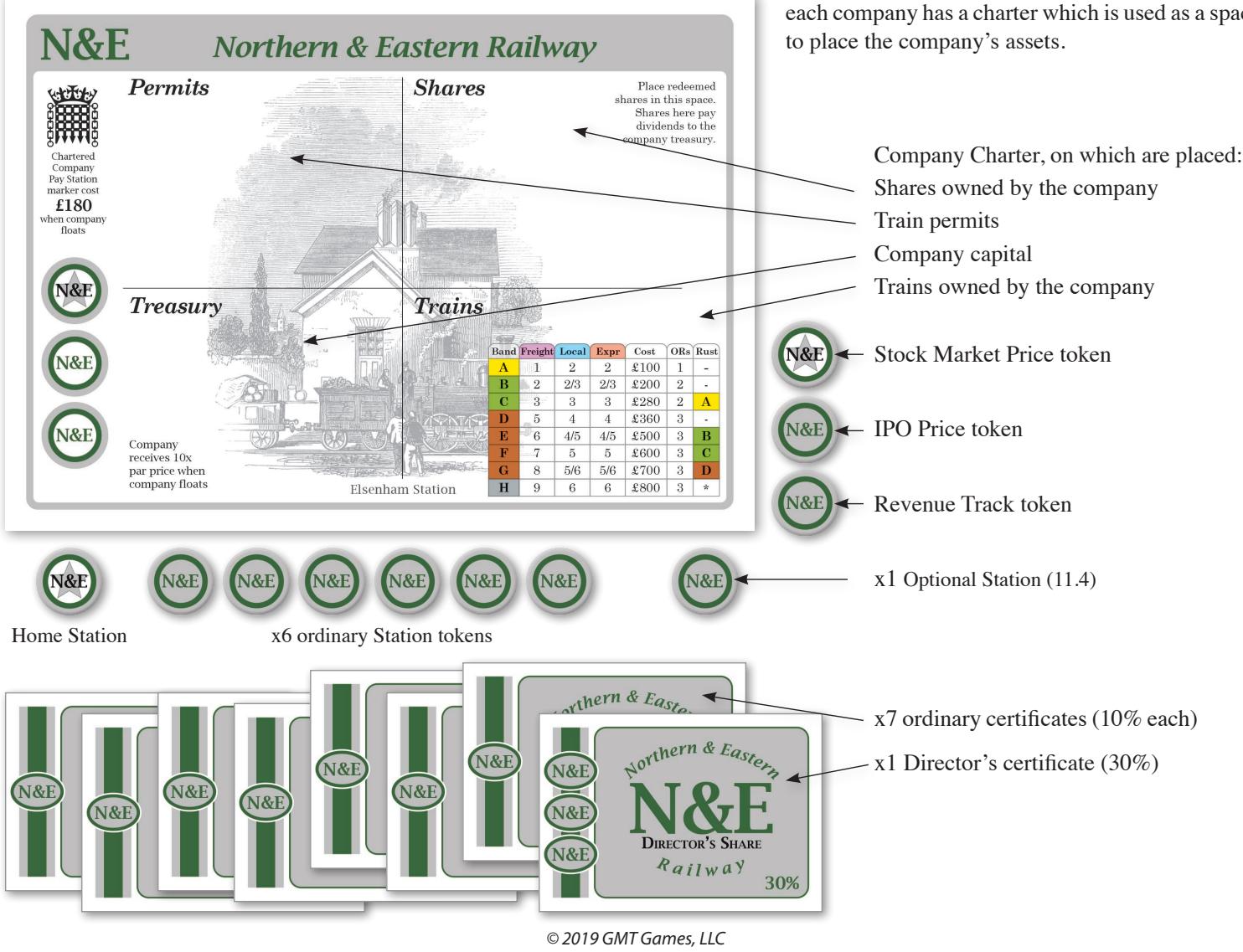
Each company floats and begins to operate when players have bought 50% of its shares. The company will start with at least two station markers, one being its home station marker. The home station marker is marked with a star on one side, and is marked “home base” on the reverse.

Station markers are bought up-front from the company treasury as soon as it floats. Companies may gain more tokens through mergers, up to a total of seven (but see 11.4).
Initially a company will only be able to operate one of the three types of train (Freight, Express, and Local). A company will only be able to diversify into using other train types by means of merging with a company which is able to operate a different type of train.
2.2 Trains
Trains are represented in the game by train cards. The companies will buy these during the game, and use them to raise revenue. Each train card shows three types of train:
• Express Train—shown by a number in a red circle
• Local Train—shown by a number in a blue diamond
And on the reverse of the train card:
• Freight Train—shown by a number in a purple hexagon.

Each type of train has a different method for calculating revenue, and benefits from different track building strategies. When a train is bought its type (Express/Local/Freight) must be chosen, and the train card is placed on the company charter in a manner which makes it clear which type it is. Typically this will be by placing the card so the appropriate type is shown in the top left hand corner of the card, as placed on the charter. The train cannot change between types once this decision has been made.
The number of trains used in the game will vary on the length of the game played (short, standard, and long).
2.3 Track Tiles
Track tiles are placed on the board to mark routes between stations. Track tiles come in three colours (yellow, green, and russet), and two types—Large and Small Stations. Large Stations come with 1-4 large circles. Company station markers can be placed in these circles. The other type of tile shows a small station as a dot. Note that the stations on green and russet small-station tiles are marked by placing a small station marker on the tile. Small station markers are not “owned” by any company. Note also that small station tiles contain no junctions; on each of these, separate tracks do not meet, although some may cross over others.

Large Station Tiles
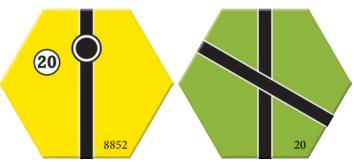
Small Station Tiles
Small station markers may be placed on “clear” stretches of track (see 7.6.4).
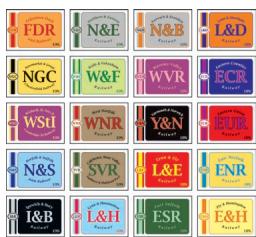
List of Companies
| Letters | Name | Colour | Home station | Active |
| E&H | Ely & Huntingdon | Yellow/Orange | Ely | 1847-1849 (EA) |
| ECR | Eastern Counties Railway | Blue/Purple | Witham | 1839-1862 (GE) |
| ENR | East Norfolk Railway | Yellow/Blue | Cromer | 1874-1880 (GE) |
| ESR | East Suffolk Railway | Green | Ipswich | 1851-1859 (EU) |
| EUR | Eastern Union Railway | Red/Purple | Colchester | 1846-1862 (GE) |
| FDR | Felixstowe Dock & Railway | Orange/Red | Felixstowe | 1877-1887 (GE) |
| I&B | Ipswich & Bury Railway | Black/Grey | Bury St Edmunds | 1847-1847 (EU) |
| L&D | Lynn & Dereham Railway | Orange/Blue | Swaffham | 1846-1849 (EA) |
| L&E | Lynn & Ely Railway | Red/Yellow | Downham Market | 1847-1849 (EA) |
| L&H | Lynn & Hunstanton Railway | Blue/Red | King's Lynn | 1862-1890 (GE) |
| N&B | Norwich & Brandon Railway | Grey/Orange | Thetford | 1845-1852 (EC) |
| N&E | Northern & Eastern Railway | Grey/Green | Bishop's Stortford | 1840-1844 (EC) |
| N&S | Norfolk & Suffolk, Joint Railway | Blue | Lowestoft | 1898-1923 (MG) |
| Y&N | Yarmouth & Norwich Railway | Black/Red | Great Yarmouth | 1844-1852 (EC) |
| NGC | Newmarket and Great Chesterford Railway | Yellow/Black | Newmarket | 1848-1851 (EC) |
| SVR | Colchester, Stour Valley, Sudbury & Halstead | Brown/Green | Sudbury | 1849-1862 (EC) |
| WNR | West Norfolk Railway | Brown/Red | Wells-next-the-Sea | 1866-1872 (L&H) |
| W&F | Wells & Fakenham Railway | Green | Fakenham | 1852-1862 (GE) |
| WVR | Waveney Valley Railway | Purple/Pink | Beccles | 1855-1862 (GE) |
| WStI | Wisbech, St Ives & Cambridge Junction Rwy | Purple/Yellow | Wisbech | 1847-1848 (EC) |
Key: EA: Absorbed into the East Anglian Railway EC: Absorbed into the Eastern Counties Railway EU: Absorbed into the Eastern Union Railway
GE: Absorbed into the Great Eastern Railway MG: Absorbed into the Midland & Great Northern Joint Railway L&H: Merged into the Lynn & Hunstanton railway
2.4 Game Setup
Place the board in the centre of the playing area, in easy access to all players. Place the hexagonal track tiles close by, so that players can see which tiles are available. Stack the trains in ascending order (A-H) in a pile on the designated area of the board. Nominate a competent player as banker, and arrange the money in piles to form the bank where the banker can easily reach them.
2.4.1 Setup for 2-6 players
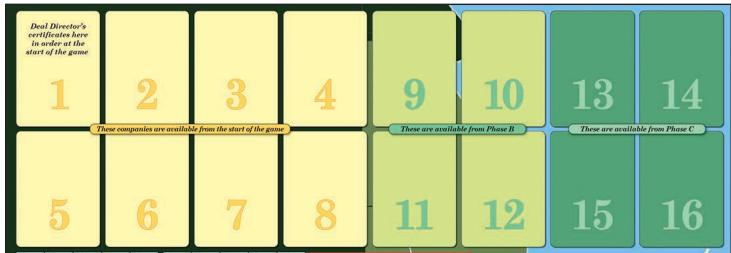
The banker takes all the directors’ certificates and shuffles them. He deals these out on the three Initial Purchase Offer (IPO) areas of the board: first eight (on spaces 1-8), followed by four (numbered 9-12), and then followed by another four (13-16). The initial eight companies are available for purchase from the start. The next four are available from phase B, and the next four from phase C. The final four companies are discarded, out of the game. Place a white counter marker on each of these last four companies’ home stations to show that they are out of play.
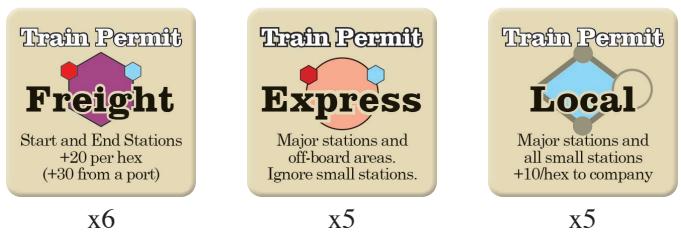
Next the banker takes 16 train permit cards: six Freight, and five each of Express and Local permits. The banker shuffles the 16 cards and deals one to each company (on its charter or on the IPO). In
this way each company will have one train permit for a particular type of train.
Put the company charters and ordinary share certificates for the companies to be used in the game in a number of piles next to the board. Similarly put the tokens for these in piles next to the board. Designate a player to look after these and hand them out when they are needed.
2.4.2 Setup for 7-8 players
When playing with 7 or 8 players, players may opt to start with additional companies available at the start. The extra companies are available, and may be started, from the very first Parliament Round. With 7, add one additional company. With 8, add two additional companies. For train permits, use six of each type of train permit and deal these out at the start as usual. Discard any unused additional permits.
2.4.3 Trains and Game Length
Decide what length of game you will be playing. The short game uses fewer trains than the standard game, and the long game uses more. Place the appropriate train manifest card face up on the table in the trains space.
Sort the train cards into alphabetical order (A at the top, H at the bottom). For the standard game, count out seven ‘A’ trains, six ‘B’ trains, four ‘C’ trains, three ‘D’ trains, three ‘E’s, two ‘F’s, one ‘G’, and all of the ‘H’ trains. For the short and long games, use the numbers shown on the train manifest card chosen, or look the numbers up in the table at the back of the rules.
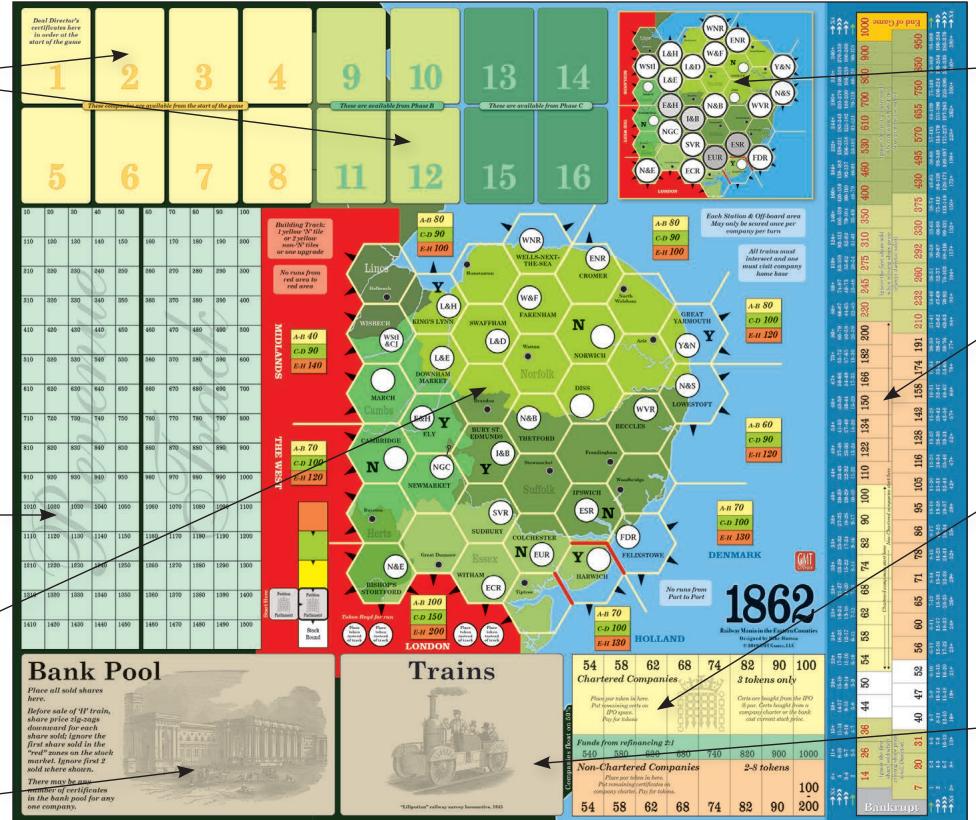
Initial Purchase Offer (IPO). Shares are placed here in companies that have not started yet.
Revenue Track. Place tokens here to keep track of company revenues.
Track tiles and company station markers are placed on the map. Towns are marked with a large circle, and villages with a dot.
Bank Pool. Place shares in here as they are sold.
© 2019 GMT Games, LLC
Home Base Chart. Put home base markers for the companies which are available on this chart. As desired, place permit tokens corresponding to those granted to the companies on these spaces as well.
Stock Market Chart. Company share values are recorded here.
IPO Price Chart. The initial share price of companies is recorded here. This is also used to calculate the revenues gained by refinancing.
Place trains waiting to be bought here.
Place the phase cards for each letter at the top of each group of trains with the same letter, as follows:

2.4.4 Player Order, and Starting the Game
Players choose their seating order randomly using the player order cards, and are handed their initial money at the start of the game:
2 players: £1200 6 players: £400
3 players: £800 7 players: £345
4 players: £600 8 players: £300
5 players: £480
The player with the lowest value card is given the Priority Deal token (PD). If players wish they can devise another method for arranging seating and start player.
The game starts with two Parliament Rounds, followed by the first Stock Round.
2.5 Simpler Game Variants
Please note that at the end of the rules there are simpler versions of the game for novice players or those who prefer a simpler game. Whereas many veteran 18xx players may shy away from using these when learning a new game, in this case it is a good idea initially to play a simpler game as there are many things which will be unfamiliar to even the most experienced player.
3.0 GAME OVERVIEW
There are three types of rounds in the game.
• Parliament Round: players bid to start new railway companies.
• Stock Round (SR): players buy and sell shares in railway companies, and may start companies by doing so.
• Operating Round (OR): railway companies build track and stations, run for revenue, and pay dividends.

The game proceeds in a sequence of Parliament Round, Stock Round, and some Operating Rounds (one in Phase A, two in Phases B and C, and three thereafter), all repeated until the game ends. The game starts with an additional Parliament Round, so there are two consecutive Parliament rounds to start the game.
The game ends when the bank runs out of money, when a company share prices reaches the top of the market, or after a full set of operating rounds after the sale of the first ‘H’ train. The winner will be the player with the most personal wealth (cash in hand plus shares) at the end of the game. Monies held within company treasuries do not count.
3.1 Chartered and Non-Chartered Companies
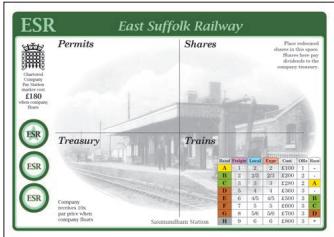
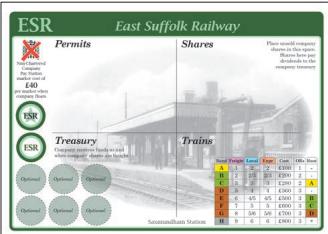
There are two different ways of starting a company in the game. The first is to petition parliament in a Parliament round. Companies started this way are called chartered companies, and are funded by nationwide subscription with political backing. As a result a chartered company is fully funded and receives its full value (10 x par price) when it floats. Non-chartered companies are started when the director’s share is bought from the IPO in a Stock Round. They are not fully funded as they rely on local subscription for shareholders, and receive money for the shares bought by players as and when they are bought.
Chartered companies start with three station markers—i.e. the company home station marker and two others—which must be bought at £60 each. Non-chartered companies may have between two and seven station markers, including the home station marker, bought for £40 each. The director chooses the number of tokens a non-chartered company buys when the company floats.
Chartered
Non-Chartered
The company charters are double sided, showing one side for a chartered company and the other for non-chartered. Use the appropriate side of the charter when the company is started, and use the non-chartered side after the company merges with another.
3.2 Available Companies
At the start of the game, only the initial eight (or more for 7+ players) companies may be started. After the sale of the first “B” train a further four companies become available, and the final four after the first “C” train is bought.
In order for a company to start it must be able to place its home station marker on its first operating turn. This will be because of one of the following:
• There is no track on the company home station.
• There is a track tile on the company home station, and there is an empty token space on the tile into which the company can put its home station marker.
• There is a track tile on the company home station, but even though all of the station marker spaces on the tile are currently occupied, the company can upgrade the tile with a currently available upgrade which will increase the number of available station marker spaces on the hex. (See ESR, which can place its home base token if it upgrades its home—currently occupied by the WVR and N&B—to tile 791).
If a company will be unable to place its home station marker on its first operating turn, it may not be started. In some cases a company’s home station is completely blocked by other companies’ station markers. Under these circumstances the company might not be able to start in the game at all.
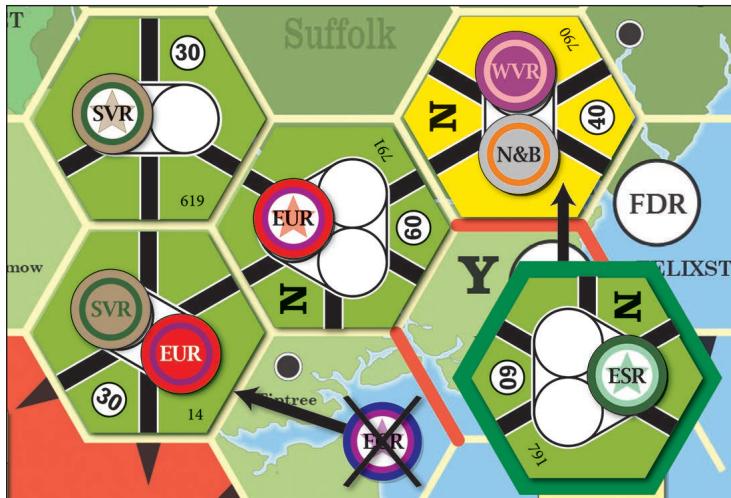
EXAMPLE: The ECR cannot place its home marker as its tile is fully occupied by the SVR and EUR, and cannot be upgraded to provide additional space. The ESR, however, can upgrade the yellow N tile to a green N tile to allow room for its Home Station.
4.0 PARLIAMENT ROUNDS
4.1 Proposals
A Parliament round takes the form of a series of auctions, where players’ bids signify the level of expenditure on lobbying. Starting with the player with the PD and proceeding clockwise, each player may start an auction by selecting an available company and making an initial bid, which must be a multiple of £5 and at least £0, or pass. Once an auction has started, players in turn may raise the bid by a multiple of £5, or pass. A player who passes in an auction may not rejoin that auction.
A player who has less than £162 (i.e. three times the lowest available par price) plus the amount of the smallest legal bid must pass. A player who is on or above the certificate limit must pass. A player who has obtained a Parliamentary Charter in this round may not start an auction, but may bid in an auction started by another player.
Once all players but one have passed, the auction is won by the highest bidder. The highest bidder will immediately start the company. See “Obtaining a Parliamentary Charter”.
After this, starting with the player to the left of the highest bidder, players resume the process of starting auctions. The whole Parliament Round is over when all players successively decline to start an auction. The PD does not move during Parliament Rounds.
4.2 Obtaining a Parliamentary Charter
The player who bid the highest must start the company under proposal and pays the amount bid to the bank. Other players retain the money they bid.
The player starting the company under proposal pays the amount he bid to the bank, chooses a par price for the company by placing a company token on the IPO chart in the space reserved for chartered companies, takes the respective charter and buys the director’s certificate (three shares), setting par and paying for the certificate from cash.
| 54 | 58 | 62 Chartered Companies | 68 | 74 SFOY | 82 | 90 3 tokėns only | 100 |
| Place par token in here. Put remaining certs on IPO space. Pay for tokens | CIOIOIOIO | ESR | Certs are bought from the IPO @ par. Ġerts bought from a company charter or the bank cost current stock price. | ||||
| 540 | 580 | Funds from refinancing 2:1 620 | 680 | 740 | 820 | 900 | 1000 |
| Non-Čhartered Companies | 2-7 tokens |
ESR’s company token has a Par price of 74.
Note that the director’s certificate costs three times the par price.
The player may not sell shares at this point in order to raise capital in order to start the company. Par must be low enough for the player to afford three shares after paying the amount he bid. The player starting the company may then buy up to two additional shares in the company out of cash in hand. If he buys 50% of the company, then it floats at this point and a company marker will be placed on the Stock Market at the same value as that chosen as the par price by the player. Any remaining shares are placed in the IPO in the space where the director’s share started the game. See 6.5.4 for details of company flotation.
4.3 Obligations
A player who has gained a parliamentary charter for a company (see above) is said to be under obligation. This means that some time before the end of the following Stock Round, the company must float; i.e. at least 50% of the company’s shares must be bought. If the company fails to float, the player who gained the charter for it in the previous Parliament round is fined a sum equal to 5 x the par price at the end of the round. The fine must be paid firstly from pocket, then from the sale of shares in the company due to be floated, and lastly from other stock sales. The company shares are then placed back in the IPO without compensation, and all other tokens placed beside the board. The company will be available again at the start of the next Stock Round.
5.0 MERGING SHARES
5.1 Merging Opportunities
At various points in the game, company shares may be merged 2 for 1. This happens in the following circumstances:
5.1.1 Mergers – At the Start of a Company’s Operating Turn
At the start of a company’s operating turn it may merge with another company by mutual consent between the two directors—who are most often the same player! Shares in the two companies are combined 2:1 for shares in the “surviving company”. The resulting company operates as normal provided neither constituent company has operated in this OR. If one of them has operated, then the resultant company’s turn is over; it will not operate again until the following operating round.
5.1.2 Acquisitions—At the End of Company’s Operating Turn
At the end of a company’s operating turn it may acquire another company by mutual consent between the two directors. Whether the other company has operated in this round or not is irrelevant. As with mergers, shares in the two companies are combined 2:1 for shares in the “surviving company”.
5.1.3 Company Refinancing—During Forced Train Purchase
In the train-buying phase of a company’s operating turn, the director may be forced to re-finance the company if the company in question has no train. Re-financing involves issuing additional shares of equal value to those in play, and merging existing shares 2:1 for all existing shareholders. This halves the share holdings of current shareholders, and adds 10 x the par price as additional revenue raised.
5.2 Merging Procedure
Merging follows these steps. Some of the steps only apply for mergers and acquisitions, and these are marked (M/A Only). While the share merging procedure is in progress, do not check for changes in directorship as these will be resolved at the end of the procedure.
5.2.1 Choose Companies Involved (M/A Only)
If merging occurs as part of mergers & acquisitions, the first action is that the director of the active (operating) company chooses which of the two companies will survive. This is known as the surviving company, and the other as the non-surviving company.
5.2.2 Move Certificates from IPO to Bank Pool
All share certificates in any of the companies involved in the merging procedure which are in the IPO are moved to the Bank Pool.
5.2.3 Determine New Share Price (M/A Only)
If merging shares occurs as part of mergers & acquisitions, the new company share price is calculated at this point. Details are given in 7.5.3. Mark the new share price on the Stock Market and IPO charts. Note that if the new share price is 100 or over the marker on the IPO chart is put on the “100” space. Similarly, if the new price is 54 or less, put the marker on the “54” space.
5.2.4 Return, Redeem or Relinquish Half shares
The players and shareholding company now merge their shares 2:1. While this is happening, any companies holding affected shares are treated as a single company (as they will be merging), and this company is dealt with as though it were a player sitting directly to the right of the player initiating the merge, controlled by the initiating player (this is for the purposes of company-held shares).
Going clockwise, once round from the director who initiated the merge, shareholders in any of the companies affected by the merge must do the following in order:
1) The player returns half his share holding in the affected companies, rounded down, to the Bank Pool. In the case of a merge, the player’s holding in both companies’ shares held are combined, and then half returned, with the non-surviving shares returned first. If the player started with an odd number of shares in the affected companies, then one of the shares retained is turned over as an “option” share. As players wish, they may choose to all perform this step simultaneously. But the following steps should be resolved in player order.
2) If the player has any shares (including an option share) in the non-surviving company, he now swaps these, 1:1, with surviving shares first held by the bank, and then held by the nearest shareholder of the surviving company, counting clockwise from him/herself, who has not already returned shares during this share merge. Option shares must be swapped in this way too, after the player’s other non-surviving shares have all been swapped.
3) If the player still holds non-surviving shares then these cannot be redeemed and must be sold to the bank for the current share price. Option shares sold this way are sold at half the current share price, rounded up. This should only happen in the most exceptional of circumstances.
4) If the player has an option share, this must now be redeemed or relinquished. The value of the option share is half the current share price, rounded down. If this is paid by the player to the bank, then the share is flipped face up and retained. Otherwise the player is paid this amount by the bank, and the option share is placed in the Bank Pool.
A player holding the directorship of a company affected by the merge, who holds fewer than six merging shares (60%) before the merge, must exchange the director’s certificate held for three ordinary merging share certificates in the Bank Pool if they are available, before performing his turn in the merge. If the three required shares are not available in the pool, the player puts all his involved ordinary certificates in the Bank Pool and turns over the director’s certificate to show it is an option certificate. The redemption value of the certificate depends on the player’s original holding:
• 50%: redeem for half the new share price, sell for two and a half times the share price
• 40%: redeem for new share price, sell for twice the share price
• 30%: redeem for one and a half times the new share price, sell for same value.
5.2.5 Determine Company Director
After players’ share holdings have been determined, the surviving company director is determined as being the player with the highest number of shares in the resultant company, with ties broken firstly in favour of the director of the company which initiated the merge, and then clockwise from that player. If necessary the director exchanges three ordinary shares for the director’s certificate at this point. If no player has three shares in the company at this point, the company is in receivership and no player is director. Follow the rules for receivership.
5.2.6 Example #1
| Richard | Emma | Peter | Linda | N&E Treasury | WStI Treasury |
| 4 x N&E | 3xN&E | 1 x N&E | 2 x N&E | ||
| 5xWStI | 1 x WStI | 1 x WStI | 1 x WStI |
Richard, Emma, Peter, and Linda are sitting clockwise in order. Richard chooses to merge the N&E and WStI. He has four N&E shares and five WStI shares. Emma has three N&E shares, Peter has one N&E share and one WStI share, and Linda has a single WStI share. The N&E has two shares in its treasury. The WStI has a single share in its treasury, one in the Bank Pool, and one in the IPO. Richard chooses to have the N&E be the surviving company. The resulting company starts with two N&E shares and one WStI share in its treasury.
First, the WStI share in the IPO is put in the Bank Pool. The new N&E share price is calculated as £134 (N&E / WStI prices were both 90 prior to the merge). Next, players (and the N&E) return half their shares to the pool, discarding WStI before N&E.
In order: Richard discards four WStI shares to the Bank Pool, and turns his remaining WStI share over as an option share. He then swaps this last WStI with one of Emma’s N&E shares. Finally he decides to pay £67 (half of £134) to redeem this option share. Richard ends with five N&E shares.
Emma now has two N&E shares and one WStI. She returns the WStI share to the Bank Pool and turns over one N&E share as an option share. She too decides to pay £67 to redeem the share. Emma ends with two N&E shares.
Peter has one N&E and one WStI share. He returns the WStI share to the Bank Pool and ends with one N&E share.
Linda has a single WStI share which she turns over as an option, swaps with a N&E share from the N&E company (leaving it one N&E and two WStI shares). She does not have £67, and so cannot redeem the option share. She receives £67 and the N&E share is returned to the Bank Pool.
The resulting company (the N&E) starts with one N&E and two WStI shares. It returns one WStI share to the Bank Pool, turns over the second one as an option, and swaps this option share for a N&E share from the Bank Pool (just relinquished by Linda). It chooses to redeem the share by paying £67 and ends with two N&E shares in its treasury. It is worth noting that had Linda redeemed her option, there would not have been enough N&E shares left to allow the N&E company to redeem its option, and it would have been forced to sell the option for £67.
Final holdings of N&E shares: Richard 5, Emma 2, Peter 1, Linda 0, N&E (in treasury) 2, Bank pool: 0. All of the WStI shares are in the Bank Pool apart from the director’s certificate which is replaced in the IPO with a new train permit card (the same as the one it started the game with).
| Richard Emma | N&ETreasury | |||
| Peter | Linda | |||
| 5 x N&E | 2 x N&E | 1 x N&E | 0 x N&E | 2 x N&E |
Richard remains the N&E director. The WStI director’s certificate is returned to the IPO, and the rest of the certificates placed with the non-started company certificates by the side of the board.
5.2.7 Example #2
This time the players hold the following, and are sitting in the following order:
| I&BHelen Martin Rachel Charles Treasury | ||||
| 1 x N&E | 4xN&E | 3xN&E | ||
| 5xI&B | 3xI&B | 2xI&B | ||
N&E share price is 100, but has no train. I&B share price is 74, and does have a train. There are two N&E shares in the IPO, and no N&E or I&B shares in the pool.
Martin opts to merge the N&E and I&B. The N&E is chosen to survive.
First, the two N&E shares in the IPO are put in the Bank Pool.
The new share price is the lower share price, plus half the higher share price. However, since the N&E has no train, its share price is £50. So the share price calculated is £50 + (£74/2) = £50 + £37 = £87, which is rounded down to the nearest share price of £86. The par marker is placed on the next lowest par space (£82). See the section on mergers in 7.5.3 and 7.5.4.
In order, players return half their shares and redeem/sell option shares. Each player will do this in turn, but for illustration the following shows how many shares each has after they have returned half their shares to the bank:
| Helen | Martin | Rachel | Charles | I&B Treasury |
| (N&E) | 4xN&E | 1 x N&E, (N&E) | ||
| (I&B) | 1 x I&B, (I&B) | 1x I&B |
Players resolve their option shares as follows:
• Martin swaps his (I&B) option with one of the N&E shares in the bank, pays £43 to the bank, and keeps the option share, turning it over.
• Rachel swaps her I&B and (I&B) option with the two remaining N&E shares in the bank. She then pays £43 to the bank to redeem the option and turns the option share over.
• Charles pays £43 to the bank to redeem his option, and turns the option share over.
• Helen pays £43 to the bank to redeem her option, and turns the option share over.
• The I&B would like to exchange its I&B share for an N&E one, but it can’t—all the N&E shares are now taken. As a result it sells the share it has to the bank at the new share price, and £86 is added to the I&B treasury. The I&B share is added to the Bank Pool.
The holdings at the end of this process are as follows:
| Helen | Martin | Rachel | Charles | I&B Treasury |
| 1 x N&E | 5 x N&E | 2 x N&E | 2 x N&E | no N&E, but +£86. |
6.0 STOCK ROUNDS
6.1 Priority Deal
The player with the Priority Deal token starts the Stock Round, and play passes clockwise. This continues until all players pass consecutively (see 6.6).
6.2 Player actions
A player may perform the following actions on his turn, in the following order:
• Sell one or more shares
• Purchase a single share or start an un-chartered company.
If a player performs neither of these actions on his turn, he is deemed to pass.
6.3 Directorships and Share Purchases/Sales
The company director is the player holding the director’s certificate. This will be a player who owns at least three shares, and who has the highest share ownership in the company. The owner of this certificate is initially determined when the company starts, but ownership may change as follows:
If the director sells shares, or another player buys shares so that another player holds more shares than the director, that player becomes the director and exchanges three ordinary share certificates he owns in the company for the director’s certificate.
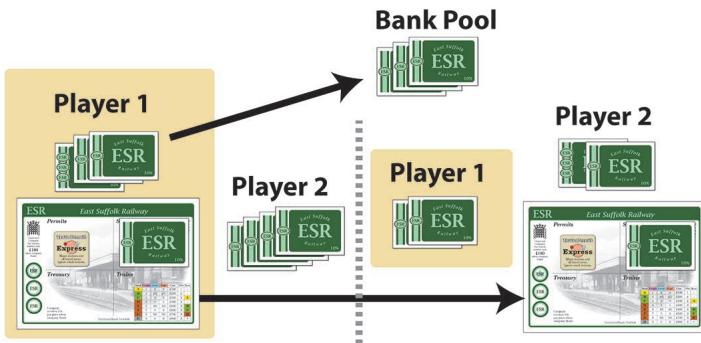
EXAMPLE: Player #1 (holding 50%) sells three shares to the pool, giving the directorship to Player #2.
The directorship may also change, in the same way as above, if a player owns more shares than the director as a result of mergers/ acquisitions, or refinancing.
The director’s certificate may be sold to the bank. In order to do this, the player must sell enough shares to reduce his share holding to below three. The seller may part-exchange the director’s certificate with available shares in the Bank Pool, or among others being sold at the same time, in order to sell down to one or two shares. Where the player owns only three or four shares, there may be insufficient ordinary share certificates in the Bank Pool and amongst those he is selling (combined), to allow him to retain the number of shares he wishes to.
EXAMPLE: If the director holds four shares (the director’s certificate + one ordinary certificate), and none are in the Bank Pool, then the player will be unable to sell just two shares, as only one ordinary certificate will be available for him to keep after the sale. In this case the player may not choose to sell two shares, but must choose a different number.
The director’s share cannot be bought directly from the Bank Pool. If the director’s certificate is in the pool, then it remains there until one of the players holds three or more shares in the company, or if the company goes bankrupt. Until this happens the director’s certificate remains in the Bank Pool and the company may operate without a director if a replacement director cannot be found. See later for details.
To gain the director’s certificate from the Bank Pool a player needs to hold at least three ordinary share certificates in the company.
If the director’s certificate is in the Bank Pool, and another player has three or more shares in the company, and has the most shares in the company, he becomes the new director and swaps three of his shares in the company for the director’s certificate in the Bank Pool; ties for the most shares are broken in favour of the player closest to the previous director’s left.
Swapping shares owing to changes in directorship does not count as a share purchase or sale.
6.4 Selling Shares
During a single turn in a Stock Round, a player may sell any number of shares, subject to the constraints set out below. Shares in a single company sold in one turn must be sold in a block, not individually. The seller chooses the order in which blocks of company shares are sold. Shares sold are placed in the Bank Pool. There is no limit to the number of shares that can be in the Bank Pool.
A player may not sell shares that he has bought during the current Stock Round, although he is permitted to sell shares in a company he has bought shares in, provided that the shares sold were bought in a previous round. To clarify this, newly bought certificates should be kept separately from other holdings until the end of the Stock round. Note, however, that a player may sell part of a holding represented by a director’s certificate provided that the number of shares retained is at least equal to the number bought during the current Stock Round.
EXAMPLE: A player who starts a Stock Round holding just the director’s certificate may buy and then sell one share in that company during the round.
6.4.1 Company Prices
If the company owns at least one train, share sales take place at Stock Market value. If the company does not own a train, share sales take place at half Stock Market value, rounded down.
6.4.2 Stock Market Movement
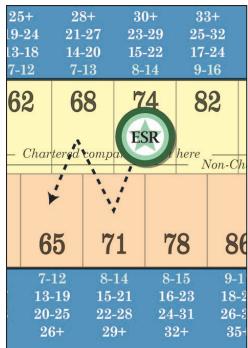
Immediately after shares are sold, the share price zigzags downwards one space per share sold to the Bank Pool (note: not to a company or player). In this way a company with a share price of 74 would fall to 71 on the first share sold, then to 68, 65 and so on as more shares are sold. In each case if the price falls to a space containing other company markers, place the company marker underneath all the other markers on that space.
If the share price is above 200 or below 40, and the player selling the share(s) is not the company director, ignore the first certificate sold before making the share price zig-zag downwards. In the upper zone (400 and over), ignore the first two shares sold.
The share price does not fall on share sales if the company has not floated, or after the formation of the LNER (see 10.3).
6.5 Buying a Share
6.5.1 Available Shares
Shares may be bought from the IPO, the Bank Pool, or a company. They may not be bought from another player. There is no limit to the number of shares a player may hold in a single company.
If a share is bought from the IPO (i.e. from a company with a parliamentary charter), the purchaser pays the par price for the share into the bank. Otherwise the price paid is the current market price as marked on the Stock Market, and the money is paid to the bank (for shares in the Bank Pool), or to the company (for shares on a company charter). The number of trains held by the company does not affect the purchase price.
A player may not buy shares in a company he has sold during this Stock Round.
6.5.2 Certificate Limit
A player may not buy a certificate if the number of certificates he holds is on or above the certificate limit. Each Director’s certificate represents three shares, but only counts for one certificate against this limit. The limit depends on the number of players, as follows:
| Players: | 2 | 3 | 4 | 5 | 6 | 7 | 8 |
| Limit: | 25 | 18 | 13 | 11 | 10 | 9 | 8 |
At some point player may find himself above the certificate limit. Under these circumstances the player must sell shares until he no longer has more than the limit at the start of his next turn in a stock round. This changes as below:
When the London & North Eastern Railway is formed (10.3), the certificate limit becomes equal to the highest number of shares (not certificates) held by any one player at that point. This means that every director should be able to buy at least two additional shares and still be under the certificate limit. The new limit remains in force and unchanged for the rest of the game. Note that after the LNER is formed players do not need to sell shares to get under the certificate limit.
6.5.3 Starting a New Non-Chartered Company
A company may be started in a Stock Round if
-
The director’s certificate is in the IPO.
-
The company’s home base hex is empty, or if there is a free station marker space on the tile there.
-
The company will be able to place its home station marker when it operates. See section 3.2 for details.
| 54 | 58 | 62 | 68 | 74 | 82 | 90 | 100 |
| Chartered Companies | Plaej par tolken inl here. Put remaining certs on IPO space. | Pay for tokens | ODOOO | t QOOOO | 3 tokens only Certs are pought from phe IPO par. Certs bought from a | company charter or the bank cost current stock price. | |
| Funds from refiñancing 2:1 540 | 580 | 620 | 680 | 740 | 820 | 900 | 1000 |
| Non-Chartered Companies | Place par token in here. Put remaining certificates o | 2-7 tokens | 100 | ||||
| 54 | 58 | mpany charter, Pay for tolns. 62 | 68 | 74 | 82 | 90 | 200 |
A player starting a new company takes the director’s certificate from the IPO, and chooses a starting price for the company, marking this with a company token on the Stock Market. If there are tokens already on that space, put the token at the
bottom of the pile. The price must be one in the pink or yellow regions of the Stock Market (between 54 and 200). The player takes the company charter, places the rest of the company certificates on it, and then pays the company three times the Stock Market Price for the director’s share (not the bank). The money is placed on the company’s charter. The company’s par token is placed in the “Non-chartered” area of the par chart, at the highest price which is equal to or lower than the initial share price.
It is important to note that, for non-chartered companies, the par token is not used to determine the cost of shares, but rather is used if the company re-finances in order to afford a train.
6.5.4 Flotation
Flotation occurs when 50% of a company’s shares have been bought from the IPO or company. Once this happens, any sales of shares in the company cause the share price to drop, and the company begins to operate from the start of next operating round.
The company receives money into its treasury, station markers, and a train permit as soon as it floats.
6.5.4.1 Capitalisation: For companies with a parliamentary charter, capitalisation is 100%—the company receives ten times the par price into its treasury as soon as it floats. Companies started without a parliamentary charter are partially capitalised—they do not have a par price as such, and receive money as players purchase shares from the company. To summarise: Chartered company: 100%; Non-chartered company: Partial.
6.5.4.2 Station Markers: If the company is a chartered company, the company will have three station markers. Otherwise the director immediately chooses the number of station markers the company will have—between two and seven, including the company home station. These must be paid for immediately out of the company’s treasury, and the company must have sufficient funds to be able to do so at this point. Each token costs £60 for a chartered company and £40 for a non-chartered company. The tokens are placed on the company charter, ready for use.
6.5.4.3 Train Permits: Each company will start off with one train permit, determined at the start of the game [exception—the simple games do not use these]. A company can never lose train permits, but will only gain other permits by means of mergers and acquisitions. A company may only run trains it has a permit for, but it may buy trains of other types.
6.6 End of the Stock Round
The Stock Round ends when all players have passed consecutively. The Priority Deal token is then given to the player who started the round of consecutive passes.
7.0 OPERATING ROUNDS
7.1 Operating Order
Companies operate in descending order of share price, with ties broken by the position of a company’s share token in the stack of tokens at each position. A company in a stack of tokens operates before those below it in the stack. A company’s share token is placed at the bottom of any stack of share tokens on the appropriate Stock Market space, whenever its share price moves for any reason, or when the company operates.
Each company may only operate once in an operating round.
The company director makes all decisions for the company.
When a company operates, it may do the following, in the following order:
1) Merge with another company
2) Lay or upgrade track using track tiles
3) Place a station marker
4) Run trains to gain revenue
5) Pay revenue as dividends or retain the revenue as company income
6) Purchase trains
7) Redeem a share from the Bank Poo
8) Acquire another operating company
7.2 A Company’s First Operating Turn
On a company’s first operating turn it places its home station marker on its home station as its first action. If the home station hex is empty, the company’s first track build must be to lay a track tile on its home station hex. If the home station hex has a track tile on it which does not contain space available for the token, then the director must upgrade the home station hex as its track build for the first turn if it can. Such a tile lay or upgrade will count as the company build for the operating turn. If there is still insufficient space on the company home station hex for the company to place its station marker then it displaces one of the tokens already there, which is sent back to the company owning it. If more than one company’s station markers are on the home station hex, the marker placed last on the hex is the one removed. Note this will only occur if the station marker is placed after the new company was started.
The moment the home station marker is placed at the start of its first operating turn, it is treated as though it has full connection to any track on its home base tile. As such it is possible—although not necessarily prudent—to merge the company with another as part of its very first action, provided the company it merges with can trace a route (see 7.4) to the first company’s home base hex.
When the company gets to its first building action, whether or not it merges with another company before this happens, it must perform a building action if its home station marker does not occupy a station space on a track tile in its home hex.
Placing the home station marker does not prevent a company from placing a second, additional station marker on its first operating turn, subject to the usual rules for placing station markers.
7.3 Companies without a Director
If the operating company does not have a director—that is, if the director’s share is in the Bank Pool—it is in Receivership (see section 8). Such a company will not lay any track or place new station markers. It will run any trains it has for as much total revenue as possible, including any local train subsidy revenue. It will retain revenue. It will buy the next train from the bank if can afford to, subject to normal restrictions on buying trains. It will buy a maximum of one train per Operating Round. If, at the end of the train-buying phase of its operating turn, the director-less company has no train and cannot afford to buy one from the bank, it is declared bankrupt (7.12).
7.4 Routes
Routes are an important concept when dealing with how trains calculate revenue, and where a company may or may not build. A route of a company is a continuous length of track, including on it at least one city (other than London) with a station marker on it belonging to the company. It may not reach, or pass through, any station or port or red off-board hex more than once. It may reach, but not pass through any city completely filled with station markers belonging to other companies. It may not use any segment of track more than once. If a route visits a red off-board hex or a port, it must terminate there. A route may contain at most one red off-board area, and at most one port.
A route may not be traced into London unless the company has a station marker there (7.6.5). A route may never be traced out of London or solely from a station marker in London—these tokens are used to denote that the company may run trains into London.
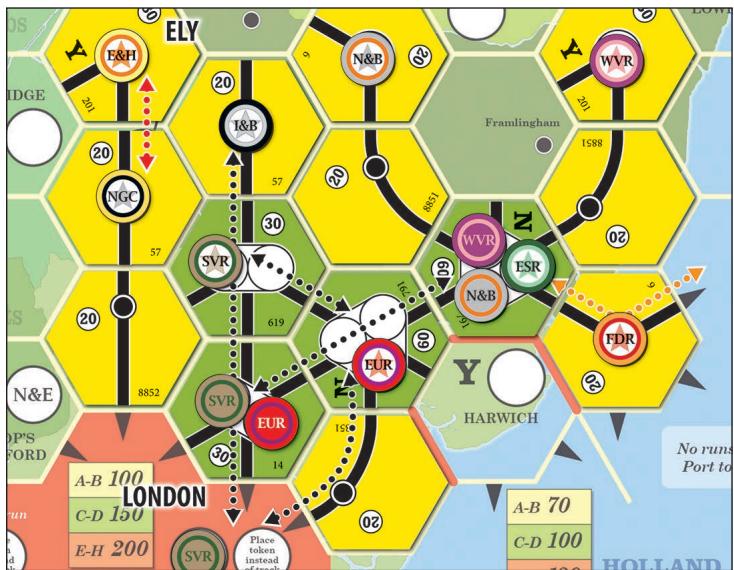
The NGC only has a route from its home to Ely (traced north) as shown by the red arrow. It does not have a route into London as it
does not have a token in London.
The SVR has routes as shown by the black arrows. It cannot trace past Ipswich as Ipswich is blocked by other station markers, and it cannot trace a route back out of London to Newmarket (where the NGC is), as markers in London cannot be used to trace routes.
The FDR (orange arrow) only has a route from the sea to Felixstowe and Ipswich. It cannot trace further than this as Ipswich is blocked by other station markers.
7.5 Mergers and Acquisitions – Mergers
The operating company can merge with another at the start of its operating turn. The other company might or might not have already operated in this operating round.
If the other company has not operated, then the company which results from the merger will continue the operating turn directly after the merger is complete, in lieu of the remaining portion of the operating turn of the original company.
If the other company has already operated, then the operating turn ends immediately after the merger. The resulting company does not operate until the next operating round.
7.5.1 Consent
A merger only occurs if the directors of the two participating companies agree. The active player—that is, the director of the active company—determines which company will remain in play after the merger and which will be returned to the IPO.
7.5.2 Connection
A merger can only happen if the two companies merging are connected by track. Specifically, there must be an uninterrupted route between a station marker belonging to one of the companies to a station marker belonging to the other. This includes cases where the two companies have station markers occupying the same station. Markers in London may not be used to trace connections (7.2).
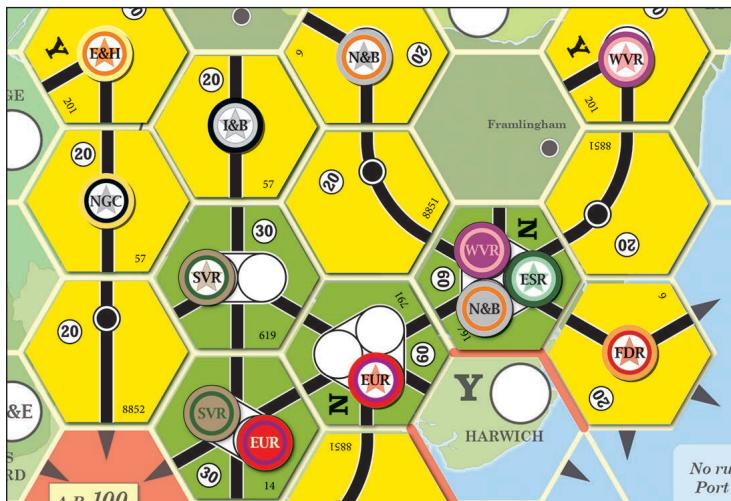
EXAMPLE: The FDR may merge with the WVR, ESR, and N&B, but is blocked from merging with the EUR, SVR, and I&B as it cannot trace a route past Ipswich. The SVR, ESR, N&B, EUR, SVR, and I&B may all merge with one another. The NGC and E&H may merge with one another, but not with any other companies as they cannot trace a route through London to reach the other companies’ station markers.
It is worth remembering that when a company has its first operating turn it is allowed to merge. Please see the section on a company’s first operating turn, above.
7.5.3 New Share Price
A new share price is calculated as the lower share price plus half the higher share price, rounded down to the nearest valid share price. If either company is train-less, treat the train-less company share price(s) as being worth half, rounded down, before applying the above calculation.
E.g. Two companies with trains have share prices of 68 and 100.
New share price = 68+(100/2) = 118, rounded down to 116. E.g. Two companies with trains have share prices of 54 and 6
Content is long; only the first part is inlined. Download the file or open the rules page for the full text.
Download MarkdownTexts are community-compiled or publicly released by publishers; copyright remains with the original authors. For personal reference only.