
Advanced Squad Leader
At a glance
Rules, cards and Q&A (Chinese)
The rules, card data and player questions for this game are written in Chinese. Open the Chinese page to read them.
Where to find full rules
Full rules and card lookup are available in the cunlema app at cunlema.cn — pick this game and ask about any rule, card or turn you are unsure about.
Related games
- Twilight Imperium: Fourth Edition
- War of the Ring: Second Edition
- Pacific War: The Struggle Against Japan, 1941-1945 (Second Edition)
- Twilight Struggle
- Empire of the Sun: The Pacific War 1941-1945
- Imperial Struggle
- Advanced Squad Leader: Starter Kit #1
- Tanto Monta: The Rise of Ferdinand & Isabella 1470-1516
- The Last Hundred Yards
- Risk
Rulebook text (Markdown)
This game has 1 rulebook Markdown file(s) in our library; 1 rendered inline below — expand to read or download.
advanced-squad-leader_Official-Rules.md256.4 KB
ADVANCED SQUAD LEADER STARTER KIT RULES
through ASLSK #4 Pacific Theatre of Operations with subsequent errata, updated through 01/31/2020
Order of Presentation
Introduction...... 3.4 Defensive Fire Phase (DFPh)...14
1.0 Game Components....... ….2 3.5 Advancing Fire Phase (AFPh) ............14
1.1 Mapboard ...... ..2 3.6 Rout Phase (RtPh) 14
1.1.1 Terrain Types 3.7 Advance Phase (APh).16
1.2 Counters 3.8 Close Combat Phase (CCPh)...........16
1.2.1 Single-Man Counters (SMC) 3.9 Turn Record Chart..18
1.2.2 Multi-Man Counters (MMC) 4.0 Weapons and Support Weapons (SW.......19
1.2.3 Broken Side 4.1 Machine Guns (MG)..19
1.2.4 Support Weapons (SW) 4.2 Flamethrowers (FT) ........... ….19
1.2.4.1 Rate of Fire (ROF) 4.3 Demolition Charges (DC)...19
1.2.5 Smoke 4.4 Light Anti-Tank Weapons (LATW)....19
1.2.6 Guns 4.4.1 Bazooka (BAZ) & Panzerschreck (PSK)
1.2.7 Vehicles 4.4.2 Panzerfaust (PF)
1.3 Scenario Cards... 4.4.3 Backblast
1.4 Dice 4.4.4 Anti-Tank Rifles (ATR)
2.0 Definitions 4.4.5 PIAT
3.0 Sequence of Play ... 4.5 Light Mortars.... ...20
3.1 Rally Phase (RPh) 5.0 ELR and Unit Distinctions........
3.2 Prep Fire Phase (PFPh) and 5.1 Experience Level Rating (ELR)......20
Fire Attacks ... ..8 5.2 Nationality Distinctions..20
3.2.1 Line of Sight (LOS) 5.3 Field Promotions .... …..21
3.2.2 Fire Attacks 5.4 Inexperienced MMC... .....21
3.2.2.1 Triple Point Blank Fire (TPBF) 5.5 Captured Equipment.... ...21
3.2.3 Effects 6.0 Ordnance .... ..21
3.2.4 To Hit Process 6.1 Critical Hits (CH).... …..21
3.2.5 Prep Fire Phase (PFPh) 6.2 Special Ammo and
3.3 Movement Phase (MPh)....12 Depletion Numbers... …..211
3.3.1 Infantry Movement 6.3 Emplacement..... ....21
3.3.2 Vehicle Movement 6.4 Hidden Initial Placement (HIP)...........21
3.3.2.1 Motion Status Attempt 6.5 Gun Movement.... …..22
3.3.2.2 Bounding First Fire 6.6 Gunshield .... ..22
3.3.3 Defensive First Fire...... .....13 6.7 Guns as Targets.. ….22
3.3.4 Reaction Fire 6.8 Infantry Firepower Equivalent (IFE)....22
3.3.5 Residual Fire 6.9 Mortars .... .....22
Introduction:
Welcome to the 4th Core Module in the Advanced Squad Leader Starter Kit (ASLSK). This module features the Pacific Theater of Operations (PTO) and will introduce you not only to the primary material necessary for the ASLSK experience but also to the Japanese and U.S. Marine Corps forces as well. Advanced Squad Leader (ASL) is a detailed wargaming system that can simulate any company level ground action from any theater of World War II. Playing pieces represent squads, half-squads, leaders, crews, Guns, and vehicles from every major and minor combatant of World War II. The battlefields are represented by geomorphic mapboards upon which the counters are maneuvered. Starter Kits provide the new player with an easy method of becoming familiar with the basics of the ASL system using entry-level scenarios, counters, boards, and rules. Abbreviations have been used for many of the terms presented in the rules. While you will become familiar with them through use, the Definitions section provided in the rules can be a helpful reference to this special terminology.
6.10 Target Acquisition. ..23
6.11 Area Acquisition... ...23
6.12 Ordnance Breakdown.... ..23
7.0 Vehicles.... ...23
7.1 Armor Factors (AF)...... ....23
7.2 Main Armament (MA) and
Turret Types...... ..23
7.2.1 Low Ammo
7.3 Vehicle Target Size.... ...23
7.4 AFVs as Cover and Wrecks... ....24
7.4.1 AFV/Wreck LOS Hindrance
7.5 Vehicular Smoke Dispensers.....24
7.6 Bog and Ground Pressure..... ....25
7.7 Crew Exposed (CE)/Buttoned Up
(BU).... ...26
7.8 Vehicular Machine Guns/IFE Fire........26
7.9 To Kill Process... ....27
7.10 AFV Effects..... ....27
7.11 Area Target Type Results.. …..8
7.12 Collateral Attack.... ....28
7.13 Open-Topped (OT)... ....28
8.0 Pacific Theater.... ...28
8.1 The Japanese. ...28
8.2 PTO Terrain ...30
8.3 Concealment... ..31
8.4 U.S. Marine Corps & Early U.S. Army...33
(Although all of section 8 is new, it has not been
highlighted in the rules.)

Squad counters represent approximately 9-15 men, depending on nationality and type. Individual leader counters represent combat leaders historically present at the battle and also help represent the overall combat independence of the unit to which they are attached. Each squad and each leader is given a morale level on its counter; the higher the morale level, the better it can stand up in combat and the quicker it can recover from setbacks. Support weapon, Gun, and vehicle counters represent individual weapons beyond the organic small arms that are already included in the firepower values given each squad and half-squad counter. Firegroups for attacking enemy units are put together from the combined firepower of individual units and weapons. After totaling the firepower of the attack, two six-sided dice are rolled and that result (modified by various factors) is cross-referenced with the applicable firepower column of the Infantry Fire Table to determine the result of the attack. Ordnance, including vehicular Main Armaments, must first secure a hit before checking for results. Results range from no effect, to causing the enemy to check his morale level to see if it breaks, to outright elimination of one or more enemy units. Units also use their firepower in close combat, usually in an all-or-nothing fight to the death.
Each ASLSK scenario simulates a historical battle by providing both the Attacker and the Defender with an order of battle containing specific units and weapons with which to maneuver in an effort to achieve specified victory conditions. The geomorphic mapboards can be arranged in numerous combinations to represent the varied battlefields of World War II.
ASLSK Pacific Theater of Operations is a complete game that introduces the player to a new nationality and theater of combat. It includes mapboards and scenarios, and counters representing squads, half-squads, leaders, support weapons crews, crew-served ordnance weapons, and vehicles as well as simplified rules and terrain to use them with. You may use this material to expand your ASLSK options or it may tempt you to enter the fantastically detailed world of tactical wargaming by venturing into ASL. In either case, the material presented herein—rules, mapboards, and counters—is designed to be fully compatible with previous installments of ASLSK and with ASL. You will not need any other product to play this game, it is completely self-contained; however, you can find additional material for ASL and many other fine products at www.multimanpublishing.com. Additional ASLSK scenarios are available in SPECIAL OPS magazine.
These rules have been color-coded to show what has been revised from ASLSK Historical Module #1. Any rules or wording in salmon have been revised to correct errata from previous ASLSK rulebooks. This rule booklet takes precedence over the rulebooks found in ASLSK #1, 2, 3, EP #1, and Historical Module #1. Finally note that ASLSK PTO contains all the counters needed to play the eight scenarios under average circumstances. ASLSK is a game of wide possibilities, however, and exceptional circumstances in a given playing may result in a shortage of a particular counter.
1.0 Game Components
1.1 Mapboard:
This ASLSK module contains three geomorphic mapboards (m, n, and o). These represent the battlefield and can be butted end-to-end or sideto-side together with others to form different playing areas. Superimposed over each map is a hex grid used to measure distance. Each hex contains a specific type of terrain. Different types of terrain have different effects on movement and combat. Each hex also contains its own grid coordinate that indicates its location on the map (e.g., hex K2). Listing the mapboard in front of the coordinate (e.g., mK2) provides a unique identifier for any hex in the system. Each hex contains a white dot that marks the center of the hex. This is used in determining Line of Sight (LOS). Half hexes along the board edge are the equivalent of hexes, although the grid coordinate and white center dot may be missing.
1.1.1 Terrain Types:
For aesthetic purposes, terrain symbology may extend marginally out of a hex into an adjacent hex of another terrain type, but most hexes are dominated by one specific terrain type and are governed by the rules for that specific terrain type. Usually the dominant terrain type includes the hex center dot, but occasionally non-Open Ground hexes have a hex center dot in Open Ground. Some terrain is harder to move through than other terrain; movement costs are expressed in Movement Factors (MF) for Infantry and in Movement Points (MP) for vehicles. Terrain can also block or hinder Line of Sight (LOS) and can provide some cover by modifying fire attacks with its Terrain Effects Modifier (TEM).
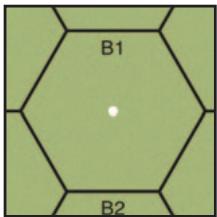
Open Ground: Open Ground is any hex devoid of other printed terrain features, generally covered uniformly in light green such as hex mB1. Open Ground presents no obstruction or Hindrance
to LOS, and the only TEM for Open Ground is the -1 First Fire Movement in Open Ground (FFMO) Dice Roll Modifier (DRM) vs moving Infantry. Open Ground costs Infantry 1 MF to enter. Open Ground costs a Fully Tracked vehicle 1 MP and an Armored Car 3 MP.
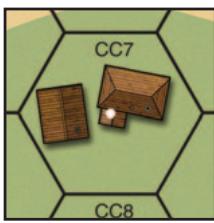
Buildings: Buildings represent man-made dwellings of various sizes. Any hex that contains a gray or brown rectangular overhead building depiction is a building, such as mCC7. If the LOS between two units
crosses the building depiction then the building hex is an obstacle to both units if they are on the same level as the building. The building depiction is also a LOS obstacle between two units at different levels. A building costs Infantry 2 MF to enter. A Mortar may not fire from a building. An Armored Car may not set up in or enter a building. A Fully Tracked Armored Fighting Vehicle (AFV) that is Buttoned Up (BU; 7.7) may enter a building at half its total MP allotment while taking a Bog Check (7.6). The TEM for a stone (gray) building is +3 and for a wooden (brown) building is +2.
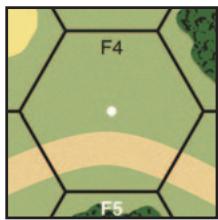
Roads: Roads represent either paved or dirt surfaces. A road represented by a brown stripe, such as nF4, is a dirt road while one represented by a gray stripe, such as sP6, is a paved surface. A road is
considered Open Ground for all purposes. Additionally, Infantry that crosses only road hexsides throughout its entire MPh is entitled to one extra MF (the road bonus) unless it claims the protective benefits of a Woods-Road hex or the non open ground of an Orchard-Road hex, or has to pay the extra movement costs for entering Smoke (1.2.5). Crossing a road hexside costs both Armored Cars and Fully Tracked vehicles ½ MP if Crew Exposed (CE; 7.7) or 1 MP if Buttoned Up (BU).
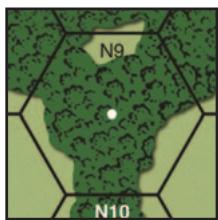
Woods: Woods represent a forested area with dense undergrowth, such as oN9. If the LOS between two units crosses the woods depiction then the woods hex is an obstacle to both units if they are on
the same level as the Woods depiction. Woods are also a LOS obstacle to the LOS between two units at different levels. Woods cost Infantry 2 MF to enter. Woods cost an Armored Car all its MP while taking a Bog Check (7.6). A Fully Tracked vehicle may choose to spend either half or all its total MP to enter a woods hex while taking a Bog Check (7.6). A vehicle spending all its MP to enter a woods hex may still spend 1 MP to start and 1 MP to stop. The severity of the Bog Check DRMs depends on how many MP the vehicle expended to enter the woods hex. The TEM for woods is +1. Mortar fire vs Infantry or CE vehicles in a woods hex instead receives a -1 TEM due to Air Bursts.
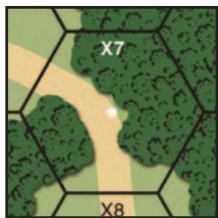
Woods-Road: A moving unit in a Woods-Road hex, such as nX7, is not eligible for the +1 Woods TEM during Defensive First Fire (and is subject to FFMO or Interdiction) if the LOS does not cross
a green woods symbol and the moving unit entered the hex at the road movement rate. Otherwise normal Woods TEM is in effect; an Infantry unit may always choose to utilize the woods movement rate and receive resultant TEM benefits. The road portion does not block LOS. A unit using a road through a woods hex pays the normal road movement rate rather than the woods movement rate. A vehicle in a Woods-Road hex is always considered to be on the road.

Orchard: An Orchard represents a thinly wooded area devoid of undergrowth such as mO3. An orchard is a Hindrance to same level LOS and therefore adds a +1 Hindrance DRM for every orchard
hex between the target and the firer. Orchards cost Infantry 1 MF to enter. Orchards cost an Armored Car 3 MP and a Fully Tracked vehicle 1 MP to enter. There is no TEM for Orchard but because it is not Open Ground it negates FFMO and Interdiction.
Orchards are in season during the months of April through October. An in-season orchard is an obstacle to any LOS drawn between units at different elevations. Each out-of-season orchard hex (November through March) adds a +1 Hindrance DRM to any LOS drawn between units at different elevations. An Orchard hex is considered Inherent Terrain (3.2.1) so the entire hex including hexsides affect LOS drawn through an Orchard hex.
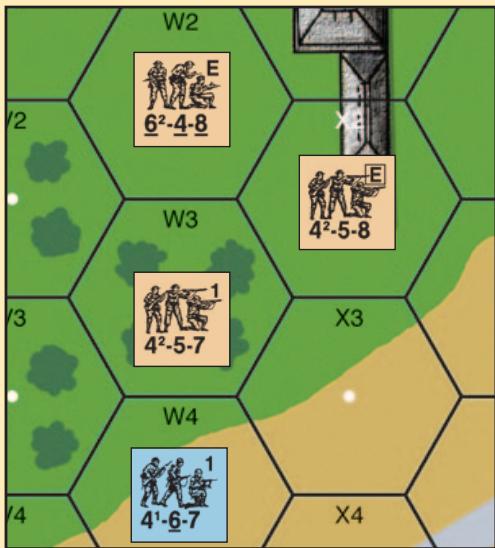
The orchards are in season. The German 4-6-7 is on the level one hill while the British units are all at level zero. The orchard in wW3 blocks LOS between the 4-6-7 at level one and the 6-4-8 and 4-5-8 at level zero. If the orchards were not in season the W3 orchard would provide a +1 Hindrance instead. The German 4-6-7 and the British 4-5-7 in hex W3 have an unhindered LOS to each other regardless of the season.

Orchard-Road: A hex containing both orchard and road symbols such as oY2 is actually a treelined road. Entrance of such a hex through a road hexside is identical to movement along any road. Hindrances do not apply to such hexes if that portion of the LOS from firer to target never leaves the confines of the road depiction regardless of elevation differences. In such cases, the -1 FFMO DRM applies to Infantry using the road to move. Otherwise, orchard-roads are identical to orchards in every respect.
Orchard Example
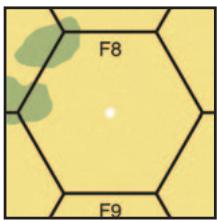
Grain: While in season, Grain represents a cultivated field of a variety of standing crops such as mF8. Grain is a LOS Hindrance between units on the same level as the Grain feature and therefore adds a +1 Hindrance
DRM for every grain hex between the target and the firer in which the LOS crosses the Grain depiction. Grain is in season during the months of June through September. Outside this season grain hexes are treated as Open Ground instead. Grain costs Infantry 1½ MF to enter when in season. Grain costs an Armored Car 4 MP to enter and a Fully Tracked vehicle 1 MP. There is no TEM for Grain but because it is not Open Ground (unless out of season) it negates FFMO and Interdiction.

Brush: Brush represents a thinly wooded area with dense undergrowth such as nT4. Brush is a LOS Hindrance between units on the same level as the Brush feature and therefore adds a +1 Hindrance
DRM for every brush hex between the target and the firer in which the LOS crosses the Brush depiction. There is no TEM for Brush but because it is not Open Ground it negates FFMO and Interdiction. Brush costs Infantry 2 MF to enter, costs an Armored Car 4 MP, and costs a Fully Tracked vehicle 2 MP.
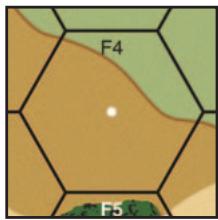
Hills: Hills represent terrain elevations that rise a full level above ground level, and any terrain on them rises normally from this new level to form new height equivalents. All hills are terrain obstacles
to LOS involving a unit not on a hill. A hill mass is depicted in a brown shade such as oF4; however for aesthetic purposes some hexes may contain both the color of the hill mass and the color of the ground level. Hexes, units, and terrain (including Inherent Terrain) are always considered to be at the elevation level containing the hex center dot. Any hill hex devoid of other terrain is also an Open Ground hex. FFMO and Interdiction will not apply if a moving/routing unit is eligible for Height Advantage (see below). A one-level (building/ woods/orchard) obstacle on a level-one hill hex becomes a two-level obstacle.
Two units on hill hexes will have LOS to each other unobstructed by any terrain that is not also on a hill. Neither ground level grain nor brush will hinder LOS between one unit on a hill and another that is not.
A Crest Line is formed in every hex where two different full level elevations meet, such as oF4. Crest Lines are important both for determining movement costs and defining the slope of the hill for possible LOS obstructions. When Infantry crosses a Crest Line into higher terrain the unit must expend double the Cost of Terrain (COT) of the hex entered. Vehicles pay the cost of the terrain in the hex plus an additional 4 MP to cross a Crest Line into higher terrain or an additional 2 MP if crossing the Crest Line via a road hexside.
Any unit receiving non-mortar fire from a lower elevation is entitled to a +1 Height Advantage TEM, provided that unit is not eligible to receive any other positive TEM. In addition, a unit eligible for the +1 Height Advantage TEM is not sub-
Height Advantage and Hill LOS Example
The German 4-6-7 in wE9 can see the American 6-6-6 in hex I7 unhindered by the grain in F8, although such an attack by the 4-6-7 against the 6-6-6 would qualify for the +1 Height Advantage TEM. It costs the
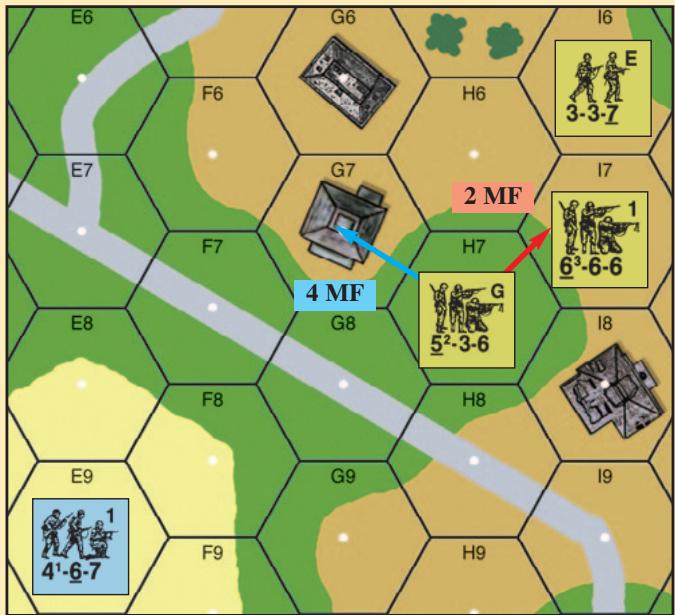
5-3-6 in H7 2 MF to move to I7 (Open Ground 1 MF doubled for crossing the Crest Line uphill). The 5-3-6 would not qualify for Height Advantage TEM for attacks from the 4-6-7 during the MPh because the moving unit crossed a Crest Line that is intersected by the firer's LOS. The 4-6-7 has no LOS to the 3-3-7 in I6 (and vice versa). If the 3-3-7 moves from I6 to I7 (1 MF), then LOS would exist with the 4-6-7, and the 3-3-7 would receive Height Advantage TEM versus an attack by the 4-6-7. If the 5-3-6 in H7 were instead to move to G7, the cost would be 4 MF (building COT of 2 doubled for crossing a Crest Line uphill, requiring the Green 5-3-6 to first declare Double Time), and the 5-3-6 would receive building TEM rather than Height Advantage.
ject to Interdiction or FFMO from an attack to which that +1 TEM applies. As an exception, a unit is not eligible for the Height Advantage TEM during the MPh or RtPh if in entering the target hex it crosses a Crest Line through the same hexside that is intersected by the firer's LOS.
Class (E, 1, 2, C/G)
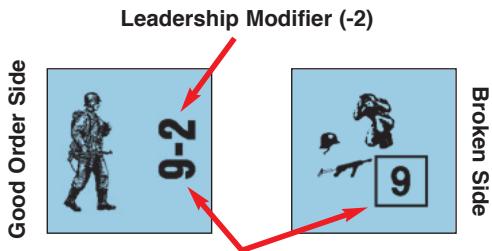
Morale (9; box = self-rally capability)
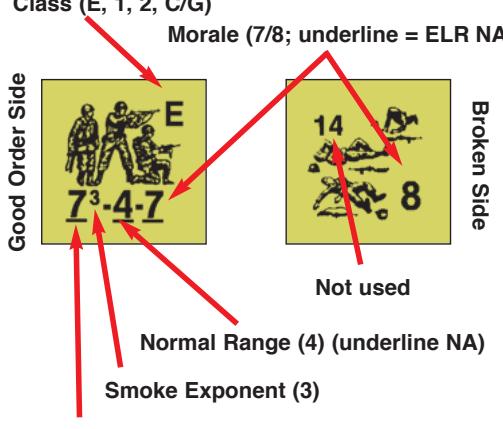
Firepower (7; underline = assault fire)
1.2 Counters:
There are five types of counters used in this game: informational markers, personnel markers, support weapons (SW), Guns, and vehicles. Informational markers are used by both sides and are generally memory devices. These include such counters as Prep Fire, First Fire, Pin, Desperation Morale, Smoke, and Crew Exposed. Informational counters will be described during the discussion of the Sequence of Play. Personnel counters come in two main types: Single-Man Counters and Multi-Man Counters.
1.2.1 Single-Man Counters (SMC):
SMC (or leaders) are elite units, which bear a single silhouette and represent just one man. Leaders have a two number strength factor, which consists of the leader's morale (on the bottom), and his leadership DRM (on the top). The latter is expressed as a negative number or a zero, or occasionally a +1. An unbroken, unpinned leader may use his leadership DRM to affect the performance of other personnel in his location (unless they are moving separately). Leadership modifiers are not cumulative. A leader may attempt only one action per phase, but may use his leadership modifier (even if 0 or +1) more than once in the same phase only to attempt to rally more than one unit in a RPh, to direct ROF and/or Defensive Fire attacks, and to assist units with Morale Checks (MC).
1.2.2 Multi-Man Counters (MMC):
MMC are units that bear the silhouette of more than one man. There are three types of MMC used in this game: squad, half-squad (HS), and crews. A squad bears the silhouette of three men, a HS that of two men, and a crew that of two men kneeling. Crews are always elite. The squads and HS counters are defined as either E (Elite), 1 (1st Line), 2 (2nd Line), G (Green), or C (Conscript) which is noted in the upper right hand corner of the counter. Two HS or crew counters equal one squad in size.
Each MMC contains a three-digit number called its strength factor that quantifies its capabilities in the game. Firepower (FP) is the leftmost factor and represents the FP the MMC can attack with prior to any modification. The middle number (its normal range) is the number of hexes away that it can reach with its full FP. The third strength factor is its Morale, the relative rating of a unit's ability to withstand punishment before breaking. Some squads have a Smoke Exponent as a superscript to their FP strength to indicate they can attempt to place Smoke grenades.
1.2.3 Broken Side:
The reverse side of each SMC and MMC is its broken side. The large number in the lower right corner is its broken morale level. If the broken morale level is encased in a square, that unit is capable of self-rally.
1.2.4 Support Weapons (SW):
These ½" counters represent weapons that must be possessed by MMC or SMC to be used (4.0). These include Machine Guns (MG), Flamethrowers (FT), Demolition Charges (DC), Light Mortars, and Light Anti-Tank Weapons (LATW). These SW are possessed by the unit stacked immediately beneath them. A SW must be possessed to be fired or moved. SW have a portage requirement (Portage Points or PP) listed on the counter. SW have both a range and a FP that is utilized like that of an MMC. Some SW (e.g. MG) may malfunction, in which case they are flipped over to their broken side. The repair number is shown in the upper left corner. The “6" in the lower right corner indicates permanent removal if the original repair dr is 6.
1.2.4.1 Rate of Fire (ROF):
Some weapons have multiple Rate of Fire (ROF) shown by a number encased in a square. If the colored die roll in a fire attack DR is less than or equal to the ROF, such an unpinned SW or Gun or vehicle Main Armament (MA) may fire again in that phase (except the AFPh) until the ROF is exceeded by the colored die roll or the Weapon or its manning Infantry is marked with a Final Fire counter (e.g., uses Subsequent First Fire). The normal ROF indicated on a counter can be decreased due to certain circumstances listed on the Quick Reference Data Card (QRDC). See also the Area Target Type (ATT) discussion in 3.2.4.
1.2.5 Smoke:
½" Smoke is placed by Infantry during the MPh
(3.3) and is removed at the end of
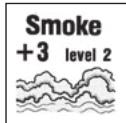
that MPh. %" Smoke lasts longer and is placed by Ordnance at the start of the PFPh or DFPh by securing a hit with the Area Target Type (ATT). Vehicles may also dispense Smoke during the MPh (7.5). If done in the PFPh, place a +3 full Smoke counter or +2 if White Phosphorus (WP); if done in the MPh or the DFPh, place a +2 Dispersed Smoke counter (+1 if WP). At the start of the placing player's next PFPh, remove all Dispersed Smoke counters and flip all full Smoke counters to the Dispersed side. Smoke represents an inherent LOS Hindrance; any fire traced through or into a Smoke hex is subject to an additional Hindrance DRM per hex (+3 for full %" Smoke; +2 for ½" Smoke, Dispersed Smoke, or WP; +1 for Dispersed WP and up to a maximum of +3 per hex); fire traced out of a Smoke hex incurs an additional +1 DRM. Any movement during the MPh/RtPh into (but not out of) Smoke costs one additional MF/MP.

1.2.6 Guns:
Any ordnance-capable non-vehicular weapon depicted on a %" counter is termed a Gun (6.0). A Gun
must be manned by a crew counter to fire without the +2 Non-Qualified Use penalty. Guns are possessed, transferred, recovered, and destroyed as if a SW (4.0). There are five types of Guns. The type is depicted on the counters in abbreviated form. They are: MTR = Mortar, AT = Anti-Tank Gun, INF = Infantry Howitzer, ART = Artillery, and AA = Anti-Aircraft Gun. These roles should not be taken literally. An Anti-Tank Gun is free to fire at Infantry, etc. The Gun counter front will also indicate its caliber size (in mm), its target size (6.7), its manhandling number (6.5) and, if any, its ROF, its Infantry Firepower Equivalent (IFE; 6.8), and its 360 degree status (3.2.4). Some Guns are Quick Set Up (QSU on back of counter), and thus able to move via manhandling. Other Guns cannot move during the course of an ASLSK scenario because they must be limbered to move (as indicated by Limbered on the back of the counter). Only small target Guns and AT/INF Guns that are not large targets may occupy a building hex.
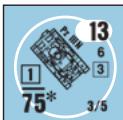
1.2.7 Vehicles:
All vehicles (7.0) are represented by %" counters. ASLSK contains two types of Armored Fighting
Vehicles (AFV). An Armored Car is recognizable by the white circular background behind its MP number. Fully Tracked vehicles (e.g., tanks, tankettes, assault guns, etc.) are recognizable by the white oval background behind the MP number. The front of a vehicle counter will also indicate its Main Armament type, its ground pressure, its target size, its ROF (if any), its Armor Factors (AF), its Turret Type, and its vehicular MGs.
1.3 Scenario Cards:
Each game begins with the scenario card which depicts the information and components required to play the game: the board(s), the units, and Weapons (with the quantity of each printed beneath its depiction), where the units set up or enter, game length, the victory conditions, the historical setting, and any scenario special rules (SSR) required to play the scenario. Note that when a specific board is identified as qualifying for Victory Conditions or the only board on which a unit may set up, the partial hexes of that board that mate to another board do not qualify for Victory Conditions or setup.
1.4 Dice:
One six-sided white die and one six-sided colored die. Sometimes a dice roll (DR) of both is required; sometimes a die roll (dr) of just one is required. The colored die is also used for determining ROF, backblast, vehicular hit location, and Bog removal.
2.0 Definitions:
A#: APCR (Armor Piercing Composite Rigid) Depletion Number.
AAMG: Anti-Aircraft Machine Gun; must be CE to use, range is 8 hexes.
AC: Armored Car; recognizable by the white circle behind its MP allowance.
Acquired Target: A TH DRM of either -1 or -2 gained by a vehicle Main Armament, Gun, or Mortar that fires at the same target again. Infantry and Vehicle Target Type use a ½" Acquisition counter, and Area Target Type uses %" Acquisition counters (6.10 and 6.11).
AF: Armor Factor (7.1).
AFPh: Advancing Fire Phase (3.5).
AFV: Armored Fighting Vehicle; any vehicle that has an Armor Factor.
Air Burst: Mortar fire vs Infantry or CE vehicle in a woods hex receives a -1 (instead of a +1) TEM (1.1.1).
Ambush: When units advance into CC while concealed (8.3), or vs concealed units, or into certain terrain, ambush might occur (3.8). The ambushing side receives a -1 DRM to its CC attacks and a +1 DRM to CC attacks against it; it resolves all its CC attacks first, and only surviving enemy units may attack back.
AP: Armor Piercing (6.2). AP can be used on the VTT and the ITT (with reduced effectiveness) but cannot be used on the ATT.
APh: Advance Phase (3.7).
Area Fire: The firepower of a non-ordnance attacking unit is halved for each case of Area Fire (3.2.2, 3.2.3, 3.3.2.2, 3.3.3, 3.4, 3.5, 4.1, and 6.4).
Area Target Type (ATT): One of three general target types used by Ordnance. Must be used by Mortars and whenever Ordnance fires Smoke; cannot be used by LATW or when firing other than HE or Smoke/WP (3.2.4).
Aspect: Location of a vehicular hit divided between turret and hull as well as front, side, or rear facing (3.2.4 and 7.1).
Assault Fire: An attack in the AFPh available to MMC that have underscored firepower factors (3.5).
Assault Movement: A type of Infantry movement (3.3.1).
ATR: Anti-Tank Rifle (4.4.4).
ATTACKER: The player whose Player Turn is currently being played.
B#: Breakdown number of a Weapon or vehicle MA (Weapon or MA is repairable) (4.0 and 6.12).
Backblast: A condition of firing a BAZ, PSK, or PF from inside a building (4.4.3).
Banzai Charge: Japanese units during their MPh can charge into an enemy-occupied hex under certain circumstances (8.1.8.6).
BAZ: Bazooka, an American Light Anti-Tank Weapon (4.4.1).
Blind Hex: A hex that cannot be seen due to LOS obstacles.
BMG: Bow Machine Gun; range is 8 hexes.
Bog: A vehicle's temporary immobilization due to failing a Bog Check caused by environmental or terrain constraints (7.6).
Bounding Fire: Fire by a vehicle in the AFPh after movement to a new hex during the MPh (3.3.2.2 and 3.5).
Bounding First Fire: Fire by a vehicle during its own MPh before or after moving (3.3.2.2).
BU: Buttoned Up (7.7).
Casualty Reduction: A combat result that eliminates a HS or crew or wounds a SMC. A squad is reduced to a HS (3.2.3).
CA: Covered Arc, the direction a Gun is facing as depicted by the gun barrel (3.2.4).
CC: Close Combat (3.8).
CCPh: Close Combat Phase (3.8).
CCT: Close Combat Table.
CCV: Close Combat Value.
CE: Crew Exposed (7.7).
Center Hex Dot: The white dot in the middle of the hex from which LOS is determined (1.1).
CH: Critical Hit (6.1).
Close Combat Reaction Fire: Also known as CC Reaction Fire, this is a form of Defensive First Fire available to Infantry in the same hex as an enemy AFV (3.3.4).
CMG: Coaxial Machine Gun, range is 12 hexes.
Concealment: An application of "fog of war" to limit knowledge about opposing forces by placing units under a concealment (“?") counter. Concealed units gain certain advantages as specified in the rules (e.g., Area Fire, +2 TH DRM, -2 ambush drm). Available when PTO Terrain is specified or by SSR (8.3).
Control: A Good Order Infantry MMC gains control of the hex or building it occupies without the presence of an enemy unit. This is often required for purposes of victory determination. Not all hexes of a building need to be occupied for a unit to Control a building if there are no enemy units in the building at the time a friendly unit enters the building. An AFV Controls the hex it presently occupies if that hex is devoid of Good Order enemy units; Control reverts immediately to its former condition when the AFV leaves the hex. At scenario start a side gains Control of all hexes/buildings within its set-up area (except for those within both sides' set-up areas), as well as all hexes/buildings on a board if that side is the only side which may set up on that board at scenario start.
COT: Cost of Terrain; the cost in MF/MP to enter a hex of a given type. The actual cost to enter a hex may be higher (e.g., crossing a Crest Line to a higher elevation).
Cowering: The penalty for MMC rolling doubles on an IFT attack without leader direction (3.2.2). Does not apply to Ordnance, IFE, or any vehicle fire.
CX: Counter Exhausted; the status of a unit after it declares Double Time (3.3.1) or uses all its MF in the APh (3.7).
D#: APDS (Armor Piercing Discarding Sabot) Depletion Number.
DC: Demolition Charges (4.3).
DEFENDER: The player whose Player Turn is not presently being played.
Defensive First Fire: Firing at moving units in the MPh (3.3.3).
DFPh: Defensive Fire Phase (3.4).
Depletion Numbers: Numbers on the back of Ordnance or vehicle counters that represent its supply of Special Ammo (6.2).
Direct Hit: A KIA/K final DR (prior to Gunshield DRM) result on the IFT after an Ordnance hit against a Gun (6.7).
DM: Desperation Morale (+4 DRM on rally attempts) (3.1, 3.2.3, and 3.6).
Double Time: An Infantry unit may add 2 MF to its MPh by becoming CX (3.3.1).
dr: die roll; a roll of just one die (1.4).
DR: dice roll; a roll of two dice (1.4).
drm/DRM: Die roll (or Dice roll) modifier; a mathematical adjustment either positive or negative to the original die roll or dice roll.
Emplaced Gun: A Gun that was not set up on a paved road and has not moved receives a +2 Emplacement TEM (6.3).
FFMO: First Fire Movement in Open Ground; a -1 DRM vs moving Infantry in Open Ground; does not apply if there is a LOS Hindrance (3.3.1).
FFNAM: First Fire Non Assault Movement; a -1 DRM vs moving Infantry provided the target is not using Assault Movement (3.3.1).
FG: Fire Group; two or more units and/or MG/ATR joining together to make a combined fire attack (3.2.2). Ordnance may not combine. A vehicle's MG/IFE may not combine with other units.
FP: Firepower; the strength with which a unit (or FG) attacks (1.2.2 and 3.2.2).
FPF: Final Protective Fire (3.3.3).
FT: Flamethrower (4.2).
Full-Strength: A Japanese squad/crew has no Broken side; it starts as Full-Strength (no red stripe) but can become Reduced-Strength (with a red stripe) via Step Reduction (8.1.2).
Fully Tracked: A vehicle that is identified by a white oval behind its MP number.
Good Order: An Infantry unit that is neither broken nor marked with a Melee counter. A vehicle that is neither Shocked (including UK) nor Stunned.
Ground Pressure: A DRM for Bog Checks (7.6)
Gun: Any non-vehicular Weapon on a %" counter (1.2.6 and 6.0).
Gunshield: Protection (usually +2 IFT DRM) sometimes available for a crew manning an AT or INF Gun (6.6).
H#: HEAT (High Explosive Anti-Tank) Depletion Number.
Hazardous Movement: Type of movement used by units manhandling a Gun (6.5).
HE: High Explosive (6.2); default Ordnance ammunition when using the ITT and ATT. Can be used on the VTT with own To Kill (TK) Table.
HEAT: High Explosive Anti-Tank; used by BAZ, PF, PSK, and PIAT and as Special Ammo by some Guns/MA (4.4 and 6.2).
Height Advantage: Protective TEM for units at a higher elevation (1.1.1).
Hindrance: Some terrain types (orchard, grain, brush) as well as vehicles/wrecks that are not moving targets and Smoke are not substantial enough to completely block Line of Sight (LOS). These are LOS Hindrances and each one hinders same level fire traced through it (but not into) and does not block it completely. Each Hindrance hex adds a +1 DRM to any same level IFT or TH DR traced through it.
HIP: Hidden Initial Placement for Guns (6.4).
Hit: Ordnance must secure a hit (via the To Hit process; 3.2.4) prior to resolving an attack via the IFT or To Kill Tables.
HS: Half-squad.
IFE: Infantry Firepower Equivalent.
IFT: Infantry Firepower Table.
Immobilized: A vehicle that, due to combat effects (including Shock or Stun results), the effects of Bog, or Mechanical Reliability may not change hexes, turn its VCA, or start.
Inexperienced: Green MMC not stacked with a Good Order leader and Conscript MMC suffer Inexperienced penalties: 3 MF; B# or X# lowered by one; cower two columns, +1 ambush drm (5.4).
Infantry: All SMC and MMC.
Infantry Target Type (ITT): One of the three general target types used by Ordnance. Not available to Mortars or LATW. All types of ammo other than Smoke/WP are allowed (3.2.4).
Inherent Terrain: Certain terrain depictions (orchards) and counters (Smoke/wreck/AFV) designate the entire hex including the hexsides
as having the characteristics of that hex. A LOS that enters such a hex (even if traced along such a hexside) is affected by its Inherent Terrain (3.2.1).
Intensive Fire: After losing ROF a Gun or vehicle MA may make one final attack (3.2.4); adds a +2 TH DRM and lowers the B# by 2 (6.12).
Interdiction: A NMC suffered by a unit that routs without using Low Crawl through Open Ground in LOS of an enemy unit in normal range if FFMO could hypothetically apply (3.6).
IPC: Inherent Portage Capacity (4.0).
Known Enemy Unit (KEU): Any unconcealed (8.3) enemy unit to which the friendly unit in question currently has LOS.
LATW: Light Anti-Tank Weapon; a type of non-MG SW, BAZ, PSK, PF, ATR, and PIAT.
LLMC: Leader Loss Morale Check; an additional MC caused at any time by the loss of a leader with higher morale than the unit(s) he is stacked with (3.2.3).
LLTC: Leader Loss Task Check; caused by the breaking of a leader with higher morale than the unit(s) he is stacked with (3.2.3).
LOS: Line of Sight (3.2.1).
Low Crawl: A rout of one hex during the RtPh; avoids Interdiction in Open Ground (3.6).
M#: Manhandling number; a DR required when attempting to move a Gun (6.5).
MA: Main Armament of a vehicle (7.2). This is considered Ordnance unless it is MG/IFE firing on the IFT.
Mandatory Fire Group: Infantry and MG/ATR in the same hex that desire to fire at the same target (or moving stack on the same expenditure) must fire as a FG rather than separately (3.2.2). Ordnance may not combine. A vehicle's MG/IFE would have to combine to fire on the same target.
Melee: A condition existing between opposing units in the same hex after being attacked in Close Combat (3.8).
MF: Movement Factor; a measure of movement capability for Infantry units (3.3.1).
MG: Machine Gun; a type of SW designated as light (LMG), medium (MMG), or heavy (HMG) (4.1). Vehicles may also be equipped with MGs.
Mired: A more severe form of Bog (7.6)
MMC: Multi-Man Counter (1.2.2); squad, halfsquad, or crew.
Mobile: A Good Order vehicle that is neither bogged nor Immobilized.
Mortars: An indirect fire type of Ordnance that must use the ATT. Light Mortars (60mm or less) are SW and can be manned by any Infantry, while all other Mortars are Guns and must be manned by a crew to fire without penalty (4.5 and 6.9).
Motion Fire: Fire by a vehicle that is Non-Stopped or while still in Motion. The MG/IFE firepower of such a vehicle is halved while still
in Motion. In addition there are certain TH penalties (3.3.2.2).
Motion Status: A vehicle that has started since the last time it stopped.
Motion Status Attempt: An attempt by a vehicle, during the opposing player's MPh, to gain Motion status or change VCA (3.3.2.1).
Moving Target: A vehicle/wreck that has moved into a new hex this Player Turn, or that is in Motion, or that started its MPh in Motion.
MP: Movement Point; a measure of movement capabilities for vehicles (3.3.2).
MPh: Movement Phase (3.3).
Near Miss: Any hit vs a Gun not resulting in a KIA/K result prior to Gunshield modification (6.7).
NMC: Normal Morale Check; requires a DR less than or equal to the current morale level of the unit to avoid breaking. Leadership modifiers can apply (3.2.3).
NTC: Normal Task Check; requires a DR less than or equal to the current morale level of the unit to perform certain tasks. Leadership modifiers can apply (3.2.3).
NT: Non-Turreted weapon including all Guns except those with a 360-degree mount (3.2.4). Also includes turretless vehicular MA.
Non-Qualified Use: The use of a Gun by units other than a crew (1.2.6); adds a +2 TH DRM and lowers the B# by 2 (6.12).
Non-Stopped: During the MPh, a vehicle that has not expended a stop MP since its last start MP (3.3.2).
OB: Order of Battle; the forces which compose one side in any scenario as defined by the scenario card.
Ordnance: A Gun, SW (Mortar or LATW), or vehicle MA that must first secure a hit via the To Hit process prior to resolving an attack via the IFT (6.0) against Infantry or prior to the To Kill process against a vehicle (7.9).
OT: Open-Topped (7.13).
PAATC: Pre-AFV Advance/Attack Task Check (3.3.4 and 3.7).
PBF: Point Blank Fire; fire at a target in an adjacent hex. Total firepower is double the normal firepower (3.2.2).
PF: Panzerfaust (4.4.2).
PFPh: Prep Fire Phase (3.2).
PIAT: Projector Infantry Anti-Tank (4.4.5).
Player Turn: The eight consecutive phases that is half of one game turn and during which the ATTACKER can move his forces.
PP: Portage Points represent how difficult a SW is to carry, and are assessed vs a unit's IPC (4.0).
PSK: Panzerschreck, a German Light Anti-Tank Weapon (4.4.1).
PTC: Pin Task Check (3.2.3).
PTO: The Pacific Theater of Operations (PTO) is where both the Japanese (8.1) and the U.S. Marine Corps (8.4) fought. The terrain (8.2) was different, and concealment (8.3) was an integral part of combat.
PTO Terrain: The terrain specific to the PTO, using rules different from the European Theater of Operations. Invoked only by SSR, PTO Terrain transforms woods, brush, orchards, certain buildings, and grain into (respectively) jungle, bamboo, palm trees, huts, and kunai (8.2).
QRDC: Quick Reference Data Card; the card containing the tables needed to play the game.
QSU: Quick Set Up Gun. This Gun may be moved during play via the manhandling process (6.5).
Recall: The condition of an AFV that must exit a friendly board edge as soon as possible (7.10). May be caused by suffering a STUN result, a second Stun result (one Stun if a 1MT), or permanently disabling its MA.
Reduced-Strength: A Full-Strength Japanese squad/crew that fails a MC usually undergoes Step Reduction and becomes a Reduced-Strength squad/crew as signified by a horizontal red stripe on the reverse of a Full-Strength squad/crew (8.1.1 and 8.1.6).
Residual FP: Firepower left in a hex as a result of Defensive First Fire (3.3.5).
RMG: Rear Machine Gun; range is 8 hexes.
ROF: Rate of Fire; a MG, Mortar, Gun, or vehicle MA may be able to attack more than once in a turn. The ROF number is encased in a square (1.2.4.1).
RPh: Rally Phase (3.1).
RtPh: Rout Phase (3.6).
s#: Smoke Depletion Number.
Self-Rally: The capability of a unit to rally itself without a Good Order leader present as indicated by a broken side morale encased in a square (3.1).
Shock: One of the possible results following a To Kill attempt (7.10).
SMC: Single-Man Counter (1.2.1).
Smoke: Smoke grenades placed by an Infantry squad (½" counter; 3.3.1) or smoke shells placed by Ordnance or dispensed by an AFV (%" counters; 6.2 and 7.5), which provide protective cover (1.2.5).
Smoke Exponent: A superscript to a unit's FP strength indicating the ability to attempt to place Smoke grenades (3.3.1).
Squad Equivalent: Two HS or crews are equivalent in size to one squad (1.2.2). A crew or HS manning a Gun is equivalent to one squad (for stacking purposes only).
SSR: Scenario Special Rule (1.3).
Stacking Limits: Each side may have up to three MMC squad equivalents per hex plus up to four SMC (3.3.1). Each side may also have up to one vehicle in a hex.
Step Reduction: When failing a MC, a Japanese squad/crew undergoes Step Reduction rather than breaking. A Full-Strength squad/crew becomes Reduced-Strength, and a Reduced-Strength squad becomes a HS (8.1.3). A Reduced-Strength crew is replaced with a broken reduced-quality (1-2-7) crew (8.1.6).
Stun: A vehicle condition that follows a failed MC, or a MG Final TK DR equal to the Final TK number (7.10).
STUN: A vehicle condition that follows a KIA, K, or a second Stun result (first for a 1MT) or rolling a 12 on a MC (7.10); also results in Recall.
Subsequent First Fire (SFF): Firing again in Defensive First Fire, but as Area Fire (3.3.3).
SW: Support Weapon (1.2.4 and 4.0)
Target Size: A Gun's size as indicated by the color of its M# (6.7). A vehicle's size as indicated by the color of its various armor factors.
TEM: Terrain Effects Modifier; an IFT or TH DRM caused by the terrain of the unit being attacked (3.2.3 and 3.2.4).
TH: To Hit; Ordnance must secure a hit (via the To Hit process) prior to resolving an attack on a unit via the IFT or TK Tables (3.2.4).
TK: To Kill; having secured a hit on the Vehicle Target Type (VTT) table, the To Kill number is used to determine the effect on the vehicle (7.9).
TPBF: Triple Point Blank Fire; fire at a target in the firer's hex; total FP is triple the normal firepower (3.2.2.1).
Turret Covered Arc (TCA): Defined either by the front of the vehicle or by the direction of the Turret counter if different than the vehicle front.
Vehicle: A motorized unit that expends MP, depicted on a %" counter.
Vehicle Covered Arc (VCA): Defined by the front of the vehicle.
Vehicle Target Type (VTT): One of the three general target types used by Ordnance. Not available to Mortars or most LATW. All types of ammo other than Smoke/WP are allowed (3.2.4).
Weapon: Either a support weapon (1.2.4), a Gun (1.2.6), or an AFV's MA (7.2) or MG (7.8).
WP (White Phosphorous): a type of Smoke limited to certain nationalities and Weapons that provides lessened cover (1.2.5) and also inflicts a NMC when it hits (6.2).
WP#: White Phosphorous Depletion Number.
Wreck: A vehicle that has been destroyed is flipped over to its wreck side.
X#: Breakdown number of a FT, DC, BAZ, or PSK (weapon is not repairable) (4.0).
Russian Rally Phase Example
3.0 Sequence of Play:
Illustration before any results

There are eight distinct phases in each Player Turn that are resolved in the following order: Rally Phase, Prep Fire Phase, Movement Phase, Defensive Fire Phase, Advancing Fire Phase, Rout Phase, Advance Phase, and Close Combat Phase. A full turn is recorded when both players have run through the entire sequence as the ATTACKER.
3.1 Rally Phase (RPh):
During the RPh both players attempt to rally their eligible broken units, fix broken equipment, or transfer equipment to another unit in the same location. Other than leaders rallying (themselves and other units) each unit may undertake only one action per RPh. These actions must be done in order:
a) Reinforcements: ATTACKER rolls for any provisional (SSR) reinforcements and sets up offboard all forces due to enter this Player Turn.
b) Recovery: Good Order units may attempt to recover an unpossessed SW/Gun in the same hex by making a dr less than 6 (+1 drm if CX) (ATTACKER first).
d) Transfer of Weapons: Stacks may be freely rearranged to change possession of all Weapons between Good Order units in the same location (ATTACKER first).
c) Repair of Broken Weapons: A Good Order unit possessing a Weapon of its own nationality (i.e., color) may attempt to repair the Weapon by making a dr less than or equal to the repair number on the back of the counter (ATTACK-ER first). A dr of 6 eliminates the Weapon permanently. A Good Order vehicle may attempt to repair each broken MG or MA; a dr of 1 repairs the Weapon and a dr of 6 eliminates it permanently.
e) Self-Rallies: Both sides may attempt to selfrally (ATTACKER first) eligible units (those with a box around their broken side morale level, e.g., leaders and crews). The ATTACK-ER only may attempt to self-rally one additional MMC without a box around its broken side morale. A leader attempting to self-rally may not apply his leadership modifier, and any unit attempting to self-rally also suffers a +1 DRM.
The broken 5-2-7 in yQ6 attempts an MMC self-rally. It must add 1 to its rally attempt for self-rally, but may subtract 1 for being in a building. The original DR is a 7, with the modifiers negating each other. Since this is less than or equal to the 5-2-7’s broken morale level of 7, the 5-2-7 rallies and is flipped to its unbroken side.
Next, the leader attempts to rally both broken squads. The broken 5-2-7 must add 4 to its DR because it is currently under DM. The leader's -1 DRM applies, as does the -1 for being in a building. The broken 4-4-7 is not under DM and does not have to apply the additional +4 for DM. The total DRM for the 5-2-7 is +2 and for the 4-4-7 is -2.
The original DR for the 5-2-7 is 6; after adding the +2 DRM the final DR is 8. Since this is greater than the 5-2-7’s broken morale level of 7, the squad does not rally. The original DR for the 4-4-7 is 9; after adding -2 the final DR is 7. Since this is less than or equal to the 4-4-7’s broken morale level of 7, the 4-4-7 rallies and is flipped over to its unbroken side.
f) Unit Rallies: Both sides (ATTACKER first) may attempt to rally broken units stacked with a Good Order leader. To rally, a unit must make a DR ≤ the morale number on its broken side. There is a +4 DRM if the unit is suffering from Desperation Morale (DM), a -1 DRM if the unit is in woods or a building, and a DRM equal to the leadership modifier of the leader attempting to rally the broken unit. If the only leader present in a stack of broken units is broken, he may attempt to rally the other units only if he self rallies first. There is no penalty for failing a rally attempt, unless the unit rolls an original 12, in which case it suffers Casualty Reduction. No unit may attempt to rally more than once per Player Turn; however, a Good Order leader may attempt to rally all the units he is stacked with.
g) Vehicle Shock: Both sides roll for Shock/ Unconfirmed Kill (UK) AFV recuperation. Remove or flip marker or eliminate vehicle as appropriate.
h) Marker Removal: All DM counters are removed at the end of the RPh unless the DM unit is adjacent to a Known Enemy Unit. A broken unit may opt to keep its DM status unless in woods or building.
3.2 Prep Fire Phase (PFPh) and Fire Attacks:
Fire attacks are the main process by which a unit attacks enemy units. No unit may fire at full strength more than once per Player Turn, except with weapons maintaining ROF. Otherwise a player may fire all, some, or none of his units in any applicable fire phase. Fire attacks ordinarily affect all units in the target hex, except during the MPh when a Defensive First Fire attack only affects units moving together.
Line of Sight Example
The 4-6-7 can see 4-4-7a in yF3 because a string drawn from the center dot in I2 to the dot in F3 does not hit any woods depiction (it goes “down the road") and can see 4-4-7b in J5 with a +1 Hindrance due to the orchard in J4; it cannot see 4-4-7c in K4 due to the building in J3.

3.2.1 Line of Sight (LOS):
A unit may only fire at an enemy unit if it has a Line of Sight (LOS) to it. Units at the same level can trace a LOS to each other barring intervening LOS obstacles. This can be determined by stretching a sewing thread taut between the center of the firing hex and the center of the target hex, and cannot apply to offboard units. If the thread does not cross the depiction of a LOS obstacle (building, woods, or hills) with the obstacle visible on both sides of the string there is a LOS between the two hexes. Similarly, if the thread does not cross a LOS Hindrance depiction (e.g., grain) or intersect an inherent Hindrance hex (e.g., orchard or Smoke), the LOS is unhindered. The terrain in the firer's hex or the target hex does not block LOS to
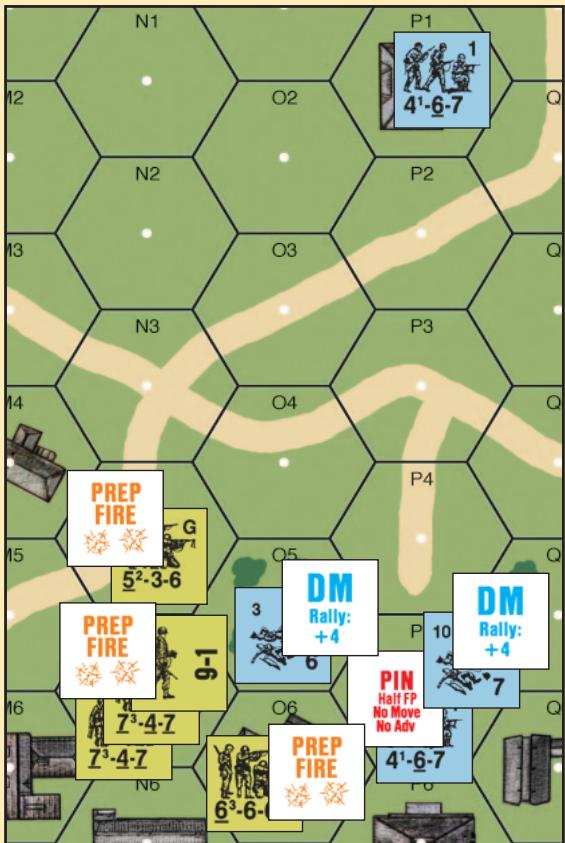
Prep Fire Phase Example (assuming German ELR of 3)
During the American PFPh one 7-4-7 in hex yN5 forms a multi-hex Fire Group with the 6-6-6 in hex O6 to fire at the German units in hex P5. The total firepower is 19 (6 FP for 6-6-6 in O6 is doubled for Point Blank Fire plus 7 FP from 7-4-7 in N5), and the attack occurs on the 16 FP column of the IFT. The DRMs include a +3 for the TEM of the stone building and a +1 for the orchard Hindrance for a total DRM of +4. The original DR is 6; after adding 4 the final DR is 10. Crossreferencing 10 on the 16 column of the IFT results in a Normal Morale Check (NMC). Thus, each unit in hex P5 undergoes a NMC. One 4-6-7 rolls an original 9 and the other rolls a 7; neither DR is modified. The 4-6-7 that rolled a 9 is flipped to his broken side with a DM counter is placed on top. The 4-6-7 that rolled a 7 has a Pin counter placed on top since it rolled equal to its morale on a morale check. Finally, the American units have a Prep Fire counter placed on them.
Next the remaining American 7-4-7 and 9-1 in N5 attack the 4-6-7 in P1 with 2 FP (7 FP at Long Range Fire is 3.5 FP, use the 2 FP column) and a +2 DRM (+3 stone building, -1 leadership modifier). The original DR is a 2 (“snake eyes!" double ones, the attack does not cower because it was directed by a leader) and the final DR is a 4. Cross-referencing 4 on the 2 column of the IFT results in a 1 Morale Check (1MC). The 4-6-7 makes an original DR of 5, modified to a 6, so the 4-6-7 is unaffected. The American units have a Prep Fire counter placed on them.
The American player then elects to fire the 5-3-6 in hex N4 at hex O5. The total firepower is 10, and the attack occurs on the 8 FP column. The DRM is +0, as orchard is a +1 Hindrance but is +0 as a Terrain Effects Modifier. The original DR is a 4 (double twos so the attack cowers two columns since the unit is Inexperienced) and the final DR is a 4. Cross-referencing a 4 on the 4 FP column (two shifts to the left of the 8 FP column) results in a 1MC. The 4-6-7 makes an original DR of 12 (boxcars) with a final DR of 13. The 4-6-7 is Casualty Reduced for rolling an original 12 and replaced with a 2-4-7. That 2-4-7 is replaced by a 2-3-7 half-squad as the final DR was greater than the morale of the unit plus that unit's ELR, so it experiences unit substitution. The 2-3-7 is flipped to its broken side and marked with a DM counter. The 5-3-6 has a Prep Fire counter placed on it.
the center dot (although Smoke in the firer's hex or the target hex does hinder LOS). Attacks may be traced through units in intervening hexes without affecting them. Neither player may make a LOS check until after an attack has been declared. Should a LOS check reveal that a LOS obstacle blocks the fire, the fire attack is not resolved, but the units that declared the attack have fired for all purposes, including possible breakdown. Any combination of Smoke or terrain LOS Hindrance DRM greater than or equal to +6 blocks that LOS completely.
A unit may trace a LOS to a lower elevation (and vice versa) only if the higher unit traces its LOS through a Crest Line as it leaves its hex and this LOS never crosses another Crest Line. A unit on a higher elevation may not see past LOS obstacles although it may see into them. A unit on a higher elevation may see over lower level Hindrances (grain/brush) without Hindrance.
3.2.2 Fire Attacks:
A fire attack by a unit or Fire Group uses the firepower (FP) strength of the unit(s). The printed FP strength can be modified under some conditions. The FP of an attacking Infantry unit/ATR/MG (including vehicular MG/IFE) is doubled for Point Blank Fire (PBF), which occurs when an Infantry unit fires at an adjacent hex and tripled vs units in the same hex for Triple Point Blank Fire (TPBF). An MMC/MG/IFE/FT may attack beyond normal range, as Area Fire (and thus with half FP), at a distance up to and including double that range. Fractions of halved FP totals are not dropped, but rather retained and subject to further modification, or added to the FP totals of other units involved in the same attack. FP modifications are cumulative; attacker's FP can be both doubled and halved and can be halved again several times. A unit may not split its FP between different targets but a squad may opt to fire its own FP at one target and any possessed Weapon at a different target. Whenever a non-leader-directed MMC attack rolls original doubles as the IFT resolution DR, it cowers and is resolved on the next lower column on the IFT and results in the cowering unit being marked with a Prep Fire or Final Fire counter (as appropriate). If an Inexperienced MMC is involved in such an attack, the attack shifts two columns to the left rather than just one. Any shift below the lowest column results in an attack that has no effect. Cowering does not affect Ordnance, vehicles, CC, DC, or Residual FP attacks.
Two or more units may join together to make a combined fire attack and are termed a Fire Group (FG). A FG may consist of units from more than one hex only if each participating unit occupies a hex in or adjacent to another participating unit of the same FG. A leader alone cannot be a FG link. Ordnance and FT may not form a FG. A vehicle's MG/IFE may FG only with themselves. All members of the FG must be able to trace a LOS (3.2.1) to the target. A multi-hex FG that discovers that part of the FG does not have a LOS to the target forfeits the participation of that unit. The units in the FG with valid LOS must still attack the target but as a smaller FG (if adjacent) or as separate attacks at the firer's option. If Infantry in the same hex are going to attack the same unit, they must do so as a Mandatory FG; they may not make separate attacks unless using FT, Ordnance, or subsequent ROF attacks.
A leader may use his leadership DRM to modify the IFT DR of any one attacking Infantry unit (except a FT) or FG per Player Turn, provided all units of the FG are in the same hex. A leadership DRM may be applied to a multi-hex FG only if a leader directing that attack is present in every hex; the leadership DRM in effect in this condition is that of the lowest quality participating leader. A leader directing fire is treated as if he were attacking.
3.2.2.1 Triple Point Blank Fire (TPBF):
MG/ATR/IFE and MMC's firepower are tripled for fire attacks vs targets in the firer's hex on those rare occasions when they can occur (an enemy vehicle moves into your hex or Infantry advances into a hex with enemy vehicle that is or becomes in Motion/Non-Stopped). BU AFV are safe from TPBF, but CE AFV are not, although the +2 CE DRM applies normally. A unit may not fire outside its hex when an enemy unit is in its hex.
3.2.3 Effects:
Fire attacks are resolved by cross-referencing the combined FP total of the attacking unit(s) with a DR on the Infantry Firepower Table (IFT). The attacker uses the rightmost column of the IFT whose listed FP does not exceed the total adjusted FP of the attack (thus an attack total of 9 is resolved on the 8 column); excess FP factors have no effect. The DR is modified by adding any applicable DRM such as leadership, Terrain Effects Modifier (TEM), or LOS Hindrance between (but not in) the firer's hex and the target hex. The results are applied as follows vs Infantry and CE AFV crews:
KIA: As many targets as the number indicated (#) are eliminated (randomly determined); all remaining targets are automatically broken and DM, or suffer Casualty Reduction (below) if already broken. If a CE AFV crew suffers a KIA result, the AFV and crew are STUNNED (7.10).
K/#: One unit suffers Casualty Reduction and all other target units (including any just reduced HS) mu
Content is long; only the first part is inlined. Download the file or open the rules page for the full text.
Download MarkdownTexts are community-compiled or publicly released by publishers; copyright remains with the original authors. For personal reference only.