
The Last Hundred Yards
At a glance
Rules, cards and Q&A (Chinese)
The rules, card data and player questions for this game are written in Chinese. Open the Chinese page to read them.
Where to find full rules
Full rules and card lookup are available in the cunlema app at cunlema.cn — pick this game and ask about any rule, card or turn you are unsure about.
Related games
- Twilight Imperium: Fourth Edition
- War of the Ring: Second Edition
- Pacific War: The Struggle Against Japan, 1941-1945 (Second Edition)
- Twilight Struggle
- Empire of the Sun: The Pacific War 1941-1945
- Imperial Struggle
- Advanced Squad Leader: Starter Kit #1
- Advanced Squad Leader
- Tanto Monta: The Rise of Ferdinand & Isabella 1470-1516
- Risk
Rulebook text (Markdown)
This game has 1 rulebook Markdown file(s) in our library; 1 rendered inline below — expand to read or download.
LHY_Series_Rules_s1v2.md199.0 KB
The Last HUNDRED YARDS
Series Rules v1.2

GMT Games, LLC • P.O. Box 1308, Hanford, CA 93232-1308 • www.GMTGames.com
The Last HUNDRED YARDS
Series Rules
Table of Contents
Introduction...
1.0 Counter Definitions
2.0 Game Terms and Definitions.
2.1 Glossary of Unit Types .
2.2 Units.
2.3 Information Markers .
2.4 Unit Stacking ....
3.0 Force Organization .
4.0 Terrain
4.1 Terrain Types.....
4.2 Line of Sight (LOS)
4.3 Concealment ...
5.0 Sequence of Play...
6.0 Activation Phase...
7.0 Activation
7.1 Coordination ..
7.2 Ad Hoc Unit Activation
7.3 Units that Fail to Activate with
their Platoon......
8.0 Reaction ...
8.1 Reaction Restrictions .
8.2 Reactions to Enemy Actions ....
8.3 Limited Reaction.
9.0 Actions....
9.1 Mandatory Actions.
10.0 Maneuver Actions ...
10.1 Maneuver Allowance .
10.2 Exiting the Map...
10.3 Non-Vehicular Maneuver Actions...11
10.4 Vehicle Maneuver Actions .....
10.5 Assault.
10.5.1 Conducting Assaults .....
10.5.2 Assault Procedures.....
10.5.3 Reactions to Assaults .
11.0 Fire Actions ........
11.1 Enfilade .
11.2 Fire Attack DRM Markers .....
11.3 Small Arms Fire
11.4 Mortar Fire .
11.5 Anti-Tank Fire ..
12.0 Recovery Actions.
12.1 Recovery ....
12.2 Disruption/Regrouping Recovery
Die roll Modifiers ... 20
12.3 Disruption Recovery
12.4 Regrouping Recovery .
12.5 Rally. 20
12.6 Heroism
12.7 Shock Recovery
13.0 Fire Resolution
13.1 Small Arms and Mortar Fire .........
13.2 Anti-Tank Fire..
13.3 Fire Resolution Results ....... .22
14.0 Assault Resolution ....... .22
14.1 Assault Resolution Procedure .........22
14.2 Assault Value Modifiers ........ .23
14.3 Assault Results . .23
15.0 Unit & Nationality Characteristics...25
16.0 Airborne Landings ................ .25
17.0 Night & Twilight.....
18.0 Random Events . .26
19.0 Mines and Wire
19.1 Minefields .
19.2 Wire. .27
20.0 Mission Setup ..........
20.1 Determine Attacker and
Nationality
20.2 Initiative .
20.3 Time Lapse.
20.4 Tracking Casualties...
20.5 Casualty Diferential Limit .............27
20.6 Starting Forces .28
20.7 Unit Disposition .28
20.8 Dummies .28
20.9 Hidden Placement .... .29
20.10 Company Command Tanks (CO)...29
21.0 Winning the Game ..... .29
21.1 Control of Terrain Objectives .........29
21.2 Attacker’s Final Score..... .29
21.3 Victory Level . .29
22.0 Optional Rules ........... ..30
22.1 Command and Control ................. ..30
22.2 Skin in the Game (Role Play) .........30
23.0 Design Your Own Missions................30
ABN – US Airborne
Game Abbreviations
AEV – Armor Enfilade Value
AFV – Armored Fighting Vehicle
AG – Assault Guns
ATDRM – Anti-Tank Die roll Modifier
ATV – Anti-Tank Value
AV – Armor Value
CDL – Casualty Diferential Limit
DRM – Die roll Modifier
DYO – Design Your Own Missions
EBE – Enemy Board Edge
EXC – Exception
MOP – Mission Objective Points
MP(s) – Maneuver Points
PP – Promotion Points
IP – Improved Positions
SADRM – Small Arms Fire Die roll Modifier
LATW – Light Anti-Tank Weapon
LHY – Last Hundred Yards
SAV – Small Arms Value
SMK – Smoke
SPG – Self-Propelled Guns
TD – Tank Destroyer
Introduction
There is, unfortunately, little historical narrative available today regarding the thousands of small-unit actions that occurred during World War II, except for the memories of those who were there. The Last Hundred Yards (or LHY) is an attempt to recreate these small engagements. The game introduces new and innovative systems to model small-unit behavior in combat. LHY seeks to simulate what it might have been like to command combat units at the platoon or company level. The game is purposely designed to deliver a brisk yet intense experience, one that forces many decisions upon you as a leader in an infantry company in World War II.
Using The Rules
This Rule Book provides the rules necessary to play and enjoy the missions provided in any LHY series game module, as well as any Design Your Own (DYO) Missions players might create. Optional Rules are provided to enhance realism and encourage a more personal involvement in the game. Rule Examples, Extended Examples of Play, and the Unit Capability Table can be found in the Playbook. Do not infer or imagine more to a rule than is stated. When in doubt, interpret strictly.
• Key words and phrases, exceptions and examples are in italics.
• Important, commonly missed, and forgotten rules are shown in bold.
• Designer notes and comments are in light-blue shaded boxes.
• All die rolls in the game use a single d10.
• Mission Special Rules (MSR) supersede any standard corresponding rules.
IMPORTANT: RED numbers appearing on unit counters, information markers, and Combat and Terrain Tables are negative die roll modifiers (DRMs), while BLACK numbers are positive die roll modifiers (DRMs).
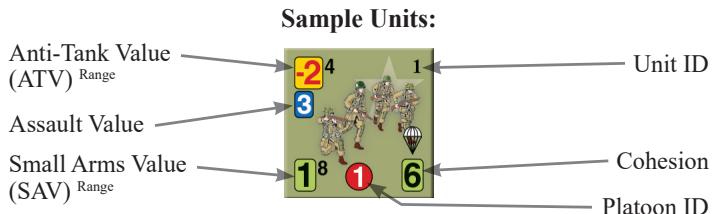

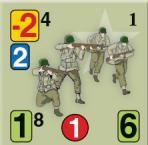
Unit Types & Background Colors:

3US Paratrooper (Elite)
US Infantry4
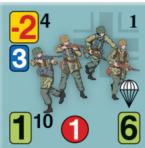
3German Paratrooper (Elite)
German Infantry (Regular)4

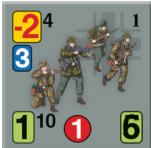
3German SS Infantry (Elite)
British Tank4
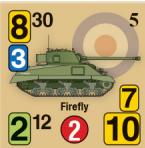
General
Players conduct missions on geomorphic maps (sectors) overlaid with a hexagonal grid. The scale is 50 yards per hex, and time varies from two to five minutes per game turn. Units consist of infantry, machine gun sections, light anti-tank weapon sections, individual vehicles, and towed guns.
Components
1 Game Box
6 double-sided geomorphic maps
1 full-color Rules booklet
1 full-color Playbook
5 Mission Cards (10 Missions)
4 Full-size counter sheets
1 Half-size counter sheet
2 Combat/Terrain Charts
1 Player Reference Card
1 Game Turn Track
4 10-sided dice (one each color: black, yellow, green, and white)
2 6-sided dice (one red, one white)
Maps and Sectors
This LHY module contains one or more 11”x17” geomorphic sectors (synonymous with map boards used in other board games). The large white number in the lower right corner identifies each sector. In some missions and DYOs, sectors may be further divided — when folded — into two sub-sectors. When positioned with the section number in the player’s lower right corner, “a” would be the left half and “b” the right half. Each mission-engagement takes place on a map consisting of one or more sectors. All half-hexes along the map board edges are in play, unless stated otherwise in a Mission Special Rule (MSR).
1.0 Counter Definitions
1.1 Cohesion
Represents a unit’s training, experience and combat efectiveness.
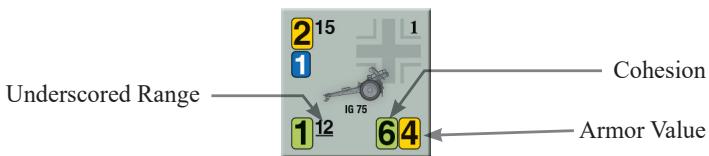
1.2 Armor Value (AV)
Represents a unit’s defense strength against anti-tank fire through its frontal arc.
1.3 Armor Enfilade Value (AEV)
Represents an AFV’s defense strength against anti-tank fire through its rear arc.
1.4 Assault Value
Represents the unit’s fighting capability during an Assault.
1.5 Small Arms Value (SAV)
Represents a unit’s ability to project firepower against soft targets and is the base small arms value to which range and other DRMs are applied. The SAV is applicable only when firing against enemy units with Cohesion.
1.6 Mortar Value (MV)
Represents the indirect fire capability of a mortar section or platoon, and is the base mortar value listed on the Mortar Fire Action Table for primary and secondary impact hexes.
1.7 Anti-Tank Value (ATV)
Represents a unit’s ability to attack armored (or ‘hard’) targets and is the base ATV to which range and other DRMs are applied. The ATV is applicable only when firing against vehicles, towed guns, or FPs.
1.8 Range
Measure of how far a weapon can efectively suppress or inflict casualties in the heat of battle. It appears as a superscript number immediately to the right of the SAV or ATV. The range listed on a counter is the maximum efective range, in hexes, for that weapon type.
1.8.1 Range for Small Arms and Anti-Tank Fire: The die roll modifier of small arms or anti-tank weapons normally decreases as the range to a target increases. Refer to the range DRM Segment within the Small Arms and the Anti-Tank DRM Tables for DRM efects at extended ranges. [EXC: The underscored SAV range value noted on Self Propelled Guns (SPG) and towed guns indicates that a DRM is not applied due to range.]
1.9 Company ID
The color of the circle behind the Platoon ID [1.10] defines the company of the unit. (The color descriptors of the various companies are shown below.)
| ALLIED | |||
| Company | Infantry | Armor | SPG |
| Able | Red | Red | Black |
| Baker | White | White | |
| Charlie | Blue | Blue | |
| AXIS | |||
| Kp. | Infantry | Armor | SPG |
| 1 | Red | Red | White |
| 2 | Black | Black | |
| 3 | Blue | Blue | |
1.10 Platoon ID
This number designates the platoon number (1st, 2nd, or 3rd).
1.11 Unit ID
The small black number or “alpha letter” (infantry sections) located in the upper-right corner of most units to distinguish them from other units.
2.0 Game Terms and Definitions
This section explains the terms and definitions used when playing LHY. It also provides example game counters to better understand the terms and definitions and consists of four parts: Glossary of Unit Types, Units, Information markers, and Unit Stacking.
2.1 Glossary of Unit Types
2.1.1 Combat: Includes infantry squads, infantry and MG sections, Towed Guns, Armored Fighting Vehicles (AFVs), Halftracks and Fortified Positions (FP).
2.1.2 Non-Combat: Includes Platoon Leaders, Light Anti-Tank Weapons (LATW), and Trucks.
2.1.3 Non-Vehicular: Non-motorized units consisting of infantry, Towed Guns, MGs, Platoon Leaders, LATWs, and FPs.
2.1.4 Vehicular: Motorized units consisting of AFVs and Carriers.
2.2 Units
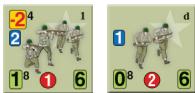
2.2.1 Infantry: Infantry includes regular infantry, elite infantry (i.e., Airborne, Rangers, German 18 6 08 2 6 SS), engineer and recon units. A typical infantry squad consists of 10–12 men and a light machine gun (LMG). An infantry section consists of 5–6 men and possibly an LMG. Squads are two-step combat units and may be deployed (i.e., broken down) into two sections [10.3.2]. Infantry sections are single-step combat units.

2.2.2 Machine Gun (MG) Section: Characterizes a medium or heavy machine gun, typically mounted on a tripod with a crew of 4–5 men. MG sections are single-step combat units.

2.2.3 Towed Gun: Characterizes an anti-tank, anti-aircraft, or infantry gun with a crew of 8–12 men. Towed gun sections are single-step combat units.

2.2.4 Fortified Positions (FP): Stationary, multi-point defensive positions with interconnecting trenches, incorporating MG and/or Anti-Tank Gun and supporting units. FPs are
combat units and count as 4-steps (equivalent to two infantry squads) for Assault Resolution [14.0], but only a single step for Casualty [13.3.3] and Target Density [11.3.3k] purposes. At setup, FPs are oriented in their hex with the red arrow perpendicular to a single recorded hexside or vertex (their frontal arc) and have 180° field of fire, 360° for spotting. Once placed, their orientation may not be changed. Friendly units may conduct Small Arms Fire against enemy units in an Assault hex containing a friendly FP, provided there are no other friendly non-vehicular units in the hex [Exception to 11.3a].
Fortified Positions:
a) may only fire, or receive fire, through their frontal arc;
b) are immune to Mortar Fire (HE), Suppression, Shock, Enfilade, Envelopment, and the Regrouping requirement;
c) are destroyed when they sufer a Casualty or when forced to Retreat;
d) may fire, even when in a hex marked with an MDRM marker [11.4.7].
e) may conduct a Vehicle Destruction Attempt during an Assault.
f) are considered Cover Terrain for Concealment purposes [4.3] and provide the TEM equivalent of an IP to other non-vehicular units in the same hex.
g) FPs cannot be placed in a hex containing a Building Feature or Improved Position [4.1.14d].

2.2.5 Platoon Leader: Represents the platoon leader and a staf of 2–4 men (runners and a radioman). A Platoon Leader can assist in Reaction, Recovery, Mortar Fire, and Platoon Leaders are zero-step non-combat units.

2.2.6 Light Anti-Tank Weapon (LATW): Represents an anti-tank rifle or short-range tubular rocket launcher, such as a bazooka or Panzerschreck, typically with a crew of two.
LATWs are used against vehicles, towed guns, and FPs. LATWs are zero-step non-combat units.

2.2.7 Armored Fighting Vehicle (AFV): motorized vehicles consisting primarily of tanks, self-propelled guns (i.e., tank destroyers, assault guns and self-propelled artillery) and cars. Each AFV is a single-step combat unit.


2.2.8 Carriers: Motorized vehicles used primarily for the transport of non-vehicular units. Tracked or Halftrack (HT) carriers are single-step
combat units. Wheeled carriers, such as Trucks, are zero-step noncombat units.
2.3 Information Markers

Initiative

Time Lapse

Casualty

Casualty Diferential


Avatar
Improved Position

Wire

Mines

Concealment

Action


Motion
Overrun

2.4 Unit Stacking
A player may stack a maximum of three squads, two MG sections, two vehicles [EXC: 4.1.9.3c], one Towed Gun, one FP, and two nonvehicular non-combat units (e.g., Platoon Leaders and LATW units) in a single hex. Riders/Passengers do count toward the stacking limit. Two sections of infantry are equivalent to one squad for stacking purposes. Stacking is checked at the end of each Platoon Activation Cycle — the owning player eliminates any excess units.
LHY introduces innovative concepts unique to most tactical games. It is strongly recommended that players follow the Sequence of Play and all Procedures very closely, until they are familiar with the system.
3.0 Force Organization
The platoon is the primary fighting formation in LHY. An infantry platoon typically consists of a platoon leader, three squads, and any support units. An armored platoon typically consists of four to five AFVs.
3.1 Forces
The forces and parameters of each mission [20.0 Mission Setup] determine the specific units available to each player and their organization for Activation purposes.
3.2 Support Units
Support units do not have a platoon ID and are considered part of — and may only activate with — units of the activated infantry platoon they are stacked with, or closest to, at the time of the platoon’s Activation. If a Support unit is equally distant from more than one platoon, it may activate with either. The parameters for each mission [20.0] determine the type and number of support units available to each player. There are three classifications of support units:
a) Towed Guns;
b) Heavy weapons (i.e., Mortars, MG, and LATW sections); and
c) Carriers (halftracks and trucks).
4.0 Terrain
The type of terrain determines whether it provides cover, afects a unit’s Maneuver, Fire, and/or LOS. The terrain efects are summarized on the Terrain Efects Table.
a) Open Terrain: Any hex devoid of woods, forest, or buildings. Open terrain does not provide cover or block LOS. Small, incidental patches of vegetation appearing within otherwise open terrain hexes are considered inconsequential terrain and have no efect on play (e.g., individual trees, thinfield boundary shrub-lines/fence rows (green boundary lines around fields and along roads), etc.).
b) Cover Terrain: Any terrain providing a Terrain Efect or Hull-Down Modifier to the defender [EXC: Vehicles in woods or forest receive neither a Terrain Efect or Hull-Down Modifier [11.5.4j] but are considered to be in cover terrain for Concealment or Hidden purposes.]
c) Blocking Terrain: Consists of Blocking Terrain hexes and features.
i. Blocking Terrain Hexes include woods, forest, and hill hexes, and are treated as if they are filled by visual obstructions extending one or more levels above ground level.
ii. Blocking Terrain Features include buildings, walls, tree lines, and contours.
d) Level: The term used when determining the height-level of woods, forest, hills and buildings, usually a simple numeral, such as “2” [4.1.4].
4.1 Terrain Types
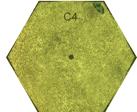
4.1.1 Rural: Any hex with a light green background representing a grassy surface (e.g., meadows, fields, or steppes).

4.1.2 Urban: Any hex with dark gray roads and gray common areas representing a paved or cobblestone surface. (e.g., plazas, squares, alleyways, and marketplaces).
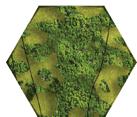
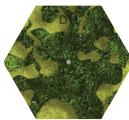
4.1.3 Woods and Forest: Blocking Terrain Hexes that provide cover to defending non-vehicular units against Small Arms and Mortar Fire.
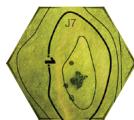
4.1.4 Hills: Blocking Terrain Hexes defined by bold contour lines. A hex is a hill hex if its center dot is within the boundaries of a bold contour line. Each bold contour line is marked with a number signifying its
level (i.e., height). Each level is approximately 40 feet. The higher the number of a bold contour line, the higher the level. Levels are applicable when determining LOS (i.e., sighting and firing) between units at diferent levels [4.2.2]. Hills provide cover for defending units when they receive fire from a lower level. In addition, units pay an additional MP cost when maneuvering uphill, but not if going downhill. An MSR may call for the levels of some or all hills in a sector to be increased or decreased, usually by a multiplier.
Example: A mission may call for all level one hills to be increased to two levels and all level two hills to be increased to level four.
IMPORTANT: When on a hill, the levels of any woods, forest, and buildings in a hex are added to the level of the hill. The level of the Terrain Types is defined in the Terrain Efects Table.
Example: Woods on a level 2 hill would result in a total of three levels in the hex. A stone building on a level 1 hill would result in a total of two levels.
4.1.5 Contours: Contours are the spaces between contour lines (whether bold or thin). The center dot in the contour of the spotting/firing hex, target hex, and intervening contours determine the elevation of the contours for LOS purposes. Contours increase in elevation in ascending order. Contours are Blocking Terrain Features and only afect LOS of units on the same numerical Level [4.2.1]; otherwise they have no efect on play.
4.1.6 Buildings: Buildings are Blocking Terrain Features. In cases where a hex contains more than one type of building, the TEM is based on the Building providing the greatest benefit to the defender. There are two types of buildings in LHY:
a) Rural Buildings: Freestanding structures in rural hexes consisting of:

i. Stone Buildings (gray): Stone cottages, villas, chateaus, and churches;
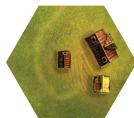
ii. Wooden Buildings (any color other than gray): farmhouses, cottages and barns.
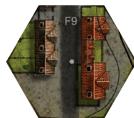
b) Urban Buildings: Freestanding or interconnected buildings (wood or stone) in urban and urban-road hexes (e.g., apartments, commercial, and municipal buildings).
i. Non-vehicular units cannot enter two consecutive Urban Building hexes unless along a road or through an opening (e.g., alley or path) between buildings in an Urban Building hex from which the unit has a clear LOS to the center dot of the adjacent hex being entered. These openings are treated as open terrain when determining maneuver-point cost to enter.
ii. Vehicles cannot enter or set up in Urban Buildings unless the hex contains an Urban Road [4.1.9.2].
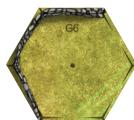
4.1.7 Walls: Walls are Blocking Terrain Features and provide cover from Small Arms [11.3] or Anti-Tank Fire [11.5] to units defending behind them — regardless of the height of the Firing unit. If opposing units oc-
cupy hexes with a common wall-hexside, the side whose units arrived there first receive the TEM benefit.

4.1.8 Tree Lines: Tree lines are Blocking Terrain Features that are one level high and provide cover from Small Arms Fire [11.3] to units defending behind them — regardless of the height of the firing unit. If opposing units occupy adjacent hexes separated by a tree line, the side whose units arrived there first receive the TEM benefit [EXC: 4.1.9.1].
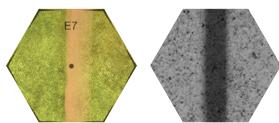
4.1.9 Roads: All thoroughfares, whether passing through a rural or urban hex are roads. [EXC: Small incidental paths, or tracks, are considered inconsequential terrain and have no efect on play.] Units maneuvering along a road pay the road MP cost, ignoring the MP cost of any other terrain type in the hexes or hexsides crossed, provided they enter from an adjacent contiguous road hex.
a) Non-vehicular units in a road hex are in the buildings, woods, forest or tree lines on either side of the road and not “out on” the road itself [4.1.9.3].
b) A vehicle in any road hex is always on the road itself.
c) The TEM of a hex containing a road is based on the other terrain in the hex [EXC: 4.1.9b].

4.1.9.1 Tree-lined Road: Any road running through a woods, forest, or tree-lined road hex is considered a tree-lined road. Carriers may only enter or exit a treelined road hex to/from another contiguous tree-lined
road or road hex. If opposing units occupy adjacent hexes separated by a tree line, the unit in the tree-lined road hex will always receive the TEM.
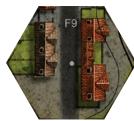
4.1.9.2 Urban Road: Any urban hex containing both urban buildings and a road is considered an urban road. Vehicles may only enter or exit an urban road hex to/ from another contiguous urban road or road hex or any to which they have a clear LOS.
4.1.9.3 Enclosed Road: Any road in a hex containing urban or rural buildings, woods, forest, or tree lines on both sides [Examples: 24.1.3 and 24.1.4].
Restrictions:
a) Small Arms Fire along a road that passes through at least one enclosed road hex of the same road is limited to a one hex range against a stationary unit, and three hexes if the enemy unit Maneuvered.
b) Anti-Tank Fire along a road that passes through at least one enclosed road hex of the same road is limited to a range of six hexes.
c) For stacking purposes, only one vehicle is allowed per enclosedroad hex.
4.1.9.4 Road Bonus: Units receive 1 additional MP when they begin and end their Maneuver action in a road hex — provided that all hexes entered and exited during the Maneuver are interconnected road hexes. Road Bonus is not applicable if:
a) any of the road hexes entered is within 2 hexes of an enemy combat unit.
b) in conjunction with a Combined Force or AFV Assault from a Non-Adjacent hex [10.5.2.3, 10.5.2.5].
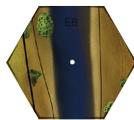
4.1.10 Rivers: River hexes are considered open terrain. Non-vehicular units maneuvering into or along a river pay the river MP cost [EXC: 4.1.12]. To exit to the opposite bank (i.e., to cross the river) each exiting non-
vehicular unit must first make an exit die roll prior to its Maneuver attempt unless, of course, at a ford or bridge. The exiting player must indicate the exiting unit and the hex it is exiting into and make a die roll. This die roll is reduced by one when assisted by the unit’s Platoon Leader. If the modified die roll is ≤ that unit’s Cohesion, the unit must exit and continue its Maneuver (the assisting Platoon Leader may also exit with it). Otherwise, the unit and the assisting Platoon Leader must remain in the river hex and are marked as Activated. A unit failing to exit is considered to have maneuvered, and thus may be subject to the Proximity Fire SADRM [11.3.3c]. Exit die roll checks are not required when withdrawing, retreating, or Heroic — unless an MSR defines the river as impassable [10.3.1.1b.iv]. Vehicles may enter or cross a river hex at bridges and fords only.
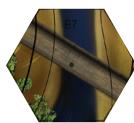
4.1.11 Bridge: A hex containing a bridge is considered open terrain, and at the same level as the hexes on either end of the bridge, unless stated otherwise in an MSR. A bridge hex can only be entered from an adjacent road
hex. Eligible units may Maneuver under a bridge, and when doing so are considered to be in a river hex.
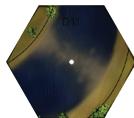
4.1.12 Ford: A hex containing a ford is considered open terrain and at the same level as the adjacent river hexes. It may be used by all units to cross a river.

4.1.13 Marsh: Marsh hexes are considered open terrain. Vehicular units cannot set up in or enter a marsh hex unless along a road. It costs non-vehicular units all their maneuver allowance to enter a marsh hex.

4.1.14 Improved Positions (IP): Represent hastily prepared defensive positions, such as foxholes and shallow trenches. Non-vehicular units receive a favorable TEM, or ATDRM
if a Towed Gun, when defending in a hex containing an IP.
a) IPs do not block LOS, and there is no MP cost to enter or exit.
b) IPs are not removed from play when vacated or captured, thus they provide the same defensive benefit to the enemy player, if captured.
c) Vehicles do not benefit from IPs — unless specified in an MSR.
d) IPs cannot be placed in a hex containing a Building Feature or Fortified Position [2.2.4g].
e) IPs are considered Cover Terrain for Concealment purposes [4.3].
4.2 Line of Sight (LOS)
LOS may be blocked [4.0c] or hindered [4.2.4], depending on the type of intervening terrain. LOS is traced from the center dot of the firing or spotting hex to the center dot of the target hex. The terrain of the hex occupied by the firing or the target unit has no efect on LOS [EXC: 4.2.1f]. Units may always fire into an adjacent hex, regardless of the terrain in the hex or hexside [EXC: 4.2.1f]. Hindrances apply to all hexes involving Fire and LOS [4.2.4].
4.2.1 Units on the Same Level: LOS is blocked when both the firing/ spotting and defending units are at the same level and the LOS [Example: 24.1.1]:
a) is traced through any part of Blocking Terrain Hex, excluding its vertices or hexsides [EXC 4.2.1g];
b) is traced along hexsides where woods, forests, or higher-level hill-hexes occur on both sides of the LOS — anywhere along the LOS [see Playbook example 24.1.1 where LOS is blocked from C to D];
c) intersects any part of the contour in an intervening hex which meets both of these conditions:
i. the contour is equal to or higher than the higher unit; and
ii. the contour encloses the center dot of an intervening hex and/ or completely encloses an intervening hexside along which the LOS is traced.
d) intersects any part of the actual image of a Blocking Terrain Feature [4.0c.ii] (but not incidental vegetation);
e) is traced through, or along, a wall hexside, unless the firing or defending unit is in a hex adjacent to the wall hexside or vertex;
f) is traced to, or from, a vehicle or towed gun in an urban-road hex and the LOS intersects a building feature within the same urbanroad hex occupied by the vehicle or towed gun [Example 24.1.3].
g) is traced along a tree-lined road [4.1.9.1] and intersects any part of the actual image of a woods, forest or tree line in an intervening hex.
4.2.2 Units on Different Levels: The LOS between a hex at a lower level and a higher one is blocked if an intervening hex [Example: 24.1.2] (including its terrain) is ≥ than the higher-level hex. Otherwise the Blind Hex Procedure is used to determine LOS when the firing/spotting and defending units are on diferent levels.
4.2.3 Blind Hexes: Hexes that are not in LOS due to intervening terrain. Only intervening woods, forest, hills (levels), or buildings can cause blind hexes “behind them.” Walls do not block LOS from higher levels for the purpose of determining blind hexes. Blind hexes are reciprocal (i.e., if I can’t see you, you can’t see me).
Blind Hex Procedure:
-
Determine the level-diference (row) between the intervening terrain and the higher of the two (spotting/firing and target) hexes.
-
Determine the number of hexes from that higher hex to the intervening terrain (column).
-
Refer to the Blind Hex Table and cross-index the column corresponding to the number of hexes to the intervening terrain with the row corresponding to the level diference.
-
The result is the number of blind hexes behind the intervening hex. LOS cannot be traced from or to these blind hexes.
4.2.4 Hindrances: Includes all MDRM and Smoke markers [11.4.10] and vehicles, provided the vehicle is in an Enclosed Road hex [4.1.9.3]. All hindrances are cumulative. Hindrances do not block Fire or LOS, but hinder them instead, as reflected by the corresponding Fire DRMs. Fire and LOS is hindered when:
a) passing into, out of, or through — but not over [4.2.3] — any part of a hex containing an MDRM or Smoke marker;
b) the line is traced along hexsides that divide MDRM or Smoke markers on one side of the LOS and a wood, forest, or hill hex on the other—even ifthe hexsides ofthese hexes are not adjacent;
c) the path is traced along hexsides on which MDRM or Smoke markers occur on both sides of the LOS. In this case the DRM is based on the hex with the greatest hindrance; or
d) passes into or through — but not over [4.2.3] — any part of an enclosed-road hex containing a vehicle [4.1.9.3].
4.3 Concealment
Concealment characterizes the situation in which the general location and type of a unit is known — but its specific location has not been determined. Only one Concealment marker is allowed in a hex. A player cannot inspect another player’s units marked with a Concealment marker. However, the firing player may inquire, and the enemy player must declare, whether the concealed unit type in a hex consists of any AFVs, FPs, Carriers, Towed Guns, or other non-vehicular units, prior to the execution of their Fire attack. The enemy player is not required to identify the specific ordnance of unit(s). Once requested and answered, the firing player must execute at least one Fire attack, if possible.
Example: The German player has two Pz IVs and a squad in LOS of a woods hex containing concealed enemy units. Prior to executing a Fire Action, the German player inquires as to the type of units in the woods hex, in order to determine whether to conduct small arms or Anti-Tank Fire. The American player states that the hex contains two AFVs, one Towed Gun, and one non-vehicular unit. The German player decides to conduct an Anti-Tank Fire Action at the topmost AFV with one Pz IV, the Towed Gun with the other Pz IV, and a Small Arms Fire Action against the hex with the squad.
4.3.1 Concealment Loss: All units lose concealment when they Disrupt, Shock, Maneuver adjacent to, or enter, an enemy-occupied hex. In addition, units lose concealment in the following cases [EXC: 4.3.1.3]:
4.3.1.1 Non-Vehicular Units: Lose concealment immediately if:
a) they Maneuver into, or Fire from, an open-terrain hex within 8 hexes and in LOS of an enemy unit, or a Hidden unit if revealed [see 20.9.2];
b) they Maneuver into a cover-terrain hex within 3 hexes (one hex for LATWs) and LOS of an enemy unit, or a Hidden unit if revealed [see 20.9.2];
c) they conduct Small Arms Fire from a cover-terrain hex in LOS and within 2 hexes (4 hexes if Anti-Tank Fire from a Towed Gun or FP) of an enemy unit or a Hidden unit, if revealed [see 20.9.2];
d) the result of a Final Fire Resolution die roll is ≥ the Cohesion of the afected unit; or
e) they remain in the Assault hex at the end of Assault Resolution.
4.3.1.2 Vehicular Units: Lose concealment immediately when:
a) in open terrain, and an enemy unit Maneuvers within 10 hexes and in LOS;
b) they Maneuver into, or Fire from, an open-terrain hex, or if in motion while in LOS of an enemy unit at any range;
c) they Maneuver into, or Fire from, a cover-terrain hex within 8 hexes and in LOS of an enemy unit;
d) the result of a Final Fire Resolution die roll is equal to the AV of the afected unit; or
e) an enemy unit is in an adjacent hex.
4.3.1.3 Concealment is not lost if the only enemy units in LOS are marked with an Assault Nationality marker [EXC: 10.5.3.1], or in a primary impact hex containing an MDRM marker [EXC: 11.4.7c].
4.3.2 Concealment Gain: Any unit that is not in LOS of an enemy unit during the Concealment Gain segment of the Clean-Up Phase may be marked Concealed, provided it is not disrupted, regrouping, or Heroic. (Note that a player would need to voluntarily reveal a Hidden unit in order to deny a Concealment Gain for an enemy unit in LOS of that Hidden unit.)
5.0 Sequence Of Play
I. Initiative Phase: Both players make a die roll. The player having the Initiative on the previous game turn applies their Initiative die roll modifier, if applicable, to the Initiative die roll [Each mission lists the Initiative die roll modifiersfor each player.] The player with the higher modified die roll wins the Initiative and becomes the active player. The losing player is the non-active player. In the case of ties, the Axis player wins the Initiative if the modified die roll is odd, while the Allied player wins the Initiative if the modified die roll is even. The Initiative marker is adjusted on the Game Tracks player-aid card to reflect the side that won the Initiative. A player without a Platoon Leader or an AFV in play at the end of the Initiative Phase — and after any Random Event results — automatically forfeits the Initiative to the other player. If neither player has a Platoon Leader or AFV in play, play proceeds to VI. Determine Time Lapse.
In all cases, if the unmodified Initiative die roll is 1 or 10, that player must consult the Random Event Table on the Game Tracks player aid [18.0].
II. Activation Phase: The active player conducts Actions with units of friendly activated platoon(s) [7.0], followed by both players conducting Reactions [8.0]. Units of an activated platoon without a Platoon Leader in play are restricted in their Actions [13.3.4.2]. Once all platoon Activations and Reactions have been completed, play proceeds to the Fire Resolution Phase.
III. Fire Resolution Phase: Fire attacks are resolved in any order. Each DRM marker in play represents a single Fire attack. (Fire attack die rolls are based on the DRM markers in the hex at the beginning of the Fire Resolution Phase, even if players find an error was made when the DRM marker was originally placed.)
IV. Assault Resolution Phase: The active player determines the order in which assaults are resolved [14.0].
V. Mortar Fire Adjustment Phase
-
Remove MDRM and Smoke markers [11.4.10].
-
Determine Mortar Recovery [11.4.8].
-
Forward Observers (FOs) currently on their Final side, or in a hex without a friendly unit, are removed — along with the corresponding Primary Impact marker — and placed in the Mortar Support Pending Box on the Game Tracks player-aid card.
-
Conduct Mortar Fire Extensions [11.4.9].
VI. Determine Time Lapse: The active player makes a die roll on the Time Lapse Table to determine the Time Lapse (in minutes) and adjusts the time on the Time Lapse Track accordingly.
VII. Clean Up Phase
-
Remove Overwatch and Motion markers from all vehicles that did not conduct an action during the game turn.
-
Place returning Platoon Leaders [13.3.4.1].
-
Recombine squads [10.3.3].
-
Conceal any units not in LOS of an enemy unit.
-
Reset counter orientation.
-
Check whether the Mission Objective or Victory Conditions have been met.
6.0 Activation Phase
The Activation Phase consists of the active player (i.e., the player winning the Initiative) activating friendly platoons sequentially. Only the active player can activate platoons in any given game turn. Each platoon Activation is followed by alternating calls for Reaction by both players. Note that all Activations and Reactions during the Activation Phase are assumed to occur simultaneously, hence the results of any Fire attacks are not determined until after the Activation Phase is over [Example: 24.2].
Platoon Activation Procedure
I. Company Selection: The active player selects a company. (Companies with Heroic units must be selectedfirst.)
II. Platoon Activation Cycle
- Platoon Activation Segment: The active player Activates a platoon from the selected company, or platoons if Coordination was won for that round [7.1]. Once the active player completes conducting Actions with units of the activated platoon(s), they call for Reaction from the non-active player. Units of the activated platoon:
a) that are Heroic must be activated prior to those that are not;
b) must conduct Mandatory Actions [9.1.1] if applicable;
c) can Maneuver, Recover, or Fire at any enemy unit in their LOS. Units that do not conduct Actions during the Platoon Activation Segment are limited to Reactions for the balance of the game turn.
-
Non-Active Player Reaction Segment: The non-active player can, and in some cases must, React [8.0]. Once finished with Reactions, the non-active player then calls for Reaction from the active player.
-
Active Player Reaction Segment: The active player can React [8.0]. Once finished with Reactions (or perhaps simply Passing) the active player then calls for Reaction (again) from the nonactive player. Players continue to alternate calls for Reaction until both players Pass consecutively, ending all calls for Reaction for that Platoon Activation Cycle.
4. Marker Adjustment:
a) Remove red Motion markers.
b) Units marked with an Assault Arrow marker are placed in the assault hex — unless a Feint [10.5.2.4] is declared — and then an Assault Nationality marker (of the assaulting force) is placed on top of the units in the assault hex [10.5.2.2].
c) Check stacking limits [2.4].
- Repeat: Repeat Steps 1 through 4, until the last platoon of the selected company has been activated. (If the active player has one or more companies that have not yet been selected, select another company and return to step I.) The active player must activate all of their friendly platoons but is not required to conduct Actions with any units of an activated platoon, except for Mandatory Actions [9.1.1]. A player is still obligated to call for Reaction, regardless of whether any units of the activated platoon conducted Actions. Once all the active player’s companies have been selected and all platoons have been activated, the Activation Phase ends. Play then proceeds to the Fire Resolution Phase.
The Platoon Activation Cycle is the heart of LHY. It is important to understand that only platoons as a whole, including any ad hoc units, are activated at any one time, and thus units of the activated platoon are then free to conduct eligible Actions. Units other than those of the activated platoon are limited to conducting Reactions only.
7.0 Activation
Activations are limited to the platoon(s) of the selected company by the active player. All units of an activated platoon (i.e., units with the same platoon ID and any support units) [3.2], and any ad hoc units [7.2], may conduct Actions (i.e., Maneuver, Fire or Recover) for which they are eligible.
7.1 Coordination
Upon selecting a company, and before selecting the initial platoon for Activation, the active player may attempt a Coordinated Activation, which allows the simultaneous Activation of two platoons (including ad hoc units) within a single Activation. To do so, the active player makes a die roll, applying a Coordination DRM if available, and refers to the Coordination Table on the Game Tracks player aid. If unsuccessful, the active player may only activate one platoon of the selected company, or any single AFV platoon. If successful, the active player may conduct a Coordinated Activation in either his first or a later platoon action. When conducting a Coordinated Activation, the player may choose from the following options:
a) Two platoons of the selected infantry company or, one infantry platoon of the selected company and any one AFV platoon or,
b) Two platoons of the selected AFV company or, one AFV platoon of the selected company and any one infantry platoon.
7.2 Ad Hoc Unit Activation
An infantry platoon may be strengthened by the temporary addition of other units to activate with units of the activated platoon. This can happen during Mission Setup, or on the spur of the moment when an infantry platoon is activated. Ad hoc unit Activations are allowed under the following conditions:
a) A single infantry combat unit from a non-activated platoon of the same company, stacked with units of an activated infantry platoon, may activate with that activated platoon — unless the hex contains the Platoon Leader of the non-activated unit. Only a single unit per company may be activated in this way per game turn;
b) In any given Platoon Activation Segment, units from a single AFV platoon may activate with units of one or more activated infantry platoons, provided those units are in the same hex with units of the activated infantry platoon(s) at the beginning of their Activation. However, the reverse is not true: units of an infantry platoon cannot activate with units of an activated AFV platoon. AFVs carrying Riders may only be activated with the infantry platoon of the Riders.
7.3 Units that Fail to Activate with their Platoon
Units with the same platoon ID, and their support units, that did not conduct Actions during their platoon’s Activation during Step One of the Platoon Activation Cycle cannot Activate later in the game turn, although they may always, of course, React.
8.0 Reaction
Reactions occur after a call for Reaction by either player. In Reaction, units of the reacting player may, and sometimes must [9.1.2], conduct an Action [9.0].
Example: The American player wins the Initiative and activates 1st Platoon, subsequently conducting a Maneuver Action with the 1st Squad, and then calls for Reaction from the German player. The German player can now React, but only with units that had LOS into a hex entered by the American 1st Squad. Although several units had or have LOS, the German player elects to react only with the 3rd MG Section and conducts a Fire Action against the American 1st Squad, and then calls for Reaction from the American player. Although the German player had other units that could have reacted to the Maneuver Action of the American 1st Squad, once Reaction was called for, the opportunity to react to the American 1st Squad for the balance of that game turn is forfeited.
8.1 Restrictions
a) Reacting units may only React to enemy Actions that occurred immediately prior to the enemy player’s last call for Reaction [EXC: 8.3].
b) Reacting units cannot conduct Small Arms or Anti-Tank Fire against an enemy unit that did not conduct an Action.
c) Reactions to Mortar Fire Actions (MFA) or Random Events are not allowed.
8.2 Reactions to Enemy Actions
Any friendly unit that observed an enemy unit Maneuver or Recover within a hex, or Maneuver into a hex (not from), or Fire from a hex, may React [8.0].
8.3 Limited Reactions
Units that did not observe an enemy Action are more limited and may React only as follows after any enemy call for Reaction:
a) Any Platoon Leader — as its sole action for that game turn — may Maneuver or Recover and/or direct units of the same platoon (including any ad hoc units) to Maneuver or Recover, if at the beginning of their Reaction those units are:
i. stacked with their Platoon Leader, regardless of terrain; or
ii. adjacent to their Platoon Leader, provided all units involved are in open terrain, or on a road hex.
b) Any eligible unit can request an MFA [11.4.4.1];
c) Any non-vehicular unit(s), excluding Towed Guns and FPs, can attempt to Withdraw [10.3.]. To withdraw, the controlling player specifies the withdrawing units and makes a single die roll. This die roll is compared to the withdrawing unit with the best Cohesion. If the die roll is ≤ to the unit’s Cohesion, the units may withdraw. Otherwise, they remain in their current hex and are marked activated;
d) Vehicles in motion can conduct eligible Maneuver Actions [10.4];
e) Stationary vehicles may either Recover, if Shocked, [12.7] or go into motion within their current hex;
f) LATW sections can Fire, Maneuver, or Maneuver & Fire [11.5.2];
g) Any non-vehicular unit may mount or dismount;
h) Any unit can reinforce an adjacent Hex Under Assault [10.5.3.3];
i) Elite units may attempt Recovery [15.1b].
9.0 Actions
Units conduct Actions as the result of either a platoon Activation or Reaction. Actions include Maneuver, Fire, and Recovery. Each unit is limited to a single Action per game turn, regardless of whether that action comes as a result of an Activation or Reaction.

Although not required, Action markers may be used to identify which of a player’s units conducted Actions, and the type of Action conducted,
during a player’s Activation or Reaction. When used, each player places one of their Action markers (depending on the Action taken, i.e., Fire, Maneuver, or Recover) in the hex they Fired from, Recovered in, or entered. Each player removes their Action markers at the end of the opposing player’s Reaction or, at the end of the Platoon Activation Cycle. In addition, the Fire-Action side may be used to indicate the hexside or vertex through which a unit Fired. (Suggestion: Mark units as having completed an Action by simply turning the counter 90°.)
9.1 Mandatory Actions
9.1.1 Active Player: The active player must conduct an Action with units of an activated platoon during Step 1 of the Platoon Activation Cycle when those units are:
a) Heroic [12.6] or Shocked [12.7];
b) Disrupted [13.3.2] or Regrouping [14.3.6], and in LOS of an enemy unit;
c) Vehicles in motion [10.4.1b]; or
d) Vehicles in range, and LOS, of an unconcealed enemy unit capable of conducting Anti-Tank Fire.
9.1.2 Non-Active Player: In Reaction, units of the non-active player must conduct an Action when:
a) Disrupted [13.3.2] or Regrouping [14.3.6], and in LOS of units of the Active player’s last activated platoon; or
b) Heroic [12.6] or Shocked [12.7] — and must do so during the first non-active player’s Reaction Segment of the game turn.
10.0 Maneuver Actions
Units conduct Maneuver Actions, expending some or all their allotted Maneuver Allowance [10.1], expressed in Maneuver Points (MP), to enter each hex [EXC: 10.3.1, 12.6]. In addition, LHY includes other distinct Maneuver Actions such as Assault, Deploy, Withdrawal, Envelopment, Overrun, Halt & Fire, and Shoot & Scoot, which provide players various tactical options. (Refer to the Terrain Efects Table for the MP cost for each terrain type.)
a) A unit may not enter a hex unless it has the MPs necessary to do so [EXC: 10.1.1a, 10.1.2a].
b) A Non-Vehicular unit must end its Maneuver when it enters an enemy-occupied hex [10.5.1].
c) Towed Guns cannot Maneuver unless transported by a Carrier unit.
10.1 Maneuver Allowance
A unit’s Maneuver Allowance depends on the type of unit, whether Day or Night [17.1], and whether the Maneuver is the result of an Activation or Reaction. The Activation Maneuver Allowance applies to units of the activated platoon that Maneuver during the Platoon Activation Segment. The Reaction Maneuver Allowance applies to Maneuvers of Reacting units during a Reaction Segment.
10.1.1 Activation Maneuver Allowance
a) Non-Vehicular units have a Maneuver Allowance of 3 MPs. An Activated unit can always maneuver at least two hexes, regardless of the maneuver-point cost [EXC 4.1.6b].
b) AFVs and Halftracks are allowed 5 MPs; Trucks are allowed 6 MPs. All Vehicles are limited to 3 MP in Reverse [10.4.4].
10.1.2 Reaction Maneuver Allowance
a) Non-vehicular units have a Maneuver Allowance of 2 MPs. A Reacting unit can always maneuver at least one hex, regardless of the maneuver-point cost.
b) Vehicular units are allowed 4 MPs but are limited to 3 MP in Reverse [10.4.4].
10.2 Exiting the Map
Friendly (FBE) and enemy board-edges (EBE) are generally labeled on each mission’s map or defined in the mission itself. Any unit may exit the map from any hex on any board-edge other than the EBE, either as a result of a Maneuver (including Withdraw) or Retreat, unless stated otherwise in a Mission Objective or MSR. Once exited, units cannot return to play (unless specified in an MSR).
a) Combat units must immediately make a die roll upon exiting the map from any hex other than a hex along an FBE. If the result is > 7, the exiting unit(s) sufers Casualties and the Casualty marker is adjusted accordingly on the Casualty Track. There is no die roll required when exiting the FBE.
b) Combat units marked with one or more Fire Attack DRM markers at the time they exit the map, immediately sufer those Fire Attacks and any consequent Cohesion Checks and Casualties. The Casualty marker is adjusted on the Casualty Track accordingly when an existing unit sufers a Casualty. (This is in addition to any losses incurred in case “a” above).
10.3 Non-Vehicular Maneuver Actions
10.3.1 Withdrawal: A Maneuver Action allowing non-vehicular units to conduct an orderly disengagement from the enemy. Units may Withdraw as part of a platoon’s Activation or in Reaction. Units do not expend Maneuver Points to Withdraw, but instead can Withdraw one to four hexes [EXC: 10.3.1d]. Also, some or all units in a hex may Withdraw individually or as a stack. Withdrawing units:
a) cannot enter an enemy-occupied hex or a primary impact hex, but can enter a secondary impact hex [11.4.7];
b) may exit any primary or secondary impact hex, but will sufer the Mortar Fire Attack upon exiting [11.4.7];
c) cannot withdraw from an assault hex [10.5.3.1] but may attempt to Withdraw when under Assault [10.5.3.2].
d) Withdrawals in or through one or more River, Marsh or Urban Building hexes are limited to three hexes.
10.3.1.1 Withdrawal Priority: In general, withdrawing units must withdraw toward their FBE unless stated otherwise in a Mission Objective or MSR [EXC: 16.1.7]. When doing so, they have one of two options depending on the orientation of the hexes within the sector towards the FBE. A Withdrawing unit is subject to the following priority order for each hex entered during the Withdrawal [Example 24.3]. a) When the hexsides are parallel to the FBE [Example: 24.3.1]:
i. a hex toward the FBE and not adjacent to an enemy combat unit;
ii. a hex toward the FBE adjacent to enemy combat unit [10.3.1.2];
iii. when adjacent to an FBE, or impassable terrain, may withdraw along the FBE or impassable terrain, provided each hex entered is further away from its original hex;
iv. when withdrawing along an impassable river must Maneuver to, and attempt to cross, at a ford or bridge if possible. Units that can’t meet these criteria are eliminated.
b) When the hexsides are not parallel to the FBE [Example: 24.3.2]:
i. a hex toward the FBE, or laterally (consecutive lateral hexes are not allowed), provided the hex is not adjacent to an enemy combat unit;
ii. a hex toward the FBE or laterally (consecutive lateral hexes are not allowed), adjacent to an enemy combat unit [10.3.1.2];
iii. when adjacent to an FBE or impassable terrain, may withdraw along the FBE or impassable terrain, provided each hex entered is further away from its original hex;
iv. when Withdrawing along an impassable river, must Maneuver to and attempt to cross at a ford or bridge, if possible. Units that can’t meet these criteria are eliminated.
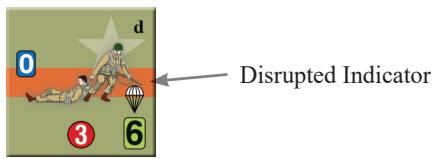
10.3.1.2 Withdrawing Adjacent to an Enemy Combat Unit: If at any time during Withdrawal an undisrupted non-vehicular unit moves adjacent to an enemy-occupied hex containing an undisrupted, or nonshocked enemy combat unit, the Withdrawing unit is marked with a Regrouping marker [14.3.6] at the end of its Withdrawal unless:
a) The Withdrawing unit was Disrupted;
b) The enemy-occupied hex is a Primary Impact hex, or contains an Assault Arrow or a Nationality marker; or
c) The hex entered contains an undisrupted, friendly combat unit.
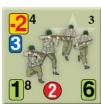
10.3.2 Deploying Squads: A special Maneuver Action allowing a player to Deploy an infantry squad into two sections at any time during the Platoon Activation or Reaction Segment. Each Deployed section may Maneuver, Fire
[10.3.2c], or conduct no action at all. There is no MP cost to deploy. Restrictions:
a) Disrupted units may not deploy.
b) Deployment is limited to one squad per infantry platoon.
c) Only one of the two sections are allowed to conduct a Fire Action at the moment of Deployment.
d) Sections that do not conduct an Action at the time of Deployment are limited to Reactions for the balance of the game turn [7.3].
To Deploy: remove the deploying squad counter from play and replace it with two randomly selected sections, not currently in play, from the same platoon. (Not all the SAVs of the sections are necessarily going to be the same, depending upon a nation’s tactical doctrine. If this is the case, the player selects one section of each SAV value, at random).
Example: For a German platoon, two sections have an SAV of 1, and two sections have an SAV of 0. In this case, the player would select one of each, at random.
10.3.3 Recombining Squads: Any time two sections of the same platoon are in the same hex during Step 3 of the Clean Up Phase, they may recombine into a squad — selected at random — from the same platoon. If one of the two sections is disrupted, a Recovery die roll is made and compared to the Cohesion of the non-disrupted section. If the die roll is ≤ to this section’s Cohesion, the two sections are replaced with a non-disrupted squad, otherwise they are replaced with a Disrupted squad. Concealment is only retained if both sections were Concealed prior to Recombination.
10.4 Vehicular Maneuver Actions

10.4.1 Vehicular Motion: For the most part, vehicles Maneuver just like other units. However, because of its faster rate of -1 travel, a vehicle is always regarded as either “in (continuing) motion” or “stationary.” A Motion marker indicates a vehicle’s Maneuver status as either currently stopped or in motion. It costs 1 MP to go into motion, and zero MP to stop. A vehicle may not go into motion and then stop, or stop and then go into motion, in the same game turn. A vehicle may not Fire while marked with a Motion marker — unless conducting Shoot & Scoot [10.4.2] or Halt & Fire [10.4.3] Actions.
Summary of Vehicle Motion Options:
a) A stationary vehicle conducting a Maneuver Action, whether as a result of an Activation or Reaction, is immediately marked with a green Motion marker at the beginning of its maneuver. The vehicle may then Maneuver into another hex or Shoot & Scoot [10.4.2].
b) A vehicle in motion may conduct any one of the following Actions: i. Maneuver into a diferent hex. (maintaining its green Motion marker).
ii. Either stop in its current hex, or Maneuver into a diferent hex and stop. (In either case, the green Motion
Content is long; only the first part is inlined. Download the file or open the rules page for the full text.
Download MarkdownTexts are community-compiled or publicly released by publishers; copyright remains with the original authors. For personal reference only.