
Risk
At a glance
Rules, cards and Q&A (Chinese)
The rules, card data and player questions for this game are written in Chinese. Open the Chinese page to read them.
Where to find full rules
Full rules and card lookup are available in the cunlema app at cunlema.cn — pick this game and ask about any rule, card or turn you are unsure about.
Related games
- Twilight Imperium: Fourth Edition
- War of the Ring: Second Edition
- Pacific War: The Struggle Against Japan, 1941-1945 (Second Edition)
- Twilight Struggle
- Empire of the Sun: The Pacific War 1941-1945
- Imperial Struggle
- Advanced Squad Leader: Starter Kit #1
- Advanced Squad Leader
- Tanto Monta: The Rise of Ferdinand & Isabella 1470-1516
- The Last Hundred Yards
Rulebook text (Markdown)
This game has 2 rulebook Markdown file(s) in our library; 2 rendered inline below — expand to read or download.
rules_zh_战国风云_924.md35.7 KB
欢迎参加大战役“征服世界战役”游戏!
担 任大军统和无 古 人的超战略战术。尔的目标很简世界。大战役游戏与你以前玩过的游戏不同。这一游戏包括多轮循环,轮到你时,你需要做出决策:何时进攻,何时进攻和何时停止进攻。
组装装
从塑料袋中取出所有部件。扔掉塑料袋。
内装物
6个军队,各军以不同颜色表示
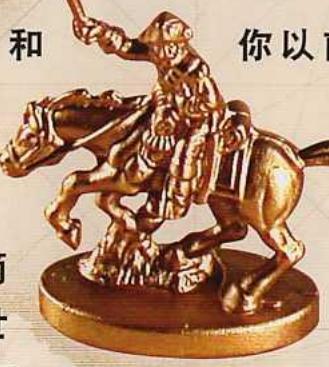
·金甲骑兵棋子
72张卡片
5颗骰子游戏板
游戏一览
首先,将所有棋子放在游戏板上你看得见之处。一边阅读以下规则,一边观看棋子,你就会明白棋子的作用和原理。
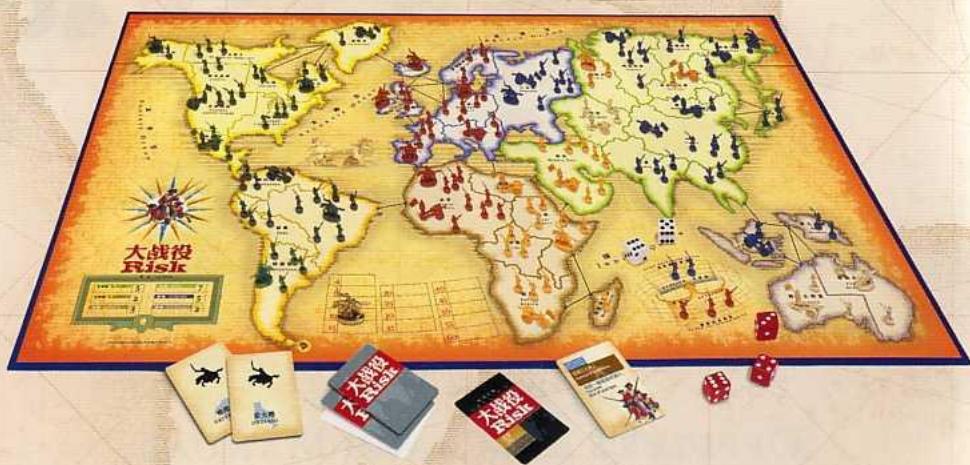
游戏板
全世界等着你去征服。游戏板分为42块领各领土有其各自的名称。其中有许多地名可能不太熟悉,因为这些地名存在于200年前,当时的世界与现在相比差别很大。这些表成大陆包美洲以不、美鱼表示)这世大陆包北美洲(色)、亚洲(绿色)和澳洲(灰色)。
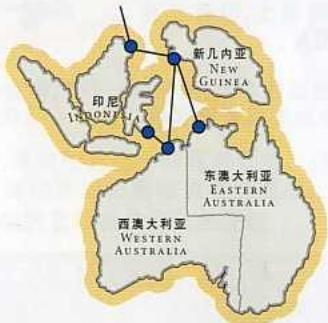
例如:新几内亚、印尼、东澳大利亚和西澳大利亚分别为4大领土,一起构成了澳洲大陆。
如图所示,有些领土彼此相邻。相邻领土通常共享边界线或共享海岸线。你统帅的军队可从一块领土跨向另一相邻领土。
说明:有一条海岸线从亚洲围绕游戏板一直延伸到北美洲,导致堪察加半岛和阿拉斯加两大地区相邻。
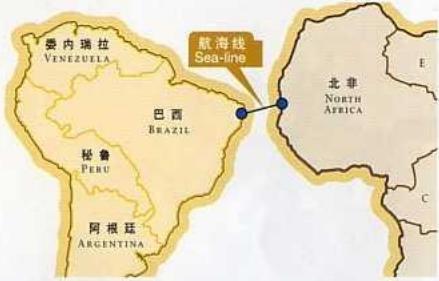
例如:巴西版图与委内瑞拉、秘鲁和阿根廷接壤,因为这些地区共享边界线。同时,巴西又通过海岸线与北美洲跨洋相邻。位于巴西的队可进攻任何相邻领土。但是,应注意的是,位天 巴西的这一军队也可能受到来自上述任意领土的进攻。
南大西洋有一数字图表(包括4、6、8、10等数字),南美洲的对边有一包含大陆名称的盒子(其中数字更多)。以上各项将在游戏后期使用,下文将详细说明。
同时,印度洋也是兵家必争之地,多场战争将在此发生。我们将在第8页“投入战斗”中详细介绍。
塑料棋子
本游戏共包括6支军队,各支军队以不同的颜色表示。各参赛者统帅一支颜色不同的军队。游戏中还有一颗“金甲骑兵”棋子,该棋子不属于任何参赛者。该棋子负责联络奖励性增援部队。现在用不上,将其放在一边。
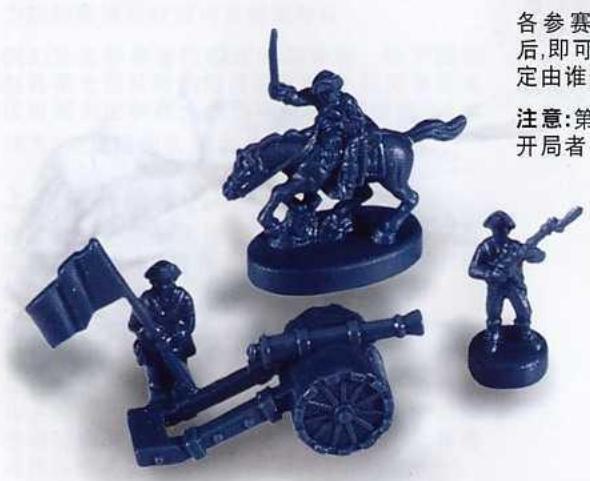
仔细观察棋子,会发现棋子有三种形状:一种是扛枪的士兵(步兵),一种是骑马的士兵(骑兵),还有一种是站在大炮旁边的士兵(炮兵)。这些棋子都是你的军队,但是,各个棋子代表不同数量的分队。

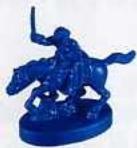
步兵棋子1个分队
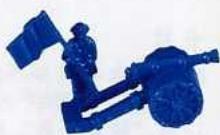
骑兵棋子5个分队
炮兵棋子10个分队
游戏过程中,你可在游戏板上摆放多颗棋子,有时至一上放子在为摆放一颗炮兵棋子比摆放10颗步兵棋子简单得多(两者都等于10个分队)。携带两个面值 为一角的硬币比带20个面值为一分的硬币简单得多。同样,移动两颗炮兵棋子比移动20颗步兵棋子简单得多。在游戏中的任何时刻,你都可以在某一领土换用不同的棋子,实现战术改变”。但是,必须确保分队数量不变。
大战役
指挥官手册
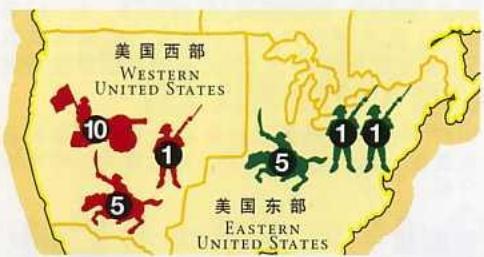
例如:绿方参赛者在美国东部有一颗骑兵棋子颗步兵棋子。由于一颗骑兵棋子表示5 支参方骑赛队,一颗步兵棋子代表1支分队,因此,绿方美国西部有一颗炮兵棋子、一一颗步兵棋子。由此可见,红方参在美国西部共有16支分队(10+5+1)。
骰子
骰子用于领土进攻和防御。其中,三颗红色骰子用于进攻,两颗白色骰子用于防御。
卡片
共有两种卡片,一种是任务卡,另一种是领土卡。任务卡用于“特别任务”游戏(参阅第14页“特别任务”规则)。进行“征服世界战役”游戏时,不需要使用任务卡。
游戏板上每块领土均有一张领土卡。各领土卡上标有领土名称和图片,还包括步兵、骑兵或炮兵的图片。另外,还有两张万能卡,万能卡上未标明任何领土,但有三种军队的图片。
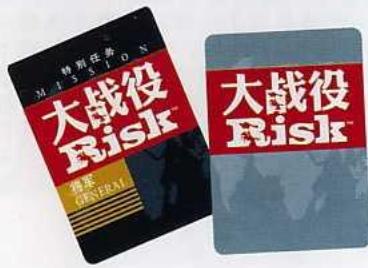
例如:这是一张万能卡,卡上未标明领土,但有三种军队的图片。
在整个游戏中,领土卡用于获得奖励性增援部队。稍后将对其作用予以说明。
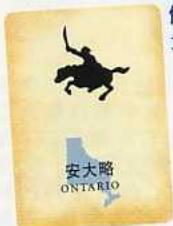
例如:这一领土卡表示安大略地区,卡上有安大略地区的图片和一支骑兵。

大战役-征服世界战役游戏
游戏人数:3-6人
·设置游戏板,以能方便每一参赛者为宜。
·将领土卡洗匀,将卡片正面朝下放在游戏板旁边。这就是你的抽牌堆。抽牌堆旁应留下摆放弃牌堆的位置。
·将“金甲骑兵”棋子放在游戏板下部图表中的4号位。

·各参赛者选择一种颜色,选出该颜色代表的所有分队。将分队放在身旁的卡堆中。
·现在,将你的先行分队摆放到位。这些分队应在游戏开始之前摆放在游戏板上。先行分队的数量根据参赛人数而定。
| #参赛人数 | 先行分队数 |
| 2 | 参阅两参赛者规定 |
| 3 | 各35个分队 |
| 4 | 各30个分队 |
| 5 | 各25个分队 |
| 6 | 各20个分队 |
统计你的先行分队,将其放在面前。
现在,各参赛者掷骰子,以确定由哪一参赛者开局。由骰子数字最大者开局。然后向左转。
宣布领土占领
骰子数字最大者宣布占领第一块领土。
宣的参队依 占领领土时,将一支先行分队放入未占领 土者在 上。 现在,你就控 制了这 一 领 土 下 一分。被领的我领者左边的参布古须该领 未占领的领土上,并宣此类推。应注意的是,如果某一领土某一分队占领,你不能宣布占领该领土。
最后,42块领土全部宣布被占领。有些参赛者控制的领土可能比其它参赛者多。这属正常现象。
注意:现在,游戏板已经没有未被占领的领土。领土的控制权(即:某一参赛者将分队放于该领土上)可能发生变化,但是,任何领土不可能无人占领。
领土巩固
宣布领土占领之后,你将开始对领土进行巩固。(领土上分队越多,越利于进攻和防御)。
领土巩固十分简单,只需要将一支先行分队放
在放左类 你 控 制的 领 土 上 即可 。你 不 能 将增 援 部 队增援部队之后,你曾援部队,依此推,一直进行到各个参赛者的全部先行分队
已摆在游戏板上为止。
领土上摆放分队的数量不受限制。你可用大量分队增援某一领土,或者说,你可将分队分散到所有领土。
各参赛者的先行分队都摆放到游戏板上之后,即可开始宣战。各参赛者再次掷骰子,以决定由谁开局。
注意:第一个摆放分队的参赛者不一定是本轮开局者。
轮到你开局时
概述
每次轮到你开局时,你将获得额外分队,你可将其放在戏上之后队进可一次对某你 击敌军。战斗之后,你可获得一次对某些分队进行重新部署的机会。如果你在这一轮中征服了某一领土,将抽取一张领土卡。这就是你在这一轮中的所有活动。现在,我们将进行详细介绍,以便你能制订全球征战计划。
| 步骤 |
| 1 获得和部署增援部队(必须)。 |
| 2 进行战斗(自行决定) |
| 3 巩固阵地(自行决定) |
| 4 领取领土卡(征服某一领土后方可领取) |
第一步:获得和部署增援部队
每次轮到你开局时,你将获得额外分队。获得的增援部队数量根据你控制的领土数量、控制的大陆数量(若有)以及你交出的领土卡数量而定。
统计你的领土数:
你首先要做的是统计控制的领土(即:你已摆放分队的领土)数量。计算出领土总数,将其除以3(余数忽略不计)。其得数就是你可获得的增援部队数量。但是,你至少可获得3支增援部队。因此,即使你控制的领土极少,也能至少获得3支增援部队。从你的分队堆中拿取增援部队,将其放在前面。这就是你增援的开始。
例如:绿方参赛者在这一轮开局时控制13块领土。13除以3等于4(记住:余数忽略不计)。那么,绿方参赛者即可获得4支增援部队。
例如:红方参赛者在这一轮开局时控制5块领土。5除以3等于1。但是,获得的增援部队数不能小于3。因此,红方参赛者获得3支增援部队。
参阅下表,以确定你可获得增援部队的数量。
| 领土数 增援部队数 |
| 1-11 3 |
| 12-14 4 |
| 15-17 5 |
| 18-20 6 |
| 21-23 7 |
| 24-26 8 |
| 27-29 9 |
| 30-32 10 |
| 33-35 11 |
| 36-38 12 |
| 39-41 13 |
你是否控制了大陆?
每控制一块大陆,你也可获得增援部队。应记住的是,大陆由颜色相同的多块领土组成。最小的大陆(也是最容易控制的大陆)是澳洲大陆和南美洲。最大的大陆是亚洲大陆。如果你控制了某一大陆内的每一块领土,则控制了整个大陆。
你获得的增援部队总数由你控制的大陆总数而定。游戏板左下角的图表标明了你控制某一大陆时可获得的增援部队数。统计分队堆中拿出的增援部队数,将其与你前面的增援部队(开始统计领土时采用的增援部队堆)堆相加。
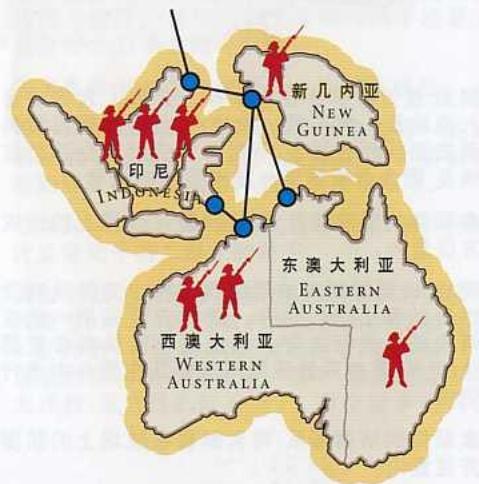
例1:红方参赛者控制澳洲。除了因控制其领土而获得的增援部队之外,红方参赛者还可因为控制澳洲而获得两支增援部队。
例2:灰方参赛者控制欧洲和非洲。除了因控制其领土而获得的增援部队之外,灰方参赛者还可因为控制两大洲而获得8支增援部队(欧洲为5支增援部队,非洲为3支增援部队)。
上交持有的卡片
你可能对此感到困惑,因为我们还尚未介绍怎样获得领土卡(将在第4步中介绍)。不过,你此时应上交领土卡,以获得奖励性增援部队。
我兵有片得 们在 前面介绍过,每张领土卡上 部 都图各交 有片张以 步都卡获将骑兵或炮兵图片(万能卡三
),还记得吗?如果你有一套三张卡
上 图 片相同或各不相同,你可将其
增 援部
其作为步兵、骑兵或炮兵卡片。
奖励要求
符合以下任何一项组合条件时,你可将卡片上交:
3张步兵卡;3张骑兵卡;3张炮兵卡;1张步兵卡、1张骑兵卡和1张炮兵卡(记住:万能卡可作为三种卡中的任何一种卡)。
注意事项:如果你持卡总数等于或超过5张,你必须上交一组卡片,因为你持有的卡片中至少有一组符合上述组合条件。
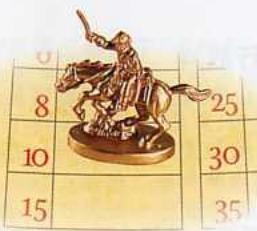
你上交卡片而获得的增援部队总数决定于你目次这援性 前 为止 在游戏中上交的卡片组总数。请再看游戏板上的图表(4、6、8、10等)。部队总数。你上交的第一组卡片值4支奖励增援部队,上交的第二组卡片值6支奖励性增援部队。依此类推。最终,这些卡片组将让你获得大量奖励性增援部队。
上交一组卡片后,将金甲骑兵棋子向前移动一格,移动到下一个较大数字处。这表示你下次上交一组卡片时可获得的增援部队数。将奖励性增援部队放在增援部队堆中,将卡片组丢弃到废弃卡堆中。
例如:该轮开始时,红方参赛者持有4张卡片:两
张赛卡轮来赛援甲 步者 兵将 卡其 、一 张骑兵卡和一 张炮兵 卡。 该步是始 参兵本以参增金下中骑 三兵第 张 作 为一 组 片 上 交 一然 张这一 共张交赛组 和一 张 炮 卡 。 虽中上 的 一组卡片,但是,却是游戏开该 参获 者 交的第三组卡片。因此,红方者 得8支增援部队。她拿取8支奖励性部 B 将其放在增援部队堆中。然后,她将兵 棋子向前移动一格,从8移动到10。上交卡片组的参赛者将获得奖励性增援
部队。
部署增援部队
获得增援部队之后,将其全部部署在你控制的领土上。你可将全部增援部队集中部署在某一领土,或将其分散部署到各块领土。记住:应部署全部增援部队。
第二步:投入战斗
战人攻择跨完领 斗是 你在这一轮中的主要任务,目的是向敌发次不入为士 进 攻进 并 领 土。 你可自 行决 定 进、 选则起任何进攻(如果不发起任何进攻,三 步),或选择一直进攻到全 部分 用块
战斗相关词汇解释:
以下是战斗过程中涉及的部分词汇:
·进攻方,指的是当前一轮中处于进攻的参赛者。
·防御方,指的是当前一轮中处于防御的参赛者。
·入侵,指的是领土受到外敌入侵的状态。入侵状态一直持续到领土被占领或进攻方停止入侵时为止。轮到你作为进攻方时,你可入侵多块领土。
·战斗,指的是入侵过程中掷骰子一圈(分别代表进攻方和防御方)。一起入侵可能只进行一次战斗,或进行数十次战斗。
应从何处入侵?
你可从控制的任何一块领土侵入敌方领土。记住:如果领土共享边界线或之间存在海岸线,则为相邻领土。
你只能入侵敌方领土,不能入侵自己的领土选择你控制的领土,宣布你即将入侵的相邻领土。
怎样进行战斗
你必须至少将两支部队部署到某一领土内,才能发起进攻,原因在于必须留下一支部队对你发起进攻的领土进行防守。该部队只能驻守,不能投入战斗。
现在,决定从后方领土调遣多少支部队投入战斗。你可调遣一支、两支或三支部队。你的入侵部队可能远远超过三支部队,但是,每次战斗最多只能调遣三支部队投入战斗。
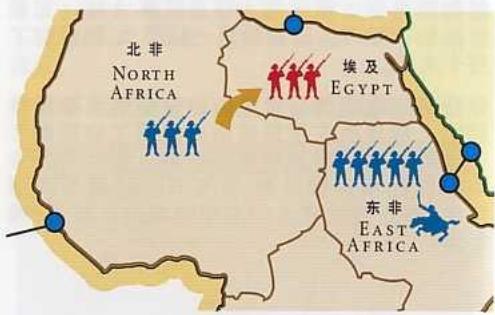
例如:蓝方参赛者在北非有三支部队,现在决定入侵埃及。对于第一次战斗,蓝方参赛者可将两支部队派往埃及,不能将三支部队全部派往埃及,因为必须留下一支部队驻守北非。
拿取你的进攻部队,将其部署在战场上的进攻方位置内。
现在,轮到防御方决定应调遣多少支部队对受攻击的领土进行防守。防御方可采用一支或两支部队进行防守。领土内可能具有多支部队,但是,最多只能采用两支部队在战斗中进行防守。
拿取你的防御部队,将其部署在战场上的防御方位置内。
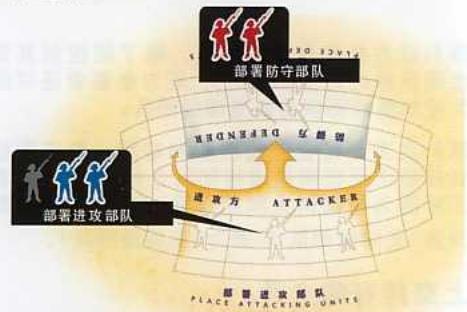
例如:红方参赛者对埃及进行防守,共有三支部队。该参赛者可在第一次战斗中调遣两支部队进行防守。
现在,战斗开始。各方投掷骰子,各进攻部队或防御部队投掷一颗骰子。也就是说,进攻方将投掷一颗、两颗或三颗骰子,防御方则投掷一颗或两颗骰子。双方同时投掷骰子。
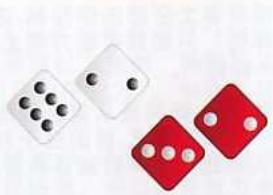
例如:蓝方参赛者投掷两颗骰子,原因在于已将两支部队投入战斗。红方参赛者采用两支部队进行防守,因此,也投掷两颗骰子。
决定战斗胜负
双方投掷骰子后,将你的骰子按点数从高到低按顺序摆好。将你的最大点数与对手的最大点数相比,以决定战斗胜负。
注意事项:如果数字相同,则为防御方获胜。
骰子点数较大者为获胜者。失败者将一支部队从战场上撤离。该部队已被打败。将被打败的部队放回游戏板外的部队棋子堆中。
你和对手对比点数最大的骰子后,然后开始对比点数处于第二最大的骰子。
例如:进攻方的骰子点数是3和2,防御方的骰子点数是6和2。首先,双方对比最大点数:蓝方是3,红方是6。因此,红方为获胜者,蓝方将一支进攻部队从战场上撤离。然后,双方对比第二大点数:蓝方是2,红方是2。两个数字相同。
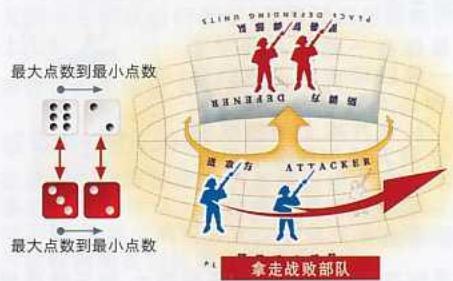
根据规则,这种情况下,防御方为获胜者。因此,红方为获胜者,蓝方将其另一支进攻部队从战场上撤离。
如果你投掷骰子的次数比对手多,多余的次数应予以忽略。
战斗结束后,剩余部队返回各自领土。但是,别着急,你可马上将其调回战场。
停止入侵
通过某次战斗后,你(进攻方)可决定停止入侵。你可自行决定入侵新的领土,入侵战斗过程中曾经入侵过的领土,或中途停止战斗。
在战役之间,你可改变入侵领土,从不同的相邻领土继续入侵。但是,你不能与来自不同领土的多支部队并肩作战。在一次战役中,你的所有部队必须来自同一领土。
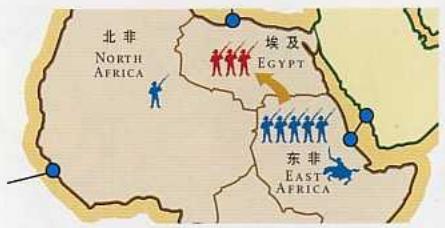
例如:北非只留下一支部队,因此,蓝方从该地入记进行必)。下一,对你发有10支部队,而东非也与埃及接壤。因此,蓝方可从东非继续入侵,从该地调遣三支部队(最大进攻部队数)入侵埃及。红方可采用两支部队(最大防御部队数)进行防御。
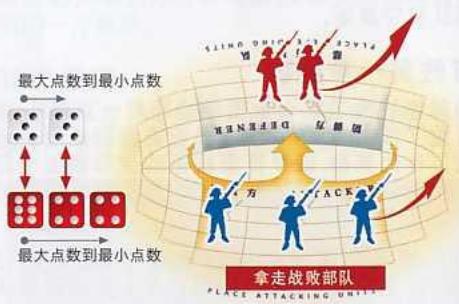
蓝方参赛者投掷三颗骰子(各代表一支进攻部队),点数分别为6、4和4。红方投掷两颗骰子,点数均为5。蓝方最大点数为6,红方最大点数为5。由于6大于5,因此,红方失去一支防御部队,将该部队从战场上撤离。蓝方的第二最大点数是4,而红方的第二最大点数是5。由于5大于4,因此,蓝方失去一支进攻部队,将该部队从战场上撤离。蓝方最后一颗骰子点数为4,该点数不予计算,因为没有防御方骰子与其对比。
入侵获胜,长驱直入
打败来自某一领土的最后一支防御部队后,即在入侵中取得了胜利。现在,你已征服了这一土。拿取战役中使用的部队棋子,将其从战场上移动到被占领的领土。现在,你可将后方领土的部队调入。因此,虽然只能让三支部队投入战斗,但是,入侵胜利后,你可将更多的部队调入新占领的领土。该类部队调遣必须在再次宣布入侵前完成。

部队调入
例如:红方只有一支防御部队留守埃及,因此,蓝往战场,向埃及发起进攻。红方将其一 支 部战部将胜,诚往成场成,以保后,及将三文进攻队调入埃及,宣布占领这一领土。然 方6支剩余部队中的5支部队调入埃及,只有一支部队留守原地。
打败另一参赛者
如果你打败了某一参赛者的最后一支部队,则打败了该参赛者。这样,该参赛者到此退出游戏。作为奖励,该参赛者获得的全部领土卡归你所有。现在,将这些领土卡添加到你原有的领土卡中。
如果你手中现有的领土卡等于5张或超过5张,应立即停步,将一组领土卡上交以 得奖励性增援部队。获得增援部队后,将其方 放 1 你的领等于或上你上持的领土卡以获得奖励性增援部队。最后,当手中的领土卡等于或少于4张时,可继续进行游戏。
第三步:巩固阵地
进攻结束后,你可获得一次部队巩固机会(自由调兵)。
为巩固阵地,你可从你控制的一块领土中随意调遣部队,将其调往另一相邻的领土。(记住:必须至少保留一支留守部队,否则视为放弃该领土)。
如果之间的所有领土全部由你控制,这些领土则视为“一体化”。如果被敌方领土隔离,则不能视为“一体化”。
这并不是一种进攻,而只是从某一领土向另一领土移动的一种调兵方式,目的在于对前线进行防卫,或进入阵地为下一轮做好准备。
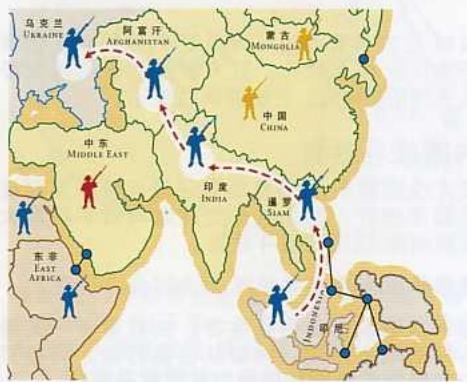
例如:在一轮结束时,你可从印尼通过暹罗、印度、阿富汗向乌克兰调兵,以进行阵地巩固,因为这些领土均处于你的控制之下。因为你完全通过自己的领土调兵,因此,印尼和乌克兰可视为“一体化”领土。
第四步:获得领土卡
在一轮结束时,你可能获得一张领土卡。
至领土领土领得 了的领取领少获 领领张抽手多能 轮未获堆加你 你块么从将。轮 张领土卡。 如少土卡土卡土一

如果你在一轮中未占领任何领土,则不能获得领土卡。
获胜者
如果你坚持到最后,也就是说,如果你控制了游戏板上的全部领土(共42块领土),则为游戏获胜者。现在,你成为了统治全球的统治者。
大战役-征服世界战役游戏
2人对赛
对于双人“征服世界战役”游戏的两种不同玩法,请参阅以下规则。两种玩法中均存在中立军队(称为中立方)。中立方与双方参赛者共同占用游戏板。
第一种玩法中,中立方为被动方,既不能移,也不进攻。一 方在双方我方之 屏障作用。另一种玩法中,中立方为活跃方,可与一方参赛者结盟。
规则与“征服世界战役”游戏相同,只有适当变动。
目标
消灭敌人。
游戏设置
两个参赛者各拥有36支部队。四家中立方(参赛者未使用的四种颜色)各拥有24支部队,将其摆放在游戏板上。
从领土卡中拿出两张万能卡。两参赛者各发9张领土卡,中立方各发6张领土卡。从军队将一支部队摆入领土。所有领土都宣布占领后,将万能卡和领土卡放在一起洗匀,将其正面朝下放在游戏板旁边。
投掷骰子,决定应由谁首先部署增援部队。两参支中方土 者 轮 流部署增援部队。 各 参 赛 者 部 署领中 三土立领队 可将其全部部到占领的对 的的一支部队进行部署(部署到该方控制的二上)。
参赛者投掷骰子,点数较大者先行。
被动中立方游戏
在被动中立方游戏中,当你进攻中立方时,对手移动其防御部队。中立方部队在游戏板上保持不动,直到被消灭为止。中立方不能移动,也不能获得增援部队或发起进攻。
现在,你已学会了游戏规则。现在开始游戏!
活跃中立方游戏
在活跃中立方游戏中,中立方不仅作为参赛者之间的屏障,还可与一方参赛者结成联盟,并可在游戏过程中改变联盟关系。
中立方可处于三种状态:不结盟;于1号参赛者联盟;与2号参赛者联盟。
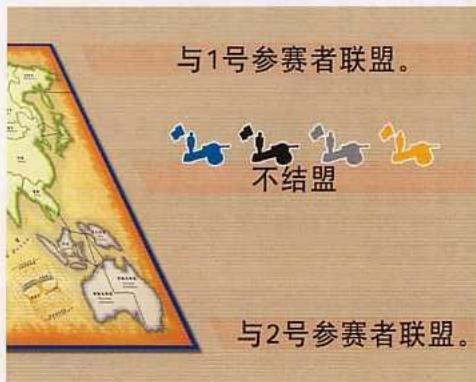
在游戏板旁边部署一门大炮(针对各中立方),以应对各中立方发起进攻。开局时,中立方未结盟,因此,将大炮置于两参赛者之间的中途位置。中立方改变状态后,将大炮向与其结盟的一方靠近。
轮次顺序
轮次顺序与“征服世界战役”游戏相同,但新增了一些步骤。新增步骤以斜体表示。
| 步骤 |
| 1 收买中立方。 |
| 2 获得增援部队。 |
| 3 增援联盟方。 |
| 4 投入战斗。 |
| 5 巩固阵地。 |
| 6 巩固联盟方。 |
| 7 获得领土卡。 |
大战役
指挥官手册
第一步:收实中立方
你的一轮开始时,你可将一张领土卡赠送给中立方,使之偏向于你。将该中立方的大炮向你靠近一个位置,表示对手的一支盟友解除结盟(大炮从对手的前边移动到你和对手之间的位置),中立方与对手解除结盟后与你结盟(大炮从你和对手之间的位置移动到你的前边)。将用于收买中立方的领土卡正面朝下,放在中立方的大炮之下。该领土卡现归中立方所有。
·你可在一轮中将两张领土卡赠与中立方,使之移动两个位置。
·你可将领土卡赠与多个中立方,获得领土卡赠送的中立方将移动其全部大炮。
你不能将领土卡赠与已经拥有5张领土的中立方,因为已获得5张领土卡的中立方不能再被收买。

例如:红军与绿军对垒,中立方为蓝军、黑军
灰领军军 军土。 和 黄 军 现 轮 到 红 军 开局。 红 军 将 二 张黄红正而朝下在军的从下,以收买 ,红军将黄军大炮从非结盟位置(和 灰
军已成为红军的盟军。
第二步:获得增援部队
你获得并照常部署增援部队。决定增援部队部署时,别统计由你的盟军控制的领土数或大陆数。
第三步:增援盟军
你的各个盟友可根据你的要求获得增援。选择 一个 盟友 投掷 1
部队部部 到该盟 友 的领土中。 你 将这多世块部署到该盟友控制的一 块 领土 中
土中。重复这一步骤,向你希望增援的盟友供增援。
·是否向盟友提供增援,由你自行决定。
·决定提供增援时,不计算盟友控制的领土。
·盟友并不因为控制大陆而获得奖励性增援。
·盟友不能上交领土卡以获得增援部队。
第四步:投入战斗
轮到你时,你可用盟友的部队发起进攻。这些部队可进攻你的对手、其它中立方或其它盟友。
向中立方发起进攻或与某一盟军联合发起进攻时,会使之接近对手。
进攻某一中立方的领土之后(无论是否已征服),或者说,与盟军联合发起进攻之后,应投掷一次骰子。如果点数为1-4,将该中立方的大炮移动到离你更远的位置。如果点数为5或6,该中立方或盟友保持其现有状态。
如果你与某一盟友向另一中立方发起进攻,应投掷两次骰子,但每次只投掷一颗骰子。
如果你消灭了某一中立方,该中立方的全部领土卡归你所有。如果你通过盟友消灭某一中立方,你(而不是盟友)将获得被消灭的中立方的领土卡。
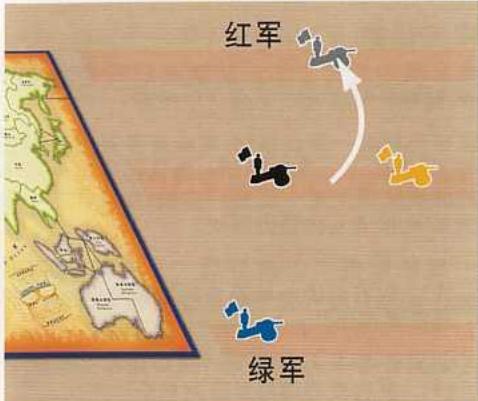
如 1:绿方 参 者现 决处 入 侵 魁北 该绿次如绿 领方股果方 土未子点更 由能以数远方入定3 军侵灰绿置 控获军应 未绿是大 结方否炮 盟 状的灰 那状方 大的 将应移 投改动 掷变到
通过,绿方还通过蓝方军队(蓝方作为中立方,现为绿方盟友),入侵澳洲(现由红方军队控制)。绿方在入侵中获胜。
现在,绿方投掷一次骰子,以决定蓝方军队的状态是否改变。如果点数是5,蓝方军队将继续作为绿方的盟友。
第五步:巩固阵地
完成进攻之后,应对阵地进行巩固,方法与“征服世界战役游戏”中使用的方法相同。
第六步:巩固盟军
对于各个盟友,你可“自由移动棋子”一次。用“战国风云游戏”中介绍的规则对盟友军队进行巩固。
第七步:获得领土卡
盟友并不因为征服某一领土而获得领土卡。如果通过盟军占领某一领土,你不能获得领土卡。只有通过你自己的军队占领某一领土时,才能获得领土卡。
特别任务游戏
游戏人数:3-6人
在特别任务游戏中,游戏的目的不使消灭对手或征服世界,而是完成在游戏开局时受命的4项特别任务。有些任务易于完成,有些人难度极大。遵照“征服世界战役”游戏中使用的规则即可(其中包括某些变动)。
游戏设置
根据卡片背面的说明(将军、少校、上校和上尉),将任务卡分成四堆。将各堆卡片洗匀,将其正面朝下放在桌上。
各参赛者从各卡片堆中抽出一张任务卡,共抽出四张任务卡。各参赛者可查看自己的任务卡,但不能让对手看见。任何参赛者不得翻看剩余的任务卡,将其放回盒中。
所有参赛者均接受任务后,游戏设置按“征服世界战役”游戏的设置方式继续进行。
增援部队
在“特别任务”游戏中,上交卡片与“征服世界战役”游戏不同。这一游戏中,不是通过游戏板下部的图表决定卡片的分值,而是通过以
下图表决定应获得多少奖励性增援部队。
| 增援部队表 |
| 卡片集 奖励性增援部队数 |
| 3张步兵卡 4支增援部队 |
| 3张骑兵卡 6支增援部队 |
| 3张炮兵卡 8支增援部队 |
| 各一张 10支增援部队 |
因此,上交3张骑兵卡,总会获得6支奖励性增援部队,无论是第一次上交,还是第15次上交,均不例外。上交“各卡片一张”,即可获得数量最高的奖励性增援部队。
消灭对手
如果你消灭对手,你仍可获得该对手原拥有的领土卡,但不能获得任务卡。任务卡将一直保密到游戏结束。
完成任务
你可根据卡片上的说明宣布已完成某一任务,但每轮只能宣布完成一项任务。
宣布已完成一项任务时,向所有参赛者出示任务卡(任务卡上有此说明),确认已根据任务卡的要求完成了某一任务。之后,将该任务卡放回盒中,该卡从此退出游戏。
·如果任务卡上内容为“一轮开始时进行”,则在你的一轮开始时出示卡片,然后再获得增援部队。
·如果任务卡上内容为“获得增援部队后进行”,则在获得增援部队后出示卡片。
·如果任务卡上内容为“一轮结束时进行”,则在抽取领土卡(若有)之后出示卡片,也就是说,在你的一轮结束时出示卡片。
当示赛能直 某第者在保 参 赛卡 者已完成三项任务,该 参便哪应 赛让 者其任之 应它务后 出参才一四都游持 张 片该获 (最后一 张卡片), 以
知 道中 者还 完成 一在
戏 这一
公 状态。 以便人人都能看见。
任务卡说明:
某一任务可能要求你占领某一岛屿。所谓岛屿,指的是各边被水包围、仅通过航线与其它领土连接的领土,例如印尼。
获胜
最先完成四项任务的参赛者为获胜方。你也可通过消灭所有对手而获胜,但是,这一做法难度很大。
“团队配合”游戏
游戏人数:4-6人,分成两队
在这一游戏中,参赛者并非独立获胜,而是以团队形式获胜。双方参赛者部署其领土。游戏过程中,同一团队的参赛者可共享领土。
游戏目标
某一团队中某一参赛者被消灭时,游戏即告结束。另一团队为获胜者。
游戏设置
首先确定哪些参赛者属于哪一团队。双方参赛者应交叉座位,以便双方轮换,例如:1队、2队、1队、2队,依此类推。
双方参者部署其领土。
获得增援部队
确定你控制的领土数量时,应考虑到是否与同队成员共享领土(参赛者可在巩固阵地过程中进入友好领土,以下将予以说明)。
在某一领土上部队最多的参赛者成为该领土的控制者。如果两个参赛者的部队数量相同,都拥有最多部队数,那么,该领土则视为无人控制。
例如:红方、黑方和绿方属同一团队。轮到绿
方方不方队 开和能有 始黑被两因 时 ,绿方 控制7块领土。在格 陵 兰 岛 绿均黑部和方 有四支部队。这样,绿方和黑方视。 红方有部部方有 黑 支方
红方,因此,视为绿方控制这一领土。
如果某一领土未被任何方控制(部队最大数出现平局),则该大陆的奖励性增援部队失效。
例如:黑方控制新几内亚、东澳大利亚和西澳大利亚。在印尼,黑方和红方各有两支部队。由于双力量均等,任何一方均不能控制这一领土。因此,黑方并未控制澳洲大陆,因此,不能获得由此应得的两支奖励性增援部队。
同时,根据以下图表(而不是根据游戏板下部的图表)确定上交卡片应得的奖励性增援部队。
增援部队表
| 卡片集 | 奖励性增援部队数 |
| 3张步兵卡 | 4支增援部队 |
| 3张骑兵卡 | 6支增援部队 |
| 3张炮兵卡 | 8支增援部队 |
| 各一张 | 10支增援部队 |
因此,上交3张骑兵卡,总会获得6支奖励性增援部队,无论是第一次上交,还是第15次上交,均不例外。上交“各卡片一张”,即可获得数量最高的奖励性增援部队。
投入战斗
你不能进攻同一团队内的另一参赛者。
巩固阵地
关于巩固阵地,有两大规则不相同。
巩固阵地时,你可将部队从你拥有部队的领土调遣到你拥有部队或其他成员拥有部队的领土。也就是说,你可进入其他队员的领域,无论对方是否愿意。
同时,从一块领土向另一领土调动部队时,你可将队友的领土(或多个队友的领土)视为友好邻邦,在认为必要时可予以利用。
例如:在一轮结束时,红方可从印尼通过暹罗(由队友绿方控制)、印度(由红方控制)、中东(由绿方和黑方部队共同控制)进入东非。
获得领土卡
领土卡由队友共享。你获得领土卡时,将其添加到团队现有的领土卡中。你的一轮结束时,将团队持有的领土卡交给同队的下一参赛者。
任何一名参赛者均可在一轮开始时将卡片集上交以获得增援部队。如果某一参赛者获得一张卡后共有5张卡,则必须上交一组卡片。
获胜
当一支团队中某一参赛者被消灭后,另一团队则为获胜者。
Download MarkdownRisk_Rulebook_Comparison.md41.4 KB
RISK
★ ★ ★ ★ ★
A Side-by-Side Field Manual
Three Editions, Three Eras of Global Conquest
THE 1980's EDITION
Winning Moves, 2023
The classic ruleset, faithfully reproduced.
2–6 players, ages 8+.
Roman-numeral army pieces.
REVISED EDITION
Parker Brothers / Hasbro, 2008
Expert variants included.
A radical redesign.
3–5 players, ages 12+.
Cities, Capitals, Objectives, Rewards.
Basic Training & Command Room modes.
HASBRO 2015 EDITION
Hasbro, 2015
A streamlined return to classic.
2–5 players, ages 10+.
Plastic Infantry/Cavalry/Artillery.
Secret Mission, Classic, 2-Player, Capital modes.
“…the dangers, as well as the rewards, are high.”
I. Game Identity & Scope
All three editions are Risk: conquer the world by moving troops and rolling dice. What differs is the feel of the game. The 1980's Edition reissue is the classic experience with no extra moving parts. The 2008 Revised Edition adds mid-game objectives, cities, and capitals to fight over. The 2015 Hasbro edition strips most of that back out but makes Secret Mission the default mode out of the box.
| CATEGORY | RISKThe 1980's Edition(Winning Moves, 2023) | RISKRevised Edition(Parker Brothers / Hasbro, 2008) | RISKHasbro 2015 Edition(Hasbro, 2015) |
| Publisher / Year | Winning Moves (licensed from Hasbro), 2023reissue of the classic Parker Brothers ruleset. | Hasbro / Parker Brothers, 2008. A major redesignof the system. | Hasbro, 2015. Standard retail edition. |
| Player Count | 2 to 6 players. | 3 to 5 players. | 2 to 5 players. |
| Age | Ages 8 and up. | Ages 12 and up. | Ages 10 and up. |
| Game Length / Feel | Long, classic, attritional. Optional shorter rulesincluded (Headquarters variant). | Two distinct modes: Basic Training(introductory) and Command Room (full game).Shorter than classic because the game can endon a 3-Objective trigger. More directed thanclassic Risk, but stacked Rewards and chainedObjectives can still generate abrupt momentumswings. | Four play modes: Secret Mission RISK, ClassicRISK, RISK for 2 Players, and Capital RISK (ashorter variant). Secret Mission, the flagshipmode, fundamentally restructures play; seeSection X. |
| Win Condition(default) | Eliminate every opponent by capturing all 42territories. | Be the first to complete 3 Objectives ANDcontrol your own capital at the end of your turn. Aseparate “World Conquest” rule lets you ignoreObjectives and play to total domination. | Depends on mode. Default flagship mode (SecretMission) is the first player to complete the SecretMission on their card. |
| Tone of theRulebook | Sober, traditional. Includes a “Risk Questions”FAQ and a “Rule Variations for Risk Experts”appendix (matched-set values, fortify chains,army caps, Commanders, attack-card re-rolls). | Military field-manual aesthetic. Reference cards:Overview of Components, How to Set Up, How toDraft Troops, How to Attack, Objectives &Rewards, Ending Your Turn. | Leatherbound “Game Guide” booklet design.Each variant gets a clearly labeled GAME 1 /GAME 2 / GAME 3 / GAME 4 section. |
II. Components
Component lists are where each edition's design philosophy first becomes visible. The classic ruleset trusts the dice and the map alone; its only innovation is scalable Roman-numeral tokens. The 2008 Revised Edition adds material to the table (capitals, cities, objective markers, reward chips), declaring that the map is no longer enough. The 2015 edition retreats from that maximalism but keeps one structural addition: a deck of Secret Mission cards that ride alongside the standard territory deck.
| CATEGORY | RISKThe 1980's Edition(Winning Moves, 2023) | RISKRevised Edition(Parker Brothers / Hasbro, 2008) | RISKHasbro 2015 Edition(Hasbro, 2015) |
| Board | Map of six continents, 42 territories. Continentarmy-bonus table printed in the lower right of theboard. | Map of six continents, 42 territories. Adds citiesas game-relevant icons placed on selectedterritories. Capital pieces drop into territories. | Map of six continents, 42 territories. Continentarmy-bonus icons printed above each continentname on the board. |
| Army Pieces | 6 colored sets. Pieces are Roman numerals: I = 1army, III = 3, V = 5, X = 10. Substitute up-valuesto save space. | 5 sets of colored unit arrows: small arrow = 1troop, large arrow = 3 troops. Plus 5 capitaltokens and 15 city tokens. | 5 armies. Three plastic troop types: Infantry = 1,Cavalry = 5, Artillery = 10. 5 war crates (storagetrays). |
| Cards | 44 Risk cards: 42 territory cards (foot soldier /horseman / cannon) plus 2 wild cards. | Deck of 42 cards. Each card shows a territoryand has 1 or 2 stars. The star count (not thetroop icon) drives the trade-in bonus. | 56 cards total: 42 territory cards (Infantry /Cavalry / Artillery), 2 wild cards, and 12 SecretMission cards. |
| Dice | 5 dice: 2 white (defense) and 3 red (attack). | 7 dice: standard attack dice, defense dice, plus abonus attack die and bonus defense dieearned via Rewards. | 5 dice. Red for attacking; blue for defending. |
| Special Tokens | None beyond army pieces and cards. OptionalHeadquarters variant uses ordinary territorycards as “HQ” markers. | Objectives (Minor and Major), Rewards (Minorand Major: Airfield, Attack Die, Defense Die,Additional Maneuver, Guaranteed Card, StartingManeuver, 2 Troops), cities, capitals, Airfieldtoken. | Card box and war crates. No objective / capital /city tokens by default. The Capital RISK variantrepurposes ordinary territory cards asHeadquarters markers. |
III. Setup & Initial Placement
All three editions follow the same broad rhythm: count starting troops by player count, claim territories, then reinforce. The differences are in starting-army counts, the order of claiming, and what extra pieces (capitals, cities, objectives, Secret Mission cards) hit the table during setup.
| CATEGORY | RISKThe 1980's Edition(Winning Moves, 2023) | RISKRevised Edition(Parker Brothers / Hasbro, 2008) | RISKHasbro 2015 Edition(Hasbro, 2015) |
| Starting TroopCounts | 3 players: 35 each 4 players: 30 each 5players: 25 each 6 players: 20 each. | Command Room mode: 3 players: 30 4players: 25 5 players: 20. Basic Training usespre-set boards. | 3 players: 35 each 4 players: 30 each 5players: 25 each. (2-player game uses 40 eachplus a 40-piece neutral army.) |
| Claiming Territories | Highest die roll claims first by placing one armyon any territory. Going left, each player claimsone unoccupied territory at a time until all 42 areclaimed. | Highest roller takes their capital plus one startingtroop into an empty territory, claiming both atonce. Clockwise, each player places a capitaland troop. After all capitals are placed, playerscontinue placing single troops clockwise intoempty territories until all 42 are claimed. | Territory cards are dealt out (wilds removed).Each player places one Infantry on each territorylisted on their dealt cards. There is noclaim-by-claim phase. |
| Reinforcing AfterClaims | Each player takes turns placing one more armyonto a territory they already occupy, repeatinguntil all starting armies are placed. No territorycap. | After all 42 are claimed, players take turnsplacing one starting troop into one of theirterritories until all starting troops are placed. | Once all 42 are claimed, the youngest playergoes first and players take turns placing oneadditional Infantry onto any of their own territoriesuntil starting Infantry are exhausted. |
| Cities / Capitals /Objectives Setup | Not applicable. | Setup involves: drawing 15 random territorycards to place cities; shuffling Objectives andplacing 4 Minor + 4 Major face up on the board;placing one Reward token face up on eachObjective. | Not applicable in Classic, 2-Player, or CapitalRISK. Secret Mission RISK: the General removesthe 12 Secret Mission cards, removes thosereferencing unused army colors, shuffles them,and deals one face down to each player. |
| Who Takes the FirstTurn | The player who placed the first army. | The player who placed the first capital. The 3rdand 4th players start with one card; the 5th playerstarts with two cards (Command Room). | After setup, each player rolls one die; highestroll goes first. |
| Wild Cards DuringSetup | Wilds are removed from the deck during the2-player setup, then returned before play. In thestandard game, wilds stay in. | Wilds do not apply; the deck uses star-basedtrade-in. | Wilds are removed when dealing territory cardsfor setup, then shuffled back in before play. |
IV. Turn Structure
All three editions share the classic three-beat turn (draft, attack, maneuver). The 2008 Revised Edition inserts a fourth beat (Objectives) between attacking and maneuvering.
| CATEGORY | RISKThe 1980's Edition(Winning Moves, 2023) | RISKRevised Edition(Parker Brothers / Hasbro, 2008) | RISKHasbro 2015 Edition(Hasbro, 2015) |
| Turn Phases | 1. Get and place new armies.2. Attack (optional).3. Fortify your position (optional). | 1. Draft more troops.2. Attack enemies.3. Collect one Objective (and its Reward) ifeligible.4. Maneuver troops & draw a card if eligible. | 1. Receive and place new troops.2. Attack (optional).3. Maneuver your troops (optional). |
| Reinforcements:Territories | Count territories you occupy; divide by 3; ignorefractions. Minimum 3 armies per turn. | Count territories AND cities you control; divideby 3; ignore remainder. Minimum 3 troops perturn. | Count territories occupied; divide by 3; ignorefractions. Minimum 3 troops per turn. |
| Reinforcements:Continents | Continent bonuses printed on the board (e.g., N.America 5, Asia 7, Europe 5, S. America 2, Africa3, Australia 2). | Same idea: continent bonuses are printed on theboard next to each continent. | Continent bonus icon printed above eachcontinent's name on the board. Stack withterritory bonus. |
| Reinforcements:Capitals | Not applicable. | Draft one troop for every capital you control,including your own. | Not applicable in default play; in Capital RISK,capitals are tracked but do not grant draft troops. |
| PlacingReinforcements | Place all reinforcements onto any one or more ofyour territories at the start of your turn. | Pool all drafted troops, then place them at thestart of your turn. May concentrate all in oneterritory or spread them across your territories. | Place new troops on any territory or territoriesyou already occupy. |
| Maneuver / Fortify | Move as many armies as desired from oneterritory to one adjacent territory; must leave atleast 1 behind. Expert variant allows movementacross chains of connected territories youcontrol. | Move as many troops as desired from oneterritory to one other connected territory.Connection is the chain rule by default. Mustleave at least 1 behind. | Move as many troops as desired from oneterritory to one connected territory you alsocontrol. Chain rule applies. Must leave at least 1behind. |
| End-of-Turn Card | If you captured at least one territory this turn,take 1 territory card. Only one card per turnregardless of how many territories were captured. | If you captured at least 1 enemy territory, draw 1card. If you collected an Objective this turn,you do NOT also draw a card. | If you captured at least one territory, take the topcard. Only one card per turn. |
V. Combat Mechanics
Combat is mechanically identical across all three editions: same dice counts, same garrison rules, same resolution (match dice high-to-high, defender wins ties, attacker never loses more than two per roll). The rulebooks frame it differently (the 1980's edition speaks of "choosing dice"; the 2008 and 2015 editions speak of "sending troops," each rolling 1 die), but the rules these framings describe are the same. The real differences are dice colors, the 2008 edition's bonus dice from Rewards, and minor wording around capturing.
| CATEGORY | RISKThe 1980's Edition(Winning Moves, 2023) | RISKRevised Edition(Parker Brothers / Hasbro, 2008) | RISKHasbro 2015 Edition(Hasbro, 2015) |
| Dice Colors | Attacker rolls red (1, 2, or 3 dice). Defender rollswhite (1 or 2 dice). | Attacker rolls black (1, 2, or 3 dice). Defenderrolls red (1 or 2 dice). Bonus attack/defense diceare separate dice earned through Rewards. | Attacker rolls red (1, 2, or 3 dice). Defender rollsblue (1 or 2 dice). |
| Attacker Constraints | Must have ≥ 2 armies in the attacking territory.Attacker chooses to roll 1, 2, or 3 dice. Theterritory must hold at least one more army thandice rolled (1 army always stays behind). | Must have ≥ 2 troops in the attacking territory.Same rule, different framing: choose to send 1, 2,or 3 troops; 1 troop stays to guard. Each senttroop rolls 1 die. Mechanically identical to the1980's edition; only the language differs. | Must have ≥ 2 troops in the attacking territory.Choose to send 1, 2, or 3 troops; 1 stays toguard. 1 die per sent troop. Same mechanic asthe others; the rulebook just describes it inphysical-troop terms. |
| DefenderConstraints | Rolls 1 die or 2 dice. Must have at least 2 armiesin the territory to roll 2 dice. The defender mayuse their last army in the battle. | Defender chooses 1 or 2 dice. To roll 2 dice thedefender needs 2 troops in the territory. | Defender chooses to defend with 1 or 2 troopsMay defend with the last troop; no guardrequired. |
| Resolving the Roll | Pair highest-to-highest. Higher number wins;defender wins ties. Unequal dice: lowest extrasignored. Attacker can never lose more than 2 in asingle resolution; only two die comparisons canoccur per battle. | Order both sides' dice highest to lowest.Compare top-to-top, then next. Defender winsties. | Pair highest dice; for each attacker die that ishigher, defender loses 1; vice versa. Defenderwins ties. Same two-comparison ceiling onattacker losses per roll. |
| Bonus Dice | None in core rules. Expert variant allowsre-rolling one die per battle if you hold a Risk cardshowing the attacking or attacked territory (attackonly). Expert variant Commanders: once perturn while attacking, change one of your dice to a6. | Bonus Attack Die Reward and Bonus DefenseDie Reward: add an extra die when attacking /defending; after the roll, replace the lowest die ofthe matching color with the bonus die (unless thebonus die is already lowest). | None. |
| Capturing a Territory | Move in at least as many armies as the numberof dice rolled in the last battle. Always leave atleast 1 behind. No territory is ever left empty. | Move attacking troops in; may also move inadditional troops from the attacking territory. Mustleave at least 1 behind. If the captured territorycontains an enemy capital, the capital stays inthe territory. | Move all surviving attacking troops in; may movein additional troops from the attacking territory.Must leave at least 1 behind. |
| Eliminating anOpponent | Take that player's Risk cards. If your totalreaches 6 or more cards, you must immediatelytrade in matched sets until you have 4 or fewercards. | Take that player's Objectives and cards.Rewards are NOT taken; they are eliminatedwith the player. The defeated player's capitalstays on the board. | Take that player's cards. If winning them givesyou 6+ cards you must immediately trade in setsto reduce to 4 or fewer. Note: this is the only timeyou may trade in cards outside the start of a turn. |
VI. Combat Is the Same in All Three Editions
Section V said all three editions share the same combat. This page proves it three ways: by quoting each rulebook in their own words, by showing each rule does the same thing underneath, and by playing the same battle through all three rulebooks to confirm the results match.
1. What each rulebook actually says
| 1980's Edition “You, as the attacker, are allowed to roll one, two or three red dice, but you must have at least one more army in your territory than the number of dice you roll. ... The defender may roll either one or two white dice. To roll two dice, however, they must have at least 2 armies on the territory under attack." (Rules, page 5) | Revised Edition (2008) "Choose one of your territories that contains at least 2 troops. Select 1 troop to stay behind' and guard your territory. The remaining troop(s) can attack. ... Choose how many troops will attack. You can send in 1, 2, or 3. ... Each side rolls 1 die for each troop in the battle." (How to Attack, steps 1–4) | Hasbro 2015 Edition “You can attack with up to three troops; no matter how many troops you have in a territory, you can only attack with one, two, or three. ... You must always leave at least one troop behind to stand guard. ... The attacker will roll one red die for each attacking troop, and the defender will roll one blue die for each defending troop." (2. Attacking, pages 6–7) |
2. The same procedure under three names
| FORMALPROCEDURE | RISKThe 1980's Edition | RISKRevised Edition | RISKHasbro 2015 Edition |
| To attack, you need ≥ 2 | “must have at least one more army than thenumber of dice you roll" — rolling 1 die needs 2armies. | “Choose one of your territories that contains atleast 2 troops." | “You must always leave at least one troop behindto stand guard” — implies ≥ 2 to attack with 1. |
| armies/troops in theattacking territory. | |||
| Choose k ∈ {1, 2, 3} diceto roll. Constraint: k ≤armies – 1. | “roll one, two or three red dice” + the “one morearmy than dice” rule. | “Send 1, 2, or 3 troops” + “1 troop stays behind”– same constraint. | “attack with one, two, or three” + “leave at leastone troop behind” — same constraint. |
| Defender chooses j ∈ {1,2} dice. To roll 2,defender needs ≥ 2 interritory. | “may roll either one or two white dice. To roll twodice ... must have at least 2 armies” | “The defender chooses how many troops willdefend — 1 or 2 troops." | “Defend with one or two troops ... the defendercan use their last troop in the battle." |
| Roll. Sort each sidehigh-to-low. Comparetop pair; if both sidesrolled ≥ 2, comparesecond pair. Defenderwins ties. Loser of eachpair loses 1. | “compare the highest die ... if each has rolledmore than one die, compare the next-highest .In case of a tie, the defender always wins." | “Both sides put their dice in order from highest tolowest. ... The higher number wins, and thedefender wins ties." | “pair up the highest dice each of you rolled. Forevery attack die that is higher, the defender losesone troop ... defender wins ties." |
| Attacker loses at most 2per resolution (only 2pairs are compared). | “The attacker can never lose more than twoarmies on a single roll." | Implied by procedure: only 2 dice compared atmost. | Implied by procedure: only 2 dice compared atmost. |
VI. Combat Is the Same in All Three Editions (continued)
3. A worked example: one battle, three rulebooks
Scenario: Yellow has 4 armies in Brazil and attacks Blue in North Africa (2 armies). Yellow commits to the maximum attack; Blue defends with everything. Dice come up: Yellow rolls 6, 4, 3; Blue rolls 5, 2.
| STEP | RISKThe 1980's Edition | RISKRevised Edition | RISKHasbro 2015 Edition |
| SetupHow is the attackexpressed? | Yellow announces “3 attack dice." Brazil holds 4armies; 4 > 3 √. 1 army stays in Brazil by thestanding rule. | Yellow declares 1 troop will stay in Brazil; sends3 troops across to attack North Africa. Eachattacking troop will roll a die. | Yellow pushes 3 troops across the line; 1 stays inBrazil to guard. Each attacking troop will roll onered die. |
| DefenderHow is defenseexpressed? | Blue announces “2 defense dice." 2 armiespresent, both stay; both dice rolled. | Blue chooses to defend with 2 troops (themaximum). | Blue chooses to defend with both troops. Eachwill roll a blue die. |
| Roll | Yellow: 6, 4, 3 (red). Blue: 5, 2 (white). | Yellow: 6, 4, 3 (black). Blue: 5, 2 (red). | Yellow: 6, 4, 3 (red). Blue: 5, 2 (blue). |
| ResolveSort & pair high-to-low | Sorted: Y[6,4,3] vs B[5,2]. Pair 1: 6 vs 5 → Blueloses 1. Pair 2: 4 vs 2 → Blue loses 1. Yellow'sthird die (3) is unpaired and ignored. | Sorted: Y[6,4,3] vs B[5,2]. Pair 1: 6 vs 5 → Blueloses 1. Pair 2: 4 vs 2 → Blue loses 1. Yellow'sthird die has no defender die to pair with. | Sorted: Y[6,4,3] vs B[5,2]. Pair 1: 6 vs 5 → Blueloses 1. Pair 2: 4 vs 2 → Blue loses 1. Yellow'sthird die: “the lowest number is ignored." |
| Outcome | Blue loses 2 armies. North Africa is empty —Yellow captures it. Yellow must move in at least3 armies (= dice rolled). Brazil: 1 army stays. | Blue loses 2 troops. North Africa is empty –Yellow captures it. Yellow must move in at least | Blue loses 2 troops. North Africa is empty –Yellow captures it. Yellow must move in at least3 troops (= dice rolled). Brazil: 1 troop stays. |
| 3 troops (= dice rolled). Brazil: 1 troop stays. |
Every step produces the same intermediate state and the same final outcome. The 2008 and 2015 rulebooks describe combat by talking about troops: you push 1, 2, or 3 troops across the border, and each one rolls a die. The 1980's rulebook describes combat by talking about dice: you pick how many dice to roll, with a rule that says you must have at least one more army than dice. These are the same rule said two different ways. The procedure is the same, the inputs are the same, and the outputs are the same. That's why the probability tables in the per-edition player aids match each other (with the 2008 Bonus Dice as the only real exception)
VII. Cards & Trade-Ins
The classic ruleset and the 2015 edition share the familiar troop-symbol set trade-in economy with escalating bonuses, a system that punishes hoarders unevenly and rewards the player who happens to trade after others have inflated the global count. The 2008 Revised Edition replaces it with a star-based trade-in: each card carries 1 or 2 stars, and you trade any combination totaling 2 to 10 stars against a printed board chart. The strategic implication is significant. The star economy invites two opposite playstyles, low-star cycling (trade often, keep churning) versus high-star hoarding (wait for 10-star sets worth 30 troops), where classic Risk's global escalator pressures everyone toward the same trade tempo.
| CATEGORY | RISKThe 1980's Edition(Winning Moves, 2023) | RISKRevised Edition(Parker Brothers / Hasbro, 2008) | RISKHasbro 2015 Edition(Hasbro, 2015) |
| Matched SetDefinition | A set is: 3 cards of the same design; OR 1 ofeach of the 3 designs; OR any 2 plus a wild card. | No matched-set concept. Cards have 1 or 2stars. Trade in any combination of cards totaling2 to 10 stars. | A set is: 3 cards of the same troop design; OR 1each of the 3 troop designs; OR any 2 of thesame design plus a wild card. |
| Trade-In BonusSchedule | 1st set: 4 armies. 2nd: 6. 3rd: 8. 4th: 10. 5th:12. 6th: 15. Each set thereafter: +5 over theprevious. (Expert variant: linear +1, so 4, 5, 6, 7,..) | Star-driven, printed on the board:2★ = 2 troops 3★ = 4 4★ = 7 5★ = 10 6★ =13 7★ = 17 8★ = 21 9★ = 25 10★ = 30. | 1st set: 4 troops. 2nd: 6. 3rd: 8. 4th: 10. 5th:12. 6th: 15. Each set thereafter: +5 over theprevious. (Counts are global across all players inthe game.) |
| Numbering of Sets | “First / second / third” refer to sets traded in byanyone during the game (global counter). | Not applicable; value is determined purely bystars on the cards traded in, not by globaiordering. | “First / second / third” refer to sets traded byanyone (same global counter as the classicruleset). |
| Mandatory Trade-In | If you hold 5 or more cards at the start of yourturn, you must trade in a matched set. | Not explicitly capped, but you may not hold morethan ~5 cards in practice; trades are voluntaryunless eliminating a player pushes you to 6+,then you must immediately trade until ≤4 (thisrule is the same Risk standard). | If you have 5 or 6 cards at the start of your turn,you must trade in at least 1 set; you may trade ina 2nd. If eliminating an opponent gives you 6+cards, you must immediately trade down to ≤4cards. |
| Territory Bonus onTrade | If any of the 3 cards traded shows a territory youoccupy, you get 2 extra armies, placed on thatterritory. Maximum 2 extra per turn regardless ofhow many sets traded. | Not applicable: trade is by stars, not territoryicons. Territories shown on cards are irrelevantwhen drafting troops. | If any of the 3 cards traded shows a territory youoccupy, you get 2 extra troops, placed on thatterritory. |
| Special Cards | 2 wild cards, each showing all three troopdesigns. | No wild cards. No troop-symbol categories. | 2 wild cards, each marked with all three troopimages. 12 Secret Mission cards are part of thedeck but separated during non-Mission play. |
| Card Re-Roll (Expert/ Variant) | Expert variant: when attacking, if you hold a Riskcard matching the attacking-from orbeing-attacked territory, you may re-roll one dieper battle involving that territory. Place the cardface up; return to hand when you stop attackingthat territory. Not usable on defense. | Not applicable. | Not applicable. |
VIII. Game Modes & Variants
Each rulebook offers alternative formats for different group sizes or session lengths. The classic ruleset treats them as variants in an appendix; the 2008 Revised Edition treats them as the fundamental structure of the game; the 2015 edition presents four parallel modes as equals.
| CATEGORY | RISKThe 1980's Edition(Winning Moves, 2023) | RISKRevised Edition(Parker Brothers / Hasbro, 2008) | RISKHasbro 2015 Edition(Hasbro, 2015) |
| Default / FlagshipMode | Classic Risk: world conquest by elimination. | Command Room: full Objectives game withCities, Capitals, and Rewards. Basic Training isa teaching mode using pre-set boards andObjectives only (no Rewards). | Secret Mission RISK is presented as Game 1,i.e. the recommended default. Classic RISK isGame 2. |
| Two-Player Variant | Each side gets 40 armies; a third color is a40-piece “neutral." Deal 14 cards to each. Place3 armies per turn (2 your own + 1 neutral).Neutral never attacks or reinforces. | Not supported. The game requires 3 to 5 players. | Same concept: player + 40-piece neutral buffer.Deal 14 cards each to all three. Alternate placingyour 2 own per turn until 40 placed, thenalternate placing 1 neutral until 40 placed.Neutral never attacks or reinforces. |
| Short / Quick Variant | Headquarters / Rules for Shorter Play: afterdeploying, secretly designate one of yourterritories as your HQ via its territory card.Reveal. Win by capturing all opposing HQs whileholding your own. 4 players win by capturing any2 opposing HQs; 5–6 players any 3. | Basic Training is itself a quicker introductoryformat. The 3-Objective + own-capital wincondition gives the full Command Room game afaster ceiling than classic Risk. | Capital RISK: same Headquarters concept asthe classic ruleset. Designate one territory asyour capital secretly via its territory card; reveal.Win by capturing all opposing capitals whileholding your own. 4-player option: capture any 2;5-player option: capture any 3. |
| Objectives /Missions | Not applicable. | Objectives are the core engine. Minor: Control 8Cities; Control Europe; Control North America;Control Asia; Control an Enemy Capital; TakeOver 4 Cities in 1 Turn. Major: Take Over 10Territories in 1 Turn; Control 2 Enemy Capitals;Control 18 Territories; Control 2 Continents; TakeOver a Continent in 1 Turn; Control 11 Cities. | Secret Mission cards drive Game 1. Each playergets a single secret mission (e.g., destroy alltroops of a specific color, occupy a specified setof continents). The first to complete and revealwins. Missions can be completed indirectly. Forexample, if another player removes the lastyellow troop, your “destroy all yellow"” mission stillresolves. |
| Expert / HouseRules in the Book | Includes a “Rule Variations for Risk Experts”section: linear card-set value progression (+1 perset); chained fortify movements;12-army-per-territory cap; attack-card re-roll;Commanders (force one of your dice to 6 onceper turn while attacking). | Includes a “World Conquest” rule note: ignore theObjectives win and play until one player controlsall territories. | FAQ section, plus the four parallel modes. Noexpert variants beyond the four modes. |
| Win the Game | Eliminate every opponent by capturing all 42territories. | Complete 3 Objectives AND control your owncapital at the end of your turn. (Or under theWorld Conquest rule, control every territory.) | Per mode: complete your Secret Mission (Game1); eliminate all opponents (Game 2 / Game 3);capture all opposing capitals while keeping yourown (Game 4). |
IX. Unique Features Spotlight
Below: the elements that appear in only one of the three editions.
UNIQUE TO THE 1980's EDITION
• Roman-numeral army pieces (I, III, V, X) as scalable currency.
• 6-player support.
• Expert variant: 12-army cap per territory.
• Expert variant: chain fortify across connected territories you control.
• Expert variant: card-based attack re-roll when you hold a card matching the attacked or attacking territory.
• Expert variant: Commanders: change one of your dice to a 6 once per turn while attacking.
• Linear-progression card trade-in expert rule (+1 per set rather than escalating).
UNIQUE TO THE 2008 REVISED EDITION
• Capitals as game pieces tied to victory.
• Cities placed on territories: they boost your draft count and matter for Objectives.
• Objectives: Minor and Major. Complete 3 + hold your capital to win.
• Rewards tied to Objectives: Airfield, Bonus Attack Die, Bonus Defense Die, Additional Maneuver, Starting Maneuver, Guaranteed Card, +2 Troops per turn.
• Star-based card trade-ins using a printed board chart.
• Two formal modes: Basic Training (teaching) and Command Room (full).
• Pre-set starting positions for Basic Training (player counts 3/4/5).
UNIQUE TO HASBRO 2015 EDITION
• 12 Secret Mission cards as the flagship variant (Game 1).
• Plastic Infantry / Cavalry / Artillery as 1 / 5 / 10 troop denominations.
• A dedicated “General” role at setup who handles Secret Mission card distribution.
• Setup by dealing territory cards rather than picking territories one-by-one (in the default mission mode).
• Four parallel modes (Secret Mission / Classic / 2-Player / Capital) presented as equal-weight games rather than variants.
• Note explicitly addresses indirect mission completion (e.g., another player removing the last enemy troop still completes your mission).
X. Where the Editions Actually Differ
Player Elimination
One of the biggest changes across these three editions is how they handle a player getting wiped out. In classic Risk, when you lose your last army you're done. You sit and watch the rest of the game, which could be hours.
The 1980's edition treats this as just how Risk works. There's no consolation, no late-game catch-up. The player who wipes you out takes your cards, which often pushes them to 6+ cards and forces a trade-in that pumps even more troops onto the board. The rich get richer. Old-school Risk players treat this as part of the game's diplomacy: don't let yourself become the obvious next victim.
The 2008 Revised Edition attacks the problem by making games shorter. The 3-Objective + capital win condition means most Command Room games end before any snowball really gets going. And because you can win on Objectives, a player who's behind on the map still has a real path to victory (control 11 cities, for instance) without needing to dominate the board.
The 2015 Hasbro edition softens elimination by changing what ends the game. In Secret Mission play, the game ends the moment somebody completes a mission, often before anyone has been wiped out. Capital RISK has explicit text saying you're not out when your capital falls ("If at any point your Headquarters is captured by an opponent, you are not eliminated from the game."). The 2-Player game still uses classic elimination but adds a neutral army to slow things down.
Looking at all three together, you can see roughly 40 years of board-game thinking: in 1980 elimination is just how Risk works, in 2008 it gets shortened around, and in 2015 most modes make it optional.
Secret Mission Changes Everything
The 2015 edition calls Secret Mission "Game 1" — the default mode out of the box. That undersells it. Secret Mission isn't just a variant. It changes how you play every other part of the game.
Continent values flip. In classic Risk, North America and Asia are prized because their continent bonuses are big and they're defensible. In Secret Mission, those same continents may be useless to you — or worse, dangerous. Visibly stacking Asia tells everyone your mission probably involves Asia, and they'll come after you. If your mission doesn't involve a particular continent, holding it gets you nothing beyond the standard troop draft.
Diplomacy stops working. Classic Risk runs on table talk: "don't attack me, go after the leader." That talk depends on everyone being able to see who's threatening whom. Secret Mission breaks that. When your neighbor stacks armies next to you, nobody knows if it's aimed at you, at someone else, or at completing a color- or continent-based mission. Threat assessment becomes guessing.
Wiping out an opponent gets weird. In classic Risk, eliminating someone is almost always good — you take their cards and remove a future threat. In Secret Mission, if your mission is to destroy their color, eliminating them wins you the game. But if your mission is something else, eliminating them might just complete someone else's mission for them. The rulebook even spells this out: if another player removes the last enemy of your assigned color, your mission completes anyway.
The takeaway: Secret Mission isn't a smoother version of classic Risk. It's a different game that happens to use the same board, the same dice, and the same combat rules.
XI. Bottom Line
Three editions, three different answers to the question of how much structure a Risk game should impose.
| If you want...the original feel: long attritional play, Roman-numeral armies, classic dice combat, with a few experthouse rules tucked in the back of the book. | Choose the 1980's Edition. |
| If you want...a shorter, more directed game where mid-game objectives matter, dice can be bent by rewards,and capitals give the map texture beyond raw territory counts. | Choose the 2008 Revised Edition. |
| If you want...familiar classic-RISK with a strong default Secret Mission mode, accessible at age 10+, and fourwell-defined play formats in one box. | Choose the 2015 Hasbro Edition. |
Texts are community-compiled or publicly released by publishers; copyright remains with the original authors. For personal reference only.