
Barony
At a glance
Rules, cards and Q&A (Chinese)
The rules, card data and player questions for this game are written in Chinese. Open the Chinese page to read them.
Where to find full rules
Full rules and card lookup are available in the cunlema app at cunlema.cn — pick this game and ask about any rule, card or turn you are unsure about.
Related games
Rulebook text (Markdown)
This game has 3 rulebook Markdown file(s) in our library; 3 rendered inline below — expand to read or download.
rules_zh_骑士纹章_2139.md13.4 KB

2-4人遊戲
騎士紋章 arony



14+
Marc Andréi 設計
Ismaël 美工
在帝國遙遠的邊境上,四家男爵貴族陷入了殘酷的權力鬥爭。各家的騎士團都採取了戰略部署,為領主擴張疆域以及興建村莊、城市以及要塞。權力的爭奪沒有退路,最終只有一家貴族飢成就一方霸業!
配件
• 36 個領地板塊(山
地,森林,平原,田
園,湖泊)
- 1 張計分板
- 80個資源標記
- 1個起始玩家標記
每位玩家(藍、黃、綠
和紅)擁有:
- 7個騎士
- 5個城市
- 2個要塞
• 14 個村莊
- 1個計分標記
- 1 張玩家輔助表
遊戲目標
每位玩家需要爭奪領土,建造並守禦村莊、城市和要塞。當至少有一位玩家晉升公爵時,分數最高的玩家將成為大領主並贏得遊戲勝利。
• 遊戲元素 •
遊戲開始前,隨機拼放領地板塊,從而構建遊戲版圖(見第2頁遊戲準備)。
每個領地板塊由3個相互獨立的六邊形構成。
每個六邊形表示遊戲版圖中的一塊領地區域,並且其地形是以下五種之一:山地,森林,平原,田園或湖泊。
除了湖泊以外,每種領地地形對應有一種資源標記。(見第3頁)。
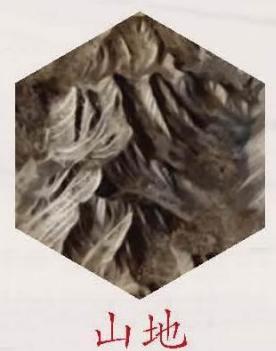
領地板塊
放置一個單位在山地區域中就足以阻擋其他玩家的進入。
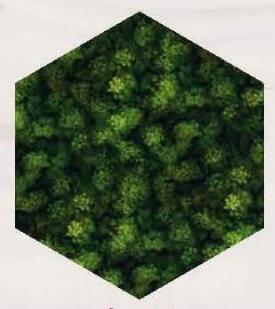
不能放置城市在森林區域中,也不能在其中建造城市。
單位
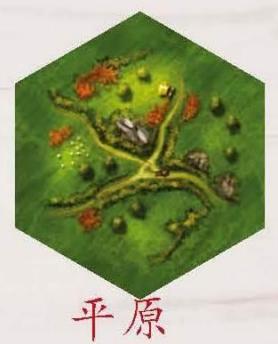
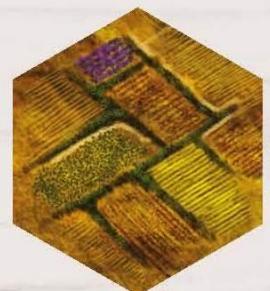
這些是最繁榮的領地區域。當你執行“進爵”行動時,你會發現這些地形能幫助你升上更高的貴族階層。

整局遊戲中,任何單位都不能通過或佔據該地形區域。

- 建造條件
一個村莊可以開拓為一個城市。每個城市價值10分。
見行動 D - 第4頁
- 防禦力
其他玩家的騎士無法進入你的城市所佔據的區域。
- 能力:徵募
城市區域中可以徵募騎士。
見行動 A - 第2頁
- 建造條件

騎士可以在城市中被徵募。
見行動 A - 第2頁
- 防禦力
同區域中,兩個同顏色的對手騎士才可以消滅你的一個騎士。
- 能力:移動
騎士可以從一個區域中移動到另一個區域,從而來佔領區域,進攻對手或增加防禦。
見行動 B - 第3頁
- 能力:建築
一個騎士可以升級為一個村莊或一個要塞。
見行動 C - 第3頁
- 建造條件
可以通過升級版圖中的一個騎士來獲得一個村莊。
見行動 C - 第3頁
- 防禦力
同區域中,兩個同顏色的對手騎士才可以消滅你的一個村莊。
- 能力:開拓
一個村莊可以開拓為一個城市。
見行動 D - 第4頁
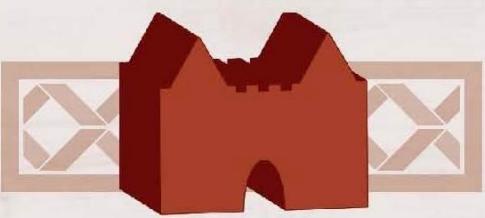
要塞
- 建造條件
可以通過升級版圖中的一個騎士來獲得一個要塞。
見行動 C - 第3頁
- 防禦力
其他玩家的騎士無法進入你的要塞所佔據的區域。
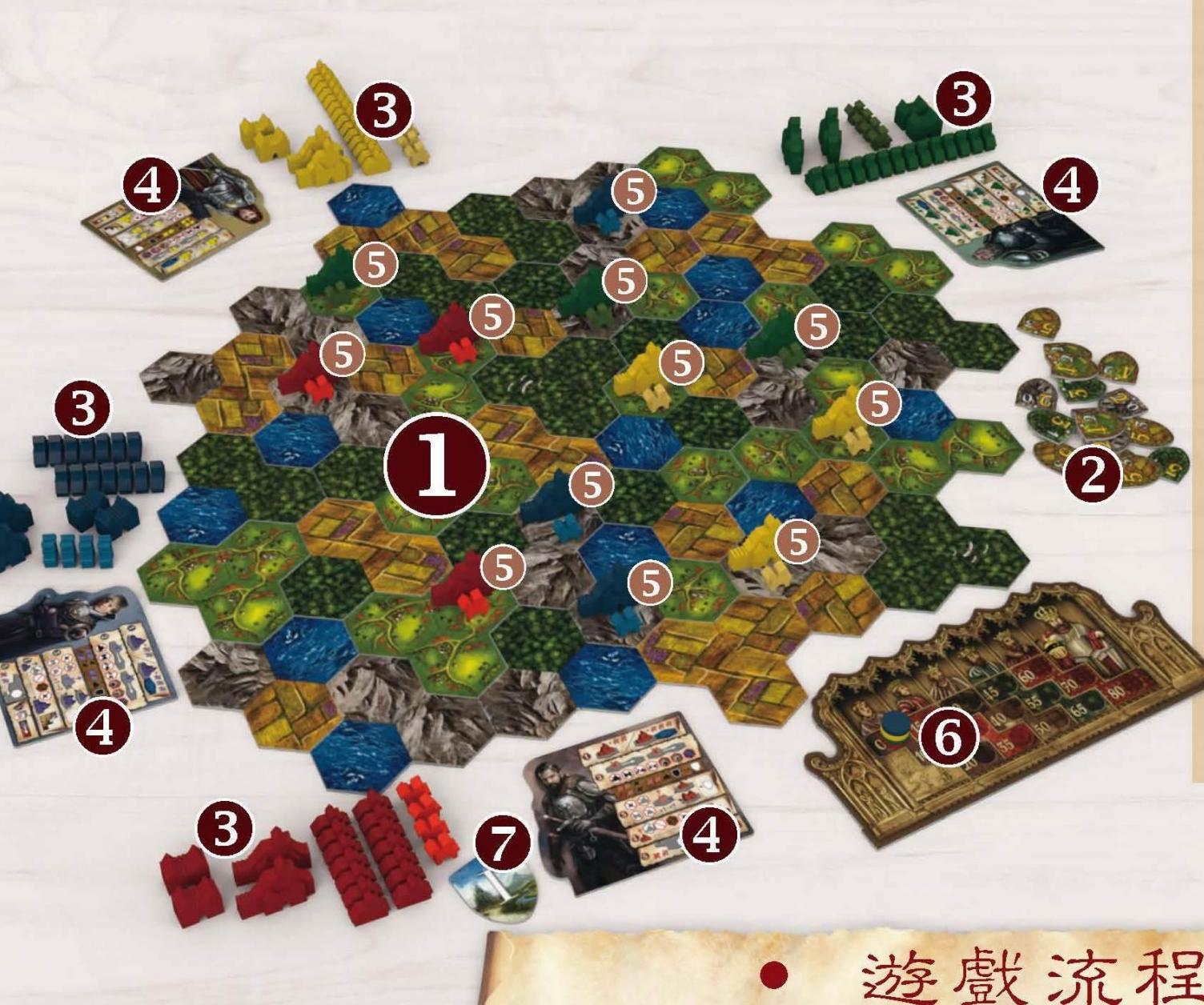
- 遊戲準備
- 每位玩家隨機拿取9個板塊然後一齊將其隨機拼放構建出遊戲版圖①。如果少於4位玩家,未使用到的板塊放回遊戲盒中。
- 所有資源標記堆放在遊戲版圖一旁②,構成資源堆。
- 每位玩家選擇一種顏色並將相應顏色的所有單位放於自己面前:5個城市,2個要塞,7個騎士,14個村莊③以及一張玩家輔助表④。
- 每位玩家按照右側規則依次放置3個城市和3個騎士⑤。
- 將計分標記放置在計分板上0位置處⑥。
- 最年輕的玩家選擇一位玩家作為起始玩家。該玩家拿取起始玩家標記⑦。
初始城市和騎士的放置
起始玩家需將他的一個城市放置在任意一個區域中,並且該區域中再放置1個他的騎士。
然後按照順時針順序,除末位玩家以外的其他每位玩家依次放置1個城市和1個騎士,放置規則與起始玩家相同。
末位玩家則是放置3個城市(而不是1個)到任意3個區域中,每個城市也都放上他的一個騎士。
接著按照逆時針順序,除末位玩家以外的其他每位玩家依次放置2個城市和2個騎士。
因此,每位玩家第一回合開始前都各有3個城市,分佈在版圖中的3個不同區域,並且每個區域內有一個騎士。玩家剩餘的單位堆放在面前構成儲備堆。
—限制 —

- 城市不能處於湖泊區域。
- 城市不能處於森林區域。
- 任意兩個城市不能相鄰,而且一個區域中不能有兩個城市。
• 遊戲流程 •
玩家按照順時針順序輪流進行遊戲回合。
在一位玩家的回合中,該玩家必須選擇並執行以下六種行動之一:
A) 徵募

B) 移動

C) 建築
D) 開拓

E) 遠征

F) 進爵

澂募
選擇你的一個城市,從你的儲備堆中至多拿取2個騎士放到該城市所在區域中。如果該城市區域與一個或多個湖泊區域相鄰,則改為你可以至多拿取3個騎士放入。
如果你的儲備堆中一個騎士都沒有了,你就不能再選擇徵募行動。

因為紅色城市在湖泊旁,所以紅色玩家可至多徵募3個騎士在該城市中。


移動
移動你的1或2個騎士到與其相鄰的區域。
你不能在一次移動行動中,移動同一個騎士兩次。但你移動的兩個騎士的出發區域和到達區域可以是不同的,也就是說,兩次移動是分別獨立執行的。同一區域中,你的騎士的存在數量沒有上限。
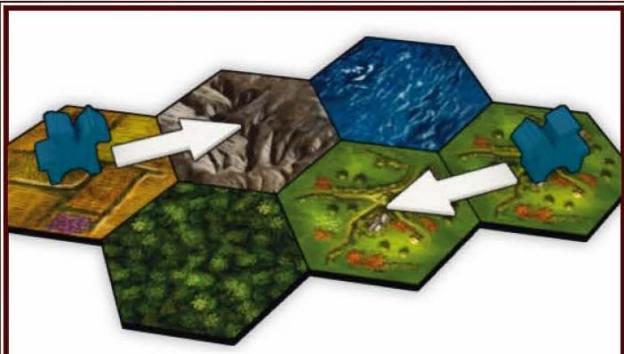
藍色玩家移動了他的2個騎士。
—限制 —
No
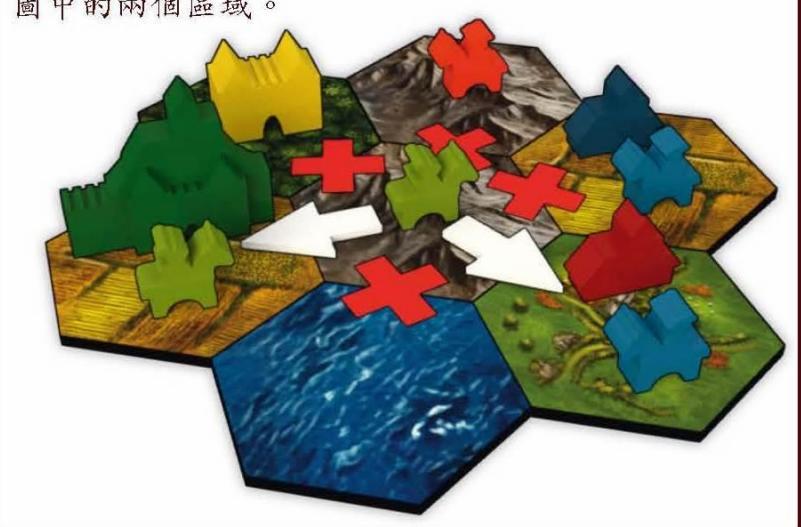
綠色騎士只能移動到下圖中的兩個區域。
騎士不能移動到下列區域中:
- 湖泊區域。
- 被其他玩家的1個城市或要塞所佔據的區域。
- 被同一位其他玩家的至少2個單位所佔據的區域(2個騎士或1個騎士+1個村莊)。
- 被其他玩家的1個單位所佔據的山地區域。
共存與衝突
- 同一區域中,只要大家的單位(騎士或村莊)都不超過一個,則允許多位玩家的單位共存。
- 如果一個區域中已經存在某位玩家的單位,此時該玩家若將他的另一個騎士移動到了該區域中,則他將摧毀該區域中所有其他玩家的單位。
被摧毀的騎士和村莊返回所屬玩家的儲備堆中。
說明:
當一位玩家摧毀了其他玩家的一個村莊時,進攻玩家奪取受害玩家的一個資源標記(見本頁底部)。由進攻玩家來選擇要奪取的資源標記。如果受害玩家此時沒有任何資源標記,則進攻玩家一無所獲。另外,玩家摧毀其他玩家的騎士時,不會奪取任何資源標記。

建築
將版圖中你的任意多個甚至全部的騎士分別升級為村莊或要塞。
村莊和要塞從儲備堆中拿取,騎士則返回儲備堆中。
每一處的建築升級,根據所在區域的地形你將立即獲得相應的一個資源標記。
—限制 —

下列區域無法建築:
- 區域中已存在一個村莊,要塞或城市,無論其屬於哪位玩家。
- 區域中存在其他玩家的騎士。
說明:
- 如果你的兩個騎士在同一區域中,你只能升級其中一個。
- 建築數量有限,如果你的儲備堆中沒有村莊或要塞了,你就不能再繼續建築升級,之後也不能再選擇建築行動。你不能主動移除或移動版圖中你的建築。
四種不同的資源標記都標有資源點:金色數字用於行動 E — 進爵;銀色數字用於遊戲結束時加入玩家總分。
資源標記

黃色玩家移動一個騎士到一區域中,該區域之前已經存在一個他的騎士,一個紅色騎士,以及一個藍色村莊。

由於湊足了2個騎士,黃色玩家將摧毀該區域中所有對手的單位,並奪取藍色玩家的一個資源標記。

紅色玩家只能在這兩個區域中建造村莊或要塞。

他將一個騎士升級為一個要塞,另一個升級為村莊。然後根據建築所處區域的地形,他獲得一個森林資源標記和一個田園資源標記。

開拓
將你的一個村莊開拓為城市(同樣地,只有當你的儲備堆中仍有城市時才能選擇該行動)。
城市從你的儲備堆中拿取,
村莊則返回儲備堆中。
當你開拓了一個新城市時,
你立即獲得10分:將你的計
分標記下滑一格。
遠证
從你的儲備堆中拿取2個騎士。將其中一個移出遊戲(放回遊戲盒中),將另一個放置在版圖邊緣的任意一個空區域中。
—限制

下列區域無法開拓:
- 處於森林區域中的村莊無法開拓。
- 與另一個城市區域相鄰的村莊無法開拓(無論該城市屬於哪位玩家)。
- 區域中存在其他玩家的騎士。
限制
下列區域無法放置騎士:
- 湖泊區域。
- 存在任何其他單位的區域,無論該單位屬於哪位玩家。
進爵
遊戲開始前,所有玩家的貴族階層都是男爵。在遊戲中有機會晉升為子爵,伯爵,侯爵,以及公爵。
支付至少15點資源點則可以將你的計分標記向右前進一格,晉升為更高一級的貴族階層。
支付掉的資源標記返回資源堆中。
說明:
如果支付了超過15點的資源點,資源堆也不會找零。一次行動中最多只能晉升一級,即使你有富餘的資源點也只能在之後的行動中來晉升爵位。


藍色玩家將他的一個村莊開拓為城市,並獲得了10憤怒。此時他一共擁有25分。
此時,只有兩個村莊可以開拓為城市。

綠色玩家從他的儲備堆中移除了一個騎士,然後拿取另一個騎士放在了版圖邊緣的一個空森林區域中。該區域與紅色村莊相鄰。

黃色玩家支付16點資源點,計分標記向右前進了一格。他從伯爵晉升為了侯爵,此時一共擁有45分,
• 遊戲結束 •
當一位玩家晉升為公爵(達到計分板最後一列的60、70、80分格)時,該回合結束後遊戲立即結束。也就是說遊戲結束時,每位玩家的總回合數是相等的。每位玩家將各自未使用的資源點(銀色數字)加入他的總分中。隨後,擁有最多分數的玩家成為大領主,並贏得遊戲勝利。如果出現平局,順時針順序離起始玩家最遠的玩家贏得勝利。
中文翻譯&排版:金屬城堡
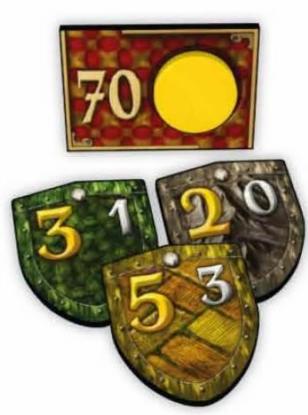
黃色玩家計分板上擁有70分。他還有3個未使用的資源標記,價值4分。
他的最終得分為74分。
Download MarkdownBARONY_RULES_EN.md13.8 KB


A game by Marc André Illustrated by Ismaël
arony

At the farthest reaches of the Empire, four barons fight for the power. With their armies of knights, they extend their territories and build villages, strongholds and cities. At the end of this race for power, one of them will become King.
Contents
• 36 Territory tiles
(Mountains, Forests,
Plains, Fields, Lakes)
• 1 scoreboard
• 80 Resource tokens
• 1 First Player token
For each player (blue,
yellow, green and red):
• 7 knights
• 5 cities
• 2 strongholds
Goal of the game
• 14 villages
• 1 score counter
• 1 Player Reference sheet
Each player must conquer territories, build and protect villages, strongholds, and cities. When at least one player becomes a Duke, the player with the most Victory points is crowned King and wins the game.
• Elements of the game •
Assemble the tiles at the start of the game to build the game board (see Game Setup, page 2).
Each tile is made up of 3 independent hexagons.
Each hexagon represents one space of the board game and is one of the five types of land: Mountains, Forests, Plains, Fields, or Lakes.
Each land type, except the Lake, is associated with one Resource token (see page 3).

MOUNTAIN
Land tiles
One pawn placed in a mountain space is enough to keep other players from entering.

FOREST
No city can be placed or built in a forest space.
Pawns
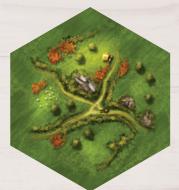

PLAIN
These are the most prosperous territories. They make it easier to gain a rank of nobility when you take the "Noble Title" action.
FIELDS

LAKE
This space cannot be crossed or occupied by any pawns during the game.
CITIES
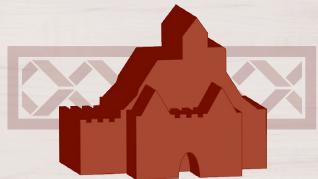
•Defense
A space occupied by a city is inaccessible to opposing knights.
•New city
A village can become a city. Each new city earns 10 victory points.
See Action D - page 4
Action: Recruitment
Knights are recruited in cities. > See Action A - page 2
KNIGHTS

Recruitment
Knights are recruited in a city. > See Action A - page 2
Action: Movement
Knights move from one space to another to claim territory, attack opponents, or defend.
See Action B - page 3
•Construction
One knight can be replaced with a village or a stronghold.
See Action C - page 3
•Defense
One knight can be destroyed by two opposing pawns of the same color.

Construction
A player can replace one knight on the board with a new village.
See Action C - page 3
• Action: New city
Cities are always constructed from villages. > See Action D - page 4
Defense
One village can be destroyed by two opposing knights of the same color.
STRONGHOLDS

Construction
A player can replace one knight on the board with a new stronghold.
See Action C - page 3
•Defense
A space occupied by a stronghold is inaccessible to opposing knights.
• Game setup •
• Take 9 random tiles per player and place them randomly to build a game board ①. If there are fewer than 4 players, unused tiles should be put back in the game box.
• Place all of the Resource tokens together next to the game board ②.
This is the resource bank.
• Each player chooses one color and places in front of him the corresponding pawns: 5 cities, 2 strongholds, 7 knights, and 14 villages 3 and also a Player Reference sheet ④.
• Each player will place 3 cities and 3 knights ⑤ as explained on the right.
• Place the score counters on the 0 space of the scoreboard ⑥.
• The youngest player chooses a first player. This player takes the First Player token. He may choose himself as the first player ⑦.
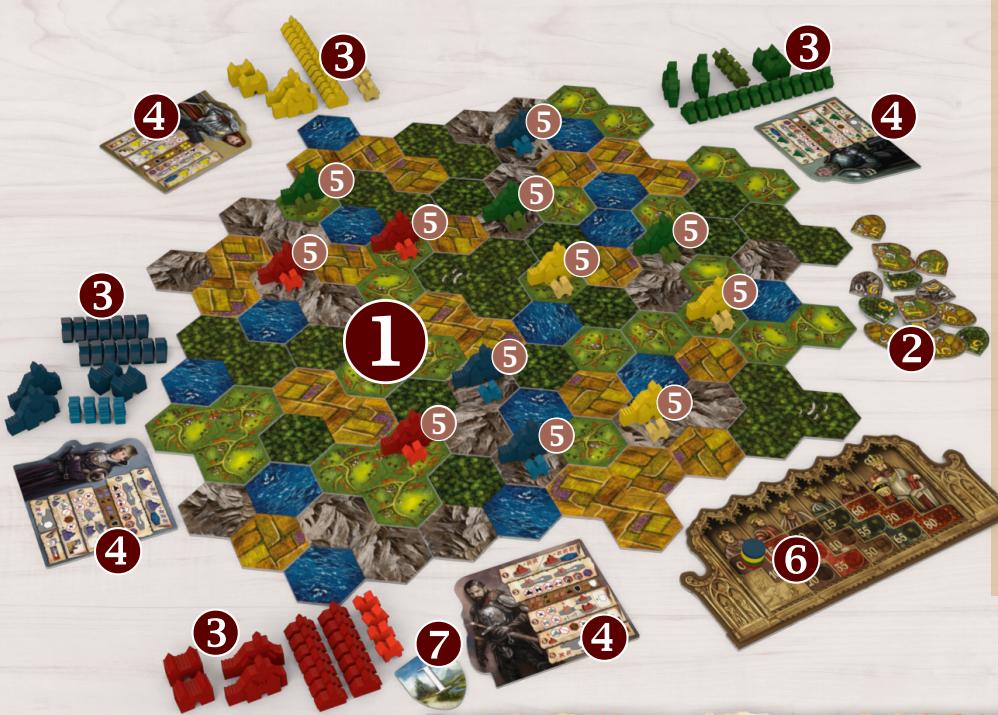
Arrangement of the first cities and knights
After a moment of reflection in which he examines the board, the first player places one city and one knight in the space of his choice.
Then, in clockwise order, each player does the same except for the last player, who places 3 cities instead of 1, with one knight in each of them.
Then, proceeding counterclockwise, each player other than the last player then places 2 cities with 1 knight in each of them.
Thus, each player will start his first turn with 3 cities, each with one knight, in three different spaces of the board. The remaining pawns are each player's reserve.
– RESTRICTIONS –



• No cities are allowed in lake spaces
• No cities are allowed in forest spaces
• No cities may be placed in the same space
or in a space adjacent to another city
• Game progress ·
The game is a succession of turns which are played in clockwise order. On his turn, a player can take ONE and only one of the following six actions:
A) Recruitment

B) Movement
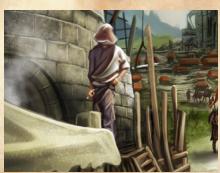
C) Construction
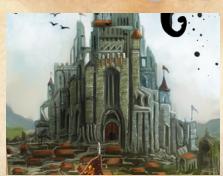
D) New city
E) Expedition

F) Noble title
Recruitment
Choose one and only one city and place up to 2 knights taken from the reserve into the same space as the city. If the city's space is adjacent to one or more lake(s), you can place up to 3 knights instead.
If you have no knights in your reserve, you cannot take the recruit action.

The red city is on the edge of a lake. Thus the red player recruits 3 knights

Movement
Move 1 or 2 of your knights to an adjacent space.
The two moves are completely independent (the starting and destination spaces of the knights can be different). However, you cannot move the same knight twice.
There is no limit to the number of your knights that can be present in the same space.

– RESTRICTIONS –

The blue player moves two knights.
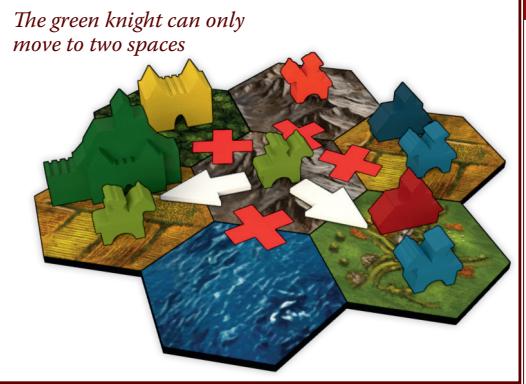
A knight cannot move to the following spaces:
• A lake space
• A space with an opponent's city or stronghold
• A space containing at least 2 pawns belonging to the same opponent (2 knights or 1 knight + 1 village)
• A mountain space with an opponent's pawn in it.
Coexistence and conflict
• In a single space, pawns of different players can coexist as long as a player doesn't have more than one pawn (knight or village) in this space.
• If a player already present in a space moves another knight into that space, he destroys all opposing pawns in that space.
Destroyed knights and villages are returned to their owners' reserves.
Important: When a player destroys an opponent's village, he takes from that player a Resource token (see below). The attacking player chooses the Resource token. If the attacked player has no Resource tokens left, the attacker takes nothing. No Resource token is earned when a player destroys an opponent's knight.

Construction
Replace all or any of your knights on the game board with a village or stronghold from your reserve.
Knights replaced in this way are returned to your reserve.
– RESTRICTIONS –
For each build, you immediately earn one Resource token corresponding to the land type of the space.

You cannot build:
• If there is already a building on the space (village, stronghold, or city) regardless of who the owner is.
• If an opponent's knight is present on the space.
Notes :
• If two knights of the same color are in the same space, only one of them will be replaced.
• Buildings are limited to the quantity in your reserve. If you have no strongholds or villages left, you cannot build any more. You cannot remove one of your own buildings from the board.
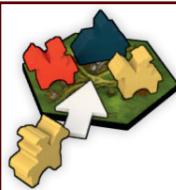
The yellow player moves a knight to a space which already contains one of his knights, a red knight and a blue village.
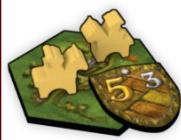
With his 2 knights he destroys all of his opponents' pawns, and takes a Resource token from the blue player.

There are only two spaces where the red player can build strongholds or villages.
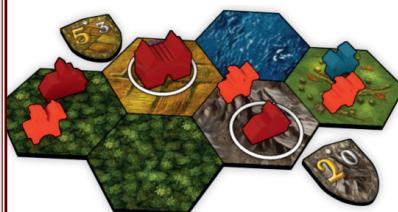
He replaces one knight with a stronghold and the other with a village. He then takes one Mountain and one Fields Resource token, corresponding to the spaces where he just built.
Resource tokens
Each of the 4 different tokens are worth Resource points which can be used during the Action E - Noble title (gold number), or counted and added to the player's score at the end of the game (silver number).

In this situation, only two villages can be replaced with cities.


New city
Replace one of your villages with a city from your reserve (this is only possible if you have a city in your reserve).
The replaced village is returned to your reserve.
When you build a new city, you immediately earn 10 victory points: move your score counter down one space.
Expedition
Take two knights from your reserve. One of them is permanently removed from the game (put it back in the game box) and place the other in a free space of your choice on the edge of the game board.
– RESTRICTIONS –

You cannot build a city:
• If the village is in a forest space.
• If the village is in a space adjacent to a space containing a city (regardless of who owns the city).
• If an opponent's knight is present on the space.
– RESTRICTIONS –
You cannot place the knight:
• In a lake space.
• In a space containing another pawn (knight or building) regardless of its owner.
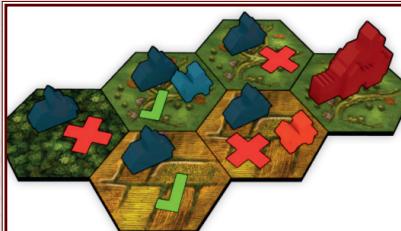
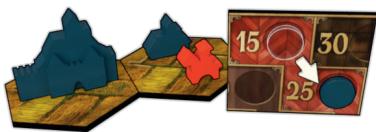
The blue player replaces one of his villages with a city and earns 10 victory points. He now has 25 points.
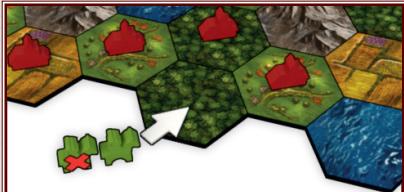
The green player removes one of his Reserve knights from the game and then places another in the free Forest space on the edge of the game board, behind the red player's villages.
Noble title
All players start the game with the title of Baron. They can then become Viscount, Count, Marquis, and then Duke.
Discard a minimum of 15 Resource points to acquire a higher Noble title, and then move your score counter one space to the right on the scoreboard.
Discarded Resource tokens are returned to the resource bank.
Watch out!
The resource bank doesn't give change if more than 15 Resource points are spent.
No one can advance by more than one rank at a time, even if someone possesses enough Resource points.
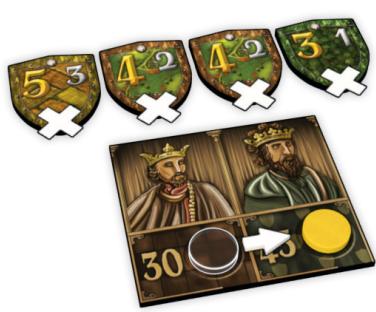
The yellow player spends 16 Resource points and moves one space to the right. He has advanced from Count to Marquis, and now has 45 points.
• End of the game
When one player becomes a Duke (the last column on the scoreboard with the 60, 70, and 80 values), continue until the end of the round so that each player has played the same number of turns.
Each player adds his unused Resource points (silver number) to his Victory points on the scoreboard.
The player with the most points becomes the King and wins the game.
In case of a tie, it is the tied player who is furthest from the first player in turn order who wins.
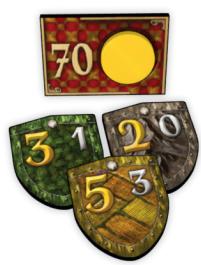
The yellow player has 70 points on the score board.
He has also 3 Resource tokens left with 4 points on them.
His final score will be 74 points.
Download Markdown简繁检索对照.md1.6 KB
168513_167513_barony — 简体/繁体检索对照
本游戏的规则书是繁体中文原文。用户用简体提问时,把关键词按下面这张表转成繁体再去 grep 原文,命中率最高。
回答时用简体或繁体都可以,但引用的原文保持繁体。
简体 → 繁体 对照(按该游戏原文出现频率排序,共 60 字)
| 简体 | 繁体 | 原文出现次数 |
|---|---|---|
| 个 | 個 | 111 |
| 区 | 區 | 61 |
| 骑 | 騎 | 56 |
| 动 | 動 | 35 |
| 游 | 遊 | 30 |
| 戏 | 戲 | 30 |
| 庄 | 莊 | 28 |
| 标 | 標 | 26 |
| 资 | 資 | 25 |
| 记 | 記 | 23 |
| 为 | 為 | 20 |
| 时 | 時 | 18 |
| 将 | 將 | 18 |
| 开 | 開 | 17 |
| 该 | 該 | 17 |
| 备 | 備 | 15 |
| 进 | 進 | 15 |
| 单 | 單 | 14 |
| 领 | 領 | 13 |
| 图 | 圖 | 13 |
| 两 | 兩 | 13 |
| 无 | 無 | 12 |
| 筑 | 築 | 12 |
| 储 | 儲 | 12 |
| 见 | 見 | 11 |
| 页 | 頁 | 11 |
| 级 | 級 | 11 |
| 于 | 於 | 11 |
| 计 | 計 | 10 |
| 并 | 並 | 10 |
| 御 | 禦 | 10 |
| 则 | 則 | 10 |
| 从 | 從 | 9 |
| 后 | 後 | 9 |
| 点 | 點 | 9 |
| 块 | 塊 | 8 |
| 数 | 數 | 8 |
| 据 | 據 | 8 |
| 条 | 條 | 8 |
| 选 | 選 | 8 |
| 择 | 擇 | 8 |
| 红 | 紅 | 7 |
| 晋 | 晉 | 7 |
| 占 | 佔 | 7 |
| 获 | 獲 | 7 |
| 顺 | 順 | 7 |
| 与 | 與 | 7 |
| 说 | 說 | 7 |
| 夺 | 奪 | 6 |
| 蓝 | 藍 | 6 |
| 黄 | 黃 | 6 |
| 当 | 當 | 6 |
| 种 | 種 | 6 |
| 征 | 徵 | 6 |
| 处 | 處 | 6 |
| 结 | 結 | 6 |
| 远 | 遠 | 5 |
| 边 | 邊 | 5 |
| 贵 | 貴 | 5 |
| 没 | 沒 | 5 |
Texts are community-compiled or publicly released by publishers; copyright remains with the original authors. For personal reference only.