
骑士纹章Barony
一句话概览
骑士纹章 是一款已收录于村了吗规则库的桌游,支持 2–4 人,原名 Barony。
本页内容:一句话概览 · 游戏概述 · 1. 游戏组件 · 2. 游戏设置 · 3. 地形说明 · 4. 单位类型 · 5. 游戏流程 · 6. 行动详解 · 7. 资源标记 · 8. 游戏结束 · 关键规则与常见问题 · 常见问题
骑士纹章 规则速览
以下规则速览由本站整理,与官方规则书表述不同,仅供快速上手参考。
游戏概述
在帝国遥远的边境上,四家男爵贵族展开残酷的权力斗争。各家的骑士团战略部署,为领主扩张疆域、兴建村庄与城市、建造要塞。当至少有一位玩家晋升公爵时,分数最高的玩家将成为大领主并赢得游戏。
核心机制: 板块放置、单位移动与战斗、建筑升级、爵位晋升
1. 游戏组件
| 组件 | 数量 |
|---|---|
| 领地板块 | 36块(山地、森林、平原、田园、湖泊五种地形) |
| 计分板 | 1张 |
| 资源标记 | 80个(含金色数字"资源点"和银色数字"最终分数") |
| 起始玩家标记 | 1个 |
| 骑士(每色) | 7个 |
| 城市(每色) | 5个 |
| 要塞(每色) | 2个 |
| 村庄(每色) | 14个 |
| 计分标记 | 1个(每色) |
| 玩家辅助表 | 1张(每色) |
每位玩家拥有四种颜色之一:蓝、黄、绿、红。
2. 游戏设置
2.1 版图构建
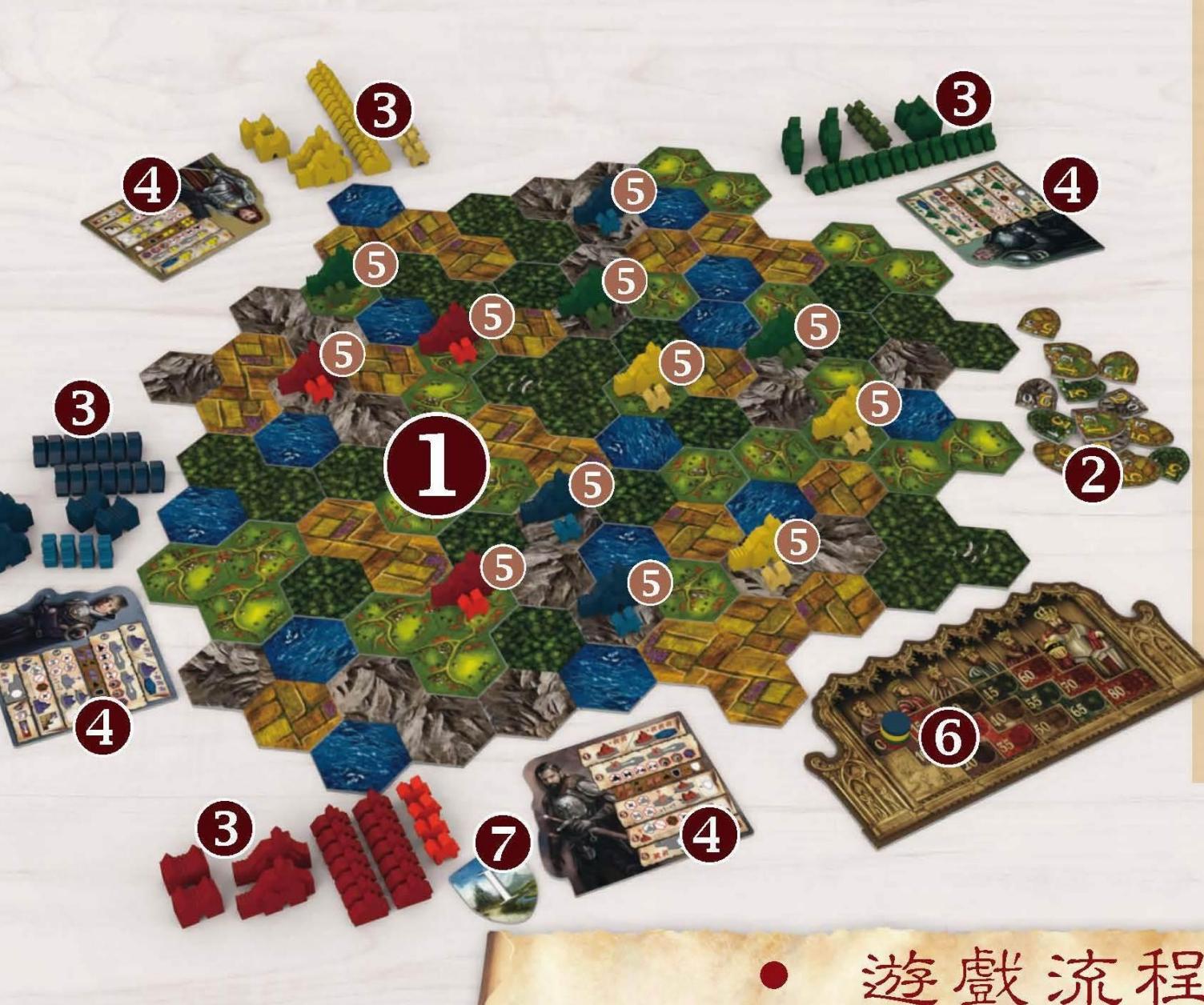
- 每位玩家随机抽取9块领地板块,然后将这9块一起随机拼接,构建立体的游戏版图①。
- 如果少于4位玩家,未使用到的板块放回游戏盒中。
- 所有资源标记堆放在版图一旁②,构成资源堆。
2.2 玩家准备
- 每位玩家选择一种颜色,将相应颜色的所有单位放于自己面前:5个城市、2个要塞、7个骑士、14个村庄③以及一张玩家辅助表④。
- 计分标记放置在计分板的0位置处⑥。
- 最年轻的玩家选择一位玩家作为起始玩家,该玩家拿取起始玩家标记⑦。
2.3 初始城市和骑士的放置
按顺时针顺序依次放置初始单位:
第一步——起始玩家:
1. 将自己的一个城市放在任意一个区域中;
2. 在该城市中再放置1个自己的骑士。
第二步——顺时针放置:
1. 除末位玩家以外的其他每位玩家依次放置1个城市和1个骑士(规则同上)。
第三步——末位玩家:
- 末位玩家放置3个城市(而非1个)到任意3个区域中,每个城市都放上自己的1个骑士。
第四步——逆时针放置:
- 除末位玩家以外的其他每位玩家依次放置2个城市和2个骑士。
至此,每位玩家第一回合开始前各有3个城市,分布在版图中的3个不同区域,每个区域内有一个骑士。玩家剩余的单位堆放在面前构成储备堆。
2.4 放置限制
- 城市不能放在湖泊区域。
- 城市不能放在森林区域。
- 任意两个城市不能相邻,且一个区域中不能有兩個城市。
3. 地形说明
每个领地板块由3个相互独立的六边形构成,每个六边形表示一块领地区域,地形分为以下五种:
| 地形 | 说明 |
|---|---|
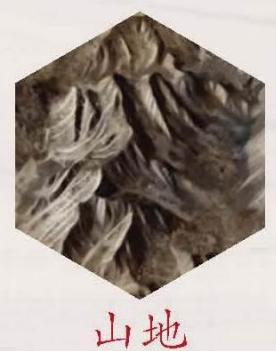
| 山地 | 放置一个单位在山地区域就足以阻挡其他玩家的进入。整局游戏中,任何单位都不能通过或占据该地形区域。 |
| 森林 | 骑士可以到达但不能在此建造城市。村庄不能从森林区域开拓为城市。 |
| 平原 | 繁荣的地形,执行"进爵"行动时可帮助升上更高贵族阶层。 |
| 田园 | 繁荣的地形,执行"进爵"行动时可帮助升上更高贵族阶层。 |
| 湖泊 | 骑士不能移动到湖泊区域。骑士不能从湖泊区域出发进行远征放置。 |
除湖泊以外,每种领地图形对应有一种资源标记。
4. 单位类型
骑士
| 属性 | 说明 |
|---|---|
| 能力 | 招募、移动、建筑、开拓 |
| 建筑 | 可升级为村庄或要塞 |
| 防御力 | 同区域中,需要对手至少2个同色骑士才能消灭你1个骑士 |
村庄
| 属性 | 说明 |
|---|---|
| 获取方式 | 将版图中一个骑士升级为村庄 |
| 开拓 | 可开拓为城市 |
| 防御力 | 同区域中,需要对手至少2个同色骑士才能消灭你1个村庄 |
城市
| 属性 | 说明 |
|---|---|
| 招募 | 在城市所在区域可招募骑士 |
| 防御力 | 其他玩家的骑士无法进入你城市占据的区域 |
| 价值 | 每个城市价值10分 |
| 破坏 | 被摧毁时返回所属玩家储备堆,不夺取消耗者资源标记 |
要塞
| 属性 | 说明 |
|---|---|
| 获取方式 | 将版图中一个骑士升级为要塞 |
| 防御力 | 其他玩家的骑士无法进入你要塞占据的区域 |
| 破坏 | 被摧毁时返回所属玩家储备堆,不夺取消耗者资源标记 |
5. 游戏流程
玩家按照顺时针顺序轮流进行游戏回合。在一位玩家的回合中,该玩家必须选择并执行以下六种行动之一:
- A) 招募 — 从储备堆取骑士放入城市所在区域
- B) 移动 — 移动骑士到相邻区域
- C) 建筑 — 将骑士升级为村庄或要塞
- D) 开拓 — 将村庄开拓为城市
- E) 远征 — 从储备移除一个骑士,将一个骑士放置到版图边缘空区域
- F) 进爵 — 支付资源点晋升贵族阶层
每次只能执行一种行动,不可组合。
6. 行动详解
6.1 A — 招募
执行步骤:
1. 选择你的一个城市;
2. 从你的储备堆中至多拿取2个骑士,放到该城市所在区域中。
湖泊加成: 如果该城市区域与一个或多个湖泊区域相邻,则改为你可以至多拿取3个骑士放入。
限制: 如果你的储备堆中一个骑士都没有了,就不能再选择招募行动。
6.2 B — 移动
执行步骤:
1. 移动1个或2个骑士到与其相邻的区域。
关键规则:
- 在一次移动行动中,不能移动同一个骑士两次。
- 两次移动可以分别从不同的出发区域到达不同的区域,即两次移动是分别独立执行的。
- 同一区域中,你的骑士的存在数量没有上限。
移动限制
骑士不能移动到以下区域:
- 湖泊区域。
- 被其他玩家的1个城市或要塞所占据的区域。
- 被同一位其他玩家的至少2个单位所占据的区域(2个骑士或1个骑士+1个村庄)。
- 被其他玩家的1个单位所占据的山地区域。
共存与冲突
- 共存: 同一区域中,只要大家的单位(骑士或村庄)都不超过一个,则允许多位玩家的单位共存。
- 冲突: 如果一个区域中已经存在某位玩家的单位,此时该玩家若将他的另一个骑士移动到了该区域中,则将摧毁该区域中所有其他玩家的单位。
摧毁处理:
- 被摧毁的骑士和村庄返回所属玩家的储备堆中。
- 攻击奖励: 当一位玩家摧毁了其他玩家的1个村庄时,进攻玩家夺取受害玩家的1个资源标记。由进攻玩家来选择要夺取的资源标记。如果受害玩家此时没有任何资源标记,则进攻玩家一无所获。
- 注意: 玩家摧毁其他玩家的骑士时,不会夺取任何资源标记。
6.3 C — 建筑
执行步骤:
1. 将版图中你的任意多个(甚至全部)骑士分别升级为村庄或要塞。
2. 村庄和要塞从储备堆中拿取,骑士则返回储备堆中。
3. 每一处的建筑升级,根据所在区域的地形,你将立即获得相应的1个资源标记。
建筑限制:
以下区域无法建筑:
- 区域中已存在一个村庄、要塞或城市,无论其属于哪位玩家。
- 区域中存在其他玩家的骑士。
重要说明:
- 如果两个骑士在同一区域中,只能升级其中1个。
- 建筑数量有限,如果储备堆中没有村庄或要塞了,就不能再继续建筑升级,之后也不能再选择建筑行动。
- 不能主动移除或移动版图中你的建筑。
6.4 D — 开拓
执行步骤:
1. 将你的1个村庄开拓为城市。
2. 城市从你的储备堆中拿取,村庄则返回储备堆中。
3. 当你开拓了一个新城市时,你立即获得10分:将你的计分标记下滑一格。
开拓限制:
以下区域无法开拓:
- 处于森林区域中的村庄无法开拓。
- 与另一个城市区域相邻的村庄无法开拓(无论该城市属于哪位玩家)。
- 区域中存在其他玩家的骑士。
限制: 只有当储备堆中仍有城市时才能选择开拓行动。
6.5 E — 远征
执行步骤:
1. 从你的储备堆中移除1个骑士(移出游戏,放回游戏盒中)。
2. 从你的储备堆中拿取另1个骑士,放置在版图边缘的任意一个空区域中。
放置限制:
以下区域无法放置骑士:
- 湖泊区域。
- 存在任何其他单位的区域,无论该单位属于哪位玩家。
6.6 F — 进爵
游戏开始前,所有玩家的贵族阶层都是男爵。在游戏中有机会晋升为子爵、伯爵、侯爵,以及最终的公爵。
执行步骤:
1. 支付至少15点资源点,将计分标记向右前进一格,晋升为更高一级的贵族阶层。
2. 支付掉的资源标记返回资源堆中。
关键规则:
- 一次行动中最多只能晋升一级,即使你有富余的资源点也只能在之后的行动中继续晋升。
- 如果支付了超过15点的资源点,资源堆也不会找零。
7. 资源标记
资源标记有两种数值标识:
| 颜色 | 数字含义 | 用途 |
|---|---|---|
| 金色数字 | 资源点 | 用于行动E(进爵)的支付费用 |
| 银色数字 | 分数点 | 游戏结束时加入玩家总分 |
- 建筑升级时根据所在区域的地形获得相应类型的资源标记。
- 村庄被摧毁时,进攻方从防守方夺取1个资源标记。
8. 游戏结束
结束触发
当一位玩家晋升为公爵(达到计分板最后一列的60、70或80分格)时,该回合结束后游戏立即结束。也就是说,游戏结束时每位玩家的总回合数是相等的。
最终计分
- 每位玩家将各自未使用的资源标记(银色数字)加入自己的总分中。
- 拥有最多分数的玩家成为大领主,赢得游戏胜利。
- 如果出现平局,顺时针顺序离起始玩家最远的玩家赢得胜利。
关键规则与常见问题
易错规则
- 六种行动二选一: 每回合只能执行一种行动,不可组合执行多个。
- 移动两个骑士互斥: 在一次移动行动中不能移动同一个骑士两次,但可以从不同区域移动两个不同骑士。
- 冲突条件严格: 只有当你已经将1个单位放在某区域后,再将第2个骑士移入该区域才触发摧毁。双方同时不在该区域时无冲突。
- 摧毁村庄才有资源标记奖励: 摧毁骑士不获得任何资源标记。
- 进爵只升一级: 一次行动最多晋升一级,超额支付的资源点不找零。
- 城市不能建在森林或湖泊中: 这是硬性限制,不仅是放置时,开拓也不行(森林中的村庄不能开拓)。
- 城市不能相邻: 任意两个城市不能相邻放置。
- 远征要消耗1个骑士: 从储备移除1个骑士永久退出游戏,同时从储备拿1个放到版图边缘空区域。
- 要塞和城市的防御力更强: 其他玩家的骑士无法进入,不同于村庄(需2个骑士才能攻破)。
- 招募时湖泊相邻加至3个: 不是默认2个,而是如果城市旁有湖泊可以拿最多3个。
常见问题
-
Q:同一区域能有多少个我的骑士?
A:没有上限。你的骑士可以无限叠加在同一区域。 -
Q:进爵需要多少资源点?
A:至少15点。支付超过15点也不找零。 -
Q:城堡被摧毁会怎样?
A:被摧毁的城市/要塞返回所属玩家的储备堆中。 -
Q:如何确定谁先行动?
A:最年轻玩家选起始玩家,之后按顺时针方向轮流。 -
Q:什么时候结束游戏?
A:当任意一名玩家晋升为公爵时,本回合结束后游戏结束,所有人回合数相等。 -
Q:平局怎么处理?
A:顺时针顺序离起始玩家最远的玩家获胜。 -
Q:资源标记有什么用?
A:金色数字用于进爵(晋升贵族),银色数字在终局计分时计入总分。
常见问题(FAQ)
以下 1 条问答中 0 条来自站内玩家的真实提问,其余 1 条为本站整理的常见疑问;答复内容保持原样。
骑士纹章支持几个人玩?
2–4 人。
去哪查完整规则
想核对具体规则细节、卡牌效果或某个回合的结算方式,可以在村了吗里选中这款游戏后直接提问。
同类桌游
- 卡坦岛德式
- 工业革命:伯明翰德式
- 勃艮第城堡:特别典藏版德式
- 方舟动物园德式
- 卡卡颂抽象
- 瘟疫危机传承:第一季美式
- 阿瑞迪亚:勇踏征途美式
- 重塑宇宙德式
- 幽港迷城美式
- 埃多拉的德鲁伊德式
规则原文(Markdown)
本站收录这款游戏的规则原文 3 个文件,此处内联渲染 3 个,可直接展开阅读或下载。
rules_zh_骑士纹章_2139.md13.4 KB

2-4人遊戲
騎士紋章 arony



14+
Marc Andréi 設計
Ismaël 美工
在帝國遙遠的邊境上,四家男爵貴族陷入了殘酷的權力鬥爭。各家的騎士團都採取了戰略部署,為領主擴張疆域以及興建村莊、城市以及要塞。權力的爭奪沒有退路,最終只有一家貴族飢成就一方霸業!
配件
• 36 個領地板塊(山
地,森林,平原,田
園,湖泊)
- 1 張計分板
- 80個資源標記
- 1個起始玩家標記
每位玩家(藍、黃、綠
和紅)擁有:
- 7個騎士
- 5個城市
- 2個要塞
• 14 個村莊
- 1個計分標記
- 1 張玩家輔助表
遊戲目標
每位玩家需要爭奪領土,建造並守禦村莊、城市和要塞。當至少有一位玩家晉升公爵時,分數最高的玩家將成為大領主並贏得遊戲勝利。
• 遊戲元素 •
遊戲開始前,隨機拼放領地板塊,從而構建遊戲版圖(見第2頁遊戲準備)。
每個領地板塊由3個相互獨立的六邊形構成。
每個六邊形表示遊戲版圖中的一塊領地區域,並且其地形是以下五種之一:山地,森林,平原,田園或湖泊。
除了湖泊以外,每種領地地形對應有一種資源標記。(見第3頁)。
領地板塊
放置一個單位在山地區域中就足以阻擋其他玩家的進入。
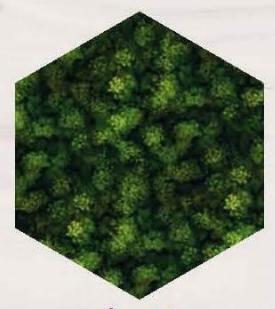
不能放置城市在森林區域中,也不能在其中建造城市。
單位
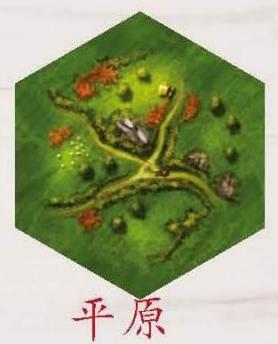
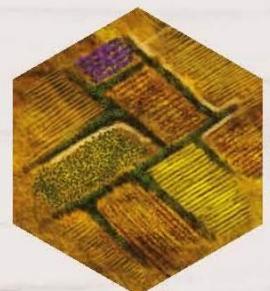
這些是最繁榮的領地區域。當你執行“進爵”行動時,你會發現這些地形能幫助你升上更高的貴族階層。

整局遊戲中,任何單位都不能通過或佔據該地形區域。

- 建造條件
一個村莊可以開拓為一個城市。每個城市價值10分。
見行動 D - 第4頁
- 防禦力
其他玩家的騎士無法進入你的城市所佔據的區域。
- 能力:徵募
城市區域中可以徵募騎士。
見行動 A - 第2頁
- 建造條件

騎士可以在城市中被徵募。
見行動 A - 第2頁
- 防禦力
同區域中,兩個同顏色的對手騎士才可以消滅你的一個騎士。
- 能力:移動
騎士可以從一個區域中移動到另一個區域,從而來佔領區域,進攻對手或增加防禦。
見行動 B - 第3頁
- 能力:建築
一個騎士可以升級為一個村莊或一個要塞。
見行動 C - 第3頁
- 建造條件
可以通過升級版圖中的一個騎士來獲得一個村莊。
見行動 C - 第3頁
- 防禦力
同區域中,兩個同顏色的對手騎士才可以消滅你的一個村莊。
- 能力:開拓
一個村莊可以開拓為一個城市。
見行動 D - 第4頁
要塞
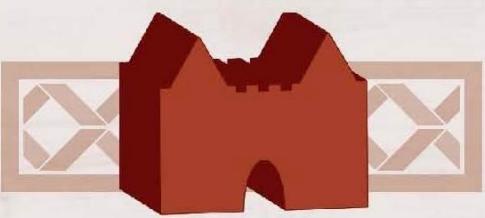
- 建造條件
可以通過升級版圖中的一個騎士來獲得一個要塞。
見行動 C - 第3頁
- 防禦力
其他玩家的騎士無法進入你的要塞所佔據的區域。
- 遊戲準備
- 每位玩家隨機拿取9個板塊然後一齊將其隨機拼放構建出遊戲版圖①。如果少於4位玩家,未使用到的板塊放回遊戲盒中。
- 所有資源標記堆放在遊戲版圖一旁②,構成資源堆。
- 每位玩家選擇一種顏色並將相應顏色的所有單位放於自己面前:5個城市,2個要塞,7個騎士,14個村莊③以及一張玩家輔助表④。
- 每位玩家按照右側規則依次放置3個城市和3個騎士⑤。
- 將計分標記放置在計分板上0位置處⑥。
- 最年輕的玩家選擇一位玩家作為起始玩家。該玩家拿取起始玩家標記⑦。
初始城市和騎士的放置
起始玩家需將他的一個城市放置在任意一個區域中,並且該區域中再放置1個他的騎士。
然後按照順時針順序,除末位玩家以外的其他每位玩家依次放置1個城市和1個騎士,放置規則與起始玩家相同。
末位玩家則是放置3個城市(而不是1個)到任意3個區域中,每個城市也都放上他的一個騎士。
接著按照逆時針順序,除末位玩家以外的其他每位玩家依次放置2個城市和2個騎士。
因此,每位玩家第一回合開始前都各有3個城市,分佈在版圖中的3個不同區域,並且每個區域內有一個騎士。玩家剩餘的單位堆放在面前構成儲備堆。
—限制 —

- 城市不能處於湖泊區域。
- 城市不能處於森林區域。
- 任意兩個城市不能相鄰,而且一個區域中不能有兩個城市。
• 遊戲流程 •
玩家按照順時針順序輪流進行遊戲回合。
在一位玩家的回合中,該玩家必須選擇並執行以下六種行動之一:
A) 徵募
B) 移動

C) 建築

D) 開拓

E) 遠征

F) 進爵

澂募
選擇你的一個城市,從你的儲備堆中至多拿取2個騎士放到該城市所在區域中。如果該城市區域與一個或多個湖泊區域相鄰,則改為你可以至多拿取3個騎士放入。
如果你的儲備堆中一個騎士都沒有了,你就不能再選擇徵募行動。

因為紅色城市在湖泊旁,所以紅色玩家可至多徵募3個騎士在該城市中。


移動
移動你的1或2個騎士到與其相鄰的區域。
你不能在一次移動行動中,移動同一個騎士兩次。但你移動的兩個騎士的出發區域和到達區域可以是不同的,也就是說,兩次移動是分別獨立執行的。同一區域中,你的騎士的存在數量沒有上限。

藍色玩家移動了他的2個騎士。
—限制 —
No
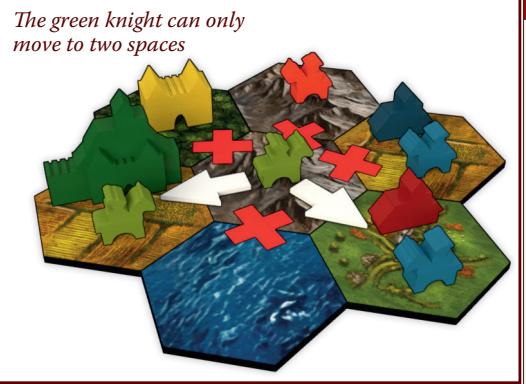
綠色騎士只能移動到下圖中的兩個區域。
騎士不能移動到下列區域中:
- 湖泊區域。
- 被其他玩家的1個城市或要塞所佔據的區域。
- 被同一位其他玩家的至少2個單位所佔據的區域(2個騎士或1個騎士+1個村莊)。
- 被其他玩家的1個單位所佔據的山地區域。
共存與衝突
- 同一區域中,只要大家的單位(騎士或村莊)都不超過一個,則允許多位玩家的單位共存。
- 如果一個區域中已經存在某位玩家的單位,此時該玩家若將他的另一個騎士移動到了該區域中,則他將摧毀該區域中所有其他玩家的單位。
被摧毀的騎士和村莊返回所屬玩家的儲備堆中。
說明:
當一位玩家摧毀了其他玩家的一個村莊時,進攻玩家奪取受害玩家的一個資源標記(見本頁底部)。由進攻玩家來選擇要奪取的資源標記。如果受害玩家此時沒有任何資源標記,則進攻玩家一無所獲。另外,玩家摧毀其他玩家的騎士時,不會奪取任何資源標記。

建築
將版圖中你的任意多個甚至全部的騎士分別升級為村莊或要塞。
村莊和要塞從儲備堆中拿取,騎士則返回儲備堆中。
每一處的建築升級,根據所在區域的地形你將立即獲得相應的一個資源標記。
—限制 —

下列區域無法建築:
- 區域中已存在一個村莊,要塞或城市,無論其屬於哪位玩家。
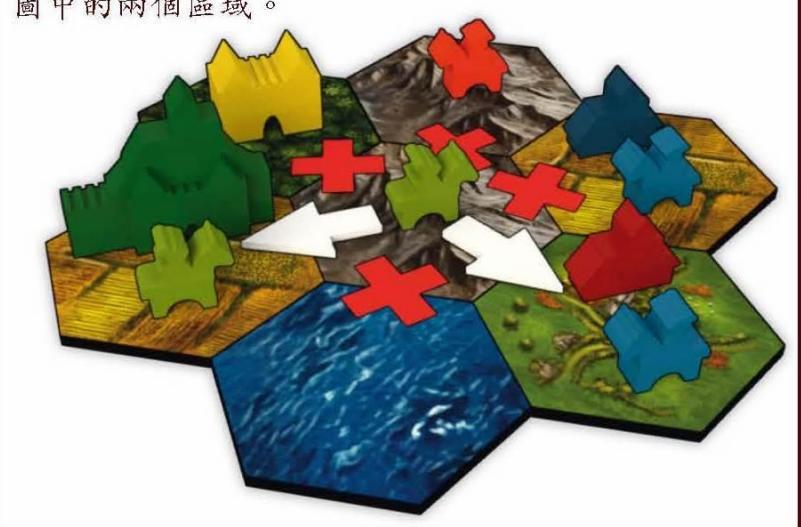
- 區域中存在其他玩家的騎士。
說明:
- 如果你的兩個騎士在同一區域中,你只能升級其中一個。
- 建築數量有限,如果你的儲備堆中沒有村莊或要塞了,你就不能再繼續建築升級,之後也不能再選擇建築行動。你不能主動移除或移動版圖中你的建築。
四種不同的資源標記都標有資源點:金色數字用於行動 E — 進爵;銀色數字用於遊戲結束時加入玩家總分。
資源標記

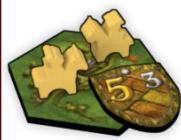
黃色玩家移動一個騎士到一區域中,該區域之前已經存在一個他的騎士,一個紅色騎士,以及一個藍色村莊。

由於湊足了2個騎士,黃色玩家將摧毀該區域中所有對手的單位,並奪取藍色玩家的一個資源標記。

紅色玩家只能在這兩個區域中建造村莊或要塞。

他將一個騎士升級為一個要塞,另一個升級為村莊。然後根據建築所處區域的地形,他獲得一個森林資源標記和一個田園資源標記。

開拓
將你的一個村莊開拓為城市(同樣地,只有當你的儲備堆中仍有城市時才能選擇該行動)。
城市從你的儲備堆中拿取,
村莊則返回儲備堆中。
當你開拓了一個新城市時,
你立即獲得10分:將你的計
分標記下滑一格。
遠证
從你的儲備堆中拿取2個騎士。將其中一個移出遊戲(放回遊戲盒中),將另一個放置在版圖邊緣的任意一個空區域中。
—限制

下列區域無法開拓:
- 處於森林區域中的村莊無法開拓。
- 與另一個城市區域相鄰的村莊無法開拓(無論該城市屬於哪位玩家)。
- 區域中存在其他玩家的騎士。
限制
下列區域無法放置騎士:
- 湖泊區域。
- 存在任何其他單位的區域,無論該單位屬於哪位玩家。
進爵
遊戲開始前,所有玩家的貴族階層都是男爵。在遊戲中有機會晉升為子爵,伯爵,侯爵,以及公爵。
支付至少15點資源點則可以將你的計分標記向右前進一格,晉升為更高一級的貴族階層。
支付掉的資源標記返回資源堆中。
說明:
如果支付了超過15點的資源點,資源堆也不會找零。一次行動中最多只能晉升一級,即使你有富餘的資源點也只能在之後的行動中來晉升爵位。


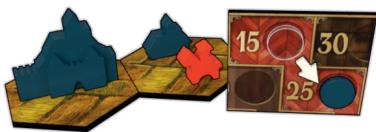
藍色玩家將他的一個村莊開拓為城市,並獲得了10憤怒。此時他一共擁有25分。
此時,只有兩個村莊可以開拓為城市。

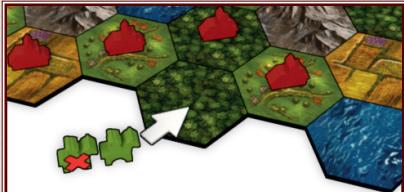
綠色玩家從他的儲備堆中移除了一個騎士,然後拿取另一個騎士放在了版圖邊緣的一個空森林區域中。該區域與紅色村莊相鄰。

黃色玩家支付16點資源點,計分標記向右前進了一格。他從伯爵晉升為了侯爵,此時一共擁有45分,
• 遊戲結束 •
當一位玩家晉升為公爵(達到計分板最後一列的60、70、80分格)時,該回合結束後遊戲立即結束。也就是說遊戲結束時,每位玩家的總回合數是相等的。每位玩家將各自未使用的資源點(銀色數字)加入他的總分中。隨後,擁有最多分數的玩家成為大領主,並贏得遊戲勝利。如果出現平局,順時針順序離起始玩家最遠的玩家贏得勝利。
中文翻譯&排版:金屬城堡

黃色玩家計分板上擁有70分。他還有3個未使用的資源標記,價值4分。
他的最終得分為74分。
下载 MarkdownBARONY_RULES_EN.md13.8 KB

A game by Marc André Illustrated by Ismaël
arony

At the farthest reaches of the Empire, four barons fight for the power. With their armies of knights, they extend their territories and build villages, strongholds and cities. At the end of this race for power, one of them will become King.
Contents
• 36 Territory tiles
(Mountains, Forests,
Plains, Fields, Lakes)
• 1 scoreboard
• 80 Resource tokens
• 1 First Player token
For each player (blue,
yellow, green and red):
• 7 knights
• 5 cities
• 2 strongholds
Goal of the game
• 14 villages
• 1 score counter
• 1 Player Reference sheet
Each player must conquer territories, build and protect villages, strongholds, and cities. When at least one player becomes a Duke, the player with the most Victory points is crowned King and wins the game.
• Elements of the game •
Assemble the tiles at the start of the game to build the game board (see Game Setup, page 2).
Each tile is made up of 3 independent hexagons.
Each hexagon represents one space of the board game and is one of the five types of land: Mountains, Forests, Plains, Fields, or Lakes.
Each land type, except the Lake, is associated with one Resource token (see page 3).

MOUNTAIN
Land tiles
One pawn placed in a mountain space is enough to keep other players from entering.

FOREST
No city can be placed or built in a forest space.
Pawns


PLAIN
These are the most prosperous territories. They make it easier to gain a rank of nobility when you take the "Noble Title" action.
FIELDS

LAKE
This space cannot be crossed or occupied by any pawns during the game.
CITIES
•Defense
A space occupied by a city is inaccessible to opposing knights.
•New city
A village can become a city. Each new city earns 10 victory points.
See Action D - page 4
Action: Recruitment
Knights are recruited in cities. > See Action A - page 2
KNIGHTS

Recruitment
Knights are recruited in a city. > See Action A - page 2
Action: Movement
Knights move from one space to another to claim territory, attack opponents, or defend.
See Action B - page 3
•Construction
One knight can be replaced with a village or a stronghold.
See Action C - page 3
•Defense
One knight can be destroyed by two opposing pawns of the same color.

Construction
A player can replace one knight on the board with a new village.
See Action C - page 3
• Action: New city
Cities are always constructed from villages. > See Action D - page 4
Defense
One village can be destroyed by two opposing knights of the same color.
STRONGHOLDS

Construction
A player can replace one knight on the board with a new stronghold.
See Action C - page 3
•Defense
A space occupied by a stronghold is inaccessible to opposing knights.
• Game setup •
• Take 9 random tiles per player and place them randomly to build a game board ①. If there are fewer than 4 players, unused tiles should be put back in the game box.
• Place all of the Resource tokens together next to the game board ②.
This is the resource bank.
• Each player chooses one color and places in front of him the corresponding pawns: 5 cities, 2 strongholds, 7 knights, and 14 villages 3 and also a Player Reference sheet ④.
• Each player will place 3 cities and 3 knights ⑤ as explained on the right.
• Place the score counters on the 0 space of the scoreboard ⑥.
• The youngest player chooses a first player. This player takes the First Player token. He may choose himself as the first player ⑦.
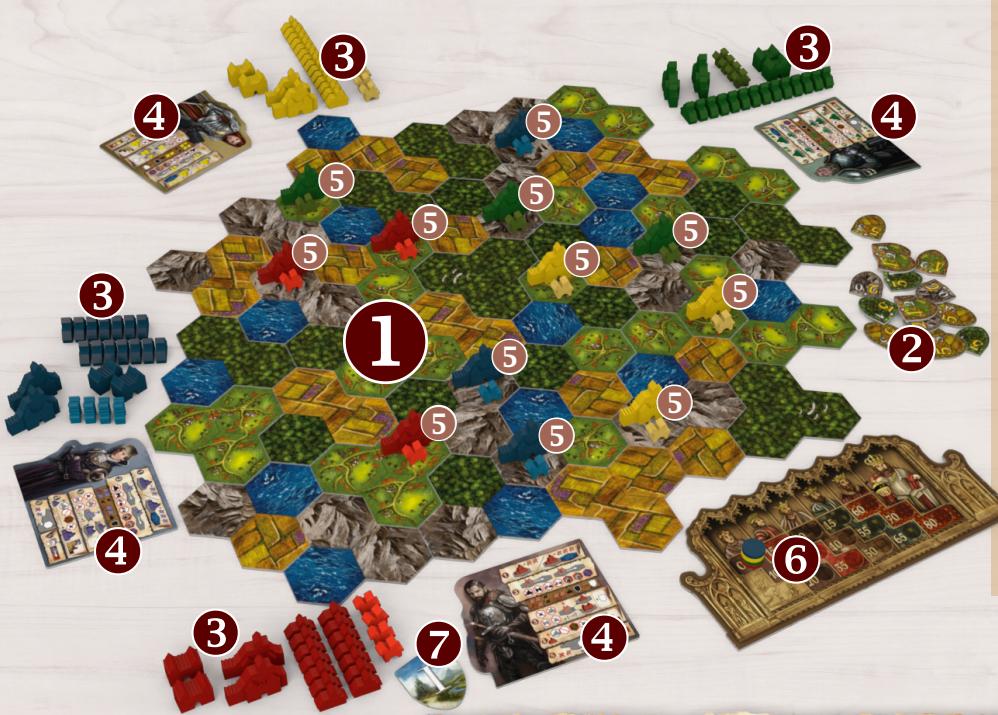
Arrangement of the first cities and knights
After a moment of reflection in which he examines the board, the first player places one city and one knight in the space of his choice.
Then, in clockwise order, each player does the same except for the last player, who places 3 cities instead of 1, with one knight in each of them.
Then, proceeding counterclockwise, each player other than the last player then places 2 cities with 1 knight in each of them.
Thus, each player will start his first turn with 3 cities, each with one knight, in three different spaces of the board. The remaining pawns are each player's reserve.
– RESTRICTIONS –



• No cities are allowed in lake spaces
• No cities are allowed in forest spaces
• No cities may be placed in the same space
or in a space adjacent to another city
• Game progress ·
The game is a succession of turns which are played in clockwise order. On his turn, a player can take ONE and only one of the following six actions:
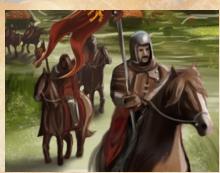
A) Recruitment

B) Movement
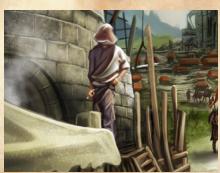
C) Construction

D) New city
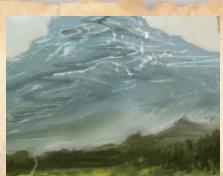
E) Expedition

F) Noble title
Recruitment
Choose one and only one city and place up to 2 knights taken from the reserve into the same space as the city. If the city's space is adjacent to one or more lake(s), you can place up to 3 knights instead.
If you have no knights in your reserve, you cannot take the recruit action.

The red city is on the edge of a lake. Thus the red player recruits 3 knights

Movement
Move 1 or 2 of your knights to an adjacent space.
The two moves are completely independent (the starting and destination spaces of the knights can be different). However, you cannot move the same knight twice.
There is no limit to the number of your knights that can be present in the same space.

– RESTRICTIONS –

The blue player moves two knights.
A knight cannot move to the following spaces:
• A lake space
• A space with an opponent's city or stronghold
• A space containing at least 2 pawns belonging to the same opponent (2 knights or 1 knight + 1 village)
• A mountain space with an opponent's pawn in it.
Coexistence and conflict
• In a single space, pawns of different players can coexist as long as a player doesn't have more than one pawn (knight or village) in this space.
• If a player already present in a space moves another knight into that space, he destroys all opposing pawns in that space.
Destroyed knights and villages are returned to their owners' reserves.
Important: When a player destroys an opponent's village, he takes from that player a Resource token (see below). The attacking player chooses the Resource token. If the attacked player has no Resource tokens left, the attacker takes nothing. No Resource token is earned when a player destroys an opponent's knight.

Construction
Replace all or any of your knights on the game board with a village or stronghold from your reserve.
Knights replaced in this way are returned to your reserve.
– RESTRICTIONS –
For each build, you immediately earn one Resource token corresponding to the land type of the space.

You cannot build:
• If there is already a building on the space (village, stronghold, or city) regardless of who the owner is.
• If an opponent's knight is present on the space.
Notes :
• If two knights of the same color are in the same space, only one of them will be replaced.
• Buildings are limited to the quantity in your reserve. If you have no strongholds or villages left, you cannot build any more. You cannot remove one of your own buildings from the board.

The yellow player moves a knight to a space which already contains one of his knights, a red knight and a blue village.
With his 2 knights he destroys all of his opponents' pawns, and takes a Resource token from the blue player.

There are only two spaces where the red player can build strongholds or villages.

He replaces one knight with a stronghold and the other with a village. He then takes one Mountain and one Fields Resource token, corresponding to the spaces where he just built.
Resource tokens
Each of the 4 different tokens are worth Resource points which can be used during the Action E - Noble title (gold number), or counted and added to the player's score at the end of the game (silver number).

In this situation, only two villages can be replaced with cities.


New city
Replace one of your villages with a city from your reserve (this is only possible if you have a city in your reserve).
The replaced village is returned to your reserve.
When you build a new city, you immediately earn 10 victory points: move your score counter down one space.
Expedition
Take two knights from your reserve. One of them is permanently removed from the game (put it back in the game box) and place the other in a free space of your choice on the edge of the game board.
– RESTRICTIONS –

You cannot build a city:
• If the village is in a forest space.
• If the village is in a space adjacent to a space containing a city (regardless of who owns the city).
• If an opponent's knight is present on the space.
– RESTRICTIONS –
You cannot place the knight:
• In a lake space.
• In a space containing another pawn (knight or building) regardless of its owner.

The blue player replaces one of his villages with a city and earns 10 victory points. He now has 25 points.
The green player removes one of his Reserve knights from the game and then places another in the free Forest space on the edge of the game board, behind the red player's villages.
Noble title
All players start the game with the title of Baron. They can then become Viscount, Count, Marquis, and then Duke.
Discard a minimum of 15 Resource points to acquire a higher Noble title, and then move your score counter one space to the right on the scoreboard.
Discarded Resource tokens are returned to the resource bank.
Watch out!
The resource bank doesn't give change if more than 15 Resource points are spent.
No one can advance by more than one rank at a time, even if someone possesses enough Resource points.

The yellow player spends 16 Resource points and moves one space to the right. He has advanced from Count to Marquis, and now has 45 points.
• End of the game
When one player becomes a Duke (the last column on the scoreboard with the 60, 70, and 80 values), continue until the end of the round so that each player has played the same number of turns.
Each player adds his unused Resource points (silver number) to his Victory points on the scoreboard.
The player with the most points becomes the King and wins the game.
In case of a tie, it is the tied player who is furthest from the first player in turn order who wins.

The yellow player has 70 points on the score board.
He has also 3 Resource tokens left with 4 points on them.
His final score will be 74 points.
下载 Markdown简繁检索对照.md1.6 KB
168513_167513_barony — 简体/繁体检索对照
本游戏的规则书是繁体中文原文。用户用简体提问时,把关键词按下面这张表转成繁体再去 grep 原文,命中率最高。
回答时用简体或繁体都可以,但引用的原文保持繁体。
简体 → 繁体 对照(按该游戏原文出现频率排序,共 60 字)
| 简体 | 繁体 | 原文出现次数 |
|---|---|---|
| 个 | 個 | 111 |
| 区 | 區 | 61 |
| 骑 | 騎 | 56 |
| 动 | 動 | 35 |
| 游 | 遊 | 30 |
| 戏 | 戲 | 30 |
| 庄 | 莊 | 28 |
| 标 | 標 | 26 |
| 资 | 資 | 25 |
| 记 | 記 | 23 |
| 为 | 為 | 20 |
| 时 | 時 | 18 |
| 将 | 將 | 18 |
| 开 | 開 | 17 |
| 该 | 該 | 17 |
| 备 | 備 | 15 |
| 进 | 進 | 15 |
| 单 | 單 | 14 |
| 领 | 領 | 13 |
| 图 | 圖 | 13 |
| 两 | 兩 | 13 |
| 无 | 無 | 12 |
| 筑 | 築 | 12 |
| 储 | 儲 | 12 |
| 见 | 見 | 11 |
| 页 | 頁 | 11 |
| 级 | 級 | 11 |
| 于 | 於 | 11 |
| 计 | 計 | 10 |
| 并 | 並 | 10 |
| 御 | 禦 | 10 |
| 则 | 則 | 10 |
| 从 | 從 | 9 |
| 后 | 後 | 9 |
| 点 | 點 | 9 |
| 块 | 塊 | 8 |
| 数 | 數 | 8 |
| 据 | 據 | 8 |
| 条 | 條 | 8 |
| 选 | 選 | 8 |
| 择 | 擇 | 8 |
| 红 | 紅 | 7 |
| 晋 | 晉 | 7 |
| 占 | 佔 | 7 |
| 获 | 獲 | 7 |
| 顺 | 順 | 7 |
| 与 | 與 | 7 |
| 说 | 說 | 7 |
| 夺 | 奪 | 6 |
| 蓝 | 藍 | 6 |
| 黄 | 黃 | 6 |
| 当 | 當 | 6 |
| 种 | 種 | 6 |
| 征 | 徵 | 6 |
| 处 | 處 | 6 |
| 结 | 結 | 6 |
| 远 | 遠 | 5 |
| 边 | 邊 | 5 |
| 贵 | 貴 | 5 |
| 没 | 沒 | 5 |
原文为社区整理/出版社公开资料,版权归原作者,仅供个人学习查阅。