
Concordia Venus
At a glance
Rules, cards and Q&A (Chinese)
The rules, card data and player questions for this game are written in Chinese. Open the Chinese page to read them.
Where to find full rules
Full rules and card lookup are available in the cunlema app at cunlema.cn — pick this game and ask about any rule, card or turn you are unsure about.
Related games
Rulebook text (Markdown)
This game has 3 rulebook Markdown file(s) in our library; 3 rendered inline below — expand to read or download.
rules_zh_康考迪娅:维纳斯_488.md43.2 KB
康考迪娅:维纳斯 中文规则书
来源:
concordia-venus_source_zh_488.pdf(集石文档 488,扫描件,无文本层)
转写:本机 MinerU 3.4.5 + MinerU2.5-Pro-2605-1.2B(vlm-engine),2026-10-30
说明:原书图位保留为「〔图:images/xxx.jpg〕」并在mineru/images/存原图;文字条款以本文件为准,涉及图标数量的细节与英文官方规则书交叉核对。
康考迪亚:维纳斯扩展规则
游戏配件
中文翻译 & 排版:陈斌华
这个扩展的的配件如下。如果要玩康考迪亚 - 维纳斯这个扩展,需要用到基础游戏的以下配件:
·城市指示物
·奖励标记
·钱币
·仓库图板
·木头配件
此外,维纳斯扩展也能用于任何康考迪亚的地图扩展。
1 块双面游戏版图
〔图:images/82822da87d606e1e2f9a42e7fa81cc0dba389f78e363202c44c282ccfbd6976f.jpg〕
(图内文字:IONIVM)
钍
〔图:images/629c7059942c94d688a5efd6d61978499b8293c17b76fec57ea5b5bde6ceb60e.jpg〕
(图内文字:BELLAS 000000 000000 000000 000000 000000 000000 000000 000000 000000 000000 000000 000000 000000 000000 000000 100000 100000 100000 100000 100000 100000 100000 100000 100000 100000 100000 100000 100000 100000 10 000000 100000 100000 100000 100000 100000 100000 100000 100000 100000 100000 100000 100000 100000)
希腊
1 块卡牌展示板(2 面拼接面板)
〔图:images/e0def2b238108ccd60447f3ea1f99271ef16993357d9c8fb2fbbb386761ff890.jpg〕
(图内文字:VENES VENES VENES VENES VENES VENES VENES ② ② ② ② ② ②)
1 仓库图板
20 个白色木质配件
3 个海上殖民者
〔图:images/db2489947314c77b9ddbe85936cc31c997a67c5f135bd3de1ffc47229bc9b071.jpg〕
1 个计分标记
〔图:images/282d5c6cedbd6564cb1554bb7dc31c235e3533e7a56f0509b0cd9b8093c549cc.jpg〕
〔图:images/5ca6ec5a07995412cced091e5ae34c5420b83b6637d24b6ad9ea34e29356ee77.jpg〕
19 个木质货物
砖块
〔图:images/79ce5edcde663177a4dcf6dcda49aaaeea7707635f819f2008fe165de1cd76dc.jpg〕
食物
〔图:images/e1f484d50088ac231f97e4310e0bdddea5cbdf4bf820e90d377a3b13f01ae244.jpg〕
工具
〔图:images/6a51a293d0a3519abdb8001ce3b13273daae7729bad2bbfb1e85d7757720bec3.jpg〕
酒
〔图:images/92f6c7621830b7c93c310159c61c1caa569d34c8e2b9c1f1e4b014e518d7f98c.jpg〕
布匹
〔图:images/6d509c1b12f4c3af4da8ee8d9d9512e96bc7591cc5c8e87efbd5b969c2c62da2.jpg〕
110 张卡牌
〔图:images/3e61b196c4410de7cf01493cf239d48fb3ef587b230688ba254fbd865ac96f46.jpg〕
102 张人物卡
〔图:images/54f8625fe22bffb83caee30faf0b5ba15fb98cb6f7d9490675cad8300207bbac.jpg〕
60 张起始卡牌每人 10 张
42 张用于出售的卡牌,牌背为 I-V
〔图:images/5bc280ef7c768b9b039473bf0b866cdf7c90b56299c8c42a91669b02eb97e458.jpg〕
康考迪亚卡
〔图:images/6c42ebdf6049f908d7d701e635ff37d386fddf0816ba82bdf4e31b10038a6a0a.jpg〕
用于扩展的最高行政长官卡
〔图:images/465dc790f5ae34f9579db4b0dd29d6d217e26c725f6981232aa703dcd8760fd2.jpg〕
玩家提示卡
〔图:images/91f38834ca6fae3f13a6d168391e3d906d8c47efb67600ff2fa9e9cb4da48dfd.jpg〕
1 张最高行政长官卡 / 万神殿卡
钱币若干(1,2,5 和 10 元面额)
将古罗马货币单位 sestertii 译为元
〔图:images/716884f53b963043c6bbab065cf418c8610a1c6ecd6bdd85a5a1119a1aaaa3a7.jpg〕
(图内文字:I II V X)
1 本规则书
1 本快速指引
1 回合顺位标记
〔图:images/45606e160204fa65d19442f982842d8dd0146e78f6db2cf52c97abe82cdcfe6d.jpg〕
单独作战或团队对抗
康考迪亚 - 维纳斯提供 2 种游戏变体:一种是支持 2-5 人,每人单独作战的模式,另一种是支持 4 至 6 人的团队对抗(2 个团队或 3 个团队)。大多数游戏都能应用于这两种变体规则。有些规则会清楚地写明该规则是只能用于单独作战或是团队对抗。
支持 2 至 5 人的单独作战模式
在这个变体规则中,每位玩家为自己而战,我们推荐玩家第一次玩康考迪亚时使用这个模式。第一次玩的时间可能比宣传中的时间更长,特别是5位新玩家。
支持 4 至 6 人的团队对抗模式
这个变体规则是建立在 2 队或 3 队玩家,每队 2 人的基础上的。俩个队友要么一起赢要么一起输。不要只想着你自己,偶尔也需要队友的帮助。
游戏概述
游戏设置
康考迪亚 - 维纳斯的初始设置在单独的快速入门中有详细描述。
游戏流程
玩家按照顺时针依次进行他们各自的回合。玩家的手牌由他还未打出的人物卡组成。玩家的回合则由打出一张手牌并执行相关行动所组成。玩家打出的卡牌会构成个人弃牌堆,并只展示最后打出过的卡牌。通过护民官,玩家能够将之前所打出过的所有卡牌收回至手牌。
在团队变体规则中,一张打出的行动卡不只是会被拥有者执行,还会让其队友执行。
游戏结束
游戏会在某一玩家获得版图上最后的卡牌,或首先建设完成15个房屋后结束。无论哪一种情况,该玩家都将获得康考迪亚卡作为奖励,然后所有其他玩家执行他们各自最后的行动,接着所有玩家加总他们的最终胜利点数。
计算胜利点数
每张人物卡都与一个古代神祇关联。这些神祇会分别对特定的成就进行奖励(例如稠密人口省份的数量,殖民者的数量等)。
如果玩家第一次玩康考迪亚(维纳斯),建议使用单独作战变体规则并进行一次中程计分。在最后一页有最终(以及中程)计分的细节描述。
〔图:images/88143eee3755fca0cf55de8f6f8a70a8f4876e294f2bcf4d3d4f01336d43ec11.jpg〕
护民官 Tribune
1. 收回卡牌
玩家收回所有之前打出过的卡牌至手牌。若玩家收回超过了3张卡牌(包含护民官本身),每超过1张,便从银行获得1元钱。
2.1 个新的殖民者
玩家可以选择支付 1 个食物和 1 个工具到银行,获得 1 个新的殖民者,并把 1 个新的陆上或海上殖民者从玩家的仓库放置到 “罗马”。
举例
一个玩家已打出过 4 张卡牌,现在他打出了护民官。因此他将收回总计 5 张卡牌进入手牌,并因此从银行获得 2 元钱。此外,他决定获得一个新的殖民者。他支付了 1 个食物和 1 个工具到银行,并将新的殖民者放在了游戏版图上首都城市位置,而这个殖民者为玩家仓库内的货物发现了一个新的储藏空位。
〔图:images/4a58dd83885511b6fb01352370fb267d774dca24036d7e5ddf4cf42449091244.jpg〕
(图内文字:DIPLOMAT 1 TAS ABE ALL YOUR PRESIDUALS AND AND GAIN IN FOR EACH GAIN FOR EACH GAIN IN GAIN OF 3 DECEANS THE GAIN OF THE GOUNT IN GAIN OF THE GAIN IN GAIN OF THE GOUNT CAPITAL CITY POST 2 MARS)
〔图:images/59d56b11029c10c00fb5e7a84b263b485ddc48e693a41cb45b7c5585c7301ed3.jpg〕
建筑师 Architect
1. 移动殖民者
根据玩家在游戏版图上已有的殖民者数量,决定该玩家能够自由分配移动其殖民者的移动步数。陆上殖民者只能够通过棕色线路移动,而海上殖民者只能通过蓝色线路移动。每个殖民者第一步移动是将其从起始城市移动到与其相邻的一条线路上,之后的移动则是将殖民者穿越城市移动至与这座城市相邻的线路上。在移动结束时,殖民者不能够停留在已有殖民者占据的线路上。然而,殖民者允许在移动时经过有其他殖民者占据的线路上,这部分线路移动依然会计算在移动步数中。
2. 建设房屋(所有移动结束后)
玩家可以在自己殖民者所相邻的任意城市内建设房屋。每个在城市内建设的房屋需要支付给银行货物与金钱:
- 货物:每个生产砖块的城市需要 1 份食物,其他城市则需要 1 份砖块以及 1 份与该城市类型相同的货物。
· 金钱:生产砖块的城市需要 1 元钱,生产食物的城市需要 2 元钱,生产工具的城市需要 3 元钱,生产酒的城市需要 4 元钱,生产布匹的城市则需要 5 元钱。
如果在已有其他房屋存在的城市建造房屋,需要的金钱则会乘以该城市在建造后已有房屋的数量(即城市中第四个房屋的金钱费用需要乘以4)。货物的费用不变。玩家不可以在1个城市内建造超过1个以上的房屋,首都城市不允许建造房屋。
团队对抗:仍然在城市里的殖民者不能用于建造房屋。
黑色箭头展示了他是如何分配他的殖民者移动的。海上殖民者从
“罗马 Roma”移动至通往“马西利亚 Massilia”的海上线路,而陆上殖民者移动了两步到达了“阿奎莱亚 Aquileia”与“文多波纳 Vindobona”之间。在移动后他的殖民者可以建造房屋。总而言之,与他的殖民者相邻的城市共有5个。但是他已经在“科洛尼亚 Colonia A.”拥有了1个房屋。他能够建造的城市只剩4个。他有足够的货物和现金去建造3个新房屋。他在“马西利亚 Massilia”建造了一个房屋(5元钱,1份布匹,1份砖块)
〔图:images/582e84ec30cd03ad46f82fb53e994d273c9a281ad0db46ee700eeab79c2636fa.jpg〕
(图内文字:COLONIA A. IV GERMANIA VINDOBONA AOVILEIA NOVARIA MASSILIA RÓMÁ ITA)
1 份布匹,1 份砖块),在“诺瓦里亚 Novaria”建造了一个房屋(4 元钱,1 份酒,1 份砖块),还在“阿奎莱亚 Aquileia”建造了一个房屋(6 元钱,1 份食物,1 份砖块)。生产食物的城市房屋建造费用本来只需1 份砖块,1 份食物和2 元钱,然而“阿奎莱亚 Aquileia”已经有两个房屋,因此价格变为3 倍。他支付了所有货物和金钱到银行,并把3 个新的房屋放置在城市上。
〔图:images/6771443e49433433b27a539369a0f56055f86133e0b18378f801d37176a95207.jpg〕
行政长官 Prefect
玩家从两种行动中选择一种:
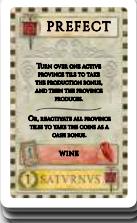
a) 玩家选择让 1 个行省生产货物。此时玩家只能选择 1 个可用状态的行省,该行省奖励标记(行省板块)必须是货物符号朝上。所选行省是否有该玩家(或其他玩家)的房屋并不重要。玩家将被选择的行省对应的奖励标记翻面到钱币那一面朝上,并从银行获得 1 份对应类型的货物。此外该行省内的所有房屋,无论其所有者是谁,每个房屋都会生产 1 份对应城市类型的资源。
或者
b) 不进行生产,玩家可以选择获得金钱奖励。奖励标记上每个可见的钱币图标都会让玩家从银行获得 1 元钱。之后所有奖励标记翻面到货物面朝上。
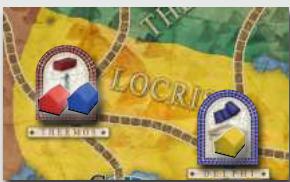
因为此奖励标记仍是货物符号朝上,所以罗克里斯Locris可以生产货物。红色玩家打出了行政长官牌,选择了罗克里斯Locris,并获得奖励标记上显示的1份布匹的奖励。罗克里斯奖励标记现在翻面为钱币面,罗克里斯所有的房屋进行生产:红色和蓝色玩家各获得1份砖块,黄色玩家获得1份布匹。
在上方图示的状况下,如果一个玩家选择了获得金钱奖励,并从银行拿走10元钱,因为在奖励标记上只有10个钱币可见,然后这6个钱币面朝上的奖励标记翻面,再次显示为货物面。
〔图:images/1aae58f3d6b985e5e7808e9fbf2f530a2b0f097e4536cd5301d788e4f0cf598a.jpg〕
〔图:images/2bd816bcb4c615ec4f8c85f6d78c7a8f2282d154d184f84c7fb8f569c6180a18.jpg〕
商人 Mercator
该回合要执行 2 个步骤:
- 玩家从银行获得 3 元钱(或通过购买的商人获得 5 元钱)
- 他可以与银行进行 2 种类型货物的交易。这意味着他可以出售 2 种类型,或是购买 2 种类型,抑或是出售 1 种并购买另 1 种。玩家能够出售和 / 或购买的货物数量只会受到他的仓库空置区域限制。每一份货物会占据仓库的一格区域。交易会以固定价格进行,价格标注在了仓库的屋顶。
绿色玩家拥有 2 元钱,他的仓库如图所示。她打出商人卡牌并获得 3 元钱(这不
是一张通过购买获得的商人)。她出售3份酒到银行获得3X6=18元钱,因此她现在现金共有23元钱。她的第二种货物类型是希望购买砖块。她能够支付7份砖块的费用,但她现在仓库内只有5个储藏空位,因此她不能购买超过5份。她决定购买4份砖块,支付4X3=12元钱。她可能想要再购买1单位食物,但是由于她已经进行了2种不同
〔图:images/372041971bdedf73464027d32197a9012fe0bdb35f6ea74702a1db8b3bf7d8c0.jpg〕
(图内文字:3 4 5 6 7)
〔图:images/17d0ab38e83ae6922fda46166fa4bff13acb973702a3161b029dd9b6736b0554.jpg〕
外交官 Diplomat
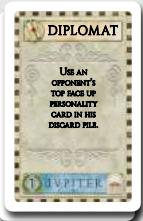
玩家执行一张对手弃牌堆顶部的人物卡行动。执行该行动就如同玩家打
出自己的卡牌一样。最近使用过外交官或通过护民官收回卡牌至手牌的玩家行动不能被复制。
在团队变体规则中,玩家不能复制使用同一队队友的人物卡,因为队友不视为对手。此外,同一张卡牌不能被同一队的两名成员复制两次。
单独作战变体规则:这里展示了最近其他 4 名玩家打出的人物卡牌。
第 5 名玩家打出了 1 张外交官 Diplomat。他现在可以执行元老院议员 Senator、建筑师 Architect, 或是行政长官 Prefect 其中 1 个行动。
〔图:images/9c1ce37936fd272cdab8546355570a549c045484457340c16fcd8bc547588190.jpg〕
团队对抗变体规则:这
里展示了最近其他 4 名玩家打出的人物卡牌。玩家 1 打出了外交官 Diplomat,此时他可以复制玩家 2 的商人 Mercator,或者是玩家 4 的行政长官 Prefect。他不能复制建筑师,因为那张是他队友玩家 3 的牌并且不是对手的牌。他复制了对手的的行政长官 Prefect 并让一个行省生产货物。现在他的队友(玩家 3)也执行行政长官的行动并选择获得金钱奖励。在他回合结束后,玩家 2 为其队伍打出一张牌。如果在之后的游戏过程中玩家 3 也打出了一张外交官 Diplomat,他不能选择再次复制玩家 4 的行政长官 Prefect,因为他的队友已经在同一轮内复制了那张牌。
〔图:images/011933c802a107d9fe0580c47509967ced3888bcd58a77bda9bcdc6ab4a7df63.jpg〕
教师 Magister
(只用于单独作战)
玩家再次执行他上一回合打出过的一张人物卡的行动。只有元老院议员卡不能被教师激活使用。之前那张卡的行动就像玩家打出那张牌时那样执行。
玩家打出教师卡。上一回合他已经打出了一张行政长官。现在这张行政长官的行动又一次被执行了。
〔图:images/6473954478cd341f528779d261c1d06dfcf872d800d73fb237b521eed4f5be23.jpg〕
(图内文字:MAGISTER USE YOUR OWN TOP FACE UP PERSONALTY CARD ONCE AGAIN (NOT SALES) PREFECT TURN OVER ONE ACTIVE PROVINCER IS TO TAKE THIS PROVINCER SOME AND THEN THE PROVINCER PROVINCER. WHOLE ALL PROVINCER BE THE ITEMS AS A THE AUTHOR. ② YES ITEMS VRNVS)
〔图:images/09b3df48a6979431543202acb2bb988b36b02a7abcacb56f74261fbf97c4c49b.jpg〕
殖民者 Colonist
玩家从两种行动中选择一种:
a)玩家可以放置新的殖民者到玩家版图上,每个殖民者需要支付1份食物和1份工具。新的殖民者能够被放置在“罗马”或是任何已有玩家自己房屋的城市。
或者
b) 玩家获得 5 元钱, 此外在游戏版图上每有 1 个玩家自己的殖民者再获得 1 元钱。
红色玩家拥有 2 份食物和 3 份工具在仓库中,并打出了殖民者卡牌。他
支付了 2 份食物和 2 份工具,并开始放置 2 个殖民者:他决定放置 1 个新的海上殖民者在 “罗马 Roma”,而另一个新的陆上殖民者在 “马利西亚 Massilia”。他也能够选择放置 1 个殖民者在 “阿奎莱亚 Aquileia”,但是不能放置在 “诺瓦里亚 Novaria”,因为他在那里没有房屋(显而易见,只有陆上殖民者出现在 “诺瓦里亚 Novaria” 才合理),或者他甚至也可以放置 2 个殖民者在相同的城
〔图:images/3d82f33fccd570de1db14ec51e2fa34c0eed198b9348e96b1ae962a30b23f21c.jpg〕
(图内文字:GE A NOMERIA AOMERIA MASSPEIA R.O.M.A)
〔图:images/3760ccecffb1f99b883ce46ddbe2f3085e8b843a38fd1513002f84a40d09fd79.jpg〕
专家 Specialists
(石匠 Mason, 农夫 Farmer, 铁匠 Smith, 酿酒人 Vintner, 纺织工 Weaver)
玩家所有和此类型货物相关的房屋都会生产1份货物。
玩家共有 4 个房屋在生产酒的城市,他打出酿酒人,获得 4 份酒放置进入仓库的 4 个空置区域。其他玩家不会获得任何货物。
〔图:images/00f6db9f56d1034a7e4e72a35b01abd1de1dc2e9887771db6610b6aaedc7024a.jpg〕
元老院议员 Senator(只用于单
独作战)
玩家可以从游戏版图的展示区域获得至多2张人物卡牌,并将其加入手牌。卡牌的价格总共是:
·卡牌红色区域描绘的货物
- 加上游戏版图上卡牌所在位置下方描绘的货物,如果是问号,则代表玩家可以任选。
在获得卡牌后,如产生空位,将所有展示区内剩下的人物卡牌往左移动。并将展示区补足至7张卡牌(只要牌库还有新的卡牌)。
〔图:images/89da8b70e5d50962991dc0dbb989e4805a6d34f582af663329d275d94477960a.jpg〕
长官 Praetor(只用于团队对抗)
长官的原理就像元老院议员,但同一队的每个队员不能从展示区获得超过1张以上
的人物卡。展示区只会在两位队员都完成了他们的回合后才更新卡牌。
图片展示了待出售最便宜的4张人物卡牌。玩家希望获得商人
Mercator 和建筑师 Architect卡牌。商人卡牌 Mercator 将花费 1 份酒,而建筑师卡牌 Architect 花费 1 份工具和 1 份砖块。砖块也可以用
〔图:images/33319535ad91672dde39863326713136bed29fd48fea35f1a9dae0dd900869ba.jpg〕
(图内文字:MERCATOR TAKS 5 DISTRICTS AND TRAVE UP TO 2 TYPES OF GOODS. WINE PREFECT TURN OVER CASH ACTIVY PROVINCE TILE TO TAKE THE PRODUCTION NOVA, AND THAT THE PROVINCE TREED UP. OR REACTIVE TO ALL PROVINCE TILE TO TAKE THE GOODS AS A CASH SOUSA. WINE 1 SATVRNVS ARCHITECT MOVE YOUR COLONISTS THEN BUILD IN CITIES ADJACENT TO YOUR COLONISTS. TOOLS 1 JVPITT FARMER PRODUCE FOOD IN ALL TOUR FOOD RICHES 3 MINERVA)
其他任意货物代替,因为问号允许玩家任意选择货物支付。他将商人 Mercator 和建筑师 Architect 加入手牌。现在将行政长官卡 Prefect 往左移动一格,所有其他卡牌往左移动 2 格。最后从牌库补充 2 张新的卡牌补满空位。(农夫 Farmer 卡牌需要花费 1 份砖块,1 份食物和 1 份布匹)
〔图:images/12043d44a9fecf0489ab403ea8fd91b8afaa77c786dd51eb3e7e3d45858eac25.jpg〕
执政官 Consul(只用于单独作战)
玩家可以从游戏版图的展示区获得1张人物卡牌并加入手牌。价格只包含人物卡牌
红色区域的货物。任何卡牌位置下方描绘的货物被忽略。如同元老院议员,在获得卡牌后,如产生空位,将所有展示区内剩下的人物卡牌往左移动。并从牌库补充新的卡牌到展示区(只要牌库还有新的卡牌)。
玩家想要获得位于展示区第6个位置的殖民者卡牌,他只需要支付1份食物,因为游戏版图上描绘的货物被忽略(1份布匹以及1份任意货物)。但是他不能获得超出1张的卡牌。玩家将殖民者卡Colonist加入手牌,并将行政长官Prefect往左移动,行政长官卡Prefect之前的位置从牌库中抽取一张新的卡牌进行补充。
〔图:images/37f65bf8a2789925c432e413bd455f6640dc64e493cb5cb4a56effb6680d6113.jpg〕
(图内文字:COLONIST Build new colonists in your cities. SACER BOR. OR, TAKE 5 SEBERTS PLAS 1 PER COLONIST. FOOD 2 M PREFECT TUM OVER ONE ACTIV'S PROVINCE TIL TO TAKE THE EXTRACTION BOMES. AND THEN THE PROVINCE PRODUCES. OR, REACTIVATE ALL PROVINCE TILUS TO TAKE THE GOINS AT A CASH BORUS. WINK 1 SATVRNVS)
〔图:images/da8d3303598d37f4f6ee76e0e7d53c80d07e41a67022d22098c0176967e0a093.jpg〕
总督 Proconsul(只用于团队对抗)
总督的原理就像执政官,玩家可以从游戏版图的展示区获得1张人物卡牌并加入手
牌(此时玩家不能以此法获得另一张总督)。之后,队友从手上打出另一张人物卡并执行其行动,但只有自己一个人执行该行动。此时队友不能打出的卡牌只有大使卡。展示区只会在两位队员都完成了他们的回合后才更新卡牌。
重要提示:队友打出的牌不会改变回合顺序;橘色回合顺位标记会与总督卡放在一起直到两位队员都完成了他们的回合为止。
黑色玩家和白色玩家是同一队的:
黑色玩家打出总督并从展示区购买一张人物卡且不必支付额外费用。在他之后,白色玩家打出一张牌并使用行政长官Prefect来让一个行省生产。现在这个队伍都完成了其回合,然后卡牌展示区更新卡牌。最后,将橘色回合顺位标记移到黑色玩家左手边的玩家。
注意:此时白色玩家的每张牌只会用于其自身:比如说,白色玩家打出护民官卡 Tribune 只会让他自己回收卡牌等等。
黑色玩家
〔图:images/c4cc0fcf5d1f185c643c78833887adc60c041d0c9190f031c06596e57b19f9e7.jpg〕
白色玩家
〔图:images/dbbe7c26b1bc83aa03dd01e3ce12dbc9d32bb65e293509e3a0502b71e6de95a0.jpg〕
〔图:images/94ad5f794bb3d9ce6d9392d2c3b406a68a7967ca1806c1f6ce8f7d51cbb4bd8f.jpg〕
大使 Legatus(只用于团队对抗)
大使是一种要求队友立即从手上打出特定卡牌的牌。在结算该牌之前,玩家可以检
查其队友的手牌,并在返还卡牌给队友时建议其默默地将特定的一张牌放在队友面前。当然,队友通常可随意选择是否听从其建议。当队友打出一张人物卡时,这张最终打出来的人物卡决定了两位队友能以通常方式执行的行动。现在打出卡牌的队员还能从执行相关行动开始进行操作。
注意正常的回合顺位是不会受到影响的,并且橘色回合顺位标记会与大师卡放在一起直到两位队员都完成了他们的回合为止。
黑色玩家和白色玩家是同一队的:
黑色玩家想要建造房屋,但是没有建筑师卡,所以改为打出大使卡。他检查他队友的手牌并在返还卡牌时将建筑师卡放在其面前。白色玩家听从了其建议,打出了建筑师并执行其行动。在他之后,黑色玩家可以按卡牌上的描述建造房屋并将橘色回合顺位标记传给其左手边的玩家。
黑色玩家
〔图:images/c53fc624c926629c1defc3bfd89bd380616e97fb5636d36a1afbb37b7836bb10.jpg〕
白色玩家
〔图:images/cadc4e087f197f0b9944ac66283b819dd790bc83ee8e69f58bc50e5de52e3c16.jpg〕
双项选择卡
行政长官 Prefect / 建筑师 Architect - 建筑师 Architect / 商人 Mercator - 行政长官 Prefect / 商人 Mercator
这通常是两张人物卡之间的一种选择。被选择的人物就像游戏规则中各自描述的方式来使用。
单独作战变体:选择其中一个人物并执行其行动。
团队对抗变体:打出这张牌的玩家选择其中一个人物来执行其行动,然后他的队友被迫执行另一个描述人物的行动。
在单独作战变体中,玩家打出了建筑师 Architect / 商人 Mercator,他决定使用商人:他从银行获得 5 元钱并且至多进行 2 种不同类型货物的交易。
〔图:images/852a40e8cf1ba22bb2494f8027fc1d024f6c9bf715ef7f0ea9b4788b96ec08f4.jpg〕
更多规则
最高行政长官 PRAEFFECTUS MAGNUS 如果一个玩家当前拥有最高行政长官卡牌。为了让 1 个行省进行生产,打出了 1 张行政长官卡牌(或通过外交官使用),他将获得双倍的奖励(2 份货物代替原本的 1 份货物)。城市的生产不受影响。回合结束后,将最高行政长官卡牌传递给他右手边的玩家。当能够使用最高行政长官卡牌时,玩家必须使用,不能够选择放弃其收益保留到之后再使用。但是如果一个玩家打出行政长官是为了获得金钱奖励,最高行政长官卡牌不会触发效果,并继续保留在玩家处:不会产生双倍的金钱奖励。
如果使用团队对抗变体规则,则最高行政长官会以通常的方式运作,但此牌只限于当前拥有者。当前拥有者的队友不会以任何方式获得最高行政长官卡的奖励。
仓库
每个玩家都拥有 1 个 12 位储藏空位的
仓库。每个空位可以放置1个殖民者或储藏1份货物。在游戏开始时,有4个空位被殖民者占据,因此不能够用来储藏货物。然而,如果玩家放置新的殖民者在游戏版图上,该空位就将变为可用状态。如果所有的空位都被放满了,就不能获得更多的货物。为了放置其他的货物而弃掉货物是不允许的。如果玩家获得了大批货物而没有足够的空位储藏时,玩家可以从中选择保留他想要的货物,但是不能让任何储藏空位空置。
交易与供应区
玩家间不允许进行货物交易。货物与金钱的数量是无限的。每个玩家的殖民者数量限制为 6 个。
万神殿 Pantheon
这里总括了游戏中卡牌上出现的取决于玩家人数的神祇数量。
团队对抗变体规则的特殊说明
卡牌展示区
游戏版图钍 IONIUM 和塞浦路斯 CYPRUS 不含有卡牌展示区。但是有一块放在游戏版图旁的单独卡牌展示面板。在该面板背面还有一种不同额外费用的变体规则,这可以用于康考迪亚的所有游戏版图。当应用该变体时,新的卡牌展示区就会覆盖在游戏版图上。
游戏版图钍 IONIUM
钍 IONIUM 含有一条特殊路线,在 BRUNDISIUM 和 APOLLONIA 之间,这里的陆上殖民者可以跨过海洋。为了使用这条路线,陆上殖民者需要像往常一样移动,但是在移动后不能停留在那条路线上。
在严格的 2 人或 3 人游戏中,推荐玩家们通过排除掉标记 "B" 的城市来将城市数量降低到 22 个。此时,3 个意大利的行省不会加入到游戏中。这些行省可以简单地通过使用单独的展示卡牌盖住。
团队
玩家们以每队 2 人的方式组建 2(或 3)队进行游戏,他们每个人围绕桌子的座位应该与其队友相对立。
回合
玩家的回合包含从手上打出一张牌,将牌正面朝上放到他的弃牌堆,然后执行相关行动。之后他的队友也立即执行该牌的相关行动。队友此时不再打出一张牌 Legatus 和总督 Procons
回合顺位标记
在一个队伍的两位队员都完成其回合后,橘色标记会按照顺时针方向传递给下一位玩家,然后该玩家为他们团队打出一张人物卡。
如图所示,4位玩家分为2队互相对抗:玩家1和玩家3对抗玩家2和玩家4。玩家4当前拥有橘色标记,他打出行政长官卡并决定一个行省进行生产或收集金钱奖励。在玩家4之后,现在玩家2可以决定自己如何使用行政长官。最后两位队员都完成了其回合,然后橘色标记移到玩家1
的位置。现在玩家 1 为他的团队打出一张人物卡等等。
〔图:images/d19d7a5a67c081db0573ad15b59e5a06bcfe1f5a0964c80efef8d5eeb6e3e501.jpg〕
(图内文字:1 2 3 4 PLAYSTART)
储备和钱币
团队各成员严格管理他们个人的物品。队员之间不允许以任何方式交换,贷款或交易各自储备的货物或人物卡。只有以下关于金钱的例外规则:如果一位玩家需要额外金钱来执行行动(比如建筑师或商人),他可以从他的队友拿取需要的现金,而且他的队友不能拒绝。
队友之间的沟通交流
每位玩家自己决定打出哪一张牌和如何使用该牌。即使这个决定与队友的计划和想法有冲突,我们都应该尊重他的想法。在开始游戏之前,建议允许合作队友之间能相互交流。没有经验的团队可以比其他团队更直接了当地沟通。根据规则,大使卡是唯一一种可以查看队友手牌并建议打出特定卡牌的方式。
虽然康考迪亚需要玩家各方面齐头并进,然而维纳斯则需要你真正理解你的队友。
如果 1 个玩家在游戏中为了收回卡牌第 1 次打出护民官卡牌,他立即进行 1 次个人中程计分。他按照最终计分的描述为他所有的卡牌计分,并在计分轨上移动他的计分标记。
在所有玩家都第一次打出他们的护民官后,进行分数比较,第一名的玩家获得2元钱,第二名的玩家获得1元钱。如果名次相同,他们获得相同数量(所有第一名的玩家获得2元钱,所有第二名的玩家获得1元钱)。然后将所有计分标记移回计分轨0的位置。
如果所有玩家对这款游戏均已熟悉,我们不建议进行中程计分。
如果有玩家获得了游戏版图展示区最后1张人物卡牌,或建造了第15个房屋,该玩家将获得价值7分的康考迪亚卡牌。
单独作战变体规则:其他所有玩家现在开始执行他们的最后1回合行动。
团队对抗变体规则:在队伍完成其回合后,所有其他队伍开始执行他们的最后1回合行动。
拥有最高分的玩家或队伍获得游戏胜利。平手情况下,持有最高行政长官卡牌的玩家,或是下一个将获得最高行政长官卡牌的玩家获胜。
在每位队员都分别统计完各自分数后,将两位队员的分数加总就是其团队分数。
大使卡含有 3 种神祇,因此该牌会计为一张朱庇特,一张萨图努斯和一张维纳斯。
在最后回合结束后,按照以下描述的方式进行计分。
最终计分
每张人物卡牌和一个古代神祇相关联,会给予持有者分数奖励。首先,玩家把所有的卡牌,包含弃牌堆的卡牌进行整理,根据不同的神祇分类排列。玩家辅助卡的背面按照计分顺序显示了所有神祇计分的概要。每张标识有对应神祇的卡牌计分在下文进行详述。所有分数(VP)通过计分标记在计分轨上进行记录。建议所有玩家先进行维斯塔的计分,然后是朱庇特,以此类推。
维斯塔 VESTA
将所有仓库中的货物按照正常价值换成现金。然后玩家按照每 10 元钱 1 分进行计分,余数忽略。
朱庇特 JUPITER
玩家每个非生产砖块城市中的房屋价值 1 分。(每张牌最大值 15 分)
萨图努斯 SATURNUS
每个至少有 1 个玩家自己房屋的行省价值 1 分。(每张牌最大分值 = 不同行省数量)
维纳斯 VENUS
单独作战:每个至少含有玩家自己2个房屋的行省都将获得2分。(每张牌最大分值14分)
团队对抗:每个含有双方队员的各1个房屋的行省都将获得1分。(每张牌最大分值 = 不同行省数量)
墨丘利 MERCURIUS
玩家的房屋每生产一种类型货物价值 2 分(每张牌最大分值 10 分)
马尔斯 MARS
游戏版图上每个玩家自己的殖民者价值 2 分(每张牌最大分值 12 分)
密涅瓦 MINERVA
玩家按照专家卡牌描述,获得对应货物类型城市的特定分数。
玩家共有 12 个房屋在游戏版图上,其中 3 个生产砖块,4 个生产食物,3 个生产工具,2 个生产布匹。这些房屋分散在 7 个行省。此外,玩家拥有 5 个殖民者在游戏版图中,拥有 13 元钱,因为获得游戏版图展示区最后 1 张卡牌,拥有康考迪亚卡。仓库里有 1 份布匹,3 份工具,1 份砖块。在如右图排列卡牌后,最终计分如下:
维斯塔 VESTA: 他的货物价值 7 (1 份布匹) +15 (3
份工具)+3(1份砖块)元钱。再加上他手里的现金(13元钱),他一共有38元钱,因此价值3分。
朱庇特 JUPITER: 他的 12 个房屋里有 3 个生产砖块,因此他有 9 个房屋计分,因为有 2 张朱庇特卡牌,因此获得 2X9=18 分。
萨图努斯 SATURNUS: 玩家在 7 个行省拥有房屋,并有 4 张萨图努斯,因此获得 4X7=28 分。
维纳斯 VENUS(单独作战为例):玩家在 5 个行省内至少拥有 2 个房屋。他每张维纳斯牌价值 10 分,因此获得 2×10=20 分。
墨丘利 MERCURIUS: 很不幸地,该玩家并没有生产酒的城市房屋,但是他能够生产其他4种类型的货物,他有2张墨丘利卡牌,因此获得2X8=16分。
马尔斯 MARS: 玩家有 5 个殖民者在游戏版图上,每张马尔斯卡牌将为他带来 10 分,因此获得 3×10=30 分。
密涅瓦 MINERVA: 玩家拥有一张农夫卡 Farmer,每个生产食物城市的房屋为他带来 3 分,因此 4 个房屋计分 12 分。
再加上来自康考迪亚卡的 7 分,因此玩家总共获得 134 分。
〔图:images/e921b7e2424f390cceee58384dc22f2ba17ef2bfc4851cce982ec5b1a6193cad.jpg〕
康考迪亚-维纳斯扩展
中文翻译 & 排版:陈斌华
游戏设置
1. 分配城市指示物
- 将 30 个城市指示物洗混, 并将它们的英文字母面朝上 (由于希腊版图不含有 “D” 字母的城市, 所以这类指示物不会在游戏中使用)
- 将城市指示物随机放置在版图上每个对应字母的城市位置。
- 将指示物翻面,让城市生产的货物类型可见。
2. 分配奖励标记
对每个行省最高价值的货物进行鉴定。布匹的价值是7,酒是6,工具是5,食物是4,而砖块是3。该类货物的奖励标记会放置到游戏版图左上角对应的行省上。
在这个例子中 Euboea 行省和 Sporades 行省已经有正面朝上的城市指示物。在 Euboea 最高价值的货物是工具,而在 Sporades 则是布匹,将两个行省对应的货物类型奖励标记放置在游戏版图上。其他行省也按照相同的方式进行配置。
3. 准备卡牌牌库
- 两种变体: 单独作战 (2 至 5 人) 需要 30 张背面标记着圆柱的卡牌,而团队对抗 (4 或 6 人) 则需要 30 张背面标记着双环的卡牌。
〔图:images/0ae4d4df0b4b75361c84919f97a2f3918752e4f0023a52b90fc37aa33d7b773d.jpg〕
圆柱: 双环:单独作战 团队对抗
- 将 30 张用于出售的卡牌根据
他们的牌背罗马数字(I-V)进行排列。
〔图:images/b87cba256878e8abf5c4ce228264daf280f3de8924fa53b78bf6147e487033f5.jpg〕
(图内文字:I VENVS II VENVS III VENVS IV VENVS V)
- 将卡牌数字大于玩家人数的卡牌从游戏中移除(例如 3 人游戏时,将移除 IV 以及 V 的卡牌)。其他卡牌按照罗马数字分类并洗混,最后形成一个卡牌面朝下的牌库:数字 I 的所有卡牌在最顶上,下面是数字 II 的卡牌,以此类推。
〔图:images/c5eeb06ca21ffb4ebc88b0333ea6db798624d6d003f0624c14a227d26b785b90.jpg〕
- 把牌库最顶上的 7 张卡牌面朝上放置在游戏版图右上角的展示区。剩余的牌库与康考迪亚卡一起,放置在游戏版图旁。
〔图:images/c006e84e0f6ac6ce17cdfa28a602320398d86f4d0764aacef45ce4afd78a8d48.jpg〕
4. 起始玩家
随机决定一位玩家成为起始玩家。将最高行政长官卡牌发给最末位行动的玩家。
5. 只用于团队对抗变体规则
每一队由 2 位玩家组成,每位玩家坐在其队友的对面。起始玩家获得橘色回合顺位标记。
以下是 6 人局的例子,玩家 1 和玩家 4 是第一队,玩家 2 和玩家 5 是第二队,
玩家3和玩家6是第三队。
〔图:images/75d5125636a3fc3da13ce4a9d2caa1177bd00bc70a58579a3dc29f88b7c1c50d.jpg〕
(图内文字:1 2 6 3 5 4)
6. 玩家设置
每个玩家(此处是黄色玩家)放置1个陆上和1个海上殖民者到首都城市。如果是团队对抗,每个队伍里的第二位玩家随意将其中一种殖民者的2个放到任何一个他想放置的城市,但是不能与首都城市直接相邻。(并且所选城市只能全部连接陆地路线或海洋路线,两个起始殖民者都要匹配这种状况,以红色为例,红色玩家将2个海上殖民者都放到KYTHERA。
此外,所有玩家将自己其余殖民者放到各自仓库内并拿取6个货物放到仓库内:
2份食物,1份布匹,1份砖块,以及1份工具。现在12个储
〔图:images/f95342121b7cf2b9654489d5792179d3f5ce49b6a632124eaf6391f03f26a80c.jpg〕
natural_image
Illustration of a multi-level building with arched windows and colorful geometric shapes on the roof (no text or symbols)藏空位已被占据了10个。
〔图:images/a724a455a0a0d99a336ca67edd4d3a4d7b5059a32a8f7b625b4bbadf0ef6972e.jpg〕
(图内文字:每位玩家将自己颜色的15个木质房屋放置在自己的供应堆。)
如果是单独作战模式,每位玩家拿取各自起始的8张手牌,这些牌背面含有一个
〔图:images/ec882062a32e946e8e0bfa1f4665dcd3ac24817736a1e8c0e7b339aefccdb247.jpg〕
圆柱体图标。起始玩家获得5元钱,第二位玩家获得6元钱,其他以此类推。
如果是团队对抗模式,每位玩家拿取背面含有双环图标的7张起始手牌,但要将其中一张牌放回盒子里,所以每位
玩家起始手牌是6张:每支队伍里的第1位队员放弃一
〔图:images/fc81f483765a79dffa5bddd8c469ee82620c2964e1e1313eb887179cbf934512.jpg〕
张外交官卡,第2位队员放弃一张建筑师卡。第一支队伍的每位成员都获得5元钱,第二支队伍的每位成员都获得6元钱,然后如果有第三支队伍,则该队的每位成员获得7元钱。
路线
路线连接城市:棕色路线是陆上殖民者使用的,而蓝色路线是海上殖民者使用的。同一时刻每条路线只能有1个殖民者在此占据。
行省
基克拉迪群岛有10个行省。每个行省有2个或3个城市。(其他版图有些含有12个行省)
游戏流程
一位玩家的回合包含从手上打出一张牌和执行相关的行动。
康考迪亚 - 维纳斯的开发
在两个合作伙伴的队伍中游玩康科迪亚的想法原本都来自于2017埃森博览会之后的Frank Lamprecht。维纳斯是爱情和亲密的女神,她要求你不仅要想到自己,还要想到你伴侣的需求。通过这种方式,康考迪亚获得了非常特殊的深度和动态的策略体验。在我们的游戏测试会议期间,通常情况是我们的合作伙伴出人意料地提出了迄今尚未考虑的新机会。合作伙伴之间不断的互动创造了快乐和情感。追求相同的想法非常重要,合作伙伴之间的集体和谐往往是成功的关键。此外,维纳斯允许出现第6名玩家,因为每张牌同时对2名玩家来说非常重要,因此可以保持合理的宕机时间。
康考迪亚 - 维纳斯的另一个变种,每位玩家单独玩,也提供了新的机会和挑战。教师卡 MAGISTER 允许新的合作回合,而神祇维纳斯更开辟了新的策略。新的地理场景使游戏更加完美。值得注意的是,IONIUM 是一款灵活的版图,如果省略 3 个意大利行省,它可以很好地与 2 或 3 名玩家合作。
康考迪亚由 Stephan Borowski, Thomas Mumm, RüdigerKuntze, Frank Lamprecht, Claudia Barmbold 和 PeterDörsam 等人进行了非常密集的测试。其他重要的测试者是 Heike 和 Michael Lopez, 来自英格兰的 Nick Case 和来自意大利的 Pietro Cremona。原型也受到了 Spielkultur Hamburg, Wedel 的 Olafs Spieletreff, Hamburger Fest der Spiele, 汉堡 Spieletage, Rahlstedt 的 BRETT 汉堡, Bremer Spieletage, 葡萄牙的 LeiriaCon 以及意大利的 PlayModena 等等活动的热烈欢迎。Mark Bigney 很快就翻译好了英文规则。Dominik Mayer 绘画了封面, 并且 Marina Fahrenbach 绘制了新的版图。如果没有以上这些多人的帮忙, 还有一些未能全部提及的人名, 康考迪亚 - 维纳斯就不会出现, 这是一个非常伟大的团队, 感谢你们为此所做的一切。
2018年10月记于汉堡
Mac Gerdts
团队对抗和 Salsa/ Gallia 扩展
团队对抗和 Salsa 扩展的结合
如果康考迪亚 Salsa 扩展的广场卡通过维纳斯的团队对抗模式被使用,有以下几点需要注意:
- 广场卡只能被各自拥有者使用,他们的队友不能使用。
- 如果其中一个金钱较少的玩家适当地使用广场卡,队友的现金也可以使用。
- 当护民官卡被打出时,两位队友可以拿去一张新的广场卡。他们合计拿回到手上的卡牌数量,然后可以自由分配这些卡牌到他们手上。
广场卡只会在团队完成了其回合后才会更新。
团队对抗和康考迪亚 Gallia 扩展的结合
举例:两位队友每位都能拿回5张牌。他们现在决定一共支付10元来获得新的广场卡。他们现在有3种选择:
a) 两位队友从广场拿取最前面 2 张卡的其中一张(支付 $4+6=10$ 元)。
b) 只有一位队员拿取广场卡。(如果队友拿取第3或第4张广场卡,支付8元或10元,另一位队友不拿去任何广场卡,因为那将需要超过10元钱。)
c) 两位队友都不会拿取广场卡。
每个队伍的第二个队员可以随意选择起始城市,但所选城市不能与首都城市直接相邻。在 Gallia 的正常游戏那样,只有陆上殖民者会被放置,海上殖民者必须等待地中海的税收。
康考迪亚基础游戏
康考迪亚 - 维纳斯的人物卡页可以用于玩“康考迪亚”。需要按照以下步骤把需要的卡牌准备好:
〔图:images/b8ea5b9a6675d53abf205c2329c90eaeb3b6bc1efc0f3e5e21ec75f706ab966f.jpg〕
(图内文字:1. 首先,将所有标记着圆柱的卡牌加入游戏。 2. 然后用4张既不含有圆柱也不含有双环图标的卡牌替换掉神祇“维纳斯”的出售卡牌。 3. 将石匠Mason卡牌洗进牌库Ⅰ而非牌库Ⅱ。 4. 没有玩家会使用教师卡Magister——将该牌放回游戏盒子里。)
维纳斯起始卡牌概览
〔图:images/2f62efad8089d951ffab9756ac660c937501bd859b94c592640a72be5c68577a.jpg〕
(图内文字:ARCHITECT Make your ORI THY RUSSE OF YOUR CLASSICITY TO YOUR INDIA DEPLOYER DIPLOMAT One or other THE RUSSE OF YOUR CLASSICITY TO YOUR INDIA THE RUSSE OF YOUR CLASSICITY TO YOUR PREFECT The RUSSE OF YOUR CLASSICITY TO YOUR PREFECT The RUSSE OF YOUR CLASSICITY TO YOUR PSENATOR Pursuits of A NEW PREDICTORY THE RUSSE OF YOUR CLASSICITY TO YOUR PUBBLING THE RUSSE OF YOUR CLASSICITY TO YOUR TRIBUN THE RUSSE OF YOUR CLASSICITY TO YOUR MACISTER Can you ON THE RUSSE OF YOUR CLASSICITY TO YOUR INDIA THE RUSSE OF YOUR CLASSICITY TO YOUR PUBBLING THE RUSSE OF YOUR CLASSICITY TO YOUR MACISTER)
第一位队友
第二位队友
〔图:images/cd5dacbb26206e40ff3a5a34c5e65705887f9843e98c437cfc45e2c08c23dd85.jpg〕
(图内文字:ARCHITECT MERCATOR PREFSCT PRATOR TRIBUNE LSOATUS DIPLOMAT MERCATOR PREFSCT PRATOR TRIBUNE LSOATUS)
Download Markdowna8-concordia-venus-rulebook.md31.9 KB

Concordia Venus
GAME MATERIAL
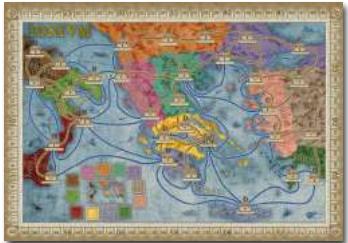
Ionium
2 game boards with 4 scenarios:
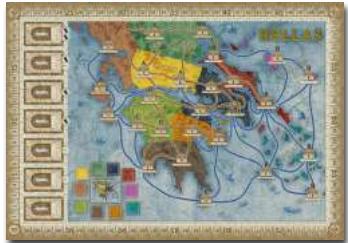
Hellas
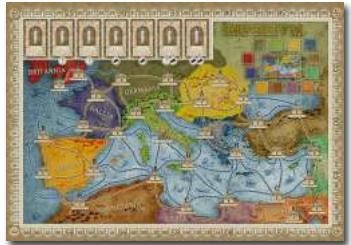
Imperium
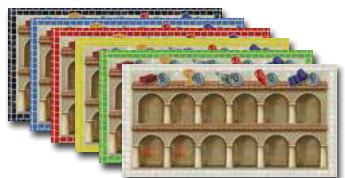
6 storehouses
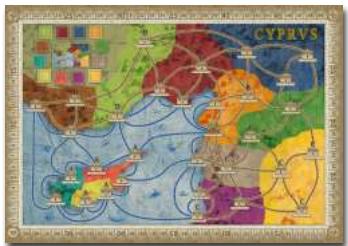
Cyprus
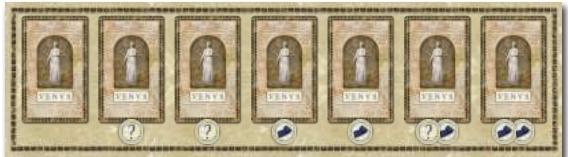
1 card display (2 puzzle pieces)
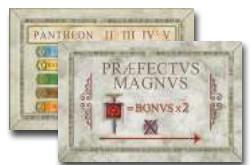
1 Praefectus Magnus/Pantheon
132 wooden pieces in player colors red, green, yellow, blue, black, and white; per player:
3 sea colonists

3 land colonists

1 scoring marker


15 houses



30 city tokens

24 bonus markers
110 cards

60 starting cards, 10 per player
102 personality cards
42 cards for sale, decks I - V
Concordia Card

Praefectus Magnus with explanation
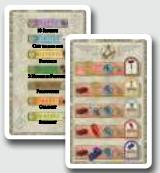
6 player aids
Coins (1, 2, 5, and 10 sestertii)

1 game rules 1 quick intro 1 turn order marker

INDIVIDUAL OR TEAM PLAY
Concordia Venus offers two different variants: The Individual Play for 2 to 5 players, and the Team Play for 4 or 6 players (in 2 or 3 teams). Most game rules apply to both variants. It is clearly indicated if any rules apply only to the Individual or the Team Play variant.
Individual Play for 2-5 players
This variant, where every player plays individually for themselves, is recommended for your first Concordia game. The first session will probably last longer than announced, especially with 5 new players.
Game setup
The setup of Concordia Venus is described in detail in the separate quick intro.
This variant establishes 2 or 3 teams of 2 players each. Both partners will win or lose together. It is very important not only to think of yourself, but also for the needs of your partner.
Game flow
Team Play for 4 or 6 players
Players execute their turns in clockwise order. A player’s hand consists of their unplayed personality cards. A player’s turn consists of playing 1 card from their hand and executing the related actions. All played cards form a personal discard pile showing only the last card played. With the Tribune, a player takes back all cards previously played.
GAME OVERVIEW
In the Team Play variant, the actions of a played card are executed not only by its owner, but also by their partner as well.
Game end
The game ends either after a player purchases the last card from the card display on the board, or after the first player builds their 15th house. In either case, this player is awarded the Concordia Card. Now all other players (or all other teams) execute their final turn and then all players tally their final victory points (VP).
Scoring victory points
Each personality card is related to an ancient god. These gods individually reward certain achievements (for instance number of populated provinces, number of colonists, etc.)
If Concordia (Venus) is played for the first time, it is recommended to use the Individual Play variant and to conduct an intermediate scoring. The final (and intermediate) scorings are described in detail on the last page.

Tribune
1. Recover cards
The player recovers all of their previously played cards back into his hand. If the player takes back more than 3 cards (including the Tribune in the count), they receive 1 sestertius per card past the 3rd from the bank.
2. 1 new colonist
In addition the player may optionally purchase 1 new colonist by paying 1 food and 1 tool to the bank and placing either a new land or sea colonist from their storehouse into the capital city.

Architect 1. Move colonists
The number of colonists a player has on the board determines the number of possible movement steps that a player can freely allocate to their own colonists. Land colonists are moved only along the brown lines and sea colonists only along the blue lines. A colonist’s first movement step is out of its starting city onto an adjacent line. Any further steps will move the colonist through a city and onto the next adjacent line to that city. At the end of its movement, a colonist cannot be placed on a line that is already occupied by another colonist. However, a colonist is allowed to move through occupied lines, adding the occupied sections passed through into its movement count.
2. Build houses (after all movements)
The player may build houses in cities adjacent to any of their own colonists. Each new house built in a city is paid with goods and coins to the bank:
• Goods: 1 food in a brick city, or 1 brick plus the good of that city type in every other city.
• Coins: 1 sestertius in a brick city, 2 sestertii in a food city, 3 in a tool city, 4 in a wine city, and 5 in a cloth city.
If a new house is built in a city where there are already other houses, the cost in coins is multiplied by the number of houses that will be in the city after this build (i.e., to build the fourth house in a city the cost in coins is multiplied by 4). The cost in goods remains the same. Players may never have more than 1 of their own houses in a single city and never have a house in the capital city.
Team Play: A colonist that is still inside a city cannot be used to build a house.

Prefect
The player chooses between two alternatives:
a) The player chooses a province where the houses produce goods. They can only choose an active province whose bonus marker (province tile) still shows the goods symbol. It is not necessary that the player (or any other player) owns a house in the chosen province. They flip the bonus marker of the province to its coin side and receives 1 unit of the goods type depicted on the bonus marker from the bank. In addition all houses inside the province, regardless of their owner, each produce one unit of the goods produced in that city.
or
b) Instead of producing the player may choose to collect the cash bonus. For every visible coin on the bonus markers they receive 1 sestertius from the bank. Afterwards all bonus markers are flipped back to the side showing their good’s symbol.
Example
A player who until now has played 4 cards now plays his Tribune card. Therefore he takes a total of 5 cards back into his hand and receives 2 ATRIBOT sestertii from the bank.
In addition he decides to build a new colonist. He pays 1 food and 1 tool to the bank and places the new colonist inside capital city on the game board. The colonist uncovers one new storage space for goods inside his storehouse.

Red has 3 colonists, 1 land colonist is located between “Colonia A.” and
“Novaria”, and the other 2 are still in “Roma”. Therefore he has 3 movement steps available. The black arrows show how he allocates his movements to his colonists. The sea colonist from “Roma” moves onto the sea line to “Massilia” (1 step), and the land colonist makes 2 steps onto the line between “Aquileia” and “Vindobona”.
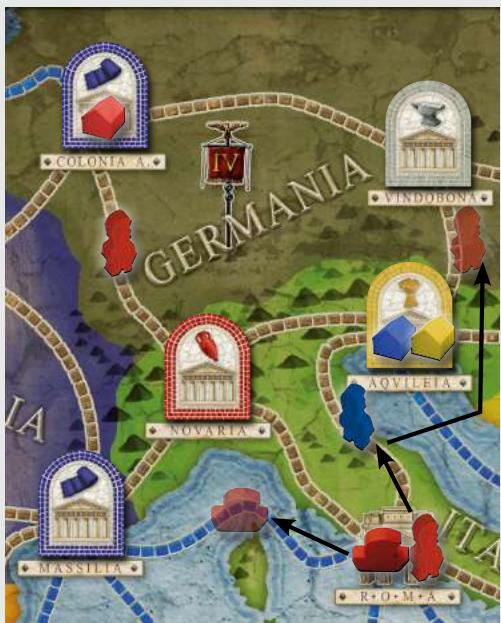
After moving his colonists he may build houses. All in all there are 5 cities
adjacent to his colonists. But as he already owns a house in “Colonia A.” only 4 cities remain where he could build. He has enough goods and cash to build 3 new houses. He builds a house in “Massilia” (5 sestertii, 1 cloth, and 1 brick), in “Novaria” (4 sestertii, 1 wine, and 1 brick) and in “Aquileia” (6 sestertii, 1 food, and 1 brick). A house in a food city basically costs only 1 brick, 1 food, and 2 sestertii, but as “Aquileia” already has 2 houses the cash price is tripled. He pays the goods and sestertii to the bank and puts 3 new houses into the cities.
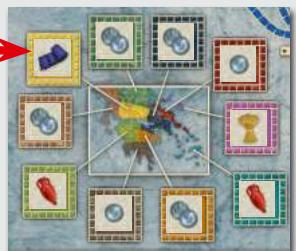
Locris is able to produce because its bonus marker still shows the good’s symbol. Red plays the Prefect card, chooses Locris, and receives a bonus of 1 cloth as shown on the bonus marker. That bonus marker of Locris is now flipped over to its coin side and all houses in Locris produce: Red and Blue receive 1 brick each, and Yellow receives 1 cloth.
In the situation depicted above a player who chooses the cash bonus would get 10 sestertii from the bank, because there are 10 coins visible on all bonus markers. The 6 bonus markers with coins would be turned over to show their units of goods again.

Mercator
This turn is executed in 2 steps:
-
The player receives 3 sestertii from the bank (or 5 sestertii with a purchased Mercator).
-
They may then trade in two types of goods with the bank. This means they may sell two types, buy two types, or sell one type and buy another. The number of units they may sell and/or buy is only limited by the free space inside their storehouse, where every single unit occupies one storage space. The trade is done at fixed prices, which are shown on the roof of the storehouses.

Diplomat
The player executes an action from a personality card that is on top of an opponent’s discard pile and thus is displayed face up in front of them. The action is executed the same as if the player had played that card himself. Actions of players who recently used a Diplomat card or took back their cards into their hand with their Tribune card cannot be copied.
In the Team Play variant, a personality card cannot be copied by the partner of the same team, because that partner is not considered as an opponent. Furthermore, a single card cannot be copied twice by 2 partners of the same team.

Magister (only individual play)
The player executes the actions from his previously played personality card once again. The only exception is the Senator who cannot be activated by a Magister. The actions of the previous card are executed as if the player had played that card themselves.

Colonist
The player chooses between two alternatives:
a) The player may place new colonists on the game board, each of which cost 1 food and 1 tool. New colonists can be placed inside the capital city or inside any other city where the player owns a house.
or
b) The player receives 5 sestertii plus 1 sestertius for each of their own colonists on the game board.

Specialists
PERSONALITY CARDS
(Mason, Farmer, Smith, Vintner, Weaver)
All the player’s houses of the related type of goods produce one unit each.
Green has 2 sestertii cash and her storehouse is as depicted. She plays the Mercator card
and receives 3 sestertii (It is not a purchased Mercator). She sells 3 units of wine for 3 x 6 = 18 sestertii to the bank, so that the total cash now is 23 sestertii. For her second type of goods she wants to buy bricks. She would be able to pay for up to 7 bricks, but there are only 5 storage spaces available in the storehouse so that she cannot buy
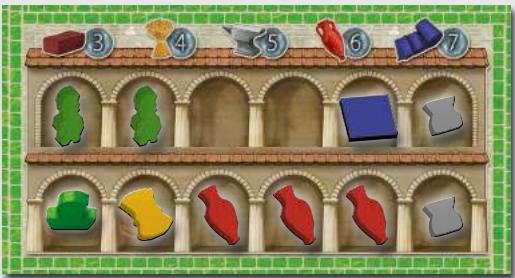
more than 5 units. She decides to buy 4 units of bricks paying 4x3=12 sestertii. She would have loved to buy a unit of food, but that is not allowed as she has already traded in two different types of goods.
Individual Play variant: The picture shows the personality cards recently played by the
other 4 players. The 5th player plays a Diplomat card. He now may either execute the action of a Senator, an Architect, or a Prefect.
Team Play variant: Here the picture shows the


4 cards recently played by all players. Player 1 plays the Diplomat, which allows him to copy either the Mercator of player 2, or the Prefect of player 4. He cannot copy the Architect because player 3 is his partner and not an opponent. He copies the opponent’s Prefect and lets a province produce goods. Now his partner (player 3) also executes the actions of a Prefect and chooses to take the cash bonus. After him, player 2 plays a card for his team. If later in the game player 3 should also play a Diplomat, he would not be able to copy the Prefect of player 4 once again, because his partner already copied that card in the same round.
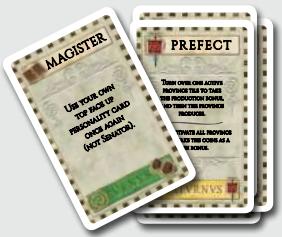
The player plays the Magister. In his previous turn he had played a Prefect. Now the actions of a Prefect are executed once again.
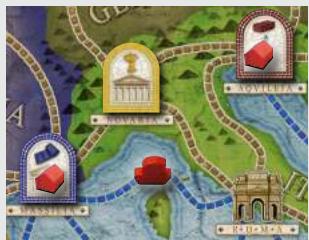
Red has 2 food and 3 tools in his storehouse and plays the Colonist card.
Paying 2 food and 2 tools he places 2 colonists. He decides to place a new sea colonist in the capital city “Roma” and a new land colonist in “Massilia”. He could also have chosen to place one colonist in “Aquileia” instead, but not in “Novaria” because he has no house there (obviously, only a land colonist would be reasonable in “Novaria”). Or he could even place 2 colonists in the same city.
The player has a total of 4 houses inside wine cities and plays the Vintner. She receives 4 units of wine and puts them on 4 empty storage spaces inside her storehouse. The other players do not receive any goods.

Senator (only individual play)
The player may purchase up to two personality cards from the card display and take them into nd. The price of a card is the sum of:
• The goods depicted inside the red field of the card
• plus the goods depicted beneath the card’s position on the card display, where a question mark stands for a good of the player’s choice.
After the purchase(s), all remaining personality cards inside the display move to the left if their left position is empty, and the display is replenished to the new total of 7 cards (as long as there are cards inside the stack)

Praetor (only team play)
A Praetor works like the Senator, but each partner of the team can purchase no more than 1 personality card from the card display. The display is only replenished after both partners have completed their turn.

Consul (only individual play)
The player may purchase one personality card from the card display and take it into their hand.
The price consists only of the goods depicted in the red field of the personality card. Any goods depicted beneath the card’s position on the card display are ignored. As with a Senator, the remaining cards inside the display move to the left if their left position is empty, and the display is replenished from the stack (as long as the stack exists).

Proconsul (only team play)
As with the Consul, the player may purchase one personality card from the display and take it into their hand (The only exception is that another Proconsul cannot be purchased this way.). After that, the partner plays another personality card from their own hand and executes its actions, but only for themselves. The only card the partner could not play would be the Legatus. The card display is only replenished until both partners have completed their turn.
Important: The partner’s play does not change the general turn order; the orange marker stays with the Proconsul until both partners completed their turn.

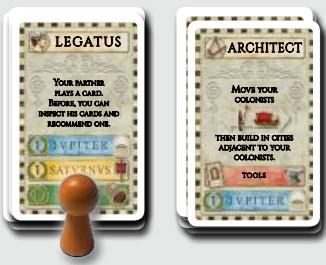
Legatus (only team play)
The Legatus is a request to one’s partner for playing a certain card from their hand immediately. Before that happens, the player may inspect their partner‘s hand of cards, and silently suggest a certain card by putting it in front when returning the cards. Of course, the partner is always free to follow that suggestion or not. The partner plays a personality card, and that personality card finally played determines the actions for both partners in the usual way. Now the partner who plays the card also starts with executing the related actions.
Note that the general turn order is not affected and the orange marker stays with the Legatus until both partners have completed their turn.
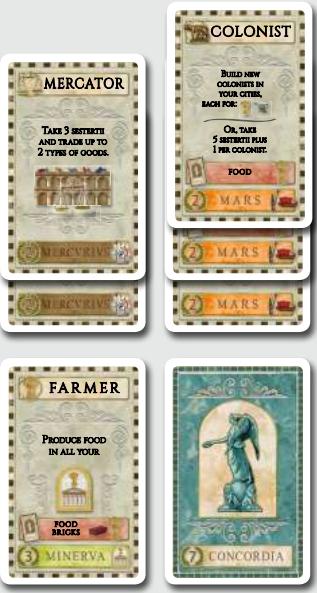
The picture shows the cheapest 4 personality cards on sale. The player wants
Mercator and the Architect card. It costs 1 unit of wine for the Mercator card, and 1 tool and 1 brick for the Architect card paid to the
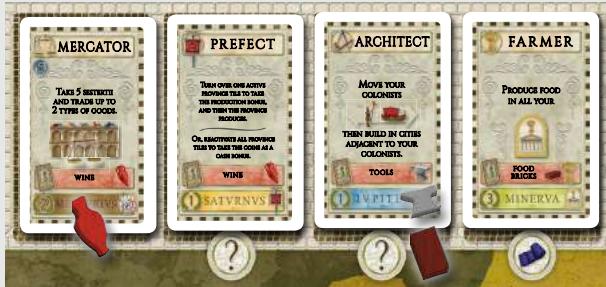
bank. Instead of a brick he could have paid with any other type of goods as the question mark allows a free choice of goods for payment. He takes the Mercator and the Architect card into his hand. Now the Prefect card moves by 1 and all other remaining cards by 2 positions to the left. Finally the 2 free spots on the display are replenished with 2 new cards from the stack. (The Farmer would have cost 1 brick, 1 food, and 1 cloth)
The player wants to purchase the Colonist card, which is located in 6th position inside the card’s display. He pays only 1 unit of food because the goods depicted on the card display are ignored (1 unit of free choice plus 1 cloth). But he cannot purchase more than 1 card. He takes the Colonist into his hand and the Prefect card moves one position to the left. The former position of the Prefect is replenished with a new card from the stack.

Black and White play as one team:
Black plays a Proconsul and purchases one personality card from the display without paying additional costs. After him White plays a card and uses a Prefect to let a province produce. Now the team has completed its turn and the card display is replenished. Finally, the orange marker moves to Black’s left neighbor.
black
white
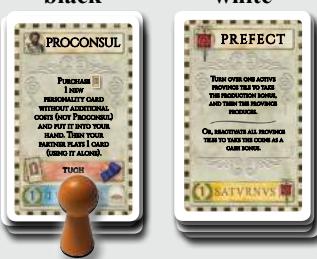
Note that each of White’s cards would have worked only for himself: For instance, the Tribune would let only him recover his cards etc.
Black and White play as one team:
Black would like to build houses, but not owning an Architect he plays the Legatus instead. He inspects the hand of cards from his partner and puts the Architect in front when returning the cards. White likes the suggestion, plays the Architect and executes its actions. After him, Black can build houses as desired and finally hands the orange turn order marker on to his left neighbor.
white
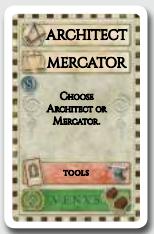
Double Choice Cards
Prefect / Architect – Architect / Mercator – Prefect / Mercator
There is always a choice between these two personality cards. The chosen personality is used exactly the way as described in the respective section of the game rules.
Individual Play variant: Choose one of either personalities and execute its actions.
Team Play variant: The player who plays the card chooses one of either personalities.
Their partner is then obliged to use the other personality depicted.
In the Individual Play variant the Architect/Mercator is played. The player decides which personality he wants to use and chooses the Mercator. He takes 5 sestertii from the bank and trades up to 2 different types of goods.
FURTHER RULES
PRÆFECTUS MAGNUS
If a player who currently owns the PRÆFECTUS M. plays a Prefect card (or uses one with the Diplomat) in order to let a province produce, they receive a double bonus (2 units instead of 1). Production inside the cities is not affected. After their turn they hand the PRÆFECTUS M. to the player sitting to their right. A player must use the PRÆFECTUS M. when able and may not choose to forego its benefit to keep it for later. But if a player plays a Prefect card in order to receive the cash bonus, the PRÆFECTUS M. is not activated and remains with the player: it is not allowed to double the cash bonus.
If the Team Play variant is used, the PRÆFECTUS M. works in the usual way, but only for its current owner. The current owner’s partner does not benefit in any way from it.
Storehouse
Each player has a storehouse with 12 storage spaces. Each space may house either one colonist or one unit of goods. At the beginning of the game, 4 storage spaces are occupied by colonists and therefore are not available for housing goods. However, if a player places new colonists on the game board, additional storage spaces become available. If all spaces are occupied in one way or another, no more units of goods can be taken in. It is not allowed to discard goods in order to make room for other ones instead. If a player receives plenty of goods without having enough empty storage spaces, it is allowed to choose which specific units of goods they want to take, but not to leave any storage spaces empty.
Trade and Stockpile
Players are not allowed to trade goods with each other. Goods and coins are considered to be unlimited. The number of colonists is restricted to 6 per player.
Pantheon
This summary shows how often these gods appear on the cards that enter the game, depending on the player count.
Card Display
The boards of IONIUM and CYPRUS do not contain a card display area. Instead, the separate cardboard display is used and placed next to the game board. On its reverse side there is a variant with different additional costs, which is generally usable with all game boards of CONCORDIA. When applied, the new display covers the printed one on the board.
Game board IONIUM
IONIUM contains a special connection between BRUNDISIUM and APOLLONIA where land colonists may cross the sea. Using that line, a land colonist needs a movement step in the usual way, but is not allowed to stay on that line after moving.
For a tighter 2 or 3 player game it is recommended to reduce the number of cities to 22 by omitting the cities marked with a “B”. This way, the 3 Italian provinces do not take part. They may be easily covered by the separate card display.
SPECIAL RULES FOR THE TEAM PLAY VARIANT
Teams
The players establish 2 (or 3) teams of 2 players each and take their seats around the table opposite to each other.
Turns
A player’s turn consists of playing 1 card from their hand, placing it face up on their discard pile, and executing the related actions. Immediately afterwards, their partner executes
the related actions of that card as well. The partner themselves does not play a card (exceptions: Legatus and Proconsul).
Turn Order Marker
As shown here, 4 players play in 2 teams against each other: players 1 and 3 against players 2 and 4. Player 4, who currently holds the orange marker, plays the Prefect card and decides whether to let a province produce or to
After a team has finished its turn with both partners, the orange marker moves in clockwise order to the next player, who then plays a personality card for their team etc.
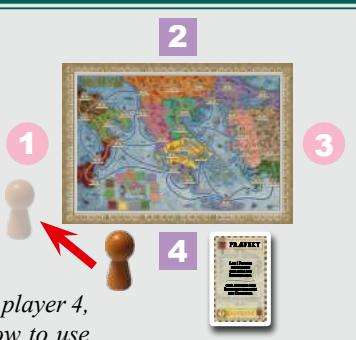
collect the cash bonus. After player 4, now player 2 may decide how to use
the Prefect for himself. Finally, both partners have executed their turns and the orange marker moves to player 1. Now player 1 plays a personality card for his team etc...
Stockpile and Sestertii
Both team partners administrate their personal stuff strictly separated. It is never allowed to exchange, lend or trade in any way neither stockpile nor personality cards with each other. The sestertii are the only exception from this general rule: If a player needs additional sestertii for their desired actions (for instance with an Architect or Mercator), they may take the needed cash from their partner, who cannot refuse this.
Communication between partners
Each player decides on their own which card to play and how to use it. These decisions are always to be respected, even if they contradict their partner‘s plans and ideas. Before starting to play, it is recommended to agree on the ways in which partners are allowed to communicate with each other. Teams that are not as experienced could be allowed to communicate more explicitly than other teams. According to the rules, the Legatus is the only way to look inside the partner’s hand of cards and to propose playing a certain card.
While Concordia promotes common unity, Venus requires a real understanding of your partner.
INTERMEDIATE SCORING
If a player plays their Tribune card for the first time in the game in order to take their cards back into their hand, they immediately perform a personal intermediate scoring. They score all their cards as described below for the final scoring, and tallies their VP on the VP-track.
After all players have played their Tribune card for the first time and have received the intermediate scoring, these scores are compared and player with the highest score receives 2 sestertii. Second place receives 1 sestertius. If players share the same position, they all receive the same amount (all in 1st place receive 2 sestertii and all in 2nd place receive 1 sestertius). After that, all scoring markers move back to the zero position on the VP-track. We do not recommend performing intermediate scoring if all players know the game well.
VESTA
The value of all goods in the storehouse (usual price as depicted) is added to the player’s money. Then the player receives 1 VP per full 10 sestertii, any fractions are ignored.
Each personality card is related to an ancient god who rewards its owner with victory points. First players gather all their cards, including the ones from their discard pile, and arrange them according to the different ancient gods. The back of the player aid shows a summary of the gods and in which order they are scored. The victory points assigned to each card that is marked with the respective god are described in the following text. All victory points (VP) are tallied with the player’s score marker on the VP-track. It is recommended to first score VESTA for all players, then JUPITER etc.
JUPITER
For each house inside a non-brick city the player receives 1 VP. (max. 15 VP per card)
SATURNUS
For each province with at least one of their houses the player receives 1 VP. (max. VP per card = number of different provinces)
VENUS
Individual Play: For each province with at least two of their houses the player receives 2 VP. (max. 14 VP per card)
Team Play: For each province, where both partners at least have 1 house each, the player receives 1 VP. (max. VP per card = number of different provinces)
MERCURIUS
For each type of goods that the player produces with their houses, they receive 2 VP. (max. 10 VP per card)
MARS
For each of their colonists on the game board the player receives 2 VP. (max. 12 VP per card)
MINERVA
For each city of the related city type the player receives a certain number of VP as depicted on the specialist’s card.
If a player purchases the last personality card and thereby empties the card display, or if they build their 15th house, they receive the Concordia Card, which is worth 7 additional VP.
Individual Play variant: Every other player now executes his last turn.
Team Play variant: After the team has completed its turn, all other teams execute one last turn as well.
After the last turn in the game the final scoring is done as described below.
The player or the team with the most VP wins the game. A tie is won by the player or the team owning PRÆFECTUS MAGNUS, or by the tied player who would receive it next in the course of the game.
The VP of a team are calculated as the sum of VP of both partners, after each partner has counted his VP individually.
The Legatus contains 3 ancient gods, and therefore is counted once along with Jupiter, once with Saturnus, and once with Venus.
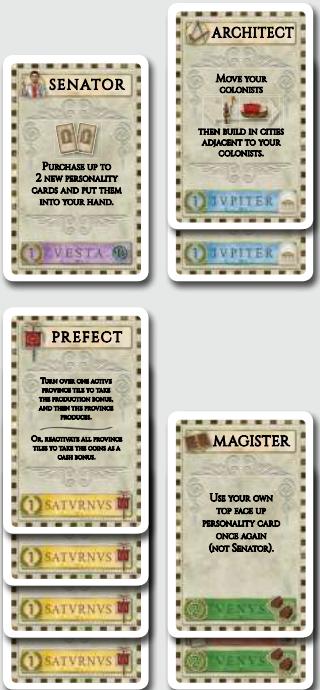
FINAL SCORING
The player owns a total of 12 houses on the board of which 3 produce bricks, 4 produce food, 3 produce tools, and 2 produce cloth. They are distributed over 7 provinces, of which 5 provinces contain 2 of the player’s houses each. Furthermore the player owns 5 colonists on the game board, has a total of 13 sestertii, and owns the Concordia Card
because he purchased the last card from the display area on the game board. The storehouse contains 1 cloth, 3 tools, and 1 brick. After arranging the cards as shown to the right, the final scoring gives the following result:
VESTA: His goods are worth 7 (1 cloth) + 15 (3 tools) + 3 (1 brick) sestertii. Added to his cash on hand (13 sestertii) he has 38 sestertii which are worth 3 VP.
JUPITER: As 3 of his 12 houses are inside brick cities, he has 9 houses that count for this god. With 2 cards assigned to Jupiter he receives 2 x 9 = 18 VP.
SATURNUS: As the player has houses in 7 provinces and owns 4 cards assigned to Saturnus, he receives 4 x 7 = 28 VP.
VENUS (Example for Individual Play): The player is present in 5 provinces with at least 2 houses each. He receives 10 VP per card assigned to Venus, hence 2 x 10 = 20 VP.
MERCURIUS: Unfortunately the player has not built inside a wine city, but he does produce the other 4 types of goods. For his 2 cards assigned to Mercurius he receives 2 x 8 = 16 VP.
MARS: For his 5 colonists on the game board he receives 10 VP per card assigned to Mars, hence 3 x 10 = 30 VP.
MINERVA: The player owns a farmer who rewards him with 3 VP for each house inside a food city. With 4 such houses this results in 12 VP.
Together with 7 points from the Concordia Card the player therefore achieves 134 victory points.
rules_en_concordia-8-forum-cards-mini-expansion_209574.md4.4 KB
Concordia: 8 Forum Cards mini-expansion
逐页 VLM 转写(qwen3-vl-plus),保留原文结构,未翻译。
CONCORDIA SALSA
FORUM CARDS
The 8 new forum cards are a small expansion for Concordia Salsa. They may be combined with the 27 old forum cards. Out of balancing reasons we recommend to put 4 old patricians (blue cards) aside.
Note: The 8 new forum cards may be used without Concordia Salsa as well. Each player randomly gets one patrician or both citizens (green cards).
The blue patricians are permanent cards. They stay the whole game at the owner’s side. Conversely, the green citizens offer a one-time advantage. After their use they must be discarded.
[图: ADVENTUS ARCADII card: "1x Buy 1 single good", Architectus]
The player may buy exactly 1 good before or after they build houses.
[图: CURSUS ARCADII card: " =1 ", Architectus]
Example: The player moves along 5 lines. 3 lines are occupied by other colonists. The player needs 2 movement steps.
[图: MINUS DENARIUS card: "1x –", Architectus]
In every turn, the player may sell one single good.
Example: The player sells 1 cloth for 5 sestertii.
[图: VITUS MARCELLUS card: amphora and coins, Mercator]
If the player sells wine, he will get 8 sestertii each. Buying wine still costs 6 sestertii each. Selling and buying wine in one turn is forbidden.
[图: LINUS POMPEIUS card: building icon → ?, Praefectus]
Example: The province produces cloth, wine, and food. The player chooses food as bonus good.
[图: EMERITUS SCIPION card: two portraits, Senator]
Note: If the Senator is used as a Consul, the player may accordingly buy only one card.
[图: RETURNUS card: book → cards, Mercator]
Example: The player takes their already played Senator back to the hand.
[图: SEXTUS card: "6x", Mercator]
The player may trade up to 6 single goods instead of the usual two types of goods..
[图: small salt bag icon]
The small salt bag at the very bottom marks the 8 new forum cards.
NAVEGADOR
PRIVILEGE-CARDS
The 7 privilege cards are a small expansion for NAVEGADOR. They form a supply beside the game board. The following additional rules apply:
-
A player who chooses “PRIVILEGE“ on the rondel picks one privilege card from the supply at the end of their turn. It does not matter whether the player takes a small privilege from the gallery or not.
-
The players may own only one privilege card at a time. If a player enters “PRIVILEGE“ and still owns a card, they must exchange it for a new privilege card.
-
Privilege cards are played in addition to the rondel action and put back to the supply afterwards. With the exception of the card “Buildings discount“ they are not bound to a special rondel action. When moving backwards on the rondel, only the chosen action is performed.
-
A card which is played while on “PRIVILEGE“ may not be picked in the same turn.
[图: PRIVILEGE CARD ship: "Build a ship for free & let it sail"]
The new ship starts in Portugal and may sail immediately. The distance depends on the game phase.
[图: PRIVILEGE CARD rondel with arrow: "Move backwards on the rondel"]
The player moves his game stone on the rondel 1, 2 or 3 squares backwards and performs the chosen action.
[图: PRIVILEGE CARD colony: "Found one new colony"]
The player may found exactly one new colony. It must be purchased as usual.
[图: PRIVILEGE CARD market: "Change one price by 4 squares"]
The player may change one market price up to 4 squares.
[图: PRIVILEGE CARD ship with sails: "Depending on the phase: 3/6/9 sail steps"]
The player has 3 / 6 / 9 sail steps available. These may be allocated freely on their ships.
[图: PRIVILEGE CARD worker: "One temporary worker"]
The player uses one additional worker. The card may be spent on “PRIVILEGE“ instead of a normal worker.
[图: PRIVILEGE CARD buildings: "Buildings discount depending on the phase:"]
The player gets a discount on “BUILDINGS“. Depending on the game phase they save 50, 100 or 150 Cruzados.
[图: PRIVILEGE CARD rules summary: "1. Whenever you hit 'PRIVILEGE' on the rondel take a privilege card. 2. You may own only one privilege card at a time. 3. Play a privilege card in addition to your rondel action and put it back into the supply afterwards. 4. If you use a card on 'PRIVILEGE' you may not take that card again."]
A summary of the rules for the privilege cards.
Download MarkdownTexts are community-compiled or publicly released by publishers; copyright remains with the original authors. For personal reference only.