
Fits
At a glance
Rules, cards and Q&A (Chinese)
The rules, card data and player questions for this game are written in Chinese. Open the Chinese page to read them.
Where to find full rules
Full rules and card lookup are available in the cunlema app at cunlema.cn — pick this game and ask about any rule, card or turn you are unsure about.
Related games
Rulebook text (Markdown)
This game has 1 rulebook Markdown file(s) in our library; 1 rendered inline below — expand to read or download.
FITS Rules (English).md7.4 KB
FITS
FILL-IN-THE-SPACES!
Challenging Fun for 1 to 4 Players, Ages 8 and Up
By: Reiner Knizia Design: DE Ravensburger, die licht gestalten Schwarzschild · die Kommunikatur KniffDesign · Editor: Philipp Sprick · Foto: Becker Studios Ravensburger®Game No. 26 503 9

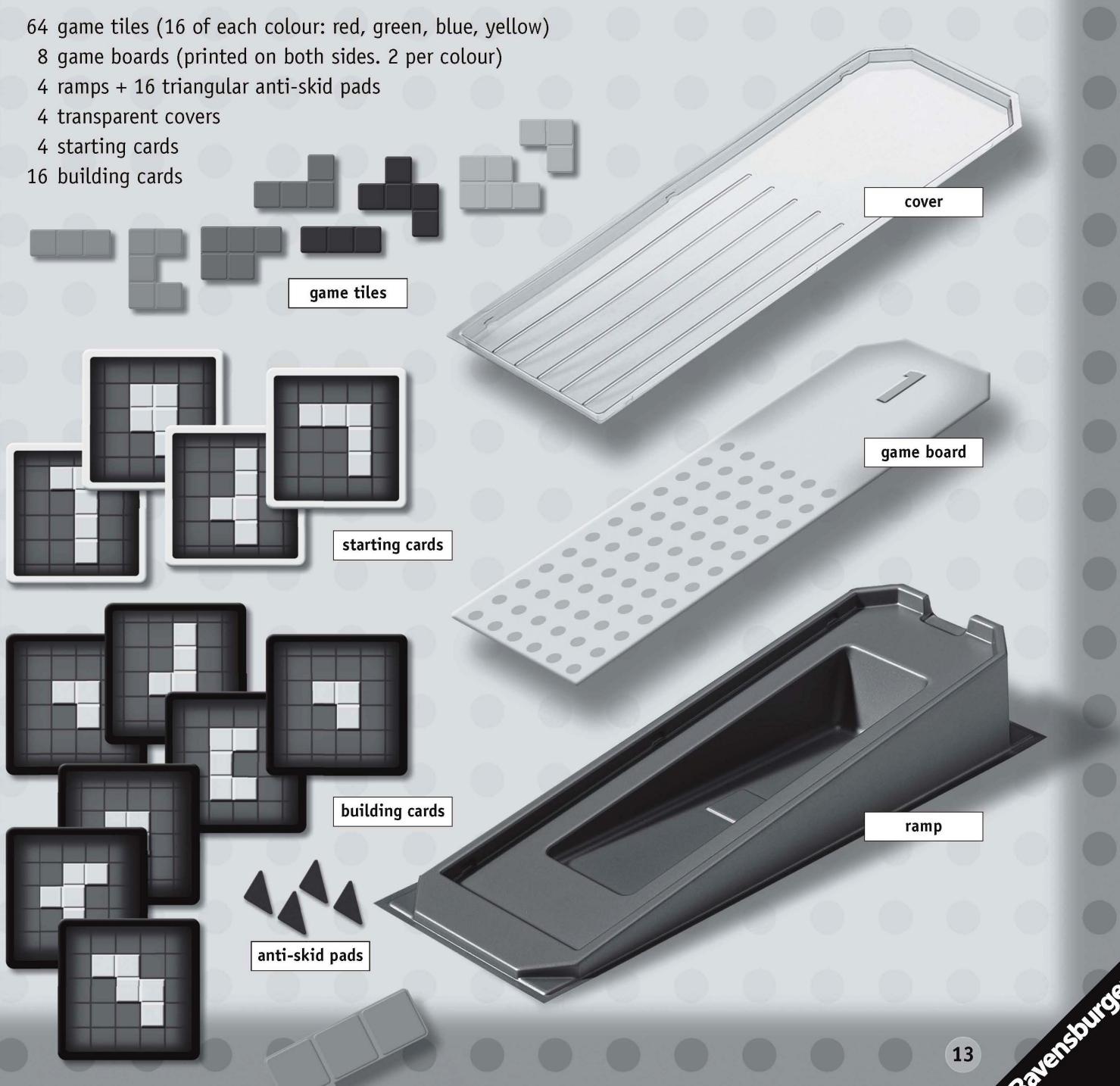
Contents
Object of the Game
Players try to arrange the differently shaped tiles onto their boards in the best way possible in order to obtain the most points.
Preparation
Before playing for the first time:
• Remove the starting and building cards from their original panels.
• Remove the plastic wrapping.
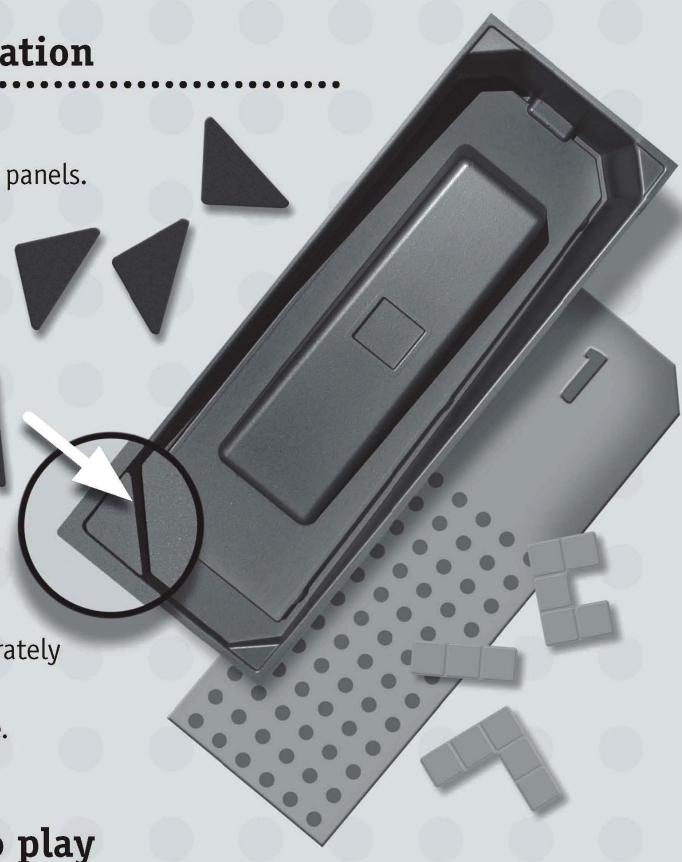
• Detach the 4 ramps from each other.
• Apply 4 triangular anti-skid pads to the bottom of each ramp as shown in the illustration.
Each player receives:
• All tiles of a colour of their choice.
• Both game boards of the same colour.
• A ramp and cover.
If there are less than 4 players, the remaining pieces are put back into the box.
Shuffle the 4 starting cards and the 16 building cards separately and place the two decks face down on the table. You also need a sheet of paper and a pencil for keeping score.
How to play
(For 2 to 4 players. A game variation for a single player is explained on page 16.)
The game is made up of 4 rounds.
A round consists of the following phases:
-
Inserting a game board
-
Turning over a starting card and positioning that tile
-
Turning over building cards and positioning the corresponding tiles
1. Inserting the game board
● The game boards are numbered from 1 to 4 with a grid of 6 x 12 dotted spaces. Boards 2, 3 and 4 have various special spaces that are explained in the section about “Scoring".
• In the first round, all players play with board 1, in the second round with board 2, and so on.
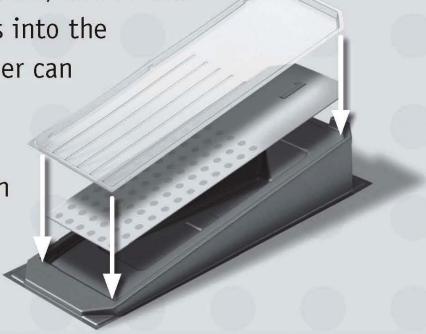
• Insert the game boards into the ramp so that the number can be seen at the top.
• Lastly, place a cover over the ramp as shown in the illustration.
2. Turning over a starting card and positioning the corresponding tile
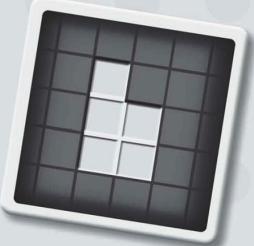
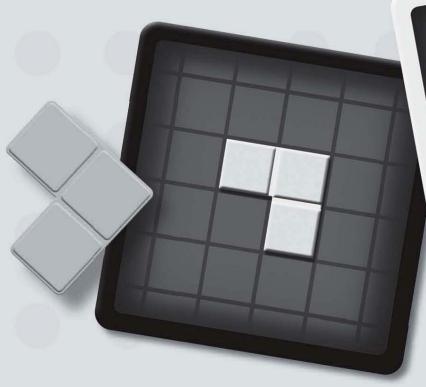
Each player draws a starting card from the pile. They select the corresponding tile shown on the card and place it on their board.
Basic Rules:
• You may choose any column.
• You may position the tile any way you like. For every tile there are up to 8 different possibilities:
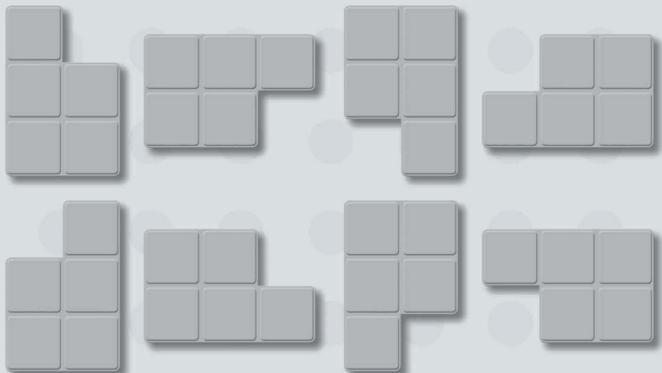
The illustration on the card only shows which tile to use. It does not determine direction.
Place the tile at the top end of the ramp on the cover so that the tile's indentations fit on the tracks of the cover. Then slide it down the ramp until it reaches the bottom (see illustration A). The tile may not be adjusted while sliding down the ramp.
Players keep their starting cards until the end of each round.
3. Turning over building cards and positioning the corresponding tiles
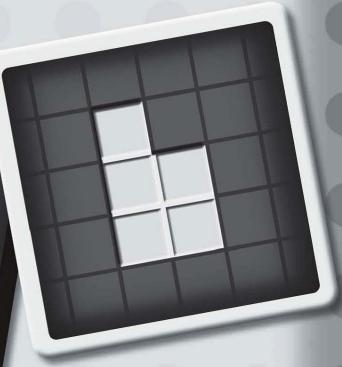
As soon as all players have placed their starting tile, a player turns over the first building card. Each player chooses the corresponding tile from their supply, places it on their ramp and slides it down until it either reaches the bottom edge of the ramp or rests against already set tiles (see illustration B).
The following rules apply:
• Each player uses the same tile at the same time.
• If a building card is identical to a player's starting card, that player misses the turn.
• If a player decides not to place a tile, they can put it aside.
Note: You can put as many tiles aside as you wish: however, duringeach round, every building card appears only once. That means that a tile that is put aside cannot be used again during that round.
• Tiles may not go over the left or right side of the ramp, however, they may go over the top edge of the grid.
Attention! You may not place any tiles into gaps that are not accessible from above (see illustrations C and D)!
As soon as all players have positioned their tile shown on the building card, a player turns over the next card. Place this building card on top of the old one to form a face-up card pile. All players now select the new game tile shown on the card and place it on their board, and so on.
End of a round
Once the building cards are usedup, the round is over and you count up your points (see below).
For the next round, players position board 2 on the ramp and shuffle the starting and building cards again. For the third and fourth round, the procedure is the same.
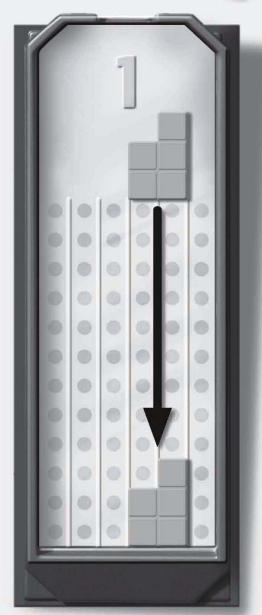
Place the starting tile
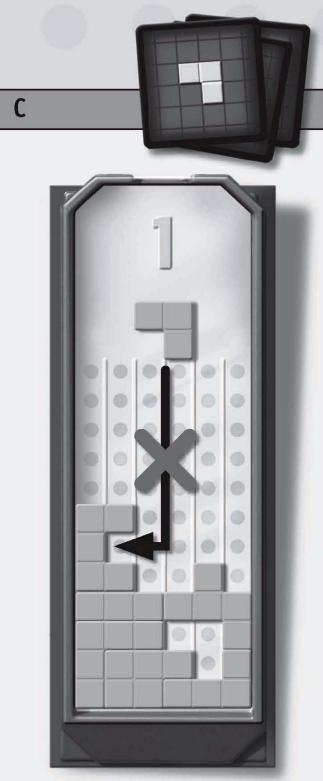
The tile may not be shifted to the left or right while being slid into place.
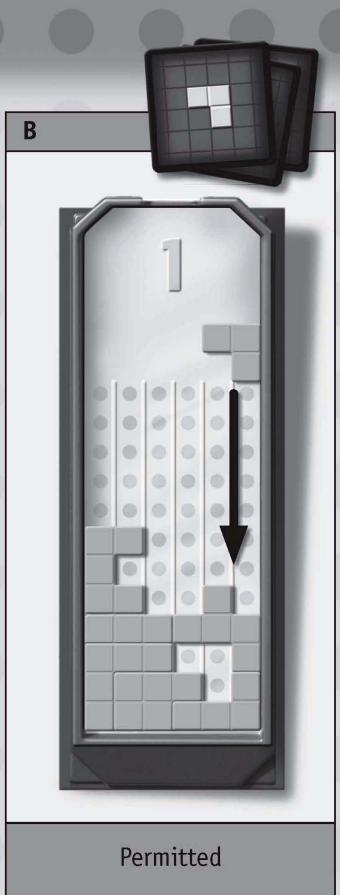
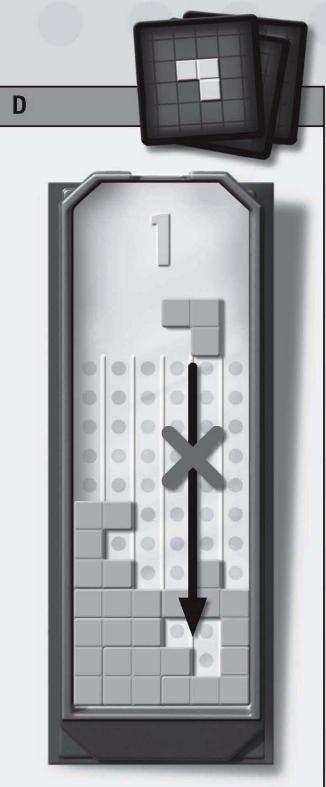
The tile may not be placed in an enclosed gap.
Scoring
Points are scored according to the game boards.

Applies to all boards:
Each dot that is not covered at the end of a round counts as a penalty point.
The only exceptions are the special spaces on boards 2, 3 and 4.
Special rules for individual boards:
• Board 1: Each complete (gapless) horizontal row counts as 1 point.
• Board 2: This board has special spaces with bonus points ranging from 1 to 3. Each number that is still visible at the end of a round counts as that amount of points.
• Board 3: This board has special spaces with bonus and penalty points. Each number that is still visible at the end of a round counts either towards or against your score.
• Board 4: This board has special spaces with five different symbols. Each symbol appears twice.
• Each pair of symbols still visible at the end of the round counts as 3 bonus points.
• Each pair of symbols where only one is still visible, counts as 3 penalty points.
• Pairs of symbols that are completely covered count neither as bonus nor penalty points.
End of the game
The game ends after the fourth round. All points from the previous rounds are now added up. The player with the most points wins. In the event of a tie, there are several winners.
Variation for a single player
Play all the game boards 1 through 4 and record your points. What's your result?
More than 30 points: master builder
26 to 30 points: architect
21 to 25 points: stone mason
16 to 20 points: handyman
11 to 15 points: landscaper
6 to 10 points: the new guy
Up to 5 points: clean up crew
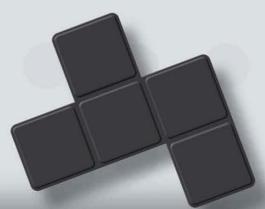

Helpful Hints
• Storage: After the game, store the tiles inside the ramps and secure them with the covers.
• Duration: For a shorter game simply omit some of the boards. For variety, play the boards in a different sequence.
© 2009 Ravensburger Spieleverlag GmbH
Texts are community-compiled or publicly released by publishers; copyright remains with the original authors. For personal reference only.