
拼块大师Fits
一句话概览
拼块大师 是一款已收录于村了吗规则库的桌游,支持 1–4 人,原名 Fits。
本页内容:一句话概览 · 常见问题
这游戏怎么玩
- 本站已收录这款游戏的规则资料,可以在对话里直接提问规则细节。
常见问题(FAQ)
以下 1 条问答中 0 条来自站内玩家的真实提问,其余 1 条为本站整理的常见疑问;答复内容保持原样。
拼块大师支持几个人玩?
1–4 人。
去哪查完整规则
想核对具体规则细节、卡牌效果或某个回合的结算方式,可以在村了吗里选中这款游戏后直接提问。
同类桌游
- 卡坦岛德式
- 工业革命:伯明翰德式
- 勃艮第城堡:特别典藏版德式
- 方舟动物园德式
- 卡卡颂抽象
- 瘟疫危机传承:第一季美式
- 阿瑞迪亚:勇踏征途美式
- 重塑宇宙德式
- 幽港迷城美式
- 埃多拉的德鲁伊德式
规则原文(Markdown)
本站收录这款游戏的规则原文 1 个文件,此处内联渲染 1 个,可直接展开阅读或下载。
FITS Rules (English).md7.4 KB

FITS
FILL-IN-THE-SPACES!
Challenging Fun for 1 to 4 Players, Ages 8 and Up
By: Reiner Knizia Design: DE Ravensburger, die licht gestalten Schwarzschild · die Kommunikatur KniffDesign · Editor: Philipp Sprick · Foto: Becker Studios Ravensburger®Game No. 26 503 9
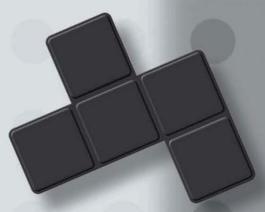
Contents
Object of the Game
Players try to arrange the differently shaped tiles onto their boards in the best way possible in order to obtain the most points.
Preparation
Before playing for the first time:
• Remove the starting and building cards from their original panels.
• Remove the plastic wrapping.
• Detach the 4 ramps from each other.
• Apply 4 triangular anti-skid pads to the bottom of each ramp as shown in the illustration.
Each player receives:
• All tiles of a colour of their choice.
• Both game boards of the same colour.
• A ramp and cover.
If there are less than 4 players, the remaining pieces are put back into the box.
Shuffle the 4 starting cards and the 16 building cards separately and place the two decks face down on the table. You also need a sheet of paper and a pencil for keeping score.

How to play
(For 2 to 4 players. A game variation for a single player is explained on page 16.)
The game is made up of 4 rounds.
A round consists of the following phases:
-
Inserting a game board
-
Turning over a starting card and positioning that tile
-
Turning over building cards and positioning the corresponding tiles
1. Inserting the game board
● The game boards are numbered from 1 to 4 with a grid of 6 x 12 dotted spaces. Boards 2, 3 and 4 have various special spaces that are explained in the section about “Scoring".
• In the first round, all players play with board 1, in the second round with board 2, and so on.
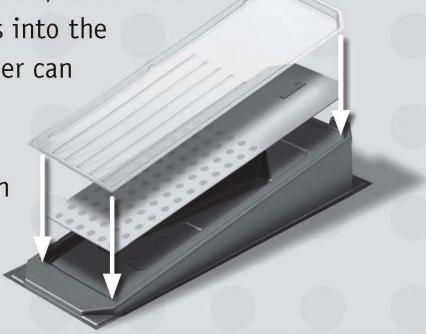
• Insert the game boards into the ramp so that the number can be seen at the top.
• Lastly, place a cover over the ramp as shown in the illustration.
2. Turning over a starting card and positioning the corresponding tile
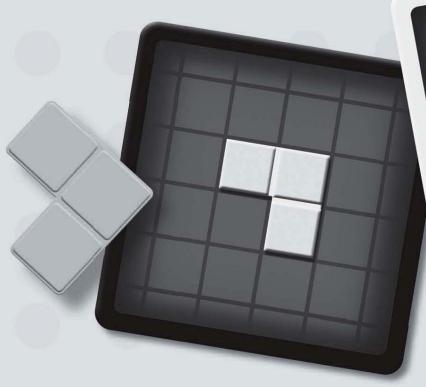
Each player draws a starting card from the pile. They select the corresponding tile shown on the card and place it on their board.
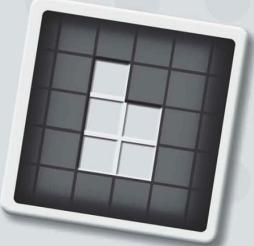
Basic Rules:
• You may choose any column.
• You may position the tile any way you like. For every tile there are up to 8 different possibilities:
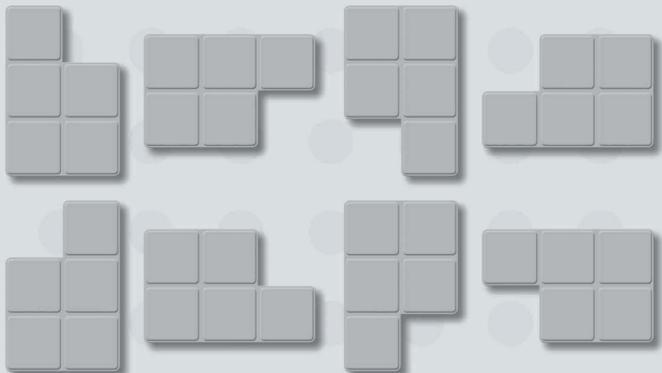
The illustration on the card only shows which tile to use. It does not determine direction.
Place the tile at the top end of the ramp on the cover so that the tile's indentations fit on the tracks of the cover. Then slide it down the ramp until it reaches the bottom (see illustration A). The tile may not be adjusted while sliding down the ramp.
Players keep their starting cards until the end of each round.
3. Turning over building cards and positioning the corresponding tiles
As soon as all players have placed their starting tile, a player turns over the first building card. Each player chooses the corresponding tile from their supply, places it on their ramp and slides it down until it either reaches the bottom edge of the ramp or rests against already set tiles (see illustration B).
The following rules apply:
• Each player uses the same tile at the same time.
• If a building card is identical to a player's starting card, that player misses the turn.
• If a player decides not to place a tile, they can put it aside.
Note: You can put as many tiles aside as you wish: however, duringeach round, every building card appears only once. That means that a tile that is put aside cannot be used again during that round.
• Tiles may not go over the left or right side of the ramp, however, they may go over the top edge of the grid.
Attention! You may not place any tiles into gaps that are not accessible from above (see illustrations C and D)!
As soon as all players have positioned their tile shown on the building card, a player turns over the next card. Place this building card on top of the old one to form a face-up card pile. All players now select the new game tile shown on the card and place it on their board, and so on.
End of a round
Once the building cards are usedup, the round is over and you count up your points (see below).
For the next round, players position board 2 on the ramp and shuffle the starting and building cards again. For the third and fourth round, the procedure is the same.
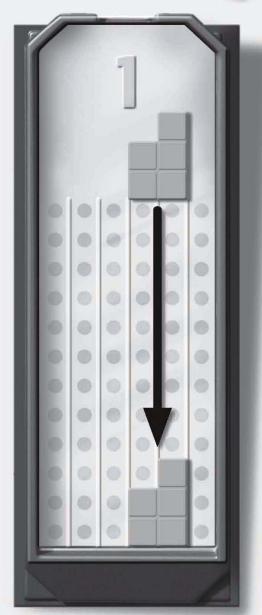
Place the starting tile

The tile may not be shifted to the left or right while being slid into place.
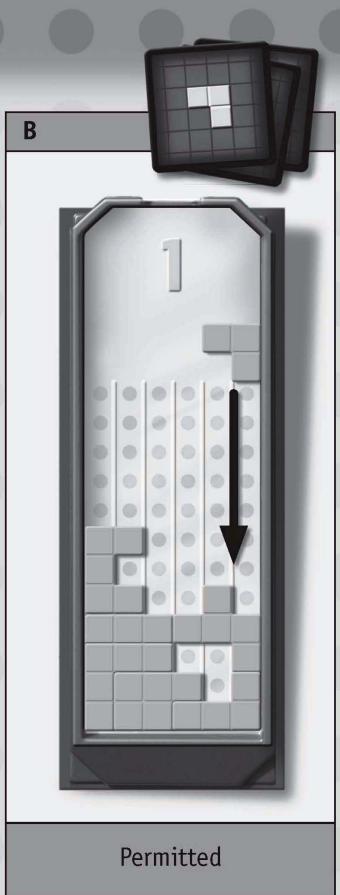
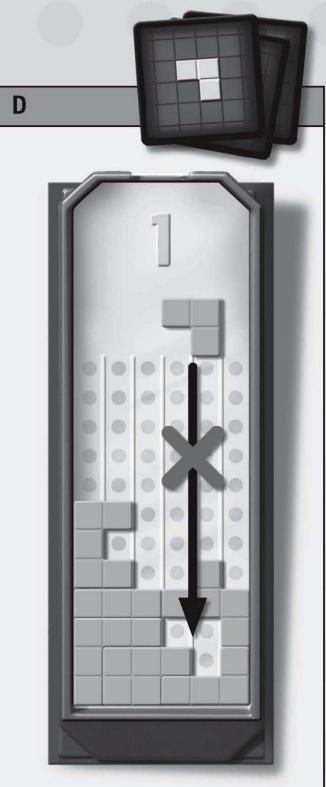
The tile may not be placed in an enclosed gap.
Scoring
Points are scored according to the game boards.

Applies to all boards:
Each dot that is not covered at the end of a round counts as a penalty point.
The only exceptions are the special spaces on boards 2, 3 and 4.
Special rules for individual boards:
• Board 1: Each complete (gapless) horizontal row counts as 1 point.
• Board 2: This board has special spaces with bonus points ranging from 1 to 3. Each number that is still visible at the end of a round counts as that amount of points.
• Board 3: This board has special spaces with bonus and penalty points. Each number that is still visible at the end of a round counts either towards or against your score.
• Board 4: This board has special spaces with five different symbols. Each symbol appears twice.
• Each pair of symbols still visible at the end of the round counts as 3 bonus points.
• Each pair of symbols where only one is still visible, counts as 3 penalty points.
• Pairs of symbols that are completely covered count neither as bonus nor penalty points.
End of the game
The game ends after the fourth round. All points from the previous rounds are now added up. The player with the most points wins. In the event of a tie, there are several winners.
Variation for a single player
Play all the game boards 1 through 4 and record your points. What's your result?
More than 30 points: master builder
26 to 30 points: architect
21 to 25 points: stone mason
16 to 20 points: handyman
11 to 15 points: landscaper
6 to 10 points: the new guy
Up to 5 points: clean up crew


Helpful Hints
• Storage: After the game, store the tiles inside the ramps and secure them with the covers.
• Duration: For a shorter game simply omit some of the boards. For variety, play the boards in a different sequence.
© 2009 Ravensburger Spieleverlag GmbH
原文为社区整理/出版社公开资料,版权归原作者,仅供个人学习查阅。