
Here I Stand: 500th Anniversary Edition
At a glance
Rules, cards and Q&A (Chinese)
The rules, card data and player questions for this game are written in Chinese. Open the Chinese page to read them.
Where to find full rules
Full rules and card lookup are available in the cunlema app at cunlema.cn — pick this game and ask about any rule, card or turn you are unsure about.
Related games
- Twilight Imperium: Fourth Edition
- War of the Ring: Second Edition
- Pacific War: The Struggle Against Japan, 1941-1945 (Second Edition)
- Twilight Struggle
- Empire of the Sun: The Pacific War 1941-1945
- Imperial Struggle
- Advanced Squad Leader: Starter Kit #1
- Advanced Squad Leader
- Tanto Monta: The Rise of Ferdinand & Isabella 1470-1516
- The Last Hundred Yards
Rulebook text (Markdown)
This game has 1 rulebook Markdown file(s) in our library; 1 rendered inline below — expand to read or download.
Here-I-Stand-Rules-2023.md240.1 KB
by Ed Beach
500th Anniversary Edition
RULE BOOKRULE BOOK

GMT Games, LLC • P.O. Box 1308, Hanford, CA 93232-1308
www.GMTGames.com
INDEX
Rule Page
1. INTRODUCTION. 3
2. GAME MAP.... 3
2.1 Space ..... 3
2.2 Political Control .. 3
2.3 Religious Influence..
2.4 Control Markers .. 4
2.5 Other Map Elements... 4
3. POWERS AND RULERS. 5
3.1 Player...... 5
3.2 Power..... 5
3.3 Ruler ...... 5
4. POWER CARDS.. 6
5. MILITARY UNITS . 6
5.1 Leaders . 6
5.2 Land Units ... 7
5.3 Naval Units..... 7
6. CARDS.... 7
6.1 Card Types... 7
6.2 The Deck . 8
7. SEQUENCE OF PLAY.. 9
8. STARTING A TURN .. 10
8.1 Turn 1 ........ ... 10
8.2 Card Draw Phase... ... 10
9. DIPLOMACY ...... ... 11
9.1 Negotiations.. .. 11
9.2 Alliances .........
9.3 Suing for Peace....... ... 12
9.4 Ransom of Leaders.........
9.5 Removing Excommunication.. .... 13
9.6 Declarations of War...
10. SPRING DEPLOYMENT.. .. 14
11. THE ACTION PHASE.. ... 15
11.1 Actions.. ... 15
12. CONTROL & UNREST... ...... 16
12.1 Line of Communication... ... 16
12.2 Unfortified Space. .. 16
12.3 Fortified Space.... ... 17
12.4 Unrest ..... ..... 17
12.5 Displacement....
13. MOVEMENT.......
13.1 Land Movement Procedure .
13.2 Interception.... .... 18
13.3 Avoid Battle ...
13.4 Withdrawing into Fortifications.. .... 19
14. FIELD BATTLE...... ..... 19
14.1 Retreat ........ ... 20
15. SIEGE...... .. 21
15.1 Assault ... . 21
15.2 Relief Forces.. . 22
Rule Page
15.3 Breaking a Siege.. .. 22
16. NAVAL AFFAIRS ..... .. 23
16.1 Naval Movement .. 23
16.2 Naval Combat... .. 24
16.3 Naval Transport .. .. 24
16.4 Piracy. .. 25
17. UNIT CONSTRUCTION.. ..... 26
17.1 Land Units .... .... 26
17.2 Naval Units.. .. 26
18. THE REFORMATION.. .... 26
18.1 Religious Actions . .. 26
18.2 Religious Modifiers .. .... 28
18.3 Reformation Attempts .... 29
18.4 Counter Reformation Attempts . .. 30
18.5 Theological Debates .... ... 31
19. WINTER .. 32
19.1 Loaned Squadron Markers . .. 32
19.2 Renegade Leader ... .... 32
19.3 Returning Home .. 32
19.4 Major Power Alliance Markers . .. 34
19.5 Replacements... .. 34
19.6 Piracy Markers . .. 34
19.7 Debaters...... .. 34
19.8 Mandatory Events. .. 34
20. THE NEW WORLD.. .... 34
20.1 Colonies... ... 34
20.2 Voyages of Exploration . .... 34
20.3 Voyages of Conquest .. .. 35
20.4 New World Riches.. .... 36
21. MAJOR POWERS . .. 36
21.1 Ottoman.. .... 36
21.2 Hapsburg .. 36
21.3 England.... .... 37
21.4 France ... .. 38
21.5 Papacy . .... 38
21.6 Protestant ... .. 39
21.7 Foreign Wars ... ... 40
22. MINOR POWERS .. 40
22.1 Inactive Minor Powers . ..... 40
22.2 Activation .. 40
22.3 Active Minor Powers. ... 41
22.4 Deactivation.. ... 41
22.5 Defeat of Hungary-Bohemia .. ... 41
22.6 Independent Keys.. .... 42
23. VICTORY.. .... 42
23.1 Automatic Victories.. .. 42
23.2 Victory Points ......
23.3 Victory Determination Phase.. . 43
1. INTRODUCTION
Here I Stand is a game for two to six players based on the military, political and religious conflicts within Europe at the outbreak of the Protestant Reformation, from 1517-1555. Each player controls one or more major powers that dominated Europe at the time. The major powers represented are the Ottoman Empire, the Hapsburgs, England, France, the Papacy and the Protestant states.
2. GAME MAP
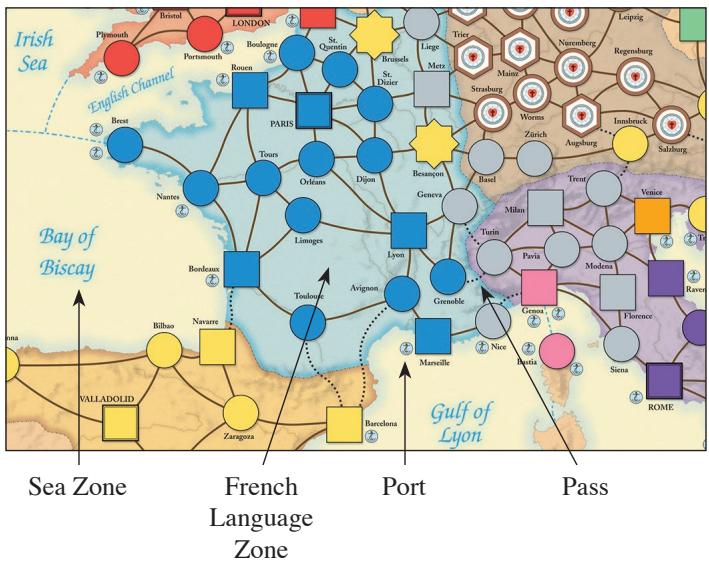
The game is played on a 22” x 34” map of Europe in the 16th century. Cities and towns that played an important role in the history of the period are represented on the map as square, circular, hexagonal, or eight-pointed symbols called “spaces.” A network of lines called “connections” link these spaces. A space connected to another by one of these lines is an “adjacent” space. Some of the spaces are also ports (a circular symbol with an anchor inside). Ports allow access to a series of areas called “sea zones” (light yellow regions with dash blue boundaries).
The political and religious status of each space is updated throughout play using control markers. Detailed information about map elements and control markers is provided in this section of the rulebook.
[This mapsheet also contains the following charts referenced within these rules: New World Riches Table, New World display, Victory Track, Electorate Display, Diplomatic Status Display, Henry’s Wives Pregnancy Chart and the Turn Track.]
2.1 Space
All spaces in the game are either fortified or unfortified.
Fortified Space: A fortified space represents a walled city (or town). A power must successfully besiege a fortified space to gain political control of that city. Up to four friendly land units may remain within a fortified space to defend that city against an enemy siege. Fortified spaces also serve as winter quarters. There are three different types of fortified spaces:
• Key: A key is a fortified space represented by a square. Keys are the most influential and wealthy spaces; control of a key gives a power victory points and cards. Six of the keys have a double-square border (London, Paris, Valladolid, Vienna, Rome, and Istanbul); these keys are capitals. The Hapsburg power has two capitals (Valladolid and Vienna) while the Protestant power has none. The other four powers each have a single capital.
• Electorate: An electorate is a fortified space represented by a hexagon. There are six electorates on the map, all in Germany. Each electorate represents the home city of one of the electoral princes who had the power to elect the Holy Roman Emperor. These spaces are the focal point of the political and religious struggle in Germany during the game. Electorates are not keys, but they are important spaces for the powers interested in German affairs: the Hapsburgs, the Papacy, and the Protestants.
• Fortress: A fortress is a fortified space represented by a circle with eight points. Fortresses are walled towns with little economic value. They never grant a power additional victory points or cards. However, a fortress’s strong defenses force a power to besiege the space to gain political control. Several event cards allow a player to construct a fortress on an unfortified space during the game.
Unfortified Space: A circle represents an unfortified space. These spaces represent cities (or towns) that could be controlled without a siege. Forces from two powers that are at war must fight a field battle if they ever simultaneously occupy the same unfortified space.
Home Space: Spaces with a gray fill color are independent and are not aligned with any of the powers represented in the game. All other spaces are a home space for a specific power, as indicated in the table below. This power is referred to as the “home power” for that space.
Major Power Home Space Color
Ottoman dark green
Hapsburgs yellow
England red
France dark blue
Papacy purple
Protestant Brown edge with white center
Minor Power Home Space Color Genoa pink Hungary/Bohemia light green Scotland light blue Venice orange

Protestant

France
England


Hapsburg
Papacy

Ottoman

Independent
2.2 Political Control
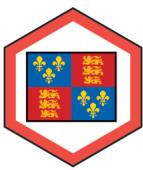
The political control of each space is tracked throughout the game. By default, each space is under the political control of its home power. As political control changes, control markers are placed on top of the space to indicate that the political control has changed to a non-home power. These control markers are color-coded by power and also include a flag used by that power during the 16th century.
Controlled Space
A space that is controlled by a major or minor power is a controlled space. Controlled spaces for a power include:
• Home spaces that have not fallen to another power.
• Independent (gray) spaces seized by the power.
• Home spaces of other powers seized by the power.
• Home spaces of allied minor powers.
Control Terminology
Friendly: The term “friendly” refers to any game element (space, unit, stack, formation, debater) that is controlled by the active power or an ally of that power.
Enemy: The term “enemy” refers to any game element that is controlled by a power that is currently in a state of war with the active power. In addition, Papal and Protestant debaters are always considered to be enemies of each other.
Independent: The term “independent” refers to any game element that is not controlled by a major or minor power. Independent game elements are never considered to be either friendly or enemy items for the purposes of any rules of play.
EXAMPLES: Independent units can not intercept moving forces since only enemy formations may attempt intercepts. Adjacent independent units do not prohibit unoccupied, unfortified spaces from being controlled, an action that is restricted by the presence of adjacent enemy units.
2.3 Religious Influence
The dominant Christian denomination (Catholic or Protestant) in many spaces changes during the game as the Reformation sweeps across Europe. Only Ottoman home spaces (which are considered to be either Muslim or Eastern Orthodox) are immune to such a change of religious influence.
Catholic Space: All spaces on the map (other than Ottoman home spaces) start the game under Catholic religious influence. Catholic spaces are shown by either the absence of a control marker over a solid-covered space or by a control marker on its solid side.
Protestant Space: Protestant spaces represent cities where the new reformed beliefs are dominant. Spaces under Protestant influence are shown by the absence of a control marker on a Protestant home space or by a control marker with a colored border and white center (the reverse of its solid colored side).
2.4 Control Markers
Control markers are used to denote a space’s political control and religious influence. The flag and border color of the marker indicates the political control of the space. The interior color of the marker indicates the religious influence. One side of the control marker is a solid color that represents Catholic religious influence while the flip side of the control marker has a colored border with a white interior that represents Protestant religious influence. There are two shapes for control markers: a square marker for keys and a hexagonal marker for all other spaces.
Square Markers
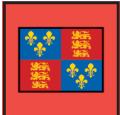
Square control markers are used to show the status of keys. These markers are transferred between the power cards (Section 4) and the map when a key is captured or lost. Note these two rules:
-
Every key on the map must contain a square control marker. Exceptions: independent keys not currently under major power control, keys of minor powers when they are neither allied to a major power or captured, and keys captured by the Protestant power (which has no square markers).
-
Every square control marker must be either on the map or on the appropriate power card.
Following these two rules ensures that the power cards are always kept up to date with the proper information about card draws and victory points.
Hexagonal Markers
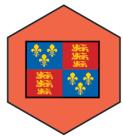
power cards.
Hexagonal markers are used to show status of electorates, fortresses, unfortified spaces, and keys captured by the Protestant power. These markers are kept out of play until needed to update the political or religious status of a space. They are never placed on
2.5 Other Map Elements
Four other elements of the map are important to play.
Language Zone
The background of the game map is color-coded to depict five language zones. Each space falls entirely within a single language zone, as determined by looking at the background color of the map around that space. Exception: the spaces within a tan background; these spaces lie outside all five language zones. Spaces within a language zone are sometimes referred to as “speaking” that language, e.g. a space in the English language zone is an “English-speaking space.”
Language Language Zone Color English pale red French pale blue German gray Italian pale purple Spanish pale yellow

Control Marker Example
1: Hapsburg unfortified home space. Still Catholic and under Hapsburg political control.
2: Hapsburg home key. Still Catholic but now under English political control.
3: English home key. Now Protestant but still under English political control.
4: Independent space. Now Protestant, but still independent politically.
5: Protestant unfortified home space. Now Protestant in religion, but under Hapsburg political control.
6: Protestant home electorate. Still Catholic and under Hapsburg political control.
7: Protestant home electorate. Now Protestant in both religion and politics.
Pass
A connection shown with a dashed line is a pass. There are 3 passes across the Pyrenees between Spain and France, 6 passes in the Alps near northern Italy, and 7 passes in the Balkans. Formations of land units moving over a pass expend 2 command points (CPs) instead of the usual cost of 1 CP for moving over a normal connection. Passes also:
• slow the spread of religious ideas
• block spring deployment of land units
• prevent interception by an enemy formation that is adjacent across a pass, and
• inhibit land units’ ability to control adjacent spaces and remove unrest in adjacent spaces.
Units may retreat or avoid battle over a pass.
Sea Zone
The map contains 14 sea zones, each labeled in a blue italic font.
Boundaries between sea zones are shown by a broken blue line.
Only naval leaders and naval units may occupy sea zones; land units must always end every action in a space.
Port
Most (but not all) of the spaces near the coast act as ports, which provide access to one or more sea zones. One-zone ports possess a single anchor symbol. Two-zone ports have two anchors next to them, one anchor within each of the two sea zones that may be accessed from that space.
The following sea zones are not connected:
• Ionian Sea/Tyrrhenian Sea (two-zone port: Messina)
• Barbary Coast/Atlantic Ocean (two-zone port: Gibraltar)
• Black Sea/Aegean Sea (two-zone port: Istanbul)
However, if the two-zone port between these zones (Messina, Gibraltar, or Istanbul) is under friendly control, naval units may move into this port from one zone during one Naval Move action and then back out to either zone during a later Naval Move action.
The following sea zones are CONNECTED (as shown by the double-ended arrows at the top of the map):
North Sea/Irish Sea
North Sea/Baltic Sea
3.0 POWERS AND RULERS
Here I Stand is best played with either three or six players. The rules in this booklet are for a game with six players. The small number of rule changes needed to support play with 3 to 5 players are listed in the section “Games with 3 to 5 Players” in the Scenario Book. Play with 2 players is also possible using the Two-Player Variant presented at the end of the Scenario Book. Unless you are using the Two-Player Variant, all six major powers are assigned to a player and take an active part in the conflict. This section defines players, powers, and rulers and gives high-level information about each of these game concepts.
3.1 Player
In the six-player game, each player controls a single major power. In games with three to five players, some players control two major powers so that all major powers are in play.
3.2 Power
A power is a nation or city-state present in the game. The Protestant reformers and the German princes who defended their religious changes represent an additional power. There are 10 powers: 6 major and 4 minor. If the text of a rule or card says “power” without specifying “major” or “minor”, the rule pertains to a major power.
Major Power
The major powers are England, France, the Hapsburgs, the Ottoman Empire, Papacy, and the Protestants. Each major power has a “power card” (Section 4) that tracks its status with respect to allowable actions, card draws, victory points, and current ruler. Many game functions are conducted one power at a time in the following order:
- Ottoman
- Hapsburgs
- England This order is known as
- France “Impulse Order.”
- Papacy
- Protestant
Minor Power
The minor powers are Genoa, Hungary/Bohemia, Scotland, and Venice. The allegiance of these states can change during play.
3.3 Ruler
The ruler of each major power plays an important role during the game, whether monarch, sultan, or pontiff. The rulers of two major powers remain constant throughout the game:
• Hapsburgs - always ruled by Charles V
• Ottoman Empire - always ruled by Suleiman I
The rulers of the other four major powers change during play as the result of Mandatory Event cards (Section 6.1). The initial ruler for each of these powers is printed on the right side of their power card. Subsequent rulers enter play through Mandatory Event cards. These cards are placed over the ruler printed on the power card so that the new ruler’s attributes are visible to all players.
Attributes
All rulers possess two attributes: administrative rating and card bonus, as described below. English and Papal rulers also affect the resolution of religious conflicts (Section 18). Explanatory text is included on the power card or Mandatory Event card for each English/Papal ruler to show how that ruler alters the resolution of religious conflicts.
Administrative Rating: The administrative (or “admin”) rating of a ruler evaluates that ruler’s ability to conserve national resources so they can be applied in times of need. An administrative rating is always given in terms of the number of cards that ruler can save from one turn to the next.
Card Bonus: The card bonus of a ruler evaluates whether or not a ruler was exceptionally resourceful in mobilizing support for his endeavors. A card bonus is given in terms of the number of extra cards a power is dealt when led by this ruler.
Additional Ruler Functions
The Protestant rulers Luther and Calvin may also affect the game as reformers and as debaters (Section 18). Some rulers may affect the game as army leaders: Suleiman I (Ottoman); Charles V (Hapsburgs); Francis I, Henry II (France); and Henry VIII (England). See Section 5.1. These additional functions are entirely separate from their role as ruler of a major power. While serving in these additional capacities, these rulers function like any other reformer, debater, or army leader and are governed by the appropriate section of the rules for that type of unit.
4. POWER CARDS
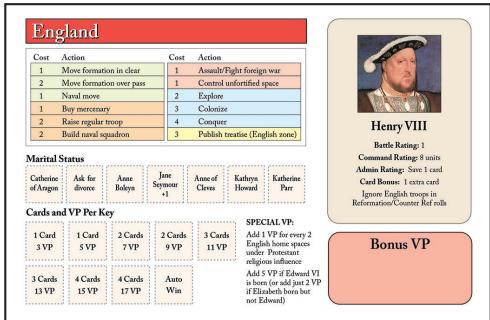
The status of each major power is tracked on a power card. Each of the 6 power cards contains the following sections:
• List of Actions (upper-left): A list of each possible action that this power can undertake during the Action Phase (Section 11), including the actions’ CP cost. The list of possible actions differs by power.
• Initial Ruler Card (upper-right): Attributes of the initial ruler for this power, as described in Section 3.3.
• Bonus VP Box (lower-right): This is a holding area for markers that show the player has gained bonus Victory Points (VP) for Voyages of Exploration, Voyages of Conquest, disgracing or burning enemy debaters, winning wars, controlling keys in Italy, completing Bible translations, and other special events.
The power card also contains customized information in the lower-left. Although the format of this section differs for each power, this section always shows how to determine the number of card draws for that power (before card bonuses are added) and the number of base VP (before special and bonus VP are added). For some powers this area also includes one or more special power-specific tracks, described in more detail in Sections 18 and 21.
5. MILITARY UNITS
There are three types of military units: leaders, land units, and naval units. This section shows an example of each military unit and explains the importance of any numeric values on the counter. The pieces provided are an absolute limit. No more may be created for any purpose; the number provided is indicative of the overall manpower and financial resources of each power during this period. Military units use the same color as the home spaces for each power.
5.1 Leaders

Leaders are placed in plastic stands so players can quickly determine their current location on the map. (Flat leader counters are also provided for those who prefer this alternative.) The numeric information

contained on the leader counter differs slightly for army and naval leaders. Naval leaders have a blue background for their counters that distinguishes them from army leaders.
Army Leader
Battle Rating: The top number on army leaders is their battle rating. Higher battle ratings increase the chance of successfully intercepting or avoiding battle, and add extra dice during assault and field battle.
Command Rating: The bottom number (always appearing in a yellow box) is the leader’s command rating. This number indicates the number of land units the leader can control at one time.
Formations
A formation is a group of land units in a single space that functions as a combined entity for the purposes of movement, field battle, intercept, and assault. One or more army leaders may also be included in the formation or even move without units. The maximum number of land units in a formation is dependent on the Command Rating of any leaders present:
Leaders Present Maximum Formation Size none 4 1 Command Rating of leader 2 or more Sum of highest two command ratings
Army leaders are never counted when determining the size of a formation. Formations may not include units from two different major powers. They may include units of a major power and a minor power which is actively allied to that major power.
FORMATION EXAMPLE: The Ottoman leaders Suleiman (command rating 12) and Ibrahim Pasha (command rating 6) are stacked in Buda with 12 regulars and 2 cavalry. The Ottoman spends 1 CP to move a formation to Pressburg. If the Ottoman includes neither leader with the formation, just 4 land units may move. If the Ottoman includes only 1 leader, the number of regulars and cavalry must be equal to or less than the command rating of that leader. The Ottoman player would have to move both leaders from the space in order to move all 14 land units from Buda.
Naval Leader
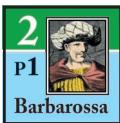
Battle Rating: The top number on naval leaders is their battle rating. Higher battle ratings increase the chance of successfully intercepting or avoiding battle, and add extra dice during naval combat.
Piracy Rating: The Ottoman naval leaders Barbarossa and Dragut possess a second numeric value. This number (after the “P”) is their piracy rating, indicating the number of extra dice the leader provides when present in a sea zone where the Ottoman is initiating piracy.
5.2 Land Units
There are three types of land units, all represented with circular pieces. Land unit pieces come in different “denominations” (1, 2, 4, and 6) to facilitate stacking. Not all denominations are available for every power. Players may free up small denomination units at any time by replacing several pieces (all of the same type and all in the same space) with a stronger piece of equal total strength. If, after freeing up small denomination units wherever possible across the board, a power still has an insufficient number of small denomination units to properly “make change” to satisfy a Combat or Event card result, that power loses additional units from the space where the combat or event is occurring until a number is reached that can be represented with the available counters.
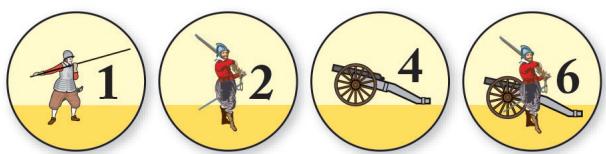
The four denominations of Hapsburg regulars
Regulars: Regulars have a multi-colored unit symbol and a dark stripe across the bottom of the counter in their power’s color. The numeric value on the counter shows the number of regulars represented by this game piece. All powers, both major and minor, have regulars.
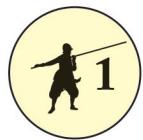
Mercenaries: Mercenaries have a solid black unit symbol. The background is a pale version of their power’s color. The numeric value on the counter shows the number of mercenaries represented by this game piece. All major powers except the Otto-
man receive mercenaries. Mercenary units can be found on the reverse side of regulars for these powers. Mercenaries are cheaper to construct than regulars, but may desert a player at a key moment.

Cavalry: Only the Ottoman player possesses cavalry units. The numeric value on the counter shows the number of cavalry units represented. Cavalry units can be found on the reverse side of Ottoman regulars. Cavalry aid in intercept and avoid battle
attempts, but are ineffective during siege operations.
5.3 Naval Units
Rectangular pieces are used to represent naval units. Each naval unit always represents a single squadron or corsair. There are no denominations of naval units.

Squadron: Naval squadron counters depict a vessel with white sails. The numeric value on the counter shows the number of dice it rolls in naval combat and the num-
ber of enemy hits required to eliminate it. The color around the number shows which power owns the squadron. All powers have naval squadrons, except the Protestants and Hungary/Bohemia.
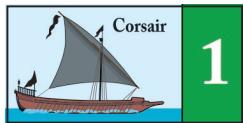
Corsair: Corsair counters depict a vessel with black sails. The numeric value on the counter shows the number of dice it rolls in naval combat and the number of enemy
hits required to eliminate it. Corsairs can be found on the reverse side of Ottoman naval squadrons. Only the Ottoman power receives Corsairs.
6. CARDS
The game play in Here I Stand is driven by a single deck of 110 cards. This section explains each of the different types of cards, and how to manage adding and removing cards from the deck.
6.1 Card Types
There are five types of cards in the game, as described below. With the exception of Mandatory Event cards, every card may be played as either an event, or as command points (CPs). CPs may be used to take actions (Section 11), or to declare war (Section 9.6). (When playing a Mandatory Event, the event takes effect first, then the active power receives 2 CPs to spend on actions.) If a player uses a card as an event, he or she follows the instructions printed on the card. Some cards have two alternate sets of instructions separated by the word “OR” in capital letters. These cards give the player an option of playing them two different ways. When playing a card with two sets of instructions, only the conditions and effects in the portion of the card chosen by the player apply.
Home Cards
Each power has a specific Home card (the Papacy has two) which starts every turn in their hand. Once used, Home Cards are placed on the appropriate power card (not in the discard pile) to show that they are not available until cards are dealt at the start of the next turn. A player may not pass during his impulse in the Action Phase if a Home Card is still in his hand. Home Cards can never be drawn from a power’s hand when a random draw or discard is required (either by Event card play, diplomatic agreement, or piracy), even if it is the last card in your hand.
Mandatory Event Cards
Cards with the name of the card in red and the word “Mandatory” printed on them are Mandatory Event cards. Mandatory Event must be played during the Action Phase of the turn in which they are drawn. When played, the event is always resolved first, then the playing power receives 2 command points to spend on actions. Mandatory events may never be held from one turn to the next. A player may not pass during his impulse in the Action Phase if a
Mandatory Event card is still in his hand. All Mandatory Events are removed from play after they occur, except Council of Trent and Master of Italy. These two Mandatory Events remain in the deck from turn to turn and may each occur numerous times. Mandatory Events can be drawn from a power’s hand when a random draw or discard is required; in this case the event is not triggered. Mandatory Events cannot be chosen when a player has his choice of card to be discarded (e.g. with the French Chateau table or the events Mercenaries Demand Pay, Sack of Rome, Spanish Inquisition, or Thomas More). If the owning player has his choice of discard and his options for discard consist only of Home Card(s) and Mandatory Events, skip the discard; all those cards remain in that player’s hand.
Response Cards
Cards with the name of the card in blue and the word “Response” printed on them are Response cards. Response cards are playable as an event in the Action Phase during any player’s impulse (including your own). Play of a Response card interrupts a player’s impulse, a battle, or an Event card play. Players should allow a reasonable amount of time for play of a Response card by another player after each action, event, naval combat, or assault. Response cards can also be played for CPs during a player’s impulse if a player does not wish to use the card’s special ability to interrupt another player.
Combat Cards
Cards with the name of the card in black and the word “Combat” printed on them are Combat cards. Combat cards are playable as an event only during a field battle, assault, or naval combat in which the card owner’s units are participating. The Combat card is played just before that battle is resolved. Combat cards can also be played for CPs during a player’s impulse if a player does not wish to use the card’s special ability to be played during combat.
Event Cards
All other cards in the deck are Event cards. The name of these cards appears in black, like Combat cards. These cards are played as events during the owning player’s impulse in the Action Phase. They may also be played for CPs during a player’s impulse if a player does not wish to use the card’s event. Three events (Augsburg Confession,

Printing Press, and Wartburg) have game effects that last until the end of the current game turn. A marker is provided in the counter mix for each of these events. Place the appropriate marker on the Turn Track when one of these three cards is played as an event, to remind players that this event is in effect. Three Event cards have special uses elsewhere as events in another phase. These special uses are as follows:
| Card Name | Other Phase Used | Phase too? |
| Diplomatic Marriage | Diplomacy | Yes |
| Spring Preparations | Spring Deployment | No |
| Venetian Informant | Spring Deployment | No |
Events with an entry of “Yes” in the “Action Phase too?” column may be played as events either in the Action Phase or this other phase. Spring Preparations and Venetian Informant are only playable as an event in the Spring Deployment phase (though they may be used for CP in the Diplomacy or Action Phases).
6.2 The Deck
The cards available to each power each turn consist of their Home card(s) and a variable number of cards dealt to that power from a single deck of shared cards. The deck is reshuffled each turn, after any new cards for that turn have been added, and before cards are dealt to each power.
Adding Cards
The upper-right hand corner of 42 cards contains a turn number or the word “Variable.” None of these cards are used on Turn 1.
Instead, at the start of the Card Draw Phase of Turn 3 and later turns, players review each of these cards to see if they should be added to the deck before new hands are dealt. These cards fall into three types:
• 36 of these cards show a turn number, with no further condition. These cards are always added to the deck in the indicated turn.
• 2 of these cards (#19 ‘Edward VI’ and #21 ‘Mary I’) show a turn number with a condition for play. These cards are added to the deck in the indicated turn only if the condition listed is true. If it is false, the card is set aside until the following turn. The card is added to the deck during the Card Draw Phase of the next turn in which the condition is satisfied. These cards may never be added to the deck before the indicated turn, even if the condition is satisfied.
• 4 of these cards read “Variable.” These cards are each added to the deck during the Card Draw Phase of the first turn in which the condition is satisfied.
Cards without a turn number or the word “Variable” start in the deck at the beginning of the game (Exception: In a scenario with the 1532 setup, cards marked with “(1517)” are not included.).
Dealing Cards
Each power is dealt the number of cards indicated in the lower left section of their power card plus one extra card if they receive a card bonus from their ruler. These newly dealt cards are combined with the power’s Home card(s) and any unused cards from the previous turn to form the power’s “hand” for the upcoming turn. The base number of cards dealt falls into two cases:
| 1 Luther's 95 Theses Phase (Turn 1 only) The Protestant player plays the Luther's 95 Theses Mandatory Event card ... 18.1 |
| 2 Card Draw Phase Add debaters, reformers, leaders ... 8.2 Add new cards to the deck |
| Roll for New World riches . 20.4 Shuffle deck and deal cards .. 6.2 |
| 3 Diplomacy Phase (Limited on Turn 1) Negotiation Segment 9.1 Hold negotiations and announce deals |
| Peace Segment (Not on final turn) 9.3 Sue for peace if at war |
| Ransom Segment . 9.4 Pay ransom (1 card draw) to regain captured army leader |
| Excommunication Segment ... 9.5 Give up a card draw to remove Excommunication |
| on ruler War Segment ... 9.6 Pay to declare new wars |
| 4 Diet of Worms Phase (Turn 1 only) ... 18.1 Hapsburg, Papacy, and Protestant play 1 card each and resolve Diet of Worms |
| 5 Spring Deployment Phase 10 Powers move one formation of land units from |
| capital to a controlled space 6 Action Phase ... 11 Powers take impulses in this order until all |
-
All powers except Protestant: Number of cards is determined by the number of square control markers on the board. The last uncovered square in the “Cards and VP Per Key” section shows the number of cards dealt to that power. Squares on a power card can also be covered by Unrest markers (Section 12.4), further reducing the power’s card deal. If all spaces are covered, that power still receives 1 base card.
-
Protestant: Number of cards is based on the number of electorates under Protestant political control (5 cards if 4 or more electorates are under Protestant political control; 4 cards if 3 or fewer are controlled).
Powers then receive an extra card (above the base cards) if their current ruler has a Card Bonus. They also receive one less card for each “–1 Card” marker on their power card.
CARD DEAL EXAMPLES
1: Luther is the Protestant ruler; the Protestant power has political control of 3 electorates. Receive: 4 cards
2: Francis I is the French ruler; the French power has control of 8 keys. Receive: 4 (keys) + 1 (bonus) = 5 cards.
3: Suleiman rules the Ottomans. The Ottomans control 7 keys, 2 of which are in unrest. Receive: 4 cards.
Discard Pile & Cards Out of Play
After a card is played, it is either removed from the game or placed in a single discard pile shared by all players:
Out of Play: Cards are removed from the game if they are played as an event and the text “Remove from deck if played as event” or “Remove from deck after play” appears on the card. Cards that may be removed from the deck are marked with a red dagger after the title.
Discard Pile: Cards are always placed in the discard pile if they lack the text “Remove from deck...” Event cards with this text are also placed in the discard pile if they are played for CP, rather than as an event. Two of the cards in the game (Here I Stand and Papal Inquisition) can be exchanged for a card selected from those currently in the discard pile. There are a few restrictions on these retrievals from the discard pile:
• Mandatory Events may never be retrieved from the discard pile, and
• A power may never retrieve a card from the discard pile that this same power played as an Event, Response or Combat card earlier in the turn. (Likewise, the Protestant may not use the card Frederick the Wise to retrieve Wartburg from the discard pile if he already played it a Response this turn.)
The contents of the discard pile (and any card retrieved from it) are public knowledge at all times.
All cards in the discard pile are reincorporated back into the deck during the Card Draw Phase at the start of each turn. These cards are combined with (a) the cards that were not dealt during the previous turn, and (b) the new cards entering play to form the deck for the upcoming turn.
7. SEQUENCE OF PLAY
The game is played in nine turns or fewer. The first turn represents the period from 1517 to 1523. Each subsequent turn covers a fouryear period. Each turn consists of nine phases. The sixth phase, the Action Phase, is the most time-consuming phase, for it includes a variable number of rounds where each major power plays one card. Each such card play is called an “impulse”. Players use the final phase, the Victory Determination Phase, to decide if a winner can be declared (or if another turn is required).
The first and fourth phases only occur on Turn 1. The third (Diplomacy) phase is greatly abbreviated on that first turn as well. On that turn:
• The English player holds a negotiation with the French or Hapsburg player (his choice).
• The English player holds a negotiation with the other player (not chosen in the step above).
• The English player announces any deal(s) he has accepted from the Hapsburgs. If the Hapsburg player confirms a deal (see 9.1), it takes effect immediately.
• The English player announces any deal(s) he has accepted from France. If the French player confirms a deal (see 9.1), it takes effect immediately.
A summary of the sequence of play can be found below (and a detailed sequence of play appears on the Sequence of Play reference card):
# Phase
Section
powers pass consecutively: Ottoman, Hapsburgs, England, France, Papacy, and Protestant. A Military or Religious victory may end the game.
7 Winter Phase ... 19 Leaders and units return to fortified spaces, possibly suffering attrition Add 1 regular to each controlled capital Resolve specific Mandatory Events if they have not been played
8 New World Phase ....... 20 Resolve Voyages of Exploration Resolve Voyages of Conquest
9 Victory Determination Phase ..... 23 Check for winner. If none, advance turn marker and start a new turn.
8. STARTING A TURN
Starting with this section (and continuing to Section 20), the rules are presented in Sequence of Play order. This section describes the start of a turn.
8.1 Turn 1
On the first turn of the game, play begins with the Luther’s 95 Theses Phase. The Protestant player plays the Luther’s 95 Theses card as described in Section 18.1 to initiate the reforms of the Catholic Church. This phase is skipped on all subsequent turns.
8.2 Card Draw Phase
The second phase is the Card Draw Phase. On each turn, players add leaders, debaters and reformers; add new cards to the deck; and deal cards during this phase.
Add Leaders

The Protestant army leader Maurice of Saxony is placed on the map at the start of Turn 6. Maurice is the only army leader that doesn’t either start the game on the map or enter via a Mandatory Event. Place Maurice in te under Protestant political control.
Naval leaders eliminated from play are also brought back during the Card Draw Phase. Place them in a friendly port if possible. If no friendly port exists, they remain on the Turn Track for another turn. Naval units eliminated in a previous turn are also returned to each power’s pool of units available to be constructed at this time.
Add Reformers
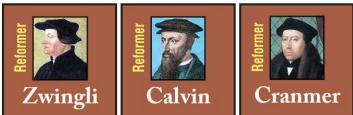
The reformers Zwingli, Calvin, and Cranmer are placed on the map. Reformers provide bonuses to the Protestant player
during religious actions attempted in or adjacent to their space. The turn that Cranmer enters varies based on the timing of Henry VIII’s divorce proceedings. Place Cranmer on the map on the first turn after Henry has married Anne Boleyn. The complete information on the entry of reformers is shown in this table:
| Figure | Space | Turn of Entry (Phase) |
| Luther | Wittenberg | 1 (Luther's 95 Theses Phase) |
| Zwingli | Zürich | 2 (Card Draw Phase) |
| Calvin | Geneva | 4 (Card Draw Phase) |
| Cranmer | London | Turn after Henry VIII marries Anne Boleyn (Card Draw Phase) |
Convert the religious influence of the space where a reformer enters to Protestant religious influence. Reformers may not move from their starting space at any time during the game. They are completely immobile. They may temporarily be removed from the map due to play of the card Calvin Expelled or through Excommunication (Section 21.5). Reformers temporarily removed from the map reenter play in the same space during the Card Draw Phase at the start of the next turn. The religious influence of a space does NOT change when a reformer reenters play. Reformers are never affected by the presence of land units or by changes in the political control and religious influence of spaces.
NOTE: Zwingli is permanently removed from play by the event Zwingli Dons Armor. He never reenters play.
Add Debaters

Debaters represent the Protestant and Papal (Catholic) points of view during Theological Debates. The Protestant player starts the game with four German-speaking debaters. During the course of the
game, additional Protestant debaters enter play during the Card Draw Phase, both for the German language zone and the English and French language zones. The Papacy starts with five debaters and adds more during play. Papal debaters may participate in debates in any language zone; they are not partitioned by language like their Protestant adversaries.
The number in the middle of the debater counter (on both sides) is their debate value. Text describing the debater’s special bonus appears on the front side of the counter against a white background. Each debater also has a reverse side with a gray background that includes their picture. A debater is flipped to this reverse side when “committed” to a particular activity for that turn. Commitment makes that debater more vulnerable to Theological Debates called by the opposing religious power. The turn of entry is also printed on the back of the debater’s counter. Debaters are placed on the Religious Struggle Card in the appropriate box of available debaters, with their front side up, when they enter the game. Note that the English debaters Cranmer, Coverdale and Latimer may not be added if the reformer Cranmer is not in play. In such a case, these three English debaters are delayed until the turn in which Cranmer does appear.
Add New Cards to Deck/Deal Cards
If this is Turn 3 or later, new cards may be added to the deck. Cards are then dealt to each power as described in Section 6.2.
9. DIPLOMACY
The third phase of each turn is the Diplomacy Phase. On the first turn, the Diplomacy Phase is abbreviated, with the English player holding negotiations with two other players (Section 7). Players may wish to skip this section when first learning the game since most of these rules do not apply until Turn 2.
9.1 Negotiations
The first segment of the Diplomacy Phase allows players to conduct secret negotiations away from the game board with one or more opponents. Several such discussions can occur during the Negotiation Segment of a single turn. This portion of the turn is the only time players may make deals in private; all other discussions must take place in the presence of all players. Players are free to discuss general strategic considerations during negotiations. Cards in your hand may be revealed to other players if desired. Players may also make a limited set of agreements that alter the position of units, leaders, cards or markers in play. Such a change is considered to be a “change in the current game state.” The only agreements allowed that change the game state are:
• Two powers may agree to end a war they are fighting. End the war as described in Step 8 of the Peace Segment Procedure (Section 9.3). Exception: The Protestant may never end wars with the Hapsburgs and Papacy that were triggered by the Schmalkaldic League Mandatory Event. War Winner VP are not awarded when a war is ended in this fashion (i.e. by mutual agreement; this way of ending a war is commonly known as a “white peace”).
• Two powers may form an alliance for exactly one turn (Section 9.2), but not if they are currently at war and are not agreeing to end that war (see above).
• A power entering an alliance may loan naval squadrons and naval leaders to the other power in that same alliance for one turn (Section 9.2).
• A captured army leader may be returned. Place that army leader in his capital if possible. If not, place him in a friendly home key.
• A power may yield political control of spaces it controls (even keys and electorates) to another major power. Any units occupying these spaces are displaced (12.5). Such a space may only by ceded if it is either:
(a) a home space for either the power giving up the space or the power receiving it,
(b) printed on the map as an independent (gray) space, or
(c) a minor power home space that is being ceded to its major power ally.
One additional restriction is that you can never yield control of your own capital. You can yield control of another power’s capital (for instance if you have conquered it and want to trade it back to that power).
• A power may agree to give another power up to two random card draws from their hand. Such a card must always be chosen at random; players can not exchange specific cards. Two players may not give each other card draws in the same turn; such an exchange can only occur in one direction on a given turn. (Remember that Home cards are ignored when drawing randomly from a player’s hand.)
• A power may agree to give another power (other than the Ottoman) up to four mercenaries. The power removes the specified number of mercenaries from any single space or combination of spaces. The power receiving the mercenaries then places the equivalent number of mercenaries from his force pool on the map. If the receiving power is the Hapsburgs, England, France or the Papacy, these mercenaries are placed in his capital (which must be controlled for this exchange to take place); if the receiving power is the Protestant, they are placed in any single controlled electorate (Protestant’s choice). Two players may not give each other mercenaries in the same turn; such an exchange can only occur in one direction on a given turn.
• If the “Henry’s Marital Status” marker is on the “Ask for Divorce” space, the Papacy may agree to grant the divorce to the English power. If such an agreement occurs, the English player moves the marker to the “Anne Boleyn” space and rolls immediately on the Pregnancy Chart as described in 21.3. The English player may roll again during the Action Phase of this turn if they want to play the Six Wives of Henry VIII Home card as an event to advance this marker to Jane Seymour. The Papacy is not allowed to ally with the Hapsburgs this turn.
• The Papacy may agree to rescind excommunication on a ruler (Section 21.5). Remove the “–1 Card” marker from that power card.
Players should agree to a time limit for the Negotiation Segment before discussions begin. Suggested limits are:
• 10 minutes in face-to-face play
• 48 hours in email play
When this time limit is reached (or discussions have ended), each power (in Impulse Order) declares any agreements it has made that will result in a change in the game state. Announcements can be made as individual items, or as a group of agreements that need to be ratified together. The earlier power in Impulse Order must propose the agreement; then the power involved that follows later in Impulse Order must confirm all the contents of this declaration when it is their turn in the Impulse Order. If they do not confirm the full deal, NONE of the items in the agreement take effect. If the agreement is confirmed, the players immediately change the game state by updating diplomatic status, marking and moving loaned naval squadrons, returning army leaders, changing political control of spaces, drawing random cards, and exchanging mercenaries.
Non-Binding Agreements
The only portion of an agreement that is binding between powers is the portion that changes the current game state. Since items such as a diplomatic action on a future turn, a promised card play, or a coordinated movement of troops can’t be executed at this time, they do not change the current game state and are examples of a non-binding portion of an agreement. Non-binding agreements can be made at any time between players but they are never announced and there is never any repercussion within the game mechanics for breaking them (though there might be some repercussions at your gaming table!).
9.2 Alliances
Alliances are agreements between two major powers to cooperate for one turn. Alliances must be announced to all players at the end of the Negotiation Segment. A single power may be part of more than one alliance in the same turn. Two or more powers each in
Negotiation Example
1: It is Turn 4 of the game. At this time, the Ottoman player has no interest in negotiating. The Hapsburg player, on the other hand, is trying to convince the French and Papal players to each ally with him to drive the Ottoman navy from the Mediterranean. He requests a simultaneous negotiation with both of those powers. Of the remaining players, only the English want to initiate another negotiation (with the Protestant).
2: Since the two negotiations involve different sets of players, they are held simultaneously. France, the Hapsburgs, and the Papacy confer; both the French and Papacy agree to ally with the Hapsburgs for the turn. All French and Papal naval squadrons are loaned to the Hapsburg. In return, the Hapsburg player gives the space of Besancon to France and a random card draw to the Papacy. In the other negotiation, the English player offers to play Book of Common Prayer and Calvin’s Institutes (both in his hand) as events to spur on the Reformation. All he asks in return is that the Protestant push forward with the Reformation in England with all possible haste.
3: The Hapsburg player announces his two alliances, the loan of naval squadrons, and the transfer of Besancon. The French and Papal players each in turn confirm this deal as announced by the Hapsburg. The English and Protestant do nothing during this step; they did come to a consensus on the strategic considerations they discussed, but they never made an agreement that changes the current game state.
4: Ally markers are placed in the two relevant boxes of the Diplomatic Status Display. Markers are placed on the loaned French and Papal squadrons. Each loaned squadron is transferred to the nearest Hapsburg port. Besancon becomes French; Hapsburg troops there are moved to Antwerp. The Papacy draws a card at random from the Hapsburg hand (excluding the Hapsburg home card).
alliance with the same power need not be allied with each other. The restrictions on creating an alliance and the effects of forming one are detailed below.
Restrictions
• An alliance may not be created if the two powers are currently at war.
• The Papacy and Ottomans may never become allies.
• The Papacy may not ally with the Hapsburgs if they granted a divorce to Henry VIII this turn.
Effects
An alliance provides these benefits:
• Spaces controlled by either power become friendly to both powers. This means that land units may enter spaces controlled by their ally during movement and retreat.
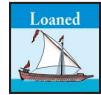
Naval squadrons (but not corsairs) may be loaned to an ally for 1 turn. Such a loan must be announced at the same time as the alliance; naval squadrons may
not be loaned later in the turn. Two players may not loan each other squadrons in the same turn; such an exchange can only occur in one direction on a given turn. Place one of the receiving powers’ “Loaned” markers on each squadron received. Then move the loaned squadron to the nearest port controlled by the receiving power, counting each sea zone traversed as 1 space along such a path. A loaned naval squadron is treated just like any other naval unit of the receiving power (it moves, fights, retreats, and intercepts as if it was one of that power’s naval units). The naval squadrons stacked in a single port do not need to be loaned as a complete group. A naval leader stacked with the on-loan squadrons may also be loaned to the allied power. Naval units may never be loaned to the Protestant power. Naval units may not be loaned unless there is a path of sea zones connecting their current port with a port of the receiving power. This path may not include a port space (such as Gibraltar).
• If a stack of land units from two major powers is attacked, they combine their units and army leaders into one defensive force. Either power may retreat their units and/or leaders from the space (with each power making a separate Avoid Battle roll). If units from two major powers defend together, battle and assault losses are split evenly between the powers until a power is eliminated; roll randomly to see who suffers any odd loss.
Add an “Allied” marker to the space that serves as a cross-reference between these powers on the Diplomatic Status Display. The alliance is always terminated at the end of the turn. Alliances do not allow land units from the two powers to move, conduct sieges, assault, intercept, or avoid battle together. Furthermore, Alliances do not create a new state of war with any third party power (i.e. a power does not add an “At War” marker with its new ally’s enemies). However, as described above, all allied units will add to the defense of a space even if only one of the defending powers is at war with the attacker.
9.3 Suing for Peace
The second segment of the Diplomacy Phase allows powers to sue for peace if they find themselves in an unfavourable position in a war and were not able to convince the other power to make peace during the Negotiation Segment. This phase is skipped in the final turn of the game (usually Turn 9, but Turn 6 in the tournament scenario). The procedure for this Peace Segment is as follows:
Peace Segment Procedure
- Announce Peace Request: Each power, in Impulse Order (Section 3.2), announces whether or not it would like to sue for peace to end one of the wars it is currently fighting. A power may not sue for peace unless it has had an army leader or home space (fortified or unfortified) captured by the other power in the conflict. The power suing for peace may not have ceded one of their home spaces to the other power during the Negotiation Segment of this turn. The Hapsburgs and the Papacy may not sue for peace with the Protestant (and vice versa). When suing for peace, execute Steps 2-8 below to arrive at peace terms for this war. Then return to this step to consider suing for peace in other conflicts.
War 2. Award VPs: The other power in this conflict is declared Winner the winner. Add a “War Winner 1VP” marker to the 1VP bonus VP box on their power card. If the Ottoman was one of the powers involved in the war, the winner receives an extra “War Winner 1 VP” marker in this step (for a total of two such markers).
-
Give Up Control: The losing power gives up control of all of the winning power’s home spaces that the loser currently controls. Units in these spaces are displaced (12.5).
-
Remove Units: The losing power removes 2 units (land or naval) of his choice from the map. Units removed must be from his own power (allied units are not eligible).
-
Regain Home Keys: The losing power then decides if it wants to regain political control of any home keys currently controlled by the winning power. If so, the losing power must give the winner one of the following items for each key recovered:
• another “War Winner 1VP” marker, or
• a random card draw from the loser’s current hand.
Any units occupying these spaces are displaced to the nearest fortified space controlled by their power, or its capital, using the process described in Step 3 above.
-
Regain Captured Leaders: The losing power then decides if it wants to regain an army leader captured by the winning power. If so, the losing power gives the winning power a VP marker or random card draw for each army leader regained. Place the army leader in his capital if possible; if not, place him in a friendly home key (losing player’s choice).
-
Regain Non-Key Spaces: The losing power then decides if it wants to regain political control of any number of sets of two nonkey home spaces currently controlled by the winning power. If so, the losing power gives the winning power a VP marker or random card draw for each set of spaces recovered (an odd number of spaces may be recovered, in this case one full VP marker or card draw is granted for that final space).
-
Adjust Diplomatic Status Display: End the war by removing the “At War” marker from the appropriate box on the Diplomatic Status Display. If the Papacy makes peace wi
Content is long; only the first part is inlined. Download the file or open the rules page for the full text.
Download MarkdownTexts are community-compiled or publicly released by publishers; copyright remains with the original authors. For personal reference only.