
Innovation
At a glance
Rules, cards and Q&A (Chinese)
The rules, card data and player questions for this game are written in Chinese. Open the Chinese page to read them.
Where to find full rules
Full rules and card lookup are available in the cunlema app at cunlema.cn — pick this game and ask about any rule, card or turn you are unsure about.
Related games
Rulebook text (Markdown)
This game has 1 rulebook Markdown file(s) in our library; 1 rendered inline below — expand to read or download.
INOV_Rules_EN_Eco v1.2.md18.2 KB



TYPE OF DOGMA and REQUIRED ICONS
CONTENTS
• 4 Gaming boards / Rules summaries
• 105 Innovation cards (21 per color)
• 5 Influence Domain cards
• 1 Rulebook
- GAME MECHANICS
Innovation is a tactical management game in which you are the leader of a civilization. Your role is to develop your civilization by acquiring Innovations which represent fundamental discoveries related to the ten great periods in History.
Innovation cards are grouped in five colors and enable you to increase your gaming options and to provide you with icons to increase your strength and resistance.
During the game, you accumulate these cards in your Zone in piles, one per color, so as to make up a maximum of five piles (as many piles as colors. See p7).
Each card has one or more Dogmas. They represent the ideology of your civilization at a given time. There are two kinds of Dogmas, the Cooperative Dogmas from which players who have at least as many of the required icons as you benefit, and Supremacy Dogmas that serve to force your demands on weaker civilizations (those that have fewer icons). Activate these Dogmas to lead your civilization forward more quickly than your opponents theirs.
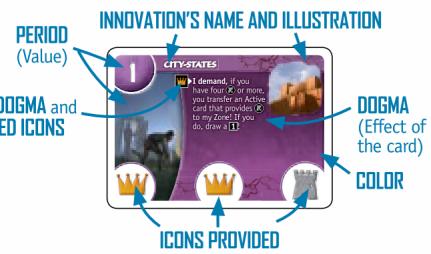
Although no more than five cards can be Active at the same time, cards underneath can be splayed by these Dogmas so they may increase the number of icons you have. Icons enhance the power and resilience of your civilization. They make it possible for you to benefit from your opponents' Innovations, to boost your attacks and to protect yourself from those of your opponents.
Finally, some Dogmas will enable you to win the necessary Influence points to Dominate Periods. It is an important factor as there are in fact three ways of winning the game: one is being the first to dominate a specific number of Periods and/or Domains; another is having the most Influence points at the end of the game; and last is meeting the Dogma conditions of some cards. 1
Set Up
Shuffle the cards by Period and make 10 draw piles that you place as illustrated. Draw the first card from Periods 1 through 9 without looking at them and place them in the center to represent the Periods to be dominated. Place the Domains to the side. Each player then takes a gaming board, draws 2 cards from Period 1, chooses one that is put in play face up, and keeps the other in hand without revealing it.
The first player is the one whose Innovation in play is the first in alphabetical order. The first player (or the first two in a four player game) gets only one action on the first turn.
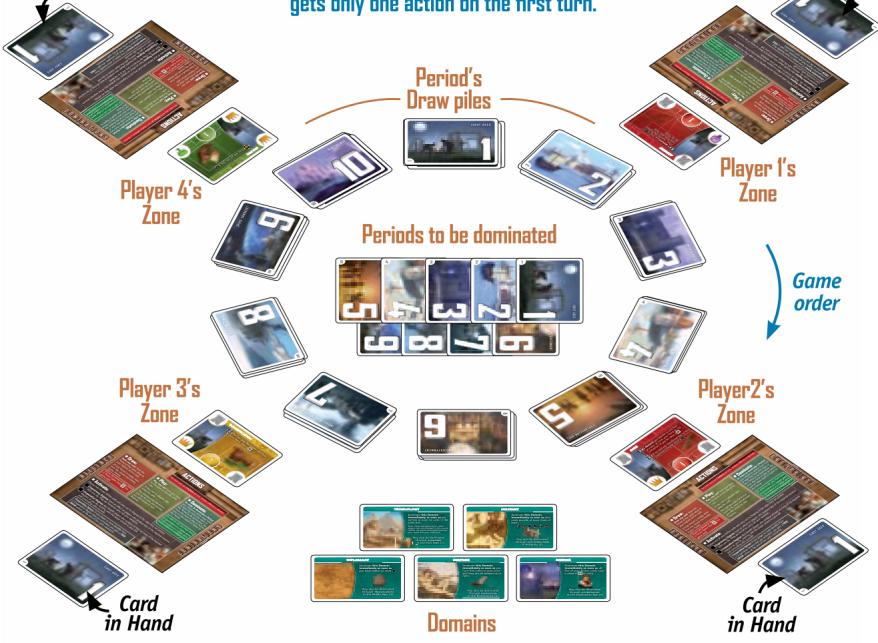
GAME MECHANICS
Prepare the game as illustrated. When it is a player's turn, that player must carry out two Actions, whether different or identical, among the following:
Draw

Play
Activate
Dominate
Then it is the turn of the next player, clockwise.
Note: always let the other players know how many cards you have in Hand and what their value is.
ACTIVE CARD
An Active Card is the visible card in play that is on top of any of your color piles.
ACTIONS
DRAW (Researching an Innovation) Draw a card from the same period as the value of your highest Active card.
Note: there is no limit to the number of cards you may have in Hand.
If you have no cards in play, draw your cards from Period 1.
If the Period from which you must draw is empty, draw from the next higher non-empty Period.
Example: your highest Innovation is a 4 and Periods 4, 5 and 6 are empty. You must draw your card from Period 7.
When you use the Draw action, you cannot draw from a Period lower than your highest Active card.
PLAY (Discover an Innovation) Choose a card from your Hand and put it in play in your Žone on the top of the pile of the same color.
If that color is not in play, start a new pile.
If the pile is already splayed, place the card so as to continue splaying (see p.8).
You can put in play a card of any value. Example: you can give up Genetics (9) by covering it with Pottery (1).
ACTIVATE: activate the Dogmas on one of your Active cards. These are the core mechanics of the game: Dogmas represent the orientation that your civilization has chosen to follow.
- Choose one of your Active cards.
- Identify affected players:
Each Dogma is tagged with an icon that sets its type ()and the required Icon ( Q ).
Players add up their icons similar to the required one to determine whether they will benefit from the Dogma, or be subject to its effects, depending on its type.
- Resolve the Dogmas, one after the other. If a card has several Dogmas, every player affected by the first Dogma goes through its effects before moving on to the next.
Note: it is possible to use your two Actions to activate the same card twice.
DOMINATE: this is one of the ways to win! In order to dominate a Period, you must meet two conditions:
- your Influence points total must be at least five times the value of the Period you wish to dominate,
- and, the value of one of your Active cards must be equal or higher to the Period you wish to dominate.
Example: in order to dominate Period 3, you must have 3 x 5 = 15 Influence points and an Active card of value 3 or higher.
If you meet these two conditions, use the action to take the corresponding Period to be dominated and archive it under Dominations to the right of your Gaming Board, without looking at it.
You do not spend any Influence points. You can never lose any of your dominated Periods and they cannot be stolen.
Note: you must never look at the Innovations of Periods to be dominated, even after having dominated them.
Domains are dominated without using Actions (see p.5).
TYPES OF DOGMAS
There are two types of Dogmas, identified by the icon on the left that introduces its effect and indicates the required icon in order to be affected by it.
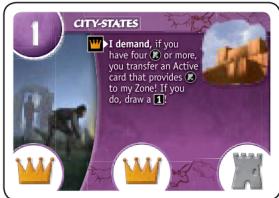
SUPREMACY DOGMAS
These Dogmas are preceded by this symbol () and begin with I demand....
These are aggressive Dogmas from which only you will benefit.
Affected players: players who have fewer of the required icons than you do.
Effect: you must read the Dogma out loud and affected players have to comply, clockwise, starting with the player to your left.
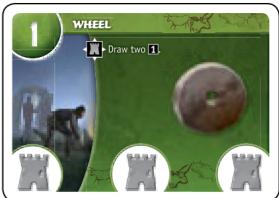
COOPERATIVE DOGMAS
These Dogmas are preceded by this symbol ()and can be shared with other players.
Affected players: players who have as least as many of the required icons as you do.
Effect: affected players carry out the Dogma before you, one after the other, clockwise, starting with the player to your left and closing with you.
Cooperation Bonus: if at least one other player benefits from your Cooperative Dogmas, you gain a free Draw action at the end of the card's resolution (and only one, whatever the number of players).
ADDITIONAL INFORMATION ON DOGMAS - all Dogma effects must be fully carried out, by every affected player, even if the card is covered or lost during execution.
- An affected player cannot decide not to carry out a Dogma unless the beginning of the text specifies « you may », even if it is a Cooperative Dogma!
- In order to gain the Cooperation Bonus, a player is considered as benefiting from a Cooperative Dogma if the effect has caused a modification in the game.
Example: if a Cooperative Dogma requests that a card be put in play and the player has none, then nothing happens and he is not considered as having benefitted from the Dogma effect, so you do not gain the bonus.
-DOMAINS
In addition to the Periods to be dominated, displayed at the center of the circle, you can also dominate five Domains.
Your civilization can dominate these Domains separately from your Influence points and without using actions.
These dominations are automatic and immediate as soon as a player meets the requirements given on the card.
The dominated Domains are archived under Dominations to the right of the game board and are counted as Dominations towards victory. Similarly to Periods, Domains can never be stolen or lost.
Each of these Domains can also be dominated earlier in the game by activating the Dogma of its specific Innovation card. This card is indicated on each Domain.
- END OF THE GAME
VICTORY THROUGH DOMINATION: the game immediately ends when a player dominates a specific number of Periods or Domains, depending on the number of players:
2-player game: 6 Dominations
3-player game: 5 Dominations
4-player game: 4 Dominations
There are two other cases in which the game can end:
VICTORY THROUGH INFLUENCE: the game immediately ends when a player must draw a card from a Period higher
Caution: this Dogma is a Cooperative one and you will be last to act, so make sure another player does not collect the Domain by benefitting from the Dogma before you.
If two players meet the requirement simultaneously (for instance by exchanging cards), the Active player gets the Domain (if one of the two players above), or else the closest player to his left.

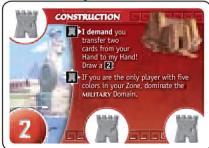
You can
dominate the
Military Domain as soon as
you produce
3 Resources
of each
or
by activating
the Construction Innovation.
than(which may occur_for example when a player must draw a 10and there isn't any) or when a Dogma effect says “the game ends".
The winner is the player with the most Influence points. In case of a tie, the player with the most Dominations wins. If there is still a tie, the victory is shared.
VICTORY THROUGH DOGMA: the game immediately ends when a player activates a Dogma effect that declares a
winner provided some conditions are met.
The corresponding Innovations are in Periods 8, 9 and 10.

-LEXICON
• Put in play/play: put a card on the top of the pile of same color, or create a new pile if the color is not yet represented in your Zone.
• Active: the Active card is the one face up on top of a color pile; a card splayed underneath the top card is not an Active card.
• Bottom: the bottom card is the card that is at the very bottom of a pile, whether the pile is splayed or not. If a pile has a single card, this card is also considered as being the Active card.
• Higher/Lower: compared to the value of a Period. All the highest/All the lowest cards means all the cards of the highest/lowest value.
If you have two7and threein Hand. Transfer all your highest cards from Hand means you have to transfer your two 7. While transfer the three highest cards means you have to transfer your two7 and one5.
• Value: a card's value is equal to its Period. It is printed on both sides of the card. If a card refers to a value that you do not have (for example: the highest card in your Hand although you have no more cards, or the Active card of a color you do not have), consider the value as equal to 0. Higher/Lower refer to this value.
• Influence: your Influence is the total value of all your cards in your Influence to the left of your gaming board.
-DOGMA EFFECTS
• Archive: archiving a card is putting it at the bottom of the pile of same color, also splaying it if the pile is already splayed. If there is no pile of the card's color, it starts a new one.
• Discard: remove from the game.
If the first Dogma effect of the Fission Innovation succeeds, it forces everyone to discard every card in Hand, Zone and Inlfuence, which means removing them from the game and putting them back in the box. Dominations stay and the players have to manage with what few cards are left to draw.
• Draw and...: usually, draw one card and put it in your Hand, unless the Dogma tells you to do something else with the card.
When a Dogma asks you to “draw and play", “to draw and archive", or “to draw and score" in every case the card to be played, scored or archived is the one you just drew. You cannot replace it with a card from your Hand.
Keep in mind when you are supposed to draw from an empty Period that you draw instead from the next higher nonempty Period.
• Exchange: give a card and receive one. The exchange can take place even if one of the players has nothing to exchange.
• Recycle: a recycled card is placed beneath the pile of the corresponding period, face down. If you must recycle several cards at once, choose the order.
• Score: slip a card under your board on the left side in your Influence.
• Splay: to splay a pile, slide your cards in the direction splayed in order to reveal the first icons on all the cards beneath the Active card.
In the gaming example here, yellow is splayed up, purple is splayed right and red is splayed left. Blue and green are not splayed.
A pile can only be splayed in a single direction. When you must change direction, realign the pile then splay the cards in the new direction.
When a pile is splayed, all the cards in it must be splayed. When you archive a card on its bottom or put a card in play on top, you keep splaying.
When a pile is down to one card or less, the splaying is automatically cancelled.
• Transfer: when several cards must be transferred and you do not have enough, you must transfer as many as you can.
When a transfer indicates the specific value of the card to be transferred and you do not have any of that value, there is no transfer.
If a Dogma requests that a be transferred from a player's Influence. If there are none, awill not be transferred instead.
LEGENDS
Supremacy Dogma
Card from Period X, for example, a10 is a card from Period 10
A card transferred to a player's Zone is put on top of the pile of same color, unless the Dogma says otherwise.
• Victory Dogma: some cards state "the player with... wins immediately". If no player meets the requirements (for example, the requirement for Artificial Intelligence if several players have 0 points)), the Dogma is ignored and the game goes on.
• Without sharing: when there is this sentence, the other players cannot benefit from the Dogma. However, they can still be targeted by it.
EXAMPLE OF A PLAYER'S GAMING AREA
You can always look at your covered cards, but never at your opponents'
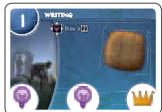

ACTIVE CARDS Perspective (yellow), Feudalism (purple) Gunpowder (red) Navigation (green) Writing (blue)


Yellow pile splayed up
The blue and green piles are not splayed
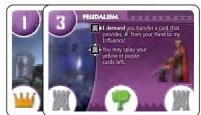
Purple pile splayed right
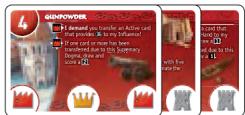
Red pile splayed left
INFLUENCE
Slip scored cards here to increase your Influence by leaving their value visible.
You can always look at the Innovations of your Influence cards.
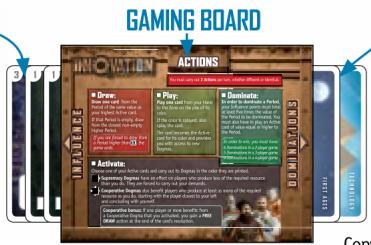
DOMINATIONS
Slip dominated Periods and Domains here.
You can never look at the Innovation of a dominated Period.
EXAMPLE OF A PLAYER'S TURN
This is a 4-player game and and it is Andre's turn. He has 2 piles in his Zone:

His cards provide him 3, 2, 1, 1. As his first Action, he decides to Activate Banking system.
The required icon is.
- The first Dogma is a Supremacy Dogma. As Bill has less than Andre, he is the only player affected and must transfer one of his Active non-green cards that provides to Andre's Zone. He decides to transfer Chemistry, which ends up covering Evolution,splayed:

Then, as Bill transferred a card, he draws a 5 and scores it.
-CREDITS
AUTHOR: Carl Chudyk
ILLUSTRATIONS:
• Cyril van der Haegen - Couver
• Robin Olausson - Periods & Domains
• Christophe Swal - Innovations
US PLAYTESTERS: Chris Cieslik (thank you so much!), Jessica Maryott, Brian Tobia, Matt Murphy, John Brodin, Kevin Lundberg, Doug Orleans, Ted Vessenes, Rebecca Vessenes, Eruc Reus, The MIT SGS and the visitors of KurisuCon.
PUBLISHER: Iello
Line managers: Cédric Barbé and Patrice Boulet Project manager: Thibaud Gruel Assistant manager: Gabriel Durnerin - The second Dogma is a Cooperative Dogma, Charles has as many as Andre, and Dominic has more. They can both benefit from the Dogma. Charles, the first player to Andre's left, decides to splay his green cards right. Then it is Dominic's turn but he has no green cards so cannot benefit from the Dogma. Finally, Andre decides to splay his green cards right:

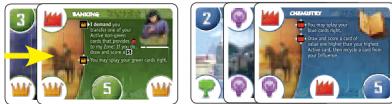
At the end of the card's resolution, as at least one player (in this case Charles) benefitted from his Cooperative Dogma, Andre draws a free card of the same value as his highest Active card, a.
Andre has 3, 3, 3, 1.
As a 2nd Action, he decides to Draw one Innovation and must therefore draw a But the draw pile fors is empty so he draws from the next higher non-empty Period, a6.
PACKAGER: Origames
(Design, layout and development)
Development manager: Guillaume Gille-Naves

Art director: Igor Polouchine
Translation & correction: Giles Maurice and Alienoïds
Test and problem solving team FR: Rodolphe Gilbart, Reyda Seddiki, Igor Polouchine. Sincere thanks to Philippe Longa, Fréderic Vasseur and Yann Wenz.
©2011 Iello. All rights reserved.
IELLO
309 BD DES TECHNOLOGIES
54710 LUDRES - FRANCE
www.iello.info
Texts are community-compiled or publicly released by publishers; copyright remains with the original authors. For personal reference only.