
Qwinto
At a glance
Rules, cards and Q&A (Chinese)
The rules, card data and player questions for this game are written in Chinese. Open the Chinese page to read them.
Where to find full rules
Full rules and card lookup are available in the cunlema app at cunlema.cn — pick this game and ask about any rule, card or turn you are unsure about.
Related games
Rulebook text (Markdown)
This game has 1 rulebook Markdown file(s) in our library; 1 rendered inline below — expand to read or download.
Qwinto_PandaS_rule.md7.2 KB

Players try to write down as many numbers as possible in the three differently colored rows on their respective score sheet. If you manage to enter a number in all the fields of a colored row, you’ll score even more points for the row. There are also lucrative bonus points you can score for completing each field of a column made up of 3 fields.
Entering numbers
The order in which you enter the numbers in the colored rows is up to you. For example, you can first enter a number in the yellow row on the right, then in the middle of the purple row, and then on the left side in the purple row; then to the far right of the orange row, and then in the yellow row on the left side, and so one and so forth. When entering numbers you only have to follow these two rules:
1) Within a colored row (i.e. horizontally from left to right) the numbers must be in ascending order from left to right with the larger numbers to the right, and no number may appear more than once in the same row. You may have gaps of any size between the entered numbers in a row, which you can fill in later (with the right numbers).
2) Within a column (i.e. vertically from top to bottom) no number may appear more than once; the same goes for a 2-field column and a 3-field column. The order of the numbers in a column doesn’t matter.
Note: Each colored row has one missing field. Do not enter a number in this field. It stays empty and serves no further purpose. In each of the five columns consisting of 3 fields each there is one bonus field in the shape of a pentagon. If all three fields in the column are filled with numbers, you get the number in the bonus field as bonus points.
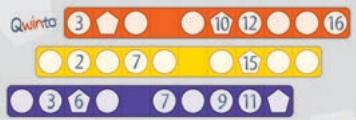
Tim has already entered numbers in some of the fields. In each colored row, the numbers get bigger as you move from left to right. Within the columns (2-field and 3-field columns) no number appears more than once. Everything is correct.
Note: In the yellow row, Tim can enter only the number 1 in the field furthest to the left. In the purple row, he can no longer enter a number between the 6 and 7. He is allowed to leave the field empty, but it will have to remain empty until the end. Tim has all three fields of two columns filled with numbers and has already recorded the bonus points from the corresponding bonus fields at the bottom of his score sheet.
How to play
Each player receives a score sheet and a pencil or pen. Note: Beginners should use a pencil so that they can easily erase any mistakes. Players can share a pencil if necessary. More experienced players can also use a pen.
Draw to see who goes first. On your turn, proceed as follows:
Decide how many dice you want to roll, whether 1, 2 or 3. You also get to decide (if you’ve decided to roll only 1 or 2 dice) which colored dice you would like to use. It is Linus’ turn. He decides to use two dice. He selects the purple and the yellow dice.
On your turn, roll the die or dice. If you’re satisfied with your roll, you don’t must make a second attempt. However, if you’re not satisfied with what you have rolled, you have to roll all the dice that you rolled on your first attempt. Then call out the sum of all the dice you have rolled clearly so that everyone can hear you.
In his first attempt, Linus rolls a 2 and a 4. He’s not happy with his roll. In his second attempt, he rolls a 4 and a 5. He calls out the sum of the dice in a clear voice: “nine!“

• Now all players can (but do not have to) write down the sum that was called out into exactly one field on their score sheets. The sum can only be entered into a row that matches in color with the dice that were rolled. As long as the two rules mentioned above (see section “Entering numbers”) have been correctly followed, each player decides himself where to write down the number.
Since Linus used the yellow and the purple dice, the sum of 9 can be entered into either the purple or the yellow row only.


Linus writes down the 9 in the yellow row.
Tim also enters the 9 in the yellow row, but a little further to the right.

Sarah enters the 9 in the purple row.
Failed attempt: If the player rolling the dice cannot or does not want to enter a number, he has to record a failed attempt on his score sheet. Players not rolling the dice never have to record a failed attempt.
Now the next player in a clockwise direction takes his turn at rolling the dice as described above. Play then continues with each player taking turns in a clockwise direction.
Very important: After entering the numbers, all players carefully make sure that both rules for entering numbers have been correctly followed. If someone has made a mistake, simply erase the incorrect number and enter the number somewhere else where it fits (or don’t enter it at all). If you don’t notice that a number was incorrectly entered until a later round, erase the incorrectly entered number, which cannot be entered anywhere else. When entering numbers on your score sheet, you can conceal your entry while entering it, but throughout the course of the game, the score sheets remain in plain sight for everyone to see.
End of game and scoring
The game is over when a player has two colored rows completely filled out. The game is also over when someone has recorded their fourth failed attempt.
First, record the points that each player has scored in each of the three colored rows: • If a colored row contains empty fields, each entered number in this row is scored as a single point.
• If a colored row contains no empty fields, the number showing on the far right (the largest number) is scored as points .
Now record the bonus points for the five (vertical) columns consisting of 3 fields each:
• If there are empty fields in a column, no bonus points are rewarded for this column. • If there are empty fields in a column, no bonus points are rewarded for this column.
• If all three fields in the column are filled with numbers, the number in the bonus field is scored as bonus points.
The points from the three colored rows and the bonus points are then added up. From this sum, subtract points for each failed attempt (-5 each). The player with the most points wins.
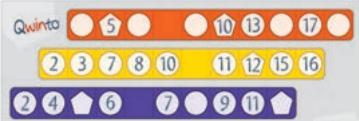
416 65 10 12-1043
Sarah has entered 4 numbers in the orange row. This row is worth 4 points. In the yellow row, she entered a number in every field. For this row, she gets 16 points, the number entered in the field on the far right. In the purple row, she entered 6 numbers. She receives 6 points for this row. Sarah has filled out all
three fields of three different columns. For these filled out columns she receives the number recorded in each of the bonus fields: 5, 10 and 12 points. Her two failed attempts amount to 10 minus points. Therefore, Sarah’s final point total is 43 points.
Download MarkdownTexts are community-compiled or publicly released by publishers; copyright remains with the original authors. For personal reference only.