
QwintoQwinto
一句话概览
Qwinto 是一款已收录于村了吗规则库的桌游,支持 2–6 人,原名 Qwinto。
本页内容:一句话概览 · 常见问题
这游戏怎么玩
- 本站已收录这款游戏的规则资料,可以在对话里直接提问规则细节。
常见问题(FAQ)
以下 1 条问答中 0 条来自站内玩家的真实提问,其余 1 条为本站整理的常见疑问;答复内容保持原样。
Qwinto支持几个人玩?
2–6 人。
去哪查完整规则
想核对具体规则细节、卡牌效果或某个回合的结算方式,可以在村了吗里选中这款游戏后直接提问。
同类桌游
- 卡坦岛德式
- 工业革命:伯明翰德式
- 勃艮第城堡:特别典藏版德式
- 方舟动物园德式
- 卡卡颂抽象
- 瘟疫危机传承:第一季美式
- 阿瑞迪亚:勇踏征途美式
- 重塑宇宙德式
- 幽港迷城美式
- 埃多拉的德鲁伊德式
规则原文(Markdown)
本站收录这款游戏的规则原文 1 个文件,此处内联渲染 1 个,可直接展开阅读或下载。
Qwinto_PandaS_rule.md7.2 KB

Players try to write down as many numbers as possible in the three differently colored rows on their respective score sheet. If you manage to enter a number in all the fields of a colored row, you’ll score even more points for the row. There are also lucrative bonus points you can score for completing each field of a column made up of 3 fields.
Entering numbers
The order in which you enter the numbers in the colored rows is up to you. For example, you can first enter a number in the yellow row on the right, then in the middle of the purple row, and then on the left side in the purple row; then to the far right of the orange row, and then in the yellow row on the left side, and so one and so forth. When entering numbers you only have to follow these two rules:
1) Within a colored row (i.e. horizontally from left to right) the numbers must be in ascending order from left to right with the larger numbers to the right, and no number may appear more than once in the same row. You may have gaps of any size between the entered numbers in a row, which you can fill in later (with the right numbers).
2) Within a column (i.e. vertically from top to bottom) no number may appear more than once; the same goes for a 2-field column and a 3-field column. The order of the numbers in a column doesn’t matter.
Note: Each colored row has one missing field. Do not enter a number in this field. It stays empty and serves no further purpose. In each of the five columns consisting of 3 fields each there is one bonus field in the shape of a pentagon. If all three fields in the column are filled with numbers, you get the number in the bonus field as bonus points.
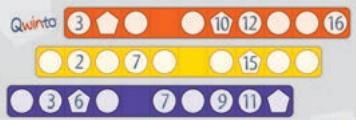
Tim has already entered numbers in some of the fields. In each colored row, the numbers get bigger as you move from left to right. Within the columns (2-field and 3-field columns) no number appears more than once. Everything is correct.
Note: In the yellow row, Tim can enter only the number 1 in the field furthest to the left. In the purple row, he can no longer enter a number between the 6 and 7. He is allowed to leave the field empty, but it will have to remain empty until the end. Tim has all three fields of two columns filled with numbers and has already recorded the bonus points from the corresponding bonus fields at the bottom of his score sheet.
How to play
Each player receives a score sheet and a pencil or pen. Note: Beginners should use a pencil so that they can easily erase any mistakes. Players can share a pencil if necessary. More experienced players can also use a pen.
Draw to see who goes first. On your turn, proceed as follows:
Decide how many dice you want to roll, whether 1, 2 or 3. You also get to decide (if you’ve decided to roll only 1 or 2 dice) which colored dice you would like to use. It is Linus’ turn. He decides to use two dice. He selects the purple and the yellow dice.
On your turn, roll the die or dice. If you’re satisfied with your roll, you don’t must make a second attempt. However, if you’re not satisfied with what you have rolled, you have to roll all the dice that you rolled on your first attempt. Then call out the sum of all the dice you have rolled clearly so that everyone can hear you.
In his first attempt, Linus rolls a 2 and a 4. He’s not happy with his roll. In his second attempt, he rolls a 4 and a 5. He calls out the sum of the dice in a clear voice: “nine!“

• Now all players can (but do not have to) write down the sum that was called out into exactly one field on their score sheets. The sum can only be entered into a row that matches in color with the dice that were rolled. As long as the two rules mentioned above (see section “Entering numbers”) have been correctly followed, each player decides himself where to write down the number.
Since Linus used the yellow and the purple dice, the sum of 9 can be entered into either the purple or the yellow row only.

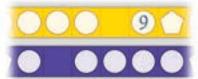
Linus writes down the 9 in the yellow row.
Tim also enters the 9 in the yellow row, but a little further to the right.

Sarah enters the 9 in the purple row.
Failed attempt: If the player rolling the dice cannot or does not want to enter a number, he has to record a failed attempt on his score sheet. Players not rolling the dice never have to record a failed attempt.
Now the next player in a clockwise direction takes his turn at rolling the dice as described above. Play then continues with each player taking turns in a clockwise direction.
Very important: After entering the numbers, all players carefully make sure that both rules for entering numbers have been correctly followed. If someone has made a mistake, simply erase the incorrect number and enter the number somewhere else where it fits (or don’t enter it at all). If you don’t notice that a number was incorrectly entered until a later round, erase the incorrectly entered number, which cannot be entered anywhere else. When entering numbers on your score sheet, you can conceal your entry while entering it, but throughout the course of the game, the score sheets remain in plain sight for everyone to see.
End of game and scoring
The game is over when a player has two colored rows completely filled out. The game is also over when someone has recorded their fourth failed attempt.
First, record the points that each player has scored in each of the three colored rows: • If a colored row contains empty fields, each entered number in this row is scored as a single point.
• If a colored row contains no empty fields, the number showing on the far right (the largest number) is scored as points .
Now record the bonus points for the five (vertical) columns consisting of 3 fields each:
• If there are empty fields in a column, no bonus points are rewarded for this column. • If there are empty fields in a column, no bonus points are rewarded for this column.
• If all three fields in the column are filled with numbers, the number in the bonus field is scored as bonus points.
The points from the three colored rows and the bonus points are then added up. From this sum, subtract points for each failed attempt (-5 each). The player with the most points wins.
416 65 10 12-1043
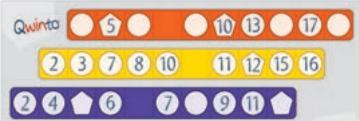
Sarah has entered 4 numbers in the orange row. This row is worth 4 points. In the yellow row, she entered a number in every field. For this row, she gets 16 points, the number entered in the field on the far right. In the purple row, she entered 6 numbers. She receives 6 points for this row. Sarah has filled out all
three fields of three different columns. For these filled out columns she receives the number recorded in each of the bonus fields: 5, 10 and 12 points. Her two failed attempts amount to 10 minus points. Therefore, Sarah’s final point total is 43 points.
下载 Markdown原文为社区整理/出版社公开资料,版权归原作者,仅供个人学习查阅。