
Smash Up
At a glance
Rules, cards and Q&A (Chinese)
The rules, card data and player questions for this game are written in Chinese. Open the Chinese page to read them.
Where to find full rules
Full rules and card lookup are available in the cunlema app at cunlema.cn — pick this game and ask about any rule, card or turn you are unsure about.
Related games
Rulebook text (Markdown)
This game has 3 rulebook Markdown file(s) in our library; 3 rendered inline below — expand to read or download.
rules_zh_大杀四方_952.md18.7 KB
大殺四方
一款2-4人的大亂鬥遊戲
目標
你的目標就是要在所有基地都擁有絕對爆表的戰鬥力。好好利用你的隨從去攻佔敵人的基地吧。第一個獲得15分(VP)的玩家就是最終的赢家
遊戲配件
這套遊戲包含:
·8組種族牌,每組20張(一共160張牌)
·16張基地牌
·這本規則書
目錄
大殺四方…………………………2
目標………………………………………………2
遊戲配件……………………2
iPad玩大杀四方……………………2
遊戲設置…………………3
輪到你的回合……4
卡牌圖示!……………………………5
随從………………………………………………5
戰術…………………………………………………………………5
搶更多的分…………………6
來熟悉下你的牌!……1
規則關鍵詞……………………8
避免規則爭議………9
各種族介紹……………10
比賽規則建議和版權資訊11
基本流程.…12
更多種族擴展
《大殺四方》:霸氣9000級擴展包含了4個全新的種族,你可以把這些種族任意組合去擊敗你的對手。盡你所能把這些种族跟基礎的种族组合在一起創造出新的奇跡吧。


遊戲設置
每位玩家將兩個含20張牌的不同牌組洗混在一起組成一套40張牌的牌庫。

如果你有兩套大殺四方,不同的人可以使用相同的種族,比如巫師對決巫師。但是一個玩家不能把兩個相同的種族混在一起玩,等等。

选择种族的顺序
常來說,把所有的種族的牌放在桌子中間,隨機找個起始玩家來選擇其中一組種族,按順時針方向每位玩家輪流選擇。當所有玩家都選了一組種族後,最後一名玩家再選擇他的第二組種族,然後按照反方向每位玩家輪流選擇第二組種
把所有的基地牌洗混作為基地牌庫。有幾個人玩就抓幾張牌,再額外加一張(舉例:3人遊戲就抓4張基地牌)面朝上放在桌子中間。
每位玩家抓5張牌,如果你沒抓到随從牌,你可以展示手牌,然後棄掉所有的手牌,重新抓新的5張牌,並把剛剛棄掉的5張牌洗回牌庫。就算牌再差,你也必須保留第二次抓的5張牌來進行遊戲。
今天早上最早起床的玩家作為起始玩家。遊戲是按順時針方向進行的
你準備好了嗎?開始大殺四方吧。
基本流程
設置
每位玩家將兩組含20張牌的不同牌組洗混在一起組成自己一套40張牌的牌庫。每位玩家抓5張牌。然後把多於當前玩家人數一張的基地牌放在桌子中間(比如,4人遊戲時需要5張基地牌。)
輪到你的回合
在你回合中你可以至多打出一張隨從牌和至多打出一張戰術牌,也就是說你可以選擇不打出或少打出任何的牌。
按照牌上的描述執行你打出的牌的能力。
檢查某個基地是否可以計分。如果要滿足了條 件,請計分。
抓兩張牌。如果牌超過10張以上則棄掉多餘的牌保留10張。
計分
在你打出一張隨從和戰術牌後,如果某個基地上的隨從戰鬥力總和等於或超過了爆破臨界點,那麼該基地開始計分。在某個基地上戰鬥力總和最大的玩家為冠軍玩家,可以獲得基地牌最左邊的分數。第二大戰鬥力的玩家為亞軍玩家可以獲得基地牌中間的分數。第三大戰鬥力的玩家只能獲得基地牌最右邊的分數。如果平局,每位玩家盡可能獲得符合他戰鬥力的名次的分数。
執行完基地的能力後,棄掉在此基地的所有隨從,然後抓一張新的基地代替它。
獲勝方式:
當玩家在一個回合結束時已經擁有15分或更多分數時,他就赢了。如果有兩名或多名玩家擁有15分以上的分數,則最高分數的玩家為最終的赢家。如果是平局,遊戲繼續進行。
額外規則
通常來說,當一張牌的描述和規則有衝突時,牌上描述優於規則書。
如果牌與牌之間描述有衝突,牌面描述上寫的你不能做某件事優先於你能做此件事。比如有個不能被消滅的隨從被某張消滅某隨從的戰術指定為目標,則此隨從不會被此戰術消滅。
如果多個效果在同一時間同時觸發,當前玩家決定結算的先後順序。
你可以打出一張牌即使其影響不到任何局面。比如在沒有隨從的基地上打出“麥田怪圈”
你必須執行牌打出時的能力,即使這對你來說很糟糕。然而如果一張牌描述你可以做某件事,你能選擇是否要做這件事。
如果有個能力描述為“任意數量”,你可以選擇數量為0。你可以打出一張牌上面寫著“全部”,然而一個目標都找不到。
任何人在任何時刻都可以看任何人的棄牌堆。
卡牌圖示!


搶更多的分
當一個基地裡所有隨從的戰鬥力總和等於或超過該基地的爆破臨界點時,基地開始計分(見第頁)。如果有多個基地同時滿足計分條件,由當前玩家選擇哪個基地優先計分。
當基地要計分時,每位玩家先執行一些特殊能力“在基地計分前”,如果戰鬥力總和下降到爆破臨界點以下,你仍舊先完成基地的計分。
舉例:一個海盜玩家看到她會在歐亞西斯叢林只能拿個亞軍的分數。她心想拿個0分太不值了,她就打出“滿帆而行”(特殊能力)這張戰術牌,傳送自己所有在此基地的隨從到其他基地上。然後原來的基地戰鬥力總和一下子不夠12點了。但基地已經開始計分了,這依舊會先執行計分的動作。
我先上!
如果有多個玩家都有特殊能力要發動,從當前玩家開始,順時針依次發動直到所有人都不想發動為止。(如果你不發動而另一個玩家要發動特殊能力,你能在其後再選擇是否發動你的特殊能力)。如果特殊能力是讓你打出一張額外的牌,你必須立即選擇是否要打出。
搶奪分數
在某個基地上戰鬥力總和最大的玩家為冠軍玩家,可以獲得基地牌最左邊的分數。第二大戰鬥力的玩家為亞軍玩家,可以獲得基地牌中間的分數。第三大戰鬥力的玩家為季軍玩家,只能獲得基地牌最右邊的分數。你必須至少有一個隨從在基地上才能獲得其計分的分數。
召回你的隨從
在計分後,玩家可以使用一些“在基地計分後”的特殊能力。然後停留在基地的隨從全部移到各自的棄牌堆。這不代表是消滅了他們,不過有些進入棄牌堆的能力依舊會觸發。
把計分過的基地牌放到基地的棄牌堆。把基地牌頂牌更新到新的空缺上。
請檢查是否有另一個基地也要計分了。如果要計分的話,同樣執行以上的步驟。

來熟悉下你的牌!

和氣生財
如果玩家在基地的戰鬥力總和打平而基地要計分了,每位玩家盡可能拿更高的分數。
比如,有3位玩家在某基地要計分時各有10,10和5點戰鬥力總和。那麼10點戰鬥力總和的玩家們都會獲得冠軍的分數,而5點戰鬥力的玩家只能拿到季軍分數。亞軍分數无人能拿到。如果有兩位玩家都是亞軍,那麼无人能拿到季軍的分數,就是这么殘酷。
如果有玩家因為基地的能力而打平(比如忍者道場),他們可以参考上面“我先上”來解決問題。
這就是基地的能力。通常基地牌都放在桌子中間,而其能力是一種特殊的,持續的而又讓人敬畏的神秘力量。
遊戲結束了,小夥伴!在任意回合結束時有人拿到15分,擁有最多分數的玩家就是最後的贏家。如果分數打平,則繼續遊戲直到有一方分數更多。除了你的兩組種族外不要分享任何資訊給對手。你和小夥伴們依舊 是好朋友!
規則關鍵詞
規則的某些限制和效果是否會發動,請看以下具体描述。
效果:有些牌會在被移動,移回手上,被消滅,或被戰術牌附屬時觸發效果。


消滅:当一張牌寫著消滅另一張牌時,把被消滅的牌放到其擁有者的棄牌堆。
棄牌:當一張牌被棄掉時,放到其擁有者的棄牌堆。不管是誰打出或操控的牌。
額外:通常來說,你每回合只能打出一張隨從牌 或一張戰術牌。打出一張額外的随從牌
或戰術牌意思就是允許你本回合再打出一張隨從或戰術牌。你可以按任意想法來玩,你不一定非要打出一張額外的牌。

傳送:這張牌會讓你可以從一個基地移動一個隨從到另一個基地上
而不是正常打出。傳送隨從時不會觸發打出時的效果。

持續能力:一直持續生效的能力,不會立即消失。持續能力在打出牌時就會觸發了,只要還在場上,它們便仍然有效。

打出:你在步驟2打出一張牌或特殊能力允許你打出一張牌時才會觸發牌的能力。
當牌被移動,置入牌庫或移回手上都不視為打出,牌的能力都不會觸發。


返回:這張牌意思是從哪來就回哪裡去,當一張牌從基地移回手上時,棄掉附屬在上面的牌。

特殊能力:多數特殊能力都在你打出牌的時
觸發,有些特殊能力在特殊時刻或滿足特殊條件時觸發。
特殊能力表現在已經打出在場的牌或者你的手牌上。卡牌上都有相應的使用描述。如果你在自己回合中打出特殊能力牌,這不

視為那回合中你免費打出的一張牌。
避免規則爭議
通常來說,當一張牌的描述和規則有衝突時,牌上描述優於規則書。總之卡牌描述優於一切。
如果牌與牌之間描述有衝突,牌面描述上寫的你不能做某件事優先於你能做此件事。比如有個不能被消滅的隨從被某張消滅某隨從的戰術指定為目標,則此隨從不會被此戰術消滅。
如果多個效果在同一時間同時觸發,當前玩家決定結算的先後順序。
你可以打出一張牌即使其影響不到任何局面。比如在沒有隨從的基地上打出“麥田怪圈”。這可以讓你過濾一些你暫時不需要的牌。
你必須執行牌打出時的能力,即使這對你來說很糟糕。然而如果一張牌說你可以做某件事,你能選擇是否要做這件事。
如果有個能力描述為“任意數量”,你可以選擇數量為0。你可以打出一張牌上面寫著“全部”,然而一個目標都找不到。
如果你在一個基地計分時可以打出額外的隨從或戰術牌,你必須立即選擇是否要打出這些額外的牌。
當一張牌被棄掉時,放入其擁有者的棄牌堆。不管是誰打出或操控的牌。
任何人在任何時刻都可以看任何人的棄牌堆。你猜的沒錯,一些掘墳愛好者,老喜歡看你的棄牌堆裡都有啥好東西在裡面。。。
種族介紹
這套基礎的《大殺四方》有8組種族,可以組合出28種不同的牌庫。在未來的擴展會有更多的種族加入這個遊戲,就會有更多的變化。按你自己的風格來挑選符合你的種族吧。
外星人
外星人喜歡在人群中製造混亂,它們喜歡把其他人搞的更亂。把隨從移回手上,找個新基地駐紮,一言不合就改造整個星球。

恐龍
如果有一件事恐龍知道要做的。。。用它們小腦袋瓜想想也知道,他們不需要知道怎麼去做。不過他們個個都是大塊頭,而且——天哪!——有人還給了它們裝了激光炮!

忍者
如果你看到一個忍者,代表你已經死了(然後如果你在死時還看到他們,請跳轉到喪屍)。我不想失去秘密或任何美

好的事物,但這種族實在太兇殘了。
來無影去無蹤,正如其名。
海盜

你可知道有什麼比漂流在大海上更美妙的事?隨風逐浪,想去哪就去哪。海盜們可隨意進出各種港口,而且有時你不喜歡也要自己跳下去。
機器人
公司老闆們製造了這些機器人,然後機器人接手了公司並更高效地運作公司!現在它們可以生產更小,更高科技的機器人讓敵人來頭疼。哇哦,還有一些巨型機器人。。。

騙術家
偷東西,設路障,自己開路,藏你的鑰匙,榨幹油水錢。。。這麼多年來,你視它們這些小生物為害蟲,現在它們更加變本加厲無法無天了。

更多種族!
如果有很多玩家都想嘗試忍者這
組種族?好的,現在買2副《大殺四方》的小夥伴們就都能用相同的種族來對戰了。但是記住,你不能拿兩組相同的種族牌組成一套牌。當使用2副《大殺四方》時僅使用其中一套的基地牌。
巫師
轉眼間,巫師們施放了他們渴望的各種戰術咒語。他們只是稍微腦力激蕩了一下,看看他們的手,帽子。。。或是他們剛剛在你廚房打開的通往另一個世界的巨型通道。

喪屍
“他們只為你蜂擁而來,玩家2。”打死一個頑強屍怪太難了。喪屍們只需要默默地退後,然後偶爾從山洞裡冒出來。把喪屍棄掉並不能拖多久時間,不一會“又見面了!”

2vs2比賽規則建議和版權資訊
《大殺四方》2vs2比赛规則建議:
2人組成一隊,雙方圍繞桌子的座位和出牌順序為:自己,對手1,隊友,對手2。
遊戲初始設置:起始玩家選擇第一組種族,然後按順時針方向每位玩家輪流選擇他的第一組種族。當所有玩家都選了一組種族後,最後一名玩家再選擇他的第二組種族,然後按照反方向每位玩家再輪流選擇第二組種族。
比赛規則和獲勝方式:2vs2規則是以《大殺四方》基礎規則為基礎的競技規則。每位玩家起始5張手牌,如果不滿意可以全部棄掉,重新抓5張,然後把剛棄掉的牌洗回牌庫。每個人在基地計分獲得的分數是歸入隊伍總分而非個人得分。若有一隊的隊伍總分率先達到或超過25分則獲得遊戲勝利!若兩隊同時達到25分或以上則比賽繼續進行直到某一隊的分數比另一個隊多,以此判定更多分的一隊獲勝。
於交流:
規則作為競技比賽而執行時,禁止同隊隊員之的一切語言和手勢交流。

版權資訊
設計師:Paul Peterson出版人: 任智傑製作人: 陳斌華翻譯: 陳斌華排版: 陳斌華校對: 梁文浩

聯繫我們
MYBG中文桌遊出版社
地址:廣東省廣州市中山三路大東門125號金寶怡庭A705
http://www.gamdow.com
http://www.mybg.taobao.com
輪到你的回合
1. 檢查回合開始
有些能力會在你的回合開始時發動,請檢查下其效果是否會還結算完畢。
2. 打出牌
在你回合至多打出一張隨從牌和至多打出一張戰術牌,或打出一張額外的。。。等等都是自由分配的。你可以隨意安排出牌的順序,你也可以不打出任何的牌。
隨從
打出一張隨從,選擇一個基地然後把該隨從面朝著你放在此基地的旁邊,執行卡牌所描述的能力。(如果有些牌有特殊效果視為特殊能力,请看第8页的舉例)
戰術
打出一張戰術,給大家看看這個戰術有多麼霸氣的效果。轟隆!然後把該戰術牌棄掉(除非這是張有持續能力的牌)。
3.檢查得分
在你打出牌後,請檢查下任何某個基地是否要計分了(見第6頁)。如果要計分了,你必須先計分完再進行其他動作。
在基地計分後,檢查下某個玩家是否已經達到15分或更多。如果那樣的話,遊戲就結束了,見第7页。
4.抓2張牌
正如上面所說的那樣。你的手牌最大上限是10張。如果你在抓牌後超過了10張,請棄掉多餘的牌僅保留10張。
如果你需要抓牌或展示牌庫時牌庫已經沒牌了。先把棄牌堆洗成牌庫,然後背面朝上放好這就是你新牌庫。以後的牌就在這裡抓。
5.關門了事
可能會有某些在回合結束時触发的能力在此时生效。然後輪到你左邊的玩家開始行動。
作弊!你動了兩次?當你把牌打出來時或有些牌描述“打出”只會觸發一次效果。當隨從來回移動時不會觸發任
Download MarkdownSU_BIGGER-GEEKIER-BOX_RULEBOOK.md140.9 KB
MASHUP PaulPeterson
SmashUpComprehensiveRulebook(fornow)
THELEASTFUNNYSMASHUPRULEBOOKEVER
Smash Up is a fight for 2–4 players, ages 14 and up.
OBJECTIVE
Your goal is nothing short of total global domination! Use your minions to crush enemy bases. The first player to score 15 victory points (VP) wins!
GAME CONTENTS
This glorious box of awesome contains:
· The Geeks faction
• The Smash Up All Stars faction
• Card dividers
• Close to 1000 cubic inches of space
•This rulebook
The Expanding Universe
From its first big bang, the Smash Up universe has expanded until our first Big Geeky Box became too small to hold it all! So we took that box and made it better, stronger, faster, bigger. Not only does this new box hold all the cards, this rulebook holds all the rules as well, or at least everything published up to now, all in one convenient if not terribly funny 32-page package.
How to Use This Book
If this is your first exposure to Smash Up, don't let this ginormous book scare you off! The basic rules are covered on pages 3-6, and summarized on page 31. Use those to start with, along with any special rules for the sets you are using, as found on pages 7-8.
As you play, you can find answers to many of your rules questions in the Terms and Phrases, and the Card Clarifications, which are sorted by faction. After a game or two you may enjoy reading the more Detailed Rules for greater enlightenment, and browsing the Phactioin Philes and Faction Cross-Reference to help decide which set you'd like to get next!
CONTENTS
0bjective…
Game Contents.
The Expanding Universe....
How to Use This Book....
Know Your Cards!
Meet These Other Cards!....
Setup.
Sample Setup
Kickin'It Queensberry.
As the Game Turns / The Phases of a Turn....
The Big Score
MeFirst! .
Awarding VP.
Tie Fighter ...
Back to Your Corners
Scoring Summary..
Game Over,Man! ..
Special Cards, Counters, and Rules .
+1 Power Counters..
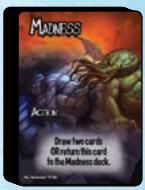
The Madness Deck ..
Monsters and Treasures .
Titans..
Non-Minions that Grant Power ...
Burying.
Duels
Terms & Phrases ...
Detailed Rules for Cards, Abilities, and Other Wackiness .. 12
Calculating Values for Breakpoints or Power
Using Card Abilities .
Conflicting Text & Timing.
Multiple Effects..... 2
Canceling or Preventing Effects...
Extra Cards ....
Attached Cards.
Triggered and Tagged Abilities ..
Decks,Discards, and Searches.
In and Out of Play..
Last of All..
Rules Changes and Errata....
New GeneralRules
Card Text Changes (by Faction)
Card Clarifications...
Minions, Actions, and Titans (by Faction).
SpecialMinions and Actions (by Type).
Bases (byName).
PhactionPhiles
Moar Factions!.
Credits ..
All Your Basics
Smash Up Faction Cross-Reference ... 32
Factions Sorted by Set
Sets Sorted by Faction
Base Cards by Set.
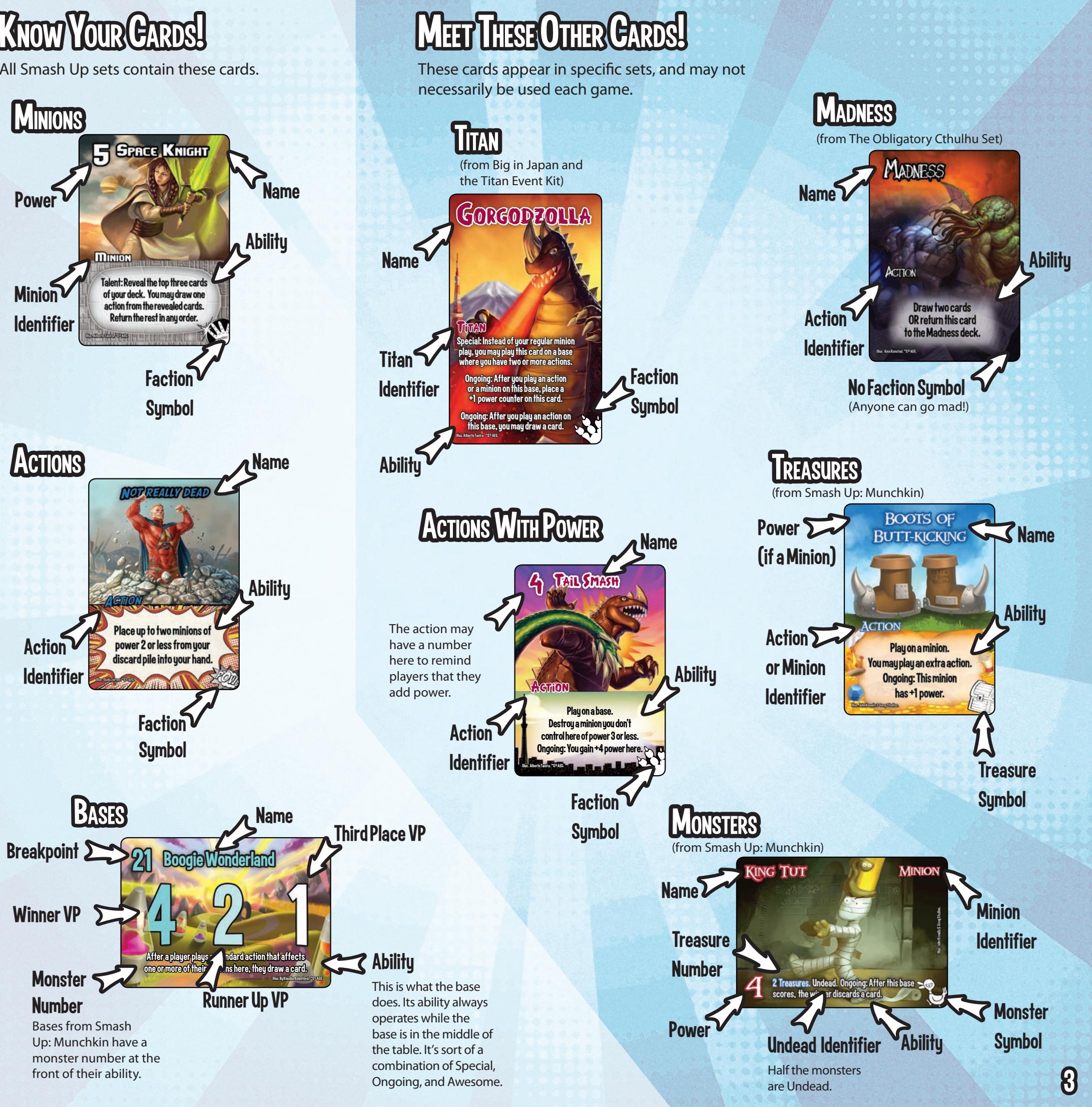
Each player selects two different factions to play with. For gameplay purposes, each player is considered the owner of the factions they chose. Shuffle together your two factions to make a 40-card deck. If your factions have any titans, place them near your deck. (See page 8)
Next, make your base deck. You don't have to play with all the bases at once. Each set comes with bases meant to go along with the factions in that set, but If you shuffle all 120 (or more) bases together, there isn't much chance for a player to get to see the bases that are best for the factions they are playing! So we recommend you just grab the bases from the sets the chosen factions came from. For example, if you are playing Halfling Kung Fu Fighters vs. Mega Trooper Rock Stars vs. Orc Grannies, take the bases from That '70s Expansion, Smash Up: Munchkin, Big in Japan and What Were We Thinking? to make your base deck. Shuffle those base cards together.
If any of the sets used in your game has extra decks (e.g. Madness for Cthulhu, Monsters and Treasure for Munchkin), shuffle those decks and set them out too. (Okay, the Madness deck doesn't need to be shuffled.)
Draw one base per player, plus one (e.g., four bases for three players), and place them face up in the middle of the table. If any of the bases needs monsters, add them now (see Monsters & Treasures on page 7).
All players draw five cards from their decks. If you have no minions in your opening hand, you may show your hand, discard it, and draw a new hand of five cards; you must keep the second hand. The first player is the person who (in order of priority) was most recently
• abducted by an alien,
• shanghaied by a pirate,
• bitten by a vampire,
· burned by a dragon,
• kissed by a princess,
• driven insane by Cthulhu,
• attacked by a teddy bear, or
• eaten by an orc.
If no one meets the criteria, then you'll just have to figure out who goes first on your own.
Kickin' It Queensberry
For formal play, put at least 2 factions per player in the middle of the table. Randomly determine who goes first. The first player chooses one faction. Choice continues clockwise. When everyone has chosen one faction, the last player chooses a second faction. Choice continues in reverse order.
SAMPLE·SETUP

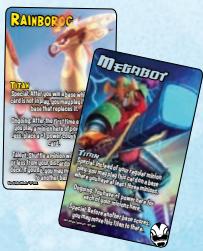
The game items below are only used with certain sets. The decks are placed where all can reach them; titans are placed near their owners' decks.
Madness Deck
Titans

ASTHEGAMETURNS/THEPHASES OFA TURN
1. Start Turn
Some abilities (and effects like Uncovering) happen at the start of your turn. This is the phase when it all happens. And we mean all: every ability of a card in play (or special in hand) that says “at the start of your turn" can happen here, not just the first one.
Any abilities that expire at the start of your turn expire before any of those start-of-turn events.
2. Play Cards
On your turn play one minion, play one action, or play one of each... for free! You can play your cards in any order. You don't have to play any cards. (To play titans, see page 8.) In addition, some of your cards may have abilities that you can use during this time (see “Abilities" below for more details).
Minions
To play a minion, choose a base and put the minion card beside it, facing toward you. Do what the card says. (Card abilities that start with the word Special or Talent are a special case. No, really. See page 11.)
Actions
To play an action, do what the card says. Boom! Note that action cards come in two types: standard and non-standard. If it didn't say to play it on a base or on a minion, then it's a standard action, and you discard it after following its instructions. (If it did say to play on a base or minion, then it's non-standard, and you leave it where it is.)
Abilities
Minions and non-standard actions often have abilities that work during the Play Cards phase. An ability labeled “Talent" can only be used once during this phase of your turn (see page 11). Likewise, any ability that says, “on your turn" can only be used during your Play Cards phase.
3. Score Bases
After you are done playing cards, check to see whether any bases are ready to score (see page 6). If any are ready, you must start scoring.
This is the only time when bases are scored. If a base's power meets or exceeds its breakpoint at other points of a turn, you still have to wait until the next Score Bases phase to do anything about it.
4.Draw 2 Cards
Just what it says: draw 2 cards.
If your hand is empty at other times of the game, you don't get to draw a new hand; you have to wait for the Draw 2 Cards phase of your turn. On the other hand, if you need to draw, reveal, search for, or look at a card and your deck is empty, shuffle your discard pile and put it on the table face down—that's your new deck. Start drawing from there.
After drawing, the maximum number of cards you can have in your hand is 10. If you have more than 10 cards after drawing, discard down to 10 (you may weep while doing so, as long as you don't get the cards wet). If your hand is bigger than 10 at other times of the game, that's okay: you wait until now to discard down.
5. End Turn
Just like the start, there's a phase for the end of the turn. Things that happen here (like destroying a minion or drawing a card) happen first; if there is more than one, the current player chooses their order. After that, all abilities that expire here (like “+1 power until the end of your turn") expire at the same time.
Finally, check to see if any players have 15 or more victory points. If so, see Game Over, Man! on page 6. Otherwise the turn is over and play passes to the player on the left.
Card Resolution Order
Playing a card will often trigger other cards, so here's a handy guide for figuring out their order.
-
Resolve the card just played.
-
Finish resolving any other cards that are in the middle of resolving.
-
Resolve any cards in play that are triggered by the card of step 1. If there are more than one, the current player chooses their order.
-
Play and resolve cards in players' hands that are triggered by the card of step 1. If there are more than one, go clockwise from the current player. (Me First, page 6)
-
Discard the card of step 1 unless it was played on another card.
THEBIG SCORE
Bases only score during the Score Bases phase of a turn; they never score in the middle of a turn. If the total power of all cards on a base equals or exceeds the base's breakpoint (see p. 3), that base is eligible to score at this time. If more than one base is ready to score, the player whose turn it is decides which one to score first. You cannot refuse to score an eligible base.
After a base has been chosen to score, players may use abilities that happen “before" the base scores. Even if these abilities drop the total power on the base below its breakpoint, you still finish scoring that base.
For example, a Pirate player sees that she will be the runner up at Jungle Oasis. Since that's worth 0 VP, she plays Full Sail to move all her minions away to another base. That drops the total power on this base below 12, but since it's already started scoring, it still finishes.
If a scoring base leaves play before VPs are awarded (usually because it is replaced by another base), stop scoring it immediately, since the base that was scoring is now gone. Then evaluate the bases on the table to see if any are eligible to score—which may include the replacement base!
Me First!
When scoring a base, several card effects may take place, and players may wish to use Special abilities. Handle this situation (and all similar triggering events) as follows: First resolve abilities of cards in play, in the order chosen by the current player. Then, if more than one player wants to play a card with a Special ability, each player, starting with the current player and going clockwise, either plays one Special or passes. You can play another Special when your next option comes around, and you can play a Special after passing, but once all players pass in sequence, that's the end of it.
Awarding VP
The players with the highest, second-highest, and third-highest power on a base are the winner, runner up, and third place! They get victory points equal to the 1st, 2nd and 3rd number on the base card respectively. Anyone with the 4th highest power or lower gets nothing. If there are less than 3 players on a base, no one gets the VPs for the unclaimed spots. Dispense VP tokens in the appropriate amounts to everyone who scored. Abilities that happen “when" a base scores may change how this happens. To earn victory points, you must have at least one minion on that base (even if it's worth 0 power) or a card that gives you at least 1 power there (even if it's not a minion).
If there are monsters on a base when it scores, see Getting Loot on page 7.
Tie Fighter
If players are tied on a base, all involved players get points for the position they tied for. So, if three players had 10, 10, and 5 power on a base when it scores, the winners with 10 power each get first place points! The player with 5 power then gets third place, not second. If two players tie for runner up, no one gets third place. Harsh.
If players tie for use of a base's ability, they each get to use it. Priority starts with the current player and goes clockwise. If using it twice doesn't make sense (e.g., choosing the next base), then only the first tied player gets to use it.
Back to Your Corners
After awarding points, players can use abilities that happen “after” a base scores, in the same order described under “Me First.
After that, all cards still on that base go to their respective discard piles simultaneously (regular minions and actions go the piles of their owners, even if they were controlled by other players, or buried; monster and treasure cards go to their own piles; and titans are placed near their owners' decks). When these cards go to the discard pile, this might trigger abilities. Note: Going to the discard pile after scoring is not the same as being destroyed, but it does count as leaving play.
Place the scored base into the base discard pile. Replace it with the top card of the base deck, adding monsters if necessary. If the base deck or monster deck has run out, shuffle the discard pile to make a new deck.
Now that the base is done scoring, check to see if another base is ready to be scored. Score it too, the same way. Since scoring a base can (and often does) change conditions on other bases, you always re-evaluate whether any bases are ready to score after completely finishing a base's scoring process. Choosing the order to score bases can be a key strategic decision, one even more important than choosing a prom date.
Scoring Summary
-
Check all bases to see if any are ready to score. If none are, go to the End of Turn phase.
-
The current player chooses one base that is ready to score.
-
Play and/or use any “Before scoring" abilities.
-
Award VPs according to the current power totals. "When scoring" abilities trigger now.
-
Play and/or use any “After scoring" abilities. This may affect steps 6–9.
-
Award treasures from any monsters on the base.
-
Discard all cards on the scored base.
-
Discard the scored base.
-
Draw a new base to replace it. Place monsters on it as required.
-
Go to step 1.
-
There is no step 11.
GAMEOVER,MAN!
At the end of each turn, everyone checks their VP totals. If anyone has 15 VP or more, then the player with the most VP wins the game! If there is a tie for the most VP, keep playing turns until there isn't. No sharing the win! Except for your two factions. You guys are BFFs.
Games played with the Madness deck have special rules for determining the winner; see page 7.
SPECILCARDS,COUNTERS,AND RULES
Every Smash Up set has bases, minions, and actions, but there are several other game components that only appear in some of the sets.
+1 Power Counters
First used in Monster Smash
These pump up your minions with extra power. They are not a separate item; your VP tokens do double duty as +1 power counters (if it's in your VP pile it's a VP token, but if it's on a card it's a power counter). +1 power counters can be placed on cards, transferred between cards, and removed from cards when a card's ability says to do so. When a card leaves play, remove all +1 power counters on it.
Note: In early sets, these were called +1 power tokens.
Each +1 power counter on a minion increases the minion's power by one for as long as it is on that minion. For example, a 2-power minion with three +1 power counters on it is treated as a 5-power minion. If a power counter is transferred, the counter no longer affects the card it used to be on, and starts affecting the new one.
A power counter affects the minion it is on, so abilities that protect minions from effects protect against placing power counters on them, as well as transferring or removing them.
See page 8 for how power counters work with Titans. Power counters on actions, bases, or buried cards have no effect unless a card says otherwise.
TheMadness Deck
Used in The Obligatory Cthulhu Set
This is a set of 30 identical action cards. Keep the Madness deck face up (since all cards are identical) and separate from all other decks. Players cannot draw a card from the Madness deck, or return a Madness card to it, unless a card's ability specifically allows it. If the Madness deck is out of cards, ignore any instructions to draw a Madness card until one or more Madness cards return to the deck.
The current controller of each Madness card is treated as its owner as well. When a Madness card leaves play, it goes to its controller's discard pile rather than to the Madness deck. When a Madness card returns to the Madness deck, the player ceases to control it.
Madness and the Final Score
Madness cards give you extra card draws during the game, but at the end of the game they cause you to lose VPs!
When the game ends, and one player is in the lead with 15 VP or more, players count the total number of Madness cards in their hands, decks, and and discard piles, or that are buried. Each player then loses 1 victory point for every 2 Madness cards that they have. The player with the highest modified VP total then wins. In case of ties, the player with the fewest Madness cards wins. Further ties share the win!
For example, John has 15 VPs and 5 Madness cards; he gets -2 VPs for a final total of 13 VPs. Mary has 14 VPs and 3 Madness cards, giving her a -1 VP penalty. Her modified total is 13 VPs, but she has fewer Madness cards, so she wins the tie. Finally, Chris has 13 VPs and no Madness cards. Chris, with the fewest Madness cards, wins the game, and John comes in last place!
Monsters and Treasures Used in Smash Up: Munchkin
Monsters and treasures are special types of minion and action cards. They each have their own deck and discard pile, set to the side for any player to use when necessary. Players cannot draw from these decks unless allowed in these rules or by a card's ability.
Monsters are treated as normal minions, and treasures are treated as normal actions or minions, in all ways except as defined below.
Monsters and treasures have no owner or faction, therefore cards that refer to a minion's owner do not apply to monsters. When a monster or treasure card leaves play, it always goes to the corresponding discard pile, regardless of card text to the contrary.
Monsters are not played from players' hands but directly from the top of the monster deck. They can only be played when a game effect specifically says to play a monster. Playing a monster does not count against a player's limit of one minion per turn, nor does it count as an extra minion. Playing a monster does not give a player control of it; however, other cards may allow a player to take control of a monster in play.
Treasures are special awards gained either by defeating monsters, or by special card effects. Although they have no owner or faction, they do have a controller as normal.
Monsters and Bases
Bases in Smash Up: Munchkin have a monster number (see page 3). Whenever such a base enters play, draw that many monsters from the monster deck and play them on the base. To save table space, you may overlap the monster cards so only their power and abilities show. Monsters played on new bases are not considered played by any player. Monsters' abilities trigger when they are played just as with normal minions.
Monsters do not count against the breakpoint of the base they are on. Instead, they ADD to the breakpoint of the base, making it harder to score. However, if someone takes control of a monster, it stops adding to the base's breakpoint and acts as a normal minion of that player.
Getting Loot from a Monster
Monsters have a treasure number. If a monster is destroyed by a card effect, the player who controls the effect that destroyed it draws that many treasure cards and places them in his or her hand. Big phat lewt!
Getting Loot from a Base that Scored
After awarding VPs for a base, add the treasure numbers of all the monsters that are still on the base and reveal that many cards from the treasure deck. Players take turns choosing one of the revealed cards and adding it to their hand. To be eligible to claim a treasure, a player must either control a minion at that base or have at least 1 power there by virtue of some other effect. All qualifying players are included in treasure selection, not just the top three.
When choosing treasures, start with the base's winner and proceed by the decreasing amount of power present on the base. Priority for breaking ties starts with the current player and going clockwise. Continue selecting (restarting with the winner if there are more treasures than players) until all treasures have been claimed.
Example: A base scores. The monsters still on the base have a total treasure value of 5. Alan has a bunch of minions on the base, and Beth has one minion with a power of zero. The players reveal a total of 5 cards from the treasure deck. Alan, who had the highest total power, chooses one of the cards. Beth chooses second, then Alan chooses another, etc. In the end, Alan gets the first, third, and fifth choices, and Beth gets second and fourth. Chris had neither minions nor power on the base, and thus does not get any treasure.
Titans
Used in Big in Japan and the Titan Event Kit
Titans are a card type entirely different from minions, actions, or bases. Representing large, uncontrollable forces, titans are neither good nor evil; they are pure awesome. Titans start the game on the table near their owner; they never go in the hand, deck or discard pile.
Titans may be played on a base when a card, including the titan card itself, says you can play them. Playing a titan is optional. “Instead of your regular minion [or action] play" means instead of the normal minion or action play allowed during your Play Cards phase. Titans are not played as, and do not count as, extra cards.
If you play a titan, you control it even if you do not own it. You cannot play a titan if you already control a titan in play.
Titans are not affected by abilities that specifically target minions or actions. Abilities that target "cards" can affect titans and even force them out of play (destroyed, returned, placed, etc.). Titans also leave play if the base card they are on leaves play. When a titan leaves play for whatever reason, set it aside near its owner, discarding any counters on it. It can be played again anytime a card allows it.
Titans do not have power, but they can give power to their controller's total at their base through their abilities. In addition, titans that have +1 power counters on them also provide that power to their controller.
Clash of the Titans
After you play or move a titan to a base that already has a titan, one of them must be removed from play. The two controllers compare their total power at that base, after resolving any applicable ongoing abilities. The player with the lesser total removes their titan; in case of ties, the titan that was on the base first wins.
Non-Minions that Grant Power
First used in Big In Japan
Some actions have inherent power, and some bases grant power. This power counts both toward breaking the base and toward earning VP rewards, even if the player has no minions present there.
Burying
Used in Oops, You Did It Again
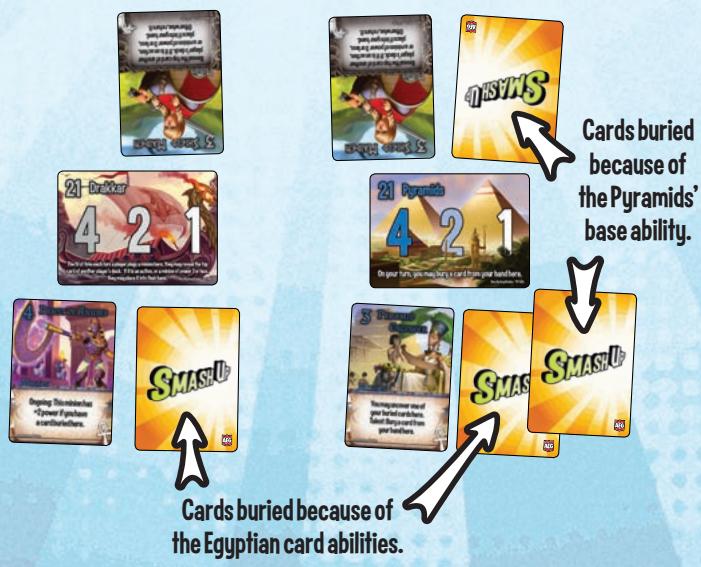
How to bury: To bury a card you place it face down beside a base, facing you. You don't show it to others unless the card says to bury itself. You may only bury a card if an ability allows it.
Status: A buried card is not affected by abilities that target minions, actions, or any other card type. They are affected by abilities that target "cards". A buried card is controlled by the player who buried it, and its controller is considered its owner until it is uncovered or discarded. Players may look at buried cards they control at any time; but they may only look at them one at a time and may not mix them up. A buried card's abilities may not be triggered until after it is uncovered.
Uncovering: Each player may uncover one of their buried cards at the start of their turn. A player may also uncover a card when an ability allows it. When a buried card is uncovered, its controller immediately plays it as an extra card. It is played either on the same base, or on a minion on that base, or simply resolved and discarded, as appropriate. It is resolved just as if it were played from the hand. If circumstances make playing it impossible (e.g. it's a card that is only played before a base scores), it is discarded instead. When a card is uncovered or re-buried (as Mummies do), any counters or cards on it are discarded first. Uncovered cards may not be immediately reburied.
Scoring: Buried cards do not themselves have power, nor the presence to help break or win a base. After a base scores or leaves play for any reason, buried cards still on it go to their owners' discard piles. Madness cards that are buried at the end of the game still count against their controller.
Duels
Used in Oops, You Did It Again
Basics: When two minions duel, their controllers may each place a card from their hand on the table face down, and then each reveals their card (if any), starting with the challenger. If it is an action it is played normally, otherwise it is returned to the hand. After the dueling cards are resolved, the minion with the higher power is determined to be the winner; in case of ties, both sides get all the effects of the duel. The benefits of winning, or the harm of losing, are specified by the card that starts the duel.
Details: Placing a dueling card on the table is optional, and the decision to place one is first made by the challenger.
You may place any card from your hand for a duel, including actions that affect minions outside the duel, or even minions that are just returned to the hand (they make a good bluff).
While on the table, dueling cards are not considered part of the hand, deck or discard pile, are not considered in play, and cannot be targeted by any ability.
Two duels may not happen at the same time, so if any ability that allows a duel is triggered during another duel, that part of the ability is ignored.
After a duel's actions are resolved, if the two minions of the duel are not together on the same base as each other, the duel stops without resolution. However, changing control of either or both minions does not stop the duel.
During a duel no other cards may be played or invoked, unless they are allowed by the duel's actions (or by the cards allowed by the actions, etc.) or they are triggered by the duel or the cards involved in it.
Being in a duel does not by itself count as affecting a minion, but the duel's consequences may affect it.

Minion just played at So-So Corral, which lets it duel another minion there.
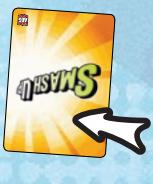
Dueling card for the challenging player.
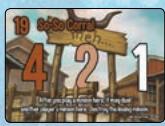
Both these cards will be revealed and either played (if an action) or returned to the hand (if a minion).
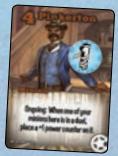
Dueling card for the challenged player.
TERMS&PHRASES
We do our best to use the words in the rules and card abilities carefully; specific words are not synonymous no matter how similar they seem. For example, destroy, discard, move, place, play, and return are all different things done with or to cards. This means that a card that cannot be destroyed can still be returned or discarded. In this section we clarify what the specific words mean.
A Minion: Any minion in play, unless stated otherwise. Exception: "Play a minion" means one from the hand.
Affect: A card is affected if it is moved or transferred, removed from play (e.g., destroyed, returned, shuffled, or placed), changed in power or controller, has an action or counter attached, or its ability canceled. Removing
an attached +1 power counter is considered to affect the card that it was attached to; but removing an attached action is not considered to affect the card that it was attached to, even if that indirectly changes the card's power, abilities, etc. Credit for affecting a card goes to the controller of the card that explicitly mandated the effect.
Exception: If the card specifies a different player to carry out an effect, that player gets the credit.
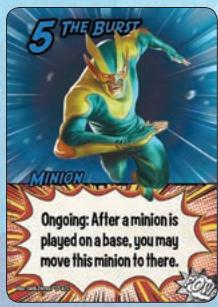
And/Or: "X and/or Y″ means X by itself, or Y by itself, or both X and Y.
After: "After X do Y" means you resolve X completely before you start doing Y. If X does not happen, neither does Y. You must do Y immediately after X, meaning before the current player does some other activity
that does not depend on X. (Use common sense and courtesy when applying this rule.)
Exception: "After a base scores" means after the VP are awarded, not after the new base is chosen; see page 6.
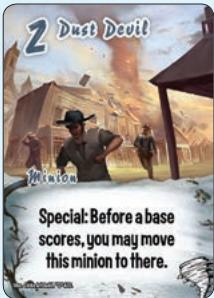
Attachments: Anything that is attached to or played on a card, like other cards or power counters.

Before a Base Scores: After a base has been chosen to be scored, but before VPs have been awarded.
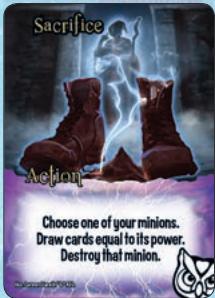

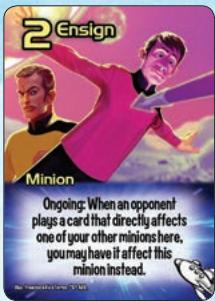
Destroy: This lets you remove a card that's in play and put it into the appropriate discard pile.
Cancel: Canceling an ability means the ability is treated as if it does not exist. Canceling does not undo previous effects created by the ability.
Control: By default, each card you play is controlled by you. If you gain control of a card, it is as if you had played it: minions add to your power total, abilities on the card apply to you and you can use them, etc. Controlling a
minion does not mean you control any actions played on it, but their abilities apply to the minion normally. When the card leaves play, it goes to the hand, deck, or discard pile of its owner.
Directly Affects: Card X directly affects card Y if X's ability does one of the things listed under “Affect”, and Y is a target specified by X.
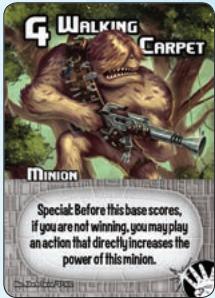
Directly increases power: A card directly increases power if it gives it “+N power", or places or transfers a +1 power counter, or sets the printed power to a higher value. Granting a power-increase talent (e.g. The Touch), or
destroying a negative power card (e.g. Change Into A Gun) are not direct power increases.
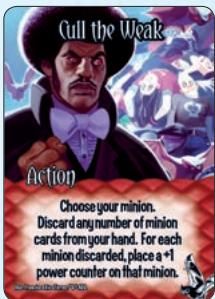
Discard: This lets you put a card that is not in play or has just been scored into the appropriate discard pile. It comes from your hand unless it says otherwise.
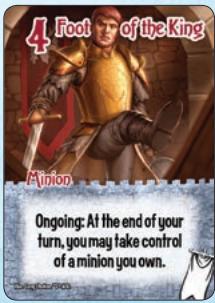
End of a turn: The phrase "end of the turn" means the end of the current player's turn; "end of your turn″ means the end of your current turn if you are the current player, or the end of your upcoming turn if you are not the current player.
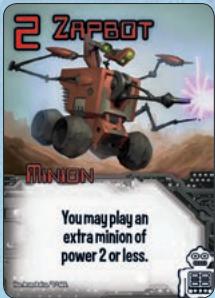
Extra: An extra minion or action is one that is not counted against your normal limit of one per type per turn. You may always play it immediately. If an ability gives you an extra card during the Play Cards phase, you may play it later in the phase unless it refers to a specific card, or it was given by a Special ability. Like regular cards, extra cards are optional.
Have: You have cards at a base if and only if you control the cards.

Here: "Here" refers to the base that the card currently occupies, or to the base itself if a base says “here”. “Move a card here" means “move a card to here” unless another destination is specified.
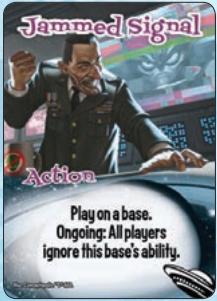
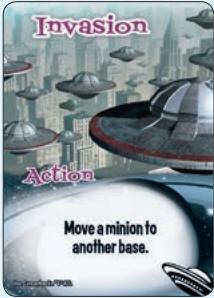
Ignore an Ability: Ignoring a base's ability means: you do not follow a base's instructions, you are not subject to its restrictions, and your cards are neither affected nor protected by its ability.
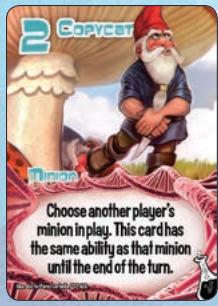
In the box: A card that is in the box is entirely removed from play. Treat it as if it doesn't exist for the duration of the game.
pile, or set aside, or in the box, are not in play.
In Play: Cards in play are in the middle of the table, i.e., an active base, a card on an active base, or a card on a minion. Cards are in play once they hit the table, even before their ability is resolved. Cards in the hand, deck, discard

May: The phrase “You may do X" means you are allowed to do X, but are not required to do X. “You may do X and Y″ means you either do both X and Y, or neither X nor Y; you cannot opt to do just one of them.

Move: This lets you relocate a minion or titan from one base to another, along with any cards or counters on it. Moving a card does not count as playing it. On-play (i.e unlabelled) abilities do not trigger when you move a card.


On Your Turn: This means during the normal Play Cards phase of your turn. You can only do it once per turn unless it says otherwise.
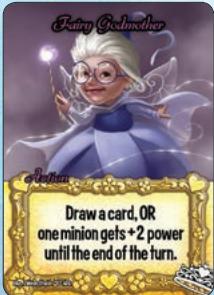
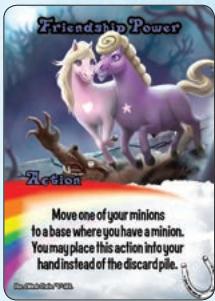
Ongoing: Most abilities happen and then they're over, or else they end at the end of the turn. Ongoing abilities are active for as long as they're in play, and/or they trigger at some later time while in play. Ongoing abilities
do not work from the hand, deck or discard pile.
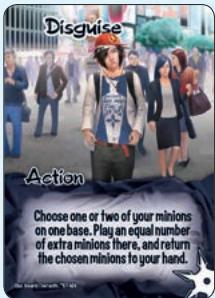
OR: "X OR Y", with "OR" typeset in all capitals, means the controller chooses either X or Y to happen, but cannot choose both.
Other Players: Everyone except “you."
Owner: The player who had the card at the start of the game. Monsters and treasures have no owner.
Place: This lets you relocate a card in a way not covered by other terms, such as from a base to the bottom of your deck, or from the discard pile to your hand.
Play: You play a card when it's one of the free cards you get in the Play Cards phase, or any time an ability specifically says that you're playing it. A card's ability happens when you play it. When cards are moved, placed,
returned, or transferred, they're not being played, and their abilities don't happen.

Player's abilities: The abilities on the cards the player controls. This includes minions, actions, and titans, but not cards the player doesn't control like bases or monsters. Players do not have abilities for themselves, separate from their cards.
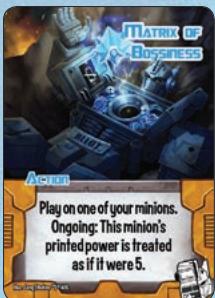
Printed Power: The number physically printed on the card. The printed power is also the starting power of a card, unless an ability changes it.
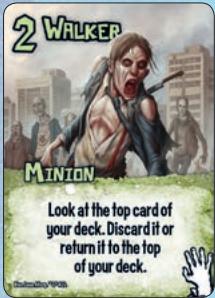
Return: This sends a card back to where it came from. When a card returns from a base, discard attachments on that card and place it in its owner's hand.
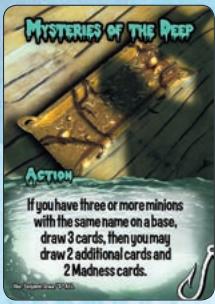
Same Name: A group of one or more cards that all have identically matching card titles. Two or more Ninja Acolytes are such a group, but partial matches like a Ninja Acolyte / Ninja Master do not count. A

single card always counts as a group of cards with the same name.


Special: Special abilities happen at unusual times or in unusual ways, as described in the abilities themselves. (E.g. they might trigger on a card already in play, or in your hand or discard pile.) A card played using a Special ability doesn't count as one of your free cards for the turn. If a Special must be played when its conditions don't allow it, it is discarded instead.
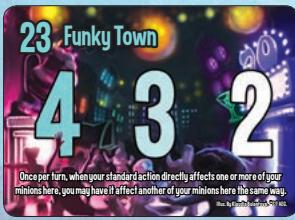
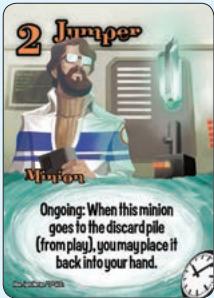
Standard: A standard action is one that does not say “Play on a base" or “Play on a minion". It does its job and leaves.
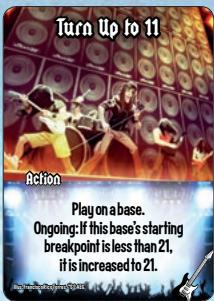
Starting: The power of a minion, or the breakpoint of a base, before being modified by other abilities (or by monsters for breakpoints). Normally this is the number printed on the minion or base, but some cards can change it.
Talent: This is an ability that the card may use once during the Play Cards phase of each of its controller's turns. Using a talent is optional, and a talent can be used at any time during the Play Cards phase.
There: This means the location just referred to by the card text.
This: "This" usually refers to the card itself. If it refers to a different type of card (e.g., a minion with the text “this base”), then it means the card of that type that it is played on; in such cases, “this" has no meaning on a card that is not in play.

To: Some cards say, "Do X to do Y” (e.g. “Discard cards equal to a minion's power to destroy it.") With these cards, if doing X completely is thwarted for any reason (e.g., you don't have enough cards in hand), then you
can't do any of X, or do Y either. If two or more cards tell you to do X to make something else happen, you cannot have that same X count for multiple cards. So there.

Transfer: This lets you relocate actions or power counters from one card to another. When adding counters to your cards (from the pool), or discarding counters from your cards (to the pool), that's not transferring. If the target of the transfer is immune to effects, the transferred card or token is discarded instead.
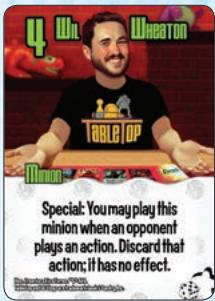
When: "When scoring" means at the time VP rewards are distributed. For uses other than scoring, "when X″ means as X starts happening (typically, you interrupt the part of X that is pertinent to the ability of the card that says, "when"; if there is nothing to interrupt, then “when X” acts just like “after X″ and you've discovered a card that we made an error on).
While: In general, "while X" means as long as X is true. “While scoring" means any time during the Score Bases phase, from the moment the base is chosen to score until it is discarded and replaced by a new base.

You: On a minion, action, or titan, “you" means the controller of the card. On a base, it means any player it describes, which is usually the current player.
Your: When referring to cards in play, this means cards you control, no matter which faction or deck they are from.
DETAILED RULES FOR CARDS,ABILITIES,AND OTHER WACKINESS
This section is where you get into the sinew and gristle of the rules. Okay, that sounds kind of gross. How about... um... this is where we explain how to resolve corner cases and special situations.
Calculating Values for Breakpoints or Power
-
The printed value is the number printed on it, unless an ability specifically changes it (e.g. Matrix of Bossiness, Let's Finish This).
-
The starting value is the printed value, unless an ability resets it to a specific number (e.g. Overgrowth, Mimic). If more than one ability tries to reset the same number, the current player chooses one and the others are ignored.
-
All abilities and other effects that adjust the value up or down -- e.g. "gains +X”, “reduced by Y", power counters, monsters on bases -- are added to or subtracted from the starting value.
-
If the final value is less than zero, raise it up to zero.
Using Card Abilities
On-play (i.e. unlabelled) abilities, and Ongoing abilities with no specified timing, are resolved immediately after playing the card. Ongoing and Special abilities with a trigger (before/when/ after/if X) are only resolved when X happens. Talents and Ongoing abilities that say “on your turn" may be chosen to be resolved once per your Play Cards phase.
When you resolve an ability you must follow all its instructions even if it's bad for you, unless it specifically says you “may" do something.
If you cannot do everything an ability makes you do (e.g., discard a certain number of cards), do as much as you can.
If an ability says “any number," you may choose one, or even zero. You may play a card that says "all” even if there are no targets for it to affect.
If no limit is specified in the rules or on the card, there is no limit. For example, there is no limit to the number of cards that can be played on a base or on a minion; and while an ability only resolves once per trigger, there is no limit to the number of triggers it can respond to unless it says otherwise.
On-play abilities happen when you play a card from your hand, or any time a card says “play." When minions just move around, that's not playing them.
Unless otherwise stated (on the card or in the rules), the effects of an ability expire at the end of the turn. An Ongoing ability ends when its card leaves play, unless the ability stated another expiration time, like the end of the turn. Abilities that grant control of another card last while the controlled card is in play, or until another ability changes its control.
Conflicting Text & Timing
In a game as crazy as this, card text and rules text often conflict. When there's a fight, card text wins. So there's an implicit “unless stated otherwise” with every rule in this book. Exception: Minion power, base breakpoint, and VP rewards can never be reduced below zero.
If cards conflict, the one that says you can't do something beats the one that says you can.
If a card refers to a superlative, e.g. “the highest power here", then ties for that superlative all count.
If abilities from different cards that are in play can be applied at the same time, the current player chooses their order.
If several players can play a card simultaneously (e.g., a Special when a base is chosen to score), or if several players can use the abilities of the same card (e.g., tied winners at a base), the priority goes to the current player first, then around the table clockwise.
Multiple Effects
Multiple parts of a card's ability must be done in their stated order, unless it says otherwise.
If an ability lists multiple effects conditionally (examples: "If X, Y″ or “Do X to do Y" or “When X, Y" or “Each time X, Y" or "After X, Y"), then if you do X, you must do Y. In addition, effect X must happen for effect Y to happen. If you can't do all of X, then you are not allowed do part of it, (for example, discarding some cards lower than the amount you were supposed to); and if X does not fully occur, you cannot do Y.
If an ability lists multiple effects independently (e.g. "Do X then Y" or "Do X and do Y″ or "Do X. Do Y."), then you must do both X and Y if you can, in that order. If you cannot do one, you must still do the other.
Abilities that say “Do X until Z" (e.g. "Each of your minions gains +1 power until the end of the turn") only affect the cards currently in play, not those played after that ability triggers.
Abilities that say “Until Z do X” (e.g. “Until the end of the turn, cancel the abilities of all cards on the base"), and ongoing abilities with no time limit (e.g. “Ongoing: All your minions here have +1 power") do affect cards that are played or moved there later, and do not affect cards moved away.
Canceling or Preventing Effects
You can play a card even if its ability can't or doesn't happen. For example, you can play an action that destroys a minion even if no minions are in play, or if the minion you choose is immune to destruction.
If an ability affects multiple targets, resolve that effect on each target separately. For example, if several minions are destroyed by one action card, and one of those minions is immune, it survives the destruction while all the other minions are destroyed.
If ability X protects a minion from card effects when the minion's power is within a certain range (e.g. "power 2 or less"), and ability Y changes that minion's power to a value within that range (e.g. “-1 power" on a 3-power minion), then the power change takes precedence over the protection. The change is what makes the minion fall in the protected range, so that effect is allowed despite the apparent protection.
Extra Cards
An extra card is one played in excess of the quota of one per card type (minion or action) per turn. Cards you play outside the Play Cards phase of a turn are counted as extra cards.
Extra cards must be played during the phase they are granted (usually the Play Cards phase).
You do not have to play the extra cards that you have earned. An extra card can, and in some cases must, be played before the normal quota card is played.
Some extra card plays granted may be held in reserve until later in the phase. These are the generic ones (e.g., “play an extra minion") that are granted by a non-Special ability during your Play Cards phase.
You may always play an extra card immediately. You must play an extra card immediately if:
• the extra card play effect refers to a specific card (e.g., "Reveal the top card of your deck. If it's a minion you may play it as an extra minion."), or
• another part of the ability follows the extra play (e.g., “You may play an extra minion and place a +1 power counter on it."), or
· the extra card play is granted outside the Play Cards phase (e.g., “When a base scores...").
Attached Cards
Cards that say, “play on a base/minion" stay there until another card relocates them or the base or minion it is on leaves play.
When a minion is moved, cards attached to it move with it; when a minion is destroyed, returned or placed, discard any attachments it has. When a base scores, discard all cards on it.
If an ability says that a minion or base is not affected by cards or actions, any such cards that are already attached to the minion or base are immediately destroyed, since having a card attached is an effect. Similarly, if you try to play such a card on a minion or base protected from its effects, that card is discarded instead.
An action played on a minion is controlled by the player who played the action, not by the controller of the minion. Changing control of a minion does not affect the control of actions on it, and vice versa.
You can attach two identical actions to the same minion.
Only cards that say, "Play on a base or minion" are considered played on that base/minion. Actions on minions are not on the base. Standard actions that affect a base or minion but don't get played on it (e.g., Rampage) are not on the base or minion.
Triggered and Tagged Abilities
Specials can be played at any time they are applicable, even on other players' turns.
If an event happens that triggers an ability, that single event triggers any and all such cards. But any card can be used only once per trigger. If the trigger is something like “on/during your turn”, you can use it at most once per your turn.
Abilities can trigger at one point of time but take effect later. E.g. cards that say “after X do Y” trigger when X starts, but don't take effect until after X ends.
If a timing label (Ongoing, Special, Talent) appears in an ability description, that label applies to all text that follows the label up to the end of the description, or to another label (if there is one). Text that precedes a label, and text without a label, are normal on-play ability effects that take place instantly when played.
Decks, Discards, and Searches
If you need to draw, reveal, search for, or look at a card and your deck is empty, shuffle your discard pile and put it on the table face down—that's your new deck. Start or continue drawing (revealing, searching) from there.
Drawing and revealing always start at the top of the deck or discard pile.
Anyone may look through any discard pile at any time.
If you “look" at a card, show it to no one else. If you “reveal" it, show it to everyone else.
If you “search" a deck or discard pile for a card, you must reveal the card chosen. After searching a deck, you must shuffle it.
In and Out of Play
When a card that others can see goes to the hand, deck, or discard pile, it goes to the one belonging to the card's owner (i.e., the player whose deck the card came from), no matter who played or controlled it. However, if no one else can see the card, these restrictions are lifted. You can place a card from your hand atop your deck even if you don't own it, for example, since no one can see whose it is.
When a card leaves play, discard any cards and counters on it. This includes bases: no card on a base leaving play may stay for its replacement unless explicitly allowed.
When a card leaves play there is no memory of its previous status, so that even if it is replayed in the same turn it is treated as a new card, not the same card.
The power of a minion not in play is only the number printed on it, but once in play its power includes all modifications see Calculating Values for Breakpoints or Power, page 12.
Last of All
If there is a situation you don't know how to resolve, work it out the best you can, with an attitude of fun, fair play, and a sense of humor. (Afterward, you can email questions to CustomerService@alderac.com.)
RULES CHANGES AND ERRATA
Over the years we've had to adjust or add a few rules (beyond those needed for new mechanics). Some are general rules, while others are needed to prevent unintended use of certain cards. And yes, a few mistakes crept in at various places. We blame the nefarious activities of HAVOC.
New GeneralRules
• After you search your deck for a card, you must always reveal it and shuffle your deck, even if the card doesn't mention this.
When a card that others can see goes to the hand, deck, or discard pile, it goes to the one belonging to the card's owner (i.e. the player whose deck the card came from), no matter who played or controlled it.
• You no longer need a minion on a base to receive VP rewards; if you have power there by some other means, that qualifies you to earn rewards.
Card Text Changes (by Faction)
Several cards, especially those from early sets, have had their text corrected. We recommend that you treat each of these cards as if it had the text shown below. Some of them are also discussed in the Clarifications section on pages 16-25.
The following sets have had card errata:
• Smash Up (core set): Aliens, Dinosaurs, Ninjas
• Awesome Level 9000: Bear Cavalry, Killer Plants
• Monster Smash: Giant Ants
· The Obligatory Cthulhu Set: Elder Things, Innsmouth, Minions of Cthulhu
• Pretty Pretty Smash Up: Mythic Horses
· Science Fiction Double Feature: Time Travelers
• Promo factions: Sheep
Aliens

Collector: "You may return a non-Collector minion of power 3 or less on this base to its owner's hand." This prevents infinite loops.
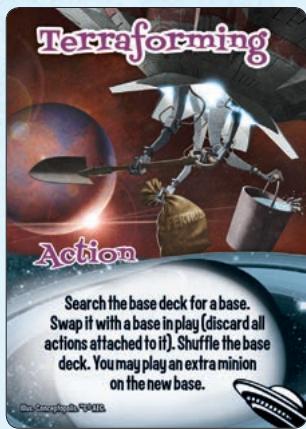
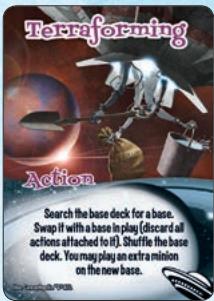
Terraforming: "Search the base deck for a base. Swap it with a base in play (discard all actions attached to it). All minions from the original base remain. Shuffle the base deck. You may play an extra minion on the new base."
Bear Cavalry
This makes the implication explicit.

Bear Hug: “Each other player destroys his or her minion with the least power (controller chooses in case of ties)."
Otherwise this could lead to an impasse if the owner is not the controller.
Dinosaurs
Elder Things
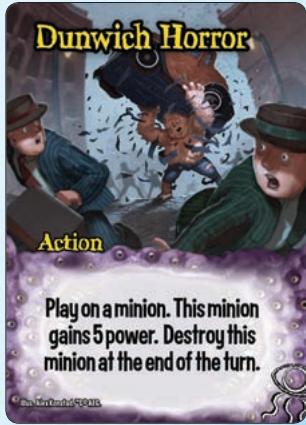
Dunwich Horror: "Play on a minion. Ongoing: This minion gains 5 power. Destroy this minion at the end of the turn."
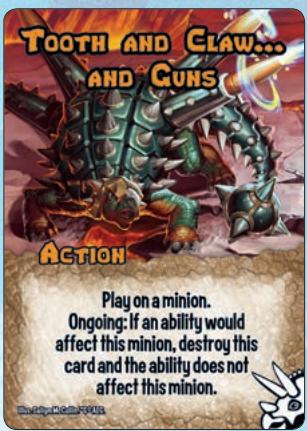
Tooth and Claw ... and Guns: "If another player's ability would affect this minion, destroy this card and the ability does not affect this minion for the rest of the turn."
The card was never meant to prevent your actions, or the effects of bases or the minion itself. We added a time limit for effect negation.
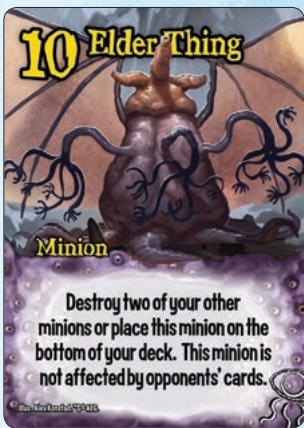
Elder Thing: "Destroy two of your other minions or place this minion on the bottom of your deck. Ongoing: This minion is not affected by opponents cards."
Defines the card's timing.
Defines the card's timing.
Giant Ants
Special:After this base scores, transfer any or all+1 power counters from one of your minions here to another minion.
Playonabase.
Your minions here of power
2orless arenotaffectedby
opponents'cards.
Innsmouth
Killer Plants

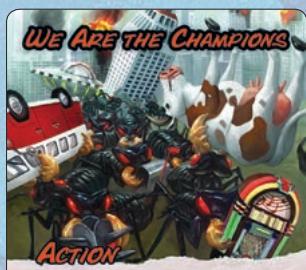
We Are the Champions: "Special: After a base scores, transfer any or all +1 power counters from one of your minions there to another minion."
This matches the intent of being triggered from the hand.
Minions of Cthulhu
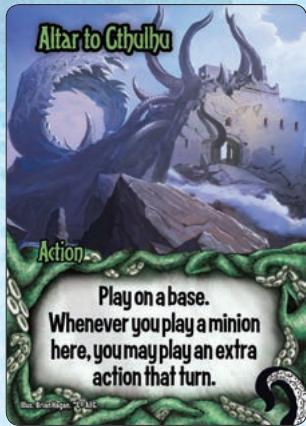
Altar to Cthulhu: "Play on a base. Ongoing: Whenever you play a minion here, you may play an extra action that turn." Defines the card's timing.
In Plain Sight: "Play on a base. Ongoing: Your minions here of power 2 or less are not affected by opponents' cards." Defines the card's timing.
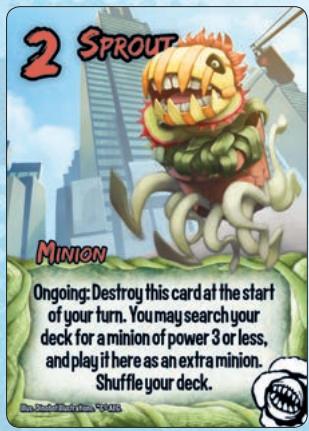
Sprout: "Destroy this card at the start of your next turn. You may search your deck for a minion of power 3 or less, play it here as an extra minion, and shuffle your deck."
This avoids gross exploitation with cards that reward destruction (e.g. Field of Honor).

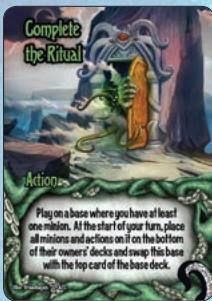
Complete the Ritual: "Play on a base where you have at least one minion. Ongoing: At the start of your turn, place all minions and actions on it on the bottom of their owners' decks and swap this base with the top card of the base deck." Defines the card's timing.
Mythic Horses
Talent:If youhave played another minion here, drawacard.
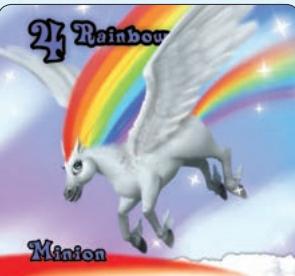
Rainbow: “Talent: If you have played another minion here this turn, draw a card." This matches the fact that in Smash Up you don't keep track of what happened on the base in previous turns.
Ninjas
Sheep

Time Travelers
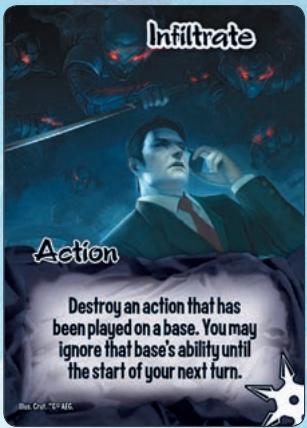
Infiltrate: "Play on a base. Destroy another action that has been played here. Ongoing: You may ignore this base's ability. Destroy this card at the start of your turn."
The card does not destroy itself when played, and does not stay after it expires.
Counting Sheep: Play on a base. Ongoing: Once per turn, after the power of another player's minion's increases, your minions here gain +1 power until the end of the turn. This prevents infinite loops.
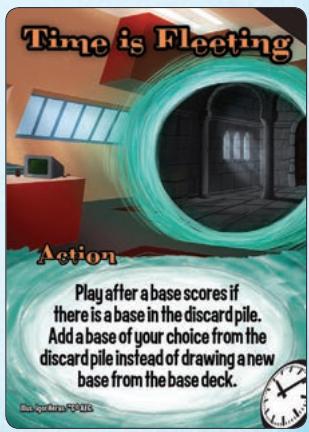
Time is Fleeting: "Special: Play after a base scores if there is a base in the discard pile. Add a base of your choice from the discard pile instead of drawing a new base from the base deck."
Defines the card's timing.
CARD CLARIFICATIONS Minions, Actions, and Titans (by Faction)

Aliens
Smash Up core set
Collector: Collectors cannot return Collectors. (See the errata, page 14.)
Invader: If the Invader is destroyed, you do not lose the VP it gave you.
Jammed Signal: Ignoring a base's ability means: you do not follow a base's instructions, you are not subject to its restrictions, and your cards are neither affected nor protected by its ability.
Terraforming: You do not discard minions on the Terraformed base, nor actions attached to them.

Ancient Egyptians Oops, You Did It Again
Blessing of Anubis: If you use this card's ability to bury itself, you reveal it and place it face down on the base. If you uncover it you play it again but ignore the first part since uncovered cards are not reburied.
Mummy: This ability can only trigger if the
Content is long; only the first part is inlined. Download the file or open the rules page for the full text.
Download Markdown简繁检索对照.md1.6 KB
137_122522_smash-up — 简体/繁体检索对照
本游戏的规则书是繁体中文原文。用户用简体提问时,把关键词按下面这张表转成繁体再去 grep 原文,命中率最高。
回答时用简体或繁体都可以,但引用的原文保持繁体。
简体 → 繁体 对照(按该游戏原文出现频率排序,共 60 字)
| 简体 | 繁体 | 原文出现次数 |
|---|---|---|
| 张 | 張 | 63 |
| 个 | 個 | 49 |
| 时 | 時 | 47 |
| 从 | 從 | 38 |
| 战 | 戰 | 36 |
| 随 | 隨 | 34 |
| 种 | 種 | 33 |
| 后 | 後 | 33 |
| 则 | 則 | 29 |
| 数 | 數 | 29 |
| 这 | 這 | 28 |
| 计 | 計 | 28 |
| 们 | 們 | 25 |
| 组 | 組 | 24 |
| 来 | 來 | 24 |
| 为 | 為 | 24 |
| 弃 | 棄 | 23 |
| 会 | 會 | 22 |
| 规 | 規 | 21 |
| 选 | 選 | 21 |
| 游 | 遊 | 20 |
| 术 | 術 | 20 |
| 发 | 發 | 20 |
| 戏 | 戲 | 19 |
| 当 | 當 | 19 |
| 择 | 擇 | 18 |
| 斗 | 鬥 | 17 |
| 获 | 獲 | 16 |
| 动 | 動 | 16 |
| 间 | 間 | 12 |
| 总 | 總 | 12 |
| 触 | 觸 | 12 |
| 杀 | 殺 | 11 |
| 两 | 兩 | 11 |
| 库 | 庫 | 11 |
| 军 | 軍 | 11 |
| 灭 | 滅 | 11 |
| 队 | 隊 | 11 |
| 对 | 對 | 10 |
| 额 | 額 | 10 |
| 开 | 開 | 10 |
| 轮 | 輪 | 9 |
| 说 | 說 | 9 |
| 于 | 於 | 9 |
| 执 | 執 | 9 |
| 过 | 過 | 9 |
| 标 | 標 | 8 |
| 拥 | 擁 | 8 |
| 设 | 設 | 8 |
| 顺 | 順 | 8 |
| 结 | 結 | 8 |
| 续 | 續 | 8 |
| 须 | 須 | 7 |
| 进 | 進 | 7 |
| 检 | 檢 | 7 |
| 请 | 請 | 7 |
| 点 | 點 | 7 |
| 么 | 麼 | 7 |
| 议 | 議 | 6 |
| 机 | 機 | 6 |
Texts are community-compiled or publicly released by publishers; copyright remains with the original authors. For personal reference only.