
Star Wars: Legion
At a glance
Rules, cards and Q&A (Chinese)
The rules, card data and player questions for this game are written in Chinese. Open the Chinese page to read them.
Where to find full rules
Full rules and card lookup are available in the cunlema app at cunlema.cn — pick this game and ask about any rule, card or turn you are unsure about.
Related games
- Twilight Imperium: Fourth Edition
- War of the Ring: Second Edition
- Pacific War: The Struggle Against Japan, 1941-1945 (Second Edition)
- Twilight Struggle
- Empire of the Sun: The Pacific War 1941-1945
- Imperial Struggle
- Advanced Squad Leader: Starter Kit #1
- Advanced Squad Leader
- Tanto Monta: The Rise of Ferdinand & Isabella 1470-1516
- The Last Hundred Yards
Rulebook text (Markdown)
This game has 1 rulebook Markdown file(s) in our library; 1 rendered inline below — expand to read or download.
SWL_Rulebook_1.5.md210.3 KB
WTAR
LEGION
CORE RULEBOOK
VERSION 2.5.3
Effective 7.21.2023
ATOMIC MASS GAMES
Lead Game Developer: Andrew Dursum
Game Development: Michael Plummer, Sarah Rowan
Development Manager: Will Pagani
Product Line Management: Melissa Butler and Andrea Lowe
Editing: Scheherazade Anisi, Emily Parks
Proofreading: Leland Pena and Seth Rourk
Graphic Design: Dan Gerlach, Justus Morschauser, Ryan Ritter, and Brianna Winters
Photography: Matt Ferbrache and Leah Rosen
Graphic Design Manager: Jessy Stetson
Art Direction: Josh Colón and Preston Stone
Miniature Painting: Jordan Lamb and Ingo Lehner
Scenery: Rob Hawkins
Sculpting Coordination: Mike Jones
Engineering: Bexley Andrajack, Alex Edinger, Kevin Kircus, Bryan Pierce, Nicholas Smith, and Chris Tiemeyer
Engineering Manager: Evan Kang
Sculpting Director: Marco Segovia
Marketing Manager: Brian Keilen
Marketing Coordinator: Summer Ditona
OP & Events: Courtney Downing
Social Media & Community Manager: Anne Richmond
Director of Marketing: Elizabeth Peotter
Assistant to the Creative Director: Tony Konichek
Creative Director: Dallas Kemp
Director of Operations: Derrick Fuchs
Director of Product Development: Will Shick
Head of Studio: Simone Elliott
ASMODEE NORTH AMERICA
Licensing Coordination: Kira Hartke, Kaitlin Souza
Licensing Approvals Manager: Dana Cartwright
Production Coordination: Estelle Gavin, Jarrett Ford, John Hannasch, Lee Houff, Chris Jensen, and Alex Schlee
Production Engineer: Michael Blomberg
Production Management: Justin Anger and Austin Litzler
Regional Head of Publishing: Bill Altig
Global Head of Publishing: Steve Horvath
LUCASFILM LIMITED
Licensing Approvals: Brian Merten
PLAYTEST LEADS
Chris Bieser, Nick Bodnar, Matt Dunn, Steve Gibb, Michal Koscielak, Daniel Lupo, Finn Peemüller, Nick Porterfield, Seth Rourk, and Weston Thobaben
CONTENTS
COMPONENTS
GAME OVERVIEW
KEY CONCEPTS
Rules Priority..
Objects/The Battlefield
Bases and Base Contact 5
Dice..
Units
Cards
Game Effects
Card Effects
Timing.
Card Anatomy
Battle Cards.
Unit Cards.
Upgrade Cards.
Command Cards.
Keywords..
Tokens....
Measurement
At, Within, and Beyond.
Terrain
Scatter Terrain.
Area Terrain ....
Obstacle Terrain
Terrain Restricting Movement
Terrain Providing Cover.
Terrain Height
Cover... Z
Actions
Suppression
GETTING READY TO PLAY. 5
Setup. 15
Build an Army, Command Hand, and a Battle Deck 15
Factions, Light Side, and Dark Side.
Points. 15
Ranks and Rank Requirements. 15
Upgrade Cards. 15
Building a Command Hand . 17
Building a Battle Deck. #
Establish the Battlefield and Prepare Components .18
Declare and Place Terrain.. 18
Select Player Color and Sides. 18
Reveal Battle Cards, Define the Battlefield, and Resolve
Objective and Condition Cards 18
Objective Tokens .19
Deploy Units.... .19
Winning the Game. .19
GAME MECHANICS 19
Parts of a Round. .19
The Command Phase. 19
Select and Play Command Cards 20
Determine Priority 20
Nominate Commanders and Issue Orders 20
The Activation Phase.
Choose a Unit to Activate or Pass. 21
Rallying. 22
Perform Actions. 22
Movement... 23
Climbing. 25
Mele . 26
Attack. 26
Attack Timing 27
Line of Sight.. 27
Weapons ... 28
Declare Defender... 28
Form Attack Pool.. 28
Roll Attack Dice. 29
Apply Dodge and Cover. 30
Roll Defense Dice... 30
Compare Results 30
Suffering Wounds and Defeating Miniatures 31
Full Attack Sequence Example. 32
Standby..... 33
The End Phase .. 33
Promote......
APPENDIX A: NOTCHED BASES
APPENDIX B: UNIT TYPES..
Vehicles.
APPENDIX C: MERCENARIES AND BATTLE FORCES......38
APPENDIX D: BATTLE CARD RULES 39
Claim. 39
Bombing Run Objective... 39
Payload Objective... 39
Bomb Cart Special Rules 39
Sabotage the Moisture Vaporators Objective 39
Supply Drop Condition 39
The Supply Deck... 39
APPENDIX E: TIMING.. 40
Setup. 40
Parts of a Round. 40
Parts of the Command Phase. 40
Resolving Command Card Effects. 40
Parts of the Activation Phase. 40
Parts of a Unit's Activation. 41
Attack Timing 41
Parts of the End Phase
KEYWORD GLOSSARY...
Unit Keywords
Weapon Keywords 54
Upgrade and Command Card Keywords
LINE OF SIGHT SILHOUETTE TEMPLATES
COMPONENTS
LEGRDOK
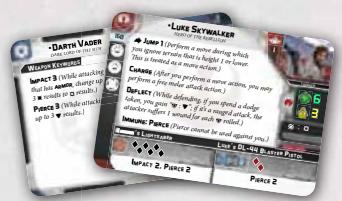
Unit Cards

Counterpart Cards
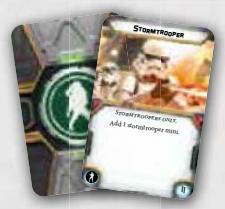
Upgrade Cards


Movement Tools
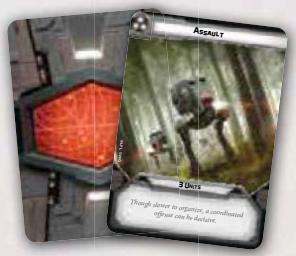
Command Cards
Battle Cards


Supply Cards
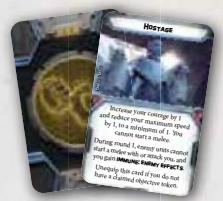
Hostage Cards
Five-Part Range Ruler

Observation Token

Smoke Token
Standby Token

Suppression Tokens

Panic Token
Condition Tokens


_Aim Token


Dodge Token
Surge Token

Objective Tokens
Order Tokens
Vehicle Damage Tokens

Operative Marker Token
Round Counter
lon Token


Victory Tokens
Poison Token
Active and Inactive Shield Tokens

Charge Tokens

Immobilize Token
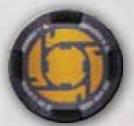
Unit ID Tokens
Wheel Mode Token
Deployment Marker

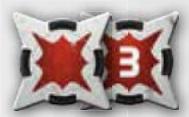
Commander Token
Wound Tokens

Red and Blue Graffiti Tokens
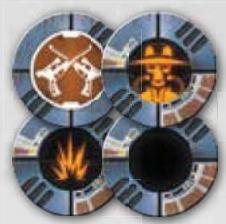
Bane Tokens
GAME OVERVIEW
In Star Wars™: Legion, players build, paint, and command entire armies from the various factions of the Star Wars galaxy. Each of these characters is represented on the tabletop by a highly detailed hobby miniature. Before the game, players assemble and paint their miniatures to create an army of Star Wars characters that is truly their own. Each miniature brings with it a host of rules and abilities for players to use in order to complete their mission and achieve victory.
KEY CONCEPTS
This section describes the fundamental concepts around the miniatures and basic gameplay.
RULES PRIORITY
This rulebook contains the core rules of Star Wars: Legion. Some special rules, keywords, or cards may contradict these rules. When they do, the special rule takes precedence over the core rules found in this rulebook.
Some rules state that things "can" happen, while others say that things "cannot." If two such rules occur at the same time, the "cannot" overrides the "can.'
OBJECTS/THE BATTLEFIELD
Miniatures, tokens, and terrain are all objects. The table or surface being played on is the battlefield.
BASES AND BASE CONTACT
Each miniature in Star Wars: Legion is modeled on a base. A unit's base depends on its unit type: troopers, clone troopers, droid troopers, and Wookiee troopers are on small bases. Everything else is on notched bases of various sizes.
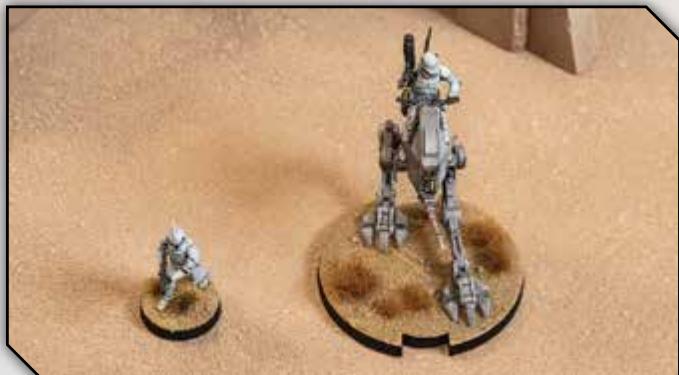
Many rules in Star Wars: Legion use the term "base contact," which means that the miniature must be touching whatever the rule is referencing. This includes another miniature's base, a piece of terrain, or a token.
Miniatures cannot move into base contact with miniatures from enemy units unless the unit leader has a melee weapon (). If the unit leader does, the unit leader can perform a move into
base contact with an enemy miniature to start a melee. For more information on melee combat, see pg. 26.
Because a miniature's base can be placed on top of uneven terrain, there are situations in which another miniature cannot be placed into physical base contact with the first miniature because of a difference in elevation between the two bases. In these situations, if the following two conditions are met, those miniatures are treated as if they are in base contact: when viewed from above, there is no space between the two miniature's bases, such that if they were not on differing elevations or were both flat on the battlefield, their bases would be touching, and the vertical distance between the two bases is no greater than the height of the lower miniature's silhouette. For more information on silhouettes, see pg. 27.
DICE
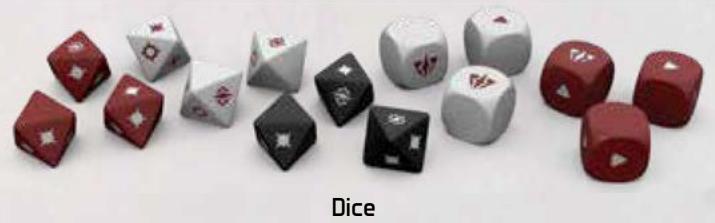
Star Wars: Legion uses dice rolls to determine the results of the actions the players' armies perform on the battlefield—most commonly attacking and defending. Star Wars: Legion uses five different kinds of dice: three for attacking and two for defending. For attacking, players roll red, black, or white attack dice; while defending, they roll red or white defense dice.
Attack dice have the following symbols: Hit (), Attack Surge (), Critical ().
Defense dice have the following symbols: Block (), Defense Surge ().
Die faces that are blank are blank results.
The faces of each die are as follows:
》:Hit
»: Critical
»: Attack Surge
»: Defense Surge
» ▼: Block
» Blank
• There are three colors of attack dice: red, white, and black.
Each attack die is represented on cards by the following icons:
» Red attack die
0-8
» White attack die
0-8
» Black attack die
There are two colors of defense dice: red and white. Each defense die is represented on a unit's card by the following icons:
» Red defense die

» White defense die

The dice used by a unit to attack and defend are listed on its Unit Card, or occasionally an Upgrade or Command Card.
UNITS
Miniatures in an army are organized as units that move and fight together. The rules for each unit in a player's army can be found on their Unit and Upgrade Cards.
Each unit in Star Wars: Legion is led by a unit leader that has a unique miniature.
Units must always be in cohesion. For more information on cohesion, see pg. 19.
FRIENDLY AND ENEMY
Rules in Star Wars: Legion often use the terms friendly and enemy when referring to units. Units a player controls are friendly to that player. Units that a player does not control are considered enemy units to that player.
CARDS
Star Wars: Legion uses a variety of cards to present the rules for different miniatures as well as track various game effects.
GAME EFFECTS
Game effect refers to any instance, occurrence, or trigger of any rule, card text or effect, unit ability, keyword, or other special rule.
CARD EFFECTS
Card effect refers to any effect that originates from the text or rule on any card. Keywords are card effects. Keywords can be found in the Keyword Glossary on pg. 42.
REMINDER TEXT
Some cards contain italicized text in parentheses called reminder text. Reminder text is NOT rules text and is only there to remind players how the rule or ability functions. For full rules text, players must consult the Keyword Glossary on pg. 42.
TIMING
Some rules refer to the active player; the active player is the player whose turn it is.
Sometimes effects will occur at the same time. The player with priority always resolves their effects first. If neither player has priority, the blue player resolves their effects first. If a player has multiple effects that occur at the same time, they choose the order in which to resolve effects.
Sometimes an effect happens after something is resolved, which means that the effect happens after that thing has been totally completed.
CARD ANATOMY
BATTLE CARDS
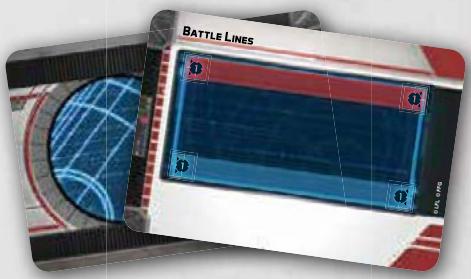
Battle Cards form the Battle Deck and are used in Setup, where players work together to build the mission they use for that game. Battle Cards are divided into three categories: Objective (Blue), Deployment (Red), and Condition (Green).
Objective Cards list the objectives the players are trying to accomplish, and the Victory conditions used to determine which player wins the game.
Deployment Cards show a map of the battlefield and the areas in which players may deploy their armies during Setup, known as deployment zones.
Condition Cards have a variety of different effects that impact the battle and how the game is played, from limited visibility to dangerous minefields!
UNIT CARDS
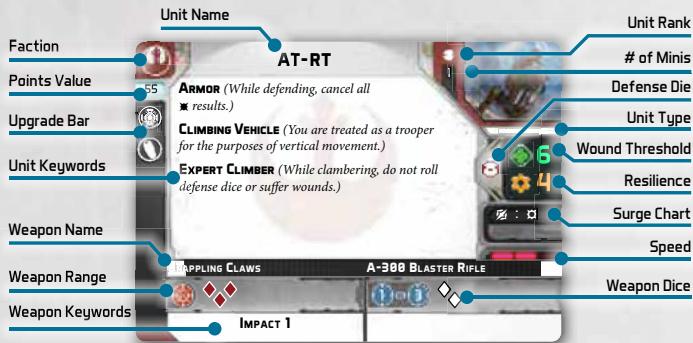
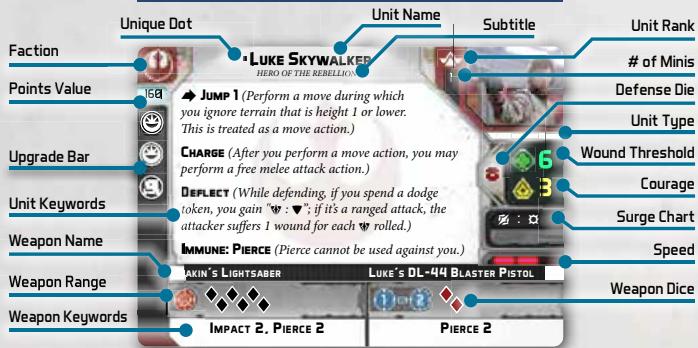
Unit Cards show the special rules and stats of a unit. Every unit in an army has its own Unit Card, an example of which is shown below.
UNIT CARD (VEHICLE)
UNIT CARD (TROOPER)
-
Name: The unit's name.
-
Subtitle: The unit's subtitle, if it has one. Rules may reference a unit with its subtitle.
-
Faction: The unit's faction. For more information on factions, see pg. 15.
-
Unit Rank: The unit's rank. For more information on ranks, see pg. 15.
-
Points Value: The unit's point cost. Points are used in Army Building. See pg. 15 for more information on Army Building.
-
Number of Miniatures: The number of miniatures in the unit.
-
Unit Type: The unit's type. For more information on unit types, see pg. 36.
-
Upgrade Bar: The types of upgrades, if any, that are available to the unit.
-
Unit Keywords: The unit's keywords. Each unit keyword provides special rules and abilities to the unit. Keywords can be found in the Keyword Glossary on pg. 42.
-
Wound Threshold: The unit's wound threshold. This is the maximum number of wound tokens each miniature in the unit can have before they are defeated.
ll. Courage Value: The unit's courage value. See pg. 14 for more information on suppression and courage.
- Speed: The unit's speed. The movement tools the unit uses while moving.
B. Weapons: The unit's weapons. For more information on weapons, attacks, and dice pools, see pg. 28.
-
Defense: The type of defense die the unit rolls when defending against attacks. For more information on rolling defense dice, see pg. 30.
-
Surge Chart: The unit's surge chart. For more information on surge results, see pg. 29.
UPGRADE CARDS
Upgrade Cards can be added to units and give them additional rules and/or miniatures. The parts of an Upgrade Card are shown below.

-
Card Title: The upgrade's title.
-
Upgrade Type: The upgrade's type.
-
Restriction: The restrictions on which units can take the upgrade, if any.
-
Expend/Exhaust: Some Upgrade Cards require the card to be expended or exhausted. See pg. 16 for more information on expend and exhaust.
-
Effect: The upgrade's effect.
-
Points Value: The upgrade's point cost.
-
Wound Threshold: The wound threshold of any additional miniatures added to the unit with the upgrade. Sometimes these miniatures will have a different wound threshold than the unit.
-
Weapon: Some Upgrade Cards add additional weapons for the upgraded unit to use. The card shows the range at which attacks may be made with this weapon, and the dice this weapon contributes to the dice pool when used in attacks. For more information on weapons, attacks, and dice pools, see pg. 28.
-
Surge Chart: Sometimes an upgrade has a surge chart. This chart is only used in certain situations and does not affect the equipped unit. For more information on surge results, see pg. 29.
COMMAND CARDS
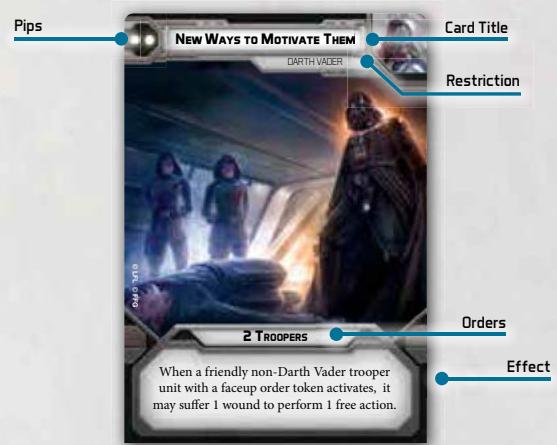
Command Cards form a player's command hand and are used in the Command Phase to determine player priority, issue orders to units, and grant powerful game effects.
-
Card Title: The title of the Command Card.
-
Pips: The number of pips this Command Card has. Pips are used in Army Building and when determining player priority.
-
Restriction: Some Command Cards are restricted to a certain commander, faction, unit, or Battle Force, which is listed here.
-
Orders: The units the nominated commander can issue orders to with this card.
-
Effect: The effect of the Command Card.
-
Weapon: Some Command Cards allow miniatures to use a weapon on the Command Card.
Bolded words are special rules called keywords. There are four types of keywords: command, unit, upgrade, and weapon. Their full rules text is written in the Keyword Glossary instead of on the cards. Keywords are found in the Keyword Glossary on pg. 42.
X KEYWORDS
Some keywords have a numerical value, presented as "X" in the Keyword Glossary. These keywords stack with themselves and can be any type of keyword. If a unit gains multiple instances of a keyword with a numerical value, add those values together.
For example, Stormtroopers have the Precise 1 keyword on their Unit Card. If they equip the Targeting Scopes gear upgrade, which gives them Precise 1, they will have Precise 2.
TOKENS
Star Wars: Legion uses a variety of tokens to track game effects and rules. Below is a list of all the different types of tokens and a summary of their effects.
| Token | Rules |
Aim | Used when attacking to reroll upto two attack dice. Aim tokens aregreen tokens. |
Dodge | Used when defending to cancelincoming hit results. Dodge tokens aregreen tokens. |
Surge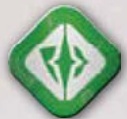 | Used when attacking or defending toconvert surges to hits or blocks. Surgetokens are green tokens. |
Standby | Used to move or attack after an enemyperforms an action. |
Observation | Used when attacking to reroll oneattack die. |
5moke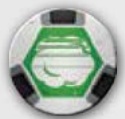 | Improves cover of nearby units. |
Suppression | Used to track the amount ofsuppression on a unit. |
Panic | Used to track units that are panicked. |
Wound | Used to track the number of wounds aminiature has suffered. |
Vehicle Damage | Used to track the penalties sufferedby a vehicle that has sustainedsignificant damage. |
Order | Used in the Command Phase to issueorders to units and to form the orderpool. Used in the Activation Phase totrack which units have activated. |
Commander | Used to track who is the activecommander and when a commander isfield promoted. |
ID | Used to track multiples of similar unitsthat may have different upgrades orrules. |
Victory  | Used to keep track of victory points anddetermine which player wins the game. |
lon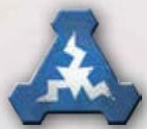 | Used to track the effects of the lonkeyword. |
Immobilize
Condition
Poison
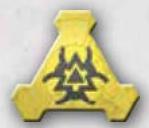
Used to track the effects of the Poison keyword.

Shield
Used to track the effects of the Immobilize keyword.

Used to track the Shielded keyword.
Charge

Wheel

Used by certain upgrade and Command Cards in conjunction with the Arm keyword.
Incognito
Used to track the Wheel Mode keyword.
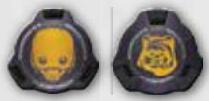
Bane
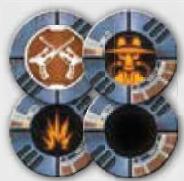
Graffiti
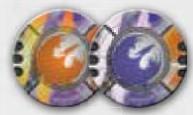
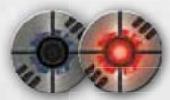
Objective

Used by Sabine Wren and her Command Cards.
Used to track the Incognito keyword.
Used by Cad Bane and his Command Cards.
Used to mark the location of objectives on the battlefield. An objective token has two sides: a red claimed and blank unclaimed side.
Used to mark certain battlefield conditions.
MEASUREMENT
Star Wars: Legion uses two kinds of measuring tools: movement tools and range tools. Any distance that is measured using a measurement tool can be measured at any time, but players may only use one movement tool and a range tool with up to five segments.
There are three movement tools, from shortest to longest: the speed-1 tool, the speed-2 tool, and the speed-3 tool.
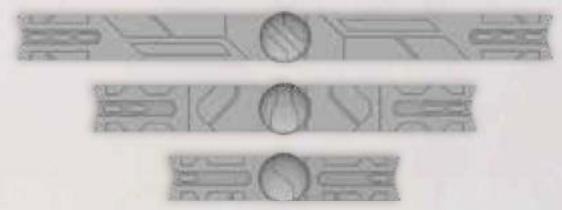
Movement Tools
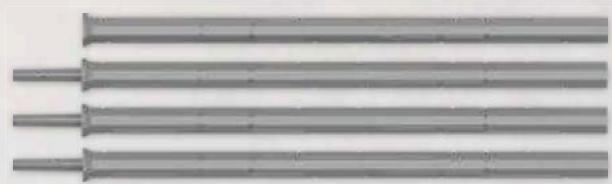
Five-Part Range Ruler
The range tool is made up of up to five segments. Many rules, weapons, and abilities refer to a required range with a set of icons, listed below.
》:Melee
»: Range 1
»: Range 2
》0: Range 3
»: Range 4
»: Range 5
»: Beyond range 5
AREA RANGE
Range icons that are yellow indicate area weapons. For the full rules on area weapons, see Area Weapons in the Keyword Glossary.
Sometimes, more than one number is shown—in this case, the first number represents the minimum range, and the second number represents the maximum range. If only a single number is shown, then that is the maximum range for that effect.
Range is always measured as the shortest distance possible between two objects. To measure range between two objects, take the range tool and place it flat on the battlefield so that one end is touching the object being measured from. Then add segments until the total length of the range tool is longer than the distance between the two objects. The segment of the range tool that object is inside is equal to the range between the two objects. When measuring to or from miniatures, always measure from the miniature's base, ignoring the miniature itself.
Melee range is not measured with the range tool; instead, two miniatures are in melee range with one another if they are in base contact. For more information on melee, see pg. 26.
EXAMPLE: MEASURING
When measuring range between two objects, only take the horizontal distance into account—never the vertical distance. A measurement tool should always be flat on the battlefield; if this isn't possible (due to terrain, for example), hold the measuring tool above the battlefield and check positions based on the measurement tool.

AT, WITHIN, AND BEYOND
Some abilities require two objects to be at, within, or beyond a certain distance from each other.
An object is at a range of another object if any portion of it is inside that range as measured by the range tool. For a unit to be at a specified range, only one miniature in the unit must be at the given range. An object is always at any range of itself.
An object is within a range of another object if it is entirely inside that range as measured by the range tool. For a unit to be within a range, all miniatures in the unit must be within the given range. A unit that is within a certain range is also at that range.
An object is beyond a range of another object if it is entirely outside that range as measured by the range tool. For a unit to be beyond a range, all miniatures in the unit must be beyond the given range.
EXAMPLE: AT, WITHIN, AND BEYOND

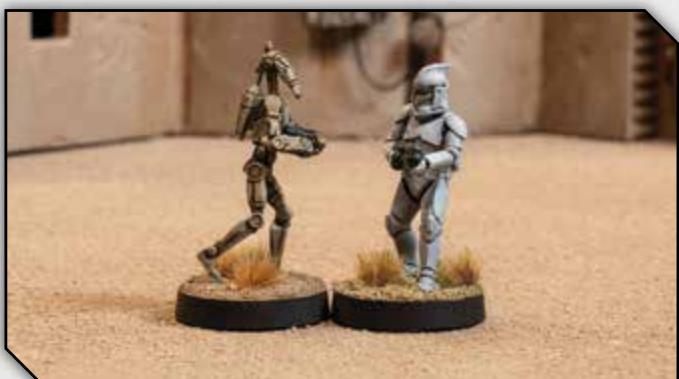
The Clone Trooper unit is at range 1 of Obi-Wan Kenobi because it has at least one miniature whose base is at least partially inside the first segment of the range tool. The AT-RT is within range 1 of Obi-Wan Kenobi because its base is entirely inside the first segment of the range tool. The B1 Battle Droids are beyond range 1 of Obi-Wan Kenobi because all of their miniatures' bases are entirely outside the frst segment of the range tool.
TERRAIN
The scenery and features that make up the battlefield are terrain. Terrain serves more of a purpose than simply being aesthetically pleasing—the terrain over which armies fight can have as dramatic an impact on the course of battle as the abilities of the armies themselves. Players should always discuss terrain before the game starts. There are three types of terrain: scatter terrain, area terrain, and obstacle terrain.
SCATTER TERRAIN
Scatter terrain represents small terrain features such as crates, planters, or lamp posts.
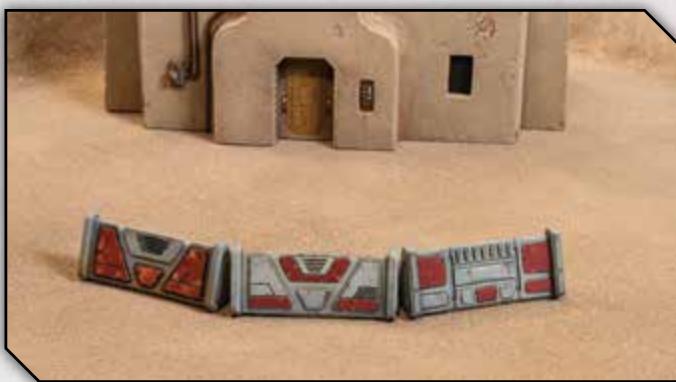
BARRICADES
Barricades are a specific type of scatter terrain found in some Star Wars: Legion Core Sets and in their own expansion pack. Barricades are difficult terrain for trooper units and provide non-creature trooper trooper units with heavy cover.
Barricades cannot be placed overlapping objective or condition tokens and cannot have objective or condition tokens placed on them. A trooper miniature can never partially overlap a barricade at any time.
AREA TERRAIN
Some terrain features consist of an area of terrain containing multiple terrain elements inside a boundary or footprint, like a forest, craters, ruined buildings, or piles of rubble. 'The individual elements and their locations inside the area terrain are not relevant, only the boundary.
When determining the size of area terrain, imagine a silhouette beginning at the bottom of the area terrain and extending upwards to the tallest point of the terrain. The volume of this silhouette is all part of the area terrain. It is up to the players to determine the height, the boundaries, special rules, and the type of cover that area terrain provides.

OBSTACLE TERRAIN
Obstacle terrain represents large or tall terrain features such as buildings, cliffs, or high walls. When a trooper miniature wants to move through or onto an obstacle terrain feature, it may have to perform a climb based on the obstacle terrain's height.
TERRAIN RESTRICTING MOVEMENT
In addition to being scatter, area, or obstacle terrain, a terrain feature is also open, difficult, or impassable.
Open terrain represents parts of the battlefield that are relatively easy to traverse and free from obstacles or obstructions. Open fields, lamp posts, planters, tall grass, or sandy desert are all open terrain. Open terrain does not restrict movement.
Difficult terrain restricts but does not completely prevent movement. Craters, barricades, ruins, woods, piles of rubble, and swamps are all examples of difficult terrain. Difficult terrain reduces the maximum speed of a unit moving through or into it by 1 to a minimum of 1.
Impassable terrain completely prevents movement. Miniatures cannot move through or end a movement on impassable terrain unless they have a special rule which allows them to do so.
Some larger and more complex pieces of terrain are made up of various parts that each restrict movement differently. For example, the walls of a piece of obstacle terrain may be impassable, but a miniature may be able to move through a door or window that is open terrain. Players should discuss the parts of terrain and agree on how they are to be played before the game begins.
EXAMPLE: DIFFERENT TYPES OF TERRAIN

The Clone Trooper unit is preparing to move. The battlefield is open terrain and does not restrict the Clone Trooper unit's movement. The barricades are difficult terrain and will slow down the Clone Troopers should they choose to move over them. The building is impassable terrain, and the Clone Troopers may not move through it unless they have a special rule that allows them to do so.
FITTING ON TERRAIN
When a trooper miniature's base is overlapping a piece of obstacle terrain, it must be completely overlapping that terrain. Trooper miniatures cannot end a movement or be placed in a way that would cause their base to only partially overlap a piece of obstacle terrain and may not have any part of part of its base hanging off the terrain. Trooper miniatures cannot be deployed in a way where any part of their base is only partially overlapping a piece of obstacle terrain.
EXAMPLE: FITTING ON TERRAIN
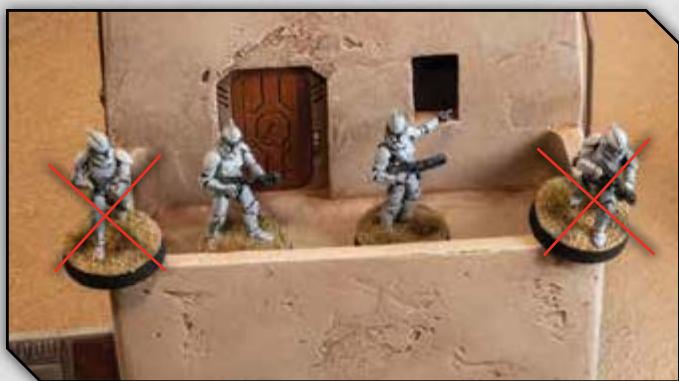
When placing miniatures on obstacle terrain, a miniature's base must completely overlap the terrain. Because the two Clone Troopers are hanging off the balcony and only partially overlapping the piece of obstacle terrain, they cannot be placed there and must be placed in such a way that their bases completely overlap the obstacle terrain like the other two Clone Troopers
TERRAIN PROVIDING COVER
The main purpose of terrain is to block line of sight between miniatures and provide them with cover. Terrain provides either light, heavy, or no cover. What kind of cover, if any, a piece of terrain provides is ultimately for players to decide. Before the game begins, players should agree on what kind of cover each piece of terrain on the battlefield provides.
TERRAIN HEIGHT
Each piece of terrain has a height characteristic. To measure this, take the range tool and put one end on the battlefield, orienting the range tool vertically. Then add segments until the end of the range tool is taller than the piece of terrain. The segment of the range tool that the top of the terrain is inside is equal to that object's height.
Some terrain might have various pieces at multiple heights. When determining the height of the terrain for the purposes of performing a movement or a climb, measure the height of the part of the terrain the miniatures are moving or climbing to, subtracting the height of any terrain the miniatures may be on.
EXAMPLE: MEASURING HEIGHT
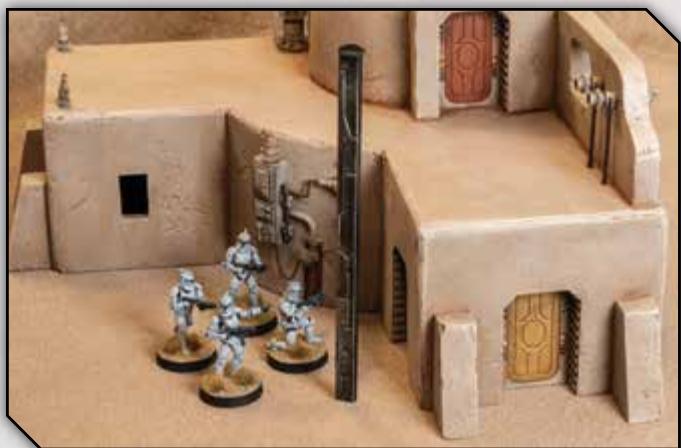
Sarah wants to measure the height of this building to determine how it will impede the movement of her Clone Troopers. To do so, she takes the range tool and places one end on the battlefield, holding the range tool upright. Because the roof of the building is entirely inside the first segment of the range tool, the building is considered height 1.
Later in the game, Sarah measures the height of another building. Because this building has multiple levels, it consists of different heights. One roof is completely inside the first segment of the range tool, so that part of the building is height 1. However, the second roof of the building is inside the second segment of the range tool, so that part of the building is height 2.
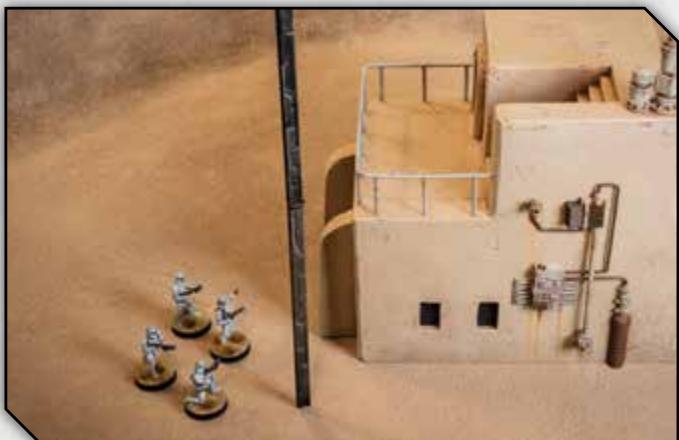
To determine how the building affects the movement of her Clone Troopers, Sarah only considers the part of the building her Clone Troopers wish to move to—they may perform a climb onto the height 1 part of the building but are unable to move onto the height 2 part from the battleield. If they begin their movement while on the height 1 part of the building, then they may climb onto the height 2 part of the building.
THE GOLDEN RULE OF TERRAIN
Ultimately, the type of terrain and the rules used are up to the players and should be discussed before the game begins.

Cover helps miniatures defend themselves from attacks. Cover is divided into three categories: light, heavy, and no cover, and is determined during the attack sequence. Some rules refer to cover having a numerical value that is improved or reduced— light cover has a value of 1, heavy cover has a value of 2, and no cover has a value of 0. The numerical value of cover cannot be increased above 2 for any reason. Resolve effects that improve cover before effects that reduce cover.
For more information on determining cover, see pg. 30.
ACTIONS
Actions are how units of miniatures move and fight their way across the battlefield. A unit will typically perform two actions during its activation. The following actions are available to every unit.
• Aim: The unit gains an aim token, which allows it to reroll up to two dice when attacking.
• Attack: The unit attacks with its weapons.
• Dodge: The unit gains a dodge token, which allows it to cancel incoming results when defending.
Card Action: The unit performs an action listed on its Unit Card or one of its Upgrade Cards. Card actions have this symbol . A unit may perform more than one card action, as long as they are different. A card action withrequires two actions to perform.
Free Card Action : The unit performs an action listed on its Unit Card or one of its Upgrade Cards. Free card actions do not cost the unit any actions to perform. Free card actions have this symbol . A unit may perform more than one free card action, as long as they are different. A unit may only perform free actions during their Perform Actions step and may only perform each instance of a free action once per activation. Free actions do not allow a unit to perform a non-move action more than once during its activation.
• Move: The unit moves.
Standby: The unit gains a standby token, which allows it to perform certain actions after an enemy unit performs an action.
• Recover: The unit removes any number of suppression tokens and readies any exhausted Upgrade Cards.
EXAMPLE: CARD ACTIONS AND FREE ACTIONS
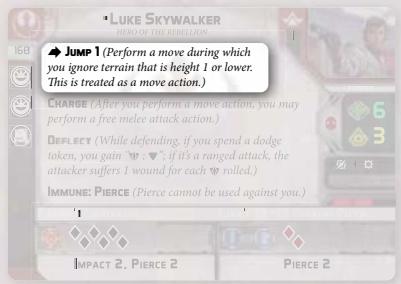
Luke Skywalker has the Jump 1 card action on his Unit Card. During his activation, he may spend one of his actions to perform the Jump action.

Luke Skywalker also has the Force Reflexes Upgrade Card equipped. Once per activation as a free action, he may exhaust the card to gain a dodge token. This is in addition to the two actions he is allowed per activation, but he may only perform the Force Reflexes free action when he would normally be allowed to perform an action. A unit may perform any number of different free actions during its activation.
SUPPRESSION
Suppression represents the morale and combat effectiveness of a unit—the more suppression it has, the less effective it is on the battlefield. Suppression is tracked during the game with suppression tokens. Vehicles do not suffer suppression.
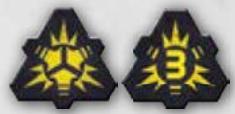
Suppression Tokens

Trooper units have a courage value on their Unit Card. When a unit has a number of suppression tokens equal to or greater than its courage value, it is suppressed. If a unit has a number of suppression tokens that is equal to or greater than double its courage value, it is panicked. A suppressed unit performs one less action each activation, while a panicked unit suffers additional effects. For more information on the effects of suppression, see pg. 22.
GETTING READY TO PLAY
SETUP
The process of getting ready to play a game of Star Wars: Legion is called Setup. Setup consists of the following steps:
-
Build an Army, Command Hand, and a Battle Deck
-
Establish the Battlefield and Gather Components
-
Declare Terrain
-
Place Terrain
-
Select Player Color and Sides
-
Reveal Battle Cards
-
Define the Battlefield
-
Resolve Objective and Condition Cards
-
Deploy Units
BUILD AN ARMY, COMMAND HAND, AND A BATTLE DECK
Before the game begins, each player builds an army using the Star Wars: Legion miniatures in their collections. In addition to their miniatures, each player prepares a command hand, a Battle Deck, and the Unit and Upgrade Cards containing the rules for their units.
FACTIONS, LIGHT SIDE, AND DARK SIDE
Units in Star Wars: Legion are grouped together in factions: the Galactic Empire (Empire), the Rebel Alliance (Rebel), the Separatist Alliance (Separatist), and the Galactic Republic (Republic). A unit's faction is shown by the faction icon printed in the top left corner of its Unit Card. All units in an army must share the same faction, unless otherwise specified by a special rule.
Occasionally a rule references the Light Side or the Dark Side. The Rebel Alliance and the Galactic Republic are the Light Side, and the Galactic Empire and the Separatist Alliance are the Dark Side. Armies not built using these factions state whether they are part of the Light Side or the Dark Side in their rules text.
POINTS
Each army is made up of a collection of miniatures organized into units. These units may further be equipped and customized with Upgrade Cards. Each unit and upgrade have a point cost printed on the corresponding card. The total points cost of all units and Upgrade Cards in an army cannot exceed 800 points. An updated list containing the points for all unit and upgrade cards can be found at https://www.atomicmassgames.com/starwars-legion-documents.
RANKS AND RANK REQUIREMENTS
Each unit in Star Wars: Legion has a rank. When building an army, a player is restricted on the number of units of each rank they may include as follows:

Commander: Each army must include one to two commander units.

Operative: Each army may include up to two operative units.

Corps: Each army must include three to six corps units.


Special Forces: Each army may include up to three special forces units.
Support: Each army may include up to three support units.

Heavy: Each army may include up to two heavy units.
UPGRADE CARDS
Upgrade Cards contain additional rules that can be equipped by units during Army Building. Upgrades vary between additional miniatures, weapons, equipment, or even special training or programming.
The types of upgrades available for a unit to equip are shown on the unit's upgrade bar.
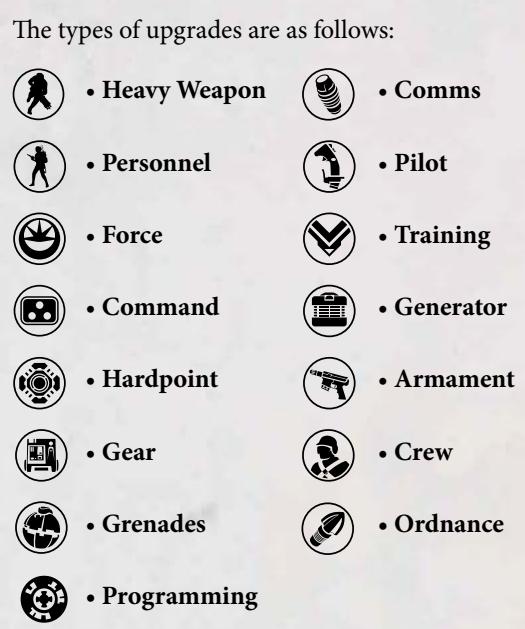
For each icon on the unit's upgrade bar, the unit may equip one Upgrade Card with a matching icon. Points listed on the Upgrade Card are counted towards an army's points total. A unit may not equip the same Upgrade Card twice. Some Upgrade Cards have restrictions on which units may equip them. Any restrictions for an Upgrade Card are listed on the card.
Cards with the or icons add a miniature armed with the weapon shown on the upgrade card to the unit in addition to any weapons on the Unit Card. Only the miniature added to the unit by the Upgrade Card may use the weapon on the Upgrade Card.
Cards with the, , or icons add an additional weapon, as shown on the Upgrade Card. Any miniature in a unit with an, , , , or Upgrade Card equipped may use the weapon on the Upgrade Card.
EXHAUST AND EXPEND
Most Upgrade Cards provide a static game effect, but some cards must be exhausted or expended after being used. A card that must be exhausted or expended after use has the exhaust or expend icon on the card. Cards that exhaust or expend start the game readied, and only readied cards may be exhausted or expended.
When a card is exhausted, turn the card 90° to the right so that it is sideways. Exhausted cards may not be used until they are readied through an effect.
When a card is expended, turn the card 180º so that it is upside down. Once a card is expended, it cannot be used for the rest of the game. Expended cards cannot be unexpended or readied.
After a miniature adds a weapon on an exhaust or expend Upgrade Card to an attack pool, exhaust or expend the Upgrade
Card. If the weapon is an upgrade that exhausts or expends, then any number of miniatures in the unit may add the weapon to the attack pool.
When a unit recovers, it readies all of its exhausted cards. When a card is readied, turn it 90º to the left so it is in its original orientation. The card is no longer exhausted.
EXAMPLE: EXHAUST AND EXPEND
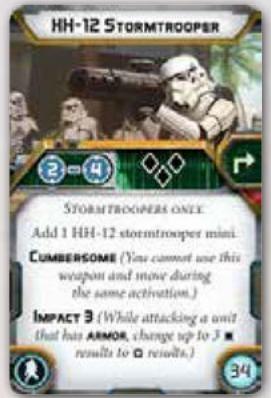
The Stormtooper unit adds the HH-12 Stormtrooper's weapon to an attack pool, exhausting the card once the dice are added. It cannot be added to another attack pool until it is readied.
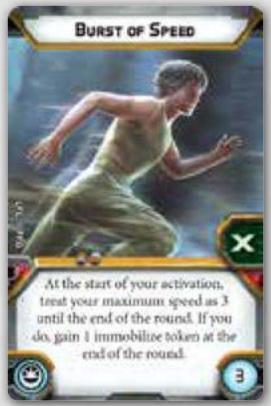
Luke Skywalker expends Burst of Speed to increase his speed. The card is expended and cannot be used for the rest of the game.
UNIQUE AND LIMITED
Some units and upgrades represent specific characters, weapons, or equipment. Unique or limited cards are identified by a number of bullets (•) in front of their name. The number of bullets indicates the maximum number of cards a player can field that share the same name. This restriction also applies across card types. For example, if a name has two bullets in front of it, the player could field two units with that name, two upgrades with that name, one Unit Card and one upgrade with that name, etc.
-DARTH VADER DARK LORD OFTHE
DEFEATING UPGRADE CARD MINIATURES AND DISCARDING UPGRADE CARDS
When a miniature added by an Upgrade Card is defeated, the unit it was added to can no longer use or benefit from any rules on the Upgrade Card, with the exception of additional upgrade icons granted to the unit.
If an Upgrade Card that adds a miniature to a unit is discarded, but the miniature is not defeated, the miniature is not removed, but the unit can no longer use or benefit from any rules on the discarded Upgrade Card.
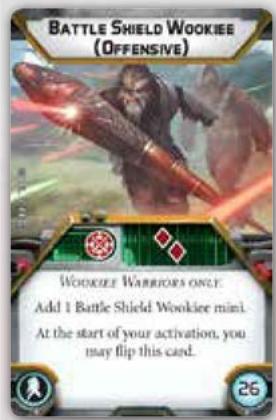
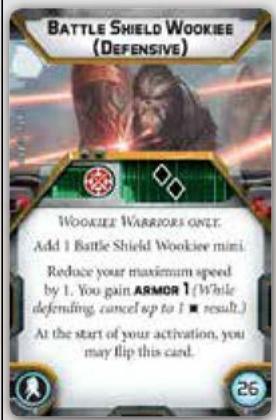
DUAL-SIDED UPGRADE CARDS
Some Upgrade Cards are dual-sided. When building an army, only count the points cost on one of the sides of the card. When a unit with a dual-sided Upgrade Card equipped deploys, the unit's controlling player decides which side is faceup. Only the rules on the faceup side of the card can be used.
FORCE UPGRADE CARDS
If a unit has a Upgrade Card equipped, measure the range of any effects on the card from the unit's unit leader.
BUILDING A COMMAND HAND
Each player prepares a command hand of exactly seven Command Cards. A player must include two 1 pip cards, two 2 pip cards, and two 3 pip cards, with no duplicates. Additionally, players must always include the 4 pip card “Standing Orders."
Some Command Cards require certain units. The required unit must be in a player's army for these Command Cards to be included in a command hand. Occasionally, a Command Card requires a player to be fielding an army from a certain faction or Battle Force to be included in the command hand. These restrictions are printed on the Command Card.

SECRET INFORMATION
The contents of a player's command hand are secret information and are never shared with their opponent. However, the number of cards in a player's command hand is not secret, nor is the contents of a player's discard pile. Non-secret information must be freely shared between players at all times.
BUILDING A BATTLE DECK
Battle Cards form the Battle Deck and are used in Setup, where players work together to build the mission for that game. Battle Cards are divided into three categories: Objective (Blue), Deployment (Red), and Condition (Green).
Each player must prepare a Battle Deck of 12 cards before the game begins, consisting of exactly 4 cards of each type with no duplicates.
ESTABLISH THEBATTLEFIELD AND PREPARECOMPONENTS
Once players have built their armies, they must establish the battlefield. Star Wars: Legion uses a 6 ft x 3 ft (72” x 36") battlefield.
Players then gather any tokens, measuring tools, cards, or other game components they might need and place them near the battlefield.
DECLARE AND PLACE TERRAIN
Players determine what pieces of terrain to use in their game and their rules. Players should be sure to agree with their opponent on the rules for each terrain piece before the game begins.
Once players have determined what terrain is being used and any applicable rules, they then cooperatively set up terrain on the battlefield.
SELECT PLAYER COLOR AND SIDES
In Star Wars: Legion, a player is either the red player or the blue player. After terrain has been placed, the player whose army consists of the least number of points gets to choose if they are the red player or the blue player. If both players' armies have the same number of points, have one player roll a red defense die. On a ▼ result, they get to choose which color they are; on any other result the other player gets to choose.
The red player then chooses one of the long edges of the battlefield as their side, and the blue player gets the opposite side.
REVEAL BATTLE CARDS, DEFINE THE BATTLEFIELD, AND RESOLVE OBJECTIVE AND CONDITION CARDS
Players work together to define the battlefield and determine the mission they will use for their game of Star Wars: Legion. Using the blue player's Battle Deck, separate the Objective, Deployment, and Condition Cards into three facedown piles and shuffle each pile, orienting them so they are faceup to the blue player. Then, draw four cards from each category, placing them faceup in a horizontal row left to right in the order they were drawn, with each category in its own row. The order of the rows does not matter, only that each category is placed in its own horizontal row. Once all cards have been drawn, players should have a 4x3 grid of cards as shown.
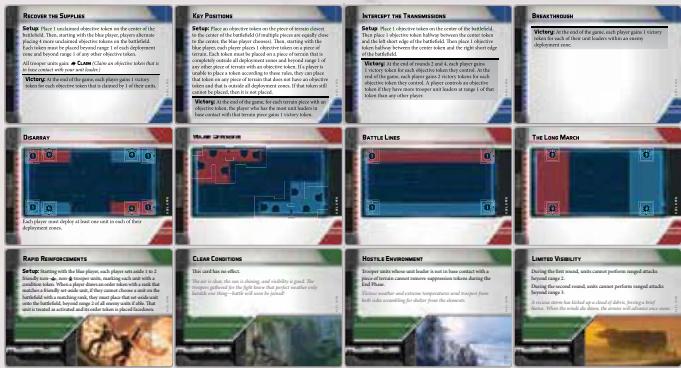
Once the grid has been laid out, players define the battlefield. Starting with the blue player, players take turns choosing a category and eliminating the leftmost card in that row. A player may also decide to not eliminate a card if they do not want to. If players eliminate the first three cards in a row, they cannot eliminate the final card. After each player has had two chances to eliminate a card, the leftmost card remaining in each row is the card that is used during that game.
Next, players resolve any Setup instructions on the Objective Card, then resolve any Setup instructions on the Condition Card.
For more information on the rules for specific Battle Cards, see pg. 39.
EXAMPLE: DEFINING THE BATTLEFIELD
Matt and Andrew have determined that Matt will be the blue player and Andrew will be the red player. Using Matt's Battle Deck, they separate the Objective, Deployment, and Condition Cards into three separate facedown piles, shuffling each. Then they draw four cards from each category, placing each category horizontally in a row. Starting with Matt, he and Andrew take turns choosing a row and eliminating the leftmost card in that row. Matt chooses the Objective row, and the leftmost card is eliminated. Andrew then chooses Conditions, and the leftmost card is eliminated. Matt then chooses to eliminate the leftmost card in the Deployment row. Content with how things are, Andrew decides to not eliminate any more cards. The leftmost cards in each row are the Battle Cards that Matt and Andrew will use for their game.
OBJECTIVE TOKENS
Units in Star Wars: Legion frequently capture objective tokens to score victory tokens and win the mission. Some objective tokens can be interacted with, usually through card actions listed on the Objective Battle Card.

All objective tokens are placed with their unclaimed side faceup unless otherwise specified. When placing objective tokens in the battlefield during Setup, an objective token cannot be placed overlapping another objective token or only partially overlapping a piece of terrain. If an objective token would be placed partially overlapping terrain, players should adjust terrain placement in a mutually agreeable manner so that the token is no longer partially overlapping terrain. If an Objective Battle Card states that an objective is placed in base contact with a unit during Setup, that objective token is claimed by that unit
A unit may not be in base contact with an unclaimed objective token at the end of setup.
DEPLOY UNITS
After resolving any Setup rules on the Objective and Condition Cards, players then resolve any Setup rules on the Deployment Cards. Then, starting with the blue player, players alternate, placing one unit from their army within their respective deployment zones as shown on the Deployment Card. Players continue taking turns placing units until all units have been deployed. When deploying a unit with multiple miniatures, all miniatures must be placed in cohesion with their unit leader.
A unit is in cohesion if all miniatures in that unit are at a speed-1 move of the unit leader and within a vertical distance equal to the height of the unit leader's silhouette. For units on notched bases, this move may be measured from any part of the miniature's base. For more information on silhouettes, see pg. 27. When measuring cohesion, the speed-1 movement tool may not overlap a piece of impassable terrain. If a unit is not in cohesion for whatever reason, its next action must be a move action that ends with all miniatures in cohesion.
During deployment, a unit may not be placed in base contact with an enemy unit, nor may it move into base contact with an enemy unit.
After deployment is complete, one player takes the round counter and sets it to “1." The game of Star Wars: Legion is ready to begin!
WINNING THE GAME
A player wins the game immediately by either defeating all their opponent's units or by earning the most victory tokens at the end of the game. The game ends after the final End Phase, and victory tokens are scored as detailed by the Victory conditions on the Objective Card being used for that game.
Panicked units and objective tokens they have claimed cannot be used to satisfy Victory conditions on an Objective Card.
If an Objective Card instructs players to gain victory tokens at the end of a round, they do so after advancing the round counter and before the next round begins.
If the players have an equal number of victory tokens at the end of the game, the player who defeated more points worth of their opponent's army is the winner. When calculating how many points a player has defeated, only count units that were completely defeated, including any upgrades equipped to the unit. If players defeated the same number of points, the player whose army consisted of more points at the start of the game is the winner. If there is still a tie, the game is a draw.
GAME MECHANICS
Star Wars: Legion is played over a series of six rounds. Each round is divided into turns, taken by each player. The following sections contain the rules that specify the parts of each round and how to play them.
PARTS OF A ROUND
Each of the six rounds in a game of Star Wars: Legion are divided into the following phases:
I. The Command Phase
-
The Activation Phase
-
The End Phase
THE COMMAND PHASE
During the Command Phase, players select a Command Card from their command hand, reveal and resolve their Command Cards, determine priority, issue orders, and create the order pool.
PARTS OF THE COMMAND PHASE
-
Select and Play Command Cards a. Resolve Command Cards
-
Determine Priority
-
Nominate Commanders and Issue Orders
-
Create the Order Pool
SELECT AND PLAY COMMAND CARDS
Each player secretly chooses a Command Card to play from their hand and places it facedown on the battlefield. If a player does not have at least one or ▲ unit on the battlefield, they may not play any Command Cards this round.
Some units have several unique Command Cards, which may only be played if that unit is included in a player's army and is not defeated.
RESOLVE COMMAND CARD EFFECTS
After both players have played a Command Card facedown, they then reveal their Command Cards by flipping them faceup and proceed to resolve the effects of the Command Cards. Fully resolve the effect of each Command Card before moving to the next Command Card. If both players have an effect that occurs at the same time, the blue player always resolves their Command Card effect first.
DETERMINE PRIORITY
Once players have resolved all relevant Command Card effects, compare the number of pips on the Command Cards that were played this round. The player whose card has the least number of pips has priority for the round.
If both players reveal Command Cards with the same number of pips, one player rolls a red defense die. If the result is a ▼, that player has priority. On any other result, the other player has priority.
If one player was unable to play a Command Card due to not having a or unit, the other player automatically has priority. If neither player played a Command Card, one player rolls a red defense die to determine priority.
EXAMPLE: PLAYING A COMMAND CARD ANDDETERMINING PRIORITY
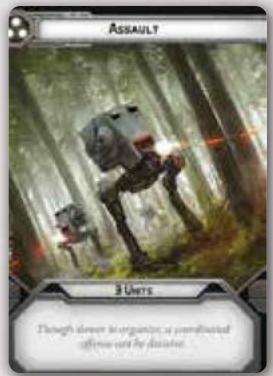
Michael and Kevin are choosing their Command Cards for the turn. They each secretly choose a card from their hands to play, then they reveal their cards at the same time. Michael has played a 3-pip card, Assault, and Kevin has played a 1-pip card, Ambush. Because Kevin played the card with the fewest number of pips, he gains priority for the round.


Sarah and Michael are choosing Command Cards for the turn. Both of them play the 4-pip card Standing Orders. Because they revealed cards with the same number of pips, one of them rolls a red defense die. Michael rolls the die and rolls a blank. Because he did not roll a ▼, Sarah has priority for the round.
NOMINATE COMMANDERS AND ISSUE ORDERS
After determining priority, players nominate commanders and issue orders to their units.
If the played Command Card corresponds to a specific unit, that unit must be nominated as the commander. Otherwise, players may nominate any one unit to be their commander.
Once all players have nominated a commander, they issue orders to their units, starting with the player who has priority. The number of orders and the units they can be issued to is listed on each Command Card. For a commander to issue an order to a unit, a unit must:
• Be at range 1-3 of the nominated commander (the nominated commander is always at range 1 of itself).
The unit c
Content is long; only the first part is inlined. Download the file or open the rules page for the full text.
Download MarkdownTexts are community-compiled or publicly released by publishers; copyright remains with the original authors. For personal reference only.