
Targi
At a glance
Rules, cards and Q&A (Chinese)
The rules, card data and player questions for this game are written in Chinese. Open the Chinese page to read them.
Where to find full rules
Full rules and card lookup are available in the cunlema app at cunlema.cn — pick this game and ask about any rule, card or turn you are unsure about.
Related games
Rulebook text (Markdown)
This game has 4 rulebook Markdown file(s) in our library; 3 rendered inline below — expand to read or download.
rules_zh_大漠商豪_4882.md15.2 KB
TARGI大汉行商
游戏的创意来源及游戏目标
与其他沙漠民族不同,在阿拉伯语中被称为“塔吉”(Targi)的“图阿雷格”族男人在 25 岁成年后要用蓝紫色面纱遮挡住脸庞,而族里的女人们则不用。在过去图阿雷格人曾一度靠武力主宰撒哈拉沙漠南北的货物贸易利用五条纵贯沙漠的贸易路线连接撒哈拉沙漠以南的大城市,与非洲北边的地中海沿岸。不同的家族被划分成为各种部落,听从于部落中的贵族。作为图阿雷格部落的首领,玩家们将用部落周边(椰枣与盐)或进口货物(胡椒)进行贸易,从中获取金币与其他利益,并同时扩张他们的家族。但沙漠是个险恶之地,强盗和其他部落都在与你争夺有限的资源。在游戏结束时拥有最多胜利点数的玩家获胜。
游戏配件:
80 张卡牌,包括:

45 张部落卡
19 张货物卡
16 张边界卡

8 个金币指示物

6 个塔吉人标记


1 个强盗标记
4 个部落标记


1 个起始玩家指示物(银护身符)
30 个货物指示物(椰枣,盐,胡椒各10个)


15 个胜利分数指示物
游戏准备
初次游戏前,请将所有指示物从板块上小心取下。
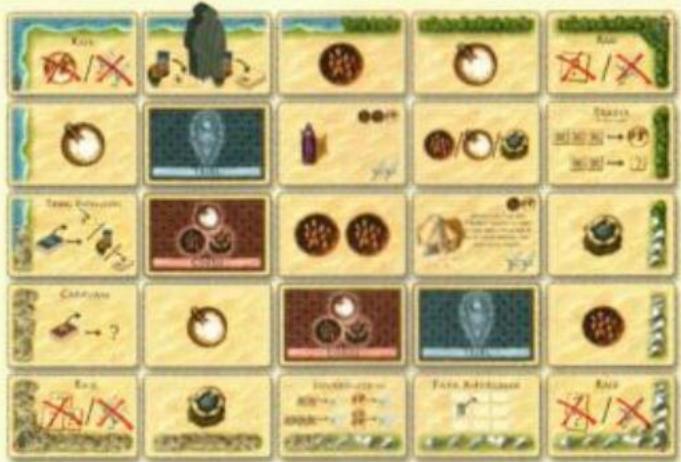
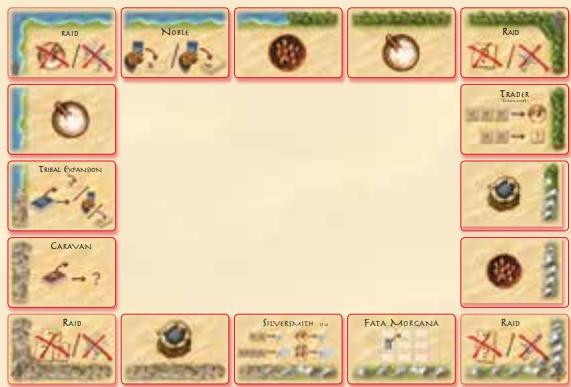
16 张边界卡上标注了1-16 的数字,如下图所示按顺序进行摆放 让卡牌的数字位于左上角 ,形成一个环。所有边界卡在整场游戏中不会变动位置。
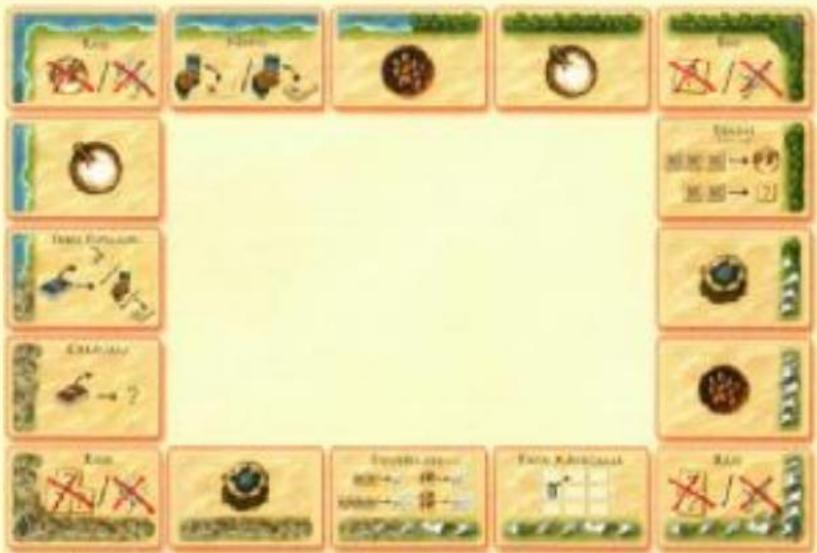
提示:在边界卡的正面,不同的作用使用了对应符号作为说明。在卡牌背面,则用文字进行描述。初学本游戏时,推荐使用卡牌的背面进行游戏。
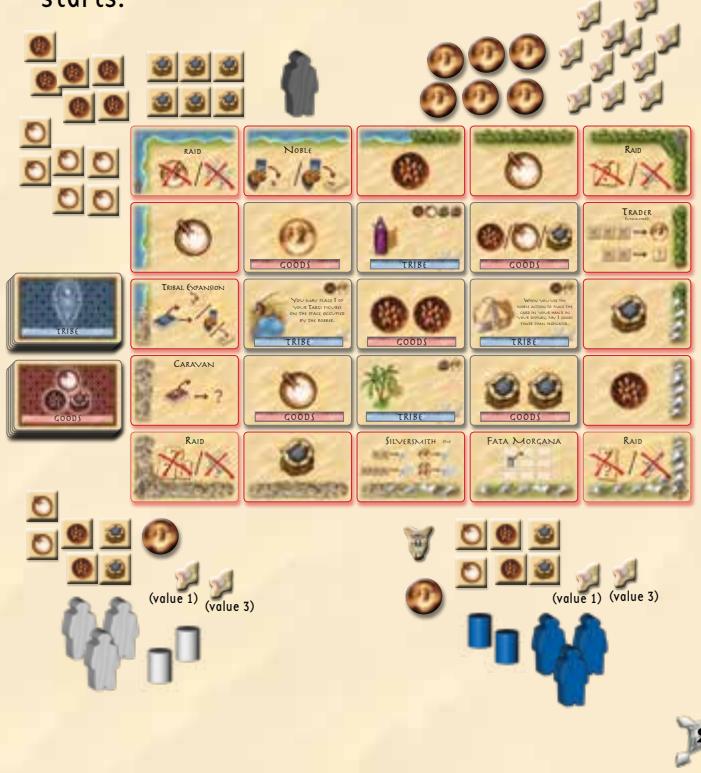
分别随机混洗货物卡以及部落卡 然后分配 5 张货物卡与₄ 张部落卡进入边界卡围成的中央区域。
将剩下的部落卡形成牌库放在边界卡 14“部落扩张”旁;将剩下的货物卡形成牌库放在边界卡 13“旅行商队”旁。将货物,金币,以及胜利分数指示物放在一旁作为公共供应堆。将强盗(灰色标记)放在边界卡“贵族”旁。每个玩家获得各自颜色的3个塔吉人标记以及2个部落标记。同时每个玩家还获得椰枣、盐、胡椒各2个,1个金币,4点胜利分数指示物。
最近吃过椰枣的玩家为起始玩家并拿取起始玩家指示物开始游戏。若无人吃过,则蓝色方玩家为起始玩家。(“图阿雷格”人有时也被称为“蓝人”)

游戏的进行
游戏概览
在每轮里 ,每个玩家轮流依次在边界卡上放置自己的3个塔吉人标记。然后在每两个同色塔吉人标记所在行列十字相交的中央区域上,放上该玩家的部落标记。玩家的标记放置的卡牌表示了玩家可以执行何种行动。玩家可以巧妙的结合执行行动的顺序来获益。当有玩家将部落区 12 个位置填埋或强盗在边界卡上走完一圈到16 时,游戏结束。
游戏流程
1. 将强盗标记向前移动1 格(在边界卡上)
在每轮开始时,将强盗按照顺时针往前移动1格。在第1轮,直接将强盗放置在1号边界卡“贵族”上。玩家的塔吉人标记不能放置在强盗所在边界卡上。每当强盗到达游戏区域的边角处时,会执行一次该卡牌上描述的掠夺,玩家将可能会失去货物或胜利分数,在后期甚至会失去金币(参见“掠夺”)
2. 依次放置塔吉人标记(在边界卡上)
从起始玩家开始 每个玩家依次放置1个其拥有的塔吉人标记到边界卡上,直到3个全部放完,玩家通过放置塔吉人标记占据边界卡来获得其在本轮中想要执行的行动。而以下边界卡玩家不能放置塔吉人标记:
• 强盗所在的边界卡;
“掠夺”(四个角落)边界卡;
• 已放置塔吉人标记的边界卡;
• 与对手玩家已放置塔吉人标记相对的边界卡;
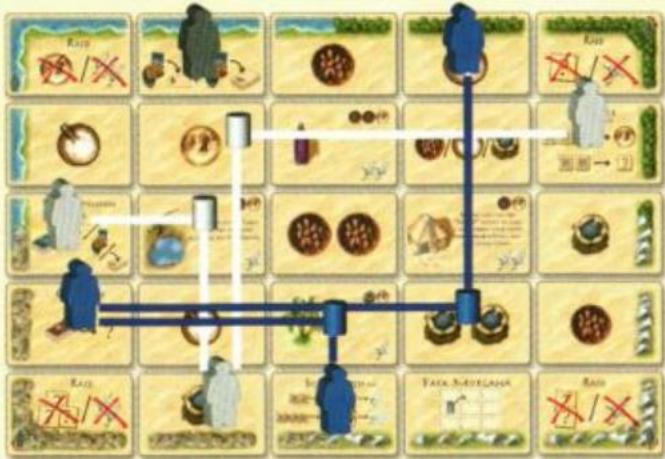
范例:蓝色玩家开始放置他的第一个塔吉人(1)。紧接着白色玩家放置了塔吉人在另一个区域,他不能放置塔吉人在标注白色x的区域上。
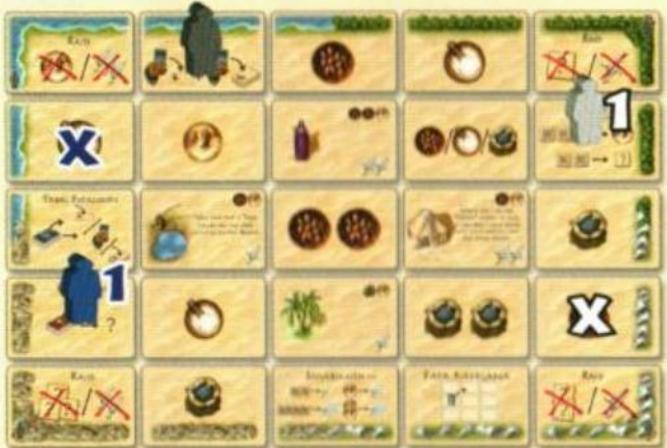
蓝色玩家放置他的第二个塔吉人(2)。他不能放置在标注蓝色X标记的区域。因为该区域对面已有一个白色塔吉人。然后白色玩家放置其第二个塔吉人在强盗的对面区域。放置塔吉人在强盗对面是允许的,但是不允许放置在强盗所在区域上。

最后玩家们各自放置他们最后的塔吉人标记:

3. 在十字交叉点放置部落标记(中央区域)
在玩家放置完所有塔吉人标记后,每个玩家开始放置部落标记,每个玩家根据其所属颜色的塔吉人所在边界卡行列的直线进行延伸,一旦在中央区域产生交叉点,就可以在交叉点放置对应颜色的部落标记。最常见的情况下可以放置2 个部落标记。
提示若玩家在放置塔吉人标记时出现同色相对的情况,最多只会产生1个交叉点,即只能放置1个部落标记。接着前一个范例:玩家放置对应的部落标记。
4. 执行行动
由起始玩家开始,玩家连续执行完所有塔吉人以及部落标记所在卡牌对应的行动。顺序可由玩家自由决定。无论如何,玩家必须在结束前一个行动后再执行下一个行动。玩家也可以选择不执行完所有的行动。
一旦玩家使用了某边界卡的行动,他将他的塔吉人标记取回,边界卡保留不动。
若中央区域的卡牌被使用,玩家将他的部落标记取回,卡牌空位将立即被一张相异类型的卡牌代替:
若货物卡被使用,将其放到货物卡的弃牌堆,并将1 张部落卡面朝下放置在其之前腾出的空位。若部落卡被使用,同理则使用货物卡来代替。
提示:货物牌库被摸完时,洗混弃牌堆形成新的牌库。
若1张货物卡上描绘了1或2种货物,或 1 金币或 1VP,玩家
获得相应的资源。若卡牌上描绘了带有斜线划分的3种货物,玩家可以选择获取他所选择的1个货物。然后弃掉该货物卡。
提示:若供应堆没有可用的指示物时,玩家可以通过纸笔进行记录。
玩家在支付部落卡上描述的相应货物或金币后可将部落卡放在面前(参见“部落区”)。若玩家不能或不想支付部落卡的费用时,他可以选择将卡收入手牌中。无论如何,每个玩家部落卡的手牌上限为一张。
然而一旦存在手牌,在接下来的时间中,若存在抽取部落卡的机会,而又不能立即打出该卡牌( 支付费用)时,抽取的部落卡必须被放入部落卡弃牌堆。亦不允许在有手牌时与刚刚摸取的部落牌进行交换。
通常部落卡只能在你获取它时打出,在稍后的回合中,当塔吉人标记放置到“贵族”边界卡时,你可以从手中打出你前期收入手牌的部落卡。(例外:某种部落卡允许玩家直接从手牌打出而无需“贵族”行动)
当使用贵族行动时,你可以从手中打出部落卡(需支付费用),或弃掉手牌为更好的卡牌腾出空间。
5. 翻面新入场的货物与部落卡并交换起始玩家
在轮次最后,所有玩家执行完其行动时,将所有新入场的货物卡与部落卡翻面正面朝上。起始玩家将起始标记交给对方,新的 1 轮随着移动强盗开始。

其他规则细节
部落区
打出部落卡的费用在卡牌右上角。

提示:在某些卡牌费用上有斜线存在,这意味着玩家能够选择支付相应货物或1 个金币来打出该卡。
卡牌右下角为卡牌自身胜利分数,用1-3 个银十字架来表示。
许多卡牌在游戏中给予玩家一些好处。每张卡牌上均有详细描述。部落卡一旦打出,玩家即可使用该卡所带来的好处。例如:若卡牌给予玩家1个额外的货物,该玩家可以在该卡牌打出的同一轮次获得此货物。
玩家在构建自己的部落区时,应当按照合计三行,每行四张的原则来进行。每行卡牌在扩张时须遵循从左至右的规则。允许在一行未填满时直接在其他行第一张的位置放置卡牌。
这意味着允许玩家数行同时进行建设。但打出的卡牌通常在整局游戏中都不会再变动位置(例外:某种部落卡允许两张打出的卡牌进行位置互换)


若一个玩家使用 4 张相同类型的部落卡牌完成部落区中一行的建设,将在游戏结束时获得₄分。
若使用 4 张类型各不相同的部落卡牌完成部落区中一行的建设,将在游戏结束时获得2分。
在一行中未完成 ₄ 张 ,或是完成4 张但不符合以上要求的情况,不会获得任何额外的分数。
金币不被视为货物。
掠夺
若强盗移动到“掠夺”边界卡时,玩家
必须交出卡上描绘的物品。从当前起始玩家开始,每个玩家选择交出分数或货物(最后一轮则为金币)。将交出的物品返还公共供应堆,并且将强盗立即移动到下一个边界卡,然后玩家们开始依次放置塔吉人标记。
轮次结束时货物和金币的库存限制
获得的货物与金币在进入下一轮前有库存限制。如果一个玩家在执行完他所有行动后,拥有超过10个以上货物和/或 3 个以上金币,则必须返还超出的货物以及金币。返还的货物的类型由玩家自行决定。而在游戏轮次中,玩家获得的货物与金币并没有限制,只要他能在轮次结束前消耗掉即可。

游戏结束与计分
当有玩家打出 12 张部落卡时,该轮次即为游戏的最后一轮。若打出 12 张部落卡的玩家为当轮的起始玩家,他的对手依然可以将回合进行完。
或当强盗移动到第四个“掠夺”卡时,玩家们必须先支付第四张掠夺卡所需的费用,然后游戏立即结束。
每个玩家将他所获得的胜利分数指示物以及打出的部落卡上的分值进行加总。某些部落卡会提供额外的分数,详见卡牌说明。
然后根据玩家的打出的部落区进行额外加分:
• 一行部落区中,4 张部落卡均采用相同的类型建造,获得4分。
• 一行部落区中,4张部落卡均采用不同的类型建造,获得2分。
最高分数的玩家获胜。若出现分数相同的情况,持有最多金币的玩家获胜。若双方金币仍然相同,该局游戏为平局。
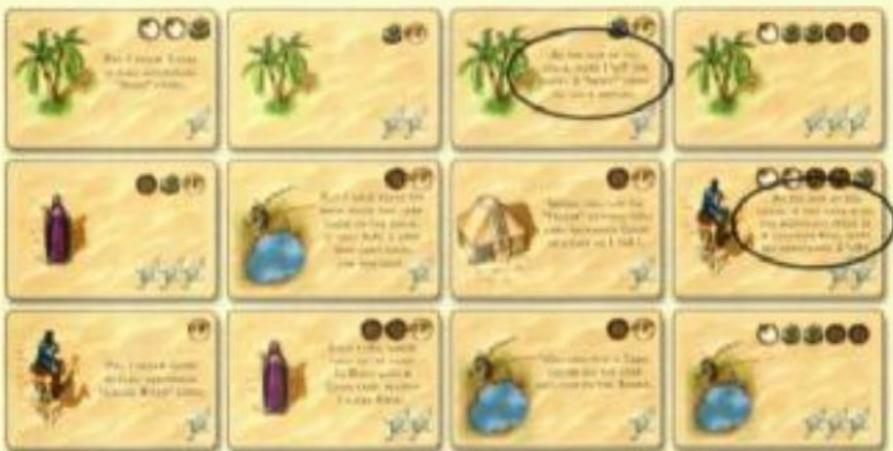
范例:蓝色玩家打出了12 张部落卡而导致游戏结束。他持有的胜利分数指示物为3分,打出的部落卡上的分数为 21 分,他还获得了两个部落卡的额外加分:每打出2个“水井”类型部落获得1分以及每打出2个“骆驼”类型部落卡获得1分。此外他还通过第一行的四个绿洲类型部落卡获得了4 分,第二行四个不同类型的部落卡获得2分,第三行没有获得其他分数。最终蓝色玩家分数为33 分。
范例的分数合计:
部落卡: 21
胜利分数指示物: 3
特殊部落卡: 3
同类型的部落卡行: 4
各不相同的部落卡行: 2
合计 33
后记
小科普——沙漠之王的今昔
图阿雷格是沙漠上古老的游牧部族,他们是北非柏柏尔人的后裔,起源于利比亚的费赞地区,后来扩张之其他撒哈拉地区。据一个古老的传说,图阿雷格氏族的真正祖先是一个名叫希娜纳的女王,因而图阿雷格妇女便得到了至高无上的尊贵地位她们是图阿雷格文明的真正标志。
沙漠地带的资源匮乏 ,完全依赖放牧根本不可能生存。在这种情况下,图阿雷格人一方面向来往于撒哈拉沙漠的商队收取过境税,另一方面则干脆武装抢劫过往商队或者周边的定居国家。有时图阿雷格人自己也参与经商,不过他们的货物一般都是抢来的。
图阿雷格人对撒哈拉沙漠商队的抢劫遵循一种“可持续发展”的原则,既不对商队进行毁灭性劫掠,也不天天劫掠。所以,即使图阿雷格人长期横行于撒哈拉商道,但基本上没有使这些商道断绝。
长期的游牧、劫掠和征战养成了图阿雷格人彪悍的性格,不过他们并不是常胜将军。据说,本来在图阿雷格人那里戴面纱的是女人。有一次,男人战败归来,一个个垂头丧气,他们的女人见了之后又羞又怒,将自己脸上的面纱扯下来,扔给那些男人,对他们说:“你们这些男人真是没用,看来应该由你们来戴这些面纱。就这样,图阿雷格男人戴起了面纱。
然而到了现代图阿雷格人的生活面临着诸多困境,原本的绿洲随着沙漠化逐年消失,卡车的普及使得骆驼商队利润减少。而更糟的是在二战后殖民地国家纷纷独立,划分国界时,图阿雷格人被迫分散在数个国家,成为了遭受排挤的少数族群。也许这正应了他们古代的称谓“Targi”被神遗弃的人。
原作信息
设计:Andreas Steiger规则:TM-Spiele
插图:Franz Vohwinkel 美工:Imelda Vohwinkel
DIY 过程
本桌游的素质真的很高,虽然只支持2人,但其策略变化非常多变。在得到了高清素材后,发现还没有简中版,于是决定好好制作一番。
鸣谢:
moonsang
规则书汉化原稿TOTO
英文素材扫描——风中脚步
Download Markdown691479_Targi-Manual.md16.9 KB
For 2 players, ages 12 and up
GAME OVERVIEW AND GOAL
A Targi is a male member of the Tuareg, a semi-nomadic people who inhabit the Sahara desert in North Africa. They wear blue indigo-dyed veils and turbans to protect themselves from the harsh windblown desert sands. The female members, or Targia, typically do not wear veils. For centuries, the Tuareg people have controlled critical trade routes across the desert, and have been instrumental in the spread of culture, religion, and goods throughout the vast region. Targi families are divided into tribes, run by the Imascheren, or nobles.
In this game, as leaders of Tuareg tribes, players compete to have the most prosperous tribe. To do this, they trade goods from near (such as dates and salt) and far(such as pepper) in order to earn gold and advantages, to ultimately expand their tribes. But the desert is a dangerous place, with robbers and rival tribes all vying for the same resources. The player with the most victory points at the end of the game is the winner.
GAME MATERIALS
80 game cards, including:

45 Tribe cards

19 Goods cards

16 Border cards
8 Gold tokens

6 Targi figures

4 Tribe markers

1 Robber figure

30 Goods tokens

(10 of each: Dates, Salt, and Pepper)
1 Starting player token (Amulet)

15 Victory point tokens: silver crosses with values of 1 (6 tokens), 3 (5 tokens), and 5 (4 tokens)

GAME PREPARATION
Before the first game, carefully separate all of the pieces from the die-cut board.
The players should seat themselves so that they can both read the writing on the cards easily.
The 16 border cards form the edge of the playing area and are laid out as shown in the illustration (framed in red). They are placed in order from 1-16 with the numbers in the upper left corner of each card. The border cards remain in the same positions throughout the game. Note: The functions of the border cards are explained by symbols on the fronts of the cards. On the backs, the functions are described in words. During the first game, rather than learning the symbols before playing the game, you can simply place the cards with the back sides facing up to show the writing. You can also turn the cards over at any time during a game to read the writing on the back, of course.
Shuffle the goods cards and tribe cards separately. Then, draw 9 cards (5 goods cards and 4 tribe cards) and lay them face up on the center spaces, in the alternating pattern shown in the illustration on the next page.
Place the stack with the remaining tribe cards next to the "tribal expansion" border card, and the stack with the remaining goods cards next to the "caravan" border card on the left.
The goods, gold, and victory point tokens are placed next to the playing area as a general supply.
Set the robber (gray figure) next to the number 1 border card ("noble").
Each player gets 3 Targi figures and 2 tribe markers in his or her playing color. Each player also gets 2 dates, 2 salt, 2 pepper, 1 gold, and 2 victory point tokens with a total value of 4 (1 x 1-point token and 1 x 3-point token).
The player who was the last to eat dates will get the starting player token and takes the first turn. If neither player has eaten dates, the blue player starts.
GAME PLAY
Game overview
In each round, the players take turns placing their 3 Targi figures on the border cards. Each player then places his or her 2 tribe markers on the center card cards at the intersections "drawn" between 2 Targis of his or her color (see below). Then, the players carry out the actions indicated by the cards on which their Targi figures and tribe markers are standing. Players must place their figures skillfully in order to collect the most victory points. The game ends when one player has assembled 12 tribe cards or the robber has circled the field of play once.
Course of play
1. ADVANCE ROBBER 1 BORDER CARD
At the start of each round, the robber is advanced to the next border card in a clockwise direction. In the first round, the robber is placed on the "noble" border card. A Targi figure cannot be placed on the card occupied by the robber. If the robber reaches a corner card, there is a raid in which the players lose goods or victory points, or gold as well later in the game (see the raid section).
2. PLACEMENT OF TARGI FIGURES BY TURNS
Beginning with the starting player, the players take turns positioning their 3 Targi figures one by one. Each player occupies the 3 border cards that he or she wants to use in this round. No figures may be placed on the following cards:
● On the card where the robber is standing
• On a raid corner card
• On a card where one of the player's own Targi or one of the opposing player's Targi is standing
• On a card opposite one of the opposing player's Targi

Example: The blue player starts and positions her first Targi (1). Then, the white player places his first Targi (i) on a different border card. The white player is not allowed to place a figure on the card marked with a white X.
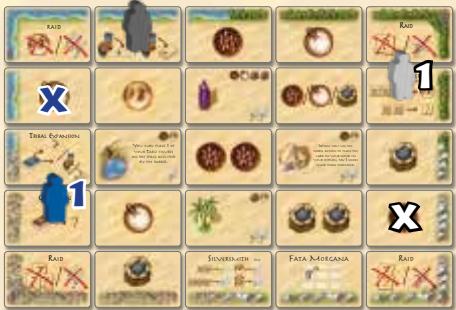
Then, the blue player places her second Targi (2). She is not allowed to place her Targi on the card marked with a blue X opposite the white Targi. Then, the white player places his second Targi (2) on the card opposite the robber. Placement opposite the robber is allowed, but not allowed on the robber's card itself.

Finally, both players have positioned all 3 of their figures:

3. PLACE TRIBE MARKERS ON THE INTERSECTIONS
After both players have positioned all 3 of their Targi figures, each player will still have to position his or her tribe markers. To do that, imagine drawing a straight line from each of your Targi figures to the opposite side. Place a tribe marker on each card where the 2 lines cross. Usually, there will be 2 crossing points for each player.
Note: If a player has placed 2 of his or her Targi figures in the same row or column, there will be just 1 crossing point. In that case, the player will only be able to position 1 tribe marker.
Example (cont.): The players place their tribe markers on the cards at the intersections of their Targi figures.

4. CARRYING OUT ACTIONS
First, the starting player is allowed to carry out all actions permitted by his or her Targi figures and tribe markers. Then, the second player carries out all of his or her actions.
The order in which a player takes his or her actions is up to the player. However, each card's action must be completed before beginning the next.
A player may also choose not to carry out any given action.
As soon as a player has completed the action of a border card, he or she takes back the Targi figure from that card. The border card remains in place.
If a card in the center area has been used, the player takes back his or her tribe marker. The card is immediately replaced with a card of the opposite type:
A goods card is placed on a discard pile for goods cards and a tribe card is put face down in its place on the empty card. Similarly, a tribe card is replaced with a face down goods card.
Note: If the draw pile for goods cards has been used up, shuffle the goods card discard pile and use it as the new draw pile.

If a goods card shows 1 or 2 goods, 1 gold, or 1 victory point token, the player takes the

corresponding tokens. If all 3 goods are shown with forward slash lines between them, the player is allowed to select 1 good of his or her choice. Note: If it should happen that a token is no longer available in the supply, the player temporarily notes his or her possession on a sheet of paper.
Tribe cards are immediately placed face up ("displayed") in front of the player. The player must pay for them in the form of goods and gold (see the tribe cards section).

If a player cannot or does not want to pay for a tribe card, the player is allowed to hold it in his or her hand or discard it. However, each player is only allowed to hold 1 tribe card in his or her hand at a time. If he or she gets more tribe cards and does not display them immediately, those cards must be placed on the discard pile for tribe cards. It is not permitted to exchange a tribe card in your hand for another, or to discard it. A tribe card in your hand can only be played if you use the "noble" border card with your Targi figure in a later round. Then, you may display the card in exchange for paying the price. (Exception: There is 1 tribe card that permits a tribe card in the hand to be played without the “noble" card.) The "noble" action also allows the player to instead place the tribe card in his or her hand on the discard pile at no cost in order to make room in his or her hand for a better tribe card.
5. UNCOVERING NEW GOODS AND TRIBE CARDS AND CHANGING THE STARTING PLAYER

At the end of the round, once both players have carried out their actions, the goods and tribe cards that were placed face down in the center area are turned face up. The starting player gives the starting player token to the opposing player, who becomes the new starting player. The next round begins by once again advancing the robber.
Additional rules in detail
THE TRIBE CARDS
At the top right of the tribe cards, you will see the costs for displaying the card. Note: Some cards will have a forward slash. In that case, the player may choose whether to pay in goods or gold.

The lower right-hand corner of the tribe cards shows the number of victory points (1, 2, or 3).
Many cards offer advantages during the game. Some advantages are one-time, whereas others are permanent. The detailed descriptions are written on the cards. As soon as a tribe card has been displayed, its advantage may be used. If, for example, you receive an extra good, it applies in the round in which the card is played. Note: Tribe cards with references to goods cards on them do not apply to the border cards from which goods are obtained.
Each player uses the tribe cards that he or she has obtained to create his or her own display. The display consists of 3 rows of 4 cards each. In each row, the cards are displayed from left to right. You do not have to finish 1 row before starting the next.
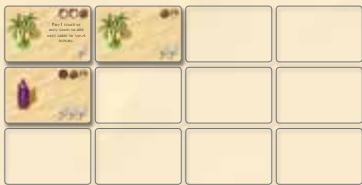
Each player can work on several rows at the same time. The cards remain in place the entire game. (Exception: 1 of the tribe cards allows you to move 2 displayed cards as long as it does not create any empty gaps.)
The tribe cards are grouped according to 5 symbols:

If one player manages to complete a row in which all 4 cards have the same symbol, he or she will get 4 extra victory points at the end of the game. If all 4 cards in 1 row have 4 different symbols, that player receives 2 extra victory points at the end of the game. Rows with fewer than 4 cards and complete rows in which a symbol appears two or three times will not yield any extra victory points.
RAID
When the robber is placed on a "raid" card, the players must hand over what is shown on the card.

Starting with the current starting player, each player decides whether to return victory points or goods back to the supply, or 1 gold in the case of the last raid card. Then the robber is immediately advanced onto the next border card and the players position their Targi figures in turn.
LIMITATIONS ON GOODS AND GOLD AT THE END OF THE ROUND
The amount of goods and gold that you are allowed to take to the next round is limited. If a player has more than 10 goods and/or more than 3 gold after carrying out his or her actions, he or she has to return the extra material to the supply. The player decides for himself or herself which goods those are. During the round, however, the players may have a larger quantity of goods and gold, which they may use to pay for tribe cards or for exchange at the "trader" or "silversmith."
END OF GAME AND SCORING
The game ends at the end of the round in which one player plays his or her twelfth tribe card. If the current starting player ends the game, the opposing player still gets one complete turn to carry out all of his or her actions for that round.
The game can also end if the robber reaches the fourth raid card. In this case, the players will have to pay the required 1 gold or 3 victory points, and the game ends immediately afterwards.
Now it's time for scoring. Both players add up their victory points in the form of silver crosses (victory point tokens and silver crosses on tribe cards).
Some tribe cards will yield extra points (see the writing on the cards).
Then extra points are allocated for the symbols in completed rows (4 cards in a row):
• 4 points for rows with the same symbol
• 2 points for rows with 4 different symbols The player with the most points wins. In case of a tie, the player with the most gold wins. If this is also a tie, the payer with the most goods wins. And if that is also a tie, the game ends undecided.
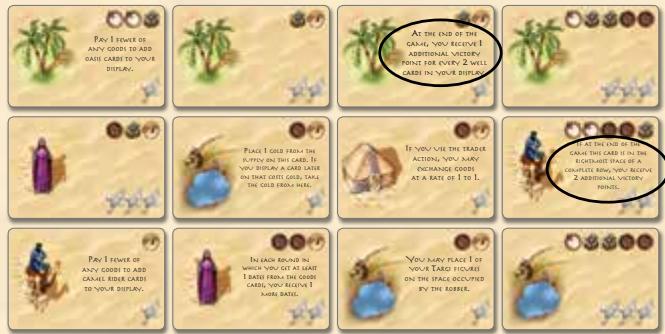
Example: The blue player has displayed her twelfth tribe card, thus ending the game after the current round. She has 3 victory point tokens. Added to that are the 21 victory points depicted on her displayed tribe cards. In addition, she gets victory points due to the 2 tribe cards marked in the picture: 1 victory point for 2 displayed "well"cards and 2 victory points for the “camel rider" card on the right.
And finally, for the complete row with 4 oases, the blue player gets 4 extra victory points and for the complete middle row with 4 different symbols she gets 2 extra
victory points. For the bottom row, she gets no extra points, since 1 symbol appears twice. In total, then, this player gets 33 victory points.

The author: Andreas Steiger, born in 1973, lives with his wife and two sons near Stuttgart, Germany and works as a kindergarten teacher. Besides board games, he enjoys video games and improvisational theater. With board games, what is especially important to him is that the players are constantly faced with new decisions. He has followed his successful first work, Targi, which was
nominated for "Kennerspiel des Jahres" (German "Connoisseur's Game of the Year"), with an equally challenging expansion.
Editing: TM-Spiele
Illustrations: Franz Vohwinkel
Graphics: Imelda Vohwinkel
English Translation: David Gamon
English Editing: Camille Duhamel, Ted McGuire, Tom Wetzel
Additional Graphics: Dan Freitas
The author and publisher would like to thank all the test players and rules reviewers.
© 2012 Franckh-Kosmos Verlags-GmbH & Co. KG. Pfizerstr. 5-7, D-70184 Stuttgart, Germany. Phone: +49 711 2191-0; Web: kosmos.de
© 2018 Thames & Kosmos, LLC, Providence, RI, USA
Thames & Kosmos® is a registered trademark of Thames & Kosmos, LLC. All rights reserved. Printed in Germany / Imprimé en Allemagne
Distributed in North Amèrica by Thames & Kosmos, LLC. Providence, RI 02903. Phone: 800-587-2872 Web: thamesandkosmos.com
Distributed in United Kingdom by Thames & Kosmos UK LP. Cranbrook, Kent TN17 3HE
Phone: 01580 713000; Web: www.thamesandkosmos.co.uk
targi-the-expansion-rulebook-french.md15.2 KB
1 Or
TARGI L'EXTENSION Pour 2 joueurs, à partir de 12 ans
APERÇU ET BUT DU JEU
L'expansion des Touaregs continue, avec de nouvelles tribus et de nouveaux contours.
Maintenant, les décisions sont encore plus délicates. La Targuia voyage dans le sens opposé au Voleur, revalorisant de ses cadeaux les contours dédaignés. Placer un Targui sur une dune de sable mouvant peut procurer de gros avantages, mais vous fait perdre le bénéfice d'une action dans la zone centrale. Enfin, l'eau est un nouvel élément offrant de la flexibilité et de nouvelles manières de jouer rafraîchissantes. A la fin de la partie, le joueur avec le plus de Points de Victoire est déclaré vainqueur.
MATÉRIEL DE JEU
45 cartes Tribu
5 cartes Marchandises
10 cartes Contour *
20 cartes Dune de sable
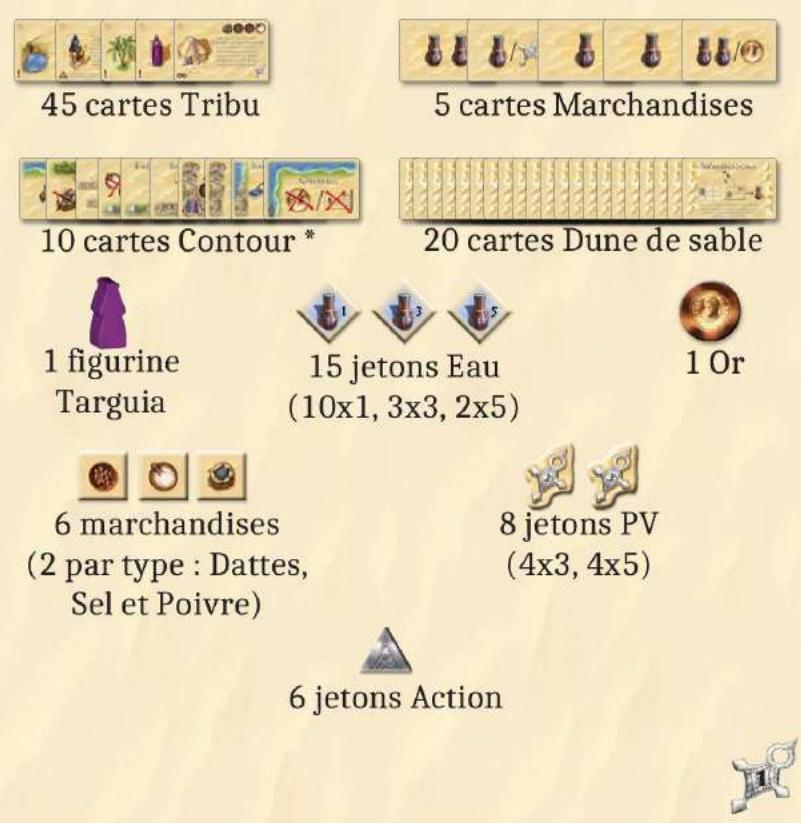
15 jetons Eau
(10x1, 3x3, 2x5)
6 marchandises
(2 par type : Dattes, Sel et Poivre)
(4x3, 4x5)
6 jetons Action
MISE EN PLACE
Avant votre première partie, retirez soigneusement toutes les pièces de la planche. Les joueurs doivent être assis de manière à ce que chacun puisse lire les textes sur les cartes. Le mieux est d'être côte à côte.
Du jeu de base, vous aurez besoin:
• des 6 figurines Targui
• des 4 marqueurs Tribu
- du Voleur
- de toutes les marchandises, Or, jetons PV, et du jeton premier joueur
• des 6 cartes Contour montrant une marchandise
- de toutes les cartes Marchandises
Important : Lors de vos premières parties, n'utilisez pas les cartes Tribu du jeu de base.
Les 6 cartes Contour qui montrent une marchandise, ajoutées aux 10 nouvelles cartes Contour, forment les 16 cartes Contour. Elles délimitent la zone de jeu centrale et sont placées comme sur l'illustration ci-dessous. Les cartes sont disposées dans l'ordre, de 1 à 16, et sont orientées afin que les petits nombres inscrits soient toujours en haut à gauche.
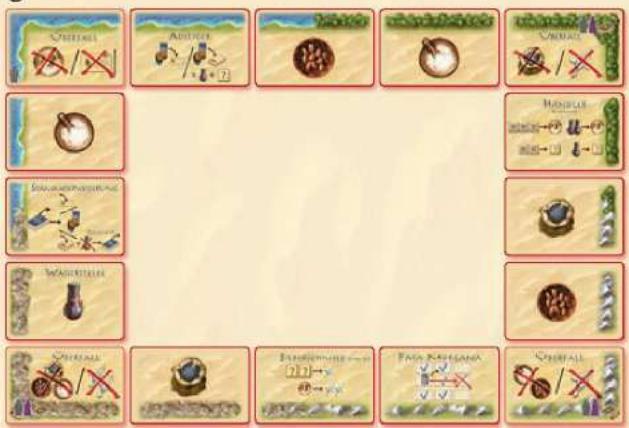
Remarque : Chaque carte Contour comporte une face avec une iconographie, et une face avec les explications sous forme de texte. Nous vous conseillons d'utiliser la face texte lors de vos premières parties.
Mélangez les 5 nouvelles cartes Eau dans la pioche des cartes marchandises.
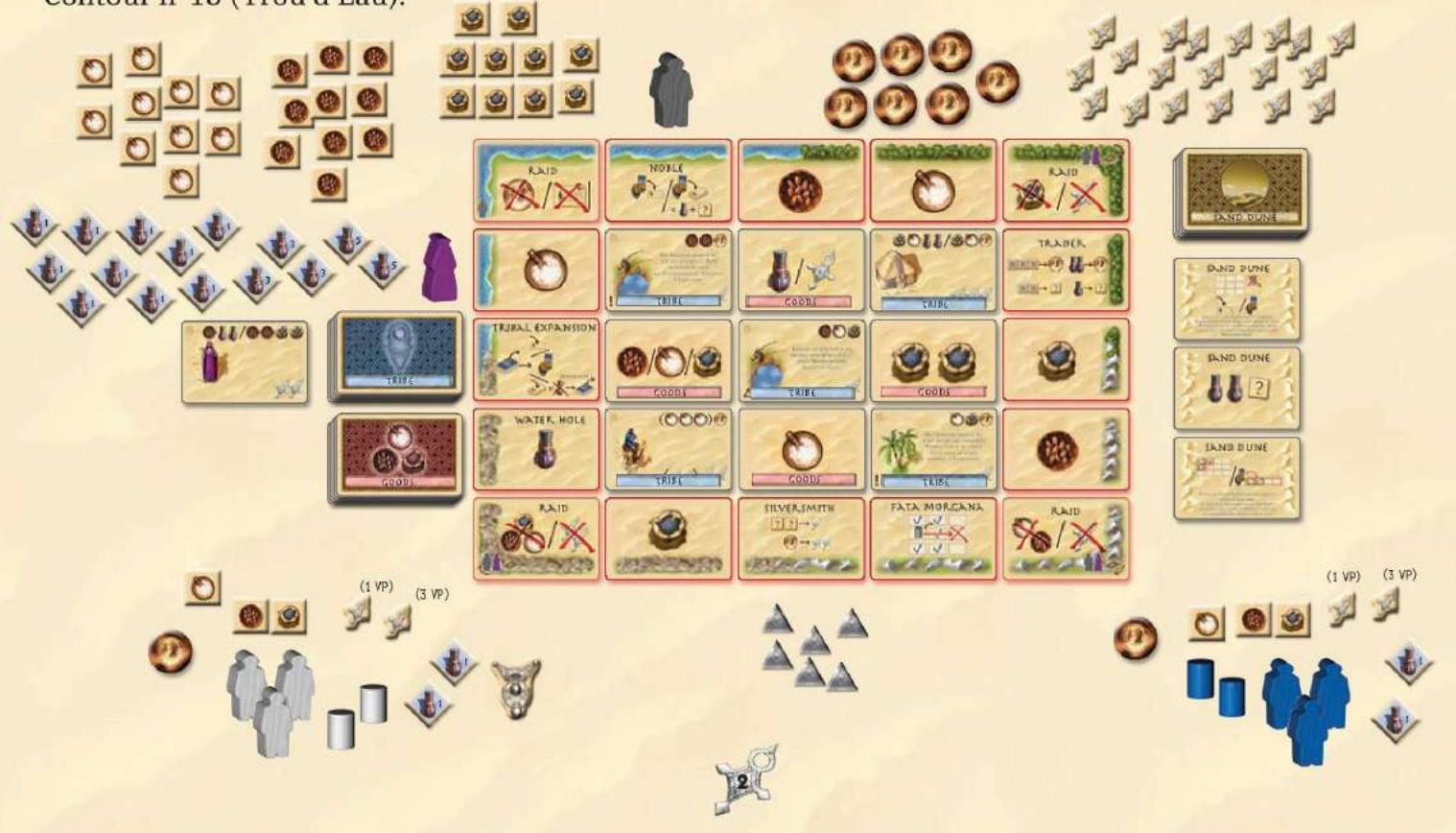
Les cartes Marchandises et Tribu sont mélangées séparément. La zone centrale est remplie avec 9 cartes face visible, disposées aléatoirement et en alternance, comme représenté ci-dessous.
Vous devez avoir un total de 4 cartes
Marchandisees et 5 cartes Tribu dans la zone centrale.
La pile des cartes Tribu restantes est placée à gauche de la carte Contour n°14 (Expansion Tribale), et la carte du dessus est révélée. La pile des cartes Marchandises est placée à gauche de la carte Contour n°13 (Trou d'Eau).
Les 20 cartes Dune de sable sont mélangées et 3 sont placées face visible près de la zone de jeu, à côté de la pile restante face cachée.
Les marchandises, jetons Eau, jetons PV et jetons Action sont placés dans une réserve près de la zone de jeu.
Le Voleur (figurine grise) est placé au dessus de la carte Contour n°1 (Noble).
La Targuia (figurine violette) est placée à côté de la carte Contour n°15 (Sel).
Chaque joueur reçoit les 3 figurines Targui et les 2 marqueurs Tribu de sa couleur. De plus, il reçoit 1 Datte, 1 Sel, 1 Poivre, 1 Or, 2 Eau, 1 jeton 1PV et 1 jeton 3PV (pour un total de 4PV).

Variante : Pour une découverte plus facile du jeu, commencez avec 1 marchandise supplémentaire de chaque sorte (soit 2 Dattes, 2 Sels, et 2 Poivres).
Le dernier joueur à avoir utilisé du poivre reçoit le jeton premier joueur et commence. Sinon, c'est le joueur blanc qui commence.
DÉROULEMENT D'UNE PARTIE
Les règles sont les mêmes que celles du jeu de base, avec les ajouts suivants :
Symboles des cartes Tribu
Activez immédiatement et une seule fois la capacité de la carte lorsqu'elle est jouée dans l'étalage d'un joueur. Pour le reste de la partie, le texte de la carte n'est plus pris en compte.
∞ Dès lors qu'un joueur a joué cette carte dans son étalage, l'effet indiqué est permanent jusqu'à la fin de la partie.
Lorsque le joueur joue cette carte dans son étalage, il y place immédiatement 1 jeton Action. Le joueur peut bénéficier de l'avantage à tout moment durant son tour en défaussant le jeton Action.
! L'avantage de cette carte ne sera pris en compte qu'à la fin de la partie.
Cartes Tribu spéciales
Si le coût d'une carte comporte un "/", le joueur peut décider librement lequel des deux coûts il veut payer.

Si le coût d'une carte comporte des marchandises entre parenthèses, le joueur a le choix de les payer ou non.
S'il le fait, il reçoit immédiatement, sous forme de jetons, les points de victoire indiqués entre parenthèses. Pendant le calcul du score de fin de partie, seuls les points de victoire en dehors des parenthèses sont décomptés.
La Targuia
Au début d'un tour, après le Voleur, la Targuia est déplacée dans le sens anti-horaire sur la carte Contour suivante. Au premier tour de jeu, elle est placée sur la carte n° 15 (Sel).

Contrairement au Voleur, la Targuia ne bloque pas sa carte Contour.
Si un joueur place son Targui sur la carte Contour de la Targuia, il peut, en plus de la capacité de la carte, utiliser un des deux avantages de la Targuia:
- Recevez 1 Marchandise au choix de la réserve
ou bien
• Payez 1 marchandise au choix.
Révélez ensuite la carte du dessus de la pile des cartes Marchandises et obtenez l'avantage indiqué sur la carte.
Si les marchandises sont séparées par un "/", le joueur n'en choisit qu'une.
Si le joueur n'est pas satisfait de la carte, il peut la défausser et payer à nouveau 1 marchandise de son choix pour révéler une autre carte Marchandises. Il peut effectuer cette action autant de fois qu'il le souhaite, jusqu'à ce qu'il décide de profiter de la dernière carte révélée.
Jetons Eau
Tout comme l'Or, l'Eau n'est pas une marchandise. Les joueurs sont limités au maximum de 10 Eau à la fin d'un tour. Tout excédent doit être défaussé dans la réserve. L'Eau apporte de la flexibilité :
• A tout moment, vous pouvez échanger
3 Eau contre 1 Or
2 Eau contre 1 marchandise au choix
- A la fin de la partie, pour chaque 2 Eau restantes, receivez 1PV
- L'Eau est un coût alternatif de certaines cartes Tribu, et parfois requise pour certains effets de cartes Contour et Dune de sable.
Cartes Dune de sable
Lorsqu'un joueur place un Targui, il peut le faire sur une carte de Dune

de sable inoccupée. Chaque carte de Dune de sable ne peut contenir qu'un Targui. Un joueur peut choisir une autre Dune de sable inoccupée lors d'un prochain placement.
L'ordre dans lequel un joueur résout ses actions est libre. Cependant, une action doit être totalement terminée avant d'en résoudre une autre.
Le joueur peut résoudre la capacité unique des cartes Dunes de sable qu'il occupe une seule fois, puis il défausse la carte de Dune de sable utilisée. Le joueur peut choisir de renoncer à l'action d'une carte Dune de sable, mais il doit toujours la défausser.
Important : Si un joueur a placé un Targui sur une carte Dune de sable, il a un croisement (c'est-à-dire un marqueur Tribu placé) en moins pour ce tour. S'il a placé deux ou même les trois Targuis sur des cartes Dune de sable, il n'a aucun marqueur Tribu. Cependant, les capacités des cartes Dune de sable sont plutôt fortes.
De nouvelles cartes Dune de sable sont mises en jeu de deux façons :
- Au début d'un tour, si aucune carte Dune de sable n'est en jeu, 1 carte Dune de sable est retournée face visible depuis la pioche.
- Après un raid, toutes les cartes Dune de sable restantes sont défaussées et 3 nouvelles cartes Dunes de sable sont révélées.
Remarque: S'il n'y a pas de cartes Dune de sable en jeu avant un raid, il n'est pas nécessaire d'en révéler une, car 3 nouvelles le seront de toute façon.
FIN DE PARTIE ET DÉCOMPTE
La partie s'achève à la fin du tour lors duquel au moins l'un des deux joueurs a rempli son étalage avec 12 cartes Tribu. Si cela se produit durant le tour de l'actuel premier joueur, son adversaire joue et termine également le sien.
La partie s'achève au plus tard lorsque le Voleur atteint la quatrième carte Raid. Dans ce cas, les joueurs doivent encore payer 1 Or ou bien défausser, depuis leur étalage, la carte Tribu la plus à droite d'une ligne de leur choix. Puis, la partie prend fin immédiatement après.
Les joueurs procèdent ensuite décompte final en additionnant leur jetons PV aux points de victoire de leurs cartes Tribu (à l'exclusion de ceux entre parenthèses).
Certaines cartes Tribu valent des points de victoire bonus (selon leur texte).
Enfin, les joueurs vérifient s'ils marquent les points bonus pour les lignes avec le même symbole ou pour quatre symboles différents:
- 4 points pour une ligne avec 4 cartes du même symbole
- 2 points pour une ligne avec 4 cartes de symboles tous différents.
1 point par lot de 2 jetons Eau.
Le joueur avec le plus de points de victoire l'emporte. En cas d'égalité, le vainqueur est le joueur possédant le plus d'Or, puis le plus de marchandises. Si les joueurs sont toujours à égalité, la victoire est partagée.
Situations particulières
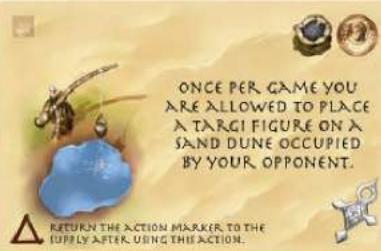
Cette carte autorise un joueur à placer un Targui sur une Dune de sable déjà occupée par son adversaire.
Les règles spéciales suivantes s'appliquent : Après que le premier joueur ait utilisé la carte Dune de sable, ne la défaussez pas. Attendez que le second joueur l'utilise à son tour.
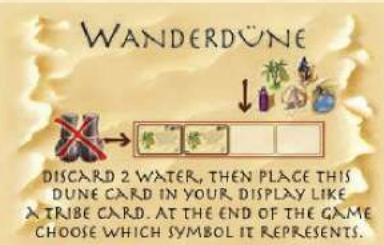
Si un joueur place de cette façon un second Targui sur cette Carte, alors, c'est le premier joueur qui l'obtient (étant le premier
à l'activer). Le deuxième joueur ne reçoit rien, sauf si le premier joueur décide de renoncer à résoudre la capacité.
Les mêmes règles s'appliquent dans le cas extrêmement rare où les marqueurs tribaux des deux joueurs se retrouvent sur la même carte de la zone centrale : si le premier joueur décide d'utiliser la carte, le deuxième joueur ne reçoit rien.
Combiner les cartes du jeu de base avec celles de l'extension
Les nouvelles cartes Tribu sont équilibrées pour fonctionner entre elles. C'est pourquoi on devrait d'abord jouer uniquement avec les cartes de l'extension.
Si des joueurs souhaitent les combiner avec celles du jeu de base, voici ce qui est recommandé :
- Triez l'ensemble des 90 cartes Tribu (base et extension) par symbole (Camp, Oasis, Puits, Chamelier, Targuia) et mélangez chacune des 5 piles séparément.
Piochez aléatoirement 9 cartes de chacune des piles et mélangez l'ensemble. Ces 45 cartes Tribu sont prêtes à l'emploi. Lors de la prochaine partie, vous pouvez simplement utiliser les 45 restantes.
- Bien sûr, les joueurs peuvent construire leur propre deck à leur convenance, mais il devrait au final contenir 9 cartes de chaque symbole tribal.
Les joueurs qui souhaitent encore plus de variations peuvent également expérimenter différentes combinaisons de cartes Contour du jeu de base et de l'extension.
Pour identifier les cartes de l'extension, il y a un symbole Targuia sur les cartes. Il est situé sur la face avant pour les cartes de tribu, et au verso (côté avec texte) pour les cartes Contour.


L'auteur : Andreas Steiger, né en 1973, vit avec sa femme et leurs deux enfants dans la région de Stuttgart. Il y travaille comme instituteur en maternelle. Andreas est un vrai passionné de jeux, qu'il s'agisse de jeux de société ou de jeux vidéo. Il aime également le théâtre d'improvisation. Les grands jeux compétitifs doivent selon lui toujours offrir de nouveaux choix aux joueurs. Ces temps-ci,
il consacre son temps de jeu aux titres qui fonctionnent très bien en couple. C'est pourquoi «Targui», son premier jeu édité, est un jeu à deux joueurs. Targui a été nominé pour plusieurs prix nationaux et internationaux comme le prix du «connaisseur de l'année 2012» et le prix «à la carte» en tant que meilleur jeu de cartes de l'année. Puisque l'auteur et sa femme aiment toujours jouer régulièrement à Targui, et étant donné l'attente de nombreux fans, il a développé cette extension qui apporte du sable frais dans le désert en ajoutant seulement quelques nouvelles règles.
L'auteur est particulièrement reconnaissant envers Xavi Bühlmann, Pierre De Boes, Patrick Egner, Olga Fedarynchyk, Claudia Gold, Anja Heppe, Jonas Heppe, Dennis Heydrich, Lines J. Hutter, Ralf Kuhn, Jörg Lehleitner, Wolfgang Lüdtke, Dominic Matthes, Peter Neugebauer, Martina Reichl, Torsten Sammet, Carsten Wannhoff, Genia Warnez et bien sîr Antonella Steiger, "ma source d'eau dans le désert".
Note personnelle de l'auteur à la communauté franchophone des joueurs de Targui :
Chers joueurs Targui du monde entier, merci d'avoir joué à Targui en utilisant des vignettes et d'avoir donc une expérience de jeu un peu dégradée. Je vous prie de m'excuser pour la gêne occasionnée et l'effort supplémentaire pour l'opération de collage. Je suis vraiment désolé qu'il n'y ait pas de version française de l'extension de Targui pour le moment, donc merci de l'avoir malgré tout achetée une dans une autre langue pour jouer.
Merci encore pour votre patience et j'espère que vous vous amuserez avec cette extension.
Cordialement,
Andy
L'auteur et l'éditeur tiennent à remercier les différents testeurs et relecteurs, notamment Dave Bootz (bgg: bikefreak) pour la relecture des règles anglaises et Sean Crooks (bgg: facemelt) pour avoir retravaillé les règles et les faire ressembler à celles d'origine.
Editeur : Wolfgang Lüdtke
Editeur assistant : Peter Neugebauer
Illustrations : Franz Vohwinkel
Graphismes : Imelda und Franz Vohwinkel
Traduction française non officielle : Grovast (avec l'aimable accord de Andreas Steiger)
Relecture : Morlock Bob
Note sur la terminologie française : cette traduction utilise les termes de "cartes Contour" et de "Voleur" à l'image de la version française Filosofia de 2012. La version 2018 de Iello les nomme pour sa part "cartes Périphérie" et "Pillard".
© 2016 Franckh-Kosmos Verlags-GmbH & Co. KG
Pfizerstraße 5-
D-70184 Stuttgart
Tel.: +49 711 2191-0
Fax: +49 711 2191-199
info@kosmos.de
kosmos.de
Texts are community-compiled or publicly released by publishers; copyright remains with the original authors. For personal reference only.