
Terraforming Mars: Ares Expedition
At a glance
Rules, cards and Q&A (Chinese)
The rules, card data and player questions for this game are written in Chinese. Open the Chinese page to read them.
Where to find full rules
Full rules and card lookup are available in the cunlema app at cunlema.cn — pick this game and ask about any rule, card or turn you are unsure about.
Related games
Rulebook text (Markdown)
This game has 4 rulebook Markdown file(s) in our library; 3 rendered inline below — expand to read or download.
rules_en_terraforming-mars-ares-expedition_328871_ocr.md39.2 KB
来源类型:OCR 文本(非 PDF 源,早期 OCR 产物)
说明:原文未改动,仅调整存放位置与文件名;非 PDF 扫描件,无对应原书 PDF
[第1页]
7 ag |
=< — ’ en - vhs — = _
: Ps 3
. : , ) :
—— A > a
eae | |
— = : = - " 3 : ad
TERRAFORMING®
ARES EXPEDITION
[第2页]
Rey
ER A MESSAGE OF HOPE:
at In this time of unprecedented prosperity and advancement for humankind, we are
et finally ready to expand beyond what once were considered our limits and make a new
7 =" home among the stars. Mars is more than just a new world to house our ever-expanding
: | population. It is also the first step of a lifetime of steps towards humanity embracing the
y potential of our universe as a whole.
i All we need in order to fully realize this glorious future is to invest ourselves in the
process of terraforming the great red planet. To this end, we ask the great corporations
of Earth to join us in funding new research, supporting the construction and shipping
of important resources, and doing whatever it takes to create a lush, liveable world for
humanity to enjoy. This project will require the combined efforts of all humankind, but
we believe that it will be worth it to secure a better future for our descendants.
Teri Ngo, Astro Liason for the United Nations, January 10th, 2315 AD.
| Terraforming Mars: Ares Expedition is an engine-building game in which players control
interplanetary corporations with the goal of making Mars habitable (and profitable). You will do
* this by investing mega credits (MC) into project cards that will directly or indirectly contribute
_ to the terraforming process. In order to win, you will want to accumulate a high terraform rating
_ (TR) and as many victory points (VP) as you can. Players raise their TR by increasing global
(f= parameters: oceans, oxygen, and temperature. TR also determines each corporation’s basic
_ sss income, and, at the end of the game TR counts as VP. Additional VP and production capabilities
ste are awarded for building project cards and other actions taken during the game.
its The game is played in rounds, and each round the players will choose one of five phases, which
sstsss determines which activities will take place during that round. This means every round is different,
siscs but can consist of building new project cards, taking general and project-specific actions,
siere producing income and resources (plants and heat), or researching to draw more project cards.
siete Every player will take all the phases selected for the round, and will receive a special bonus during
sesss the phase that they selected. To speed up the game, players should resolve each phase
:::5: simultaneously!
| prise The game board has tracks for oxygen, temperature, and terraform rating, as well as a place
siecs for all of the ocean tiles that will be flipped over the course of the game. The game ends when
225: there is enough oxygen to breathe (14%), oceans enough to allow Earth-like weather (9), and the
maers temperature is well above freezing (+8°C). It will then be possible, if not comfortable, to live on the
==: — surface of Mars!
BS: The winner is the player with the most VP at the end of the game.
= we
[第3页]
__igameboard 208 project cards 9 ocean tiles
$ , oa 0) ae == o S
S o. ee ——
iy ee Re f z
10" ‘iad ee, a <i 24 forest VP tokens
Ay ’ Lap ’ a a (16 '1' VP tokens and 8 '5' |
0 — ~ ae VP tokens) '
Wer
4 player boards 12 corporation cards eer
S| ee | ee mamel | - g = 148 resource cubes
' | ae een Ss (100 copper cubes, 24 silver
| ow § eo a cubes, 24 gold cubes)
a se i ee | E ig
52 player cubes ES
(13 for each player in four a ; clear i ;
different colors) or temperature an a
20 phase cards a oxygen tracks) Be
(5 cards each in 4 different player colors) , sta!
F pn ° 7 i equal to 41 oy me dew cards ang ststs4
= 5 phase tracking tokens sesssq
. * a 4 h. —— ‘ : * 7 . | . = 4 i 7 a $33
Fj Ya Ya Sa & Puen elie
SE 8 ae ee Ce SS Se ee oo TD
[第4页]
(ge =e |
| The game board has four sections:
1. TERRAFORMING RATING TRACK - When you gain TR, you advance your player cube on
this track.
2. OCEANS - This is where the ocean tokens are placed facedown at the start of the game.
When you flip an ocean, pick an ocean that has the orange side faceup and flip it over, then
gain 1 TR and the reward listed on the back of the flipped ocean tile.
3. PHASE TRACKING TOKENS - Place the phase tracking tokens along this side of the
board.
: 4, OXYGEN TRACK - When you raise the oxygen, advance the cube on this track and gain 1
| TR.
5. TEMPERATURE TRACK - When you raise the temperature, advance the cube on this
track and gain 1 TR.
The oxygen and temperature tracks are each divided into four colors: purple, red, yellow, and
| white. Certain cards will require the oxygen or temperature to be in certain color zones.
| : TERRAFORMING 3
RATING TRACK w oo
7 ‘a, " OCEANS | <a
Ferst a 3 é “a * OXYGEN TRACK
Biete: TEMPERATURE = Cnc dd
———————- -- ==,
[第5页]
_ ‘i, — — — - » ny ™ } - 7
1 , — = — Ee j es er ee AY
J | Beg
CARD ANATOMY ED
7
PROJECT CARDS ie z
Project cards are the backbone to building a powerful corporation in order to win the game. It is 4 .
important to note that at any time you may discard a project card in your hand to gain 3 MC. Project i .
cards have the following pieces of information on them: _
1. NAME - | i Al Central |
2. COST - This is how much MC Del
you must spend in order to play § ‘fF be cc 4) j
the card. 7) = 7 ee a)
3. REQUIREMENT - Some cards sf y ™ y rf : p A .
have additional requirements in nm A vy j f
order to play them. This is shown ¢ > se Re iM oF ie
in brief here and in more detail in 4 a y bet 9, “
the ability section (11) of the card. 7% a hy wy ag
4. TAGS - Cards can have up to 5 ,” , 4 3 ‘rl
three tags. Tags have no inherent 4 ~ 5 wir
value but are referenced in the - & ie Vee Requires 5 @
ability section of many cards. oS 2h | Action: raw two cards.
5. COLOR - There are three colors “=n 3 aude
of cards: blue (active), green p ale <i 2»
(automated), and red (event). —— —=
A. Blue cards either have effects that trigger when certain things happen or actions that i
can be used during the action phase.
B. Green cards have resources that are gained in the production phase or have steel/
titanium capabilities which are used to reduce the cost of playing certain cards. See
page 12 for more info on steel and titanium. :
C. Red cards have effects that happen immediately and do not provide any additional ed
impact after they are played, other than the tags they provide that can be referenced .
by other cards. Be
6. EFFECT (Purple) - This appears only on blue cards and shows icons representing an effect et
which triggers when certain criteria are met. If an effect’s condition is met multiple times when a assem
card is played, then resolve the effect multiple times. asec
7. PRODUCTION (Orange) - This appears only on green cards and shows the icons of what this seats
card produces during the production phase. sesesa
8. CAPABILITY (Gray) - This appears only on green cards and shows that this card has steel or sesesa
titanium capabilities. sisted
9. ACTION (Blue) - This appears only on blue cards and shows icons representing actions which s33:24
happen during the action phase. sizisd
10. ACTIVE PHASES - This section only appears on green and blue cards. The roman numerals jeieas
represent the phases in which the card’s ability can be used. pe
11. ABILITY - This section lists any additional requirements needed to play the card (7), any soieg
immediate effects of the card ( oF ), and the ability of the card. =23t34
12. VP -This section shows how many points this card is worth at the end of the game. sal
13. CARD NUMBER 333)
i 7 <<
— , EEE
[第6页]
7 ie \
JJ CORPORATION CARDS PLAYER BOARD
- These cards represent the corporation each player the player board keeps track of your current
==} _ is acting as. Corporation cards have five parts: resources and production. Resource cubes are
Rea = . placed in their respective boxes, and player
ts 1. NAME Dee INTERPLANETARY | ge markers are used on the production tracks.
4 |. CINEMATICSF. 42
peas 2. TAG-Tags =a Se
have no 5 k 3b 1. PHASES - A brief description of the phases.
*- inherent ns . o> Tae 4 2. PRODUCTION TRACKS - When you
he value but are atansiaiied gain production of a resource, move the
ff mentioned weiner rays Ag) corresponding cube on its track. Add a
/ in the ability ae { second cube to the right column if needed.
section of eee) | ame There are four types of production: (a.)
many cards. BD esrect: when you play MC, (b.) card, (c.) heat, and (d.) plant. The
3. LOGO haa fe d, production tracks show how much of each
4. STARTING "sale chee, you will gain during the production
RESOURCES - This section tells you
how many mega credits (MC) you gain at | Example: If you gain two heat production on
the start of the game. It may also tell you __ the first turn, move your player cube on the heat
if you start with any production or other production track from 0 to 2.
abilities.
. 5, EFFECT/ACTION - This shows any 3. RESOURCES - Whenever you gain (a.) MC,
| L : (b.) heat, or (c.) plants, place the copper,
{ ongoing effects or actions you have : :
access to during the game. silver, and gold cubes into the section
corresponding to the resource gained. The
copper cubes are worth 1, the silver 5, and
| PHASE CARDS the gold 10.
i ed ses ac gar 7m Sees le Example: If you produce 6 plants, place 1 copper
| p y P y , cube and 1 silver cube into the green resource
cards have four parts: section to the right of the plant production track
‘ EE on your player board.
o es: 1. PHASE NUMBER -
ect The phases are ea UTtg@ 4. CAPABILITIES - When you gain (a.)
erese resolved in order steel or (b.) titanium capabilities, move the
eters based on this — corresponding cube on its track. Add a
secss number. a second cube to the right column if needed.
st: 2. NAME ape §, STANDARD ACTIONS - During the action
brit 3. ABILITY - Thisis ; phase, players may perform as many of these
esist ihe effect that all actions as they want, any number of times.
Ries: players will resolve jas
Betis during this phase. Pay 3 MC less for the card you play
sist 4 BONUS-Thisis [oP
siete the additional effect
atts that you will resolve during this phase
EH only if you selected this phase this round.
| = ————SSES
[第7页]
There are four different kinds of resources in | baad
F Terraforming Mars: Ares Expedition: mega ha
are credits, heat, plants, and special resources. k
= GG | | MEGA CREDITS (MC) - MC is
as used to play cards and activate |
il ' a actions.
: K 20} HEAT - Heat is used to raise the :
eee temperature of Mars. During the
action phase, players may spend 8
heat to raise the temperature one
i E3p step and gain 1 TR.
PLANTS - Plants are used to make
ae forests, which raise the oxygen
on Mars. During the action phase,
: = players may spend 8 plants to gain
+ aT €23 a forest VP, raise the oxygen one
) step, and gain 1 TR.
°: p/m 2: 0/3 ay SPECIAL RESOURCES - Some |
eo ae® ° cards allow you to place special i uf
: = 2 - - "| resources (animals, microbes, and
, + €D science) on that or other cards.
o® 999 = =i These resources do different things,
n-¢ O- >¢ sH-| D-e as specified by the different cards. Pe
i a OTHER TOKENS
: ia cig dite leh nggeatins add undillg Raslaitee vtlas abnlhs . FOREST VP TOKENS - Awarded sa
epoCid TEGOUICE, 250 Hie COPPO, SIVey, .. 4 when a forest is built. Worth 1 VP at 255)
and gold cubes to track the number of each the end of the game. There are 5 VP ih
resource you Nave. [he copper cubes are forest tokens in case you run out of $8585
PHASE TRACKING TOKENS - sesieg
_ sisted
’ k ’ ~~} Show which phases were selected sieies
NOTE: Some production cards increase their by all players during the round. ssisza
production when you have more of a specific sstsd
tag. You'll need to update your player mat every OCEAN TILES - During setup, sicits
time you play that tag. place these on the board with the seseas
= \ orange side faceup. When you flip sses=g
an ocean over to the blue side, you sis
NOTE: You will always be able to calculate Gy will receive the benefit shown on tsitsts
your Current production and capabilities by that side. For example, if you flip 223
looking at your cards in play. The player board is the tile shown to the left, you gain 33H
just more convenient. 2 plants. Once an ocean tile is blue ===)
side up, it cannot be flipped over aaa}
again. asP
—————— - —=<<<—<<<7_
ee ee ee we ee ee ee ee ee ee oo
[第8页]
| Bee |
iiss. ; |
a] SETUP r a
2 | 1. Set the game board in the middle of the table. ae oN. |
| i | 2. Set the phase tracking tokens next to the game board a 8
—| with the closed door side up. Pe be ads
a 7 3. Set all of the forest VP and the copper, silver, and gold 7 «aD
F cubes next to the game board. ‘
Pf, 4, Place the two clear cubes on -30° C on the peter
SF temperature track and 0% on the oxygen track. a agi
f 5. Give each player a player board and the 13 cubes in eR x
| their player color. Each player places a cube on the gee sata TS.
‘0’ space of each of the six production tracks on their a ype
player boards and a cube on the ‘5’ of the TRtrackon 3 jy { ma
the game board. Use the other cubes when you have ain tk -
10 or more production/capabilities. .
-
Shuffle the ocean tiles blue side down and place them = "ety , brag
on the nine ocean spaces on the board. | ga “ -
/ For your first game instead of performing step 7, find a Pe sg es a
the sixteen green project cards thathavea nextto | [oe oe : oa
the card number. Shuffle them and deal each player ie 0 my = coarse j > ee
i, four of those cards. Place any remaining cards with a | Sie: | fee more ca
in the discard pile. The rest of the project cards are a
1 already shuffled. Feel free to cut the deck, then deal a
: four more cards to each player. _ a SAey —
4 x =e: bie a: "a
f Shuffle all of the project cards together facedown to ef
form the project card deck. Deal each player eight ; oes
| project cards. You will keep all of them. Split the deck pe —
into two piles so that all players can easily reach one “<) Eoaeter | —
j of the decks. i
BE 8. / For your first game, instead of performing step 8, = Hetlowdaaal
ee deal each player one of the corporation cards with a id / = a
gets W next to its card number. HS :
Biss: Shuffle all of the corporation cards facedown and deal 4 nd . ™ ,
ssccs each player two corporation cards. Each player picks es atch > beat
Sees one to use for the game and discards the other. Return —_¥ A
Bit all unused corporation cards to the box. bi
eter Advanced Rule: Once you have been dealt your BST notuse mc a: heat’ i
sists corporations, but before you have chosen which one a
eres you want to use, you may discard any number of
Bits project cards and draw that same amount. De a eM A AMS Py
piece 9. Each player receives any starting resources and ———
tess abilities from their corporation. ga 2 ay ag .
fe: 10. Give each player a set of five phase cards S | he liane
Ri: corresponding to their player color.
BH 11. Start the game. eae ae roe
ee 8 ——
[第9页]
— ~~ ST
A - 7 : a a—
OW - Wal VS a 3 - |)
See oS | oe
[4 r wa
aid wea —
—E_ = -_
[第10页]
: _| The game is played over the course of several rounds. Each round is divided into three steps:
Ey A. PLANNING STEP (pg. 10)
a B. RESOLVE PHASES STEP (pgs. 11-15)
ja C. END STEP (pg. 16)
In each step and phase, players play simultaneously. Not all phases will happen every round.
Each round will always start with a planning step in which players will determine which phases will
occur that round.
| A. PLANNING STEP
Each player simultaneously chooses a phase card from their hand and places it facedown.
Starting with the second round, players will place this card at a 90° angle on top of the last phase
card they chose. Players are not allowed to pick the same phase two rounds in a row. After
| revealing the played phase card, players will return the phase card they chose from the previous
| round to their hand.
= Once all players have done this, the chosen phase cards are revealed. These cards determine
- _ which phases are resolved this round. For each phase that was chosen for this round, flip the
= _ associated phase tracking token faceup so that the name of the phase is showing.
< . iV PRODUCTION : DEVELOPMENT
eee ew . pr =
Bs: { Siraws 4 j er SA | ath Each player may play 1 green
ace te product — ? aq " project card.
psist: 7 i BONUS
fetese Bb. — «A ee Pay 3 MC less for the card you play
es rd this phase.
Beetss
eerese
Bis A player is not allowed to pick the same phase two rounds in a row.
= 10 = —%
So a a ea a a a a ee oe oe eT p@ 2s" ss 2-4-9 - 8 8-88)
[第11页]
B. RESOLVE PHASES STEP c2
During this step, players resolve the phases that were chosen during the planning step. The peed
chosen phases are always resolved in the following order: +
I. DEVELOPMENT PHASE (pg. 71) :
Il. CONSTRUCTION PHASE (pg. 72)
Hil. ACTION PHASE (pg. 14)
IV. PRODUCTION PHASE (pg. 75)
V. RESEARCH PHASE (pg. 15)
Each player resolves each of the chosen phases (and only the chosen phases) once in the round.
Players resolve each chosen phase simultaneously. Once all players have finished with a phase, |
they all move onto the next chosen phase. |
If multiple players choose the same phase, that phase is resolved only once. If a phase is not
chosen, each player skips that phase this round.
When you choose a phase, you will receive the specific bonus in that phase that is listed at the
bottom of the phase card.
BONUS
| DEVELOPMENT PHASE: secre
During this phase, each player may play one green project card from their hand by es : : a4
paying its cost. See Playing Project Cards on page 12. Bonus: If you chose this —— sie
phase, the cost of the card you play this phase is reduced by 3 MC. ae: <4
After playing a green card, make sure to adjust the corresponding =e 33 ss =
capability or production track on your player board. scseed
Reminder: Players may discard project cards in hand at any time to gain 3 MC. This see ~
can be done for any reason. Whenever a player discards a card for any reason, it is 333]
discarded facedown to the project card discard pile. oe
Ss — ——————— = ===; _
“Se eee eee ee f——= == = ee oe oe oe
[第12页]
‘ 4 li CONSTRUCTION PHASE:
i i During this phase, each player may play one blue or one red project card from their a
‘ | hand by paying its cost. Bonus: If you chose this phase, you can either: Draw a card or
td | before or after playing a card this phase OR you may play an additional blue or red ew
a card this phase. 4
|
ae Tip to save table space: Play green cards along the bottom of your player board on
f the right side. You can overlap them so that just the production box and tags along
the left side are showing.
. Play blue cards in a row above your green cards. You can overlap them so that just
the ability icons and tags along the left side are showing.
Play red cards in either row, you can overlap them so just the tags are showing.
PLAYING PROJECT CARDS
The cost to play a project card must be paid with MC. You can use MC cubes you
have and/or discard other project cards in your hand at a rate of 3 MC per card. Any
overpayment in cards is returned to you using cubes. (Ex. You can play an 8 MC
5 card by discarding two cards and paying 2 MC, or by discarding three cards in
| hand. If you discard the three cards, you will receive 1 MC back.)
| REQUIREMENTS
] Some cards have additional requirements in order to play them. Cards with
requirements have a checkmark icon (@) next to the cost of the card. These
i requirements are listed in the text box at the bottom of the card next to the same
| checkmark icon (i) and shown in icons at the top. If a card has an ocean, oxygen,
or temperature requirement, that requirement needs to have been met at the start of
Le the phase in order for you to be able to play it. If the requirements of a card are not
@ x met, you cannot play that card.
Bt STEEL AND TITANIUM
Secs The cost of Project_cards with a building tag @, regardless of color, is reduced by 2
pistes MC for each steel {fii you have.
tt: The cost of Project cards with a space tag >. regardless of color, is reduced by 3
beiece MC for each titanium {J you have.
Bete The cost to play a card cannot be reduced below zero.
aiese You may play cards that raise parameters beyond their maximums or add special
beisrs resources when you don’t have a card to add them to. You will simply not receive
betets the benefits of those effects.
—-
[第13页]
]
Example: Bob wants to play Microprocessors, which is a green card that costs 17 MC. $3 :
Microprocessors has a building tag (@). pe Bob has two steel, so his cost to play Ht
cards with building tags is reduced by 4 MC. 2 Bob chose the development phase this ait
turn, so his cost to play this green card is reduced by 3 MC. Thus, Bob’s cost to play —_
Microprocessors is 17-4-3=10.
oe Bob has 4 MC cubes which he can use to pay for the card, but that leaves Bob 6 MC
short of playing it. Bob can discard two project cards from his hand at a rate of 3 MC each a
to pay for the remaining 6 MC. -* Bob chooses to discard two cards and spends his 4 MC
cubes, and places Microprocessors into play.
S Bob resolves the immediate effect of the card which is “Draw two cards. Then, discard a
card.” Finally, Bob is done with the development phase.
[ Microprocessors
x ie a ‘
‘“ “er '
ig ¥ Draw two cards. 1
Then, discard a card. {
3 Pts otc 5 heat |
| DEVELOPMENT a
: 4 ai | atets
1 1( Eachplayermayplayigreen ee = F, ee sess 3
4 project card. <3 "3 |
this phase. ‘ s.08
‘i - 4 MC less for it fe te
te
13 —=—
& FL ee ee Ce a ee ee ee a ee ee
[第14页]
Hi ACTION PHASE:
Each player may resolve the “Action:” ability on each of their cards in play once 1) aera
during this phase. Each player may resolve any number of the standard actions any
number of times. Bonus: If you chose this phase, you may resolve the “Action:” fF ere
ability on one of your cards in play an additional time.
STANDARD ACTIONS ——
During the action phase, players may use the standard actions printed on
their player boards. Those actions are:
ae dee a © Spend 8 plants to gain a forest VP and raise the oxygen one step.
| [20> ar ® Spend 20 MC to gain a forest VP and raise the oxygen one step.
|
| 8 cS ® Spend 8 heat to raise the temperature one step.
ai] © Spend 14 MC to raise the temperature one step.
n> - ®@ Spend 15 MC to flip an ocean tile. When a player flips an ocean
. tile, they immediately receive the reward shown on the back of
es the tile.
< Reminder: Whenever you raise oxygen, raise temperature, or flip an ocean, you
= gain 1 TR. This happens for each step you raise those parameters.
= ! During the phase in which a global parameter reaches it's maximum (temperature
x at +8°C, oxygen at 14%, or 9 ocean tiles fipped), all players can continue to
Es take actions or play cards to increase that parameter. They will receive all of the
ars benefits, such as forest VP and TR. During the phase that the last ocean tile is
iss: flipped, any player who continues to take actions or play cards to flip oceans will
eee gain the reward on the last ocean tile that was flipped in addition to the TR.
ates:
+ sees After the phase in which the parameter reached it's maximum, players can no
+ ofet longer gain rewards for increasing that parameter.
3 3 $3 Players may continue to gain forest VP tokens for building forests after the phase
+ Ue when oxygen reaches 14%, but won't gain TR for increasing oxygen when they do.
prises Important Rule: At the end of the action phase, if you are able to spend heat or plants for a
Brsctt standard action, you must do so unless the associated terraforming parameter has already
eters: been raised to its maximum.
ee 4 aS
<= = = Ss eS ee ee ee I i ee ee ee
[第15页]
IV PRODUCTION PHASE: isi
During this phase, each player collects resources equal to the production on their ty, PRODUCTION es
green cards, corporation card, and place on the TR track. Bonus: If you chose this pens
phase, gain 4 MC. pees tt
a | Gain MC equal to your MC production + your TR. Gain heat and plants fi
eS equal to your production for those resources. Place copper (1), silver a!
— (5), and gold (10) cubes to track these resources in the appropriate
ip resource section of your player board. For each card production, you
draw a card during this phase.
Example: Bob has played four cards, shown below, so far this game. When Iy. PRooucTIoN
he played these cards, he adjusted his player board accordingly. During — |
the planning step of this round, he chose to play the production phase. F Each player gins eat 5 ‘ |
During the production phase, Bob will gain all of the resources shown on Renter pod, |
his player board plus MC equal to his TR, which he can verify by checking —
the production boxes on the cards he has played. He gains the ee
following: ie
; oan 1. 4 MC for his MC production
1 .
5) and 6 MC for his TR 1 |
» . 2. 1 card |
gOs5 ¥ Gi 4. 1 plant ee
rs — i Ye 5. 4 MC asa bonus for A
rere. 3 choosing the production oe
ase © Ci) (e) phase. | g
"hail eee l= —— ing i pes ee
SaGe : oee8e 34 i i <0 4 vi | you have, including this. ciety
V RESEARCH PHASE: 32:34
Each player draws two cards, keeps one, and discards the other. Bonus: If you Pees | taiesg
chose this phase, you draw three additional cards and keep one additional card. ~~ ee i
Meaning, in total, you draw five cards and keep two, discarding the other three. scared
If at any point, a player needs to draw a project card and the project card deck sie ee 233) :
is empty, shuffle all of the discarded project cards together to form a new project =33|
card deck. al 3H
en 5 re
See ee eee ae ee ee SSR ———
[第16页]
Ee
- (jc. END STEP
om | During this step, each player discards down to ten cards in hand. For each card discarded this
| | way, that player gains 3 MC as normal.
EE | Flip all of the phase tracker tokens so that the closed door side is faceup, and start the next
me §=6round.
h END OF THE GAME
a i The end of the game is triggered when all three of the following are true:
- All nine ocean tiles have been flipped blue side up.
| 2. The temperature is at +8°C.
- Oxygen is at 14%.
Once this happens, players finish the current phase and then proceed to final scoring. The
round does not continue to any other phases that were picked. For example, if all of the global
parameters are capped during the construction phase, and the action and production phases
were also chosen for this round, the game does not continue to the action or production phase.
Tip: If the game ends during the action phase, players will likely want to convert
all of their cards in hand and MC into standard actions that gain TR.
: FINAL SCORING:
__ Players score VP for the following things
t - 1VP per TR
= 2. VP equal to their forest VP tokens
| 3. VP equal to what is printed on the project cards they played,
“ies including cards that have variable VP denoted with an asterisk*
{ i: The player with the highest total VP wins the game. In the event of a tie, the tied player with the
steee most heat, MC, and plant resources added together is the winner. Be sure to convert project
geist cards in hand to MC beforehand.
Biss: Example: At the end of the game, Bob totals his final
brie: score:
steee He has 25 TR as shown on the TR track. saa
ete: He has 6 forest VP. wy
Brisi: He has four project cards with VP on them, for a total of 9 = =
scree He also has a project card with variable VP worth 1 VP "a
Rezes per 2 animals on the card. Bob added 6 animals (resource i i
fess cubes) to this card over the course of the game, so it is sialon i a
EE | worth ave Spa
Bi: Bob’s final score is 25+6+9+3=43. ne =
SS = — So,
[第17页]
—z a 2 a om ane — iow * ’ 1¥ 7 Di = a
~ ~ ~ Le Ce EE Se
of a —_ a = ——> - a Peigltl —** — ————f
a | oe y
4 SYMBOLS TEMPERATURE - Raise the temperature i 7
by 2°C. Heat, MC, or effects on cards can 2
All abilities and requirements on project cards are be used to increase the temperature. The : Fi
shown both with symbols and explained in text. temperature starts at -30°C and can be |. ie
Below is a glossary of all symbols you will see on _ raised 2°C at a time up to +8°C. This will createan | 5& 5:
project cards. equatorial zone where water stays liquid. t ia
OXYGEN - Raise the oxygen by 1%.
VICTORY POINTS AND Plants, MC, or effects on cards can be used {i
TERRAFORMING RATING to raise the oxygen level. The oxygen starts (
VICTORY POINTS (VP) - Points that will at 0% and can be raised 1% at a time up to 14%. tS
At 14% the atmosphere resembles that of Earth at \
add to your score at the end of the game. a 3000M-elevation \
Some cards have either a set number of VP ,
) on them, or anumber contingent on another OCEANS - Flip one ocean tile. MC or
factor (Such as resources on the card mn effects on cards can be used to flip ocean
or certain cards in play). You win the game by _ tiles. Each ocean tile represents 1% ocean
having the most VP. Taking the time to terraform coverage. The ocean coverage starts at 0% and
in a sustainable, environmentally conscious way, can be raised 1% at a time to 9% (or, 9 ocean
create impressive structures, and bring beautiful tiles). With 9% of the surface covered by oceans,
creatures to our new planet, will ultimately be Mars will have a hydrological cycle, creating rain
rewarded. and rivers.
TERRAFORM RATING (TR) - Points
that will both produce MC throughout 2
the game and add to your score at the [LLL=CL' [a= INS
end of the game. TR is the measure of how much __ There are four types of resources that can be
you have contributed to the terraforming process. _ used in your corporation’s work to terraform Mars: |
Each time you raise the temperature, the oxygen MC, plants, heat, and special resources (animals, i
level, or flip an ocean tile, your TR increases. microbes, and science).
Every step towards terraforming is its own reward, .*
but as an added bonus, there are also government (e] MEGA pieneleapr at thie the di
stipends in return for your hard work making Mars Sena, Mewes NEN Se ee
habitable how your corporation will pay to complete
: projects and take certain actions. =
PLANTS - Plants represent the hard work a3 7
PARAMETERS your corporation is putting in to increase ese
the forest coverage on Mars. Plants are a seats
There are three parameters that gauge how : . aeeeeg
: resource you can use to build forests and raise mazes
much Mars has been terraformed: temperature, stata
the oxygen. =.26%
oxygen, and oceans. You and your fellow players asece
are competing to contribute the most to the HEAT - Heat represents your corporation's 52555
terraforming of Mars. Each of these symbols efforts to make the temperature of Mars tiie
indicates raising the associated parameter habitable. Heat is a resource you can use to seee8
one time. Each time you raise one of these raise the temperature 2°C. stets
palainters you will galb-l- Tin. ele y aspectos SPECIAL RESOURCES - Your corporation "2:5
preparing our new home is equally important. : : . ‘ =s5s2
can invest itself in the animals, the seats
Only when our atmosphere and ocean levels are : : azar
am i : ‘ microbes, or the science resources of aae5%
perfectly maintained can we begin to bring over a . atafe
wn humanity's future home. These three special =i #""
our citizens. F asa
~ | resources are collected on project cards to =
be used for specific effects. tea
———— | ant ——SSa CC
ee 82-6 ee Pee ee ee ee
[第18页]
pena CAPABILITIES — STEEL way ANIMAL: This project involves introducing
various kinds of animals into the Martian
es AND TITANIUM ecosystem. These cards generate VP.
ce Sale has te ahd e ae es “ss Statin EVENT: This project is a one-time operation
zea | cene oe / oe See to permanently alter Mars. All events are red
Bal | project cards. The proper building materials are as
essential when starting an expensive project! ;
j ASTERISK: When an icon has an asterisk
. ae : ab
| f Fae i da am his oh pee! a ”,~ (*) next to it, there is a special rule that you
vy i ee ee Capa iy edie must read in the ability text on the card.
ie the cost of playing project cards with a
f building tag © by 2 MC.
TITANIUM - This represents building =
keg materials used in space. Each titanium TW O P LA Y E R
capability lowers the cost of playing project
cards with a space tag © by 3 MC. Cc Oo — Oo Pp IVE O D E
In this mode, two players work together to
TAGS completely terraform Mars before time runs out. All
: the rules of the game are the same with the following
Project cards can have up to three tags on them, exceptions:
which can be referenced by some cards' effects.
— BUILDING: This project involves SETUP
construction on Mars, and canbe cheaper _ After you have finished setting up the game, in the
*) ey to produce using steel. upper right hand section of the game board, place
ee 5 oe ‘ 27 copper cubes and 3 cubes of a player color you
SPACE: This project uses space are not using in a pile.
technology, and can be cheaper to produce
using titanium.
- GAMEPLAY
w POWER: This project involves the creation _ Players should give each other advice and
of energy, and the conversion of energy into encouragement! We recommend that you don’t
other resources. discuss specific cards in your hand, but rather keep
- a. . . your statements broad, like, “I have a lot of heat
— fer €) SCIENCE: This project helps invent new, production, so don’t worry about that” or “I’m going
mg feet ..' cutting edge technology to streamline the to choose the production phase this round.”
ste terraforminig process. After players have revealed their phase cards each
estes JOVIAN: Jovian means ‘having to do round, each player takes a cube from the pile on the
Stets with Jupiter.’ This project represents game board. If you take a copper cube, add it to
Fsssts infrastructure in the outer solar system. your MC. If you take one of the player color cubes,
areas : discard the cube and you may trade one project card
Sttss i, EARTH: This project is related to activities in hand for a project card in your partner’s hand.
fetes on Earth.
sesss PLANT: This project involves plant life or END OF THE GAME
Stree other photosynthesizing organisms. The game ends at the end of the round in which the
rene last cube is taken from the pile (15 rounds).
Brses cS) MEGROBE Tins pooja ENON At the end of the game, if all of the terraforming
sits introducing various kinds of microbes into parameters have been completed and the players
Sst: the Martian ecosystem. have a total score of at least 80 VP, the players win!
ere Otherwise, the players lose. Record your VP and try
=: to beat your high score the next time you play.
18
[第19页]
The goal of the solo game is to fully terraform Mars before time runs out. ‘i
All the rules of the game are the same with the following exceptions: | Besa
SETUP A
1. Set aside an additional set of five phase cards as a dummy hand. Shuffle that set of iB
cards facedown.
2. Place a player cube of a color you are not using on the 1 on the TR track. \J
‘
3. Choose a difficulty level: Novice, Advanced, or Expert. a"
GAMEPLAY
Once you have selected a phase card during the beginning phase, play the top card of the
dummy hand faceup. That phase is also played this round (without a bonus). Continue to play
rounds, playing a card from the dummy hand each round.
When all five dummy hand cards have been played, shuffle them all facedown to reform the
dummy hand. Each time you reshuffle the dummy hand, advance the dummy player cube (that
started on 1) to the next space on the TR track. Once that cube reaches 5, play five final rounds.
You are allowed to pick the order in which the dummy hand phase cards are played in these final
rounds. After all of the phase cards from that hand have been played (25 rounds in total), the
game ends. jae
{)
DIFFICULTY LEVELS: Solo mode can be a great way to learn the game, but it is |
not easy to win if you aren’t experienced with the game and its many strategies. If you |
aren’t experienced, consider choosing one of the lower difficulty settings below. Ina :
lower difficulty setting, the terraforming parameters will advance each time the dummy
player’s cube moves (4 times per game), to help you reach your terraforming goals.
Note - raising terraforming parameters in this manner does not provide TR nor ae
Forest VP tokens. seat
NOVICE MODE: Increase oxygen or temperature 2 steps after advancing the 333
dummy player’s cube. atste]
ADVANCED MODE: Increase oxygen or temperature 1 step after advancing the Besse
dummy player’s cube. cesses
EXPERT MODE: No bonuses are given. tses
Once five full dummy hands have been played (25 rounds), the game ends. If Mars is fully 23333
terraformed, you win. Otherwise, you lose. Finally, you score VP, attempting to achieve as high a Ptr
score as possible. asace
Did you see the two-player co-op rules on the previous page? :
lass 19 =]
a poe 2-6 6 ee are Pi ee eS
[第20页]
=i — = > eee _. em —— er ee A ee eee
‘ _| The game is played over the course of several rounds. Each round is divided into three steps:
i: | A. PLANNING STEP
=f Each player simultaneously chooses a phase card from their hand and places it facedown.
mm A player is not allowed to pick the same phase two rounds in a row.
i
| |
_/## B. RESOLVE PHASES STEP
i? i During this step, players resolve the phases that were chosen during the planning step. There
. are no turns, so each player plays each phase at the same time. All players may participate in
the selected phases, but players only receive bonuses for the phase they selected. Bonuses are
printed in the bottom section of the phase cards.
The chosen phases are always resolved in the following order:
I. DEVELOPMENT PHASE
e Each player may play one green project card from their hand by paying its cost.
Il. CONSTRUCTION PHASE
e Each player may play one blue or one red project card from their hand by paying its cost.
ill. ACTION PHASE
e Each player may resolve the “Action:” ability on each of their blue cards in play once.
ie IV. PRODUCTION PHASE
t e Each player collects MC equal to their TR and resources based on their green cards and
their corporation card.
V. RESEARCH PHASE
e Each player draws two cards, keeps one, and discards the other.
i” C. END STEP
During this step, each player discards down to ten cards in hand. For each card discarded this
= way, that player gains 3 MC as normal.
r st: Flip all of the phase tracker tokens so that the closed door side is faceup, and start the next
tees round.
Bt: The game ends when all of the global parameters have been completed. The player with the
=s:5: most VP wins!
sects Game Design: Jacob Fryxelius, Nick Little, and Sydney Engelstein
25252 Development Consultant: Will Sobel
Peres Graphic Design: Bill Bricker, Jason D. Kingsley, and Isaac Fryxelius
=25= Illustrations: Bill Bricker, Garrett Kaida, Nio Mendoza, Andrei Stef,
£555" Naomi Robinson, and Justine Nortjé
Setes 3D assets: Renham, Pandoraskitten
SeSs% Art Direction: Bill Bricker ‘ :
sists Editor: Anna Russell Indie Game Studios
“aget Playtesters: Travis Worthingon, Peyton Worthington, Rhet ai Oakland, CA 94610
ets Eikleberry, Hayley Nielsen, Adam Ping, Marc Martinez, Katie And visi Email: info@StrongholdGames.com
ss Martinez, Ryan Bruxvoort, Aaron and Kimberly Myerson, Anna d visit our wnt ee i i ll
S Russell, Will Sobel, Stephen Buonocore, Chad Krizan, Geoffrey All Fi ia Feared
== Engelstein, Brian Engelstein, James Williams, Jeffrey Tabler, Donnie ig e STRONGHOLD
eee Smith, Brandon Basham, Troy Lopez, and Alexis Lopez GAMES
a eo —_________o~|,
0e-terraforming-mars-ares-expedition-rulebook.md39.2 KB
A MESSAGE OF HOPE:
In this time of unprecedented prosperity and advancement for humankind, we are
nally ready to expand beyond what once were considered our limits and make a new
home among the stars. Mars is more than just a new world to house our ever-expanding
population. It is also the frst step of a lifetime of steps towards humanity embracing the potential of our universe as a whole.
All we need in order to fully realize this glorious future is to invest ourselves in the process of terraforming the great red planet. To this end, we ask the great corporations of Earth to join us in funding new research, supporting the construction and shipping of important resources, and doing whatever it takes to create a lush, liveable world for humanity to enjoy. This project will require the combined efforts of all humankind, but we believe that it will be worth it to secure a better future for our descendants.
Teri Ngo, Astro Liason for the United Nations, January 10th, 2315 AD.
OVERVIEW
Terraforming Mars: Ares Expedition is an engine-building game in which players control interplanetary corporations with the goal of making Mars habitable (and profitable). You will do this by investingmega credits (MC) into project cards that will directly orindirectly contribute to the terraforming process. In order to win, you will want to accumulate a high terraform rating (TR) and as many victory points (VP) as you can. Players raise their TR by increasing global parameters: oceans, oxygen, and temperature. TR also determines each corporation's basic income, and, at the end of the gameTR counts as VP. Additional VP and production capabilities are awarded for building project cards and other actions taken during the game.
The game is played in rounds, and each round the players will choose one of five phases, which determines which activities will take place duringthat round. This means every round is different, but can consist of building new project cards, taking general and project-specific actions, producing income and resources (plants and heat), or researching to draw more project cards. Every player will take all the phases selected for the round, and will receive a special bonus during the phase that they selected. To speed up the game, players should resolve each phase simultaneously!
The game board has tracks for oxygen, temperature, and terraform rating, as well as a place for all of the ocean tiles that will be flipped over the course of the game. The game ends when there is enough oxygen tobreathe (14%), oceans enough to allow Earth-like weather (9), and the temperature iswell above freezing (+8°C). It will then be possible, if not comfortable, to liveon the surface of Mars!
The winner is the player with the most VP at the end of the game.
CONTENTS
12 corporation cards
1 game board

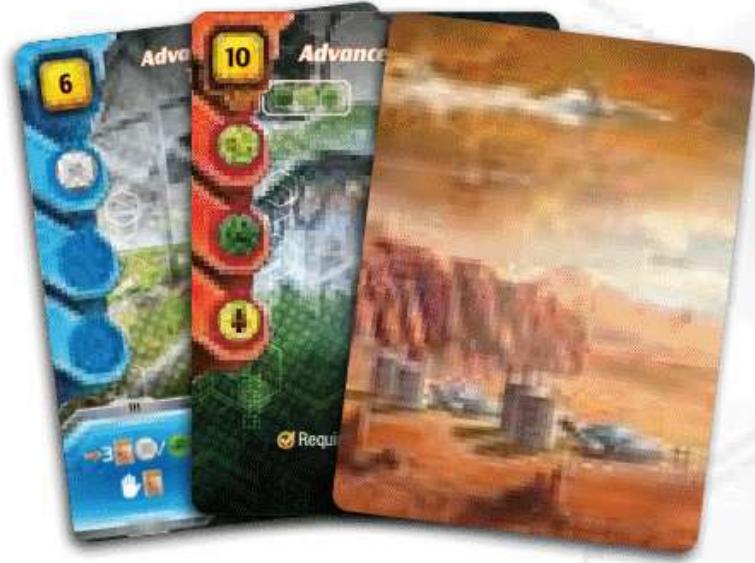
208 project cards
9 ocean tiles

24 forest VP tokens (16 '1'VP kens and 8 '5' VP tokens)
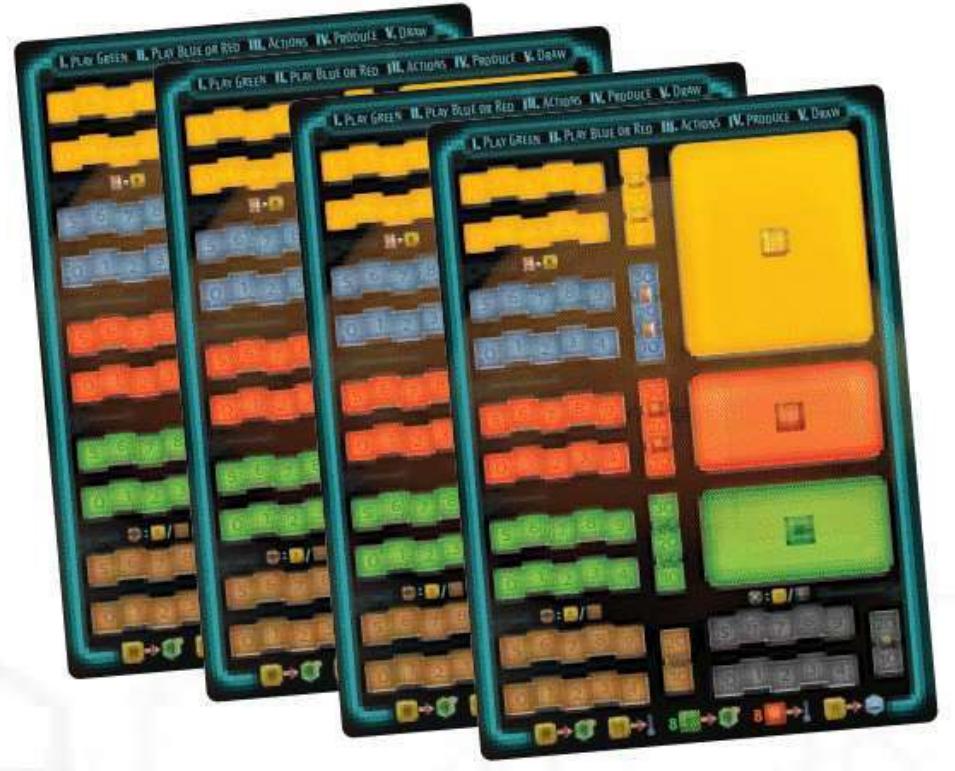
4 player boards

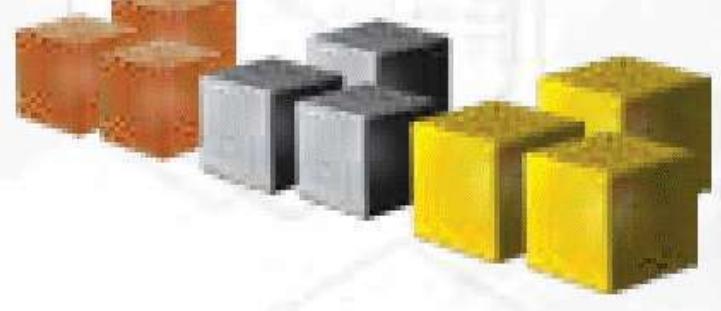
148 resource cubes (100 copper cubes, 24 silver cubes, 24 gold cubes)
20 phase cards (5 cards each in 4 different player colors)
52 player cubes (13 for each player in four different colors)
2 clear cubes (for temperature and oxygen tracks)


5 phase tracking tokens

GAME BOARD
The game board has four sections:
-
TERRAFORMING RATING TRACK - When you gain TR, you advance your player cube on this track.
-
ocEANs - This is where the ocean tokens are placed facedown at the start of the game. When you flip an ocean, pick an ocean that has the orange side faceup and flip it over, then gain 1 TR and the reward listed on the back of the flipped ocean tile.
-
PHASE TRACKING TOKENS - Place the phase tracking tokens along this side of the board.
-
oXYGEN TRACK - When you raise the oxygen, advance the cube on this track and gain 1 TR.
-
TEMPERATURE TRACK - When you raise the temperature, advance the cube on this track and gain 1 TR.
The oxygen and temperature tracks are each divided into four colors: purple, red, yellow, and white. Certain cards will require the oxygen or temperature to be in certain color zones.

CARD ANATOMY
PROJECT CARDS
Project cards are the backbone to building a powerful corporation in order to win the game. It is important to note that at any time you may discard a project card in your hand to gain 3 MC. Project cards have the following pieces of information on them:
1. NAME
-
cosT - This is how much MC you must spend in order to play the card.
-
REQUIREMENT - Some cards have additional requirements in order to play them. This is shown in brief here and in more detail in the ability section (11) of the card.
TAGS - Cards can have up to three tags.Tags have no inherent value but are referenced in the ability section of many cards.
- COLOR - There are three colors of cards: blue (active), green (automated), and red (event).

A. Blue cards either have effects that trigger when certain things happen or actions that can be used during the action phase.
B. Green cards have resources that are gained in the production phase or have steel/ titanium capabilities which are used to reduce the cost of playing certain cards. See page 12 for more info on steel and titanium.
C. Red cards have effects that happen immediately and do not provide any additional impact after they are played, other than the tags they provide that can be referenced by other cards.
-
EFFECT (Purple) - This appears only on blue cards and shows icons representing an effect which triggers when certain criteria are met. If an effect's condition is met multiple times when a card is played, then resolve the effect multiple times.
-
PRoDucTIoN (Orange) - This appears only on green cards and shows the icons of what this card produces during the production phase.
8.CAPABILITY (Gray) - This appears only on green cards and shows that this card has steel or titanium capabilities.
-
AcTioN (Blue) - This appears only on blue cards and shows icons representing actions which happen during the action phase.
-
ACTIvE PHAsEs - This section only appears on green and blue cards. The roman numerals represent the phases in which the card's ability can be used.
-
ABILITY - This section lists any additional requirements needed to play the card (), any immediate effects of the card (), and the ability of the card.
-
vP -This section shows how many points this card is worth at the end of the game.
-
CARD NUMBER
CORPORATION CARDS
These cards represent the corporation each player is acting as. Corporation cards have five parts:
1. NAME
- TAG - Tags have no inherent value but are mentioned in the ability section of many cards.

3. LOGO
4. STARTING
RESoURCES - This section tells you how many mega credits (MC) you gain at the start of the game. It may also tell you if you start with any production or other abilities.
EFFECT/ACTION - This shOWS any ongoing effects or actions you have access to during the game.
PHASE CARDS
Players use phase cards to choose which phases they want to play this round. Phase cards have four parts:
- PHASE NUMBER The phases are resolved in order based on this number.
2. NAME
-
ABILITY - This is the effect that all players will resolve during this phase.
-
BONUS - This is the additional effect
Pay 3 MC less for the card you play this phase.
that you will resolve during this phase only if you selected this phase this round.
PLAYER BOARD
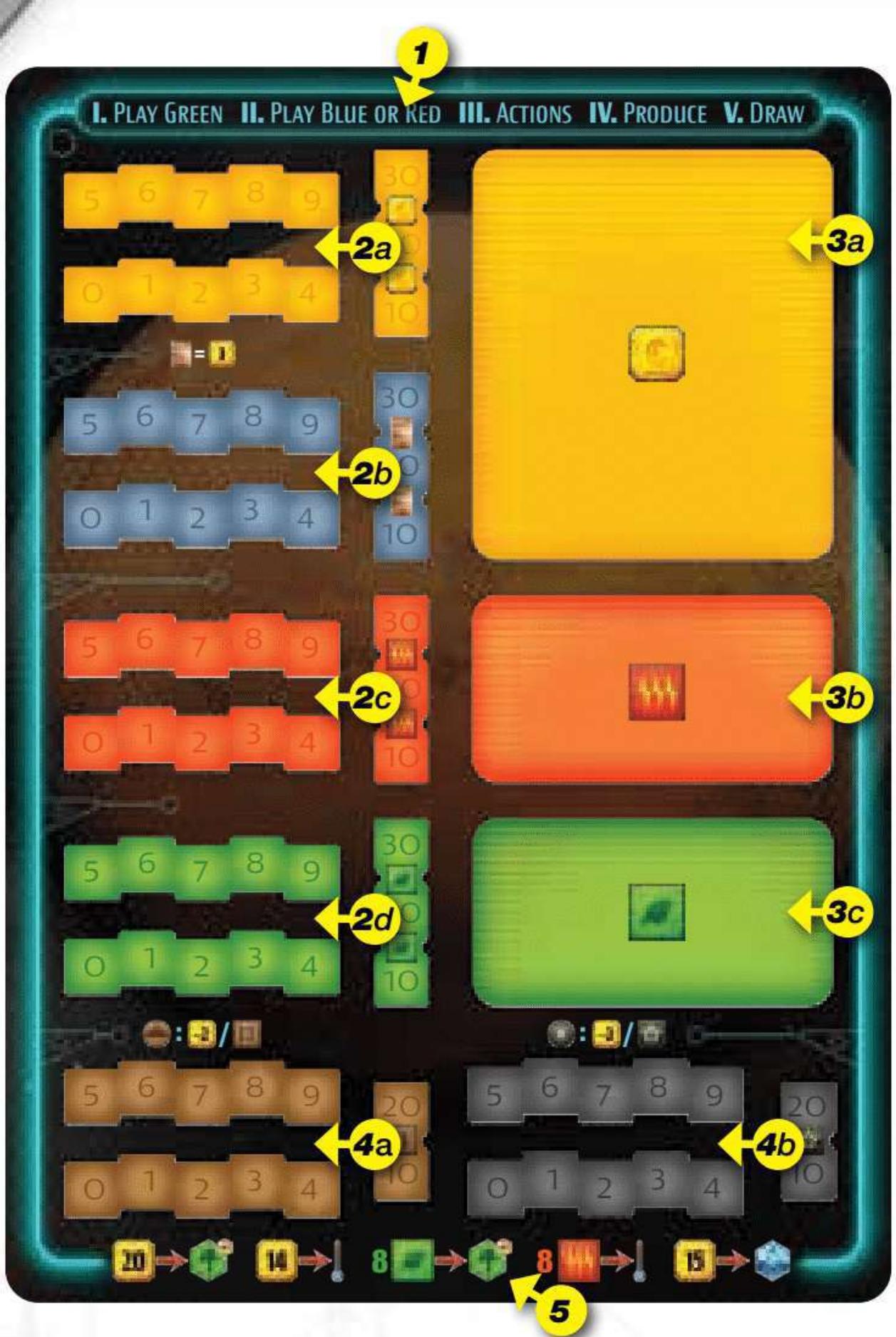
The player board keeps track of your current resources and production. Resource cubes are placed in their respective boxes, and player markers are used on the production tracks.
-
PHASES - A brief description of the phases.
-
PRODUCTION TRACKS - When yOU gain production of a resource, move the corresponding cube on its track. Add a second cube to the right column if needed. There are four types of production: (a.) MC, (b.) card, (c.) heat, and (d.) plant. The production tracks show how much of each resource you will gain during the production phase.
Example: If you gain two heat production on the first turn, move your player cube on the heat production track from 0 to 2
- RESoURCES - Whenever you gain (a.) MC, (b.) heat, or (c.) plants, place the copper, silver, and gold cubes into the section corresponding to the resource gained. The copper cubes are worth 1, the silver 5, and the gold 10.
Example: If you produce 6 plants, place 1 copper cube and 1 silver cube into the green resource section to the right of the plant production track on your player board.
-
CAPABILITIES - When you gain (a.) steel or (b.) titanium capabilities, move the corresponding cube on its track. Add a second cube to the right column if needed.
-
STANDARD ACTIONS - During the action phase, players may perform as many of these actions as they want, any number of times.
Reminder: All resources are either tracked on the player board or on a card if it is a special resource. Use the copper, silver, and gold cubes to track the number of each resource you have. The copper cubes are worth 1, the silver 5, and the gold 10.
NOTE: Some production cards increase their production when you have more of a specific tag. You'll need to update your player mat every time you play that tag.
NOTE: You will always be able to calculate your current production and capabilities by looking at your cards in play. The player board is just more convenient.
RESOURCES
There are four different kinds of resources in Terraforming Mars: Ares Expedition: mega credits, heat, plants, and special resources.

MEGA CREDITS (MC) - MC is used to play cards and activate actions.
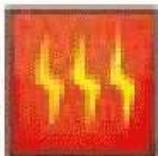
HEAT - Heat is used to raise the temperature of Mars. During the action phase, players may spend 8 heat to raise the temperature one step and gain 1 TR.

PLANTS - Plants are used to make forests, which raise the oxygen on Mars. During the action phase, players may spend 8 plants to gain a forest VP, raise the oxygen one step, and gain 1 TR.
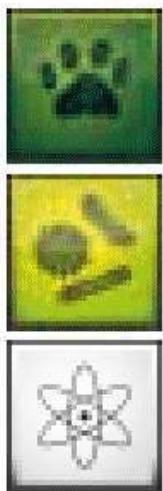
SPECIAL RESOURCES - Some cards allow you to place special resources (animals, microbes, and science) on that or other cards. These resources do different things, as specified by the different cards.
OTHER TOKENS

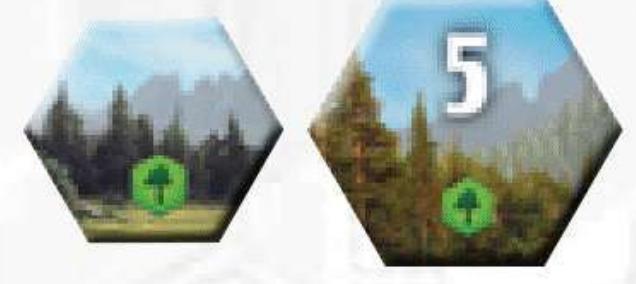
FOREST VP TOKENS - Awarded when a forest is built.Worth 1 VPat the end of the game. There are 5 VP forest tokens in case you run out of 1's.
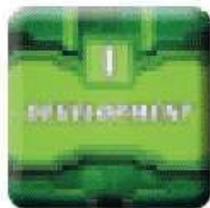
PHASE TRACKING TOKENS - Show which phases were selected by all players during the round.
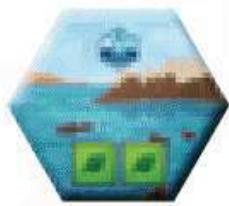
OCEAN TILES - During setup, place these on the board with the orange side faceup. When you flip an ocean over to the blue side, you will receive the benefit shown on that side. For example, if you flip the tile shown to the left, you gain 2 plants. Once an ocean tile is blue side up, it cannot be flipped over again.
SETUP
-
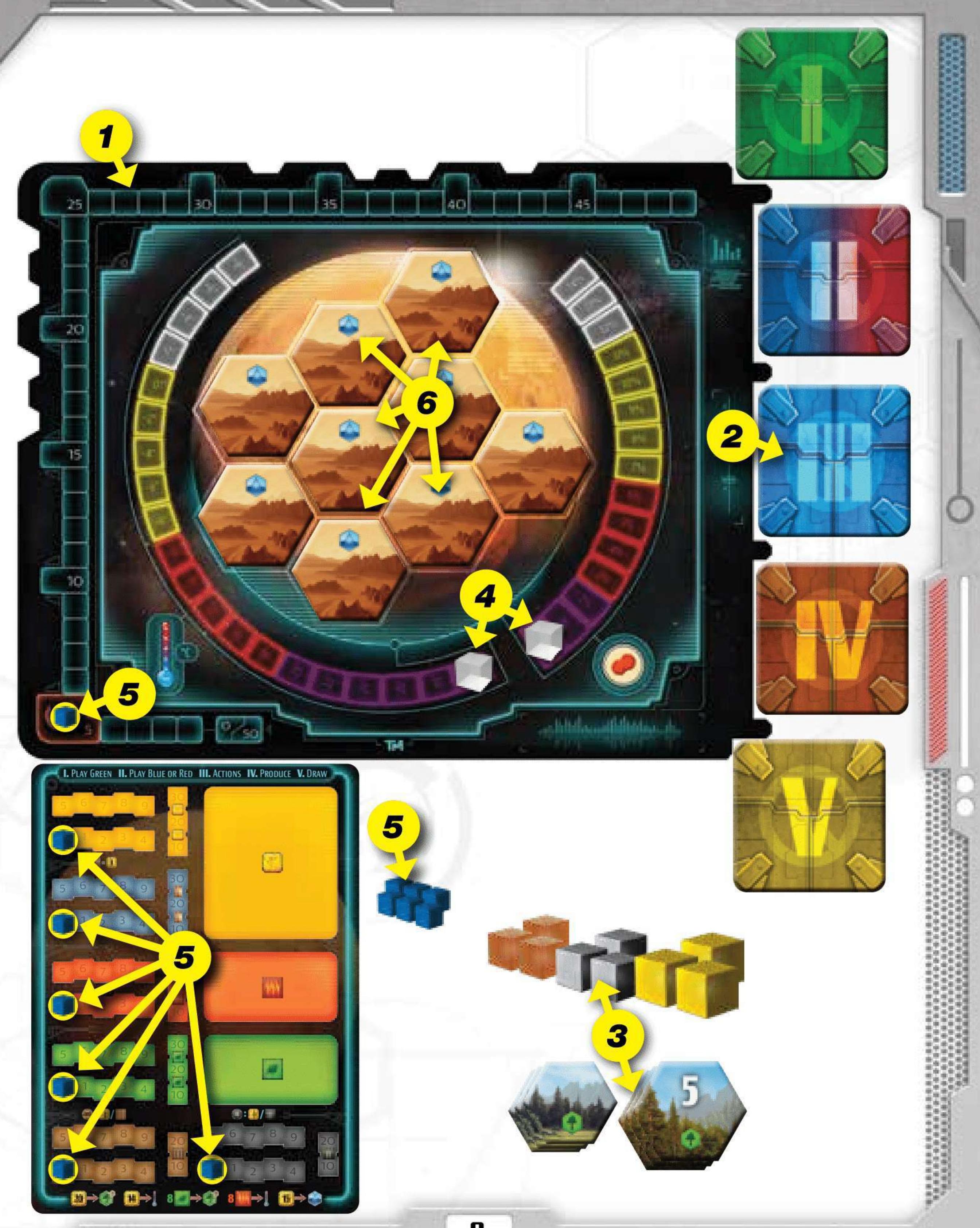
Set the game board in the middle of the table.
-
Set the phase tracking tokens next to the game board with the closed door side up.
-
Set all of the forest VP and the copper, silver, and gold cubes next to the game board.
Place the two clear cubes on $\mathfrak { - 3 0 } ^ { \circ } \mathbb { C }$ on the temperature track and 0% on the oxygen track.
-
Give each player a player board and the 13 cubes in their player color. Each player places a cube on the ‘0' space of each of the six production tracks on their player boards and a cube on the ‘5'of the TR track on the game board. Use the other cubes when you have 10 or more production/capabilities.
-
Shuffle the ocean tiles blue side down and place them on the nine ocean spaces on the board.
For your first game instead of performing step 7, find the sixteen green project cards that have next to the card number. Shuffle them and deal each player four of those cards. Place any remaining cards with a in the discard pile. The rest of the project cards are already shuffled. Feel free to cut the deck, then deal four more cards to each player.
Shuffle all of the project cards together facedown to form the project card deck. Deal each player eight project cards. You will keep all of them.Split the deck into two piles so that all players can easily reach one of the decks.
For your first game, instead of performing step 8, deal each player one of the corporation cards with a next to its card number.
Shuffle all of the corporation cards facedown and deal each player two corporation cards. Each player picks one to use for the game and discards the other. Return all unused corporation cards to the box.
Advanced Rule: Once you have been dealt your corporations, but before you have chosen which one you want to use, you may discard any number of project cards and draw that same amount.
- Each player receives any starting resources and abilities from their corporation.
10.Give each player a set of five phase cards corresponding to their player color.
- Start the game.

GAMEPLAY
The game is played over the course of several rounds. Each round is divided into three steps:
A. PLANNING STEP (pg. 10)
B. RESOLVE PHASES STEP (pgs. 11-15)
C. END STEP (pg. 16)
In each step and phase, players play simultaneously. Not all phases will happen every round. Each round will always start with a planning step in which players will determine which phases will occur that round.
A. PLANNING STEP
Each player simultaneously chooses a phase card from their hand and places it facedown.
Starting with the second round, players will place this card at a $90 ^ { \circ }$ angle on top of the last phase card they chose. Players are not allowed to pick the same phase two rounds in a row. After revealing the played phase card, players will return the phase card they chose from the previous round to their hand.
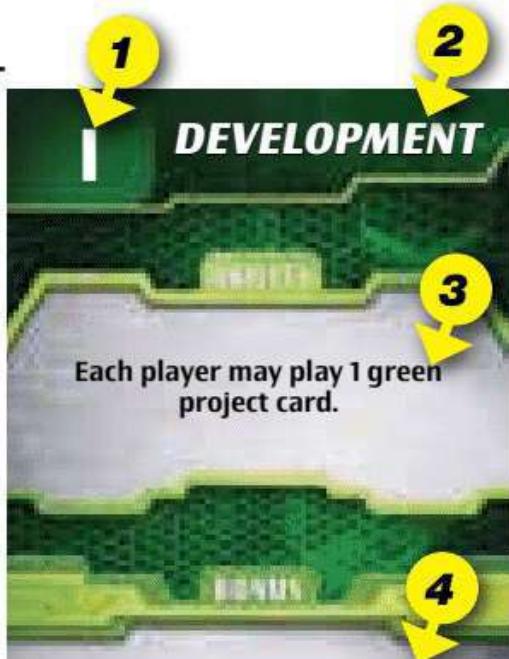
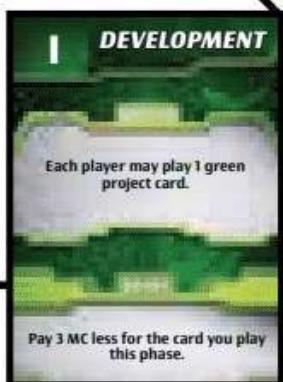
Once all players have done this, the chosen phase cards are revealed. These cards determine which phases are resolved this round. For each phase that was chosen for this round, flip the associated phase tracking token faceup so that the name of the phase is showing.
IV PRODUCTION
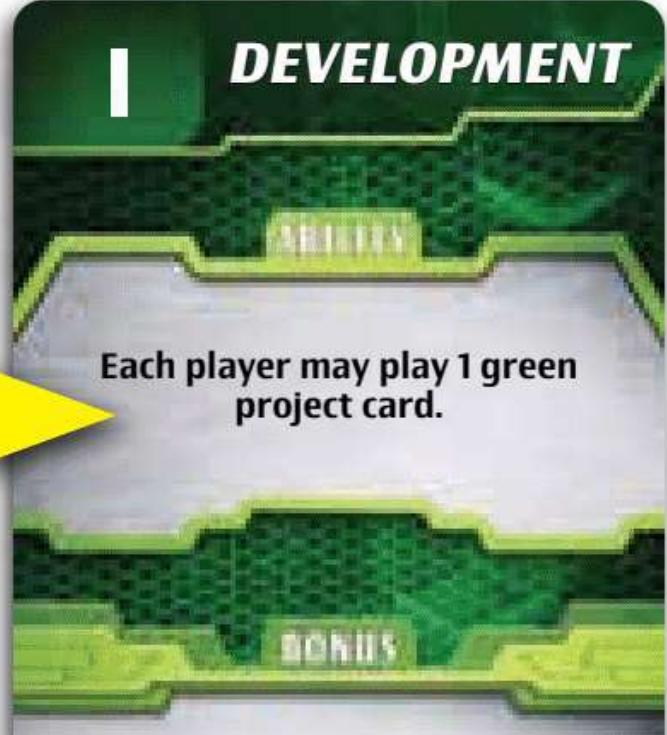
Pay 3 MC less for the card you play this phase.
A player is not allowed to pick the same phase two rounds in a row.
B. RESOLVE PHASES STEP
During this step, players resolve the phases that were chosenduring the planningstep. The chosen phases are always resolved in the following order:
I. DEVELOPMENT PHASE (pg. 11)
II. CONSTRUCTION PHASE (pg. 12)
III. ACTION PHASE (pg. 14)
IV. PRODUCTION PHASE (pg. 15)
V. RESEARCH PHASE (pg. 15)
Each player resolves each of the chosen phases (and only the chosen phases) once in the round. Players resolve each chosen phase simultaneously. Once all players have finished with a phase, they all move onto the next chosen phase.
If multiple players choose the same phase, that phase is resolved only once. If a phase is not chosen, each player skips that phase this round.
When you choose a phase, youwill receive the specific bonus in that phase that is listed at the bottom of the phase card.

DEVELOPMENT PHASE:
During this phase, each player mayplay one green project card from their hand by paying its cost.See Playing Project Cards on page12. Bonus: If you chose this phase, the cost of the card you play this phase is reduced by 3 MC.
After playing a green card, make sure to adjust the corresponding capability or production track on your player board.
Reminder: Players may discard project cards in hand at any time to gain 3 MC. This can be done for any reason. Whenever a player discards a card for any reason, it is discarded facedown to the project card discard pile
II CONSTRUCTION PHASE:
During this phase, each player may play one blue or one red project card from their hand by paying its cost. Bonus: If you chose this phase, you can either: Draw a card before or after playing a card this phase OR you may play an additional blue or red card this phase.

Tip to save table space: Play green cards along the bottom of your player board on the right side. You can overlap them so that just the production box and tags along the left side are showing.
Play blue cards in a row above your green cards. You can overlap them so that just the ability icons and tags along the left side are showing
Play red cards in either row, you can overlap them so just the tags are showing.
PLAYING PROJECT CARDS
The cost to play a project card must be paid with MC. You can use MC cubes you have and/or discard other project cards in your hand at a rate of 3 MC per card. Any overpayment in cards is returned to you using cubes. (Ex. You can play an 8 MC card by discarding two cards and paying 2 MC, or by discarding three cards in hand. If you discard the three cards, you will receive 1 MC back.)
REQUIREMENTS
Some cards have additional requirements in order to play them. Cards with requirements have a checkmark icon () next to the cost of the card. These requirements are listed in the text box at the bottom of the card next to the same checkmark icon () and shown in icons at the top. If a card has an ocean, oxygen, or temperature requirement, that requirement needs to have been met at the start of the phase in order for you to be able to play it. If the requirements of a card are not met, you cannot play that card.
STEEL AND TITANIUM
The cost of Project cards with a building tag (), regardless of color, is reduced by 2 MC for each steelyou have.
The cost of Project cards with a space tag (), regardless of color, is reduced by 3 MC for each titaniumyou have.
The cost to play a card cannot be reduced below zero.
You may play cards that raise parameters beyond their maximums or add special resources when you don't have a card to add them to. You will simply not receive the benefits of those effects.
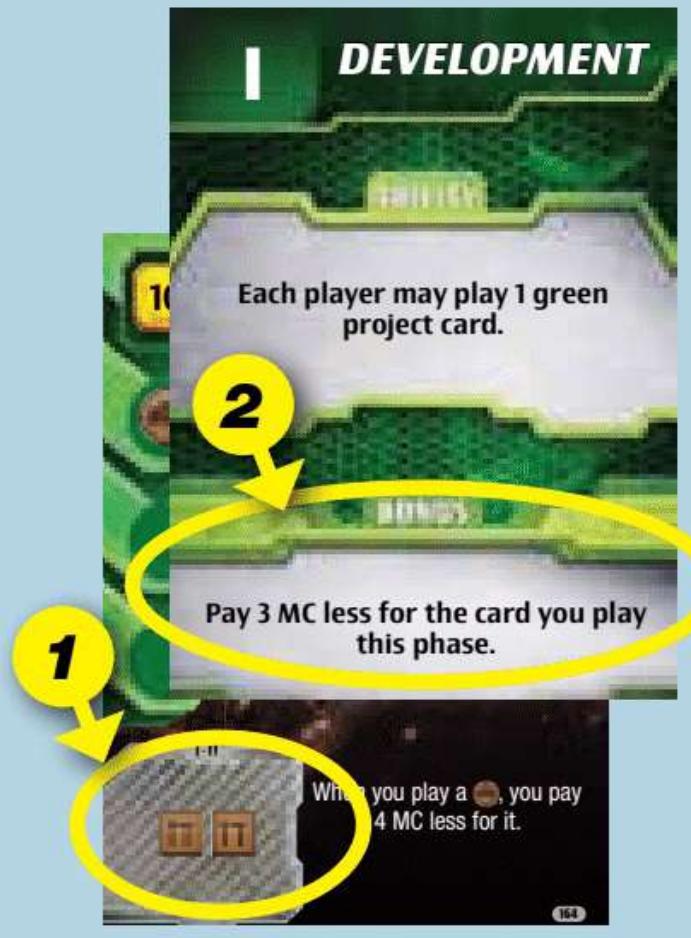
Example: Bob wants to play Microprocessors, which is a green card that costs 17 MC. Microprocessors has a building tag ). 1 Bob has two steel, so his cost to play cards with building tags is reduced by 4 MC. 2 Bob chose the development phase this turn, so his cost to play this green card is reduced by 3 MC. Thus, Bob's cost to play Microprocessors is 17-4-3=10.
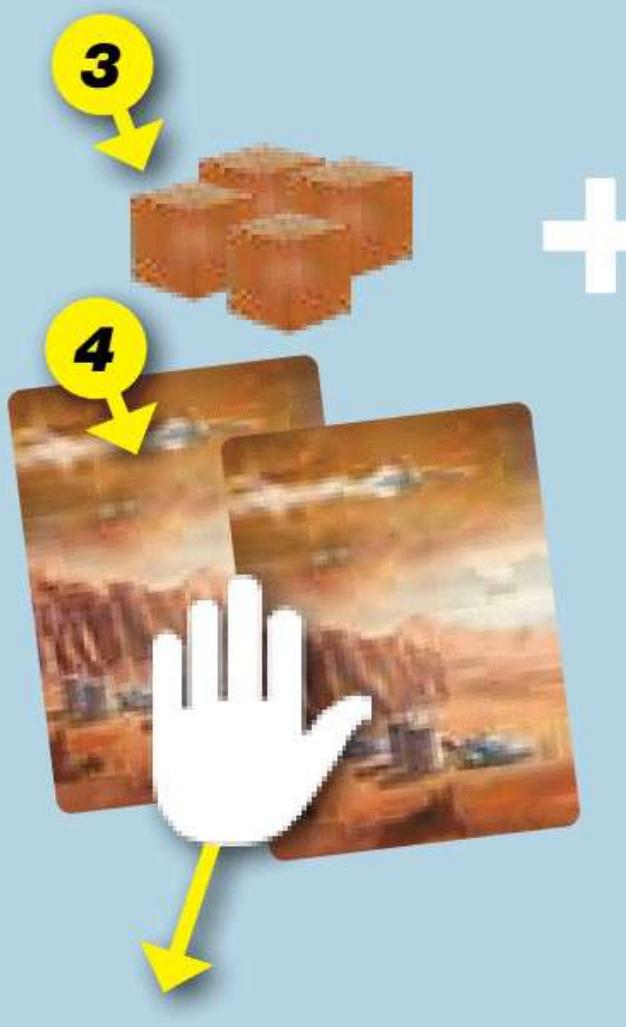
3 Bob has 4 MC cubes which he can use to pay for the card, but that leaves Bob 6 MC short of playing it. Bob can discard two project cards from his hand at a rate of 3 MC each to pay for the remaining 6 MC. 4 Bob chooses to discard two cards and spends his 4 MC cubes, and places Microprocessors into play.
5 Bob resolves the immediate effect of the card which is “Draw two cards. Then, discard a card." Finally, Bob is done with the development phase.

ACTION PHASE:
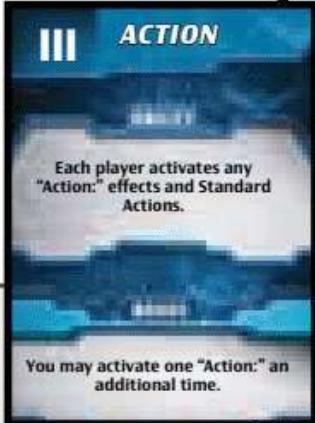
Each player may resolve the “Action:"ability on each of their cards in play once during this phase. Each player mayresolve any number of the standard actions any number of times. Bonus: If you chose this phase, you may resolve the “Action:” ability on one of your cards in play an additional time.
STANDARD ACTIONS
During the action phase, players may use the standard actions printed on their player boards. Those actions are:
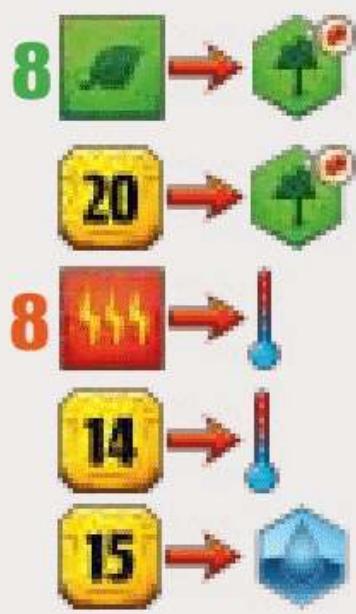
• Spend 8 plants to gain a forest VP and raise the oxygen one step.
• Spend 20 MC to gain a forest VP and raise the oxygen one step.
• Spend 8 heat to raise the temperature one step.
• Spend 14 MC to raise the temperature one step.
• Spend 15 MC to flip an ocean tile. When a player flips an ocean tile, they immediately receive the reward shown on the back of the tile.
Reminder: Whenever you raise oxygen, raise temperature, or flip an ocean, you gain 1 TR. This happens for each step you raise those parameters.
During the phase in which a global parameter reaches it's maximum (temperature at +8°C, oxygen at 14%, or 9 ocean tiles fipped), all players can continue to take actions or play cards to increase that parameter. They will receive all of the benefits, such as forest VP and TR. During the phase that the last ocean tile is flipped, any player who continues to take actions or play cards to flip oceans will gain the reward on the last ocean tile that was flipped in addition to the TR.
After the phase in which the parameter reached it's maximum, players can no longer gain rewards for increasing that parameter.
Players may continue to gain forest VP tokens for building forests after the phase when oxygen reaches 14%, but won't gain TR for increasing oxygen when they do.
Important Rule: At the end of the action phase, if you are able to spend heat or plants for a standard action, you must do so unless the associated terraforming parameter has already been raised to its maximum.
PRODUCTION PHASE:
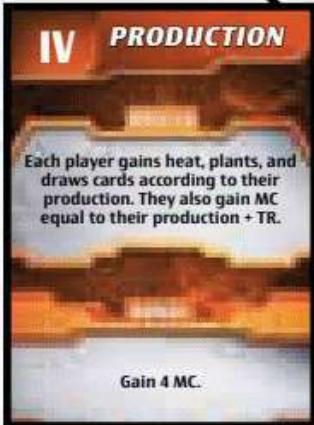
During this phase, each player collects resources equal to the production on their green cards, corporation card, and place on theTR track. Bonus: If you chose this phase, gain 4 MC.

Gain MC equal to your MC production + your TR. Gain heat and plants equal to your production for those resources. Place copper (1), silver (5), and gold (10) cubes to track these resources in the appropriate resource section of your playerboard.For eachcard production, you draw a card during this phase.
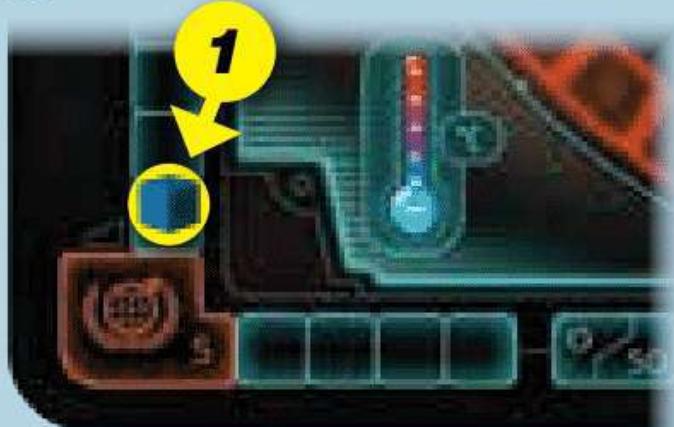
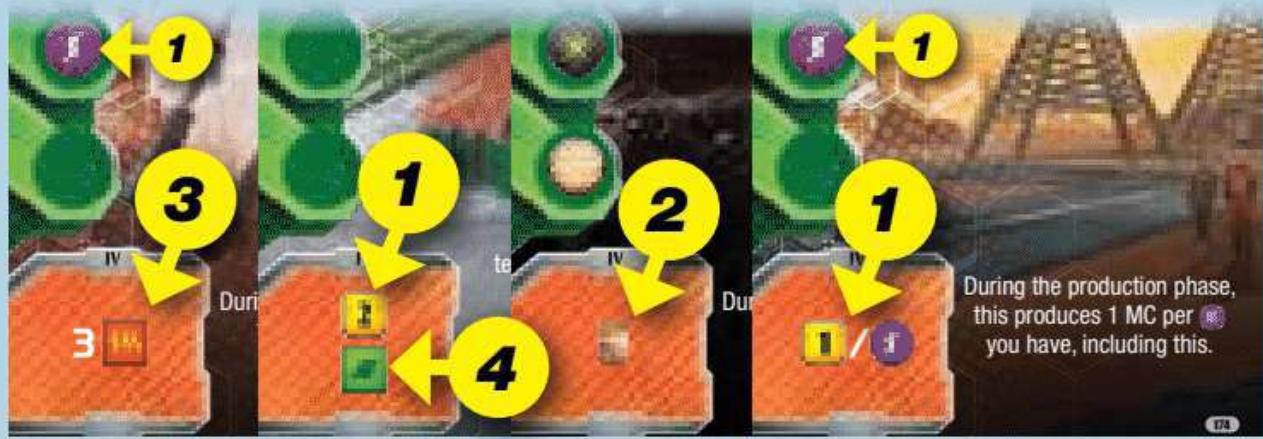
Example: Bob has played four cards, shown below, so far this game. When he played these cards, he adjusted his player board accordingly. During the planning step of this round, he chose to play the production phase. During the production phase, Bob will gain all of the resources shown on his player board plus MC equal to his TR, which he can verify by checking the production boxes on the cards he has played. He gains the following:

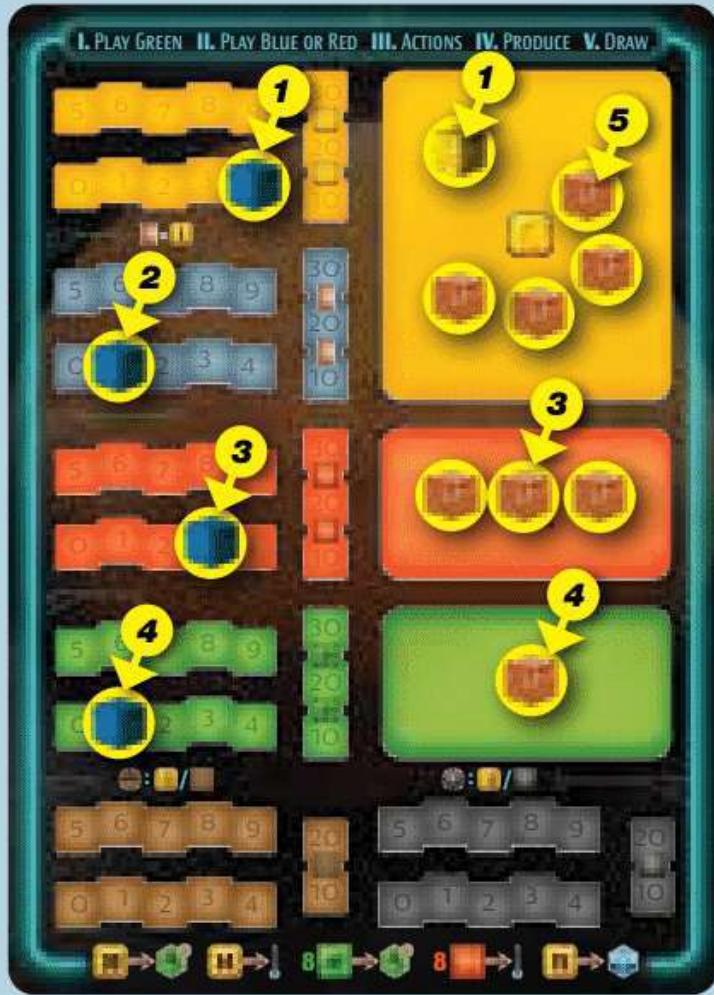
-
4 MC for his MC production and 6 MC for his TR
-
1 card
-
3 heat
-
1 plant
-
4 MC as a bonus for choosing the production phase.
RESEARCH PHASE:
Each player draws two cards, keeps one, and discards the other. Bonus: If you chose this phase, you draw three additional cards and keep one additional card. Meaning, in total, you draw five cards and keep two, discarding the other three.
If at any point, a player needs to draw a project card and the project card deck is empty, shuffle all of the discarded project cards together to form a new project card deck.

C. END STEP
During this step, each player discards down to ten cards in hand. For each card discarded this way, that player gains 3 MC as normal.
Flip all of the phase tracker tokens so that the closed door side is faceup, and start the next round.
END OF THE GAME
The end of the game is triggered when all three of the following are true:
-
All nine ocean tiles have been flipped blue side up.
-
The temperature is at $+ 8 ^ { \circ } C .$
-
Oxygen is at 14%.
Once this happens, players finish the current phase and then proceed to final scoring. The round does not continue to any other phases that were picked. For example, if all of the global parameters are capped during the construction phase, and the action and production phases were also chosen for this round, the game does not continue to the action or production phase.
Tip: If the game ends during the action phase, players will likely want to convert all of their cards in hand andMC into standard actions that gain TR.
FINAL SCORING:
Players score VP for the following things
-
1 VP per TR
-
VP equal to their forest VP tokens
-
VP equal to what is printed on the project cards they played, including cards that have variable VP denoted with an asterisk*
The player with the highest total VPwins the game. In the event of a tie, the tied player with the most heat, MC, and plant resources added together is the winner. Be sure to convert project cards in hand to MC beforehand.
Example: At the end of the game, Bob totals his final score:
He has 25 TR as shown on the TR track.
He has 6 forest VP.
He has four project cards with VP on them, for a total of 9
He also has a project card with variable VP worth 1 VP per 2 animals on the card. Bob added 6 animals (resource cubes) to this card over the course of the game, so it is worth 3VP.
Bob’s final score is 25+6+9+3=43.

SYMBOLS
All abilities and requirements on project cards are shown both with symbols and explained in text. Below is a glossary of all symbols you will see on project cards.
VICTORY POINTS AND TERRAFORMING RATING


VICTORY POINTS (VP) - Points that will add to your score at the end of the game. Some cards have either a set number of VP on them, ora number contingent on another factor (such as resources on the card
or certain cards in play). You win the game by having the most VP. Taking the time to terraform in a sustainable, environmentally conscious way, create impressive structures, and bring beautiful creatures to our new planet, will ultimately be rewarded.

TERRAFORM RATING (TR) - Points that will both produce MC throughout the game and add to your score at the end of the game. TR is the measure of how much you have contributed to the terraforming process. Each time you raise the temperature, the oxygen level, or flip an ocean tile, your TR increases. Every step towards terraforming is its own reward, but as an added bonus, there are also government stipends in return for your hard work making Mars habitable.
PARAMETERS
There are three parameters that gauge how much Mars has been terraformed: temperature, oxygen, and oceans. You and your fellow players are competing to contribute the most to the terraforming of Mars. Each of these symbols indicates raising the associated parameter one time. Each time you raise one of these parameters, you will gain 1 TR. Every aspect of preparing our new home is equally important. Only when our atmosphere and ocean levels are perfectly maintained can we begin to bring over our citizens.
TEMPERATURE - Raise the temperature by2°C. Heat, MC, or effects on cards can be used to increase the temperature. The temperature starts at $- 3 0 ^ { \circ } C$ and can be
raised 2°C at a time up to $+ 8 ^ { \circ } C .$ This will create an equatorial zone where water stays liquid.

Plants, MC, or effects on cards can be used to raise the oxygen level. The oxygen starts at 0% and can be raised 1% at a time up to 14%. At 14%the atmosphere resembles that of Earth at a 3000m elevation.

OCEANS - Flip one ocean tile. MC or effects on cards can be used to flip ocean tiles. Each ocean tile represents 1%ocean coverage. The ocean coverage starts at 0% and can be raised 1% at a time to 9% (or, 9 ocean tiles). With 9% of the surface covered by oceans, Mars will have a hydrological cycle, creating rain and rivers.
RESOURCES
There are four types of resources that can be used in your corporation's work to terraform Mars: MC, plants, heat, and special resources (animals, microbes, and science).

MEGA CREDITS (MC) - This is the currency used in the24th century and is how your corporation will pay to complete projects and take certain actions.
PLANTs - Plants represent the hard work your corporationis putting in to increase the forest coverage on Mars. Plants are a resource you can use to build forests and raise the oxygen.
HEAT - Heat represents your corporation's efforts to make the temperature of Mars habitable. Heat is a resource you can use to aise the temperature2°C.
SPECIAL RESOURCES - Your corporation can invest itself in the animals, the microbes, or the science resources of humanity's future home. These three special resources are collected on project cards to be used for specific effects.
CAPABILITIES - STEEL AND TITANIUM
Some green cards give a player steel and titanium capabilities. They reduce the cost of playing project cards. The proper building materials are essential when starting an expensive project!
STEEL - This represents building materials used on Mars. Each steel capability lowers the cost of playing project cards with a building tag () by 2 MC.

TITANIUM - This represents building materials used in space. Each titanium capability lowers the cost of playing project cards with a space tag by3 MC.

TAGS
Project cards can have up to three tags on them, which can be referenced by some cards' effects.

BUILDING: This project involves construction on Mars, and can be cheaper to produce using steel.

SPACE: This project uses space technology, and can be cheaper to produce using titanium.

POwER: This project involves the creation of energy, and the conversion of energy into other resources.

sCIENCE: This project helps invent new, cutting edge technology to streamline the terraforming process.

JovIAN: Jovian means 'having to do with Jupiter.' This project represents infrastructure in the outer solar system.

EARTH: This project is related to activities on Earth.

PLANT: This project involves plant life or other photosynthesizing organisms.

MICROBE: This project involves introducing various kinds of microbes into the Martian ecosystem.

ANIMAL: This project involves introducing various kinds of animals into the Martian ecosystem. These cards generate VP.

EVENT: This project is a one-time operation to permanently alter Mars. All events are red cards.

ASTERISK: When an icon has an asterisk (*) next to it, there is a special rule that you must read in the ability text on the card.
TWO-PLAYER CO-OP MODE
In this mode, two players work together to completely terraform Mars before time runs out. All the rules of the game are the same with the following exceptions:
SETUP
After you have finished setting up the game, in the upper right hand section of the game board, place 27 copper cubes and 3 cubes of a player color you are not using in a pile.
GAMEPLAY
Players should give each other advice and encouragement! We recommend that you don't discuss specific cards in your hand, but rather keep your statements broad, like, “I have a lot of heat production, so don't worry about that” or “I'm going to choose the production phase this round."
After players have revealed their phase cards each round, each player takes a cube from the pile on the game board. If you take a copper cube, add it to yourMC. If you take one of the player color cubes, discard the cube and you may trade one project card in hand for a project card in your partner's hand.
END OF THE GAME
The game ends at the end of the round in which the last cube is taken from the pile (15 rounds).
At the end of the game, if all of the terraforming parameters have been completed and the players have a total score of at least 80 VP, the players win! Otherwise, the players lose. Record your VP and try to beat your high score the next time you play.
SOLO RULES
The goal of the solo game is to fully terraform Mars before time runs out.
All the rules of the game are the same with the following exceptions:
SETUP
1 Set aside an additional set of five phase cards as a dummy hand. Shuffle that set of cards facedown.
-
Place a player cube of a color you are not using on the 1 on the TR track.
-
Choose a difficulty level: Novice, Advanced, or Expert.
GAMEPLAY
Once you have selected a phase card during the beginning phase, play the top card of the dummy hand faceup. That phase is also played this round (without a bonus). Continue to play rounds, playing a card from the dummy hand each round.
When all five dummy hand cards have been played, shuffle them all facedown to reform the dummy hand. Each time you reshuffle the dummy hand, advance the dummy player cube (that started on1) to the next space on the TR track. Once that cube reaches5, play five final rounds. You are allowed to pick the order in which the dummy hand phase cards are played in these final rounds. After all of the phase cards from that hand have been played (25 rounds in total), the game ends.
DIFFICULTY LEVELS: Solo mode can be a great way to learn the game, but it is not easy to win if you aren't experienced with the game and its many strategies. If you aren't experienced, consider choosing one of the lower difficulty settings below. In a lower difficulty setting, the terraforming parameters will advance each time the dummy player's cube moves (4 times per game), to help you reach your terraforming goals. Note - raising terraforming parameters in this manner does not provide TR nor Forest VP tokens.
NovICE MoDE: Increase oxygen or temperature 2 steps after advancing the dummy player's cube.
ADVANCED MoDE: Increase oxygen or temperature 1 step after advancing the dummy player's cube.
EXPERT MoDE: No bonuses are given.
END OF GAME
Once five full dummy hands have been played (25 rounds), the game ends. If Mars is fully terraformed, you win. Otherwise, you lose. Finally, you score VP, attempting to achieve as high a score as possible.
Did you see the two-player co-op rules on the previous page?
GAME OVERVIEW
The game is played over the course of several rounds. Each round is divided into three steps:
A. PLANNING STEP
Each player simultaneously chooses a phase card from their hand and places it facedown.
A player is not allowed to pick the same phase two rounds in a row.
B. RESOLVE PHASES STEP
During this step, players resolve the phases that were chosen during the planning step. There are no turns, so each player plays each phase at the same time. All players may participate in the selected phases, but players only receive bonusesfor the phase they selected. Bonuses are printed in the bottom section of the phase cards.
The chosen phases are always resolved in the following order:
I. DEVELOPMENT PHASE
• Each player may play one green project card from their hand by paying its cost.
II. CONSTRUCTION PHASE
• Each player may play one blue or one red project card from their hand by paying its cost. III. ACTION PHASE
• Each player may resolve the “Action:" ability on each of their blue cards in play once.
IV. PRODUCTION PHASE
• Each player collects MC equal to their TR and resources based on their green cards and their corporation card.
V. RESEARCH PHASE
• Each player draws two cards, keeps one, and discards the other.
C. END STEP
During this step, each player discards down to ten cards in hand. For each card discarded this way, that player gains 3 MC as normal.
Flip all of the phase tracker tokens so that the closed door side is faceup, and start the next round.
The game ends when all of the global parameters have been completed. The player with the most VP wins!
Playtesters: Travis Worthingon, Peyton Worthington, Rhet Eikleberry, Hayley Nielsen, Adam Ping, Marc Martinez, Katie Martinez, Ryan Bruxvoort, Aaron and Kimberly Myerson, Anna Russell, Will Sobel, Stephen Buonocore, Chad Krizan, Geoffrey Engelstein, Brian Engelstein, James Williams, Jeffrey Tabler, Donnie Smith, Brandon Basham, Troy Lopez, and Alexis Lopez
Download Markdownterraforming-mars-ares-expedition-crisis-rulebook-english.md17.8 KB
原文本层提取版本已由本版替换(2026-10-31),正文相似度 0.70
ARES EXPEDITION:
CRISIS
EMERGENCY BROADCAST:
People of Mars, our world is in crisis. This morning, October 3rd, 2775, a C-Class Asteroid of unprecedented size collided with comet C/2214 B1 and changed trajectory. Two hours ago, it impacted our planet fifty miles south of the Valles Marineris. The asteroid's descent ripped a hole in the atmosphere, and the seismic aftershocks have destroyed much of the infrastructure supporting our life here on Mars. Clouds of dust are still rising from the impact, blocking out the sun and suffocating our plant life. Early reports from the few research outposts that remain online are catastrophic: The rip in the atmosphere is upsetting the greenhouse gas effect and letting water vapor escape. The longer we wait, the colder our planet will become. There is no time to evacuate the populace. Our only option is a race against time.
People of Mars, I urge you not to panic. Our most powerful corporations have already begun to reconstruct the necessary infrastructure to keep this planet livable. Mars was a desolate wasteland when we found it, but we did not give up. We made a home where it was once considered impossible. We will not let it be taken from us now. We will do the impossible again.
Anaya N'Gomo, Representative of The United Martian Nations.
OVERVIEW
In Ares Expedition: Crisis, players play as corporations, just as in the original Ares Expedition. You choose phases and play project cards as normal. The difference is players are working together to keep Mars habitable after a natural disaster has landed the planet in crisis. Every round, a new Crisis card will be drawn that will require the players to achieve a certain goal to remove that crisis from play. Each turn that a Crisis card is not completely dealt with, it will lower one or more of the terraforming metrics that keep Mars habitable.
Handle all the crises as they arise. Eventually, a Crisis card will be drawn that allows the players to win the game once they have completed re-terraforming Mars.
CONTENTS
4 corporation cards
〔图:images/e2c0d8a1df5fda9b344c76d7f69f88b1c56fd3cf42d38b04b2b65d23c3da1f31.jpg〕
85 Crisis cards
10 dummy player
phase cards
〔图:images/3e687c8105de66153fa99e03cc0353395d8043d3ccd7692c5789f88b00883643.jpg〕
7 card dividers
1 Co-op game board
〔图:images/34b2854d22aa135e4bc9d2e7d51c2636554c72ff3e89ab26aa96a9bf45d48ba4.jpg〕
1 Crisis board
〔图:images/e65e5d677a7ce2044ee29f63cd595652d3ea078dbce0446636e366d56a856134.jpg〕
3 double-sided
detriment tokens
〔图:images/1099bb1ca3a2f576e42919fac78ac8940db7b7b5b5489c5ab0fe0c2e01e19f4e.jpg〕
16 Crisis counters
〔图:images/72c9a17a791a056d25ad72775eb323ebb0cf78fac89faf48f1f92a38c4d202ad.jpg〕
〔图:images/d04d2e80ba411535b98a29483f0b3dee149b2c6bb3a3f0372bdab35a876dbef2.jpg〕
9 ocean tiles
22 1VP tokens
〔图:images/58c017535f48aaf7349978c22353c045a7d3c82e82dff895f88e474ff81d3574.jpg〕
〔图:images/bc90de69c42b056a9db2ac270bfe3a050d3cac18720231aa7314b23c918337fe.jpg〕
〔图:images/b2934d4638654ff09c77caf0935c45abab1dbdf6efe7160da64d4235b0fdb19b.jpg〕
SETUP
Follow the setup instructions in the Ares Expedition rulebook, with the following alterations:
- Set the Co-op specific game board in the middle of the table. Set the Crisis board near this board.
- Place the two clear cubes on the top space of the temperature track and the top space of the oxygen track.
- Place the ocean tiles orange side down on the nine ocean spaces on the board.
- Before shuffling the project card deck, go through and remove any cards with temperature, oxygen, or ocean requirements. Also remove the cards that reference Milestones if you are playing with the Awards and Milestones expansion, which have this icon next to the card number: A. Additionally, remove the cards Adaptation Technology, Conserved Biome, and Special Design. (You don't have to do this during setup if you want to just remove them as they are drawn during gameplay.)
- Divide the Crisis cards by their player number shown on the front. Return to the box the Crisis cards that don't have a player number matching your player count.
- Sort the cards that do have your player count by the tier number shown on the
back of the card. Shuffle the tier 5 cards facedown and place them on the Crisis board. Place the tier 4 card facedown on top of the tier 5 cards. Shuffle the tier 3 cards, return two of them to the box, then place the rest facedown on top of the tier 4 card. Repeat this for the tier 2 cards, returning two cards to the box, and tier 1 cards, returning only one card cards are all in one pile. This is the Crisis deck.
If it is your first game or you want the game to be a little easier, shuffle the three tier 0 cards and place them on top of the Crisis deck.
- Place the three detriment tokens in a supply near the game board. These are the yellow and red tokens that correspond to the three terraforming metrics.
- Set the Crisis counters in a pile near the Crisis deck. Set the 1VP tokens near the game board.
- Before dealing out corporation cards, remove the Inventrix corporation. Then, shuffle in the four corporation cards included with this expansion.
- If you are playing 2—4 players, place the purple dummy phase cards in the center of the table and return the Crisis solo mode phase cards to the box. If you are playing 3 or 4 players, remove the Action Phase card from the purple dummy phase deck and return that to the box as well. If you are playing solo, place the Crisis solo mode phase cards in the center of the table and return the set of purple dummy phase cards to the box. Then, shuffle the Crisis solo mode phase cards and set them facedown near the game board. Rules for these sets of cards vary based on player count.
Note: Awards and Milestones are not used in Crisis Mode. Additionally, you are encouraged to use the advanced play variant which allows you to discard and redraw project cards once during setup, but do not use the drafting variant introduced in the Discovery expansion.
〔图:images/6e8ccd0e5df3c7cf501f04cf2442b2ca0e50bdcb47a84dcda94a2367d84f96f0.jpg〕
GAMEPLAY
Play the game as normal with the following additions:
COMMUNICATION
You are allowed to talk about anything.
ROUND STRUCTURE:
The Crisis Co-op Mode has a few additional steps in each round. The new round structure is:
1. CRISIS STEP (NEW)
a. Check metrics
b. Resolve persistent Crises
c. Draw a Crisis card
d. Draw a card from the dummy hand
2. PLANNING STEP
3. RESOLVE PHASES STEP
4. END STEP
a. Spend VP tokens (NEW)
CRISIS STEP
The Crisis step is a new step that happens at the beginning of every round. During this step, players check the terraforming metrics to see if they will play the round with any hindrances, resolve persistent effects of any Crisis cards that they have not completed, and then draw a new Crisis card.
a CHECK METRICS
- At the start of each turn, check the current state of the temperature and oxygen. If any of these metrics are currently in a yellow or red zone on their track, take the matching detriment token, flip it to the corresponding side, and set it out in the middle of the table.
- Effects on the temperature and oxygen detriment tokens will impact all players for the duration of the round.
- Use the Ocean zones chart on the main game board to determine the state of oceans. Place and immediately resolve the yellow or red detriment token if applicable.
If any of the three metrics are currently in the purple zone of their track, you lose the game!
Note: Use the Ocean zones chart on the main game board to keep track of the white/yellow/red/purple zones of oceans.
b RESOLVE PERSISTENT CRISES
During this part, resolve the persistent effects of all Crisis cards currently in play in the order they came into play. If this causes a metric to go into the purple zone, you will need to raise it before the beginning of the next round.
〔图:images/68ae969d97b597f764721a2d5b8a59ac1c8499c71e9d370577c08bfadb23653d.jpg〕
C DRAW A CRISIS CARD
Draw a new Crisis card from the deck and place it into play. There is no limit to the number of Crisis cards that can be in play at one time. Resolve any immediate effects in the Immediately box on the card. Place a number of Crisis counters on the card equal to the amount shown on the lower right-hand of the card. Do not resolve the persistent effect of this Crisis card this turn.
〔图:images/dcd61d545c7f52251276bbd9a562021c17c1ca7b9a362f5380f7f8f8c85a0bc2.jpg〕
CRISIS CARDS
Crisis cards represent the aftermath of the asteroid that has knocked Mars into crisis. Players will need to meet the goal shown on the card a number of times equal to the number of Crisis counters that are placed on it in order to handle the crisis. For each round that the crisis is not dealt with, one or more of the terraforming metrics will decrease based on the persistent effect. Crisis cards can have up to eight pieces of information on them:
- Card name.
- Persistent Effect: An effect that occurs during the Resolve persistent Crises step while this Crisis is in play. In this field you will find the following three icons. If any of these icons is preceded by a number, then resolve the effect that many times.
a. ↓ : Flip a faceup ocean of your choice facedown.
b. : Decrease oxygen 1 step.
c. ↓ : Decrease temperature 1 step.
- Immediate Effect: When the Crisis card is drawn from the deck, this effect will happen immediately and then never be repeated. This effect can be positive or negative.
- Goal: When a player performs the task written here, they remove a counter from the Crisis. When a Crisis has no counters on it, it is discarded.
- Counters: How many counters to place on the Crisis card when it comes into play.
- Tier number: During setup, Crisis cards will be divided by tier before being shuffled so that a tier 1 Crisis will happen first, followed by tier 2, and so on.
- Player count: Only use the cards that correspond to the player count you are playing with.
- Card number.
〔图:images/27f4077f36e12d7aaa5044fd18c7546ec2b54eac0b1c5baee98d47d18bfd82d7.jpg〕
COMPLETING GOALS
When you play a card/take a game action that fulfills a goal, you remove a Crisis counter from the corresponding card. You may fulfill the goals of multiple cards at the same time if the card you played qualifies for both (ie. playing a blue card with a space tag would allow you to remove one counter from a goal that requires you to play blue cards and one counter from a goal that requires you to play space tags).
When you remove the last counter from a Crisis card, discard that card.
〔图:images/2f4c11d14d644aa0afd0736a459061556e75c2b304cab58a59f96ebe423df986.jpg〕
There are a few cards that allow you to discard cards, heat, or plants to remove counters. In those cases, one player must discard the required amount during the action phase to remove a counter. This cost cannot be split over multiple players. However, another player may pay the cost again to remove a second counter.
d DRAW A CARD FROM THE DUMMY HAND
During this step, draw one or two cards from the dummy hand based on your player count. The effect of the cards drawn varies based on player count:
- In a solo game, draw two cards from the Crisis solo mode cards. These cards have two phases on them. Draw both, and then choose which phase you want to play for each one. Rotate the card so that the chosen phase is at the top. You will resolve both of those phases this turn, as well as the one you choose from your own phase cards. You may choose to play the same phase from your own phase cards as the dummy hand revealed this round in order to gain the Bonus, but the phase will only resolve once.
- In a 2-player game, draw one card from the dummy hand. Both players will resolve this phase as if it had been chosen by a player. You may choose to play the same phase from your own phase cards as the dummy hand revealed this round in order to gain the Bonus, but the phase will only resolve once.
- In a 3- or 4-player game, draw one card from the dummy hand. Players cannot choose that phase this round.
Once all of the dummy player's phase cards have been revealed, shuffle them facedown at the start of the next round. If you need to draw a phase card and there are none while playing solo, shuffle all of the phase cards from previous rounds together facedown.
PLANNING STEP
There are no changes to this step.
RESOLVE PHASES STEP
There are only a few changes to this step. They are covered below.
FACEDOWN OCEANS
When you play a card or take an action that flips an ocean faceup, you can flip over any ocean tile that is facedown. The ocean rewards are visible on both sides of the tile, but they are only gained when the ocean is flipped faceup.
ACTION PHASE
You are not required to spend heat and plants to increase terraforming metrics during the action phase.
VP BANK
The VP Bank is a section next to the Crisis board where 1VP tokens are held to reward players for scoring VP during the game. These tokens can be used to remove Crisis counters in the End step. Whenever a player gains a forest VP, they place 1VP in the VP Bank instead. Whenever they play a card with VP on it or fulfill the condition of a card with variable VP, that player also places 1VP tokens equal to the amount of VP gained there. There is no limit on how many VP tokens may be there at one time. Players may choose to spend these tokens during the End step.
If a card that holds resources has variable VP scored at the end of the game, when the requirement to score a VP is hit, remove the corresponding resources from the card and place a VP token in the VP Bank. For example, if a card scores 1 VP for every two animals on it at the end of the game, when this card has two animals on
it, remove them and add one VP token to the VP Bank.
Do not place these tokens into the VP Bank when gaining TR.
〔图:images/962774f814c982aafcf3cf6fbfb05d740ea748429f7e57f227bf4e9fe391b119.jpg〕
CARDS WITH NEGATIVE VP
There are some cards with negative VP value. In order to play those cards, you must spend VP tokens from the VP Bank equal to the negative value.
END STEP
At the end of the End step, players may choose to spend VP tokens in the VP Bank to remove Crisis counters from a Crisis card at a ratio of two VP tokens for each Crisis counter removed. They may remove any number of Crisis counters this way. When the last counter is removed from a Crisis card, discard that card.
〔图:images/14bd4d9deb830d4447ebb38dfd4747c70415e87919fd8bfc0069ea0081c84a5d.jpg〕
END OF THE GAME
The game ends when one of the following happens:
- If the Dwindling Supplies Crisis card (which is the only card in tier 4) has come out of the deck and all three terraforming metrics are completed during the End step, the players win!
- If the oceans, the oxygen, or the temperature is in the purple zone during the Check metrics step at the beginning of the round, the players lose.
- If you are forced to decrease temperature or oxygen and the cube is on the last purple space, the players lose. The same is true if you have to flip an ocean facedown and all of them are already facedown.
- If you would draw a Crisis card but the deck is empty and the terraforming metrics are not completed, the players lose.
ADDED DIFFICULTIES
The rules provided in this rulebook are for the normal difficulty of Crisis Mode. There are three additional difficulties: beginner, expert, and nightmare.
BEGINNER DIFFICULTY - For your first few games, you should add the three tier 0 Crisis cards to the top of the deck once it has been formed. Once you have won a few times, try to win without them. Additionally, as you try the harder difficulties, if you find them too hard, you can add some or all of the tier 0 cards back in.
EXPERT DIFFICULTY - In expert difficulty, each Crisis card that comes into play with Crisis counters comes into play with an additional counter.
NIGHTMARE DIFFICULTY - Nightmare difficulty is the same as expert, except during setup you decrease the oxygen and temperature 2 steps and flip two oceans facedown.
Game Design: Nick Little and Sydney Engelstein
Graphic Design: Bill Bricker
Illustrations: Nio Mendoza
Playtesters: Marcus E. Burchers, Emily Scholten, Alex Hodgson, Russell Mott, Emma Mott, Leah Mott, Matt Maness, Leah Correll, Derek Morgan, Christina Arrington, Dustin Raimondo, Bastroion Raimondo, Ryan McLclenahan, Jorden Hannum, Matt Asher, Caroline Marie-Louise Fallu, Ron Dobyns, Jason "the man" Mandell, Lalo Caballero, Ben Harmon, Joel French, Scott Marcy, Isabelle Marcy, Amy Marcy, Mason Marcy, Jon Ward, Heather Ward, Eero Ward, Matthew Boutell, Acissia Boutell, Travis Boutell, Alex "Wix" Kofford, Karina "Bop" Kofford, Douglas Mayfield, Jason Mayfield, David Mayfield, Richard Van Loon, Isabella Van Loon, Brett Chaiyawat, Hendrik Lianto, Jason Guy, Reylin Guy, Zane Guy, Tsere Guy, Hannah Sjöstedt, Fredrik Andersson, BJ Williams, Joe Ray, Katie Barnett, Patrick Hanlan, Jess Matchan, Alastair Buchanan, Joanna Tai, Damian Brown, Regina and Jonathan Lee, and Camille Marvin
Indie Game Studios
Oakland, CA 94610
Email: info@StrongholdGames.com
And visit our website at: StrongholdGames.com
© 2022 Indie Game Studios
All Rights Reserved
〔图:images/750217fd216ac642d422e2533d67122ed20aa73aa47c8db7858fa497d61d02ae.jpg〕
STRONGHOLD GAMES®
Texts are community-compiled or publicly released by publishers; copyright remains with the original authors. For personal reference only.