
Through the Ages: A New Story of Civilization
At a glance
Rules, cards and Q&A (Chinese)
The rules, card data and player questions for this game are written in Chinese. Open the Chinese page to read them.
Where to find full rules
Full rules and card lookup are available in the cunlema app at cunlema.cn — pick this game and ask about any rule, card or turn you are unsure about.
Related games
Rulebook text (Markdown)
This game has 4 rulebook Markdown file(s) in our library; 3 rendered inline below — expand to read or download.
rules_zh_历史巨轮_人类文明新篇章_1525.md151.4 KB
历史巨轮
请做好准备,你将创造一个历经时代变迁的伟大文明。
在游戏中,每位玩家潜心发展自己的文明,努力让它在历史长卷中留下浓墨重彩的一笔。你可以借助文学,戏剧,宗教,奇迹以及伟大的领袖等让自己的文明获得相应的文化点数。最开始所有文明的起点都是一样的,但你的抉择将导致你和其他文明的差异。鼓励发展文化艺术,掠夺赢弱的对手,或是经营快餐连锁店等,你的每一项决定都可能改变自己的发展轨迹。游戏结束时,获得文化点数最多的文明将赢得胜利。
历史巨轮:你将为我们呈现一段怎样的历史故事?
关于玩家手册
玩家手册通常用于新手教学。除了对基础规则进行详细阐述外,本手册还模拟了一系列的游戏流程来帮助玩家深入地学习这款游戏。玩家手册会根据你在游戏中的流程顺序来解释相应的游戏概念。同时,你还可以在其中发现许多有用的操作实例。玩家手册的大部分内容介绍了为初学者准备的简单模式下的游戏规则,这让你更加容易了解游戏的相关内容,更快地上手并开始你的第一次游戏。同时,在简单模式下由于玩家不可以互相攻击,所以你可以更专注地体验游戏的相关机制,并享受文明发展带来的乐趣。但这并不意味着在简单模式下游戏会变得非常轻松。游戏仍将持续几个小时,为所有玩家提供一种全方位的充满竞争的游戏体验。完整模式下的游戏包含一些其他的机制和概念,我们会在玩家手册第22和23页详细介绍。对于那些已经体验过简单模式的玩家,上手完整模式的游戏将变得十分容易。当你进行第二次游戏时,你可以尝试使用完整模式的游戏规则。
关于规则书
规则书可以和玩家手册搭配使用。它按照一定的逻辑顺序为我们介绍了游戏的整体规则。当你了解游戏的机制后,你可以通过它快速查找某项规则。规则书还额外提供了一篇附录,对一些卡牌效果的细节进行了说明。
当你阅读玩家手册时,规则书可以帮助你理解手册中的一些内容。当你感觉对某项规则或卡牌效果不太理解时,也可以使用规则书进行查询。但需要注意的是规则书为你介绍的是完整模式下的游戏。
关于原版游戏
如果你玩过之前版本的历史巨轮(历史巨轮:人类历史文明的故事),那么你不需要阅读玩家手册。游戏中的概念基本没有变化,你可以直接根据规则书进行游戏。不过为了方便玩家的阅读,我们还是在手册的最后部分对新旧版本做了区别介绍。
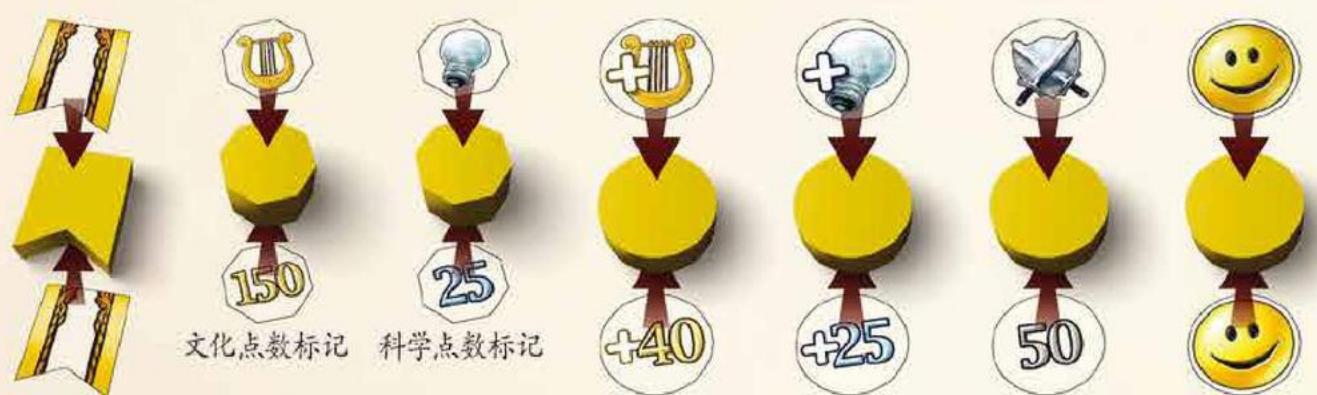
阵型标记
文化增速标记
科学增速标记
军力等级标记
幸福等级标记
游戏设置-玩家游戏区域
在历史巨轮中,没有地图版图的概念。你需要在自己面前为文明规划出一片区域,这片区域就是你的游戏区域。
玩家版图
你的玩家版图是你游戏区域的主体部分。在设置时:
选择一种玩家颜色。
·将相应颜色的玩家版图放在自己面前,并在版图四周为你文明今后的发展预留足够的空间。
玩家配件
每位玩家根据自己选择的颜色拿取相应的一组木质配件。在第一次游戏前,你可以使用游戏提供的贴纸来装饰这些配件。
阵型标记
该配件用于标记一个文明激活的当前阵型。


点数标记
这些配件用于记录一个文明累积的文化和科学点数。


增速/等级标记

这些配件用于记录一个文明的4种基本信息:文化增速,科学增速,军力等级和幸福等级。
将你的幸福等级标记放到玩家版图幸福等级指示条数字0的位置。
方块标记
方块标记分为蓝色,黄色,白色和红色4种。你需要将一定数量的方块标记放到自己的游戏区域中:
拿取16个蓝色标记,将它们放到你的蓝色供给区。
·拿取25个黄色标记,将它们放到你的玩家版图上:其中18个放到你的黄色人口区,1个放到你的工人区,6个放到初始科技牌上。
工人
你玩家版图上未被放到黄色人口区的7个黄色标记被称作工人。它们代表了你文明的初始人口。
拿取4个白色标记和2个红色标记,将它们放到你的玩家版图右侧。
其中6个工人已经被放到你的初始科技牌上。这些工人代表你当前拥有的1个军事单位,2座农场,2座矿山和1个
当每位玩家都设置好自己的版图后,需要将剩余的方块标记放回盒中,或者把它们放到任何不妨碍游戏进行的地方。通常情况下,你只会在自己的游戏区域中移动这些标记。为数不多的情况下,你需要从盒中拿取新的标记或者将游戏区域中的标记放回盒中。
第7个工人被放到你的工人区中,称作未使用的工人。它现在并没有任何用处,但是可以被派遣去做各种工作。
初始科技
6张绘在玩家版图上的卡牌代表你所拥有的初始科技。即使绘在版图上,它们也被视作游戏中的卡牌。这些卡牌代表你文明最初的认知,以及你初始可以建造的建筑。
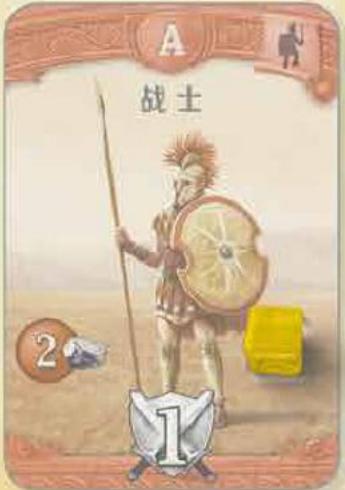
军事单位科技牌(红色)
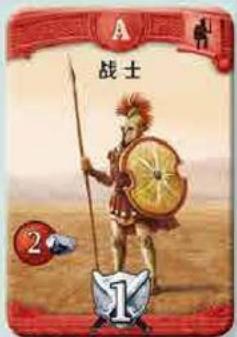
战士科技牌允许你建造一个战士单位。卡牌上的一个工人代表你的一个战士单位。卡牌底部的数字表示每个战士单位提供的军力等级。你的一个战士单位将为你的文明提供1点军力等级。
卡牌右上角的符号代表它属于步兵类型。在后续的游戏中,你将会获得更多高等级的兵种单位,和等。

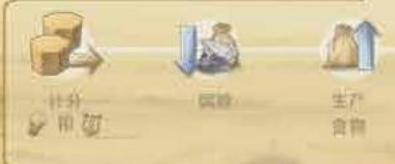
回合结束阶段流程:

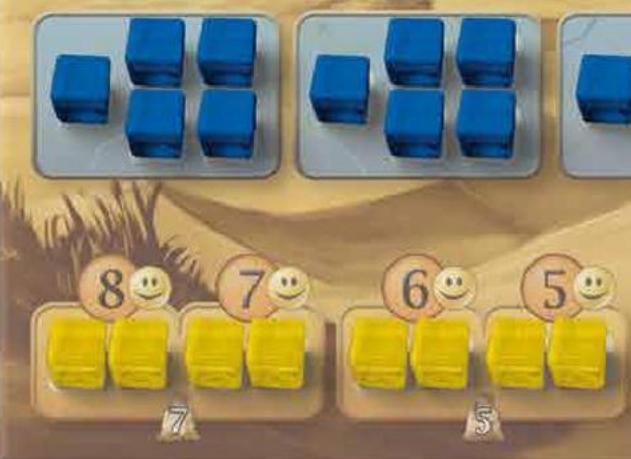
蓝色供给区
蓝色标记代表食物和资源。当它们位于农场科技牌上时,它们代表食物。当它们位于矿山科技牌上时,它们代表资源。这些蓝色标记直到被使用前,都存放在你的蓝色供给区
当你的工人生产食物和资源时,你需要将相应的标记从蓝色供给区移动到相应的卡牌上。在任何时候,你都需要最先移动那些位于蓝色供给区最右侧的标记。
当你支付食物和资源时,你需要将你的蓝色标记放回到蓝色供给区,并按照从左到右的顺序填充。
当你蓝色供给区中的一个小区域为空时,这意味着你已经储存了一定量的食物和资源。如果在本回合你需要使用这些食物或资源,这不会有什么问题。但是当你的回合结束时,一些小区域仍然是空的,那么你可能面临腐败问题。
黄色人口区
你黄色人口区中的黄色标记并不代表你的工人。你可以将它们视作你领土中的闲置土
在任何时候,当你增加人口时,你需要从黄色人口区拿取最右侧的一个标记,并将它放到你的工人区。这时候你获得了一个工人,同时你黄色人口区中的标记减少了,这意味着你闲置的土地变少了。随着你人口密度的增加,你的人口需求也会随之增多。这二者的关联将通过黄色人口区中长度不同的多个小区域来表示。
在游戏开始时,你的人口不会消耗食物。他们通过狩猎和耕种自给自足。只有当你想增加人口时,你才会用到你储存的食物。增加人口的费用都绘在每个小区域的底部。
随着你人口的不断增加,你的黄色人口区最终会被拿空。游戏中,你需要一定数量的食物来维持你的人口,同时增加人口将会消耗你更多的食物。

游戏设置-玩家游戏区域
农场和矿山科技牌(棕色)
农业是一张农场科技牌,它允许你建造一座农场。铜矿是一张矿山科技牌,它允许你建造一座矿山父。卡牌本身并不代表实际意义上的农场或矿山。它们只表示建造农场和矿山时所需的科技。农场和矿山由你放在相应卡牌上的工人来表示。在游戏开始时,你拥有2座农场和2座矿山。
科技牌底部的数字表示每座农场或矿山可以生产的食物或资源的数量。食物是增加和维持你文明人口数量的重要保证。资源可以用于建造农场,矿山,城市建筑,奇迹和军事单位等。
城市建筑科技牌(灰色)
哲学允许你建造实验室了,宗教允许你建造寺庙。与农场和矿山一样,实际的建筑是由放在相应科技牌上的工人表示的。卡牌本身只表示建造相应建筑时所需要的科技。在游戏开始时,你拥有1个实验室,但是没有寺庙——因为宗教牌上没有任何工人。
城市建筑牌底部的符号表示每个建筑可以为你提供的效果。你的一个实验室可以提供1。你的一个寺庙可以为你提供1和1个,不过你现在还没有寺庙。
卡牌右上角的符号代表卡牌和城市建筑的类型。在后续的游戏中,你可以建造更多高等级的实验室和寺庙,以及各种其他类型的城市建筑。
时代和等级
初始科技牌顶部的符号A表示这张牌属于时代A—古代。游戏中的任何一张卡牌都属于四个时代之一:
时代A:古代(公元前及公元后最初的几个世纪)
.时代I:中世纪(直到16世纪)
.时代Ⅱ:大航海时代(直到19世纪)
.时代Ⅲ:现代(20世纪)
当你进行第一次游戏时,你可以不使用时代Ⅲ的卡牌。
游戏会在你进入现代时结束。
有时候,基础规则或卡牌的描述中提到一张卡牌的等级,它表示的是与其时代所对应的数字:时代A的卡牌等级是0,时代Ⅰ的卡牌等级是1,时代Ⅱ的卡牌等级是2.时代Ⅲ的卡牌等级是3。
一个农场,矿山,城市建筑或军事单位的时代或等级,与其对应卡牌的时代或等级是相同的。
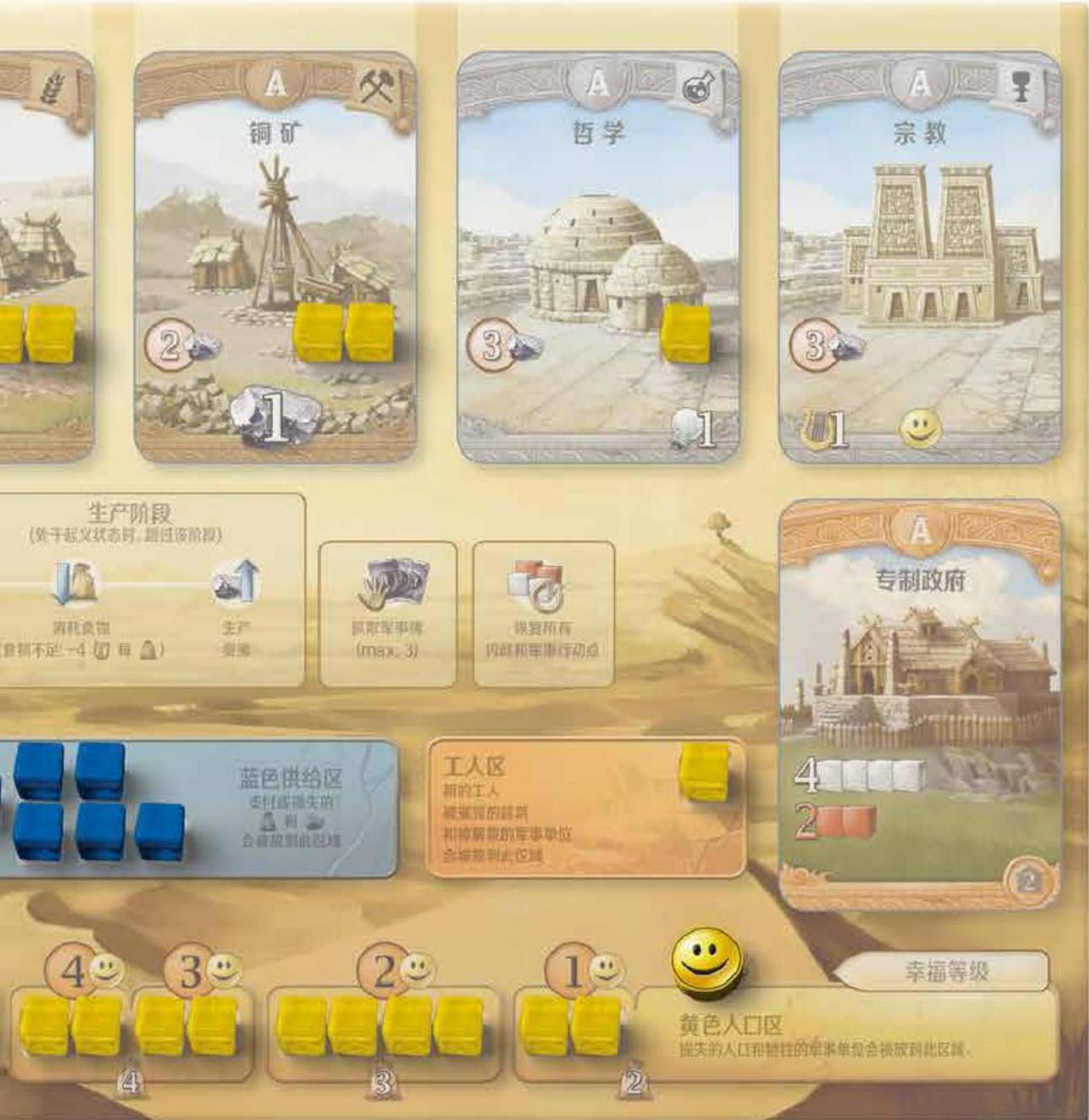
幸福等级指示条
你的笑脸总数由你黄色人口区上方的幸福等级指示条上的幸福等级标记来记录。在游戏开始时,只有宗教会为你提供笑脸。因为宗教牌上并没有你的工人,也就是说你还没有寺庙,所以你的幸福等级初始数值为0.
当你的黄色人口区逐渐变空时,幸福等级对你而言就显得非常重要。随着你人口的增加,你的人民需要更多的娱乐消遣。你黄色人口区的每个小区域上方都绘有一个数字。当相应的小区域为空时,你至少需要拥有其上方对应数量的笑脸。否则,你将获得不满工人,这些不满工人可能会引发起义。
政府科技牌(橙色)
橙色的科技牌代表你文明当前的政府体制,它是你每个回合内政行动点和军事行动点的主要来源。这些行动点代表你政府当前的工作效率,决定了你可以执行多少行动。
游戏开始时,每个文明都是专制政府。根据卡牌上绘有的4个和2个,你总计拥有4点内政行动点和2点军事行动点可以使用。这些行动点由你放在玩家版图旁的白色和红色标记表示。
后续的游戏中,你可以通过革命或和平演变的方式发展为更高级的政府体制,这样你也可以获得更多的内政行动点和军事行动点。
参考提示卡
每位玩家会获得一张参考提示卡。其中一面记录了每位玩家的回合流程概述。(在你进行第一次游戏时,可以忽略提示卡上深红色背景的文字。)
上的这不大确定时可以差着提关上相为的讲分。
你的回台
FANGEEALS EMN
L动RR
LAN A e mm
游戏设置-公共区域
将游戏版图放到桌子中央合适的位置,
保证所有参与游戏的玩家都可以清晰地看见版图上的内容。
牌堆
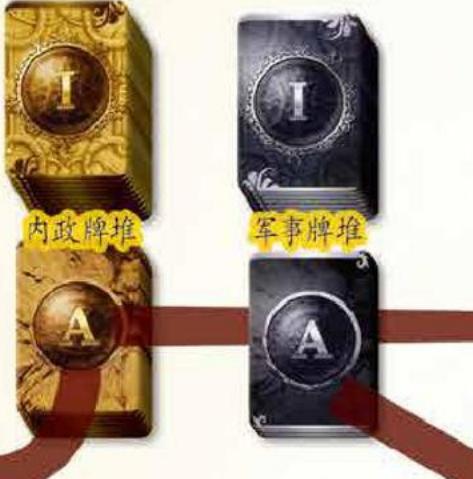
游戏总共有两种卡牌——内政牌和军事牌。我们已经对内政牌有所介绍:所有绘在玩家版图上的初始科技牌都属于时代A的内政牌。军事牌会在后续的游戏中陆续加入。
·你可以根据牌背将卡牌分为8堆。
在你进行第一次游戏时,游戏的时间会相对较短,玩家之间也不会有太多的军事冲突。为保证这一点,你需要对牌堆进行相应地调整;
·将整个时代Ⅲ的牌堆放回盒中。在你进行第一次游戏时,相比完整模式下的游戏你会少使用一个时代的牌堆。
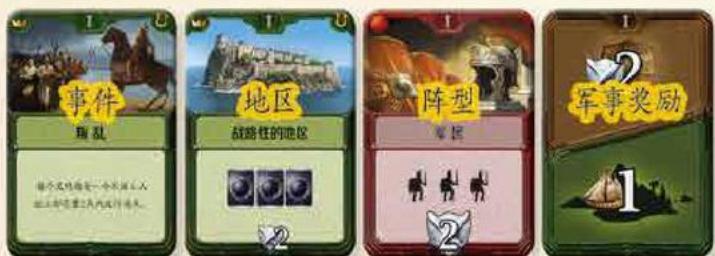
·在时代Ⅰ和时代Ⅱ的军事牌堆中,只保留以下卡牌:
- 事件牌和地区牌(左上角绘有的绿色卡牌)
-阵型牌(卡牌下半部分绘有军事单位图标的红色卡牌)
一军事奖励牌(一半棕色一半绿色的卡牌)
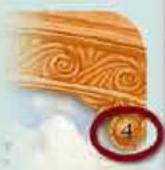
当参与游戏的玩家少于4人时,需要对内政牌堆进行一定地调整。在2-3人游戏时,移除时代Ⅰ和时代ⅡΠ内政牌堆中相应的卡牌。
需要移除的卡牌在右上角绘有标记:
3人游戏时,从每个时代的牌堆中移除3张具
·2人游戏时,从每个时代的牌堆中移除6张具有的卡牌和3张具有4的卡牌。

在你进行第一次游戏时,只会用到6个牌堆。



分别切洗每个牌堆。
游戏设置时,你只会用到时代A的牌堆。你可以暂时将时代Ⅰ和时代Ⅱ的牌堆放在一旁,它们将会在后续的游戏中被使用。
卡牌列
玩家可以从展示的卡牌列版图上拿取自己想要的内政牌。这是游戏的核心要素之一。玩家通过从卡牌列上拿取的这些卡牌发展自己的文明。你需要将卡牌列版图放到所有玩家都方便使用,并且可以清晰看到卡牌内容的位置。
从时代A的内政牌堆抓取13张卡牌,并将它们面朝上放到卡牌列版图上。

科学版图
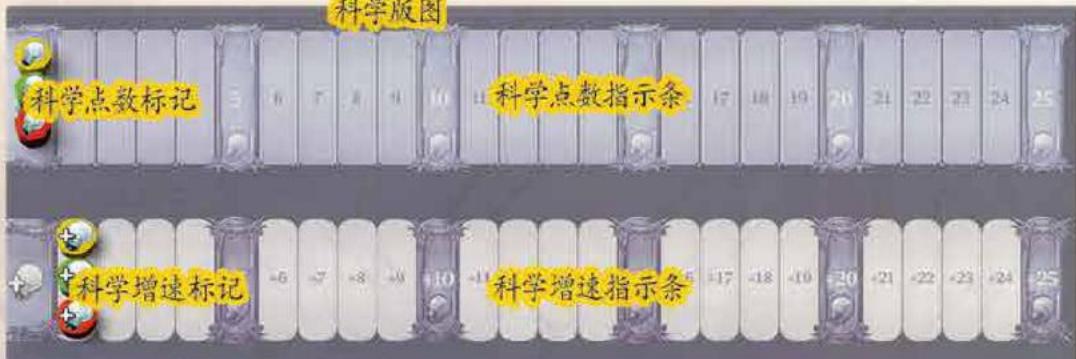
科学版图
科学代表一个文明拥有的知识技术,以及发现并使用新知识和新发明的能力。

科学增速指示条
一个文明的科学增速表示该文明在每个回合的生产阶段可以获得的科学点数。当玩家建造或摧毁自己的一些建筑时,会调整相应的科学增速。
·所有玩家的科学增速标记(圆形)在科学增速指示条上的初始数值都为1。
查看你的玩家版图。在游戏开始时,你拥有一个时代A的实验室,用一个放在哲学科技牌上的工人来表示。卡牌底部的1个符号表示卡牌上的每个实验室都可以让你获得1科学增速。这也是你当前科学增速为1的原因。
科学点数指示条
在游戏过程中,每位玩家都会根据自己的获得相应的科学点数。他们可以通过支付科学点数来发展自己的技术。
·所有玩家的科学点数标记(八角形)在科学点数指示条上的初始数值都为0。
游戏开始时,你没有科学点数。因为你当前的科学增速为1,所以在你的第一回合结束时,你将获得你的第1点科学点数。
文化版图
文化版图
文化代表一个文明对整个世界的影响力。无论是通过艺术,宗教,奇迹,还是侵略和战争,一个文明总是需要不断地传播自身的文化影响力。在游戏结束时,文化点数最高的文明将获得游戏胜利!
文化增速指示条
一个文明的文化增速表示该文明在每个回合的生产阶段可以获得的文化点数。当玩家建造或摧毁自己的一些建筑时,会调整相应的文化增速。
·所有玩家的文化增速标记(圆形)在文化增速指示条上的初始数值都为0。在你的玩家版图上,你能看到的只有宗教科技牌让你获得文化增速。因为该牌上还没有工人,这表示你还没有自己的寺庙,所以你当前的文化增速为0。
文化点数指示条
在游戏过程中,信玩会极化点获得相应的文化点数,不过有时候
·所有玩家的文化点数标记(八角形)在文化点数指示条上的初始数值都为0。
游戏设置-公共区域
当前时代版图
这个小型的当前时代版图用来放置当前时代的内政和军事牌堆。
当前时代内政牌堆
当前时代的内政牌堆用来放置当前时代用于补充到卡牌列上的内政牌。
·游戏设置时,在补充卡牌列后,将剩余的时代A的内政牌堆放到当前时代版图上。
当前时代军事牌堆
当前时代的军事牌堆用于放置每位玩家回合结束时抓取的军事牌。不过,在时代A时这个地方是空的,所以玩家不会抓取时代A的军事牌。


起始玩家
随机选择起始玩家。起始玩家在游戏过程中不会更改,也不会获得一些特殊优势。不过,为了保证每位玩家的总回合数一致,记住谁是起始玩家还是有必要的。如果你愿意,你也可以将一张未使用的时代A的军事牌放在起始玩家的玩家版图下,用来标记他(她)是起始玩家。
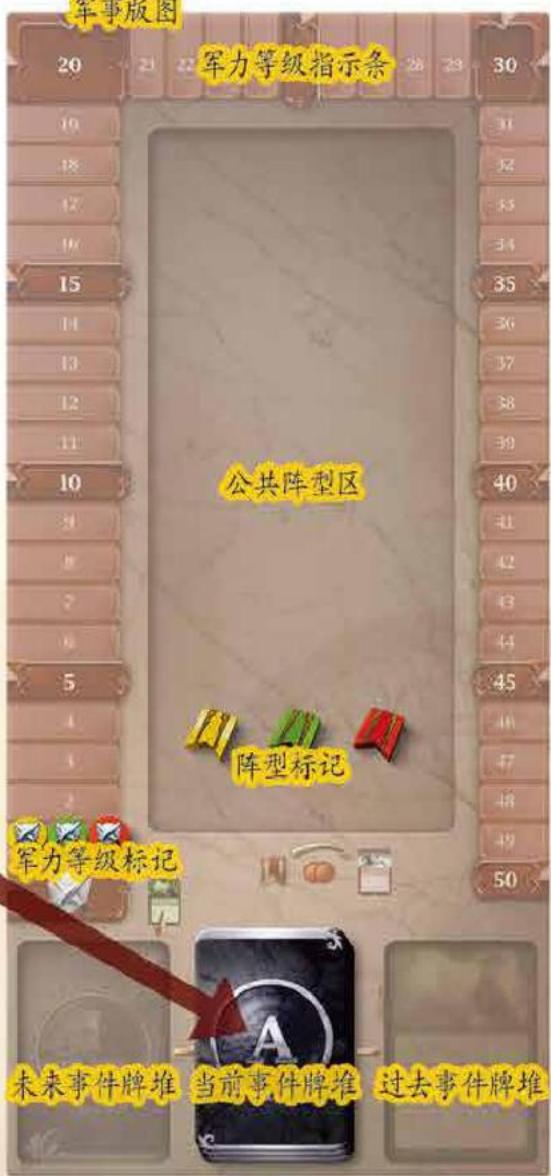
军事版图
军力等级指示条
军力等级代表一个文明军事单位的总军力,与战争相关的能力,以及其他的军事优势。在你进行第一次游戏时,相比完整模式下的游戏,军力等级显得并不重要。因为玩家之间不会有直接的战争冲突。然而,当游戏中发生的一些需要比较文明军力的事件时,军力等级也会发挥一定的作用。军力更高的玩家通常能借助该事件受益,而军力较低的玩家则会受到一定的惩罚。
• 所有玩家的军力等级标记在军力等级指示条上的初始数值都为1。
第一轮行动
第一个游戏轮,所有玩家在各自的第一回合中并不能执行全部的行动。放在玩家版图旁的白色和红色标记代表你当前不可用的行动点。可用的行动点是用放在玩家政府牌上的白色和红色标记表示的。
·起始玩家将1个白色标记放在自己的专制政府牌
第三位玩家将3个白色标记放在自己的专制政府
·第四位玩家将4个白色标记放在自己的专制政府
因此,每位玩家的第一回合中分别会有1.2,3或4点内政行动点可用,但是没有军事行动点可用。
在你的玩家版图上,你的战士科技牌上有一个工人,这表示你拥有一位战士,战士提供的军力等级为1。因为在游戏开始时,战士是你唯一的军力等级来源,所以你初始的军力等级为1。
公共阵型区
公共阵型区位于军事版图的中央。在游戏过程中,玩家可以将阵型牌放到这里,以表示自己的文明已经足够强大。
·所有玩家的阵型标记都被放到公共阵型区。
这些标记用于表示每位玩家激活的当前阵型。在游戏开始时,公共阵型区中没有卡牌——每位玩家也没有激活的当前阵型。
事件牌堆
在军事版图上有两个用来放置可能在游戏过程中发生的各种事件的事件牌堆。最开始的一些事件是从时代A的军事牌堆中随机抽取,并放在当前事件牌堆中的。这些事件大多为增益类事件。
在游戏过程中,玩家将从手中选择事件牌,并将其加入未来事件牌堆中。每当筹划一个未来事件时,你都会展示一张当前事件牌并结算。当所有时代A的事件结算完后,未来事件牌堆将组成新的当前事件牌堆。
根据参与游戏的玩家人数从时代A的军事牌堆中拿取最顶上的4,5或6张卡牌,并将它们面朝下放置在军事版图上作为当前事件牌堆。拿取的卡牌数量为参与游戏的玩家人数+2.
·在不查看任何卡牌的情况下,将剩余的时代A的军事牌堆放回盒中。
游戏开始时,未来事件牌堆为空。
过去事件牌堆

游戏概述
在完成你的第一次游戏设置后,游戏过程中将有以下事情发生:
第一个游戏轮
整局游戏开始于古代,第一个游戏轮更像是后续游戏的一个准备轮。在第一轮中,每位玩家只有部分内政行动可以执行。他们从卡牌列拿取卡牌,并根据自己的规划发展最初的文明。每位玩家的回合在结算完获得科学点数,生产食物和资源等流程后结束。
第二个游戏轮
从游戏的第二轮开始,每位玩家的回合开始前都会有一些新的内政牌出现在卡牌列上。游戏的第二轮将开启中世纪时代。与此同时,相应的时代Ⅰ的卡牌将出现在卡牌列上。
在各自的第二回合中,玩家可以开始建造并发展自己的文明。他们可以使用所拥有的内政和军事行动点,并且能够执行除拿取卡牌外的更多行动。在结算各自的生产阶段后,玩家还有机会抓取军事牌。
后续的游戏轮
从游戏的第三轮开始,每位玩家可以使用获得的军事卡牌。这些卡牌允许玩家运用自己的政治手段,并通过阵型牌来提升自己的军力等级。当然,玩家也可以继续增加人口,发展新的科技,提高自己的食物和资源产量,同时获得更多的科学点数和文化点数。相应地,玩家需要采取一定的措施来保障自己人口的幸福等级,并及时解决可能出现的腐败问题。
历史巨轮的前进
当时代Ⅰ的内政牌被拿空时,时代Ⅱ大航海时代将开启。一些过期的卡牌在此时将被弃置,同时你的人口也会有更多的需求。但是,游戏的基本规则保持不变。时代Ⅱ的内政和军事牌堆加入游戏,你将获得更多的先进科技,工业化的奇迹,和开明的领袖等。
游戏结束
你的第一次游戏通常使用的是简单模式。所以,当时代∏的内政牌堆被拿空时,游戏已经接近尾声。你需要再次弃置那些过期的卡牌,同时人口需求也会再次提升。时代Ⅲ现代将开启,不过在此时你不会用到时代Ⅲ的卡牌。每位玩家还拥有各自的最后一个回合来发展自己的文明。位于起始玩家右侧的玩家执行完他(她)的最后一个回合后,整局游戏结束。这样也会保证每位玩家总回合数一样。最后,文化点数最高的玩家获得胜利。
边学边玩
你可以一边阅读玩家手册一边进行游戏。按照手册描述的方式设置游戏。然后,阅读第一个游戏轮的部分,并进行第一轮游戏。阅读第二个游戏轮的部分,并进行第二轮游戏。阅读后续的游戏轮部分,并进行后续的游戏。在时代Ⅰ的内政牌堆被拿空后,阅读时代结束的部分。同时,你还应该阅读游戏结束的部分,以便你在时代Π中更有策略地进行游戏。
第一个-游戏轮
第一个游戏轮的流程比较简单,但它是以后游戏流程的重要基础。
游戏从古代开始,第一个游戏轮作为整局游戏的准备轮,每位玩家可以从卡牌列拿取一些卡牌。这些牌将成为你文明发展进程中的古老遗产。
每位玩家根据第一个游戏轮的规则,各自执行第一回合。
你的第一回合只有两个阶段:
· 行动阶段,你可以从卡牌列拿取一张或多张卡牌。
· 回合结束阶段,你的文明将生产食物和资源,并获得科学点数。在恢复所有的行动点后,你的回合结束。
行动阶段
在第一个游戏轮中,你可以使用的行动点和可选的行动都会受到限制。
可用的行动点
每位玩家在自己的回合开始时,其专制政府牌上的白色标记数量并不一样。政府牌上的每个白色标记代表1.点可用的内政行动点。
每位玩家根据自己的行动顺序,将获得1,2,3或4点可用的内政行动点。并且这些行动点只能用来从卡牌列拿取卡牌。
后续的游戏轮中,你的回合开始时你将拥有全部可用的行动点。
拿取卡牌
在游戏开始时,卡牌列由时代A的13张内政牌组成。拿取卡牌需要消耗一定数量的内政行动点。卡牌列相应牌位底部的符号数量表示拿取该牌的费用:拿取前5张,每张卡牌的费用为1点内政行动点;拿取中间4张,每张卡牌的费用为2点内政行动点;拿取最后4张,每张卡牌的费用为3点内政行动点。
从卡牌列拿取一张卡牌时,你必须根据其牌位底部的符号数量支付相应的内政行动点。
支付内政行动点
在支付内政行动点时,你需要从自己的政府牌上拿取相应数量的白色标记,并将其放到政府牌旁边,代表你已经支付的内政行动点。它们不可以再被使用直到你的下个回合。
起始玩家只有1点内政行动点,所以他只能拿取卡牌列上前5个牌位的牌。第二位玩家可以拿取前5个牌位上的最多2张牌,或是拿取卡牌列中间部分的1张牌。如果玩家愿意,他可以不完全使用自己的行动点。
时代A的卡牌
在古代共有3种卡牌:领袖牌(绿色),奇迹牌(紫色)和行动牌(黄色)。
领袖牌
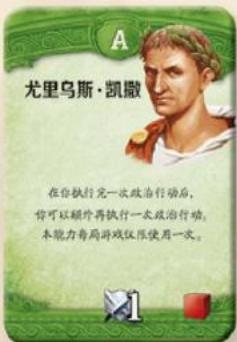
领袖牌是你选择的一位文明导师,同时他也是某位著名的历史人物。领袖牌可以为你带来一些特殊能力和增益效果。你可以通过卡牌的描述或是卡牌底部的符号来了解该牌。
当你拿取一张领袖牌时,你需要先将其加入自己的手牌。直到你将它加入到你的游戏区域前,它
不会为你提供任何效果。在第一个游戏轮中,你不可以将领袖牌加入到游戏区域中,所以你只能将拿到的领袖牌暂时放在手中。
在每个游戏轮中,你都要遵从以下限制:
你不可以拿取同时代的第2张领袖牌。
奇迹牌
当你拿取一张时代A的领袖牌后,你就不可以再拿取另外一张领袖牌。无论你的领袖牌是否被加入到游戏区域中,或是已经从游戏中移除,上述限制依然有效。但是,你可以拿取一张时代I的领袖牌。

奇迹牌在游戏中大部分是各种史诗级的建筑。它们可以为玩家提供各种强力的效果,不过想要建造完成这些奇迹需要花费大量的时间和资源。
奇迹牌是唯一一种可以在你拿取它时,直接加入到游戏区域中的卡牌。你永远都不可能将一张奇迹牌加入到自己的手中。当你从卡牌列拿取一张奇迹牌时,将其放到你的玩家版图旁。同时,将其横置以表示该奇迹处于未完成的状态。这种奇迹称作未完成的奇迹。
在你的游戏区域中,只允许存在1个未完成的奇迹。如果你当前拥有的奇迹尚未完成,那么你也不可以拿取新的奇迹牌。
当你完成一个奇迹后,你需要将其恢复至竖直状态,以表示该奇迹处于已完成的状态。同时,奇迹牌的效果立即生效。已完成的奇迹不会妨碍你拿取新的奇迹牌,但是会增加你拿取新奇迹牌的费用:
在之前的游戏中,你每完成一个奇迹,在拿取一张新的奇迹牌时,你就需要多消耗1点内政行动点。
所以当你拿取第1张奇迹牌时,你只需要正常消耗内政行动点。一旦你完成了该奇迹,那么在拿取下一张奇迹牌时,你需要额外支付1点内政行动点。拿取第3张奇迹牌时,需要额外支付2点内政行动点,以此类推。
注意:在你拿取一张奇迹牌前,你应该确定该奇迹就是自己希望建造的奇迹,并可以顺利建造它。因为想摆脱一张未完成的奇迹牌是件非常困难的事情,而且它还会妨碍你拿取其他你想要的奇迹牌。
行动牌
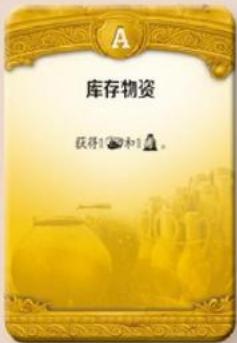
一张行动牌可以为你带来一些你需要的财产(食物和资源)或是特殊效果。与其他的内政牌不同,行动牌不会产生任何持续性的效果。它会在你打出的时候,为你带来一个一次性的效果,然后你需要将其弃置。当你拿取一张行动牌时,你需要将其加入自己的手中,你可以在自己后续的回合中打出它。
第一个-游戏轮
第一个游戏轮卡牌拿取实例

三位玩家从以上的卡牌列中选择并拿取自己想要的卡牌:
起始玩家只有1点内政行动点。他选择拿取领袖牌摩西,并将其加入自己的手中。然后,他根据下文的描述执行自己的回合结束阶段。
第二位玩家有2点内政行动点。她选择拿取罗德岛太阳神巨像,并将其横置在自己的玩家版图旁边,以表示未完成的状态。然后,她决定使用自己的第2点内政行动点拿取卡牌建造天赋,这样她可以更快地完成奇迹罗德岛太阳神巨像。她将拿取的卡牌加入自己的手中,并执行自己的回合结束阶段。
第三位玩家有3点内政行动点。他想要支付2点内政行动点,来拿取领袖牌汉谟拉比。但是,他的第3点内政行动点怎么办?因为支付1点内政行动点能拿取的卡牌只有领袖牌荷马和亚里士多德,而玩家又不能拿取相同时代的两张领袖牌。如果他决定无论如何都要拿取领袖牌汉谟拉比的话,他只能以1点未使用的内政行动点结束自己的回合。举个例子,如果他更想要拿到2张卡牌的话,他可以拿取领袖牌亚里士多德。然后,将奇迹牌亚历山大图书馆作为一个未完成的奇迹,加入到自己的游戏区域中。或者,如果他觉得卡牌列上最后的部分中有比汉谟拉比更好的卡牌,他也可以支付3点内政行动点,从中拿取1张卡牌。无论是以上哪种情况,他都需要执行回合结束阶段来结束自己的回合,然后,第二个游戏轮开始。
公开内政牌
因为所有的内政牌都是面朝上从卡牌列版图上拿取的,所以对于那些愿意记录卡牌信息的玩家,这些内政牌都是公开的。
如果你不希望这种记牌手段影响到游戏体验,你可以征得其他玩家的同意,所有玩家将内政牌加入到手中时始终保持公开状态,或者将自己获得的内政牌直接面朝上放在桌面上(尽量将这些卡牌横置,以表示它们是你的手牌,而并不是你游戏区域中的卡牌)。尽管卡牌被公开了,除非它们被打出或是被弃置,否则这些卡牌始终被算作你的手牌。
回合结束阶段
只有部分步骤会被结算。

生产阶段(处于起义状态时,跳过该阶段)

计分 P和T

腐败


弃置多余的军事牌

生产阶段
现在暂时还没有起义的风险,所以你可以执行自己的生产阶段。
获得科学点数和文化点数
根据你当前的文化增速,将你的文化点数标记沿着版图向前移动相应的格数。
在第一个游戏轮中,玩家只能从卡牌列拿取卡牌,所以他们在各自的回合结束后文明数值的增速是一样的:科学增速为1,文化增速为0。将你的科学点数标记向前移动1格,而你的文化点数标记保持在数字0的位置不动。
根据你当前的科学增速,将你的科学点数标记沿着版图向前移动相应的格数。
生物
生产源
注意:这时候你的科学增速标记(圆形)不会移动,它是表示你可以将科学点数标记(八角形)向前移动多
(食物不足:-4每)
腐败
在第一个游戏轮中没有腐败的风险。所以你可以忽视
生产食物
你的每座农场都会生产食物。
你的农场科技牌上每有1个工人,你就可以将1个蓝色标记从蓝色供给区移动到相应的卡牌上。
因为你拥有2座时代A的农场(农业科技牌上有2个黄色标记),所以你需要从蓝色供给区移动2个蓝色标记到自己的农业科技牌上。农业科技牌底部的数字表示每个蓝色标记代表。恭喜!你的文明现在已经获得了2食物。
消耗食物
你的文明现在人口还非常稀少,所以不需要消耗你储备的食物。在第一个游戏轮中,你可以忽略此步骤。
生产资源
与生产食物的流程类似:
你的矿山科技牌上每有1个工人,你就将1个蓝色标记从蓝色供给区移动到相应的卡牌上。
将2个蓝色标记移动到你的铜矿科技牌上,这代表你储备了2资源。你可以在后续回合中使用这些资源。
抓取军事牌 (max. 3)

抓取军事牌
你每有1点可用的军事行动点就可以抓取1张军事牌。在第一个游戏轮中,因为你没有可用的军事行动点,所以你不会抓取任何军事牌。请忽略此步骤。
恢复所有的内政和军事行动点
将你所有的白色标记和红色标记放回到专制政府牌上。
在你的下个回合,你将拥有4点内政行动点和2点军事
第二个-游戏轮
在第二个游戏轮中,你将有更多的行动选择。
第二轮的游戏规则与后续的每个游戏轮规则完全一样。但是,因为你当前还没有可用的军事牌,所以在第二个游戏轮中有些行动你也不能执行。
在你的第二回合:
·补充卡牌列。
• 使用你的内政和军事行动点,并执行相应的行动(在你的行动阶段)。
• 结算回合结束阶段流程。
补充卡牌列
在第一个游戏轮中,所有玩家都不需要补充卡牌列。但是在后续的游戏轮中,每位玩家在自己的回合开始阶段都需要补充卡牌列。
除第一个游戏轮外,每位玩家在自己的回合开始阶段都需要补充卡牌列:
移除卡牌列最左侧相应牌位上的卡牌。
·将卡牌列上剩余的卡牌向左移动。
抓取新的内政牌并填充剩余的空位。
移除卡牌
按照卡牌列版图最左侧牌位上方的显示,根据参与游戏的玩家人数移除相应数量的卡牌。
·2人游戏时,移除最左侧3个牌位上的卡牌。
·3人游戏时,移除最左侧2个牌位上的卡牌。
·4人游戏时,移除最左侧1个牌位上的卡牌。


有时候,因为前一位玩家拿取了应该被移除的牌位上的卡牌,导致相应的一个或多个牌位为空。那么对你而言,这些卡牌相当于已经被移除了,所以此时你并不需要也不可能再移除它们。
被移除的卡牌不会再回到游戏中。所以,你最好将内政牌的弃牌堆放在盒中,以保证不会有被移除的卡牌因玩家失误而重新回到游戏中。
移动卡牌
此时,卡牌列版图上将会有一个或多个卡牌的空位。将所有卡牌向左移动,以补充所有左侧的空位。当你这样做后,所有的空牌位只存在于卡牌列的右侧。但卡牌列上其他卡牌间的顺序并未改变,只是从费用较高的牌位移动到了费用较低的牌位。

拿取新的卡牌

注意:只有起始玩家会造成时代A的结束,时代I的开启。但是在后续的游戏中,起始玩家的回合与其他玩家相比并没有什么不同。即使你不是起始玩家,在你的回合开始阶段,你也需要先补充卡牌列。
在你的第二回合,你可以使用所有的行动点,4个内政行动点(白色)和2个军事行动点(红色)。当你为一个行动支付行动点时,你需要从你的政府牌上将1个相应颜色的行动点标记放到旁边。
行动阶段
注意:在你的第二回合中,我们建议你只使用你的内政行动点。在这种和平变体的游戏模式下,你不需要过早地建造军事单位。通过这些剩余的军事行动点,你可以在回合结束阶段抓取更多的军事牌。
你可以使用这些行动点来执行以下各种行动。你可以按照自己的意愿交替使用所有的内政行动点和军事行动点,并以任意顺序执行这些行动。如果你可以支付足够的行动点,你可以多次执行同一行动,但是另有说明的除外。你不必用完你所有的行动点。
将时代Ⅰ的相应牌堆放在当前时代版图上,这是在时代A结束时,玩家唯一要做的事情。在时代I和时代Ⅱ结束时,玩家还会进行一些额外的步骤,这些我们将在后文中详细介绍。
以下是你可以执行的内政行动:
将剩余的时代A的内政牌堆放回盒中。切洗时代I的内政牌堆,并将其面朝下放在当前时代版图的浅色部分。从现在开始,我们将使用时代Ⅰ的卡牌补充卡牌列。切洗时代1的军事牌堆,并将其放在当前时代版图的深色部分。从现在开始,玩家可以在各自的回合结束阶段从当前军事牌堆抓取军事牌了。
·从卡牌列拿取一张卡牌;
·建造一个城市建筑
·升级一个农场,矿山,或城市建筑当你第一次补充卡牌列时,你需要用当前时代版图上的时代A的内政牌堆进行补充。(因为在第一次补充卡牌列时,时代A的内政牌堆基本上是不会被拿空的,但是如果被拿空了,你也可以用时代Ⅰ的内政牌堆补充剩余的空牌位。)
·建造一座农场或矿山
·增加人口
·摧毁一个农场,矿山,或城市建筑
·打出一张领袖牌
当玩家第一次补充卡牌列时,时代A结束,时代I将开启。
时代A结束
·发展一项科技
·建造奇迹的一个等级
·宣告革命
·打出一张行动牌
以下是你可以执行的军事行动:
· 组建一个军事单位
·升级一个军事单位
• 解散一个军事单位
打出一张阵型牌※
·复制一张阵型牌
这些行动在你的第二回合中不太可能会被执行,但是由于上下文的关系,我们只好在这里来列出它们。
在中需要介到一些十尚未拿到的军事,我们
注意:以上玩家可以执行的所有行动都列在了玩家的参考提示卡上。
拿取一张卡牌
你可以从卡牌列拿取一张卡牌。拿取卡牌的规则与第一个游戏轮相同。除领袖牌,奇迹牌和行动牌外,你还可以拿到以下科技牌。
科技牌
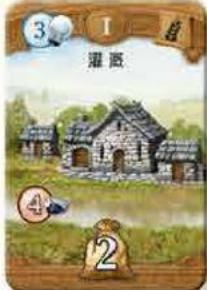
农场或矿山科技牌

城市建筑科技牌
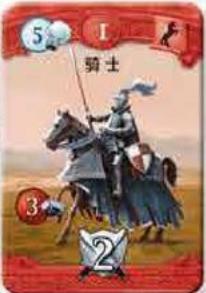
军事单位科技牌
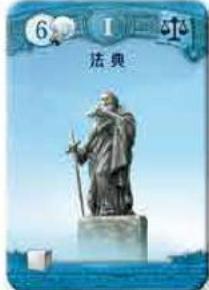

特殊科技牌
政府牌
科技牌分为多种颜色。每张科技牌的左上角都绘有一个蓝色数字,代表该牌的科学点数费用。
你可以根据卡牌列上的显示支付相应的行动点,然后从卡牌列上拿取任意张科技牌。
不过这里会有一个小小的限制:
你不可以拿取与手牌或游戏区域中同名的科技牌。
当你拿取科技牌时,你需要将其加入自己的手中。在你将其加入到游戏区域之前,它不会产生任何效果,这点将在后文中进行说明。
内政牌的手牌限制
你手中的内政牌数量受到总内政行动点的限制也就是你所拥有的白色标记的总数量。无论它是在你的政府牌上还是已经被放到一旁,如果你手中的内政牌数量已经达到了你的总内政行动点数,你就不能再将其他内政牌加入手中。
注意:这条规则不会妨碍你拿取奇迹牌。因为奇迹牌不会加入到你的手牌,而是直接进入你的游戏区域中。
在游戏开始时,你拥有4个白色标记。所以不管你是否使用了内政行动点,你手中的内政牌数量上限为4。除非你获得了更多的内政行动点,否则你手中的内政牌数量不能超过4张。
注意:请谨慎选择并拿取自己想要的内政牌。因为没有什么好的方法从手中弃置内政牌。

第二个-游戏轮
增加你的人口
你可以选择增加自己的人口,这样你可以获得更多的工人。
在增加人口时,你需要:
• 支付1点内政行动点。
·拿取你黄色人口区最右侧的1个黄色标记。
·根据该标记所在的黄色人口区小区域底部的白色数字支付相应的食物费用。
· 将拿取的黄色标记放到你的工人区。现在,它成为了你的一个未使用的工人。
支付食物
当你第一次增加人口时,你会根据黄色人口区最右侧小区域底部的白色数字支付2食物。
在支付食物时,你需要将表示等量食物的蓝色标记从你的农场科技牌上放回到蓝色供给区。
请看下面的插图。
在第一个游戏轮后,你的农业科技牌上有2个蓝色标记卡牌底部的符号表示每个蓝色标记代表。如果你需要支付2食物,你可以从你的农业牌上将2个蓝色标记放回到蓝色供给区。你不可以用你的铜矿科技牌上的蓝色标记进行支付,因为它们代表你的资源而不是食物。
当你没有足够的食物时,你不能执行增加人口的行动。在你的第二回合,你通常不会有足够的食物增加两次人口。
注意:当你支付时,你不需要将你的蓝色标记移除,只需要将其放回到你的蓝色供给区。
你的新工人
在你将黄色人口区最右侧的工人移动到工人区后,你就获得了一个未使用的工人,而你的黄色人口区会减少1个黄色标记。这表示你文明的人口密度开始增加。
在你黄色人口区相应的小区域中,你还有另一个黄色标记。在你下次进行增加人口行动时,你仍然只需要支付2食物。但是当相应的小区域为空时,你再执行增加人口行动就需要支付3食物了。当你从相应的小区域拿走另一个黄色标记后,会露出一个符号,这表示你的文明在回合结束阶段时需要消耗1食物。
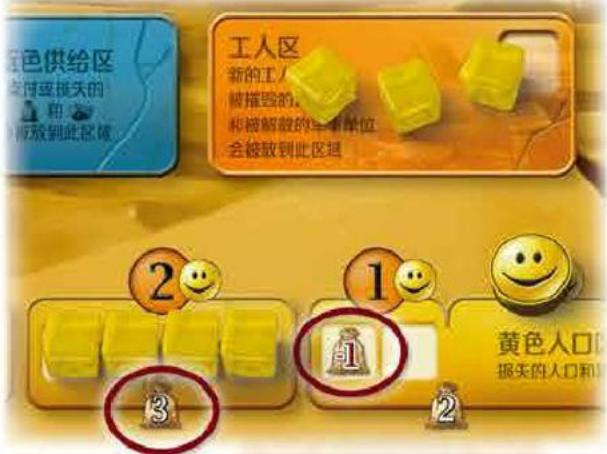
随着你工人数量的增加,你的黄色人口区会逐渐变空。这代表闲置的土地越来越少。你需要消耗更多的食物来增加和维持你的人口数量。当你的黄色人口区完全为空时,你不能再执行增加人口的行动,你的人口密度已经达到最大值。
增加人口带来的另一个影响会表现在你的幸福等级指示条上。这也是将幸福等级指示条加入到玩家黄色人口区的原因。随着人口的增长,如果你还想保持你的人口幸福的话,就需要根据完全为空的小区域上方的数字提供额外的笑脸。详见玩家手册第19页,幸福等级与不满工

第二个-游戏轮
建造一座新的农场或矿山
你可以把未使用的工人派去工作。建造一座新的农场或矿山是非常不错的主意,这样可以增加你生产的食物或资源。
在建造一座新的农场或矿山时,你需要:
支付1点内政行动点。
是示的费用,支的农及的发家科技牌(综色)上
移动你的一个未使用的工人到相应的农场或矿山科技牌上。
支付资源
支付资源与支付食物的方式一样。
在支付资源时,你需要将相应数量的蓝色标记(用于表示资源)从矿山科技牌上放回到蓝色供给区。
建造一座时代A的农场或矿山,你需要根据农业或铜矿科技牌上的显示支付2资源。由于在第一回合中你的铜矿进行了生产,并放置了2个蓝色标记,每个蓝色标记因卡牌底部的数字代表着。所以,现在你可以用它们来建造一座新的农场或矿山。然后,将相应数量的蓝色标记放回你的蓝色供给区。
当你不能为其支付费用时,你不能执行相应的行动。
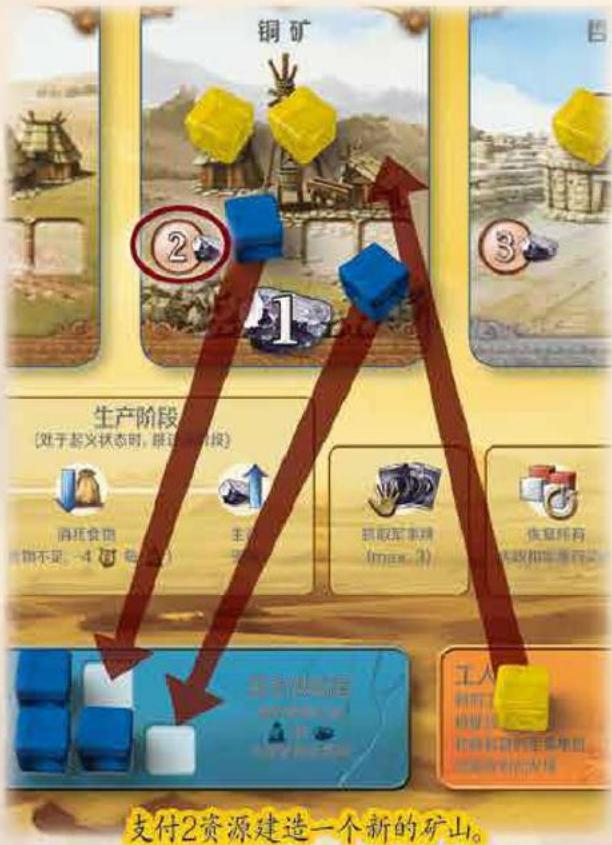
你的新农场或新矿山
当你的工人被放到农业或铜矿科技牌上后,它表示你的一座时代A的农场或矿山。这样做虽然没有任何即时性的效果,但是在生产阶段你可以多获得1个蓝色标记,你文明的生产水平得到了提升。
当你打出一张更高级的农场或矿山科技牌时,你可以建造更好的农场或矿山。但是如果你愿意,你仍然可以继续建造那些时代A的农场和矿山。

建造一个城市建筑
城市建筑的建造方法与农场和矿山一样:
支付1点内政行动点。
·根据你的一张已打出的城市建筑牌(灰色)上显示的费用,支付相应的资源。
· 移动你的一个未使用的工人到相应的城市建筑科技
· 调整你的增速/等级标记。(详见另一页方框中调整你的文明数值部分)
无论是建造哲学,还是宗教相关的城市建筑都需要花费3资源。但是你当前只有2资源,所以在你的第二回合中,除非使用行动牌,否则你基本无法建造这些城市建筑。(行动牌将在后文中进行介绍)

你的新城市建筑
城市建筑科技牌上的每个工人都代表你的一个相同类型和等级的城市建筑。在游戏开始时,你只有2张这样的科技牌你可以建造等级为0的实验室和寺庙。在后续的游戏中,你可以建造更高等级的实验室和寺庙,同时你还可以建造图书馆,剧院以及竞技场等其他类型的城市建筑。这些建筑的建造方法完全相同。
城市建筑科技牌底部的符号表示建筑上的每个工人可以为你提供的效果。当你建造完成一个城市建筑时,你需要立即调整你的增速/等级标记。(详见另一页中调整你的文明数值部分)
举例:当你建造了第2个实验室后,你的每个回合将多获得1。将你的科学增速标记移动到+2的位置,现在你的科学增速为2。
如果你建造了一个寺庙,你的文化增速和幸福等级将增加到1。如果你建造了第2个寺庙,两项数值将都会增加
城市建筑的限制

你的政府牌右下角的数字会限制你的城市建筑数量。该数字表示你同类型的城市建筑可以建造的数量上限。
绘在政府牌上的城市建筑限制决定了玩家可以建造的同类型城市建筑的最大数量。
一个城市建筑的类型由卡牌右上角的符号决定。城市建筑的限制适用于所有相同类型的城市建筑,并且忽略卡牌的等级。
在城市建筑的限制规则下,你可以建造1个或者多个实验室专制政府的城市建筑限制为2。所以,除非你改变了当前的政府体制,以获得更高的城市建筑限制。否则,你不能建造第3个实验室(即使你打出一张更高级的实验室科技牌)。但是,无论你已经建造了几个实验室,你仍可以再建造最多2个寺庙。
你可以建造任意数量的农场或矿山,城市建筑的限制并不适用于它们。
组建一个军事单位
在你的第一次游戏中并不会有太多的军事冲突,所以你可能不会在自己的第二回合就开始组建军事单位。但如果你想的话,基础规则允许你这样做。组建一个军事单位的方法除了支付所需的军事行动点外,其他方面与建造城市建筑一样。
· 支付1点军事行动点。
·根据你玩家区域中一张军事单位科技牌(红色)上显示的费用,支付相应的资
·移动你的一个未使用的工人到相应的军事单位科技
调体的军力等。(详见另一页方框中调整你
注意:你的每个军事单位都会根据卡牌上的描述为你提供相应的军力等级。因此,如果你又建造了一个战士单位,你的军力等级会再加1。
你可以拥有的每种类型的军事单位数量没有上限。
打出一张领袖牌
在你将领袖牌从手中放入到玩家区域之前,它不会产生任何效果。
·支付1点内政行动点。
·将领袖牌放到你的玩家版图旁边。
· 调整你的文明数值,如有需要。(详见另一页方框中调整你的文明数值部分。)
你可以在同一回合拿取领袖牌,并将其放入到你的游戏区域中。但是需要支付拿取和打出领袖牌对应的内政行动点
你的领袖效果
当领袖牌加入到你的游戏区域后,卡牌的效果将立即生效。一些领袖牌在底部绘有一些符号,这些符号将影响你的文明数值。
领袖牌的描述中会提到它能够为你带来的各种行动和特殊效果。
举例:
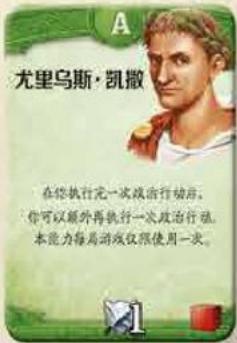
领袖牌凯撒可以让你获得1个额外的军事行动点,并且军力等级加1。它还可以在你的政治阶段为你提供一个额外的行动。这些将在后文中详细说明。
更多领袖牌的说明详见规则书最后一页的附录部分
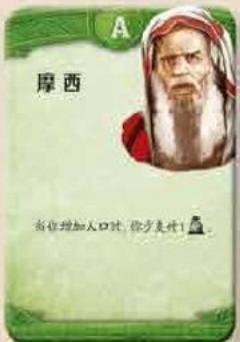
领袖牌摩西不会改变你的文明数值,但是它可以改变你增加人口时的规则。
第二个-游戏轮
替换一张领袖牌
当你的游戏区域中已经有一位领袖时,它可能会自行移除游戏,也可能在你打出一张新的领袖牌后被动移除游戏。旧的领袖牌失效的同时,新领袖牌的效果将立即生效。当旧的领袖牌被替换移除游戏时,你可以拿回1点内政行动点。
在替换领袖牌时:
· 支付1点内政行动点。
·从你的游戏区域中移除旧的领袖牌。
·将新的领袖牌加入到你的游戏区域中。
· 调整你的文明数值,如有需要。(不要忘记扣除旧领袖牌的效果。)
· 拿回1点内政行动点(将相应的标记放回到政府牌上)。
你可以在替换一张领袖牌前,先使用它的效果。
注意:支付行动点,然后再拿回行动点并不表示你可以免费替换领袖。如果你当前没有可用的内政行动点,那么你不可以替换自己的领袖。
举例:你当前的领袖为摩西。在你的回合,你使用1点内政行动点来增加人口(根据摩西的效果你可以少支付1食物),然后从卡牌列版图的中间部分拿取一张时代I的领袖牌,同时支付2点内政行动点。最后,使用你的最后1点内政行动点将其加入到自己的游戏区域中。领袖牌摩西将移除游戏,同时你可以拿回1点内政行动点。接下来,你就可以使用这1点内政行动点来执行其他行动。
但是,如果你在拿取时代1的领袖牌前增加了两次人口,那么你将不能在本回合替换摩西,因为你所有的内政行动点都已经使用了。
总结——领袖牌
·当你从卡牌列拿取1张领袖牌时,你不能再拿取同时代的另1张领袖牌。
· 支付1点内政行动点来打出领袖牌。当你的游戏区域中已有1张领袖牌时,旧的领袖牌将自动从你的游戏区域中移除,然后你可以拿回1点内政行动点
一张被牌的效果会在它加入到你的游戏区域后
建造奇迹的一个等级
一张奇迹牌在加入到你的游戏区域时需要横置,以表示其处于未完成状态。每张奇迹牌的底部都绘有有一行数字。每个数字都代表在建造奇迹的一个等级时,你需要支付的资源费用。
举例:金字塔的建造总共会经历3个等级。第一个等级需要支付3资源,第二个等级需要支付2资源,最后一个等级需要支付1资

建造未完成奇迹的一个等级:
支付1点内政行动点。
根据奇迹最左侧未被覆盖的数字支付相应的资
·从你的蓝色供给区拿取1个蓝色标记,将其覆盖在你所建造的那个等级所对应的数字上。
调整你的文明数值
你的文明数值由你游戏区域中的卡牌和你工人所处的位置决定。影响你文明数值的卡牌通常会在其底部绘有相应的符号,共分为两种:
· 当城市建筑科技牌和军事单位科技牌第一次加入到你的游戏区域时,它们不会产生任何效果,但是你可以放置工人。这些卡牌上放置的每个工人都会为你提供其底部显示的效果。当你的卡牌上只有1个工人时,效果只会发生一次。当有2个工人时,效果会发动两次,以此类推。当卡牌上没有工人时,它不会影响你的文明数值。
· 其他的卡牌(例如,特殊科技牌,政府牌,领袖牌和完成的奇迹牌等)不需要放置工人。当它们加入到你的游戏区域时,其效果立即生效(如果是奇迹牌,在它完成时才会立即生效)。但它们的效果只会发动
注意:卡牌的效果有时会通过数字表示(2),有时会通过重叠的符号表示()但它们所代表含义是相同的。(获得2点相应的文明数值)
文明的增速/等级标记
你的文明增速/等级标记根据相应的指示条共分为4种。你的文明增速/等级完全由你游戏区域中的卡牌和工人决定,相应的指示条只是起到时刻记录玩家文明的增速/等级的作用,这样你可以不必每次都重头核算所有的文明数值。



幸福等级
科学增速
文化增速
军力等级
如果你的一张卡牌需要放置工人,你的文明增速/等级会在卡牌上放置工人,或工人从卡牌上移除时发生变化。如果你的一张卡牌不需要放置工人,你的文明增速/等级会在卡牌加入到你的游戏区域中,或从你的游戏区域中移除时发生变化。这些时候,你需要立即调整自己相应指示条上的增速/等级标记。
在同一回合中,如果你有足够的资源和内政行动点,你可以建造一个奇迹的多个等级。即使你在本回合刚刚从卡牌列拿取它,你也可以建造该奇迹的多个等级。
你的奇迹牌上的蓝色标记既不代表食物,也不代表资源。它们只是用来标记奇迹的建造进度。
完成一·个奇迹
当你建造了奇迹的最后一个等级,该奇迹就完成了:
·将卡牌上所有的蓝色标记放回你的蓝色供给区。
·将卡牌恢复为竖直状态,以表示它处于已完成状
·调整你的文明数值,如有需要。(详见本页调整你的文明数值部分)
当一个奇迹完成时,奇迹牌上的效果立即生效。同时,你需要根据奇迹牌底部的符号调整你的文明数值。
注:与上不常要收置建筑和军事单位科技牌不同。
举例:你使用最后的1点内政行动点来建造金字塔的最后一个等级。金字塔的效果为你提供了1个额外的内政行动点。所以你从盒中拿取1个白色标记,并将其放在你的政府牌上。你可以在本回合以及后续的所有回合中使用它。
更多奇迹牌的说明详见规则书最后一页的附录部分。
会改变其他卡牌为你提供文明增速/等级的方式。
文明增速/等级的限制
你的文明增速/等级不会低于0。当你的卡牌和工人为你提供的总文明增速/等级为负值时(不太可能发生,但理论上可以),你的文明增速/等级仍然为0。
你的幸福等级不会大于8。当你的卡牌和工人为你提供的笑脸总数大于8时,你文明的笑脸总数仍然为8。
你的科学增速,文化增速和军力等级没有上限。当你的文明增速/等级超过指示条的最大
值时,你需要将相应的标记翻面,并放回指示条上数字0的位置,以便重新计算。例如,一个翻面的科学增速标记被放在科学增速指示条上数字5的位置,这表示你当前的科学增速为30。
殖民修正
你游戏区域中的一些卡牌会为你提供殖民修正效果。在游戏中部分卡牌上绘有,它只会在殖民行动中产生作用,这点我们将在后文中进行介绍。由于它很容易计算,所以我们不需要为其配置相应的标记。
总行动点数
你的总内政行动点等于你所拥有的白色标记的总数量。你的总军事行动点等于你所拥有的红色标记的总数量。你的政府牌是你行动点的主要来源,但是一些底部绘有或的卡牌也会为你提供一些相应的行动点。
当有一张上述卡牌加入到你的游戏区域中,或从你的游戏区域中移除,或被一张新的卡牌替换时,你的总行动点将发生相应的改变:
·当你的一种行动点增加时,你需要从盒中拿取相应数量的白色或红色标记,并将其放在你的政府牌上。现在它们处于可用的状态。
·当你的一种行动点减少时,你需要将相应数量的白色或红色标记放回盒中。你必须优先放回那些已被使用的行动点。
总结——奇迹牌
·当你从卡牌列拿取一张奇迹牌时,它会以未完成的状态加入到你的游戏区域中。在你完成它之前,奇迹牌的效果不会生效。
·如果在你的游戏区域中已有一张未完成的奇迹牌,你不能再从卡牌列拿取其他的奇迹牌。
·奇迹需要按照等级依次建造。奇迹的每个等级的 建造都需要你支付1点内政行动点和相应的资源费
·奇迹的效果在其完成后立即生效。
·当你从卡牌列拿取一张新的奇迹牌时,你之前每完成一个奇迹,你就需要额外支付1点内政行动点。
第二个-游戏轮
发展一项科技
你从卡牌列拿取的科技牌在你将其打出前不会产生任何效果。
发展一项科技时:
• 支付1点内政行动点。
• 根据卡牌左上角的显示支付相应的科学点数费用。
· 将科技牌加入到你的游戏区域中。
当你将科技牌加入到自己的游戏区域中时,一些卡牌将产生效果,我们会在后文中介绍相关的内容。
当基础规则和卡牌的描述中提到你的科技时,它们所指的是你游戏区域中的科技牌。
支付科学点数费用
在你支付科学点数费用时,你需要将科学点数指示条上的科学点数标记向后移动相应的格数。当你没有足够的科学点数时,你不能发展相应的科技。
在你的第二回合中,你可能还不能发展任何科技,因为你只拥有1点科学点数。
农场或矿山科技牌(棕色)
当你打出了一张新的农场或矿山科技牌,你需要将其放在游戏区域中同类型的科技牌上,卡牌只需要叠放,但不能覆盖住等级较低的科技牌所显示的资源费用。
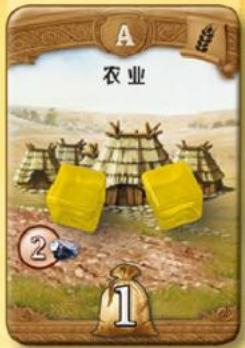
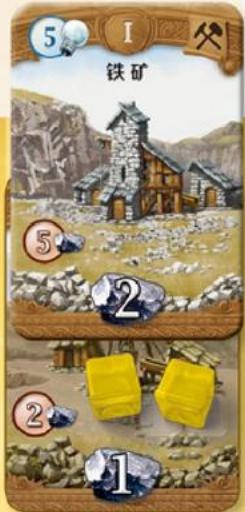
刚才打出的科技牌并不代表你的一个农场或矿山父,它只是表示你掌握了更高级的知识和科技。直到你将自己的工人放到该牌上之前,它都不会为你生产任何的资源或食物。当你支付了相应的资源费用后,你可以在该牌上建造新的农场或矿山。当然,你仍然可以建造那些等级较低的农场和矿山。
也可以升级那业等级较低的农场和矿山,这点我们会
城市建筑科技牌(灰色)
当你打出一张城市建筑科技牌时,根据卡牌右上角的显示,检视它的建筑类型。如果你的游戏区域中已有该类型的城市建筑,将等级更高的卡牌叠放在等级较低的卡牌上。如果这是一张新类型的城市建筑牌,你需要将其放在你的其他城市建筑牌牌列的旁边,以组成新的牌列。
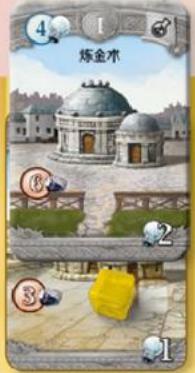
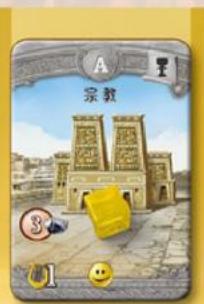

新的城市建筑科技牌在放置工人之前不会产生任何效果。你可以通过建造一个新的城市建筑,或升级一个已存在的城市建筑来放置自己的工人。这点我们会在后文
中进行介绍。
军事单位科技牌(红色)
当你打出一张新的军事单位科技牌时,你需要查看其卡牌类型。如果你的游戏区域中已有该类型的军事单位科技牌,将等级更高的卡牌叠放在等级较低的卡牌上。如果这是一张新类型的军事单位科技牌,你需要将其放在你的其他军事单位科技牌牌列的旁边,以组成新的牌列。
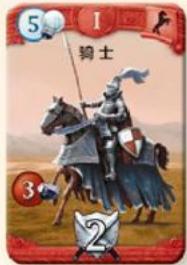

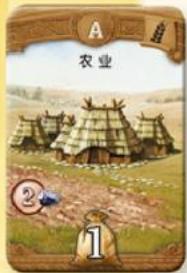
新的军事单位科技牌在放置工人之前不会产生任何效果。你可以通过建造或升级一个军事单位来放置自己的工人
注意:为提示你打出一张军事单位科技牌需要支付1点内政行动点,卡牌科学点数费用的背景色被设计成白色。为了提示你建造,升级或摧毁一个军事单位需要支付1点军事行动点,卡牌的资源费用的背景色被设计成红色。
特殊科技牌(蓝色)
特殊科技牌代表你的文明所拥有的特殊知识和科技。这些卡牌不需要你建造任何建筑就能为你提供各种效果。它们遵循以下规则:
·特殊科技牌的效果在其加入到你的游戏区域时立即生效。特殊科技牌不需要放置工人。
• 你的游戏区域中不能同时拥有2张相同类型的特殊科技牌。根据卡牌右上角的符号,当你打出一张已有的特殊科技牌时,等级较高的特殊科技牌会保留在你的游戏区域中,等级较低的特殊科技牌会从游戏中移除。
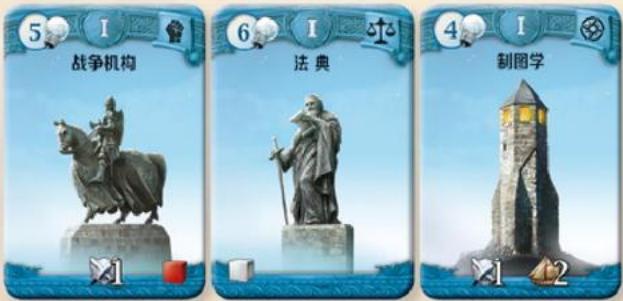
的文明增速/等级。
这些特殊科技牌的效果会增加你的军力等级或为你带来殖民奖励,也有一些特殊科技牌的效果会为你提供额外的内政和军事行动点,甚至蓝色标记。当你打出这些特殊科技牌时,你需要调整你的文明数值。(详见前一页调整你的文明数值部分)
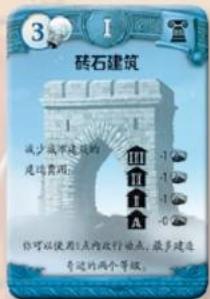
建筑类的特殊科技牌不会调整你的文明数值,但它们会让你在建造城市建筑时少支付一些费用。当你建造一个城市建筑时,你可以根据自己建筑类特殊科技牌上的效果,少支付相应的资源费用。(减少的具体费用会根据你建造的城市建筑科技牌所属的时代进行相应的调整)
如果你拥有足够的资源,建筑类的特殊科技牌也允许你花费1点内政行动点建造奇迹的多个等级。你需要一次性支付总的建筑费用,然后从你的蓝色供给区将相应数量的标记移动至奇迹牌上。
政府牌(橙色)
打出一张政府科技牌只有两种方式。我们将在下文中详细介绍它们。
改变政体
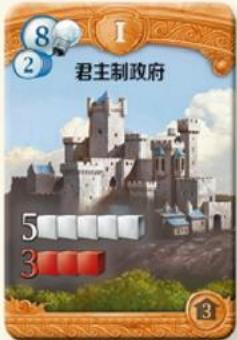
你的游戏区域中有且只能拥有1张政府牌,这通常是指那些橙色的科技牌。在游戏开始时,你的初始政府牌为专制政府,它绘在你的玩家版图上。在后续的游戏中,你可以使用更高级的政府牌来替换它。高级的政府牌会为你带来更多的内政和/或军事行动点,同时会提高你城市建筑的数量上限。一些政府牌也会影响你
游戏中总共有两种方式来改变你当前的政府体制:和平演变和革命。这两种方式都视作“发展一项科技”,并且都需要支付相应的科学点数费用。但是,这两种方式所支付的科学点数费用是不同的,这也是政府牌左上角绘有两个不同数值的科学点数费用的原因。
和平演变
你可以通过和平演变来更换你当前的政府体制。随着社会的发展,人们的思想会变得越来越开明。所以,政府体制的改变在一定程度上体现了一种新的社会意识形态。和平演变会消耗你更多的科学点数费用,但是你的人民会更乐意接受这种改变。政府体制的和平演变与打出其他科技牌的方式一样。
当你的政府体制进行和平演变时:
• 支付1点内政行动点。
• 支付政府牌左上角较高数值的科学点数费用。
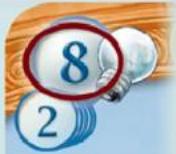
• 将新的政府牌加入到你的游戏区域中,并替换之前的政府牌。
• 调整你的文明数值(尤其是总内政和军事行动点)。用新的政府牌替换了之前的政府牌后,旧的政府牌会从游戏中移除(除你的初始政府牌专制政府外,因为它是绘在玩家版图上的)。任何放在旧政府牌上未被使用的行动点都会被移动到新的政府牌上。
如果你的新政府牌为你提供了更多的内政或军事行动点,你需要根据玩家手册第11页方框中调整你的文明数值部分的描述,从盒中拿取相应数量的白色或红色标记放到你的政府牌上,以表示你的行动点。这些新获得的行动点可以在本回合中立即使用。
举例:当你打出神权政府牌时,你需要支付1点内政行动点和6点科学点数。然后,用神权政府牌覆盖你的专制政府牌,并将所有未被使用的行动点移动到新的政府牌上。你不会获得额外的白色标记。(因为神权政府牌提供的总内政行动点与专制政府牌一样)但是,你可以获得1个新的红

色标记,并将其放到你的神权政府牌上。你可以在本回合使用这个新的军事行动点。与此同时,你的文化增速加1,军力等级加1,并获得1个笑脸。
第二个-游戏轮
宣告革命
通过革命来改变你的政府体制会支付相对较少的科学点数,但也会让你的文明在本回合陷入瘫痪,几乎无所事事。你需要支付所有的内政行动点来宣告革命。
当你宣告革命时:
·支付你所有的内政行动点。如果你已经使用了部分内政行动点,那么你不能宣告革命。

支付政府牌上数值核小的科学点
·将新的政府牌加入到你的游戏区域中,替换你之前的政府牌。
· 调整你的文明数值。(尤其是内政行动点和军事行
花费掉它们。
你必须在自己的回合一次性支付所有的内政行动点来宣告革命。在革命前,你不能使用任何的内政行动点(除非你为一个行动支付行动点后,你又得到了一个行动点—例如,替换领袖)。这意味着你不能从卡牌列上拿取一张政府牌,并在当回合宣告革命
一些中间的步骤与和平演变是相同的,但宣告革命最大的区别在于你将支付所有的内政行动点,包括那些因为革命而获得的内政行动点。
你的军事行动点不会受到影响。你可以在宣告革命前或之后随意使用它们。你通过新政府牌获得的军事行动点也可以被使用。
举例:当你宣告革命并打出君主制政府牌时,你需要支付所有的(目前是4点)内政行动点(因此这可能是你本回合唯一的内政行动)和2点科学点数费用。然后,你拿取1个新的白色标记和红色标记。该红色标记与革命前你未使用的所有军事行动点都会被放到君主制政府牌上,而新的白色
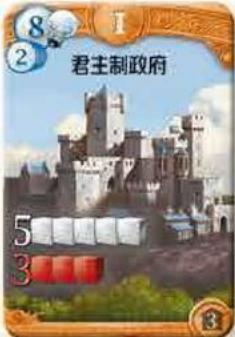
标记会被放在政府牌旁边,它也被视作革命花费中的
总结——科技牌
科技即是指科技牌。其中6张初始科技牌被绘在你的玩家版图上,其他的科技牌需要玩家打出。
当你从卡牌列上拿取一张科技牌并加入到自己手中时,它不会产生任何效果。
你的不区书成手牌中已有一张同名的科技牌
你可以通过“发展一项科技”这个行动打出一张科技牌,但这需要你支付1点内政行动点和一定数量的科学点数。
·大部分的科技牌只有当牌上放有工人时才会产生效果。(见第14页的总结工人)你可以同时拥有类型相同但等级不同的科技牌。
特殊科技牌(蓝色)上不能放置工人。它们在加入你的游戏区域时就会立即生效。
每张特殊科技牌的右上角都绘有一个符号。你不能同时拥有两张相同符号的特殊科技牌。等级较低的那一张特殊科技牌将自动从游戏中移除。
新的政府牌在打出后将替换旧的政府牌,忽略它们
升级一座农场或矿山
在你的第二回合中,你很难升级自己的农场或矿山,但是理论上你在第一回合过后就可以执行该行动了。正如前文所说,如果你有一张等级更高的农场或矿山科技牌你可以直接建造一座农场或矿山,或者升级一座你已有的农场或矿山。
当升级一座你已有的农场或矿山时:
· 支付1点内政行动点。
· 选择你的一座农场或矿山,以及一张相同类型但等级更高的农场或矿山科技牌。
·根据两张卡牌显示资源费用,支付其差值。
例如:

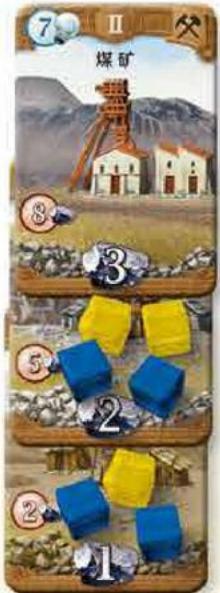
在后续的游戏中,你可以打出以上的科技牌。支付1点内政行动点,你可以:
·花费4资源将时代A的农场升级成时代Ⅱ的农场。
·花费3资源将时代A的矿山升级成时代I的矿山。
·花费3资源将时代I的矿山升级成时代Ⅱ的矿山。
·花费6资源将时代A的矿山升级成时代Ⅱ的矿山。
根据上面的插图,如果你拥有一个未使用的工人,你也可以建造一座新的任意等级的农场或矿山。(当然,除了时代Ⅱ的矿山外因为很显然你无力支付建造所需的8资源费用)
等级更高的农场和矿山
时代A的农场和矿山所遵循的规则依然适用于等级更高的农场和矿山科技牌。不同之处在于等级更高的科技牌上的1个蓝色标记代表了更多的资源。
在生产阶段,相应卡牌上的每个工人都会生产1个蓝色标记,卡牌底部的数字代表每个标记所表示的资源数量。例如,煤矿牌上的1个蓝色标记等价于3资源。
根据上面的插图,你目前拥有6资源。在生产阶段,你会生产出5资源——时代Ⅰ的卡牌上将有2个蓝色标记,时代A的卡牌上将有1个蓝色标记。
支付食物和资源
当你支付食物或资源时,每从卡牌上移动1个蓝色标记到你的蓝色供给区,就意味着你支付了与该牌底部数字等量的食物或资源。
例如:在之前的例子中,如果你需要支付2,你可以从时代Ⅰ的卡牌上移动1个蓝色标记放回到蓝色供给区,或者从时代A的卡牌上移动2个蓝色标记放回。
在支付费用时,你可以(有时候必须)将1个更高价值的蓝色标记转换成总价值相等或更低的1个或多个蓝色标
例如:
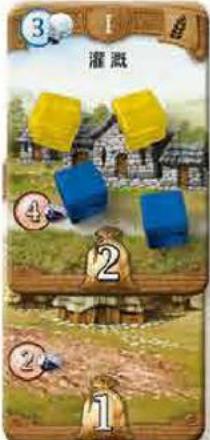
你需要支付1食物,但是你没有价值1的,而只有价值2的。你将其中一个价值2的放回到蓝色供给区,然后从蓝色供给区移动2个蓝色标记放到时代A的卡牌上,这样你就可以正常支付1食物了。
当然,你也可以不必这样来回的移动蓝色标记。你直接将灌溉科技牌上的1个蓝色标记移动到时代A的相应卡牌上,这样你的文明所储存的食物从4降到了3,等同于你支付了1
注意:即使一张农场或矿山科技牌上没有工人,它也可 以用于存放蓝色标记。
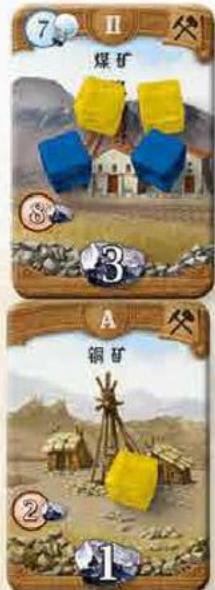
现在,假设你需要支付1资源。你可以将煤矿牌上的1个蓝色标放回到蓝色供给区,并从蓝色供给区移动3个标记放到铜矿牌上,然后再正常支付1个蓝色标记。事实上,你还可以将煤矿牌上的1个蓝色标记移动到铜矿牌上(等同于支付2资源),然后再从蓝色供给区移动1个标记并放到铜矿牌上(等同于获得1资源)。这样,煤矿牌上的1个蓝色标记转变成了铜矿牌上的2个蓝色标记,等同于支付1
为支付4资源,你可以先支付3个价值1资源的蓝色标记,然后通过上述方法来支付最后的1资源。或者你可以从煤矿牌上移动2个蓝色标记并放到铜矿牌上,以此来支付4资源。这样也能达到目的:煤矿牌上没有蓝色标记,铜矿牌上有2个蓝色标记,代表总共支付了4。
以上转换只能沿着单一方向进行——将高价值的标记转换成低价值的标记。
任何时候,你都不能将低价值的标记转换成高价值的标记。
例如:你不能将农业科技牌上的2个蓝色标记放回蓝色供给区,用来转换成灌溉科技牌上的1个蓝色标记。
升级一个城市建筑
如果你有两张相同类型的城市建筑科技牌(通过卡牌右上角的符号加以确认),你可以只支付这两张卡牌上显示的差值费用,将一个等级较低的城市建筑升级为等级较高的城市建筑:
当你升级一个城市建筑时:
• 支付1点内政行动点。
• 选择一个城市建筑,以及一张相同类型但等级更高的城市建筑科技牌。
• 根据两张卡牌显示的资源费用,支付其差值。
• 将等级较低的科技牌上的1个工人移动到等级更高的卡牌上。
调整你的文明数值。
例如:
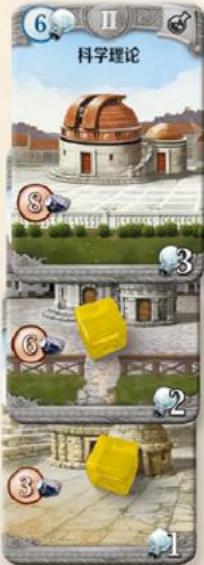
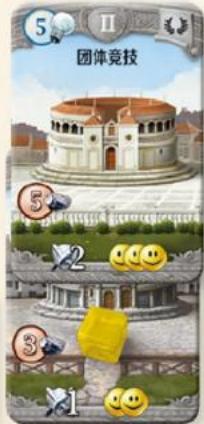

支付1点内政行动点,你可以:
• 花费3资源将一个时代A的实验室升级成时代I的实验室,并提升1点科学增速。
·花费5资源将一个时代A的实验室升级成时代Ⅱ的实验室,并提升2点科学增速。
·花费2资源将一个时代Ⅰ的实验室升级成时代Ⅱ的实验室,并提升1点科学增速。
·花费2资源将一个时代Ⅰ的竞技场升级成时代∏的竞技场,并提升1点军力等级和1点幸福等级。
根据上面的插图,如果你有一个未使用的工人和足够的资源,你可以建造一个新的任意等级神庙或竞技场。但是,不要忘记如果你仍然使用专制政府作为你的政体,那么你相同类型的城市建筑数量上限为2。在达到上限的情况下,你可以升级实验室,但不能建造新的实验室。
建筑科技和升级城市建筑
绘有这个符号的特殊科技牌,在你建造或升级城市建筑时会修正你所要支付的费用。有时候它会减少升级建筑的费用,但并非总是有效。当计算建筑费用的变动时,你需要附加这些卡牌产生的修正效果。
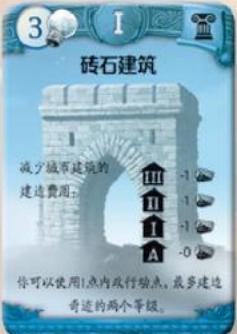
例如:你如果拥有砖石建筑这张特殊科技牌,在建造一个时代I和时代Ⅱ的建筑时,你可以少支付1资源。这样,你建造一个时代I的实验室只需要支付5资源,但建造一个时代A的实验室仍需要3资源,所以你可以支付2资源将时代A的实验室升级成时代I的。在这种情况下,上述卡牌的效果减少了
升级费用。但是,你如果将一个时代I的建筑升级成时代Ⅱ的建筑,由于卡牌描述中这两个时代费用的减少值相等,所以实际支付的差值费用和没有砖石建筑这张牌时
第二个-游戏轮
升级一个军事单位
该行动与升级一个城市建筑类似,但你需要支付1点军事行动点,而不是1点内政行动点。
当你升级一个军事单位时:
• 支付1点军事行动点。
选择一个军事单位,以及一张相同类型但等级更高的军事单位科技牌。
• 根据两张卡牌显示的资源费用,支付其差值。
• 将等级较低的科技牌上的1个工人移动到等级更高的卡牌上。
• 调整你的军力等级。
注意:与农场、矿山和城市建筑一样,军事单位科技牌右上角的符号是非常重要的。你可以将战士升级成等级更高的步兵单位,但是不能升级成骑兵或炮兵单位。
摧毁一个农场、矿山或城市建筑
一般而言,这并不是一个好主意。但是在某些情况下,这可能是你唯一能得到一个未使用工人的方法。
当摧毁一个农场、矿山或城市建筑时:
· 支付1点内政行动点。
· 从选择的棕色或灰色科技牌上移动一个工人放回到你的工人区中。
但是这样操作后,你不会获得任何的资源补偿。
解散一个军事单位
与摧毁一个农场、矿山或城市建筑类似,但你需要支付1点军事行动点,而不是1点内政行动点。
当你解散一个军事单位时:
· 支付1点军事行动点。
·从相应的军事单位科技牌上将一个工人移动至你的工人区中。
总结——工人
· 一个工人是指位于你的游戏区域并不是黄色人口区的1个黄色标记。
· 一个未使用的工人是指一个未被放在卡牌上的工
• 一个位于科技牌上的工人代表一个农场,矿山,城市建筑或军事单位,其等级和类型与卡牌所对应。
• 你可以执行一个建造行动将一个未使用的工人移动到相应的卡牌上,而你需要为此支付一定的资源费用。
• 你可以执行一个升级行动将一个工人从等级较低的卡牌移动到等级较高的卡牌上,而你需要为此支付二者之间的差值费用。
你可以执行一个摧毁或解散行动将一个工人从相应的卡牌上移回工人区,该工人将成为一个未使用的工人。
·农场,矿山和城市建筑的建造,升级或摧毁都需要支付1点内政行动点,军事单位的这些行动则需要支付1点军事行动点。
·相同类型的城市建筑的数量上限由你的政府牌决定。农场,矿山和军事单位则没有数量上限。
打出一张行动牌
与前面提到的其他卡牌不同,行动牌并不会加入到你的游戏区域中。当你打出它们后,它们只会产生一次性的效果
一张行动牌不能在你拿取它的当回合内打出。
在游戏中,行动牌代表你文明为未来苦难的来袭所做的准备。对游戏进程而言,你在拿取一张行动牌和打出它之间将有一定的时间延迟,这会让你更容易计划下一个回合的行动。当其他玩家进行他(她)的回合时,你已经知道自己文明食物和资源的收支情况,同时你也知晓哪些行动牌你可以使用。这样,在你的下一个回合,你不会被卡牌列上那些尚不知道能否获得的行动牌所影响。
当你打出一张行动牌时:
• 支付1点内政行动点。
· 按照卡牌上的描述执行相应效果。如果该效果提到你可以执行一个行动,那么你可以执行它,并且不需要额外支付相应的内政行动点。
· 然后将其弃置。该行动牌不会再加入游戏中。
让我们来看看行动牌上可能有哪些效果。
对科学和(或)文化点数计分
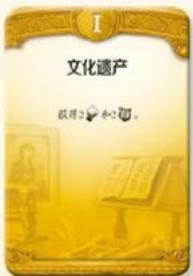
将你的科学或文化点数标记沿着版图前进相应的格数。(你将直接获得科学或文化点数,但不会影响你的增速标记。)
获得食物和(或)资源
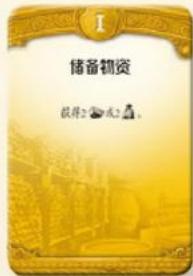
当你获得食物时,从蓝色供给区拿取相应数量的标记,并移动到你的农场科技牌上,以代表你获得了该数量的食物。例如,移动1个蓝色标记到灌溉科技牌上,或者移动2个蓝色标记到农业科技牌上,以表示你获得了2食物。你也可以将蓝色标记移动到没有工人的卡牌上。
获得资源与获得食物类似。
当你获得食物或资源时,你不允许将卡牌上的蓝色标记向等级更高的卡牌转移。例如,如果你拥有铜矿牌(每个蓝色标记价值1资源)和煤矿牌(每个蓝色标记价值3资源),你可以移动2个蓝色标记到铜矿牌上,这样你获得了2资源。但是,你不能从铜矿牌上移动1个蓝色标记到煤矿牌上。你也不能将1个新的蓝色标记放到煤矿牌上,然后将铜矿牌上的2个蓝色标记放回到你的蓝色供给区。
执行一个费用修正的行动
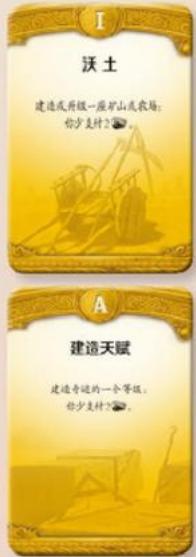
如果卡牌的描述允许你执行一个行动阶段能够执行的行动,你可以按照基础规则执行它,但不需要支付相应的内政行动点。因为在你打出行动牌时就已经为其支付了行动点。
你仍然需要支付资源费用,但这些卡牌会帮你减少一些,它们和其他卡牌的减费效果是叠加的。如果你需要支付的费用被减到0以下,那么你的资源费用为0.
注意:只允许你建造奇迹的一个等级,即使你拥有一张能让你一次性建造奇迹多个等级的科技牌。
无论何种原因,如果你不能执行卡牌
上描述的行动,你就不能打出该行动牌。
第二个-游戏轮
执行一个行动,然后获得奖励
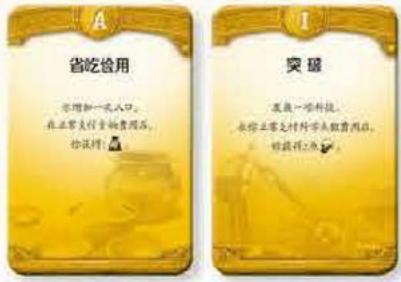
这些卡牌的描述也允许你执行一个能够执行的行动。同样地,你可以按照基础规则执行它,但不需要支付相应的内政行动点。由于这些卡牌没有提供减费效果,所以你必须全额支付食物或科学点数费用。当你执行完相应的行动后,才能获得卡牌上的奖励。
如果你不能执行相应的行动,你就不能打出该牌。
例外:突破也可以用于宣告革命。在这种情况下,你会为革命支付所有的内政行动点,而不是打出突破时支付的1点内政行动点。当然,你只能在所有内政行动点都未被使用时这样做。

获得与军事单位相关的资源和一个军事行动点。
这张卡牌的效果将持续到你的回合结束。实际上,你并不会真正拿到相应的资源,只需要记住你拥有多少。当你建造或升级一个军事单位时,优先使用这些临时资源。当你获得的资源超过需要支付的资源时,你可以使用剩余的资源来建造或升级其他的军事单位。回合结束时,你所有未使用的临时资源都会被弃置。
类似地,你临时获得的军事行动点并不会让你拿到1个新的红色标记,你只需要记住你拥有它。当你支付军事行动点时,优先使用它。在你的行动阶段,如果你没有使用临时的军事行动点,你可以在抓
取军事牌时再使用它,但是它不会被保留至你的后续回合。
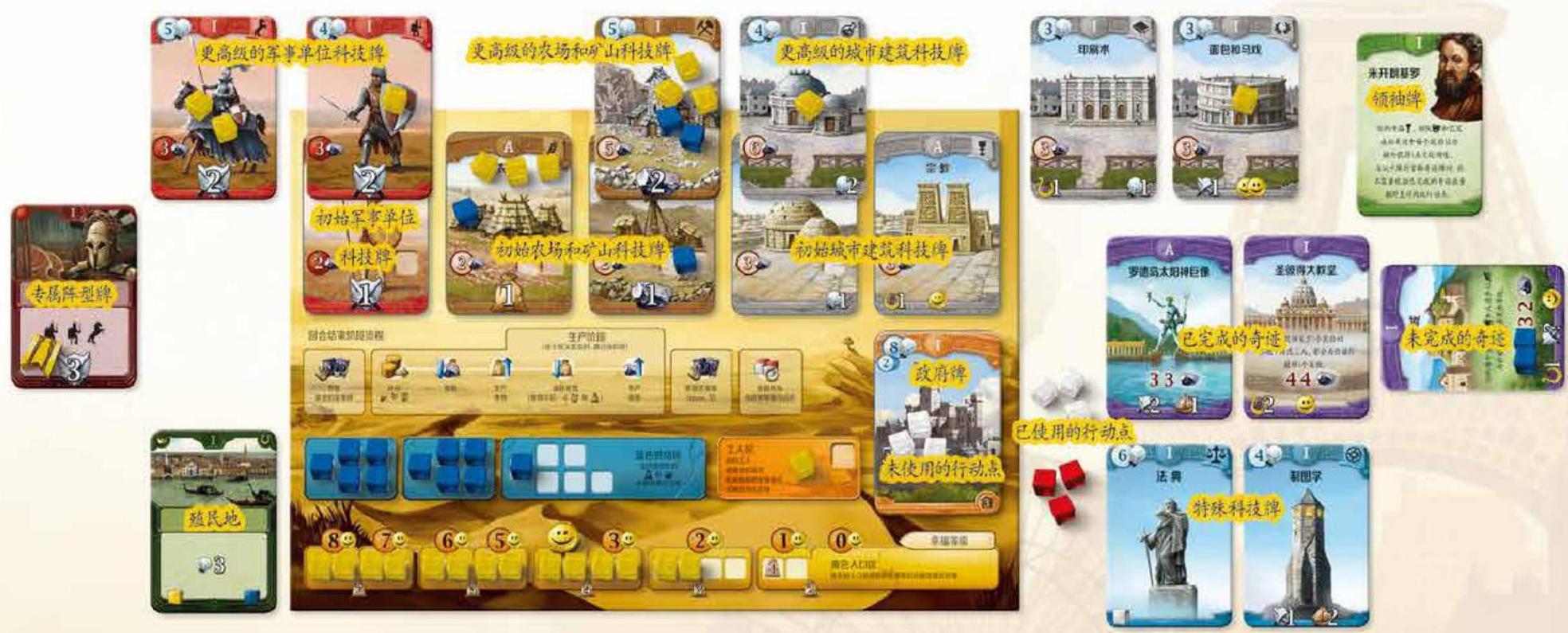
推荐的玩家区域展示图
撤销行动
历史巨轮是一款复杂的游戏。在头脑中完美地规划你的行动并不容易,你可能需要做出一些尝试,以便让行动阶段圆满结束。如果你的行动阶段进行的非常糟糕,你可以拿回你的行动点,然后去尝试执行其他行动。但是有时候,你自身也不太愿意这样做,因为过多地撤销行动将拖慢整局游戏的节奏,同时移动大量的标记会导致复盘工作难以进行。
记录行动
你可以将行动点标记放在你执行行动的地方,而不总是要放在你的政府牌旁边。如果你增加人口,你可以将1个白色标记放在工人区,以表示你执行了该行动。如果你执行建造或升级行动,你可以将白色标记放在你刚刚移动过的工人旁边,这样你就能记住具体是哪个工人。当你从卡牌列拿取一张卡牌时,你也可以将白色标记放在该牌上。当你打出一张科技牌时,你也可以将1个白色标记放在相应的卡牌上………当然,如果是政府牌最好别这样做。
通过这种方法,你很容易查看自己当回合做了哪些行动,也利于你撤销一些行动。
当你的回合结束时,恢复所有内政和军事行动点,将你的白色和红色标记放回到你的政府牌上。
回合结束阶段流程
你的第二回合,回合结束阶段流程和第一回合是类似的,只不过你现在可以抓取军事牌了。在回合结束后,你需要按照玩家版图上绘制的流程进行结算。
你不用弃置多余的军事牌,不会面临工人的起义,腐败和消耗问题也不太可能,这些我们都会在后文中详细介绍。
还拥有一个神庙,你也会获得1点文化点数。
在生学件产作全生会物营源。在后续的游成中,如果体建造了新的农场成矿山
抓取军事牌
在生产阶段过后,你的每个未使用的军事行动点都会让你从当前军事牌堆抓取1张军事牌。
如果你拥有2点军事行动点,行动阶段也没有支付任何行动点来建造或升级军事单位,那么你将从时代Ⅰ的军事牌堆抓取2张军事牌。你可以将它们留在手中,不需要展示给其他玩家看。军事牌是不公开的。
后续的回合
在第二回合开始时,你尚未拥有任何军事牌。但是在你的回合结束后,你可能会抓取一些。现在让我们来看看它们有哪些效果。
军事牌
在你的第一次游戏中,军事牌只会有三种类型。
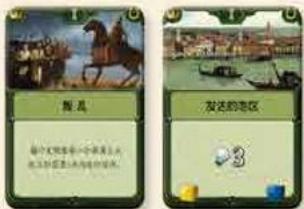
左上角绘有的卡牌可以作为一个政治行动打出,它允许你筹划一个影响全球的事件。在你的第一次游戏中,只会出现事件牌和地区牌。而在完整模式的游戏
牌
你的政治阶段介于补充卡牌列和行动阶段之间,你可以不执行政治行动。
在政治阶段,你最多执行一个政治行动。
政治行动包括打出侵略牌、战争牌和条约牌,但这些卡牌在你的第一次游戏中都不会出现。你唯一可能的政治行动就是筹划事件。当然,只有当你拥有一张事件牌或地区牌时才可以执行该政治行动。
筹划事件
事件牌和地区牌从玩家手中打出时是无法区分的。它们将面朝下放入未来事件牌堆中,因此只有打出该牌的玩家才知道具体是什么。
随着游戏进行,未来事件牌堆将变成当前事件牌堆。当一张当前事件牌被展示时,该事件牌的效果会被结算。
当你筹划一个事件时:
·从手中选择一张右上角绘有的绿色军事牌。
·将该牌面朝下放入未来事件牌堆中。
你可以获得与该牌等级相同的文化点数。
·展示当前事件牌堆顶部的一张事件牌,并结算其效
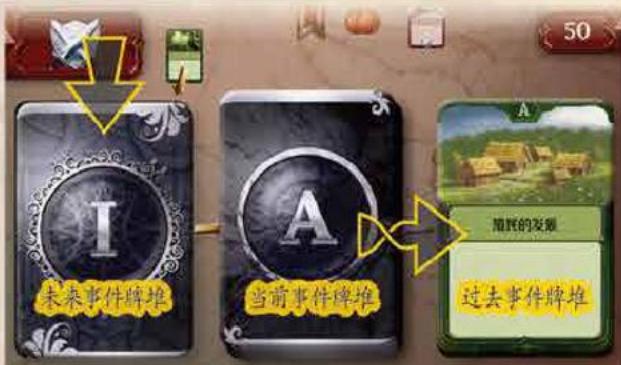
第一位筹划事件的玩家会将卡牌放在空置的未来事件牌堆区,以组成相应的未来事件牌堆。同时,该玩家会获得1点文化点数(假设该牌是一张时代1的事件牌)。然后,他(她)将展示当前事件牌堆顶部的一张牌,显然这是一张游戏开始时就设置好的时代A的事件牌。
第二位筹划事件的玩家会将卡牌放在未来事件牌堆的顶部。同样地,获得相应的文化点数,并展示下一张当前
如果当前事件牌堆的最后一张牌被展示并结算了,那么你需要切洗未来事件牌堆,并将其放在当前事件牌堆区,以组成新的当前事件牌堆。
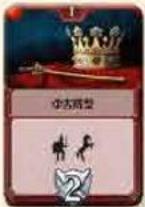
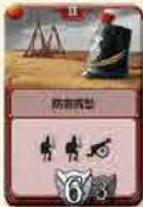
阵型牌是一种底部绘有军事单位图标的红色军事牌。你可以在行动阶段打出它
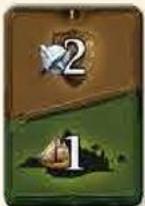
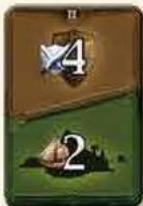
军事奖励牌将在你殖民一个新地区时为你提供相应的效果。在完整模式的游戏中,该牌的上半部分可以用于抵御侵略。
政治阶段
在此之后,下一位筹划事件的玩家需要将卡牌放到新的空置的未来事件牌堆区,并展示当前事件牌堆顶部的一张卡牌,而该牌就是之前回合玩家所筹划的某个事件。如果你筹划了一些事件,那么你可以根据这点提前规划自己的发展路线以获得一些优势,但是你并不知道那些事件出现的确切时间。
随着游戏进行,不同时代的事件牌可能会被放在同一个未来事件牌堆中。
当未来事件牌堆成为当前事件牌堆时,你需要根据事件牌的时代进行整理(面朝下根据卡牌的背面加以区分),将时代较早的事件牌放在时代较晚的事件牌上方,以保证时代较早的事件牌会被先展示并结算。
展示当前事件牌
当有玩家通过政治行动来筹划事件时,一张当前事件牌堆的卡牌会被展示,并立即结算其效果。然后,当前玩家继续他(她)的回合。
卡牌名称中写有“地区”字样的事件牌属于可殖民的地区牌,我们将在后文中详细介绍。如果被展示的卡牌并非一张地区牌,请按照以下步骤进行。
当结算一张非地区事件牌时:
·执行卡牌上的效果。
·然后将其面朝上放入过去事件牌堆中。
过去事件牌堆中的卡牌将不会再加入游戏中。
时代A的事件牌

最开始的那些事件牌是在初始设置时就准备好的。它们都是正面效果,所有玩家都会从中受益。如果一张事件牌的描述让玩家做出决定,那么所有玩家将按照顺时针顺序依次决定,从当前玩家开始。
如果一张事件牌的描述让你执行一个在行动阶段能够执行的行
动,那么你可以按照基础规则执行它,但不需要额外支付相应的内政行动点。如果一张事件牌的描述允许你免费执行建造行动,那么你不需要支付任何的资源费用。
注意:一些事件牌的效果只有当你拥有未使用的工人时才会生效,所以在回合开始时拥有一个未使用的工人是
如果一张事件牌的描述让你增加人口,那么你必须按照基础规则支付相应的食物。如果一张事件牌的效果让你获得1人口,那么你可以免费从黄色人口区移动1个黄色标记到你的工人区中。
你的完整回合
你的一个完整回合将按照以下流程进行:
·补充卡牌列。
·公开你的专属阵型,如有需要。
·政治阶段:最多执行一个政治行动。
·行动阶段:通过你的行动点执行内政或军事行动。
括生产阶段。
时代I和Ⅱ的事件牌
当时代A的事件牌都被展示并结算后,由玩家筹划的事件牌将开始出现。它们的效果可能是正面,负面或二者都有。其中,一些事件牌的效果还可能只影响一位特定的玩家。
军力等级的比较
如果一张事件牌的描述中提到最强的一个文明,最强的两个文明,最弱的一个文明或最弱的两个文明等,那么你需要比较玩家的军力等级。
相家,作优者找顺时针顺序最接近
为了帮助你记忆平局的判定规则,你可以这样理解:当前玩家能够优先提升他的军力等级,所以他在结算最强的文明时占据优势。上一回合的玩家可以预先提升他的军力等级,但他没有这么做,所以他成为最弱的文明。
注意:很多的事件牌会助推最强的文明,打压最弱的文明或者二者兼有,所以在回合结束时,让你的军力等级超过其他玩家肯定不是一个坏主意。这会在没有直接战争冲突的游戏中同样引发军备竞赛。
以上规则也适用于文化点数最多的文明的平局判定。但是,有时候获得最多的文化点数会是一个劣势。
同样地,以下是2人游戏的特殊规则:
如果一张卡牌的描述中提到最强的两个文明或最弱的两个文明,这在2人游戏中应该理解为最强的一个文明或最弱的一个文明。
在一些情况下,并不是所有的比较都会触发平局判定:
如果一张事件牌的效果是针对“所有………最多”的文明,那么所有并列最多的文明都将受到影响,这时候就不需要平局判定。
其他情况
于,时非的生你在结耳其效果时不需要支付行
一些卡牌的效果在你的玩家提示卡上有所解释,一些特定的卡牌也会在规则书的附录部分进行细节补充。
后续的回合
殖民
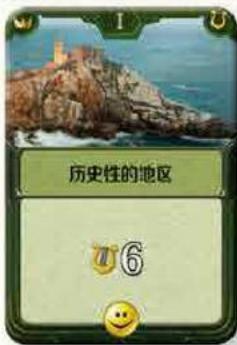
当被展示的当前事件牌是一张地区牌时,所有玩家都可以通过竞拍方式来殖民它,意愿给出最大殖民军力的玩家将赢得竞拍,并通过兑现该军力承诺来获得殖民地。
竞拍
从当前玩家开始,所有玩家按照顺时针顺序依次做出决定。轮到你时,你可以选择参与竞拍或退出。
如果你参与竞拍,你需要给出一个大于0且高于上一位竞拍玩家出价的数字。该数字代表你意愿给出的最大殖民军力,但它不能超过你可以实际给出的最大殖民军力。
如果你不参与竞拍,你必须选择跳过并退出该地区牌的竞拍。
竞拍的结果可能是:
·如果没有玩家参与竞拍,你需要将该地区牌加入过去事件牌堆中,并完成当前事件牌的结算。
·否则,竞拍将持续若干轮,直到仅剩下一位玩家未退出。该玩家赢得竞拍,并且必须给出等于或超过他(她)竞拍中承诺的殖民军力。
给出殖民军力
如果你赢得竞拍,你必须殖民该地区,并且不能改变你竞拍的出价。
在殖民一个地区时,你必须挑出1个或多个军事单位。
这些军事单位的军力等级将作为你的基础殖民军力。同时,你也可以打出一些绘有的卡牌,这些卡牌拥有殖民修正效果。你打出的军事奖励牌也可以用于增加你的殖民军力,这些卡牌下半部分的殖民数值将被加总到你的殖民军力中。

当你计算殖民军力时:
·加总你挑出的所有军事单位的军力等级。
的业年,(我们以义中个知这些军队提
结算你游戏区域中有殖民修正效果的卡牌。
你可以打出任意数量的军事奖励牌,并将卡牌下半部分的殖民数值加总到殖民军力中。
获得和损失黄色和蓝色标记
在游戏开始时,你拥有25个黄色标记和16个蓝色标记。当你将绘有或的卡牌加入到游戏区域时,你会获得相应数量的黄色或蓝色标记。你需要从盒中拿取它们,并放在玩家版图上相应的区域。如果这些卡牌从游戏中移除,那么你需要将相应的标记放回到盒中。
这个符号会产生负面效果你需要从你的蓝色供给区将1个蓝色标记放回到盒中。但是,如果这张卡牌从游戏中移除了,你会从盒中拿回1个蓝色标记。
在游戏中,一些卡牌的效果和基础规则会要求你获得或损失一些黄色或蓝色标记。与白色和红色标记不同,你的黄色和蓝色标记的数量并不能直观地从你游戏区域中的卡牌上反应出来。
能够修正你军力等级的效果不会作用于你的殖民军力例如,亚历山大大帝,长域和战争机构对你的殖民没有任何效果。
你必须至少挑出1个军事单位,即使殖民修正和军事奖励牌的效果足以给出你竞拍中承诺的殖民军力。
注意:竞技场是城市建筑,而不是军事单位。即使卡牌上的工人对你的军力等级有所加成,但是它们不能被用于增加你的殖民军力。
在殖民时,你挑出的所有军事单位都会牺牲。
一 即是说,相应卡牌上的黄色标记会被放回到你的黄色人口区。
你打出的所有军事奖励牌都会被弃置。
举例:
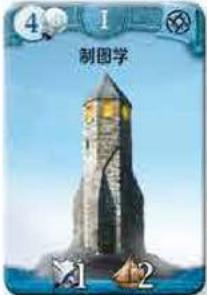


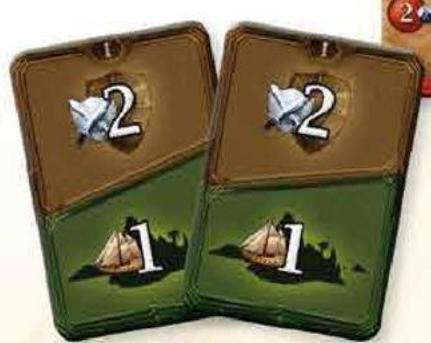
你以4点的出价赢得了竞拍,现在你必须给出等于或大于4点的殖民军力。卡牌制图学为你提供了2殖民数值,所以你只需要再给出至少2点殖民军力,两张军事奖励牌又为你提供了2殖民数值,但是你必须至少挑出1个军事单
你可以保留两张军事奖励牌,通过挑出2个战士或1个骑士来给出4点殖民军力,但是军事单位通常来说非常宝
因此,你认为最好的方式是挑出1个战士,然后打出一张提供1殖民数值的军事奖励牌,再加上制图学提供的2殖民数值,这样你就满足了所有的要求。你将践士牌上的1个黄色标记移回到你的黄色人口区,并打出然后弃置一张军事奖励牌。最后,该地区成为你的一个殖民地。
当作个我园成色标记,你常要从金中取
·当你损失黄色标记时,你需要从黄色人口区中将相应数量的标记放回到盒中。如果你没有足够的标记放回,你只需要放回黄色人口区中已有的全部标记。
·当你损失蓝色标记时,你需要从蓝色供给区中将相应数量的标记放回到盒中。如果你没有足够的标记放回,你需要从科技牌上放回相应的标记以补齐差
获得殖民地
将相应的地区牌加入到你的的游戏区域中,现在它成为了你的一个殖民地,每个殖民地都会拥有两个效果。
卡牌底部绘有的符号是该殖民地的永久效果。正如第11页调整你的文明数值部分提到的,这些效果将会影响你的文明数值。如果卡牌底部绘有黄色或蓝色标记,请查看本页获得和损失黄色和蓝色标记部分的说明。
卡牌名称下的描述代表该殖民地首次被殖民时产生的即时性效果。当你获得殖民地时,先获得它的永久效果再享受它的即时性效果。即时性效果可能会让你获得食物,资源,科学点数,文化点数或军事牌等,甚至可能让你免费获得人口。
在为数不多的情况下,你可能会失去你的殖民地。如果出现这种情况,在你失去殖民地时,你也会失去它的永久效果,但你不需要归还它的即时性效果。即时性效果只有当相应的地区牌首次被殖民时才会触发。
例如:当你获得该地区牌时,你可以从盒中拿取3个黄色标记,并放到你的黄色人口区。然后,你立即从黄色人口区移动2个黄色标记放到你的工人区,这并不会花费你的食物或行动点
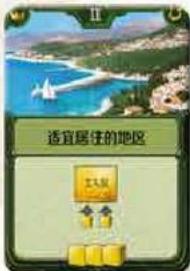
后续的游戏中,当一张事件牌的描述
中提到你的殖民地宣布独立你将失去它时,你需要将相应的卡牌从游戏中移除,并且从你的黄色人口区移动3个黄色标记放回到盒中,但你不会因此损失之前获得的人
后续的回合
阵型牌
你的军事单位可以通过阵型牌组建成军队,这会为你的文明提供额外的军力等级。
当前的阵型牌

每位玩家只会拥有一张当前的阵型牌。当你使用一张阵型牌时,将你的阵型标记放在该牌上。在游戏开始时,每位玩家的阵型标记都被放在军
事版图的公共阵型区,且所有玩家都未拥有激活的当前
在行动阶段,你可以通过打出一张阵型牌或复制一张阵型牌来激活阵型。每位玩家在行动阶段只能执行二者
当你选定好当前阵型牌后,在你选择另一张之前它的效果持续有效。
打出一张阵型牌
你可以在行动阶段从手中打出一张阵型牌
当你打出一张阵型牌时:
支付1点军事行动点。(卡牌的左上角绘有相应的符
·将该牌加入到你的游戏区域中。
将你的阵型标记放在该牌上,以表示它是你激活的
·调整你的军力等级。
如果你已经拥有一张当前阵型牌,那么它的效果不再生效。你的军队将根据新的阵型牌来组建。
公开专属阵型
当一张阵型牌位于你的游戏区域时,其他玩家不能使用它。但是每个文明都拥有精明的将领,过不了多久他们就会了解并掌握你的专属阵型。
在你补充卡牌列后,你的政治阶段尚未开始前,你必须将自己游戏区域中的阵型牌移动到军事版图的公共阵型
这意味着阵型牌对你而言只有一回合是独自拥有的。
你的阵型标记会一直放在该牌上,所以它仍然视作你的当前阵型牌,并为你提供相应的军力等级。唯一的区别在于现在其他玩家可以复制它了。
位于公共阵型区的阵型牌上面的阵型标记没有数量限制,你可以按照任何适合的方式放置它们
复制一张阵型牌

当一张阵型牌加入到公共阵型区后,在你的行动阶段你就可以复制
当你复制一张阵型牌时:
·选择公共阵型区的任何一张阵型牌。
·支付2点军事行动点。(军事版图上绘有相关图示)
你的作型你造择的型牌上,现在它成
·调整你的军力等级。
一张阵型牌通过何种方式成为你激活的当前阵型并不重要,复制一张阵型牌与你打出它具有同样的效果。
如果多位玩家激活了公共阵型区的同一张阵型牌,那么他们都可以享受该阵型牌的效果,而不会受到任何限
一在或,交于有任有玩家选择,它
在之:前打一件型冲将花费2点军事行动点,即使它是
当前的阵型牌的效果
军队
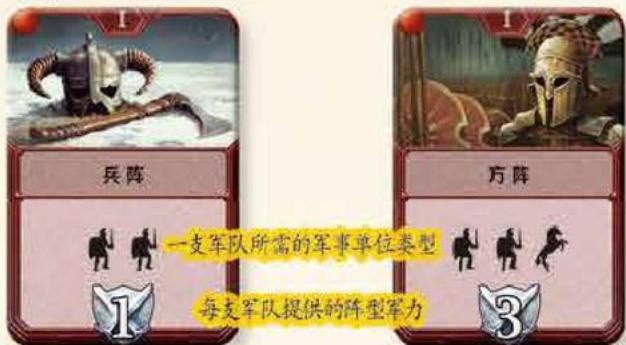
型牌的底部绘有一支军队所需的军事单位类型和数量。
一支军队的组建方式明确绘在相应的阵型牌上,一个军事单位只能隶属于一支军队。
个位身军力,这一加成并不
旧式军队

时代Ⅱ和Ⅲ的阵型牌底部绘有两种数值的阵型军力,数值较大的代表标准军队提供的阵型军力,数值较小的代表旧式部队提供的阵型军力。
如果一支军队中任意一个军事单位的等级比阵型牌低两级或更多,那么这支军队被视作旧式军队。
例如:如果你激活的是一张时代Ⅱ的阵型牌,那么任何一支拥有时代A的军事单位的军队都被视作旧式部队。
旧式军队的阵型军力将按照阵型牌上较小的数值计算。你所有符合阵型牌要求的军队(1日式军队除外)都将按照较大的数值计算阵型军力。
注意:当判定你的军队是否是旧式时,你只需要考虑军队中军事单位的时代和阵型牌的时代,而不用考虑当前处于哪个时代。
殖民中的军队
在殖民一个地区时,你挑出的军事单位也可以组建军队,它们所提供的阵型军力也会被加总到殖民军力中。
举例:

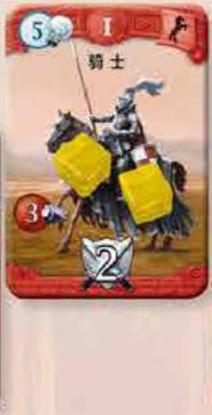
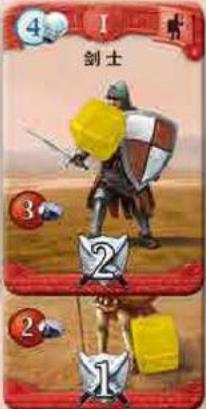
举例:这5个军事单位为你的文明提供6点军力等级。如果你没有激活的当前阵型,那么这将是你的文明全部的军事力量。如果
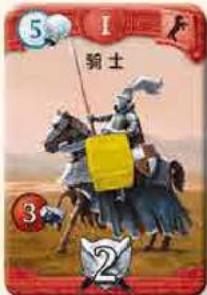
你激活的当前阵型是兵阵,你的4个战士将组建成两支相应的军队,但你的骑兵不会加入进来。这两支军
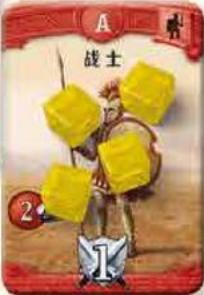
队各为你提供1点的阵型军力,这样你的军力等级就为8
如果你激活的当前阵型是方阵,那么你只能组建一支军队,但是你的阵型军力为3,这样你的军力等级就为9。
你不需要支付任何行动点或移动任何配件来表示你的军事单位组建成了军队,它们总是自发形成的,你只需要结算并调整你的军力等级。
举例:


如果你激活的当前阵型是防御阵型,那么你只能组建一支军队,其中
包括一个时代A的步兵单位。所以这支军队是旧式的,你的阵型军力为3。
如果你激活的当前阵型是机动阵型,那么你可以组建两支军队,时代Ⅰ的骑士在使用时代Ⅱ的阵型牌时不会被视作旧式,所以每支军队将按照卡牌上较大的数值计算阵型军力,这样总阵型军力为10。
如果你激活的当前阵型是拿破仑阵型,那么你也可以组建两支军队,其中一支包括一个时代A的步兵单位,所以这支军队是旧式的,但另外一支则是标准军队。旧式军队提供的阵型军力为3,标准军队提供的阵型军力为5.所以总阵型军力为8。
在任何情况下,军队所提供的阵型军力都是建立在这些军事单位自身18点军力等级上的。
你激活的当前阵型是拿破仑阵型,并且这些军事单位都可以被挑选去参与殖民。如果你挑出足够的军事单位,它们可以根据阵型牌组建军队,为你增加殖民军力。
如果你挑出2个骑士和1个剑士,那么它们的基础军力为6. 同时它们组建的军队还有有5点阵型军力。
如果你挑出2个骑士和1个战士,那么它们组建的是一支旧式军队,殖民军力总和会降至8:军事单位自身的军力等级为5,阵型军力为3。注意:上述方式会让战士自发地加入到殖民军队中。即使在计算你的军力等级时,战士并没有参与军队的组建。
挑出你所有的军事单位将为你提供总计12点的殖民军
后续的回合
幸福等级和不满工人
如果你希望工人开心的工作,那么你需要关注自己文明的幸福等级。
在游戏中,你有多种方式提升幸福等级。例如,建造特定的城市建筑或完成特定的奇迹。如果你这样做,你的幸福等级标记将沿着黄色人口区上方的幸福等级指示条前进、你的黄色人口区被划分成多个小区域,每个小区域上方的圆圈中都绘有相应的幸福等级。当一个小区域的工人被拿空时,为了让你的每个工人都保持开心,你需要达到相应的幸福等级(即笑脸数量)。
如果你没有足够的笑脸数量,你的文明将产生不满的工人。
你不满工人的数量由幸福等级标记左侧的黄色人口区中空置的小区域数量决定。
如果你不满工人的数量超过未使用的工人数量,那么你将面临非常麻烦的问题。除非你能很好地解决,否则你会面对工人的起义,你的生产阶段将直接被跳过
以下是我们给出的实例:
需要一个笑脸
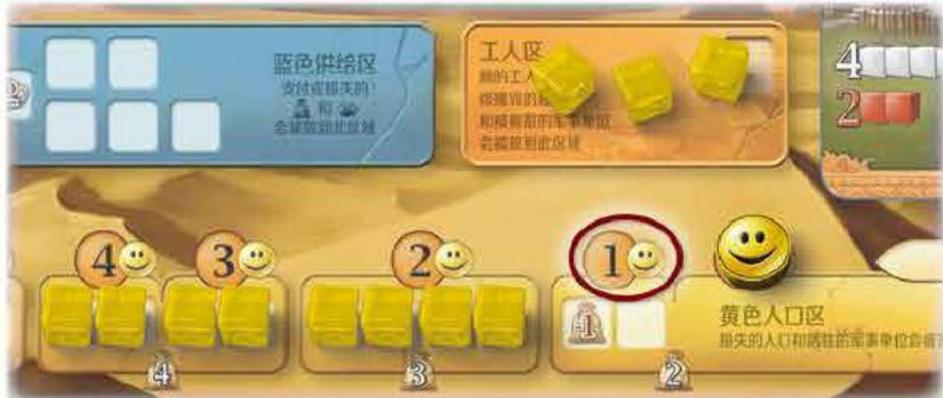
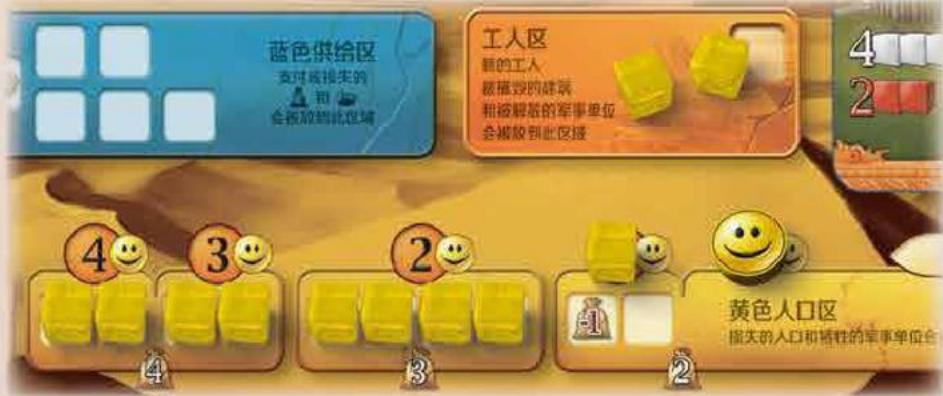
在你第二次增加人口后,黄色人口区的第一个小区域被拿空了,这时候你至少需要一个笑脸来使工人保持开心。
你可以提升你的幸福等级(一般通过建造建筑的方式),或者接受你将产生一个不满工人的现实。
足够的笑脸
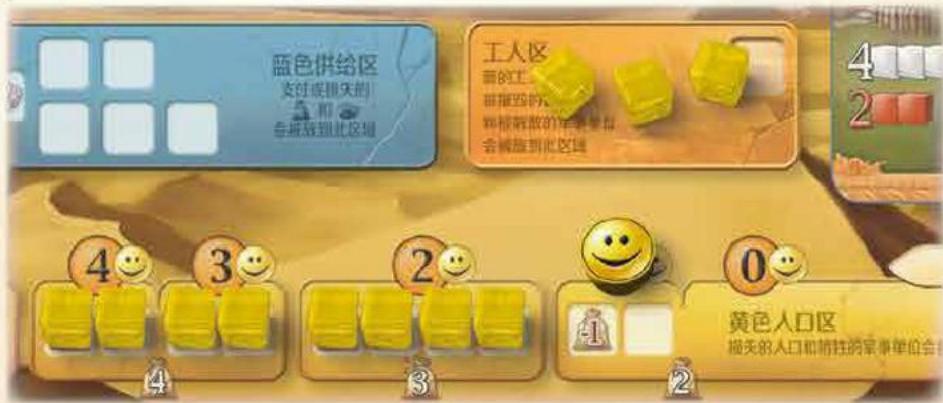
如果你成功提升幸福等级达到1级或更高,那么一切都将恢复正常。你的幸福等级标记刚好位于空置的小区域上方,所以你的每个工人都会保持开心。
一个不满工人
如果你没有为工人提供相应的笑脸,那么你将产生一个不满工人。你可以将一个未使用的工人移动到空置小区域上方的圆圈中以表示这种情况。
这个工人仍被视作未使用的工人,与工人区的其他工人一样可以被使用。但是,将它从工人区移走是有原因的——提醒你的文明产生了一个不满工人。如果你没有足够数量的未使用工人放到空置小区域的上方,那么你将在回合结束时面对工人的起义,你的文明不会生产任何东西
潜在的工人起义
在后续的游戏中,你可能会遇到以下情况:
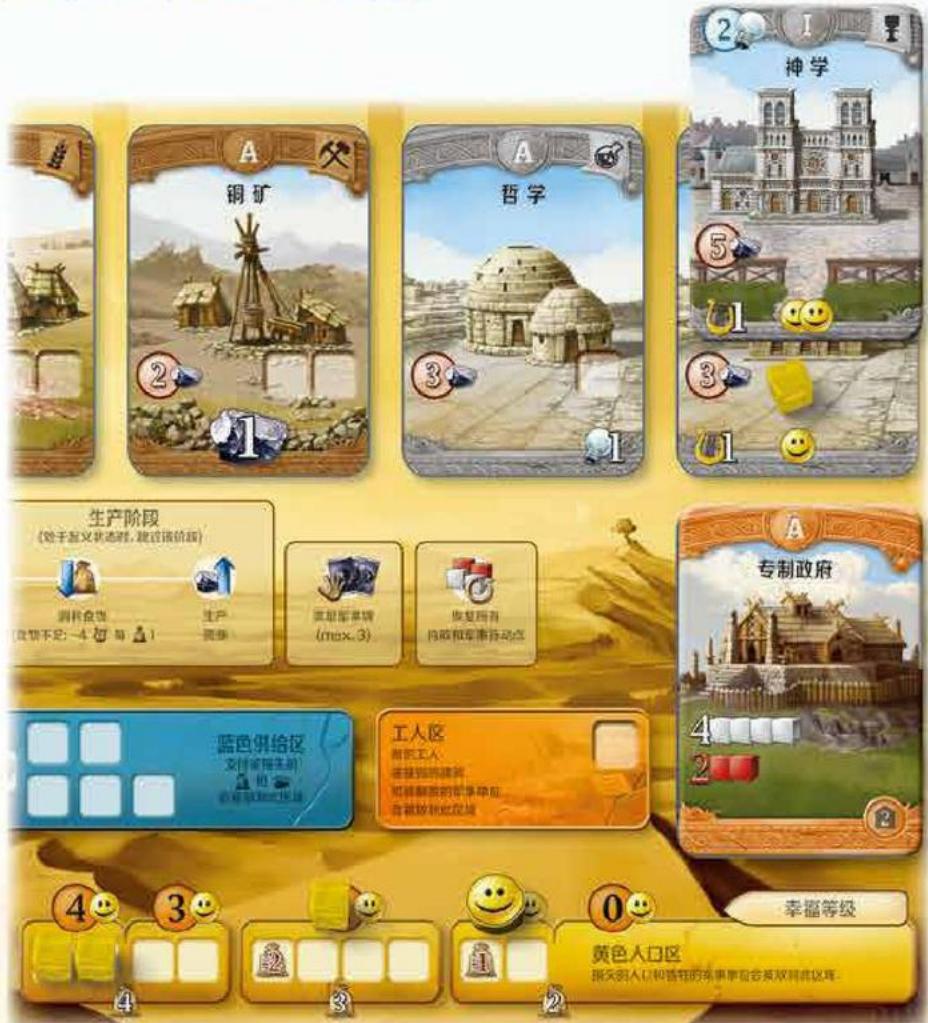
你产生了两个不满工人,但你只有一个未使用的工人。这意味着如果不改变现状,你仍会产生一个不满工人从而导致起义。
现在你有哪些选择?
·你可以升级你的寺庙,这会让你的幸福等级达到2级。然后,你会有一个不满的工人,但是你可以将一个未使用的工人放到空置小区域的上方以弥补笑脸的不足,所以你不会面对工人的起义。
·你可以新建造一个时代Ⅰ的寺庙,被放到空置小区域上方的工人是一个未使用的工人,所以你可以用它来建造一个新的寺庙。这样,你的幸福等级将达到3级,你将不再产生不满工人。
·你可以增加人口,这会让你多出一个工人,但不会导致黄色人口区的第四个小区域空置。现在,你虽然产生了两个不满工人,但你同样拥有两个未使用的工人。你可以将新增加的工人放到空置的另一个小区域上方,以表示不满工人的数量没有超过未使用的工人数量。所以在回合结束后,你不会面对工人的起义。但是,你应该找到一个更适用的办法。因为如果你再次增加人口,你又会出现一个空置的小区域,然后你又被迫需要将新的工人放到相应的区域。
·你也可以通过摧毁一个农场,矿山,城市建筑或解散一个军事单位来得到一个未使用的工人,但这通常不是一个好主意。
·被迫放弃任由起义发生是最差的选择。但在为数不多的情况下,你不得不这么做。

后续的回合
回合结束阶段流程
随着你文明的发展,回合结束阶段流程中每一步都与你息息相关。
弃置多余的军事牌

在本阶段过后,你手中军事牌的上限由你的红色标记数量决定。
如有需要,你必须弃置一些军事牌,以使你的军事牌总数不超过红色标记的数量。弃牌时,你需要面向下弃置。
游戏的流畅性
当你决定完弃置哪些军事牌后,流程的剩余步骤将自动进行。你不需要做出其他抉择。下一位玩家也可以在你完成弃牌后就开始他(她)的回合。
当然,如果在他(她)的回合中发生了一些能够影响你的事情,他(她)需要暂停自己的回合,直到你完成回合结束阶段的所有结算。
生产阶段
生产阶段
生产阶段
(处于起义状态时,跳过该阶段)
如果你不满工人的数量超过未使用的工人数量,你将面对工人的起义,并跳过生产阶段。
工人的起义在前文中已经做了详细介绍。本质上,如果你的文明强迫不开心的工人去工作,他们会变得非常愤怒并停止生产。跳过你的生产阶段是起义发生后的唯一负面效果,但你也应该极力避免,因为生产阶段你将获得许多有用的东西。
对科学点数和文化点数计分

与之前的回合一样,根据你的科学增速和文化增速获得相应的科学点数和文化点
你需要将相应的点数标记翻转过来,并重新放到指示条数字0的位置,以表示你已拥有最大值的点数。例如,一个位于文化点数指示条第10格的已翻转的标记代表160点文化点数。
腐败

腐败
当你储存过多的食物和资源时,你将面临腐败问题。一个未完成的奇迹也可能导致腐败。当获得额外的食物和资源时,玩家总是会尽力花费它们。
如果你的蓝色供给区中出现一个或多个未被标记覆盖的负值,那么最左侧的负值就是你的腐败数值。如果它们都被标记所覆盖,你将不会出现腐败问题。
当你的蓝色供给区中至少拥有11个标记时,你不会出现腐败问题。
举例:
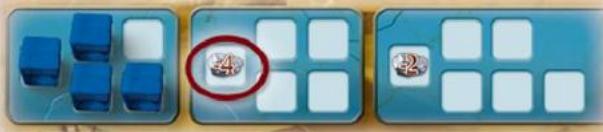
这种情况下,你将面临腐败并失去4资源。
实际结算时,你需要根据腐败数值失去相应的资源。如果你没有足够的资源,你会先失去你所有的资源,再用食物去补齐差值。
即是说,你需要从矿山科技牌上将一些蓝色标记放回到蓝色供给区。如果你没有足够的标记,你需要从农场科技牌上将一些蓝色标记放回到蓝色供给区。值得注意的是,位于较高等级科技牌上的蓝色标记的实际价值可能超过1。
注意:你可以通过精心规划来避免腐败问题。例如,获得那些让你拿到更多蓝色标记的卡牌,或者打出等级更高的农场或矿山科技牌。等级更高的科技牌可以让你用更少的蓝色标记来储存更多的食物和资源。
生产食物
与之前的回合一样,农场科技牌上每有一个工人,你就需要从蓝色供给区移动1个标记放到该牌上。位于等级更高的卡牌上的一个工人虽然也只生产1个蓝色标记,但该标记代表着更多数量的食物。
消耗食物

消耗食物(食物不足:-4U每)
如果你的黄色人口区拥有一个或多个未被标记覆盖的负值,那么最左侧未被覆盖的负值就是你需要消耗的食物数量。当所有的负值都被标记覆盖时,你不会消耗食物。
举例:

在这种情况下,你需要在生产阶段消费3食物。
你必须支付等量的食物消耗。如果你没有足够的食物,你需要先支付全部食物,再为你尚未支付的每个食物损失4点文化点数。
注意:在游戏早期,你不太可能面临食物短缺。消耗食物总是在生产食物之后,这意味着除非摧毁所有的农场,否则你总会拥有足够的食物。但是在后续的游戏中,随着消耗食物的增长,如果它超过了你生产食物的数量,那么你需要采取一些措施来解决这个问题。
生产资源

与之前的回合一样,矿山科技牌每有一个工人,你就需要从蓝色供给区移动1个标记放到该牌上。位于等级更高的卡牌上的一个工人虽然也只生产1个蓝色标记,但该标记代表着更多数量的资源。
总结——蓝色供给区
·蓝色标记通常位于你的蓝色供给区中。
·一些卡牌的效果会影响你的蓝色标记数量,让你从盒中拿取蓝色标记或者将蓝色标记放回到盒中。
·在生产阶段,你需要将蓝色标记从蓝色供给区中移动到你的农场和矿山科技牌上,每有一个工人就移动1个蓝色标记到相应的卡牌上。
•农场或矿山科技牌上的每个蓝色标记代表与卡牌底部数字等量的食物或资源。
•即使卡牌上没有放置工人,蓝色标记仍可用作表示食物或资源。
•当你支付食物或资源时,将卡牌上相应数量的蓝色标记放回到蓝色供给区。
• 当你支付食物或资源时,你可以将价值更高的蓝色标记转换成价值更低的多个蓝色标记。
• 当你做转换时,你不能将价值较低的卡牌上的蓝色标记移动到价值较高的卡牌上。
•一个未完成的奇迹需要用蓝色标记来表示已建造的等级。
· 你总是从左至右补充蓝色供给区中的蓝色标记。如果蓝色供给区的小区域中有负值未被标记覆盖,那么你的文明将面临腐败问题。
腐败直到你的生产阶段才会结算效果。在腐败阶段,你必须失去相应数量的资源。如果你没有足够的资源,你必须使用食物来补齐差值。
抓取军事牌
你未使用的每点军事行动点都可以让你抓取一张军事牌,即使这会导致你的军事牌超过相应的数量上限。在本阶段,你最多只能抓取3张军事牌。
如果你拥有3点以上的军事行动点未被使用,那么你也只能抓取3张军事牌。
如果当前的军事牌堆被抓空了,你需要切洗相应时代的军事弃牌堆以组成新的军事牌堆。
在你的第一次游戏中,不会出现时代Ⅲ的卡牌。所以在时代Ⅲ时,你不会抓取军事牌。
总结——手牌
·你手中内政牌的数量上限是你拥有的白色标记数
·如果你已经达到内政牌的数量上限,你不可以再拿取一张新的内政牌。
• 如果你已经达到内政牌的数量上限,你仍然可以拿取一张奇迹牌,因为奇迹牌不会加入到你的手牌中。
•你手中军事牌的数量上限是你拥有的红色标记数
•与内政牌不同,当你达到军事牌的数量上限时,你仍然可以抓取军事牌。
·你只会在回合结束阶段流程的第一步检查你的军事牌数量。如果此时你超过了数量上限,你需要弃置多余的军事牌。
在后续的流程中,当你抓取军事牌后,你可能又超过了数量上限。
恢复所有的内政和军事行动点

你回合结束阶段的最后一步是将所有已使用的行动点重新放回到政府牌
时代的结束
旧时代的结束意味着新时代的开启,你的伟大文明将面临新的机遇。
时代A的结束
当起始玩家第一次补充卡牌列时,时代A立即结束。(详见第8页)
新的时代牌堆
你需要将时代Ⅰ的内政牌堆和军事牌堆放到当前时代版图的相应区域,它们组成了当前时代的牌堆。在时代A结束时,不会发生任何事情。
时代I的结束
当时代I的内政牌堆为空时,时代Ⅰ立即结束。这可能发生在任何玩家的回合中,当他(她)补充卡牌列时就可能出现这种情况。


如果内政牌堆为空,当前时代版图上的图示就会显露出来,这将提醒你在时代结束时有哪些步骤需要结算,这些结算对所有玩家都有效。
如果内政牌堆为空,当前时代版图上的图示就会显露出来,这将提醒你在时代结束时有哪些步骤需要结算,这些结算对所有玩家都有效。
弃置过期的卡牌

每位玩家都需要弃置手中所有过期的卡牌。
从游戏中移除过期的领袖牌和未完成的奇迹
当你拥有时代A的领袖时,你需要将其从游戏中移除。如果你拥有一个未完成的时代A的奇迹,你也需要将其从游戏中移除,
奇迹牌上的蓝色标记将被放回到你的蓝色供给区。
这些图示将提醒你移除过期的卡牌,但是在你的第一次游戏中不会出现条约牌。
其他的所有卡牌(包括已完成的奇迹)都将留在游戏中,忽略卡牌所对应的时代。
损失黄色标记

最后,每位玩家从黄色人口区将2个黄色标记放回到盒中,这代表历经时代更迭你的人口得到减少,先进的文明期望独享吃喝玩乐。
注意:你应该为时代结束早做准备。忽略食物生产和笑脸数量的文明将陷入尴尬的境地。
新的时代牌堆
时代[的结束意味着时代∏的开启,将时代Ⅱ的内政牌堆切洗,并放到当前时代图版的相应区域,以组成当前时代的内政牌堆。如果使用之前时代的内牌堆牌尚未补满卡牌列,你需要使用新的时代Ⅱ的内政牌堆补齐空位。
将时代Ⅰ的军事牌堆从当前时代图版上移除,切洗时代∏的军事牌堆并放到相应区域,以组成新的军事牌堆。
注意:位于当前事件牌堆和未来事件牌堆的卡牌不会受到时代结束的影响。
时代Ⅱ的结束

当时代Ⅱ的内政牌堆为空时,时代Ⅱ立即结束。与时代Ⅰ结束的流程一样,最大的区别在于现在时代Ⅰ的卡牌成为过期的卡牌。
· 你需要从手中弃置所有时代I的卡牌。
· 你需要将时代I的领袖和时代Ⅰ的未完成的奇迹从游戏中移除。
·每位玩家损失2个黄色标记。
没有新的时代牌堆
在你的第一次游戏中,时代Ⅱ结束后时代Ⅲ将开启,但是你没有相应的时代Ⅲ的卡牌,所以你需要移除所有时代∏的军事牌,并让当前时代版图空置。
从现在开始,卡牌列不会补充新的卡牌,但是玩家仍然需要移除相应牌位上的牌,并向左移动剩余的卡牌。所有玩家都无法抓取军事牌。
最后的游戏轮
在时代∏结束后,每位玩家至少会再行动一次,具体情况由起始玩家决定。
· 如果时代Ⅱ在起始玩家的回合结束,那么该游戏轮是最后的游戏轮。
· 否则,下一个游戏轮将是最后的游戏轮。
无论何种情况,末位玩家都将进行最后一个游戏回合,所以每位玩家的总回合数是相同的。
总结——黄色人口区
• 黄色标记通常位于你的黄色人口区中。
• 一些卡牌的效果会影响你的黄色标记数量,让你从盒子中拿取黄色标记或者将黄色标记放回到盒中。
•你需要在时代Ⅰ和时代Ⅱ结束时将2个黄色标记放回到盒中。(在完整模式下时代Ⅲ的结束也会如此)
• 一个位于你黄色人口区外的黄色标记就是你的一个工人。(详见第14页总结——工人)
•为了使你黄色人口区的一个黄色标记成为你的一个工人,你需要执行增加人口行动。食物的费用(白色数字)绘在你玩家版图黄色人口区的每个小区域底部,新增加的工人会被放到你的工人区中。
•只有当你殖民时牺牲了军事单位,你的工人才会被放回到黄色人口区,或者是一些卡牌的效果让你减少
·黄色人口区的黄色标记并不是你的工人,它们只是游戏中计数系统的一部分。当你拿取黄色标记时,你需要从右向左依次拿取。当其中一个小区域被拿空时,相应的负值(红色数字)会显露出来,该数值代表你文明的消耗数值。
• 消耗食物会在你的生产阶段结算。在结算时,你必须失去相应数量的食物。如果你没有足够的食物,每1差值会让你损失4。
· 黄色人口区的每个小区域上方都绘有一个笑脸。如果一个小区域被拿空,你的文明就需要达成相应数量的笑脸。如果你没有足够的笑脸,那么幸福等级标记左侧空出的小区域数量就是你的不满工人数量。
(详见第19页幸福等级和不满工人)
总结——弃置卡牌
·内政牌总是面朝上弃置的。
·被弃置和从游戏中移除的内政牌都不会再加入到游戏中,你需要将它们放回盒中。
·军事牌总是面朝下弃置的。
·打出和弃置的军事牌会通过背面加以整理。如果当前时代的军事牌堆为空,那么你需要将相应时代的军事牌弃牌堆切洗,以组成新的军事牌堆。
·非地区牌的事件牌在结算效果后会被弃置,并放入过去事件牌堆中,它们也不会再加入到游戏中。
结束你的第一次游戏
你的第一次游戏会在末位玩家完成他(她)的最后一个回合后结束。最后是终局计分。
终局计分
在第一次游戏结束后,每位玩家会因为自己文明的成就获得额外的文化点数:
· 每张时代I的科技牌会为你提供1点文化点数,每张时代∏的科技牌会为你提供2.点文化点数。你的政府牌会为你提供双倍的文化点数。
·你将获得等于你科学增速数值的文化点数。
·你将获得等于你军力等级数值的文化点数。
·你将获得等于你幸福等级数值的文化点数。
·你将获得等于你食物和资源生产数值的文化点数。(即计算生产阶段你能够生产的食物和资源数量,忽略消耗食物和腐败问题)
你的每个殖民地将为你提供3点文化点数。
·你的每个已完成的时代Ⅱ的奇迹将为你提供6点文化点数。
按照以上规则一步步加总你获得的文化点数,给每位玩家一些时间来计算各自的终局分数。
注意:以上的计分规则只适用于你的第一次游戏。在完整模式的游戏中,你将按照另一套计分规则结算。
获胜玩家
获得最高文化点数的玩家将赢得胜利。
如果出现平局,玩家共享胜利。
但最重要的是你已经完成了你的第一次游戏。下一次,你可以尝试完整模式下的历史巨轮。
完整模式与你的第一次游戏非常类似,但是在加入了时代Ⅲ的卡牌后,你和对手之间会有更多的互动。
在完整模式下,时代Ⅲ和时代],Ⅱ一样拥有一个完整的
在结算完时代Ⅱ的结束后,切洗时代Ⅲ的内政和军事牌堆,并将其放到当前时代图版的相应区域,以组成当前时代的牌堆。游戏将进入下一个时代。
·当时代Ⅲ的内政牌堆为空时,你手中所有时代Ⅱ的卡牌将被被弃置,时代Ⅱ的领袖,未完成的奇迹和条约牌都会从游戏中移除,每位玩家也都会损失2个黄色标记。在时代IV开启后,并没有相应时代的牌堆。
·如果时代Ⅳ是在起始玩家回合开启的,那么该游戏轮就是最后的游戏轮。否则,下一个游戏轮将是最后的游戏轮。
时代Ⅲ的奇迹
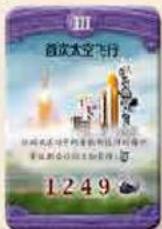
时代Ⅲ的奇迹在完成后都会为你提供一个一次性的效果。你将根据游戏区域中的其他卡牌和工人获得相应的文化点数。其中,一些奇迹的效果会在规则书的附录中详细介绍。
在完整模式下,你可以使用所有的军事牌,包括侵略牌,战争牌和条约牌,这会为你的政治阶段提供新的选择。当然,如果你已经落后太多,你也可以选择体面退出。
你可以在规则书第4页找到打出这些卡牌的相关步骤,战争牌会在你打出后的下个回合结算,这点在规则书第3页也有介绍。现在,你应该对剩余的游戏流程有所了解,相关的规则也没有问题。
这里,我们会再为你做一个简单的回顾。
游戏的军事部分
军事是游戏的一个重要部分。虽然你很难单纯地依靠军事获胜,但如果你忽略军事的发展,你会很容易输掉
事件
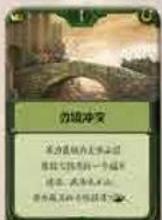
即使玩家不是很有侵略性,但军力最强的文明还是会从与军力相关的事件中受益,而军力最弱的文明也会因此承受负面效果。如果势头保持下去,这会让军力占优的文明越来越强。
侵略

如果一位玩家的军力明显超过你,那么他很可能会向你打出一张侵略牌。侵略牌需要作为一个政治行动打出,攻击方必须支付相应的军事行动点。
御这次侵略,你可以通过从手中打出军事奖励牌来提升军力。一张军事奖励牌会将它的防御值(卡牌上半部分的数值)加总到你的军力中。你也可以通过面朝下弃置
空军单位
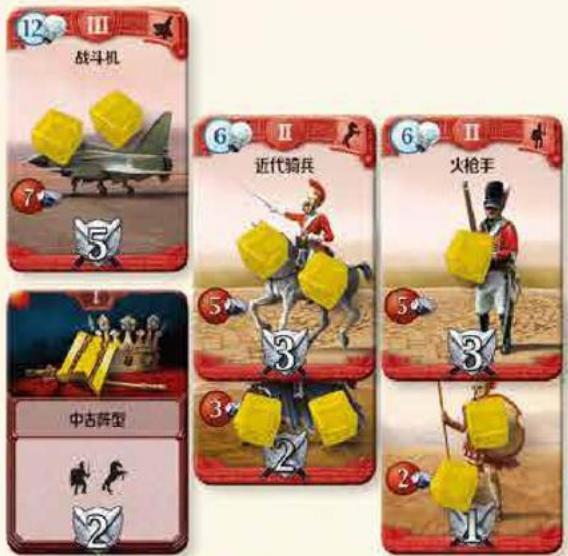
空军单位是一种只出现在时代Ⅲ的新型军事单位。一个空军单位和其他军事单位一样,它会为你提供自身的基础军力等级。所有的阵型牌都不需要空军单位,但是一个空军单位可以加入任何一支军队,以使这支军队的阵型军力翻倍。一个空军单位只隶属于一支军队。一支军队可以存在多个空军单位,但其阵型军力只享受一次翻倍效果。
举例:
政治阶段
整你的军力等级。
如果你无法持平或赶超攻击方的军力(或者你根本就不打算这样做),那么这次侵略视作成功。通常情况下,攻击方会夺取或摧毁你文明的某些东西。
别让你的文明在军事上过多的落后其他文明,特别是你手中没有任何军事奖励牌来抵御侵略时。相对的,如果你的军力远高于对手,那么进攻肯定是个好主意。
注意:一个文明在殖民某个地区后很容易受到其他文明的攻击,因为它刚刚牺牲了军事单位,或者打出了军事奖
战争
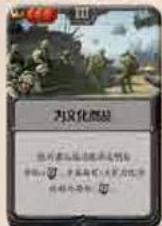
也许你已经厌倦了无休止的军备竞赛。你在军事上落后对手太多,军事奖励牌也无法挽救你了,所以你决定放弃抵御侵略,一心致力于文明的发展建设。这或许是个不错的策略,亦或许你将成为一场战争的宣告目标。
一位玩家需要在他(她)的政治阶段宣告战争,但是战争并不是立即结算的。战争涉及的双方都有一次机会来增加他们的军力等级,即使宣告战争的玩家已经支付了不少军事行动点来发动战争,可能只剩下少量的军事行动点。战争将在攻击方的下个回合开始阶段结算。
与侵略不同的是:
战争双方都不能打出或弃置军事牌来增加自己的军力。只有游戏区域中已打出的卡牌才会提供军力有关的附加效果
这些军事单位都会为你提供它们自身的军力等级。此外,你的阵型牌可以让你组建三支军队。通常情况下,一支军队的阵型军力为2,但是其中两支军队加入了空军单位,所以它们的阵型军力翻倍变为4。所有军队的阵型军力加总后为10。

征服者阵型的效果更佳,你将组建两支军队。其中一支包括了1个战士单位,所以被视作旧式军队。但每支军队都包括一个空军单位,这会使阵型军力翻倍。因此,旧式军队的阵型军力为6,另一支标准军队的阵型军力为10。所有的军事
单位除自身提供的军力等级外,总计为你提供了16,点阵型军力。
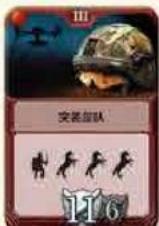
如果你将阵型牌替换成突袭部队,那么它的效果并不比征服者阵型要好。你现在只能组建一支军队,其中包括一个时代I的军事单位,所以它被视作旧式军队。即使该军队包括一个空军单位来使阵型军力翻倍,但翻倍后的阵型军力也
只有12点。而另一个空军单位不会加入任何军队(但是它仍然会为你提供自身的5点军力等级)。如果你升级其中的一个骑士,那么该军队不再被视作旧式军队,将为你提供22点的阵型军力。
战争双方都有可能成为胜利者,并对对方造成损失。在侵略中,如果进攻方没有获胜,那么侵略不会产生任何效果)
战争的负面程度将由双方的军力差值决定。(在侵略中,你的军力等级落后5点或是20点并没有任何区别,但是在战争中这点很重要)
其他,完家将会性事的你物義得大多的整体优
相对地,如果其他玩家的军力远低于你,你可以考虑发动战争,但需要格外谨慎。一个经济腾飞的文明可能在一回合内就大幅增加他(她)的军事力量。相信你肯定不愿输掉由你主动发起的战争。
条约
的会以学,在人游成中,你需要
条约牌使游戏加入了外交和合作的环节。在政治阶段,你可以用一个行动向其他玩家提出一项条约,对方可以接受也可以拒绝。如果该玩家接受,那么条约牌的效果持续有效。如果该玩家拒绝,条约牌将回到你的手中。但无论如何,你都会结束当回合的政治阶段。在后续回合的政治阶段,你仍然可以继续提出该条约。
注意:在你提出一项条约前,你不能有意地欺诈对方。
你可以成为多项条约的当事人,但你的游戏区域中只能拥有一张条约牌。如果你提出一项新的条约并被对方接受,那么你游戏区域中已有的条约立即失效。你也可以使用一个政治行动,主动取缔一项与你有关的条约。在时代更迭时,如果条约牌被视作过期也会从游戏中移除。(就像过期的领袖和未完成的奇迹一样)

一些条约是平等的,其效果对双方都一样,但这也可能是把双刃剑。在其他文明攻击你之前,缔结一项开放边境条约总是不错的。在其他文明花光你的科学点数之前,缔结一项科学合作条约也是个不错的主意。
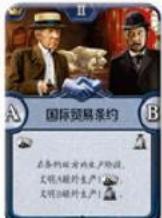
一些条约可能稍显不平等,但双方获得的效果总是互补的。这些条约中通常会让你向对方提供一些东西,你可以向那些缺少这些东西的玩家提出该项条约。

也有些条约可能非常不平等,玩家需要向对方提供一些东西以换取和平或保护。如果你在军事上落后过多,你可以向一个军事强大的文明提出该项条约,以避免被侵略。相反的,如果你在军事上很强大,你也可以用该项条约来威胁一
与你的第一次游戏一样,完整模式下的游戏会在末位玩家结束他(她)的最后一个回合后结束。
你不会使用第一次游戏结束时的计分规则,取而代之的是,你的文明的某些领域会被计分。玩家可以通过筹划时代Ⅲ的事件决定终局计分项。
终局计分
在游戏结束后,你需要展示当前事件牌堆和未来事件牌堆中所有时代Ⅲ的事件牌,并且一张一张地结算,这时候结算顺序并不重要。
注意:更早时代的事件牌在终局计分时并没有任何效果。
时代Ⅲ的事件牌
每一张时代Ⅲ的事件牌都提供了一种计分项。时代Ⅲ的事件牌可能在游戏过程中就已经被展示并结算效果。在游戏结束时,当前事件牌堆和未来事件牌堆中未被展示的所有时代Ⅲ的事件牌将在终局计分阶段被展示并个军事弱小的文明。当你提出一项不平等条约时,你需要先选择自己扮演哪一方,而对方可以接受也可以拒绝。
注意:除非一项条约的描述中明确提到,否则该条约并不能保护双方不被对方攻击。除非一项条约的描述中提到特殊情况,否则该条约在攻击后仍然有效。
记录额外的生产
你可以标记从特定条约中额外获得的生产效果,这需要你从盒中拿取1个红色标记放在你的时代A的农场或矿山上。你也可以使用这种方法来标记有关其他卡牌的额外生产效果。例如,跨洲铁路。
体面退出
希望这种情况不会发生在你的身上,但有时候局势已经不能逆转了。如果其他玩家的军事力量都很强大,而你又没有足够的经济基础来追赶他们。你会发现自己每个回合过后与其他玩家的差距越来越大,也很容易受到侵略,战争和负面事件的影响。
完整模式的游戏结束
结算。当你打出一张时代Ⅲ的事件牌时,你可以确定它一定会被结算。

大多数时代Ⅲ的事件牌会根据每位玩家游戏区域中的卡牌和工人提供一定的文化点数。
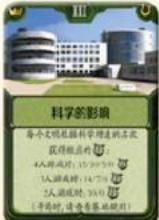
一些时代Ⅲ的事件牌也会根据玩家在某些领域的名次提供不同的文化点数。例如,科学的影响中“14/7/0”表示科学增速最高的玩家将获得14,第二高的玩家将获得7,而第三位的玩家不会获得任何文化点数。这时候的平局判定
为:结算事件时的当前玩家,或按顺时针顺序李当前玩家最近的玩家成为优势方,将赢得平局判定。
当然,即使你输掉游戏也可以享受游戏过程中的乐趣。你不会被强制退出游戏,但体面退出是个不错的选择。你能够接受自己的失利,并让其他玩家继续军备竞赛,而不是眼睁睁地比较哪位玩家从你这里获得的优势最大。
你需要使用一个政治行动来体面退出,任何与你有关的战争都会被取消。(但这还是会让宣告战争的玩家获得一定的文化点数,就像历史总会记录下胜利者的姿态你的文明和游戏区域中的所有卡牌都将从游戏中移除。如果只剩下2-3位玩家,那么请按照2-3人游戏的规则继续游戏。如果仅剩一位玩家,那么该玩家获得游戏胜利。
在大多数情况下,游戏会在所有玩家都未退出时结束,最后进入终局计分
在终局计分时,起始玩家始终被视作当前玩家。
在游戏中,后手位玩家相比先手位玩家更容易知道游戏终局时的计分项。
获胜玩家
在结算完所有时代Ⅲ的事件牌后,终局计分结束。
获得最高文化点数的玩家将赢得胜利。如果出现平局情况,玩家共享胜利。
但最重要的是每位玩家都能讲述一段独一无二的有关自己文明发展的故事。
游戏配件的收纳
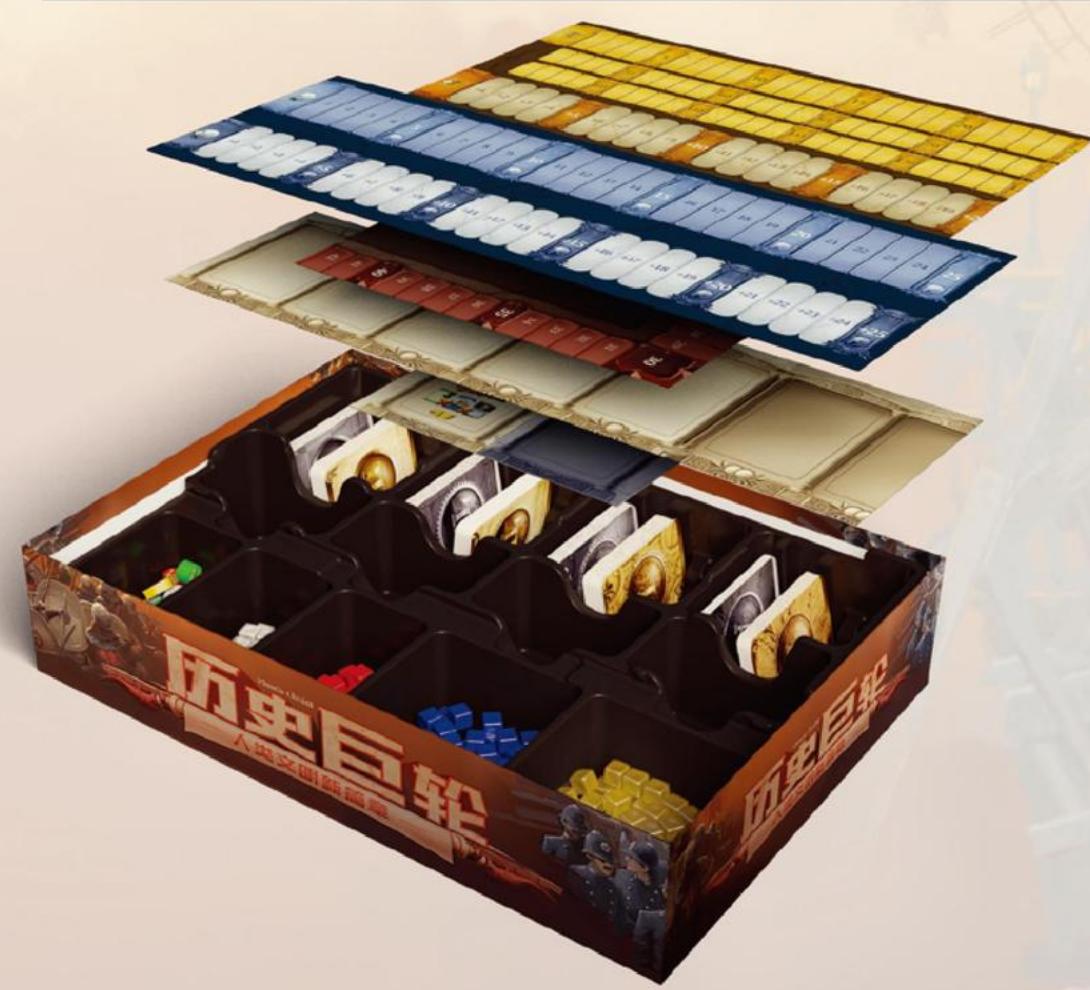
卡牌,版图和标记都可以像图中一样收纳到盒中。你可以将内政牌和军事牌按时代分类整理。如果你经常进行2人或3人游戏,那么你可以将那些需要移除的卡牌单独放置,这样会帮助你今后游戏的初始设置。
游戏版图可以放在盒中物品的最上方,从当前时代版图开始,最后是文化和科技版图,这样收纳的版图间可以互相固定。这样做后,还有一些空间来放置玩家版图,规则书和玩家提示卡。
在游戏中,未使用的白色,红色,黄色和蓝色标记可以留在盒中,在需要使用时玩家可以很方便地拿取。
如果你想为你的
Content is long; only the first part is inlined. Download the file or open the rules page for the full text.
Download Markdownthrough-the-ages-new-story-rules-en.md68.0 KB
THROUGHAGES
A NEW STORY OF CIVILIZATION
This rulebook presents all the rules for Through the Ages in a point-by-point format. It is especially useful for players who need to find a rule quickly. Players who are learning the game should not start with this rulebook. Instead, they should learn from the Handbook, which provides thematic background and detailed examples.
The first half of this book describes what happens during the game. The second half defines terms and concepts.
GAME FLOW
Set up the game. (Setup p 2.)
Players take turns, beginning with the starting player and continuing clockwise. (Your Turn p 3.)
Turns are organized into rounds. Each round begins with the starting player's turn.
– The first round is different from the others. (First Turn p 3.)
- Note: Most of the time, nothing special happens at the beginning or end of a round.
During the game, the current age gradually changes through Ages A, I, II III, and finally IV. (Replenish the Card Row p 3.) - If Age III ends during the starting player's turn, that is the last round.
- If Age III ends during any other player's turn, then the following round is the last round.
The game ends when the last round is over. Every player will have had an equal number of turns. Then it is time for the final scoring: - All Age III events in the current and next events decks are evaluated in any order. (Evaluating an Event p 7.)
– Any end-of-game bonuses are scored (the Bill Gates card).
- The player with the most culture points is the winner.
· If there is a tie, the tied players share the victory.
GAME BOARDS
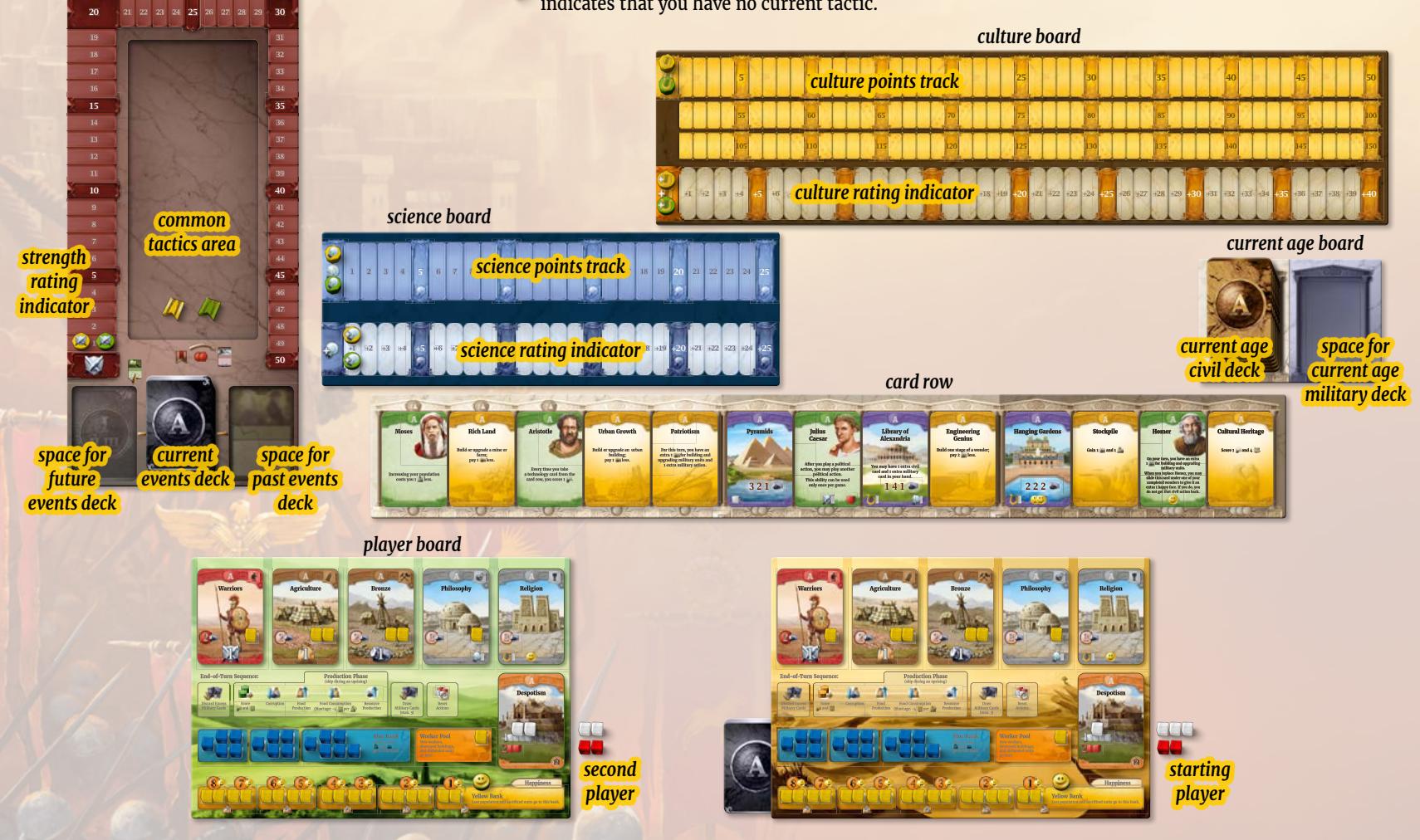
Place the game boards in the center of the table, in any suitable configuration.
DECK SETUP
Ages A, I, II, and III each have their own civil and military decks. So there are 8 separate decks, each with a different back.
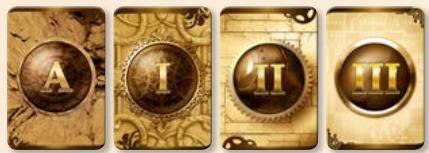
civil decks

military decks
▶ In a 2- or 3-player game, you must remove certain cards. These cards will not be used.
- Before a 3-player game:
Civil decks I, II, and III each have three cards with this marking. Remove these cards from these decks.

- Before a 2-player game:
3+ Civil decks I, II and III each have nine cards with one of these markings. Remove these cards from these decks.
Military deck I has two pact cards, and military decks II and III each have four. Remove all pact cards from these decks.
PLAYER COMPONENTS
Each player chooses a color and takes the components in that color:
PLAYER BOARD
The player board depicts 6 initial technologies: Warriors, Agriculture, Bronze, Philosophy, Religion, and Despotism. These count as technology cards.
▶ Put a blue token on each of the 16 squares in the blue bank.
A Put a yellow token on each of the 18 squares in the yellow bank, on each of the 6 squares on the technology cards, and on the square in the worker pool.
Your initial government card, Despotism, depicts 4 civil actions and 2 military actions. Place 4 white tokens and 2 red tokens next to the card (but not on it).
RATING MARKERS
You have 4 rating markers in your color.
military board

Place your science rating marker on space 1 of the science rating indicator.

Place your culture rating marker on space o of the culture rating indicator.

Place your strength rating marker on space 1 of the strength rating indicator.

Place your happiness rating marker on space 0 of the happiness rating indicator on your player board.
Note: These settings are determined by the workers on your initial technology cards. (Ratings p 10.)
POINTS COUNTERS

Place your science points counter on space o of the science points track.

Place your culture points counter on space o of the culture points track.
TACTICS STANDARD

Place your tactics standard in the common tactics area of the military board. This indicates that you have no current tactic.
IN THE Box
Some blue, yellow, red, and white tokens will be left over after setup. They will be needed during the game, but only rarely. They are said to be "in the box".
PREPARING THE EVENT DECK
Shuffle the Age A military deck.
Take a number of cards equal to the number of players plus 2. Place these face down on the military board as the current events deck.
Return the rest of the cards to the box without looking at them.
STARTING PLAYER
Choose the starting player however you like. The starting player will not change during the game. You may mark this by sliding one of the unused Age A military cards face down under the starting player's board.
INITIAL ACTIONS
V The starting player will have 1 unspent civil action on his or her first turn. Indicate this by placing one of the starting player's white tokens on his or her Despotism card.
In clockwise order, each player begins with one more civil action than the previous player. They indicate this with 2, 3, or 4 white tokens on their Despotism cards.
Players have no military actions on their first turn. All red tokens remain beside the player boards.
PREPaRING THE Card Row
▶ Shuffle the Age A civil deck.
Deal 13 cards face up to the spaces of the card row.
Put the rest of the deck on the light half of the current age board.
▶ Keep the other decks nearby, but out of the way. You will not need them until later in the game.
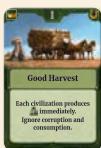
... remove these antiquated cards from play
COURSE OF THE TURN
Your turn consists of these phases and steps:
Start-of-Turn Sequence:
- Replenish the card row.
- Resolve a war, if necessary.
- Make exclusive tactics available, if necessary.
Politics Phase
▶ Action Phase
End-of-Turn Sequence:
- Discard excess military cards.
- Production Phase. (Skip during an uprising.)
- Draw military cards.
Reset civil and military actions.
FIRST TURN
Your first turn is different:
You begin with a limited number of civil actions. (Initial Actions p 2.)
You skip the Start-of-Turn Sequence and the Politics Phase.
▶ During your Action Phase you are not allowed to do anything except:
- Take a non-wonder from the card row.
Take a wonder from the card row and put it into play as an unfinished wonder.
START-OF-TURN SEQUENCE
REPLENISH THE CaRD Row
Note: The card row is not replenished during the first round.
You begin your turn by replenishing the card row:
Discard any cards remaining in the leftmost spaces:
- The first three spaces if there are 2 players in the game.
– The first two spaces if there are 3 players in the game.
– Only the leftmost space if there are 4 players in the game.
If someone has resigned (p 4) count only those players remaining in the game, not the initial number of players.
▶Shift all remaining cards to the far left, leaving no empty spaces between them.
A Deal cards from the current age civil deck into the empty spaces, from left to right. (Skip this in Age IV, which has no deck.)
END OF AN AGE
Replenishing the card row sometimes triggers the end of an age:
Age A ends when the card row is replenished for the first time.
Note: This occurs on the starting player's second turn.
After dealing Age A civil cards to the empty spaces, remove the rest of the Age A deck from the game.
Shuffle the Age I civil and military decks and place them on the current age board. They are now the current civil and military decks.
If all the Age A civil cards were dealt and there are still empty spaces in the card row, continue filling the row from the Age I civil deck.
Ages I, II, and III end when the last card of the current civil deck is dealt to the card row. The next age begins immediately:
Cards from ages older than the one that just ended (but not cards from the age that just ended) become antiquated:
• Players discard all antiquated cards from their hands.
• All antiquated leaders are removed from play.
All antiquated unfinished wonders are removed from play. (Blue tokens on them are returned to the players' blue banks.)
· All antiquated pacts are removed from play.
Note: Other cards in play (technologies, colonies, completed wonders, exclusive and common tactics, declared wars) remain in play even if they are antiquated.
- Each player loses 2 yellow tokens.
Shuffle the civil deck for the age that has begun. Place it on the current age board. It is now the current civil deck.
• Continue filling the card row if there are still empty spaces.
If Age IV has begun, there is no new civil deck and the empty spaces will remain empty.
Remove the military deck from the previous age. Shuffle the new age's military deck and place it on the current age board.
If Age IV has begun, there is no new military deck. Drawing military cards is not possible in Age IV.
- Age IV is the game-ending age. If Age IV starts, determine which round will be the last.
• This round is the last if Age IV begins during the starting player's turn.
• The next round will be the last if Age IV begins during any other player's turn.
When the new age begins...
... discard antiquated cards in hand
.. and lose 2 yellow tokens.
RESOLVE A WAR
If you have no war in play, skip this step. But if you have a war card in your play area, you must resolve the war at this time.
▶ Compare your strength with the strength of the opponent on whom you declared war.
- If a card in play gives you a bonus when you attack this opponent, include that bonus.
A If one player has a higher strength than the other, that player is the victor and the other player is the defeated civilization. The difference between their strengths is the strength advantage. Follow the text on the card.
If the victor steals a special technology, the victor takes the card from the defeated civilization's play area and puts it into his or her own play area.
A player cannot steal a special technology that is the same as one he or she already has in play or in hand.
If you steal a special technology of the same type as one that you have in play, you keep the higher level card in play and discard the other.
If the players have same strength, the war resolves with no effect.
Either way, discard the war card.
Note: Neither side can use military bonus cards to augment their strength in a war.
MAKE TACTICS AVAILABLE
If you have an exclusive tactics card in play, you must make it available at this time.
Move your tactics card to the common tactics area of the military board.
- There is no limit to the number of cards that can be in the common tactics area.
If the same card is already in the common tactics area, you may merge the cards by putting one under the other or by removing one from the game. However, do not discard it to the discard pile. (Discard or Remove From Play p 8.)
- Note: Your tactics standard remains on the card and it continues to be your current tactic.
POLITICS PHASE
During your Politics Phase, you may perform at most one political action, if you wish:
Prepare an Event
Play an Aggression
▶ Declare a War (not during the last round)
Offer a Pact (not in a 2-player game)
▶ Cancel a Pact (not in a 2-player game)
Resign (not in Age IV)
This symbol on a military card means it is played as a political action.
PREPARE AN EVENT
An event is a green military card marked with thesymbol in the upper right corner. To prepare an event, do the following:
Put your event card face down on top of the future events deck (or on the space, if it is empty).
▶ Score culture equal to the level of the card.
Reveal the top card from the current events deck and resolve its effect. If it is a territory, resolve colonization. (Current Events p 7.)
If this was the last card in the current events deck:
- Shuffle the future events deck.
Sort it face down, so that cards from earlier ages are above cards from later ages.
Place it on the current events space. It is now the current events deck.
Note: An event you prepare now will be revealed and resolved on a later turn.
PLAY AN AGGRESSION
An aggression is a brown military card. It has the word "Aggression:" in its name. To play one, do the following:
▶ Reveal the card.
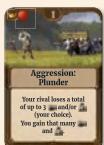
Pay the military action cost depicted next to the crown symbol.
Declare which player you are attacking. That player is your rival.
You cannot attack a player if the two of you have a pact that says you cannot attack.
- You cannot attack a player whose strength equals or exceeds yours.
Remember to include any bonuses that trigger when you attack the other player.
• Do not include bonuses from pacts that end if you attack.
If you and your rival have a pact that says it ends if you attack, remove that pact from play.
Your rival may defend against the aggression by adding temporary strength bonuses to match or exceed your strength:
Your rival can play one or more military bonus cards. The defense value in the upper half of the card is added to his or her strength. (These cards are discarded after their bonus is counted.)
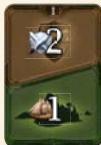
Your rival can gain a +1 strength bonus for each military card discarded face down.
Limitation: The total number of cards your rival plays or discards for bonuses cannot exceed his or her military action total.
If your rival matches or exceeds your strength, the aggression is unsuccessful. Discard it with no effect.
A If your rival cannot or does not wish to match or exceed your strength, your rival does not play or discard any cards for bonuses and the aggression is successful:
– Resolve the effect stated on the card.
If the effect refers to the cost of a card, use the cost printed on the card, ignoring any modifiers.
- Discard the aggression card.
DECLARE A WAR
A war is a gray military card with the words "War over" in its title. To declare a war, do the following:

Reveal the card.
Pay the military action cost depicted next to the crown symbol.
Declare which player you are attacking. That player is your rival:
If a card says you cannot attack a player, you cannot declare war against that player.
If you and your rival have a pact that says it ends if you attack, remove that pact from play.
▶ Place the war in your play area, with the top of the card toward your rival.
▶ The war will be resolved at the beginning of your next turn.
Limitation: You cannot declare a war during the last round.
OFFER A PaCT
A pact is a blue military card with a shaking-hands symbol above its name. Two-player games do not have pacts. To offer a pact, do the following:
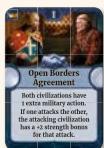
▶ Reveal the card.
Declare which player you are offering the pact to.
If the pact has sides labeled A and B, declare whether you are taking the role of side A or side B.
Then, your fellow player decides whether to accept the offer or not.
If your fellow player refuses the offer, return the pact to your hand. It still uses up your political action for this turn.
If your fellow player accepts the offer, the pact enters play:
Any other pact in your play area ends, whether it was with this player or a different player. Remove the old pact from play.
Note: You may still be a party to pacts in other players' play areas.
Place the newly accepted pact in your play area rotated so that the corresponding side (A, B, or either side if they are not labeled) faces your opponent.
- The new pact applies immediately.
Note: A pact that prevents attacks or declaring a war does not cancel wars that were already declared.
CANCEL A PACT
This action allows you to cancel a pact to which you are a party. Some of the political actions described above may also cause a pact to end as a side effect. To cancel a pact, do the following:
Choose a pact in play to which you are a party. It does not have to be a pact in your play area.
▶ Remove the pact from play. It ceases to affect you and your fellow player.
RESIGN
You may use your political action to resign.
Your civilization immediately leaves play. You have lost.
A Discard your hand and remove all cards in your play area from play. If you are party to any pact in someone else's play area, remove that pact from play.
If there are any wars declared against you, the players who declared them remove their war cards from play and score 7 culture points.
If there is only one player left in the game, the game ends and that player wins.
If there are still two or more players, they continue without you:
They do not change the current decks. (So some cards designed for more players may appear in this age.)
Before switching to Age II or Age III, they adjust the decks for the new ages ās if setting up the game for the new number of players. (Deck Setup p 2.)
- If only two players are left, they use rules for two players when evaluating events. (Evaluating an Event p 7.)
Exception: You cannot resign in Age IV.
ACTION PHASE
During the Action Phase, you may spend your civil and military actions to perform any combination of the actions described in this section in any order.
On your first turn, you are not allowed to do anything except take cards from the card row. (If you take a wonder, you do put it into play.)
You cannot perform an action unless you are able to perform all the required steps and pay all the required costs.
You may choose to end your Action Phase even if you have available civil or military actions.
Some of the actions described in this section may also be performed as effects of certain cards. If the action is an effect of a card:
The action costs you no civil or military actions unless the card says so. (Exception: Declare a Revolution p 5.)
V The action may have other costs (usually food, resources, or science points) which you must pay unless the card says you perform the action for free.
TAKE A NON-WONDER CaRD
FROM THE CaRD Row
Choose any card in the card row that is not a wonder.
Pay 1, 2, or 3 civil actions, as depicted at the bottom of that space of the card row.
Add the card to your hand.
▶ Limitations:
You cannot take any non-wonder card if the number of civil cards in your hand is equal to or greater than your civil action total.
You cannot take a technology card if you already have a card with the same name in your hand or in play.
If you have taken a leader, you cannot take another leader from that age. This applies even if the leader you took has already left play.
TAKE A WONDER
FROM THE CaRD Row
A wonder is a purple card with a row of numbers at the bottom of the illustration depicting the cost of building each stage of the wonder. It enters play when you take it:
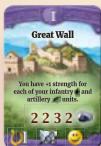
▶ Choose a wonder in the card row.
Pay civil actions equal to the number of civil actions depicted under that space plus one extra civil action for each wonder you have completed. (This includes wonders that have crumbled to ruins due to effects such as Ravages of Time.)
Put the wonder in play, rotated by 90 degrees to indicate that it is your unfinished wonder.
Limitation: You cannot take a wonder if you currently have an unfinished wonder in play.
▶ Note: You can take a wonder even if your hand is full.
▶ Note: The wonder's effects do not apply while it is unfinished.
INCREASE POPULATION
Pay 1 civil action.
Pay food equal to the white number depicted under the rightmost occupied section of your yellow bank.
Take the rightmost yellow token from your yellow bank and add it to your worker pool. (It becomes an unused worker.)
Note: You cannot increase your population if there is no yellow token left in your yellow bank.
BuILd A Farm, MinE,
OR URBAN BUILDING
Pay 1 civil action.
Choose one of your farm, mine, or urban building technology cards in play.
Pay the resource cost depicted on the card
Note: The construction special technologies reduce the cost of urban buildings only.
Move one of your unused workers to the card.
Update your ratings, if necessary.
Limitation: The lower right corner of your government card depicts your urban building limit. If you already have that many or more urban buildings of a particular type, you cannot build a new urban building of that type.
UPGRADE A FARM, MINE,
OR URBAN BUILDING
Pay 1 civil action.
Choose one of your farms, mines, or urban buildings (as represented by a worker on the corresponding technology card).
Choose another technology card you have in play of the same type and higher level.
Pay resources equal to the difference between the resource costs depicted on these two cards.
If the cost of one or both cards is modified, apply the modifiers before calculating the difference.
▶ Move the worker to the higher level card.
Update your ratings, if necessary.
DESTROY A FARM, MINE,
OR URBAN BUILDING
Pay 1 civil action.
Choose one of your farms, mines, or urban buildings (as represented by a worker on the corresponding technology card).
Move the worker from the card to your worker pool. (It becomes an unused worker.)
▶ Update your ratings, if necessary.
PLAY A LEADER
A leader is a green civil card with a portrait of a famous historical figure in the upper right corner.

▶ Pay 1 civil action.
Choose a leader from your hand.
▶ Put the leader in play.
▶ If you already have a leader in play, it is replaced. Discard the old leader.
- Get one civil action back.
The leader's effects apply immediately. Update your statistics, if necessary.
BUILD A STAGE OF A WONDER
You can do this only if you already have an unfinished wonder in play.
Pay 1 civil action.
Pay resources indicated by the leftmost uncovered cost depicted on the wonder.
Cover that cost with a blue token from your blue bank.
- If there are no tokens in your blue bank, use one from your technology cards.
If all costs on the wonder are now covered, the wonder becomes completed.
- Return all blue tokens from the wonder to your blue bank.
- Turn the card so that its name is right side up.
- The wonder's effects now apply. Update your statistics, if necessary.
If a card allows you to build multiple stages of a wonder as a single action, the procedure is the same. You add up all the costs for all the stages you plan to build, you pay all those costs at once, and then you cover the costs with blue tokens.
DEVELOP A TECHNOLOGY
The technology cards in your hand are distinguished by a science point cost in the upper left corner. The various types are described under Technology Cards in Play (p 9).
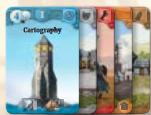
Pay 1 civil action.
Choose a technology card from your hand.
Pay the science cost depicted on the card.
- For government technologies, you pay the higher depicted cost.
Put the technology card into play.
If the card is a special (blue) technology of the same type as one you already have in play, only the higher-level card stays in play.
Usually, the older card is replaced by the new one.
In rare cases, the one you just played is removed. This still counts as playing a technology for purposes of other cards (such as Einstein).
If the technology is a government, the previous government is replaced. Remove the old one from the game or put the new one on top of it.
Effects of special technologies and governments apply immediately. Update your statistics, if necessary.
DECLARE A REVOLUTION
Declaring a revolution is a special way of developing of a government technology.
Choose a government technology card from your hand.

Pay civil actions equal to your civil action total.
If an event (Development of Civilization) allows you to develop a technology, you may declare a revolution by paying this full civil action cost.
If an action card (Breakthrough) allows you to develop a technology, you may declare a revolution by paying this cost instead of the action card's cost.
Note: This usually means you can't declare a revolution unless all your civil actions are available.
Pay the lower science cost depicted on the government card.
Put the government into play. Replace your previous government by removing it from the game or covering it with the new card.
Apply all effects of the new government.
- Update your statistics, if necessary.
But if you increased your civil action total, move the new white tokens off the card so that you still have no civil actions available.
A Effects that trigger when you develop a technology (Da Vinci, Newton, Einstein) are resolved at this time. (So in the case of Newton, you will end up with 1 available civil action.)
PLAY AN ACTION CaRd
An action card is a yellow civil card.
▶ Pay 1 civil action.
Choose an action card from your hand, but not one that you took during this Action Phase.
Reveal the card and resolve its effect:
If the effect of the card orders you to perform another action, you follow the usual rules for that action, except you do not pay any civil or military actions for it.
• If the card reduces a cost below 0, then that cost is 0.
If the card says "develop a technology" you may declare a revolution. Instead of paying 1 civil action to use the card, you will pay the cost of the revolution. (Declare a Revolution p 5.)
If the card says "build one stage of a wonder" you can only build one stage, even if other cards in play allow you to build multiple stages "for 1 civil action".
• If you cannot perform the action the card specifies, the card cannot be played.
If the card gives you something "for this turn", then that bonus does not count toward your statistics and it is not represented by a physical game component.
Note: An extra military action can be used to draw a military card at the end of your turn. (Draw Military Cards p 6.)
▶ Discard the card after playing.
BUILD A MILITARY UNIT
Pay 1 military action.
▶ Choose one of your military unit technology cards in play.
Pay the resource cost depicted on the card.
Move one of your unused workers to the card.
Update your ratings.
UPGRADE A MILITARY UNIT
Pay 1 military action.
Choose one of your military units (as represented by a worker on a military unit technology card).
▶ Choose one of your military unit technologies of the same type and higher level.
Pay resources equal to the difference between the resource costs depicted on these two cards.
If the cost of one or both cards is modified, apply the modifiers before calculating the difference.
▶ Move the worker to the higher level card.
Update your ratings.
DISBAND A MILITARY UNIT
Choose one of your military units (as represented by a worker on a military unit technology card).
Pay 1 military action.
▶ Move the worker to your worker pool. (It becomes an unused worker.)
Update your ratings.
PLAY A TACTIC
A tactic is a red military card with icons of military units in the bottom half.
Pay 1 military action.
Choose a tactics card in your hand.

Put it into play in your area as your exclusive tactics card.
Place your tactics standard on it. It is now your current tactic.
Update your strength rating. (Tactics Cards p 9.)
Limitations: You can play or copy a tactic only once per turn.
COPY A TACTIC
Choose a common tactics card on the military board.
Pay 2 military actions.
Place your tactics standard on it. It is now your current tactic.
Update your strength rating. (Tactics Cards p 9.)
▶ Limitation: You can play or copy a tactic only once per turn.
END-OF-TURN SEQUENCE
Once you declare the end of your Action Phase, follow the End-of-Turn Sequence in order.
Only the first step requires a player decision. Once you have chosen military cards to discard, the rest is automatic. To keep the game moving, the next player may start his or her turn as soon as you discard.
DISCARD EXCESS MILITARY CARDS
If the number of military cards in your hand exceeds your military action total, discard any excess cards, face down.
CHECK FOR AN UPRISING
If your discontent workers outnumber your unused workers, you face an uprising and skip the Production Phase. (Discontent Workers p 10.)
PRODUCTION PHASE
If you are not facing an uprising, perform these steps in order.
Score Science and Culture
Score science points equal to your science rating.
Score culture points equal to your culture rating.
Corruption
The leftmost square in each section of your blue bank is marked with a negative number.
If all these numbers are covered by blue tokens, you have no corruption.
• Otherwise, the leftmost uncovered negative number is your corruption.
- Lose resources equal to your corruption.
If you lost all your resources but not enough to account for the entire amount of corruption, lose food to cover the difference.
Food Production
For each worker on your farm technology cards, move one blue token from the blue bank to that card.
If there are not enough tokens, move all that you can to the farm technology cards, beginning with those of the highest level.
Food Consumption
- The leftmost square in each section of your yellow bank is marked with a negative number.
• If all these numbers are covered by yellow tokens, you have no consumption.
Otherwise, the leftmost uncovered negative number is your consumption.
- Lose food equal to your consumption.
If you lost all your food, but not enough to account for the entire consumption, lose 4 culture points for each unit of food necessary to cover the difference.
Resource Production
For each worker on your minetechnology cards, move one blue token from the blue bank to that card.
If there are not enough tokens, move all that you can to the mine technology cards, beginning with those of the highest level.
DRAW MILITARY CARDS
For every available military action you have left, draw one military card from the current age military deck.
Limitation: You may draw at most 3 cards this way.
- In Age IV, there is no military deck and you draw no cards.
Note: On the first round, players have no available military actions and thus draw no cards.
A If you draw the last military card, shuffle the current age's military card discard pile (p 8) and place it on the current age board. It is now the military deck.
Continue drawing from the new deck if you have not yet drawn all the cards you are entitled to.
RESET YOUR ACTIONS
Move the red and white tokens back to your government card. All your military and civil actions are available again. Some events may require you to spend some of them before your next turn.
CURRENT EVENTS
When a player puts an event in the future events deck as his or her political action, the top card of the current events deck is revealed and evaluated. Some events represent the discovery of new territories. These have the word "Territory" in their name. Other events have an effect that is written out on the card.
If the current event has a written effect, evaluate it as written.
▶ If it is the discovery of a new territory, then players may attempt to colonize it.
EVALUATING AN EVENT
Follow the text on the card.
If multiple players must make a decision, they decide in clockwise order, beginning with the player who revealed the event.
If the card requires players to compare a statistic, ties are resolved this way:
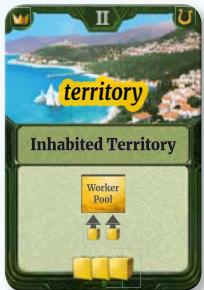
- The current player, or the player who is closer to the current player in clockwise order, is considered to have the higher value.
• Note: In some cases (such as Terrorism or Barbarians) this may be a disadvantage.
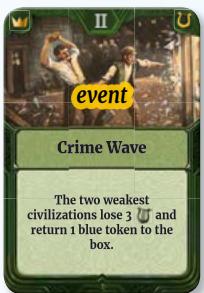
- If an event is evaluated at the end of the game, the starting player is considered to be the current player when breaking ties.
But if the card applies to "all civilizations" with the most or least of something (as in Immigration) then any ties remain unbroken.
For a two player game: whenever a card says it applies to 2 civilizations with the most or least of something, it should actually be applied to only one. For example, "The two strongest civilizations" should be read as "The strongest civilization".
If the effect enables a player to perform an action that can be chosen during the Action Phase, the player follows the usual rules for that action, except that he or she does not pay any civil or military actions unless the card says otherwise.
Exception: If the card says "develop a technology" a player may declare a revolution, but the revolution will still use up all civil actions. (Declare a Revolution p 5.)
▶ Once the card's effect has been resolved, place it in the past events pile. It does not go to the military cards discard pile and cannot be drawn again.

COLONIZATION
If a territory is discovered as the current event, all players have a chance to colonize it. Players bid to see who is willing to send the largest colonization force to colonize the territory.
A bid is always a whole number higher than zero and higher than the previous bid (if any).
No player may bid with more colonization force than he or she can actually send.
Players bid in turn, clockwise around the table, beginning with the player who revealed the territory.
- On his or her turn, a player may bid or pass. A player who passes drops out of the auction.
- If no one bids, the territory event card is placed on the past events pile and colonization comes to an end.
- If someone bids on the territory, bidding continues until all but one player has dropped out. That player must colonize the territory.
The winner must form a colonization force equal to or greater than the bid.
The player must send one or more military units. Their strength is summed to get a base value for the colonization force.
The units sent may be grouped into armies according to the player's current tactic. The armies' tactical strength is added to the colonization force. (Tactics Cards p 9.)
The way they were grouped in calculating the civilization's strength rating is not relevant right now.
The civilization's colonization modifieris applied to the colonization force. (Colonization Modifier p 10.)
The player may play any number of military bonus cards and add the colonization value in the lower half of each card to the colonization force.
Note: It is not possible to form a colonization force with just bonuses and modifiers. The player must send at least one military unit.
Note: Effects that modify a civilization's strength, such as those provided by Napoleon or Alexander, do not apply to the colonization force.
Once the player announces the composition of the colonization force:
The units sent are sacrificed. Their yellow tokens go to the player's yellow bank.
- Any military bonus cards used are discarded.
The player takes the card and puts it into his or her play area. It is now that player's colony.
The player updates his or her statistics, especially:
: The permanent effects depicted on the bottom of the new colony are dealt with.
: The player's new strength rating (after losing the sacrificed units) is calculated.
- Then, the player resolves the immediate effect depicted in the middle of the card:
: Gain the number of resources depicted.
· Gain the amount of food depicted.
: Score the indicated number of science points.
·Score the indicated number of culture points.
Gain population once for each of these symbols.
Draw the indicated number of military cards from the current age military deck. Ignore any limits. Draw nothing in Age IV.
- Note: Order is important. The permanent effect may give the player yellow or blue tokens that enable the player to perform the immediate effect.
YOUR CIVILIZATION ...
YOUR CARDS
These are general rules that apply to drawing, playing, and discarding cards. Basic functions of certain types of cards are explained on the following pages.
LEVEL OF A CARD
The level of the card is a numerical value that corresponds to the age of the card: Age A = 0, Age I = 1, Age II = 2, and Age III = 3.
The level of a military unit, farm, mine, or urban building is the level of the technology it is on. If a card refers to your best mine, lab, library, etc. it means one with the highest level among all workers of that type.
YoUR HAND
You may hold both civil and military cards in your hand.
CIVIL CARDS
Civil cards are drawn from the card row. (Take a Non-Wonder Card from the Card Row p 5.)
Because civil cards are never drawn secretly, the players may decide that civil cards in hand are public at all times.
The number of civil cards in your hand is limited by your civil action total. When you are at or above the limit, you may not add another civil card to your hand by any means. However, if you are above the limit for some reason, you do not have to discard excess civil cards.
MILITARY CARDS
Military cards are drawn secretly from the current age military deck. Other players do not see them until they are revealed.
The number of military cards in your hand is limited by your military action total. You may draw cards to exceed this limit, but you will discard the excess during the designated step of your End-of-Turn Sequence. (Discard Excess Military Cards p 6.)
CARDS IN PLAY
A card in play is face up on the table, either as part of a civilization's play area or as a common tactic on the military board.
Other cards (in player's hands, in discard piles, in decks, in the card row) are not in play.
Unless stated otherwise, whenever a rule or effect refers to leaders, colonies, wonders, or technologies, it is referring to cards in play.
DISCaRD oR REMOVE FROm PLAY
Discard usually means to discard a card from your hand. Remove from play means to discard a card that was in play. Either way, the card goes to the same place.
If a civil card is discarded or removed from play, it will not enter the game again.
When a military card is discarded or removed from play, it goes to a face down discard pile of the corresponding age. Cards that are discarded without being played are not shown to the other players.
If the current military deck runs out, the discard pile of the current age is shuffled to create a new current military deck.
Note: Events that have been resolved go to the past events pile, which is not the military card discard pile.
YOUR PLAY AREA
RECOMMENDED LAYOUT FOR THE PLAYER AREA
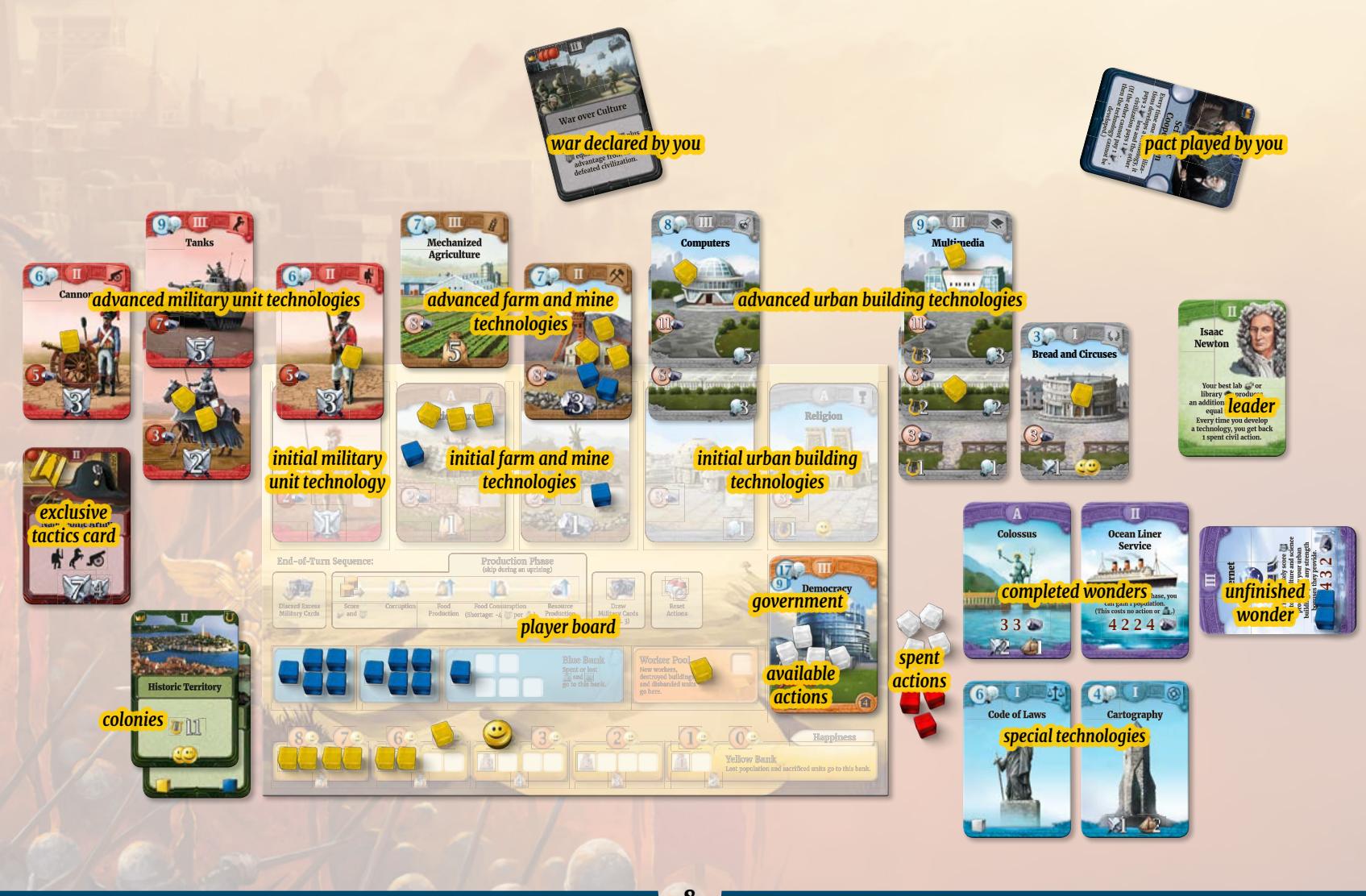
TECHNOLOGY CARDS IN PLAY
Most of the cards you have in play are technology cards. They include:
Any civil card that has a science cost in its upper left corner.
Your initial technologies, which are printed on your player board. For all purposes, they are considered to be cards in play.
The type of the technology is depicted in the upper right corner of the card.
FARM OR MINE TECHNOLOGIES
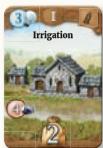
These allow you to build farms or mines, and to store food and resources.
Farm or mine: Each worker on a farm technology card
or mine technology card in play represents one farm or mine of the corresponding level. There is no limit to how many farms or mines you can have.
Farms and mines have no effect on your ratings. During the Production Phase, each farm or mine produces food or resources. (Production Phase p 6.)
Farm and mine technologies allow you to store food and resources. Each blue token on the card is worth the amount of foodor resourcesdepicted at the bottom. There is no limit to how many blue tokens may be on a card. (Food and Resources p 11.)
Note: A farm or mine technology card can store food or resources even if it has no worker.
URBAN BUILDING TECHNOLOGIES
These allow you to build urban buildings.
| Urban | building: | Each |
| worker | on an | urban |
| building technology card |
in play represents an urban building of the corresponding level and type.
Your government has an urban building limit that specifies the maximum number of urban buildings you can have of any particular type.
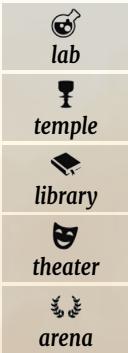
Each urban building (i.e., each worker
on an urban building technology card) contributes to your ratings as indicated by the symbols at the bottom of the card. (Your Statistics p 10, Ratings p 10.)
MILITARY UNIT TECHNOLOGIES
These allow you to build military units.
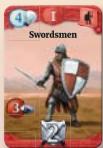
Military unit: Each worker on a military unit technology card in play represents a military unit of the corresponding level and type. There is no limit to how many military units you can have.
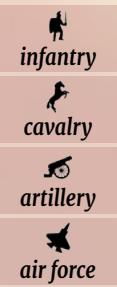
Each military unit (i.e., each worker on a military unit technology card)
contributes to your strength rating by the value printed at the bottom of the card. Military units may be grouped into armies according to your current tactic. (Tactics Cards p 9.)
SPECIAL TECHNOLOGIES
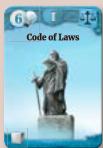
| These technologies provide effects without workers. Each technology's effect | I law |
| is depicted on the card. Symbols are explained | 怡 warfare |
| under Your Statistics (p 10). | O |
Limitation: You can never be affected by two special technologies of the same type. If you have two of the same type
in your play area, you immediately remove the one with the lower level.
GOVERNMENTS
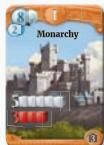
Governments provide most of your civil and military actions. Workers cannot be placed on a government card.
You always have exactly one government in play. You begin the game with
Despotism. Each time you put a new government into play, it replaces the old one. In addition to giving you actions, some governments also have other effects. (Your Statistics p 10.)

B The number in the lower right corner defines your urban building limit. This specifies the maximum number of urban buildings you can have of any particular type.
OTHER CIVIL CaRDS IN PLAY
WONDERS
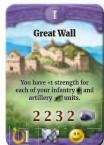
Wonders must be built in stages. (Build a Stage of a Wonder p 5.)
A wonder enters play turned sideways to indicate that it is unfinished. It will have no effect until it is completed. You can
never have more than one unfinished wonder in play You may have any number of completed wonders. (Take a Wonder from the Card Row p 5.)
Once a wonder is completed, it is turned right side up and its effects begin to apply.
The Age III wonders say "You immediately score". This is a one-time effect that happens as soon as the wonder is completed.
Exception: The Taj Mahal's text applies when the Taj Mahal is in the card row.
LEADERS

A leader gives your civilization a special ability. You can never have more than one leader in play. Taking a leader from the card row prevents you from taking any other leader from that age. (Take a Non-Wonder Card from the Card Row p 5.)
When you put a leader in play, the card's effect immediately begins to apply. (Play a Leader p 5.)
ACTION CARDS
Action cards are never put into play. They have a one-time effect, and the card is discarded as soon as the effect is resolved. (Play an Action Card p 6.)
MILITARY CARDS IN PLAY
COLONIES
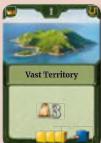
Some events represent the discovery of a new territory. If you colonize the territory, it enters your play area and becomes your colony. (Colonization p 7.)
A colony has an immediate effect depicted an inimiediate effect depicted in the middle of the card. This occurs only when it is first colonized. (Colonization p 7.)
It also has a permanent effect depicted at the bottom. (Your Statistics p 10.)
The permanent effect transfers with the colony. If you lose your colony, you remove it from play and lose the permanent effect depicted. If another player steals your colony, move the card to his or her play area. You lose the permanent effect and the new owner gains it. By contrast, the colony's immediate effect is ignored when it is lost or stolen.
TACTICS CARDS
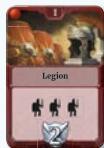
Tactics allow players to form armies.

Your current tactic is marked by your tactics marker. It may be an exclusive tactics card (in your play area) or a common tactics card (in the common tactics area of the military board). At the start of the game, you have no current tactic.
(Play a Tactic p 6, Copy a Tactic p 6, Make Tactics Available p 3.)
Forming armies: Your current tactic depicts a set of types of military units. To make an army, you need that many military units of those types. (Note: Armies are formed virtually. Your worker tokens are not moved.)
At the bottom of the card is a number specifying each army's tactical strength. Each army you can make contributes its tactical strength to the strength rating of your civilization. Each army may also have one air force unit. This doubles its tactical strength.
Note: A unit may belong to no more than one army.
Outdated armies: Age II and Age III tactics also depict a lesser tactical strength value. If any unit in the army is two or more levels lower than the level of the tactics card, the army is considered outdated and has the lesser tactical strength. Outdated armies with air forces have double the lesser tactical strength.
Your armies always form in a way that maximizes your strength rating. You cannot choose to form them differently. (Strength Rating p 10.)
PACTS
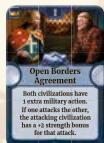
Pacts let you cooperate with other civilizations. You may have at most one pact in your play area. However, you may also be affected by pacts in other players' areas. (Offer a Pact p 4, Cancel a Pact p 4.)
WARS
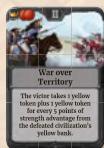
When wars are put into play, they have no effect. They have a one-time effect one round later, when they are resolved. Then they are removed from play. (Declare a War p 4, Resolve a War p 3.)
OTHER MILITARY CARDS
Other military cards are never put into play. They have only a one-time effect.
AGGRESSIONS
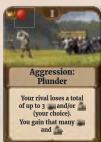
Aggressions are evaluated when played and then discarded. (Play an Aggression p 4.)
EVENTS
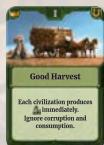
Events are evaluated when they are revealed from the current events deck. Then they go to the past events pile. (Prepare an Event p 4, Evaluating an Event p 7.)
MILITARY BONUS CARDS

Military bonus cards are played for a onetime bonus when defending against an aggression or colonizing a territory. Then they are discarded. (Play an Aggression p 4, Colonization p 7.)
YOUR STATISTICS
Your statistics are determined by cards in play and the locations of your tokens.
The symbols at the bottom of a card depict how it alters your statistics:
If the card requires workers, then the symbols at the bottom of the card depict the contribution of each worker on the card. (And the card contributes nothing if it has no workers.)
If the card does not require workers, then the symbols at the bottom of the card depict the entire contribution of the card.
Exception: A tactics card depicts the contribution of each army. (Tactics Cards p 9.)
- A wonder does not contribute until it is completed. (Build a Stage of a Wonder p 5.)
Your statistics can also be modified by special abilities that are written on cards in play.
When a rule in this book reminds you to update your statistics, it means that you should be sure that any changes to your statistics are reflected by your ratings indicators and your number of red, white, blue, and yellow tokens.
RATINGS
You have four ratings tracked by the positions of your rating markers on four indicators. (Rating Markers p 2.) This bookkeeping system is just informational. At any given time, your ratings can be calculated from your workers and the cards in play.
SCIENCE RATING
This symbol depicts the amount of science produced either by the card or by each worker on the card. Add up all the science produced, including any modifiers. This is your science rating. (Unless the result is negative. In that case your science rating is o.) There is no limit to how high it can be.
CULTURE RATING
This symbol depicts the amount of culture produced by the card or by each worker on the card. Add up all the culture produced, including any modifiers. This is your culture rating. It cannot be lower than o. There is no limit to how high it can be. Note: An effect that lets you scoreunder certain circumstances does not count toward your rating.
STRENGTH RATING
On a tactics card, this symbol depicts the tactical strength contributed by each army. (Tactics Cards p 9.) On any other card, it depicts the amount of strength contributed by the card or by each worker on the card. Add up all the strength contributions, including any modifiers. This is your civilization's strength rating. It cannot be lower than o. There is no limit to how high it can be.
Note: A military unit always contributes its strength, even if it is in an army.
HAPPINESS RATING
Each of these symbols represents one happy face produced by the card or by each worker on the card.
Similarly, this represents -1 happy face produced by the card or by each worker on the card. (Note: A card with this symbol does not count as a card that gives you a happy face.)
Add up all the happy faces. (Don't forget to subtract unhappy faces.) If the total is between 0 and 8, that is your number of happy faces. If the total is less than 0, you have o happy faces. If the total is more than 8, you have 8 happy faces.
The number of happy faces you have is also called your happiness rating.
COLONIZATION MODIFIER
Cards with this symbol can provide a colonization modifier. A modifier might be specified in the text of a card. If you have no such cards, your colonization modifier is zero. The colonization modifier is relevant only during colonization. (Colonization p 7.)
CIVIL AND MILITARY ACTIONS
ACTION TOTAL
Your civil action total is the number of these symbols you have on your cards in play. Include the symbols on your government card, plus all those at the bottoms of other cards.
Your military action total is the number of these symbols you have on your cards in play. Include the symbols on your government card, plus all those at the bottoms of other cards.
SPENDING ACTIONS
You should have white tokens equal to your civil action total and red tokens equal to your military action total. When these tokens are on your government card, they represent actions that are available to be spent. When you spend or pay an action, move the corresponding token off the card. It is no longer available.
If you are required to pay actions to do something and you do not have enough available actions, then you cannot do that thing.
Some effects allow you to gain an action back. In this case you move a spent token back onto your government card. It is available again. If you have no spent actions when you gain one back, nothing happens.
Temporary actions: If an effect gives you an action for a turn, you spend that action the first time it applies. It does not affect your action total.
WHEN YOUR ACTION TOTAL CHANGES
Your action total changes only when a card enters or leaves play. This will affect your spent and available actions:
If your action total increases, take the appropriate number of red or white tokens from the box and put them on your government card. They represent available actions.
If your action total decreases, return the appropriate number of red or white tokens to the box. You return spent tokens first. Available tokens are returned only if there are not enough spent tokens.
If a card leaves play because it is being replaced by a card entering play, update your tokens once the process is complete. You cannot resolve it as two separate steps.
BLUE AND YELLOW TOKENS
You start the game with a certain number of blue and yellow tokens on your player board, most of them in your blue and yellow banks.
Your banks are always filled from left to right. Each token is placed in a square. If all the squares are full, additional tokens may be kept in the rightmost section. There is no limit to the number of tokens that can be there.
Most operations with blue and yellow tokens involve transferring them between your player board and cards in play. The exceptions are:
If a card with either of these symbols on the bottom enters your play area, you gain that many blue or yellow tokens. If it leaves your play area, you lose that many tokens.
If a card with either of these symbols on the bottom enters your play area, you lose that many blue or yellow tokens. If it leaves your play area, you gain that many tokens.
▶ Some cards can cause players to gain new tokens, return tokens to the box, or take them from each other, as specified in the text of the card.
If you gain blue or yellow tokens, they go to your blue or yellow bank, respectively.
If you lose blue tokens, you return blue tokens from your blue bank to the box. If there are not enough in your blue bank, you also return tokens from mines and farms of your choice.
If you lose yellow tokens, return tokens from your yellow bank to the box. If there are not enough, you return all those in your yellow bank, but no more.
If you take yellow tokens from another player, take them from his or her yellow bank and add them to yours. If there are not enough in the other player's bank, take them all, but no more.
WORKERS AND POPULATION
Any yellow token in your play area that is not in your yellow bank is a worker.
An unused worker is one that is not on any card. It can be in your worker pool or it can be marking a missing happy face, as explained below.
If an effect tells you to gain 1 population, you move one yellow token from your yellow bank to your worker pool. It is now a worker. This does not require any food.
If an effect tells you to increase your population, you follow the rules for the action (Increase Your Population p 5). Increasing your population usually requires food.
If an effect tells you to lose 1 population, you move one unused worker to your yellow bank. If you have no unused worker, you must take one from your cards. An equivalent term is lose workers.
DISCONTENT WORKERS
Your yellow bank is divided into subsections, each marked by a number next to a happy face. The number depicted above the leftmost empty subsection specifies how many happy faces your populace requires. If you have fewer happy faces, the shortfall is your number of discontent workers. If you have the required happy faces or more, you have no discontent workers. (Happiness Rating p 10.)
If your discontent workers outnumber your unused workers at the end of your turn, you face an uprising and must skip your Production Phase. (Check for an Uprising p 6.)
Bookkeeping trick: You should have no empty subsections to the left of your happiness marker. If you do, place an unused worker above each such subsection. If you don't have enough, you will face an uprising unless you correct the problem. Workers used in this bookkeeping method are still considered to be available.

Note: The game does not track which workers are discontent. Only the number is important for events like Rebellion, Civil Unrest, Emigration, and Impact of Population. It does not matter whether there are actually unused workers covering missing happy faces or not.
... YOUR CIVILIZATION
Food AND RESOURCES
Your foodand resources are represented by blue tokens on the mine and farm technologies you have in play. Each blue token represents the quantity printed at the bottom of the card.
GaINING Food OR RESOURCES
Usually, you produce food and resources during your Production Phase (p 6) but some cards allow you to gain them as an immediate effect.
Whenever an effect tells you to gain food or resources, move one or more blue tokens from your blue bank to your farm or mine technology cards. The resulting total must be exactly the amount of food or resources you are supposed to gain.
If there are not enough blue tokens in your blue bank to cover the required value, you gain the nearest lower value that can be gained. If the blue bank is empty, you cannot gain food or resources. If an effect tells you to gain food and resources at the same time, gain them in the order written on the card.
LOSING Food Or RESOURCEs
When you need to pay or spend food and resources, you have three options:
Return a blue token from a farm or mine technology card to your blue bank, thus paying the amount depicted on that card.
▶ Move a blue token from a farm or mine technology to a technology of the same type with lower value, thus paying the difference between the values.
Pay as above, and then gain some food or resources back (of lesser total value) thus paying the difference between the amount p
Content is long; only the first part is inlined. Download the file or open the rules page for the full text.
Download Markdownthrough-the-ages-new-leaders-and-wonders-rulebook-french.md57.3 KB
原文本层提取版本已由本版替换(2026-10-31),正文相似度 0.52
Vlaada Chvátil THROUGH the AGES
L'HISTOIRE VOUS APPARTIENT
Nouveaux Horizons
〔图:images/202396ae311e1616c6f377d512e294f342a836efe51021aee930c1108663ba76.jpg〕
Chères joueuses, chers joueurs,
Cette extension était prévue de longue date et a été développée pendant de nombreuses années. L'idée d'origine était d'ajouter simplement de nouveaux leaders et de nouvelles merveilles. Au cours du développement, de nombreuses cartes ont donc été proposées, la plupart dans différentes versions. Les cartes qui ont finalement été choisies sont celles qui, à notre avis, améliorent le plus l'expérience de jeu, celles qui sont les plus amusantes et les plus intéressantes à jouer. Parfois, pour privilégier l'aspect ludique, il nous a fallu laisser de côté des éléments qui avaient plus de sens sur le plan historique. Nous avons par la suite décidé qu'il serait dommage de ne pas toucher à la partie politique du jeu. Nous avons donc ajouté quelques nouvelles cartes militaires pour pimenter cet aspect du jeu, sans pour autant le transformer en profondeur.
La tâche la plus ardue a consisté à équilibrer toutes ces nouveautés. Heureusement, de nombreux joueurs à travers le monde connaissent notre jeu par cœur. Nous avons donc intégré les cartes de cette extension dans la version numérique de Through the Ages, et nous avons invité les meilleurs joueurs en ligne à jouer plusieurs milliers de parties incluant les cartes de cette extension. Les résultats de ces parties et les retours des joueurs nous ont aidés à équilibrer toutes ces nouvelles cartes. Nous leur en sommes vraiment reconnaissants, car sans eux il aurait été impossible d'équilibrer aussi finement cette extension.
Pour finir, comme nous avions à notre disposition énormément de données et de retours sur le jeu de base, la dernière pièce logique de ce puzzle a consisté à ajuster les cartes exceptionnellement fortes ou faibles afin de les rééquilibrer. Nous avons aussi légèrement modifié la durée des parties.
Honnêtement, tout cela a pris bien plus de temps que prévu. Mais Through the Ages est un projet qui nous tient particulièrement à cœur. Nous ne regrettons donc pas les efforts supplémentaires que nous avons déployés pour cette extension. Nous espérons que vous apprécierez le résultat autant que nous avons aimé œuvrer à sa réalisation.
DANS CETTE EXTENSION...
Les cartes disposant de cette icône sont ajoutées au jeu de base :
〔图:images/04fc25a952e0107ccf83c1a8ca26f724b1cb8a6bdac6694cddd1c8bf3f3e63e9.jpg〕
24 nouvelles cartes de leaders
(six pour chaque Âge)
〔图:images/c69c96974a6d7d942ec76d553deb87d8270543bea3308a53f7415cc38550322a.jpg〕
16 nouvelles cartes de merveilles
(quatre pour chaque Âge)
〔图:images/279449085d1824a6a6bb26f3848071570797bc5f0aa50abbf4e19ec09ac423cf.jpg〕
19 nouvelles cartes militaires
(une pour l'Âge A et six pour les Âges suivants)
〔图:images/b05799646be4229247797dc50de6e50b09fc0bed50c9fc3846442d02d32177a2.jpg〕
21 cartes alias pour les leaders
(sept pour les Âges I, II et III)
〔图:images/1f10a1f17665afc4836c0139836e4e4d50c632e52aab099facde8756f45b7d3d.jpg〕
15 cartes alias pour les merveilles
(cinq pour les Âges I, II et III)
〔图:images/ea60439de004b852c0daedff212c727a42d3c23878e835b8383230e5d34d8a69.jpg〕
6 cartes d'action supplémentaires marquées ③+
(une pour l'Âge I, deux pour l'Âge II
et trois pour l'Âge III)
Les cartes avec ce symbole remplacent les cartes du même nom dans le jeu de base :
• 7 cartes de leaders rééquilibrées
• 5 cartes de merveilles rééquilibrées
• 7 cartes de technologie rééquilibrées
〔图:images/0a9944e254a7712fbb9fb1b6ce154545ebc38c99027f6bcbe79a8a4eb2802e43.jpg〕
〔图:images/cf701ab72c3e3259f316d77394531d72ad37d72b8ba4a23f764e96c7594c7e3a.jpg〕
〔图:images/4de1a57e2c562a25171f5d1f33387778bfe436eeb93a2c4bcd95352043e17ef3.jpg〕
〔图:images/d08afac0d9128dd17a9722a2841786f09ede6f4210a4c80be0acc2f1f3be464e.jpg〕
〔图:images/edf55a654ec7627221d53cff0a162b39b46a53f86889da03331c0f59cd143352.jpg〕
Utilisez les nouveaux paquets militaires à la place des paquets du jeu de base.
〔图:images/e7aeaff4ecdb76062a7a2c81476df51b78058c3d45691e68a9c99c08057f477c.jpg〕
Utilisez ce côté du plateau pour des parties à 2 joueurs.
Utilisez l'autre côté pour des parties à 3 ou 4 joueurs.
〔图:images/cbcc1faa75417ffea2889ea6f9cae3699d3be4139b68b14f8b11234eb5bc6f07.jpg〕
Nous avons ajouté quelques cubes, car certaines cartes peuvent en avoir besoin.
Les cubes sont aussi utilisés pour résoudre de nouveaux effets, comme expliqué dans l'Annexe.
〔图:images/ea0c2d8ee8bc638e612e822e1e4e921d3bdcae88ae489e379930d2e404df584a.jpg〕
Utilisez ce jeton pour indiquer qui est le premier joueur (pour savoir qui a joué un tour de plus et qui commencera la dernière manche).
MODULES DE L'EXTENSION
Trois modules distincts composent cette extension et peuvent être utilisés indépendamment :
Cartes du jeu de base rééquilibrées
Nouvelles cartes militaires
Nouveaux leaders et nouvelles merveilles
Chacun de ces trois modules est détaillé dans ce livret de règles.
RÉÉQUILIBRAGE DU JEU DE BASE
Pour rééquilibrer le jeu, nous nous sommes appuyés sur les retours de joueurs expérimentés et sur les statistiques de milliers de parties en ligne. Voici les ajustements effectués :
CARTES RÉÉQUILIBRÉES
Certaines cartes étaient tellement fortes que les joueurs expérimentés les prenaient systématiquement dans la rangée de cartes, même pour le coût maximum. Nous avons légèrement réduit leur puissance. Ce sont toujours de bonnes cartes, mais il faut désormais réfléchir et évaluer leur pertinence.
À l'opposé, certaines cartes étaient trop faibles, et les prendre pouvait réduire vos chances de remporter la partie. D'autres cartes n'étaient intéressantes que dans certaines situations. Les joueurs expérimentés le savaient, et elles n'étaient que très rarement jouées. Nous avons donc renforcé ces cartes pour qu'elles fassent davantage partie du jeu. Certaines sont peut-être désormais les plus puissantes de leur Âge.
AJUSTEMENT DE LA
DURÉE DE LA PARTIE
Nos données ont montré que les parties avec plus de joueurs (et particulièrement les parties à 3 joueurs) duraient, en moyenne, une manche de moins que les parties à 2 joueurs. Les joueurs avaient le sentiment que l'Âge III passait très vite, sans leur laisser le temps de profiter pleinement de la civilisation qu'ils avaient développée.
De plus, un problème évident se posait pour les cartes d'action : le même nombre de cartes était en jeu, quel que soit le nombre de joueurs, ce qui rendait les cartes d'action plus difficiles à récupérer dans les parties à 3 ou 4 joueurs.
Nous avons pris en compte ces deux problèmes en ajoutant six cartes d'action (elles disposent d'une icône ③+). Nous avons aussi décalé trois cartes de technologie de ④ à ③+. Il y a donc désormais légèrement plus de cartes dans les parties à 3 et 4 joueurs.
COMPATIBILITÉ ENTRE L'APPLICATION ET LES NOUVELLES CARTES
Les versions plateau et numérique du jeu de base ont été développées ensemble, mais elles comportaient tout de même quelques différences. Nous avons clarifié cela dans cette extension :
- Les cartes Territoire Riche et Sports Professionels utilisent désormais les valeurs de la version numérique.
- Chemin de Fer Transcontinental a été modifiée pour rendre le texte davantage homogène vis-à-vis des nouvelles cartes de cette extension.
- Remarque : Sports Professionnels a été modifiée pour trois raisons! Elle était quelque peu différente dans la version numérique, sa puissance devait être augmentée, et nous voulions ajouter une autre carte Sports Professionnels dans les parties à 3 joueurs.
COMMENT RÉÉQUILIBRER LE JEU DE BASE
Si vous souhaitez rééquilibrer le jeu de base, voici les étapes à suivre :
- Pour chaque leader et chaque merveille portant l'icône 🌐, cherchez la carte correspondante dans le jeu de base et remplacez-la par sa nouvelle version.
-
Faites de même pour les 7 cartes de technologie :
-
Communisme et Fondamentalisme ne sont qu'en un seul exemplaire dans le jeu de base. Remplacez-les par les nouvelles cartes.
- République et Sports Professionnels sont en deux exemplaires dans le jeu de base. Remplacez chacune de ces cartes (un des deux exemplaires était ④, et sera désormais ③+).
-
Attention avec Théorie Militaire. Le jeu de base contenait deux exemplaires de cette carte. Remplacez la carte ④ par la nouvelle carte ③+. L'autre carte Théorie Militaire reste en jeu normalement.
-
Ajoutez les six cartes d'action (jaunes) comportant l'icône 🌟. Elles seront intégrées aux parties à 3 et 4 joueurs (icône ③+).
- La nouvelle version de la carte Territoire Riche est incluse dans le nouveau paquet militaire de l'Âge I. Plus d'informations en page suivante.
CONSERVER LES ANCIENNES CARTES
Nos changements se basent sur les données d'un grand nombre de parties. Cependant, il se peut que votre groupe de joueurs trouve que nous avons renforcé des cartes déjà puissantes, ou affaibli des cartes qui étaient rarement jouées. Vous pouvez choisir de nous faire confiance et d'utiliser les cartes rééquilibrées, ou décider de conserver les anciennes cartes. C'est à vous de voir!
Dans tous les cas, utilisez les nouvelles cartes République et Sports Professionnels, augmentant ainsi le nombre de cartes dans les parties à 3 joueurs.
DÉCOMPTE DES CARTES
Le tableau ci-dessous résume les changements effectués :
| Marquées 3+ | Marquées 4 | Pour 3 (4) joueurs | |
| JÉU DE BASE | |||
| Âges I à III | 6 technologies | 3 technologies | → ajout de 6 (9) cartes |
| JEU RÉÉQUILIBRÉ | |||
| Âge I | 6 technologies, 1 action | 3 technologies | → ajout de 7 (10) cartes |
| Âge II | 7 technologies, 2 actions | 2 technologies | → ajout de 9 (11) cartes |
| Âge III | 8 technologies, 3 actions | 1 technologie | → ajout de 11 (12) cartes |
Ce n'est plus aussi simple qu'avant, mais nous avons préservé une certaine symétrie.
NOUVELLES CARTES MILITAIRES
Les nouveaux paquets militaires contiennent 16 nouvelles cartes pour ajouter un brin de variété à vos parties. La carte Territoire Riche a été rééquilibrée pour correspondre à la version numérique. 3 cartes militaires bonus ont également été ajoutées pour conserver la même proportion de cartes.
C'est le module le plus simple de cette extension. Laissez les paquets militaires d'origine dans la boîte de base et utilisez seulement les nouveaux.
Le fait d'utiliser de nouveaux paquets entiers permet d'assurer que les cartes du jeu de base ne peuvent pas être différenciées de celles de l'extension lorsque vous regardez leur dos. L'Annexe vous précisera comment certaines cartes militaires fonctionnent.
Astuce : Si vous ne lisez pas l'Annexe avant votre première partie, piocher des cartes militaires et révéler des événements vous réservera de belles surprises !
NOUVEAUX LEADERS ET NOUVELLES MERVEILLES
Et voici le module le plus excitant de cette extension : 40 nouvelles cartes de leaders et de merveilles!
Certains effets s'avèrent plus complexes que dans le jeu de base. Toutes les explications sont compilées dans l'Annexe. Le fonctionnement est cependant très intuitif, et vous n'aurez rapidement plus besoin de vous référer à l'Annexe. (Doubler le nombre de cartes accroît considérablement le nombre de combinaisons et d'interactions!)
Si vous faites découvrir le jeu à de nouveaux joueurs, nous vous conseillons de vous limiter au jeu de base. Mais si tout le monde sait déjà jouer, vous êtes certainement impatients de découvrir ces nouvelles cartes. Il y a plusieurs manières de les utiliser :
EXTENSION TOTALE
La manière la plus simple de vous familiariser avec les nouvelles cartes est de remplacer les anciennes cartes de leaders et de merveilles par les nouvelles. Le nombre de leaders et de merveilles ne changera pas, et les règles du jeu resteront les mêmes.
Astuce : Si vous ajoutez les cartes sans en prendre connaissance, votre partie sera un plongeon rafraîchissant dans l'inconnu!
TIRAGE SECRET
En mixant les cartes du jeu de base et celles de l'extension, le nombre de combinaisons est très élevé. Vous pouvez aussi choisir d'augmenter le nombre de cartes dans vos parties à 3 ou 4 joueurs pour les rendre moins difficiles à prendre dans la rangée de cartes.
Récupérez tous les leaders et toutes les merveilles du jeu de base et de l'extension, et triez-les selon leur Âge. Mélangez chaque pile de cartes séparément et piochez (aléatoirement donc) des leaders et des merveilles :
- Dans une partie à 2 joueurs, piochez 6 leaders et 4 merveilles par Âge.
- Dans une partie à 3 ou 4 joueurs, piochez 7 leaders et 5 merveilles par Âge.
Sans les consulter, ajoutez ces cartes aux paquets de cartes civiles correspondants. Rangez les cartes non utilisées dans la boîte.
La partie se déroule ensuite selon les règles habituelles. Dans une partie à 3 ou 4 joueurs, vous disposerez alors d'un choix de cartes légèrement plus grand à mesure que les Âges passeront.
TIRAGE PUBLIC
Nous conseillons de réserver ce mode de jeu aux joueurs expérimentés. Il offre une grande variété de combinaisons tout en permettant une planification stratégique.
CARTES ALIAS
Une fois l'Âge A passé, les cartes de leaders et de merveilles ne seront plus glissées dans les paquets civils. Dans les paquets civils des Âges I, II et III, remplacez les leaders et les merveilles par les cartes alias correspondantes.
〔图:images/750eb6da91d3bfae6265d8034ecf155239992ecb6b7cadd6ff255a2b4061bcb1.jpg〕
- Dans une partie à 2 joueurs, utilisez pour chaque Âge les cartes alias leaders numérotées de 1 à 6 et les cartes alias merveilles numérotées de 1 à 4.
- Dans une partie à 3 ou 4 joueurs, utilisez toutes les cartes alias (1 à 7 pour les leaders et 1 à 5 pour les merveilles).
(Autrement dit, dans une partie à 2 joueurs, n'utilisez pas les cartes alias marquées ③+.)
Mélangez chacun des paquets séparément.
PLATEAUX DES LEADERS ET DES MERVEILLES
Ces plateaux vous permettent de visualiser les cartes disponibles pour votre partie. Chaque plateau est recto verso : la face « 2 joueurs » dispose d'emplacements pour 6 leaders et 4 merveilles, alors que la face « 3-4 joueurs » en propose pour 7 leaders et 5 merveilles. Choisissez les faces correspondant au nombre de joueurs et placez les deux plateaux sur la table, visibles de tous (l'idéal est de les placer juste au-dessus de la rangée de cartes).
CHOIX DES LEADERS ET DES MERVEILLES
Récupérez toutes les cartes de leaders et toutes les cartes de merveilles du jeu de base et de l'extension, et triez-les en huit paquets – un paquet des merveilles et un paquet des leaders pour chaque Âge.
Mélangez chaque paquet séparément et piochez, aléatoirement et pour chaque Âge, le nombre approprié de leaders (6 pour 2 joueurs, 7 pour 3 et 4 joueurs) ainsi que le nombre approprié de merveilles (4 pour 2 joueurs, 5 pour 3 et 4 joueurs). Seules ces cartes seront utilisées dans votre partie, les autres cartes sont rangées dans la boîte.
Mélangez les leaders et les merveilles de l'Âge A dans le paquet civil de l'Âge A. On retrouve ici le mode « Tirage secret » présenté à la page précédente, sauf que là, vous pouvez prendre connaissance des cartes sélectionnées.
Placez les leaders et les merveilles de l'Âge I sur les emplacements prévus à cet effet sur le plateau des leaders et le plateau des merveilles. Il y a un emplacement prévu pour chaque carte. Leur ordre n'a pas d'importance, il sera fixé plus tard lorsque vous révélerez les cartes alias.
Les paquets des leaders et des merveilles des Âges II et III sont conservés face visible à côté des plateaux. Les joueurs peuvent consulter ces paquets à tout moment. Si vous avez de la place sur la table, vous pouvez même étaler ces cartes pour qu'elles soient visibles de tous les joueurs. Lorsque vous connaîtrez suffisamment les cartes, il vous suffira de lire leur nom pour les identifier.
PREMIÈRE MANCHE
- Lors de la première manche de jeu, les leaders et les merveilles de l'Âge A sont placés dans la rangée de cartes, comme d'habitude.
- Si un joueur le souhaite, il peut consulter les cartes restantes dans le paquet de l'Âge A.
- Avant de compléter de nouveau la rangée de cartes avec des cartes de l'Âge A, mélangez ce paquet (les joueurs ne sont pas censés connaître l'ordre d'apparition des cartes).
MANCHES SUIVANTES
- Dès que vous commencerez à piocher des cartes dans le paquet civil de l'Âge I, des cartes alias pourront être révélées et placées dans la rangée de cartes. Lorsqu'une carte alias apparaît, remplacez-la par la carte correspondante du plateau des leaders ou du plateau des merveilles. Par exemple, lorsque la carte alias leader n° 4 est placée dans la rangée de cartes, remplacez-la par le leader positionné sur l'emplacement n° 4 du plateau des leaders. Ainsi, les cartes des plateaux des leaders et des merveilles entreront en jeu dans un ordre aléatoire.
- Défaussez la carte alias dans la défausse de son Âge.
Par exemple, une carte alias de l'Âge I sera placée dans la défausse de cartes civiles de l'Âge I.
FIN DE L'ÂGE I
- À la fin de l'Âge I, toutes les cartes alias ont été piochées, et les plateaux des leaders et des merveilles sont vides. Placez les leaders et les merveilles de l'Âge II sur leurs plateaux respectifs.
FIN DE L'ÂGE II
- À la fin de l'Âge II, placez les leaders et les merveilles de l'Âge III sur leurs plateaux respectifs.
Les cartes alias sont remplacées dès qu'elles sont placées sur la rangée de cartes. À votre tour, vous avez devant vous les leaders et les merveilles accessibles, comme dans une partie classique. Les plateaux des leaders et des merveilles vous indiquent simplement quelles cartes sont à venir pour l'Âge en cours.
Astuce : Vous pouvez prévoir des défausses spécifiques pour les cartes de leaders et de merveilles. Ainsi, elles ne se mélangeront pas avec les cartes alias qui, pour leur part, sont défaussées comme des cartes civiles classiques. Cela permettra une mise en place plus rapide lors de vos prochaines parties.
AUTRES VARIANTES
Vous pouvez bien entendu utiliser les nouveaux leaders et les nouvelles merveilles selon vos envies.
Vous aimez le mode « Tirage public », mais pas la quantité d'informations disponibles dès le début de la partie? Gardez secrets les futurs leaders et ne les révélez qu'au début de leur Âge.
Vous souhaitez utiliser l'ensemble des nouveaux leaders et des nouvelles merveilles, tout en ajoutant un leader et une merveille supplémentaires à chaque Âge? Vous disposez d'un large choix pour ce faire, et l'apparition de vieilles connaissances au milieu des nouvelles cartes sera une surprise bienvenue.
Vous voulez choisir quelles cartes seront en jeu? Plutôt que d'effectuer un tirage aléatoire, vous pouvez vous mettre d'accord sur les cartes sélectionnées. Ou distribuer deux merveilles et trois leaders à chaque joueur (pour chaque Âge), et les laisser choisir (chaque joueur sélectionne un leader et une merveille par Âge, et les cartes manquantes sont piochées aléatoirement). Si vous jouez en mode « Tirage secret », cela donnera à chaque joueur une bribe d'information.
〔图:images/1cb0f7d7de24af29a370121a9230b2447d2a4e95a5f702a0c2b49a98820fef42.jpg〕
〔图:images/72d5cb341560ae6dddf45a90c811315138492fe0b9f175476285d641614ad108.jpg〕
〔图:images/01634ad22e2da658fc1056a824d6186e67aca8b57a46c788ff13869ee6cbb7a5.jpg〕
NOUVELLES RÈGLES
Cette extension n'apporte pas de nouveaux mécanismes de jeu, mais les nouvelles cartes proposent de nouveaux effets et combinaisons. Pour que ces nouvelles cartes fonctionnent, il est nécessaire de clarifier quelques points :
BONUS DE PRODUCTION
〔图:images/13298fab5399e6df94c5376dfacfb3d9931ce261f60a2e77524bd91af2837b32.jpg〕
Certaines nouvelles cartes produisent des ressources supplémentaires. Elles sont reconnaissables grâce au symbole 📄 au bas de la carte et, sur certaines cartes, clarifiées par un texte. Ce n'est pas un nouveau mécanisme. Il a déjà été utilisé sur les pactes Commerce International et Acceptation de la Suprématie.
À chaque fois que vous produisez des ressources (à la fin de votre tour de jeu ou lorsque la résolution d'un événement vous permet de produire), commencez par produire de manière classique – ajoutez un cube bleu pour chaque cube jaune présent sur chaque carte de technologie de mine (et les laboratoires avec Bill Gates). Profitez dès à présent des avantages de Chemin de Fer Transcontinental et de Machu Picchu.
Ensuite, ajoutez tous vos bonus de production (procurés par le symbole 📄 et les pactes du jeu de base) et déduisez, le cas échéant, la pénalité du pacte Acceptation de la Suprématie. Vous gagnez toutes les ressources simultanément. Ainsi, si vous disposez de trois cartes qui vous procurent chacune un bonus 📄, vous n'avez pas à placer trois cubes bleus sur une carte Bronze ; vous pouvez placer un cube bleu sur une carte Charbon. (Si votre total est négatif, vous perdez des ressources au lieu d'en gagner.)
Les bonus de production sont aussi comptabilisés lorsqu'une carte vous demande d'évaluer votre production de ressources. Par exemple, ils comptent pour l'Empire State Building et l'Impact de l'Équilibre. L'Impact de l'Industrie est une exception, car la carte se réfère explicitement à la production de vos mines.
Astuce : Pour ne pas oublier vos bonus de production, vous pouvez placer des cubes rouges au pied de vos cartes de mines. Chaque cube rouge représente le nombre de cubes bleus que vos bonus vous allouent. Par exemple, si vous avez bâti les Voies Romaines, placez un cube rouge sur une carte Bronze durant l'Âge I. Si par la suite Isabelle de Castille guide votre civilisation, vous pouvez ajouter un second cube rouge ou déplacer le cube rouge sur Fer, si vous avez développé cette technologie. À la fin de l'Âge I, lorsque les Voies Romaines arrêtent de produire 📄, ajustez vos cubes rouges afin d'être en adéquation avec votre nouveau niveau de production.
Consultez l'Annexe pour des conseils relatifs au décompte des bonus de Machu Picchu et de Chemin de Fer Transcontinental.
RESSOURCES ACCORDÉES DANS UN BUT PRÉCIS
〔图:images/2cfa7626ef0897061085fd2b35bc4dc7976c35e40710e63a2ab0a4eb879c89fb.jpg〕
Dans le jeu de base, des ressources temporaires peuvent être octroyées pour construire ou améliorer les unités militaires (grâce à des cartes d'action ou Churchill). Cette extension inclut de nouvelles cartes vous procurant des ressources temporaires dans un but précis.
Même si vous jouez certainement correctement, les règles du jeu de base ne sont pas aussi claires que nous le souhaitions. Voici les règles complètes :
Les ressources octroyées dans un but précis sont toujours des ressources temporaires. Cela signifie que :
- Vous ne les représentez pas par des cubes bleus. Vous les comptez juste dans votre tête.
- Au moment de payer, vous commencez par dépenser automatiquement ces ressources, jusqu'à ce qu'elles soient épuisées.
- Les ressources temporaires non utilisées disparaissent à la fin de votre tour.
〔图:images/48fda347886a646222ac2bf1aac2bd8106b7a2dc2d2618f3e55c61816581c01d.jpg〕
ANNEXE
Dans cette annexe, vous trouverez des précisions sur un certain nombre de cartes, ainsi que des conseils pour mieux tracer certains effets.
Pour une liste complète des cartes, des explications encore plus détaillées, des informations intéressantes sur leur développement et leur justification historique, rendez-vous sur www.throughtheages.com/expansion (en anglais).
CARTES DE L'ÂGE A
〔图:images/76b57c419a88dfa14a190c543be7551c96e92fa7afc8274521b96bd04e131c47.jpg〕
CONFUCIUS
Confucius vous permet de jouer n'importe quelle carte militaire comme un événement. Vous le faites exactement de la même manière que pour préparer un événement classique (les autres joueurs ne le sauront pas tant que la carte ne sera pas révélée).
Lorsqu'une carte militaire non-événement est révélée, l'événement à résoudre est « Chaque civilisation gagne 1 » même si Confucius n'est plus en jeu.
〔图:images/00573a38d524fd9dc49a688845c5502e3bd27e3d984923755d47ee77ebb395a9.jpg〕
SUN TZU
Lorsque vous devez piocher des cartes militaires, vous en piochez toujours 2, même si vous n'avez plus d'actions militaires. Vous piochez ensuite jusqu'à 3 cartes militaires, en fonction de vos actions militaires non utilisées, comme d'habitude.
Tant que Sun Tzu est en jeu, votre tactique exclusive ne rejoint pas la zone des tactiques communes. Si vous changez de tactique, votre ancienne tactique demeure dans votre aire de jeu, à côté de votre nouvelle tactique exclusive. Personne ne peut la copier, pas même vous! (Seules les tactiques communes peuvent être copiées.)
Au début de votre premier tour sans Sun Tzu, toutes les cartes tactiques de votre aire de jeu sont déplacées dans la zone des tactiques communes... comme si quelqu'un venait de les publier dans un ouvrage de stratégie militaire.
Sun Tzu a aussi un effet qui va traverser les Âges : lorsqu'il quitte la partie, placez sa carte sous votre carte tactique actuelle. (Si vous n'en avez pas, il est défaussé normalement.)
La tactique à laquelle Sun Tzu est associé reçoit un +1 de manière permanente, jusqu'à la fin de la partie. C'est la tactique spéciale de Sun Tzu. Lorsqu'elle rejoint la zone des tactiques communes, elle peut être copiée en suivant les règles habituelles.
Remarque : Tant que Sun Tzu est en jeu, votre tactique n'est pas encore spéciale. Si votre drapeau de tactique est placé sur une carte de la zone commune, les tactiques du même nom peuvent être réunies. Ce n'est que lorsque Sun Tzu quitte la partie que votre tactique reçoit le bonus de +1 (et doit donc être distinguée des tactiques du même nom).
〔图:images/f4145cf622ddc3affcfefb00b4fbf1a368ea71511e40424d8221223079f0cc6b.jpg〕
ASHOKA
Les « couleurs » sont marron (fermes et mines), gris (technologies de bâtiments urbains), rouge (technologies militaires), orange (gouvernements), vert (leaders) et jaune (cartes d'action). Les merveilles (violet) ne sont pas dans votre main.
Nous considérons que la main de cartes de chaque joueur est visible de tous. Si vous ne jouez pas avec vos cartes civiles face visible, vous devrez révéler le nombre approprié de cartes de couleurs différentes au moment d'utiliser l'effet d'Ashoka. Si votre groupe n'aime pas cette idée, ne jouez pas avec Ashoka.
〔图:images/4e3cdae87334607797c83f4a59a74e89000ddfbb49e6caa020a7c6c3832ca490.jpg〕
HIPPOCRATE
Les cubes jaunes placés sur votre carte de gouvernement ne sont pas affectés par les mécanismes ou effets qui s'appliquent aux cubes jaunes ou aux ouvriers.
Si vous n'avez plus de cubes jaunes dans votre réserve jaune à la fin d'un Âge, vous
n'en perdez pas, mais vous pouvez tout de même en gagner un grâce à Hippocrate.
〔图:images/a71aa9b0c1954b7e1f13d393b64fa9f7d45fecadac54b4ef4c4eb699e34e7e97.jpg〕
Voies ROMAINES
Imaginez que les Voies Romaines ont une icône supplémentaire imprimée au bas de la carte, et que cette icône change en fonction de l'Âge.
Utilisez un cube rouge pour ne pas oublier la production supplémentaire de l'Âge I,
comme expliqué à la page précédente. Actualisez vos niveaux de production à la fin de chaque Âge.
〔图:images/b9313b113fca1a3fc6d5a084c8a276c8f60dca6449ff144fd8ac381778ec3038.jpg〕
COLOSSE (RÉÉQUILIBRÉ)
Vous piochez les cartes au début de l'Âge, même si ce n'est pas à votre tour de jouer. En général, vous commencerez donc votre première Phase Politique du nouvel Âge avec 3 cartes de cet Âge.
CARTES DE L'ÂGE I
〔图:images/5e87f266031262f91be059b713af5178c4b8197dc00016de2d9bbdefe5d12cc2.jpg〕
SALADIN
À la fin de votre premier tour de jeu avec Saladin, prenez un cube blanc dans la boîte. Pour indiquer votre décision, placez ce cube blanc sur votre carte de gouvernement (pour l'utiliser comme action civile), ou placez-le sur votre marqueur de niveau de
force militaire (et avancez ce marqueur de 2 cases). À la fin de chacun de vos tours de jeu, vous pouvez modifier cette décision. N'oubliez pas de reculer le marqueur de niveau de force militaire de 2 cases lorsque vous retirez le cube blanc. Tant que le cube blanc est placé sur votre carte de gouvernement, il vous procure, comme tout autre cube blanc, une action civile. Ce cube compte dans votre nombre total d'actions civiles et doit être dépensé pendant une révolution. Lorsque Saladin quitte la partie, son cube blanc est aussitôt retiré. Si vous retirez le cube blanc de votre marqueur de niveau de force, n'oubliez pas de reculer le marqueur de 2 cases. Si le cube était utilisé comme action civile supplémentaire, vous pouvez retirer du jeu un cube blanc déjà utilisé lors de ce tour.
〔图:images/3e466fd79b05f49413ee733c51792abec25aa7e08e986c626adf63553bce47c1.jpg〕
JAN ŽIŽKA
Les fermiers ne comptent que pour valoriser une tactique. Ils n'ont pas de force militaire et ne peuvent pas être envoyés pour coloniser (même au sein d'une armée). La Grande Muraille ne les concerne pas.
Quel que soit leur niveau, les fermiers sont
considérés comme des unités de l'Âge A. S'ils sont intégrés dans une tactique de l'Âge II, ils sont donc considérés comme une unité obsolète.
Vous n'avez pas à choisir si vos fermiers sont des unités d'infanterie ou des unités d'artillerie, ils forment automatiquement les armées qui maximisent votre puissance militaire.
〔图:images/54f9e6ca29541861c9ff1d5cea3b858bbe60c8198df4d16db07a1c600ad06485.jpg〕
NOSTRADAMUS
Nostradamus vous permet de prendre connaissance des événements préparés par vos adversaires. Inclinez de 90° les événements que vous avez vus lorsque vous les placez dans le paquet des événements futurs. Vous pourrez regarder de nouveau
ces événements à tout moment, même si Nostradamus a quitté la partie.
Les événements préparés avant l'arrivée de Nostradamus ne sont pas inclinés de 90°, pour vous rappeler que vous ne pouvez pas en prendre connaissance.
Lorsque le paquet des événements futurs devient le paquet des événements actuels, vous pouvez regarder une dernière fois les cartes inclinées. Elles sont ensuite redressées et mélangées pour former le paquet des événements futurs.
Pour indiquer le gain conditionnel de force +3 📄, placez un cube 3 cases devant votre marqueur de niveau de force. (Le mieux est d'utiliser un cube de la couleur de votre civilisation. Pour le vert, prenez un cube blanc.) Tout joueur
qui tentera une agression contre vous devra dépasser ce niveau de force augmenté.
Le bonus de force de Nostradamus ne compte que pour se défendre d'une agression ou lorsqu'il faut identifier la civilisation la plus faible. Il n'est pas pris en compte pour Boadicée ni pour résoudre la partie d'un événement qui concerne les civilisations les plus fortes.
Remarque : Lors de la résolution de certains événements, Nostradamus fera peut-être de votre adversaire la civilisation la plus faible ET la plus forte. Dans ce cas, les deux effets s'appliquent. Parfois, rien ne se passera (la civilisation volera ses propres cubes jaunes, ou gagnera des points de culture avant de les perdre...). Dans d'autres cas, ce sera plus intéressant, une civilisation étant obligée de détruire ses propres bâtiments pour obtenir des ressources. Si une civilisation doit voler des ressources ou de la nourriture à elle-même, il faut considérer qu'elle commence par les perdre avant de les gagner (cela peut engendrer une réorganisation de ses cubes bleus).
〔图:images/e09ff00ad16220e0301444a4d3ca3457a52997bdf55df25f750c666a2eced1e5.jpg〕
JOHANNES GUTENBERG
L'action civile de Gutenberg n'est pas représentée par un cube et ne fait pas partie du nombre total de vos actions civiles. Elle n'est pas dépensée lors d'une révolution.
L'action civile de Gutenberg n'a pas à être utilisée dès lors qu'elle peut s'appliquer. Par
exemple, vous pouvez utiliser des actions civiles classiques pour prendre une carte de technologie de bibliothèque et la développer, puis utiliser l'action de Gutenberg pour construire une bibliothèque à moindre coût.
L'action civile de Gutenberg peut être utilisée pour jouer une carte d'action permettant de développer, construire ou améliorer une bibliothèque ou un laboratoire. Les bonus procurés par l'action de Gutenberg se cumulent avec ceux de la carte d'action.
Remarque : Idéalement, la carte devrait préciser que l'on prend et développe des technologies, et non des bibliothèques et des laboratoires, mais cela rendrait le texte de la carte moins facile à lire.
〔图:images/33575799d40c98d5e45a5880d7f9453163951ef55ec2397d093fae1b23469bda.jpg〕
ALIÉNOR D'AQUITAINE
Vous récupérez uniquement des actions civiles qui ont été dépensées. Par exemple, si vous avez déjà dépensé une action civile et que vous en dépensez une seconde pour remplacer Aliénor, vous n'en récupérez que deux (pour revenir à votre total d'actions initial).
〔图:images/b89f801c2267f44cad2a0d8ad3f5867f3c3c2640f9d93bb3c320941e3b6d07a6.jpg〕
CITÉ INTERDITE
Chaque fois que vous devez décompter vos ouvriers mécontents, réduisez le total de 2 (sans descendre en dessous de zéro, bien sûr). La Cité Interdite n'a pas d'effet sur le nombre de symboles de bonheur de votre civilisation.
Prenez deux cubes blancs dans la boîte et placez-les sur les deux symboles de bonheur immédiatement à gauche de votre marqueur de niveau de bonheur. Ces symboles n'auront pas à être recouverts par des ouvriers disponibles lorsque vous vérifierez si votre peuple se révolte.
〔图:images/0dcc6a4335b44f1b241f9f34f4bf3d65b3c72b25af534994910f35e527750a03.jpg〕
MACHU PICCHU
Vous pouvez indiquer cet effet avec deux cubes blancs. L'un doit être placé sous le cube jaune d'une ferme, et l'autre sous le cube jaune d'une mine. Si vous n'avez pas de ferme de l'Âge A ou I, alors Machu Picchu n'affecte pas votre production de
nourriture. Idem pour vos mines.
La production vient de la mine, pas de la merveille. La production supplémentaire de la mine est à prendre en compte pour des cartes comme Impact de l'Industrie et James Watt. Si vous avez bâti Chemin de Fer Transcontinental et aucune mine d'un niveau supérieur au niveau I, alors votre mine soutenue par Machu Picchu sera aussi votre meilleure mine pour Chemin de Fer Transcontinental. Placez un second cube blanc sous la mine pour indiquer qu'elle produit 3 cubes bleus. Si vous construisez une mine des Âges II ou III, Chemin de Fer Transcontinental s'appliquera à cette nouvelle mine.
〔图:images/8ef71c2076b74ec0e488945c3f1375fe073e9aff87982380467e1c651501f38a.jpg〕
ROUTE DE LA SOIE
L'effet de Route de la Soie s'applique à la première carte d'action de votre tour de jeu, à une exception près : lors du tour où vous construisez la première étape de la merveille, l'effet s'applique à la première carte d'action que vous jouez après la
construction de cette étape.
Chaque carte d'action a un effet qui peut être amélioré par Route de la Soie. Si la carte vous procure de la nourriture, des ressources (dans un but précis ou non), de la science, de la culture ou des actions militaires, vous en gagnez un de plus. Si la carte vous octroie une réduction, elle est augmentée d'une unité. Si la carte vous procure deux avantages, ils sont tous les deux augmentés.
Exemple : La carte Patriotisme vous procure 2 📄 pour construire ou améliorer des unités militaires, ainsi que 1 action militaire supplémentaire. Grâce à Route de la Soie, vous disposez désormais de 3 📄 et de 2 actions militaires supplémentaires.
Si les bonus octroyés par la carte d'action dépendent du nombre de civilisations remplissant tel ou tel critère, Route de la Soie vous en procure une unité de plus, quelle que soit la valeur du bonus que vous deviez obtenir. Par exemple, Route de la Soie vous octroie 1 lorsque vous jouez Mécénat Artistique, même si cette carte devait vous procurer 0. Route de la Soie ne double pas l'action civile apportée par la carte d'action. Par exemple, la carte Amélioration Efficace améliore un bâtiment, mais pas deux, et la carte Génie Civil reste limitée à une seule étape de merveille.
〔图:images/d3df8874186923073e0f58e05f7ccd7b4bd6133d459bf97153cb7e3431265098.jpg〕
CHÂTEAU DE HIMEJI
Vous êtes l'agresseur si vous avez déclaré la guerre ou déclenché l'agression. Si c'est un autre joueur, vous êtes le défenseur.
Lorsque vous jouez une agression, désignez l'une de vos unités. Vous pouvez ensuite attaquer n'importe quelle civilisation dont
la force est inférieure à votre niveau de force temporaire. Ainsi, votre rival connaît le niveau de votre force militaire avant de décider de défendre (ou non). L'unité est sacrifiée même si l'agression est un échec. Lorsque vous êtes le défenseur, vous savez à l'avance si le sacrifice est utile.
Lors d'une guerre, ce n'est qu'au moment de sa résolution que vous devez décider de sacrifier ou non une unité.
Sacrifier une unité fonctionne de la même manière que lors d'une colonisation : le cube jaune représentant l'unité sacrifiée rejoint votre réserve jaune, et non vos ouvriers inutilisés.
CARTES DE L'ÂGE II
〔图:images/19bba81629386f9cc01e015c060434ceb82e596baf8557b33805ba1b670621b7.jpg〕
JAMES WATT
Ces réductions fonctionnent comme toutes les réductions liées aux technologies de construction 📊, mais s'appliquent ici aux fermes et aux mines, de manière progressive selon les Âges. Par exemple, vous pouvez effectuer une amélioration
de l'Âge I vers l'Âge II ou de l'Âge II vers l'Âge III avec une réduction de 2 (ce qui revient à une amélioration gratuite pour les fermes de l'Âge I).
Pour le bonus de culture, votre « meilleure mine » est celle qui produit le plus de ressources. Une mine de l'Âge I peut être meilleure qu'une mine de l'Âge II grâce à Machu Picchu.
〔图:images/3ae3d65e2e0fd18612bb4b2baf1e9f8a9276df4276a53dfd949dfd0175b2df01.jpg〕
CATHERINE DE RUSSIE
Lorsque vous utilisez l'effet de Catherine de Russie, inclinez sa carte de 45° pour rappeler à tous les joueurs que vous ne pouvez plus l'utiliser de nouveau.
〔图:images/0542775ba3afebda6b1386d04cc9f6b92e664ec45a7ff5eae52e5ed689f16587.jpg〕
CHARLES DARWIN
Si vous possédez Darwin et Basilique Saint-Pierre, vos temples produisent autant de bonheurs que ce qui est inscrit sur leur carte (les deux effets sont simultanés et s'annulent).
〔图:images/85196aa6ff1c5f1480ef967a00020e0b929f8f388dcaa8550190d9f28b27ded9.jpg〕
ANTONI GAUDI
Cette réduction est basée sur les différents types de bâtiments que vous avez construits, en ignorant les bâtiments du même type que la technologie que vous développez. Par exemple, si vous avez construit 2 laboratoires 📄, 1 arène 🌥 et aucun
temple 📄, vous obtiendrez une réduction de 2 🌐 pour développer Opéra 🚗 ou Religion Organisée 📄, mais seulement 1 🌐 pour développer Méthode Scientifique 🌐.
〔图:images/eebf09d747c0cec1d38a7c3bc0bf661166c8646d38f40a9ff3c30186e962d1b0.jpg〕
MARIE-THÉRÈSE D'AUTRICHE
Les gains de science et de culture s'appliquent chaque fois que vous déplacez un cube jaune de votre réserve jaune vers vos ouvriers inutilisés. Cela inclut :
- les effets « gagner une population », comme pour les cartes Compagnies de
Paquebots et Immigration ;
- la population gagnée grâce à l'effet de Territoire Habité ;
- l'action classique « accroître votre population ».
Pour la carte Territoire Habité II, vous gagnez deux fois de la population, donc l'effet de Marie-Thérèse s'applique deux fois.
〔图:images/1dab6ba55d5f3ca8b6c8bbfef1d6f43fce7fc5e28b773a8f533d9d226e36bd8a.jpg〕
ALFRED NOBEL
Tant que le Prix Nobel est en jeu (représenté par la carte placée à côté de la piste de culture), chaque civilisation peut gagner 4 grâce à son effet. Lors du tour où Alfred Nobel est remplacé, la civilisation d'où il est issu gagne 4 si elle a développé 2 technologies,
peu importe qu'elles aient été développées avant ou après le remplacement d'Alfred Nobel. Une civilisation peut gagner de la culture grâce au Prix Nobel plusieurs fois dans une partie, mais une seule fois par tour de jeu.
Le Prix Nobel a un effet obligatoire, vous ne pouvez pas choisir de l'ignorer et récupérer une action civile lorsque vous remplacez Alfred Nobel. Si celui-ci quitte la partie par d'autres moyens sans être remplacé (fin de l'Âge III,
Iconoclasme, Missions Secrètes), l'effet ne se déclenche pas et Nobel va dans la défausse.
〔图:images/2422815a6b9479409b99c85477b3b368d83e5fd5d5b70f2ca03a215e4c76f25a.jpg〕
CHEMIN DE FER TRANSCONTINENTAL (RÉÉQUILIBRÉ)
Le texte a été légèrement changé pour le rapprocher de celui de Machu Picchu (cf. Machu Picchu à l'Âge I).
〔图:images/9ef1ab14bac0c67bcc62978e1089b6473cf90c1cabb7765a6d0c71ae0230365c.jpg〕
MUSÉE DU LOUVRE
Dépenser un cube bleu du Louvre ne nécessite pas d'action. Vous pouvez dépenser plusieurs cubes en même temps. Lorsque vous dépensez un cube, il est remis dans votre réserve bleue, et vous gagnez 2. Si vous n'avez pas la carte
Fer, vous devrez inscrire ce gain en plaçant deux cubes bleus sur Bronze. Si vous n'avez pas Fer et que votre réserve ne contient plus de cubes bleus, vous ne gagnerez que 1 (le cube retiré du Louvre est déplacé dans votre réserve, puis sur votre carte Bronze), mais cela peut vous être utile pour compléter l'Empire State Building.
Les cubes bleus sur le Louvre ne sont pas des ressources. Si un effet vous demande de perdre plus de ressources que vous n'en avez, vous n'avez pas à dépenser les cubes du Louvre pour compenser la différence.
CARTES DE L'ÂGE III
〔图:images/32725b222ca208b41d495f93f56b2e7fc7ed99213bde016b1b8def7c5dd28780.jpg〕
PIERRE DE COUBERTIN
L'effet des Jeux Olympiques n'est pas une action politique, vous pouvez en profiter même si vous avez renoncé à votre action politique dans le cadre de Accords Internationaux.
Après avoir déclaré ouverts les Jeux
Olympiques, placez Coubertin près du plateau militaire pour indiquer que son effet est en jeu. Il s'applique à partir de votre Phase Politique, et se termine avant la Phase Politique de votre prochain tour. Lorsqu'il se termine, reprenez la carte et inclinez-la de 45° pour indiquer que l'effet a été utilisé.
〔图:images/28972c03d14b3a1836a47b2b82b17e65dcbb5f09056a4f92500a89ea7f8fcc8a.jpg〕
MARLENE DIETRICH
Marlene Dietrich améliore tous vos meilleurs spectacles. Par exemple, si vous avez construit 3 spectacles de niveau II et uniquement développé la technologie de spectacle de niveau III, Marlene Dietrich améliore les 3 spectacles de niveau II. Dès
lors que vous améliorerez l'un de ces spectacles, l'effet de Marlene Dietrich ne s'appliquera qu'au spectacle de niveau III. (Elle a très envie d'être une star de cinéma!)
L'effet de Marlene Dietrich dédouble l'unité militaire uniquement pour les besoins d'une tactique. Sa force n'est pas doublée.
Comme toujours, les armées sont formées automatiquement de façon à maximiser votre force militaire. Dans de rares cas
(armées multiples, armées obsolètes, forces aériennes...), cela peut s'avérer complexe, n'hésitez pas à vous faire aider par les autres joueurs.
Cet effet s'applique aussi aux armées envoyées coloniser un territoire. Par exemple, envoyer deux unités d'infanterie et une cavalerie peut compter comme l'envoi de deux Armée Médiévale. Mais vous ne pouvez pas envoyer une seule unité d'infanterie et la considérer comme une Armée Médiévale (le dédoublement ne fonctionne que sur les unités envoyées pour coloniser).
〔图:images/9ddd502141f91c9a56e429823a44d3caefc6d725b1fdd80bd820696083cf5587.jpg〕
NELSON MANDELA
Le nombre de bonheurs en excès correspond au nombre de sous-sections non vides de votre réserve jaune atteintes ou dépassées par votre marqueur de niveau de bonheur. Par exemple, si votre marqueur de niveau de bonheur est sur 7 et que votre
sous-section vide la plus à gauche est celle portant le n° 5, alors vous avez 2 bonheurs en excès. N'oubliez pas que votre niveau de bonheur ne peut pas dépasser 8. Si votre réserve jaune est vide, vous n'aurez pas de bonheur en excès, peu importe ce que produisent vos cartes.
Vous gagnez de la culture pendant votre Phase de Fin de Tour, après avoir défaussé vos cartes militaires en excès. Ce gain supplémentaire ne fait pas partie de votre production de culture, et ne compte pas pour évaluer votre niveau de culture.
Si vous avez bâti Cité Interdite, ignorez 2 ouvriers mécontents lorsque vous prenez Mandela. Si cela signifie ne plus avoir d'ouvriers mécontents, alors prendre Mandela vous coûte 3 actions civiles de plus. Cependant, Cité Interdite n'a pas de conséquence sur le nombre de bonheurs en excès. Ces deux cartes ne fonctionnent pas très bien ensemble.
〔图:images/bb03d5da6364411e9b07954112dff7d3a169048bf4577a472eab767d942e2d7b.jpg〕
IAN FLEMING
Après avoir regardé les cartes militaires d'un joueur, faites pivoter la carte de Ian Fleming pour la positionner en face de ce joueur, afin de vous rappeler que vous ne pourrez pas regarder de nouveau ses cartes le tour suivant. Si vous ne regardez
pas de cartes, remettez Fleming dans sa position initiale. Dans une partie à 2 joueurs, vous ne pourrez regarder la main de votre adversaire qu'un tour sur deux.
Même si vous avez renoncé à votre action politique (Accords Internationaux), vous pouvez toujours utiliser la capacité d'espionnage de Fleming.
〔图:images/060c8a168bba61b84e42034da0ef0b07fdcbf2d6a72f7dd0328af8540a3e33e6.jpg〕
MARIE SKLODOWSKA-CURIE
Votre « meilleure mine » est ici celle qui a le plus haut niveau, même si Machu Picchu permet à une mine de niveau inférieur de produire davantage.
〔图:images/6ce5a20370a44250b052874722e1e411ffd5ecd6c209ce49f68e0f6279be4bc8.jpg〕
MOUVEMENT INTERNATIONAL DE LA CROIX-ROUGE
Cette merveille n'est pas construite avec des ressources, mais avec de la nourriture. Chaque étape que vous construisez vous rapporte 6 📄.
Les technologies de construction 📄 vous permettent de construire plusieurs étapes pour une action, comme toujours. Génie Civil vous permet de construire une étape,
mais la réduction est ici inutile (cela permet uniquement de défausser cette carte de votre main).
Les autres joueurs peuvent participer à la construction de cette merveille pendant leur Phase d'Actions. Le joueur dépense une action civile et 3 nourritures pour construire une étape de la merveille et marquer 6 📄. Vos adversaires ne peuvent pas construire plus d'une étape par tour. Comme ce n'est pas une action classique de construction de merveille, les cartes d'action et les technologies de construction 📄 ne peuvent pas être utilisées ici.
Le cube bleu placé sur la merveille vient de votre réserve bleue, car vous êtes le propriétaire de cette merveille. Si votre réserve bleue est vide, utilisez un cube bleu déjà en jeu sur l'une de vos cartes de technologie.
Lorsque la construction de la Croix-Rouge est achevée, à votre tour ou pendant le tour d'un autre joueur, comptez le nombre de colonies en jeu (pas seulement les vôtres). Vous marquez des points de culture pour chacune d'elles, et la Croix-Rouge compte comme une merveille que vous avez achevée, peu importe qui a réalisé la dernière étape.
〔图:images/912ab8be949bd5462bdfee7e92caac36c211de64404d46bf9713a3974b8e9bd0.jpg〕
ORGANISATION DES NATIONS UNIES
Cette merveille compte dans le total de vos merveilles. Lorsque vous résolvez l'événement, il s'applique à tous les joueurs, comme s'il avait été révélé de manière classique. Mais vous le reprenez en main, pour éventuellement le préparer comme
événement futur lors d'une prochaine Phase Politique.
〔图:images/b7dd3374dc4ef51fc31f055e8b121324006b9baf5528c457a4b505d8a1ee4c16.jpg〕
EMPIRE STATE BUILDING
Les égalités ne sont pas départagées. Dans les catégories où vous égalez le niveau d'un autre joueur, vous ne recevez rien.
UN JEU DE VLAADA CHVÁTIL
Illustrations : Milan Vavroň
Direction artistique : Dávid Jablonovský
Testeur en chef : Vít Vodička
Design graphique : Filip Murmak
Mise en page : František Horálek
Illustrations
supplémentaires : Radim Pech
Design de l'interface : Jakub Politzer
Traduction française : MeepleRules.fr
Relecture française : Robin Houpier, Alain Wernert
〔图:images/d1accf472adbd356446b20e2cdc641d3d09abe429be16774364ebc246117241e.jpg〕
© 2019 Czech Games Edition
© 2020 IELLO pour la version française
www.iello.com
Testeurs plateau : Vítek, Kreten, Filip, Míra, Vodka, Marcela, Markéta, Michal, Fanda, David, Jurri, FlyGon, Moshmir, Elwen, Mín, Alne, Pavel, Rumun, Matuš, Ondra, Dávid, Jakub, Jirka, Paul, Nino, Křupin, Lefi, Jéna, Tomáš, Martin, et beaucoup d'autres joueurs qui ont joué, testé, présenté et apprécié cette extension 😊.
Testeurs en ligne : uosen, Raist Arithon, GaryPan, Gregory Dorozik, Timothy Peters, Fabio Milito Pagliara, LaoHuang, JimmyLin, Zhang Tianle, BeetleJuice, Desgenais, Jonas Hagerlid, Pogo81, Martin Stach, kurson, Mushan Yang, Aaron Green, Brent Celmins, CarinaLaurinSakura, a440, Dirkules, ChrisCoyote, Ronnan, eNroamer, Scott Heise, 不拉魚, Travis Chapman, Chris Maloof, markosalaplaya, Yuanchu Li, Japhet, KanJar, llwlove, Thisisnotasmile, Daemon3142, little_hat, Frabac, Minasei, Ahuramazdatest, Bobisko, tinyscribbler, Knock3r, mongooseo1ca, superfry, Zulda, Raskonin, PauloRenato, Lopiger, LeonC, astrostl, Firedart, Markwerf, Michael Thiessen, PhiTrigger, Jurri, cpp, CrushU, Unnamedwater, Mr.Tin, Moroboshi, Devastatingz, Aleksi Ahtiainen, thenobleknave, blizard, gallinule, Surfil, Artful_Dodger, dvd75, Eshu, xxander, croloris, QBert, Tamirys, tequila_j, vytick, broskiumenyiora, DieKrake89, Björn Clasen, Kolo, AgileJohnTest, Rimi, Sigtaulefty, Aardwolf44, yaop, evbot2000-test, Colorichard, LukeHeinz57, Scotchester, StartPlayer, langer, Luca Leoncavallo, Prosta_kreska, Veli-Mikko Äijälä, Atsuki, Dakuske_240, DavidE, k_natsu, Skies, DownriverRick, Ferokerol, Posledni, tawlguymat3, JeremyBrokaw, Pentastar, pierrechapuis, Ali Allison, Yomi, Dan Glading, DARKUSS, michelecannone, Zimtstern, Anaru, blackholexan, Geegs, jkdvz, Jan Krawczyk, Peterson, Rychlik, et d'autres.
Remerciements particuliers à : Vítek, pour son investissement dans le projet ; Matúš, Marcela, Jakub, Dan et toutes les personnes de l'équipe numérique de CGE, pour avoir implémenté l'extension pour les tests en ligne; Dávid, Milan et Fanda, pour la réussite graphique; Jason, Ondra et Dita, pour avoir rendu tout cela lisible; et presque tous les personnels de CGE, pour avoir soutenu ce projet et apporté leurs idées et opinions. C'était génial de travailler avec eux.
CARTES MILITAIRES
〔图:images/4e4ad1b23e3c103f8d55659ddd94fbae9829c8e782c65727a6a63d136410ca26.jpg〕
DÉVELOPPEMENT DE LA PLANIFICATION
Lorsque cet événement est révélé, prenez au hasard 3 cartes militaires de l'Âge A parmi celles qui n'avaient pas été placées dans le paquet des événements actuels. La carte que vous choisissez s'applique uniquement
à votre civilisation. Plusieurs joueurs peuvent choisir la même carte.
〔图:images/b380b98b64c54661206c0f055e29e00db6515be96f249d5960a208d493d685cb.jpg〕
ÂGES SOMBRES
Prenons l'exemple d'une civilisation qui possède 9 📄. C'est 5 de plus que 4 📄. Elle en perd donc la moitié, arrondie au chiffre supérieur, soit 3 📄.
〔图:images/e832a1cdc649c50bcbf980d6f9a338d719c626846d67bff5621a665e415244b3.jpg〕
APPEL AUX ARMES
Dans une partie à 3 ou 4 joueurs, la civilisation la plus faible perd 2 actions civiles et pioche 2 cartes militaires. La seconde civilisation la plus faible perd 1 action civile et pioche 1 carte militaire. Dans une partie à 2 joueurs, la civilisation la plus faible perd
2 actions civiles et pioche 2 cartes militaires.
Une civilisation qui ne peut pas perdre le nombre d'actions civiles prévu (à cause de Rébellion) ne pioche des cartes militaires qu'à hauteur du nombre d'actions civiles perdues. Si Appel aux Armes est révélé à l'Âge IV, les actions civiles sont perdues même si les joueurs ne peuvent pas piocher de cartes militaires.
〔图:images/dffa5362b8a2368cdb2d4bb58c08b42e40435990c23c2275838c4593a1b6f77a.jpg〕
LIBERTÉ DE CIRCULATION
Les effets qui permettent d'obtenir des coûts réduits ou des réductions (technologies de construction 📄, Shakespeare, James Watt) s'appliquent aux deux cartes de technologie concernées, comme lors d'une amélioration. Les cartes
d'action ne peuvent pas être utilisées. Vous devez respecter votre limite de bâtiments urbains.
〔图:images/ec8531a931fbbdf1e5ba794f81cff1cd62e3dcf9c51f93138e402188a6bb48ec.jpg〕
TERRITOIRE AUTONOME
Lorsque vous colonisez ce territoire, vous choisissez l'une des quatre récompenses indiquées au centre de la carte.
〔图:images/f6e843d9e1344e139db8342cb2aeb2703cdd403cb2024d1f77fc30e3b95fc297.jpg〕
NÉGOCIATIONS INTERNATIONALES
Si la civilisation la plus faible a moins de 3 📄, moins de 3 📄 et moins de 3 📄, il ne se passe rien.
Le choix est fait par le joueur qui a révélé l'événement, et peut donc être réalisé par la civilisation la plus faible, la plus forte, ou aucune des deux.
〔图:images/a309f6b6ce348c19882adebf234eab2674ec46d7c33808584918e5166293aff1.jpg〕
INDUSTRIE DE L'ARMEMENT
Les joueurs comparent le niveau de leurs technologies d'unités militaires. La technologie doit avoir été développée, mais il n'est pas nécessaire d'avoir placé une unité sur sa carte.
Comparez les niveaux dans chaque type de technologie, et déterminez le nombre total de ressources que gagne chaque joueur. Les gains des joueurs sont cumulés. Par exemple, si vous gagnez 2 pour chaque type, votre gain cumulé est de 6, que vous pouvez représenter par 2 cubes bleus sur une carte Charbon. C'est le même fonctionnement que celui des bonus de production présentés page 6.
〔图:images/f89a1c4c80b522beabd2ab0e3bcb3bb5e601310161e919902b9b987295e75eb4.jpg〕
AGRESSION : ENLÈVEMENT
Cette carte doit respecter certaines limites :
- Vous ne pouvez pas dépasser votre limite de cartes en main.
- Vous ne pouvez pas prendre une carte de technologie si vous possédez déjà une carte du même nom (en main ou devant vous).
- Vous ne pouvez pas prendre deux leaders du même Âge. Vous pouvez voler une carte d'action pendant votre Phase Politique et la jouer pendant votre Phase d'Actions, dans le même tour. (La règle qui interdit de jouer immédiatement une carte d'action ne s'applique qu'aux cartes prises dans la rangée de cartes pendant une même Phase d'Actions.)
Si votre groupe de joueurs a choisi de cacher la main des joueurs, vous ne pourrez prendre connaissance des cartes de votre rival que si votre agression réussit. Vous pourrez alors regarder sa main et y prendre une carte. Vous pouvez aussi choisir de ne rien prendre.
〔图:images/593b6556e13ac0c05333549371f2e7e7c495dc8fb735237f394613734171c141.jpg〕
HUSSARDS
La force de cette tactique est de 2 plus le niveau de l'unité la plus faible composant la tactique. Par exemple, un chevalier et un tank forment une armée de force 3, car le chevalier est une unité de niveau I. Les guerriers de Genghis Khan sont des
unités de cavalerie de niveau 0. Une armée de Hussards comportant l'un de ces guerriers aura une force tactique de 2. Au mieux, vous pouvez avoir une force tactique de 5 en combinant deux tanks.
Si vous formez plusieurs armées, chacune peut avoir une force tactique différente. Les unités se réunissent toujours de manière à obtenir la force tactique la plus élevée.
Pourquoi avons-nous introduit une nouvelle mécanique uniquement pour une carte? Nous voulions pouvoir former des armées avec deux unités de cavalerie, mais les tests ont montré qu'une force tactique de 3 était trop faible, et qu'une force tactique de 4 était trop forte. Cette nouvelle mécanique résout le problème, et nous la trouvons amusante!
Download MarkdownTexts are community-compiled or publicly released by publishers; copyright remains with the original authors. For personal reference only.