
Trinket Trove
At a glance
Rules, cards and Q&A (Chinese)
The rules, card data and player questions for this game are written in Chinese. Open the Chinese page to read them.
Where to find full rules
Full rules and card lookup are available in the cunlema app at cunlema.cn — pick this game and ask about any rule, card or turn you are unsure about.
Related games
Rulebook text (Markdown)
This game has 2 rulebook Markdown file(s) in our library; 2 rendered inline below — expand to read or download.
rules_zh_Trinket_Trove_46532.md12.8 KB
TRINKET TROVE
中文规则书
中文翻译 & 排版:陈斌华
TRINKET TROVE
设计:Rocco Privetera
协力:Paul Salomon
美术:Sandara Tang
2-6人●30分钟
年龄10岁+●竞争
地板之下,墙壁之间,
一个隐秘的世界生机勃勃。
月光中,收集者们匆匆钻进静谧的角落,
搜寻小小的珍宝:
镜面挂坠盒、闪亮的纽扣、发光的宝石,还有更多。
黎明破晓之际,
动物们便躲回舒适的小窝,
分享故事,交换夜晚的小玩意儿。
概述
你是一位收集者——
一个生活在人类世界边缘的可爱小生物。
在 Trinket Trove 中,你交易并收集饰品卡牌套组来装饰你的洞穴。
你需要收集相同饰品的套组,以获得尽可能多的饰品分数。
每轮都会出现新的饰品供大家争夺。你和其他玩家拿出自己的饰品来决定谁先挑选这些新饰品。
在 6 轮结束后(5 人或 6 人游戏时为 5 轮),拥有最多饰品分数的收集者获胜!
配件
1规则书
2 First/last 指示物
8 角色板块
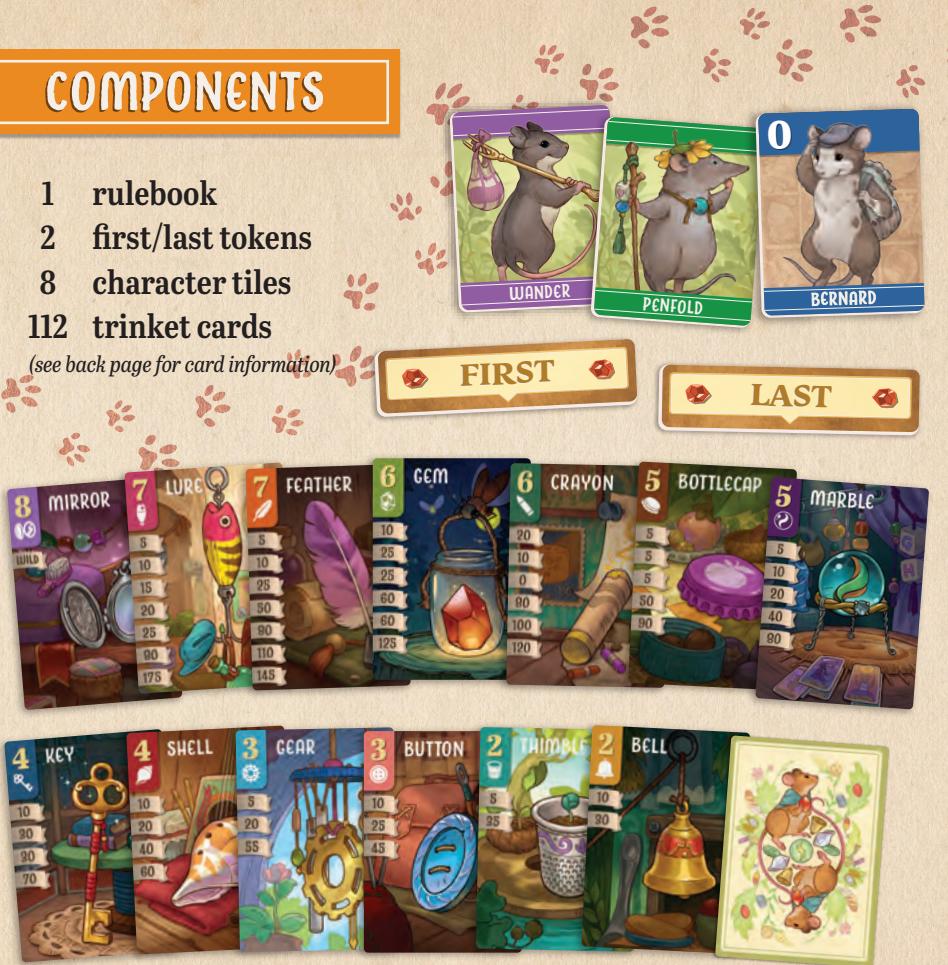
112 小饰品卡
(卡牌信息见背面)


设置
将牌组洗牌,然后发给每位玩家4张牌作为起始手牌。如果任何玩家有一张镜子牌,则必须用它与牌组中的另一张牌交换,并重新洗牌组。


用牌组中的 6 张牌创建一个面朝下的 “计时牌库” (5 人或 6 人游戏时为 10 张牌)。将主品牌库和计时牌库分别放在游戏区域的两侧。
将 “first” 和 “last” 标记放置在桌面中央的游戏区域左右两侧。这两个标记之间的空间称为 “回合顺位行”。该空间上方构成另一个区域,称为 “竞拍行”。

为每个玩家选择一个角色板块。将所有未使用的板块顺序返回到盒子中。

通过将角色板块面朝下(0 面朝下)并排放置在回合顺位行中,随机设定游戏的初始回合顺位。
计时牌组

主牌库
竞拍行


回合顺位行
游戏流程
Trinket Trove 进行 6 轮游戏(5 人或 6 人游戏时为 5 轮)。每轮包含三个阶段:
轮次设置
竞拍
选取
通过收集相同饰品的套组来最大化你的饰品分数。镜子牌是“百搭牌”,每张镜子牌可在游戏结束时加入任何饰品套组。拥有最多饰品分数的收集者获胜!
轮次设置
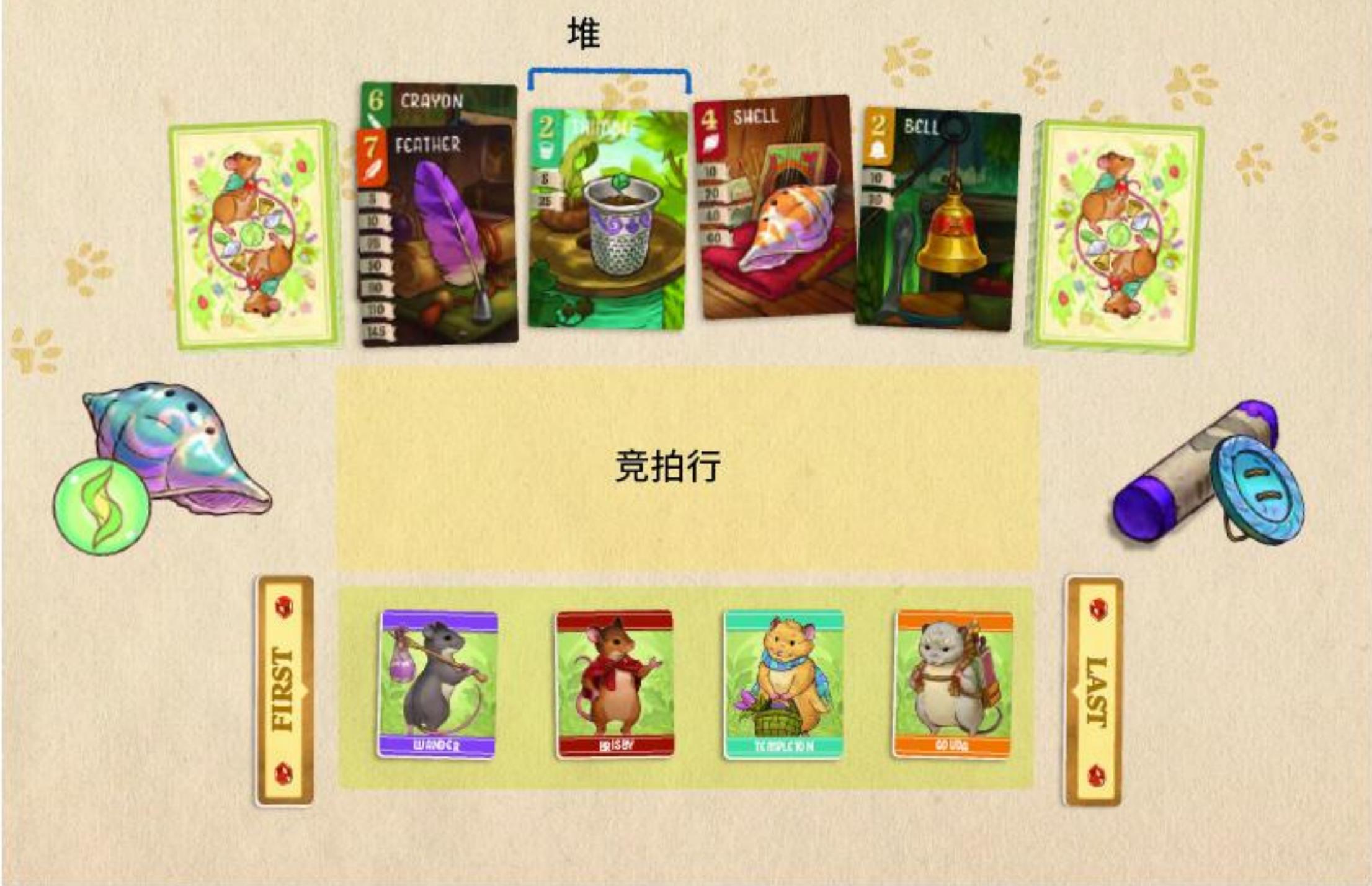
·从牌组中,为每位玩家亮出1张牌,正面朝上放到桌面中央。
每张牌或每堆牌都被视为独立的“堆”,可以在选取阶段被玩家获取。
·从计时牌组中拿取1张牌,正面朝上加入第一堆。
在 5 人或 6 人游戏中,从计时牌组中拿取 1 张牌,正面朝上加入前两堆中的每一堆。
拥有多张牌的堆必须垂直扇形展开,使其名称可见。
竞拍与回合顺位
玩家现在通过提供饰品来决定回合顺位。玩家按照回合顺位行所示的顺序,从 first 到 last 依次创建自己的竞拍组合。
·从你的手中选择任意数量的牌放入竞拍区。
你可以选择从手中不出牌(即竞拍 0 张牌)。在这种情况下,翻开抽牌堆的顶牌,将其正面朝上作为你的竞拍牌。
- 将你的角色板块放在你的竞拍牌上。
如果你选择从手中竞拍 0 张牌,则将你的角色板块 0 面朝上,放置在从牌组抽出的那张牌上。如果你使用手中的牌进行竞拍,则将你的角色板块 0 面朝下放置。包含多张牌的竞拍组合应垂直扇形展开,使其名称可见。
·确定回合顺位
当竞拍组合加入竞拍区时,应根据以下规则从左到右排列:首先按牌的数量,然后按总饰品价值。牌数更多的竞拍组合视为更高,应放在更左侧。牌数相同的竞拍组合,应根据总饰品价值从左到右排列。对于牌数相同且总饰品价值也相同的竞拍组合,将后出的竞拍组合放在左侧。
回合顺位由玩家竞拍的牌的数量决定,平局时由竞拍牌的总饰品价值决定。若仍然平局,则后出价的玩家优先。
竞拍举例:

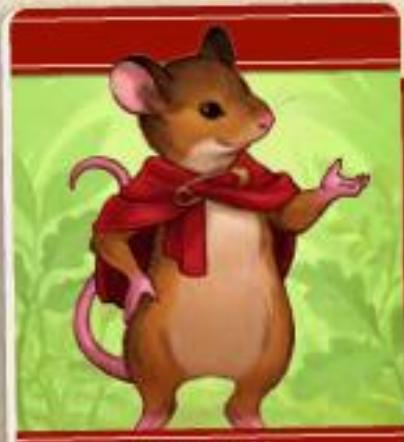
Wander(紫色)首先出价,在竞拍区放置了1张钥匙牌(价值4点)。
接下来 Brisby(红色)从手牌中拿出两张牌,由于 Brisby 竞拍的牌更多,所以放置在 Wander 竞拍的左侧。
接下来 Templeton (蓝色) 决定 “竞拍 0 张牌”,因此从牌组中翻开一张牌,使用角色板块的 0 面,并放置在竞拍区的最右侧,因为 “0 张牌” 少于 Wander 的 1 张牌竞拍。
最后,Gouda (橙色) 像 Wander 一样竞拍 1 张牌,但由于 Gouda 的牌显示 3 点,低于 Wander 的 4 点,所以 Gouda 将竞拍放置在 Wander 和 Templeton 之间。
在所有玩家都完成竞拍后,将每个角色板块下滑至回合顺位行,直接置于对应竞拍组合的正下方。这表示选取阶段的回合顺位,并提醒每位玩家所竞拍的牌。
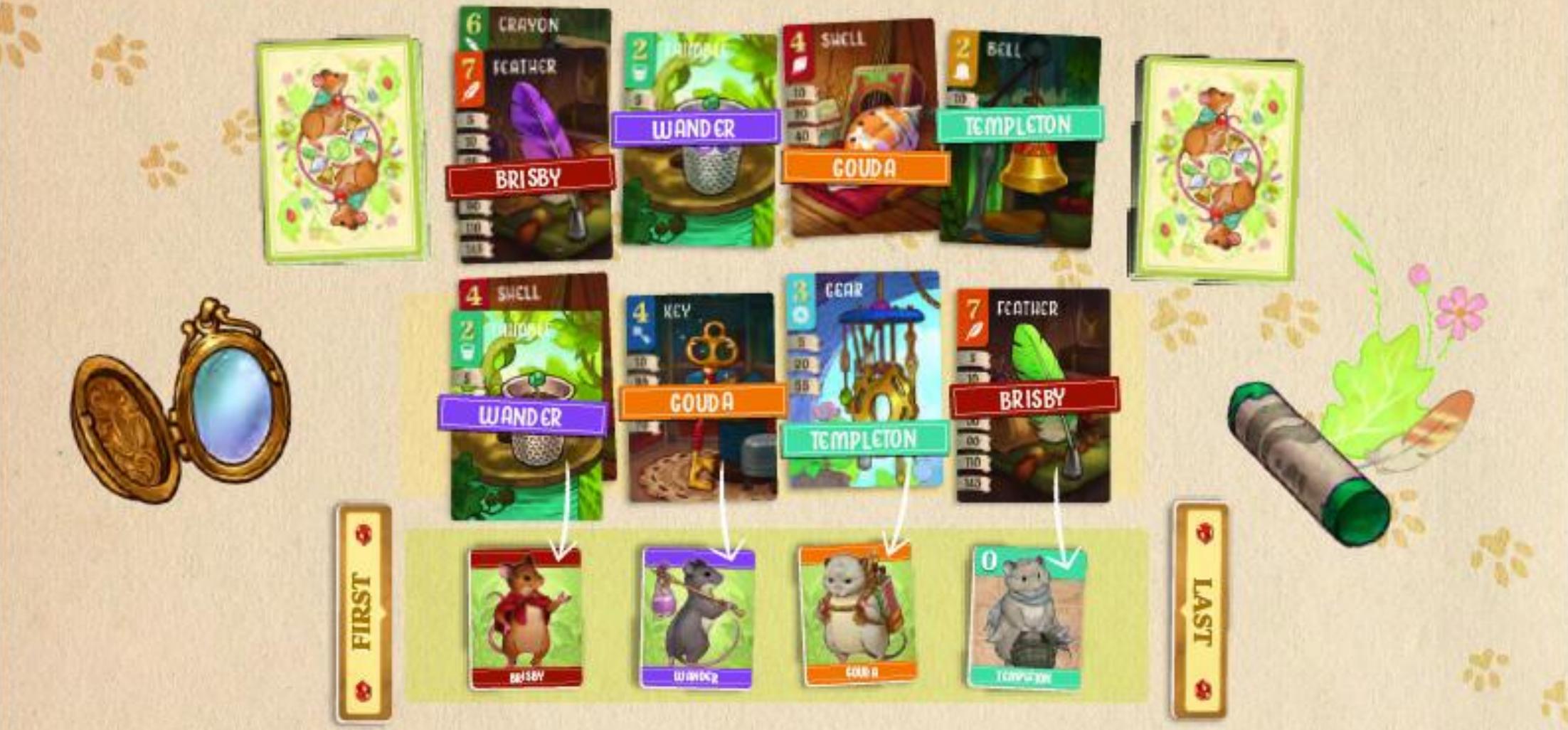
上方的彩色姓名标签将在下一页的选取示例中使用。

选取
玩家按回合顺位行所示的顺序,从 first 到 last 依次进行回合。
· 在你的回合,认领两堆饰品牌并加入你的手牌。
你可以拿取轮次设置中的任意堆,或其他玩家竞拍的牌。每次竞拍都是一个独立的堆。last 玩家认领所有剩余的牌。这是玩家可能认领自己竞拍牌的唯一方式。
选取示例
在左侧示例中,Brisby 首先进行回合。他不能认领自己的竞拍牌,而是拿取轮次设置中的蜡笔和羽毛作为第一堆,并拿取 Templeton 的竞拍牌作为第二堆。接下来是 Wander 的回合。他认领 Brisby 的竞拍牌(贝壳和顶针)作为第一堆,并拿取回合设置中的顶针作为第二堆。
在 Gouda 的回合,他拿取了贝壳和钥匙。这仅留下齿轮和铃铛给 Templeton 拿取。

轮次结束
当所有玩家都认领了两堆牌后,该轮次结束。保留你手中的饰品牌,并让角色板块保持在回合顺位行的原位。
如果计时牌组中仍有牌剩余,则开始新的一轮。

游戏结束
游戏在 6 轮后结束(5 人或 6 人游戏时为 5 轮)。此时计时牌组将被耗尽。
最终得分
将你手中的牌按相同名称组成套组。镜子牌是“百搭牌”,每张镜子牌可以加入任何饰品套组。如果玩家拥有某种饰品的完整套组,则可以开始收集该牌类型的第二套组,并为两套组都计分。
将你所有套组的饰品分数相加来确定你的最终得分。拥有最多饰品分数的收集者获胜。如果出现平局,在回合顺位行中距离“first”标记最近的平局玩家获胜!
计分举例
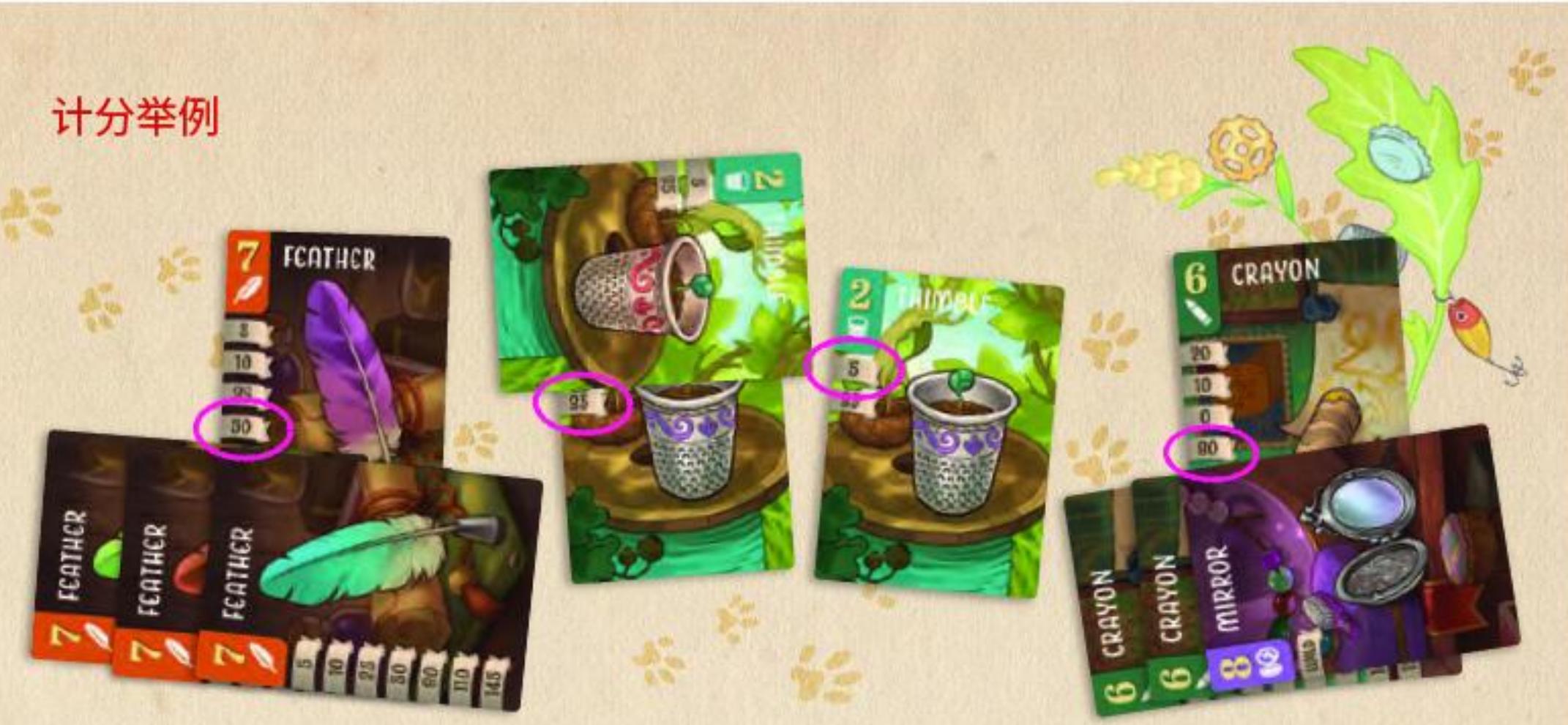
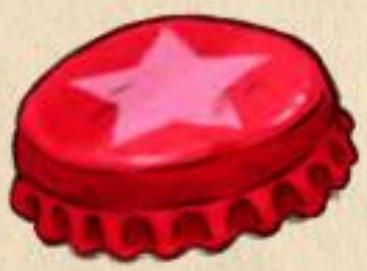
游戏结束时,Brisby 拥有 4 张羽毛牌、3 张顶针牌、3 张蜡笔牌和 1 张镜子牌。他已按上图所示排列,以便更容易看清每个套组的饰品分数。4 张羽毛牌组成的套组总共值 50 分。完整的顶针套组值 35 分。Brisby 的第 3 张顶针牌开始组成第二套组,值 5 分。Brisby 决定将他们的镜子牌计为蜡笔牌(而非羽毛牌或顶针牌)。这样组成了一个 4 张蜡笔牌的套组,值 90 分,而不是仅凭 3 张蜡笔牌能得到的 0 分。

BRISBY
将这些套组分数相加,
Brisby 的最终得分是 180 饰品分数。
(50+35+5+90=180)
2人规则
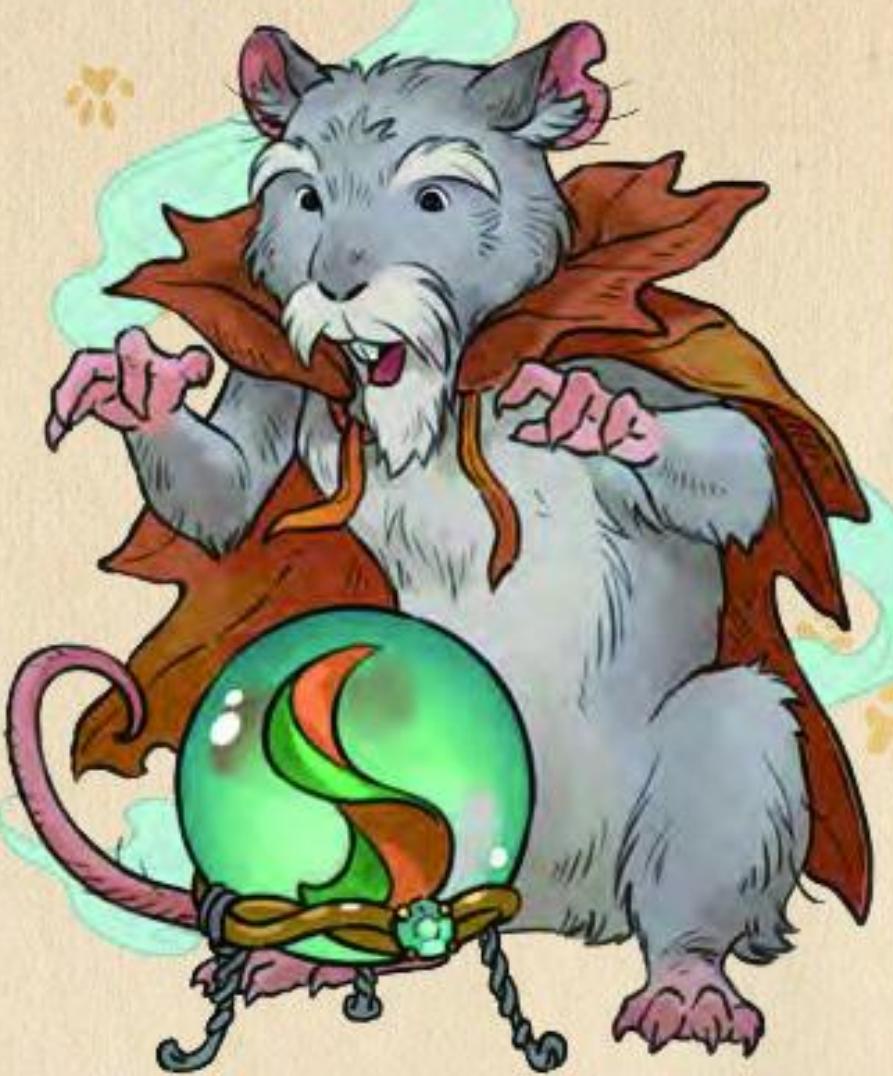
对于双人对局,使用 Nimbus 的特殊规则来模拟第三位玩家。Nimbus 是一个简单的自动玩家,能提升游戏体验。Nimbus 的玩法与其他玩家相同,但有两个例外:
-
Nimbus 不获得任何分数。
-
Nimbus 使用牌组中的牌进行竞拍。
设置为双人游戏
按照 3 人游戏的方式设置,但务必将 Nimbus 作为 3 个角色板块之一。
竞拍阶段
当轮到 Nimbus 竞拍时,他们总是从牌组中亮出 2 张牌作为竞拍牌。
选取阶段
当轮到 Nimbus 认领堆时,他们认领竞拍强度最高的两堆并将其放在一旁。如果需要解决平局,在当前回合顺位中最接近 first 的玩家决定 Nimbus 认领哪一堆平局中的堆。
提醒:Nimbus 不能认领自己的竞拍牌,除非他在回合顺位中是最后一个。

上图显示了一个双人游戏在选取阶段开始时的状态。Patches 首先行动,从轮次设置中选取了铃铛和镜子,以及 Nimbus 的竞拍牌(瓶盖和宝石)。轮到 Nimbus 时,他认领竞拍强度最高的两堆。由于 Patches 的竞拍牌是唯一剩下的 2 张牌的堆,Nimbus 将其作为第一堆认领。这剩下 3 个相同大小的堆:纽扣、瓶盖和弹珠。查看它们的饰品分数,瓶盖和弹珠同为 5 点。Patches 在当前回合顺位中处于 first 位置,因此由他来解决平局。Patches 决定 Nimbus 应该选取弹珠,将纽扣和瓶盖留给 Penfold。
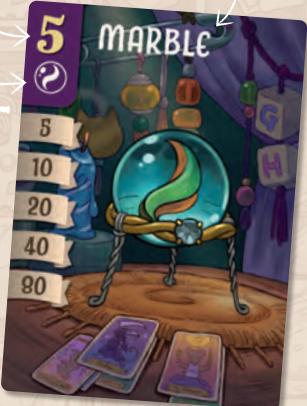
饰品卡 & 计分
饰品价值用于竞拍,并表明该饰品组成完整套组需要多少张牌。牌组中每种饰品有两套完整套组(镜子总共只有4张)。
同名饰品也拥有相同的花色图标。
套组图标
游戏结束时根据套组中的牌数计算饰品分数。上方数字是1张套组的分数,下方数字是完整套组的分数。
例如,2 张弹珠组成的套组可得 10 分,如右图所示。
饰品名称

游戏设计:Rocco Privetera
开发:Paul Salomon
插画: Sandara Tang
平面设计:Manny Vega游戏测试:Tommy O'Brien, Pete Wissinger, Richard Nava, Emily Nava, Patrick Fitzgibbon, Henry R. Seymour, Gabrielle Stewart, Patrick Logan, David Burleyson, Dave Deenik
游戏时有疑问或有故事要分享?
发送邮件至 help@gamehead.com 或 在 BoardGameGeek 上提及
需要替换零件吗?
在 gamehead.com/replacement-parts 申请
想要保持联系吗?
在 gamehead.com/newsletter 订阅每月更新
© 2025 GameHead Products Incorporated。Trinket Trove 是 GameHead Products Incorporated 的商标。保留所有权利。
Download MarkdownTrinket Trove Rulebook for Web.md12.8 KB
TRINKST TROVE
RULEBOOK
TRINKGT TROVE
Design by Rocco Privetera with Paul Salomon Art by Sandara Tang
2-6 players • 30 minutes ages 10+ · competitive
Beneath the floor boards and between the walls, a secret world thrives. By moonlight, the collectors scurry into quiet corners in search of tiny treasures: mirrored lockets, shiny buttons, gleaming gems, and more. When dawn breaks, the animals retreat to their snug little burrows to share stories and trade the night's trinkets.
OVERVIEW
You are a collector - a cute little critter living in the margins of the human world. In Trinket Trove, you trade and collect sets of trinket cards to decorate your burrow. You want to collect sets of the same trinket to score as many trinket points as you can. Each round, new trinkets will be up for grabs. You and the other players offer up your own trinkets to decide who gets first pick of the
new ones. At the end of 6 rounds (5 rounds in a 5- or 6-player game) the collector with the most trinket points wins!

SETUP

Shuffle the deck of cards and give each player 4 cards for their starting hand. If any player has a mirror they must swap it with another card from the deck and reshuffle the deck.
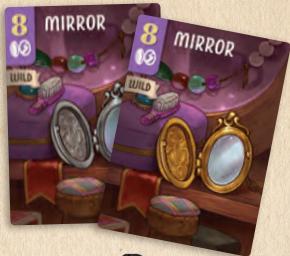


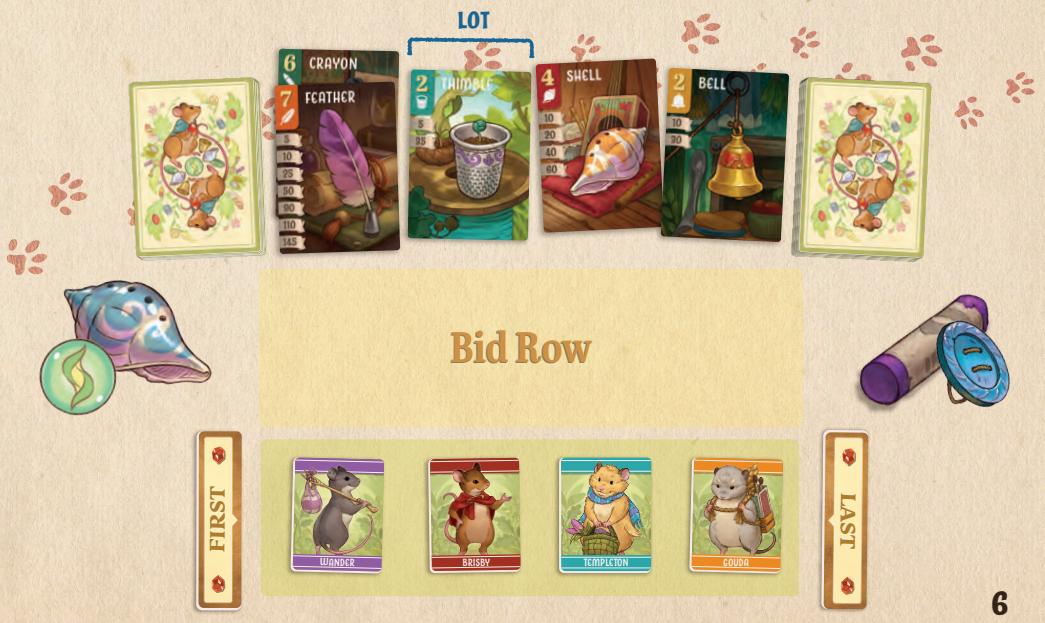
Create a face-down "timer deck" with 6 cards from the deck (10 cards in a 5- or 6-player game). Place the deck of cards and the timer deck on opposite sides of the play area.

Place the “first” and “last” tokens on the left and right sides of the play area in the center of the table. The space between these tiles is called the "turn order row." The space above this forms another area called the “bid row."

Select l character tile for each player. Return any unused turn order tile to the box.


Set the initial turn order for the game by randomly placing the character tiles, O-side down, side by side in the turn order row.
Timer Deck
Base Deck


Bid Row


Turn Order Row

GAMEPLAY

Trinket Trove is played over 6 rounds (5 rounds in a 5- or 6- player game). Each round consists of three phases:
Round Setup Bidding Drafting
Maximize your trinket points by collecting sets of matching trinkets. Mirrors are "wild", and each Mirror may be added to any set of trinkets at the end of the game. The collector with the most trinket points wins!
Round Setup
• From the deck, reveal 1 card per player face up into the center of the table.
Each card or pile of cards is considered a separate “lot" that can be claimed by a player during the drafting phase.
• Add a face up card from the timer deck to the first lot.
In a 5- or 6-player game, add 1 face up card from the timer deck to each of the first 2 lots.
Lots with multiple cards should always be splayed vertically so that their names are visible.
Bidding & Turn Order
Players now offer trinkets to determine turn order. Players take turns creating their bid, from first to last, as shown in the turn order row.
• Choose any number of cards from your hand to place into the bid row.
You may choose to bid 0 cards from your hand. In this case, flip over the top card of the draw deck and place it face up as your bid.
• Place your character tile on top of your bid.
If you chose to bid 0 cards from your hand, place your character tile O-side up on top of the card you drew from the deck. If you bid using cards from your hand, place your character tile 0-side down. Bids with multiple cards should be splayed vertically so the names are visible.
• Determine Turn Order.
As bids are added to the bid row, they should be arranged left to right, based first on how many cards are in the bid, and then by trinket value. Bids with more cards are considered higher and should be placed to the left. Bids with the same number of cards should be arranged left to right, based on the total trinket value of each bid. For bids with the same number of cards and the same total trinket value, place the later bid to the left.
Turn order is determined by the quantity of cards a player bid, with ties being broken by the total trinket value of the bid cards. Continued ties favor the player who bid later.
Bidding Example
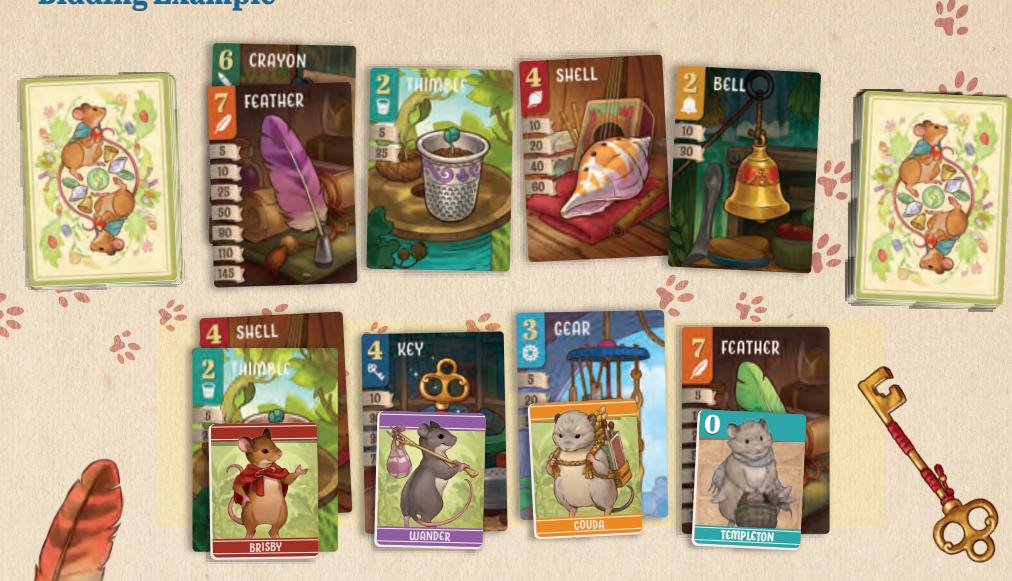
Wander (purple) bids first, placing 1 Key in the bid row. Next Brisby (red) offers two cards from their hand, placing to the left of Wander's bid, since Brisby bid more cards. Next Templeton (blue) decides to "bid 0,"so they flip a card up from the deck, use the 0 side of their character tile, and place their bid to the right side of the row, since "0 cards" is less than Wander's 1-card bid. Finally, Gouda (orange) bids 1 card, like Wander, but since Gouda's card shows a 3, which is less than Wander's 4, Gouda places their bid between Wander and Templeton.
After all players have bid, slide each character tile down to the turn order row, directly beneath the associated bid. This indicates turn order for the drafting phase and serves as a reminder of which player bid which cards.

The colored name tags above are used in the Drafting Example on the next page.
Drafting
Players take their turn, from first to last, as shown in the turn order row.
• On your turn, claim two lots of trinket cards and add them to your hand.
You may take any lot from round setup or the cards bid by other players. Each bid is a separate lot. The last player claims all remaining cards. This is the only way in which a player may end up claiming their own bid.
Drafting Example
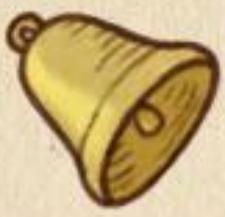
In the example on the left, Brisby takes their turn first. They cannot claim their own bid. Instead, they take the crayon and feather from round setup as their first lot, and they take Templeton's bid as their second lot. Wander is up next. They claim Brisby's bid (Shell and Thimble) as their first lot, and the Thimble from round setup as their second lot. For Gouda's turn they take the Shell and Key. This leaves only the Gear and Bell for Templeton to take.

End of Round
Once all players have claimed two lots, the round is over. Keep your hand of trinket cards and leave your character tile where it is in the turn order row.
If any cards are left in the timer deck, begin a new round.
The game ends after 6 rounds (5 rounds in a 5- or 6-player game). At this point the timer deck will be depleted.
Final Score
Arrange your hand of cards into sets of cards with the same name. Mirrors count as "wild" and each mirror may be added to any set of trinkets. If a player has a complete set for one of their trinkets, they may begin a second set of that card type and score points for both sets.
Add up the trinket points from all of your sets to determine your final score. The collector with the most trinket points wins. In the case of a tie, the tied player closest to "first" in the turn order row is the winner!

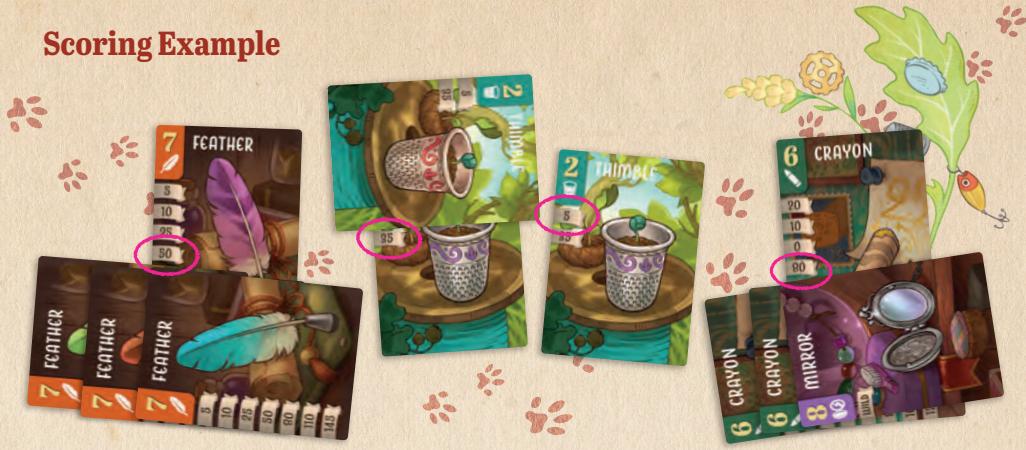
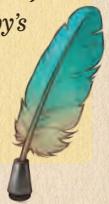
At the end of the game, Brisby has 4 feathers, 3 thimbles, 3 crayons, and 1 mirror. They have arranged it as shown above to make it easier to see the trinket points for each set. The set of 4 feathers is worth 50 points total. The complete set of thimbles is worth 35 points. Brisby's 3rd thimble begins a second set, worth 5 points. Brisby decides to count their mirror as a crayon (rather than a feather or thimble). This creates a set of 4 crayons, worth 90 points, rather than the 0 points they would have scored for the 3 crayons alone.

BRISBY
Adding these set scores together, Brisby's final score is 180 trinket points. (50+35+5+90=180)
TWO-PLAYER RULES
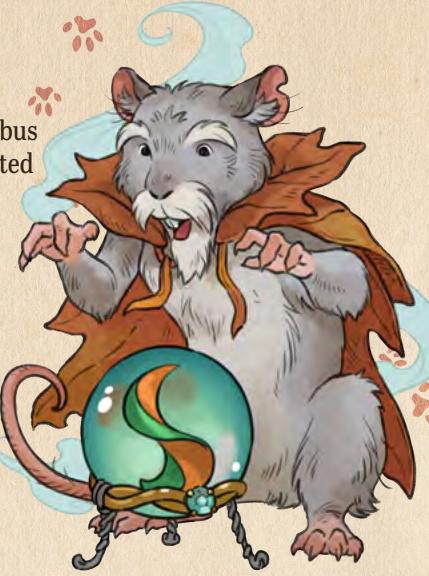
For a game with two players, use special rules for Nimbus to simulate a third player. Nimbus is a simple, automated player that improves the gameplay experience.
Nimbus acts just like any player with two exceptions:
-
Nimbus does not score any points.
-
Nimbus bids with cards from the deck.
Setup
Set up the game as usual for a 3-player game, but be sure to include Nimbus as one of the 3 character tiles.
Bidding
When it is Nimbus' turn to bid, they always bid 2 cards face up from the deck.
Drafting
When it is Nimbus's turn to claim lots, they claim the two lots with the highest bid strength and set them aside. If a tie must be resolved, the player closest to first in the current turn order decides which of the tied lots are claimed by Nimbus.
Reminder: Nimbus may not claim their own bid unless they are last in turn order.
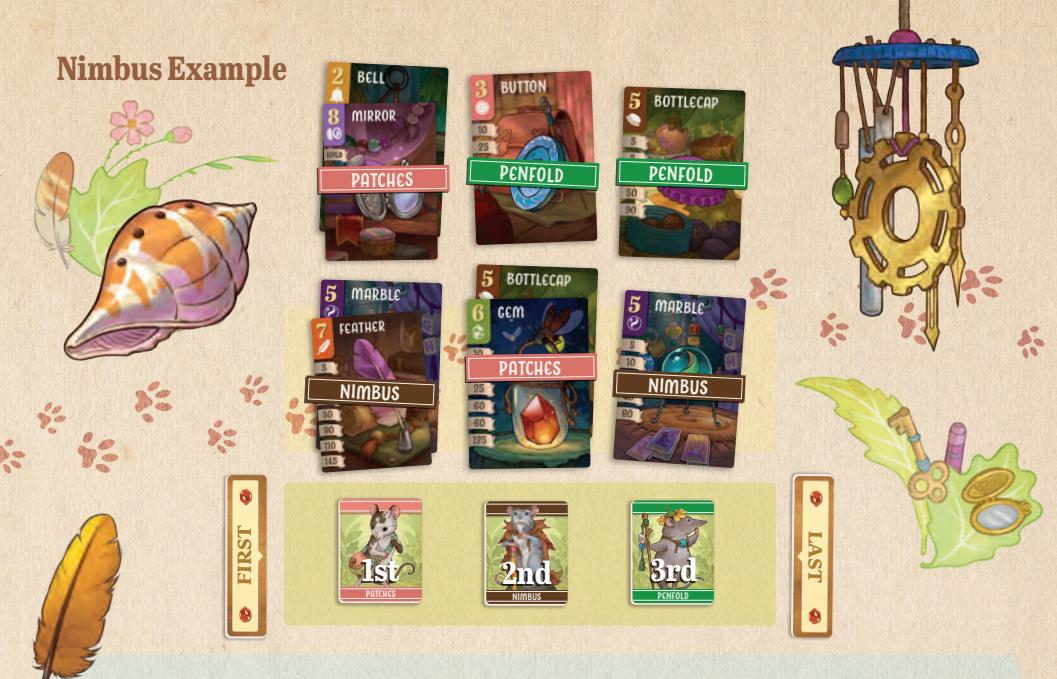
The image above shows a 2-player game at the start of the drafting phase. Patches takes the first turn and drafts the bell and mirror from round setup and Nimbus's bid (bottlecap and gem). For Nimbus's turn they claim the 2 lots with the largest bid strength. Since Patches's bid is the only remaining lot with 2 cards, Nimbus claims it as his first lot. This leaves 3 equally-sized lots: the button, bottlecap, and marble. Looking at their trinket values, the bottlecap and marble are tied at 5. Patches is first in the current turn order, so they get to resolve the tie. Patches decides that Nimbus should draft the marble, leaving the button and bottlecap for Penfold.
TRINKET CARDS & SCORING
Trinket Value is used in bidding and indicates how many cards make a full set for that trinket. There are 2 full sets of each trinket in the deck (there are only 4 Mirrors total). Trinkets with the same name will have the same suit icon as well.
Trinket points are scored at the end of the game, depending on how many cards are in the set. The top number is scored for a set of1 card, while the bottom number scores for a full set. A set of 2 Marbles, for example, would score 10 points, as shown to the right.
Playtesting: Tommy O'Brien, Pete Wissinger, Richard Nava, Emily Nava, Patrick Fitzgibbon, Henry R. Seymour, Gabrielle Stewart, Patrick Logan, David Burleyson, Dave Deenik
Game Design: Rocco Privetera Development: Paul Salomon Illustration: Sandara Tang Graphic Design: Manny Vega
Trinket Value
Trinket Name
Trinket Points
Suit Icon
HAVE A QUESTION WHILE PLAYING OR A STORY TO SHARE? Email help@gamehead.com or mention it on BoardGameGeek
NEED A REPLACEMENT PART? Request it at gamehead.com/replacement-parts
WANT TO STAY IN TOUCH? Subscribe to monthly updates at gamehead.com/newsletter
Download MarkdownTexts are community-compiled or publicly released by publishers; copyright remains with the original authors. For personal reference only.