
1822: The Railways of Great Britain1822: The Railways of Great Britain
一句话概览
1822: The Railways of Great Britain 是一款已收录于村了吗规则库的桌游,支持 3–7 人,原名 1822: The Railways of Great Britain。
本页内容:一句话概览 · 游戏概述 · 游戏组件 · 游戏设置 · 规则详解 · 关键规则提醒 · 常见问题
1822: The Railways of Great Britain(1822: The Railways of Great Britain)规则速览
以下规则速览由本站整理,与官方规则书表述不同,仅供快速上手参考。
游戏概述
Components List 1. Overview of the Game Sequence of Play Etiquette About These Rules The Map The Bank Pool The Stock Market Setting Up the Game 2. Game Phases Overview Phase Descriptions. 3.
📊 BGG排名: #155
游戏组件
- Overview of the Game
- Game Phases
- Corporate Entities
- Stock Rounds
- London 25
- London and the Metropolitan
- The Ènglish Channel and France.....26
- Merthyr Tydfil And Pontypool .27
- Game End 28
- Variants 28
- 1822+ Expansion 29
- Scenarios 30
游戏设置
1.7.1 Lay the map board on the table between the players.
Place the major company share certificates nearby.
1.7.2 The bank is £12,000, including players' starting money.
The starting money is £2100 divided equally among the players.
Distribute the appropriate number of bidding tokens to each player.
1.7.3 Sort the track tiles by type, and place them by the board.
规则详解
游戏流程
1.1.1 The game consists of an alternating series of stock rounds and operating rounds.
Initially, there is one operating round after each stock round.
Once the first 2-train is bought, there are two operating rounds after each subsequent stock round.
1.1.2 In stock rounds, players act as investors, buying and selling shares in the various companies.
1.2 Etiquette
1.2.1 Players should try to speed play as much as possible.
Deciding what share to buy and which track tile(s) to lay should as much as possible be done during other players' turns.
Other players should help the banker(s) by claiming payments promptly.
All personal and company assets are public knowledge and must be disclosed to any player upon request.
关于游戏
1.3.1 The abilities of the private companies often create rules exceptions, or allow rules to be "broken." In these instances, the ability of the private company overrides the normal rules.
These exceptions are noted in the rules where appropriate, but are not described in detail.
Full rules covering each private company are in the table beginning on page 36.
地图
1.4.1 The map shows most of Great Britain.
A hex grid is superimposed to show where hexagonal track tiles may be laid.
Some hexes are coloured yellow or grey denoting pre-built track.
1.4.2 Cities are represented by one or more large open circles.
Some cities bear a label (BM, Y, S, C, T, or EC) upon which only corresponding track tiles may be placed.
Each large circle in a city represents a station.
1.5 The Bank Pool
1.5.1 The bank pool holds shares sold to the bank and trains discarded to the bank.
Players or companies may purchase bank pool items per the normal rules.
市场
1.6.1 The stock market is shown as a grid.
The value of a company's shares (also known as the share price) is shown by the position of the company's stock market token on this chart.
1.6.2 "Descending share price order" is the order of companies based on their share price, from the highest to the lowest.
1.6.3 There is one space shaded solid red at £50.
Only minor companies may start at this price.
游戏总览
2.1.1 The game starts in Phase 1.
As the first of each new type of train is bought or exported the game phase advances correspondingly.
The phase affects the availability of track tiles, the revenue from off-board areas and grey pre-printed cities, the train limit, and the number of operating rounds after each stock round.
2.1.4 The "train limit" is the number of trains a company is allowed to own.
阶段
- L-trains and 2-trains are available for purchase.
- Trains may only be bought from the bank.
- Yellow tiles are available.
- Off-board areas use the first (yellow) value for earnings calculations.
- Minor companies start at stock value £50 (worth £100) with £100 starting treasury, irrespective of the amount bid.
- Companies may only lay one yellow tile per turn.
- The train limit is 2 for minor companies.
- There is one operating round after each stock round.
- Major companies may not be floated.
阶段
- A minor company's starting stock price is the winning bid amount divided by 2, then rounded down to the nearest starting value. The company's starting treasury is 2× the stock value.
- Concessions may be converted to director's certificates during stock rounds. This floats the associated major company.
- Major companies may now acquire operational minor companies for the remainder of the game.
- The major company train limit is 4.
阶段
- L-trains rust.
- Trains may now be bought from the bank, the bank pool, or from another company.
- Yellow and green tiles are now available.
- Minor companies may lay one yellow or one green upgrade tile for the remainder of the game.
- Major companies may lay two yellow tiles or upgrade one tile to green.
- A minor company's starting stock value is the winning bid amount divided by 2, then rounded down to the nearest starting value, but now the full amount bid is given to the starting treasury.
- Off-board areas use the second (green) value for earnings calculations.
阶段
- 2-trains rust.
- The minor company train limit is 1.
- The major company train limit is 3.
阶段
- Unconverted concessions are removed from play.
- Yellow, green, and brown tiles are now available.
- Major companies may lay two yellow tiles, or upgrade one tile to green or brown.
- Minor companies’ track laying is unchanged from Phase 3. They may never upgrade track past green.
- Major companies require 50% sold to float (still incremental capitalization).
- Major companies may now acquire unfloated minor companies directly from the bidding boxes for the remainder of the game.
- Major company train limit is 2 for the remainder of the game.
- Off-board areas use the third (brown) value for earnings calculation.
关键规则提醒
(详细规则请参阅原始说明书)
常见问题(FAQ)
以下 1 条问答中 0 条来自站内玩家的真实提问,其余 1 条为本站整理的常见疑问;答复内容保持原样。
1822: The Railways of Great Britain支持几个人玩?
3–7 人。
去哪查完整规则
想核对具体规则细节、卡牌效果或某个回合的结算方式,可以在村了吗里选中这款游戏后直接提问。
同类桌游
- 卡坦岛德式
- 工业革命:伯明翰德式
- 勃艮第城堡:特别典藏版德式
- 方舟动物园德式
- 重塑宇宙德式
- 埃多拉的德鲁伊德式
- 1817 (2020)德式
- 甜蜜国度德式
- 卡里普索德式
- 铁路环游德式
规则原文(Markdown)
本站收录这款游戏的规则原文 1 个文件,此处内联渲染 1 个,可直接展开阅读或下载。
1822 Rules.md169.8 KB
1822
RULES OF PLAY
TABLE OF CONTENTS
Components List
1. Overview of the Game
Sequence of Play
Etiquette
About These Rules
The Map
The Bank Pool
The Stock Market
Setting Up the Game
2. Game Phases
Overview
Phase Descriptions.
3. Corporate Entities
Private Companies
Minor Companies
Major Companies
Concessions
4. Stock Rounds
Introduction
Certificate Limit
Player Loans.
Selling Shares 10
Buying Shares. 10
Major Company Formation Overview... 11
Converting a Concession to a Director's
Certificate (Phases 2-4) 11
Forming a Major Company Directly
(Phases 5-7) 11
Completing Major Company Formation 12
Bidding 12
End of Stock Round And Floating Minor
Companies 13
End of Stock Round Share Price
Movement 14
. Operating Rounds 15
Overview 15
Operating Round Turn Order 15
Operating Round Actions 15
Routes 15
First Turn Housekeeping 16
Acquire Private Companies 16
Lay Track/Upgrade Track. 16
Check For Connection to Destination ... 18
Place Station Tokens 18
Trains Overview 19
Run Train(s) 20
Earnings Distribution 21
Purchase Trains 22
Forced Train Purchases 23
Emergency Money Raising 23
Acquire a Minor Company
Requirements 23
Acquire a Minor Company From a Player
(Phase 2 to Phase 7) 24
Acquire a Minor Company From the Bid
Boxes (Phase 5 to Phase 7) 24
Issue or Redeem Stock 25
6. London 25
Special Rules 25
7. London and the Metropolitan
Railway (M14) 26
8. The Ènglish Channel and France.....26
9. Merthyr Tydfil And Pontypool .27
10. Game End 28
11. Variants 28
12. 1822+ Expansion 29
Expansion Overview 29
Component List. 29
Setup Changes 29
Bid Box Filling 29
Permanent L-Train 29
Variants. 29
13. Scenarios 30
Scenario Overview 30
Medium Regional Scenario 30
North Regional Scenario 31
2-Player Variant For the Regional
Scenarios 31
Credits 32
Designer's Notes 33
Easy to Miss Rules 34
Company Tables 36
Index 41
Tile Manifest. 44
COMPONENTS LIST
• This rulebook with tile manifest/upgrade chart
• Map board
• Bank pool sheet
• Dividend tracker sheet
• 10 major company charters
• 24 minor company charters (plus 6 for 1822+)
• 2 private company charters (plus 1 for 1822+)
• 81 major company 10% share certificates
• 10 concession certificates (printed back to back with director's certificate)
• 6 cardboard “T” city markers
• 24 minor company share certificates (plus 6 for 1822+)
• 18 private company share certificates (plus 3 for 1822+)
• 7 player order number cards
• 57 train cards
• Yellow, Green, Brown and Grey track tiles (see tile manifest)
• Bid Tokens: 7 sets of 6 coloured cubes, one set per player (subject to number of players in the game, players do not receive all of these tokens)
• 54 large diameter discs with labels
• 96 small diameter cylinders with labelst.
• A bank of \$12,000 must be supplied by the players
OVERVIEW OF THE GAME
1.1 SEQUENCE OF PLAY
1.1.1 The game consists of an alternating series of stock rounds and operating rounds. Initially, there is one operating round after each stock round. Once the first 2-train is bought, there are two operating rounds after each subsequent stock round.
1.1.2 In stock rounds, players act as investors, buying and selling shares in the various companies. The player with the most shares in each company is the company's director.
1.1.3 In operating rounds, players, as company directors, run the various companies that they control, deciding all actions that the companies take. They choose whether and how to build track and place station tokens, which trains to run on which routes, whether to pay or withhold dividends, and whether to invest in more trains
1.2 ETIQUETTE
1.2.1 Players should try to speed play as much as possible. Deciding what share to buy and which track tile(s) to lay should as much as possible be done during other players' turns. Other players should help the banker(s) by claiming payments promptly. All personal and company assets are public knowledge and must be disclosed to any player upon request. Assets should be arranged neatly so that the need for explicit requests is minimised. Players may negotiate with each other and strike deals. Such deals are not binding.
1.3 ABOUT THESE RULES
1.3.1 The abilities of the private companies often create rules exceptions, or allow rules to be "broken." In these instances, the ability of the private company overrides the normal rules. These exceptions are noted in the rules where appropriate, but are not described in detail. Full rules covering each private company are in the table beginning on page 36.
1.3.2 When the rules refer to specific minor or private companies, they use the format Mx and Px respectively, where x is the number of the company.
1.4 THE MAP
1.4.1 The map shows most of Great Britain. A hex grid is superimposed to show where hexagonal track tiles may be laid. Some hexes are coloured yellow or grey denoting pre-built track.
1.4.2 Cities are represented by one or more large open circles. Some cities bear a label (BM, Y, S, C, T, or EC) upon which only corresponding track tiles may be placed. Each large circle in a city represents a station.
1.4.3 A station with a company logo printed on it is that company's home station. A station with a number printed in it is the home station of the correspondingly-numbered minor company.
1.4.4 Stations are “occupied" if they contain a station token, otherwise they are “unoccupied."
1.4.5 A company logo with a black banner printed in a hex but not in a station denotes that company's destination city.
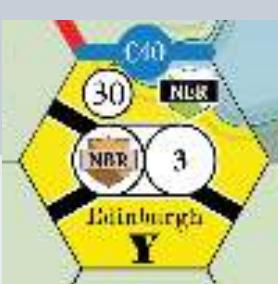
EXAMPLE. Edinburgh (hex H5) contains two stations. One is the home station of the North British Railway (NBR), and the other is the home of minor company M3, the Edinburgh & Dalkeith Railway. It is also the destination city for the North Eastern Railway (NER).
1.4.6 Towns are represented by small solid black circles
1.4.7 The London hex is coloured black with pre-printed track extensions from each station to the adjacent hex. There is also an off-board rondel, located in the Thames estuary, showing the London hex. The rondel shows the location of minor company M14, The Metropolitan Railway, in London. The London value tokens are also placed here. Sections 6 and 7 provide more information on London.
1.4.8 There are also various grey off-board areas around the edges of the map, such as Aberdeen and Cornwall. Off-board areas have two or three stations. Some off-board areas are destinations, and some contain the home stations of various companies.
1.4.9 There is no direct connection between Mid Wales (hexes F25-F31) and either Holyhead to the north (hex F23) or Pontypool to the south (hex F33).
1.4.10 The connection between Merthyr Tydfil and Pontypool is discussed in Section 9.
1.5 THE BANK POOL
1.5.1 The bank pool holds shares sold to the bank and trains discarded to the bank. Players or companies may purchase bank pool items per the normal rules.
1.6 THE STOCK MARKET
1.6.1 The stock market is shown as a grid. The value of a company's shares (also known as the share price) is shown by the position of the company's stock market token on this chart.
1.6.2 "Descending share price order" is the order of companies based on their share price, from the highest to the lowest. If one or more companies have the same share price, the company's whose stock market token is furthest to the right takes precedence. If several companies' stock market tokens are in the same space, the order is from the topmost token to the bottommost.
1.6.3 There is one space shaded solid red at £50. Only minor companies may start at this price.
1.6.4 There are five red-outlined spaces at £60, £70, £80, £90 or £100. Major and minor companies may start at these prices. Section 4.11 covers starting minor companies.
1.6.5 Several spaces in the lower left area of the stock market are shaded in yellow. Stock certificates of a company whose stock market value token is in this area do not count against the certificate limit (See section 4.2 for more information on certificate limits).
1.7 SETTING UP THE GAME
1.7.1 Lay the map board on the table between the players. Place the major company share certificates nearby.
1.7.2 The bank is £12,000, including players' starting money. The starting money is £2100 divided equally among the players. Distribute the appropriate number of bidding tokens to each player.
| NUMBER OF PLAYERS | 3 | 4 | 5 | 6 | 7 |
| CERTIFICATE LIMIT | 26 | 20 | 16 | 13 | 11 |
| START MONEY PER PLAYER | £700 | £525 | £420 | £350 | £300 |
| BIDDING TOKENS | 6 | 5 | 4 | 3 | 3 |
1.7.3 Sort the track tiles by type, and place them by the board. At the start of the game, only the yellow track will be used, but the other tiles should be available for inspection. Place the company charters and station tokens by the board.
1.7.4 Take the set of company concession certificates. Remove the London & North West Railway (LNWR) concession and shuffle the remaining concession certificates. Place the concession certificates in a face-up pile with the LNWR on top. The players may examine the order of the concession stack, but they cannot change it. Exception: P17 The Lancashire Union Railway.
1.7.5 Take the set of minor company director's certificates. Remove M24, the Swansea & Mumbles Railway (S&MR) certificate and shuffle the remaining certificates. Place the certificates in a separate face up pile with the S&MR on top. The players may examine the order of the minor company stack, but they cannot change it. Exception: P17 The Lancashire Union Railway.
1.7.6 Take the set of private company certificates. Remove the P1, the Butterley Engineering Company (BEC) certificate and shuffle the remaining certificates. Place the certificates in a separate face up pile with the BEC certificate on top. The players may examine the order of the private company stack, but they cannot change it. Exception: P17 The Lancashire Union Railway.
1.7.7 Fill each bidding box with certificates from its corresponding stack, starting with the lowest-numbered box. For example, the certificate on top of the concession stack goes on concession bidding box 1, the next on box 2, etc.
1.7.8 Place the round marker on the space marked SR (“Stock Round").
1.7.9 Appoint one or more players to be banker and be responsible for conducting transactions with the bank.
1.7.10 Players may find it useful to place one reminder station token for each minor and major company near its home station. These tokens show reserved station spaces and have no impact on the game; only that company may place a station token in this space. They are not in play on the board and hence they do not count as station tokens for the purpose of blocking routes. A minor company's home station is no longer reserved if it is removed from the game. Remove any reminder token it may have on the board.
EXAMPLE. The figure below illustrates that M12 has not started operating, but its reserved token space is indicated by its token.

1.7.11 Arrange the trains in ascending order from top to bottom with the double-sided L/2-trains on top and the double-sided 7/E-trains on the bottom.
1.7.12 Shuffle and deal out the player number cards, one to each player, to randomly determine player order.
1.7.13 Place the “20" value London token in the rondel.
1.7.14 Play then begins with a stock round.
2 GAME PHASES
2.1 OVERVIEW
2.1.1 The game starts in Phase 1. As the first of each new type of train is bought or exported the game phase advances correspondingly. The phase affects the availability of track tiles, the revenue from off-board areas and grey pre-printed cities, the train limit, and the number of operating rounds after each stock round.
2.1.2 Phase change effects take place immediately, except when the number of operating rounds per stock round increases to two; this change only applies after the following stock round. The full effects of phase changes are shown in the table below.
2.1.3 If a phase change causes trains of a prior type to rust, those trains are removed from the game immediately without compensation.
2.1.4 The "train limit" is the number of trains a company is allowed to own. If a phase change lowers the train limit, companies with more trains than the new limit must discard the excess without compensation. Discarded trains go into the bank pool (doublesided trains retain their orientation at time of discard). This check is made after rusted trains have been discarded.
2.1.5 If more than one company has excess trains, they decide which to discard in descending share price order.
| PHASE | 1 | 2 | 3 | 4 | 5 | 6 | 1 |
| Triggered by | Game start | Purchase offirst 2-train | Purchase offirst 3-train | Purchase offirst 4-train | Purchase offirst 5-train | Purchase offirst 6-train | Purchase offirst 7/E train |
| Trains rusted | - | - | L | 2 | 3 | 4 | |
| Train limit(minor) | 2 | 1 | |||||
| Train limit(major) | 4 | 3 | 2 | ||||
| Buying trains | From bank only | From bank or other company | |||||
| ORs between SRs | 1 | 2 | |||||
| Tiles available | Yellow | Y + Green | Y + G + Brown | Y + G+ B + Grey | |||
| Off-boardarea value | Yellow | Green | Brown | Grey | |||
| Tile Lay PerTurn: Major | N/A | 1 Yellow | 2 yellow or 1 upgrade | ||||
| Tile Lay PerTurn: Minor | 1 Yellow | 1 yellow or 1 green upgrade | |||||
| Minorcompanies | Float at £50with capitalof £100 | Float at between£50 and £100with capital of 2×stock value | Float at between £50 and £100 with capital of sum bid | ||||
| Acquisition ofMinorCompanies | Not possible | Can be acquired by major companies | Can be acquired by major companies or directly fromthe bid boxes for £200 | ||||
| ConcessionCertificates | Cannotbe converted | Provide a £100 discount against the cost of director'scertificate when converted. For LNWR straightexchange for director's certificate | Removed from play | ||||
| Major CompanyFlotation | Not possible | Floated once director's certificate is exchanged byconversion of concession certificate | Floated once 50% sold | ||||
| Capitalisationon Flotation | Not applicable | Incremental capitalisation | 100% capitalisation | ||||
2.2 PHASE DESCRIPTIONS
2.2.1 As the game phase progresses, rule changes come into effect. Unless otherwise stated, once a phase introduces a new rule, the rule is in place for the rest of the game.
2.2.2 The game starts in Phase 1.
• L-trains and 2-trains are available for purchase.
• Trains may only be bought from the bank.
• Yellow tiles are available.
• Off-board areas use the first (yellow) value for earnings calculations.
• Minor companies start at stock value £50 (worth £100) with £100 starting treasury, irrespective of the amount bid.
• Companies may only lay one yellow tile per turn.
• The train limit is 2 for minor companies.
• There is one operating round after each stock round.
• Major companies may not be floated.
2.2.3 Phase 2 starts when the first L-train is converted to a 2-train, or the first 2-train is bought from the bank.
• A minor company's starting stock price is the winning bid amount divided by 2, then rounded down to the nearest starting value. The company's starting treasury is 2× the stock value.
• Concessions may be converted to director's certificates during stock rounds. This floats the associated major company.
• Major companies may now acquire operational minor companies for the remainder of the game.
• The major company train limit is 4.
Two operating rounds will follow each stock round, starting from the stock round following the start of this phase, and continuing for the remainder of the game.
2.2.4 Phase 3 starts when the first 3-train is bought.
• L-trains rust.
• Trains may now be bought from the bank, the bank pool, or from another company.
• Yellow and green tiles are now available.
• Minor companies may lay one yellow or one green upgrade tile for the remainder of the game.
• Major companies may lay two yellow tiles or upgrade one tile to green.
• A minor company's starting stock value is the winning bid amount divided by 2, then rounded down to the nearest starting value, but now the full amount bid is given to the starting treasury.
• Off-board areas use the second (green) value for earnings calculations.
2.2.5 Phase 4 starts when the first 4-train is bought.
• 2-trains rust.
• The minor company train limit is 1.
• The major company train limit is 3.
2.2.6 Phase 5 starts when the first 5-train is bought.
• Unconverted concessions are removed from play.
• Yellow, green, and brown tiles are now available.
• Major companies may lay two yellow tiles, or upgrade one tile to green or brown.
• Minor companies’ track laying is unchanged from Phase 3. They may never upgrade track past green.
• Major companies require 50% sold to float (still incremental capitalization).
• Major companies may now acquire unfloated minor companies directly from the bidding boxes for the remainder of the game.
• Major company train limit is 2 for the remainder of the game.
• Off-board areas use the third (brown) value for earnings calculation.
2.2.7 Phase 6 starts when the first 6-train is bought.
• 3-trains rust.
Major companies require 50% sold to float, but receive full capitalization (the remaining five shares are placed in the bank pool upon flotation).
2.2.8 Phase 7 starts when the first 7-train or E-train is bought.
• 4-trains rust.
• Yellow, green, brown, and grey tiles are now available.
• Major companies may now lay two yellow tiles or one green, brown, or grey upgrade tile.
• Minor companies' track laying is unchanged.
• Off-board areas use the fourth (grey) value for earnings calculation.
3.1 PRIVATE COMPANIES
3.1.1 There are 18 private companies (21 if the 1822+ expansion is used) in the game. The Company Table beginning on page 36 provides specific information on each. In the case where a private company's rules contradict the rules elsewhere, the private company's rules take precedence.
3.1.2 While open, a private company pays its owner a fixed revenue (which in some cases is £0) at the start of each operating round.
3.1.3 The face value of all private companies is £0.
3.1.4 A private company can only be bought by players through the bidding mechanism in a stock round.
3.1.5 Private companies held by players count against the certificate limit. Exception: P16 off-shore tax haven does not.
3.1.6 Private companies may not be traded between players or sold to the bank. Private companies may not be transferred between companies.
3.1.7 Private companies are never forced to close. Exception: P15 Highland Railway and P20 Canterbury & Whitstable (1822+) must close at the start of Phase 7 (but may be closed earlier).
3.1.8 Generally, a major or minor company may acquire private companies from consenting players at the start of its turn in an operating round. Players receive no compensation from the acquiring company for this transaction. See sections 5.16 - 5.18 for private company acquisitions.
3.1.9 Private company revenue is paid to the owning company treasury during the “pay the private companies"” phase of each operating round. (Some private companies cease paying revenue once acquired by a major or minor company.) Thus, the revenue cannot be received by the owning player pre-acquisition and then again by the acquiring company on the turn in which it is acquired. P6 and P7 (mail contracts) are exceptions as this operation-based income is paid during the run trains phase.
3.1.10 The powers of private companies can generally only be exercised by their owning company, during the owning company's operating turn. Exceptions: P9 Midland and Great Northern Joint Railway, P16 off-shore tax haven.
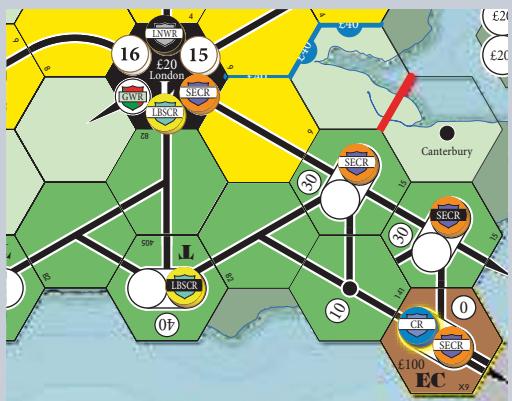
EXAMPLE. The left and center diagrams show that the SECR has used the powers of private company P11 to place plain brown track before Phase 5, and has also used the powers of private company P2 to upgrade a green tile with a small town to a plain brown track tile with no town. The tile replaced is highlighted in diagrams.
The right diagram shows how private company P5 can be used to place a station token in the English Channel. If there is no space for the token, P5 allows the owning company to lay track in the English Channel hex (for the standard £100 cost and following phase restrictions). In the right diagram, the Caledonian Railway has used P5 to upgrade the English Channel tile to brown and then place a station token there.


3.2 MINOR COMPANIES
3.2.1 There are 24 minor companies (30 if the 1822+ expansion is used) as listed in the Company Table beginning on page 36.
3.2.2 A minor company only has a 50% director's certificate (worth two shares). The other 50% of the company is effectively embedded in the company. There are no other shares of minor companies available to buy.
3.2.3 The director of each company controls its actions.
3.2.4 Players can only buy minor companies through the bidding mechanism in a stock round. See sections 4.10 and 4.11 for information on starting minor companies.
3.2.5 Once bought, a minor company may never be sold, though it can be acquired by a major company during its acquisition phase.
3.2.6 Minor companies can only acquire private companies whose cards have a green background.
3.2.7 Minor companies can only lay one yellow tile, or upgrade one tile to green, per operating round. Minor companies can never upgrade tiles past green, even with the use of a private company power.
3.2.8 Earnings are always half withheld in the treasury and half paid to the director.
3.2.9 A minor company must own a train at the end of its operating turn.
3.3 MAJOR COMPANIES
3.3.1 There are ten major companies, as listed in the Company Tables starting on page 36.
3.3.2 Each company's stock consists of nine share certificates, one of which (the director's certificate) represents 20% (two shares) of the total shares in the company. All other share certificates represent a single 10% share. Exception: the LNWR has 10 certificates each representing a 10% share, including the director's certificate.
3.3.3 The director's certificate is always owned by the majority stockholder in the company. This player is the director of that company. If another player acquires more shares than the director, or the director sells enough shares to bring their holding below that of another player, the director's certificate is swapped for two 10% certificates belonging to that other player (or one in the case of the LNWR) and the other player becomes the director.
3.3.4 The director of each company controls the company's actions.
3.3.5 Each major company has a total of eight tokens (the LNWR has nine); one each to represent its share price and latest earnings, and six (the LNWR has seven) to represent stations on the map.
3.3.6 Major companies each have a destination city. These are printed on the board (as described in 1.4.5) and on the company charters. They are also listed in the table on page 40.
3.3.7 No one player may buy more certificates in a company once they hold 60% of that company. However, a player may acquire up to 100% of a major company's stock through share exchange in the acquisition of minor companies.
3.3.8 Major companies can lay one yellow tile per operating round in Phase 2. From Phase 3 on they may either lay one or two yellow tiles, or upgrade one tile, per operating round.
3.3.9 A major company's earnings may be withheld in the treasury, paid out as a dividend, or half withheld and half paid.
3.3.10 A major company must own a train at the end of its operating turn.
3.4 CONCESSIONS
3.4.1 Each major company has an associated concession certificate (on the back of the director's certificate). Concessions are used to start major companies in Phases 2-4, as described in section 4.7. Director's certificates may not be purchased while the corresponding concession is still in play.
3.4.2 Concessions are bought through the bidding boxes as described in section 4.10. The face value of a concession is £100.
3.4.3 Concessions count towards the owning player's certificate limit.
3.4.4 Each concession pays a dividend of £10 per operating round to the owning player.
3.4.5 At the start of Phase 5 the concession certificates are removed from play. Flip the concessions to the director's certificate side and place them with the company's other shares. From then on, director's certificates may be bought as a stock round buy action.
4.1 INTRODUCTION
4.1.1 At the start and end of each stock round, if there are any vacancies in the bidding boxes, all the certificates present are shifted to the lowest numbered boxes, and then the concession certificates, minor company director's certificates, and private company certificates on the top of their respective piles are placed in any appropriate empty bidding boxes (filling lowest numbered vacancies first). Thus, in the first stock round, four of the minor company director's certificates, and three each of the major company concession certificates and the private company certificates are moved from their respective stacks to empty bidding boxes.
4.1.2 The stock round starts with the holder of the Player 1 card and proceeds in player number order until all players pass in turn. All share certificate transfers in a stock round are made between a player and either the bank or a company. Players may never buy shares directly from one another.
4.1.3 During a player's stock round turn, a player may perform one or more of the following actions in the order listed below. A player may choose to take no action and pass instead.
A. Sell any number of certificates subject to the limits set out below in section 4.4.
B. Repay loans.
C. Do one of the following:
• Buy one major company share certificate.
• Convert a concession certificate to a director's certificate.
• Place or increase up to three bids on the concession certificates, minor company director's certificates, and/or private companies, using the bidding boxes.
4.1.4 The stock round ends when all players have passed consecutively. At this point bids are resolved, share prices may change, and the player order for the next stock round is determined.
4.2 CERTIFICATE LIMIT
4.2.1 Each certificate a player owns counts against the player's certificate limit, which is determined by the number of players in the game.
| NUMBER OF PLAYERS | 3 | 4 | 5 | 6 | 7 |
| CERTIFICATE LIMIT | 26 | 20 | 16 | 13 | 11 |
4.2.2 Private companies, concessions, and stock certificates owned by players count against the certificate limit. Exception: P16 offshore tax haven does not.
4.2.3 Share certificates for a company whose stock market value token is in the yellow area of the stock market do not count against the certificate limit.
4.2.4 A player at certificate limit may not make any purchases that would cause them to exceed the limit. Exception: buying a share for P16 off-shore tax haven.
4.2.5 A player may not place a bid on an item if they are at the certificate limit. Each item on which a player currently has the highest bid counts as a certificate against the certificate limit.
4.2.6 A player owning more stock than the certificate limit will be required to sell down to meet the limit. See rule 4.4.7.
4.3 PLAYER LOANS
4.3.1 Over the course of the game, a player may be forced to take loans to fund train purchases (see sections 5.14 Forced Train Purchase and 5.15 Emergency Money Raising). A player may not buy any shares, convert a concession, or place a bid whilst they have loans.
4.3.2 After their “sell shares" step, a player may make a payment on outstanding loans. This may be for the full amount or a partial amount. The money is paid to the bank.
4.3.3 A player is not obliged to sell shares to raise money to pay off loans.
4.3.4 If a player still has debt at the end of a stock round, a further 50% interest (rounded up) is charged by the bank. Any debt still held by a player at the end of the game is subtracted from their wealth.
4.3.5 The sum of any loans in play does not count towards the bank limit of £12,000 (i.e. treat the loan as coming from a separate source, not the bank).
4.4 SELLING SHARES
4.4.1 In their stock round turn, a player may sell any number of stock certificates, transferring them from their holdings into the bank pool subject to the constraints set out below:
Private companies, minor companies, and concessions may not be sold.
• Shares cannot be sold in a company that has not completed an operating round.
• A maximum of 50% of a company's stock is allowed in the bank pool.
• The director's certificate cannot be sold into the bank pool.
• Shares held by P16 Tax Haven may not be sold.
4.4.2 If due to selling shares, the share holding of a company director drops below that of another player (who must own at least 20% of the company, or 10% in the case of the LNWR) that other player becomes the new director. If there is more than one eligible player, the new director is the player with the largest holding, or, in the case of a tie, the tying player closest to the outgoing director in next player order. The outgoing director exchanges their director's certificate for two ordinary 10% shares (or one share in the case of the LNWR) belonging to the new director. This exchange occurs before resolving the rest of the sale. This mechanism allows the director of a company to divest themselves of the directorship without the director's certificate entering the bank pool.
4.4.3 The player receives the current share price from the bank for each share sold.
4.4.4 The company's price now drops. Move its share market token down one space vertically per share sold. If the token is at or reaches the bottommost space then it does not move further.
4.4.5 If the token moves to a space on the stock market which is already occupied by other stock market tokens, it is placed at the bottom of the pile; if the token stays on its original space it stays in its relative position in the pile.
4.4.6 A player who sells shares in more than one company in a single turn decides on the order in which to sell them; this will decide the relative order of companies whose stock market tokens move to the same space.
4.4.7 A player who owns more certificates than the certificate limit allows must sell stock, if possible, to bring themselves within the limit at their first opportunity in a stock round. If they can sell some stock but not enough to be within the limit, then they must sell what they can. They may choose freely which stock to sell but all rules covering sales must be respected
4.5 BUYING SHARES
4.5.1 To buy stock, the active player transfers one certificate from the bank pool or a company treasury into their own holdings, paying the stock market value. If the certificate is from the bank pool, the payment is made to the bank; if the certificate is from the company treasury, the payment is made to the company treasury.
4.5.2 Only shares that have a stock market value can be bought in this way. The director's certificate of a company cannot be bought by a “buy" action until Phase 5, and ordinary shares of a company cannot be bought until some player holds the director's certificate. From Phase 5, the stock market value is set by the purchasing player when taking the director's certificate. See section 4.8 for more information.
4.5.3 Buying stock does not cause the current share price to change.
4.5.4 Only one certificate may be bought per stock round turn.
4.5.5 A player cannot buy stock in a company if they sold any of its stock earlier in the same stock round.
4.5.6 Players may not buy additional certificates in a company once they hold 60% of that company (exception: P16 Tax Haven). However, it is possible for a player to acquire up to 100% of a major company's stock through share exchange during the acquisition of minor companies (see section 5.17).
4.5.7 A player cannot buy any share certificate that would cause them to exceed the certificate limit, even if the purchase would cause a change of directorship and at once reduce the player's holding back to the limit. Exception: buying a share certificate to put into P16 off-shore tax haven.
4.5.8 Stock from a company whose share price token is in the yellow zone of the stock market does not count against the certificate limit. A player at the certificate limit may purchase stock in such a company.
4.5.9 If, because of a share purchase, the player's holding exceeds that of the current director, they become the new director, exchanging the director's certificate for two 10% certificates (or one in the case of the LNWR) of their own.
4.6 MAJOR COMPANY FORMATION OVERVIEW
4.6.1 The procedure for forming major companies depends on the phase.
4.6.2 Major companies may not be formed in Phase 1.
4.6.3 In Phases 2-4, players cannot buy director's certificates directly. Instead, they acquire them by converting the associated concession as a stock round action. This procedure is covered in section 4.7.
4.6.4 Starting in Phase 5, players buy director's certificates directly, and the newly formed company does not become operational until 50% of its shares are sold. This procedure is covered in section 4.8,
4.7 CONVERTING A CONCESSION TO A DIRECTOR'S CERTIFICATE (PHASES 2-4)
4.7.1 In Phases 2-4, a player may start a major company by converting its concession to the director's share.
4.7.2 For all companies except the LNWR, the concession holder announces that they are converting the concession. They then turn over the concession certificate to the 20% director's certificate. They then announce the starting share price by putting the share price token in the corresponding red-outlined space (between £60 and £100) on the stock market, underneath any tokens already there.
4.7.3 The director now takes the appropriate company charter and places £100 from the bank into the company treasury on its charter. They then pay the balance of twice the starting price less £100 into the company treasury from their own funds. The company is now floated and will operate in the next operating round. The remaining certificates are placed in the company treasury and are available for purchase by players.
4.7.4 For the LNWR: The concession holder announces that they are converting the concession. They then turn over the concession certificate to the 10% director's certificate side. They then announce the starting share price by putting the share price token in the corresponding red-outlined space (between £60 and £100) on the stock market, underneath any tokens already there. They then take the LNWR charter and take the initial starting price from the bank and place it in the company treasury on its charter. The company is now floated.
4.7.5 Note that concessions can only be bought through the bidding mechanism. At the end of a stock round, those items that have bids on them are bought. A player therefore does not gain possession of a concession they have bid on until the stock round has finished; they therefore cannot convert it until the following stock round. See section 4.11 for more details
4.7.6 The company has now floated. Proceed to section 4.9 to complete major company setup.
EXAMPLE. Alice is converting the GWR concession to the director's certificate. She first turns the concession over to the director’s certificate side. Next, she sets the initial share price at £80 by placing a GWR token in the £80 red-outlined box on the stock market. The company will start with twice this value (£160) in its treasury, because the director's certificate is worth two shares. To put this amount into the treasury she rst takes £100 from the bank (the face value of the concession), and then adds £60 of her own funds. The GWR now has £160 in its treasury, twice the starting price of £80.
4.8 FORMING A MAJOR COMPANY DIRECTLY (PHASES 5-7)
4.8.1 At the start of Phase 5, the concession certificates are removed from play and the director's certificates may be bought as a buy action. Flip the concessions to the director's certificate side and place them with each company's other shares.
4.8.2 To form a major company in Phase 5 or later, the forming player sets the initial share price (placing a token on the corresponding £60, £70, £80, £90 or £100 space), and purchases the director's share for twice that price, paying the money into the company treasury.
4.8.3 The newly formed company does not float and become operational until 50% of its shares are sold.
4.8.4 Starting in Phase 6, once 50% of the shares are sold, the company receives an additional five times its starting value from the bank into its treasury, and the remaining 50% of shares (five 10% certificates) are placed in the bank pool. This does not affect the share price. In total the company will now have ten times its starting value in the treasury: half from share purchases, and half from the bank.
4.8.5 Thus a company that floats before Phase 6 will be funded through incremental capitalization as players buy its shares, whereas a company that floats in Phase 6 or 7 has full capitalization (with five shares placed in the pool).
4.8.6 The flotation conditions depend on the current phase when the company floats (i.e. converts its concession or reaches 50% sold), not when it first operates. A company floats during a stock round, but phase changes occur at the end of a stock round (due to train exports) or during an operating round (due to train purchases).
4.8.7 Proceed to 4.9 to complete major company setup.
4.9 COMPLETING MAJOR COMPANY FORMATION
4.9.1 Whether formed by converting a concession or directly, the rest of the setup is the same.
4.9.2 The director takes the six station tokens and places them on the charter in the spaces that match the type of token. Each company has five regular tokens (the LNWR has six) and one black banner destination token. The spaces on the charter that are blank are not filled at this time.
4.9.3 They then place an additional token on the revenue track.
4.9.4 Note that the company's home station is not placed on the map until first turn housekeeping (section 5.5).
4.10 BIDDING
4.10.1 There are four bidding boxes for the minor company director's certificates, and three of each for the concessions and private company certificates.
4.10.2 At the start and end of each stock round, if there are any vacancies in the bidding boxes, the remaining certificates are all shifted to the lowest available numbered boxes, and then the top concession certificates, minor company director's certificates, and private company certificates are placed in any corresponding empty bidding boxes (filling lowest numbered vacancies first).
4.10.3 Each player has a limited number of bidding tokens (based on the number of players in the game, rule 1.7.2), which also represents the maximum number of the items available that they may bid on during any stock round.
4.10.4 To place a bid, a player either
• Places an unallocated bidding token in an empty space on a bidding box
• Moves a previously-placed bidding token to a higher-valued empty space on the same item. This is only allowed if another player has placed a higher bid on that item.
4.10.5 Players may place and/or move up to three bids in a stock turn.
4.10.6 The opening bid on any item must be equal to or greater than the face value. All bids must be in whole multiples of £5.
4.10.7 A bid must be higher than any previously placed bids for that item, and the bid must not take the player's committed resources to more than their available cash in hand. A player's committed resources are the sum of the amounts bid for those items for which they have the highest bid. Note that a player's committed resources may go down if they are outbid by another player on an item for which their bid was previously highest.
4.10.8 A player may not place or move a bid on an item if they are at the certificate limit. Each item on which a player currently has the highest bid counts as a certificate against the certificate limit. (This applies to P16 tax haven as well.)
4.10.9 If a player wishes to bid £100 or more over face value for an item, they may do so. A spare token (i.e. not one of the players' actual bidding tokens), or a £100 chip is placed on the item each time the bidding goes “round the clock."
4.10.10 A player who has bid on an item cannot withdraw that bid by taking the bidding token back into their hand or by moving it to make a bid on another item, even if they are later overbid by another player.
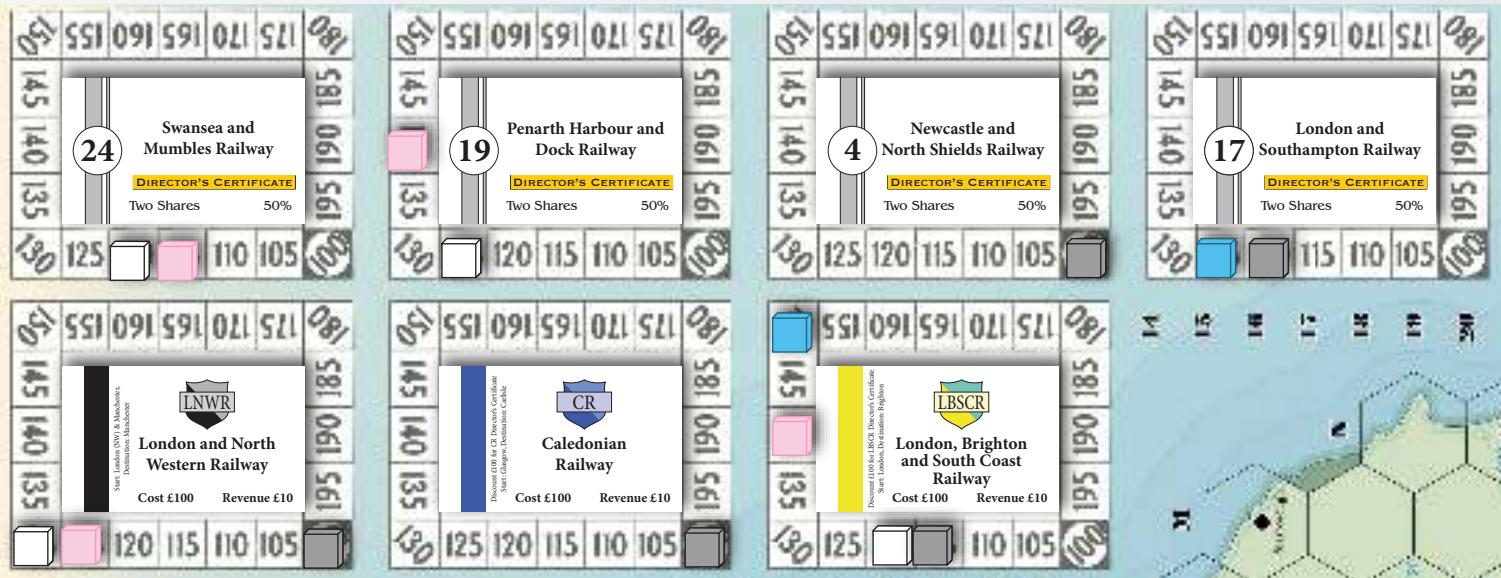
EXAMPLE. The figure illustrates a series of bids (in the first stock round) as summarised in the table below. The private company bidding track is not illustrated. We can assume that all players apart from grey (who has 5 bidding tokens in play on the minor company and concession bidding tracks) might have placed some bids on the private companies.
The pink and white players have been competing for the Welsh minor companies, and pink has won M19 at a price of £140, while white has won M24 at a price of £120. M19 is pink's only winning bid, but at least M19 will operate first, as it had the highest bid value. The white player can content themselves with M24 and the LNWR concession.
After a four-way fight for the LBSCR concession, the grey player has dropped out of all their expensive battles and has opted for the low cost, lower return strategy: buying M4 and the Caledonian concession both at face value.
Conversely, the blue player has decided to pay the price of winning the better companies, and has won the LBSCR concession for £150 and M17 for £125.
Without knowing what is coming up next in the bidding stacks we cannot judge these bids, but none of them seem unreasonable.
| PLAYER | M24 | M19 | M4 | M17 | C: LNWR | C: CR | C: LBSCR |
| Pink | 115 | 140 | 1 | 125 | 140 | ||
| White | 120 | 125 | - | 130 | 120 | ||
| Grey | - | 100 | 120 | 100 | 100 | 115 | |
| Blue | 125 | 一 | 150 |
4.11 END OF STOCK ROUND AND FLOATING MINOR COMPANIES
4.11.1 Once all players pass consecutively, the stock round is over.
4.11.2 Each player pays for and takes the items on which they were the highest bidder. All players remove their bidding tokens.
4.11.3 Minor companies purchased from the bid boxes are then floated. Flotation order is from the highest sum bid to the lowest. In the case of a tie, the company from the lowest-numbered box takes precedence.
4.11.4 The player with the highest bid on a minor company must buy the 50% director's certificate for the price bid. The starting price for the company and its initial capitalization depend upon the phase of the game in which it was bought:
• In Phase 1, irrespective of the price bid, the minor company starts at £50 (the solid red colored space on the stock market) with £100 starting treasury. The certificate represents two shares, so is worth twice the stock market price; i.e. it is worth £100.
• In Phase 2, the price bid is divided by two and rounded down to the highest value in the starting value space on the stock market (outlined red, including the solid red colored space). The company has twice this value as its starting treasury. For example, a bid of £100, £105, £110 or £115 will result in a price of £50, with £100 capital. A bid of £120, £125, £130, or £135 will result in a price of £60, with £120 capital. And so on, with any bid over £200 resulting in a price of £100 with £200 capital.
• In Phase 3 and later, the price bid is divided by two and rounded down to the highest value in the starting value space on the stock market (outlined red, including the solid red colored space) as in Phase 2. The company starts with the sum bid as its starting treasury. For example, a bid of £135 would give a start price of £60 but with £135 capital, and a bid of £350 would give a start price of £100 (and therefore value £200), with £350 starting capital.
The following table shows possible starting prices per phase.
| BID PRICE | SHARE PRICE | STARTING CAPITAL | |
| PHASE 2 ONLY | PHASES 3 AND UP | ||
| $110-$115 | $50 | $100 | Price bid |
| $120-$135 | $60 | $120 | |
| $140-$155 | $70 | $140 | |
| $160-$175 | $80 | $160 | |
| $180-$195 | $90 | $180 | |
| $200+ | $100 | $200 | |
4.11.5 Because minor companies run before major companies, it is convenient to place minor company tokens on top of any major company tokens already on the relevant space. If any minor companies already occupy the relevant space, then the new tokens are placed beneath them.
4.11.6 After the purchased minor companies have been floated, check to see if any minor company certificates remain in the bid boxes. For each minor company with no bid placed upon it, one L/2-train is exported from the bank (not the bank pool); exported trains are removed from the game. If there are no L/2-trains remaining in the bank, then no action is taken.
4.11.7 Then, if the minor company in Bid Box 1 was not sold during the stock round, it is removed from play and the next available new train from the bank (not bank pool) is exported. Thus, a minor unsold in Bid Box 1 could export two trains from the bank if there is still at least one L/2 train remaining. This train export counts as a sale and can cause a phase change.
4.11.8 All other unsold items stay on the bidding boxes. Those in higher numbered boxes are moved to occupy lower numbered bidding boxes. For example, if a minor company in Bid Box 3 was the only item unsold, it would be moved to Bid Box 1 before repopulating the remaining bidding boxes. The bidding boxes are refilled at the end and again at the beginning of a stock round (this is only relevant after Phase 5, when companies can acquire minor companies directly from the bidding boxes during an operating round).
4.11.9 The Player 1 player order card for the next stock turn is given to the player with the most cash. The Player 2 card is given to the player with the second most cash, and so on. If two players have equal cash, their stock turn order relative to each other stays unchanged from the previous stock round. Exception: P9 Midland and Great Northern Joint Railway.
4.11.10 50% interest is charged on any outstanding loans.
4.12 END OF STOCK ROUND SHARE PRICE MOVEMENT
4.12.1 At the end of the stock round, if 100% of a major company is in players' hands (including P16 Tax Haven), its stock market token moves one space up on the stock market. If it is at the top of its column it does not move.
4.12.2 All affected stock market tokens move in descending share price order, and from top to bottom when stacked together. If a company's token moves to a space which is already occupied, it goes to the bottom of the stack.
4.12.3 Minor companies are never 100% sold out, as only 50% of their share stock is available for sale.
5 OPERATING ROUNDS
5.1 OVERVIEW
5.1.1 Initially there is a single operating round after each stock round. Once the first 2-train has been bought, after the next stock round there will be two operating rounds after each stock round.
5.2 OPERATING ROUND TURN ORDER
5.2.1 During an operating round, companies run in the following order:
A. Private companies and concessions pay their dividends to their owners (whether players or companies), if applicable (rules 3.1.2 and 3.4.4).
B. Minor companies run in descending share price order.
C. Major companies run in descending share price order.
5.2.2 If the stock values of two or more companies are in the same space on the stock market, then the one whose stock market token is on top runs first. If the stock values of two or more companies are equal but in different spaces, the furthest to the right runs first. The determination of which company runs next is deferred until the end of the previous company's operations; sales of stock during an operating round (which in practice rarely occurs) may affect this order.
5.3 OPERATING ROUND ACTIONS
5.3.1 All decisions made on behalf of a company are made solely by its director. When a company runs, it performs the following activities. Most are optional, but if done, they must occur in this order:
A. Perform first turn housekeeping (first turn only, compulsory).
B. Acquire private companies from (consenting) players.
C. Lay/upgrade track.
D. Check for connection to destination and place destination token if applicable (major companies only).
E. Place one station token (major companies only).
F. Run train(s), if any, to establish earnings (compulsory).
G. Pay, split, or withhold dividends (minor companies must split earnings).
H. Buy trains (usually optional but sometimes compulsory).
I. Acquire a minor company from a (willing) player, or from Phase 5 onwards, from a bidding box (major companies only).
J. Issue or redeem company stock (major companies only).
5.4 ROUTES
5.4.1 Many company activities revolve around routes. A route of a company is a continuous unbranched length of track, including at least one city or off-board area with a station token on it belonging to the company.
5.4.2 A company's route may only pass through a city or off-board area if it has a station token there, or if there is at least one unoccupied station present, or both.
5.4.3 A route is blocked by and cannot pass through any city or off-board area completely filled with station tokens belonging to other companies, although it may begin and/or end in such a city.
5.4.4 A route may not use any segment of track more than once.
5.4.5 For the purposes of running a train, a route must not reach or pass through any city or town more than once. It is permissible for a train to pass through both towns in a double town hex, so long as the route uses different track segments each time (section 5.11 covers train runs).
5.4.6 Most grey off-board areas are termini. A route can begin or end at one of these locations, but cannot pass through. In all other respects, the pointed pre-printed track functions as normal track linking the stations in the off-board area to the adjoining hex. These off-board locations have multiple routes leading to/from them. Despite this, the locations, if included in routes, must be termini. Glasgow, Merthyr Tydfil and Pontypool are exceptions and are treated like a normal city for determining routes. Exceptions pertaining to Merthyr Tydfil and Pontypool are covered in section 9.
EXAMPLE. Minor company M2 can run from the Highlands to Glasgow (and beyond) on pre-printed track, and can also lay track out towards Stirling (and beyond). However, even with a token in the Highlands, there is no route from Glasgow, through the Highlands, and out to Stirling.
5.5 FIRST TURN HOUSEKEEPING
5.5.1 On a major or minor company's first turn of operation, the company director places the company's free home station token on its home city, which is marked on the map.
5.5.2 The LNWR also places its destination token on the map, in Manchester. This is treated as a normal station token until a route can be traced to its home station in London, at which point it becomes a destination token.
5.5.3 A minor company (only) may buy an L-train, if any remain available for purchase from the bank or bank pool.
5.5.4 Note that when emergency money raising to buy a train from the bank or bank pool, the

cheapest available train must be purchased (section 5.15). Thus, a minor company starting with £100 in its treasury (for example) cannot choose to buy a 2-train at the end of its turn using emergency money raising, but must buy an L-train.
5.6 ACQUIRE PRIVATE COMPANIES
5.6.1 During this step, a company (major or minor) may acquire private companies from one or more consenting players, providing the phase acquisition requirement has been met. The phase requirement is indicated on the private company certificate. (Unlike most 18xx games, private companies can only be acquired in this step of the operating turn.)
5.6.2 No compensation is paid by the acquiring company to the player.
5.6.3 Once acquired by a minor or major company, the private company certificate is flipped over and placed reverse-side up on the purchasing company's charter; or is removed from play, giving the acquiring company the associated power, token, or tile.
5.6.4 Private company certificates are color coded red, green, or blue. Red-colored private companies may only be acquired by major companies. Green-colored private companies may be acquired by either major or minor companies. The blue private company (P16 Off-Shore Tax Haven) cannot be acquired.
5.6.5 There is no restriction on the number of private companies that may be acquired by a minor or major company on its turn.
5.6.6 Some private companies continue to pay their revenue of £10 per operating round after they have been acquired and flipped, until they are closed by using their powers. This is noted on the reverse of the certificates and their revenue values are colored gold.
5.6.7 A major company may acquire P1, which becomes a 5-train, even if it is already at train limit. If the company is then over the train limit it must discard trains accordingly.
5.7 LAY TRACK/UPGRADE TRACK
5.7.1 In this part of its turn, a company may place or upgrade track tiles on the map. This step is optional.
5.7.2 Yellow tiles are laid on, and aligned with, the pale green colored hexes on the map. These may be upgraded successively to green, brown, and grey, when those colors become available due to phase changes. Development proceeds in order; intermediate colors must not be skipped. The upgraded tile is returned to the bank and is available for reuse elsewhere.
5.7.3 A company may choose to play no track at all, or may place less than its full allowance. If two tiles are being played they do not have to connect to each other.
5.7.4 In order to place or upgrade a tile, a company must be able to trace a route that uses track on the tile after it has been placed.
5.7.5 If there is no track in the hex where a company's home station token resides, the company may lay any suitable yellow city tile there.
5.7.6 The placement of yellow tiles is differentiated from upgrading tiles because the various companies have different building allowances:
• In Phases 1/L and 2, each company may place one yellow tile.
• From Phase 3 on, mi
内容过长,此处只内联前一部分;完整内容请下载或到规则页阅读。
下载 Markdown原文为社区整理/出版社公开资料,版权归原作者,仅供个人学习查阅。