
卡斯卡迪亚之旅Cascadia
一句话概览
卡斯卡迪亚之旅 是一款已收录于村了吗规则库的桌游,支持 1–4 人,原名 Cascadia。
本页内容:一句话概览 · 游戏概述 · 1. 游戏组件 · 2. 游戏设置 · 3. 游戏流程 · 4. 栖息地板块说明 · 5. 终局与计分 · 6. 单人模式 · 7. 变体规则 · 关键规则与常见问题 · 常见问题
卡斯卡迪亚之旅 规则速览
以下规则速览由本站整理,与官方规则书表述不同,仅供快速上手参考。
游戏概述
玩家在太平洋西北地区的生态环境中竞争,通过选取栖息地板块和野生动物标志物,拼接出得分最高的风景拼图。每局使用5种野生动物(熊、麋鹿、鲑鱼、鹰、狐)各一张计分卡,玩家在按模式摆放动物获取分数的同时,还需争夺最大连片栖息地走廊的奖励。每人恰好进行20回合后终局计分,总分最高者获胜。
核心机制: 板块拼放、标志物选取(轮抽)、图案组合计分、栖息地连片竞争
1. 游戏组件
| 组件 | 数量 |
|---|---|
| 栖息地板块 | 85块(含25块拱心石板块) |
| 野生动物标志物 | 100个(熊、麋鹿、鲑鱼、鹰、狐各20个) |
| 自然标志物(松果) | 25个 |
| 起始栖息地板块 | 5块 |
| 野生动物计分卡 | 21张(熊4、麋鹿4、鲑鱼4、鹰4、狐4、家庭/进阶各1) |
| 布袋 | 1个(用于抽取野生动物标志物) |
| 计分表 | 1份 |
2. 游戏设置
2.1 准备标志物
将所有野生动物标志物放入布袋中充分混洗。
2.2 准备栖息地板块
根据玩家人数随机抽取对应数量的栖息地板块:
| 玩家人数 | 使用板块数 |
|---|---|
| 1人 | 43块(移除42块) |
| 2人 | 63块(移除22块) |
| 3人 | 63块(移除22块) |
| 4人 | 83块(移除2块) |
将选用的板块洗匀后面朝下堆叠(可分成数叠),放在所有玩家方便取用处。未选用的板块放回盒中。
2.3 准备计分卡
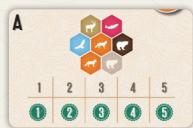
从5种动物的计分卡中各随机抽取1张,共5张放在游戏区中央,供所有玩家查看。其余计分卡放回盒中。初次游戏建议使用右下角标有「A」的计分卡。
2.4 玩家个人设置
每位玩家拿取1块起始栖息地板块,面朝上放在自己面前。此板块及后续拼入的板块和标志物共同构成该玩家的「环境」。
2.5 准备展示区
从面朝下的板块叠中翻开4块栖息地板块,面朝上放在游戏区中央。从布袋中随机抽取4个野生动物标志物,按顺序分别与4块板块配对,形成4个组合。
2.6 准备自然标志物
将自然标志物放在所有玩家方便取用处。
2.7 确定起始玩家
随机决定起始玩家。
3. 游戏流程
从起始玩家开始顺时针进行。每位玩家的回合按以下步骤执行:
3.1 选择栖息地板块与野生动物标志物
展示区中始终保持4块栖息地板块与4个野生动物标志物配对。在选择前,先检查是否存在动物过盛:
强制清除(4个相同): 若展示区中4个野生动物标志物完全相同,必须全部移除。将这4个标志物放在一旁,然后从布袋中依次抽取4个新标志物,按顺序与4块栖息地板块重新配对。此情况在一回合内可能发生多次。
可选清除(3个相同): 若展示区中有3个相同的野生动物标志物,当前玩家可选择移除这3个标志物。将其放在一旁,然后从布袋中依次抽取3个新标志物重新配对。此操作每回合最多执行一次。
过盛处理完成后,所有被移除的标志物放回布袋。
3.2 使用自然标志物(可选)
在选择组合之前,玩家可花费自然标志物执行以下操作之一(无数量限制):
- 从展示区中任意选取1块栖息地板块,再任意选取1个野生动物标志物(不必来自同一组合)
- 清除展示区中任意数量的野生动物标志物并重新抽取替换
花费的自然标志物归还供应堆。若没有自然标志物,必须选取现有组合之一。
3.3 拼放板块与标志物
选定板块和标志物后,按任意顺序拼入自己的环境。
栖息地板块放置规则:
- 必须与环境中已有的某块栖息地板块相邻(至少一条边相接)
- 不可叠放在其他板块之上,也不可移动已放置的板块
- 地形匹配不是放置规则,但会影响终局计分
野生动物标志物放置规则:
- 放到环境中的某一块栖息地板块上(每块板块最多1个标志物)
- 该板块必须显示对应的动物图标(板块上显示1-3种动物选项)
- 若无法合法放置或选择不放置,将标志物放回布袋
- 可放在本轮刚放置的板块上,也可放在其他已有板块上
拱心石奖励: 若将野生动物标志物放到拱心石板块上,立即获得1个自然标志物。
3.4 补充展示区
放置完成后,从面朝下的板块叠顶部翻出1块新板块补充展示区空位,从布袋中随机抽取1个新标志物补充空位。补充时不动已有组合,只填补空位。回合结束,顺时针传递给下一位玩家。
4. 栖息地板块说明
每块栖息地板块包含1或2种地形类型,以及1、2或3种可放置的动物选项。例如:湿地-河流板块可放置鲑鱼、熊或鹰;山脉-草原板块可放置熊或狐。
拱心石板块 是特殊的双地形板块。将匹配的野生动物标志物放到拱心石板块上时,获得1个自然标志物。
5. 终局与计分
当任何玩家回合结束后,若面朝下的板块叠中已无板块可补充展示区空位,游戏立即结束(每人恰好进行20回合)。按以下4项分别计分:
5.1 野生动物计分卡
根据本局使用的5张野生动物计分卡,分别计算每种动物的得分。不同动物的计分规则各异:
熊: 按熊群的大小和数量计分。熊群可为任意形状,但两个熊群不可相邻。必须恰好凑出计分卡上标注的数量才能得分。
麋鹿: 按麋鹿群的形状计分(如直线、特定图案、环形等)。麋鹿群可相邻,但每只麋鹿只能计入一个群组。多个相邻群组以得分最高的解读方式计分。
鲑鱼: 按鲑鱼「线路」计分。线路定义为首尾相邻、且每只鲑鱼至多与另外两只相邻的线形排列(三角形3只鲑鱼算作线路,但该线路上不可再连接其他鲑鱼)。线路中每只鲑鱼不可有第三只相邻鲑鱼。
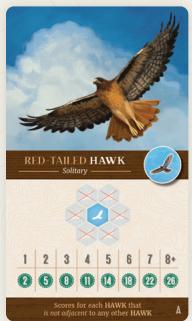
鹰: 按鹰的分布计分。可能按孤立鹰的数量、有视线连接的孤立鹰、鹰之间的视线数量、或鹰对之间的独特动物种类计分。视线为六角形平边到平边的直线,仅被另一只鹰打断。
狐: 按狐相邻位置的动物种类计分。每只狐(或每对狐)独立计分,根据相邻栖息地空间中的独特动物种类、动物对或同类数量获得递增分数。
5.2 栖息地走廊
计算每位玩家在5种地形(山脉、森林、草原、湿地、河流)中各自最大的连片走廊。连片指至少一条边相连的同类型地形板块群。每种地形取最大连片的板块数作为该地形得分。
5.3 栖息地走廊多数奖励
根据玩家人数,对每种地形最大连片的玩家给予额外奖励:
| 玩家人数 | 奖励规则 |
|---|---|
| 单人 | 连片≥7块的地形各得2分奖励 |
| 2人 | 最大连片玩家得2分;并列则各得1分;第二名无奖励 |
| 3-4人 | 最大连片玩家得3分,第二名得1分;两人并列第一各得2分,无第二名奖励;三人及以上并列第一各得1分,无第二名奖励;第二名并列则各得0分 |
5.4 自然标志物
每个未使用的自然标志物得1分。
所有项目得分相加,总分最高者获胜。平局时,拥有更多自然标志物的玩家获胜;仍平局则共享胜利。
6. 单人模式
按2人游戏设置,但只给自己1块起始栖息地板块,板块叠放在左侧。
每回合正常进行,但在补充展示区前,先将离板块叠最远的1块栖息地板块和1个野生动物标志物移出游戏。然后将剩余的2块板块和2个标志物滑向远离板块叠的方向,最后补充2块新板块和2个新标志物。
单人模式同样进行20回合,计分方式与多人游戏相同。单人计分参考:
| 总分 | 评价 |
|---|---|
| 60+ | 不错的开始 |
| 70+ | 渐入佳境 |
| 80+ | 非常好 |
| 90+ | 优秀 |
| 100+ | 精英 |
| 110+ | 登峰造极 |
7. 变体规则
7.1 家庭变体
设置与标准游戏相同,但仅使用1张家庭变体计分卡替代5张动物计分卡。家庭变体计分卡按同种动物群的大小给出固定分数,群组可为任意形状。终局可选择是否使用栖息地走廊多数奖励。
7.2 进阶变体
与家庭变体玩法相同,但使用进阶变体计分卡,不同大小群组的分数更高。
关键规则与常见问题
易错规则
- 过盛检查在选择之前进行,而非之后
- 4个相同必须清除,3个相同可选清除,且清除后需重新抽取配对
- 每回合可花费任意数量的自然标志物,但每次花费只能执行一个操作
- 动物标志物只能放在显示该动物图标的板块上,且每块板块最多1个
- 无法放置的标志物放回布袋,不会强制放置
- 拱心石板块上放动物可获得自然标志物,这是自然标志物的主要获取途径之一
- 终局每个未使用的自然标志物值1分,不必在游戏结束前全部用完
- 栖息地走廊是同一地形的最大连片,不是所有地形混在一起
- 单人模式每回合会移除1组板块和标志物,展示区保持2对而非4对
常见问题
-
Q:自然标志物可以在同一回合使用多个吗?
A:可以,回合内无使用数量限制 -
Q:可以将动物标志物放在本轮刚放置的板块上吗?
A:可以,只要该板块显示对应的动物图标 -
Q:拱心石板块与普通板块有什么区别?
A:拱心石板块是双地形板块,将动物放在上面时可获得1个自然标志物 -
Q:熊群不能相邻,那麋鹿群呢?
A:麋鹿群可以相邻,但每只麋鹿只能计入一个群组 -
Q:鲑鱼线路中三角形3只算线路吗?
A:算,但该线路上不可再连接其他鲑鱼 -
Q:终局平局如何处理?
A:自然标志物多的玩家获胜;仍平局则共享胜利 -
Q:展示区4个标志物全部相同时怎么办?
A:必须全部移除并重新抽取,一回合内可能多次发生 -
Q:3个相同时清除是强制的吗?
A:不是,由当前玩家决定是否清除,每回合最多清除一次
常见问题(FAQ)
以下 4 条问答来自站内玩家的真实提问,答复由本站依据规则资料作答;答复内容保持原样,仅对提问做了去口语化的轻微整理。
所有地形都是1分吗?
结论:是的。标准基础计分里,5 种地形的基础分完全一样——每块板块 1 分,没有哪种地形天生更值钱。
具体做法:
- 对山脉、森林、草原、湿地、河流每种地形分别计算。
- 每种地形只取你环境中最大的一片连片,其中每块板块得 1 分。
- 「连片」指板块之间至少共一条边相接(六边形六条边之一)。
- 较小的同地形连片不计分。例如你有 3 块森林连片、另有 4 块森林连片,森林只算 4 分。
- 5 种地形都是用这同一个「每块 1 分」的标准,彼此没有高低之分。
真正因地形而异的是上层奖励(多数奖励):
- 单人:某地形最大连片达到 7 块及以上,该地形得 2 分奖励。
- 2 人:每种地形最大连片的玩家得 2 分;并列则各得 1 分;第二名无奖励。
- 3–4 人:每种地形最大连片者得 3 分,第二名得 1 分;两人并列第一各得 2 分且无第二名奖励;三人及以上并列第一各得 1 分且无第二名奖励;第二名并列则各得 0 分。
- 注意:判断谁拿这份奖励,用的就是上面记录的「最大连片数值」,即取最大值,不是把所有连片加起来。
两个需要区分的点,避免误读:
1. 地形分与多数奖励是两项分开计分:先按最大连片算基础分(每块 1 分),再按玩家之间比较给加成。
2. 规则书里另有可选挑战玩法(Achievements/Rule Restrictions)会改动地形计分,例如「恰好 3 块的连片各算 3 分」「连片必须 5 块以上才计分」「放置板块时至少一边地形匹配」等——但那些是自愿加的限制玩法,不是标准基础规则。标准规则下就是每块 1 分。
本内容仅供参考,如有冲突以说明书和身边大佬为准。
拿出来的动物还放回盲抽袋吗?
结论:要放回盲抽袋——但分几种情况,只有单人模式每回合弃掉的那一组是例外。
1. 过盛清除拿出来的动物 → 放回盲抽袋
- 展示区4个动物完全相同(强制清除)或3个相同(当前玩家可选清除)时,先把这些标志物放到一旁,然后从布袋依次抽新标志物按顺序重新与板块配对。
- 等所有过盛情况都处理完之后,被清掉的标志物统一放回盲抽袋。
- 注意顺序:是"全部处理完再一起放回",不是清一次就立刻塞回去。
2. 你自己拿走、但放不下去或不想放的动物 → 放回盲抽袋
- 如果环境中没有任何空格板块能容纳该动物(板块上必须有对应动物图标、且每块板块最多1个标志物),或者你自己选择不放,就把这个标志物放回布袋,不会强制你放。
3. 例外:单人模式每回合弃掉的那一组 → 移出游戏,不放回
- 单人模式在补充展示区之前,会弃掉离板块叠最远的那1块栖息地板块和1个动物标志物。这两件是移出游戏、本局不再使用,不是放回布袋。
- 只有这一处是"移出游戏"的处理。
另外提醒一个容易混的点: 花掉的自然标志物(松果)是归还到供应堆,它不属于动物标志物,和盲抽袋没有关系。
本内容仅供参考,如有冲突以说明书和身边大佬为准。
卡斯卡迪亚我们10个人一起玩?
很遗憾:《卡斯卡迪亚》官方规则不支持 10 人一起玩同一局。
规则书封面就写明:
> Designed by Randy Flynn, for 1-4 players, ages 10+
> (1–4 人游戏,适合 10 岁以上)
在 Setup 部分,地景板块的数量也是按人数设置的:
- 2 人:使用 43 块 Habitat Tiles
- 3 人:使用 63 块
- 4 人:使用 83 块
- 没有 5 人以上规则
另外,每位玩家一局固定会玩 20 回合。如果 10 人一起玩,至少需要约 203 块地景板块,但整盒游戏只有 85 块 Habitat Tiles,所以也不够。
如果你们有 10 个人想一起体验《卡斯卡迪亚》,可以这样安排:
- 官方方式:分成多桌,每桌 2–4 人。
- 例如:4 人一桌 + 4 人一桌 + 2 人一桌
-
或:4 人一桌 + 3 人一桌 + 3 人一桌
但注意:每桌都需要独立的一盒《卡斯卡迪亚》,因为一盒配件只够一局使用。 -
如果只有一盒:最多只能 4 人同时游戏。
可以把 10 人分成 2–4 人的小组,按顺序轮流开几局,各自计分,最后比较分数;但这不是官方“10 人同局”规则,只是为了让大家都能玩到的组织方式。 -
也可以让未上场玩家围观、帮忙补充板块、管理动物标记,但同样只是娱乐性质,非官方玩法。
所以结论是:《卡斯卡迪亚》最标准、最推荐的一局人数是 2–4 人;10 人不能在同一局内进行。
本内容仅供参考,如有冲突以说明书和身边大佬为准。
地形计分是只计算最大的吗?
结论:是的——每种地形只按「最大的那一片连片」来算,不是把该地形的所有板块加总。
具体做法:
- 对 5 种地形(山脉、森林、草原、湿地、河流)分别计算。
- 在每种地形里,找出你环境中最大的 contiguous habitat corridor(连片走廊)——"连片"指通过最少一条边相接的同类型地形板块所构成的群组。
- 这片最大连片中的每一块板块得 1 分。
- 该地形的其他较小连片不额外计分(不累加)。
举例:若你有一片 3 块的森林连片,另有一片 4 块的森林连片,森林只算 4 分(取最大的那片),而非 7 分。
容易混淆的另一点——这是两项分开的计分:
1. 栖息地走廊分:如上,每种地形取最大连片,每块 1 分。
2. 栖息地走廊多数奖励:在这基础上,按人数比较各玩家「每种地形的最大连片」,给最大者额外奖励分(例如 2 人局最大者 2 分、并列各 1 分、第二名无奖励;3/4 人局最大者 3 分、第二 1 分等)。判断谁拿奖励,用的正是上面记录的那个最大连片数值。
本内容仅供参考,如有冲突以说明书和身边大佬为准。
去哪查完整规则
想核对具体规则细节、卡牌效果或某个回合的结算方式,可以在村了吗里选中这款游戏后直接提问。
同类桌游
规则原文(Markdown)
本站收录这款游戏的规则原文 3 个文件,此处内联渲染 3 个,可直接展开阅读或下载。
rules_zh_卡斯卡迪亚之旅_24210.md36.5 KB
卡斯卡迪亚之旅
RANDY FLYNN
規则書
卡斯卡迪亚之旅
款包含板塊放置和標記輪抽的拼圖類遊戲,以太平洋西北地區的棲息地和野生動物為特色。由RandyFlynn設計,適合1-4位年龄在14歲及以上的玩家
這片地區
太平洋西北部地區,也被稱作卡斯卡迪亞,是一個位於北美西部的地區,西臨太平洋,東(近)臨落基山脈。雖然這裡不存在官方的邊界,但通常都認為其包括加拿大不列顛哥倫比亞省和育空地區以及美國愛達荷州、俄勒岡州和華盛頓州。
這款遊戲
在《卡斯卡迪亞之旅》中,玩家們通過輪抽棲息地板塊、野生動物標記來鑲嵌成一幅華麗景
觀,在太平洋西北地區競相創建最多樣化的生態區。每一場《卡斯卡迪亞之旅》遊戲的得分目標都會有不同的組合,這些組合與五種野生動物有關。在將野生動物排列成得分圖案的同時,玩家們還會競相創建最大的連續棲息地廊道。玩家建造生態區時,必須特别注意自己創建的棲息地和居住其中的野生動物,目的是在《卡斯卡迪亞之旅》建立最和諧的生態系统。
我們的製作團隊
我們團隊的大部分成員都把卡斯卡迪亞當作家!我們都是狂熱的冒險家,熱表於在這片偉大的地區徒步旅行、騎車、划船和探險!這片奇妙土地中美麗的棲息地以及野生動物啟發了我們,很高興與您和您的家人和朋友分享這款遊戲以及關於該地區的一些事實!不管你會去哪,我們希望它會激發你的探索之心,或讓你考慮去卡斯卡迪亞避玩!

配件
你的《卡斯卡迪亞之旅》遊戲應包含以下物品。

85塊棲息地板塊,包含25塊原生板塊 (山脈、森林、草原、濕地、河流)


5塊起始棲息地板塊


100個野生動物標記(20個熊、20個鹿、20個鮭魚、20個鷹、20個狐狸)

21張野生動物計分卡牌(4張熊、4張鹿、4張鮭魚、4張鷹、4張狐狸、1張家庭/中階)

25個自然標記 (高大花旗松的松果)

1個布袋 (用來裝野生動物標記)

1本記分冊
遊戲準備
1將所有野生動物標記放進布袋並充分搖匀。
2 通過以下圖表,基於玩家人數決定需要多少棲息地板塊。隨機選擇這些板塊。不要查看要使用或移除的板塊。單人模式準備,請查看第10頁。
:43(即移除42)
:63(即移除22)
(注意:每位玩家20塊,餘下3塊)
1228:83(即移除2)
將這些板塊混洗並正面朝下放成堆(多少堆都可以),放在所有玩家方便拿取的位置。將所有移除的棲息地板塊放回盒中,它們在本次遊戲中不再會用到。
3 隨機為5種野生動物選取野生動物計分卡牌,每種各選取1張,然後將這5張卡牌放在遊戲區域的中央,方便所有玩家查看。將其餘的野生動物計分卡牌放回盒中。(首次遊戲時,我們建議使用如下頁所示,右下角带有“A”的野生動物計分卡牌)。
每位玩家随機拿取一塊起始棲息地板塊,正面朝上放在各自面前。將其餘的放回盒中,它們在本次遊戲中不再會用到。
5 從正面朝下的棲息地板塊堆中翻開4塊,正面朝上放到遊戲區域的中央,所有玩家方便拿取的位置。
6 從布袋中抽取4個野生動物標記並按順序將其與4塊棲息地板塊兩兩配對,形成4组,每组為1塊板塊和1個標記。
7 將自然標記放在所有玩家方便拿取的位置。
8 最近在現實或遊戲中見過野生動物的玩家即為起始玩家。(也可以隨機選取起始玩家)。

遊戲概覽
從起始玩家開始,所有玩家按順時針依次進行自己的回合,輸抽楼息地板塊和野生動物標記,放入逐漸擴人的生態區中,直到遊戲结束。
每回合中,玩家選取一個組合(1塊棲息地板塊加上1個野生動物標記),放入自己的生態區。(注意:生態區即為每位玩家面前所有放置好的板塊和標記,包括其起始棲息地板塊)。每位玩家回合结束時,從棲息地板塊堆和布袋中分別拿取新的楼息地板塊和野生動物標記以填補被拿取的板塊和標記。
需要填補而沒有可用的楼息地板塊時,遊戲結束。(注意:每位玩家將會進行正好20個回合)。然後遊戲將進入最終計分,得分最多的玩家獲勝!
回合一覽
1 選取1塊棲息地板塊和1個野生動物標記

每回合開始時,遊戲區域中央將會有4塊棲息地板塊和4個野生動物標記。棲息地板塊和野生動物標記將會排列成不同的4組,每组带有1塊棲息地板塊和1個野生動物標記——提供4個選擇
在你作出選擇前,檢查是否有野生動物種群過剩:
如果所有4個可用的野生動物標記相同,它們將被自動清除

拿取這4個標記並放在一邊。然後,依次從布袋中抽取共4個標記,並按順序將每個標記與一塊棲息地板塊配對。(注意:在任意玩家的回合這種情況都有可能發生多次)。
如果3個可用的野生動物標記相同,那麼當前玩家可以選擇清除這些標記。
種群過利:3個相同的野生動物標記

常前玩家可以遥擇清除這3個野生動物標記
只拿取這3個標記並放在一邊。然後,依次從布袋中抽取共3個標記,並按順序將每個標記與一塊棲息地板塊配對。(注意:玩家每回合只能執行一次)。
一旦所有的種群過剩問題被解決,將所有清除的標記放回布袋。
現在你選取一個组合(1塊楼息地板塊+1個野生動物標記)。通常情況下,你必須拿取一個現有的組合。然而,在你選取前,你可以選擇花費1個自然標記來進行以下行為之一:
-
拿取4塊樓息地板塊中的任意一塊和4個野生動物標記中的任意一個。
-
清除任意數量的野生動物標記並填補。(填補環節請查看本頁的種群過剩規則)。
花費的自然標記放回供應堆。在你的回合中,你可以花費任意數量的自然標記。如果你沒有任何剩餘的自然標記,你必須拿取一個現有的组合。
將板塊和標記放進你的生態區

一旦你已經選取了棲息地板塊和野生動物標記,你可以按任意順序將其放進你的生態區。
棲息地板塊必須根據以下放置規則放進你的生態區:

A. 棲息地板塊必須與你的生態區中已放置的棲息地板塊相鄰,也就是說該棲息地板塊必須接觸到另一塊之前放置的板塊(或起始楼息地板塊)的一邊。
B. 棲息地板塊不能放到另·塊棲息地板塊上,也不能讓其他棲息地板塊發生移動。
(注意:地形匹配並不在放置規則中,但卻能使你在遊戲結束計分時獲得分数)。
野生動物標記可以根據以下放置規則放在單塊棲息地板塊上:

A.該棲息地板塊上必須沒有野生動物標記
(注意:這意味著你的每塊棲息地板塊上自始至终只能有最多1個野生動物標記)。
B. 必須與該楼息地板塊上顯示的野生動物匹配(板塊上會顯示1-3個選项)。
如果因沒有可用的棲息地板塊,你不能按照規則放置野生動物標記,或你選擇不放置野生動物標記,將該標記放回布袋。
你可以將野生動物標記放置在你當前回合剛選取的棲息地板塊上,或放置在任意其他可用的棲息地板塊上。
如果你在原生板塊上放置了野生動物標記,拿取一個自然標記。(板塊概覽見第8頁)。
在你放置完選取的板塊和標記後,在遊戲區域的中央填補相應的板塊和標記。填補樓息地板塊時,從任意正面朝下的板塊堆頂拿取。填補野生動物標記時,隨機從布袋中拿取。
注意:在遊戲區域填補板塊和標記時,不要移動現有的板塊和標記。只填補空位。
你的回合至此結束。按順時針的下一位玩家進行回合。
板塊概覽
每塊棲息地板塊會有一到兩種地形,以及一到三個野生動物標記的選項。

該板塊含有濕地、河流。你可以在本板塊上放置一個鮭魚、熊或鷹。

該板塊含有山脈、草原。你可以在本板塊上放置一個熊或狐狸。

該板塊為帶有的原生板塊。每當你在一塊原生板塊上放置對應的野生動物標記,獲得一個自然標記。
你的回合中,在你選取板塊和標記前,你可以花費一個自然標記來進行以下兩項之一:
-
拿取4塊棲息地板塊中的任意一塊和4個野生動物標記中的任意一個。
-
清除任意數量的野生動物標記並予以填 補。(填補環節請查看第6頁的種群過剩規
在你的回合中,你可以花費任意數量的自然標記。
在遊戲結束時,任何你仍持有的自然標記值1分。
遊戲結束&計分
在任意玩家的回合結束時,如果板塊堆中沒有正面朝下的楼息地板塊可以拿來填補,遊戲立即結束,統計分数。(注意:每位玩家將會进行正好20個回合)。
在記分冊上記錄以下分數:
-
野生動物計分卡牌
-
楼息地板塊廊道
-
棲息地板塊最多的廊道
-
自然標記
1. 野生動物計分卡牌
每位玩家根據遊戲中使用的野生動物計分卡牌,為其每種野生動物計分。(詳細信息見第11頁野生動物計分卡牌)。
2. 楼息地板塊廊道
每位玩家的各類楼息地(山脈、森林、草原、濕地、河流)中,最大的連續楼息地廊道(同一類型相連的棲息地板塊組)中的每塊棲息地板塊得1分。
如果板塊共享至少一條同一地形的邊,即是在連續棲息地廊道中。
(在記分冊上,將相關玩家以及楼息地的這些分數記錄在對應方框的左上部分)。
例如:
如果你有一組3塊森林,一組4塊森林,你將獲得4分,因為你最大的一組森林為4。
3. 最大的楼息地板塊廊道
根據玩家數量,為每種棲息地中擁有最大的連續棲息地廊道的玩家記録獎勵分數。(使用步驟2中記分册上記錄的數字來決定誰獲得額外分數。將相關玩家以及棲息地種類的這些分數記錄在對應的方框右下部分)。
單人遊戲:每種棲息地中,7塊及以上板塊的廊道額外獲得2分。
2人遊戲:每種棲息地中擁有最大棲息地廊道的玩家額外獲得2分。如果並列,每人獲得1分。擁有第二大樓息地廊道的不得分。
3-4人避戲:每種棲息地中擁有最大棲息地廊道的玩家額外獲得3分。擁有第二大棲息地廊道的额外獲得1分。如果有兩位玩家並列最大棲息地廊道,並列玩家各獲得2分,其餘玩家不得分。如果三到四位玩家並列最大棲息地廊道,並列玩家各獲得1分,其餘玩家不得分。所有情況下,並列擁有第二大棲息地廊道的玩家都不得分。

4. 自然標記
每位玩家未使用的每個自然標記計1分。
最後,統計總分,分數最高的玩家獲勝!如果平局,擁有最多自然標記的玩家獲勝。如果繼續平局,平局玩家同時獲勝。


為傑德的生態區計分2對熊,得11分
一行2個鹿,一行3個鹿,(5+9)得14分一串4個鮭魚,得12分
4個鷹,得11分
3個狐狸,得(3+5+3)11分
六塊相連的山脈,得6分,且與艾希並列,所以额外獲得2分
| 8 | 傑德小 | 李 | 艾希 |
| 11 | 19 | 4 | |
| e | 14 | 7 | 11 |
| 0 | 12 | 20 | 16 |
| 11 | 8 | 14 | |
| 11 | 13 | 10 | |
| W | 59 | 67 | 55 |
| + | |||
| 62 | 5 | 62 | |
| 业 | 41 | 4 | 41 |
| 4 | 71 | 3 | 83 |
| 83 | 7 | 6 | |
| 5 | 72 | 72 | |
| H | 37 | 30 | 39 |
| 2 | 0 | 1 | |
| O | 98 | 97 | 95 |
四魂相連的森林,得4分,三方並列,所以额外獲得1分
七塊相連的草原,得7分,少於艾希,所以額外獲得1分
八塊相連的濕地,得8分,多於小李和艾希,所以额外獲得3分
五塊相連的河流,得5分,因數量最少所以不额外得分兩個未使用的自然標記,得2分
單人模式
遊戲準備:根據2人遊戲來進行遊戲準備,但有以下改動:只給你自己1塊起始棲息地板塊並將棲息地板塊堆放在避戲區域的左邊。
回合一覽:如常進行回合,但在你填補棲息地板瑰和野生動物標記前,棄掉距離板塊堆最遠的板塊和標記,然後將剩餘2塊板塊和2個標記移至距離板塊堆最遠的位置。棄掉的板塊和標記將從遊戲中移除。然後,抽取2塊新的棲息地板塊和2個新的野生動物標記並如常放置。
回合示例:
你在你的回合中花費了一個自然標記,所以你可以拿取原生板塊和對應的鹿野生動物標記。

在你將板塊和標記放進生態區後,棄掉距離板塊堆最遠的板塊和標記(山脈-濕地板塊和熊標記將從遊戲中移除)。

將剩餘的2塊棲息地板塊和2個野生動物標記移至距離板塊堆最遠的位置,形成兩對(如未配對)。然後如常填補空缺的位置。

遊戲結束&計分:遊戲結束的方式與多人遊戲相同(注意:你將會進行正好20個回合)。按第8-9頁遊戲結束&計分進行。單人遊戲時,使用右方表格來衡量你的分数。若要體驗完整的《卡斯卡迪亞之旅》單人模式,嘗試第13頁的情景模式。
| 60+ | 良好開局! |
| 70+ | 你在進步! |
| 80+ | 很有一套! |
| 90+ | 太属害了! |
| 100+ | 绝世高手! |
| 110+ | 登峰造極!! |
變體
家庭遊戲變體
遊戲準備:家庭遊戲變體遊戲準備與標準遊戲相同,除在步驟3中,只使用家庭遊戲變體的野生動物計分卡牌。
回合一覽:沒有變化(查看第6-7頁回合一覽)。
遊戲結束&計分:根據第8-9頁計分,但你可以選擇跳過步驟3,取決於你是否想要計算最大廊道的得分。得分最高的玩家獲勝!

家庭避戲變體計分卡牌
根據板塊组的大小和對應的分数,为每组同類的野生動物計分。板塊組可以是任意形状。


上方的示例為一组3個鮭魚、一組2個狐狸、一組2個鹿、兩個單獨的熊以及三個單獨的鷹。
中階變體
中階變體的遊戲進行與家庭遊戲變體相同,但使用中階變體的野生動物計分卡牌,計分項不同。
野生動物計分卡牌


熊:创建成組的熊板塊並根據該组的大小得分。每组熊板塊可以是任意形狀和朝向,但兩組板塊不可以相互接觸。若要得分,每组板塊必須包含與計分卡牌上所示數量完全相同的熊。卡牌說明:(A)根據成對熊的總數得分,成對數越多,得分越高。(B)每組數量正好為3個熊的板塊得10分。(C)每組大小為1-3個熊的板塊得分,若三组大小各擁有一組,額外獎勵3分。(D)每組大小為2-4個熊的板塊得分。


鹿:創建成組的鹿板塊來得分。大多数鹿卡牌需要每組板塊的形狀/陣型與卡牌上所示的完全相同。與熊不同,每組鹿板塊之間可以相互接觸,但每個鹿板塊只能計入一個板塊組/陣型。在對相連的多組鹿板塊計分時,總是以能夠得分最多的方式來計分。卡牌說明:(A)成直線的一組板塊得分。如圖所示,如果所有板塊的對稱軸都能在同一條直線上,那麼這樣排列的板塊就構成直線(無論朝向)。(B)與所示形狀完全相同的每組板塊得分,可以是任何朝向。


(C)每組連續的鹿板塊得分,數量越多,得分越高。每组板塊可以是任意形狀或大小。(D)如圖所示,板塊组必須處於圓形陣型。


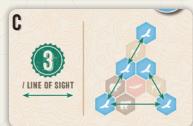
鮭魚:創建成串的板塊來得分。一串板塊即為一組相鄰的鮭魚板塊,其中每個鮭魚不與超過兩個其他鲑魚相鄰。(注意:這意味著一组3個且成三角形的鲑魚板塊可以算作一串,但不能有其他的鮭魚附到這串上)。每串鮭魚不可以有其他鮭魚與其相鄰。卡牌說明:(A)每串根據大小得分,最高得分為7個鮭魚。(B)每串根據大小得分,最高得分為5個鲑魚。(C)每串鮭魚根據大小(3-5個)得分。(D)根據每串鮭魚得分,串中每個鲑魚得1分,且每個相鄰的動物標記得1分(勐物種類沒有關係)。


鷹:散佈到景觀中來得分。每個鷹,每對鷹,鷹之間的視線都可以得分。如圖所示,視線是六邊形之間的直線,如果所有板塊的對稱軸都能在同一條直線上,那麼這樣排列的板塊就構成直線。一條視線只會被另一個鷹打斷(因此,兩個鷹之間如果有鷹,則視線無法穿過)。卡牌說明:(A)根據每個不與任何其他鷹相鄰的鹰得分,數量越多,得分越高。(B)根據每個不與任何其他鷹相鄰且與其他鷹間有直接視線的鷹得分,數量越多,得分越高。(C)每條兩個鷹之間的視線得3分。(注意:同一個鷹可以處於多條視線中)。(D)根據每對鷹之間的不同動物種類的数量(不包括其他膺)得分,種類越多,得分越高。每個鷹只能計入一對中。
狐狸:根據與狐狸相鄰的其它動物得分。狐狸可以單獨或成對得分,每個(或每對)狐狸獨立計分,取決於相鄰棲息地格子中是否滿足條件滿足條件越多,得分越高(單個狐狸為6個相鄰格,一對狐狸為8個相鄰格,如卡牌D所示)。卡牌說明:(A)每個狐狸根據直接與其相鄰的不同動物種類數(包括其他狐狸)得分,種類越多,得分越高。(B)每個狐狸根據直接與其相鄰的不同動物成對數(不包括其他成對狐狸)得分,成對數越多,得分越高。如圖所示,其他成對的動物無需互相相鄰。(C)每個狐狸根據直接與其相鄰的一種動物數(不包括其他狐狸)得分,數量越多,得分越高。只對數量最多的相粼同種動物計分。(D)每對狐狸根據直接與其相鄰的不同動物成對數(不包括其他成對狐狸)得分,成對數越多,得分越高。如圖所示,其他成對的動物無需互相相鄰。
《卡斯卡迪亞之旅》成就
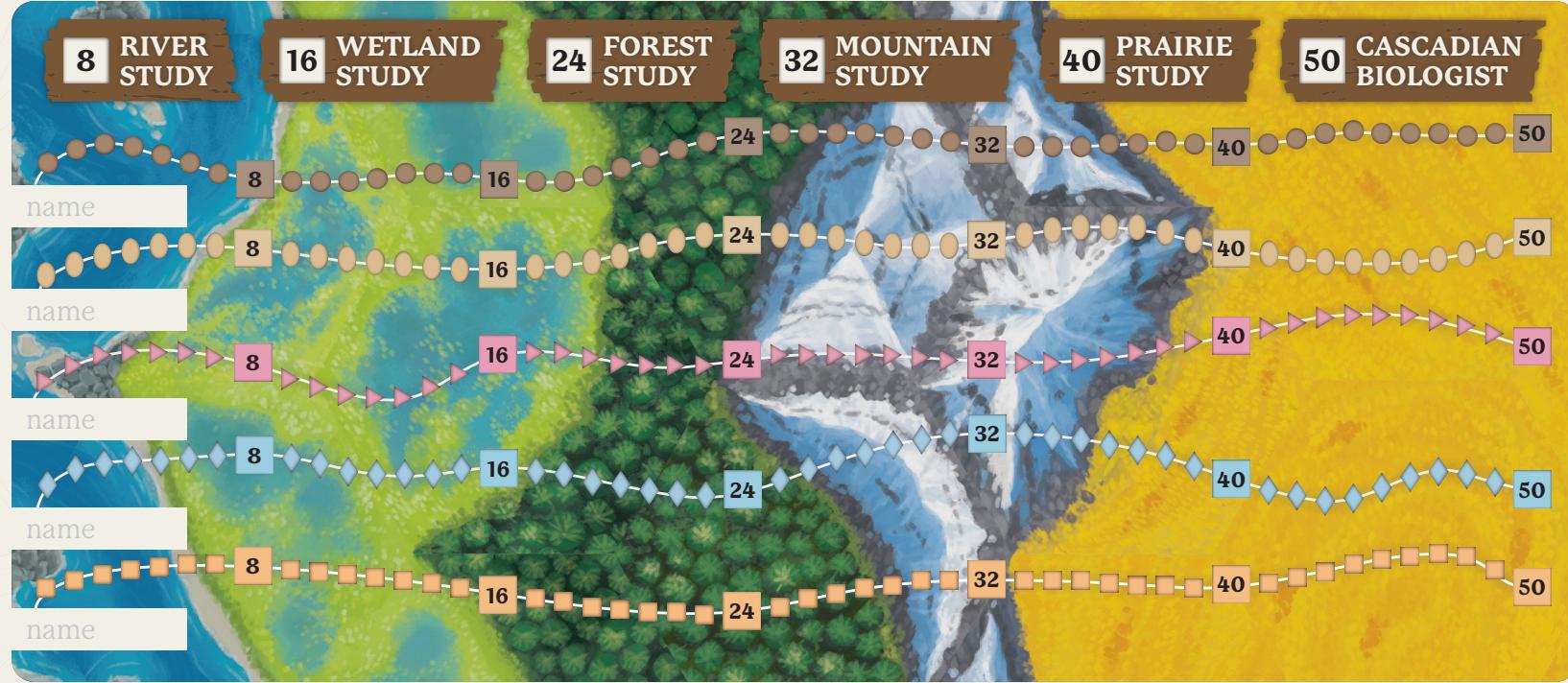
穿越卡斯卡迪亞的自然景觀,成為一名當地的生物學家,同時研究這裡的棲息地和野生動物以獲得成就!單人或多人模式下皆可獲得並記錄你的成就。下方是徒步旅行成就表,最多5名玩家可以在此記錄他們的總進度。你隨時可以開始獲得成就。隨著你獲得成就,在任一颜色的徒步旅行記錄條中寫下你的名字。每次你遊玩時,從3種成就模式中選擇一個:情景(第13頁)、普通遊戲(第14頁)、規則限制(第14頁),然後按照說明進行操作。從現在起,每當你在任意成就模式下獲得成就(),塗滿你在相應模式下的圖形,然後回到本頁,在你的徒步旅行上從左至右塗滿下一個圖形。你能成為卡斯卡迪亞的生物學家嗎?

獲得至少#總分
不#野生動物獲得最高一級得分的次數
每個#棲息地至少獲得#分
每種所示野生動物至少獲得#分
每個所示楼息地至少獲得#分
W#在(W)野生動物或(H)棲息地中獲得#總分
所示的每種野生動物各至少打出#個
不能相鄰放置的野生動物種類
不能相鄰放置的楼息地種類
該種類棲息地上不能放置的野生動物種類
第一種野生動物類型必須與第二種相鄰
种野生動物,每種必須獲得#分
乐智源桌游工作室
成就(情景)
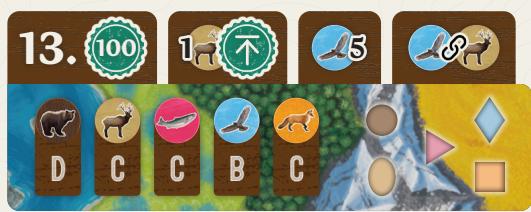
情景模式可以在多人或單人模式下遊玩。每個情景會向你說明使用哪些野生動物計分卡牌,以及通過該情景需完成的1-4個目標。單人遊玩時,我們建議從情景1開始遊玩,情景1至情景15難度逐漸遞增。只有在通過情景時可以塗滿你的成就圖形。多人遊玩時,選擇任意情景。所有成功通過情景的玩家可以塗滿他們的成就圖形。每當你塗滿一個圖形,在成就頁(第12頁)徒步旅行圖上塗滿你的下一個圖形。


成就(普通避戲)
遵循通常規則設置並進行一場多人的《卡斯卡迪亞之旅》遊戲。遊戲獲勝者如達成了成就,在其一列中塗满最多一個成就圖形。每當你塗满一個圖形,在成就頁(第12頁)徒步旅行圖上塗滿你的下一個圖形。
獲得80+分
獲得85+分
獲得90+分
獲得95+分
獲得100+分
獲得105+分
獲得110+分
沒有自然標記剩餘
沒有熊
沒有鹿
沒有鮭魚
沒有鹰
沒有狐狸一種野生動物大於10
赢得3種最大棲息地
所有棲息地獲得5+分
單個樓息地獲得12+分
單個棲息地獲得15+分
每種野生動物獲得10+分
兩種野生動物獲得20+分
單種野生動物獲得30+分
遊戲結束時有5+個自然標記
遊戲結束時有10+個自然標記
沒有完成的原生楼息地
只有3種野生動物
成就(規則限制)
遵循通常规則設置並進行一場多人的《卡斯卡迪亞之旅》遊戲,但添加以下規則限制中的一條。獲勝的玩家在使用的規则限制下塗满其成就圖形。每當你塗滿一個圖形,在成就頁(第12頁)徒步旅行圖上塗滿你的下一個圖形。
1. 放置板塊時,至少一塊楼息地必須匹配。

- 放置板塊時,匹配的棲息地不可以接觸。(注意:本場遊戲忽略楼息地計分)。

3.棲息地計分變化:所有正好為3的棲息地廊道,每個計3分。

4.棲息地計分變化:楼息地廊道的大小必須為5+才能得分。

5.在只顯示三對板塊/標記的情況下遊玩。

6.用兩组野生動物計分卡牌避玩,玩家遗擇其中想要的一组進行計分。

7.不使用起始棲息地板塊。改為開始時,每位玩家的生態區為兩塊随機棲息地板塊。

8.進行自然標記行動時,需要2個自然標記。

9.你不可以在你剛放置的棲息地板塊上放置野生動物標記。

10.在遊玩中才翻開計分卡牌——每位玩家阴始避戲時持有五張野生動物計分卡牌中的一張為手牌(保密),其餘的在桌上翻開。你打出一個自然標記時,翻開你的計分卡牌,正面朝上放置在桌上。


灰熊
灰熊(學名:Ursus arctos horribilis)是北美熊類裡體形最大的,用後腿站立時有8英呎高。灰熊的飲食中约75%通常是漿果、水果和堅果,然而這些雜食動物也很會見機行事,各種各樣的植物和動物皆可入腹。由於人類在灰熊的領土上定居,對其種群數量造成了巨大的影響。儘管某些地區的保護工作成功穩定了灰熊的種群數量,但如今的灰熊數量還不到曾經在這片土地漫步的5%。


羅斯福馬鹿
羅斯福馬鹿(學名:Cervus canadensis roosevelti)是北美地區體形最大的鹿種——他們可以長到10英职長,6英呎高,重量超過1000磅!羅斯福馬鹿是為了紀念美國總統——西奧多·羅斯福而命名,他在1909年建造了奧林匹斯山國家紀念地(現為美國奧林匹克國家公園),為了保護動物及其棲息地。
帝王鮭
帝王鮭(學名:Oncorhynchus tshawytscha)是卡斯卡迪亞地區發現的最大的太平洋鮭魚種。帝王鲑的分佈範圍極其廣泛,遍佈太平洋西北地區,一直到加利福尼亞海岸,西至亞洲,横跨太平洋。人類的定居,尤其是水壩與河道附近的開發,還有過度捕撈,威脅到了許多鮭魚的種群數量。

紅尾鸞
紅尾为(學名:Buteojamaicensis)是北美最普遍的鷹類之一,遍佈卡斯卡迪亞和整個大陸。紅尾篇翼展約為50英寸,是一種“猛禽”,也就是食肉鳥。紅尾鴛會張開雙腿緩慢俯衝攻擊,這與猛撲向獵物的獵鷹不同。

赤狐
赤狐(學名:Vulpes vulpes)是整個北半球分佈最廣的哺乳動物之一。喀斯喀特赤狐是赤狐的一個亞種,生活在喀斯喀特山脈關下的草原和亞高山地區。赤狐是聴明的獵手,幾乎什麼都吃——從小型齧齒動物到鳥類、蛋,甚至昆蟲。
河流
哥倫比亞河是卡斯卡迪亞中最大的河流之一,也可能是最著名的河流!它從不列顛哥倫比亞省的落基山脈源頭蜿蜒而下,直到俄勒岡州阿斯托里亞附近的太平洋。這條河超過1000英里長,其流域是許多鮭魚種群的家,包括帝王鲑、銀大麻哈魚、红大麻哈魚以及北美鱒魚。
濕地
濕地通常被稱為“大自然的腎臟”,因為它們能有效地從水中吸收磷等管養物買,從而淨化水生生態系統。濕地有著豐富的生物多樣性,這意味著它們包含了各種各樣的生物。溼地也是一種高產的地貌,其中暨富的植物能有效地將太陽能轉化為生物質能。
森林
卡斯卡迪亞的森林是世界上最关麗,最具多樣性的森林之一。花旗松主宰了許多原始森林、位於華盛頓奥林匹克半島的霍河溫帶雨林是最潮濕的地方之一,每年的降雨量超過10英尺!森林是極其重要的碳匯,因為樹木含有大量的碳,是减少全球氣候變化的重要環節。
草原
草原指的是空曠而樹木稀少的草原生態系统。在卡斯卡迪亞中,許多草原地區位於更乾旱的區域。草原可能看起來只是長草的平原,但其實卻是地球上最多樣化的地方之一,生活著許多不同的野生動物物種,包括齧商動物、爬行動物、鳥類和許多像狐狸這樣的哺乳動物。
山脈
喀斯喀特山脈從不列顛哥倫比亞省南部一直延伸到加利福尼亞州北部。該山脈中有兩座火山,包括1980年爆發的聖海偷火山,以及非火山的北喀斯喀特山脈。該山脈中的最高峰在雷尼爾山,海拔近15000英尺。雷尼爾山是西雅圖大際線上的一大美景,也是該地區最具標誌性的地理地標之一。

2019年初, Flatout Games打開了創建Flatout Games Colab的大門。Colab為Flatout Games的創始人員提供了一個與桌面遊戲業的傑出人士一起創作美好事物的機會。我們的方法是讓所有人都參與到整個進程來建立最佳的體驗。通過共同的努力與利益,我們力求與每個合作者建立熱情與激情。Colab出版的《卡斯卡迪亞之旅》就是一個所有人都参與進來的“熱情”項目,我們是一個相連的團隊——我們一同承擔風險,一同獲取回報。
CREATING GREAT GAMES, TOGETHER
参與製作《卡斯卡迪亞之旅》的Flatout Games CoLab製作人员:
Randy Flynn - 設計與開發
David Iezzi- 開發
MollyJohnson-藝術指導,行政,開發,市場營銷
Dylan Mangini-平面設計,市場營銷
Robert Melvin-開發,行政,物流
Kevin Russ -平面設計,市場營銷,開發
Shawn Stankewich-項目管理,生產,開發,營銷
插畫- Beth Sobel
單人模式設計 - Shawn Stankewich
情景&成就設計 - Randy Flynn, Robert Melvin, Shawn Stankewich
AEG製作人员:
Nicolas Bongiu-項目總監
David Lepore - 生產
中文製作人员:
中文翻譯:黄嘉粤
中文校對:PeterTargaryen,Shawn
讓我們再次感謝以下朋友們對《卡斯卡迪亞之旅》的測試與支持:
Kalil Alobaidi, Julie Arenivar, Marleen Arenivar, Haley Shae Brown, Brian Chandler, Joseph Z. Chen, Jeremy Davis, Chris Domes, Justin Faulkner, Manuel Fernandez, Jacki Flynn, Ken Grazier, Kevin Grote, Spencer Harris, Ashwin Kamath, Carla Kopp, Emma Larkins, Peter McPherson, Julian Madrid, Chad Martinell, Gavin McGruddy, Aaron Mesburne, Tony Miller, Chris Morris, Robert Newton, Kathryn Nicholls, Eric Nicholls, Sophie Nicholls, Rhys Nicholls, Tom Rorem, Ryan Sanders, Taylor Shuss, Cody Thompson, Samantha Vellucci, Lauren Woolsey, Mark Yuasa, and John Zinser. Arcane Comics, Blue Highway Games, Playtest Northwest, Seattle Area Tabletop Designers, UnPub, and Zephyr Workshop.
所有評論和測試都慷慨地貢獻了時間和才能來試玩《卡斯卡迪亞之旅》,並幫助它與世界分享!
Flatout Games誠摯感謝這些支持者,有了他們的前期幫助,這款遊戲才變為現實:Andrew Amerman, Marleen Arenivar, Gregory Beecher, Justin Bird, Steve Carpenter, Vincent Deloso, Bojan Despotovic, Jacki Flynn, Jim & Pam Flynn, Benjamin Guinane, Michael & Holly Indence, Theresa L. Misenhelter, The Monaghan Family, Dexter Nicholson, Morgan Nicholson, Aaron M Pope, Erik Schick, Jenny & Andy Sletten, Mark Stankewich, Upstart Boardgamer.
LOVE CASCADIA?
PLEASE #CASCADIAGAME
FOLLOW US @FLATOUTGAMES
2505 Anthem Village Dr. Suite E-521
Henderson, NV 89052 USA
All rights reserved.產地中國。
警告:可能有室息的危險!
WWW.FLATOUT.GAMES
下载 MarkdownCascadia-Rules.md39.2 KB
CASCADIA
A puzzly tile-laying and token-drafting game featuring the habitats & wildlife of the Pacific Northwest. Designed by Randy Flynn, for 1-4 players, ages 10+.
About the Region
The Pacific Northwest, alsoreferred to as Cascadia (kas-KAE-Dee-uh), is a geographic region in western North America bounded by the Pacific Ocean to the west and (loosely) by the Rocky Mountains to the east. Though no official boundary exists, the most common conception includes the Canadian province of British Columbia and Yukon Territory as well as the U.S. states of Idaho, Oregon, and Washington.
About the Game
In Cascadia™, players compete to create the most diverse Pacific Northwest environment as they draft Habitat Tiles and Wildlife Tokens to construct a beautiful landscape mosaic. Eachgame of Cascadia™ features unique combinations of scoring objectives linked to each of the five wildlife species. While arranging wildlife into point scoring patterns, players will also be competing to create the largest contiguous habitat corridors. As players build out their environments they must pay careful attention to the habitats they create and the wildlife they populate, with the goal of creating the most harmonious ecosystem in Cascadia™.
About the Team
Most of our team members call Cascadia home! We are avid adventurers and have spent time hiking, cycling, paddling, and exploring in this great region! We were inspired by the great beauty of the habitats and the wildlife of this wonderful area and are excited to share this game, along with some facts about the region,with you and your family and friends! We hope it will inspire you to explore wild places wherever you may be, or consider paying Cascadia a visit!
COMPONENTS
Your game of Cascadia should include the following. If it doesn't, please go to https://alderac.com/customer-service

85 Habitat Tiles including 25 Keystone Tiles (Mountains, Forests, Prairies,Wetlands, Rivers)

100 Wildlife Tokens (20 Bear, 20 Elk, 20 Salmon, 20 Hawk, 20 Fox)

25 Nature Tokens (Cones from the mighty Douglas Fir)
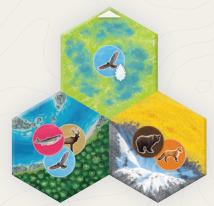
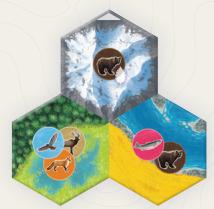
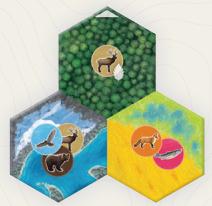
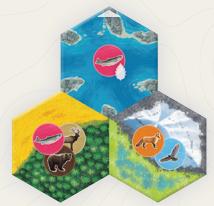
5 Starter Habitat Tiles
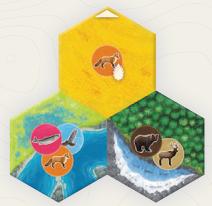

21 Wildlife Scoring Cards (4 Bear, 4 Elk, 4 Salmon, 4 Hawk, 4 Fox, 1 Family/Intermediate)

1 Cloth Bag (For Wildlife Tokens)
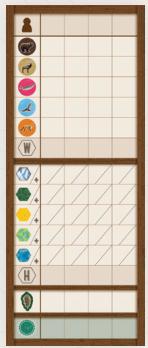
1 Scorepad
SETUP
1Place all Wildlife Tokens in the Cloth Bag and shuffle/shake them well.
2 Using the chart below, determine how many Habitat Tiles you need, based on the number of players. Randomly select these tiles. Do not look at the tiles you include or exclude. For solo mode setup, please see page 10.
88: 43 (or remove 42) 888: 63 (or remove 22) (Note: This is 20 per player, plus 3) 8888: 83 (or remove 2)
Shuffle these tiles and stack them face down (any number of stacks) within easy reach of all players.
Place any excluded Habitat Tiles back into the box, they will not be used this game.
3 Randomlyselect 1 Wildlife Scoring Card for each of the five wildlife, then place those five cards in the center of the playarea within easy view of all players. Put the other Wildlife Scoring Cards back in the box. (For your first game we recommend using the Wildlife Scoring Cards shown - these arethe cards with ‘A' in the bottom right corner).
4 t d s plae placing it face-up in front of them. Place the
5 Reveal 4 Habitat Tiles from the face-down stacks and place them face-up in the center of the play area within easy reach of all players.
6 Dom 4 bin to of tm td toth ag and pair them, in order, with eac of the 4 Habitat Tiles to
7Place the Nature Tokens within easy reach of all players.
8TOrp widiein e ga will e he frst layer.

GAMEPLAYOVERVIEW
Beginning with the starting player and proceeding clockwise around the table, players will take turns drafting Habitat Tiles and Wildlife Tokens and adding them into their expanding environment, until the end of the game.
On each turn, a player will select a Habitat Tile and Wildlife Token combination and play them into their environment. (Note: An environment is thefull arrangement of tiles and tokens in front of each player that includes their Starter Habitat Tile).At the end of each player's turn, both the Habitat Tile and Wiidlife Token selected will be replaced withnew ones from the Habitat Tile stacks and Cloth Bag, respectively.
The game ends when there are no more Habitat Tiles available to replace one selected by a player. (Note: each player will play exactly 20 turns). Then the game will proceed to final scoring and the player with the most points will be the winner!
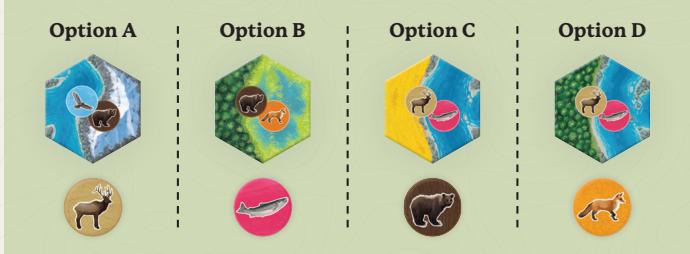
TURN SUMMARY
1Select a Habitat Tile and Wildlife Token
At the beginning of each turn there will be four Habitat Tiles and four Wildlife Tokens in the center of the play area. The Habitat Tiles and Wildlife Tokens will be arranged in four distinct combinations, each with one Habitat Tile and one Wildlife Token-providing four choices.
Before you make a selection, check to see if anyof the wildlife are overpopulated:
If all 4 of the available Wildlife Tokens are the same, they are automatically wiped.
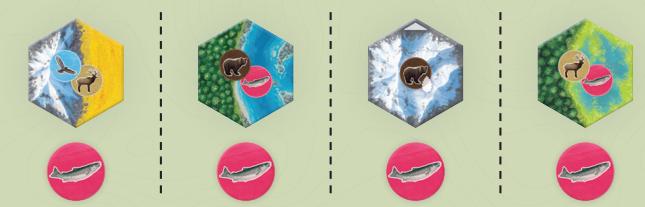
Automatically wipe Wildlife Tokens
Take all 4 tokens and place them aside. Then,oneat-a-time, draw 4 new tokens from the Cloth Bag and pair each one, in order, with a Habitat Tile. (Note: this could happen multiple times on any given player's turn).
If 3 of the available Wildlife Tokens are the same, then the active player may choose to wipe these tokens.
Overpopulation: 3 of the same Wildlife Token

Active player may choose to wipe the 3 Wildlife Tokens
Take only those 3 tokens and place them aside. Then, one-at-a-time, draw 3 new tokens from the Cloth Bag and pair each one, in order, with a Habitat Tile. (Note: You may only do this once per turn).
Once all overpopulations have been resolved, place any wiped tokens back into the Cloth Bag.
You will now select one Habitat Tile + Wildlife Token combination. Typically, you must take an existing combination. However, before you do, you may optionally spend a Nature Token to do one of the following:
-
Take ANY one of the four Habitat Tiles and ANY one of the four Wildlife Tokens.
-
Wipe ANY number of Wildlife Tokens and replace them. (See overpopulation rules on this page for replacement process).
The spent Nature Token is placed back into the supply. There is no limit to the number of Nature Tokens you may spend on your turn. If you do not have any remaining Nature Tokens, you must take an existing combination.
2 Place the Tile and Token into Your Environment

Once you have selected your Habitat Tile and Wildlife Token, you will place them into your environment in any order.
The Habitat Tile must be placed into your environment according to the following placement rules:

A. The Habitat Tile must be placed adjacent to any Habitat Tile already in your environment, that is, the Habitat Tile must touch at least one side of another previously placed tile, or the Starter Habitat Tile.
B. The Habitat Tile may not be placed on top of another Habitat Tile nor can any other Habitat Tile be moved.
(Note: Matching terrain is not a placement rule but may gain you points during end game scoring).
The Wildlife Token may be placed onto a single Habitat Tile according to the following placement rules:

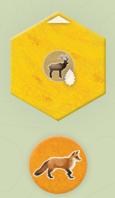
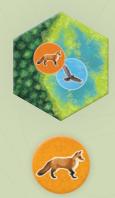
There are 2 possible Habitat Tiles where this fox could be placed
A. The Habitat Tile must not already have a Wildlife Token on it.
(Note: this means you will only ever have, at most, one Wildlife Token per Habitat Tile).
B. The Habitat Tile must show the matchingwildlife (tiles display 1-3 options on them).
If you cannot legally place the Wildlife Token because no open Habitat Tile can support that wildlife, or if you choose not to place the Wildlife Token, return the token to the Cloth Bag.
You may place the Wildlife Token onto the Habitat Tile you just selected on your current turn,or you may place it onto any other available Habitat Tile.
If you place your Wildlife Token onto a Keystone Tile, take a Nature Token. (See Tile Overview on page 8).
After you have placed thetile and token you selected, replace each one in the center of the play area. The Habitat Tile is replaced from the top of any face-down stack. The Wildlife Token is replaced by randomly selecting one from the Cloth Bag.
Note: when replacing tiles and tokens in the play area, do notmove the existing tiles and tokens. Simply refill the empty spots.
Your turn is now complete. Play passes clockwise to the next player.
Tile Overview
Each Habitat Tile has one or two types of terrain and one, two, or three options for Wildlife Tokens.
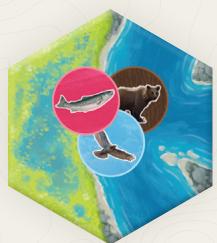
This tile has wetlands and rivers. You can place a salmon, bear or hawk on this tile.
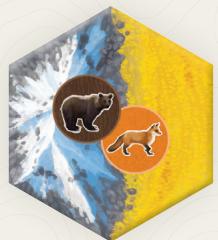
This tile has mountains and prairies. You can place a bear or fox on this tile.

This tile is a Keystone Tile .Whenever you place the matching Wildlife Token onto a Keystone Tile, you gain a Nature Token.
On your turn, before you select a tile and token, you may spend a Nature Token to do one of the following:
-
Take ANYone of the four Habitat Tiles and ANY one of the four Wildlife Tokens.
-
Wipe any number of Wildlife Tokens and replace them. (See overpopulation rules p.6 for replacement process).
There is no limit to the number of Nature Tokens you may spend on your turn.
At the end of the game, any Nature Tokens you still have are worth l point.
END GAME &SCORING
If, at the end of any player'sturn, there are no face-down Habitat Tiles left in the stacks to replace the one taken, the game ends immediately and scores are tallied. (Note: each player will play exactly 20 turns).
Record scores on the Scorepad for the following:
-
Wildlife Scoring Cards
-
Habitat Tile Corridors
-
Habitat Tile Corridor Majorities
-
Nature Tokens
1. Wildlife Scoring Cards
For each player, score each Wildlife based on the Wildlife Scoring Cards used in the game. (See Wildlife Scoring Card details on page ll).
2. Habitat Tile Corridors
For each player, score l point per Habitat Tile in their largest contiguous habitat corridor (group of a connected habitat type) in each of the 5 habitats (Mountains, Forests, Prairies, Wetlands,Rivers).
Tiles are included in a contiguous habitat corridor if they share at least one matching edge of the six edges of the tile.
(Record these points in the top left section of the corresponding box on the Scorepad for the habitat and player in question).
Example:
If you had a group of 3 Forests and a group of 4 Forests, you would gain 4 points because 4 is your largest Forest group.
3. Habitat Tile Corridor Majorities
According to player count, score bonus points for having the LARGEST contiguous habitat corridor for each of the 5 habitat types. (Use the numbers recorded on the Scorepad from step 2 to determine who gainsbonus points. Record bonus points in the bottom right corner of the corresponding box for the habitat type and player in question).
Solo game: 2 point bonus for each habitat type with a group size of 7 or more.
2-player game: 2 point bonus to the playerwiththe largest habitat corridor in each of the habitat types. If tied, 1 bonus point each. No bonus points for second largest.
3/4-player game: 3 point bonus to the player with the largest habitat corridor in each of the habitat types. 1 point bonus for the second largest. If two players tie for largest, 2 points each, no points for nextlargest. If three or four players tie for largest, 1 point each, no pointsfor next largest. Any ties for second largest, O points each.


4. Nature Tokens
For each player, score l point for each unused Nature Token.
Finally, tally all points and the player with the most points wins! In the case of a tie, the player with the most Nature Tokens wins. If still tied, they share the victory.

Two pairs of bears for 11 points
A line of two elk and line of three elk for (5+9) 14 points
Run of 4 salmon for 12 points Four hawks for 11 points
Three foxes for(3+5+3) 11 points
Six connected mountains for 6 points which was tied with Ash, so a bonus 2 points
Four connected forests for 4 points which was a three-way tie, so a bonus 1 point
Seven connected prairies for 7 points which was less than Ash, so a bonus 1 point

Eight connected wetlands for 8points which was more than Lee or Ash, so a bonus 3 points
Five connected rivers for 5 points which was the least, so no bonus points
Two unused Nature Tokens for 2 points
SOLOMODE
Setup: Follow the setup for a 2-player game with the following exceptions: only give yourself a Starter Habitat Tile and place the stacks of Habitat Tiles to the left side of the play area.
Turn Summary: Follow a turn as usual, but before you replace the Habitat Tile and Wildlife Token in the display, discard the tileand token furthest from the draw stacks, then slide the remaining two tiles and two tokens away from the draw stacks. The discarded tileandtoken are removed from the game. Then, draw two new Habitat Tiles and two new Wildlife Tokens and place them in the display as usual.
Turn Example:
On your turn you spend a Nature Token so you can take the Keystone Tile and thematching Elk Wildlife Token.

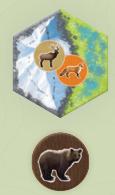
After you have placed the tile and token into your environment, discard the tile and token furthest from thedraw stacks (The Mountains-Wetlands tile and the Bear token are removed from the game).

Slide the remaining two Habitat Tiles and two Wildlife Tokens away from the stacks, creating two pairs (if not already paired). Then refill the empty spaces in the display as usual.

End Game & Scoring: The game
ends the same way as a multiplayer game (Note: you will play exactly 20turns). Go through End Game & Scoring on pages 8-9. For single games, use this chart and compare your score. For the full Cascadia Solo Mode experience, try the Scenarios on page 13.
| 60+ | A good start! |
| 70+ | You're getting it! |
| 80+ | Very Good! |
| 90+ | Excellent! |
| 100+ | Elite! |
| 110+ | Ascended!! |
VARIANTS
FAMILY VARIANT
Setup: The Family Variant setup is the same as the standard game except, for step 3, use ONLY the Family Variant Wildlife Scoring Card.
Turn Summary: No changes (see Turn Summary on pages 6-7).
End Game & Scoring: Follow scoring on pages 8-9 but you may choose to skip step 3 depending on if you want majority scoring. The highest score wins!

Family Variant Scoring Card
Score points shown for each group of the same wildlife, depending on group size. Groups may be in any shape.
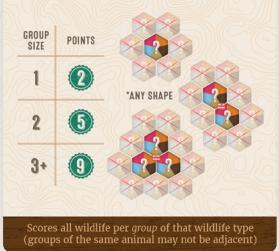
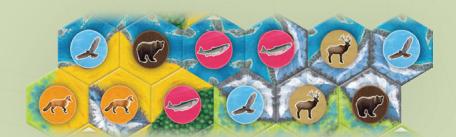
Example above is a group of three Salmon, a group of two Foxes, a group of two Elk, two single Bears, and three single Hawks.
INTERMEDIATE VARIANT
The Intermediate Variant plays the same as the Family Variant but use the Intermediate Variant Wildlife Scoring Card which has different scoring for different sized groups.
WILDLIFE SCORINGCARDS


BEARS score for creating groups of bears of various sizes. In each case, bear groups may be inany shape or orientation, but two groups may not be placed next to one another. Each group must contain the exact number of bears shownon the scoring card, in order to score. Card clarifications: (A) Score an increasing number of points, based on the total number of pairs of bears. (B) Score 10 points for each group of exactly three bears. (C) Score for each group of bears l-3 in size, and awards a bonus of 3 points for having one of each of the3 group sizes. (D) Score for each group of bears 2-4 in size.

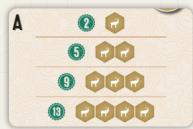
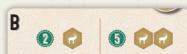


ELK score for creating groups of elk. Most elk cards require the groups to be in the exact shape/formation pictured on the card. Unlike bears, elk groups may be placed next to one another, but each elk may only score once, for a single group/formation. When scoring elk groups that are connected, always score the groups based on the interpretation that would result in the largest number of points. Card clarifications: (A) Score for groups in straight lines. Straight lines, as pictured, must be connected from flat side to flat side of the hexagons, in any orientation. (B) Score for groups in the exact shapes shown, in any orientation.

D
(C) Score for each contiguous group of elk, an increasing number of points, based on size. These groups may be of any shape or size. (D) Groups must be in a circular formation, as pictured.



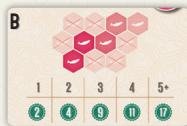
SALMON score for creating runs of salmon. A run is defined as a group of adjacent salmon, where each salmon is adjacent to no more than two other salmon. (Note: This means that a group of 3 salmon in a triangle shape may count as a run, but no other salmon may be attached to this run). Each run of salmon may not have any other salmon adjacent to it. Card clarifications: (A) Score for each run, based on size, up to a maximum size of 7. (B) Score for each run, based on size, up to a maximum size of 5. (C) Score for each run, based on size, between 3 and 5. (D) Score for each run of salmon, one point for each salmon in the run, plus one point for each adjacent animal token (type of animal does not matter).


HAWKS score for spreading out over the landscape. Hawks can score for either each hawk, each pair of hawks, or for lines of sight between hawks. A line of sight is a straight line from flat side to flat side of the hexagons, as pictured. A line of sight is only interrupted by the presence of another hawk (therefore, line of sight may not cross from one hawk to another, through a hawk). Card clarifications: (A) Score an increasing number of points for each hawk that is not adjacent to any other hawk. (B) Scorean increasing number of points for each hawk that is not adjacent to any other hawk, and also has a direct line of sight to another hawk. (C) Score 3 points for each line of sight between two hawks. (Note: multiple lines of sight may involve the same hawk). (D) Score for each pair of hawks, an increasing number of points based on the number of unique animal types between them (not including other hawks). Each hawk may only be part of one pair.
FOXES score for adjacencies to other animals. Foxes score either individually or in pairs, and each fox or fox pair is independently scored, with an increasing number of points, depending on whether conditions are met in any of the adjacent habitat spaces (6 in the case of a single fox, 8 in the case of a fox pair in Card D). Card clarifications: (A) Score for each fox, an increasing number of points based on the number of unique animal types (including other foxes) directly adjacent to it. (B) Score for each fox, an increasing number of points based on the number of unique animal pairs (not including other fox pairs) directly adjacent to it. As pictured, pairs of other animals do not need to be adjacent to each other. (C) Score for each fox, an increasing number of points based on the number of similar animals (not including other foxes) directly adjacent to it. Only score the most abundant adjacent animal type. (D) Score for each fox pair, an increasing number of points based on the number of unique animal pairs (not including other fox pairs) directly adjacent to it. As pictured, pairs of other animals do not need to be adjacent to each other.
CASCADIA ACHIEVEMENTS
Study the Cascadian habitats and wildlife to gain Achievements as you hike your way through the landscape to become a Cascadian biologist! Cascadia Achievements can be earned and tracked as you play multi-player & solo games. Below is the Achievements hiking chart where up to 5 players can keep track of their overall progress. You may begin gaining Achievements at any time. To do so, write your name below any of the colored hiking tracks. Each time you play, choose one of the three Achievement modes: Scenarios (page 13), Normal Game (page 14), or Rule Restrictions (page 14) and follow the instructions. From now on, whenever you gain an Achievement (■) from any of the Achievement modes, fill in your shape under the appropriate mode and then come back to this page and fill in the next shape on your hike from left to right. Can you become a Cascadian biologist?
# Fully score Wildlife # of times
Score at least # points per any # Habitats
Score at least # points in each Wildlife shown
Score at least # points per Habitat shown
W#Score # total points in (W)ildlife or (H)abitat
Play at least # of each Wildlife shown
Wildlife types cannot be placed next to one another
Habitat types cannot be placed next to one another
Wildlife type cannot be placed on Habitat type
1st Wildlife type must be adjacent to 2nd Wildlife type
Score at least # points per any # Wildlife





ACHIEVEMENTS (Scenarios)
Scenarios can be played in multi-player or solo mode. Each of the scenarios will show you which Wildlife Scoring Cards to use and l-4 objectives that must all be completed to pass the scenario. When playing solo, we suggest starting with scenario l and working your way up to 15 as they get progressively more difficult. You may only fill in your Achievement shape when you pass the scenario. When playing multi-player, choose any scenario. All players who successfully pass the scenario may fill in their Achievement shape. Whenever you fill in a shape, fill in the next shape on your trail on the Achievement hiking map (page 12)



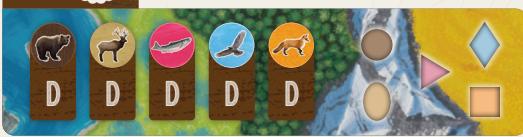









ACHIEVEMENTS (Normal Game)
Set up and play a multi-player game of Cascadia using the normal rules. The winner of the game will fill in a maximum of one Achievement shape in their column if an Achievement was earned. Whenever you fill in a shape, fill in the next shape on your trail on the Achievement hiking map (page l2).
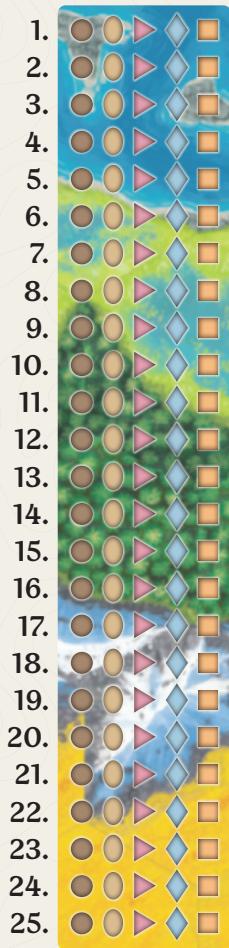
Score 80+ Points
Score 85+ Points
Score 90+ Points
Score 95+ Points
Score 100+ Points
Score 105+ Points
Score 110+ Points
Have no Nature Tokens Left
Have no Bears
Have no Elk
Have no Salmon
Have no Hawks
Have no Foxes
Have more than 10 of a single Wildlife
Win Majority for 3 Habitats
Score 5+ Points for all Habitats
Score 12+ Points for a single Habitat
Score 15+ Points from a single Habitat
Score 10+ Points for each Wildlife
Score 20+ Points for two Wildlife
Score 30+ Points for a single Wildlife
End the game with 5+ Nature Tokens
End the game with 10+ Nature Tokens
Have nocompleted Keystone Habitats
Only have 3 types of Wildlife
ACHIEVEMENTS (Rule Restrictions)
Set up and play amulti-player game of Cascadia following the normal rules with one rule restriction from the list to the right. The winner of the game will fill in their Achievement shape under the rule restriction that was used. Whenever you fill in a shape, fill in the next shape on your trail on the Achievement hiking map (page 12).
- At least one Habitat must match when placing tiles.

- No matching Habitats may touch when placing tiles.
(Note: ignore Habitat scoring this game).

- Habitat Scoring change: All Habitat corridors of exactly three count for 3 points each.

- Habitat Scoring change: Habitat corridors must be
5+ in size to score.

- Play with a display of only three pairs of tiles/ tokens.

- Play with two sets of Wildlife Scoring Cards - players each choose which of the two they wish to score.

- Do not use Starter Habitat Tiles. Instead, each player's environment starts with two random Habitat Tiles.

- Two Nature Tokens are required to take a Nature Token Action.

- You may not place the Wildlife Token on the Habitat Tile you just placed.

- Play with revealing scoring cards - each player starts the game with one of the five Wildlife Scoring Cards in their hand (secret), and any remaining are public on the table. When you play a nature token, reveal your scoring card by placing it face-up on the table.


GRIZZLY BEAR
The Grizzly Bear (Ursus arctos horribilis) is the largest of the North American bear species and can tower 8 ft tall when standing on their hind legs. About 75% of a Grizzly's diet is typically berries, fruits, and nuts, however, they are opportunistic omnivores, meaning they will eat a variety of plants and animals. Grizzly populations have been massively impacted by human settlement of their territories. Although conservation efforts have been successful at stabilizing populations in some areas, the number of Grizzlies now is less than 5% of the number that used to roam the land.

ROOSEVELT ELK
The Roosevelt Elk (Cervus canadensis roosevelti) is the largest species of elk in the region - they can grow to be 10 ft long and around 6 ft tall, and weigh over 1,000 lbs! The Roosevelt Elk was named after president Theodore Roosevelt, who established the Mount Olympus National Monument (now Olympic National Park) in 1909, in order to protect the animals and their habitat.

CHINOOK SALMON
The Chinook Salmon (Oncorhynchus tshawytscha) is the largest of the Pacific Salmon species found in Cascadia. Chinook Salmon have an incredibly large range and can be found throughout the Pacific Northwest, all the way down the coast of California and as far west as Asia, across the Pacific Ocean. Many salmon populations are threatened by human settlement, especially by dams and development in and near waterways, as well as overfishing.

RED-TAILED HAWK
The Red-Tailed Hawk (Buteo jamaicensis) is one of North America's most common bird species. It can be found throughout Cascadia, as well as throughout the continent. Its wingspan is about 50 inches. Red-tailed Hawks are raptors', or birds of prey, and they attack with a slow dive with their legs outstretched, which is different from a falcon, which swoops towards its prey.

RED FOX
The Red Fox (Vulpes vulpes) is one of the most widespread mammals in the entire northern hemisphere. The Cascade Red Fox is a subspecies of red fox that is found in the prairies and subalpine areas at the foot of the Cascade Mountains. Red foxes are clever hunters that will eat just about anything - from small rodents to birds, eggs, and even insects.
RIVERS
The Columbia is one of the largest, and perhaps most wellknown rivers in all of Cascadia! It winds its way from headwaters in the Rocky Mountains of British Columbia all the way to meet the Pacific Ocean near Astoria, Oregon. The river is over 1,000 miles long and its basin is home to many species of salmon, including the Chinook, Coho, Sockeye, and Steelhead.
WETLANDS
Wetlands are often referred to as Nature's Kidneys' because they are so effective at cleaning aquatic ecosystems by pulling nutrients like phosphorus out of water. Wetlands are extremely biodiverse, meaning they contain a wide variety of life. They are also highly productive landscapes, since their abundant plant life effectively converts the sun's energy into biomass.
FORESTS
The forests of Cascadia are some of the most beautiful and diverse in the entire world. The Douglas Fir is the dominant species in many of the old-growth forests. The Hoh Rainforest located on Washington's Olympic Peninsula is one of the wettest places, receiving over 10 feet of rain each year! Forests are extremely important carbon sinks, as trees hold large amounts of carbon and are important links in reducing global climate change.
PRAIRIES
Prairies are grassland ecosystems that are often open with sparse tree cover. In Cascadia, many of the prairie areas are found in the more arid, high desert parts of the region. Prairies might seem like they are just grassy plains, but they are some of the most diverse places on earth, supporting many different wildlife species including rodents, reptiles, birds, and many mammals like foxes.
MOUNTAINS
The Cascade Range stretches from southern British Columbia all the way to Northern California. The range features both volcanic mountains, like Mt. St. Helen's which erupted in 1980, and non-volcanic mountains like the North Cascades. The highest peak in the range is Mt. Rainier which towers nearly 15,000 feet above sea level. Mt. Rainier is a major feature on the Seattle skyline, and is one of the most iconic geographic landmarks in the region.

In early 2019, Flatout Games opened its doors to create the Flatout Games CoLab. The CoLab is an opportunity for the founding members of Flatout Games to team up with awesome folks in the board game industry and make cool things together. Our approach is to build the best possible experiences by involving everyone in the entire process. We strive to build passion and excitement in each of our collaborators through shared efforts and shared profits. This CoLab publication of Cascadia is a passion project for everyone involved, and we are all part of an interconnected team - we take risks and are rewarded together.
CREATING GREAT GAMES, TOGETHER
The Flatout Games CoLab for Cascadia is:
Randy Flynn - design, development
David Iezzi - development
Molly Johnson - art direction, administration, development, marketing
Dylan Mangini- graphic design, marketing
Robert Melvin - development, administration, logistics
Kevin Russ - graphic design, marketing, development
Shawn Stankewich - project management, production, development, marketing
Illustration - Beth Sobel
Solo Mode Design - Shawn Stankewich
Scenario &Achievements Design - Randy Flynn, Robert Melvin, Shawn Stankewich
AEG Credits:
Nicolas Bongiu - director of projects
David Lepore - production
We would like to thank these friends for their playtesting and support of Cascadia:
Kalil Alobaidi, Julie Arenivar, Marleen Arenivar, Haley Shae Brown, Brian Chandler, Joseph Z. Chen, Jeremy Davis, Chris Domes, Justin Faulkner, Manuel Fernandez, Jacki Flynn, Ken Grazier,Kevin Grote, Spencer Harris, Ashwin Kamath, Carla Kopp, Emma Larkins, Peter McPherson, Julian Madrid, Chad Martinell, Gavin McGruddy, Aaron Mesburne, Tony Miller, Chris Morris, Robert Newton, Kathryn Nicholls, Eric Nicholls, Sophie Nicholls, Rhys Nicholls, Tom Rorem, Ryan Sanders, Taylor Shuss, Cody Thompson, Samantha Vellucci, Lauren Woolsey, Mark Yuasa, and John Zinser. Arcane Comics, Blue Highway Games, Playtest Northwest, Seattle Area Tabletop Designers, UnPub, and Zephyr Workshop,
All of the reviewers and previewers who graciously offered their time and talents to try out Cascadia and to help share it with the world!
Flatout Games would like to express immensegratitude to these Cascadia Founders whose early support helped make this game possible: Andrew Amerman, Marleen Arenivar, Gregory Beecher, Justin Bird, Steve Carpenter, Vincent Deloso, Bojan Despotovic, Jacki Flynn, Jim & Pam Flynn, Benjamin Guinane, Michael & Holly Indence, Theresa L. Misenhelter, The Monaghan Family, Dexter Nicholson, Morgan Nicholson, Aaron M Pope, Erik Schick, Jenny & Andy Sletten, Mark Stankewich, Upstart Boardgamer.
LOVE CASCADIA? PLEASE #CASCADIAGAME
FOLLOW US @FLATOUTGAMES
WWW.FLATOUT.GAMES

CE
下载 Markdown简繁检索对照.md1.6 KB
060_295947_cascadia — 简体/繁体检索对照
本游戏的规则书是繁体中文原文。用户用简体提问时,把关键词按下面这张表转成繁体再去 grep 原文,命中率最高。
回答时用简体或繁体都可以,但引用的原文保持繁体。
简体 → 繁体 对照(按该游戏原文出现频率排序,共 60 字)
| 简体 | 繁体 | 原文出现次数 |
|---|---|---|
| 块 | 塊 | 175 |
| 个 | 個 | 121 |
| 动 | 動 | 103 |
| 记 | 記 | 102 |
| 标 | 標 | 95 |
| 栖 | 棲 | 75 |
| 游 | 遊 | 65 |
| 戏 | 戲 | 65 |
| 计 | 計 | 54 |
| 种 | 種 | 51 |
| 获 | 獲 | 48 |
| 为 | 為 | 39 |
| 与 | 與 | 38 |
| 对 | 對 | 36 |
| 区 | 區 | 35 |
| 将 | 將 | 34 |
| 时 | 時 | 34 |
| 数 | 數 | 34 |
| 亚 | 亞 | 32 |
| 这 | 這 | 31 |
| 组 | 組 | 27 |
| 进 | 進 | 26 |
| 鱼 | 魚 | 25 |
| 并 | 並 | 25 |
| 图 | 圖 | 24 |
| 们 | 們 | 24 |
| 选 | 選 | 23 |
| 鹰 | 鷹 | 22 |
| 类 | 類 | 21 |
| 鲑 | 鮭 | 21 |
| 据 | 據 | 21 |
| 页 | 頁 | 20 |
| 邻 | 鄰 | 20 |
| 过 | 過 | 19 |
| 从 | 從 | 19 |
| 开 | 開 | 19 |
| 会 | 會 | 18 |
| 单 | 單 | 18 |
| 变 | 變 | 18 |
| 体 | 體 | 17 |
| 来 | 來 | 16 |
| 态 | 態 | 16 |
| 两 | 兩 | 16 |
| 须 | 須 | 15 |
| 于 | 於 | 14 |
| 脉 | 脈 | 14 |
| 该 | 該 | 14 |
| 补 | 補 | 14 |
| 没 | 沒 | 14 |
| 结 | 結 | 14 |
| 线 | 線 | 14 |
| 规 | 規 | 13 |
| 连 | 連 | 13 |
| 发 | 發 | 13 |
| 后 | 後 | 13 |
| 张 | 張 | 12 |
| 则 | 則 | 12 |
| 涂 | 塗 | 12 |
| 择 | 擇 | 11 |
| 条 | 條 | 11 |
原文为社区整理/出版社公开资料,版权归原作者,仅供个人学习查阅。